Niger builds relationships with overseas uranium partners
WNN, 16 December 2025
Niger’s state-owned Timersoi National Uranium Company has signed an agreement with Russian company Uranium One Group to cooperate in uranium mining and eventually open new mines. Meanwhile, Global Atomic Corporation remains upbeat about the prospects for securing financing for the Dasa uranium project – although first uranium shipments could now be delayed.
The Memorandum of Cooperation signed on 9 December by the Timersoi National Uranium Company (TNUC) and Uranium One Group – part of the Rosatom State Corporation group of companies – is expected to make a significant contribution to strengthening the Russia-Niger partnership in the energy sector, Uranium One said.
Under the agreement, the two companies plan to “obtain the necessary permits, conduct geological exploration of prospective deposits, and ultimately establish new uranium mining operations at those sites
Niger has produced uranium commercially since 1971, in operations closely linked with French companies. But that changed following the overthrow of the government in a military coup in July 2023, which saw the revoking of mining permits held by French company Orano at Imouraren and Canadian company GoviEx Uranium at Madaouela. However, Toronto-headquartered Global Atomic has continued to develop the high-grade Dasa deposit, apparently with the support of the Niger government………………………………………………………………………………………. https://www.world-nuclear-news.org/articles/niger-builds-relationships-with-overseas-uranium-partners
Russia outsmarts France with nuclear power move in Niger
BBC, Paul Melly, West Africa analyst, 26 Aug 25
Russia has dangled the possibility of building a nuclear power plant in uranium-rich Niger – a vast, arid state on the edge of the Sahara desert that has to import most of its electricity.
It may be deemed impractical and may never happen, but the concept is yet another move by Moscow to seek a geopolitical advantage over Western nations.
Niger has historically exported the metal for further refining in France, but that is changing as the military-led country cuts off ties with the former colonial power.
The uranium-mining operation operated by French nuclear group Orano was nationalised in June, which cleared the way for Russia to put itself forward as a new partner.
It is talking about power generation and medical applications, with a focus on training local expertise under a co-operation agreement signed between Russian-state corporation Rosatom and the Nigerien authorities.
If ever brought to fruition this would be the first nuclear power project in West Africa.
Beyond initial discussions, it is unclear how far down this road things will progress. But already, with this first move, Moscow has shown that it grasps the depth of local frustrations.
For more than five decades Orano – which until 2018 was known as Areva – mined Niger’s uranium, to supply the nuclear power sector that is at the heart of France’s energy strategy.
The French government-owned company now gets most of its supplies from Canada and Kazakhstan and has projects in development in Mongolia and Uzbekistan.
But the Nigerien connection remained significant and freighted with a degree of political and perhaps even cultural weight.
Yet Paris did not share its nuclear energy knowhow with its loyal African supplier. Niger, meanwhile, has to rely largely on coal-fired generation and imports of electricity from Nigeria.
But now, the rupture in relations between Niger’s junta and France has allowed Moscow to offer the hope, however distant, of a nuclear future, something that Areva/Orano, over so many years of local operation, had failed to do.
“Our task is not simply to participate in uranium mining. We must create an entire system for the development of peaceful atomic energy in Niger,” Russian Energy Minister Sergei Tsivilev declared on 28 July during a visit to Niamey.
Naturally, this is not entirely altruistic. There are economic benefits for Russia and it is part of a broader push to displace Western influence from the Sahel region.
The Russians could get the chance to develop the mine in Imouraren, one of the world’s largest uranium deposits……………………………………………………………………………….
Building a nuclear plant can take years and such projects require a huge amount of capital investment, and once operational they need a large and secure power supply.
Furthermore, viability depends on the availability of industrial and domestic consumers who can afford the price of the power being generated.
There are also questions over whether a nuclear power plant could be safely built and protected in today’s fragile and violent Sahel region. Jihadist armed groups control large areas of terrain in Mali and Burkina Faso, and parts of western Niger which makes the area highly insecure.
Given the time, the costs and the complications of developing the nuclear sector in Niger, this remains a distant prospect…………………………………………………………………
the junta in power today now seems determined to bring the era of French uranium mining in Niger to an end, with one official telling the Paris newspaper Le Monde that Orano had been “stuffing itself with our country’s natural resources”.
Who can say what Moscow’s proposals for nuclear scientific partnership and perhaps even power generation will ever amount to in concrete terms?
But one thing is clear, in Niger it is the Russians who have correctly read the political mood. https://www.bbc.com/news/articles/c5y23lvm05no
Niger to nationalise uranium project co-owned with France’s Orano
Niger has said it will nationalise a large uranium project it jointly owns
with French nuclear fuel producer Orano, in a significant escalation of the
tensions between the west African country’s military government and the
state-owned company. The plan was announced on the state broadcaster late
on Thursday, after ministers adopted a draft resolution transferring
complete ownership of the Somair project to the government in Niamey. Orano
owns just over 63 per cent of Somair and Niger’s state-run Sopamin holds
the rest.
FT 20th June 2025,
https://www.ft.com/content/a0f40288-f932-409a-bc98-eb8e05b43086
French nuclear company Orano explores sale of Niger uranium assets
French state-owned nuclear fuel company Orano is exploring the sale of its
uranium assets in Niger after the breakdown of its relationship with the
west African country’s military rulers. Orano operates three mines in
Niger in a joint venture with the Russian-backed government that seized
power in a coup two years ago, but was stripped of its rights over one
project in June and forced to stop work at another soon after because of
financial pressures. It said at the time that Niger had blocked uranium
exports and halted payments of its obligations as joint venture partners
since the 2023 coup that toppled the country’s pro-western government.
This has forced Orano to look at a possible sale of its Niger assets,
according to multiple people familiar with the matter.
FT 18th May 2025
https://www.ft.com/content/e0d5c62f-3794-4148-95e2-31deecbc7717
Nuclear company Orano seeks arbitration over Niger mining licence
World Nuclear News 20th Dec 2024, https://www.world-nuclear-news.org/articles/orano-seeks-arbitration-over-niger-mining-licence
The French company has opened international arbitration proceedings against the State of Niger following the withdrawal of its mining licence for the Imouraren project in June.
“This move comes after several months of unsuccessful attempts at mediation and conciliation,” the company said.
The Imouraren project is about 80km south of Arlit and about 160km north of Agadez and, with mineral reserves of over 200,000 tU, is one of the largest known uranium reserves in the world. Operating company Imouraren SA – owned 66.65% by Orano Expansion and 33.35% by Niger state interests – was awarded an operating permit to mine the deposit in 2009, but development work was suspended in 2015 due to market conditions at the time.
Earlier this year, the company announced it had restarted preparatory work for the project, but within days the Nigerien authorities withdrew the Orano subsidiary’s operating permit.
“The announcement of the withdrawal of the licence took place when Orano presented the State of Niger with a concrete, technical proposal, which would have allowed the IMOURAREN deposit to be exploited as quickly as possible, and after works had resumed since June 2024,” Orano said today. It has engaged law firm Clay Arbitration as its representative.
In July, the Nigerien authorities also withdrew Canadian company GoviEx Uranium’s mining rights for the Madouela uranium project. Earlier this month, the company and its fully owned subsidiary GoviEx Niger Holdings Ltd started proceedings against Niger under the Convention on the Settlement of Investment Disputes Between States and Nationals of Other States, on the basis the state had breached its legal obligations in withdrawing the permit.
How a uranium mine became a pawn in the row between Niger and France

Paul Melly, BBC 8th Dec 2024
In the latest sign of a dramatic deterioration in relations, Niger’s military rulers appear increasingly determined to drive France out of any significant sector in their economy – and particularly uranium mining.
This week the French state nuclear company Orano announced that the junta – which deposed France’s ally, President Mohamed Bazoum, in a coup in July 2023 – had taken operational control of its local mining firm, Somaïr.
The company’s efforts to resume exports have for months been blocked by the regime and it is being pushed into financial crisis.
And the impact could be felt more widely – although Niger accounts for less than 5% of the uranium produced globally, in 2022 it accounted for a quarter of the supply to nuclear power plants across Europe.
So the timing could hardly be more awkward, as Western countries struggle to meet the challenge of climate change and cut their carbon emissions from electricity generation.
For French President Emmanuel Macron, already wrestling with political crisis at home, the potential departure of Orano from Niger is certainly awkward in image terms…………………………………………………………………………………………………………
In this poisonous atmosphere of hostility and mistrust, Orano was an obvious and convenient target for junta retaliation.
The French company’s predominant role in the uranium sector had for years fuelled resentment among many Nigériens, amidst claims that the French company was buying their uranium on the cheap, despite periodic renegotiations of the export deal. Although the mining operations only started years after independence, they were seen as emblematic of France’s ongoing post-colonial influence.
……………….Niger’s junta feels no need to make concessions to Orano because it is now buoyed by a sharp rise in oil exports, thanks to a new Chinese-built pipeline.
With that financial cushion, the regime appears prepared to bear the cost of paralysing and probably dismantling the traditional uranium partnership with France – now its main international opponent.
https://www.bbc.co.uk/news/articles/czjd70mzge2o
Niger takes control of French nuclear firm’s uranium mining operations
Morning Star 5th Dec 2024, https://morningstaronline.co.uk/article/niger-takes-control-french-nuclear-firms-uranium-mining-operations
AUTHORITIES in Niger have taken control of the uranium mining operations of a French nuclear firm, it was reported on Wednesday.
After coming to power in July last year, Niger’s military leaders said they intended to seize back the natural resources of the west African country for the benefit of the people rather than Western interests.
The government said they would revamp rules regulating the mining of raw materials by foreign countries and earlier this year withdrew the permit for French nuclear company Oreno to mine one of the world’s largest uranium deposits.
Orano responded by suspending production of uranium in Niger.
Niger accounts for about 5 per cent of global uranium output, making it one of the world’s top 10 producers of uranium vital for the generation of nuclear weapons and the generation of nuclear power.
Last month, Niger’s Minister of Mines, Colonel Abarchi Ousmane said: “The French state, through its head of state, has declared that it does not recognise the current authorities in Niger. Does it seem possible to you that we, the state of Niger, would allow French companies to continue extracting our natural resources?”
Orano said that it intended “to defend its rights,” but also wanted to work with “stakeholders to re-establish a stable and sustainable mode of operation.”
Nuclear Energy Firm Orano Halts Niger Uranium Production
By Boureima HAMA avec Nathalie ALONSO à Paris, October 24, 2024, https://www.barrons.com/news/nuclear-energy-firm-orano-halts-niger-uranium-production-ed2fd6b6
French nuclear fuel firm Orano said on Wednesday it was halting its uranium production in junta-ruled Niger from October 31, citing a “highly deteriorated” situation and its inability to operate.
The Nigerien government, whose leader Abdourahamane Tiani seized power in a July 2023 coup, has previously made clear it would overhaul rules regulating the mining of raw materials by foreign companies.
Orano-owned mining subsidiary “Somair’s worsening financial difficulties have compelled the company to suspend its operations,” in the Artlit region of north Niger where Orano has operated since 1971, the French group’s Paris spokeswoman told AFP on Wednesday.
The Sahel nation’s military rulers have turned their backs on Paris, ordering French troops deployed there to leave and instead forging ties with fellow juntas in Burkina Faso and Mali — as well as Iran and Russia.
Niger’s position as the world’s seventh-largest uranium producer plays an important role in the shifting relations.
Iran has significantly increased its stock of enriched uranium in recent months, while strengthening ties with Niger, according to the International Atomic Energy Agency.
The production of uranium concentrate will cease from October 31 as Orano was unable to export the commodity, in part due to landlocked Niger’s closed border with coastal Benin, the firm said.
“Despite all the efforts deployed” with the military regime “to try and resolve the situation” and obtain export licenses, “all of our proposals were left unanswered”, said the spokeswoman of the group, which specialises in nuclear fuel.
Nigerien authorities did not follow up on an Orano proposal to export uranium by air via Namibia.
“Maintenance will continue but there will be no more production,” she added.
Nigerien authorities did not comment on the matter.
Niamey in June rescinded Orano’s licence to operate in one of the largest deposits in the world, Imouraren, with estimated reserves of 200,000 metric tonnes (220,000 US tons).
Niger’s Council of Ministers on September 19 passed a draft decree proposing to create a state company named “Timersoi National Uranium Company”, without detailing the move.
French nuclear giant ORANO slips into the red following Niger-French breakup
French nuclear giant Orano ended the first half of the year with a loss of €133 million, weighed down by difficulties in its mining activities in Niger due to a “highly degraded” political context since a military regime came to power a year ago.
Radio Free Europe: 29/07/2024 –
At the end of June 2024, the group noted “the deteriorated situation affecting mining operations in Niger,” Orano’s chief financial officer, David Claverie, said in a statement.
The coup d’état in Niger on 26 July last year led to a halt in imports of critical materials necessary for uranium exploitation in Orano’s Somaïr mine, such as soda ash, carbonate, nitrates and sulphur.
And although uranium extraction continued in the first quarter of 2024 “after several months of early maintenance,” Somaïr’s sales were unable to resume “due to a lack of logistics solutions approved by the Niger authorities”.
The blockage led the mine into “financial difficulty … weighing on its ability to continue its operations”, the statement read.
In late June, Niger decided to withdraw the licence of Imouraren SA, a company jointly operated by Orano, Niger Mining and Korea Electric Power, and which ran the Somaïr mine.
The situation could eventually lead to “insolvency in the short to medium term, in the coming months”, Claverie said……………………………… https://www.rfi.fr/en/international/20240729-french-nuclear-giant-slips-into-the-red-following-niger-french-breakup
France’s Orano loses operating licence at major uranium mine in Niger.
Niger has removed the mining permit of French nuclear fuel producer Orano
at one of the world’s biggest uranium mines, the company said Thursday,
highlighting tensions between France and the African country’s ruling
junta.
RFI 21st June 2024
Does Europe need Niger’s uranium?
Will the lights go out in Europe if Niger were to prevent France from mining more of its uranium? DW asked experts in Niger and Europe about the energy supply chain in the wake of the coup. Niger’s greatest treasure lies underground: Uranium is the most
important commodity in the Sahel state. But coup plotters have been in
charge for just over a month, fuelling fears that the uranium supply to
global markets is in jeopardy. France, the former colonial power in Niger,
is in a particularly tight spot. Around two-thirds of its electricity comes
from nuclear power plants powered by uranium sourced in Niger. It also
exports electricity to other countries in Europe that have no nuclear
plants of their own.
Deutsche Welle 4th Sept 2023
https://www.dw.com/en/does-europe-need-nigers-uranium/a-66711717
Niger is Far From a Typical Coup
Rather than send troops in response to the coup, France and the U.S. seem to favor a “Rwanda” type solution applied in Mozambique earlier this year, writes Vijay Prashad. Only this time ECOWAS would apply force.
SCHEERPOST, By Vijay Prashad / Peoples Dispatch 20 Aug 23
In July 26, 2023, Niger’s presidential guard moved against the sitting president—Mohamed Bazoum—and conducted a coup d’état. A brief contest among the various armed forces in the country ended with all the branches agreeing to the removal of Bazoum and the creation of a military junta led by Presidential Guard Commander General Abdourahamane “Omar” Tchiani. This is the fourth country in the Sahel region of Africa to have experienced a coup—the other three being Burkina Faso, Guinea, and Mali
The new government announced that it would stop allowing France to leech Niger’s uranium (one in three lightbulbs in France is powered by the uranium from the field in Arlit, northern Niger). Tchiani’s government revoked all military cooperation with France, which means that the 1,500 French troops will need to start packing their bags (as they did in both Burkina Faso and Mali).
Meanwhile, there has been no public statement about Airbase 201, the US facility in Agadez, a thousand kilometers from the country’s capital of Niamey. This is the largest drone base in the world and key to US operations across the Sahel. US troops have been told to remain on the base for now and drone flights have been suspended. The coup is certainly against the French presence in Niger, but this anti-French sentiment has not enveloped the US military footprint in the country.
Hours after the coup was stabilized, the main Western states—especially France and the United States—condemned the coup and asked for the reinstatement of Bazoum, who was immediately detained by the new government. But neither France nor the United States appeared to want to lead the response to the coup. Earlier this year, the French and US governments worried about an insurgency in northern Mozambique that impacted the assets of the Total-Exxon natural gas field off the coastline of Cabo Delgado. Rather than send in French and US troops, which would have polarized the population and increased anti-Western sentiment, the French and the United States made a deal for Rwanda to send its troops into Mozambique. Rwandan troops entered the northern province of Mozambique and shut down the insurgency. Both Western powers seem to favor a “Rwanda” type solution to the coup in Niger, but rather than have Rwanda enter Niger the hope was for ECOWAS—the Economic Community of West African States—to send in its force to restore Bazoum.
A day after the coup, ECOWAS condemned the coup. ECOWAS encompasses fifteen West African states, which in the past few years has suspended Burkina Faso and Mali from their ranks because of the coups in that country; Niger was also suspended from ECOWAS a few days after the coup. Formed in 1975 as an economic bloc, the grouping decided—despite no mandate in its original mission—to send in peacekeeping forces in 1990 into the heart of the Liberian Civil War. Since then, ECOWAS has sent its peacekeeping troops to several countries in the region, including Sierra Leone and Gambia. Not long after the coup in Niger, ECOWAS placed an embargo on the country that included suspending its right to basic commercial transactions with its neighbors, freezing Niger’s central bank assets that are held in regional banks, and stopping foreign aid (which comprises forty percent of Niger’s budget).
The most striking statement was that ECOWAS would take “all measures necessary to restore constitutional order.” An August 6 deadline given by ECOWAS expired because the bloc could not agree to send troops across the border. ECOWAS asked for a “standby force” to be assembled and ready to invade Niger. Then, ECOWAS said it would meet on August 12 in Accra, Ghana, to go over its options. That meeting was canceled for “technical reasons.” Mass demonstrations in key ECOWAS countries—such as Nigeria and Senegal—against an ECOWAS military invasion of Niger have confounded their own politicians to support an intervention. It would be naïve to suggest that no intervention is possible. Events are moving very fast, and there is no reason to suspect that ECOWAS will not intervene before August ends.
Coups in the Sahel
When ECOWAS suggested the possibility of an intervention into Niger, the military governments in Burkina Faso and Mali said that this would be a “declaration of war” not only against Niger but also against their countries…………………………………………………………………………….. https://scheerpost.com/2023/08/20/niger-is-far-from-a-typical-coup/
US/France Threaten Intervention in Resource-Rich Niger: Fears of War in West Africa
SCHEERPOST, August 8, 2023, By Ben Norton / Geopolitical Economy Report
The US and France have threatened foreign intervention to re-install a pro-Western regime in Niger.
The US and France have threatened intervention to re-install a pro-Western regime in Niger, which produces uranium needed for nuclear energy, has untapped oil reserves, and hosts strategic US drone bases and French troops. This follows coups led by nationalist, anti-colonial military officers in West Africa.
Niger is a major producer of gold and uranium, the latter of which is needed for European nuclear energy. The country has significant oil reserves to which foreign corporations have wanted access. It also hosts large US drone bases.
These Western threats follow coups led by nationalist, anti-colonial military officers in neighboring Burkina Faso and Mali, whose governments have warned that intervention would be considered an act of war, and could thus set off a regional conflict.
West Africa is rich in natural resources. It is also very strategic for the United States and France.
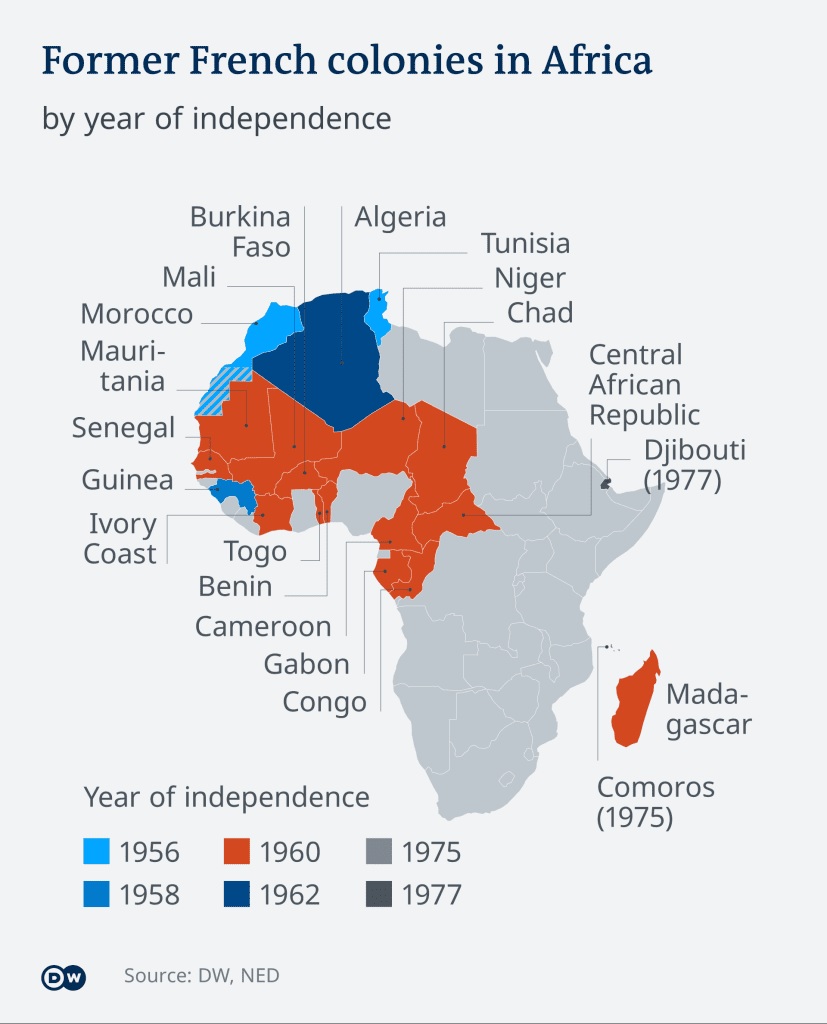
Almost all of West Africa was colonized by France, which committed brutal atrocities in the region.
Still today, France maintains neocolonial policies, effectively controlling West African economies by forcing them to use the CFA franc as their national currency.
Senegalese development economist Ndongo Samba Sylla described the CFA franc as “a colonial currency, born of France’s need to foster economic integration among the colonies under its administration, and thus control their resources, economic structures and political systems”.
Paris dictates the monetary policies and even holds much of the foreign exchange reserves of numerous West African nations, including Niger, Burkina Faso, and Mali.
The CFA franc is a “a barrier to industrialisation and structural transformation” in these countries, explained Sylla, who characterized it as a “neocolonial device that continues to destroy any prospect of economic development in user nations”.
The United States has one of its largest and most important drone bases in Niger: the Air Base 201, which cost $110 million to build, and an additional $20-30 million per year to maintain – in one of the poorest countries on Earth.
Niger is geostrategically important for the Pentagon’s Africa strategy. It is located in the middle of the Sahel, a region with a lot of US and French military activity, where thousands of troops are stationed on a regular basis.
Washington uses its drone bases in Niger, in the heart of the Sahel, to project military dominance in North and West Africa, in coordination with the forces that US Africa Command, or AFRICOM, has deployed across the continent.
If Washington loses its ally in Niger, the new nationalist military government may try to close the foreign military bases and kick out the roughly 1000 US soldiers in the country.
Niger’s historically subordinate relationship with the Western powers has not brought the Nigerien people any prosperity.
The country is a major producer of gold, but more than 40% of Nigeriens live in extreme poverty.
Niger is also one of the world’s largest producers of uranium. This radioactive material is crucial for nuclear energy in Europe, especially in France, where roughly one-third of electricity comes from nuclear power.
Less known is that Niger also has sizeable oil reserves………………………………………………………………………………………………………………………………………….
Soon after the coup in Niger, there were similar reports that the nationalist military government decided to block exports of uranium and gold to the West.
The prospect of a foreign military intervention in Niger and potentially other West African nations is truly on the table. It is by no means an empty threat…………………………………………………………………………………………………..
Anti-colonial nationalists rise to power in West Africa
Some of the nationalist military leaders who have taken power in West Africa are invoking the historical legacy of anti-colonial movements………………………………………………………………………………………………….
Threats of intervention in West Africa
The leaders of the new government in Niger publicly warned that France is plotting military intervention.
Paris is looking “for ways and means to intervene militarily in Niger”, the authorities said, stating that French officials met with the chief of staff of Niger’s national guard “to obtain the necessary political and military authorisation”, The Guardian reported.
The British newspaper described Niger’s toppled president, Bazoum, as “an ally of western powers”.
Along with Paris, the US State Department is actively coordinating with Bazoum and plotting to put its ally back in power.
To give supposed “multilateral” cover to their plans for intervention, the US and France have been working closely with the Economic Community of West African States (ECOWAS).
Reuters reported that ECOWAS and “West African defence chiefs have drawn up a plan for military action if Niger’s coup is not overturned”.
The UK-based news outlet emphasized, “Given its uranium and oil riches and pivotal role in the war with Islamist rebels in the Sahel region, Niger has strategic significance for the United States, China, Europe and Russia”.
ECOWAS imposed sanctions on Niger, and the country’s southern neighbor Nigeria has begun establishing a de facto blockade……………………………………………………………………………………………………………………………………….
Niger is a leading producer of uranium, needed for European nuclear energy
One of the principal economic interests that Western powers have in Niger is its uranium.
The anti-poverty organization Oxfam published a report in 2013 detailing how France was making a killing profiting off of the uranium in Niger, which is one of the poorest countries in the world.
The people of Niger, who are known as Nigeriens (not to be confused with Nigerians from Nigeria), have seen almost no benefits from this uranium extraction.
Oxfam cited a Nigerien activist who noted, “In France, one out of every three light bulbs is lit thanks to Nigerien uranium. In Niger, nearly 90% of the population has no access to electricity. This situation cannot continue”.
“It is incomprehensible that Niger, the world’s fourth-largest uranium producer and a strategic supplier for Areva and France, is not taking advantage of the revenue from this extraction and remains one of the poorest countries on the planet”, an Oxfam researcher added.
……………………………………………………………………………………. Since the coup in Niger, both France and EU leadership have insisted they will not be affected, stating that they have enough uranium in their reserves to last a few years.
But if the nationalist government remains in power in Niger and abides by its alleged pledge to cut off uranium exports, Europe could face economic consequences.
This also comes at a complicated moment for Europe, which has pledged to boycott Russian oil exports and reduce imports of Russian gas………………………………………………………………………………………………..
Niger hosts strategic US military bases
In addition to foreign economic designs on West Africa, the US military has a massive footprint on the region – particularly in Niger, where it operates multiple bases.
A 2019 report in PBS noted an increasing US military presence in Africa, revealing that the Pentagon had nearly 800 personnel stationed in Niger. (That figure later rose to roughly 1000.)………………………………………………………………..
General Thomas Waldhauser, the commander of US military forces in Africa, described Niger’s pro-Western government as “a good partner in a very, very bad neighborhood”.
PBS indicated that the US military was creating a base in Agadez, Niger, which “will be the largest installation Air Force personnel have ever built”.
“The U.S. has been operating drone missions out of another base in Niger’s capital since 2013”, the media outlet wrote, adding, “The CIA is also believed to be using another drone base in Northeastern Niger”.
Investigative journalist Nick Turse, reporting in 2023, described this US facility in Niger, Air Base 201, as “the linchpin of the U.S. military’s archipelago of bases in North and West Africa and a key part of America’s wide-ranging intelligence, surveillance, and security efforts in the region”……………………………
What is striking is the neocolonial symbolism of the United States maintaining these high-tech military facilities worth hundreds of millions of dollars in Niger, one of the poorest countries on Earth, where the majority of the population doesn’t even have access to electricity.
Before the July 2023 coup, Washington saw the Nigerien government as a key ally in its attempt to isolate China and Russia.
Antony Blinken took a historic trip to Niger in March, in the first-ever visit by a US secretary of state………………………………………………………………………………………………………………… Washington sees the continent as highly strategic in its new cold war against China and Russia.
…………………………………………………………………………………………………………………..The nationalist governments in Niger, Burkina Faso, and Mali are very unstable, and the threat of Western-sponsored military intervention could destabilize the countries, fueling more coups, and potentially setting off a regional war.
The transparent goal of the United States and France is to re-impose political control over the region, to exploit its plentiful natural resources and geostrategic location…………. more https://scheerpost.com/2023/08/08/us-france-threaten-intervention-in-resource-rich-niger-fears-of-war-in-west-africa/
Uranium profits in Niger. France is grabbing it all
Meillure Ecole du Senagal 24 April 23
Of the 5504 billion CFA francs (US$ 5504 millions) in annual uranium revenues, Niger earns only 86 billion CFA francs and France quietly takes the 5418 billion CFA francs.
Niger mines 43,000 tonnes a year, selling for 43 million CFA francs a tonne (US$ 64 000) at 43,000 CFA francs a kilo (US$ 64). Niger’s uranium is listed on the stock market, more specifically on the Chicago exchange. A kilo of uranium dioxide sells for 128 million CFA francs(US$ 128 000), not forgetting that on the international market the cost of materials fluctuates.
On the basis of current figures (128 million CFA francs (US$128 000 X 43,000 tonnes = 5504 billion CFA francs (US$ 5504 millions), we realize that out of the 5504 billion CFA francs (US$ 5 504 millions), Niger will only be entitled to 86 billion CFA francs (US$ 86 millions) i.e. a shortfall of 5418 billion CFA francs (US$ 5418 millins) for the country of Niger.
Niger’s 20 million tonnes of radioactive waste
Uranium tailings in Niger are blowing in the wind and poisoning the water
By Linda Pentz Gunter
Note: In late July, a military coup ousted Niger’s president, Mohamed Bazoum. Since then, those who have declared themselves in charge have announced a halt to uranium exports to France. France relies on Niger for around 17% of the uranium that fuels its troubled commercial reactor fleet (with Kazakhstan and Uzbekistan the main suppliers). Since Russia’s invasion of Ukraine, European countries have been wrestling with their uncomfortable dependence on Russian-sourced uranium supplies. The Russian mercenary group, Wagner, already has a strong presence in Africa, and one that is now growing.
The grey mountain looms, mirage-like, on the horizon of the uranium mining town of Arlit in Niger. (Picture below is of Kyrgyzstan’s mountain of uranium tailings, not Niger’s – but the same type)

This lethal legacy has been confirmed by the independent French radiological research laboratory — Commission de Recherche et d’Information Indépendantes sur la Radioactivité — known in international circles simply as CRIIRAD. The lab, and its director, Bruno Chareyron, have been studying the situation around uranium mines in Niger for years. In 2009 his lab measured the radioactive levels of the wastes at 450,000 Becquerels per kilogram.
In a recent video, CRIIRAD describes the waste pile— mostly radioactive sludges — as “a sword of Damocles hanging over the drinking water supply for more than 100,000 people.” (You can watch the video below, in French with English subtitles. If you understand French, you can also listen to the CRIIRAD podcast episodes on this topic on Spotify.)
Under its subsidiary, Cominak, Orano exploited mines near Arlit for 40 years. Much of the uranium extracted was used as fuel for reactors in France and other countries in the European Union.
As part of the extraction process, radon gas was released into the air along with fine radioactive dusts, inhaled by the uranium mine workers and local residents. Radioactively contaminated materials ended up in workers’ homes, used to fashion furniture and utensils and even as construction materials for the homes themselves. And yet, no effort was made by Orano to contain this waste. Instead, as the Radio France International report says, “it was simply dumped on the ground.”
Some workers who were treated in the local Areva-run hospital were told their illnesses had nothing whatever to do with the uranium mines.
Diners along the Seine, sitting under their Parisian fairy lights, rarely if ever thought about the workers in Arlit who helped turn those lights on, and who suffered all the negative health consequences while enjoying none of the financial gain. Niger remains one of the world’s poorest countries.
Niger is yet another example of colonialism, its people burdened effectively with a radioactive smallpox blanket. It’s a story and a pattern that repeats itself across the world where people of color toil in uranium mines or other foreign-imposed government or corporate methods of exploitation, working to benefit white western customers thousands of miles away.
And it’s an exploitation that could now be prolonged at Orano’s only remaining uranium mine in Niger — Somair. Earlier this year, Orano and the then Niger government signed an agreement to extend operations at Somair until 2040, 11 years longer than its originally projected closure date. That agreement may now be in doubt under the current political uncertainty brought about by the July coup.
Imouraren in northern Niger, with potentially 200,000 tonnes of uranium deposits, is still also potentially within Orano’s sights, although what would become the world’s biggest uranium mine has been on hold for some time, even before the current coup.
Meanwhile, in Arlit, many live without electricity at all. Or even running water. That water, according to Chareyron, has already been contaminated by the 40 years of waste discharges from the mines —chemicals and heavy metals along with radioactive uranium and its daughter products such as radium and polonium— which have migrated into groundwater. Absent other alternatives, local populations are obligated to keep drinking it.
According to the Radio France International report, “Orano’s Niger subsidiary, Cominak, said that it will cover the radioactive mud with a two-metre layer of clay and rocks to contain the radiation.” But, even though it is a necessary first step to prevent further dispersal into the air, the measure will scarcely be an enduring barrier, given the wastes will be dangerous to human health for hundreds of thousands of years.
But while it is dangerous for Arlit locals to wash their hands in their radioactively contaminated water supply, has Cominak washed its hands of them? In the two years since the mines closed, nothing has happened to safeguard the waste piles.
Almoustapha Alhacen, a former mine worker who heads the local NGO, Aghir’n Man and collaborates with CRIIRAD, told Chareyron that the reason given for inaction is lack of financing.
In reality, the problem is an even bigger one than miserly corporate inaction. Worldwide, points out Chareyron, authorities have yet to figure out how to confine lethal radioactive waste safely over the longterm. The simple answer is that, when it comes to radioactive waste, no one really knows what to do.
1 This Month

of the week – Shut Down Drone Warfare!


Tell the Ukrainian Government to Drop Prosecution of Peace Activist Yurii Sheliazhenko

Petition to revoke the licensing of the Near Surface Nuclear Disposal Facility (NSDF) at Chalk River. https://www.ourcommons.ca/petitions/en/Petition/Details?Petition=e-7247
To see nuclear-related stories in greater depth and intensity – go to https://nuclearinformation.wordpress.com
-
Archives
- March 2026 (237)
- February 2026 (268)
- January 2026 (308)
- December 2025 (358)
- November 2025 (359)
- October 2025 (376)
- September 2025 (257)
- August 2025 (319)
- July 2025 (230)
- June 2025 (348)
- May 2025 (261)
- April 2025 (305)
-
Categories
- 1
- 1 NUCLEAR ISSUES
- business and costs
- climate change
- culture and arts
- ENERGY
- environment
- health
- history
- indigenous issues
- Legal
- marketing of nuclear
- media
- opposition to nuclear
- PERSONAL STORIES
- politics
- politics international
- Religion and ethics
- safety
- secrets,lies and civil liberties
- spinbuster
- technology
- Uranium
- wastes
- weapons and war
- Women
- 2 WORLD
- ACTION
- AFRICA
- Atrocities
- AUSTRALIA
- Christina's notes
- Christina's themes
- culture and arts
- Events
- Fuk 2022
- Fuk 2023
- Fukushima 2017
- Fukushima 2018
- fukushima 2019
- Fukushima 2020
- Fukushima 2021
- general
- global warming
- Humour (God we need it)
- Nuclear
- RARE EARTHS
- Reference
- resources – print
- Resources -audiovicual
- Weekly Newsletter
- World
- World Nuclear
- YouTube
-
RSS
Entries RSS
Comments RSS
 nuclear-news