Water shortage affecting uranium mining industry in Namibia
Rio Tinto, Paladin Uranium Mines in Namibia Face Water Shortage, Bloomberg News By Felix Njini November 18, 2013 Uranium mines operated by companies including Rio Tinto Plc (RIO) and Paladin Energy Ltd. in Namibia face a water shortage as a drought in the southwest African nation curbs supply to the operations and three coastal towns.
Volumes from the Omaruru Delta acquifer, about 200 kilometers (124 miles) northwest of the capital, Windhoek, have declined to 4 million cubic meters this year from 9 million cubic meters a year earlier, said Nehemia Abraham, under-secretary for water and forestry in the Ministry of Agriculture.
The source is in the semi-arid Erongo region, which supplies the towns of Swakopmund, Walvis Bay and Henties Bay and suffers from severe shortages. Water from a desalination plant owned by Areva SA (AREVA), the country’s first such facility, isn’t enough to meet needs of Paladin’s Langer Heinrich uranium mine, China Guangdong Nuclear Power Co.’s Husab uranium project and Rio’s Rossing complex.
“The water-supply situation at the coastal area has become too critical,” Abraham said by phone yesterday. “Mining companies in the area will have to operate with less water. We are reviewing the situation now and from end of November we might be unable to get enough water from the aquifer to supply to mines.”
Langer Heinrich spokeswoman Ratonda Murangi didn’t immediately respond to e-mailed questions. Botha Ellis, a spokesman for Rossing, directed queries to Namibia Water Corp., the country’s state-owned utility known as Namwater.
Water Needs
Rossing’s total water requirement for 2012 was 7.48 million cubic meters, 41 percent of which was for fresh water, while the rest was recycled, according to its website.
The three towns use about 4.5 million cubic meters and there is currently no spare capacity from the aquifer, known as Omdel, Abraham said…… http://www.businessweek.com/news/2013-11-18/rio-tinto-paladin-uranium-mines-in-namibia-face-water-shortage
Australian uranium miner Paladin’s share price tumbles
Shares of uranium miner Paladin dive after cancelled sale Reuters, Aug. 02 2013, Shares of Australian uranium miner Paladin Energy Ltd. fell as much as 29 per cent in Toronto on Friday after the company cancelled plans for now to sell a minority interest in an African mine, and instead raised funds through a private placement of shares. Paladin said it ended negotiations with a potential investor on Thursday and all other parties for a stake in its Langer Heinrich mine in Namibia. The company said it was unlikely to get the price it wanted because of low uranium prices….. Trading of Paladin stock was halted in both Canada and Australia on Thursday, pending news.
Paladin’s stock was down 28 per cent, or 26 Canadian cents to 66 Canadian cents in early trading on the Toronto Stock Exchange. http://www.theglobeandmail.com/report-on-business/industry-news/energy-and-resources/shares-of-uranium-miner-paladin-dive-after-cancelled-sale/article13572589/
Share price falls as Paladin’s sale of Langer Heinrich uranium mine is delayed
Uranium producer Paladin’s shares slide after stake sale delay BY:BARRY FITZGERALD The Australian June 27, 2013 SHARES in African uranium producer Paladin have been pulled back to near 52-week lows because of a delay in a planned debt-reducing sale of a minority equity position in the group’s flagship Langer Heinrich operation in Namibia.
It had been hoped that Paladin would make inroads into its $US740 million debt pile by making the sale the news of which pushed the shares from an April low of 70c to more than $1 a share in late May. But recent concerns that the previously advised June 30 target date would not be met have sent the shares lower.
The concerns were well placed, with Paladin saying yesterday that the planned sale had been delayed until mid-to-late August. Paladin shares closed 6c, or 6.8 per cent, lower at 82c.
The fall came despite Paladin managing director John Borshoff remaining confident a sale will be achieved. The planned deal is with two unnamed nuclear groups……http://www.theaustralian.com.au/business/mining-energy/uranium-producer-paladins-shares-slide-after-stake-sale-delay/story-e6frg9df-1226670445221
In dismal uranium market, Rio Tinto cuts back, slashes jobs
 Namibia’s Roessing uranium mine to slash jobs Global Post, 1 Mar 13, The Roessing uranium mine in Namibia, a unit of British mining giant Rio Tinto, said Friday it plans to cut 17 percent of its workforce due to slowing demand for nuclear fuel…. As with many other uranium producers, Roessing is buckling under low metal prices and reduced demand, the company’s managing director Chris Salisbury told reporters.
“Since the Japanese tsunami in 2011, uranium demand has remained depressed and the uranium price has fallen by more than 36 percent,” he said.
Japan shut down its nuclear power plants after the tsunami destroyed the Fukushima nuclear plant, and a number of other countries including Germany have also signalled they plan to reduce or phase out their facilities.
“With the utility sector in Japan essentially shutdown, there is little prospect of a turnaround in the near term,” he added.
At the same time electricity and water costs have gone up…. Roessing Uranium Limited is owned 68.6 percent by British mining giant Rio Tinto and is one of two operating uranium mines in Namibia. .http://www.globalpost.com/dispatch/news/afp/130301/namibia-s-roessing-uranium-mine-slash-jobs
Australian uranium companies use taxpayer funds to set up overseas aid, and look good
Paladin, which has been the subject of some controversy in Malawi over job cuts, was last year linked to a funding application through its employees’ charity – Friends and Employees of Paladin for African Children.
Paladin’s (African) Ltd general manager, international affairs, Greg Walker, who was invited late last year to be Australia’s honorary consul to Malawi, was involved in the process, according to 2012 correspondence from Australia’s ambassador to Zimbabwe, Matthew Neuhaus, to Mr Walker. The letter obtained under freedom of information confirmed Mr Walker’s successful application for the employees’ charity funding proposal.
 The Aidwatch director Thulsi Narayanasamy said it was not the place of the Australian aid program to fund the corporate social responsibility programs of wealthy mining companies.
Firms use tax money for aid projects : http://www.smh.com.au/money/tax/firms-use-tax-money-for-aid-projects-20130129-2ditd.html#ixzz2Jbp0RzOT January 30, 2013 Rory Callinan
WEALTHY resource companies operating overseas are tapping into Australian taxpayer funds to set up aid projects potentially benefiting their corporate social responsibility credentials.
Aid and mining watchdogs have expressed concerns about the practice, arguing the corporations are wealthy enough to bankroll their own aid and that linking donations to controversial mine operations is a conflict of interest.
Nine mining companies all operating in Africa have been linked to the successful applications via the Foreign Affairs Department’s Direct Aid Program – a scheme that allows heads of missions to give up to $30,000 to local causes.
About $215,000 of taxpayers’ money went to the mining company-conceived projects last financial year, including a school for the deaf, providing trade skill training to local workers, establishing women’s groups and digging wells. Two applications involved uranium mining companies, Paladin Energy in Malawi and Bannerman Resources in Namibia. Continue reading
Doom and gloom for the uranium industry – no improvement in sight
 End of last month, the price had fallen to US$49.25 and for most of September, it hovered at the US$48 mark. This is almost 60% below the entry level target as calculated by Bannerman. The impact on the development of new mines, is obvious.
I believe the commodities boom is over, or at least on hold for another five years. In the meantime, no new mines.
Our Anticipated Uranium Projects Will Not Go Ahead, Except One [analysis] Equities.com Daniel Steinmann All Africa Global Media 22 Sept12, Bannerman Resources, the Australian company driving one of four new uranium projects in Namibia, recently said at a mining conference, the price for uranium U308 needs to be between US$75 and US$90 per pound (0.454kg) to drive any new investment in greenfields uranium mines.
Hidden in this seemingly neutral observation and analysis, are many serious consequences for the further development of the uranium sector Continue reading
In Malawi, Namibia, Niger workers making trouble for uranium mining companies
Conflicts with unions and management may have even larger impacts in the future,
Uranium Miners in Africa Facing Labor Disputes, Business Insider, Resource Investing News | May 16, 2012, Uranium mining companies are operating in difficult environments in many jurisdictions, facing challenges ranging from regulatory compliance,
environmental delays, rising costs, and labor relations. Over the last year, the labor challenges seem to have become more accentuated for African uranium mining companies, with several companies having reporting strikes. Continue reading
Uranium mining damages health of workers and environment
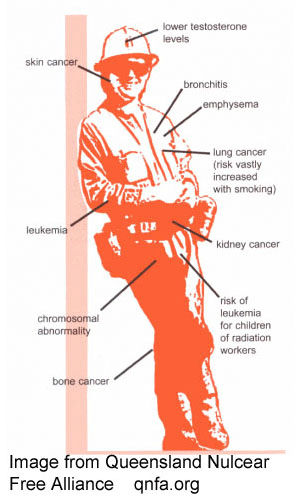 the World Health Organisation (WHO) acknowledges that Radon, which is a heavy gaseous radioactive chemical, is the second cause of lung cancer after smoking.
Uranium, even when purified, Chareyron said is radioactive and miners cannot really be protected from it.
 Concerns over uranium mining New Era, 12 Apr 2012 – by Irene Hoaës WINDHOEK – Renewed concern has been expressed regarding uranium mining activities along the coastal areas and its impact on the environment following tests undertaken by the Commission for Independent Research and Information about Radiation (CRIIRAD) and EARTHLIFE Namibia.
These mining activities have a direct bearing on people’s health as they reportedly cause cancer, especially to people that get exposed to them.
According to CRIIRAD, people that spend 30 minutes to 35 hours at a distance below 25 meters from the waste rock dump, would receive an external radiation dose above the trivial dose of 10 microsieverts per year.
One of the main concerns is uranium concentrates found in underground water sources and on sediments in areas where Rössing and the Langer Heinrich mines are found, especially along the Khan and Gawib rivers.
According to Bruno Chareyron, a Nuclear Physics Engineer and Director of the CRIIRAD Laboratory, the radioactive tailings (waste) of the mines are not covered and dust particles from the tailings are accumulating on bushes and slopes.
“When it rains, this dust is even washed off the waste rock dumps that are situated next to the river banks and therefore deposited into the river system,” the nuclear engineer said. Continue reading
The human consequences of uranium mining
“The most difficult part for the victims of uranium exposure is to prove that their symptoms are directly related to the work they were doing in those mines,” Hecht said. Due to this difficulty, workers do not receive any compensation.
Lecture tackles global uranium trade, The Brown Daily Herald. Alissa Haddaji, February 17, 2012 To understand the consequences of global uranium trade in Africa, the intricate interaction between political lobbying, government and human interests must be explored, said Gabrielle Hecht, professor of history at the University of Michigan, in a lecture hosted by the science and technology studies program Thursday.
The presentation — held in Smith-Buonanno 106 — was part of the program’s lecture series “Nothing Can Go Wrong: Rethinking Nuclear Energy in the 21st Century” and introduced themes from Hecht’s forthcoming book, “Being Nuclear: Africans and the Global Uranium
Trade.” …. Continue reading
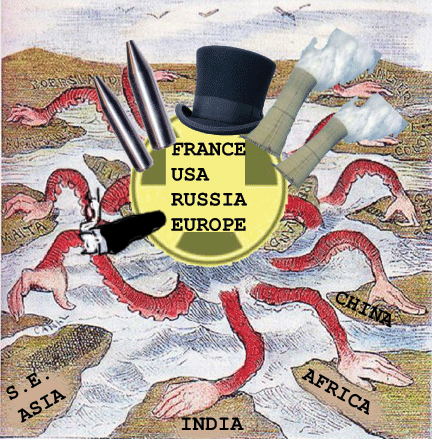
Rio Tinto, uranium miners, and nuclear colonialism
situation isn’t all rosy for the multinational, which has long faced allegations of widespread environmental destruction and labor and human rights abuses in Africa, Asia and even the U.S.
Foreign control of metals and other natural resources in African and other developing countries is increasingly seen as a new form of colonialism, wherein locals work for relatively low wages and often in grueling, repressive conditions for companies that take most of the profit from the resources and labor out of the country.
Namibian Uranium Miners vs. Rio Tinto, IN THESE TIMES, BY KARI LYDERSEN, OCT 3, 2011 Namibian union uranium miners on strike against international mining giant Rio Tinto alleged in late September that a week into the strike, the company was violating mutually agreed upon conditions of the strike by hiring nonunion workers at its Rossing uranium mine.
Rio Tinto says it is not hiring nonunion workers and is demanding written proof from the Namibian Miners Union.
Miners have demanded payments of $2,557 (USD) each to end the strike over union allegations of unfair bonus payments and other grievances. Rio Tinto has asked the country’s labor court to rule that the union’s complaints are not grounds for a strike. Continue reading
Strike at Rio Tinto’s Rossing uranium mine
Strike at Rio Tinto’s Rossing mine, IOL, September 23 2011 Workers at Rio Tinto’s Rossing mine in Namibia on Friday started an indefinite strike at the uranium mine after rejecting management’s latest offer that was meant to settle a dispute over production incentives, a union official said.
“Workers have shot down the management offer. The strike has started as planned at 0800 (10:00 SA time) this morning,” Mineworkers Union of Namibia Rossing branch representative Ismael Kasuto told Reuters. – http://www.iol.co.za/business/international/strike-at-rio-tinto-s-rossing-mine-1.1143719
Rossing uranium mine first hit by rains, now by union strike
Namibia mine union readies for strike at Rossing Reuters 21 Sept 11, – Namibia’s Mineworkers Union of Namibia (MUN) on Wednesday served Rio Tinto’s Rossing uranium mine with a strike notice after failing to reach a deal in talks over output incentives, with a stoppage expected to start on Friday. Continue reading
Radioactive uranium drums found on beach in Namibia
There are a number of reasons why the latest incident is of great concern:
• it puts into question the level of security at Namibian uranium mining operations, with the worry being that radioactive uranium oxide could get into the “wrong hands”….
Drums of radioactive uranium found on beach, Care 2 by Andreas S., August 30, Last week, Namibian authorities discovered four unguarded barrels of radioactive uranium oxide on a beach near the coastal town of Swakopmund.
Floods cause production drop in Namibia’s uranium mines
Namibia Q2 uranium production down | Industrial Fuels and Power August 30th, 2011 NewsroomUranium production in Namibia decreased from 2.35mlb to 2.09mlb in the second quarter of 2011 when compared with the previous quarter.“This was largely due to adverse weather conditions, with some of the mines becoming flooded with the abnormally heavy rains seen this year,” financial group Capricorn Investment Holdings said.Namibia’s uranium is produced by Rio Tinto and Australia’s Paladin Energy.
Namibia Q2 uranium production down | Industrial Fuels and Power
Theft of nuclear materials in Namibia
Namibia arrests four in suspected nuclear theft, Aug 29, 2011 11. WINDHOEK (Reuters) – Namibian authorities have arrested four people they suspect of stealing drums of radioactive material from a mine in the country that is a major exporter of uranium, officials said on Monday.
The four were arrested on Friday in the coastal town of Swakopmund, the drums have been recovered and the material is thought to have come from Areva’s Trekkopje mine, they said.Axel Tibinyane, regulator of the Atomic Energy Board of Namibia, said the contents of the drums are radioactive….
Areva’s Trekkopje is one of the few mines in Namibia that has processing facilities for yellow cake — a form of uranium ore that can be enriched for nuclear fuel or, if enriched to a much higher level, for use in weapons.The four suspects were expected to appear in court later on Monday.http://af.reuters.com/article/topNews/idAFJOE77S0F520110829?feedType=RSS&feedName=topNews
1 This Month

of the week – Shut Down Drone Warfare!


Tell the Ukrainian Government to Drop Prosecution of Peace Activist Yurii Sheliazhenko

Petition to revoke the licensing of the Near Surface Nuclear Disposal Facility (NSDF) at Chalk River. https://www.ourcommons.ca/petitions/en/Petition/Details?Petition=e-7247
To see nuclear-related stories in greater depth and intensity – go to https://nuclearinformation.wordpress.com
-
Archives
- March 2026 (251)
- February 2026 (268)
- January 2026 (308)
- December 2025 (358)
- November 2025 (359)
- October 2025 (376)
- September 2025 (257)
- August 2025 (319)
- July 2025 (230)
- June 2025 (348)
- May 2025 (261)
- April 2025 (305)
-
Categories
- 1
- 1 NUCLEAR ISSUES
- business and costs
- climate change
- culture and arts
- ENERGY
- environment
- health
- history
- indigenous issues
- Legal
- marketing of nuclear
- media
- opposition to nuclear
- PERSONAL STORIES
- politics
- politics international
- Religion and ethics
- safety
- secrets,lies and civil liberties
- spinbuster
- technology
- Uranium
- wastes
- weapons and war
- Women
- 2 WORLD
- ACTION
- AFRICA
- Atrocities
- AUSTRALIA
- Christina's notes
- Christina's themes
- culture and arts
- Events
- Fuk 2022
- Fuk 2023
- Fukushima 2017
- Fukushima 2018
- fukushima 2019
- Fukushima 2020
- Fukushima 2021
- general
- global warming
- Humour (God we need it)
- Nuclear
- RARE EARTHS
- Reference
- resources – print
- Resources -audiovicual
- Weekly Newsletter
- World
- World Nuclear
- YouTube
-
RSS
Entries RSS
Comments RSS
 nuclear-news