France joins the throng jostling to market nuclear power to Kenya
 France joins suitors for Kenya’s nuclear plant venture, Business Daily Africa, NEVILLE OTUKI, notuki@ke.nationmedia.com February 7 2017 IN SUMMARY French Economy and Finance minister Michel Sapin said the nuclear-rich European country was looking to offer Kenya technical, engineering and financial support to develop reactors.
Kenya plans to start building its first nuclear plant from 2022 in a five-year period at a cost of about Sh500 billion
China, Russia, South Korea and Slovakia have since inked various pacts with Kenya in manpower development and skills exchange as they eye a possible deal.
France has joined the list of countries courting Kenya for a multi-billion-dollar deal to build East Africa’s first nuclear power plant.
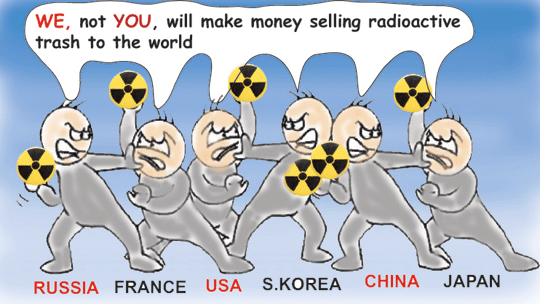
French Economy and Finance minister Michel Sapin said the nuclear-rich European country was looking to offer Kenya technical, engineering and financial support to develop reactors.
Kenya plans to start building its first nuclear plant from 2022 in a five-year period at a cost of about Sh500 billion.
China, Russia, South Korea and Slovakia have since inked various pacts with Kenya in manpower development and skills exchange as they eye a possible deal.
“We have expressed our readiness to support the construction of the plants. Our support involves everything from expertise to funding,” Mr Sapin said on Sunday after concluding his two-day visit to Kenya during which he presided over the return of Peugeot assembly to Kenya…….
Mr Sapin said that France was seeking pacts with Nairobi like the ones it entered with South Africa on nuclear power development.
France has over the years signed several pacts with South Africa whose two power plants were built by French firm Areva.
South Africa plans to add more nuclear power plants.
Energy experts from Italy and Germany last October, however, advised Kenya to drop plans to build nuclear reactors and instead harness its vast renewable energy resources for power generation. The experts, attending a renewable energy conference in Nairobi, reckoned that Kenya is better off developing more geothermal wells, solar parks and wind farms.
They cited massive costs for a nuke plant, long construction periods of about 10 years and expensive decommissioning of plants at the end of their lifespan, especially disposing of hazardous radioactive waste.
Italy shut down its last nuke plant in 1990 and the people voted against the atomic technology in a 2011 referendum. Germany plans to pull nuclear plants off its power grid by 2022 in favour of green energy. http://www.businessdailyafrica.com/France-joins-suitors-for-Kenya-s-nuclear-plant-venture/539546-3802926-item-1-119w5bk/index.html
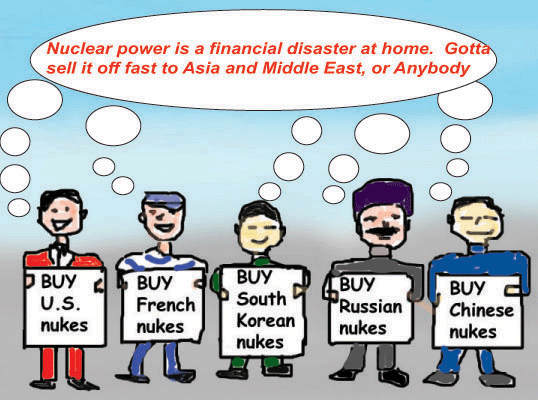
Nuclear marketing: sellers keen to finance Kenya ?
Who’s Paying For This $5 Billion Nuclear Plant In Kenya?,Daily Caller, ANDREW FOLLETT
Energy and Science Reporter, 1 Dec 16 Kenya is getting ready to start building a $5 billion dollar nuclear power plant, but its unclear where the money is coming from.
Kenya’s first nuclear reactor is scheduled to be completed by 2027 and will generate an estimated 1,000 megawatts of power. Kenya has signed agreements with China for the larger country to help finance and construct similar reactors. China’s state-controlled nuclear companies have already offered technical assistance in handling the nuclear fuel Kenya will need.
Another potential funding source for the reactor is South Korea, which signed agreements to collaborate on designing, operating and financing Kenyan reactors.
“When we talk of 1,000 megawatts, we are talking half of the capacity we have right now in the country,” Collins Gordon Juma, CEO of Kenya’s Nuclear Electricity Board, told Bloomberg Markets Tuesday. “It is very expensive, so we are looking at several funding options. We are speaking to various governments.”……..
Kenya is one of the most stable countries in East Africa, but the country has a serious problem with Islamic terrorism. In 1998, 200 people were killed when al-Qaida affiliate Egyptian Islamic Jihad bombed the U.S. embassy in the country. Another 13 were killed in an attack on an Israeli-owned Paradise hotel in 2002. More recently, the militant Islamic terror group, Al-Shabaab, killed 67 people in an attack on a shopping mall in 2013.
The country’s new reactor would not produce the weapons-grade plutonium necessary to make a nuclear weapon, but materials from them could be used to create dirty bombs. A dirty bomb combines radioactive material with conventional explosives that could contaminate the local area with high radiation levels for long periods of time and cause mass panic, though it would be millions of times weaker than an actual nuclear device. The Islamic State wants to steal this kind of radioactive material for a dirty bomb.
South Korea keen to market nuclear reactors to Kenya
 Kenya pens nuclear power deal with South Korea By Anthony Mugo, Citizen Digital2 September 2016 “……Kenya Nuclear Electricity Board (KNEB) penned a Memorandum of Understanding with the Korea Electric Power Corporation, (KEPCO), Korea Nuclear Association for International Cooperation (KNAIC) and the KEPCO International Graduate School (K-INGS).
This partnership deal will help Kenya to obtain important knowledge and expertise from Korea by way of capacity building, specialized training and skills development, as well as technical support for its intended nuclear power program……….This development comes as KNEB is gearing up for feasibility studies to identify potential sites for Kenya’s nuclear power plants as well as undertaking reactor technology assessment aimed at settling on the best option in terms of nuclear power plant model.
Keter has been leading a Kenyan delegation for a four-day nuclear power cooperation visit to South Korea which included a visit to Doosan Heavy Industries and Construction Company and the Kori Nuclear Power Plant Complex in Busan.
In May 2016 during the visit by president Park Gun-Hye in the country, the ministry of energy entered into an agreement with the Korea’s ministry of Trade Industry and Energy
The agreement facilitated the exchange of technical information, three specialists as well as training opportunities for Kenyans in Korea’s vast nuclear power industry……..Other than the agreement with South Korea, Kenya has previously signed nuclear power cooperation pacts with Russia, China and Slovakia. https://citizentv.co.ke/business/kenya-pens-nuclear-power-deal-with-south-korea-139655/
China, South Korea and Russia battle to win Kenya as nuclear customer
Africa Energy: China, Russia and South Korea In Race To Build Kenya’s Nuclear Plant
By Allan Akombo AFKI : June 2, 2016– In less than 24 hours this week Kenya signed two pacts on nuclear energy cooperation with South Korea and Russia, setting the stage for a dead-heat race against China to clinch the east Africa nation’s forthcoming nuclear energy development contract.
The first deal was in Moscow on May 30, 2016 where Russia’s state nuclear agency, Rosatom Deputy Director Nikolai Spasskiy and Deputy Head of the Kenyan Embassy to Russia Hillary N. Kyengo signed a Memorandum of Understanding (MoU) that involves the creation of a working group to identify peaceful nuclear projects and also continue consultations on the possibility of building the first nuclear power plant in Kenya.
A day later and thousands of miles away in the Kenyan capital, Nairobi host President Uhuru Kenyatta and Korean President Park Geun-Hye witnessed the signing of a nuclear corporation pact after they held bilateral talks.
The MOU on electric power and nuclear energy development was signed by Energy and Petroleum Cabinet Secretary Charles Keter and Korean Trade, Industry and Energy Minister Joo Hyunghwan.
Barely two weeks ago, Rosatom said it plans to sign cooperation agreements with Kenya, Uganda and Zambia to lay the groundwork for an expanded presence in Sub-Saharan Africa beyond its planned bid to build nuclear power plants in South Africa.
Rosatom has voiced confidence in its ability to see off competition from China, France and South Korea in a planned South African tender to build a 9,600 megawatts (MW) nuclear power fleet in the continent’s most industrialized country.
It sees scope, however, for more deals across the region, from the building of plants to supplying reactor fuel.http://afkinsider.com/126827/africa-energy-china-russia-south-korea-race-build-kenyas-nuclear-plant/#sthash.f40J0946.dpuf
Western Kenya’s solar minigrids – a rural electricity solution
A solar minigrid for 100 villages in Western Kenya, Clean Leap by DAVID KARIUKI Mar 19th 2016, Scalable solar mini grids will continue to play a major role in the rural electrification agenda in developing countries in the future. This will be fueled by the increased entry of private players into the field, and the change of regulations in respect to generation and supply of power from scalable mini grid solutions. These two are already being witnessed in Kenya. This year, Kenya is witnessing a major solar micro-grid project expected to demonstrate exactly how these power solutions can fit in rural electrification agenda now that the country is targeting 100% electricity access by 2030. The project is notable as it marks the first scalable community micro grid project since last year’s granting of the first utility concession for off-grid power supply…….

Pope and Muslim leaders in call for climate action
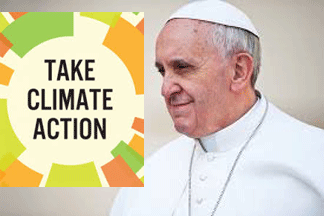 Pope Francis says failure of climate summit would be catastrophic, Guardian 26 Nov 15
Pope meets Muslim and other religious leaders in Nairobi to call for success at the Paris summit and for greater environmental protections in Africa. World leaders must reach a historic agreement to fight climate change and poverty at coming talks in Paris, facing the stark choice to either “improve or destroy the environment”, Pope Francis said in Africa on Thursday.
Francis chose his first visit to the world’s poorest continent to issue a clarion call for the success of the two-week summit, known as COP21, that starts on Monday in the French capital still reeling from attacks that killed 130 people and were claimed by Islamic State.
In a long address in Spanish at the United Nations regional office, Francis said it would be “catastrophic” if particular interests prevailed over the common good of people and the planet or if the conference were manipulated by business interests.
In Kenya, at the start of his three-nation Africa trip, the pope also said dialogue between religions was essential to teach young people that violence in God’s name was unjustified.
Bridging the Muslim-Christian divide and climate issues are major themes of the trip that also takes him to Uganda, which like Kenya has been a victim of extremist attacks, and the Central African Republic, a nation riven by sectarian conflict.
“We are confronted with a choice which cannot be ignored: either to improve or destroy the environment,” the pope said in Nairobi, home to the UN Environment Programme headquarters.
He noted that some scientists consider protection of the Congo basin tropical forest, which spreads over six countries and is the world’s second-largest after the Amazon, essential for the future of the planet because of its biodiversity.
Francis, who took his name from St Francis of Assisi, the patron saint of nature, has made protecting “God’s creation” a plank of his pontificate. In June, he issued a landmark encyclical calling for urgent action to save the planet……. http://www.theguardian.com/environment/2015/nov/26/pope-francis-says-failure-of-climate-summit-would-be-catastrophic
Remote Kenya will be connected to grid with Africa’s larges wind farm
 Africa’s largest windfarm set to connect remote Kenya to the grid, Guardian, Murithi Mutiga and David Smith , 9 Oct 15 Lake Turkana’s fierce winds have plagued villagers for generations, now they have inspired plans for Kenya’s most ambitious infrastructure project in 50 years – a 310MW windfarm, that they said was an impossible dream “……..Today, a sprawling, mostly-flat, dun-coloured terrain of moody, stumpy thorn bushes in the Sarima village around 40km from the shores of Lake Turkana is home to the most ambitious infrastructure development project carried out in northern Kenya since independence.
Covering 40,000 acres (162km2), the project will entail the installation of 365 wind turbines, each with a capacity of 850kW and is expected to be fully operational in mid 2017.
A 204km road linking the area to the nearest paved road will be built, and the Kenyan electricity transmission company, with funding by both the Kenyan government and a concessional loan from Spain, will construct a 428km transmission line to link it to the national grid……. A $600,000-700,000 community development budget means the contractors have been able to sink boreholes and deliver water to communities while the contractors have promised to light up most of the towns near the area once the power comes online……
Most people don’t worry too much about the energy but are happy that the powerful wind which was seen as a nuisance for generations might open up the region and link it with the rest of the country.” http://www.theguardian.com/environment/2015/oct/09/africas-largest-windfarm-set-to-connect-remote-kenya-to-the-grid
Safe and clean – solar-powered mosquito traps
Solar Power Helps In The Battle Against Malaria http://www.energymatters.com.au/index.php?main_page=news_article&article_id=3711 29 April 13, The Netherland’s Wageningen University is leading a project to install 4,000 solar powered mosquito traps on the Kenyan island of Rusinga. Continue reading
Great potential for decentralised solar and wind energy in Kenya
Kenya receives an estimated 4 to 6 kWh per square meter per day of solar insolation, equivalent to about 300 million tonnes of oil according to African Energy Policy Research Network 2004.
Kenya has one of the best wind resources in the world averaging between 3 and 10m/s with northern Kenya recording speeds of up to 11m/s.
 Innovation and Diversification Are Key for Kenya’s Renewable Energy Industry, Renewable Energy World, By Peter Kahare, February 20, 2012 KENYA — Decentralizing and diversifying renewable energy power generation technologies could be the panacea to save Kenyans from unreliable and expensive power supplied by hydro and thermal power generation, a recent study has found.
The new study by Christian Aid, an international agency that seeks solutions to chronic poverty in various nations says that empowering communities in rural areas in Kenya to produce power through renewable, cleaner sources could reduce overreliance on hydropower and fully exploit the renewable energy potential while offering opportunity to unlock economic growth. Participation of local communities in renewable energy technology projects such as
small/micro hydro, wind, solar, bagasse cogeneration and improved stoves could increase energy security and mitigate against climate change effects that badly affect the hydro power generation technology,” says Alison Doig, the report’s lead author and senior climate change advisor at Christian aid. Continue reading
1 This Month

of the week – Shut Down Drone Warfare!


Tell the Ukrainian Government to Drop Prosecution of Peace Activist Yurii Sheliazhenko

Petition to revoke the licensing of the Near Surface Nuclear Disposal Facility (NSDF) at Chalk River. https://www.ourcommons.ca/petitions/en/Petition/Details?Petition=e-7247
To see nuclear-related stories in greater depth and intensity – go to https://nuclearinformation.wordpress.com
-
Archives
- April 2026 (57)
- March 2026 (251)
- February 2026 (268)
- January 2026 (308)
- December 2025 (358)
- November 2025 (359)
- October 2025 (376)
- September 2025 (257)
- August 2025 (319)
- July 2025 (230)
- June 2025 (348)
- May 2025 (261)
-
Categories
- 1
- 1 NUCLEAR ISSUES
- business and costs
- climate change
- culture and arts
- ENERGY
- environment
- health
- history
- indigenous issues
- Legal
- marketing of nuclear
- media
- opposition to nuclear
- PERSONAL STORIES
- politics
- politics international
- Religion and ethics
- safety
- secrets,lies and civil liberties
- spinbuster
- technology
- Uranium
- wastes
- weapons and war
- Women
- 2 WORLD
- ACTION
- AFRICA
- Atrocities
- AUSTRALIA
- Christina's notes
- Christina's themes
- culture and arts
- Events
- Fuk 2022
- Fuk 2023
- Fukushima 2017
- Fukushima 2018
- fukushima 2019
- Fukushima 2020
- Fukushima 2021
- general
- global warming
- Humour (God we need it)
- Nuclear
- RARE EARTHS
- Reference
- resources – print
- Resources -audiovicual
- Weekly Newsletter
- World
- World Nuclear
- YouTube
-
RSS
Entries RSS
Comments RSS
 nuclear-news