‘It doesn’t make sense’: Marine biologist on Kenya’s proposed nuclear power plant.
Elodie Toto, Mongabay, 29 Aug 2025
- Kenya is considering building a nuclear power plant in Uyombo, a coastal town in Kilifi county. It would be near Mida Creek mangroves, Arabuko Sokoke Forest Reserve and Watamu National Marine Park and Reserve, all recognized for their high biodiversity, including endemic species and coral reefs.
- The plant’s cooling system could raise water temperatures in the area. This could harm marine life, potentially causing further coral bleaching and disrupting plankton and other critical species, which would, in the long run, affect the entire food chain.
- Residents and environmentalists, including marine biologist Peter Musila, have criticized the project and the government for poor communication, lack of public consultation and insufficient information on nuclear waste management.
- Musila argues Kenya does not need nuclear energy given the country’s renewable energy potential, and such a project raises concerns about potential accidents and long-term impacts on ecosystems and local livelihoods.
Kenya is in the process of building its very first nuclear power station. According to forecasts by the Kenya Nuclear Power and Energy Agency (NuPEA), construction is due to start by 2027 and will produce 1,000 MW of power. The town of Uyombo, in Kilifi county on the Kenyan coast, is one of three sites where NuPEA considers building the plant. Very quickly, a cry united the population: “Sitaki Nuclear,” no to nuclear power in Swahili. Demonstrations broke out, followed by a lawsuit filed by citizens, which was later dismissed, and a petition was also circulated online. But the project still seems to be going ahead, much to the dismay of residents and some environmentalists.
Uyombo is located on the edge of the Mida Creek mangrove swamps, a few kilometers from the Arabuko Sokoke Forest Reserve, the largest remaining coastal forest in East Africa, recognized as a biodiversity hotspot due to the concentration of many endemic species and habitat loss. It lies in close proximity to Watamu National Marine Park and Reserve, recognized as a UNESCO Biosphere Reserve because of its coral reefs and the richness of its marine life, including whale sharks (Rhincodon typus) and manta rays (Manta alfredi).
What impact could this project have on this biodiversity? Peter Musila is a marine biologist and program coordinator with the NGO A Rocha Kenya. For the NGO, he monitors the state of the region’s corals and is involved in their restoration. As a coral specialist, he is livid about this nuclear power station project.
Mongabay met him in the town of Watamu.
Mongabay: When you heard that a nuclear power station could be built in Uyombo, what was your first reaction?
Peter Musila: I first heard of this nuclear power plant in 2022. For me, it doesn’t make sense because the area they are trying to put it in is a very pristine area for wildlife, with all sorts of wildlife, even terrestrial wildlife, including birds. Mida Creek is one of the most important areas for birds. It hosts a lot of migratory birds that come here to breed. There’s so much wildlife here.
It’s also an important marine mammal area [like dolphins and whales], and the sharks and rays are here. They use this space for breeding, for nesting. We don’t want a nuclear power plant in our area.
Mongabay: As you said, this is an important marine area. As well as mammals, there are also corals. What state are they in?
Peter Musila: Before the 1990s, the reef was very good. It was very pristine. I did not see it back then, but I wish I did. There were over 200 genera of corals. The major problem that has affected this area, coral-wise, is bleaching. The first time it happened was in 1997. After that, the coral cover declined quite substantially. It was 60% [preserved before 1997] and then it declined to 10% [in 1998]. That was really bad. And then it has been trying to recover. But bleaching is now occurring more often because there was another one in 2005 and then 2007, 2013, 2016 and 2020………………………………………………………………………………………………………………………………………….. Even if it were to be built up to standard, with no corruption, it can still go wrong. That is why other big countries are going against nuclear energy because it’s not the most sustainable energy source. I don’t know why we as Kenyans are even putting that on the table, considering there are all these other technologies that can produce energy more sustainably, more cheaply. I don’t get it.https://news.mongabay.com/2025/08/it-doesnt-make-sense-marine-biologist-on-kenyas-proposed-nuclear-power-plant/
Planned nuclear plant in a Kenyan top tourist hub and home to endangered species sparks protest
Daily Mail. By Associated Press, 12 October 2024
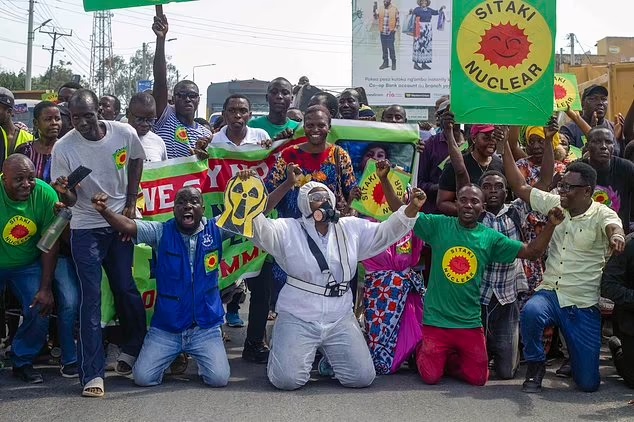
KILIFI, Kenya (AP) – Dozens rallied against a proposal to build Kenya’s first nuclear power plant in one of the country’s top coastal tourist hubs which also houses a forest on the tentative list of the UNESCO World Heritage site.
Kilifi County is renowned for its pristine sandy beaches where hotels and beach bars line the 165-mile-long coast and visitors boat and snorkel around coral reefs or bird watch in Arabuko Sokoke forest, a significant natural habitat for the conservation of rare and endangered species, according to the U.N. organization.
The project, proposed last year, is set to be built in the town of Kilifi – about 522 kilometers (324 miles) southeast of the capital, Nairobi. Many residents have openly opposed the proposal, worried about what they say are the negative effects of the project on people and the environment, leading to a string of protesters which at times turned violent.
Muslim for Human Rights (MUHURI) led the march Friday in Kilifi to the county governor´s office where they handed him a petition opposing the construction of the plant.
Some chanted anti-nuclear slogans while others carried placards with “Sitaki nuclear”, Swahili for “I don´t want nuclear.”
The construction of the 1,000MW nuclear plant is set to begin in 2027 and be operational by 2034, with a cost of 500 billion Kenyan shillings ($3.8 billion).
Francis Auma, a MUHURI activist, told the Associated Press that the negative effects of the nuclear plant outweigh its benefits.
“We say that this project has a lot of negative effects; there will be malformed children born out of this place, fish will die, and our forest Arabuko Sokoke, known to harbor the birds from abroad, will be lost,” Auma said during Friday´s protests.
Juma Sulubu, a resident who was beaten by the police during a previous demonstration, attended Friday’s march and said: “Even if you kill us, just kill us, but we do not want a nuclear power plant in our Uyombo community.”
Timothy Nyawa, a fisherman, participated in the rally out of fear that a nuclear power plant would kill fish and in turn his source of income. “If they set up a nuclear plant here, the fish breeding sites will all be destroyed.”
Phyllis Omido, the executive director at the Centre for Justice Governance and Environmental Action, who also attended the march, said Kenya´s eastern coastal towns depended on eco-tourism as the main source of income and a nuclear plant would threaten their livelihoods.
“We host the only East African coastal forest, we host the Watamu marine park, we host the largest mangrove plantation in Kenya. We do not want nuclear (energy) to mess up our ecosystem,” she said.
Her center filed a petition in Nov. 2023 in parliament calling for an inquiry and claiming that locals had limited information on the proposed plant and the criteria for selecting preferred sites. It also raised concerns over the risks to health, the environment and tourism in the event of a nuclear spill, saying the country was undertaking a “high-risk venture” without proper legal and disaster response measures in place. The petition also expressed unease over security and the handling of radioactive waste in a country prone to floods and drought.
The Senate suspended the inquiry until a lawsuit two layers filed in July seeking to stop the plant´s construction, claiming public participation meetings were rushed and urging the Nuclear Power and Energy Agency (Nupea) not to start the project, was heard………………………. https://www.dailymail.co.uk/wires/ap/article-13952403/Planned-nuclear-plant-Kenyan-tourist-hub-home-endangered-species-sparks-protest.html
In Kenya, police break up an environmental meeting that was explaining nuclear hazards
by BRIAN OTIENO Correspondent, Coast Region 24 September 23 https://www.the-star.co.ke/counties/coast/2023-09-24-police-break-up-environmental-training-on-nuclear-reactor/
Police break up environmental training on nuclear reactor
The training was to enlighten the residents on the effects of a nuclear reactor.
In Summary
- Uyombo is a village next to the beach in Matsangoni, Kilifi county and has been earmarked to host Kenya’s first nuclear reactor.
- The residents and environmental activists however remain unconvinced and still maintain there is greater risk to their health than the benefits they will get from the reactor.
Environmental activists in Kilifi county have accused the government of trying to force a dangerous project on Uyombo residents.
Uyombo is a village next to the beach in Matsangoni, Kilifi county and has been earmarked to host Kenya’s first nuclear reactor.
On Thursday, the Centre for Justice, Governance and Environment Action organized the training to enlighten the residents on the effects of a nuclear reactor on the environment and how to best protect themselves from possible harm.
However, police disrupted the training before it even started and dispersed the residents who had gathered there.
They said the meeting was illegal.
On Sunday, CJGEA executive director Phyllis Omido termed the police action “extrajudicial, punitive and abuse of power by the state officers”.
“We tried to reason with them but they refused. They kept whisking our chairs away and were determined to prevent the meeting from happening,” Omido told the Star.
She said the security and administrative agencies have been holding meetings over the same and she has been attending them.
“Why is it that when we call the meeting, it suddenly becomes illegal and suddenly there are security risks?” she posed on the phone Sunday.
However, Matsangoni police boss Kenneth Maina told the Star the activists were inciting the locals against the project.
“You know the other day we had a meeting with the PS there and it was successful. Nobody is denied the right of picketing, demonstrating and the like but these people did not get a permit or notify the police,” Maina told the Star on the phone.
He said police never deny anyone any right to do anything, but procedures must be followed.
“There was no confrontation. When the OCS arrived at the scene and asked them to disperse, they did,” Maina said.
CJGEA, Ujamaa Centre, Muslims for Human Rights and Turtle Watch are among the environmental and human rights groups opposed to the setting up of the nuclear reactor there.
There have been several meetings between Nuclear Power and Energy Agency (Nupea) officials, the residents and the local administration as part of discussions over the intended establishment of the plant.
The plant is set to be established in 2034 if all goes to plan which includes putting in place all the safety measures, according to Nupea.
The residents and environmental activists however remain unconvinced and still maintain there is greater risk to their health than the benefits they will get from the reactor.
Omido said they were shocked to learn that the area administration had quickly planned another baraza on the same day as their training and asked all residents to attend.
Kenya has restated its commitment to ensuring nuclear energy and nuclear weapons are not used in the continent.

Kenya reiterates stand on nuclear weapons during exhibition
Ogola noted that Kenya recently enacted the Nuclear Regulatory Act 29 of 2019.
Star 16 July 23
In Summary
- The Treaty of Pelindaba is the international agreement that establishes Africa as a zone free of nuclear weapons.
- Hence contributing to peace and security in Africa.
Kenya has restated its commitment to ensuring nuclear energy and nuclear weapons are not used in the continent.
This was when stakeholders in the Energy sector convened on Saturday to commemorate the 14th Anniversary of the African Nuclear Weapon Free Zone treaty.
The treaty is called the Treaty of Pelindaba.
The Treaty of Pelindaba is the international agreement that establishes Africa as a zone free of nuclear weapons, hence contributing to peace and security in Africa.
The event took place at the Trademark Hotel in Nairobi under the auspices of the Kenyan government.
Former Prisons Commissioner Wycliffe Ogola, while speaking on behalf of Energy CS Davis Chirchir, reiterated Kenya’s stand against possession of nuclear weapons adding that Kenya recognises the pivotal role the treaty plays in protecting civilians against nuclear weapons.
Ogola noted that Kenya recently enacted the Nuclear Regulatory Act 29 of 2019.
“The Act has committed the country to exclusively exclude uses of nuclear technology, recognising the need to meet Kenya’s obligation under various international considerations and criminalised access to nuclear material and radiation sources,” Ogola said.
He called for more forums to allow for the exchange of ideas on how to ensure nuclear weapons and technology are not used in Africa. ………………………. more https://www.the-star.co.ke/news/realtime/2023-07-16-kenya-reiterates-stand-on-nuclear-weapons-during-exhibition/
Kenya. Treasury allocates Sh2bn for nuclear and coal units, but nuclear is unlikely to happen for decades.
By LYNET IGADWAH, WEDNESDAY APRIL 20 2022,
SUMMARY
- A task force appointed by President Uhuru Kenyatta to look into the country’s power purchase agreement (PPAs) recommended the dropping of the Nuclear Power and Energy Agency (Nupea).
- The John Ngumi-led team argued that it was unlikely that Kenya would go into nuclear power production soon……………………………………… https://www.businessdailyafrica.com/bd/economy/treasury-allocates-sh2bn-for-nuclear-and-coal-units-3787880
Kenya’s $5billion nuclear power dream is delayed by 10 years
Kenya Delays $5 Billion Nuclear Power Dream by Decade on Demand, Bloomberg, By David Herbling 17 November 2021 Kenya will delay by a decade plans to build its first-ever nuclear power plant, a $5 billion facility, to ensure a match between power supply and demand, according to the Nuclear Power and Energy Agency.
The initial 1,000-megawatt plant is now projected to be connected to the grid in 2036, said Erick Ohaga, the state-owned agency’s director of nuclear energy infrastructure development. An earlier plan was to have the plant supply home and industries by 2026.
“Time-lines have changed because power supply needs to follow demand,” Ohaga said by phone on Wednesday. ….. https://www.bloomberg.com/news/articles/2021-11-17/kenya-delays-5-billion-nuclear-power-dream-by-decade-on-demand
Kenya cannot afford the costs of nuclear electricity, and the attendant human cost
The building of the nuclear electric power plant appears to be driven by factors other than the national interest. A cursory examination of economic, environmental and safety issues militates against the nuclear electricity option.
Kenya plans to build a 1,000 MWe nuclear power plant at a cost of US$5 billion. The National Environment Management Authority has requested for comments on a Strategic Environmental and Social Assessment Report for the Nuclear Power Programme for Kenya.
Operational costs for solar plants will be cheaper in terms of fuel, personnel and plant maintenance costs.
The amount of money spent so far in budgetary allocations to the Kenya Nuclear Electricity Board, and its successor, the Nuclear Power Energy Agency for salaries, training, and operations, is money that could have been used to build solar or wind energy plants in Kenya, or to further develop the abundant geothermal resources in the country.
Aside from economic arguments, there are numerous environmental and safety concerns. Radioactive waste that is generated at a nuclear power plant will be around for more than 300,000 years, and some of the radionuclides will be around for millions of years. The problem of radioactive waste disposal has not been conclusively resolved anywhere in the world. …….
Many countries around the world are shutting down their nuclear power plants. It is not inconceivable that Kenya will be sold second hand components of the power plants being dismantled around the world.
Vast swarm of locusts ruining the livelihood of 1000s in East Africa
Locust swarm 37 miles long and 25 miles wide threatens crops across swathes of east Africa, ITV News, 17 Jan 2020, A swarm of locusts measured at 37 miles long and 25 miles wide has been tracked in Kenya – and the insects are now threatening to decimate crops across swatches of east Africa.
The most serious outbreak of desert locusts in 25 years is posing an unprecedented threat to food security in some of the world’s most vulnerable countries, authorities say.
Unusual climate conditions are partly to blame.
Kenya’s Intergovernmental Authority on Development said: “A typical desert locust swarm can contain up to 150 million locusts per square kilometre.
“Swarms migrate with the wind and can cover 100 to 150 kilometres in a day. An average swarm can destroy as much food crops in a day as is sufficient to feed 2,500 people.”
Roughly the length of a finger, the insects fly together by the millions and are devouring crops and forcing people in some areas to bodily wade through them.
The outbreak of desert locusts, considered the most dangerous locust species, also has affected parts of Somalia, Ethiopia, Sudan, Djibouti and Eritrea and IGAD warns that parts of South Sudan and Uganda could be next.
The “extremely dangerous” outbreak is making the region’s bad food security situation worse, the United Nations’ Food and Agriculture Organisation has warned.
Hundreds of thousands of acres of crops have been destroyed……. https://www.itv.com/news/2020-01-17/locust-swarm-37-miles-long-and-25-miles-wide-threatens-crops-across-swathes-of-east-africa/?fbclid=IwAR1cn3AzYPruUHLGk_0dgXtQvDvh9bjrehBk7AeCTXeru2AjLKdlmmrYz_g
In Kenya, 87% of the electricity is from renewal sources
|
The Best Summary Of Kenya Renewable Energy (& Dirty Energy) You Can Find, Clean Technica, David Zarembka, 24 May 19 I do not need to feel guilty about contributing to global warming when my grandchildren turn on the TV to watch cartoons. This is because I live in rural, western Kenya, where 87% of the electricity is from renewal sources — the nirvana of Green Deal activists.With a population of almost 50 million (one-seventh the size of the US population), electricity capacity is only 2370 MW and peak demand is only 1770 MW. The average Kenyan consumes only 167 kWh of electricity per year. Kenyans also contribute only 0.03 percent of worldwide carbon admission to the atmosphere each year, equal to about 1 percent of what each American contributes.
It is useful to study the sources of electricity in Kenya to see how this renewable rate is achieved.
In 2017, there was a drought and the water levels in the lakes behind the dams that produce electricity fell too low to generate their normal amount of electricity. Then, as frequently happens in a climate such as Kenya’s, in 2018 there was major flooding and all the dams on the Tana River, including Masinga Dam, overflowed, leading to flooding in the lower reaches of the river. Hydropower cannot be considered a reliable source of power, so alternative sources need to be available.
The wind farm is sited in one of the best places for wind in the world. The wind blows off of Lake Turkana and is funneled between two hills, giving an extremely high wind potential. The project uses 365 Vestas 850kW wind turbines. In this day and age, I was disappointed that the wind farm used such small turbines, but the problem was transporting the turbines over 750 miles from the coast on two-lane roads. There is a second smaller wind farm in the Ngong Hills near Nairobi. Originally, it had a capacity of 5.1 MW, but it is now being upgraded with more turbines to 25.5 MW.
|
|


Kenya postpones its nuclear power plans
Kenya now pushes nuclear power plant plan to 2036, https://www.businessdailyafrica.com/economy/Kenya-now-pushes-nuclear-power-plant-plan-to-2036/3946234-4777866-b05oauz/index.html, By PATRICK ALUSHULA, SEPTEMBER 25, 2018 Kenya was already hunting for a partner to produce nuclear power by 202.
Kenya has postponed its plan to build Sh968 billion nuclear power plant by nine years to 2036 in favour renewable energy projects and coal plant.
Updated power development plan prepared by the Ministry of Energy and covering the period 2017 to 2037, now show that the earliest the country can build the nuclear plant is 2036 and not 2027 as initially planned.
In the revised plan, the first unit is expected to be completed in 2036, followed by another in 2037, making it the last project in the ministry’s 20-year plan for power generation expansion.
“All energy sources were considered in the system expansion planning. However, it is noteworthy that nuclear was not brought on board in both optimised and fixed MTP cases,” reads the updated plan shared by the Ministry.
ADVERTISEMENT
In addition to the delay, the plan size has been scaled down. Initially, Kenya was to construct two nuclear power plants, each with a capacity of 1,000 megawatts (MW) at a total cost of $4.05 billion (Sh405 billion) per plant.
However, the new plan is to have each plant with a capacity of 600MW at a cost of $4.84 billion (Sh484) billion.
The Ministry did not explain why the cost had gone up despite cutting the capacity of each unit by 40 per cent.
Kenya was already hunting for a partner to produce nuclear power by 2022 to help match-up rising demand and diversify from hydropower and geothermal.
It joins South Africa South Africa, which in August cancelled plans to add 9,600 MW of nuclear power by 2030 and will instead aim to add more capacity in natural gas, wind and other energy sources.
Growing concerns on the safety and feasibility of Kenya’s planned Sh2 trillion nuclear energy project
Kenya’s nuclear quest: A case of extreme optimism? As the country moves towards the reality of nuclear energy by 2027, questions on expertise and safety concerns abound. Daily Nation, 2 Jan 17 “………While the government brags that over 60 per cent of the country’s population has access to power, unreliable power supply and frequent power outages steal the thunder from this achievement, pushing the government into overdrive to boost power production.One of the strategies is to put up a nuclear energy plant by 2027, in a fervent push to lower the country’s energy deficit and electricity tariffs.
The project will cost a staggering Sh2 trillion begging the question of whether it will lower energy tariffs and still remain afloat.
Sceptics also argue that a sunshine-rich country such as Kenya should never think of going the risky route of nuclear energy……
While government officials strongly defend the nuclear project, questions abound about how a country whose major cities – Nairobi, Kisumu, and Mombasa – have failed to handle minor fire disasters and basic household waste will effectively deal with toxic wastes, which are the by-product of nuclear power generation.
In Nairobi for instance, where every individual generates about two kilogrammes of waste every day, garbage is littered all over, with roads becoming impassable when it rains. Moreover, some hospitals and clinics carelessly dispose their medical waste in landfills ran by cartels, yet the government insists it can handle nuclear waste.
One of the critics of nuclear power generation is North Horr Member of Parliament Chachu Gaya, who says that the government should explore safer sources of energy such as solar and wind energy, and only consider nuclear as an energy source of last resort……
Opponents are also worried about health hazards, safety and radioactive waste management, with questions about the country’s preparedness to deal with radioactive waste and accidental leaks which advanced economies like Japan have grappled with.
“Kenya only rides on optimism in its quest to generate nuclear power, but lacks human capital or infrastructure to roll out the technology,” says Oyath, adding that Kenya’s poor waste management strategies and pitiable response to disasters are considerable grounds to dismiss the project……..http://www.nation.co.ke/health/Ready-for-nuclear/3476990-4248378-l09oc2/index.html
Nuclear power for Kenya: an expensive and unrealistic dream
Why Kenya’s push for nuclear power rests on false or fanciful premises, Mail and Guardian, Kenya wants to go nuclear. Since 2012, Nairobi has been talking the talk and walking the walk. It has engaged the International Atomic Energy Agency and signed multilateral letters of intent in pursuit of nuclear power.
To date, Kenya reportedly has memoranda of understanding with Russia, China, South Korea and Slovakia which involve the building of four nuclear power plants with a total output of 4 000 MW. France is apparently also eyeing the potentially lucrative deals which would nearly double Kenya’s current electricity capacity.
Kenya’s Nuclear Electricity Board secured the global atomic energy agency’s approval in 2016. It hopes to have the first plant online anywhere from 2022 to 2027, leading a new African push for nuclear power. The only country currently generating nuclear is South Africa……..
The cost of the Kenya plant is estimated at Sh500 billion. This is costly and, given the current energy consumption patterns in Kenya, would be a massive waste of money.
Myths about Kenya’s power situation
According to the popular narrative, Kenya suffers from the twin evils of electricity that is overly expensive and in short supply. Yet there is strong evidence that Kenya’s power is relatively cheap and that successive governments have exaggerated both it’s economic growth trajectory and its need for a massive increase in power generation.
For example, Kenya has an installed capacity of just over 2 400MW, against a peak demand of just over 1 600MW. This is 800MW above peak hours demand.
While economies are required to have surplus power capacity, excess capacity can lead to higher power bills as consumers are often charged for idle power plants.
Thus the government, while promising ever cheaper power to consumers may actually be undercutting this promise in its pursuit of nuclear power plants and other costly projects that fail to reflect both industrial and private consumer demand.
Note of caution
A recent study by a German engineering consultancy further confirmed how exaggerated government figures about demand have been. It noted that Kenya’s maximum power demand would
grow 72% to 2 259MW by 2020 from the current 1 620MW, when projects such as the standard gauge railway start operating fully.
Government estimates, on the other hand, project peak demand will jump threefold to 4 755 megawatts in the three-year period. This is twice as much as the consultant’s estimates.
On top of this, Kenya’s problem isn’t that it needs more energy. Rather it needs to address distribution issues.
Any project involving the generation of more power needs to pay equal attention to Kenya’s grid and distribution system which currently can’t handle additional power. This includes corresponding efforts at regular, systematic maintenance work. Without these, any extra power generated from renewable and other energy sources will remain costly and wasted.
Yet another note of caution is in order. Demand from Kenya’s domestic consumers remains low even though a total of 5.8 -million customers now have connections to power – a five-fold increase in the past seven years.
Why is this the case?
Neither a lack of connectivity nor an unreliable supply is to blame for the low consumption of electricity by the vast majority of Kenyan consumers. Nor is it because of reportedly relatively high electricity tariffs.
Rather, it is simply because the majority of Kenyans still have low income levels. Many Kenyans simply cannot afford the luxury of modern appliances for cooking, heating or refrigerating.
This simple fact has neither been figured into government prognostications nor donor-driven last-mile connectivity scenarios………
Adding extremely expensive nuclear power to Kenya’s energy mix along with power from other inadvisable projects such as the Lamu coal power plant is arguably inexcusable as well as profligate. Lamu is expected to produce 5 000MW of power within a period of three years.
As such, Kenya needs to work overtime to set a power generation agenda that identifies real versus perceived needs. The country’s electricity agenda must not be driven by estimated consumption figures that fail to correspond to the true energy needs. In the words of a former Kenyan energy official,
It does not take much effort to notice the gap between what is on paper and the economic reality.
Brendon J. Cannon, Assistant Professor of International Security, Department of Humanities and Social Science, Khalifa University
This article was originally published on The Conversation https://mg.co.za/article/2017-12-20-why-kenyas-push-for-nuclear-power-rests-on-false-or-fanciful-premises
The fantasy of Small Modular Nuclear Reactors for outback Australia
Volunteers wanted – to house small modular nuclear reactors in Australia,Online Opinion, Noel WAuchope , 11 Dec 17,
We knew that the Australian government was looking for volunteers in outback South Australia, to take the radioactive trash from Lucas Heights and some other sites, (and not having an easy time of it). But oh dear– we had no idea that the search for hosting new (untested) nuclear reactors was on too!

Well, The Australian newspaper has just revealed this extraordinary news, in its article “Want a nuclear reactor in your backyard? Step this way” (28/11/17). Yes, it turns out that a Sydney-based company, SMR Nuclear Technology, plans to secure volunteers and a definite site within three years. If all goes well, Australia’s Small Modular Reactors will be in operation by 2030.
Only, there are obstacles. Even this enthusiastic article does acknowledge one or two of them. One is the need to get public acceptance of these so far non-existent new nuclear reactors. SMR director Robert Pritchard is quoted as saying that interest in these reactors is widespread. He gives no evidence for this.
The other is that the construction and operation of a nuclear power plant in Australia is prohibited by both commonwealth and state laws.
But there are issues, and other obstacles that are not addressed on this article. A vital question is: does SMR Nuclear Technology intend to actually build the small reactors in Australia, or more likely, merely assemble them from imported modular parts – a sort of nuclear Lego style operation?
If it is to be the latter, there will surely be a delay of probably decades. Development of SMRs is stalled, in USA due to strict safety regulations, and in UK, due to uncertainties, especially the need for public subsidy. That leaves China, where the nuclear industry is government funded, and even there, development of SMRs is still in its infancy.
As to the former, it is highly improbable that an Australian company would have the necessary expertise, resources, and funding, to design and manufacture nuclear reactors of any size. The overseas companies now planning small reactors are basing their whole enterprise on the export market. Indeed, the whole plan for “modular” nuclear reactors is about mass production and mass marketing of SMRs -to be assembled in overseas countries. That is accepted as the only way for the SMR industry to be commercially successful. Australia looks like a desirable customer for the Chinese industry, the only one that looks as if it might go ahead, at present,
If, somehow, the SMR Technologies’ plan is to go ahead, the other obstacles remain.
The critical one is of course economics. …….
Other issues of costs and safety concern the transport of radioactive fuels to the reactors, and of radioactive waste management. The nuclear industry is very fond of proclaiming that wastes from small thorium reactors would need safe disposal and guarding for “only 300 years”. Just the bare 300!
The Australian Senate is currently debating a Bill introduced by Cory Bernardi, to remove Australia’s laws prohibiting nuclear power development. The case put by SMR Technologies, as presented in The Australian newspaper is completely inadequate. The public deserves a better examination of this plan for Small Modular Reactors SMRS. And why do they leave out the operative word “Nuclear” -because it is so on the nose with the public? http://www.onlineopinion.com.au/view.asp?article=19460&page=2
Russia will pay Kenya to buy its nuclear technology

 Russia eyes deal to build Kenya’s sole nuclear plant, The Star, Kenya Mar. 14, 2017, By WEITERE MWITA @mwitamartin Russia has offered to design, finance and build Kenya’s proposed nuclear power plant.
All the global nuclear salesmen are targeting Kenya
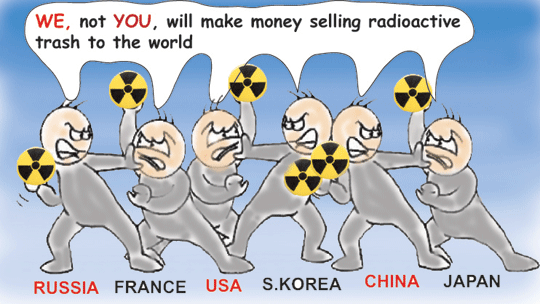
Kenya is on a delicate journey that will see it switch on its first nuclear power plant by 2027. The country plans to put up four nuclear plants in the long term, each generating 1,000 megawatts (MW) of electricity. Initial estimates show it will cost between Sh400 billion and Sh500 billion to put up one nuclear reactor. This means one plant will cost slightly more than building the 609-kilometre Mombasa to Nairobi Standard Gauge Railway (SGR). By the time the plan is complete, the country will have spent about Sh2 trillion – just under the national Budget for a year – to reap the benefits of an additional 4,000MW of energy plugged into the national grid.
Besides the financing headache, the second test for the 10-year dream being championed by the Kenya Nuclear Energy Board (KNEB) is coming up with a location to for the reactors. The board estimates site selection will cost the country Sh1.5 billion in a three-year process. Though the potential sites have remained a closely guarded secret, the power plant will be built next to any of the four biggest water bodies in the country – that is, the Indian Ocean, Lake Victoria, River Tana and Lake Turkana.
1 This Month


Petition to revoke the licensing of the Near Surface Nuclear Disposal Facility (NSDF) at Chalk River. https://www.ourcommons.ca/petitions/en/Petition/Details?Petition=e-7247


of the week – STOP SMALL MODULAR REACTORS IN CANADA
To see nuclear-related stories in greater depth and intensity – go to https://nuclearinformation.wordpress.com
-
Archives
- March 2026 (163)
- February 2026 (268)
- January 2026 (308)
- December 2025 (358)
- November 2025 (359)
- October 2025 (376)
- September 2025 (258)
- August 2025 (319)
- July 2025 (230)
- June 2025 (348)
- May 2025 (261)
- April 2025 (305)
-
Categories
- 1
- 1 NUCLEAR ISSUES
- business and costs
- climate change
- culture and arts
- ENERGY
- environment
- health
- history
- indigenous issues
- Legal
- marketing of nuclear
- media
- opposition to nuclear
- PERSONAL STORIES
- politics
- politics international
- Religion and ethics
- safety
- secrets,lies and civil liberties
- spinbuster
- technology
- Uranium
- wastes
- weapons and war
- Women
- 2 WORLD
- ACTION
- AFRICA
- Atrocities
- AUSTRALIA
- Christina's notes
- Christina's themes
- culture and arts
- Events
- Fuk 2022
- Fuk 2023
- Fukushima 2017
- Fukushima 2018
- fukushima 2019
- Fukushima 2020
- Fukushima 2021
- general
- global warming
- Humour (God we need it)
- Nuclear
- RARE EARTHS
- Reference
- resources – print
- Resources -audiovicual
- Weekly Newsletter
- World
- World Nuclear
- YouTube
-
RSS
Entries RSS
Comments RSS
 nuclear-news