How North Korea outsmarts US intelligence agencies—and what they should do to adapt

Bulletin, By Lauren Cho | October 27, 2025
In the summer of 2017, the United States learned a humbling lesson. For years, American intelligence agencies had assessed that North Korea would need several more years—until 2020 or even 2022—before it could field a missile capable of striking the continental United States. Then, on July 4, Pyongyang launched an intercontinental ballistic missile that reached deep space and re-entered at high velocity.
By that September, North Korea had detonated a hydrogen bomb more than 15 times stronger than the weapon that destroyed Hiroshima. The Central Intelligence Agency and its sister agencies had anticipated that this day would eventually come. But their inability to predict the rapid pace of advancement remains one of the starkest intelligence failures of recent decades. It was not simply a matter of bad luck or faulty technical analysis. It was the result of two forces that intersect again and again in the history of US assessments of North Korea’s nuclear program: Pyongyang’s deliberate use of strategic deception, and the institutional inertia of the US intelligence community.
From the first suspicions of a clandestine weapons program in the 1980s through the collapse of the 1994 Agreed Framework, the inconclusive Six-Party Talks, and the dramatic summits of 2018–2019, a familiar cycle has emerged: Washington enters negotiations determined to halt or roll back North Korea’s program. North Korea agrees on paper but continues developing weapons in secret, denying violations and then unveiling new capabilities with a missile test or nuclear detonation. The agreement collapses, and Washington returns to the negotiating table with hopes of restoring momentum toward denuclearization.
Each turn of this cycle reveals a recurring blind spot. American analysts focus on observable indicators and static assumptions, while North Korea manipulates visual evidence and creates ambiguity to gain time.
Defining intelligence. To the public and political leaders, any unpleasant surprise is an intelligence failure. Scholars define it more precisely. Richard K. Betts, an American political scientist who is one of the leading thinkers on this issue, has argued that failures are not rare anomalies but inevitable outcomes of systemic, cognitive, and organizational barriers. Intelligence agencies must operate under conditions of uncertainty and ambiguous evidence. The greater the ambiguity, the greater the influence of preexisting beliefs.
In the case of North Korea, ambiguity is not simply an accident involving limited information. It is a condition carefully constructed by the regime.
Strategic deception—deliberate manipulation of information to influence an adversary’s perceptions—has become a central component of North Korea’s nuclear armament strategy. American intelligence agencies have repeatedly struggled to adapt to this strategy, because they are weighed down by bureaucratic norms that prize continuity over change and reactivity over anticipation.
Strategic deception is most effective when the target already wants to believe a certain narrative……………………………………………………………………………………………………………………………………………………………………..
Rethinking US intelligence on North Korea. What, then, is to be done? Absolute accuracy in intelligence is unattainable, but incremental improvement is possible. The patterns seen in previous US-North Korean relations suggest several possible reforms. First, intelligence organizations must build for adaptability, not stability. They must prioritize agility, encourage analysts to test assumptions, reward dissenting perspectives, and treat ambiguity as a strategic variable. Rather than forcing ambiguous evidence into existing frameworks, agencies must recognize that adversaries actively manipulate ambiguity.
Also, analysts need more than satellite imagery and signals intercepts. They need linguistic, cultural, and psychological expertise to decode the narratives that adversaries craft. Deception is a cognitive process, not just a technical one. Countering it requires cognitive tools. Intelligence that is accurate but ignored is still a failure.
Finally, agencies must improve communication with policy makers, making uncertainty clear and resisting the urge to present false precision. The goal is not to eliminate ambiguity but to help decision makers understand it and prepare for multiple scenarios……………………………. https://thebulletin.org/2025/10/how-north-korea-outsmarts-us-intelligence-agencies-and-what-they-should-do-to-adapt/?utm_source=ActiveCampaign&utm_medium=email&utm_content=How%20North%20Korea%20outsmarts%20US%20intelligence&utm_campaign=20251024%20Monday%20Newsletter%20%28Copy%29
The anti-Russia, pre-SMO, Timeline of Which Legacy Media Won’t Speak
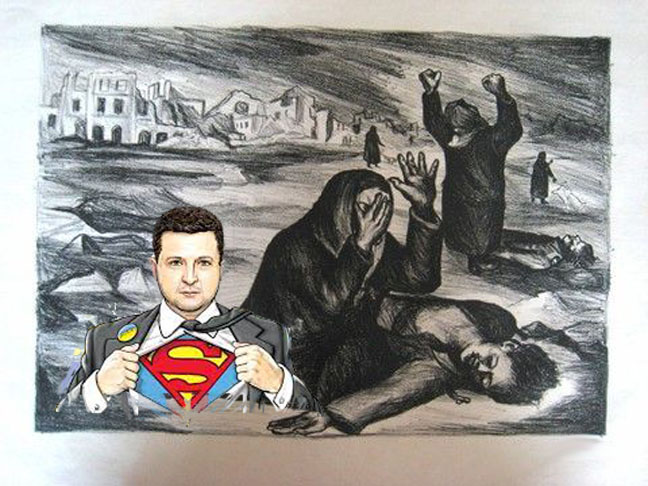
timeline of events leading up to the commencement in February 2022 of Russia’s Special Military Operation
Eva Karene Bartlett, Oct 28, 2025, https://evakarenebartlett.substack.com/p/the-anti-russia-pre-smo-timeline?utm_source=post-email-title&publication_id=3046064&post_id=177345476&utm_campaign=email-post-title&isFreemail=true&r=1ise1&triedRedirect=true&utm_medium=email
Very useful written timeline of events leading up to the commencement in February 2022 of Russia’s Special Military Operation.
Jacques Baud discussed much of this (see bottom of this post), but this written account is worth bookmarking.
Alan Watson:
“Vladimir Putin did not wake up on 24 February 2022 and decide, “I think I’ll invade eastern Ukraine today,” nor was the US campaign to expand NATO into Ukraine a last-minute maneuver. (US State Department documents show Ukraine’s future membership was discussed as early as 1994.)
9 Feb 1990: In a deal approved by Mikhail Gorbachev, the last leader of the Soviet Union, as a quid pro quo for accepting German reunification within NATO, Secretary of State James Baker pledged that NATO would not expand “one inch to the east.”
US, European and German leaders made explicit assurances to Gorbachev against any future eastward NATO expansion. Gorbachev understood the assurances as a “binding agreement.” Subsequently, Soviet leaders made decisions on that basis and acted on them – withdrawing the Red Army from Germany and dissolving the Warsaw Pact.
12 March 1999: Clinton is president. The Czech Republic, Hungary and Poland became members of NATO. A weakened post-Soviet Russia, led by Boris Yeltsin, controlled by a cabal of Oligarchs, could do nothing to prevent it. Powerless, Yeltsin was said to be “infuriated” with “his friend Bill Clinton…”
29 March 2004: George W. Bush is president. Seven more Eastern European countries join NATO: Bulgaria, Estonia, Latvia, Lithuania, Romania, Slovakia and Slovenia – largest wave of NATO enlargement ever.
April 2008: At the Bucharest NATO summit, George W. Bush announced that Ukraine and Georgia are on an “immediate path to NATO.” Bill Burns, ambassador to Russia, sent a memo to Secretary of State Condoleezza Rice. “Across the board,” he wrote, the Russian political class told him, “Ukraine is the reddest of red lines” – “Nyet means nyet.”
22 Feb 2014: Just as the Sochi Winter Olympics were underway, Kiev erupted in violence. State Department official Virginia Nuland boasted that since the 2004-2005 “Orange Revolution,” the US had spent $5 billion on regime change in Ukraine. NATO rooftop snipers killed both protestors and police, forcing Ukraine’s democratically elected president Viktor Yanukovych to flee the country.
2 May 2014: Bussed to Odessa from Kiev, Right Sector thugs carrying baseball bats confront ethnic Russians protesting the coup. When protestors fled into the city’s Trade Unions House, the building was set on fire. Forty-eight people were burned or bludgeoned to death – the Donbass civil war point of no return.
11 Feb 2015: Putin and Ukrainian President Poroshenko meet with French President Francois Hollande and German Chancellor Angela Merkel in Belarus to negotiate the Minsk ceasefire accords. The leaders agreed to a deal that would have ended the fighting – granting autonomy to the Russian-speaking Donbass, but successive Ukrainian governments refused to implement the accord.
German Chancellor Merkel later admitted that Minsk was a stall tactic to allow the West to build Ukraine’s army up to NATO standards. [Ed. note – Zelensky also admitted that he lied in his campaign for President, in pledging to uphold the Minsk agreement]
17 Dec 2021: Team Biden rejects Putin’s proposed mutual security accords that would have left a “neutral” Ukraine intact. For years, Russia had tried to convince US administrations that Ukraine was off-limits to NATO membership, but Russian concerns were brushed aside. December 2021, Team Biden insisted, “Russia doesn’t say who can join NATO.”
18 Feb 2022: During the Winter Olympics in China, the Organization for Security and Co-operation in Europe (OSCE) documented that Ukraine had ramped up artillery attacks along the Line of Contact.
(Since the 2014 coup in Kiev, the Armed forces of Ukraine, including the Neo-Nazi Banderites, had killed thousands of ethnic Russians in the Donbass.
19 Feb 2022: Invited to speak at the Munich Security Conference, Ukrainian President Zelensky said, “Ukraine will get and deploy nuclear missiles.”
20 Feb 2022: On CBS 60 Minutes, Ukraine’s Minister of Foreign Affairs Dmytro Kuleba said, “Ukraine will never honor the Minsk cease fire.”
21 Feb 2022: Russia captured a Ukrainian soldier, killed five others as they crossed over the border into Rostov. Russia learned the invasion of Donetsk city was imminent and recognized the breakaway Donbass and Luhansk oblasts as independent republics.
24 Feb 2022: With about 90,000 troops, Russia launched its “Special Military Operation” – not a “full scale invasion.” Citing the UN principle, “Responsibility to Protect,” Russia intervened in the eight-year Donbass civil war after all prospects for diplomacy had failed.
April 2022, week six of the war, Russian and Ukrainian negotiators convened peace talks in Istanbul. Later, Ukrainian diplomat Oleksandr Chalyi recalled, “Putin tried to do everything possible to conclude an agreement…” [The tentative accord would have left a “neutral” #Ukraine intact.]
On 1 April, USAID revealed photographic evidence of a “massacre” in Bucha and financed a press tour featuring US public figures. Problem: Four days earlier at a press conference, the mayor had announced that the Russians had retreated from the city [and he did not report there had been a massacre].
After the Russians voluntarily retreated, the regime scattered bodies in the streets that included both actors in body bags and recently killed “Russian collaborators” from around Bucha – giving an “outraged” Joe Biden and Boris Johnson, who flew unannounced to Kiev, the justification to order Zelensky to “keep fighting.”
If the US, UK and EU continue rejecting Russian proposals for a long term, European wide peace accord – as Putin proposed in December 2021 – the Russian army will continue advancing toward Kharkiv in the north and Odessa on the Black Sea. As Putin and Foreign Minister Sergei Lavrov emphasized: There will be no Minsk III.”
From a September 2024 interview I did with Jacques Baud (former Swiss intelligence & author). In this clip, Jacques lays out the history of events related to Ukraine prior to 2022, prior even to the 2014 coup which brought fascism to power in Ukraine, & how it was the NATO-Ukraine alliance which brought war, not Russia.
Full interview: https://rumble.com/v5fjhrh-jacques-baud-nato-threatened-russia-decades-before-2022.html https://odysee.com/@EvaKareneBartlett:9/JacquesBaudNATOThreatenedRussia:5
The UK is at risk of a nuclear attack as the US is set to house nuclear weapons in Suffolk, England, which would make the country a target in a US and Russia war
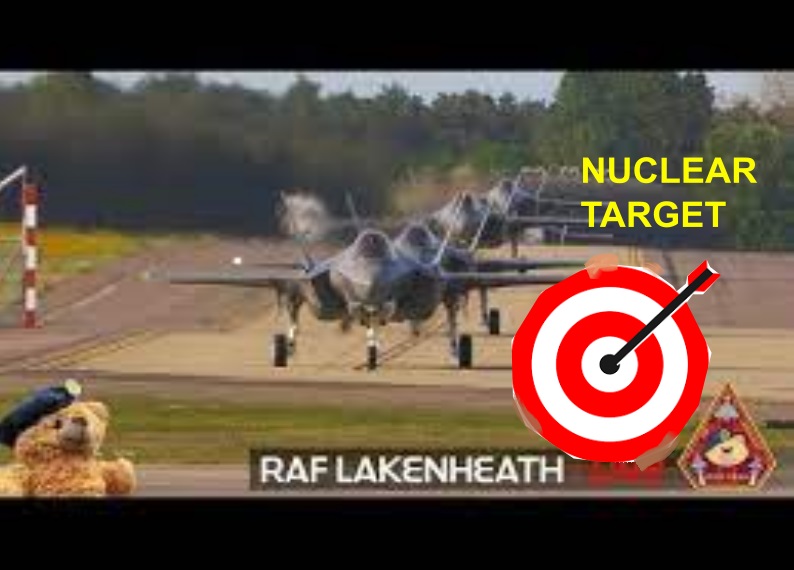
Emily Malia Mirror UK, GAU Writer, 27 Oct 2025
RAF Lakenheath in Suffolk, operated by the United States, is expected to house US/ NATO nuclear weapons in the near future. This development places the UK on the frontline of potential conflict between America and Russia.
The presence of American nuclear weapons on British soil significantly increases the nation’s risk of becoming a target. Military analysts suggest that in the event of war, Lakenheath would likely face strikes before attacks spread to other parts of the country.
Whilst experts acknowledge that nuclear conflict between the US, NATO and Russia would prove devastating globally, it’s crucial to grasp the direct consequences for British towns and cities. The Campaign for Nuclear Disarmament warns: “A single nuclear strike on any town or city would be catastrophic for the local community and environment, and the radioactive impact would spread much further.
“But a nuclear war would be catastrophic for all humanity, forms of life, and the entire planet. Yet the possibility of nuclear war is the greatest for many decades.”
Casualties
Their report reveals if a Russian warhead, such as an SS-25 or SS-27, were to strike the heart of London, nearly a million people would die. Similarly, a hit on Glasgow could result in 326,000 casualties, while in Cardiff, 196,000 lives would be lost.
The epicentre of the nuclear explosion is believed to reach a staggering temperature of several million degrees centigrade. Consequently, a heat flash would obliterate all human tissue within a 1.5 square mile radius.
Back in 1945, when the United States unleashed two atomic bombs over Hiroshima in Japan, all that was left within a half-mile radius were shadows seared into stone. The aerial bombings claimed up to 200,000 lives, most of whom were civilians………………………………………..
Further afield from the zone of instant devastation, there would be a gradual rise in fatalities among those who endured the initial explosion. Approximately seven miles from the blast site, individuals would sustain lethal burns or even require amputations, while others would be blinded or suffer internal injuries.
Unlike a typical disaster, the mortality rate would be shockingly high as most emergency services would be unable to respond due to their own personnel being killed and equipment destroyed. The sheer number of casualties would simply swamp the UK’s medical resources, with people as far as 11 miles away potentially suffering injuries from shattered windows or structural damage.
The long-term impact
In the ensuing days, even those fortunate enough to survive would now be impacted by the radioactive fallout, with the majority succumbing within a week. This would manifest in various ways, from hair loss to bleeding gums, fever, vomiting, delirium and even internal bleeding.
Those with lower levels of exposure would still face complications, including pregnant women who are at a high risk of miscarriage and birth complications. In addition, long-term effects could include radiation-induced cancers affecting many civilians, up to two decades after the event.
It’s believed that children of those exposed to radiation are statistically more likely to be born with abnormalities and suffer from leukaemia. Aside from public health, nuclear weapons are known to cause severe damage to the environment and climate on an unprecedented scale.
Predictions suggest that in the aftermath of a nuclear war, two billion people could face starvation due to climate disruption and its impact on food production. https://www.mirror.co.uk/news/world-news/horrifying-number-people-who-could-36139768
Bechtel boss urges US government to share risk of nuclear build-out

The construction group that rescued the last big US nuclear energy project
from bankruptcy has called on Washington to share the risk of cost overruns to deliver Donald Trump’s “American nuclear renaissance”.
Bechtel president Craig Albert told the Financial Times industry could deliver on the president’s executive orders to start work on developing 10
large-scale nuclear reactors by 2030. But government and the private sector would need to work together to overcome financing hurdles linked to risks of cost overruns and delays.
“The advice we’ve been giving the government is . .there is overrun risk, and no one company can take it all because they’d be betting their company,” he said in an interview.
“The government has provided very good tax incentives that improve the
rate of return, but that doesn’t address overrun risk, that just improves
the rate of return. So, I do think the government will have a role to
play.”
FT 28th Oct 2025. https://www.ft.com/content/74d1f5f0-a255-4e63-8ffa-86a9cdf663df
The Next Nuclear Renaissance?

Will a new wave of nuclear power projects deliver the safe and economical electricity that proponents have long predicted?
CATO Institute, Fall 2025, By Steve Thomas
Over the past decade, there has been a growing interest in building new nuclear power stations, particularly among policymakers. This comes some two decades after a previously forecast “nuclear renaissance” petered out, having produced few orders, all of which went badly wrong.
This article reviews the previous renaissance: What was promised, what was delivered, and why it failed. It then considers the current claims of a new renaissance led by Small Modular Reactors, forthcoming “Generation IV” designs, new large reactors, and extending the lifetime of existing nuclear plants. Despite the need for clean generation, the growing demand for electricity to power new technologies and global development, and claims of nuclear generation breakthroughs that are either here or soon will be, this new renaissance appears destined for the same failure as the previous ones.
The Last Renaissance
Around the start of this century, there was a great deal of publicity about a new generation of reactors: so-called Generation III+ designs. These would evolve from the existing dominant “Gen III” designs—Pressurized Water Reactors (PWRs) and Boiling Water Reactors (BWRs), collectively known as Light Water Reactors (LWRs)—rather than be radical new designs. There was no clear definition of the characteristics that would qualify a design as Gen III+ rather than just Gen III LWRs. However, Gen III+ was said to incorporate safety advances that would mitigate the risks of incidents like the 1979 partial meltdown at Three Mile Island (a Gen II design) and the 1986 Chernobyl meltdown (a Soviet design that used Gen I/II technology). Three Gen III+ designs received the most publicity: the Westinghouse AP1000 (Advanced Passive), the Areva EPR (European Pressurized Water Reactor), and the General Electric ESBWR (Economic Simplified Boiling Water Reactor).
The narrative was that Gen III designs had become too complex and difficult to build because designers were retrofitting safety features to avoid another Three Mile Island. Gen III+ supposedly went back to the drawing board, rationalizing existing systems and incorporating new safety features, thereby supposedly yielding a cheaper and easier-to-build design. A particular feature of these designs was the use of “passive safety” systems. In an accident situation, these did not require an engineered safety system to be activated by human operators and were not dependent on external sources of power; instead, the reactor would avoid a serious accident by employing natural processes such as convection cooling. These had an intuitive appeal, and a common assumption was that because they were not mechanical systems, they would be cheaper, and because they involved natural processes, they would never fail. Neither assumption is correct.
Another major safety feature resulting from the Chernobyl disaster was a system that, if the core was melting down, prevented the molten core from burning into the surrounding ground and contaminating it. A common approach was a “core-catcher” (already used in a few early reactors) that would be placed underneath the reactor. An alternative, often used for smaller reactors, was a system to flood the core with so much water that it would halt the meltdown.
After the September 11, 2001, terrorist attacks, designers attempted to further increase safety by strengthening the reactor shell so it could withstand an aircraft or missile impact. The core-melt and aircraft protection features inevitably tended to increase the size and complexity of the Gen III+ designs.
Nuclear advocates also claimed that the large cost and time overruns of previous plants were caused in part by the high proportion of work carried out on site. To combat this and the additional complexity noted above, designers vowed to rely more on factory-made modules that could be delivered by truck, reducing sitework mostly to “bolting together” the pieces. In practice, there was significant variability between the Gen III+ designs, with the AP1000 and ESBWR relying much more on passive safety and modular construction than the EPR.
What sold these designs to policymakers were some extraordinary claims about construction costs and times. It was claimed that their cost (excluding finance charges; so-called “overnight cost”) would be around $1,500–$2,000 per kilowatt (kW), meaning a large, 1,000-megawatt (MW) reactor would cost $1.5–$2 billion. Construction time would be no more than 48 months. While there were few existing nuclear projects then to compare the new designs with, these projected costs and times were far below the levels then being achieved with existing designs.
These claims convinced the US government, under President George W. Bush, and the UK government, under Prime Minister Tony Blair, to launch large reactor construction programs. As those countries were two of the pioneering users of nuclear power, this appeared to be a strategically important victory for the nuclear industry.
US / In 2002, President Bush announced his Nuclear 2010 program, so-called because it was expected the first reactor under the program would come online in 2010. It was assumed the new nuclear designs would be competitive with other forms of generation,………………………………………..
In states with regulated electricity markets, utilities were concerned that regulators might not allow them to recover their costs from consumers if there were time and cost overruns. Most of the other projects were abandoned on these grounds, leaving only two to enter the construction stage: a two-reactor project to join an existing reactor at the V.C. Summer plant in South Carolina, and a two-reactor project to join two existing reactors at the A.W. Vogtle project in Georgia. All four new reactors would be Westinghouse AP1000s.
In those two states, regulators gave clear signals that the utilities would be allowed to recover all their costs. The state governments broke with regulatory practice by passing legislation allowing the utilities to raise rates and start recovering their costs from the date of the investment decision, not the date when the reactors entered service…………………………………………….
Consumers started paying for the reactors in 2009–2010, even though construction didn’t start until 2013. By 2015, both projects were in bad shape, way over time and budget. Westinghouse, then owned by Toshiba of Japan, was required to offer fixed-price terms to complete the projects. Those prices soon proved far too low, and in March 2017 Westinghouse filed for Chapter 11 bankruptcy protection. The whole of Toshiba was reportedly at risk as a result. In August 2017, the V.C. Summer project was abandoned. The A.W. Vogtle project continued, and the first reactor was completed in July 2023 with the second unit following in April 2024, six or seven years behind schedule and at more than double the forecasted cost. There are now no proposals for additional large reactor projects in the United States.
UK / In 2003, a UK Energy White Paper (DTI 2003) concluded there was no case for nuclear power because renewables and energy efficiency measures were cheaper. According to the report, “the current economics of nuclear power make it an unattractive option for new generating capacity and there are also important issues for nuclear waste to be resolved.” Only three years later and despite the lack of evidence that nuclear had become cheaper or that renewables and energy efficiency had become more expensive, Blair reversed the government’s position, claiming nuclear power was “back on the agenda with a vengeance.”
As with the US program, the assumption was that the new designs would be competitive. A key promise that made the program politically acceptable was there would be no public subsidies. Politicians—even those who were favorable to nuclear—were aware that previous UK nuclear projects had gone badly and the costs of this had fallen on taxpayers and electricity consumers. The energy minister told a Parliamentary Select Committee:
There will be no subsidies, direct or indirect. We are not in the business of subsidizing nuclear energy. No cheques will be written; there will be no sweetheart deals.
This promise of no subsidies remained government policy until 2015, despite it being clear long before then that new nuclear projects were only going forward in anticipation of large public subsidies……………………………………………………………
Three consortia were created, each led by some of the largest European utilities………………………………………………….. As early as 2007, the consortium led by EDF established a leading presence, with the CEO of EDF Energy, Vincent de Rivaz, notoriously claiming that Christmas turkeys in the UK would be cooked using power from the Hinkley Point C EPR in 2017. In 2010, the UK energy secretary still claimed Hinkley would begin generating no later than 2018.
The Final Investment Decision (FID) for Hinkley was not taken until October 2016, when it was expected the two reactors would be completed by October 2025 at an overnight cost of £18 billion (in 2015 pounds sterling, equivalent to $35 billion in today’s dollars). ……………………………………………..In January 2024, EDF issued a new cost and time update—its fifth—with completion now expected to be as late as 2032 at a cost of £35 billion (in 2015 pounds sterling, equivalent to $68.7 billion in today’s dollars). As a result, EDF wrote off €12.9 billion ($14 billion) of its investment in Hinkley Point C in 2023. By 2018, EDF recognized the error it made in accepting the risk of fixing the power price, and it abandoned plans for an EPR station at Sizewell using the Hinkley C financial model. In July 2025, an FID was taken on the Sizewell C project using a different financial model and completion is not expected before 2040.
The effect of the 2011 Fukushima, Japan, nuclear plant disaster, where a tsunami resulted in meltdowns in three reactors, combined with the effect of competition in wholesale and retail markets in electricity meant that European utilities could not justify to their shareholders the building of new reactors. The Horizon and Nugen consortia were sold to reactor vendors Westinghouse and Hitachi–GE, respectively. Those firms did not have the financial strength to take significant ownership stakes in the reactors, but they saw this as an opportunity to sell their reactors on the assumption that investors could later be found. Westinghouse (then planning three AP1000s for the Moorside site) filed for Chapter 11 bankruptcy protection in 2017. Hitachi–GE abandoned its two projects (four ABWRs, two each at Wylfa and Oldbury) in 2019 when it became clear that, despite the UK government offering to take a 30 percent stake in the reactors and to provide all the finance, other investors were not forthcoming.
Lessons learned / Thus ended the last nuclear renaissance. Its failure does not determine the outcome of the present attempt, but there are some important lessons that will shape the outcome this time:
- While governments have always had to play a facilitating role in nuclear power projects, such as providing facilities to deal with the radioactive waste, they were centrally involved in the 2000 renaissance. This trend has continued, and governments are now offering to provide finance, take ownership stakes, offer publicly funded subsidies, and impose power purchase agreements that will insulate the reactors from competitive wholesale electricity markets.
- Forecasts of construction costs and times made by the nuclear industry must be treated with extreme skepticism. The claim that the new designs would be so cheap they would be able to compete with the cheapest generation option then available—natural gas generation—proved so wide of the mark that other claimed characteristics, such as supplying base-load power and offering low-carbon generation, are now given as the prime justifications for the substantial extra cost of nuclear power over its alternatives.
- The technical characteristics claimed to give advantages to the Gen III+ designs (such as factory-manufactured modules and passive safety) have not been effective in controlling construction times and costs.
- The large reactor designs now on offer are the same ones that were offered previously. No fundamentally new designs have started development this century. It is hard to see why these designs that have failed by large margins to meet expectations will now be so much less problematic……………………………………………… https://www.cato.org/regulation/fall-2025/next-nuclear-renaissance#small-modular-reactors
A Torturous Sanitation Disaster Is Unfolding in Gaza’s Displacement Camps
Every morning we wake to disease, dust, and the unbearable stench of open sewage.
By Sara Awad , Truthout, October 25, 2025
Ceasefire is a relief. After two years of surviving war, we can finally breathe — but that doesn’t mean our suffering is over. For many of us, it’s only just begun. The tents, and the people still living in them, stand as a heavy reminder that our struggles are far from over. After two years of immense destruction by the Israeli military, most families in Gaza are now living in tents — nylons and fabric that don’t protect them either from summer or winter.
In tent life, there is an unlivable war — a war that doesn’t begin with bombs, but with the absence of everything that makes life human. It is a war whose weapons are the denial of clean water, the lack of hygiene, the absence of toilets, dignity, and safety. I am not writing this as a distant witness. No — I am writing this from within it. From the ground. From inside the tent. These are not stories I’ve heard; these are the sensations I experience.
One month living in a tent was enough for me to understand the immense sanitation disaster and horrific conditions that make displaced people feel suffocated by everything around them. This kind of news doesn’t make headlines, and you might not have heard about it. But it is a silent kind of violence — one that kills us every day.
I am here to tell you how my people — including my family — are facing the devastating consequences of the sanitation crisis in these tents.
Thousands of makeshift tents at displacement camps all across Gaza are full of families seeking refuge.
A lack of sufficient toilets, access to clean water, and the presence of open sewage are catastrophic consequences faced by displaced Palestinians — conditions that have persisted since the early months of Gaza’s displacement crisis.
After spending over a month in Gaza City under Israeli occupation, 39-year-old Asma Mohammad and her family fled to the central Gaza Strip, seeking refuge in Al-Nuseirat Camp to escape the ongoing Israeli offensive. Speaking to me via WhatsApp, she described the daily struggle to access basic sanitation. “I have to walk nearly half an hour just to reach the bathroom,” Asma said. “I stopped drinking coffee or tea so I wouldn’t have to walk so far to use a filthy toilet that’s shared by hundreds of people.”
This is something that touches our dignity. I know what she meant because I am experiencing the same thing. Here where I am in az-Zawayda, in central Gaza, men spend a whole week building a bathroom — a toilet. It takes so long because there is no sewage system anywhere anymore. Israel has destroyed the vast majority of sewage facilities in every part of Gaza……………………………………………………………………………………………………………………………………………………………………………. https://truthout.org/articles/a-torturous-sanitation-disaster-is-unfolding-in-gazas-displacement-camps/?utm_source=Truthout&utm_campaign=ec58022e30-EMAIL_CAMPAIGN_2025_10_25_06_42&utm_medium=email&utm_term=0_bbb541a1db-ec58022e30-650192793
America’s $80bn nuclear reactor fleet exposes Sizewell C costs.

The plants are expected to be bankrolled by Japanese investors as part of the $550bn investment pledged by Tokyo under the new US-Japan trade deal.
The United States has announced an $80 billion plan to build a fleet of nuclear power plants for less than two thirds of the cost per gigawatt of
Britain’s Sizewell C project. About eight of Westinghouse’s one
gigawatt AP1000 reactors are to be built across America, under a
partnership between the US government and the reactor-maker’s owners,
Brookfield and Cameco, to accelerate nuclear power deployment. The plants are expected to be bankrolled by Japanese investors as part of the $550 billion investment pledged by Tokyo under the new US-Japan trade deal.
The cost of about $10 billion (£7.5 billion) per gigawatt of new capacity is
significantly cheaper than the UK government’s recently approved plans
for the Sizewell C plant in Suffolk. Sizewell is due to generate 3.2
gigawatts of electricity — enough to power six million homes — at a
cost of £38 billion, or £11.9 billion per gigawatt. The contrast will do
nothing to alleviate concerns about the high costs of Britain’s nuclear
programme, although the US plans are still at a much earlier stage.
Critics have blamed factors including the UK’s choice of EDF’s “EPR”
reactor and safety red tape for inflating nuclear construction costs in
Britain. The costs of the 3.2GW Hinkley Point plant in Somerset, already
under construction, are estimated to have risen to as much as £48 billion.
Times 28th Oct 2025,
https://www.thetimes.com/business-money/companies/article/americas-80bn-nuclear-reactor-fleet-exposes-sizewell-c-costs-qxcqfdv5z
International Court of Justice Delivers Opinion on Israel’s Obligations

Voltaire Network | 25 October 2025, https://www.voltairenet.org/article223043.html
At the request of the UN General Assembly, the International Court of Justice (ICJ), the internal court of the United Nations, issued an advisory opinion on 22 October on the “Obligations of Israel with regard to the presence and activities of the United Nations, other international organizations and third States in and in connection with the Occupied Palestinian Territory”
he Court is of the opinion that the State of Israel, as the occupying power, must fulfil its obligations under international humanitarian law. These obligations include:
ensuring that the population of the Occupied Palestinian Territory has access to the essentials of daily life, including water, food, clothing, sleeping materials, shelter and fuel, as well as medical items and services;
accepting and facilitating to the fullest extent possible relief actions for the population of the Occupied Palestinian Territory as long as they are inadequately supplied, as has been observed in the Gaza Strip, including relief actions by the United Nations and its entities, in particular the United Nations Relief and Works Agency for Palestine Refugees in the Near East, and by international organizations and third States, and not to prevent such actions;
respecting and protecting all emergency and medical personnel, as well as their premises;
respecting the prohibition of forcible transfer and deportation to the Occupied Palestinian Territory;
respecting the right of protected persons in the Occupied Palestinian Territory who are detained by the State of Israel to receive visits
respecting the prohibition of the use of starvation as a method of warfare against civilians. Furthermore, the Court is of the opinion that, as the occupying power, the State of Israel has an obligation under international human rights law to respect, protect and fulfil the human rights of the population of the Occupied Palestinian Territory, including through the presence and activities of the United Nations, other international organizations and third States in and in connection with the Occupied Palestinian Territory;
It is of the view that the State of Israel has an obligation to cooperate in good faith with the United Nations by giving it full assistance in any action undertaken by it in accordance with United Nations’ Charter, including through the United Nations Relief and Works Agency for Palestine Refugees in the Near East, in and in connection with the Occupied Palestinian Territory;
It is of the view that the State of Israel has an obligation under Article 105 of the United Nations Charter to ensure full respect for the privileges and immunities accorded to the United Nations, including its structures and organs, and its officials, in and in connection with the Occupied Palestinian Territory;
It is of the view that the State of Israel has an obligation under article II of the Convention on the Privileges and Immunities of the United Nations to ensure full respect for the inviolability of the premises of the United Nations, including those of the United Nations Relief and Works Agency for Palestine Refugees in the Near East, and the exemption of the property and assets of the United Nations from all forms of coercion.
Finally, it is of the view that the State of Israel has an obligation, under articles V, VI and VII of the Convention on the Privileges and Immunities of the United Nations, to ensure full respect for the privileges and immunities accorded to United Nations officials and experts on mission for the United Nations, in and in connection with the Occupied Palestinian Territory.
Three workers at nuclear fuel reprocessing plant possibly exposed to internal radiation

AOMORI – https://www.japantimes.co.jp/news/2025/10/29/japan/society/nuclear-plant-internal-exposure/
Three workers may have suffered internal radiation exposure while working in a spent nuclear fuel reprocessing plant in Rokkasho, Aomori Prefecture, Japan Nuclear Fuel has said.
The men in their 20s to 40s are employees of a partner company sent to work in a controlled area of the plant, according to an announcement by Japan Nuclear Fuel on Monday.
Radiation was detected inside the nasal cavity of one of the three, who is in his 40s, prompting the company to check whether all three had been internally exposed.
None of them has reported any change in their health condition so far, Japan Nuclear Fuel said.
According to the company, the three were working to replace filters that remove radioactive materials from gas emitted from a tank, in a building used for denitration of uranium-plutonium mixed solution, when radiation levels rose at around 11:10 a.m. Friday.
After they left the area, as instructed, contamination was found on the outer surface of the filters of their protective masks.
When contamination is detected, workers are typically instructed to cover air intake filters with tape to prevent further contamination and replace the filter while holding their breath.
However, two of the three breathed without filters for up to three minutes, according to Japan Nuclear Fuel. It is not clear when that occurred.
The company is still investigating why the two men breathed without filters. It is also analyzing urine and stool samples from the three workers to determine whether internal radiation exposure occurred, and investigating the cause of the increase in radiation levels.
It’s Not a Ballroom. It’s a Bunker.

The billionaires have gone bunkers. …..every action indicates that they’re not just preparing for collapse, they’re betting on it, they’re driving it. They want it to happen. We’re already crossing tipping points, like the loss of the coral reefs. Things we predicted for the 2040s are happening now.

Trump serves as the figurehead of a deeply paranoid technocratic network who sees the world collapsing, because they collapsed it. They plan to wage wars from their cyberbunkers, at home and abroad.
And there’s a reason.
Jessica Wildfire, Sentinel Intelligence, October 27 2025
The Trump administration has torn down the East Wing to build a new ballroom. Despite all the noise, everyone seems to be overlooking a simple fact.
As a piece in The Hill mentions in passing, the east wing hides a bunker. Roosevelt built the bunker during WWII, after Pearl Harbor, and he used the east wing specifically to cover it up. The bunker has served as an emergency operations center ever since. They don’t care what sits on top of it. That’s an afterthought.
Traditionally, the First Lady uses it.
Tiny corners of the internet are whispering that the demolition has nothing to do with a ballroom. It has everything to do with upgrading the bunker. Since they’re hardening the bunker, they might as well build Trump the ballroom of his dreams, the perfect place to run crypto schemes and host corrupt dictators.
Trump’s niece Mary, a vocal critic, has confirmed that the regime is simply using the ballroom as a cover for new bunker plans. Sources have also informed CBS News that the bunker upgrades will definitely happen during the ballroom’s construction. You can read about all of that here.
So, there you go.
If you don’t believe in conspiracies: When Roosevelt’s administration was building the first bunker, they also lied to the public about it. They said they were renovating the east wing to put in a museum. They knew they were fibbing.
The president technically has more than one bunker. There’s the first one built by Roosevelt’s administration, and a second one under the north lawn, and potentially a whole network of subterranean tunnels and command centers throughout D.C., stretching all the way into the Virginia mountains. They run hundreds of feet deep. The second one, under the White House Lawn, contains its own air supply.
It also has a food and water cache.
The media frequently primes the public to salivate over plush bunkers while dismissing the motivations for them as “paranoia.” Meanwhile, actuaries have warned world leaders that current estimates of the climate crisis are deeply misleading. In reality, 3C of global warming will drop the global GDP by 50 percent and kill billions. As a report by The Guardian summarizes: “At 3C or more of heating by 2050, there could be more than 4 billion deaths, significant sociopolitical fragmentation worldwide, failure of states (with resulting rapid, enduring, and significant loss of capital), and extinction events.” That’s right, 3C of warming equals 4 billion deaths. Climate research increasingly points at 3-4C of warming as the new likely scenario. In practical terms, we’ve already crossed the 1.5C threshold, a decade earlier than expected.
We’ll likely breach 2C by the end of the decade, and by then things will look bad enough that life will look and feel like collapse. It won’t be theoretical or hypothetical anymore. It’s going to be a lived experience for many of us.
That’s why they’re building bunkers.
It’s not exactly surprising that someone like Trump would want an upgraded bunker where he plans to spend more time hanging out as the world falls apart. Everyone from Sam Altman to Mark Zuckerberg are doing it. Zuckerberg has reportedly spent $300 million on his bunker, which just happens to match the amount Trump has raised to pay for his bunker, ahem, I mean, his ballroom.
They’re not just making the Spartan bomb shelters of yore.
They’re installing premium sanctuaries. Their demands have spawned an entire industry that builds luxury bunkers. These bunker companies are building their clients everything from underground sports car garages and swimming pools to movie theaters and virtual golf courses. They’re building fabrication workshops. They’re building arsenals. They’re building drone hatches. As one bunker builder puts it, “The scale and complexity of these environments have expanded dramatically, evolving far beyond survivalist shelters into fully integrated, high-comfort retreats.”
Will Trump’s bunker have a virtual golf course?
I wouldn’t doubt it.
The press casts doubt on the Trump regime’s timeline, saying there’s almost no chance they’ll actually finish before he leaves office. Of course, they’re basing that on what’s “normal.” Nothing normal is happening under this administration. As we’ve seen, when the super rich put their minds to it, they can accomplish almost anything with a swiftness that leaves everyone’s jaws on the floor.
For example:
Elon Musk’s AI company partnered with Nvidia to build the Colossus supercomputer near Memphis. It took them about four months, after estimates said it would take years. Experts consider it a superhuman feat. Now look at the speed they’re attacking the “ballroom” with. They’ve already completely torn down the old east wing. They’re not wasting any time on this thing, are they?
Consider who’s paying for it.
From The Guardian:
Donors for the proposed ballroom include a slew of major tech companies, including Apple, Amazon, Meta, Microsoft and Google. Defense contractors and communications companies have also pitched in, including Lockheed Martin, Palantir, T-Mobile and Comcast.
These corporations have accumulated $350 million for construction. The biggest tech companies in the world are paying hundreds of millions for… a ballroom? Defense contractors are chipping in?
No, I don’t think so…
Companies like Palantir don’t dabble in ballrooms. They’re in the business of building mass surveillance software, artificial intelligence suites, and drones. In fact, the U.S. military recently signed a $10 billion contract with Palantir for new toys. They’ve signed contracts with several big tech companies, including Google, Meta, and OpenAI. Even Amazon is quietly starting partnerships with the defense industry.
As we recently noted here, Silicon Valley has taken a hard military turn over the last year. The Trump administration has even created a “technical innovation unit” that’s recruiting CEOs and project managers from the same major tech companies that are funding the east wing construction. Tech investment in military tech has spiked 33 percent. They’re clearly preparing for all kinds of wars, especially urban ones.
Of course, Mary Trump makes the big mistake of dismissing the bunker as yet another sign of a fragile ego, and not a dark omen.
It’s a dark omen.
You don’t spend hundreds of millions on a structure with a bunker underneath it simply because you’re a paranoid loon with a big ego. Big military tech companies certainly don’t foot the bill for it. Don’t get me wrong, Trump is definitely a paranoid loon with a big ego. So is Peter Thiel and Russell Vought. But these aren’t the paranoid loons of ten years ago. They’re the paranoid loons of the 2020s, the ones who understand the depths of the climate crisis, the ones who lived through a pandemic, the ones watching the collapse take shape and all of the civil unrest it’s inspiring.
These bunkers have become their own perverse status symbols, with super rich families trying to top each other in terms of luxury and spectacle. Some families have built bunkers with moats, with underground race tracks for their kids, inside bamboo forests, and I suspect one or two have theme parks and shopping malls. The Kardashians tried to build a bunker with an underground spa.
Trump’s bunker tells us something.
They know.
As we’ve discussed here, the super rich and their political puppets are fully aware of what’s going on with the climate crisis. Big tech companies have largely dropped their climate pledges. So have the big banks and investment firms. They’re all going full steam ahead with coal and gas, and they’re rebooting nuclear plants, too. They’re doing it to power their AI fantasies, because they desperately want to replace people with robots while starving us and unleashing a pandora’s box of diseases. They know what’s in the latest climate reports. They know “there’s no future.” They sell hope to the masses, while quietly preparing for the end of the world. The mainstream media, and the Mary Trumps of the world, write them off as paranoid.
It’s so much worse than that.
The billionaires have gone bunkers. As we document here every week, every action indicates that they’re not just preparing for collapse, they’re betting on it, they’re driving it. They want it to happen. We’re already crossing tipping points, like the loss of the coral reefs. Things we predicted for the 2040s are happening now.
What else?
Consider what’s going on in South America…………………………………….
Trump serves as the figurehead of a deeply paranoid technocratic network who sees the world collapsing, because they collapsed it. They plan to wage wars from their cyberbunkers, at home and abroad.
You may have also seen stories that Trump is contemplating a third term. Yes, we already know it’s unconstitutional. But this Trump, often called “Trump 2.0,” has even less regard for the constitution than he did in 2020.
Everything they’ve done so far indicates that they’re planning to seize control of elections by 2026, and certainly by 2028. By then, it won’t matter what’s constitutional. The Thiels and Voughts will run Trump as long as they can, until he literally keels over dead, either in office or at one of his rallies, and then they’ll replace him with Vance. By then, they’ll have a firm grip on blue cities and polling places. If Trump never gets to enjoy his ballroom bunker, I’m sure Vance will use it.
So, if you were planning to take over the government, invade major cities, preside over a deep recession, nurture new pandemics, start wars with other countries for their resources, and potentially invade Canada, all while the planet’s climate breaks down into a chaotic mix of droughts, dust storms, heat waves, and hurricanes that ultimately collapse the GDP by 50 percent and kill billions of people….
Wouldn’t you want a cool new bunker?
Report: Israel Launched Airstrike in Gaza on Saturday After Getting US Approval.

The IDF has killed at least 93 Palestinians in Gaza since the ceasefire went into effect
by Dave DeCamp | October 26, 2025, https://news.antiwar.com/2025/10/26/report-israel-launched-airstrike-in-gaza-on-saturday-after-getting-us-approval/
Israel launched an airstrike in Gaza on Saturday after notifying the US and getting approval to launch the attack, the Israeli news site Ynet has reported.
The Israeli military launched the strike in the Nuseirat Refugee Camp in central Gaza, claiming it targeted a member of Palestinian Islamic Jihad (PIJ) who was planning an attack on the IDF, a claim PIJ strongly denied.
PIJ said in a statement that the claim that its military wing, the al-Quds Brigades, was preparing an attack was “a pure false claim and fabrication through which the occupation seeks to justify its aggression and violation of the ceasefire.” PIJ, which supported the ceasefire deal, called on mediating countries to “compel” Israel to stop its attacks on Gaza.
The strike wounded four Palestinians, according to the al-Awda Hospital. “The hospital has received four injured people following the Israeli occupation’s targeting of a civilian car in the al-Ahli Club area in Nuseirat Camp in central Gaza,” the hospital said.
The Ynet report said the alleged PIJ operative who was targeted was wounded, not killed. According to Israeli sources, the strike came after Israel passed intelligence to the US, and the attack was only launched after coordination with US Central Command (CENTCOM), which included notifying CENTCOM Commander Adm Brad Cooper. CENTCOM has established a military post in southern Gaza where it is overseeing the Gaza ceasefire.
US Middle East envoy Steve Witkoff was also briefed on the strike right after it was launched. The attack marked the first time that Israel and the US used a new mechanism to coordinate on military action in Gaza under the ceasefire deal. Hamas, a signatory to the ceasefire deal, called the Israeli strike a “clear violation” of the agreement.
In response to the report and criticism of the US-Israel relationship, Israeli officials said they were coordinating with the US but insisted Israel doesn’t need “approval” to bomb Gaza.
According to the Palestinian news agency WAFA, Israel also launched a drone strike on Friday that killed two Palestinians, and there’s no sign that Israel coordinated with the US on the attack. Gaza’s Health Ministry said on Sunday that Israeli forces have killed at least 93 Palestinians in Gaza since the ceasefire went into effect, including four who were killed over the previous 48 hours.
US Deploying Aircraft Carrier Strike Group Near Venezuela as Regime Change Push Heats Up
by Dave DeCamp | October 26, 2025 , https://news.antiwar.com/2025/10/26/us-deploying-aircraft-carrier-strike-group-near-venezuela-as-regime-change-push-heats-up/
The US military is deploying an aircraft carrier to the waters near South America as the Trump administration continues its military buildup in the Caribbean and its push toward war with Venezuela.
Sean Parnell, a US War Department spokesman, wrote on X on Friday that the USS Gerald Ford and its strike group, which includes five destroyers, will be heading to US Southern Command’s area of responsibility to “bolster US capacity to detect, monitor, and disrupt illicit actors and activities that compromise the safety and prosperity of the United States homeland and our security in the Western Hemisphere.”
The Gerald Ford has been deployed in the Mediterranean Sea, and according to a ship tracker, it is currently off the coast of Croatia in the Adriatic Sea. According to USNI News, it would take the aircraft carrier at least a week to reach SOUTHCOM’s area of responsibility from Croatia.
The deployment of the aircraft carrier and accompanying warships will mark a significant escalation of US military power in the region amid reports that the US is soon planning to bomb Venezuela with the goal of ousting President Nicolas Maduro.
The US has been stepping up the military pressure on Venezuela by flying bombers near its coast and continuing its bombing campaign against alleged drug boats in the region. A US Navy destroyer, the USS Gravely, has also arrived in Trinidad and Tobago for joint exercises near the coast of Venezuela.
Also on Friday, War Secretary Pete Hegseth announced the 10th US airstrike against a boat that he claimed was carrying drugs. The Pentagon has provided no evidence to back up its claims about what the boats it has been bombing are carrying, and has also not provided any information about the identities of the people it has been killing, who are labelled as “narco-terrorists” to justify their extrajudicial execution.
Hegseth said the latest boat strike targeted a vessel in the Caribbean and killed six “narco-terrorists,” bringing the total number of people extrajudicially executed by the US military in the region since September 2 to 43, according to numbers released by the Trump administration. “If you are a narco-terrorist smuggling drugs in our hemisphere, we will treat you like we treat Al-Qaeda. Day or NIGHT, we will map your networks, track your people, hunt you down, and kill you,” the US war chief said.
President Trump and his top officials have framed the bombing campaign and push toward war with Venezuela as a response to the large number of overdose deaths in the US, but the deaths are primarily caused by Fentanyl and other opioids, which do not come from Venezuela. A US official has told Drop Site News that US intelligence has assessed that little to no of the fentanyl trafficked to the United States is being produced in Venezuela.
Trump officials have also been claiming that the boats they are targeting are attempting to carry drugs to the US, but the official speaking to Drop Site said many of the boats targeted for strikes do not even have the requisite gasoline or motor capacity to reach US waters.
Furious French fairies challenge nuclear plans.
Frogtifa is just catching on in Portland, but French protesters have used street theatre for years. This summer’s anti-nuclear actions were no exception, reports Reseau sortir du nucléaire
Editor’s note: In her forthcoming book — No To Nuclear. Why Nuclear Power Destroys Lives, Derails Climate Progress and Provokes War — to be published by Pluto Press next March, Linda Pentz Gunter describes the creative resistance of French protesters, including the anti-nuclear movement. “The French anti-nuclear movement,” she writes, “has engaged in protests that deliver considerable numbers, abundant creativity — and sometimes a lot of useful tractors as well. France also has a long theatrical tradition, and French anti-nuclear activists have invariably embraced that as well. They understand that street theater is an attention-getter. They also know it makes protesting a lot more fun.” The chapter features the “goat ZAD” mobilized by the Piscine Nucléaire Stop collective. Since then, they have “escalated,” as sortir du nucléaire describes in this article.
From July 18 to 20, 2025, in La Hague, “HARO” made its grand debut: three days of meetings and mobilization around nuclear waste and local communities. Nearly a thousand people from the Cotentin region and elsewhere responded to the call of the Piscine Nucléaire Stop collective to participate in round tables, workshops, concerts, screenings, hikes, and, of course, the big demonstration by the Fées furieuses (Furious Fairies). The event took place in a festive atmosphere of determination.
The name of the event set the tone: derived from Norman customary law, the interjection “Haro” was used to demand justice, even in the face of powerful oppressors. In the Cotentin Peninsula, it is Orano [owner of the La Hague reprocessing facility] that is attempting to impose its Aval du Futur mega-project.
The event, located on the La Hague plateau in a field lent by local farmers committed to the anti-nuclear cause, offered a breathtaking view of the Orano plant, when the fog didn’t interfere with the festivities. The typical La Hague weather did not discourage participants who had come from all over France to take part in meetings against waste, nuclear power, and the nuclear chain, with an intersectional approach………………………………………………………………………………..
The packed program then continued throughout the weekend: between round tables on feminist anti-nuclear struggles, discussions on ways of living in contaminated areas, workshops on the legacy of decolonial struggles, the manufacture of radio transceivers, etc., there was something for everyone.
As for the cooperative village [established for the events], it was as varied as the program itself: local and national associations committed to the anti-nuclear cause or installation projects such as Atomic Marney, social struggle associations such as France Palestine Solidarité (Cherbourg branch), citizen laboratories, bookstores, and collectives from other environmental struggles, such as local committees of Soulèvements de la Terre.
The most courageous, who wanted to venture outside the meeting site, sometimes in pouring rain, were able to take part in the Randos Radieuses (Radiant Walks)…………………………………………………………..
Within this cultural program, the fight against Cigéo [the French nuclear waste entity] was highlighted with the screening of a film recounting ten years of struggle: Vivre et lutter à Bure entre 2015 et 2025 (Living and Fighting in Bure between 2015 and 2025), the documentary Les Bombes atomiques (The Atomic Bombs), which recounts a feminist highlight of the struggle in Bure, and the film Après les Nuages (After the Clouds) by the collective Les Scotcheuses
The highlight of the weekend was a demonstration on Saturday afternoon against Aval du Futur and, more broadly, the ever-increasing nuclearization of the region. In keeping with its offbeat and militant approach, the Piscine Nucléaire Stop collective decided to draw on the local legend of the little fairies and their method of collective self-defense armed with heather and gorse to confront an offense: the paving over of the last remaining primary moors on the La Hague plateau and the accumulation of nuclear waste by Orano.

A thousand people gathered to march against Orano’s project. The procession left the camp in sunny weather and headed for the village of Vauville, accompanied by a police presence and a helicopter dispatched for the weekend.
In a family atmosphere, the demonstrators and little fairies danced to the sounds of the Planète Boum Boum collective, chanted slogans concocted for the occasion, and sang to the tune of a summer camp song: “In my beautiful Cotentin, there will be no MOX, no swimming pools either, and no concrete either.”
The links between the struggles in Bure and La Hague were strengthened during this event, culminating in a concert by the Bure-based band Les Free’meuses, during which the audience was moved by their latest cover of Les Demoiselles de Rochefort: “We are twin struggles… “
In various ways throughout the weekend, activists from the east and west reiterated that “we don’t want radioactive waste dumps in La Hague, Bure, or anywhere else!”
The weekend ended with an evening concert and a final HARO as a cry of convergence of struggles to support social and environmental struggles as well as the struggle of the Palestinian people.
This article was first published in French by the Reseau sortir du nucléaire, a national network of French anti-nuclear organizations.
2
ATOMIC BLACKMAIL? The Weaponisation of Nuclear Facilities During the Russia-Ukraine War.
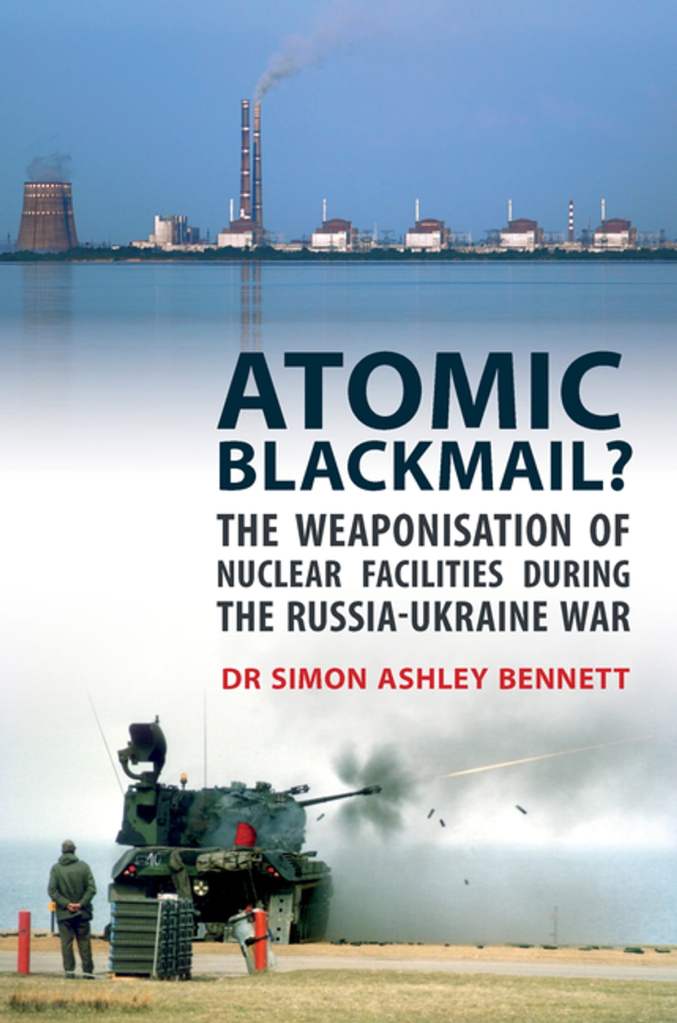
a protagonist could use long-range munitions to turn a NPP into a dirty bomb that would spread radioactive contamination over a wide area, dispersing or diverting army formations, rendering civilian infrastructure and farmland unusable, contaminating groundwater and creating a radioactive cloud that would – if the wind was blowing in a convenient direction – cause transborder harms.
Simon Ashley Bennett, https://www.libripublishing.co.uk/Products/CatID/16/ProdID=292
In Atomic Blackmail? Simon Bennett examines the very real possibility of the ‘weaponisation’ of nuclear facilities during the Russia-Ukraine War. The Russia-Ukraine War has several unique aspects, the most striking of which is that it is being fought in proximity to nuclear facilities and working nuclear power stations, including the six-reactor Zaporizhzhia Nuclear Power Plant (NPP), Europe’s largest, and the decommissioned four-reactor Chernobyl NPP that, in 1986, suffered a catastrophic failure that released radioactive contamination across much of Europe. Some experts claim the contamination caused several thousand excess cancer deaths.
In 1985, foreign affairs and nuclear expert Bennett Ramberg published Nuclear Power Plants: An Unrecognised Military Peril, with a second edition of the book published in 1992. In his visionary discourse, Ramberg posited that in future wars, regional or global, nuclear facilities and powerplants might be weaponised, to gain political traction over an opponent and/or neutralise opposing forces’ capacity for battlefield manoeuvre.
In one scenario, Ramberg described how a protagonist could use long-range munitions to turn a NPP into a dirty bomb that would spread radioactive contamination over a wide area, dispersing or diverting army formations, rendering civilian infrastructure and farmland unusable, contaminating groundwater and creating a radioactive cloud that would – if the wind was blowing in a convenient direction – cause transborder harms. As demonstrated by the Chernobyl disaster, a reactor malfunction can generate serious and long-lasting environmental impacts. Radioactive particles released from Chernobyl’s devastated Reactor Number Four were deposited as far afield as the Cumbrian hills in north-west England.
While, at the time of writing, none of Ukraine’s fifteen reactors had been damaged in an exchange of fire, the possibility remains that this could happen during Ukraine’s 2023, and subsequent, offensives to expel Russian forces from sovereign Ukrainian territory. Much to the consternation of the International Atomic Energy Agency (IAEA), there have been several near-misses, with weapons fired in and around both the decommissioned Chernobyl NPP and working Zaporizhzhia NPP. Further, Russian long-range precision munitions (cruise missiles) have been tracked flying either close to, or over Ukraine’s NPPs. The Pivdennoukrainsk (South Ukraine) NPP has been overflown. On 20 September, 2022, a missile landed some 300 metres from the NPP.
While Ramberg’s nightmare vision of destroyed NPPs rendering a country uninhabitable has not, yet, been realised in the Russia-Ukraine War, the longer and more intense the conflict, the greater the likelihood that one or more of Ukraine’s NPPs will be damaged or, via a credible sabotage threat, used to leverage tactical or strategic advantage. Atomic blackmail finally exampled.
Trump’s ‘peace plan’ traps Gaza in limbo
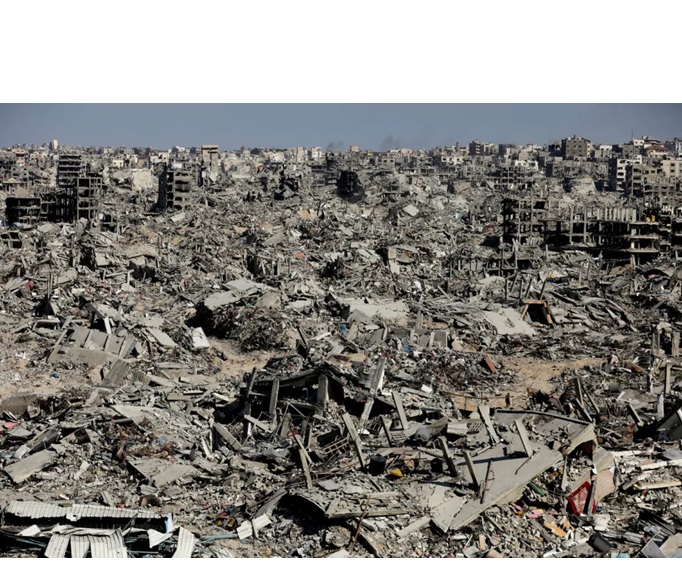
Gaza is now trapped in the limbo of the uncertainty surrounding the Trump plan. The U.S. might prevent Netanyahu from resuming Israel’s genocide, but unless Palestinians gain full control over Gaza’s future, it’s just a slower form of killing.
Mondoweiss, By Mitchell Plitnick October 25, 2025
On Tuesday, Israeli military sources announced that, in their estimation, Hamas still has some 20-25,000 fighters, although many of them are new recruits who are not well trained. They also said Hamas still has “hundreds” of rockets, although the majority of Hamas’ arsenal is said to have been destroyed.
Retired General Giora Eiland, who still has a significant position in Israel’s military hierarchy, added that the tunnel network in Gaza is still some 80% intact.
If these estimates are true, and that is far from clear, it’s either an admission of grave failure by Israel or an admission that destroying Hamas was never the point of the genocide that Israel has committed over the past two years. Or, possibly, both.
These statements are meant to arouse a feeling in Washington and in Israel that the “job” is not yet finished and Israel must be allowed to resume its genocide.
Israeli Prime Minister Benjamin Netanyahu has been squirming under the weight of President Donald Trump’s imposed ceasefire since it began, even while he has been forced to present a smiling public face about it.
Netanyahu’s immediate strategy is to require Trump to keep full pressure on Israel to maintain the “ceasefire.” He is doing this with a steady stream of provocative and deadly actions. He is allowing some aid into Gaza, but not nearly enough. Israel continues to work at provoking Palestinian responses with targeted attacks and provocative actions.
On Sunday, Israel suffered losses in the Rafah area under disputed circumstances. The United States allowed some response, but sharply limited it, preventing Israel from using the incident as an excuse for abandoning the ceasefire deal.
Lest anyone mistake the Trump administration’s actions for beneficence, there was complete silence from Washington the previous day, when Israeli forces fired on a Palestinian civilian vehicle near Gaza City, wiping out a family of eleven, including seven children.
Trump has continued to accuse Hamas of breaching the ceasefire, while ignoring Israel’s actions, which have thus far led to over 100 Palestinian deaths in Gaza since the ceasefire began.
But even while Trump has continued to issue empty threats against Hamas, his administration’s actions have been aimed at restraining Israel. The dispatch of Jared Kushner and Steve Witkoff, followed by Vice President JD Vance, and now Secretary of State Marco Rubio has had the effect of making sure that Israel is aware that the U.S. is watching and is not prepared to see this ceasefire collapse.
In a very telling episode, the Knesset voted to annex major chunks of the West Bank while Vance was in the country. This drew a sharp rebuke from the Vice President and a panicked response from Netanyahu. It is a stark contrast to Joe Biden’s meek response more than a decade ago when he visited Israel and the government announced a major new settlement while he was there. President Barack Obama was quite upset by the incident, but Biden wanted to ignore it.
Trump on Thursday warned Israel that the U.S. would no longer support Israel if it annexed the West Bank. But for Gaza, this isn’t a sustainable position. Trump is not going to maintain this kind of pressure indefinitely. He has put the annexation question to bed for some time (which just means that Israel will simply go on with its gradual annexation of the West Bank rather than the dramatic move of a formal annexation), but Gaza will require much longer-term engagement. More importantly, Trump’s “20-Point Plan” faces serious obstacles, and they are of a type that is very likely to result in the U.S. administration becoming frustrated with Hamas more than with Israel.
The danger of Hamas’ “Yes, but…”
Hamas made it clear when it agreed to the ceasefire that it was not agreeing to all of Trump’s plan. All parties understood that. ………………………………………………………………………………………………………………………………
Trump has a vested interest in seeing the ceasefire endure, but what does that mean in practice?
Neither Trump nor Netanyahu is going to be willing to allow Palestinians to govern themselves, even as technocrats. Without that, there will continue to be resistance. It’s that simple
Some limited rebuilding might be contemplated, but right now, that is being used as a tool to force Hamas to comply with Trump’s demands for their disarmament and disbandment. Jared Kushner made that clear, explicitly stating that any reconstruction efforts would be concentrated in the area of Gaza that remains under Israeli control.
Yet as much as Netanyahu would like to return to the all-out slaughter, he is not going to risk Trump’s wrath to do it. But in the meantime Gaza is likely to be trapped in a nightmarish middle ground between genocide and a functioning future.
Israel will not tolerate any security role in Gaza for Türkiye, as Trump has floated. They’d much prefer that both security and governing forces in Gaza be led by the U.S. or, short of that, more pliant Muslim countries such as Indonesia and Azerbaijan. Azerbaijan is perhaps Israel’s closest, if one of its quietest, allies in the Muslim world. Trump has already secured the participation of Indonesia and is working on Azerbaijan. ………………………………….
Gaza is now caught in the netherworld of the uncertainty of the Trump plan. While Vice President Vance says the ceasefire is “going better than expected,” it is not going anywhere for the people of Gaza.
Vance was remarking on how Israel is “complying” with Trump’s directives. That is, they are not killing so many Palestinians or doing so much shooting that the ostensible ceasefire would collapse.
But autumn is soon going to turn to winter in Gaza. There are insufficient shelters for most of the people, inadequate supplies of food and water, few heat sources, and limited means to address these issues in the short time allotted…………………………………………
The International Court of Justice’s advisory opinion, issued on Wednesday, provoked an hysterical response from Washington, as it ordered Israel to cooperate with all UN agencies, including the UN Relief and Works Agency (UNRWA), which Israel has falsely accused of supporting Hamas and encouraging attacks on Israel……………………….
All of this leaves the people of Gaza facing a different kind of hardship. There doesn’t seem to be any immediate rush to deploy an international force that would lead to a further Israeli withdrawal and enhanced efforts to clear the massive amounts of rubble. Without that necessary first step, reconstruction cannot truly begin in a sustainable way.
The population is cold, hungry, and facing unprecedented health crises that will go on for many years, according to the World Health Organization. While diplomats bicker, those conditions worsen……………………
Trump might prevent Netanyahu from returning to the full force of Israel’s two-year genocide, and that is still a real positive. But what the people of Gaza are facing now, with so many unanswered questions about how the Strip is to be managed, fed, supplied, and secured, carries with it its own set of threats.
It’s better than the genocide that was, but unless Palestinians are given full access to their own decisions and the tools they need to rebuild and survive until Gaza is rebuilt, it’s just a slower kind of killing. https://mondoweiss.net/2025/10/trumps-peace-plan-traps-gaza-in-limbo/
1 This Month
Chernobyl: The Lost Tapes – A good documentary on Chernobyl on SBS available On Demand for the next 3 weeks– https://www.sbs.com.au/ondemand/tv-program/chernobyl-the-lost-tapes/2352741955560

of the week–London Campaign for Nuclear Disarmament

Tell the Ukrainian Government to Drop Prosecution of Peace Activist Yurii Sheliazhenko
To see nuclear-related stories in greater depth and intensity – go to https://nuclearinformation.wordpress.com
-
Archives
- April 2026 (139)
- March 2026 (251)
- February 2026 (268)
- January 2026 (308)
- December 2025 (358)
- November 2025 (359)
- October 2025 (376)
- September 2025 (257)
- August 2025 (319)
- July 2025 (230)
- June 2025 (348)
- May 2025 (261)
-
Categories
- 1
- 1 NUCLEAR ISSUES
- business and costs
- climate change
- culture and arts
- ENERGY
- environment
- health
- history
- indigenous issues
- Legal
- marketing of nuclear
- media
- opposition to nuclear
- PERSONAL STORIES
- politics
- politics international
- Religion and ethics
- safety
- secrets,lies and civil liberties
- spinbuster
- technology
- Uranium
- wastes
- weapons and war
- Women
- 2 WORLD
- ACTION
- AFRICA
- Atrocities
- AUSTRALIA
- Christina's notes
- Christina's themes
- culture and arts
- Events
- Fuk 2022
- Fuk 2023
- Fukushima 2017
- Fukushima 2018
- fukushima 2019
- Fukushima 2020
- Fukushima 2021
- general
- global warming
- Humour (God we need it)
- Nuclear
- RARE EARTHS
- Reference
- resources – print
- Resources -audiovicual
- Weekly Newsletter
- World
- World Nuclear
- YouTube
-
RSS
Entries RSS
Comments RSS
 nuclear-news