‘Groundhog Day’: Israel Breaks Ceasefire to Attack Gaza, Killing 104 People, Including 46 Children.
Democracy Now, October 30, 2025
Israel launched major airstrikes on Gaza, killing at least 104 people, including 46 children, in the deadliest attacks since the U.S.-brokered ceasefire was announced. Israeli Prime Minister Benjamin Netanyahu ordered “powerful strikes” on Gaza Tuesday after Israeli officials accused Hamas of killing an Israeli soldier in Rafah — which Hamas has denied. Netanyahu is trying “everything possible to resume the genocide in Gaza,” says Muhammad Shehada, a writer and analyst from Gaza. “The only condition is that he needs to maintain the facade of the ceasefire.”
Transcript
AMY GOODMAN: Israel launched major airstrikes on Gaza beginning Tuesday night, killing at least 104 people, including at least 35 children — about a third of the dead — in the most lethal attacks since a U.S.-brokered ceasefire began on October 10th.
Israeli Prime Minister Benjamin Netanyahu ordered what he called “powerful strikes,” unquote, on Gaza after Israeli officials accused Hamas of killing an Israeli soldier in Rafah. Hamas denied involvement in the soldier’s death.
President Trump defended Israel’s attacks while also saying nothing is going to jeopardize the ceasefire……………………………………………………………………………………………………………………………………………………………….. https://www.democracynow.org/2025/10/29/gaza_israel_strikes_muhammad_shehada
It’s Just Wall-To-Wall News Stories About The US And Its Allies Abusing The World.
Caitlin Johnstone, Oct 29, 2025, https://www.caitlinjohnst.one/p/its-just-wall-to-wall-news-stories?utm_source=post-email-title&publication_id=82124&post_id=177462655&utm_campaign=email-post-title&isFreemail=true&r=1ise1&triedRedirect=true&utm_medium=email
It’s just news story after news story about the US and its allies terrorizing the world today.
The Rapid Support Forces (RSF) have been filming themselves committing horrific massacres in Sudan over the last couple of days, reportedly murdering some two thousand civilians. You can see the bloodstains on the ground in satellite images. As we discussed the other day, the RSF and its atrocities are backed by the UAE, a close partner of the United States.
Meanwhile Israel has committed another wave of massacres of its own throughout the Gaza Strip, reportedly killing 104 people in a single day, including 46 children. This is as many Palestinians as would typically be killed on any given day in Gaza prior to the so-called “ceasefire”.
CBS News’ 60 Minutes has released a cartoonishly blatant war propaganda piece on “Nicolas Maduro, Venezuela’s dictator” about how poor and unhappy the people of Venezuela are under their current government. The piece featured an interview with Republican Senator Rick Scott, who said that “If I was Maduro I’d head to Russia or China right now; his days are numbered.”
The US can make threats, impose sanctions and amass war machinery, but you don’t truly know they’re serious about attacking a country until they start churning out Pentagon propaganda in the mainstream press.
In the same interview, Scott also said that if Maduro is successfully ousted, “it’ll be the end of Cuba.”
“America is gonna take care of the southern hemisphere and make sure there’s freedom and democracy,” he added.
The senator’s statements suggest that the US is preparing a push in Latin America similar to what it has been executing with Israel in the middle east, eliminating any powers which refuse to bend the knee. South of the US border the top two disobedient governments are the socialist states of Venezuela and Cuba. In the middle east the US and Israel have spent the last two years bombing Iran and Yemen, securing a regime change in Syria, and doing everything they can to eliminate Hamas and Hezbollah in order to rule the region uncontested.
And of course we’ve still got the horrifying US proxy war in Ukraine, where men continue to be dragged off against their will to fight in a nightmarish conflict that most Ukrainians now oppose, but which Zelensky is saying he intends to keep fighting for years against the will of the public. This whole miserable ordeal could have been avoided with a little diplomacy and a few low-cost concessions, but the western power alliance avoided off-ramp after off-ramp in order to ensure that Russia would get sucked into another costly military quagmire.
All over the world the US and its allies are murdering and abusing people in order to dominate the planet and ensure the survival of the capitalist system with which its power is intertwined. It is a giant murder machine feeding on human blood and the life force of our biosphere while providing nothing but obstacles to a healthy world.
The US-centralized empire is a disease that affects our entire species. We had better find a cure, and fast.
No signs of suspicious work at bombed Iranian sites, IAEA chief says
Iran International, Oct 29, 2025,
International Atomic Energy Agency (IAEA) chief Rafael Grossi said on Wednesday there were no signs of suspicious activity at Iranian nuclear sites bombed by the United States in June, adding that inspectors had gradually resumed some work in Iran.
“We do not see anything that would give rise to hypotheses of any substantive work going on there,” IAEA Director General Rafael Grossi said in New York.
“These are big industrial sites where there is movement, there is activity going on and we are very quick to indicate that this does not imply that there is activity on enrichment,” he added.
Iran suspended cooperation with IAEA inspectors after a 12-day war in June against Israel and the United States, codified via a new law passed by parliament.
Grossi told reporters that inspectors had no access to the to sites stricken in June, but confirmed that some inspection was under way.
“We are trying to build it back, and we are inspecting in Iran,” he said, “not at every site where we should be doing it – but we are gradually coming back.”
Respecting NPT
In September, Iran and the agency agreed in Cairo to restart inspections. However, after Germany, France and the United Kingdom triggered the reimposition of UN sanctions, it remained unclear whether Iran would comply.
Foreign Ministry spokesman Esmaeil Baghaei said on Tuesday that Iran’s commitments under the Non-Proliferation Treaty (NPT) safeguards agreement with the agency remain in place…………………………………. https://www.iranintl.com/en/202510291624
Donald Trump says South Korea can build nuclear-powered submarines in US
Donald Trump has said he has given South Korea permission to build
nuclear-powered submarines in Philadelphia, in an announcement that could rattle China as the US president prepares to meet Xi Jinping. “South
Korea will be building its Nuclear Powered Submarine in the Philadelphia
Shipyards, right here in the good ol’ U.S.A.,” Trump wrote on the Truth
Social platform on Thursday during his visit to the US ally and ahead of a
summit with President Xi. Trump said the US-South Korea military alliance
was “stronger than ever” so he had “given them approval to build a
Nuclear Powered Submarine”.
FT 30th Oct 2025,
https://www.ft.com/content/a6ee6741-5a66-41b1-80b6-5e01e4a823a5
Furloughing Workers for Armageddon: Trump, Nuclear Weapons and the NNSA
To maintain and reproduce an arsenal of mass death and thanatotic desire, you need people of suspended moral principles. “Oversight matters,” Plonski remarks. “Reducing the federal workforce means increased risk in ensuring the reliability and safety of our nuclear stockpile.”
30 October 2025 Dr Binoy Kampmark, https://theaimn.net/furloughing-workers-for-armageddon-trump-nuclear-weapons-and-the-nnsa/
Instead of satirising nuclear war – a possible if difficult thing to do – the time has come to satirise the laying off and furlough of those who solemnly monitor and maintain such machinery fit, not for preserving life so much as ending it at a fiery, radiated terminus. If it’s not possible to totally disarm a nuclear inventory, it might be possible to reduce the forces behind them or render some idle. It turns out that this is happening in Freedom’s Land itself, the United States of America.
Those responsible for maintaining the US nuclear weapons arsenal have not been having the best of years. In February, President Donald Trump signed an executive order directing the heads of agencies to “promptly undertake preparations to initiate large-scale reductions in force, consistent with applicable law.” This was part of the now infamous Department of Government Efficiency Workforce Optimization Initiative. Within a few days, 300 employees at the National Nuclear Security Administration (NNSA), located within the Department of Energy, were fired. Prior to that, it had 2,000 staff and 55,000 contractors at its disposal.
The NNSA describes, as one of its “core missions” ensuring that the US “maintains a safe, secure, and reliable nuclear stockpile through the application of unparalleled science, technology, engineering, and manufacturing.” Easy to forget, on reading this, that we are not talking about agricultural supplies or lifesaving medicines, but over 3,000 nuclear warheads and ongoing production specific to that agency. “The Office of Defense programs,” the description goes on to say, “carries out NNSA’s mission to maintain and modernize the nuclear stockpile through the Stockpile Stewardship and Management System.”
NNSA deputy division director, Rob Plonski, was understandably upset that his citadel was being thinned. Ego, reputation and prowess in the nuclear field was at stake. “We cannot expect to project strength, deterrence and world dominance while simultaneously stripping away the federal workforce,” he moaned in a post on LinkedIn. He would have taken heart by the subsequent rescinding of the termination decision for all but 28 of the staff by NNSA acting director Teresa Robbins.
Trump, on the other hand, was having one of his more lucid moments, telling reporters on February 13 that nuclear forces should not be exempt from budgetary trimming. “There’s no reason for us to be building brand-new nuclear weapons. We already have so many, you could destroy the world 50 times over, 100 times over.” Daryl Kimball, executive director of the Arms Control Association, was having none of that. DOGE employees, he charged, were storming “in with absolutely no knowledge of what these departments are responsible for.” They barely realised that the purge was less to do with the Department of Energy than “the department of nuclear weapons.”
In October, the NNSA was again revisited by crisis, with the decision to furlough 1,400 employees due to that event distinct to US politics, the government shutdown. Till that point, the shutdown had lasted almost three weeks, with the Senate failing to pass a continuing resolution bill since October 1. Only 400 essential employees are being retained, labouring in patriotic sweat without pay. A spokesperson for the DOE explained that they would be working “to support the protection of property and safety of human life.”
Since its creation in 2000, the agency has had few such hiccups. “This has never happened before,” noted Energy Secretary Chris Wright during a news conference at the Nevada National Security Site on October 20. “This should not happen.” Wright, however, spoke of pursuing “creative ways” in paying the vast number of contractors, at least till the end of October.
Particular concern centres on the Pantex plant in Texas, the assembly and disassembling site for nuclear weapons, and the Y-12 National Security Complex in Tennessee, responsible for, according to the DOE, the retrieval and storage of nuclear materials, fuelling of naval reactors, and the performance of “complementary work for other government and private-sector entities.”
The NNSA had tried to argue that money be made available from previously passed spending bills to prevent the furlough. A DOE spokesperson proved icy in remarking that, “While the administration was able to identify funds to keep NNSA weapons laboratories, plants, and sites operating with our contractors, legal and budgetary limitations required the administration to begin furloughing NNSA federal employees.”
Therein lies the problem. To maintain and reproduce an arsenal of mass death and thanatotic desire, you need people of suspended moral principles. “Oversight matters,” Plonski remarks. “Reducing the federal workforce means increased risk in ensuring the reliability and safety of our nuclear stockpile.” With the support of 26 lawmakers, Rep. Dina Titus (D-Nev.) in her October 23 letter to Wright and NNSA administrator Brandon Williams similarly argued that the federal employees in question “play a critical oversight role in ensuring that the work required to maintain nuclear security is carried out in accordance with long-standing policy and the law.” Trump has also been fuzzy on the matter of nuclear weapons, acknowledging the nonsense of increasing the pile, yet simultaneously wanting tighter deadlines to deliver ever more modern weapons to the Pentagon.
This fantastically confused state of affairs throws up an interesting question: Why not turn the attention to reducing the stockpile itself and pause the euphemistically named modernisation process? A slimmer, sharper workforce for a more diminished, manageable arsenal of death that should never be used in any case. The National Security State remains, however, a tough, insatiable customer.
Patrick Lawrence: The Voices of Many Jews

“Our solidarity with Palestinians is not a betrayal of Judaism, then, but a fulfillment of it.”
these people speak not for the destruction of Israel but for its restoration to sanity — and, so, its salvation.
October 28, 2025, By Patrick Lawrence, Consortium News, https://consortiumnews.com/2025/10/25/patrick-lawrence-the-voices-of-many-jews/
This very welcome letter marks out the significantly worsening alienation between world Jewry and the Zionists’ defacement of the Judaic tradition.
At last, at last, Jews with powerful voices have gathered en masse — a critical mass, I would say — to condemn Israel and the savage spree of murder, starvation and terror it inflicts as we speak upon the Palestinians of Gaza and the Occupied Territories of the West Bank.
You may by now be aware of the open letter signed by 450–plus American, European and Israeli Jews and made public this week. In it, this sprawling group of distinguished personages denounces the criminality of the Zionist regime and asserts “the universality of justice and the fair and equal application of international law.” The signatories also call for the international community to impose immediate sanctions on apartheid Israel.
This is very big, in my read. I say this not because of what is in this document — calls for justice of this kind are by now many — but, straight to my point, for whose names are on it.
You may know of this letter and you may not, I ought to add: The Guardian reported it in its Oct. 22 editions. Anadolu Ajansi, the Turkish wire service, also had the story right away. Arab News had it, too. So did Middle East Monitor, The New Indian Express, and, stateside, Common Dreams. In Britain, Jewish Voice for Liberation, J.V.L., picked it up.
But the British daily is at writing alone among major Western media to report on this momentous call for worldwide action against the Zionist state. We read nothing of it in major Western media and hear nothing from the mainstream broadcasters. I will return to this important point shortly.
“Join the Worldwide Jewish Call,” as the letter is titled, was organized and put out by an apparently ad hoc “coalition” called Jews Demand Action. The document and various appendages explaining it are here. As the Jews Demand Action website makes clear, the intent is to announce a continually engaged movement in the cause of justice — justice for Palestinians, justice for the Zionist fanatics guilty of perpetrating a genocide, a term the group uses with obvious conviction and also with obvious anger. Among much else, the letter features a form by way of which Jews can sign the petition and receive updates on actions to come.
“At last, a serious global Jewish call for sanctions on Israel,” J.V.L., the British version of Jewish Voice for Peace in the United States, proclaimed in the above-noted report.
Yes, at last.
Lots of other Jews have stood publicly against the apartheid state, many for a long time. There is Rabbi Yaakov Shapiro, the wonderfully outspoken rabbi and author of The Empty Wagon: Zionism’s Journey from Identity Crisis to Identity Theft (Bais Medrash and Primedia eLaunch, 2020), there is the aforementioned Jewish Voice for Peace, and the Jewish organizations and students active on university campuses and in the streets of major cities. Unqualified praise to them and the many like them I cannot list in full.
I have no certain idea why it took these hundreds of influential people with self-evident consciences so long to join these others against the entity that insists on calling itself “the Jewish state.” To hazard a surmise, the past two years of Israel’s unspeakable barbarism have surely been a torment for the signatories of this letter, as for countless Jews the world over, as they have sought to distinguish their faith and their traditions from the conduct of the ultra-nationalist regime that is supposed to merit their allegiance but has emphatically lost it.
If I had to choose one sentence in this letter above all others for its significance and power — I would rather not but I will — it would be this: “Our solidarity with Palestinians is not a betrayal of Judaism, then, but a fulfillment of it.”
After this truth comes these:
“When our sages taught that to destroy one life is to destroy an entire world, they did not carve exceptions for Palestinians. We shall not rest until this ceasefire carries forward into an end of occupation and apartheid.”
This is the conceptual frame within which the signatories address António Guterres, the U.N. secretary-general, as well as “presidents, prime ministers, heads of state, [and] permanent representatives to the United Nations.” While approving of the ceasefire, or what remains of it at this point, the letter states,
“And yet there should be no doubt that this ceasefire is fragile: Israeli forces remain in Gaza, the agreement makes no reference to the West Bank, the underlying conditions of occupation, apartheid, and the denial of Palestinian rights remain unaddressed.”
“As Jews and as human beings, we declare: Not in our name,” the letter states. It then lists the four key demands the signatories advance in their names: Respect for the authority of the International Court of Justice (Yes!), a rejection of the complicity Western governments have forced upon their citizens, a full military withdrawal, the supply of aid and everything else needed to reconstruct Gaza, and, finally, “to refute false accusations of antisemitism that abusively deploy our collective history to tarnish those with whom we stand together in the pursuit of peace and justice” (Yes again times 10!).
You find some big names among the signatories (and the open letter does not give the full list): Daniel Levy, previously a “peace” negotiator for Israel and now a prominent critic; Gabor Maté, the physician-psychotherapist; Wallace Shawn, the playwright, actor, and reliable old leftie; Amy Eilberg, an American rabbi and activist; Peter Beinart (one of the organizers of Jews Demand Action), Naomi Klein, the “progressive” Canadian writer; Yuval Abraham, who co-directed No Other Land, the documentary that took an Oscar last year.
If I do not put the point too simply, these people speak not for the destruction of Israel but for its restoration to sanity — and, so, its salvation. They do not mention the two-state solution in their letter, but one gains the impression it is this for which they hope. One may differ strenuously with them on these points (as I do, emphatically), but what I will shorthand as their moderation is part of what makes their open letter so important: These are (shorthand again) mainstream Jews.
Who can say how carefully or how many presidents, prime ministers, U.N. reps, etc. will consider this letter? But this is not the salient point. This letter marks out the significantly worsening alienation between world Jewry and the state that is supposed to represent its home. And in so doing it widens and deepens the already evident isolation of the Jewish state. This latter effect may not be the intent of the open letter’s signatories, but it will prove unmistakably to be among the document’s consequences.
A Growing Consensus
We represent the growing consensus of world Jews, not the Israeli government,” the letter declares in one of its subheads. Exactly so. And as The Guardian piece cited above points out, the open letter should be read alongside some stunning numbers coming out of the most recent opinion polls. In a recent Washington Post survey, 61 percent of American Jews asked think Israel has committed war crimes in Gaza; just under 40 percent stand with the open letter’s signatories: We witness a genocide.
In a poll that does not distinguish between Jews and non–Jews, The Brookings Institution finds that 45 percent of those surveyed think Israel is committing genocide. A recent poll conducted by Quinnipiac University indicates 50 percent of register voters agree; among Democratic voters the number is 77 percent. On Thursday Reuters published a survey indicating that 59 percent of the Jews and non–Jews polled think the United States should recognize Palestine as a sovereign state.
I see a highly significant conflict growing ever sharper between the increasing number of outspoken Jews of conscience and those many — and they remain very many — who continue to defend the righteousness of the Israeli terror machine. Things are getting especially awkward for mainstream media such as the Zionist-supervised New York Times, wherein we find no mention of Jews Demand Action and its forthright open letter. This cannot end well for the Times and all the pilot fish that follow it.
However long the Times stays silent, however many media billionaire Zionists take over and corrupt, however many Bari Weisses they put in high places, this will do nothing other than discredit these media. They are effectively complicit in the Zionists’ defacement of the Judaic tradition. This is another way the open letter is important.
The world has long and urgently needed to hear from the “we” whose names are on this letter. Non–Jews need to learn of and make the distinction between Judaism and the frenzied Zionism that now rules Israel so they can think clearly of these questions. And as they are well aware, those Jews who reject Israel’s ultra-nationalist Zionism must make themselves heard for the sake of Judaism, too.
I do not accept that any great wave of anti–Semitism is breaking upon us — there is no “ferocious surge,” in Joe Biden’s preposterous phrase. But the potential for such a turn, given the extent of Israel’s inhumanity in combination with its claim to be “the Jewish home,” is obvious.
The Zionist hoards love the threat of anti–Semitism: How well it serves their pernicious purpose. At last this insidious ruse is countered by those whose voices count for most — the voices of Jews.
Patrick Lawrence, a correspondent abroad for many years, chiefly for the International Herald Tribune, is a columnist, essayist, lecturer and author, most recently of Journalists and Their Shadows, available from Clarity Press or via Amazon. Other books include Time No Longer: Americans After the American Century. His Twitter account, @thefloutist, has been restored after years of being permanently censored.
Escalating nuclear waste disposal cost leads senior MP to demand ‘coherent’ plan.
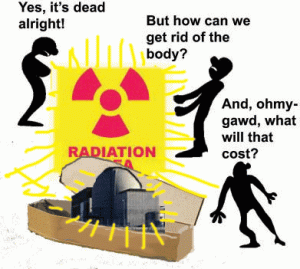
The escalating costs of the geological disposal facility (GDF) have led the Public Accounts Committee (PAC) chair to demand that the government produce a “coherent plan” to manage the country’s nuclear waste legacy
29 Oct, 2025 By Tom Pashby
https://www.newcivilengineer.com/latest/escalating-nuclear-waste-disposal-cost-leads-senior-mp-to-demand-coherent-plan-29-10-2025/
A GDF represents a monumental undertaking, consisting of an engineered vault placed between 200m and 1km underground, covering an area of approximately 1km2 on the surface. This facility is designed to safely contain nuclear waste while allowing it to decay over thousands of years, thereby reducing its radioactivity and associated hazards.
PAC chair Geoffrey Clifton-Brown’s comments were made in reaction to the revelation that the total life cost of the GDF is up to £15bn more than the sum listed in the National Infrastructure and Service Transformation Authority’s (Nista’s) recent annual report. Nista is a government body and works with the Cabinet Office and Treasury and its August 2025 report published figures from Nuclear Waste Services (NWS), the government body responsible for the GDF, showing the GDF as having a whole life cost of from £20bn to £53.3bn.
However, Nista’s Infrastructure Pipeline dashboard lists the GDF’s CapEx (capital expenditure) range for new infrastructure in 2024/2025 prices as being from £26.2bn to £68.7bn, with the top end being slightly over £15bn higher than the figure published in the annual report.
A government source explained to NCE earlier that the discrepancy is because the figures published in Nista’s annual report was based on 2017/2018 prices, meaning the effects of long-term inflation were not accounted for.
Criticism has previously been levied at High Speed 2 (HS2) because of its use of historic pricing figures to reduce the impact of inflation on budget projects and make the total cost of the project appear to be lower than it would end up being.
Government must have coherent plan to manage nuclear waste – senior MP
The House of Commons PAC is one of the most active and powerful select committees in Parliament, able to formally request that the National Audit Office carry out investigations into government projects.
Nuclear decommissioning is a key area of focus for the Committee because of the high total costs, which will hit the public purse into the far future. Sellafield is seen as the government’s flagship project within the wider nuclear decommissioning programme.
The scale of future nuclear decommissioning is clear in the Nuclear Decommissioning Authority: Annual Report and Accounts 2024 to 2025, which says: “the discounted best estimate of the future costs of the decommissioning mission of £110.1bn”. This is a £5bn increase on the previous year.
UN Human Rights Office Warns Israeli Settler Violence in West Bank Is “Surging”
The Trump administration insisted last week that it would not allow Israel to annex the occupied West Bank.
By Sharon Zhang , Truthout, October 27, 2025, https://truthout.org/articles/un-human-rights-office-warns-israeli-settler-violence-in-west-bank-is-surging/
he UN Human Rights office for Palestine has warned that Israel is rapidly accelerating its campaign to annex the occupied West Bank, with settlers adding outposts at a pace 10 times higher than the previous average rate just in the past year.
Recent settler attacks on the olive harvest have underscored the danger faced by Palestinian communities, the office noted, with this season alone seeing 150 settler attacks so far.
This includes an attack caught on camera by a journalist last week, when a 53-year-old woman was beaten by settlers and sent to the hospital during the olive harvest; as well as an attack on a 58-year-old olive farmer in Nahalin, west of Bethlehem, on Thursday, the office said.
These attacks represent just a fraction of the settler violence faced by Palestinians as Israel escalates its annexation campaign amid its genocide in Gaza, the office said. UN officials, citing Israeli group Peace Now, said that there have been 757 settler attacks in the West Bank just in the first half of 2025, marking a 13 percent increase over the previous year.
Meanwhile, Israeli settlers have created 84 new illegal outposts in the West Bank, marking a “rapid escalation” of the previous pace of eight new settlements per year on average, the office said.
The violence is “making life impossible for Palestinians in many communities across the occupied West Bank and leaving them with no genuine choice but to leave their homes.”
“These actions advance Israel’s stated policy to consolidate annexation in clear violation of international law,” the office said.
The UN statement comes just days after the Trump administration repeated its supposed opposition to annexation.
“It won’t happen,” said President Donald Trump last week when asked about annexation. “Israel would lose all of its support from the United States if that happened.”
But as the UN statement and that of other experts has underscored, Israel is already in the process of annexing the West Bank, both in policy and in practice. Top Israeli ministers have spent recent months formalizing plans for annexation, vowing to annex the West Bank in all but name or, in some cases, outright calling for the illegal policy.
The experts respond to Trump’s proposal to “start testing our Nuclear Weapons on an equal basis”

even if China was to up the number of its warheads dramatically, that would still amount to less than a third of what the United States and Russia each already have.
By Dan Drollette Jr | October 30, 2025, https://thebulletin.org/2025/10/the-experts-respond-to-trumps-proposal-to-start-testing-our-nuclear-weapons-on-an-equal-basis/
President Donald Trump wrote on Truth Social, his social media site, that he had instructed the Department of War (formerly the Defense Department) to return to “nuclear testing” — although it’s unclear whether he was referring to testing a nuclear delivery system or testing a nuclear explosive device. Those are two very different things that Trump seems to be confused about.
In the words of prominent nuclear weapons expert Hans Kristensen of the Federation of American Scientists (who is one of the lead authors of the “Nuclear Notebook” column, published regularly in the Bulletin of the Atomic Scientists): “It’s hard to know what he means. As usual, he’s unclear, all over the map, and wrong.” Kristensen then goes into detail, debunking a series of Trump’s assertions in his social media post. For instance, Trump’s initial claim that “[t]he United States has more Nuclear Weapons than any other country. This was accomplished, including a complete update and renovation of existing weapons, during my First Term in office…” is simply false.
As Kristensen points out, Russia has more nuclear weapons than the United States. And Trump’s assertion about a “a complete update and renovation of existing weapons” is also flatly wrong. In Kristensen’s words, “The nuke modernization program currently underway was initiated by Obama, Trump didn’t finish it, and it will continue for another two decades.”
Kristensen then proceeds for eight linked posts to correct or clarify the many other misstatements made by the president in Trump’s Truth Social post. For example, even if China was to up the number of its warheads dramatically, that would still amount to less than a third of what the United States and Russia each already have.
And as Kristensen notes, the US already tests its missiles (without nuclear payloads) to ensure that they can launch safely and correctly: “If by testing he [Trump] means nuclear explosive testing, that would be reckless, probably not possible for 18 months, would cost money that Congress would have to approve, and it would certainly trigger Russian and Chinese and likely also India/Pakistan nuclear tests. Unlike the US, all these countries would have much to gain by restarting test testing. There have been occasional rumors that Russia/China may have conducted very small-yield tests, I’m not aware of any reports that they have conducted significant nuclear test explosions.”
The process of resuming testing would be nowhere near as swift as Trump suggests; the White House would have to direct the US Energy Department to order our national nuclear laboratories to start preparing for a nuclear warhead test. And since the United States doesn’t currently have a nuclear weapons test explosion program, Congress would have to appropriate the money.
Furthermore, Kristensen notes “[i]t would be expensive and take time: a simple explosion is 6-10 months, a fully instrumented test in 24-36 months, and a test to develop a new nuclear warhead is about 60 months.”
Just in case Trump is indeed talking about testing a nuclear explosive device, it’s probably a good time to look back at the Bulletin’s March 2024 issue, “A return to nuclear testing?”, which lays out the many negative impacts of nuclear testing. In that issue, veteran national security reporter Walter Pincus explains exactly what those who live in a place chosen for testing experience in “The horrors of nuclear weapons testing.” People today seem to have forgotten—if they ever knew—what a single nuclear weapon can do. The inhabitants of the Marshall Islands, whose home was turned into a nuclear proving ground, have certainly never forgotten.
Beyond that, the reasons for preserving a ban on nuclear tests are many—even though Russia, China, and the United States have been keeping their test sites ready for a potential resumption of full-scale tests of explosive devices, just in case. Eminent researcher Pavel Podvig delves into this in detail in his Bulletin essay, “Preserving the nuclear test ban after Russia revoked its CTBT ratification.”
And one thing that seems to get overlooked is that the United States has benefited from a test ban as much as anyone else. Consequently, bringing the Comprehensive Nuclear Test Ban Treaty into force would lock in an American advantage in nuclear knowledge and expertise and hinder other states from developing more sophisticated nuclear arms, as Stanford University expert Steven Pifer notes in “The logic for US ratification of the Comprehensive Nuclear Test Ban Treaty.”
Hi-Tech Holocaust: How Microsoft Aids The Gaza Genocide

The Azure/IDF partnership is the result of a decades-long relationship between Microsoft and the State of Israel, one which has helped both entities.
Netanyahu himself has showered praise on the corporation, describing the Microsoft/Israel partnership as “a marriage made in heaven.”
Alan Macleod, Mintpress News, 28 Oct 25
Israel’s genocide is being powered by Microsoft. From creating a massive digital dragnet, aiding in the production of A.I.-generated kill lists, hiring hundreds of Israeli spies to run its internal affairs, and suppressing figures opposing the slaughter, the Seattle-based tech corporation has played a key role in the violence.
MintPress has detailed the deep collaboration between the Israeli Defense Forces (IDF) and Amazon, Google, TikTok, Apple, Palantir, and Oracle, but Microsoft’s relationship with the government and armed forces of Israel is potentially the closest, leading then-CEO Steve Ballmer to state that “Microsoft is as much an Israeli company as an American company.” MintPress explores the decades-long partnership between Microsoft and Israel, and the employees trying to break that marriage from the inside.
The point of all this was to create an enormous digital dragnet, where Palestinians’ every move, word, and keystroke was recorded in monitored in the greatest and most dystopian digital dragnet ever created. In the words of Yossi Sariel, the head of Unit 8200, the IDF’s surveillance division, the plan was to “track everyone, all of the time.”
Sariel argued that big data was the solution to Israel’s problems, envisaging a future where Israel intercepted and stored “a million calls an hour” from Palestine, and used A.I. to search for keywords and identify threats.
There was no way, however, that Israel could do this alone, as it did not possess the expertise or anything like the storage capacity needed for such a project. To this end, Sariel travelled to Seattle in 2021 to meet with Microsoft CEO Satya Nadella, to pitch him on the surveillance partnership whereby Microsoft would build Unit 8200 a customized and segregated area within its Azure platform.
The Israeli military uses Microsoft Azure to transcribe, translate, and otherwise process intelligence garnered via mass surveillance, which is then linked to Israel’s A.I.-based weapons systems.
The largest and most controversial organization within the Israeli military, Unit 8200 has long been the centerpiece of Israel’s hi-tech spying operation. The unit is dedicated to surveillance, cyberwarfare, and online manipulation operations. Last year, it carried out the Lebanese Pager Attack, an act that wounded thousands of civilians. Unit 8200 agents were also behind many of the most infamous international spyware and hacking cases, including the Pegasus software, that was used to surveil tens of thousands of the world’s most prominent political leaders, journalists, and human rights campaigners.
Sariel’s policy of mass surveillance changed the internal attitude at Unit 8200. “Suddenly the entire public was our enemy,” said one officer. The gargantuan trove of information compiled in Microsoft Azure amounted to a vast repository on the entire Palestinian population – a giant database of kompromat that is used to extort and blackmail the region’s indigenous people. If a person was secretly gay, or cheating on their spouse, for example, that information was readily available to Unit 8200 agents, who would then use it to turn their targets into informants. One former Unit 8200 member revealed that, as part of their training, they were made to memorize different Arabic slang words for “gay”, so that they could identify them in conversations.
The cloud database is also used to provide after-the-fact justification for arrests of innocent peoples. Off-hand, out-of-context comments made years ago can be used to portray anyone as a member of Hamas, Palestinian Islamic Jihad, or another armed resistance force.
“These people get entered into the system, and the data on them just keeps growing,” an Israeli intelligence official who served in the West Bank said.
When they need to arrest someone and there isn’t a good enough reason to do so, [the Azure surveillance repository] is where they find the excuse. We’re now in a situation where almost no one in the [Occupied] Territories is ‘clean,’ in terms of what intelligence has on them.
Unit 8200 has also used big data to compile A.I.-generated kill lists featuring tens of thousands of people. One program gave every Gazan, even women and children, a score of between 1 and 100, based on a number of factors. If they live in the same building or are in group chats with known or suspected Hamas members, for instance, their score is increased. Once their score reached a certain threshold, all Gazans were automatically placed on a kill list that was minimally overseen by humans.
According to multiple Unit 8200 agents, Microsoft Azure’s cloud-based storage platform allowed Israel to overcome targeting bottlenecks, using all manner of data to research and identify individuals for assassination, which led to the killing of tens of thousands of people during the first weeks of its post-October 7 onslaught.
Of course, the vast majority of the deaths have been civilians – around 70% were women and children. But Israeli officials can also go back after the fact and scour their digital dragnet to justify any killing, finding connections or any other incriminating evidence. A senior Israeli military officer described the cloud technology as “a weapon in every sense of the word.” Other officials, however, have gone so far as to raise concerns that Israel’s overreliance on Microsoft as a service is a strategic vulnerability that should be corrected.
Microsoft Sees No Evil, Only Profits
Throughout all this, Microsoft has protested its innocence – and ignorance – of Israeli crimes. “At no time during this engagement or since that time has Microsoft been aware of the surveillance of civilians or collection of their cell phone conversations using Microsoft’s services, including through the external review it commissioned,” a spokesperson for the company stated, adding, “Any allegations about Microsoft leadership involvement and support of this project … are false.”
But leaked documents suggest Microsoft engineers understood exactly what sort of data was being stored in Azure, and what their clients hoped to achieve. “Technically, they’re not supposed to be told exactly what it is, but you don’t have to be a genius to figure it out,” one engineer said. “You tell [Microsoft] we don’t have any more space on the servers, that it’s audio files. It’s pretty clear what it is.”
Others felt that the idea that Microsoft did not know that one of the world’s most notorious spying organizations might be using big data to spy on people was not credible, especially given how closely the two entities had been working together for years. “Microsoft says that it can’t figure out if their customers are committing crimes against humanity or mass surveillance, while at the same time Microsoft employees are working alongside uniformed IDF. Absurd!” Paul Biggar, the founder of Tech For Palestine, told MintPress.
The corporation’s claim of innocence seems even more tenuous, given the fact that Microsoft employs hundreds of former Unit 8200 agents, and recruits directly from the organization. A 2022 MintPress investigation found at least 166 former Unit 8200 operatives who went on to work for Microsoft, including many who helped design Azure itself.
Microsoft’s role in Gaza goes far beyond locking out the ICC. From cloud warfare to surveillance, it’s helping power Israel’s war machine………………………………………………………………………………
Corporate Zionism: Roots in Israel’s War Economy
The Azure/IDF partnership is the result of a decades-long relationship between Microsoft and the State of Israel, one which has helped both entities. Microsoft established its first branch in Israel in 1989, and two years later, opened a research and development center in the city of Herzliya near Tel Aviv. The first of its kind outside the United States, the center has continued to expand, and now directly employs an estimated 2,700 workers…………………………………………………………………
Every CEO in Microsoft’s history has flown to Israel to meet with Prime Minister Benjamin Netanyahu, including Bill Gates, who, in 2016, stated that hi-tech Israeli security was “improving the world.
In short, Microsoft is a cornerstone of Israel’s burgeoning hi-tech sector, which accounts for 20% of the country’s GDP and more than half of its total exports. Netanyahu himself has showered praise on the corporation, describing the Microsoft/Israel partnership as “a marriage made in heaven.”…………………..
Cracking Down on Internal Resistance
A greater threat than Iran to Microsoft, however, is its own employees, hundreds of whom have organized to oppose its role in the genocide. Under the banner of No Azure for Apartheid, workers demand that: Microsoft terminates all Azure contracts with Israel; disclose all ties to the Israeli national security state; publicly call for a ceasefire, and stop persecuting employees who speak out about the genocide……………………………………………………………………..
Targeting Enemies
Company employees are far from the only target of Microsoft’s wrath, however. In May, Karim Khan, chief prosecutor of the International Criminal Court, announced that Microsoft had locked him out of his official ICC email account, just as he was formalizing charges against Netanyahu and other top Israeli leaders. For many, the timing was not a coincidence, but rather a message……………………………………………………………..https://www.mintpressnews.com/microsoft-israel-surveillance-azure-idf-gaza-genocide/290534/
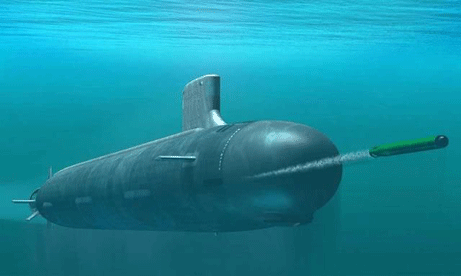
US President Donald Trump says South Korea has approval to build nuclear-powered submarine
30 Oct 25, https://www.abc.net.au/news/2025-10-30/south-korea-permission-to-build-nuclear-submarines/105951210
In short:
Korea has been given permission by Donald Trump to build a nuclear powered submarine.
The permission is a dramatic move that would admit South Korea to a small group of nations that possess this type of vessel.
The US president met with leader on his ongoing tour of Asia.
US President Donald Trump says he has given South Korea approval to build a nuclear-powered submarine, a dramatic move that would admit Seoul to a small club of nations possessing such vessels.
Mr Trump, who has been meeting with South Korean President Lee Jae Myung and other regional leaders during his visit, also said Seoul had agreed to buy vast quantities of US oil and gas.
The submarine will be built in a Philadelphia shipyard, where South Korean firms have increased investment, Mr Trump wrote on social media.
Mr Trump and Mr Lee finalised details of a fraught trade deal at a summit in South Korea on Wednesday.
Mr Lee had also been seeking US permission for South Korea to reprocess nuclear fuel.
Nuclear restrictions easing?
Seoul is barred from reprocessing without US consent, under a pact between the countries.
“I have given them approval to build a nuclear-powered submarine, rather than the old-fashioned and far less nimble, diesel-powered submarines that they have now,” Mr Trump wrote on his Truth Social platform.
South Korea’s Industry Ministry said its officials had not been involved in any detailed discussions about building the submarines in Philadelphia.
While South Korea has a sophisticated shipbuilding industry, Mr Trump did not spell out where the propulsion technology would come from for a nuclear-powered submarine, which only a handful of countries possess.
The US has been working with Australia and Britain on a project for Australia to acquire nuclear-powered submarines, involving technology transfers from the United States.
The US has so far only shared that technology with Britain, back in the 1950s.
Mr Lee said when he met Mr Trump on Wednesday that allowing South Korea to build several nuclear-powered submarines equipped with conventional weapons would significantly reduce the burden on the US military.
He also asked for Mr Trump’s support to make substantial progress on South Korea being allowed to reprocess spent nuclear fuel, or on uranium enrichment.
This is not allowed under the nuclear agreement between the two countries, even though South Korea possesses nuclear reactors to generate power.
Approval raises questions
Mr Lee’s predecessors had wanted to build nuclear-powered submarines, but the US had opposed this idea for decades.
Daryl Kimball, executive director of the Washington-based Arms Control Association, said the issue of South Korea acquiring such submarines “raises all sorts of questions.”
“As with the AUKUS deal, (South Korea) is probably looking for nuclear propulsion services suitable for subs, including the fuel, from the US,” he said.
Mr Kimball said such submarines usually involved the use of highly-enriched uranium and would “require a very complex new regime of safeguards” by the International Atomic Energy Agency, which has a key role in implementing the Treaty on the Non-Proliferation of Nuclear Weapons (NPT).
“It remains technically and militarily unnecessary for South Korea to acquire the technology to extract weapons-usable plutonium from spent fuel or to acquire uranium enrichment capabilities, which can also be used to produce nuclear weapons,” he said.
“If the United States seeks to prevent the proliferation of nuclear weapons worldwide, the Trump administration should resist such overtures from allies as strongly as it works to deny adversary access to these dual-use technologies.”
Jenny Town, who heads 38 North, a Korea-focused research group in Washington, said it was inevitable that South Korean demands for US cooperation on nuclear issues would grow, given recent allegations about Russian technical cooperation to help nuclear-armed North Korea make progress towards acquiring nuclear-powered submarines.
Kim Dong-yup, a North Korea studies professor at Kyungnam University, said the Lee-Trump summit had formalised a “transaction scheme of security guarantees and economic contributions” for maintaining the extended deterrence and alliance in exchange for South Korea’s increased defence spending and nuclear-powered subs and US investments.
“In the end, this South Korea-US summit can be summarised in one word: the commercialisation of the alliance and the commodification of peace,” he said.
“The problem is that the balance of that deal was to maximise American interests rather than the autonomy of the Korean Peninsula.”
Trump backs renewed Israeli strikes in Gaza

The US president denied that the resumption of hostilities was “jeopardizing” the ceasefire
US and China to ‘work together’ on Ukraine settlement – Trump
29 Oct, 2025
US President Donald Trump has defended Israel’s renewed strikes in Gaza nearly three weeks into a ceasefire he helped broker.
Israeli Prime Minister Benjamin Netanyahu ordered “immediate and powerful strikes” on Tuesday evening, citing Hamas attacks on Israeli soldiers still holding parts of the Palestinian enclave. At least 30 Palestinians were killed in the action, according to Gaza’s Hamas-run government.
“As I understand it, they took out an Israeli soldier,” Trump told reporters aboard Air Force One on Wednesday en route from Japan to South Korea. “They killed an Israeli soldier. So the Israelis hit back – and they should hit back. When that happens, they should hit back,” he added.
US Vice President J.D. Vance earlier said the ceasefire was holding despite “little skirmishes here and there.” Axios cited unnamed senior US officials as saying the White House had urged Israel not to take “radical measures” that could collapse the truce.
According to the Israel Defense Forces (IDF), last week two of its soldiers were attacked and killed by Hamas in Rafah, southern Gaza, and more soldiers came under fire in the same area on Tuesday. Hamas denied involvement in both incidents, accusing Israel of “a blatant ceasefire violation.”
The Palestinian armed group warned that the escalation “will lead to a delay” in recovering and returning the bodies of the 13 remaining Israeli hostages in Gaza. Israeli officials earlier accused Hamas of dragging its feet in handing over all the remains, as agreed under the ceasefire mediated by the US, Egypt, Qatar, and Türkiye, which took effect on October 10.
Members of Congress object to plutonium giveaway

October 26, 2025, https://beyondnuclear.org/senators-object-to-plutonium-giveaway/
On December 31, the Trump White House will start revealing which lucky startup companies will receive free plutonium needed for their new reactor fuel. Trump will give away between 20-25 tons, according to reports, going against US energy policy that has long avoided the transfer of nuclear weapons-usable materials into the commercial sector. One likely recipient is Oklo, on whose board Trump’s present energy secretary, Chris Wright, once sat, raising serious conflict of interest issues.
Several Members of Congress have already written to Trump expressing their concerns. In the letter sent by Senator Ed Markey and Reps. Don Beyer and John Garamendi, all Democrats, they pointed out that dishing out plutonium “to private industry for commercial energy use,” crossed a line that “goes against long-standing, bipartisan US nuclear security policy. It raises serious weapons proliferation concerns, makes little economic sense, and may adversely affect the nation’s defense posture.” They also pointed out that the amount of plutonium Trump is preparing to move into the commercial sector “is enough for at least 2,000 nuclear bombs.”
And they also took care to remind Trump that “commercial nuclear energy does not require separated plutonium, and today there is no global demand for plutonium to make civilian nuclear reactor fuel. Nuclear power reactors instead rely on uranium fuel, which is safer and cheaper to process.”
Golden Dome funding lags as industry partners line up

By John T. Seward – The Washington Times – Tuesday, October 28, 2025
The head of President Trump’s Golden Dome missile defense program gave a classified briefing to the Senate Armed Services Committee last week that described the secretive architecture of the project, The Washington Times has learned.
U.S. Space Force Gen. Michael A. Guetlein, who was tapped earlier this year by Mr. Trump to lead the design of Golden Dome, told committee members about key target dates for the project’s delivery.
Gen. Guetlein also outlined how the project will integrate missile detection capabilities and early warning systems, said two sources familiar with the briefing who spoke on the condition of anonymity to discuss aspects of the classified meeting.
Sen. Dan Sullivan, Alaska Republican and a member of the Armed Services Committee, confirmed the meeting to The Times but declined to comment on specifics because of the classified nature of the planned Golden Dome architecture.
Mr. Sullivan, who is routinely involved with the military’s missile defense programs because of his state’s strategic geographic location, said he was impressed with Gen. Guetlein’s presentation.
“He just has a really good sense of how he wants to layer it and put it together,” the senator said. “He’s got a plan, you know, it’s got like 30-day, 60-day, 120-day, and I thought it was good.”
Speculation about the specific architecture of the Golden Dome is rampant among defense industry insiders. So is unease over the status of some $24.5 billion in funding that Congress approved this year for the missile shield’s development.
Multiple sources have told The Times that none of the money has been allocated for contracts and that White House Office of Management and Budget is holding the funds.
Some defense strategy analysts say Congress’ approval of the money was unprecedented.
The initial $24.5 billion was included in the passage of H.R. 1, the One Big Beautiful Bill Act, in July. At the time, Mr. Trump touted the money as an initial down payment for the Golden Dome.
“Congress pre-appropriated $24.5 billion without a program plan, scheduled requirements — nothing,” said Todd Harrison, a senior fellow at the American Enterprise Institute.
“Never have we seen that much money appropriated in advance of a program actually starting,” Mr. Harrison said during a virtual panel discussion last week.
The discussion, hosted by the Center for New American Security, was titled: “Stuck in the Cul-de-Sac: How U.S. Defense Spending Prioritizes Innovation over Deterrence.”
Mr. Harrison said the Pentagon and the Trump administration have not publicly defined Golden Dome’s capability goals.
Analysts estimate the missile shield will be a multidecade program costing hundreds of billions of dollars for space-based and other futuristic missile defense capabilities that will continue to evolve technically over time.
Under the One Big Beautiful Bill Act, initial funding was made available for the next four years, with spending flexibility baked into the law that could make congressional oversight difficult.
There is consensus among many in the national security community that Golden Dome is urgently needed amid rising nuclear and ballistic missile threats from U.S. adversaries, most notably Russia, China, North Korea and Iran.
Mr. Harrison said the potential exists for the systems involved in the project to be focused on every threat, from small drones fulfilling a counter small uncrewed systems (C-sUAS) role to protecting against things “like a strategic nuclear strike from Russia or China, or both of them simultaneously, or a rogue missile from North Korea.”
Such concerns didn’t stop the initial funding for Golden Dome from being approved by law, a situation that has drawn criticism from some Democrats on the Senate Armed Services Committee.
The committee’s ranking Democrat, Sen. Jack Reed of Rhode Island, has called the $24.5 billion for Golden Dome a “slush fund” and said the Trump administration may try to use the funds however it sees fit.
“We’re still waiting for really detailed plans,” Mr. Reed said. “It’s such a comprehensive program, but there’s nothing there yet. What is the priority?”………………………………… https://www.washingtontimes.com/news/2025/oct/28/golden-dome-funding-lags-industry-partners-line/
Nuclear power in Scotland would have same problems as fossil fuels

NUCLEAR power has the “same fundamental challenges” as fossil fuels, international experts have said, as they criticised the UK Government’s embrace of the nuclear industry.
Four academics, from the UK and the US,
argued that costs for nuclear power are “huge” and “rising” and
that “significant delays” in getting projects online are the norm.
They also described how in the space of a year nuclear “adds as much net
global power capacity as renewables add every two days”, and criticised
the drive by Labour ministers to deregulate the industry. The group of
academics includes Amory Lovins and Professor Mark Jacobsen, from the
University of Stanford, Professor Stephen Thomas, from the University of
Greenwich, and Dr Paul Dorfman, Bennett Scholar at the University of
Sussex.
In a joint statement, published in The National, they say that Ed
Miliband’s plans to assess Scottish sites for nuclear projects and Keir
Starmer’s plans to usher in a “golden age of nuclear” with Donald
Trump are hampered by a “few awkward facts”. They said: “The reason
is simple. Nuclear costs are huge, rising, and significant delays are the
norm.
The National 29th Oct 2025,
https://www.thenational.scot/news/25579222.nuclear-power-scotland-problems-fossil-fuels/
1 This Month
Chernobyl: The Lost Tapes – A good documentary on Chernobyl on SBS available On Demand for the next 3 weeks– https://www.sbs.com.au/ondemand/tv-program/chernobyl-the-lost-tapes/2352741955560

of the week–London Campaign for Nuclear Disarmament

Tell the Ukrainian Government to Drop Prosecution of Peace Activist Yurii Sheliazhenko
To see nuclear-related stories in greater depth and intensity – go to https://nuclearinformation.wordpress.com
-
Archives
- April 2026 (139)
- March 2026 (251)
- February 2026 (268)
- January 2026 (308)
- December 2025 (358)
- November 2025 (359)
- October 2025 (376)
- September 2025 (257)
- August 2025 (319)
- July 2025 (230)
- June 2025 (348)
- May 2025 (261)
-
Categories
- 1
- 1 NUCLEAR ISSUES
- business and costs
- climate change
- culture and arts
- ENERGY
- environment
- health
- history
- indigenous issues
- Legal
- marketing of nuclear
- media
- opposition to nuclear
- PERSONAL STORIES
- politics
- politics international
- Religion and ethics
- safety
- secrets,lies and civil liberties
- spinbuster
- technology
- Uranium
- wastes
- weapons and war
- Women
- 2 WORLD
- ACTION
- AFRICA
- Atrocities
- AUSTRALIA
- Christina's notes
- Christina's themes
- culture and arts
- Events
- Fuk 2022
- Fuk 2023
- Fukushima 2017
- Fukushima 2018
- fukushima 2019
- Fukushima 2020
- Fukushima 2021
- general
- global warming
- Humour (God we need it)
- Nuclear
- RARE EARTHS
- Reference
- resources – print
- Resources -audiovicual
- Weekly Newsletter
- World
- World Nuclear
- YouTube
-
RSS
Entries RSS
Comments RSS
 nuclear-news