‘Nothing revolutionary’ about Russia’s nuclear-powered missile: Experts
Putin has touted cruise missile Burevestnik and torpedo Poseidon as game-changing weapons as the war in Ukraine rages on.
Aljazeera, By Mansur Mirovalev, 5 Nov 2025
Kyiv, Ukraine – The collective West is scared of Moscow’s new, nuclear-powered cruise missile because it can reach anywhere on Earth, bypassing the most sophisticated air and missile defence systems, the Russian Ministry of Foreign Affairs has claimed.
“They’re afraid of what we’ll show to them next,” Foreign Ministry spokeswoman Maria Zakharova told the RIA Novosti news agency on Sunday.
Days earlier, she said Moscow was “forced” to develop and test the cruise missile, which is named the Burevestnik, meaning storm petrel – a type of seabird, in response to NATO’s hostility towards Russia.
“The development can be characterised as forced and takes place to maintain strategic balance,” she was quoted by the Itar-Tass news agency as saying. Russia “has to respond to NATO’s increasingly destabilising actions in the field of missile defence”.
With much pomp, Russian President Vladimir Putin on Tuesday handed state awards to Burevestnik’s developers.
Also awarded were the designers of Poseidon, an underwater nuclear-powered torpedo which Putin has also claimed has been successfully tested.
Russia says Poseidon can carry nuclear weapons that cause radioactive tsunamis, wiping out huge coastal areas. The “super torpedo” can move at the speed of 200km/h (120mph) and zigzag its way to avoid interception, it says.
“In terms of flight range, the Burevestnik … has surpassed all known missile systems in the world,” Putin said in his speech at the Kremlin. “Same as any other nuclear power, Russia is developing its nuclear potential, its strategic potential … What we are talking about now is the work announced a long time ago.”
But military and nuclear experts are sceptical about the efficiency and lethality of the new weapons.
It is not unusual for Russia to flaunt its arsenal as its onslaught in Ukraine continues. Analysts say rather than scaring its critics, Moscow’s announcements are merely a scare tactic to dissuade Western powers from supporting Kyiv.
“There’s nothing revolutionary about,” the Burevestnik, said Pavel Podvig, director of the Russian Nuclear Forces Project at the the United Nations Institute for Disarmament Research.
“It can fly long and far, and there’s some novelty about it, but there’s nothing to back [Putin’s claim] that it can absolutely change everything,” Podvig told Al Jazeera. “One can’t say that it is invincible and can triumph over everything.”
The Burevestnik’s test is part of Moscow’s media stratagem of intimidating the West when the real situation on the front lines in Ukraine is desperate, according to a former Russian diplomat.
The missile is “not a technical breakthrough but a product of propaganda and desperation”, Boris Bondarev, who quit his Russian Foreign Ministry job to protest against the 2022 full-scale invasion of Ukraine, wrote in an opinion piece published by the Moscow Times.
Few details about ‘unique’ missile
The problem is that officials have so far unveiled very little about the Burevestnik, which NATO has dubbed the SSC-X-9 Skyfall – a missile that has a nuclear reactor allegedly capable of keeping it in the air indefinitely………………………………………………………………………… https://www.aljazeera.com/news/2025/11/5/nothing-revolutionary-about-russias-nuclear-powered-missile-experts
Bpifrance helps UK nuclear reactor to financial close.
6 November 2025 By Jacob Atkins
French export credit agency Bpifrance is covering a £5bn loan from 13
commercial banks to help finance the construction of the Sizewell C nuclear
power station in England. The facility, structured as a green loan, sits
alongside a £36.5bn term loan from the UK’s National Wealth Fund, which
was announced earlier this year, as well as a £500mn working capital
facility. Bpifrance has secured refinancing from French public development
bank Sfil, according to a November 4 statement. BNP Paribas acted as joint
debt advisor to Sizewell C, with HSBC as French authorities and green loan
co-ordinator, and Santander as documentation co-ordinator on the Bpifrance
facility. The other lenders on the Bpifrance loan are ABN Amro, BBVA,
Crédit Agricole, CaixaBank, Citibank, Crédit Industriel et Commercial
(CIC), Lloyds Bank, Natwest, Natixis and Société Générale.
Global Trade Review 6th Nov 2025, https://www.gtreview.com/news/europe/bpifrance-helps-uk-nuclear-reactor-to-financial-close/
Trump’s Threat to Resume Nuclear Testing
In 1963 John Kennedy and Nikita Khrushchev signed the ban on atmospheric nuclear weapons testing, which was extended to a moratorium in 1992 and secured as the Comprehensive Test Ban Treaty in 1996. The Treaty has been signed by 187 states. On October 31st, United Nations member states voted on a resolution in support of the Treaty and the global nuclear test moratorium. The United States was the only “no” vote.
Donald Trump is now threatening to resume nuclear testing because “he believes others are doing it.” They aren’t. The threat came after Vladimir Putin announced that the Kremlin https://www.reuters.com/world/china/putin-says-russia-tested-poseidon-nuclear-capable-super-torpedo-2025-10-29/
Tied to this is the situation at Los Alamos National Laboratory, or LANL, the heart of the new trillion-dollar modernization program that will rebuild every nuclear warhead in the planned stockpile with new military capabilities and produce new-design nuclear weapons as well. LANL will fabricate plutonium pits, or triggers, for these nuclear warheads, along with the Savannah River Site in South Carolina.
A Nuclear Watch New Mexico press release stated: “The underlying point is that new-design plutonium pits for new-design nuclear weapons may create inexorable pressures for resumed nuclear weapons testing by the United States. This would be sure to set off a chain reaction of testing by other nuclear weapons powers [ ]. The final result is a dramatically accelerating nuclear arms race, arguably more dangerous than the first arms race given multiple nuclear actors, new hypersonic and cyber weapons, and the rise of artificial intelligence.” https://nukewatch.org/press-release-item/trump-orders-nuclear-weapons-testing-for-new-nuclear-arms-race-new-plutonium-pit-bomb-cores-at-los-alamos-lab-could-make-it-real/
Scottish National Party reject UK Government’s ‘nonsense’ national security threat smear
THE SNP have rejected the UK Government’s “nonsense” accusations
that they are a threat to national security. Three Cabinet ministers have
levelled the accusation against the party three times since the beginning
of the week.
Speaking in the Commons on Monday, Defence Secretary John
Healey said: “The continuation of the Scottish nationalist Government in
Scotland is a threat to our security and to future prosperity and jobs in
that country.”
Asked about those claims at a meeting of the Scottish
Affairs Committee on Wednesday, Scottish Secretary Douglas Alexander
replied: “I find myself, as usual, in agreement with the Defence
Secretary.” He pointed to the SNP’s opposition to nuclear weapons and
to its historic ban on public money being spent on weapons manufacture.
North East Green MSP Maggie Chapman said: “Trident is a moral abomination that swallows huge sums of money that we could spend instead on improving people’s lives, on tackling poverty, on funding our public services.
The Scottish Government should not be offering even more funding for
multibillion pound weapons giants who have armed and supported Israel’s
genocide against Gaza. These are not extreme statements. They are views
held by large numbers of people, including me. The military industrial
complex does not ensure our security: it lays the foundations for future
conflict and misery.”
The National 5th Nov 2025, https://www.thenational.scot/news/25599877.snp-reject-uk-governments-nonsense-national-security-threat-smear/
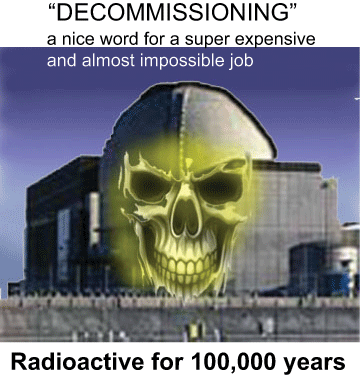
Hinkley Point B to begin 95-year decommissioning plan
Clara BullockSomerset, 5 Nov 25, https://www.bbc.com/news/articles/c986pvg41y2o
A former nuclear power station will begin its 95-year decommissioning process after regulators granted formal consent.
EDF’s Hinkley Point B, which lies on the Somerset coast near Stogursey, has been given the green light to be demolished by the Office for Nuclear Regulation (ONR).
In August 2022, Hinkley Point B reached the end of its operating life after nearly 46 years of generating electricity.
Dan Hasted, ONR director of regulation, said: “We will continue to proportionately regulate the Hinkley Point B site throughout the decommissioning phase to safeguard workers and the public.”
The nuclear site will transfer from EDF to the Nuclear Restoration Services next year, which will oversee the site’s dismantling.
Under the proposals, Hinkley Point B, which opened in 1976, could be decommissioned in three phases.
The first phase, which will last until 2038, includes the dismantling of all buildings and plant materials except for the site’s safestore structure. This facility will be used to store and manage the residential nuclear waste from the power station.
The second phase will see “a period of relative inactivity” of up to 70 years from 2039, to allow for the radioactive materials within the safestore to safely decay.
The final phase will see the former reactor and debris vaults being dismantled and removed.
Meanwhile, a new nuclear power station, Hinkley Point C, is being constructed near Hinkley B.
Israel Is Still Starving Gaza, And Other Notes
Caitlin Johnstone, Nov 06, 2025
In an article titled “Not enough tents, food reaching Gaza as winter comes, aid agencies say,” Reuters reports that “Far too little aid is reaching Gaza nearly four weeks after a ceasefire” due to Israeli restrictions preventing aid trucks from getting to their destinations, and that according to an OSHA report last week “a tenth of children screened in Gaza were still acutely malnourished.”
A report from the UK’s Channel 4 News shows warehouses full of food that aid groups say isn’t being allowed into Gaza nearly as rapidly as needed.
In an article titled “‘Under the Guise of Bureaucracy’ — Israel Blocks Humanitarian Groups From Delivering Essential Aid Despite Calm in Gaza,” Israeli outlet Haaretz reports that “Israel has implemented a new procedure requiring all humanitarian organizations operating in Gaza and the West Bank to reapply for official approval, with many denied, despite the relative calm in Gaza following the cease-fire.”
They’re using bureaucratic red tape and arbitrary restrictions to put as much inertia on the effort to rush aid into Gaza as possible. As Electronic Intifada’s Ali Abunimah put it, Israel has “successfully rebranded its genocide as a ‘ceasefire.’”
❖
Still can’t wrap my head around the fact that internationally renowned activist Greta Thunberg said she was tortured and sexually humiliated by Israeli soldiers when she was abducted for trying to bring aid to starving civilians, and the world just shrugged and moved on.
❖
It’s so silly when US empire apologists cite “the Monroe Doctrine” to defend US warmongering in Latin America, as though “the entire western hemisphere is our property” is a perfectly legitimate policy to have.
The Monroe Doctrine was just American imperialists telling Europe, “You see all these brown people over here south of our border? These are our brown people. You can do whatever you want to those brown people over there in Africa and Asia, but these brown people over here belong to us. Only we get to dominate and exploit them.”
That’s all it has ever been, and people cite it to justify warmongering toward Venezuela or wherever as though saying “yeah well that’s the Monroe Doctrine” is a complete argument in and of itself. It’s bat shit insane nonsense and it should be rejected in its entirety.
US regime change interventionism is reliably disastrous wherever it happens. It always causes immense suffering and instability, it’s always justified by lies, and it never accomplishes what its proponents claim it will accomplish. No amount of bleating the words “Monroe Doctrine” will ever change that.
The US empire backs genocidal Gulf state monarchies like the UAE and Saudi Arabia because if those states were democratically governed their people would prioritize their own interests over the agendas of the west. They wouldn’t permit US military bases on their territory, and they never would have tolerated Israel and its abuses in the region. Fossil fuel policy would be set without regard for western interests. The entire region could long ago have united into a superpower bloc which rivaled or outmuscled the western power structure using its critical resources and trade routes.
That’s why you see the US and its allies preaching about the values of Freedom and Democracy to the public while privately telling these tyrannical monarchies they can do whatever they want and receive the backing of the imperial machine. Not until their pet tyrant fails to sufficiently kowtow to the interests of the empire does the west suddenly get interested in advancing Freedom and Democracy in their nation.
This is one of the major dynamics at play in Sudan. The United Arab Emirates has been backing the genocidal atrocities of the RSF and the US empire is placing no pressure on them to stop, because that’s part of the deal. As long as the UAE plays along with the agendas of the empire, the empire will tolerate or actively facilitate its abuses……………………………………………………………….. https://www.caitlinjohnst.one/p/israel-is-still-starving-gaza-and?utm_source=post-email-title&publication_id=82124&post_id=178143727&utm_campaign=email-post-title&isFreemail=true&r=1ise1&triedRedirect=true&utm_medium=email
Trump’s Westinghouse Nuclear Fiasco: Wasting Money on a Corrupt Game of Hot Potato.

By now, it is evident that no one is buying Westinghouse’s reactors, so it must be up to the U.S. government to do it. But why?
That still means someone will have to pay the cost of $80 billion-112 billion, plus interest, for loans and/or investor returns, plus the costs of operating, fueling, decommissioning, and nuclear waste storage. Taxpayers will likely pay that cost, too.
On Tuesday, the White House announced an $80 billion deal with Westinghouse to finance construction of eight large new reactors in the U.S. There is not enough in the way of actual details about the deal, resulting in even more unanswered questions. But the promise of a large, direct investment in a pack of new reactors has predictably revved up talk of yet another “Nuclear Renaissance” and made it look like the DJT 2.0 administration is making good on big nuclear power goals from a group of executive orders issued in May.
$80 billion sure sounds like a lot! And the news that the announced $80 billion is going to come from Japanese taxpayers and not U.S. taxpayers sounds like a sweet deal!
If we were talking about just about any other energy source, it would be a lot. $80 billion could build:
- 58,000 megawatts of solar power, or
- 38,000 MW of wind power, or
- 48,000 MW of wind and solar combined, or
- 14,000 MW of geothermal power plants.
Any of those options would produce about the same amount of electricity each year as 14-16 large-sized nuclear reactors – twice as many as the Westinghouse deal promises to build.
But $80 billion is only enough to build, at most, four Westinghouse AP1000 reactors. That’s because the cost of building nuclear reactors is four to 10 times more than wind, solar, or geothermal power. Even wind and solar paired with battery storage are still several times cheaper than new nuclear reactors.
But where would the other $80+ billion for eight reactors come from? U.S. taxpayers? Ratepayers? In this case, probably taxpayers. The reactors would probably receive low-interest loans from the Department of Energy’s (DOE) loan guarantee program, and, following construction, they would be eligible to claim the Clean Energy Investment Tax Credit, which provides a 30-50% subsidy for the cost of a new energy project. That would mean $80 billion or more in loans up front, and, later, $48-80 billion in rebates from U.S. taxpayers.
That still means someone will have to pay the cost of $80 billion-112 billion, plus interest, for loans and/or investor returns, plus the costs of operating, fueling, decommissioning, and nuclear waste storage. Taxpayers will likely pay that cost, too. One of the projects that would probably be included in the deal is the proposed four-reactor Donald J. Trump Nuclear Power Plant (DJT NPP), which former Energy Secretary Rick Perry’s new company Fermi, Inc. has proposed. Fermi’s stock price surged on Tuesday after the Westinghouse deal was announced. The DJT NPP is to be built at the DOE’s Pantex nuclear weapons plant in Texas, to power AI data centers that Fermi also plans to build there. The reactors and data centers are likely to be categorized as “critical defense facilities”, per Executive Order 14299. Presumably, federal taxpayers would pay for the data centers and their power bills through DOE’s budget.
Another feature of the deal is a U.S. government profit-sharing and partial ownership in Westinghouse. The company’s Canadian owners – Brookfield Renewable Partners (BRP, an equity investment firm) and uranium company Cameco – would give the U.S. government a 20% share of Westinghouse profits, after the company earns its first $17.5 billion. Then, if Westinghouse’s corporate value reaches $30 billion, Brookfield and Cameco would have to take Westinghouse public on the stock market – and give the U.S. government at least 8.3% of the company’s stock.
This would benefit Brookfield and Cameco, but not U.S. taxpayers. Another Brookfield affiliate bought Westinghouse from Toshiba when it went bankrupt in 2017 due to soaring costs of building four AP1000 reactors for utilities in South Carolina and Georgia. The South Carolina reactors (V.C. Summer 2&3) were canceled, and the Georgia reactors (Vogtle 3&4) were completed in 2024, seven years late and $23 billion over budget. Brookfield Business Partners (BBP) was unable to sell Westinghouse after pulling it out of bankruptcy, but after countries started sanctioning Russia over its war on Ukraine, it looked like Westinghouse could replace Russia as the largest supplier of reactor fuel and services, so BBP sold the company to Brookfield Renewable Partners and Cameco.
Westinghouse’s value hasn’t exactly seen explosive growth, so it has been seeking deals to sell AP1000 reactors in Poland, Ukraine, Slovenia, the Czech Republic, and other countries, in partnership with the U.S. government, which has become increasingly convinced that it must retake global leadership in reactor construction from Russia and China. The Biden administration tried to convince states and utilities that all of the problems with Westinghouse’s AP1000 reactor had been resolved. But still, no state or utility has taken the plunge.
By now, it is evident that no one is buying Westinghouse’s reactors, so it must be up to the U.S. government to do it. But why? Japan’s offer to pitch in $80 billion will soften the blow to U.S. taxpayers. It may even be enough to build the four reactors Rick Perry wants to name after the president. But we would still end up paying the rest of the cost of too-expensive power and never-ending nuclear waste storage, from reactors that mostly will not be providing electricity to our homes and businesses, but to data centers to power AI. Westinghouse is being passed around like a hot potato and we’ll likely be on the hook when the music stops.
UK Government rapped as billions unaccounted for in nuclear spending

THE UK spending watchdog has raised serious concerns about the Ministry of Defence’s (MoD) finances after auditors found it was “unable” to
explain billions of pounds of expenditure listed as going towards nuclear
weapons programmes.
As a result, the National Audit Office (NAO) has issued
qualified opinions on the MoD’s 2024–25 financial statements, meaning
the accounts do not meet normal standards of accuracy and transparency.
Crucially, the NAO found that the UK Government has “not provided
accounting records for ongoing capital projects” carried out on its
behalf by the Atomic Weapons Establishment (AWE), a non-departmental public body that helps deliver the UK’s nuclear weaponry. Auditors found that AWE projects on behalf of the MoD “constituted £6.13 billion of the
value of the department’s assets under construction”.
Of this total, £1.5bn was said to relate to “legacy projects” – but the MoD was found to be “unable to provide supporting evidence” that this figure
was appropriate. The NAO also said it had found “several other
balances” within the £6.13bn figure that did not meet the standard
required to be signed off by auditors, without going into specifics.
The National 4th Nov 2025,
https://www.thenational.scot/news/25595083.uk-government-rapped-billions-unaccounted-nuclear-spending/
The moment of truth: The West confronts Russian military advances.
on October 20th, Russia informed the United States that it had no intention of yielding on territorial concessions, the reduction of the Ukrainian armed forces, or guarantees that Ukraine would never join NATO.
Thierry Meyssan, Voltairenet.org, Tue, 04 Nov 2025
For two years, we in the West have been living in the myth that we will bring Russia to its knees and bring Ukraine into the European Union and the Atlantic Alliance. We will try Vladimir Putin and make Russia pay. Today, this myth is colliding with reality: Moscow now possesses devastating weapons, unparalleled in the West. They make any hope of victory for our coalitions impossible. We will have to acknowledge our mistake. This is not about apologizing for our errors, but about freeing ourselves from them.
On October 26, Russian President Vladimir Putin and his Chief of Staff, Valery Gerasimov, announced the completion of a project to miniaturize a nuclear reactor and install it on a missile. They reported conducting a test launch of the 9M730 Burevestnik missile, which traveled 14,000 kilometers. The unique feature of this nuclear-powered weapon (which has an unlimited range) is its ability to be guided in such a way as to bypass interceptor sites.This, according to Russian authorities, makes it an unstoppable missile.
On October 29, President Putin tested a Status-6 Poseidon torpedo, a nuclear-powered weapon. Throughout the Soviet Union, Eurasian military researchers believed that underwater nuclear explosions could trigger massive tsunamis. To achieve this, they needed to be able to launch torpedoes much farther than was possible at the time, in order to avoid the cataclysms they intended to unleash. This has now been accomplished. Mega-tsunamis could devastate cities like Washington, D.C., or New York City, or even naval groups like those of the U.S. aircraft carriers. However, the Poseidon torpedo is significantly longer than others: 21 meters. It cannot be launched from operational submarines and required its own dedicated vessel for launch. Its ability to operate underwater almost indefinitely more than compensates for this limitation. In any case, this torpedo ensures that Russia can launch a second strike in the event of a US attack. Until now, the first to launch a nuclear strike was guaranteed to cripple its enemy’s main means of retaliation.
No weapon is ever truly definitive. Each exists within a continuum of technological advancements; each is superseded by another; and each eventually encounters effective defenses or predators. But for the moment, there seems to be no answer to these weapons, any more than there is to Russian supersonic missiles.
In about twenty years, Russia has acquired a whole host of new weapons that surpass all Western technologies.……………………………………………………..
Russia possessed the capability to disconnect NATO orders from its own weapons. This wasn’t a form of jamming; the weapons simply stopped responding to commands………………………………………
The Westerners were also testing numerous weapons, such as the tactical atomic bomb that later devastated the port of Beirut.
In 2018, once the Syrian war had ended, President Vladimir Putin presented his weapons program to parliament [ 1 ] . This program comprised six advanced weapons:the Sarmatian (which leaves the atmosphere, orbits the Earth, and re-enters the atmosphere at will) and Kinzhal (dagger) missiles; the nuclear-powered 9M730 Burevestnik and Status-6 Poseidon launchers; the Avantgarde missiles, which combine the characteristics of the Sarmatian and Kinzhal missiles with added maneuverability; and finally, anti-missile lasers.Only the latter are not yet complete.
What were only prototypes in the 2010s became operational and were mass-produced during the war in Ukraine.
The Western response was almost inaudible. Only US President Donald Trump spoke out. He regretted that his Russian counterpart had seen fit to reveal his exploits because, in doing so, he was reigniting the arms race. Furthermore, he announced that the United States was resuming its nuclear tests. Donald Trump could hardly do otherwise: deploring Russia’s renewed arms race is a way of explaining that the Pentagon’s military research is lagging far behind and of asserting Washington’s peaceful stance. Announcing that he will resume nuclear tests is a way of shifting the focus, since none of the new Russian weapons represent an advance in nuclear terms, but only in terms of atomic bomb launchers. To say that he will do this to maintain parity with Russia and China is a blatant lie: Russia has not conducted nuclear tests since 1990 and China since 1996. Moreover, it will take at least two years to rebuild or rehabilitate Cold War-era facilities, and therefore to begin these tests. Until then, the United States is nothing more than a “paper tiger.”
We are now reaching the end of hostilities in Ukraine. The Russian army is on the verge of a decisive victory in the Donbas. It will not only capture Pokrovsk, but will also inflict a third defeat on the White Führer, Andriy Biletsky, whose 10,000 men are surrounded. …………………
..on October 20th, Russia informed the United States that it had no intention of yielding on territorial concessions, the reduction of the Ukrainian armed forces, or guarantees that Ukraine would never join NATO.
Whether the West likes it or not, it no longer has a choice. It simply cannot afford to continue supplying weapons to Russia in Ukraine on its own. The EU’s plan to eventually confiscate Russian assets frozen in Belgium and spend them immediately could spell the end of the Union. In any case, neither Belgium, nor Slovakia, nor Hungary will participate in this theft, which even the Soviets, the staunch opponents of private property, never perpetrated.
The EU’s grandiose ambitions are about to collide with reality: it can only continue this war by betraying the very ideals it claims to uphold………….
All of this is coming to an end, otherwise the EU will be directly drawn into the war against the Slavs that the UK and Germany instigated in 1933: the Second World War. And the EU’s armies, stripped of their arsenals, have no hope of resisting for more than two days. This is not about bowing down to a new master, Russia, but simply about acknowledging our mistakes before it’s too late. https://www.sott.net/article/502778-The-moment-of-truth-The-West-confronts-Russian-military-advances
Rusting nuclear facilities hamper Trump’s plans for new tests
President insists new trials will begin, but officials say US not capable of doing so.
Benedict Smith, US Reporter
The United States is not ready to restart nuclear weapons testing and
risks losing ground to China and Russia if it pushes ahead with Donald
Trump’s plans, experts believe.
The president announced this week that
the US would conduct tests of nuclear weapons for the first time in more
than three decades, breaking one of the few remaining taboos among the
superpowers.
Experts fear that in doing so, Mr Trump has fired the starting
gun on a race Washington is ill-prepared to win, and that it could find
itself matched or overtaken by Moscow and Beijing.
Visitors to America’s
vast testing site in the Nevada desert said it is filled with equipment
that is slowly rusting away, while former officials say it simply has not
had the investment to match the president’s ambitions. Now there are
fears that Mr Trump has opened a “Pandora’s Box” that has remained
shut almost since the end of the Cold War. And he might not be prepared for what comes next.
Telegraph 3rd Nov 2025, https://www.telegraph.co.uk/us/politics/2025/11/03/trump-could-not-launch-nuclear-weapon-if-he-wanted/
No to Nuclear, Yes to Renewables for Wales

28th October 2025, Nuclear Free Local Authorities
Anti-nuclear campaigners meeting last weekend in Wrexham (25 October) issued a declaration calling on politicians representing Welsh constituencies in parliaments in Cardiff and Westminster to work for a nuclear free, renewables powered Wales.
Attendees at the screening of the award-winning film SOS: The San Onofre Syndrome organised by PAWB (Pobol Atal Wylfa-B, People against Wylfa B) hosted at the Ty Pawb Arts Centre in Wrexham also saw a special video message sent by the Californian filmmakers and heard from Stephen Thomas, Emeritus Professor in Energy Policy at Greenwich University and Richard Outram, Secretary of the Welsh Nuclear Free Local Authorities, who both joined the meeting online.
Welsh campaigners are working with US, Canadian and other UK activists to establish a Transatlantic Nuclear Free Alliance to campaign on issues of common concern. The film (https://sanonofresyndrome.com/) highlights the impact of the decommissioning and the legacy of managing deadly radioactive waste faced by the neighbours of the San Onofre nuclear power plant in California.
The film’s messages resonate with international audiences faced with identical threats and challenges. Commenting Professor Thomas said:
“The nuclear industry tries to assure us the radioactive waste disposal and reactor decommissioning are established processes with easily affordable costs. The truth is that we are three or more decades away from permanent disposal of waste and of carrying out the most challenging stages of decommissioning. The cost will be high, and the failure of previous funding schemes means the burden will fall on future taxpayers, generations ahead”.
28th October 2025
No to Nuclear, Yes to Renewables for Wales

Joint Media Release
Anti-nuclear campaigners meeting last weekend in Wrexham (25 October) issued a declaration calling on politicians representing Welsh constituencies in parliaments in Cardiff and Westminster to work for a nuclear free, renewables powered Wales.
Attendees at the screening of the award-winning film SOS: The San Onofre Syndrome organised by PAWB (Pobol Atal Wylfa-B, People against Wylfa B) hosted at the Ty Pawb Arts Centre in Wrexham also saw a special video message sent by the Californian filmmakers and heard from Stephen Thomas, Emeritus Professor in Energy Policy at Greenwich University and Richard Outram, Secretary of the Welsh Nuclear Free Local Authorities, who both joined the meeting online.
Welsh campaigners are working with US, Canadian and other UK activists to establish a Transatlantic Nuclear Free Alliance to campaign on issues of common concern. The film (https://sanonofresyndrome.com/) highlights the impact of the decommissioning and the legacy of managing deadly radioactive waste faced by the neighbours of the San Onofre nuclear power plant in California.
The film’s messages resonate with international audiences faced with identical threats and challenges. Commenting Professor Thomas said:
“The nuclear industry tries to assure us the radioactive waste disposal and reactor decommissioning are established processes with easily affordable costs. The truth is that we are three or more decades away from permanent disposal of waste and of carrying out the most challenging stages of decommissioning. The cost will be high, and the failure of previous funding schemes means the burden will fall on future taxpayers, generations ahead”.
Despite this, the UK Government will introduce developer-led siting plans, permitting nuclear operators to apply to locate new plants in sites throughout Wales, and intends to reduce regulation in the nuclear industry. A recent Memorandum of Understanding was also signed with the United States which could lead to British regulators being obliged to accept US reactor designs not currently approved for deployment in the UK. Great British Energy – Nuclear has also acquired land at Wylfa in Anglesey (Ynys Mon) as a potential site for the deployment of one or more so-called Small Modular Reactors being commissioned from Rolls Royce and the US company Westinghouse has also expressed interest in constructing a larger nuclear plant there. The Welsh Government specifically created Cwmni Egino to develop a new nuclear plant on the Trawsfynydd site at the heart of the beautiful Eryri National Park. And in South Wales, US newcomer Last Energy is seeking permission to deploy multiple micro reactors on a former coal power station site at Llynfi outside Bridgend.
Now eight leading campaign groups have backed the Wrexham Declaration which denounces the continued political obsession with the pursuit of nuclear power as a ‘fool’s errand’.
NFLA Secretary Richard Outram explains why: “Nuclear is too slow, too costly, too risky, contaminates the natural environment compromising human health, and leaves a legacy of nuclear plant decontamination and radioactive waste management lasting millenia that is ruinously expensive and uncertain. And nuclear plants represent obvious targets to terrorists and, as we have seen in Ukraine, to hostile powers in times of war”.
Campaigners are also convinced that nuclear will worsen fuel poverty or climate change……………………………………………………………………………………………………………………………………………………………………………………. https://www.nuclearpolicy.info/news/no-to-nuclear-yes-to-renewables-for-wales/
Trump doubles down on nuclear tests as Russia issues warning.

By Reuters, November 1, 2025 , https://www.smh.com.au/world/north-america/trump-doubles-down-on-nuclear-tests-as-russia-issues-warning-20251101-p5n6z4.html
Washington: President Donald Trump has reaffirmed that the United States will resume nuclear testing, but he would not answer directly when asked whether that would include underground nuclear tests that were common during the Cold War.
“You’ll find out very soon, but we’re going to do some testing,” Trump told reporters aboard Air Force One on Friday (Saturday AEDT) as he flew to Palm Beach, Florida, when asked about underground nuclear tests.
“Other countries do it. If they’re [going] to do it, we’re going to do it, OK?”
Trump said on Thursday that he had ordered the US military to immediately restart the process for testing nuclear weapons after a halt of 33 years, a move that appeared to be a message to rival nuclear powers China and Russia, whose last known tests were in the 1990s.
Trump made that surprise announcement on social media while aboard his Marine One helicopter flying to meet Chinese President Xi Jinping for a trade-negotiating session in Busan, South Korea.
It was not immediately clear whether Trump was referring to nuclear-explosive testing, which would be carried out by the National Nuclear Security Administration, or flight testing of nuclear-capable missiles.
Continue readingThe Nastiest Warmongers Are Trump’s Biggest Fans Now.
Caitlin Johnstone, Nov 03, 2025, https://www.caitlinjohnst.one/p/the-nastiest-warmongers-are-trumps?utm_source=post-email-title&publication_id=82124&post_id=177879309&utm_campaign=email-post-title&isFreemail=true&r=1ise1&triedRedirect=true&utm_medium=email
Massacre fetishist Lindsey Graham said “Trump is my favorite president” because “we’re killing all the right people and we’re cutting your taxes” during a speech to the Republican Jewish Coalition Annual Leadership Summit on Friday.
“We’ve run out of bombs; we didn’t run out of bombs in World War II,” the senator said.
If Lindsey Graham ever gushed about me this effusively for any reason I think I would have to shave my head and join a convent or something, because it would be a clear and undeniable sign that I had been living my whole entire life completely wrong.
It says a lot about how much of a warmonger Trump has become that he himself actually slammed Lindsey Graham repeatedly during his first crack at the presidency for being such a firebreathing war slut.
In 2016 Trump said of Graham, “I hear his theory for the [Iraq] war; you’ll be in there forever. You’ll end up starting World War III with a guy like that.”
In 2017 Trump slammed Graham and his war porn circle jerk partner John McCain, saying “The two senators should focus their energies on ISIS, illegal immigration and border security instead of always looking to start World War III.”
In 2018 Trump attacked Graham for opposing the withdrawal of US troops from Syria, tweeting “So hard to believe that Lindsey Graham would be against saving soldier lives & billions of $$$. Why are we fighting for our enemy, Syria, by staying & killing ISIS for them, Russia, Iran & other locals? Time to focus on our Country & bring our youth back home where they belong!”
In 2019 Trump said during a press conference, “Lindsey Graham would like to stay in the Middle East for the next thousand years with thousands of soldiers and fighting other people’s wars. I want to get out of the Middle East.”
Trump used to at least posture as an anti-interventionist who didn’t get along with the warmongers of the DC swamp. Now he’s best butt buddies with the most bloodthirsty swamp creatures alive.
They love him, and why wouldn’t they? He bombed Iran. He bombed Yemen. He poured genocide weapons into Israel to incinerate Gaza and to bomb Lebanon, and has been aggressively stomping out free speech that is critical of Israel’s war crimes. He’s been bombing Somalia at an unprecedented rate. He’s giving every sign that he’s getting ready to do something truly horrible in Venezuela. He’s even threatening to invade Nigeria now.
Back in March, Trump’s intelligence chief Tulsi Gabbard embarrassingly tweeted that “President Trump IS the President of Peace. He is ending bloodshed across the world and will deliver lasting peace in the Middle East.” Now she’s spending her whole career helping Trump commit mass military violence around the globe.
Trump duped his base into believing he’ll make peace, and he turned out to be Lindsey Graham’s gooiest wet dream incarnate.
UK’s nuclear waste problem lacks a coherent plan.

The [GDF] will comprise vaults and tunnels of a size that may be
approximate to Bermuda, but without the devilish tax evaders, coupled with
a 1 km square surface site that will periodically swallow up trainloads of
toxic radioactive waste. It would be unsurprising if Nuclear Waste
Services, the agency charged with finding and building the site, placed a
job advert for its own Hades to manage this dystopic underworld and if the
postholder engaged Cerberus to guard the entrance.
The plan comes with an enormous bill for taxpayers which will scare the ‘bejeebers’ out of taxpayers. Previously the Government’s new National Infrastructure and Service Transformation Authority (NISTA) had identified in its August 2025 report that the GDF facility may have a whole life cost estimated to range from £20 billion to £53 billion.
Now PAC members have had a further frightener placed on them because these headline figures were based on 2017/18 prices and they have found that, when adjusting to the present, the undersea radioactive monster might cost over £15 billion more. It would be far cheaper to hire Godzilla.
The Public Accounts Committee Chair Geoffrey Clifton-Brown has called on the Government to produce a ‘coherent plan’ to manage the UK’s stockpile of radioactive waste
NFLA 31st Oct 2025, https://www.nuclearpolicy.info/news/trick-not-treat-nuclear-dump-is-full-of-nasty-surprises-not-sweet-treats/
1 This Month
Chernobyl: The Lost Tapes – A good documentary on Chernobyl on SBS available On Demand for the next 3 weeks– https://www.sbs.com.au/ondemand/tv-program/chernobyl-the-lost-tapes/2352741955560

of the week–London Campaign for Nuclear Disarmament

Tell the Ukrainian Government to Drop Prosecution of Peace Activist Yurii Sheliazhenko
To see nuclear-related stories in greater depth and intensity – go to https://nuclearinformation.wordpress.com
-
Archives
- April 2026 (139)
- March 2026 (251)
- February 2026 (268)
- January 2026 (308)
- December 2025 (358)
- November 2025 (359)
- October 2025 (376)
- September 2025 (257)
- August 2025 (319)
- July 2025 (230)
- June 2025 (348)
- May 2025 (261)
-
Categories
- 1
- 1 NUCLEAR ISSUES
- business and costs
- climate change
- culture and arts
- ENERGY
- environment
- health
- history
- indigenous issues
- Legal
- marketing of nuclear
- media
- opposition to nuclear
- PERSONAL STORIES
- politics
- politics international
- Religion and ethics
- safety
- secrets,lies and civil liberties
- spinbuster
- technology
- Uranium
- wastes
- weapons and war
- Women
- 2 WORLD
- ACTION
- AFRICA
- Atrocities
- AUSTRALIA
- Christina's notes
- Christina's themes
- culture and arts
- Events
- Fuk 2022
- Fuk 2023
- Fukushima 2017
- Fukushima 2018
- fukushima 2019
- Fukushima 2020
- Fukushima 2021
- general
- global warming
- Humour (God we need it)
- Nuclear
- RARE EARTHS
- Reference
- resources – print
- Resources -audiovicual
- Weekly Newsletter
- World
- World Nuclear
- YouTube
-
RSS
Entries RSS
Comments RSS
 nuclear-news