Hinkley C – don’t say I didn’t warn you!

It is worth remembering that while construction costs are in the £42 to £48 billion range, the 35 years of electricity at £87.50 or £92.50/MW in 2012 money, adjusted for inflation will cost UK energy users a gargantuan £111 or £116 billion over the next 35 years. Could we use that money better? You bet.
2016 was a missed opportunity, most likely the last opportunity to scrap the benighted project, one of the worst blunders in the history of public procurement and of the UK’s energy industry
In 2016, I called for Hinkley C to be scrapped. Now its commissioning has been pushed back to the end of the decade and its costs have ballooned to as much as £48 billion in 2024 money. I was right.
Thoughts of Chairman Michael , MICHAEL LIEBREICH, JAN 25, 2024
by EDF in 2017), announced a “Nuclear Renaissance” and was lobbying for a new build programme in the UK to replace aging plants set for retirement. In the absence of evidence, they claimed new plants would produce power for £24 per MWh (£39/MWh in 2024 money, or $50/MWh).
The Labour Party, long dead set against nuclear power, were convinced. In January 2008, Prime Minister Gordon Brown declared, in the preface to a White Paper on nuclear power entitled “Meeting the Energy Challenge” that “nuclear should have a role to play in the generation of electricity, alongside other low carbon technologies.” The White Paper estimated the total cost of building a 1.6GW nuclear plant at £2.8 billion – which would translate into £5.6 billion for Hinkley C’s 3.2GW (£9.0 billion or $11.5 billion in 2024 money).
EDF’s UK CEO Vincent de Rivaz was cock-a-hoop, predicting that Brits would be cooking their turkeys with power from Hinkley C by Christmas 2017. But remember that figure – £9.0 billion for 3.2GW.
By October 2013, Osborne and Davey had agreed a Contract for Difference with EDF for electricity production at a strike price of £92.50/MWh in 2012 money (£132/MWh in today’s money or $169/MWh) – rising with inflation for 35 years, but dropping to £87.50 (£125/MWh in today’s money or $173/MWh) if a second EPR were to be built. That EPR is Sizewell C – of which more later.
At that point, Hinkley C was expected to cost £16 billion in 2015 money (£22 billion in 2024 money or $28 billion). It was due to come online in 2023 and continue cooking Christmas turkeys for 60 years.
Since then, on five separate occasions EDF has announced that costs have increased, and the commissioning date pushed back. The only delay which was not fully in the control of EDF and it suppliers in the nuclear and construction industries was Covid – which can be blamed for around a year of delay and a couple of billion of cost increase, but not more.
Last week – yet another delay and cost increase
So then last week, we learned that the plant would be lucky to open much before 2030 – that’s 13 years after de Rivaz’s 2017 promise – and costs would be between £31 and £35 billion in 2015 terms (2015 is used because the CfD figures were set in 2015 money). That is £42 to £48 billion in 2024 money, or up to $61.4 billion).
Remember, we were first promised it would cost £9 billion in today’s money, so that’s an increase of between 4.6 and 5.4 times.
Now, I know that supporters of the project and hard-core nuclear fans will be bursting blood vessels at this point, desperate to jump in an explain that most of the difference between £9 billion and nearly £50 billion is down to financing cost resulting from the use of the CfD mechanism, regulatory cost, delay in government decision-making and so on. But I’m going to say it: I don’t care.
If the nuclear industry says it can build something for £9 billion, it needs to build it for £9 billion. That’s what happens in other industries. If the right number, including finance costs was £22 billion, it should have said so all along. And if it knows that there is a good chance of cost over-runs more than doubling the cost, it should include an appropriate contingency when it promotes and negotiates projects.
How big things (don’t) get done
It is not like cost over-runs in nuclear projects are a big secret. The world’s leading academic expert on project management is Danish Professor Bent Flyvbjerg, author of How Big Things Get Done, who joined me on Cleaning Up last year. Having build a huge database of projects of different sources, he can definitively show that nuclear plants are worse only than Olympic Games in terms of cost over-runs. On average they go 120% over the budget, with 58% of them going a whopping 204% over budget.
The common trope among nuclear fans is that it is only in the western world that nuclear new build is either problematic or exorbitantly expensive, and this is driven by excessive regulation.
While excessive delays in emerging nuclear powers are certainly less common, there is no transparency over how this is achieved. There are ample examples of problems: the use of fake certification documents, the sealing of deals for reactor sales by military inducements, cutting corners on safety, failure to maintain control of the fuel supply chain, failure to disclose problems and accidents; unexplained accidents on aging plants.
There is also no transparency over the real cost of their plants. Put simply, these are are whatever their leaders say they are: it is they who decide the cost of capital, state guarantees, whether safety standards meet or exceed international standards, whether safety standards are enforced, the environmental standards applied to the supply chain, the speed projects proceed through licencing, the need or not to provision for decommissioning costs, the diversion of costs to military, energy or industrial budgets, and so on.
Back to 2016
Now let’s get back to Hinkley C, and 2016. One of the first things Theresa May did when she took over from David Cameron was to ask her security advisors to review the wisdom of allowing state-owned China General Nuclear to invest £6 billion in the project. In the end May backed down and allowed the investment to go ahead, but that is the background to my piece: the project’s future was in doubt, and it was the last realistic chance to kill it before tens of billions of pounds had been invested. And this is what I wrote: The case for Hinkley Point C has collapsed: It’s time to scrap it.
Perhaps of most interest, given the recent breathless announcements by French ministers of their desire to build a lot more new nuclear power stations, and the money being thrown by the UK government at Sizewell C before it has reached a final investment decision, is this section:
There are at least three ways in which [Greg Clark, the freshly-appointed Minister at BEIS] could potentially replace its supply contribution more cheaply, more quickly, and with more impact on UK industry and exports.
He could mandate more renewable generating capacity, paired with interconnections and a range of technologies to manage intermittency. He could push through a fleet of new gas power stations and get serious about carbon capture and storage. Or he could spend a lot less than £37bn on energy efficiency, simply removing the demand for 3.2 GW of base-load power.
Alternatively, if the government still has a nuclear itch, Clark needs to ask why Hinkley C is the right way to scratch it. After decades of technological stagnation, new nuclear technologies are approaching commercialisation, offering passive safety, so they can’t melt down in the event of a power failure, and smaller scale, so they shouldn’t take 15 years to see the light of day.
It is worth remembering that while construction costs are in the £42 to £48 billion range, the 35 years of electricity at £87.50 or £92.50/MW in 2012 money, adjusted for inflation will cost UK energy users a gargantuan £111 or £116 billion over the next 35 years. Could we use that money better? You bet.
Summary
So there you have it. 2016 was a missed opportunity, most likely the last opportunity to scrap the benighted project, one of the worst blunders in the history of public procurement and of the UK’s energy industry……………… https://mliebreich.substack.com/p/hinkley-c-dont-say-i-didnt-warn-you
Biden and Congress Are Destroying International Law for Israel

The current American threats to sanction the ICC could spell the death of International Law. Whatever little hope people had for a just international system will disappear.
MondoWeiss, BY MITCHELL PLITNICK MAY 23, 2024
“Let me be clear, we reject the ICC’s application for arrest warrants against Israeli leaders,” U.S. President Joe Biden told his audience at a Jewish American Heritage Month event at the White House on Monday.
Biden criticized the request for arrest warrants as creating a “false equivalence” between Israel and Hamas. By making that statement, Biden took a clear stance against the rule of law, under which any party, regardless of any other status, must be dealt with the same way.
He also clarified again, if anyone was still unclear on the point, that the United States rejects accountability for itself and its allies, but holds rigorous standards in that regard for its enemies. Just over a year ago, Biden said that an ICC arrest warrant against Russian President Vladimir Putin was “justified” because he had “clearly committed war crimes.”
The hypocrisy is par for the American course. But Biden is now faced with a dilemma. He and other senior officials in his administration have indicated that they will use more than words in response to the ICC Prosecutor’s request. Some in Congress are essentially calling for all-out war on the Court. But Biden is likely to be reluctant to go that far.
Republicans target the ICC
It had been clear for the past several weeks that the International Criminal Court (ICC) was preparing a case against Israeli leaders, and on Monday, the Chief Prosecutor of the Court, Karim Khan, requested arrest warrants for three Hamas leaders and two Israelis. The Israelis were Israeli Prime Minister Benjamin Netanyahu and Defense Minister Yoav Gallant.
Predictably, both Israeli and American leadership lapsed into hysterics. As usual, Netanyahu immediately labeled the request for the warrants “the new antisemitism.” He also claimed that the Prosecutor “should be worried about his status,” a thinly veiled threat of violence, and that Khan was “turning the ICC into a pariah institution” and was “pouring gasoline on the fires of antisemitism spreading around the world.”
That kind of reaction reflects a profound concern about the charges potentially being brought against him — and it should not be overlooked that his statement did not include a denial of those charges. Netanyahu ran through the entire tired propaganda playbook, yet in doing so, he only highlighted the legitimacy of Khan’s request. But this was far from the beginning of the war on the Court.
Last week, before the warrants had been requested, a group of twelve Republican senators threatened Khan directly in a letter against bringing charges against Netanyahu. The letter was signed by some of the most prominent Republicans in the Senate, including Minority Leader Mitch McConnell, Marco Rubio, Tom Cotton, Ted Cruz, and Tim Scott.
The letter threatened sanctions against the ICC and Khan himself, saying “Target Israel and we will target you.” This is language that should be more characteristic of the Mafia than of government officials, though increasingly, it is hard to tell the difference. It closed by stating flatly, “You’ve been warned.”
Khan also told CNN’s Christiane Amanpour that a “senior elected official” had told him ‘This court (the ICC) is built for Africa and for thugs like Putin.” It seems likely that such a blunt and racist bit of bullying came from an American leader……………………………………………………………………….. more https://mondoweiss.net/2024/05/biden-and-congress-are-destroying-international-law-for-israel/
It’s so hot in Mexico that monkeys are dropping dead from trees.
At least 83 of the midsize primates were found dead in the Gulf coast state of Tabasco
Independent, Mark Stevenson, 22 May 24
It’s so hot in Mexico that howler monkeys are falling dead from the trees.
At least 83 of the midsize primates, who are known for their roaring vocal calls, were found dead in the Gulf coast state of Tabasco. Others were rescued by residents, including five that were rushed to a local veterinarian who battled to save them.
“They arrived in critical condition, with dehydration and fever,” said Dr. Sergio Valenzuela. ”They were as limp as rags. It was heatstroke.”
While Mexico’s brutal heatwave has been linked to the deaths of at least 26 people since March, veterinarians and rescuers say it has killed dozens and perhaps hundreds of howler monkeys.
In the town of Tecolutilla, Tabasco, the dead monkeys started appearing on Friday, when a local volunteer fire-and-rescue squad showed up with five of the creatures in the bed of the truck.
Normally quite intimidating, howler monkeys are muscular and can be around 2 feet (60 centimeters) tall, with tails as long again. They are equipped with big jaws and a fearsome set of teeth and fangs. But mostly, their lion-like roars, which bely their size, are what they’re known for.
“They (the volunteers) asked for help, they asked if I could examine some of the animals they had in their truck,” Valenzuela said Monday. “They said they didn’t have any money, and asked if I could do it for free.”
The veterinarian put ice on their limp little hands and feet, and hook them up to IV drips with electrolytes.
So far, the monkeys appear to be on the mend. Once listless and easily handled, they are now in cages at Valenzuela’s office. “They’re recovering. They’re aggressive … they’re biting again,” he said, noting that’s a healthy sign for the usually furtive creatures.
Most aren’t so lucky. Wildlife biologist Gilberto Pozo counted about 83 of the animals dead or dying on the ground under trees. The die-off started around May 5 and hit its peak over the weekend.
“They were falling out of the trees like apples,” Pozo said. “They were in a state of severe dehydration, and they died within a matter of minutes.” Already weakened, Pozo says the falls from dozens of yards (meters) up inflict additional damage that often finishes the monkeys off.
Pozo attributes the deaths to a “synergy” of factors, including high heat, drought, forest fires and logging that deprives the monkeys of water, shade and the fruit they eat.
For people in the steamy, swampy, jungle-covered state of Tabasco, the howler monkey is a cherished, emblematic species; local people say the monkeys tell them the time of day, by howling at dawn and dusk.
Pozo said the local people — who he knows through his work with the Biodiversity Conservation of The Usumacinta group — have tried to help the monkeys they see around their farms. But he notes that could be a double-edged sword.
“They were falling out of the trees, and the people were moved, and they went to help the animals, they set out water and fruit for them,” Pozo said. “They want to care for them, mainly the baby monkeys, adopt them.”
“But no, the truth is that babies are very delicate, they can’t be in a house where there are dogs or cats, because they have pathogens that can potentially be fatal for howler monkeys,” he said, stressing they must be rehabilitated and released into the wild……………………………………………………
“This is a sentinel species,” Pozo said, referring to the canary-in-a-coal mine effect where one species can say a lot about an ecosystem. “It is telling us something about what is happening with climate change.” https://www.independent.co.uk/climate-change/news/mexico-city-heat-drought-monkeys-b2548962.html
Zaporizhzhia nuclear plant’s main power line down for hours, no safety threat
MOSCOW, May 23 (Reuters) – Russia said the main power line supplying the Russian-controlled Zaporizhzhia nuclear power plant (ZNPP) in Ukraine was down for more than three hours on Thursday, though there was no threat to safety.
The six reactors at the Zaporizhzhia plant, held by Russia and located close to the front line of the conflict in Ukraine, are not in operation but it relies on external power to keep its nuclear material cool and prevent a catastrophic accident.
The Russian management said on their official channel on the Telegram app that the reasons for the outage, which had not caused any change in radiation levels, were being investigated.
It had initially said the main 750 kilovolt (kV) “Dniprovska” power line went down at 1:31 p.m. local time (1031 GMT), while the 330 kV “Ferosplavnaya” line was supplying power to the plant now.
It later reported that the Dniprovska line was restored at 4:49 p.m. local. Power supply to ZNPP is possible via both lines, it added.
The Dniprovska power line also went down for almost five hours on March 22, highlighting what the International Atomic Energy Agency (IAEA) said were “ever present dangers to nuclear safety and security” from the Russia-Ukraine war.
Russia and Ukraine have each accused the other at various times of shelling the Zaporizhzhia plant, which is Europe’s largest. Both deny such accusations.
The IAEA has said that the ZNPP has been experiencing major off-site power problems since the conflict began in early 2022, exacerbating the nuclear safety and security risks confronting the site.
Isle of Wight-size iceberg breaks from Antarctica

BBC News, Jonathan Amos, Science correspondent, 20 May 24
Another big iceberg has broken away from an area of the Antarctic that hosts the UK’s Halley research station.
It is the third such block to calve near the base in the past three years.
This new one is not quite as large, but still measures some 380 sq km (145 sq miles) – roughly the size of the Isle of Wight.
The British Antarctic Survey (BAS) took the precaution of moving Halley in 2017 because of concerns over the way the local ice was behaving.
Its buildings were shifted on skis to take them away from immediate trouble.
The station is also now routinely vacated during the long dark months of the southern winter. The last personnel were flown out in February.
Halley sits on top of the Brunt Ice Shelf, which is the floating protrusion of glaciers that have flowed off the continent into the Weddell Sea.
This shelf will periodically shed icebergs at its forward edge and it is currently going through an extremely dynamic phase.
In 2021, the shelf produced a berg the size of Greater Paris (1,300 sq km/810 sq miles) called A74, followed in 2023 by an even bigger block (1,500 sq km/930 sq miles) the size of Greater London, known as A81.
The origin of the new berg goes back to a major crack that was discovered in the shelf on 31 October, 2016. Predictably, it was nicknamed the “Halloween Crack”.
A further fracture perpendicular to Halloween has now cut a free-floating segment of ice that has already begun to drift out into the Weddell Sea………………..
Satellite imagery confirms the GPS data. The berg is surrounded by seawater on all sides.
The loss of so much ice from the Brunt structure these past three years has triggered a rapid acceleration in the shelf’s seaward movement.
Historically, it has flowed forward at a rate of 400-800m (1,300-2,600ft) per year. It is now moving at about 1,300m (4,300ft) a year………………………….
“This latest calving reduces the Brunt Ice Shelf to its smallest observed size,” commented remote sensing specialist Prof Adrian Luckman, from Swansea University…………………………………………… more https://www.bbc.com/news/articles/c033wr32ewno
Project Veritas: White House aide admits Biden fears ‘huge Jewish influence’
The US president won’t risk angering the lobby in Washington, a security adviser told Project Veritas
Wed, 22 May 2024 https://www.rt.com/news/598009-biden-condemn-israel-veritas/
US President Joe Biden is under pressure from the Democratic Party’s progressive wing to more forcefully condemn Israel’s actions in Gaza, but will not do so unless he wins a second term in office, a National Security Council official has told Project Veritas.
Biden’s position on Israel is the result of careful “political calculations,” National Security Council policy adviser Sterlin Waters told an undercover reporter for Project Veritas, a conservative outlet known for its hidden-camera sting operations.
On one hand, Biden and his top aides need to tell Israel that “you’re not going to continue to lie, and bomb, and kill all these kids without facing serious consequences” to placate progressive voters, Waters explained in a video published by the outlet on Tuesday. However, If Biden did this, Waters continued, he would anger the “huge, powerful Jewish influence in Republican and Democrat politics” and face a smear campaign that would cost him this November’s presidential election.
“If Biden won again he could be much more forthright about saying ‘No’,” Waters stated. “[But] that is a second-term decision.”
At present, Biden’s stance on Israel seemingly changes day to day, with the US president telling a crowd of college students on Sunday that he supports “an immediate ceasefire to stop the fighting” in Gaza, and telling reporters on Monday that “we stand with Israel to take out [Hamas leader Yahya] Sinwar and the rest of the butchers of Hamas.”
Israeli Prime Minister Benjamin Netanyahu maintains that Israel can only destroy Hamas by invading Rafah, a city in southern Gaza where more than a million displaced Palestinians are currently sheltering.
Earlier this month, Biden threatened to halt the supply of weapons to Israel if Netanyahu were to order a ground invasion of Rafah, a decision that Waters said was “a political risk.”
However, while the White House froze a shipment of bombs to Israel in late April, Biden approved a different, billion-dollar arms sale – including tank ammunition and mortar rounds – to the Jewish state days after pledging to withhold future deliveries.
Israel has pounded Rafah with airstrikes for the last two weeks, in addition to launching limited ground operations in the eastern neighborhoods of the city. Netanyahu has dismissed Biden’s threat to cut off military aid, proclaiming that Israel “will fight with our fingernails” if necessary.
Despite Netanyahu’s bluster, the prime minister’s war cabinet has shelved plans for a major offensive in Rafah and opted for a more limited approach that will minimize civilian casualties, the Washington Post reported on Monday. Israeli sources who spoke to the Post said that this approach was chosen in order to avoid angering the US.

One day before Waters’ interview was published, a US State Department official told Politico that Secretary of State Antony Blinken had ordered staffers to stop leaking details to media of confidential discussions related to the Israel-Hamas conflict.
US military aid to Ukraine is ‘grift’ – Blackwater founder to Tucker Carlson

The equipment Washington sends to Kiev will never change the tide of battle, Eric Prince has said
https://www.rt.com/news/598015-us-military-aid-ukraine-blackwater/ 22 May 24
US weapons shipments to Ukraine are senseless since they are not capable of changing the course of the conflict, Eric Prince, the founder of private American military contractor Blackwater, told journalist Tucker Carlson in an interview published on Tuesday.
The military aid to Ukraine is nothing but a “massive grift paid by the Pentagon,” Prince stated, adding that the latest major aid package worth $61 billion approved by Congress and signed by President Joe Biden in April will end up lining the coffers of US defense industry giants. Prince, himself a former Navy SEAL officer, resigned and divested from his company after the 2007 Iraqi massacre scandal.
“Most of that money goes to five major defense contractors to replace at five times the cost the weapons that we have already sent the Ukrainians,” the Blackwater founder said, adding that “it does not change the outcome of the battle.”
“The Biden administration believed that all this American weaponry would have saved the day. It has not,” Prince said.
The Russian military has published photos and videos of damaged and destroyed Western-made military equipment in Ukraine, including US-supplied Abrams tanks. One of them ended up at a trophy exhibition in Moscow, alongside a German-made Leopard main battle tank and dozens of other pieces.
Kiev’s forces are already spread “very thin” and are about to face an “ugly summer,” according to Prince. “All the defenses that were supposed to be built by Ukrainians are much smaller or non-existent,” he said, mostly due to “corruption issues.”
Moscow’s forces are “going to have a very good summer” and will seek to “absolutely humiliate the West and make sure they never have a problem with Ukraine again,” the Blackwater founder believes.
The interview comes amid Russian offensives in Donbass and Ukraine’s northeastern Kharkov Region, where Moscow’s forces have been steadily gaining ground. Last month, Russia’s former defense minister, Sergey Shoigu, said Moscow’s forces had seized the initiative and “dispelled the myth of the superiority of Western weapons.”
Prince went on to say that he never believed Ukraine could push Russia out of Donbass and Crimea. “The war should never have [been] started.”
The only thing Washington and its allies will achieve in Ukraine is “facilitating the demise of the Ukrainian men” and “destroying” this nation “for future generations,” the Blackwater founder said.
Moscow has warned that Western arms shipments to Ukraine will only prolong the conflict without changing the outcome. It has also accused the West of forcing Kiev to “fight to the last Ukrainian.” In early May, Shoigu said that Kiev has lost more than 111,000 troops this year alone.
Soaring costs are likely for planned Wylfa nuclear station, but EDF, Westinghouse, Kepco clamour to build it
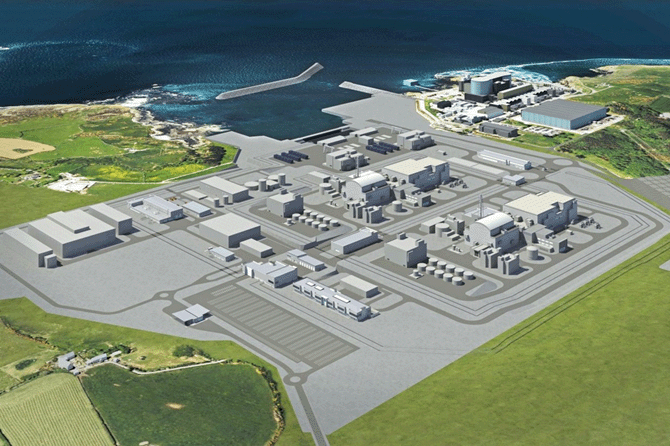
An EDF spokesman described Wylfa as a “fantastic site” and said it
wanted to bid to build the new plant. However, it is expected to face
competition from Westinghouse, an American company, and Kepco, South
Korea’s largest electrical utility firm.
The costs of the new plant are uncertain. Hinkley Point C was originally costed at £18bn but overruns have already pushed that up to at least £46bn. With several more years of
construction needed, final costs are expected to exceed £50bn –
equivalent to about £1,800 per UK home. Hinkley developer EDF is liable
for the extra costs.
The Wylfa B plant is also likely to be financed under
the RAB system which means consumers will see bill increases for Wylfa B
and Sizewell C before either generates any power. Alison Downes, of Stop
Sizewell C, said: “The Government seems determined to double down on
gigawatt nuclear, the slowest most expensive energy source to build, which
the British public – in the form of taxpayers and consumers – will be
forced to pay for.
“We send our empathy to the people of Anglesey who
will be forced to fight yet another inappropriate development. Our advice
is to take very little of what is promised in the form of ‘community
benefits’ at face value.”
Andrew Bowie, the minister for nuclear
energy, was on Wednesday scheduled to meet with the Nuclear
Non-Governmental Organisation Forum to hear various groups’ concerns over
the expansion of nuclear energy. However, he cancelled the meeting at short
notice as news of the Wylfa plan emerged.
Telegraph 21st May 2024
https://www.telegraph.co.uk/business/2024/05/21/anglesey-host-britain-third-new-nuclear-power-station/
Sites with radioactive material more vulnerable as climate change increases wildfire, flood risks

the agency does not specifically consider future climate risks when issuing permits or licenses for new sites or projects
Likewise, the Nuclear Regulatory Commission considers only historical climate data rather than future projections in licensing decisions and oversight of nuclear power plants.
“We’re acting like … (what’s) happening now is what we can expect to happen in 50 years,”
The Canadian Press. Wed, May 22, 2024,
https://ca.news.yahoo.com/sites-radioactive-material-more-vulnerable-050548288.html
As Texas wildfires burned toward the nation’s primary nuclear weapons facility, workers hurried to ensure nothing flammable was around buildings and storage areas.
When the fires showed no sign of slowing, Pantex Plant officials urgently called on local contractors, who arrived within minutes with bulldozers to dig trenches and enlarge fire breaks for the sprawling complex where nuclear weapons are assembled and disassembled and dangerous plutonium pits — hollow spheres that trigger nuclear warheads and bombs — are stored.
“The winds can pick up really (quickly) here and can move really fast,” said Jason Armstrong, the federal field office manager at Pantex, outside Amarillo, who was awake 40 hours straight monitoring the risks. Workers were sent home and the plant shut down when smoke began blanketing the site.
Those fires in February — including the largest in Texas history — didn’t reach Pantex, though flames came within 3 miles (5 kilometers). And Armstrong says it’s highly unlikely that plutonium pits, stored in fire-resistant drums and shelters, would have been affected by wildfire.
But the size and speed of the grassland fires, and Pantex’s urgent response, underscore how much is at stake as climate change stokes extreme heat and drought, longer fire seasons with larger, more intense blazes and supercharged rainstorms that can lead to catastrophic flooding. The Texas fire season often starts in February, but farther west it has yet to ramp up, and is usually worst in summer and fall.
Dozens of active and idle laboratories and manufacturing and military facilities across the nation that use, store or are contaminated with radioactive material are increasingly vulnerable to extreme weather. Many also perform critical energy and defense research and manufacturing that could be disrupted or crippled by fires, floods and other disasters.

There’s the 40-square-mile Los Alamos National Laboratory in New Mexico, where a 2000 wildfire burned to within a half mile (0.8 kilometers) of a radioactive waste site. The heavily polluted Santa Susana Field Laboratory in Southern California, where a 2018 wildfire burned 80% of the site, narrowly missing an area contaminated by a 1959 partial nuclear meltdown. And the plutonium-contaminated Hanford nuclear site in Washington, where the U.S. manufactured atomic bombs.
That realization has begun to change how the government addresses threats at some of the nation’s most sensitive sites.
The Department of Energy in 2022 required its existing sites to assess climate change risks to “mission-critical functions and operations,” including waste storage, and to develop plans to address them. It cited wildfires at Los Alamos and Lawrence Livermore national laboratories and a 2021 deep freeze that damaged “critical facilities” at Pantex.
Yet the agency does not specifically consider future climate risks when issuing permits or licenses for new sites or projects, or in environmental assessments that are reviewed every five years though rarely updated. Instead, it only considers how sites themselves might affect climate change — a paradox critics call short-sighted and potentially dangerous.
Likewise, the Nuclear Regulatory Commission considers only historical climate data rather than future projections in licensing decisions and oversight of nuclear power plants, according to a General Accounting Office study in April that recommended the NRC “fully consider potential climate change effects.” The GAO found that 60 of 75 U.S. plants were in areas with high flood hazard and 16 were in areas with high wildfire potential.
“We’re acting like … (what’s) happening now is what we can expect to happen in 50 years,” said Caroline Reiser, a climate and energy attorney at the Natural Resources Defense Council. “The reality of what our climate is doing has shifted dramatically, and we need to shift our planning … before we experience more and more of the extreme weather events.”
The National Nuclear Security Administration’s environmental safety and health division, which oversees active DOE sites, will conduct an internal review and convene a work group to develop “crucial” methodologies to address climate risks in permitting, licensing and site-wide assessments, John Weckerle, the division’s director of environmental regulatory affairs, told The Associated Press.
Assessments before and after projects are built are critical to protecting infrastructure and waste materials, said Dylan Spaulding, a senior scientist at the Union of Concerned Scientists.
“We know that climate change makes it likely that these events will happen with increased frequency, and that brings the likelihood for unprecedented consequences,” Spaulding said. Sites “can be better protected if you are anticipating these problems ahead of time.”
One of the most dangerous radioactive materials is plutonium, said Edwin Lyman, director of nuclear power safety at the Union of Concerned Scientists. It can cause cancer, is most dangerous when inhaled, and just a few hundred grams dispersed widely could pose a significant hazard, he said.
Experts say risks vary by site. Most plutonium and other radioactive material is contained in concrete and steel structures or underground storage designed to withstand fire. And many sites are on large tracts in remote areas where risk to the public from a radiation release would be minimal.
Even so, potential threats have arisen.
In 2000, a wildfire burned one-third of the 580-square-mile (1,502-square-kilometer) Hanford site, which produced plutonium for the U.S. atomic weapons program and is considered the nation’s most radioactive place.
Air monitoring detected plutonium in nearby populated areas at levels higher than background, but only for one day and at levels not considered hazardous, according to a Washington State Department of Health report.
The agency said the plutonium likely was from surface soil blown by the wind during and after the fire, though site officials said radioactive waste is buried several feet deep or stored in concrete structures.
Because the Hanford site is fire-prone — with 130 wildfires between 2012 and 2023 — officials say they’re diligent about cutting fire breaks and removing flammable vegetation.
The 2018 Woolsey Fire in California was another wakeup call.
About 150,000 people live within 5 miles (8 kilometers) of the Santa Susana Field Laboratory, a former nuclear power research and rocket-engine testing site.
The fire burned within several hundred feet of contaminated buildings and soil, and about 600 feet (183 meters) from where a nuclear reactor core partially melted down 65 years ago.
The state’s Department of Toxic Substances Control said sampling by multiple agencies found no off-site radiation or other hazardous material attributable to the fire. But another study, using hundreds of samples collected by volunteers, found radioactive microparticles in ash just outside of the lab boundary and at three sites farther away that researchers say were from the fire.
The state ordered demolition of 18 buildings, citing “imminent and substantial endangerment to people and the environment because unanticipated and increasingly likely fires could result in the release of radioactive and hazardous substances.”
It also ordered cleanup of old burn pits contaminated with radioactive materials. Though the area was covered with permeable tarps and did not burn in 2018, the state feared it could be damaged by “far more severe” wildfire, high winds or flooding.
“It’s like these places we think, it’ll never happen,” said Melissa Bumstead, founder and co-director of Parents Against Santa Susana Field Laboratory. “But … things are changing very quickly.”
Jay Coghlan, executive director of Nuclear Watch New Mexico, said he and others successfully urged federal nuclear security officials to include a wildfire plan in a 1999 final environmental impact statement for the Los Alamos National Laboratory.
The next year, the 48,000-acre (19,000-hectare) Cerro Grande Fire burned 7,500 acres (3,035 hectares) at the laboratory, including structures, and came within a half-mile (0.8 kilometers) of an area with more than 24,000 above-ground containers of mostly plutonium-contaminated waste.

The plan’s hypothetical fire “eerily matched the real fire,” Coghlan said, adding that it “could have been catastrophic,” if containers had been compromised and plutonium become airborne. But the lab had cut fire breaks around the area — and since then, most containers have been shipped to a permanent storage site in southern New Mexico.
Remaining radioactive material — including from the World War II Manhattan Project — now is underground with barriers to prevent leaching, or in containers stored under fire-retardant fabric-and-steel domes with paved floors until it can be processed for disposal.
The amount of radioactive material in each container is kept low to prevent a significant release if it were compromised, said Nichole Lundgard, engineering and nuclear safety program manager at DOE contractor N3B.
The lab also emphasizes fire preparedness, including thinning forests to reduce the intensity of future fires, said Rich Nieto, manager of the site’s wildland fire program.
“What used to be a three-month (fire) season, sometimes will be a six-month season,” he said.
Wildfires aren’t the only climate-related risk. Flooding from increasingly intense rainstorms can wash away sediment — especially in areas that have burned. Floods and extreme cold also can affect operations and have forced the shutdown of several DOE sites in recent years.
The Lawrence Livermore National Laboratory in Northern California was evacuated during a 2020 wildfire, and last year the lab was forced to shut down for three weeks because of heavy flooding.
The 2000 fire at Los Alamos was followed by heavy rainstorms that washed away sediment with plutonium and other radioactive material.
In 2010, Pantex was inundated with 10 inches (25 centimeters) of rain that forced the plant to shut down, affecting operations for almost a month. The plutonium storage area flooded and corrosion later was found on some containers that’s since “been addressed,” said Armstrong, the field office manager.
In 2017, storms flooded facilities that processed nuclear material and led to power outages that affected a fire alarm control panel.
Then in 2021, Pantex was shut down for a week because of extreme cold that officials said led to “freeze-related failures” at 10 nuclear facilities and other plants. That included failure of a sprinkler head in a radiation safety storage area’s fire suppression system.
Pantex has since adopted freeze-protection measures and a cold weather response plan. And Armstrong says there have been upgrades, including to its fire protection and electrical systems and installation of backup generators.
Other DOE sites also are investing in infrastructure, the nuclear security agency’s Weckerle said, because what once was considered safe now may be vulnerable.
“We live in a time of increased risk,” he said. “That’s just the heart of it (and) … a lot of that does have to do with climate change.”
Julian Assange’s five-year battle against extradition to the US continues as he WINS last-ditch legal battle to lodge appeal
‘Today is a victory, but part of the victory only.’
‘Today marks a turning point. We went into court and we sat and heard the United States fumbling through their arguments, trying to paint lipstick on a pig.
‘We are relieved as a family that the courts took the right decision today but how long can this go on for?
Daily Mail, By GEORGE ODLING and ELIZABETH HAIGH, 21 May 24
WikiLeaks founder Julian Assange‘s five-year battle against extradition to the US for espionage charges continues after he won a last-ditch legal battle to appeal.
‘Well, the judges were not convinced. Everyone can see what is going on here. The United States’ case is offensive.
‘It offends our democratic principles, it offends our right to know, it’s an attack on journalists everywhere.
‘We are relieved as a family that the courts took the right decision today but how long can this go on for? Our eldest son just turned seven.
‘All their memories of their father are in the visiting hall of Belmarsh prison, and as the case goes along, it becomes clearer and clearer to everyone that Julian is in prison for doing good journalism, for exposing corruption, for exposing the violations on innocent people in abusive wars for which there is impunity.
There were gasps of relief from the Australian’s wife and other supporters in the High Court as Dame Victoria Sharp said she and Mr Justice Johnson had decided they were not satisfied with assurances given by US prosecutors.
The judges had last month dismissed most of Assange’s legal arguments but said he would be able to bring an appeal on three grounds unless the US provided ‘satisfactory assurances.’
These were that Assange would be protected by and allowed to rely on the First Amendment, that his trial would not be prejudiced by his nationality and that the death penalty would not be imposed.
Dame Victoria told the court they were not satisfied Assange was guaranteed protection under the First Amendment.
Speaking outside court, Assange’s wife Stella said the judges had made the ‘right decision’, adding: ‘He should be given the Nobel prize and he should walk freely with the sand beneath his feet. He should be able to swim in the sea again. Free Assange.’
Delivering the ruling, Dame Victoria told the court: ‘We have carefully considered the submissions made in writing and orally.
‘First, in respect of the appeal under section 103 of the Extradition Act, we have decided to give leave to appeal on grounds four and five.’
Assange’s lawyer, Edward Fitzgerald KC, said he was satisfied with assurances that if the WikiLeaks founder was extradited and convicted he would not face the death penalty.
But lawyers for the US said that the fact that Assange is accused of illegally obtaining and disseminating confidential defence information means he was not guaranteed protection by the First Amendment regardless of nationality.
In written submissions, he said: ‘The position of the US prosecutor is that no-one, neither US citizens nor foreign citizens, are entitled to rely on the First Amendment in relation to publication of illegally obtained national defence information giving the names of innocent sources to their grave and imminent risk of harm.’
This principle applies to both US and non-US citizens irrespective of their nationality, he added.
The US has provided an assurance that if extradited, Assange ‘will be entitled to the full panoply of due process trial rights, including the right to raise, and seek to rely upon, the first amendment as a defence.’
Assange’s wife, Stella, has previously dismissed this pledge as ‘weasel words.’
The ruling will no doubt increase calls in Assange’s native Australia for the government to intervene on his behalf.
More than a hundred supporters gathered outside the Royal Courts of Justice to wave banners emblazoned with logos including ‘If Assange goes, free speech goes with him.’
Assange declined to attend the hearing but Mrs Assange sat next to his father John Shipton in the well of court 4.
Supporters of Julian Assange cheered as news of the decision to allow his appeal against extradition to the United States filtered out of the courtroom.
Hundreds of people gathered outside the Royal Courts of Justice in London, with many holding signs, flags and banners, while a band is also playing music.
Several speakers addressed crowds on a stage erected adjacent to the court building, with one telling supporters: ‘Today is a victory, but part of the victory only.’
Following the decision, one man with a megaphone said to Assange supporters: ‘We have to do more.’
Among the supporters chanting ‘Free Julian Assange’ were former Labour leader Jeremy Corbyn and Labour MP Apsana Begum.
Kaylaa Sandwell travelled from east London to attend the rally and said: ‘It was obvious from the beginning that they want to silence him and I think he’s a very honest man, and he’s spoken up for us, so we need to really support that.
‘He needs to be freed because he hasn’t done anything wrong.
‘If he doesn’t get freed, we won’t have a free press anymore.’
Speaking outside the Royal Courts of Justice after Julian Assange won a bid to bring an appeal against his extradition to the United States, his wife, Stella Assange, said that judges ‘reached the right decision’ and called on the US to drop the ‘shameful’ case.
She said: ‘Today marks a turning point. We went into court and we sat and heard the United States fumbling through their arguments, trying to paint lipstick on a pig.
‘Well, the judges were not convinced. Everyone can see what is going on here. The United States’ case is offensive.
‘It offends our democratic principles, it offends our right to know, it’s an attack on journalists everywhere.
‘We are relieved as a family that the courts took the right decision today but how long can this go on for? Our eldest son just turned seven.
‘All their memories of their father are in the visiting hall of Belmarsh prison, and as the case goes along, it becomes clearer and clearer to everyone that Julian is in prison for doing good journalism, for exposing corruption, for exposing the violations on innocent people in abusive wars for which there is impunity.
On top of that impunity they have gone after the man who put that impunity onto the public record.
‘The Biden administration should distance itself from this shameful prosecution, it should have done so from day one, but it may be running out of time to do the right thing.
‘Everyone can see what should be done here. Julian must be freed. The case should be abandoned. He should be compensated.
‘He should be given the Nobel prize and he should walk freely with the sand beneath his feet. He should be able to swim in the sea again. Free Assange.’
She continued: ‘The judges reached the right decision. We spent a long time hearing the United States putting lipstick on a pig, but the judges did not buy it.
‘As a family we are relieved, but how long can this go on? The United States should read the situation and drop this case now.’
The 52-year-old was indicted by a US grand jury in 2018 on 17 espionage charges and a charge of unlawful use of a computer, which Assange’s lawyers claim could see him sentenced to 175 years in jail.
American prosecutors allege that the Australian encouraged and helped former US army intelligence analyst Chelsea Manning to steal the cables, which they claim put the lives of covert sources around the globe at risk.
President Joe Biden has faced persistent pressure to drop the case filed by his predecessor Donald Trump.
Assange had previously lived inside the Ecuadorian Embassy in Knightsbridge, west London, for almost seven years until he was eventually dragged out in 2019 when the Ecuadorian government withdrew his asylum.
He entered as a fugitive in 2012 to avoid extradition to Sweden on sexual assault charges, which he denied and which Sweden dropped in 2019………………………………………………………………………. more https://www.dailymail.co.uk/news/article-13438235/julian-assange-wikileaks-death-penalty-high-court.html
Endless Trump reporting in USA media, but very little reporting of genocide in Gaza

Why so little reporting of genocide in Gaza?
Walt Zlotow, 22 May 24 https://heartlandprogressive.blogspot.com/
If you only watch mainstream news, cable and network, you may not even be aware the US is enabling Israel’s grotesque genocide of Palestinians in Gaza. There’s a couple of reasons for that.
The entire commercial media has largely scrubbed reporting on genocide there. To cover it would reveal US complicity in the first major genocide of the 21st century, destroying any semblance of a livable existence for 2,300,000 Palestinians. Why expose the truth which doesn’t fit the now debunked narrative of American exceptionalism and decency round the world.
But there’s a more ghoulish reason scenes of genocide in Gaza are missing from the American version of Pravda. Israel is killing as many reporters on the ground as US 2,000 lb. bombs can obliterate. In the first 7 months of the genocide, 143 Palestinian reporters have been killed. That is more reporters than were killed in WWII and Vietnam War combined. But worse, it only includes credentialed reporters, not the many uncredited bloggers, writers and their family members killed along with them.
As in previous Israeli campaigns in Gaza, virtually all international media professionals are barred from entering Gaza to ensure Israeli crimes against the entire Palestinian people go unreported. Israel also imposes a gag order on its own journalists who might dare report the truth of its 8 month long genocide enabled by America. Just this week Israeli authorities seized Associated Press broadcasting equipment in southern Israel and blocked the outlet’s live feed of Gaza.
Turn on the endless loop of Trump trial coverage that passes for informing the American public and ponder: ‘If the genocide in Gaza is not being covered…does that mean it’s not happening?’
Israel says it will return video equipment seized from AP
BY JOSEF FEDERMAN AND DANICA KIRKA, May 22, 2024
JERUSALEM (AP) — The Israeli government will return a camera and broadcasting equipment it had seized from The Associated Press on Tuesday, reversing course hours after it blocked the news organization’s live video of Gaza and faced mounting criticism for interfering with independent journalism.
The AP’s live video of Gaza was back up early Wednesday in Israel…………………….
After Israel seized the AP equipment, the Biden administration, journalism organizations and an Israeli opposition leader condemned the government of Prime Minister Benjamin Netanyahu and pressured it to reverse the decision……………………………………….more https://apnews.com/article/live-transmission-israel-associated-press-57e8f662907334ba3599156276381190
Israel blocks Associated Press from livestreaming of Gaza under new censorship law, US urges it to reverse decision

Josef Federman, Associated Press, Tue, 21 May 2024, https://www.sott.net/article/491599-Israel-blocks-Associated-Press-from-livestreaming-of-Gaza-under-new-censorship-law-US-urges-it-to-reverse-decision
Israeli officials seized a camera and broadcasting equipment belonging to The Associated Press in southern Israel on Tuesday, accusing the news organization of violating anew media lawby providing images to Al Jazeera. The U.S. privately urged the Israeli government to reverse the decision, two senior U.S. officials said.
The U.S. officials spoke on the condition of anonymity because they were not authorized to discuss the matter publicly.
Al Jazeera, which is based in Qatar, is one of thousands of AP customers, and it receives live video from AP and other news organizations.
“The Associated Press decries in the strongest terms the actions of the Israeli government to shut down our longstanding live feed showing a view into Gaza and seize AP equipment,” said Lauren Easton, vice president of corporate communications at the news organization. “The shutdown was not based on the content of the feed but rather an abusive use by the Israeli government of the country’s new foreign broadcaster law. We urge the Israeli authorities to return our equipment and enable us to reinstate our live feed immediately so we can continue to provide this important visual journalism to thousands of media outlets around the world.”
Officials from the Communications Ministry arrived at the AP location in the southern town of Sderot on Tuesday afternoon and seized the equipment. They handed the AP a piece of paper, signed by Communications Minister Shlomo Karhi, alleging it was violating the country’s foreign broadcaster law.
“The communications ministry will continue to take whatever enforcement action is required to limit broadcasts that harm the security of the state,” the ministry said in a statement.
On May 5, Israeli officials used the law to close down the offices of Al Jazeeraand confiscated the channel’s equipment, banned its broadcasts, and blocked its websites.
Shortly before its equipment was seized on Tuesday, AP was broadcasting a general view ofnorthern Gaza. The AP complies with Israel’s military censorship rules, which prohibit broadcasts of details like troop movements that could endanger soldiers. The live video has generally shown smoke rising over the territory.
Comment: That, and the press have mostly been prevented from entering Gaza, likely over fears that being witness to, and capturing footage of, the ongoing genocide would be too horrific for even the mainstream press to downplay – despite it being all over social media. They’d also be victims of Israel’s indiscriminate slaughter.
The AP had been ordered verbally last Thursday to cease the live transmission, which it refused to do.
Israel’s opposition leader Yair Lapid called the move against AP “an act of madness.”
“This is not Al Jazeera. This is an American news outlet,” he said. “This government acts as if it has decided to make sure at any cost that Israel will be shunned all over the world.”
Comment: Indeed. They’re giving the game away.
Karhi, Israel’s communications minister, responded that the law passed unanimously by the government states that any device used to deliver Al Jazeera content could be seized.
“We will continue to act decisively against anyone who tries to harm our soldiers and the security of the state, even if you don’t like it,” he wrote to Lapid on X.
When Israel closed down Al Jazeera’s offices earlier this month, media groups warned of the serious implications for press freedom in the country. The law gives Karhi, part of the hard-right flank of Israeli Prime Minister Benjamin Netanyahu’s Likud Party, wide leeway to enforce it against other media.
“Israel’s move today is a slippery slope,” the Foreign Press Association said in a statement, warning that the law “could allow Israel to block media coverage of virtually any news event on vague security grounds.”
White House press secretary Karine Jean-Pierre said the U.S. was “looking into” what happened and that it was “essential” for journalists to be allowed to do their jobs.
Israel has long had a rocky relationship with Al Jazeera, accusing it of bias against the country, and Netanyahu has called it a “terror channel” that spreads incitement.
Al Jazeera is one of the few international news outlets that has remained in Gaza throughout the war, broadcasting scenes of airstrikes and overcrowded hospitals and accusing Israel of massacres. AP is also in Gaza.
Comment: AP has, essentially, been censoring its reporting of the crimes against humanity from within Israel’s Gaza concentration camp.
During the previous Israel-Hamas war in 2021, the army destroyed the building housing AP’s Gaza office, claiming Hamas had used the building for military purposes. The AP denied any knowledge of a Hamas presence, and the army never provided any evidence to back up its claim.
The war in Gaza began with a Hamas attack in Israel that killed 1,200 people and saw 250 others taken hostage. More than 35,000 Palestinians have been killed since then, according to Gaza’s Health Ministry, which doesn’t distinguish between civilians and combatants in its count.
Comment: Over the previous months, Israel hasbeen emboldened by the complicity of governments and the mainstream press, and it has become ever more brazen, and deluded, however, with the ICC’s possible arrest warrant for Netanyahu, the ICJ genocide case, the campus protests, and so on, Tel Aviv is also likely becoming increasingly desperate. But whilst Israel’s cheerleaders will excuse genocide at every turn, action like this will make it increasingly hard for the ‘undecided’ to do so.
We’ve underestimated the ‘Doomsday’ glacier – and the consequences could be devastating

The Thwaites Glacier, dubbed ‘Doomsday’, could trigger a two-foot rise in global sea levels if it melts completely
Katie Hawkinson, 22 May 24, https://www.independent.co.uk/climate-change/news/thwaites-doomsday-glacier-melting-study-b2548765.html
A vast Antarcticglacier is more vulnerable to melting than previously thought, according to new research, with potentially devastating consequences for billions of people.
The Thwaites Glacier — dubbed the “Doomsday” glacier because of the grave impacts for global sea level rise if it melts — is breaking down “much faster” than expected, according to a peer-reviewed study published Monday in the academic journal, Proceedings of the National Academy of Sciences.
Using satellite imagery, scientists determined that widespread contact between the glacier and warm ocean water is speeding up the melting process. The climate crisis is interrupting natural processes across large parts of the continent, according to the Antarctic and Southern Ocean Coalition.
The glacier, roughly the size of the United Kingdom, could cause global sea levels to rise more than 2 feet if it melts completely, according to the study.
“Thwaites is the most unstable place in the Antarctic and contains the equivalent of 60 centimeters of sea level rise,” study co-author Christine Dow said in a statement.
“The worry is that we are underestimating the speed that the glacier is changing, which would be devastating for coastal communities around the world,” she continued.
Record rising sea levels have already had severe consequences for coastal and island communities. In February, 1,200 residents of the island, Gardi Sugdub, began to relocate to mainland Panama as the rising Caribbean Sea overtake their home, according to the BBC.
As a result, the indigenous Guna people have become some of the first climate refugees in the Americas.
United Nations Secretary-General Antonio Guterres said last year that more than 900million people face extreme danger from rising sea levels — a projection made even before this week’s discovery about the rapidly-melting glacier.
Mr Guterres said cities across the globe including Mumbai, Shanghai, London, New York, and Buenoes Aires will face “serious impacts”
“The consequences of all of this are unthinkable,” he said. “Low-lying communities and entire countries could disappear forever. We would witness a mass exodus of entire populations on a biblical scale. And we would see ever-fiercer competition for fresh water, land and other resources.”
Nuclear-free councils hit out at ‘mad delusion’ of new reactor

“Instead of wasting cash and time on nuclear, the Scottish NFLAs believe the money and effort would first be far better spent insulating all domestic properties and public buildings to the highest standard to improve energy efficiency, reduce energy consumption and minimise or eliminate fuel poverty, as well as investing in more renewable energy generating capacity and battery storage.”
“
By Alan Hendry alan.hendry@hnmedia.co.uk, 21 May 2024, https://www.northern-times.co.uk/news/nuclear-free-councils-hit-out-at-mad-delusion-of-new-react-351234/
Calls for a nuclear revival in Scotland – including the possibility of a new Dounreay reactor – have been dismissed as “folly” and a “mad delusion”.
Scottish Nuclear Free Local Authorities (NFLAs), a grouping of councils opposed to civil nuclear power, insisted that renewables “represent the only way forward to achieve a sustainable, net-zero future”.
The secretary of state for Scotland, Alister Jack, confirmed last week that he had asked the UK energy minister to plan for a new nuclear site north of the border as part of a nationwide strategy.
Dounreay had been put forward among the possible locations for a small modular reactor (SMR), a series of 10 power stations that engineering giant Rolls-Royce was planning to build by 2035.
Jamie Stone, the Liberal Democrat MP for Caithness, Sutherland and Easter Ross, was quick to press the case for Dounreay to be considered. After a conversation with the Scottish secretary, Mr Stone claimed there was “all to play for”.
Dounreay is being decommissioned, with the end date for the nuclear clean-up now extended to the 2070s.
A proposal that Highland Council should sign up to NFLAs came to nothing in 2019 after some Caithness councillors condemned the idea. Scottish councils that are part of NFLAs are Dundee, East Ayrshire, Edinburgh, Fife, Glasgow, Midlothian, North Lanarkshire, Renfrewshire, Shetland Islands, West Dunbartonshire and Western Isles.
In a statement, Scottish NFLAs said a new focus on nuclear generation would put the UK government at odds with the Scottish Government as the SNP remains “implacably opposed” to the construction of any new nuclear fission plants in Scotland.
“To the NFLAs, an investment in any nuclear would not only be folly, but a lamentable diversion of effort from achieving the credible goal of supplying 100 per cent of Scotland’s electricity from renewables,” the group said.
“Nuclear power plants are enormously expensive to build and notorious for their cost and delivery overruns.”
Scottish NFLAs maintained that “none of the competing SMR designs has yet received the required approvals from the nuclear regulator to even be deployed in the UK” and “the necessary finance has yet to be put in place”.
It went on: “SMRs are estimated to cost £3 billion each, but cost overruns are notorious in the nuclear industry, and the earliest any approved and financed SMR would come onstream would be in the early 2030s.
“Nuclear plants are also incredibly expensive to decommission, and the resultant radioactive waste must be managed at vast expense for millennia.
“Instead of wasting cash and time on nuclear, the Scottish NFLAs believe the money and effort would first be far better spent insulating all domestic properties and public buildings to the highest standard to improve energy efficiency, reduce energy consumption and minimise or eliminate fuel poverty, as well as investing in more renewable energy generating capacity and battery storage.”
Scottish NFLAs said Scotland could become “a powerhouse” with surplus renewable energy being exported to England and continental Europe via interconnectors.
It added: “To realise this, the Scottish NFLAs would like to see the Scottish Government recommit to establishing a state-owned renewable energy company to invest in this potential and to generate an income for the nation.
“The Scottish NFLAs believe that if the secretary of state for Scotland genuinely wants to see a sustainable, net-zero future for Scotland he should call for the British government to get behind the Scottish Government in backing this strategy, instead of maintaining his mad delusion for nuclear.”
1 This Month
15 October. Joint Appeal for Nuclear Abolition Day -presentation to the UN on October 15 will be live on UNWebTV
Endorse the Nuclear Abolition Day Appeal
23-25 October – on Zoom – World BEYOND War’s annual global conference

To see nuclear-related stories in greater depth and intensity – go to https://nuclearinformation.wordpress.com
-
Archives
- October 2026 (139)
- September 2026 (339)
- August 2026 (330)
- July 2026 (355)
- June 2026 (287)
- May 2026 (306)
- April 2026 (356)
- March 2026 (251)
- February 2026 (267)
- January 2026 (308)
- December 2025 (358)
- November 2025 (359)
-
Categories
- 1
- 1 NUCLEAR ISSUES
- business and costs
- climate change
- culture and arts
- ENERGY
- environment
- health
- history
- indigenous issues
- Legal
- marketing of nuclear
- media
- opposition to nuclear
- PERSONAL STORIES
- politics
- politics international
- Religion and ethics
- safety
- secrets,lies and civil liberties
- spinbuster
- technology
- Uranium
- wastes
- weapons and war
- Women
- 2 WORLD
- ACTION
- AFRICA
- Atrocities
- AUSTRALIA
- Christina's notes
- Christina's themes
- culture and arts
- Events
- Fuk 2022
- Fuk 2023
- Fukushima 2017
- Fukushima 2018
- fukushima 2019
- Fukushima 2020
- Fukushima 2021
- general
- global warming
- Humour (God we need it)
- Nuclear
- RARE EARTHS
- Reference
- resources – print
- Resources -audiovicual
- Weekly Newsletter
- World
- World Nuclear
- YouTube
-
RSS
Entries RSS
Comments RSS

