Devonport Dockyard nuclear sub dismantling will be hit by delays, new report predicts
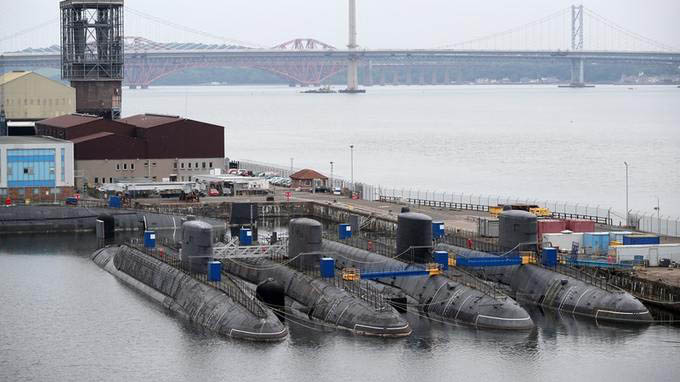
Nuclear Information Service expects no quick fix for removal of 15 decommissioned submarines laid up at Devonport
William Telford, Business Editor, 15 Feb 24 Plymouth Live
The dismantling of 15 decommissioned nuclear subs at Devonport Royal Dockyard is likely to hit delays, according to a new report. The briefing document published by the independent Nuclear Information Service says a history of infrastructure work at the Plymouth facility means “delays are more likely to materialise than not”.
The report said upgrades to 14 and 15 Docks and the Submarine Refit Complex at Devonport are overdue and progress on submarine dismantling is “on hold” while the Government focuses on its £298m “demonstrator” project to fully dismantle HMS Swiftsure at Rosyth, forecast to be complete at the end of 2026.
The Ministry of Defence told Plymouth Live it aims to dismantle the nuclear submarines at Devonport “as soon as practicably possible”. It said the Swiftsure project will “inform and refine” the dismantling process for subsequent submarines and provide more certainty on the dismantling schedule for future submarines and remains on schedule for completion by the original target date of 2026.
The Nuclear Information Service’s briefing report on Devonport Royal Dockyard gives an overview of the facility and its role in servicing the UK’s submarine fleet, including its nuclear-armed submarines. The report said: “The 15 out-of-service nuclear submarines stored at Devonport, and a further seven that are at Rosyth, together comprise every nuclear submarine the Navy has ever fielded.
“Aside from the long-overdue upgrades to 14 and 15 Docks, and the Submarine Refit Complex, progress on submarine dismantling is on hold while the Government focuses on its ‘demonstrator’ project to fully dismantle HMS Swiftsure. This work is being undertaken at Rosyth and is currently forecast to be complete at the end of 2026 at a cost of £298m.
“Three more submarines at Rosyth have had low-level waste removed from them, but it is not clear if work to defuel the nine submarines at Devonport that are still carrying nuclear fuel will begin before completion of the demonstrator project.
In 2016 the MoD estimated that fully dismantling 27 submarines would cost £2.4bn. Although the risk to in-service submarine availability from delays to submarine dismantling and defuelling is lower than from delays to the maintenance schedule, the history of problems with the project and with infrastructure work at Devonport suggests that delays are more likely to materialise than not.”…………………………..more https://www.plymouthherald.co.uk/news/plymouth-news/devonport-dockyard-nuclear-sub-dismantling-9098888—
Palestine and the Power of Language

TIME, BY ELENA DUDUM, FEBRUARY 16, 2024 Dudum is a Palestinian-Syrian-American writer currently working on a memoir about living in the diaspora as a Palestinian in America. She is a graduate of Columbia University
In today’s near-constant news cycle on Gaza, Palestinians seem to die at the hands of an invisible executioner. Palestinians are shot dead. Palestinians starve. Palestinian children are found dead. But where is there accountability? Palestinians die, they aren’t killed, as if their death is a fault of their own.
The obfuscation of responsibility is facilitated by a structure often overlooked since grade school: grammar. At this moment, grammar has the indelible power to become a tool of the oppressor, with the passive voice the most relied-upon weapon of all.
When I was young, teachers scolded me for using the passive voice—they wanted my writing to be precise and direct. Instead, my sentences always seemed to protect those who performed the actions. Back then, the fact that my sentence structure obscured accountability didn’t bother me. But I know better now. As a Palestinian American, with refugee grandparents who survived the Nakba, I’m confronting the occupation back home from the safety of my apartment in America. Over the years, I’ve combed through headlines searching for the active voice in a sea of passivity. I need those who commit actions, those who hold agency, to be named. I need Israel and its occupational forces to be named.
The passive voice often focused on the recipient of the event, not the doer. In the news today, I see only the passive voice: “A group of Palestinian men waving a white flag are shot at,” and I can’t help but hear the voices of my past English teachers ask, “But who ‘shot’ these men?” Accountability is not just vague; it’s altogether missing……………………………………………………………………………………………………………………………………….
“This is how Britain ruled the world,” Khalidi went on to explain. “It was an empire of violence. And that strategy of overwhelming violence, when challenged, has been Israel’s strategy ever since.” This history of violence can easily be traced back to the foundation of the Zionist movement. The first Israeli prime minister, David Ben-Gurion, wrote to his son in 1937: “The Arabs will have to go, but one needs an opportune moment for making it happen, such as a war.”
I saw intent in these words, but others in my class did not. So I kept searching, looking through the archive to help me piece together what parts of history I was missing. I found Joseph Weitz, director of the Jewish National Fund’s Lands Department, who wrote that there was no solution other than to transfer all Arabs from Palestine—who were the overwhelming majority in the region—into neighboring countries so that no Palestinian villages would remain. But when I shared these findings in class, they were brushed aside. “This isn’t intent,” a student said. “You can’t prove intent with a few peoples’ letters and actions.”………………………………………………………………………………………………………………
While writing tedious essays in high school, I didn’t care that I used the passive voice. I didn’t care because our writing assignments were often divorced from broader socio-political contexts. The violence of protecting those accountable versus those left bearing the burden of the violence didn’t yet touch me or my body. A privilege, I know. The calculated use of language against Palestinians didn’t yet anger me, either, even though blatant anti-Arab racism happened in front of me with growing frequency after 9/11. It felt as though this version of racism was acceptable, even expected……………………………………………………………………………………………..
The word “complicated” is often used to describe the occupation in Palestine, a word that insists that occupation is untouchable—Palestine’s history is too complex, there are too many moving parts, it’s a puzzle that can never be solved. But this word is condescending—a distraction. It wants us to feel small, worthless, and petty in our investigation. It demands power structures remain in place, allowing some to speak while requiring others to stay quiet. But what’s happening today in Palestine against the Palestinian people is not complicated. It’s a revolting violation of human rights. It is active and precise. Palestinians are killed or, if they’re lucky, violently evicted from their homes. The question—by whom?—is often never raised. Palestinian schools, hospitals, community centers, historic holy spaces, safe zones are bombed; their resources depleted; people are starving—as if all of this happened devoid of context or responsibility for those who hold power.
So let me amend the above statements, as my former English teachers would have requested, and put them into the active voice: Israel bombs Palestinian schools that house sacred archives. Israel bombs hospitals with necessary aid. Israel bombs community centers and historic holy spaces that have stood for centuries. Israel depletes Palestinian resources. Israel bombs Rafah, housing over 1 million displaced Palestinians, after claiming it a safe zone. Israel is starving Gaza. https://time.com/6695499/palestine-power-of-language-essay/—
Energy company Centrica boss says it could fund Suffolk nuclear plant Sizewell C
Energy company Centrica is considering pumping cash into the construction
of the Sizewell C nuclear power plant on the Suffolk coast, its chief
executive has revealed. Chris O’Shea said the Suffolk site was a
“possible future investment” as the government tries to secure funding
for the project. Ministers are bidding to raise hundreds of millions of
pounds from private companies to help build the plant, near Leiston.
East Anglia Daily Times 15th Feb 2024
https://www.eadt.co.uk/news/24122986.centrica-boss-says-fund-suffolk-plant-sizewell-c
Mirror 15th Feb 2024
https://www.mirror.co.uk/money/british-gas-owner-centrica-considers-32134974
Evening Standard 15th Feb 2024
Proactive Investor 15th Feb 2024
Bloomberg 15th Feb 2024
US Gives Israel the Green Light to Kill Civilians in Rafah

US officials told POLITICO that there would be no consequences for Israel if it invades Rafah, by Dave DeCamp February 13, 2024, https://news.antiwar.com/2024/02/13/us-gives-israel-the-green-light-to-kill-civilians-in-rafah/
The US has given Israel the green light to kill civilians in Rafah despite public comments from US officials calling for Israel to come up with a plan to protect civilians in the city, which is packed with an estimated 1.5 million Palestinians.
US officials told POLITICO that the Biden administration was not planning any consequences for Israel if it went ahead with a major assault on Rafah, which would inevitably kill a huge number of civilians. “No reprimand plans are in the works, meaning Israeli forces could enter the city and harm civilians without facing American consequences,” the report reads.
White House National Security Council spokesman John Kirby made clear at a press conference on Monday that the US wasn’t thinking about cutting off Israel from military aid if it went ahead with the assault. When asked if the US has threatened to withhold aid, Kirby said, “We’re going to continue to support Israel … And we’re going to continue to make sure they have the tools and the capabilities to do that.”
President Biden is also not reconsidering his full-throated support for the Israeli slaughter in Gaza despite reports of him disparaging Israeli Prime Minister Benjamin Netanyahu in private conversations.
Congress is also on board with continuing to support the mass killing of Palestinians as the Senate voted to pass a $95 billion foreign military aid bill that includes $14 billion for Israel. Only 20 Republicans voted for the bill, but the opposition is due to the lack of a border deal, as virtually all Republicans are in favor of unconditional support for Israel, even more so than Democrats in Congress.
Rafah’s pre-war population was 275,000, meaning Palestinians displaced from other areas of the Strip increased the population fivefold. The majority of the Palestinians in the city are sheltering in tents in the streets, leaving them especially vulnerable to an Israeli attack. Israeli airstrikes on Rafah on Sunday night into Monday morning killed 27 children and 22 women.
Breakthrough research unveils effects of ionizing radiation on cellular DNA

Feb 14 2024The Korea Advanced Institute of Science and Technology (KAIST)
Recent release of the waste water from Japan’s Fukushima nuclear disaster stirred apprehension regarding the health implications of radiation exposure. Classified as a Group 1 carcinogen, ionizing radiation has long been associated with various cancers and genetic disorders, as evidenced by survivors and descendants of atomic bombings and the Chernobyl disaster. Despite much smaller amount, we remain consistently exposed to low levels of radiation in everyday life and medical procedures.
Radiation, whether in the form of high-energy particles or electromagnetic waves, is conventionally known to break our cellular DNA, leading to cancer and genetic disorders. Yet, our understanding of the quantitative and qualitative mutational impacts of ionizing radiation has been incomplete.
On the 14th, Professor Young Seok Ju and his research team from KAIST, in collaboration with Dr. Tae Gen Son from the Dongnam Institute of Radiological and Medical Science, and Professors Kyung Su Kim and Ji Hyun Chang from Seoul National University, unveiled a breakthrough. Their study, led by joint first authors Drs. Jeonghwan Youk, Hyun Woo Kwon, Eunji Kim and Tae-Woo Kim, titled “Quantitative and qualitative mutational impact of ionizing radiation on normal cells,” was published in Cell Genomics.
Employing meticulous techniques, the research team comprehensively analyzed the whole-genome sequences of cells pre- and post-radiation exposure, pinpointing radiation-induced DNA mutations. Experiments involving cells from different organs of humans and mice exposed to varying radiation doses revealed mutation patterns correlating with exposure levels.
Notably, exposure to 1 Gray (Gy) of radiation resulted in on average 14 mutations in every post-exposure cell. Unlike other carcinogens, radiation-induced mutations primarily comprised short base deletions and a set of structural variations including inversions, translocations, and various complex genomic rearrangements. (Figure 3) Interestingly, experiments subjecting cells to low radiation dose rate over 100 days demonstrated that mutation quantities, under equivalent total radiation doses, mirrored those of high-dose exposure. ……………………………………….. more https://www.news-medical.net/news/20240214/Breakthrough-research-unveils-effects-of-ionizing-radiation-on-cellular-DNA.aspx
“Threat to US national security” relates to Russia’s possible launch of nuclear weapons into space
EUROPEAN PRAVDA, UKRAINSKA PRAVDA — WEDNESDAY, 14 FEBRUARY 2024, https://www.pravda.com.ua/eng/news/2024/02/14/7441914/—
Two sources of the US television channel ABC News have claimed that a “serious national security threat to the US” which was discussed on 14 February relates to Russia’s alleged intention to launch nuclear weapons into space.
Source: European Pravda, ABC News
Details: The chairman of the US House Intelligence Committee, Mike Turner, had requested that intelligence be declassified that “has to do with Russia wanting to put a nuclear weapon into space”.
ABC News has clarified that this is not about Russia dropping nuclear weapons on Earth, but rather that these weapons could be used against satellites.
“It is very concerning and very sensitive,” one source told ABC News, calling it a “big deal”.
Details of the “serious national security threat to the US” were not disclosed, but many members of the US Congress, while describing the issue as serious, assured the public that it was no cause for alarm.
National Security Advisor Jake Sullivan said that he had personally contacted leading lawmakers from the national security committees before Turner publicly warned of the “serious threat to national security”.
Background: A survey conducted ahead of the Munich Security Conference revealed a lower perception of Russia’s war against Ukraine as a major threat to the world compared to the end of 2022.
EU nuclear weapons ‘unrealistic,’ says German defense committee chair
Some German politicians have suggested the EU needs its own nukes rather than relying on the U.S., France and the U.K.
Politico, FEBRUARY 14, 2024 , BY SEJLA AHMATOVIC
The EU should prioritize other areas over developing an independent nuclear deterrent, which is an unrealistic proposal, a top German defense policymaker said Wednesday.
A debate on the potential need for EU nuclear weapons has opened up in Germany following U.S. presidential candidate Donald Trump’s recent remarks on NATO members that don’t meet the target of spending 2 percent of their GDP on defense…………………………………………………….
The debate about nuclear weapons has triggered various responses. Former Foreign Minister Sigmar Gabriel, for instance, called for the expansion of nuclear deterrence on Wednesday.
All EU members are signatories to the Treaty on the Non-Proliferation of Nuclear Weapons (NPT), which is supposed to prevent the spread of nuclear weapons and facilitate cooperation between nuclear and non-nuclear countries.
Some 191 states have signed the agreement. India, Israel, Pakistan and South Sudan have never signed the treaty, while North Korea announced its retreat in 2003. According to its official website, the EU is “firmly committed to uphold and to strengthen the integrity” of the Treaty………………………………………………………..
While France is the only EU country with its own nuclear weapons, several host U.S. nuclear weapons, including Germany. https://www.politico.eu/article/germany-defense-committee-marie-agnes-strack-zimmermann-european-nuclear-weapons/
PM Trudeau dismisses Algonquin concerns over Chalk River nuclear waste dump

COMMENT. This is a sad day when we witness so clearly who Trudeau sides with in regard to nuclear waste, as well as the betrayal to Indigenous peoples about authentic reconciliation as per the violations related to UNDRIP.
Thank heavens that various news media, including CBC, are beginning to pay increasing attention to the folly of nuclear waste disposal and how the CNSC absolutely fails to protect human health and the natural environment.
Attention also must be solicited among the news media about the proposed NWMO DGR, because if it is not stopped at this autumn’s site selection stage, I have no faith or trust in what would follow, namely, a federal environmental assessment (EA), because the EA would be controlled by the CNSC.
Trudeau touts nuclear safety commission’s expertise as Bloc leader allies with First Nations
Brett Forester · CBC News · Feb 14, 2024
Algonquin leaders are finding the Canadian government largely unmoved, but they continue to fight construction of a radioactive waste dump on unceded territory near Deep River, Ont., roughly one kilometre from the Ottawa River.
First Nations chiefs have allied with Bloc Québécois and federal Green Party leaders, joined forces with concerned civil society groups, and launched a legal fight against the project. On Wednesday they all rallied on Parliament Hill to voice their united opposition.
“The time to act is now, for the sake of our environment, our communities and the principles enshrined in the United Nations Declaration on the Rights of Indigenous Peoples,” said Lance Haymond, chief of Kebaowek First Nation, at a news conference outside the House of Commons.
While legally non-binding, the UN declaration, or UNDRIP, outlines minimum human rights standards, including against storing hazardous materials in Indigenous territories without their consent.
Last month, the Canadian Nuclear Safety Commission (CNSC) authorized construction of a “near surface disposal facility” at the government-owned, Second World War-era Chalk River nuclear laboratory, about 190 kilometres northwest of Ottawa.
Kebaowek applied for judicial review of that decision earlier this month, relying largely on UNDRIP. Three citizens’ groups applied for judicial review the same day.
Later on Wednesday in question period, Prime Minister Justin Trudeau dismissed the concerns, swatting away questions from Bloc leader Yves-François Blanchet, who picked up the cause.
“This is not a political decision. On this side of the House, we trust our experts,” said Trudeau in French.
Trudeau touted the commission as an independent, science-driven, quasi-judicial expert panel that consults with First Nations. But Haymond suggested Trudeau, always keen to recognize how Parliament Hill sits on unceded Algonquin land, is failing to live up to his promises.
“Actions speak louder than words. Reconciliation is a series of actions, and not words,” Haymond told reporters.
“So if this government is serious about reconciliation with the Anishinaabe people, we’ve given him and his government a golden opportunity.”
Run by private sector
Regulatory filings describe the disposal facility as similar to a municipal landfill, with added features for hazardous material, such as a base liner, cover, leak-detection system and wastewater treatment plant.
Canadian Nuclear Laboratories (CNL), a private-sector consortium contracted to manage federal nuclear sites, intends to bury a million cubic metres of low-level radioactive waste in the giant hillside mound.
The commission concluded the project is not likely to cause significant adverse effects on the environment or Indigenous peoples, provided CNL implements mitigation and monitoring measures.
Ten out of 11 federally recognized Algonquin First Nations oppose the project, while the Algonquins of Pikwàkanagàn, roughly 150 kilometres northwest of Ottawa, is the lone community to consent.
Before hosting a rally outside, Haymond and other Algonquin leaders joined Green Party leader Elizabeth May, Bloc MP Sébastien Lemire, and Ole Hendrickson, spokesperson for the citizens’ groups that launched a court challenge.
May accused the government of ignoring UNDRIP in the interests of industry. She singled out AtkinsRéalis, a member of the CNL consortium better known by its former name SNC Lavalin, the engineering giant that pleaded guilty to fraud in a 2019 corruption scandal.
“They are the powerful corporate lobbying interest behind ignoring UNDRIP, ” May told reporters………………………
Tritium in Perch Lake
Hendrickson warned the mound “would release pollutants into the Ottawa River during and after operation, according to the proponent’s own study. This makes it an issue for millions of people.”…………………………………https://www.cbc.ca/news/indigenous/prime-minister-chalk-river-nuclear-waste-1.7115467
First Nations urge Environment Minister not to green light Chalk River nuclear waste dump.
MARIE WOOLF, OTTAWA, Globe and Mail, 15 Feb 24
Environment Minister Steven Guilbeault was urged by First Nations chiefs Wednesday not to issue a permit to allow a nuclear waste dump on a forested site northwest of Ottawa where a variety of wildlife, including “at risk” wolves, live.
Ten chiefs and members of First Nations in Quebec and Ontario travelled to Parliament to urge the federal government to halt the Chalk River Near Surface Disposal Facility (NSDF), which the Canadian Nuclear Safety Commission approved for construction last month.
First Nations, supported by environmentalists and Bloc Québécois and Green MPs, said the site of the Canadian Nuclear Laboratories’ planned nuclear waste dump is too near the Ottawa River, which supplies drinking water to the country’s capital. They fear it could be polluted with a radioactive substance running off the site.
Kebaowek First Nation last week filed a Federal Court application for a judicial review of the Jan. 9 decision by the Canadian Nuclear Safety Commission, alleging the government breached its duty to consult Indigenous people.
At a press conference, preceding a rally with First Nations on Parliament Hill, Kebaowek Chief Lance Haymond urged the Prime Minister to intervene and halt the project saying First Nations had not been properly consulted.
Chief Dylan Whiteduck of Kitigan Zibi Anishinabeg First Nation told The Globe and Mail that an inadequate assessment of the impact on plants and mammals – including black bears hibernating in dens on the site – was conducted before approval was given.
First Nations spent several months surveying the site and found it rich with wildlife, but he said they were not given long enough, and a more extensive survey is needed.
Mr. Haymond said if Mr. Guilbeault were to issue a permit under the Species at Risk Act (SARA) it would pre-empt an assessment his department is carrying out on upgrading to a threatened species eastern wolves that roam on the site………………………………………………………………
In 2015, the Committee on the Status of Endangered Wildlife in Canada reassessed the status of the eastern wolf as threatened.
If the wolves are classed as threatened, their habitat would need to be protected, which could put on hold plans to build the waste dump on territory where they roam.
The eastern wolf, also known as the Algonquin wolf, numbers between an estimated 236 and 1,000 adults, and is confined to forests in Central Ontario and Southwestern Quebec. It is currently listed as a species of special concern.
The federal government published the proposed uplisting of the eastern wolf to a threatened species in November last year, carrying out a month-long consultation. It has until August to make a decision.
The proposed order amends Schedule 1 to the Species at Risk Act “to support the survival and recovery of the eastern wolf in Canada by uplisting it from a species of special concern to threatened.”……………………… https://www.theglobeandmail.com/politics/article-first-nations-urge-environment-minister-not-to-green-light-chalk-river/
The ‘disturbing’ intel roiling the Hill is about Russian nukes in space
The U.S. has for more than a year been concerned about Russia’s potentially creating and deploying an antisatellite nuclear weapon, one of the people familiar with the intelligence said.
Politico, By ERIN BANCO, ALEXANDER WARD and LEE HUDSON, 02/14/2024
A vague warning by the chair of the House Intelligence Committee about a “serious national security threat” Wednesday is related to Russia’s attempts to develop an antisatellite nuclear weapon for use in space, according to two people familiar with the matter.
While the people did not provide further details on the intel, one of them noted the U.S. has for more than a year been concerned about Russia’s potentially creating and deploying an antisatellite nuclear weapon — a weapon the U.S. and other countries would be unable to adequately defend against.
In his statement Wednesday morning, Rep. Mike Turner (R-Ohio) said his committee had made available the information about the national security threat and called on the administration to declassify the intelligence so officials and lawmakers could discuss the matter with allies.
It is not clear what prompted Turner to issue the statement now, as the intelligence has been available to leaders of the House intelligence committee and their top aides in a secure room on Capitol Hill for more than a week, one of the people said. The Senate intelligence committee has also had access to the information.
House intelligence committee members on Tuesday voted to open the intelligence up for viewing for all members. All Senate members now have access as well.
It’s possible Turner was attempting to raise alarms about Russia’s advancements in space as a way of underscoring the need for lawmakers to approve additional aid to Ukraine. The Senate passed the supplemental bill including $60 billion in aid for Kyiv. It is currently under review by the House.
One House intelligence committee member said the intelligence was “disturbing.” Another said “it’s a serious issue but not an immediate crisis.” Both members and the others familiar with the intelligence were granted anonymity to speak about classified materials. ………………………………………………………..
U.S. officials have raised the alarm in recent years about missiles launched from Earth’s surface that can destroy satellites in orbit. In 2021, Russia conducted an anti-satellite missile test on one of its own satellites, breaking it up into more than 1,500 pieces of debris — which can pose a serious threat to other objects in orbit.
ABC previously reported on the particulars about the most recent intelligence relating specifically to the antisatellite nuclear weapon.
There are a number of other issues that the administration has viewed as concerning in regard to Russia’s activities in space, including certain developments with its satellites and its jamming of U.S. satellites. https://www.politico.com/news/2024/02/14/house-intel-national-security-threat-russia-space-power-00141473
Britain must pay more for Hinkley, says France
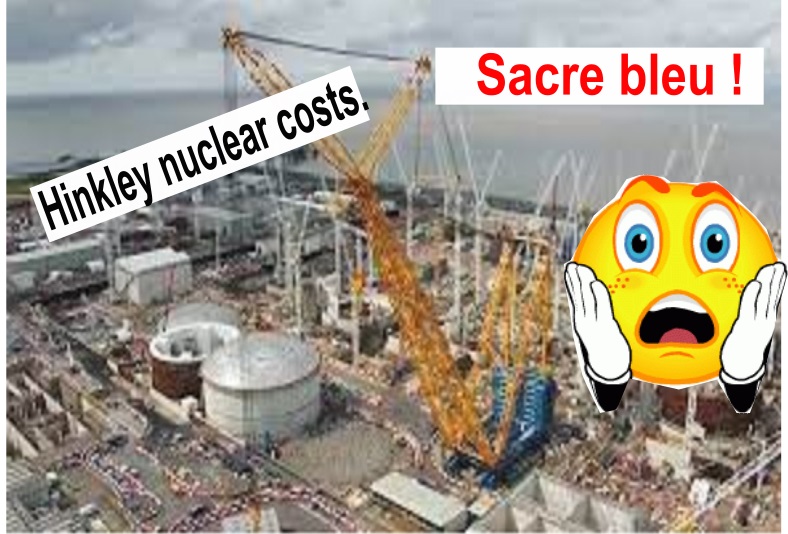
Push for funding comes weeks after Hinkley Point C costs were revised up to £46bn
Jonathan Leake, 13 February 2024
British taxpayers have been asked to stump up cash to fund nuclear power
plants being built in the UK by the French energy giant EDF. Bruno Le
Maire, France’s finance minister, said on Tuesday he would be asking
Jeremy Hunt for “an equitable sharing of costs” for the power stations
which include Hinkley Point C, in Somerset, and Sizewell C, in Suffolk.
It comes after it emerged that the costs at Hinkley Point C had surged to
£46bn, significantly more than the £18bn proposed when contracts were
signed in 2016. Speaking at an International Energy Agency ministerial
meeting in Paris, Mr Le Maire said he had raised the subject with Claire
Coutinho, the Energy Secretary, and planned to have “discussions” with
Mr Hunt, the Chancellor, about it.
The UK has so far refused to consider
paying more for Hinkley, pointing out that it is not a government project.
Last month a government spokesman said: “Any additional costs or schedule
overruns are the responsibility of EDF and its partners and will in no way
fall on taxpayers.”
There is growing concern in France over the plight of
state-owned EDF which is on the hook for most of the extra costs. If EDF
were to pull out of Sizewell it would cause huge delays and a likely end UK
hopes of building 24 gigawatts of new nuclear capacity by 2050, equating to
about seven new nuclear power stations. These would supply up to a quarter
of the country’s projected electricity demand.
Telegraph 13th Feb 2024
Small Nuclear Modular Reactors (SMRs) and Consent in Saskatchewan: What You Haven’t Been Told
Uranium Mining in Northern Saskatchewan: What You Need To Know―Four-Part Webinar Series Webinar #2: February 13th, 2024,
Small Nuclear Modular Reactors (SMRs) and Consent in Saskatchewan: What You Haven’t Been Told Everyone is welcome to attend this webinar series that will help you know more about what is happening with uranium mining in Northern Saskatchewan. While many people have been busy in survival mode and exhausted from the pandemic, wars around the world, and the extreme rising cost of living, uranium mining lobbyists and governments have been taking advantage, passing industry-favourable laws that will further degrade and threaten freshwater systems already desperately overburdened by farming and mining use and wastewater byproducts.
Hosted by Tori Cress Guests: Paul Belanger, Keepers of the Water Science Advisor. Dr. Gordon Edwards, President and co-founder of the Canadian Coalition for Nuclear Responsibility, and Benjamin Ralston BA, JD, LLM, Assistant Professor at the College of Law, University of Saskatchewan Technical support: Beverly Andrews Paul Belanger works on the Keepers of the Water team as our Science Advisor and is also an environmentalist – entrepreneur, and designer. Paul founded his first environmental organization in 1987, then went on to mentor with scientists and operate an oil field supply and safety company. After more education and some research, Paul began an ecological design company called Living Design Systems – which is still active. Paul holds much knowledge and will now take us through a brief history of uranium mining in Saskatchewan.
Benjamin Ralston is an assistant professor at the College of Law at the University of Saskatchewan. Some of his research areas include Aboriginal rights, Canadian constitutional law, environmental law, human rights law, and natural resource law. Benjamin has worked at the U of S in various capacities since 2014. Including for the first year of the Nunavut law program in Iqaluit. He taught law courses in the Kanawayihetaytan Askiy (kaun-a-way-taa-tan-ah-ski) Program for Indigenous land managers and continues to teach a graduate course on environmental law and policy for the School of Environment and Sustainability. He is completing his Ph.D. at the College of Law with a dissertation investigating the intersection between environmental assessment practices and Indigenous rights in Canada. No registration is required. We will be broadcasting live from our Facebook Event Page here, https://fb.me/e/4cpZppDBU and on our YouTube channel here, https://youtube.com/live/f6TOoWU-w5A?…
Russian nuclear capabilities in space could threaten international satellites, US military comms: Sources
House Intel Chairman Mike Turner first warned of the ‘serious national security threat’ on Wednesday
By Brooke Singman , Jacqui Heinrich Fox News, February 14, 2024
The U.S. has intelligence of a national and international security threat related to Russian nuclear capabilities in space which could threaten satellites, including potentially knocking out U.S. military communications and reconnaissance, Fox News has learned.
Sources tell Fox News that the Russian capability has not yet deployed.
House Intelligence Committee Chairman Mike Turner on Wednesday morning first warned of a “serious national security threat,” and called on President Biden to declassify it………………………………………………………………………………………………………. more https://www.foxnews.com/politics/russian-nuclear-capabilities-space-could-threaten-international-satellites-us-military-comms-sources
Patrick Lawrence: The Crisis at The New York Times
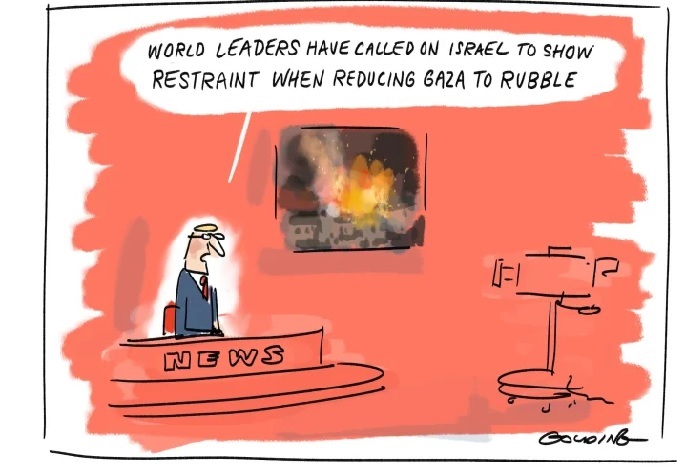
From Israeli Propaganda to Page One.
By Patrick Lawrence ScheerPost 12 Feb 24
It has been evident to many of us since the genocide in Gaza began Oct. 7 that Israel risked asking too much of those inclined to take its side. The Zionist state would ask what many people cannot give: It would ask them to surrender their consciences, their idea of moral order, altogether their native decency as it murders, starves and disperses a population of 2.3 million while making their land uninhabitable.
The Israelis took this risk and they have lost. We are now able to watch videos of Israeli soldiers celebrating as they murder Palestinian mothers and children, as they dance and sing while detonating entire neighborhoods, as they mock Palestinians in a carnival of racist depravity one would have thought beyond what is worst in humanity—and certainly beyond what any Jew would do to another human being. The Israeli newspaper Haaretz reports, as American media do not, that the Israel Defense Forces covertly sponsor a social media channel disseminating this degenerate material in the cause of maintaining maximum hatred.
It is a psychologically diseased nation that boasts as it inflicts this suffering on The Other that obsesses it. The world is invited—the ultimate in perversity, this—to partake of Israel’s sickness and said, in a Hague courtroom two weeks ago, “No.”
Post–Gaza, apartheid Israel is unlikely ever to recover what place it enjoyed, merited or otherwise, in the community of nations. It stands among the pariahs now. The Biden regime took this risk, too, and it has also lost. Its support for the Israelis’ daily brutalities comes at great political cost, at home and abroad, and is tearing America apart—its universities, its courts, its legislatures, its communities—and I would say what pride it still manages to take in itself. When the history of America’s decline as a hegemonic power is written, the Gaza crisis is certain to figure in it as a significant marker in the nation’s descent into a morass of immorality that has already contributed to a collapse of its credibility.
We come to U.S. media — mainstream media, corporate media, legacy media. However you wish to name them, they have gambled and lost, too. Their coverage of the Gaza crisis has been so egregiously and incautiously unbalanced in Israel’s behalf that we might count their derelictions as unprecedented. When the surveys are conducted and the returns are in, their unscrupulous distortions, their countless omissions, and—the worst offense, in my view—their dehumanization of the Palestinians of Gaza will have further damaged their already collapsing credibility.
We come, finally, to The New York Times. No medium in America has had further to fall in consequence of its reporting on Israel and Gaza since last October. And the once-but-no-longer newspaper of record, fairly suffocating amid its well-known hubris, falls as we speak. It has erupted, by numerous accounts including implicitly its own, in an internal uproar over reportage from Israel and Gaza so shabby—so transparently negligent—that it, like Israel, may never fully restore its reputation.
Max Blumenthal, editor-in-chief of The Grayzone, described the crisis on Eighth Avenue better than anyone in the Jan. 30 segment of The Hill’s daily webcast, Rising. “We’re looking at one of the biggest media scandals of our time,” he told Briahna Joy Gray and Robby Soave. Indeed. This well captures the gravity of The Times’s willful corruptions in its profligate use of Israeli propaganda, and Blumenthal deserves the microphone to say so. Since late last year The Grayzone has exhaustively investigated The Times’s “investigations” of Hamas’s supposed savagery and Israel’s supposed innocence.
This is more than “inside baseball,” as the saying goes. We now have a usefully intricate anatomy of an undeservedly influential newspaper as it abjectly surrenders to power the sovereignty it is its duty to claim and assert in every day’s editions. It would be hard to overstate the implications, for all of us, of what The Grayzone has just brought to light. This is independent journalism at its best reporting on corporate journalism at its worst.
What we find as we read The Times’s daily report from Israel, and from Gaza when its correspondents unwisely accept invitations to embed with the IDF, is a newspaper unwilling to question either its longstanding fidelity to Israel or its service to American power. These two ideological proclivities—well more than what its reporters see and hear—have defined the paper’s coverage of this crisis. This is bad journalism straight off the top.
It was inevitable, then, that The Times would serve as Israel’s apologist as soon as the IDF began its murder spree last October.
. This was not a rampage worthy of the Visigoths, as plentiful video footage carried on social media and in independent publications revealed it to be: It was dignified as “a war,” a war waged not against Palestinians but “against Hamas,” and Israel fought it in “self-defense.” Hamas is “a terrorist organization,” so there is no complexity or dimensionality to it, and therefore no need to understand anything about it.
It has been a question of minimizing and maximizing in the pages of The Times. Israel’s genocidal intent is indecipherable to anyone relying on its coverage. The physical destruction of Gaza is never described as systematic. The IDF does not target noncombatants. The newspaper has reported the shocking statements of Israeli officials, some openly favoring genocide, ethnic-cleansing, and the like, only when these have been so prominently reported elsewhere that The Times could no longer pretend such things were never said. ………………………………………………………………………………………………………………………………………………………………..
And so on. You have descriptions of all kinds of unimaginable, B–movie perversities—militiamen playing with severed breasts, militiamen walking around with armfuls of severed heads—that rest upon “witnesses” whose testimonies, given how often they shift or do not line up with what was eventually determined, simply cannot be counted as stable.
And then there are the official statements. Among the most categoric of these is one from the Israeli police, issued after The Times published “‘Screams Without Words’” Dec. 28 and asserting that they have found no eyewitnesses to rapes on Oct. 7 and see nothing in media reports such as The Times’s constituting evidence of systematic sexual violence.
And so on. You have descriptions of all kinds of unimaginable, B–movie perversities—militiamen playing with severed breasts, militiamen walking around with armfuls of severed heads—that rest upon “witnesses” whose testimonies, given how often they shift or do not line up with what was eventually determined, simply cannot be counted as stable.
And then there are the official statements. Among the most categoric of these is one from the Israeli police, issued after The Times published “‘Screams Without Words’” Dec. 28 and asserting that they have found no eyewitnesses to rapes on Oct. 7 and see nothing in media reports such as The Times’s constituting evidence of systematic sexual violence. ………………………………………………………………………………………………………… more https://scheerpost.com/2024/02/12/patrick-lawrence-the-crisis-at-the-new-york-times/
Nuclear Illusions Hinder Climate Efforts as Costs Keep Rising

a long line of nuclear illusionists advocating grandiose goals for nuclear energy without any evidence to suggest they could be achieved, and much to suggest why they never will be.
“In recent years the nuclear industry seems to have quietly changed its business model from making and selling products to harvesting subsidies for fantasies”
the timelines will shrink, and the mirage will fade. Money will be wasted and global warming will continue.
The federal government also continues to fund efforts to develop “new” designs for smaller reactors that are proving far less economic than larger ones and will struggle to succeed. Two government showcase projects have already collapsed for lack of customer interest.
Stephanie Cooke, 12 Feb 2024 Energy Intelligence Group, Stephanie Cooke, Washington, https://www.energyintel.com/0000018d-7a5e-d1ef-a5cd-fe7e077c0000
The price tag for new nuclear plants just got a lot higher — at up to £46 billion ($58 billion) for two French reactors under construction in the UK — but don’t expect that to deter enthusiasm for nuclear energy. According to former US Energy Secretary Ernest Moniz, the world “will soon need to build the equivalent of about 50 large nuclear power reactors per year until 2050” to mitigate climate change. Moniz admits that’s a challenge, but nevertheless possible if nations “rethink how to build, regulate and finance nuclear technology.” Moniz comes from a long line of nuclear illusionists advocating grandiose goals for nuclear energy without any evidence to suggest they could be achieved, and much to suggest why they never will be.
In 1998, when the future of nuclear energy looked grim, a group of nuclear worthies convened in Paris for an International Conference on Preparing the Ground for Renewal of Nuclear Power. It was the fourth such attempt since the initial conference on the topic in 1979. In opening remarks later published, a former General Electric executive, Bertram Wolfe, proclaimed that “if one assumes nuclear energy will be needed to provide one-third of the world’s energy by the middle of the next century,” 100-200 new reactors per year would have to be added over the next 50 years.
Global warming was seen as a potential, though still-distant threat, but enough of one to argue for more nuclear energy as a “precautionary” measure against it, according to another speaker, Chauncey Starr, who had founded and presided over the US Electric Power Research Institute. Starr dismissed renewables as the “visionary goal” of an “anti-nuclear environmental community” embraced by politicians that “either suffer from the childlike innocence of the ignorant” or “knowingly engaged in political duplicity.” By 2060, hydro and renewables would “very optimistically” account for only 23% of worldwide electricity consumption, Starr predicted, and they would be heavily dependent on subsidies. He was off by several decades. That benchmark was surpassed in 2016, according to the 2023 BP Statistical Review of World Energy.
It was the nuclear crowd that suffered from ignorance, and illusionary ideas. One prominent industry executive at the time, Shelby Brewer, proclaimed in Paris that recent deregulation of US wholesale electricity markets would have “a positive impact on nuclear power” because utilities no longer subject to state regulated rates of return would be more likely to build new reactors. “Power generators will focus explicitly on price competitiveness, cost effectiveness and equity return — a new set of dynamics for the industry.” He wound up by declaring that “the salvation of US nuclear power lies with Adam Smith, not Uncle Sam.”
Real World Experience
In the real world, annual reactor construction starts worldwide since then were far from 200, 100 or even 50 — the highest number was 15 (in 2010). In the 14 years since, construction began on a total of 84 reactors of which 41 were in China, meaning that outside China, just three were started per year on average.
Deregulation was hardly the panacea Brewer predicted either. When reactors in US deregulated markets couldn’t compete against natural gas or renewables, operators were forced to turn to Uncle Sam for subsidies or shut down. Despite subsidies on offer for new nuclear power plants, only one was ever built — in the regulated state of Georgia — with ratepayers forced to foot the bill for financing and construction. The only other US reactor start-up, Watts Bar-2, was commissioned in 2016, but construction on that started in the 1980s, stopped, and then restarted.
The federal government also continues to fund efforts to develop “new” designs for smaller reactors that are proving far less economic than larger ones and will struggle to succeed. Two government showcase projects have already collapsed for lack of customer interest.
“In recent years the nuclear industry seems to have quietly changed its business model from making and selling products to harvesting subsidies for fantasies,” says Amory Lovins, adjunct professor of civil and environmental engineering at Stanford, and cofounder and chairman emeritus of RMI (formerly Rocky Mountain Institute). “A dollar astutely invested in influence campaigns, and sometimes corruption, seems to be able to yield on the order of $10-$100+ in subsidies — for as long as they last. So long as the band plays on, it looks like good work if you can get it.”
Compared with the industry’s past cheerleaders, Moniz appears relatively modest in what he proposes, and he admits that 50 reactors per year is a tall order, “two-thirds more than were built at nuclear power’s peak in the early 1980s.”
His ideas for overcoming the challenges are worn: A “new system” to “deliver standardized products rather than costly and risky one-off multidecade projects.” Including small modular reactors and advanced reactors, there are probably 100 or more designs around the globe in various stages of development. How do you standardize out of that? The only “new nuclear” in the West are the four multidecade projects in Finland, France, the US and UK — all exorbitantly over-budget and by definition economically highly risky. Of the six reactors in question, only two are generating power — one each in Finland and the US.
Airline Industry Model
Moniz looks to the airline industry for a model in the way nuclear plants could be built and regulated. Smaller reactors especially could be produced by “assembly-line methods” and new reactor designs certified by an “international body charged with issuing a single globally accepted generic certification for reactor designs.”
This overlooks the fact that the nuclear power industry is driven by geopolitics and its historic and symbiotic relationship with nuclear weapons. Competition is intense in reactor export markets, with supplier countries jealously guarding their areas of influence and seeking the means for continued influence over decades, as reactors are sited, built and then decommissioned.
The aviation industry is driven by real demand. People who want to fly don’t have alternatives to boarding an airplane; customers who need electricity have many other low-carbon options besides reactors. No airline wants a fatal crash, so it makes sense that pilots, especially if they’re flying to other countries, follow a universal set of norms, and that aviation authorities from several countries are often involved in certifying new aircraft designs.
“To ignore or pretend to ignore that there is so much difference is an insult to readers’ intelligence,” writes Yves Marignac of Institut negaWatt in an email. “To even consider the possibility that things could change so that the conditions for this international free, standardized, ‘orderbook’ approach can be met, furthermore in a timeframe that is consistent with objectives such as delivering on 50 large reactors per year soon, is wishful thinking pushed to a record high!”
Along with the announcement of Hinkley Point C’s massive cost increase came news that the first of two reactors wouldn’t be commissioned until at least 2029, and possibly as far out as 2031. This is not stopping plans for more nuclear power in both the UK and France, with London promising eight new reactors by 2050, and Paris calling for six reactors by 2035, with as many as eight more after that. These goals, billed as part of the “global solution” to climate change, are no more than a distant mirage.
As the two countries haggle over who pays the exorbitant costs at Hinkley Point C, the timelines will shrink, and the mirage will fade. Money will be wasted and global warming will continue. “The costlier and slower new reactors are, the less fossil fuel they can displace per dollar and per year, compared to a like investment in renewables and efficient use — thereby making climate change worse, not better,” argues Lovins. “Climate effectiveness requires that we count carbon, cost and speed — not just carbon.”
It’s time to close the curtain on illusionist theater in energy policy-making. It’s a show that’s long since run its course.
Stephanie Cooke is the former editor of Nuclear Intelligence Weekly and author of In Mortal Hands: A Cautionary History of the Nuclear Age. The views expressed in this article are those of the author.
1 This Month

of the week – THE ONENESS of HUMANITY
26 June – Radiation Trainwreck at the NRC / Join the Protect Better Campaign – https://us02web.zoom.us/meeting/register/4ZlZ5_qLSHGiLSCg8FF6Bg#/registration

1st July – Webinar Waste of Space: The Environmental Harm of Military and Civil Space Activity st July, 7 pm

Report Launch Online: We are seeing an increasing exploitation of space for military and commercial purposes. This must change.

Protect Sazan Island from the Trump family! https://secure.avaaz.org/campaign/en/protect_sazan_island_from_the_trump_family_loc/?bqFCVab&v=174511&cl=22707147157&_checksum=5e9dde668860e8231c33699735e16a1fbf22ab2cb01da50c999fe8732b9775ef&utm_source=email&utm_medium=blast_email&utm_campaign=174511


Cuba Is Not a Failed State – It Is a Besieged State
PETITION: “Global Appeal to Endorse Palestinian Right of Return of Refugees”
To see nuclear-related stories in greater depth and intensity – go to https://nuclearinformation.wordpress.com
-
Archives
- June 2026 (251)
- May 2026 (306)
- April 2026 (356)
- March 2026 (251)
- February 2026 (268)
- January 2026 (308)
- December 2025 (358)
- November 2025 (359)
- October 2025 (376)
- September 2025 (257)
- August 2025 (319)
- July 2025 (230)
-
Categories
- 1
- 1 NUCLEAR ISSUES
- business and costs
- climate change
- culture and arts
- ENERGY
- environment
- health
- history
- indigenous issues
- Legal
- marketing of nuclear
- media
- opposition to nuclear
- PERSONAL STORIES
- politics
- politics international
- Religion and ethics
- safety
- secrets,lies and civil liberties
- spinbuster
- technology
- Uranium
- wastes
- weapons and war
- Women
- 2 WORLD
- ACTION
- AFRICA
- Atrocities
- AUSTRALIA
- Christina's notes
- Christina's themes
- culture and arts
- Events
- Fuk 2022
- Fuk 2023
- Fukushima 2017
- Fukushima 2018
- fukushima 2019
- Fukushima 2020
- Fukushima 2021
- general
- global warming
- Humour (God we need it)
- Nuclear
- RARE EARTHS
- Reference
- resources – print
- Resources -audiovicual
- Weekly Newsletter
- World
- World Nuclear
- YouTube
-
RSS
Entries RSS
Comments RSS
 nuclear-news