House is heading toward “nuclear” war over Ukraine funding, one top House GOP leader says
By Major Garrett, February 21, 2024 CBS News
There’s a “50-50” chance of a government shutdown in early March, says House Financial Services Chairman Patrick McHenry, of North Carolina, and it’s House Speaker Mike Johnson’s fear of being ousted that will determine the outcome. And at the same time, McHenry says the House is heading to a procedural “nuclear” war over funding for Ukraine……………………………………………………………………………………………………………. more https://www.cbsnews.com/news/house-ukraine-funding-the-takeout/
Chris Hedges: Julian Assange’s Day in Court

The defense must convince the two judges that the District Judge made serious legal errors to see an appeal granted.
They argued that espionage is, as a matter of law, a political offense and that the extradition treaty with the U.S. prohibits extradition for political offenses. They focused on the extensive UK law, common law and international law that defines espionage as a “pure political offense” because e it is directed against a state apparatus. For this reason, those charged with espionage should be protected from extradition.
The hearing was, after those in 2020 that focused on Julian’s mental and psychological health, refreshing in that it discussed the crimes committed by the U.S. and the importance of making them public.
Julian Assange’s lawyers — in a final bid on Tuesday to stop his extradition — fought valiantly to poke holes in the case of the prosecution to obtain an appeal.
By Chris Hedges https://scheerpost.com/2024/02/21/chris-hedges-julian-assanges-day-in-court/
LONDON — By the afternoon the video link, which would have allowed Julian Assange to follow his final U.K. appeal to prevent his extradition, had been turned off. Julian, his attorneys said, was too ill to attend, too ill even to follow the court proceedings on a link, although it was possible he was no longer interested in sitting through another judicial lynching. The rectangular screen, tucked under the black wrought iron bars that enclosed the upper left hand corner balcony of the courtroom where Julian would have been caged as a defendant, was perhaps a metaphor for the emptiness of this long and convoluted judicial pantomime.
he arcane procedural rules — the lawyers in their curled blonde wigs and robes, the spectral figure of the two judges looking down on the court from their raised dais in their gray wigs and forked white collars, the burnished walnut paneled walls, the rows of lancet windows, the shelves on either side filled with law books in brown, green, red, crimson, blue and beige leather bindings, the defense lawyers, Edward Fitzgerald KC and Mark Summers KC, addressing the two judges, Dame Victoria Sharp and Justice Johnson, as “your lady” and “my lord” — were all dusty Victorian props employed in a modern Anglo-American show trial. It was a harbinger of a decrepit justice system that, subservient to state and corporate power, is designed to strip us of our rights by judicial fiat.
The physical and psychological disintegration of Julian, seven years trapped in the Ecuadorian Embassy in London and nearly five years held on remand in the high-security HM Prison Belmarsh, was always the point, what Nils Melzer the former U.N. Special Rapporteur on torture calls his “slow-motion execution.” Political leaders, and their echo chambers in the media, fall all over themselves to denounce the treatment of Alexei Navalny but say little when we do the same to Julian. The legal farce grinds forward like the interminable case of Jarndyce and Jarndyce in Charles Dickens’ novel Bleak House. It will probably grind on for a few more months — one can’t expect the Biden administration to add the extradition of Julian to all its other political woes. It may take months to issue a ruling, or grant one or two appeal requests, as Julian continues to waste away in HM Prison Belmarsh.
Julian’s nearly 15-year legal battle began in 2010 when WikiLeaks published classified military files from the wars in Iraq and Afghanistan — including footage showing a U.S. helicopter gunning down civilians, including two Reuters journalists in Baghdad. He took refuge in London’s Ecuadorian embassy, before being arrested by the Metropolitan Police in 2019 who were permitted by the Ecuadorian embassy to enter and seize him. He has been held for nearly five years in HM Prison Belmarsh.
Julian did not commit a crime. He is not a spy. He did not purloin classified documents. He did what we all do, although he did it in a far more important way. He published voluminous material, leaked to him by Chelsea Manning, which exposed U.S. war crimes, lies, corruption, torture and assassinations. He ripped back the veil to expose the murderous machinery of the U.S. empire.
The two-day hearing is Julian’s last chance to appeal the extradition decision made in 2022 by the then British home secretary, Priti Patel. On Wednesday the prosecution will make its arguments. If he is denied an appeal he can request the European Court of Human Rights (ECtHR) for a stay of execution under Rule 39, which is given in “exceptional circumstances” and “only where there is an imminent risk of irreparable harm.” But the British court may order Julian’s immediate extradition prior to a Rule 39 instruction or may decide to ignore a request from the ECtHR to allow Julian to have his case heard by the court.
District Judge Vanessa Baraitser in January 2021, at Westminster Magistrates’ Court, refused to authorize the extradition request. In her 132-page ruling, she found that there was a “substantial risk” Julian would commit suicide due to the severity of the conditions he would endure in the U.S. prison system. At the same time, she accepted all the charges leveled by the U.S. against Julian as being filed in good faith. She rejected the arguments that his case was politically motivated, that he would not get a fair trial in the U.S. and that his prosecution is an assault on the freedom of the press.
Baraitser’s decision was overturned after the U.S. government appealed to the High Court in London. Although the High Court accepted Baraitser’s conclusions about Julian’s “substantial risk” of suicide if he was subjected to certain conditions within a U.S. prison, it also accepted four assurances in U.S. Diplomatic Note no. 74, given to the court in February 2021, which promised Julian would be treated well. The “assurances” state that Julian will not be subject to Special Administrative Measure. They promise that Julian, an Australian citizen, can serve his sentence in Australia if the Australian government requests his extradition. They promise he will receive adequate clinical and psychological care. They promise that, pre-trial and post-trial, Julian will not be held in the Administrative Maximum Facility in Florence, Colorado.
Continue readingBiden Casts 3rd UN Veto Allowing Israeli Genocide in Gaza To Continue

by Walt Zlotow , https://www.antiwar.com/blog/2024/02/21/biden-casts-3rd-un-veto-allowing-israeli-genocide-in-gaza-to-continue/
No surprise President Biden cast his third veto in the UN Security Council to prevent a full, permanent ceasefire in Gaza. Biden’s depraved support of Israeli genocide in Gaza has no limits. Over 25,000 tons of US weapons have contributed to over 100,000 deaths and injuries, displacement of nearly 2,000,000 Palestinians and destruction of nearly all medical, educational and cultural institutions. The appropriate word for all that? Genocide.
President Biden ludicrously claims his veto was cast because it interfered with the US ceasefire plan and efforts to get aid to beleaguered Palestinians. Biden’s first reason is ghoulish. His plan calls for a temporary ceasefire to get all the hostages out, after which Israeli ethnic cleansing, with unlimited US aid, can resume till complete. His second reason is preposterous The UN accurately states Israel blocks virtually all aid from reaching sick, starving and wounded Palestinians.
President Biden may not be in mental and physical decline severe enough to prevent his functioning as president. But his enabling of Israel’s genocidal ethnic cleansing of Gaza for 5 months now, makes Biden’s moral decline a disqualifier for further serving as president.
Walt Zlotow became involved in antiwar activities upon entering University of Chicago in 1963. He is current president of the West Suburban Peace Coalition based in the Chicago western suburbs. He blogs daily on antiwar and other issues at www.heartlandprogressive.blogspot.com.
UK lawmakers seek reassurances after nuclear missile test fails for second time
By CNN, Associated Press9News Staff, Feb 22, 2024
British lawmakers are seeking reassurances about the nation’s nuclear deterrent after a test of the system failed dramatically last month when an unarmed missile crashed into the sea near the submarine from which it was launched.
It marks the second time in eight years that the country’s Trident II ballistic missiles have malfunctioned during trials.
An “anomaly occurred” during the test on board the nuclear-powered submarine HMS Vanguard, a UK Ministry of Defence spokesperson said on Wednesday in a statement……………
Britain’s Trident nuclear deterrent system suffered an earlier failure off the coast of Florida in June 2016, a US defence official with direct knowledge of the incident previously told CNN.
The latest incident, first reported by The Sun newspaper, occurred during an exercise on January 30 near Florida. https://www.9news.com.au/world/uk-trident-nuclear-missile-test-fails-sparking-concerns-about-program/0fe0541b-67e9-4690-b31a-291e81d8bc5b
Japanese mafia boss conspired to traffic nuclear materials, says US
By Bernd Debusmann Jr, BBC News, Washington, 22 Feb 24
US prosecutors have charged an alleged member of the Japanese mafia with conspiring to traffic nuclear materials.
Takeshi Ebisawa, 60, tried to sell uranium and plutonium that he believed would be transferred to Iran to build a nuclear bomb, it is alleged.
Mr Ebisawa and a Thai co-defendant were previously hit with weapons and drug charges in April 2022.
He faces life imprisonment if convicted of the latest charges.
US authorities say Mr Ebisawa – who is being held in a Brooklyn jail – is a senior figure in the Japanese organised crime syndicate, known as the Yakuza, with operations in Sri Lanka, Myanmar, Thailand and the US.
The US Department of Justice said Mr Ebisawa and his “confederates showed samples of nuclear materials in Thailand” to an undercover agent from the US Drug Enforcement Agency (DEA)……………………………………………………………………………
Mr Ebisawa faces charges including conspiracy to commit international trafficking of nuclear materials, narcotics importation conspiracy, conspiracy to acquire, transfer and possess anti-aircraft missiles and money laundering.
His co-conspirator in the case – 61-year-old Thai national Somphop Singhasiri – is facing drugs and weapons charges.
Both are facing life in prison if convicted.
The pair will be arraigned in a New York federal courtroom on Thursday.
https://www.bbc.com/news/world-us-canada-68365597
Stop Sizewell C’s Response to Regulated Asset Base Licence Consultation

Stop Sizewell C’s Response to Regulated Asset Base Licence Consultation,
Modifications to Sizewell C Limited’s electricity generation licence.
It is entirely credible that the scenario of Hinkley Point C – where predicted
overnight costs have almost doubled, and completion time has slipped by 5
or 6 years since construction began – may be replicated at Sizewell C, with
the obvious conclusion that consumers would pay more, and for longer.
DESNZ should therefore revise the figures in the RAB impact assessment taking
this new information and inflation into account, and publish it to show how
bills would be impacted. We wish to highlight the conclusions of the
Science Information and Technology Committee which said of Sizewell C in
July 2023: “A headline lower cost than Hinkley Point C is not justified
if the value of the risk is too great”
Stop Sizewell C 29th Jan 2024
Buried trial verdict confirms false-flag Maidan massacre in Ukraine
Oligarchic and far-right leaders and organizations, including neo-Nazis, who were involved in this false-flag mass killing to seize power in Ukraine, were hailed by Western and Ukrainian politicians, media, and even many academics as heroes and defenders of democrac
Ukrainian-Canadian political scientist and professor Ivan Katchanovski on the hidden origins of the Russia-Ukraine war
Ivan Katchanovski / February 20, 2024
A nearly one-million-word verdict from Ukraine’s Maidan massacre trial has recently confirmed that many Maidan activists were shot not by members of Ukraine’s Berkut special police force or other law enforcement personnel but by snipers in the far-right-controlled Hotel Ukraina and other Maidan-controlled locations a decade ago today. The verdict, handed down on October 18, 2023, states specifically that this hotel was controlled by Maidan activists and that an armed, far-right-linked Maidan group was in the hotel and fired from it. It also confirms that there was no Russian involvement in the massacre and that no massacre orders were issued by then President Viktor Yanukovych or his ministers. The verdict concludes that the Euromaidan was at the time of this massacre not a peaceful protest but a “rebellion” that involved the killing of Berkut and other police personnel.
This is an important official acknowledgement, not only because the violence represented the most significant case of mass murder, violent crime, and human rights violations in independent Ukraine to that point, but also because of the subsequent conflicts to which it has led or contributed. Notably, the massacre precipitated the violent overthrow of Yanukovych and his government, who were falsely blamed for carrying it out. It then spiralled into the Russian annexation of Crimea, the subsequent civil war and Russian interventions in the Donbas, and the conflicts between Ukraine and Russia, and between Russia and the Western powers, which Russia dramatically escalated with its illegal invasion of Ukraine on February 24, 2022.
There has been, however, a blackout of the verdict’s confirmation of the Maidan snipers in the Ukrainian media and, with a few notable exceptions, the Western mainstream media. Moreover, in an op-ed piece in The Bulwark, an online neoconservative magazine, author Cathy Young misrepresented the verdict, falsely claiming that it had found the Berkut police responsible for the deaths of 40 of the 48 protesters killed. Young also denied and openly whitewashed the existence of Maidan snipers and the far-right’s involvement in the Maidan massacre, labelling it a “conspiracy theory” despite clear and overwhelming evidence to the contrary in the verdict, the trial, and the investigation, as well as in academic studies of the event. Such deliberate omission and misrepresentation has been perpetrated in spite of the fact that the verdict’s Ukrainian text, as well as automatic English translation of the relevant excerpts, are publicly available, and in spite viral tweets describing and quoting from it.
The verdict by the Ukrainian Sviatoshyn District Court in Kyiv, along with the findings of the investigation by the Ukrainian prosecutor general’s office (GPU), comprise a de facto official admission—on the part of Ukraine’s justice system no less, which cannot be called independent—that on February 20, 2014, at least 10 of the 48 Maidan activists killed, and 115 of the 172 wounded, were shot not by Berkut or other law enforcement personnel firing from government-controlled areas but by Maidan snipers operating in Maidan-controlled locations. The government investigation admitted that one dead protester and 77 wounded Maidan activists were not shot from Berkut-controlled sectors, and therefore did not charge anyone for those crimes. Of course, it stands to reason that if these activists were not shot by government personnel, they must have been shot by the Maidan snipers.
The verdict, issued by the Kyiv court shortly before the tenth anniversary of the Euromaidan, shows that the Maidan massacre narrative that has been propagated by governments, the mainstream media, and a variety of info-warriors in the West and in Ukraine is false. The proponents of this narrative have called the Maidan a peaceful protest and presented the massacre of the Maidan protesters as a crime perpetrated by government snipers on the orders of Yanukovych and his government. The prosecution, the victims’ lawyers, the New York Times and other mainstream media (with some notable exceptions), Wikipedia, self-proclaimed experts, and info-warriors denied the presence of snipers in the Hotel Ukraina and other Maidan-controlled buildings, the shooting of Maidan protesters by these snipers, and the far-right’s involvement in this mass killing, and claimed instead that such ideas comprise a “conspiracy theory” and “Russian disinformation.” The exceptions included reports by ARD, BBC, The Nation, Jacobin, Court House News, Ekathimerini (Greece), Jyllands-Posten (Denmark), Weltwoche (Switzerland), Il Fatto Quotidiano (Italy), and El Nacional (Spain)—in addition to Canadian Dimension, which has published some of my other writing on this subject………………………………………………………………………………………………………………………………………………………………………………………………………………….
Wikipedia editors who deliberately and literally misrepresent and whitewash the false-flag Maidan massacre also systematically misrepresent and whitewash the far-right in Ukraine and its involvement in the Holocaust. These editors include Wise2, also known as Prohoshka, who has also propagated “scientific anti-Semitism” and whitewashed the involvement of the Organisation of Ukrainian Nationalists (OUN) in the 1941 Lviv pogroms during the Nazi occupation of Ukraine, justifying it on the basis of “Jewish collaboration.” Another Wikipedia editor, who uses the handle My Very Best Wishes, brazenly whitewashed the fact that monuments in Canada to the Galicia Division and Roman Shukhevych are in fact commemorating a division of the Waffen-SS and a Nazi collaborator. A scholarly article by a noted historian at the University of Ottawa also listed My Very Best Wishes as one of the editors involved in an intentional distortion of Wikipedia’s history of the Holocaust in Poland. This editor also recently wrote, falsely, on Wikipedia’s biographical page on Elon Musk about the latter’s supposed “involvement in the Russian invasion of Ukraine.” Various publications and websites have identified Wise2/Prohoshka as a far-right Svoboda activist named Svyatoslav Gut, and My Very Best Wishes as Andrei Lomize, a biophysics researcher at the University of Michigan.
Fabricated evidence against Berkut, no massacre order by Yanukovych
The trial verdict also confirms the absence of evidence for any order by Yanukovych or his government to massacre the Maidan protesters. This is a crucial official acknowledgment, since Yanukovych and his government were overthrown on the basis of accusations of having ordered the massacre. Joe Biden, then US vice-president, wrote in his memoirs that during the Maidan massacre, he called Yanukovych and told him that “it was over; time for him to call off his gunmen and walk away,” that he “had lost the confidence of the Ukrainian people … and he was going to be judged harshly by history if he kept killing them.”
In addition to acquitting two Berkut policemen for killing and wounding the Maidan activists, the verdict states that all five accused Berkut officers had been blamed, baselessly, for killing 13 Maidan protesters and wounding another 29. This is further evidence of trumped-up, politically motivated charges.
The decision to convict in absentia three Berkut officers, who had been transferred by Zelensky to the Donbas separatists in a 2019 exchange, is a political one. The charging of these officers for the murders of 31 of 48 Maidan protesters killed, and the attempted murders of another 44 of 80, was based on a single, fabricated forensic examination, not to mention posited on the notion of collective responsibility. This single forensic examination of bullets, undertaken five years after the massacre, reversed the results of some 40 earlier forensic bullet examinations, including a computer-based examination which showed that bullets taken from the bodies of killed Maidan protesters did not match the Berkut Kalashnikov rifles.
The three Berkut policemen were convicted in absentia based on this single, fabricated forensic examination as well as on their presumed collective responsibility for the murders of 31 protesters and the attempted murders of 44 more. On the same basis and contrary to all other evidence, a Berkut commander was also convicted of the manslaughter of four protesters and the wounding of another eight, for supposedly having ordered his officers to fire indiscriminately during the evacuation of internal troops by the Berkut company, and its subsequent retreat after one Berkut officer was killed and another wounded……………………………………………………………………………………………………………………………………………….
The verdict means that a decade since this crucial massacre—one of the most documented cases of mass killing in history—nobody is in prison for the murders and attempted murders of Maidan activists and police officers, or for shooting at foreign journalists. The silence on the part of those who deny the false-flag Maidan massacre, who call these claims a “conspiracy theory” and thereby whitewash the mass murderers of the far-right, is both deafening and revealing.
Media blackout and whitewash
All Ukrainian media reports omitted the verdict’s confirmations of the false-flag massacre. The Western media (with a few notable exceptions) also omitted this information. Moreover, writer Cathy Young, mentioned above, deliberately misrepresented the Maidan massacre trial verdict, branding the revelations about Maidan snipers operating in the Hotel Ukraina a “conspiracy theory” and claiming, falsely, that the verdict did not indicate that Maidan protesters were shot from the hotel or other Maidan-controlled locations, and that it did not disprove involvement by Russian snipers. ………………………………………………………………………………
Oligarchic and far-right leaders and organizations, including neo-Nazis, who were involved in this false-flag mass killing to seize power in Ukraine, were hailed by Western and Ukrainian politicians, media, and even many academics as heroes and defenders of democracy. They were invited for government visits and talks at universities, including in Canada. Government leaders, journalists, investigators, Maidan lawyers, NGO activists, partisan researchers, and info-warriors who branded the reports of the Maidan snipers and their false-flag massacre a conspiracy theory and propaganda were hailed as defenders of justice and human rights, and given grants by Western governments, foundations, and universities, including even a Nobel Peace Prize.
It is doubtful that any of the above parties will suffer any consequences for such fraud and whitewashing of mass murderers, in particular those of the far-right. Ukraine and Ukrainians continue to suffer the consequences of this massacre, which has spiralled into major conflicts, including the ongoing and devastating Russia-Ukraine war, which is also a dangerous, unwinnable proxy war undertaken by the West against Russia.
Ivan Katchanovski teaches at the School of Political Studies at the University of Ottawa. He is the author of Cleft Countries: Regional Political Divisions and Cultures in Post-Soviet Ukraine and Moldova and co-author of Historical Dictionary of Ukraine (Second Edition) and The Paradox of American Unionism: Why Americans Like Unions More Than Canadians Do, But Join Much Less. https://canadiandimension.com/articles/view/buried-trial-verdict-confirms-false-flag-maidan-massacre-in-ukraine-2024
Germany and nuclear weapons: A difficult history

Volker Witting | Rina Goldenberg, 02/17/2024February 17, 2024
Donald Trump’s suggestion the US will no longer apply NATO’s principle of collective defense should he become president again has sent shockwaves through Europe.
German Defense Minister Boris Pistorius is annoyed by the current debate about European nuclear weapons.“There is no reason to discuss the nuclear umbrella now,” he told public broadcaster ARD.
Ever since Donald Trump suggested that, as US president, he would not provide military assistance to NATO countries if they invested less than 2% of their GDP in their defense, German politicians have been discussing whether French and British nuclear weapons would suffice as a protective shield or whether Europe needs new nuclear weapons.
“The debate about European nuclear weapons is a very German debate that we don’t see in any other country,” political scientist Karl-Heinz Kamp from the German Council on Foreign Relations (DGAP) told DW — especially not in Eastern Europe, where there is a constant perceived threat from Russian President Vladimir Putin’s Russia.
Germany has a special history: Germany was “seen as an intrinsically aggressive country, that had started two world wars and could not be trusted with nuclear weapons,” said Kamp.
Germany-based nukes during the Cold War
In 1954, not long after the end of World War II, the first chancellor of the Federal Republic of Germany, Konrad Adenauer, signed an agreement renouncing the production of its own nuclear, biological or chemical weapons on its territory. In return, the US included West Germany in its nuclear deterrence policy against the Soviet-led Warsaw Pact.
In 1958, the German parliament, the Bundestag, approved the deployment of US nuclear weapons, despite some pacifist protests among the population. In 1960, 1,500 US nuclear warheads were stored in West Germany and a further 1,500 in the rest of Western Europe.
The nuclear weapons were also available to the Bundeswehr for training and use in the “case of defense.” “There was never any discussion about Germany acquiring its own nuclear weapons,” said Kamp.
The West German and European peace movements grew. The protest against the “NATO Dual-Track Decision” in 1982 saw over a million people in West Germany take to the streets in protest against the planned stationing of new US medium-range missiles in the country.
Nevertheless, on November 22, 1983, a center-right majority in the Bundestag approved the stationing of the missiles in US bases shortly thereafter. At the time, the Greens were newly represented in the Bundestag and appealed to the Federal Constitutional Court against the storing and deployment of nuclear missiles on West German territory. This bid was rejected as unfounded in December 1984.
During the Cold War, East Germany, the communist German Democratic Republic (GDR), was part of the Warsaw Pact military alliance, and from 1958, nuclear missiles and warheads were stationed in Soviet military bases on GDR territory. Some were withdrawn in 1988 as part of the Intermediate-Range Nuclear Forces Treaty between the US and the Soviet Union.
After German reunification and the withdrawal of the Soviet military, the territory of the former GDR officially became free of nuclear weapons in 1991.
Post-Cold War Germany
After the fall of the Berlin Wall in 1989, the collapse of the Soviet Union and the end of the division between East and West Germany, the German position was once again cemented in the so-called “Two-Plus-Four Treaty”: No nuclear weapons! On September 12, 1990, the four victorious powers of World War II (the US, the Soviet Union, France and UK) stipulated that Germany East and West should be reunified and renounce nuclear weapons.
Kamp says this was hardly surprising, because “a German nuclear power would be something that would cause horror. For historical reasons alone.”
The US government withdrew many of these nuclear warheads after the collapse of the Soviet Union, though an estimated 180 US nuclear weapons are still stored in Europe, in Italy, Turkey, Belgium, the Netherlands and Germany.
Experts believe that 20 US nuclear warheads are currently stored in the town of Büchel in Rhineland-Palatinate, western Germany. “But the decision-making authority over these weapons lies solely with the American president,” explained Kamp.
Any debate about Germany acquiring its own nuclear weapons is completely unrealistic, says political scientist Peter Rudolf from the German Institute for International and Security Affairs. Nuclear bombs need to be stored so that they are not easy targets, he told the Frankfurter Allgemeine daily.
“Survivable nuclear weapons would have to be on nuclear-powered submarines that can remain underwater for a very long time, he said, pointing to equipment the Bundeswehr does not have. “So there are so many problems standing in the way of a German nuclear bomb that it has no relevance to current crises,” Rudolf concluded.
“Those who are now talking about a European defense dimension are not talking about German nuclear weapons, because Germany is a member of the Nuclear Non-Proliferation Treaty and has made several binding commitments under international law to renounce the possession of weapons of mass destruction — including nuclear weapons,” agreed Kamp.
Defense Minister Pistorius, meanwhile, who made headlines not so long ago saying Germany should get “war-ready”, is now keen to brush the whole debate aside: He told ARD that “the majority of those in charge in the United States of America know exactly what they have in their transatlantic partners in Europe, what they have in NATO.”
And Kamp agrees: “Trump may be able to damage NATO considerably, but he cannot destroy it. You can’t destroy decades of transatlantic relations in one term of office.”
Edited by Ben Knight and Peter Hille
The odds of China using nuclear war to resolve the Taiwan issue
By John F. CopperFeb 20, 2024, https://johnmenadue.com/the-odds-of-china-using-nuclear-war-to-resolve-the-taiwan-issue-u-s-expert-versus-taiwan-experts/
Recently the Centre for Strategic and International Studies, a thinktank in Washington, DC, did a survey asking U.S. and Taiwan Experts if China might use nuclear weapons in a conflict with or over Taiwan. The results were astonishing to most who read the study. Almost half of U.S. experts reported they thought China would. Only one quarter that number of Taiwan experts, 11 percent, so opined.
Different histories and variances in views of the world order explain this.
The US view
The United States was born out of war in the late 1700s. Americans call it a revolutionary war or a war of independence. It was the latter. (Social classes did not change.)
Growing from a small country on the East Coast to a two-ocean nation in a century was built on wars with the indigenous people (American Indians) that were reduced from 100 percent of the population to 2 percent today. The wars were vicious, including the use of germ weapons and deliberately starving the enemy. Essentially wars of annihilation.
In the late 1800s the Indians were defeated marked by a victory (some called a massacre) in the Battle of Wounded Knee. Thenceforth the U.S. became an external expansionist power: incorporating Hawaii, defeating Spain to colonise the Philippines, and taking some other Pacific Islands.
World War I and II enhanced America’s world power status: from being an important nation to being a preeminent world power (superpower). In 1991, the U.S. defeated the Soviet Union, the only other superpower, with an arms race that America won—to become the world’s sole superpower.
Four years ago, former President Jimmy Carter noted America had been at peace only 16 of the last 242 years and concluded the U.S. was the most warlike nation in history. By contrast, China had not been at war in the last 40 years.
Meanwhile, after World War II the U.S. built a new world order employing its superior national power and its view of what the world should be –a world of global trade and economic growth and dragooned democracy. It worked well for a while.
But America became overstretched from its role as a military giant, and in some ways soft or at least tired of its global responsibilities. After the fall of the Soviet Union, it was not ready to lead a unipolar world.
More important, it faced a growing challenge. Mao, China’s great leader, died in 1976 and two years later Deng Xiaoping reconstructed China, getting rid of Mao’s radical communism and replacing it with free-market capitalism, trade and a system that built on China’s education tradition. China boomed economically.
It even grew during the world recession of 2008 and the subsequent almost slowest U.S. recovery in recent history. China became the number one nation in the world economically based on purchasing power. It led the word in steel production and other measures of big power status. In made the UN’s poverty eradication project work by helping developing countries grow with its formidable Belt and Road Initiative that was heading toward spending a trillion dollars compared to America’s biggest, the Marshall Plan (costing a bit over 100 billion in today’s dollars). Meanwhile, China passed the U.S. in registering patents and publishing academic articles while building modern airports and fast trains (more than the rest of the world combined while American had none).
President Trump met the China challenge with a make America great again policy. He sought to bring important industries back and restore U.S. capitalism. However, he faced virtually impossible hurdles to do this: an inflated and powerful government bureaucracy, too many lawyers that impeded business, horribly expensive penal and welfare systems, high taxes and a burdensome debt. Plus, the intelligence agencies and the federal police (FBI), the mainstream media, and American academe all opposed him while the Democratic Party that was bigger than his party had more money.
President Biden sought to destroy Trump’s America. As a globalist he advocated the idea of the US as an exceptional country and a superpower. America was to be a nation organising a bloc of democracies facing off against the China-led authoritarian nations. But this failed. America’s democracy appeared to many to have evolved into partisan rule by the deep state. Europeans did not want to be led by the U.S. Europe and Japan did not wish to end important economic ties with China. The Biden administration engaged in a financial and technology war with China, which hurt the U.S. more than China. The developing countries of the world continued to admire China for its aid and investments.
Good luck competing with China…
Meanwhile, pundits were taken by an idea expressed in the ancient book by Thucydides, The Peloponnesian Wars, that competition and eventually war between a status quo power (Sparta) and a rising power (Athens) was the model for most major wars after that. The relationship between America and China fit the model well. Thus, war was coming.
Provoking a war by demonising China as an expansionist power and an abuser of human rights meant that the U.S. should to go to war soon—before China, experiencing a renaissance and rising in national power, might defeat the U.S. that was experiencing decline.
The Taiwanese view
Taiwan has a very different history and view of the world from America. It early on grew up in isolation. Then it was exposed to the world outside via trade handled by its merchants, pirates, and outsiders. Chinese migrated to Taiwan and subdued the indigenous population reducing it to 2 percent of residents as happened in America; but this did not make Taiwan a world power.
Instead, Taiwan was ruled by Westerners (the Netherlands) for a brief time that improved its economy and more. For two centuries it was then ruled by China that did not have much interest in Taiwan and eventually abandoned it. Forthwith, Taiwan became a colony of Japan, during which time it saw economic modernisation without political choice or democracy.
Then the United States defeated Japan in war and returned Taiwan to China according to wartime agreements made at Potsdam and Tehran. Taiwan was not given any choice in the matter.
But China was at war with itself–a civil war between Chiang Kai-shek’s Nationalists and Mao Tse-tung’s Communists. Four years later Chiang lost and retreated to Taiwan to regroup. Again, Taiwan had no voice.
Owing to the Korean War the United States viewed Mao as a confederate of the Soviet Union and therefore an enemy. America gave aid and protection to Chiang’s Republic of China based on Taiwan. But the U.S. did not want a war with China allied with the Soviet Union and the result was a stalemate.
Chiang shifted his attention to Taiwan’s economic development and succeeded beyond almost anyone’s expectations. Its gross national product grew at a pace that far exceeded Western countries or Japan at their halcyon growth days.
Peace made this possible. Economic growth produced prosperity. Prosperity begat a middle class. A middle class serve to create political change and democracy.
Taiwan became a model for economic development and political change. Something similar happened in China under Deng: a booming economy and some political liberalisation. China and Taiwan linked up with trade and investments such that it made for mutual understanding and the avoidance of war, the same conditions that made the European Community work.
Strategically, Taiwan aligned with the United States against China in the Cold War. Like before it had no choice. But it avoided developing a nuclear weapon believing Chinese leaders when they said they would not use its nukes against Taiwan as they would not consider killing their own people.
Taiwan believed this because China did not engage in a nuclear arms race with America even though in the last two or three decades it could afford to do so. China sought to deal with Taiwan with its economic prowess, though it pulled its punches in using pressure and Taiwan knew it.
Taiwan’s residents’ national identity made it favour its sovereignty and separation from China or independence. Yet they knew this was contingent on America’s protection, regarding which they had some doubts.
Washington’s policy was that there was one China and Taiwan was part of China. President Biden restated this in the presence of world leaders at an APEC meeting in San Francisco. Feelings grew in Taiwan that America regarded it a pawn. The Biden administration forced Taiwan to invest in producing top-of-the line computer chips in Arizona, thus disabling what President Tsai called Taiwan’s “silicon shield.” She and Taiwan’s population could also see that China was on the rise; the U.S. was not.
Opinion polls in Taiwan reflected this. While residents’ identity favoured Taiwan and they picked independence over unification, they fancied the status quo more, and perceived Taiwan would reunify with China in the long run. Most of all they wanted peace. War, even if the U.S. kept its promises and fought for Taiwan, would still mean Taiwan would suffer grievously.
Finally, they preferred China’s world order that was founded on financial and technological power, not America’s system which relied on military might that Henry Kissinger, among others, opined was in quick decay.
Hence, it is understandable why U.S. pundits see China attacking Taiwan even with nuclear weapons much more likely than Taiwan scholars.
Hinkley Point C Nuclear could kill 22 BILLION fish in the Severn estuary

the huge cost to our precious natural world has been hidden behind the low-carbon story.
Somerset Apple, 17 Feb 24, Dave Phillips
A POWERFUL grouping of environmentalists, wildlife and fishing organisations have got together to condemn EDF’s plan to backtrack on promises made to install technology to prevent millions of fish and other marine life from being destroyed by the powerful cooling intakes for Hinkley Point C (HPC) nuclear power station that’s currently under construction.
When operational, HPC will suck in an Olympic-sized swimming pool of water every 12 seconds for the next 70 years from the Severn Estuary in an area inhabited by fish. Experts say it could wipe out 22 BILLION fish during its operational lifetime.
The Dillington Vision agreed between EDF, Somerset County Council and the UK Government, set out the vision for HPC which included the commitment to “recognise the value of the natural environment”. The original design of HPC included three measures to protect the marine environment, specifically fish populations, from the impacts of the power station.
This all relates to EDF’s consultation about removing the Acoustic Fish Deterrent (AFD), one of three ways to reduce fish killed at the new power station.
The proposed three methods were designed to work together:
- Low-velocity side entry at the tunnel heads designed to allow fish to swim away and not be sucked into the cooling tunnels.
- Fish recovery and return system.
- Acoustic Fish Deterrent (AFD) using sound that deter fish from swimming too close to the intake pipes in the first place.
In 2019, EDF proposed to remove the Acoustic Fish Deterrent as being difficult to install and maintain. This went to public inquiry with environmental groups (eNGOs) collectively giving evidence to support the Environment Agency (EA) in questioning EDF’s proposal.
In 2021, the UK Secretary of State for the Environment found in favour of the EA that the AFD should remain. EDF is now proposing not to implement the AFD and is instead proposing a package of measures claimed to compensate for the loss of fish in the estuary.
The eNGO group comprises:
- Angling Trust
- Avon Wildlife Trust
- Bristol Channel Federation of Sea Anglers
- Burnham Boat Owners
- Blue Marine Foundation
- Bristol Avon Rivers Trust
- Fish Legal
- Institute of Fisheries Management
- RSPB
- Severn Rivers Trust
- Somerset Wildlife Trust
- Wildlife Trusts Wales
- WWT, the charity for wetlands and wildlifeWhilst the eNGO group accepts that habitat restoration of saltmarsh, oysterbeds, kelp forest and river work could make an important and positive impact on the estuary, there is not enough evidence that it will address the huge losses of fish life that the cooling intakes will cause.
- They say: “Hinkley Point C nuclear power station (HPC) has been promoted as green and renewable because of the need to move away from fossil fuels. However, the huge cost to our precious natural world has been hidden behind the low-carbon story.
“Europe’s largest construction project on the edge of the Severn Estuary will have a significant impact on marine and migratory fish including already vulnerable Atlantic salmon, twaite shad and European eel over its lifetime.
“The impacts of this will be felt widely, affecting Welsh rivers, River Severn, the Bristol Avon, Somerset Levels and across the Celtic Sea. Life in the whole of the Severn Estuary and Bristol Channel could be dramatically affected over the next few decades according to a group of environmental organisations (eNGO’s)……………………………………………………………………………………………..
Objectors are calling for:
- More evidence of the potential impact of the AFD removal to determine the amount of compensation needed, including more consultation with independent groups of experts.
- Agreement on comprehensive long-term monitoring of the impact of the water intakes and the compensatory habitat as it develops throughout the lifetime of the power station.
- A commitment to respond to the results of the evidence gathering and monitoring with additional compensatory habitat, the fitting of fish deterrents on the intakes and/or reduction in intake water volumes as supplementary cooling techniques are more affordable or legislated.
Citizens Advice says Sizewell C costs should not be paid with energy bill hikes

Independent advice provider calls for clarity on funding and says project may offer ‘poor value for money’
Guardian, Alex Lawson 19 Feb 24
Ministers have been urged by Citizens Advice to protect consumers from a hike in household energy bills to pay for the proposed Sizewell C power station, amid international tensions over the rising costs of nuclear projects.
The UK’s largest independent advice provider has raised concerns that the project in Suffolk may offer “poor value for money” and called for greater clarity on its funding, in a letter to the Department for Energy Security and Net Zero.
Estimates of the cost of Sizewell C vary wildy – from £20bn to £44bn – and a process to find international investors to join the UK government and France’s EDF is ongoing.
Last month, the owner of Sizewell C’s sister project, EDF’s Hinkley Point C in Somerset, said it would be delayed to 2031 and cost up to £35bn, blaming inflation, Covid and Brexit. This could reach £47.9bn under its worst-case scenario. On Friday, EDF said it had taken a €12.9bn hit on the project.
EDF, which is wholly owned by the French government, is on the hook for cost overruns at Hinkley. French officials have lobbied the UK government to share the burden of the extra costs after its Chinese partner, CGN, was removed from the Sizewell C project over security fears.
However, Sizewell C has a different funding structure to Hinkley, exposing households to potential overruns.
Sizewell C Ltd, the entity behind the project, updated its electricity licence to allow a Regulated Asset Base (RAB) model to be implemented.
RAB financing models, which have been used in the construction of the Thames Tideway Tunnel and Heathrow Terminal 5, are designed to encourage investment by offering a guaranteed income for investors during the construction phase of a large project and bring down financing costs, with the cost added to bills.
In a response to the consultation on the licence update, Citizens Advice chief energy economist Richard Hall said: “By providing investors with a relatively guaranteed income stream, and one that commences during the construction phase, it can be convincingly argued that applying the RAB model to new nuclear projects could reduce the cost of capital that consumers have to pay.
“Our concern has been, and remains, that consumers are not simply exposed to the cost of capital, but also the volume of capital that needs to be employed. If the volume of capital required balloons, the project may offer consumers poor value for money even if it is cheaply financed.”
He added: “Looking at new nuclear projects in general, and the type envisaged at Sizewell C in particular, the scope for material cost and time overruns is very significant. Consumers need to be protected from those risks. They have no way to manage them, and are reliant on the [energy] department to take steps to ensure that they are not on the hook for cost or time overruns.”
Hall also raised concerns over proposals for advertising and publicity costs included in the licence consultation. “Billpayers should not be paying for the Sizewell C sales pitch,” he said.
The latest estimates of the cost of Sizewell C, conducted by University of Greenwich Business School and seen by the Guardian, forecast that it would cost £38.4bn and be complete in 2039. Its analysis suggests that the consumer surcharge to fund it would rise from £4.07 a year in the first year of the project, to £27.82 in year 15, costing households an extra £239.21 in total during its construction.
Alison Downes of the Stop Sizewell C campaign said: “The government emphasise that Hinkley Point C is EDF’s risk and responsibility, but when Sizewell C overspends and overruns – as it inevitably will – future ministers will have to explain why it was considered acceptable to put its construction risk on to consumers and taxpayers. Why has the Hinkley fiasco not taught the government that a RAB-funded Sizewell is a bad idea?”…………………………. https://www.theguardian.com/business/2024/feb/19/citizens-advice-says-sizewell-c-costs-should-not-be-paid-with-energy-bill-hikes
Touring South Korea to support opposition to US space warfare plans
Organizing notes, Bruce Gagnon, 19 Feb 24
https://space4peace.blogspot.com/2024/02/touring-south-korea-to-support.html
I’ve just landed in South Korea (ROK) where I will be on a speaking tour around the country for the next 10 days.
I was invited to come and talk about Washington’s push to entrap South Korea into the Pentagon’s space technology strategy aimed at North Korea, China and Russia.
Already at the US Osan AFB in South Korea the Space Force has set up operations with the ROK client state.
The US has pushed the right-wing Seoul government to massively expand their spending on military space tech. With the current US national debt now at $35 trillion, Washington can’t afford to pay for its expensive and ambitious plans to ‘control and dominate’ space. Thus the #1 job of the Pentagon and State Department is to get the allies to help pay for the space warfare infrastructure.
Currently the ROK government is building space R & D centers, satellite production facilities, new airfields likely to test hypersonic missiles and expanding ‘missile defense’ deployment sites.
One key goal the US has is to use ROK satellite production and launch facilities to hoist mini-satellites into Lower Earth Orbit (LEO) to help fill up the already crowded orbits before China and Russia can get there. Eyes and ears in LEO give a nation a decisive advantage in full scale war making.
Late last year the US hosted a big space industry conference in the capital city of Seoul in order to cement this expanding space warfare relationship. Dangling the promise of ‘lots of high-tech jobs’ the US has drawn the ROK into the trap.
The problem for the ROK (like all of Washington’s allies participating in this space warfare operation) is that they will have little to no input into how and when this Star Wars program will be used. Even though ROK will help pay for it (and host many of the bases) the Pentagon will remain in charge of the ‘tip of the spear’. Once becoming a colony of the US war machine, a nation loses their right to be full partners.
One sad thing about all of this is how Jeju Island (just off the southern tip of the Korean peninsula) is becoming further militarized via this new space tech operation.
Late last year the US hosted a big space industry conference in the capital city of Seoul in order to cement this expanding space warfare relationship. Dangling the promise of ‘lots of high-tech jobs’ the US has drawn the ROK into the trap.
The problem for the ROK (like all of Washington’s allies participating in this space warfare operation) is that they will have little to no input into how and when this Star Wars program will be used. Even though ROK will help pay for it (and host many of the bases) the Pentagon will remain in charge of the ‘tip of the spear’. Once becoming a colony of the US war machine, a nation loses their right to be full partners.
One sad thing about all of this is how Jeju Island (just off the southern tip of the Korean peninsula) is becoming further militarized via this new space tech operation.
After years of avoiding extradition, Julian Assange’s appeal is likely his last chance. Here’s how it might unfold (and how we got here)
On February 20 and 21, Julian Assange will ask the High Court of England and Wales to reverse a decision from June last year allowing the United Kingdom to extradite him to the United States.
There he faces multiple counts of computer misuse and espionage stemming from his work with WikiLeaks, publishing sensitive US government documents provided by Chelsea Manning. The US government has repeatedly claimed that Assange’s actions risked its national security.
This is the final avenue of appeal in the UK, although Stella Assange, Julian’s wife, has indicated he would seek an order from the European Court of Human Rights if he loses the application for appeal. The European Court, an international court that hears cases under the European Convention on Human Rights, can issue orders that are binding on convention member states. In 2022, an order from the court stopped the UK sending asylum seekers to Rwanda pending a full review of the relevant legislation.
The extradition process has been running for nearly five years. Over such a long time, it’s easy to lose track of the sequence of events that led to this. Here’s how we got here, and what might happen next.
Years-long extradition attempt
From 2012 until May 2019, Assange resided in the Ecuadorian embassy in London after breaching bail on unrelated charges. While he remained in the embassy, the police could not arrest him without the permission of the Ecuadorian government.
In 2019, Ecuador allowed Assange’s arrest. He was then convicted of breaching bail conditions, and imprisoned in Belmarsh Prison, where he’s remained during the extradition proceedings. Shortly after his arrest, the United States laid charges against Assange and requested his extradition from the United Kingdom.
Assange immediately challenged the extradition request. After delays due to COVID, in January 2021, the District Court decided the extradition could not proceed because it would be “oppressive” to Assange.
The ruling was based on the likely conditions that Assange would face in an American prison and the high risk that he would attempt suicide. The court rejected all other arguments against extradition.
The American government appealed the District Court decision. It provided assurances on prison conditions for Assange to overcome the finding that the extradition would be oppressive. Those assurances led to the High Court overturning the order stopping extradition. Then the Supreme Court (the UK’s top court) refused Assange’s request to appeal that ruling.
The extradition request then passed to the home secretary, who approved it. Assange appealed the home secretary’s decision, which a single judge of the High Court rejected in June 2023.
This appeal is against that most recent ruling and will be heard by a two-judge bench. These judges will only decide whether Assange has grounds for appeal. If they decide in his favour, the court will schedule a full hearing of the merits of the appeal. That hearing would come at the cost of further delay in the resolution of his case.
Growing political support
Parallel to the legal challenges, Assange’s supporters have led a political campaign to stop the prosecution and the extradition. One goal of the campaign has been to persuade the Australian government to argue Assange’s case with the American government.
Cross-party support from individual parliamentarians has steadily grown, led by independent MP Andrew Wilkie. Over the past two years, the government, including the foreign minister and the prime minister, have made stronger and clearer statements that the prosecution should end.
On February 14, Wilkie proposed a motion in support of Assange, seconded by Labor MP Josh Wilson. The house was asked to “underline the importance of the UK and USA bringing the matter to a close so that Mr Assange can return home to his family in Australia.” It was passed.
In addition, Attorney-General Mark Dreyfus confirmed he had recently raised the Assange prosecution with his American counterpart, who has the authority to end it.
What will Assange’s team argue?
For the High Court appeal, it is expected Assange’s legal team will once again argue the extradition would be oppressive and that the American assurances are inadequate. A recent statement by Alice Edwards, the United Nations Special Rapporteur on Torture, supports their argument that extradition could lead to treatment “amounting to torture or other forms of ill-treatment or punishment”. She rejected the adequacy of American assurances, saying:
They are not legally binding, are limited in their scope, and the person the assurances aim to protect may have no recourse if they are violated.
The argument that extradition would be oppressive remains the strongest ground for appeal. However, it is likely Assange’s lawyers will also repeat some of the arguments which were unsuccessful in the District Court proceedings.
One argument is that the charges against Assange, particularly the espionage charges, are political offences. The United States–United Kingdom extradition treaty does not allow either state to extradite for political offences.
Assange is also likely to re-run the argument that his leaks of classified documents were exercises of his right to freedom of expression under the European Convention on Human Rights. To date, the European Court of Human Rights has never found that an extradition request violates freedom of expression. For the High Court to do so would be an innovative ruling.
The High Court will hear two days of legal argument and might not give its judgement immediately, but it will probably be delivered soon after the hearing. Whatever the decision, Assange’s supporters will continue their political campaign, supported by the Australian government, to stop the prosecution.
How British Intelligence Framed Julian Assange As Russian Agent
KIT KLARENBERG FEB 19, 2024
February 20/21st could mark WikiLeaks founder-and-chief Julian Assange’s final opportunity to avoid extradition to the US. London’s High Court has scheduled two days of arguments over whether he can ask an appeals court to block his transfer Stateside. If unsuccessful, he could be sent across the Atlantic, where he faces prosecution under Washington’s draconian Espionage Act, and penalties ranging from 175 years in a “supermax” prison, to death, for exposing the lies and crimes of US global empire.
It is the most important press freedom case of all time. Yet, at no point during Julian’s seven years of arbitrary detention in London’s Ecuadorian embassy, or five years at His Majesty’s Pleasure in Belmarsh Prison, Britain’s “Gitmo”, have the mainstream media or international human rights groups taken a serious interest in his plight. Many Western citizens – including those who had hitherto full-throatedly supported WikiLeaks, and Julian’s crusade against official secrecy – were also indifferent over, if not outright supportive of, his violent explusion from the Ecuadorian embassy.
Much of this conspiracy of silence and apathy can be attributed to a concerted campaign of calumny, incubated in London and Washington DC, designed to extinguish public sympathy for Julian. As Nils Melzer, the United Nations special rapporteur on torture, wrote in a June 2019 op-ed Western media refused to publish, he was “systematically slandered to divert attention from the crimes he exposed,” and once he’d been “dehumanized through isolation, ridicule and shame, just like the witches we used to burn at the stake, it was easy to deprive him of his most fundamental rights without provoking public outrage worldwide.”
A prominent libel against Julian was that he operated upon the orders, and in the interests, of the Kremlin. Built up as an omnipotent villain on the world stage following the February 2014 Western-sponsored Maidan coup in Ukraine, and all manner of domestic political upheaval in Europe and North America small and large framed as somehow Moscow-orchestrated ever after, anyone and anything branded as even vaguely sympathetic to Russia automatically became an FSB and/or GRU chaos agent.
When British police forcibly hauled Julian handcuffed out of the Ecuadorian embassy, many mainstream outlets – and a great many Russiagaters – cheered, believing he would soon be indicted for his GRU-assisted role in subverting the outcome of the 2016 US Presidential election. No such charges have been forthcoming. And in September 2021, Yahoo News inadvertently let an incongruous cat out of the bag. The outlet revealed the CIA had explored plans to surveil, kidnap, and even kill Julian while he was ensconced in the Ecuadorian Embassy.
The explosive report was almost entirely ignored by the mainstream media – although one fundamental aspect of the article even its advocates and promoters largely overlooked was the disclosure that the CIA possessed no evidence Julian or WikiLeaks had any ties whatsoever with Russia. “Difficulty” in proving he or his organization had operated “at the direct behest of the Kremlin” was reportedly a “major factor” when, in April 2017, Mike Pompeo, then-C.I.A. director, designated WikiLeaks a “non-state hostile intelligence service.” That unfounded assertion opened the floodgates for the Agency’s untrammeled surveillance, harassment, and persecution of Julian and his collaborators. It also served as justification for its assassination plots.
There is another dimension to this mephitic myth that has largely remained unexplored. Integrity Initiative, a covert British intelligence information warfare operation, was pivotal to perpetuating the narrative of Julian as Kremlin asset. This sordid tale reveals just how flimsy Western propaganda campaigns are concocted and then disseminated through compliant media. Now, with Julian facing extradition to the US, it has never been more urgent to expose.
Killing Hope
A major component of the Integrity Initiative scandal was the organisation’s construction of cloak-and-dagger “clusters”. These were – and may well remain today – clandestine networks of journalists, scholars, politicians and military and intelligence operatives, which the Initiative could mobilise to disseminate black propaganda, therefore influencing policy and perceptions, targeting domestic and overseas adversaries. One little-known example of the potency of clusters was an aggressive campaign to falsely connect Julian with the Kremlin.
The Initiative’s Spanish cluster was particularly instrumental in this regard. The largest and most influential of any Initiative cluster outside the UK, its ranks include a number of prominent journalists, academics, think tank representatives, lawmkaers from several parties, government ministers, and military officials.
Initiative documents leaked in November 2018 by Anonymous, the “hacktivist” collective, detail how this nexus has successfully subverted the Spanish political process. There is, for instance, the case of Pedro Baños, a colonel in the Spanish army and formerly chief of counterintelligence and security for the European Army Corps. His fate is highly relevant to the Initiative’s role in framing Assange as a Russian asset.
In June 2018, the spook-staffed Initiative learned Madrid’s governing Socialist Workers’ Party was to appoint Baños director of Spain’s National Security Department, roughly the equivalent of the US Department of Homeland Security. Baños had repeatedly appeared on RT and Sputnik in the months prior, and publicly called for constructive, harmonious relations between the European Union and Moscow.
The Initiative couldn’t tolerate his appointment to such an influential post. Within hours of learning this confidential information, the Spanish cluster covertly passed dossiers on the colonel to local and international media outlets and activated its overseas clusters to publish negative comments about the proposed move on social media, to “generate international support” for its blockage.
The Initiative’s London-based team also set up a dedicated WhatsApp group “to coordinate Twitter response, get contacts to expand awareness and get people retweeting the material.”
The cluster, moreover, sent material to El País and El Mundo, leading Spanish dailies. Representatives of the People’s Party—which has cluster operatives within its ranks—and Ciudadanos, another centrist party, publicly called for Prime Minister Pedro Sánchez to block the appointment, while some Spanish diplomats also expressed their “concerns.” As the day drew to a close, it was confirmed Baños was no longer in the running for the post……………………………………………………………………………………………………………………………………………………………………………………………………………………….
The cluster, moreover, sent material to El País and El Mundo, leading Spanish dailies. Representatives of the People’s Party—which has cluster operatives within its ranks—and Ciudadanos, another centrist party, publicly called for Prime Minister Pedro Sánchez to block the appointment, while some Spanish diplomats also expressed their “concerns.” As the day drew to a close, it was confirmed Baños was no longer in the running for the post.
Even more damningly, McGrath found Julian featured in just 17 of 596 stories about Catalonia published by RT and Sputnik from September – December 2017. Meanwhile, of the 1,508 tweets shared by the pair’s English- and Spanish-language Twitter accounts on Catalonia within this timeframe, a mere 22 – 1.46% – mentioned him. Ironically, El País published considerably more stories referencing Julian than Sputnik and RT combined during this period. McGrath concluded:
“Claims about fake news, especially those published in the media and brought before legislative bodies, need to be more thoroughly scrutinized. It is important to conduct further research to understand how widespread of an issue fake news about fake news is and how these unfounded allegations come about. It is necessary to explore how claims of fake news can themselves be used as a manipulative tactic and understand the impact this has on society.”……………………………………………………………………………………..
This egregious saga is a particularly pitiful example of the ease with which Western intelligence agencies can flood corporate media with outright fiction on the flimsiest of bases, in the knowledge credulous, pliable “journalists” will peddle their fallacious lies as fact in the manner of religious conviction, and never face consequenceso.
If and when their lies are exposed, they can pick themselves up and hurry off as if nothing happened, safely clinging to their legitimizing awards, sanitised Wikipedia entries, and plaudits. Meanwhile, Julian is approaching the fifth anniversary of his arrival in “Britain’s Gitmo”. Each and every day since, his mental and physical health has deteriorated.
Now, his only path to liberation from that hellish structure may be a 175–year sentence in a supermax prison, situated not far from the headquarters of a spying agency that not long ago drew up elaborate plans to murder him in cold blood. https://www.kitklarenberg.com/p/how-british-intelligence-framed-julian-088?utm_source=post-email-title&publication_id=552010&post_id=141816575&utm_campaign=email-post-title&isFreemail=true&r=ln98x&utm_medium=email
US Threatens to Veto New Gaza Ceasefire Resolution at UN Security Council
The US has vetoed two similar resolutions
by Dave DeCamp February 18, 2024, https://news.antiwar.com/2024/02/18/us-threatens-to-veto-new-gaza-ceasefire-resolution-at-un-security-council/
—
The US is threatening to veto a resolution calling for a ceasefire in Gaza at the UN Security Council as the US continues to provide political cover for the Israeli massacre of Palestinians.
US Ambassador to the UN Linda Thomas-Greenfield said in a statement that if the resolution, which is being drafted by Algeria, was brought to a vote, it would not be adopted.
Thomas-Greenfield justified US opposition to a ceasefire by pointing to US efforts to push for a new hostage deal between Israel and Hamas. However, Israeli Prime Minister Benjamin Netanyahu vetoed hostage talks last week, and Qatar, the mediator of the negotiations, said Saturday that things were not looking “promising.”
Thomas-Greenfield said Algeria’s resolution would “run counter” to US efforts on the hostage deal. “We have communicated this concern repeatedly to our colleagues on the Council. For that reason, the United States does not support action on this draft resolution. Should it come up for a vote as drafted, it will not be adopted,” she said.
The US has already used its veto power on the Security Council to veto two resolutions calling for an end to the onslaught. The Biden administration has also dismissed the International Court of Justice’s ruling that it’s “plausible” Israel is committing genocide and continues to provide unconditional military support for the slaughter.
Thomas-Greenfield said the resolution would get in the way of US “diplomacy” related to pushing for a hostage deal. “It is critical that other parties give this process the best odds of succeeding, rather than push measures that put it — and the opportunity for an enduring resolution of hostilities — in jeopardy,” she said.
1 This Month

of the week – THE ONENESS of HUMANITY
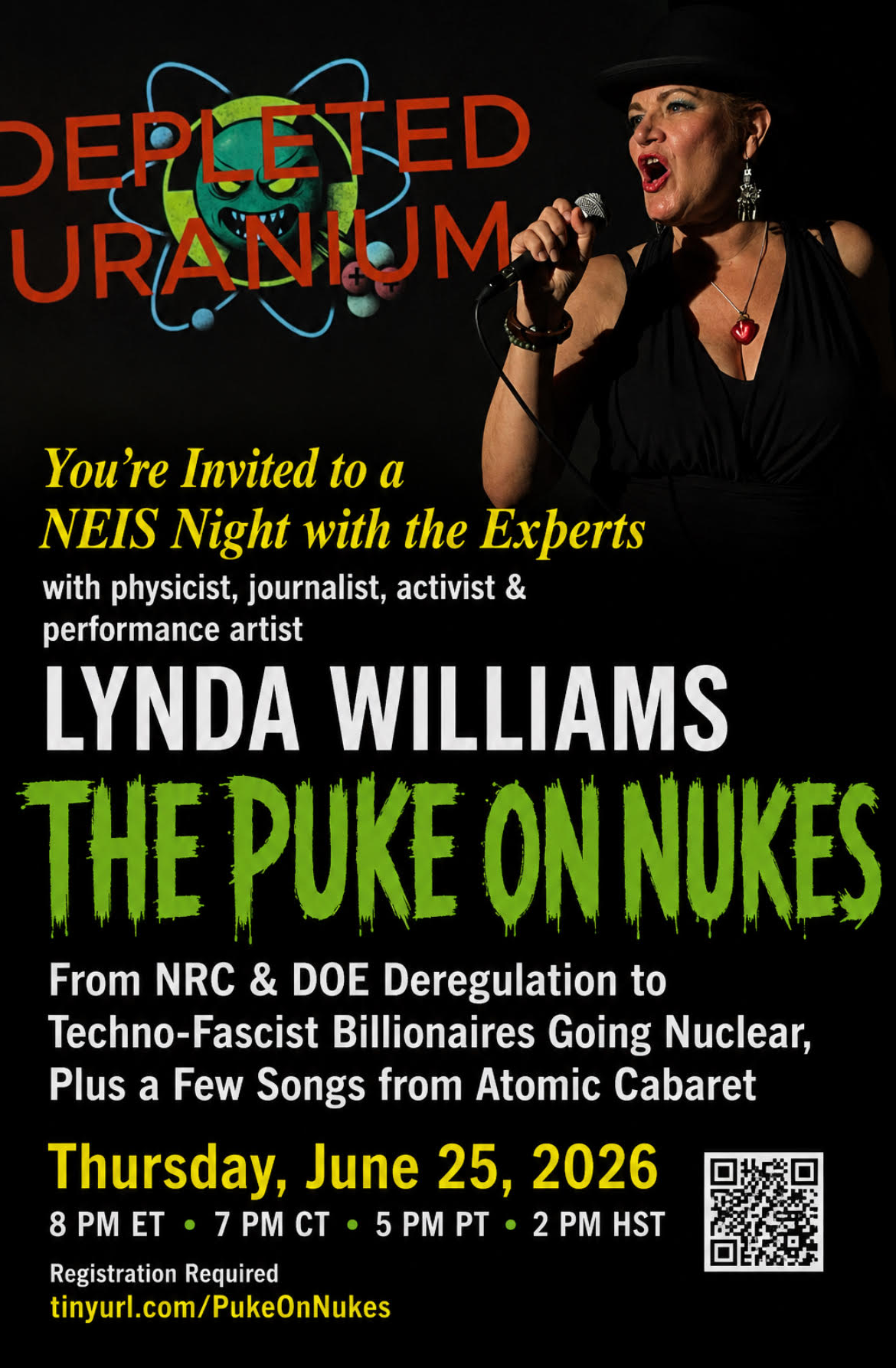
25 June- THE PUKE ON NUKES
Thursday, June 25, 2026
7pm Central Time (8pm ET, 6pm MT, 5pm PT) UTC – 5
From NRC & DOE Deregulation to Techno-Fascist Billionaires Going Nuclear, Plus a Few Songs from Atomic Cabaret REGISTER
26 June – Radiation Trainwreck at the NRC / Join the Protect Better Campaign – https://us02web.zoom.us/meeting/register/4ZlZ5_qLSHGiLSCg8FF6Bg#/registration

1st July – Webinar Waste of Space: The Environmental Harm of Military and Civil Space Activity st July, 7 pm

Report Launch Online: We are seeing an increasing exploitation of space for military and commercial purposes. This must change.

Protect Sazan Island from the Trump family! https://secure.avaaz.org/campaign/en/protect_sazan_island_from_the_trump_family_loc/?bqFCVab&v=174511&cl=22707147157&_checksum=5e9dde668860e8231c33699735e16a1fbf22ab2cb01da50c999fe8732b9775ef&utm_source=email&utm_medium=blast_email&utm_campaign=174511


Cuba Is Not a Failed State – It Is a Besieged State
PETITION: “Global Appeal to Endorse Palestinian Right of Return of Refugees”
To see nuclear-related stories in greater depth and intensity – go to https://nuclearinformation.wordpress.com
-
Archives
- June 2026 (251)
- May 2026 (306)
- April 2026 (356)
- March 2026 (251)
- February 2026 (268)
- January 2026 (308)
- December 2025 (358)
- November 2025 (359)
- October 2025 (376)
- September 2025 (257)
- August 2025 (319)
- July 2025 (230)
-
Categories
- 1
- 1 NUCLEAR ISSUES
- business and costs
- climate change
- culture and arts
- ENERGY
- environment
- health
- history
- indigenous issues
- Legal
- marketing of nuclear
- media
- opposition to nuclear
- PERSONAL STORIES
- politics
- politics international
- Religion and ethics
- safety
- secrets,lies and civil liberties
- spinbuster
- technology
- Uranium
- wastes
- weapons and war
- Women
- 2 WORLD
- ACTION
- AFRICA
- Atrocities
- AUSTRALIA
- Christina's notes
- Christina's themes
- culture and arts
- Events
- Fuk 2022
- Fuk 2023
- Fukushima 2017
- Fukushima 2018
- fukushima 2019
- Fukushima 2020
- Fukushima 2021
- general
- global warming
- Humour (God we need it)
- Nuclear
- RARE EARTHS
- Reference
- resources – print
- Resources -audiovicual
- Weekly Newsletter
- World
- World Nuclear
- YouTube
-
RSS
Entries RSS
Comments RSS
 nuclear-news
