What does Chevron mean for nuclear? The USA courts can now supercede the safety role of the Nuclear Regulatory Commission

should we trust the courts to be better arbiters of how nuclear power plants should be regulated than the actual agency set up to regulate them?
In the worst-case scenario, rogue judges are now empowered to issue out-of-pocket decisions on highly technical matters they don’t actually understand.
The NRC was the undisputed final word in what goes for nuclear energy in the United States. Did the overturning of the longstanding Chevron decision now put the courts above the regulatory agency?
Elemental, ANGELICA OUNG, JUN 30, 2024
The US Supreme Court just overturned the longstanding “Chevron deference” This is a move so dramatic that Dahlia Lithwick, senior legal editor at Slate, described it as a “requiem” for the Administrative state.
According to Lithwick in the Slate Podcast on the issue, the Chevron doctrine said that when a statute is unclear, federal courts should defer to a reasonable interpretation by administrative agencies. No more. Courts can now decide from the get-go what a statute means, regardless of what the agency thinks.
Once upon a time, ironically, it was the conservative Justice Scalia who was the Chevron doctrine’s biggest fan. But as it becomes increasingly clear that the conservative justices are going to enjoy a generational hold on the Supreme Court while the party holding the Executive Branch flips and flops, it became an advantageous political project for the court to take out Chevron and transfer power from the “ABC agencies,” which of course includes the National Regulatory Commission (NRC) over to the courts.
“This fundamentally changes the way government governs,” said Lithwick.
So what now? If the court is now the final arbiter for whether, say, a bump stock makes a gun a machine gun, is it also going to become the final arbiter on whether a giant trampoline works as well as a reinforced containment dome for that purpose of protecting a nuclear reactor from the impact of a large commercial aircraft?
In fact, since the Aircraft Impact Assessment (AIA) is a part of the NRC’s regulations, not explicitly mandated by law, the court can even opt to throw the regulation out entirely.
The undercutting of the NRC goes both ways: just as nuclear companies can now challenge what they see as unreasonably onerous NRC regulations in court, they are now also vulnerable to individuals or groups claiming harm, even if the companies followed all the regulatory guidelines, increasing their legal risk.
As Chief Justice John Roberts wrote in his opinion in the landmark 6-3 ruling, “Agencies have no special competence in resolving statutory ambiguities. Courts do.”
In a dissenting opinion, Justice Elena Kagan warned that Congress does not have the ability to write perfectly complete regulatory statutes and it would be preferable for the gaps formed by inevitable ambiguities to be filled by the responsible agency, not a court. The decision “is likely to produce large-scale disruption.”………………………………………………………………………………………………
…….should we trust the courts to be better arbiters of how nuclear power plants should be regulated than the actual agency set up to regulate them?
In the worst-case scenario, rogue judges are now empowered to issue out-of-pocket decisions on highly technical matters they don’t actually understand. https://elementalenergy.substack.com/p/what-does-chevron-mean-for-nuclear
Newly identified tipping point for ice sheets could mean greater sea level rise

Small increase in temperature of intruding water could lead to very big increase in loss of ice, scientists say
A newly identified tipping point for the loss of ice sheets in Antarctica and elsewhere could mean future sea level rise is significantly higher than current projections.
A new study has examined how warming seawater intrudes between coastal ice sheets and the ground they rest on. The warm water melts cavities in the ice, allowing more water to flow in, expanding the cavities further in a feedback loop. This water then lubricates the collapse of ice into the ocean, pushing up sea levels.
The researchers used computer models to show that a “very small increase” in the temperature of the intruding water could lead to a “very big increase” in the loss of ice – ie, tipping point behaviour.
It is unknown how close the tipping point is, or whether it has even been crossed already. But the researchers said it could be triggered by temperature rises of just tenths of a degree, and very likely by the rises expected in the coming decades.
Sea level rise is the greatest long-term impact of the climate crisis and is set to redraw the world map in coming centuries. It has the potential to put scores of major cities, from New York City to Shanghai, below sea level and to affect billions of people.
The study addresses a key question of why current models underestimate the sea level seen in earlier periods between ice ages. Scientists think some ice sheet melting processes must not be yet included in the models.
“[Seawater intrusion] could basically be the missing piece,” said Dr Alexander Bradley of the British Antarctic Survey, who led the research. “We don’t really have many other good ideas. And there’s a lot of evidence that when you do include it, the amount of sea level rise the models predict could be much, much higher.”
Previous research has shown that seawater intrusion could double the rate of ice loss from some Antarctic ice shelves. There is also real-world evidence that seawater intrusion is causing melting today, including satellite data that shows drops in the height of ice sheets near grounding zones.
“With every tenth of a degree of ocean warming, we get closer and closer to passing this tipping point, and each tenth of a degree is linked to the amount of climate change that takes place,” Bradley said. “So we need very dramatic action to restrict the amount of warming that takes place and prevent this tipping point from being passed.”
The most important action is to cut the burning of fossil fuels to net zero by 2050.
Bradley said: “Now we want to put [seawater intrusion] into ice sheet models and see whether that two-times sea level rise plays out when you analyse the whole of Antarctica.”
Scientists warned in 2022 that the climate crisis had driven the world to the brink of multiple “disastrous” tipping points, including the collapse of Greenland’s ice cap and the collapse of a key current in the north Atlantic, disrupting rains upon which billions of people depend for food.
Research in 2023 found that accelerated ice melting in west Antarctica was inevitable for the rest of the century, no matter how much carbon emissions are cut, with “dire” implications for sea levels.
The new research, published in the journal Nature Geoscience, found that some Antarctic ice sheets were more vulnerable to seawater intrusion than others. The Pine Island glacier, currently Antarctica’s largest contributor to sea level rise, is especially vulnerable, as the base of the glacier slopes down inland, meaning gravity helps the seawater penetrate. The large Larsen ice sheet is similarly at risk.
The so-called “Doomsday” glacier, Thwaites, was found to be among the least vulnerable to seawater intrusion. This is because the ice is flowing into the sea so fast already that any cavities in the ice melted by seawater intrusion are quickly filled with new ice.
Dr Tiago Segabinazzi Dotto, of the UK’s National Oceanography Centre, welcomed the new analysis of the ocean-ice feedback loop under ice sheets.
“The researchers’ simplified model is useful for showing this feedback, but a more realistic model is highly needed to evaluate both positive and negative feedbacks,” he said. “An enhancement of observations at the grounding zone is also essential to better understand the key processes associated with the instability of ice shelves.”
The Suspect Body Count: The Death Toll in Gaza is Much Higher Than We’re Being Told

Seymour Hersh Substack Thu, 27 Jun 2024 https://www.sott.net/article/492600-The-Suspect-Body-Count-The-Death-Toll-in-Gaza-is-Much-Higher-Than-We-re-Being-Told
The number of slain Palestinians in Gaza, including those believed to be Hamas cadres, has gone through a series of public recalibrations in recent weeks, as Israel’s reshuffled war cabinet has struggled to minimize international rage at the slaughter there. The reduced body count was little more than a sideshow because the Israeli offensive is continuing in Gaza with no signs of the ceasefire that the Biden administration has been desperately seeking.
Hamas triggered the war last October 7 with a surprise attack — there is so far no official explanation for Israel’s security failure that day — that killed 1,139 Israelis and injured 3,400 more. Some 250 soldiers and civilians were taken hostage.
Comment: There is plenty of evidence to strongly suggest that Israel allowed the incursion on Oct. 7th to happen and that parties unknown carried out most of the killing. This strategy fits with Israel’s decades-long goal of creating the right ‘conditions’ to justify implementing a final solution to their ‘Palestinian problem’.
The expected Israeli response began within days, with the bombing of the Gaza Strip. Some Israeli ground operations inside Gaza began on October 13, and two weeks later the expected full-scale offensive began. The war still rages, with one estimate concluding that by the beginning of April 70,000 tons of explosives had been dropped on targets throughout the 25-mile long Gaza, more tonnage than was dropped by Germany on London and by America and the United Kingdom on Dresden and Hamburg in World War II, combined.
The Gaza Health Ministry, which is under Hamas control, estimated as of Tuesday that the death toll from the Israeli attacks stood at 37,718, with more than 86,000 Gazans wounded. Last month the Israeli government issued a much lower estimate of the casualties, stating that its planes and troops had killed 14,000 “terrorists” — Hamas fighters — and no more than 16,000 civilians.
The Biden administration, on the eve of the first presidential debate, has said nothing about the new numbers, but there are many senior analysts in the international human rights and social science community who consider these numbers to be hokum: a vast underestimate of the damage that has been done to a terrorized civilian population living in makeshift tents and shelters amid disease and malnutrition, with a lack of sanitation, medical care, and medicines as well as increasing desperation and fatigue.
In days of telephone and email exchanges with public health and statistical experts in America I found a general belief that the civilian death toll in Gaza, both from the bombings and their aftermath, had to be significantly higher than reported, but none of the scientists and statisticians — appropriately — was willing to say so in print because of a lack of access to accurate data. I also asked one well-informed American official what he thought the actual civilian death count in Gaza might be and he answered, without pause: “We just don’t know.”
One public health expert acknowledged: “No clear and definite body count is possible, given the continuing Israeli bombing.” He added, caustically, “How many bombs does it take to kill a human being?”
Gaza was an ideal target for an air attack, he said. “No functioning fire department. No fire trucks. No water. No place to escape. No hospitals. No electricity. People living in tents and bodies stacked up all over . . . being eaten by stray dogs.
“What the fuck is wrong with the international medical community?” he asked. “Who are we kidding? Without a ceasefire, a million people are going to starve. This is not a debating point. How can you count something when the system is biting its own tail.” He was referring to the fact that the health system in Gaza — its hospitals and service agencies — “is being targeted and shattered” by Israeli aircraft and those responsible for the counting of the dead and injured “are themselves dead.”
The expert added that the lack of better casualty statistics is not only the fault of Israel. “Hamas has a vested interest in consistently minimizing the number of civilians killed “because of a lack of planning over the years when it was in charge of Gaza.” He was referring to ordinary Gazan citizens’ lack of access to Hamas’s vast underground tunnel complex that could have served as a bomb shelter for all. In Gaza during the Israeli bombing raids, “Is Hamas going to say that Israel” was able to kill all in Gaza “because we started a war without being able to fully protect our people?” His point was that Hamas has every reason, as does Israel, to minimize the extent of innocent civilians who have become collateral damage in the ongoing war.
Comment: Hamas did not start this most recent round of mass slaughter by Israel on Oct 7th. Hamas has never provided Israel with the justification it always sought to massacre Gazans wholesale. On Oct. 7th, Israel provided itself with that justification.
A prominent American public health official who spoke to me acknowledged that he was also concerned about the numbers of unreported dead in Gaza. In a crisis, he said, “we can start with a name-by-name count, but pretty soon the numbers of killed and missing exceed the capacity of any such approach, especially when the counters are being killed and the records [are] at risk.” He said that various postwar academic studies of mortality during the siege of Mosul — when a US-led coalition fought a door-to-door fight in 2017 against the Islamic State in Iraq, killing as many 11,000 civilians — “showed the large loss of life from the use of high-velocity weapons in urban areas. So we should expect similar in Gaza.”
Other data suggest that the published death figures are seriously misleading. Save the Children, an international child protection agency, issued a report this month estimating that as many as 21,000 children in Gaza are “trapped beneath rubble, detained, buried in unmarked graves, or lost from their families.” Other children, the agency said, “have been forcibly disappeared, including an unknown number detained and forcibly transferred out of Gaza” with their whereabouts unknown to the families “amidst reports of ill-treatment and torture.”
Comment: As if the mass slaughter and starvation of Palestinians in Gaza is not enough, it is highly likely that a large number of Palestinian children have been abducted by Zionist state forces, likely to be tortured and killed or otherwise used for the depraved pleasures of some of the people that inhabit that “shitty little country”.
Jeremy Stoner, the charity’s regional director for the Middle East, said: “Gaza has become a graveyard for children, with thousands of others missing, their fates unknown. . . . We desperately need a ceasefire to find and support the missing children who have survived, and to prevent more families from being destroyed.”
Warnings about the inevitability of far more deaths among the ordinary citizens of Gaza have been around since last winter. In December, Devi Sridhar, the chair of global public health at the University of Edinburgh, wrote in the Guardian that the Gaza war was “the deadliest conflict for children in recent years” with as many as 160 children being killed daily. The surviving children do not have “the basic needs that any human, especially babies and children, need to stay healthy and alive. . . . Unless something changes, the world faces the prospect of almost a quarter of Gaza’s 2 million population — close to half a million human beings — dying within a year.
“It’s a crude estimate,” Sridhar wrote, “but one that is data-driven, using the terrifying real numbers of death in previous and comparable conflicts.”
The New York Times and the Washington Post reported Wednesday that a new study endorsed by the United Nations found that as many as half a million Gaza residents are facing imminent starvation because of “a lack of food.” The study also said that more than one half of the surviving residents of Gaza “had to exchange their clothes for money and one-third resorted to picking up trash to sell.”)
One of the most avid early critics of the official statistics published by the Gaza Health Ministry and accepted by most in the American media, has been Ralph Nader. On March 5, he wrote a column in the Capitol Hill Citizen, a monthly newspaper he founded, about what he called “the undercount” of Palestinian casualties in Gaza. He quoted Martin Griffiths, the United Nations under-secretary-general for humanitarian affairs: “Life is draining out of Gaza at terrifying speed.”
In my years as a journalist, I have often found an oddball story that says more with each retelling. Something like that happened in February when Al Jazeera ran an interview with a 64-year-old Gazan undertaker named Saadi Hassan Sulieman Baraka, whose nickname is Abu Jawad. He complained of working almost constantly since the Israeli invasion of Gaza began.
“I’ve buried about ten times more people during this war than I did across my entire 27 years as an undertaker,” he said. “The least was 30 people and the most was 800. Since October 7, I’ve buried more than 17,000 people.” He especially remembered the day he buried the 800 dead. “We collected them in pieces; their bodies so riddled with holes it was like Israeli snipers used them for target practice; Others were crushed like . . . like a boiled potato, and many had huge facial burns.
“We couldn’t really tell one person’s body from the other, but we did our best. We made one big deep grave, probably 10 meters (30 feet) deep and buried them together.”
It could be propaganda — of course, it could. But Abu Jawad made no mention of anyone from the Gaza Health Ministry coming to collect the names of the dead. He made no mention of any government official being involved in the process at all.
Save Ukraine from American meddling

COMMENT. While the fatuous mainstream media focusses on nan unintelligent TV debate between two US presidential candidates – we increasingly look for some intelligent news.
And today – to my amazement, today – “The Hill” actually does give us an analysis of the Ukraine situation. And it’s not from the mega-paid lackeys of the military-industrial-corporate-media complex, but from the respected economist Jeffrey Sachs.
BY JEFFREY SACHS, OPINION CONTRIBUTOR – 06/27/24 https://thehill.com/opinion/international/4741597-save-ukraine-from-american-meddling/
Ukraine can only be saved at the negotiating table, not on the battlefield. Sadly, this point is not understood by Ukrainian politicians such as Oleg Dunda, a member of Ukraine’s parliament, who recently wrote an oped on this site against my repeated call for negotiations.
Dunda believes that the U.S. will save Ukraine from Russia. The opposite is true. Ukraine actually needs to be saved from the U.S.
Ukraine epitomizes Henry Kissinger’s famous aphorism, “It may be dangerous to be America’s enemy, but to be America’s friend is fatal.”
Thirty years ago, Ukraine was embraced by America’s neoconservatives, who believed that it was the perfect instrument for weakening Russia. The neocons are the ideological believers in American hegemony, that is, the right and responsibility of the U.S. to be the world’s sole superpower and global policeman (as described, for example, in the Project for a New American Century’s 2000 report, “Rebuilding America’s Defenses”).
The neocons chose three methods to push U.S. power and influence into Ukraine: first, meddle in Ukraine’s internal politics; second, expand NATO to Ukraine, despite Russia’s red line; and third, arm Ukraine and apply economic sanctions to defeat Russia.
The neocons whispered a sweet fantasy into Ukraine’s ear back in the 1990s: Come with us into the glorious paradise of NATO-land and you’ll be safe ever after. Pro-European Ukrainian politicians, especially in Western Ukraine, loved the story. They believed that Ukraine would join NATO just as Poland, Hungary and the Czech Republic had in 1999.
The idea of expanding NATO to Ukraine was fatuous and dangerous. From Russia’s perspective, the NATO expansion into Central Europe in 1999 was deeply objectionable and a stark violation of the solemn U.S. promise that NATO would not expand “one inch eastward,” but it was not deadly to Russia’s interests. Those countries do not border the Russian mainland. NATO enlargement to Ukraine, however, would mean the loss of Russia’s Black Sea naval fleet at Sevastopol and the prospect of U.S. missiles minutes from the Russian mainland.
There was, in fact, no prospect that Russia would ever accept NATO enlargement to Ukraine. The current CIA Director, William Burns, said as much in a memo to Secretary of State Condoleezza Rice when he was U.S. Ambassador to Moscow in 2008. The memo was famously entitled “Nyet means Nyet.”
Burns wrote, “Ukrainian entry into NATO is the brightest of all redlines for the Russian elite (not just Putin). In more than two and a half years of conversations with key Russian players, from knuckle-draggers in the dark recesses of the Kremlin to Putin’s sharpest liberal critics, I have yet to find anyone who views Ukraine in NATO as anything other than a direct challenge to Russian interests.”
The neoconservatives never described this Russian redline to the American or global public, then or now. Senior diplomats and scholars in the U.S. had reached the same conclusion about NATO enlargement more generally in the 1990s, as has been recently documented in detail.
Ukrainians and their supporters insist that Ukraine has the “right” to join NATO. The U.S. also says so repeatedly. NATO’s policy says that NATO enlargement is an issue between NATO and the candidate country, and that it is no business of Russia or any other non-NATO country.
This is preposterous. I’ll start to believe that claim when Adm. John Kirby declares from the White House podium that Mexico has the “right” to invite China and Russia to put military bases along the Rio Grande, based on the same “open door policy” as NATO. The Monroe Doctrine has said just the opposite for two centuries.
So Ukraine was set up for disaster by the neocons. Actually, the Ukrainian public sensed the truth, and overwhelmingly opposed NATO membership until the 2014 uprising that overthrew Ukrainian President Viktor Yanukovych.
Let’s retrace the chronology of this shockingly misguided American policy. In the early 2000s, the U.S. began to meddle intensively in Ukraine’s politics. The U.S. spent billions of dollars, according to Victoria Nuland, to build Ukraine’s “democracy,” meaning to turn Ukraine to the U.S. and away from Russia. Even so, the Ukrainian public remained strongly against NATO membership, and elected Viktor Yanukovych, who championed Ukrainian neutrality, in 2010.
In February 2014, the Obama team actively sided with neo-Nazi paramilitaries, which stormed government buildings on February 21 and overthrew Yanukovych the next day, cloaked as a “Revolution of Dignity.” The U.S. immediately recognized the new government. The astounding intercepted call between Nuland and U.S. Ambassador to Ukraine Geoffrey Pyatt, where they talk about who should be in the new Ukrainian government several weeks before the rebellion, demonstrates the level of American involvement.
The post-uprising government in Ukraine was filled with Russia-haters, and was backed by extremist right-wing paramilitaries like the Azov Brigade. When the ethnically Russian Donbas region broke away from the uprising, the central government aimed to retake the region by force. A peace agreement was reached between Kyiv and the Donbas in 2015, known as Minsk II, that would end the fighting by extending autonomy to the ethnically Russian regions of Donetsk and Luhansk.
Alas, Ukraine and the U.S. undermined the treaty even while publicly endorsing it. The treaty was a mere temporizing measure (according to German Chancellor Angela Merkel) to give Ukraine time to build its army. The U.S. shipped armaments to Ukraine to build up its military, make it interoperable with NATO and support the retaking of the Donbas by force.
The next diplomatic opportunity to save Ukraine came in December 2021, when Vladimir Putin proposed a U.S.-Russia Treaty on Security Guarantees, calling for an end to NATO enlargement, among other issues (including the urgent question of U.S. missile placements near Russia). Instead of negotiating, Biden again flatly said no to Putin on the question of ending NATO enlargement.
Yet another diplomatic opportunity to save Ukraine arose in March 2022, just days after the start of Russia’s “special military operation,” launched on February 24. Russia said that it would stop the war if Ukraine would agree to neutrality. Zelensky agreed, documents were exchanged and a peace deal was nearly reached. Yet, according to former Israeli Prime Minister Naftali Bennett, the U.S. and other NATO allies, notably the U.K., stepped in to block the agreement, telling Ukraine to fight on. Recently, Boris Johnson said that Ukraine should keep fighting to preserve “Western hegemony.”
Ukraine can still be saved through neutrality, even as hundreds of thousands of lives have been squandered by the failure to negotiate. The rest of the issues, including boundaries, can also be resolved through diplomacy. The killing can end now, before more disasters befall Ukraine and the world. As for the United States, 30 years of neoconservative misrule is long enough.
Labour plans for nuclear expansion in Scotland are flying under radar.
George Kerevan: LABOUR are planning a big expansion of nuclear power in the
UK … and in Scotland. Of course, as with much else in the party’s
intentions, this is being sneaked in under the political radar. However, a
close reading of the manifestos of both UK Labour and its Scottish branch
office clearly gives the game away.
And prominent candidates – such as
Douglas Alexander in Lothian East – are being very vocal in support of
nuclear energy when speaking at election hustings.
Why is this worrying?
Because apart from the undemocratic secrecy involved, Labour’s nuclear
fixation is expensive for the taxpayer and the electricity consumer. And
because this strategy compromises the safety of everyone living in
Scotland.
Reason: Labour is dicing with new, unproven nuclear generating
technology – called small modular reactors, or SMRs. Scotland could be the
guinea pig for SMRs at the existing nuclear plant at Torness in East
Lothian. Which is why Scottish Labour have to come clean on its plans for
new nukes.
The National 26th June 2024
https://www.thenational.scot/politics/24411664.labour-plans-nuclear-expansion-scotland-flying-radar/
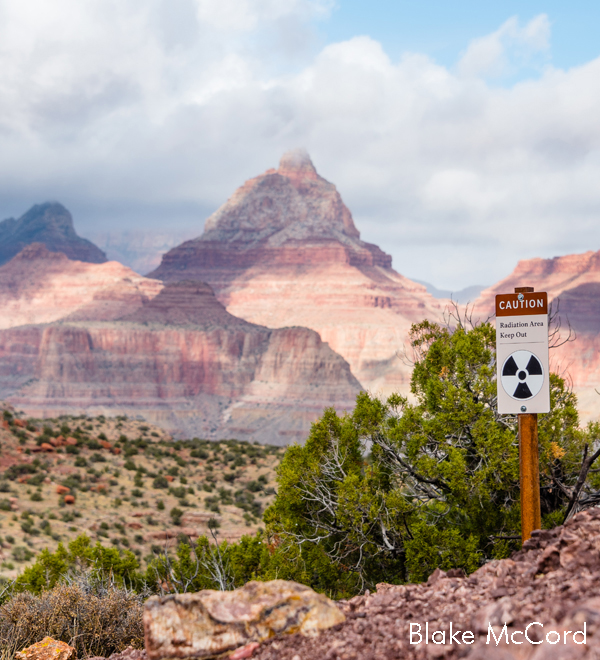
Uranium and the Grand Canyon – A Call to Close and Cleanup the Pinyon Plains Uranium Mine

http://nuclearactive.org/ 27 June 24
A recent mapping project by Stanford University shows about 23,000 abandoned uranium mines across the country. One must question beginning a new round of uranium mining when closure and cleanup of previous mining efforts have not been done. As a result, water continues to be contaminated.
June 27th, 2024
One of the most beautiful and majestic sights is found by looking across and down into the Grand Canyon at the spread of the red walls, the patches of green and the glorious Colorado River. All of this is threatened by an exemption from a federal law banning uranium mining in the watershed that feeds the complex river system. Uranium mining is allowed on U.S. Forest Service lands where the Pinyon Plains Uranium Mine is located less than ten miles from the Grand Canyon’s south rim. https://www.grandcanyontrust.org/grand-canyon-uranium
In December 2023, the Pinyon Plains Uranium Mine, formerly called the Canyon Mine, began mining operations. The owner of the mine, Energy Fuels Inc., plans to begin transporting extracted uranium 300 miles across the Navajo Nation to the corporation’s White Mesa Uranium Mill in southeast Utah. https://www.grandcanyontrust.org/white-mesa-uranium-mill and https://www.energyfuels.com/
Tribes and others in this large area know little about the corporation’s plans for transporting the dangerous materials. The federal and state agencies have done little, or none, of the required consultation with the tribes and communities about the transportation plans. The corporation has brought the threat of harm while ignoring its responsibilities to consult with those who want to keep their families safe. See links to the Uranium and the Grand Canyon panel conversation below.
The Navajo Nation passed a law against the transport of uranium across its lands. https://opvp.navajo-nsn.gov/wp-content/uploads/2024/05/President-Nygren-signs-uranium-legislation-for-April-30.pdf It is unknown what the Nation will do when the first load leaves the mine.
It is irresponsible to mine, let alone transport uranium ore through the Grand Canyon Watershed when we have already experienced the harm done to all living beings by decades of uranium mining.
A recent mapping project by Stanford University shows about 23,000 abandoned uranium mines across the country. One must question beginning a new round of uranium mining when closure and cleanup of previous mining efforts have not been done. As a result, water continues to be contaminated.
New groundwater scientific studies reveal what Peoples living in and around the Grand Canyon know: that the high interconnectivity of the groundwater systems makes uranium mining not only risky, but extremely risky. https://www.grandcanyontrust.org/blog/uranium-mining-near-grand-canyon-too-risky-research-shows and https://www.grandcanyontrust.org/blog/flooding-uranium-mine-near-grand-canyon-tops-66-million-gallons
To learn more, watch the June 27, 2024 Uranium and the Grand Canyon panel conversation with a tribal leader, a health professional, an activist, and a former uranium miner. https://video.search.yahoo.com/yhs/search?fr=yhs-iba-3&ei=UTF-8&hsimp=yhs-3&hspart=iba&p=kjzz+news&type=teff_10019_FFW_ZZ#id=3&vid=9775763ef083421924a855a8b7311be1
Navajo Nation President Buu Nygren provided an opening message. https://video.search.yahoo.com/yhs/search?fr=yhs-iba-3&ei=UTF-8&hsimp=yhs-3&hspart=iba&p=kjzz+news&type=teff_10019_FFW_ZZ#id=2&vid=9d88817057e55e3bb6c9803bc3b59c88&action=click
Gabriel Pietrorazio, of KJZZ News, hosted the event. He is a national award-winning tribal natural resources reporter. Pietrorazio’s most recent article about these issues: https://www.kjzz.org/news/2024-06-27/inside-pinyon-plain-mine-the-grand-canyon-uranium-dispute-from-two-points-of-view
Take action by going to the Grand Canyon Trust website to sign the petition to close and clean up the Canyon Mine, which was recently renamed the Pinyon Plains Uranium Mine. https://www.grandcanyontrust.org/take-action
US can’t trace $62 million of military aid sent to Ukraine – watchdog.
Rt.com 28 June 24
The Pentagon does not know whether defense items were “lost or destroyed,” an investigation has found.
The US Defense Department is unable to locate $62 million worth of weapons given to Ukraine, according to a report released on Wednesday.
The conclusions were presented by the Pentagon inspector general after an assessment on whether the DoD is effectively monitoring defense items provided to the Ukrainian Armed Forces.
The watchdog found that as of late November last year, a total $62.2 million in hardware designated for enhanced end-use monitoring (EEUM) was reported as missing. Among them are night vision devices, Javelin anti-tank missiles, and missile launch units.
According to the report, the US Office of Defense Cooperation (ODC) in Ukraine “cannot tell which of these items were lost and which were destroyed.” The Ukrainian army has not yet provided clarification, it adds…………………………………………more https://www.rt.com/news/600100-us-military-aid-millions-missing-ukraine/
UK government hires scandal-ridden Fujitsu company to account and track its nuclear waste!

Government Hires Fujitsu to Account and Track Dangerous Nuclear Wastes from Dounreay – Are they Laughing at Us?
At the same time folk at Glastonbury Festival are saying No to New Nuclear Wastes and the Post Office Inquiry is Live , Government have hired the company at the centre of the Post Office scandal to account for and track the UK’s most dangerous nuclear wastes. The £306K Fujitsu contract has been awarded by Nuclear Restoration Services (former Magnox) for Fujitsu’s ATOM application: “A contract has been awarded by NRS
Dounreay as a result of a direct award through the Crown Commercial Services
RM6194 Back Office Software Framework, for the provision and support of ATOM Application.”
Dounreay was the test site of the UK’s experimental Fast Breeder nuclear reactors. “EARLY in the morning of Tuesday 10 May 1977 there was a loud explosion at the Dounreay nuclear plant on the north coast of Scotland. The UK Atomic Energy Authority, which runs the plant, had dumped at least 2 kilograms of sodium and potassium down a 65-metre shaft packed with radioactive waste and flooded with seawater.”
Fujitsu’s ATOM stands for Accountancy and Tracking Of Material – “a comprehensive track and trace application, specifically designed for the processing, movement and reporting of nuclear and radioactive materials throughout the supply chain right up to nuclear decommissioning”. According to the United Kingdom Atomic Energy Authority in 2008 Fujitsu’s ATOM employed over ” 2,000 people • Manages over 115,000 radioactive item records in the UK.” In 2008 Dik Third, Nuclear Materials Advisor, UKAEA, worked closely with Fujitsu and said “…one of the problems with radioactive materials is that they have properties that computer-based logistics packages don’t handle. Unlike tins of beans, radioactive materials with short half-lives can transform into another isotope entirely.”
Fujitsu are now in control of the accounting and tracking of radioactive materials ie of nuclear wastes from the UKs failed fast breeder reactor at Dounreay. They will be allocating wastes to the nuclear “waste hierarchy’ that means sorting wastes to go landfill, to incineration, to the Low Level Waste Repository at Drigg, to Cyclife (radioactive scrap metal plant) and to Sellafield. The nuclear waste hierarchy has been criticised for reducing the levels at which waste can be designated for “free release” and other “disposal” routes which increasingly mean dumping into the public domain. There is a precedent for radioactive material ending up in the wrong place even without the services of Fujitsu.
READ FULL ARTICLE HERE
Deaths mount as Pakistan swelters in heatwave

As the temperatures rose in southern Pakistan, so did the body count. The
Edhi ambulance service says it usually takes around 30 to 40 people to the
Karachi city morgue daily. But over the last six days, it has collected
some 568 bodies – 141 of them on Tuesday alone. It is too early to say
exactly what the cause of death was in every case. However, the rising
numbers of dead came as temperatures in Karachi soared above 40C (104F),
with the high humidity making it feel as hot as 49C, reports said. People
have been heading to hospitals seeking help.
BBC 27th June 2024
Japan starts 7th discharge of Fukushima nuclear-contaminated wastewater despite opposition

https://news.cgtn.com/news/2024-06-28/news-1uNrsTbwBm8/p.html
Japan on Friday started the seventh round of release of nuclear-contaminated wastewater from the crippled Fukushima Daiichi Nuclear Power Plant into the Pacific Ocean.
Despite opposition from local fishermen, and residents as well as backlash from the international community, Tokyo Electric Power Company (TEPCO), the plant’s operator, started releasing the radioactive wastewater in the morning, the third round in fiscal 2024.
Just like the previous rounds, about 7,800 tonnes of wastewater will be discharged from about a kilometer off the coast of Fukushima Prefecture via an underwater tunnel until July 16.
According to TEPCO, the company will begin dismantling empty storage tanks after the wastewater has been discharged around January next year.
There are approximately 1,000 storage tanks at the Fukushima plant because of its continued production of wastewater. TEPCO plans to dismantle 21 of these tanks over about one year starting next January, which will free up 2,400 square meters of space.
There is still uncertainty when it comes to the decommissioning schedule of the Fukushima plant and the measures to deal with contaminated wastewater, Masahide Kimura, a member of a Japanese anti-nuclear campaign group, told Xinhua.
The collapse of houses, the destruction of roads and the ground uplift along the coast caused by the recent Noto Peninsula Earthquake have warned us that nuclear power plants should not be operated in Japan, an archipelago prone to earthquakes, Kimura said.
Hit by a 9.0-magnitude earthquake and an ensuing tsunami on March 11, 2011, the Fukushima nuclear plant suffered core meltdowns that released radiation, resulting in a level-7 nuclear accident, the highest on the International Nuclear and Radiological Event Scale.
The plant has been generating a massive amount of water tainted with radioactive substances from cooling down the nuclear fuel in the reactor buildings. The contaminated water is now being stored in tanks at the nuclear plant.
Despite furious opposition both at home and abroad, the ocean discharge of the Fukushima nuclear-contaminated water began in August 2023.
Complete BS from the IAEA about the non-existent “global consensus” on nuclear power.

The latest (today) International Atomic Energy Agency newsletter includes this BS info about a fantasy “global consensus” on nuclear power.
The World Bank and other MDBs currently do not contribute financing to nuclear power new build projects, although some MDBs have provided lending for upgrades to existing nuclear power reactors or their decommissioning. Mr Grossi said that financing nuclear power would better align MDBs with the “new global consensus” forged at last year at COP28 in Dubai, where the world called for accelerating the deployment of nuclear power along with other zero emission energy technologies to achieve deep and rapid decarbonization.
Dozens of countries have also signed on to a pledge made at COP28 to work towards tripling global nuclear power capacity to achieve net zero by 2050. The pledge also called on the World Bank, regional development banks and international financial institutions to include nuclear in their lending. That call was echoed by scores of countries at the first-ever Nuclear Energy Summit organized by the IAEA and Government of Belgium in March.
**
The statement supporting nuclear power was made at a private media event at COP 28 and was not part of the official COP proceedings. Canada’s nuclear industry booster NRCan has it on its website but it is not on the site of Environment Canada, which is responsible for COP declarations.
There is no “global consensus” on nuclear energy. Here’s the full IAEA statement:
How I read this: the nuclear industry is desperate. If you read the full item above, you will see a desperate plea for the World Bank and others that do not currently fund nuclear projects to begin doing it. What’s not here is why the private sector is not funding nuclear projects but rather putting their money into solar and wind development, which is that nuclear is a terrible investment and renewables are a good investment.
Israel’s leaked plan for annexing the West Bank, explained
Israeli Finance Minister Bezalel Smotrich’s plan to annex the West Bank would see over 60% of the territory becoming a part of Israel. But Palestinian experts say it is “already happening.”
BY QASSAM MUADDI Mondoweiss
The issue of Israel’s creeping annexation of the West Bank has resurfaced in recent days after a leaked recording of Israel’s finance minister Bezalel Smotrich revealed a “dramatic” plan to impose permanent Israeli control over the West Bank “without the government being accused of annexing it,” as Smotrich was recorded saying.
Smotrich’s statements, recorded by the Peace Now Israeli NGO and published by CNN and the New York Times, were made during a speech he gave to settler leaders earlier in June. Smotrich was recorded saying that he had elaborated a plan in the past year and a half and exposed it to Israel’s Prime Minister Netanyahu, who was “fully onboard.”
The plan centers around transferring administrative authorities in the West Bank from the Israeli army to the civil authorities of the Israeli government. Smotrich said that he oversaw the creation of an entire administrative body directly linked to the government and that members of this body were already embedded in the Israeli army’s Civil Administration.
In 1967, Israel began administering the West Bank and Gaza under a military administrative body, the Military Government, and in 1981, the Civil Administration was established in its place. Following Netanyahu’s formation of the most right-wing government in Israel’s history in 2022, Smotrich was put in charge of the Civil Administration. Since October 7, Smotrich’s hardline policies pushing for settlement expansion have reached new heights, with the recently leaked annexation plan raising fears about the intentions of the self-described fascist toward the Palestinians living in the West Bank.
According to Smotrich, the administrative changes he wishes to implement represent a “dramatic change” equivalent to “changing the DNA of the system.”
Smotrich said that large budgets were allocated to infrastructure projects for settlement expansion and for “security measures” for the settlements, adding that the aim of such a plan is “to avoid the West Bank from becoming part of a Palestinian state.”
Smotrich plan ‘already happening’………………………………..more https://mondoweiss.net/2024/06/israels-leaked-plan-for-annexing-the-west-bank-explained/
Israeli Officials Hiding Data About Forced Starvation of Gaza Prisoners: Report
Former detainees say the Israel Prison Service “has significantly reduced their food rations, to the point of starvation, causing them to shed dozens of kilograms.”
BRETT WILKINS, Jun 27, 2024, Common Dreams,
Israeli prison officials are concealing information about reductions in food rations for Palestinians held in the Gaza Strip, where detainees—who have also reported horrific abuse including alleged rape and deadly torture—have been deliberately driven “to the point of starvation,” according to a report published Thursday.
Security sources told the Israeli newspaper Haaretz that the Israel Prison Service (IPS) is intentionally cutting Palestinian prisoners’ caloric intake, a move confirmed by Israeli National Security Minister Itamar Ben-Gvir, who called the policy a “deterrent.”
“The Palestinian detainees will receive the minimum rights and the minimum food, and I will ensure that this policy is implemented,” Ben-Gvir, who leads the far-right Otzma Yehudit (Jewish Power) party, said Thursday in response to a query from Israel’s Supreme Court…………………………………………………………………………………………….. https://www.commondreams.org/news/israel-starving-prisoners
CEO, staff suddenly depart New Brunswick reactor developer ARC Clean Technology

“reactor developers would not normally terminate staff after hitting a regulatory milestone.
“If they were going to move forward, basically, they would be hiring people,”
MATTHEW MCCLEARN 26 June 24, https://www.theglobeandmail.com/business/article-ceo-staff-depart-new-brunswick-reactor-developer-arc-clean-technology/
ARC Clean Technology Canada, a developer of small modular reactors in New Brunswick, has revealed the sudden departure of its Canadian chief executive, raising questions about its future.
Alongside Tuesday’s announcement of CEO William Labbe’s exit, other ARC employees also received layoff notices, according to a report from the Telegraph Journal, a Saint John, N.B., newspaper. The company did not respond to questions from The Globe about those reported departures, or how many staffers remain with the company.
In a statement, ARC spokesperson Sandra Donnelly said the company had nearly completed a phase of a pre-licensing process with the Canadian Nuclear Safety Commission, and was “realigning personnel and resources to strengthen our strategic partnerships and rationalize operations to best prepare for the next phase of our deployment.”
Ms. Donnelly said ARC Canada will be led by Bob Braun, chief operating officer of its Washington-based parent ARC Clean Technology Inc., and two vice presidents, Lance Clarke and Jill Doucet.
The company’s staff changes follow the resignation of New Brunswick energy minister Mike Holland, announced June 20. Mr. Holland had been an advocate for the province’s SMR program, but had previously announced he would not stand for re-election.
ARC set up offices in Saint John several years ago, as part of an initiative to build SMRs at the province’s only nuclear power plant, Point Lepreau Nuclear Generating Station. The plant’s owner, NB Power, has promoted plans for demonstration units of two different reactors built there by 2030. The second reactor would be designed by another startup, Moltex Energy, which would include a nuclear fuel reprocessing plant.
ARC is one of several vendors jockeying to sell SMRs to Canadian utilities. All existing commercial power reactors in Canada – including the existing one at Point Lepreau – are of the homegrown Candu design. (The newest, at Ontario’s Darlington Nuclear Generating Station, was completed in the early 1990s.)
The company is in the early stages of designing a reactor known as the ARC-100, a next-generation reactor that would use sodium as coolant – a striking departure from Candus and nearly all other commercial power reactors used today, which are water-cooled. The ARC-100 is also marketed as having the ability to consume reprocessed spent fuel, something that has not been done historically in Canada.
As ARC rationalizes its work force, some of its better-established competitors are staffing up. U.S.-based GE-Hitachi and Ontario Power Generation are preparing a site at Darlington for potential construction of a BWRX-300 small modular reactor. Westinghouse, which is marketing several reactors including its AP-1000 large reactor and eVinci microreactor, announced a new 13,000-square-foot office in Kitchener, Ont., this month along with plans to hire 100 engineers to staff it by next year.
Last year, Mr. Labbe said developing the ARC-100 would cost around $500-million. But so far, the company has raised only a small fraction of that. In 2022, it announced it had raised $30-million from the provincial government and the private sector. In October, the federal government awarded it another $7-million. Its partner, NB Power, has not contributed any funding.
ARC submitted an application to the Canadian Nuclear Safety Commission in 2023 for a license to prepare a site at Point Lepreau for its demonstration unit. At an industry conference in April, Mr. Labbe said ARC was also preparing to apply for a license to construct the reactor, which it planned to issue within the next year.
“We’ve been at this for about seven years,” he told the audience. “And we really have another six, seven years until we get that commercial deployment.”
Mr. Labbe became ARC Canada’s CEO in May, 2021. His predecessor, Norm Sawyer, is now president of ION Nuclear Consulting Ltd., an adviser to investors, energy companies and First Nations. Mr. Sawyer said that, while he had no inside information on the company, reactor developers would not normally terminate staff after hitting a regulatory milestone.
“If they were going to move forward, basically, they would be hiring people,” he said.
“If you’re on hold and you’re thinking that you’re going to move forward in a short time period, you maintain your staffing levels.”
Susan O’Donnell, a researcher at St. Thomas University who studies energy technologies, said that, while ARC has managed to attract some private funding, it has remained almost wholly dependent on government money. She added that the federal government is unlikely to provide the billions of dollars required to build new reactors at Point Lepreau.
“I just don’t see how this is going to work, where the money’s going to come from,” she said. “And I think this is why we’re seeing this with ARC today.
“They can’t afford to have that number of staff.”
As recently as November, NB Power chief executive officer Lori Clark had said SMRs were “a key part” of the utility’s plans to phase out coal by 2030. On Tuesday, NB Power said it will continue to provide technical expertise to ARC and Moltex, and that it regards SMRs as a “potential option” to achieve net zero emissions electricity production by 2035.
“We continue to work toward the goal of having an SMR on the grid by the early 2030s,” spokesperson Dominique Couture wrote in an e-mail.
With a report from Emma Graney
Post Election: A Different Kind of Nuclear Bomb

The Nuclear Legacy
The Government has accidentally left behind an unexploded bomb for an incoming Labour Government. Should it go off, it will be early evidence for the argument that Starmer can’t be trusted. The bomb in question is whether or not to go ahead with building another large French nuclear power station at Sizewell in Suffolk.
Our current experience with building large French nuclear power stations is no
Tom Burke on how an incoming Labour Government will have to deal with the unexploded political bomb of nuclear left behind by the Conservatives
BYLINE SUPPLEMENT, JUN 26, 2024, https://www.bylinesupplement.com/p/post-election-a-different-kind-of
You know something is changing in British politics when our better-known political commentators start turning up at Green Party events. They have not found it easy to make much sense of what such a heterodox coalition offers voters. But there is no doubting that their presence signals an old order in transition.
The Financial Times publishes a general election poll tracker. The picture it shows has not changed significantly for eighteen months. A consistent 20 point gap between Labour and the Conservatives is now barely worth a comment. Much less noticed, however, has been another equally consistent pattern.
Adding together support for the insurgent parties – Reform at 11.5%, Lib-Dems at 9.2% and the Greens at 6.3% – may not tell you much about the balance of power in the next Parliament but it does tell you something significant about Britain’s electorate. Voter support for the three minor parties totals 27%, almost 4% higher than that for the ruling Conservatives.
Put another way, more than 70% of British voters want anyone other than the current Conservative Government to run the country. Apart from being a clear demonstration of the wisdom of crowds, this is another dagger at the heart of our archaic and increasingly dysfunctional first past the post voting system. The political complexities of the 21st Century cannot easily be tackled as a tidy battle between labour and capital. Voters have already recognised this. It is time that our political leaders did too.
No issue makes this more apparent than that of climate change. The Conservatives’ choice of this issue as a key battleground on which to fight an electoral culture war was entirely voluntary. There was no great grassroots pressure from within the Party itself. Nor was there any groundswell of public opinion although there was a noisy, if evidence-free, torrent of editorial ink from the Rothermere, Murdoch, Barclay press.
The Uxbridge by-election last July paused a string of Conservative losses. Victory was put down to a voter rebellion against too-expensive climate change policies. The Government then seized on climate as a wedge issue for the forthcoming election and began a systematic winding back of climate action.
In doing so it was copying an election strategy first adopted by the Australian National Party. Since our Prime Minister’s election strategist is the Australian Isaac Levido – a protégé of another, better known, Australian political strategist, Lynton Crosby, this should not have surprised anyone.
What is less explicable is why anyone should have thought that a strategy that failed in Australia would work here. Labour’s victory in the 2022 Australian election was aided by a break-away group of candidates standing as ‘Teals’ – blue-green Conservatives. Exactly the constituency David Cameron had wooed for the Tories here in 2010.
As things currently stand, Labour looks like being helped into Downing Street by an ill-chosen culture war that climate change won. This will have its own challenges for Labour. No-one doubts their good intentions on the climate. But their clumsy handling of, and subsequent back pedalling on, their £28 billion a year green prosperity pledge has left a legacy of doubt in voters’ minds. It risks being punished by increasingly volatile voters if it cannot quickly resolve those doubts.
The Nuclear Legacy
The Government has accidentally left behind an unexploded bomb for an incoming Labour Government. Should it go off, it will be early evidence for the argument that Starmer can’t be trusted. The bomb in question is whether or not to go ahead with building another large French nuclear power station at Sizewell in Suffolk.
Our current experience with building large French nuclear power stations is not encouraging. Although, unusually, we are not alone in this respect. No-one else, including the French themselves, has been able to do so either. Indeed, France has now decided not to even try to build any more of the type of reactors intended for Sizewell as they are too expensive and difficult to build. They will build a different design instead.
The French reactor we are currently building at Hinkley Point was promised to cost £5.6 billion in 2008 and be producing the electricity to cook turkeys on by 2017. In today’s money it will cost nearer to £46 billion and not be producing electricity before 2030. To get EDF to invest, the then Labour Government promised EDF an index linked price for its electricity.
This means that, were it available now, electricity from Hinkley Point would cost £130/MWh. Since National Grid will sell you electricity today for about £80/MWh why would anyone buy more expensive nuclear electricity? To get EDF to build Hinkley Point a Conservative Government bought 35 years’ worth of electricity in advance at a fixed price. To pay for the difference between what EDF can get from the wholesale market there will be tax on everyone’s electricity bill.
It is beyond my understanding why any sane person would want to repeat this experience. Yet that is just what the Conservative Government, with Labour support, was planning to do. It is often argued that building a second station using the same reactors will be cheaper. If that were so, someone needs to explain why the French have already decided not to build any more. Is there something they know that we don’t?
Labour now face a particular difficulty on Sizewell. Since their wind-back of the green prosperity plan, they have doubled down on their promise to deliver carbon-free electricity by 2030. So let us, for argument’s sake, put aside any reservation about whether this is practical. We, and our children, will all certainly be better off if they can deliver carbon-free, secure and affordable electricity to consumers by 2030.
But construction of Sizewell cannot start until after 2030. What then, is the case for forcing homeowners and businesses to pay a tax on their energy bills to finance an unnecessary nuclear power station? And what would this do to the scale and speed of investment in the energy efficiency and renewables which are cheaper and faster ways to get both bills and carbon emissions down?
1 This Month
15 October. Joint Appeal for Nuclear Abolition Day -presentation to the UN on October 15 will be live on UNWebTV
Endorse the Nuclear Abolition Day Appeal
23-25 October – on Zoom – World BEYOND War’s annual global conference

To see nuclear-related stories in greater depth and intensity – go to https://nuclearinformation.wordpress.com
-
Archives
- October 2026 (139)
- September 2026 (339)
- August 2026 (330)
- July 2026 (355)
- June 2026 (287)
- May 2026 (306)
- April 2026 (356)
- March 2026 (251)
- February 2026 (267)
- January 2026 (308)
- December 2025 (358)
- November 2025 (359)
-
Categories
- 1
- 1 NUCLEAR ISSUES
- business and costs
- climate change
- culture and arts
- ENERGY
- environment
- health
- history
- indigenous issues
- Legal
- marketing of nuclear
- media
- opposition to nuclear
- PERSONAL STORIES
- politics
- politics international
- Religion and ethics
- safety
- secrets,lies and civil liberties
- spinbuster
- technology
- Uranium
- wastes
- weapons and war
- Women
- 2 WORLD
- ACTION
- AFRICA
- Atrocities
- AUSTRALIA
- Christina's notes
- Christina's themes
- culture and arts
- Events
- Fuk 2022
- Fuk 2023
- Fukushima 2017
- Fukushima 2018
- fukushima 2019
- Fukushima 2020
- Fukushima 2021
- general
- global warming
- Humour (God we need it)
- Nuclear
- RARE EARTHS
- Reference
- resources – print
- Resources -audiovicual
- Weekly Newsletter
- World
- World Nuclear
- YouTube
-
RSS
Entries RSS
Comments RSS