the Navajo Birth Cohort Study, which since 2010 has been looking at the relationship between uranium exposures, birth outcomes and child development on the Navajo Nation. Among the findings is that mothers were deficient in key nutrients for babies’ developing nervous systems.
The Church Rock spill released more radioactive material than the partial meltdown at Three Mile Island four months earlier. Last week’s walk highlights the continuing cleanup and the ongoing hazards uranium mining poses to tribal lands.
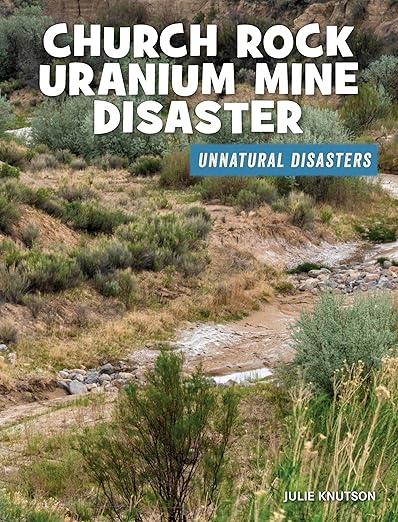
RED WATER POND ROAD, New Mexico—As Tony Hood walked along New Mexico Highway 566 last Saturday, he thought about where he was 45 years earlier, when an earthen dam broke at the site of a uranium mill operated by the United Nuclear Corp., releasing 94 million gallons of radioactive water and 1,100 tons of uranium waste across portions of New Mexico, Arizona and the Navajo Nation.
Hood was working inside a nearby underground mine owned by the Kerr-McGee Corp. when the dam broke on July 16, 1979. He didn’t learn about the spill until after returning to the surface.
As he walked in this month’s event commemorating the spill, he pointed to the spot where the dam was located.
“I guess they observed there was some cracks in the earthen dam but they didn’t do nothing about it,” he said. “Finally, the dam collapsed, breached.”
The dam failure at the processing mill north of Church Rock, New Mexico, released radioactive liquid that eventually flowed into the Rio Puerco and through areas on the Navajo Nation, nearby Gallup, New Mexico, and, finally, Arizona. Now known as the Church Rock spill, the accident released the most radioactive material in U.S. history—more than the notorious partial meltdown at the Three Mile Island Nuclear Generating Station four months earlier—yet remains largely unknown to the American public.
The nonprofit Red Water Pond Road Community Association tries to remedy that lack of awareness by organizing the annual walk by the site of the spill, during which current and former area residents, supporters and advocates remember what happened that day. They also talk about the aftermath, including what federal and tribal agencies have done and need to do to clean up the communities affected by the accident.
……………………………………………………………………………………………………….. A report in May 2014 by the U.S. Government Accountability Office found that “Navajo people continue to live with the environmental and health effects from mining operations: more than 500 abandoned mines are located across the reservation, some close to homes and communities, and an unknown number of homes and drinking water sources contain radioactive elements.”
Educational materials distributed by the Red Water Pond Road Community Association mention some health studies that residents participated in. One is the Navajo Birth Cohort Study, which since 2010 has been looking at the relationship between uranium exposures, birth outcomes and child development on the Navajo Nation. Among the findings is that mothers were deficient in key nutrients for babies’ developing nervous systems. The association notes that a comprehensive study still needs to be done about the effects of uranium on Navajo health.
Ed Miliband will press ahead with a new generation of mini nuclear power plants, with plans to unveil reactor designs by September. The energy secretary has told MPs that he will give his “absolute support” to plans to build a fleet of “small modular reactors” around Britain as part of his clean energy drive.
Looser planning rules are expected to allow these reactors almost anywhere outside built-up areas, ……………………………………………………….
He is now turning his attention to nuclear power, with a final decision on Sizewell C due, alongside efforts to finish the Hinkley Point C plant. Miliband has also committed to continuing the previous government’s drive to make Britain a world leader in small modular reactors.
A decision on which designs to take forward is due by the end of the summer. Miliband told MPs this week: “We will strive to keep to the timetable set out.” Describing nuclear power as “very important for the future”, he said: “This government were very clear in our manifesto about the role that nuclear power — both large-scale nuclear and SMRs — can play.”
A final decision is also due this year on liberalising planning rules for modular reactors. Currently nuclear power plants can be built only on eight named sites but the previous government wanted developers to be able to identify their own location based on a new list of safety and environmental criteria.
Miliband is seen as unlikely to opt for tougher rules, after repeatedly stressing to MPs this week that local concerns over development would not be allowed to veto projects seen as vital to energy security and economic growth. Under the draft rules, only “population density” and “proximity to military activities” will rule out nuclear plants, meaning they cannot be built in areas with more than 5,000 people per square kilometres, covering most towns and cities. This is designed to “minimise the risk to the public” in the event of a radioactive spill.
All other criteria would be discretionary, including size, flood risk, proximity to civil airports, the natural beauty, ecological importance or cultural heritage of the site.
The International Court of Justice ruled today: the State of Israel has the obligation to make reparation for the damage caused to all the natural or legal persons concerned in the Occupied Palestinian Territory;
the State of Israel’s continued presence in the Occupied Palestinian Territory is unlawful;
the State of Israel is under an obligation to bring to an end its unlawful presence in the Occupied Palestinian Territory as rapidly as possible;
the State of Israel is under an obligation to cease immediately all new settlement activities, and to evacuate all settlers from the Occupied Palestinian Territory;
all States are under an obligation not to recognize as legal the situation arising from the unlawful presence of the State of Israel in the Occupied Palestinian Territory and not to render aid or assistance in maintaining the situation created by the continued presence of the State of Israel in the Occupied Palestinian Territory;
international organizations, including the United Nations, are under an obligation not to recognize as legal the situation arising from the unlawful presence of the State of Israel in the Occupied Palestinian Territory; and
the United Nations, and especially the General Assembly, which requested the opinion, and the Security Council, should consider the precise modalities and further action required to bring to an end as rapidly as possible the unlawful presence of the State of Israel in the Occupied Palestinian Territory.
This is a major organizing challenge to people around the world; to get as many countries as possible to back as strong action as possible against Israel’s crimes.
Some resources are in my piece, above. Another key is action should be in NYC in front of the UN and various missions to the UN.
Well we are now awash with new shiny MPs pushing the “clean” “green” nuclear myth and falling over themselves to write fizzingly enthusiastic letters “urging” the new Labour government to “deliver” new unlicensed untested nuclear crapola which the public would be paying for before during and well after any electricity production. Meanwhile Sellafield is bursting at the seams with nuclear wastes which keep on coming – nuclear wastes whose only “solution” is to “decommission” ie disperse, dump, incinerate and forget, make room for more.
How have we come to this – it has taken a lot of effort on the part of the industry and pro nuclear governments from Thatcher to Blair and now Starmer and a lot of forgetting on the part of mainstream environmental NGOs who were the ‘green’ conscience of the people and started out with fierce unequivocal opposition to nuclear but somehow got inveigled into demanding “climate jobs’ with no anti-nuclear caveats giving the now “climate friendly” nuclear industry exactly what it wants.
I wonder how the following adverts [on original] which were in local press over June will be viewed by humanity in future years, or by aliens?
Westinghouse the front end of the industry with its “clean” “climate friendly” uranium fuel and Sellafield, the arse end of the industry with its sponsorship of the “Pride of Cumbria Awards” the Shame of Cumbria is palpable with every radioactive particle that washes back from Sellafied’s radioactive sewers with the tide.
Full Page adverts over consecutive weeks in local press
Anyway more in hope than in expectation of Advertising Standards actually doing its job and making a ruling against breathtaking greenwashing by the most dangerous industry, here is a complaint – also sent to the Westmorland Gazette and Westinghouse on July 8th (no reply from either).
I would like to make a complaint about the advert run in the Westmorland Gazette (and Whitehaven News?) for Westinghouse.
The advert was produced on the same page (on consecutive weeks) with an advert for Sellafield “Proud to be sponsoring the Pride of Cumbria Awards 2024″”.The Westinghouse advert claims that its products: Nuclear Fuel, AP1000 reactors and assisting Sellafield in decommissioning, are “clean” and “carbon free.”
This can be easily refuted as falsehood.
The nuclear fuel produced by Westinghouse at the Springfields site has been burned in nuclear reactors across the UK (and abroad) since the mid-1940s.
Clifton Marsh Landfill
Some of the many waste streams from the manufacture of nuclear fuel are dispersed to the River Ribble and Clifton Marsh Landfill although in January 2022 “the Clifton Marsh low level waste landfill site, operated by Suez, stopped accepting consignments of radioactive waste for disposal. As most of the solid radioactive waste from Springfields is disposed at Clifton Marsh, this has significantly affected routine waste management operations on site. Together with ONR we have discussed and reviewed SFL’s contingency plans to manage waste in the short term, which includes temporary accumulation of radioactive waste on site, improvements to waste characterisation and alternative disposal options. It was anticipated that Clifton Marsh would become available for disposals during the second half of 2022, although this has not yet occurred,” Environment Agency report . Decommissioning Plans Include Incineration of Radioactive Wastes Three Miles from Preston by “Clean” Westinghouse are proposing an incineration plant on their Springfields site just 3 miles from Preston for ” a large, refractory lined oven designed to treat a wide range of low and intermediate-level radioactive materials.” The feed into the incinerator would include European radioactive wastes of up to 3 tonnes a day. Countries such as Germany have now rejected new nuclear on health, safety, climate and financial grounds but still have wastes to dispose of would be keen to use Westinghouse’s new incineration plant.https://www.world-nuclear-news.org/Articles/New-UK-waste-treatment-facility-planned#:~:text=Plans% 20to%20jointly%20develop%20a,for%20the%20European%20nuclear%20market.
River Ribble
“The Ribble estuary near Preston receives radioactive substances from liquid effluent, discharged directly from the nearby Springfields Fuels Ltd site, and also transported down the coast from the Sellafield Ltd site via the Irish Sea. Estuaries are complex environments, influenced by both the marine tidal processes and the freshwater input from rivers. Some of the radioactive substances eventually become deposited in sediment in the estuary and on the nearby salt marsh.” …”The amount of shielding provided by boat hulls varied from almost none in a small pleasure boat, to 50 percent in a medium sized houseboat. Thick, dense clothing materials like rubber boots reduced the dose received from beta radiation by around 80 percent, wax jacket by 20 to 40 percent, while thin, less dense materials like woollen jumpers did not provide any protection” Environment Agencyhttps://assets.publishing.service.gov.uk/media/5a7c323240f0b674ed20f75e/scho0211btkg-e-e.pdf
The uranium fuel rod wastes from Westinghouse end up at Sellafield in Cumbria. The carbon footprint for looking after Westinghouse’s burnt uranium fuel rods last year was, according to Sellafield, 600,000 tonnes of CO2. This is far higher than all the emissions generated by all vehicles using the M6 through Cumbria every year according to Cumbria Action for Sustainability’s figures (CaFS give nuclear a free ride excluding figures despite their gargantuan C02 footprint)
AP1000 reactors – Bankruptcy, Crime and Failed Reactor Coolant Pumps
The advert states “Our AP1000 plant is setting operational records in its global fleet and is ready for deployment in the UK.” Yes it is setting operational records in being the most expensive, and fault ridden reactor to date causing Westinghouse to go into bankruptcy. “By 2016 Westinghouse began to grasp the scope of its dilemma, according to a document filed in its bankruptcy: Finishing the two projects would require Westinghouse to spend billions of dollars on labor, abandoning them would mean billions in penalties. Westinghouse determined it could not afford either option.” It chose Chapter 11 Bankruptcy. https://www.reuters.com/article/world/how-two-cutting-edge-us-nuclear-projects-bankrupted-westingho use-idUSKBN17Y0C7/ Alongside this were charges of Westinghouse executive with dozens of crimes including ” felony counts including conspiracy, wire fraud, securities fraud, and causing a publicly-traded company to keep a false record.”https://thebulletin.org/2021/08/us-attorney-details-illegal-acts-at-construction-projects-sealing-t he-fate-of-the-nuclear-renaissance/
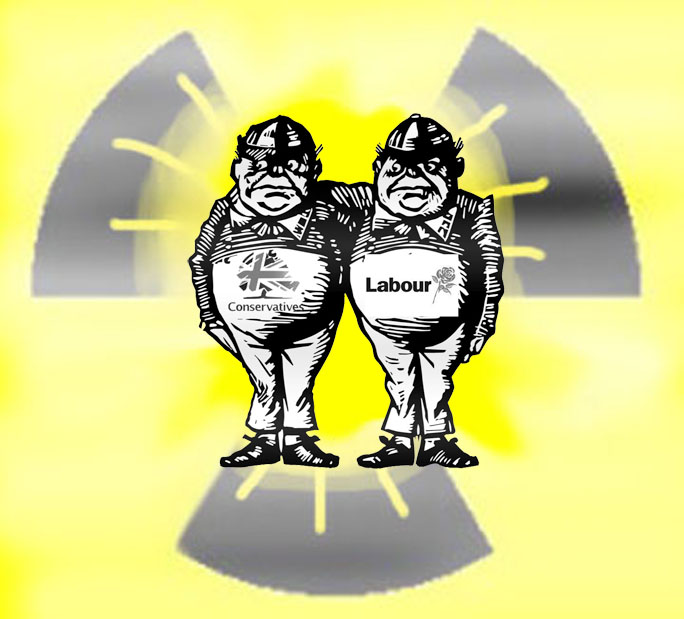
The UK/Ireland Nuclear Free Local Authorities could not help but notice that the first speech made by King Charles III at the State Opening of Parliament (17 July) was nuclear free as His Majesty was spared having to utter the word.
By tradition, the Sovereign reads the speech, written for him by Whitehall officials and signed off by Ministers, to a combined gathering of Lords and MPs. This sets out the legislative programme for the coming Parliament. Clearly with the return of a new Labour Government, elected with a huge majority, Ministers are keen to get on and exercise their mandate and the speech was brimming with forty proposals for new legislation[i].
On energy there was an emphasis on meeting the urgent
On energy there was an emphasis on meeting the urgent challenge of climate change whilst reducing customers’ bills through a ‘clean energy transition’, but His Majestry was notably not called upon to extole nuclear energy as a means to do so so; instead the speech referenced the need to ‘accelerate investment in renewable energy, such as offshore wind’ by creating a new vehicle Great Britain Energy which will be publicly owned and headquartered in Scotland. Nuclear was thankfully nowhere to be seen, seemingly stll on its summer holidays[ii].
Interestingly, the Background Briefing Notes issued to accompany the publication of the speech by Number 10 also makes no reference to nuclear.[iii]
Also interestingly, Ed Miliband shortly after his arrival at the Department for Energy Security and Net Zero issued a statement as Secretary of State to his staff – this too makes zero reference to nuclear as a component in the fight to achieve Net Zero.[iv]
Nuclear then appears late for the party, as per usual, or may even have been excluded from the invite list.
For it is notable that whilst Labour’s energy manifesto makes much of getting new nuclear projects at Hinkley and Sizewell ‘over the line’, extending the lifetime of existing plants, and backing new nuclear including Small Modular Reactors by the end of the government’s first term in 2030, mention of any of this has been noticably absent in the government’s recent pronouncements
The NFLAs hope that Ministers on being appraised of the huge costs and massive challenges of delivering a new nuclear programme has quietly opted to go for the common sense approach of choosing cheaper, practicable and achieveable renewables to deliver truly green energy, energy security, lower bills and Net Zero. Fingers crossed.
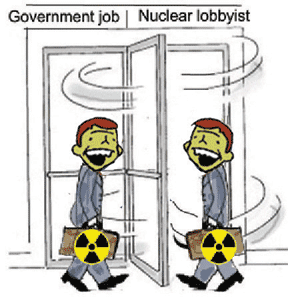
Over 80 civil society organizations from across Canada are speaking out and calling on Prime Minister Justin Trudeau and Governor General Mary Simon to rescind their recent appointment of Mr. Pierre Tremblay, a long time senior nuclear industry executive, as President of the Canadian Nuclear Safety Commission (CNSC).
In a joint letter citing conflict of interest and failure to adhere to International Atomic Energy Agency (IAEA) guidelines, the groups -a range of organizations that include in their ranks scientists and retired nuclear officials- also call on the Federal Government for an urgent reform of the CNSC and nuclear governance in Canada.
Mr. Tremblay has been a long-time senior business executive at Ontario Power Generation (Canada’s largest nuclear operator and contractor of nuclear businesses), reported co-owner of a private nuclear business involved in the Plutonium trade, and most recently president of AECOM Canada Nuclear Services -a key contractor for two questionable projects expected to report billions of dollars to the nuclear businesses involved, and impact populations for centuries: a nuclear waste dump (“Near Surface Disposal Facility”) by the Ottawa river and a project to abandon high-level nuclear waste underground in Northern Ontario, both of them expecting CNSC licenses.
The groups also call on the Federal Government to take the opportunity to initiate a long-needed reform of the CNSC, which has often been described by observers as an “industry-captured regulator”.
The request notes that the CNSC has a communications branch with 60-plus staff but no dedicated human health and environmental protection branch, and has not turned down a single nuclear industry application in more than a decade. It has also actively lobbied to weaken impact assessment legislation to exclude a range of nuclear reactors and processing facilities.
Mr. Tremblay’s appointment follows other appointments to the Commission of industry insiders, and two troubling assessments of the CNSC’s performance by the International Atomic Energy Agency (IAEA) -a June 2024 follow-up to an initial 2019 IAEA mission highlighted several problem areas; despite the CNSC’s positive spin on the IAEA missions, the findings are a cause of deep concern for independent observers and experts.
Given the CNSC’s often-stated priority and legal mandate to protect the environment and the health of Canadians, the groups are requesting the Federal Government consider recruiting CNSC senior ranks from within the health and environmental protection communities, including perhaps Environment and Climate Change Canada and the federal Health Portfolio.
The signatory organizations note that the appointment contravenes both IAEA guidelines and the Federal Government’s own guidance on the independence of regulatory bodies, and compromises the public’s expectation of neutrality, objectivity and independence of Canada’s nuclear regulatory body and reinforces the public perception of industry capture of that body. Rescinding the appointment would be a significant step towards a much-needed reform of the CNSC and towards restoring public trust in that critically important agency.
Quotes:The Canadian Nuclear Safety Commission is supposed to be a neutral body, carefully safeguarding the health of the Canadian public and the environment from the risks associated with the use of nuclear energy. Senior executives from the nuclear industry should be disqualified from positions at the CNSC.” – Dr. Ole Hendrickson.
“Having a nuclear business executive whose companies have pushed for questionable projects placed in charge of the very agency that would now regulate and approve them, is an obvious conflict of interest” – J. P. Unger, science writer and policy analyst. “The Government should abandon any pretense of having a watchdog and true regulator for nuclear matters -or carry out its urgently needed reform.”
Racism in Israel is not a flaw in the system; it is the system.
Unlike the framing commonly put forth by politicians and mainstream media, it is not “complicated.” It is not “an age-old religious feud.” And, it is not “a conflict by extremists on both sides.”
While the Biden administration continues its insincere rhetorical support for the two-state solution, the U.S. has remained Israel’s staunchest supporter, always using its veto power to shield it from accountability and prevent Palestinian statehood despite Israel’s repeated violations of international law and UN Security Council resolutions.
Seventy-Five Percent of All UN Member States Recognize the State of Palestine
In an advisory opinion, the International Court of Justice reaffirmed the Palestinian right to self-determination.
In a landmark opinion issued today, the International Court of Justice (ICJ) has said that Israel’s 57-year occupation of the West Bank, East Jerusalem and the Gaza Strip is in breach of international law.The proceedings came out of a UN resolution passed in December of 2022. In the resolution, the UN General Assembly requested an advisory opinion from the International Court of Justice on “Israeli practices affecting the human rights of the Palestinian people in the Occupied Palestinian Territory, including East Jerusalem.”
The ICJ, also known as the World Court, is the UN’s principal judicial organ that adjudicates disputes between member states and provides advisory opinions on international legal matters.
This case is separate from the one brought forth by South Africa last year, in which the ICJ provisionally ruled that Israeli practices in Gaza are plausibly genocidal. Following that ruling, Israel indicated that it rejects the ICJ’s findings.
In a post on X, Prime Minister Benjamin Netanyahu wrote, “Nobody will stop us – not The Hague, not the axis of evil and not anybody else.”
Public hearings on Israel’s occupation of Palestine were held at The Hague on February 19 and lasted for six days, during which 52 countries participated and presented arguments. The panel of 15 judges on the court was asked by the UN General Assembly to consider “the legal consequences arising from the ongoing violation by Israel of the right of the Palestinian people to self-determination, from its prolonged occupation, settlement and annexation of the Palestinian territory occupied since 1967.”
The hearings commenced with remarks by Palestinian Foreign Minister Riyad al-Maliki, in which he asserted the rights of Palestinians to live “in freedom and dignity in their ancestral land.” He asked the ICJ to recognize the Palestinian people’s right to self-determination and called on the court to “declare Israel occupation is illegal and must end it completely and unconditionally.”
Israel did not participate in the oral arguments, but the Office of the Prime Minister issued a statement saying, “Israel does not recognize the legitimacy of the discussion at the International Court of Justice in The Hague regarding the ‘legality of the occupation’ — a move designed to harm Israel’s right to defend itself against existential threats.”
Israel’s Occupation Is Sustained by a Combination of State-Sponsored Violence and Apartheid
Israel was born of British colonialism; it was created through a mixture of state violence and vigilante terrorist acts that displaced Palestinians and dispossessed them from their homes and land; it is supported — financially, militarily and diplomatically — by Western, primarily U.S., imperialism-serving war profiteers; and it is sustained by a combination of state-sanctioned violence and a system of apartheid that denies Palestinians — who form half the people in the land under Israeli control from the river to the sea — their equal rights.
After the Nakba of 1948, the State of Israel was established on 78 percent of the land of what had been British Mandate Palestine. During the June 1967 war, Israel took over the West Bank, Gaza and Arab East Jerusalem, the remaining 22 percent of historic Palestine, now known as “the Occupied Territories.” In 1980, Israel unilaterally formalized its annexation of East Jerusalem — a move that was condemned as illegal by the international community.
Over the past 57 years, successive Israeli governments have brutally terrorized Palestinians, demolished homes, confiscated large tracts of Palestinian lands, expanded Israeli settlements in the West Bank — considered illegal under international law — and added many new ones that effectively rendered the “two-state solution” impossible. Now West Bank settlers number more than 700,000; they are heavily armed and are constantly terrorizing Palestinian residents in neighboring villages in an effort to force them to leave, as described in a report by Amnesty International.
According to the Palestinian Health Ministry, since October 7,575 Palestinians — of whom 138 are children — were killed in the occupied West Bank and East Jerusalem by soldiers and armed settlers.
Israel employs oppression, violence, persecution, checkpoints, house demolitions, displacement, expulsion, imprisonment, land theft, torture of children and collective punishment to ethnically cleanse non-Jewish inhabitants.
Israel has learned that, the more routine its war crimes become, the less coverage they receive – and the less outrage they provoke.
Last week, western doctors who had volunteered in Gaza said Israel was packing its weapons with shrapnel to maximise injuries to those caught in the blast radius. Children, because of their smaller bodies, were being left with much more severe wounds.
In recent days, Israel has struck several United Nations schools serving as shelters, killing dozens more Palestinians. On Tuesday, another strike in the “safe zone” of al-Mawasi killed 17.
According to the UN refugee agency, Unrwa, more than 70 percent of its schools – almost all of them serving as refugee shelters – have been bombed.
Women and children are being targeted intentionally, say Israeli whistleblowers. From ground troops to commanders, the rules of war have been shredded
hey just keep coming. On the weekend, Israel launched another devastating air strike on Gaza, killing at least 90 Palestinians and wounding hundreds more, including women, children and rescue workers.
Once again, Israel targeted refugees displaced by its earlier bombs, turning an area it had formally declared a “safe zone” into a killing field.
And once more, western powers shrugged their shoulders. They were too busy accusing Russia of war crimes to have time to worry about the far worse war crimes being inflicted on Gaza by their Israeli ally – with weapons they supplied.
The atrocity committed at al-Mawasi camp, packed with 80,000 civilians, had the usual Israeli cover story – one rolled out to reassure western publics that their leaders are not the utter hypocrites they appear to be for supporting what the World Court has described as a “plausible genocide”.
Israel said it was trying to hit two Hamas leaders – one of them Mohammed Deif, head of the group’s military wing – although Israeli Prime Minister Benjamin Netanyahu seemed uncertain as to whether the strike was successful.
No one in the western media appeared to wonder why the pair preferred to make themselves a target in an overcrowded, makeshift refugee camp, where they were at huge risk of being betrayed by an Israeli informant, rather than sheltering in Hamas’s extensive tunnel network.
Or why Israel deemed it necessary to fire a multitude of massive bombs and missiles to take out two individuals. Is that Israel’s new, expansive redefinition of a “targeted assassination”?
Or why its pilots and drone operators continued the strikes to hit emergency rescue crews dealing with the initial destruction. Was there intelligence that Deif was not just hiding in the camp, but had hung around to dig out survivors, too?
Or how killing and maiming hundreds of civilians in an attempt to hit two Hamas fighters could ever possibly satisfy the most basic principles of international law. “Proportion” and “distinction” require armies to weigh the military advantage of an attack against the expected toll on civilian life.
Biblical vengeance
But Israel has torn up the rulebook on war. According to sources within the Israeli military, it now considers it acceptable to kill more than 100 Palestinian civilians in the pursuit of a single Hamas commander – a commander, let us note, who will simply be replaced the moment he is dead.
Even if the two Hamas leaders were assassinated, Israel could not have been in any doubt that it was perpetrating a war crime. But it has learned that, the more routine its war crimes become, the less coverage they receive – and the less outrage they provoke.
In recent days, Israel has struck several United Nations schools serving as shelters, killing dozens more Palestinians. On Tuesday, another strike in the “safe zone” of al-Mawasi killed 17.
According to the UN refugee agency, Unrwa, more than 70 percent of its schools – almost all of them serving as refugee shelters – have been bombed.
Last week, western doctors who had volunteered in Gaza said Israel was packing its weapons with shrapnel to maximise injuries to those caught in the blast radius. Children, because of their smaller bodies, were being left with much more severe wounds.
Aid agencies cannot properly treat the wounded, because Israel has been blocking the entry of medical supplies into Gaza.
Committing war crimes, if western publics have not worked it out by now, is the very point of the “military operation” Israel launched in Gaza in the wake of Hamas’s one-day attack on 7 October.
That is why there are more than 38,800 known deaths from Israel’s 10-month assault – and likely at least four times that number unrecorded, according to leading researchers writing in the Lancet medical journal this month.
That is why it will take at least 15 years to clear the rubble strewn across Gaza by Israeli bombs, according to the UN, and as much as 80 years – and $50bn – to rebuild homes for the remnants of the enclave’s 2.3 million people still alive at the end.
Israel’s twin goals have been biblical vengeance and the elimination of Gaza – a genocidal rampage to drive the terrified population out, ideally into neighbouring Egypt.
Shoot-everyone policy
If that was not clear enough already, six Israeli soldiers recently stepped forward to speak out about what they had witnessed while serving in Gaza – a story the western media has entirely failed to report.
Their testimonies, published by the Israel-based publication 972 last week, confirm what Palestinians have been saying for months.
Commanders have authorised them to open fire on Palestinians at will. Anyone entering an area the Israeli military is treating as a “no-go zone” is shot on sight, whether man, woman or child.
After months of an Israeli aid blockade that has created a man-made famine, Israel’s military has turned the people of Gaza’s ever-more frantic search for food into a game of Russian roulette.
This perhaps explains, in part, why so many Palestinians are unaccounted for – Save the Children estimates some 21,000 children are missing. The soldiers quoted in 972 say the victims of their shoot-everyone policy are bulldozed out of view along routes where international aid convoys pass.
A reserve soldier, identified only as S, said a Caterpillar bulldozer “clears the area of corpses, buries them under the rubble, and flips [them] aside so that the convoys don’t see it – [so that] images of people in advanced stages of decay don’t come out”. The soldier also noted: “The whole area [of Gaza where the army operates] was full of bodies… There is a horrific smell of death.”
Only 4 of 32 NATO Members do NOT Sell Weapons to Israel or Buy Weapons from Israel
Israel has been the largest cumulative recipient of U.S. foreign aid since its founding in 1948, having received about $310 BILLION dollars in economic and military assistance. Since October 7, 2023, the U.S. has passed legislation that has provided at least $12.5 billion in military aid to Israel, which included $3.8 billion from legislation in March 2024 and $8.7 billion from a supplemental appropriation in April 2024.
Biden says U.S. should not have “Killing Fields,” while he is complicit in the Israeli “Killing Fields” in Gaza.
As Israel continued its relentless genocide on steroids of Palestinians in Gaza with over 140 killed in the past weekend, imprisonment without charges of thousands of Palestinians in the West Bank and destruction of the hospitals, universities, schools (8 UNRWA schools bombed in the past 10 days), cultural centers and indiscriminate bombing of markets, soccer fields and “safe area” residents of Gaza have been forced into, an assassination attempt was made on former President Trump and NATO finished its gala 75th Anniversary celebrations in Washington, DC.
Biden Says “U.S. Politics Should Never Be A Killing Field,” While He is complicit in the Israeli “Killing Fields” in Gaza
As the genocide continued and a few days after the end of the NATO celebrations, an assassination attempt on former President Trump caused President Biden to address the nation and orate that “political violence has no place in America and U.S. politics should never be a killing field.”
The statement of no political violence and no killing fields in America rings totally hollow as the Biden administration and NATO countries fuel the Israeli killing fields in Gaza with over 90 Palestinians killed and 300 wounded by multiple Israeli rocket attacks in Khan Yunis on Saturday, July 12, and 80 Palestinians killed in the past 24 hours of July 13 in several refugee camps.
NATO members fuel the Genocide of Gaza by Selling/Sending Weapons to Israel
Heads of 32 NATO member states and 10 NATO “global partners”, Australia, New Zealand, Japan, South Korea, Colombia, Mongolia, Iraq, Afghanistan and Pakistan, met in Washington, DC at the 75th Anniversary events of NATO.
Some of the NATO members and partners are the same countries that are aiding and abetting the Israeli genocide of Gaza.
An Office for the State of Israel Located in the NATO Headquarters
NATO has a long, close and relatively unknown relationship with Israel that, eight years ago, resulted in establishment of an Israeli office in NATO headquarters in Brussels in 2016. Underscoring the importance to Israeli association with NATO, Prime Minister Netanyahu said upon the opening of the office, “This is an important step that helps Israel’s security. It is further proof to the status of Israel and the willingness of many organizations to cooperate with us in the field of security.”
The invitation from NATO for Israel to have an office in NATO headquarters was a result of pressure by other NATO members on Turkey to drop its veto of the invitation. The invitation arose through a new NATO partnership policy beginning in 2014 but Turkey vetoed the invitation until 2016.
Behind the scenes negotiations between Turkey and Israel in 2015 warmed the chilly relationship that had been essentially severed between the countries in 2010 over Israeli commandos killing 10 Turkish activists and wounding over 50 participants on the Mavi Marmara, a Turkish ship bound for Gaza as a part of the 7-ship Gaza Freedom Flotilla.
According to NATO documents, NATO and Israel have worked together for almost 30 years, cooperating in science and technology, counter terrorism, civil preparedness, countering weapons of mass destruction and women, peace and security. To strengthen NATO naval interoperability NATO brought on Israel as a partner for NATO’s Operation Sea Guardian. Israel’s military medical academy now serves as a “unique asset” for NATO’s Partnership Training and Education Centers community.
Israel is not officially integrated in NATO but is part of the Mediterranean Dialogue, a program sponsored by NATO in cooperation with seven countries of the Mediterranean.
Only 4 of 32 NATO Members do NOT Sell Weapons to Israel or Buy Weapons from Israel
NATO’s long-standing working relationship with Israel has translated into NATO countries selling weapons to Israel and other countries buying weapons from Israel’s big weapons industry.
With the exception of Canada, the Netherlands, Spain and Belgium, the remainder of the 32 NATO members continue to sell/send weapons to Israel as Israel conducts genocide operations on Palestinians in Gaza. Due to a court case, Denmark may suspend export of F-35 fighter jet parts to the U.S., because the U.S. sells the jets to Israel.
The Action on Armed Violence has a comprehensive worldwide listing of weapons sales and transfers to Israel.
The US is the mammoth supplier to Israel, providing an estimated 68% of Israel’s foreign-sourced weapons.
Israel has been the largest cumulative recipient of U.S. foreign aid since its founding in 1948, having received about $310 BILLION dollars in economic and military assistance. Since October 7, 2023, the U.S. has passed legislation that has provided at least $12.5 billion in military aid to Israel, which included $3.8 billion from legislation in March 2024 and $8.7 billion from a supplemental appropriation in April 2024.
Since October 7, only two of the more than one hundred military aid transfers to Israel have reportedly met the congressional review threshold of $250 million to be made public, and since the records for the other weapons transfers have not been made public, we can’t be sure . Additionally, the Israeli military received expedited deliveries of weapons from a strategic stockpile of weapons that is normally used to replenishment weapons for U.S. units in the Middle East. The U.S. has maintained massive warehouses for the stockpile of huge variety and amount of weapons since the 1980s…………………. https://www.laprogressive.com/foreign-policy/relentless-genocide—
The Chinese Foreign Ministry said Wednesday that Beijing had stopped arms control talks with the US over continued US arms sales to Taiwan and other steps that go against China’s “core interests.”
The US and China held consultations on arms control back in November 2023. A reporter asked Chinese Foreign Ministry spokesman Lin Jian about comments from US officials suggesting China declined to hold another round.
“Over the past weeks and months, despite China’s firm opposition and repeated protest, the US has continued to sell arms to Taiwan and done things that severely undermine China’s core interests and the mutual trust between China and the US. This has seriously compromised the political atmosphere for continuing the arms control consultations,” Lin said.
French state power giant EDF lost a bid to build at least two new nuclear reactors in the Czech Republic on Wednesday, a major blow to Europe’s only nuclear power plant builder at a critical time for the company. The project, won instead by Korea’s KHNP, would have been the first contract for EDF since Hinkley Point in Great Britain in 2016, and a vote of confidence after being dogged by delays and soaring costs on projects at home and abroad.
2 In April 2024, the Nuclear Industry Association applied for ‘justification’ on behalf of NewCleo and its lead-cooled LFR-AS-200 fast reactor to the Department for Environment, Food and Rural Affairs (DEFRA). The department will support the future Secretary of State in their role as the authority responsible for the ‘justification’ decision.
This was the first application for ‘justification’ for a so-called advanced modular design in the UK. In its media release, NewCleo oozed confidence its reactor design will meet with approval:
‘Justification’ is a regulatory process which requires a Government decision before any new class or type of practice involving ionising radiation can be introduced in the UK. A justification decision is one of the required steps for the operation of a new nuclear technology in the UK, but it is not a permit or licence that allows a specific project to go ahead.
Instead, it is a generic decision based on a high-level evaluation of the potential benefits and detriments of the proposed new nuclear practice as a pre-cursor to future regulatory processes.
The design failed the government’s readiness test to be entered into the Generic Design Assessment (GDA). Even if justification is forthcoming, with the design not selected for the GDA, it would surely have to undergo an equally rigorous, but more uncertain, process.
Furthermore, the reactor operates using MOX (mixed uranium and plutonium reprocessed fuel). Although, the press has previously reported NewCleo’s plan ‘to take advantage of the UK’s massive stockpile of waste at Sellafield, where it wanted to invest £2bn in a waste reprocessing factory and advanced modular reactors that would have created around 500 jobs’, the government’s recently published Civil Nuclear Roadmap makes clear that this material will not be forthcoming: ‘We are providing clarity to vendors by committing not to support the use of plutonium stored at Sellafield by Advanced Nuclear Technologies whilst high hazard reduction activities are prioritised at Sellafield’.
The other puzzle is X-Energy, which was given £3.4m by government, but seemingly, like NewCleo, has been turned down for consideration for a GDA. X-Energy have previously announced plans to deploy its reactor design at a site in Hartlepool.
In response to the news, NFLA Scotland Advisor Pete Roche and Emeritus Professor of Energy Policy at the University of Greenwich Stephen Thomas put together a question set exploring and challenging the justification and Generic Design processes. This was sent by the NFLAs to Nuclear Minister Andrew Bowie. On receiving the Minister’s response, a second letter with supplementary questions was drafted and sent, and this has just been replied to by a senior Department of Energy Security and Net Zero (DESNZ) official. The correspondence is reproduced in this briefing for your information.
IN this time of post election soul-searching, I would like to present your readers with two simple but vital facts. First, there are two roads by which heavy-duty vehicles can cross the border between England and Scotland, and two only. Secondly, to stop vehicles is a routine matter for Police Scotland
The MoD frequently sends convoys carrying Trident warheads from Aldermaston in Berkshire to Coulport in Scotland. They have to do this regularly to make sure that when they are fired, they will actually work and kill thousands of innocent people (this is called “integrity verification”, I kid you not). Indiscriminate slaughter is the one and only thing they are designed to do.
But the Treaty for the Prohibition of Nuclear Weapons (TPNW) entered into force in January 2021 at the United Nations and is supported by 122 states. Thus, the highest court in the world has specifically condemned nuclear weapons as illegal. This ruling is “jus cogens” or compulsory law; that is, a peremptory norm from which there is no derogation (like FGM, piracy, genocide, or enslavement), as opposed to customary law, where parties make mutual agreement.
A Trident warhead is a hydrogen bomb. and by the TPNW, undeniably illegal. To stop these convoys at the border and refuse to allow them to continue their criminal enterprise requires nothing more than normal police procedures; in fact, those guilty could also be arrested and charged with criminal conspiracy. This is enforcement of the law.
Humanity has at last “banned the bomb”, and we must act accordingly.
The appreciation of the logic of this is axiomatic for both the demand for independence and the praxis of self-governance. As long as we cravenly accept this criminal imposition on our land, we do not have independence because we do not deserve it.
As long as we continue with our present craven acceptance of our abject role playing Tonto to the British Lone Ranger in his lunatic nuclear fantasies, we can forget about independence. Marches and demonstrations have their place in this campaign but total commitment demands much more. This demands action.
This direct action is something we can and should do, now. The nuclear convoys should be peacefully and non-violently stopped. This would be an effective technique to obtain independence, and an unambiguous expression of being a normal legal state.
Standards don’t protect them and studies dismiss them
By Linda Pentz Gunter
In a peer reviewed article published in the British Medical Journal Pediatrics Open in October, my Beyond Nuclear colleague, Cindy Folkers and I, reviewed the studies currently available that look at the impact on children from radiation exposures caused by the nuclear power sector.
In particular, we looked at the disproportionately negative impact on children living in disadvantaged communities, primarily those of color. As we wrote in the article:
“From uranium mining and milling, to fuel manufacture, electricity generation and radioactive waste management, children in frontline and Indigenous communities can be disproportionately harmed due to often increased sensitivity of developing systems to toxic exposures, the lack of resources and racial and class discrimination.”
At about the same time, and as if to confirm our hypothesis, the story of the Jana elementary school in Missouri began to break.
The school is in a predominantly Black community in northern St. Louis and the US army corps of engineers had been called in to assess radioactivity found in classrooms, playgrounds and on sports fields at the school after findings of unacceptable levels of radioactivity on the premises were revealed in an independent report conducted by Dr. Marco Kaltofen, President of Boston Chemical Data Corporation.
The radioactive contamination found at the school was, as the report described it, “consistent with the radioactive legacy uranium processing wastes notoriously found in the heavily contaminated Coldwater Creek in North St. Louis County, MO, and in low-lying areas subject to flooding from the creek.”
The report concluded that “radiological contamination exists at unacceptable levels (greater than 5.0 net pCi/g as alpha radiation) at the Jana School property.”
Those wastes, dating back from the 1940s to 1960s, were produced by a company called Mallinckrodt, which processed uranium from the Belgian Congo as part of the Manhattan Project. The radioactive waste they produced was illegally dumped in what was then surrounding countryside and at the West Lake Landfill. It seeped into creeks and spread into parks and even homes.
A story we ran on Beyond Nuclear International in March 2018 relates the struggle of residents to get their community cleaned up. Atomic Homefront, a compelling documentary about this fight, brings home exactly the toll this environmental crime has taken on people living there, especially women.
Radioactive lead-210, thorium and radium-226 were among the isotopes found at Jana Elementary school, at levels far higher than those considered permissible (but not safe) at Superfund sites. The lead-210 was at levels 22 times what would be considered “expected” in such an environment.
Why had it taken so long to discover this immense and unacceptable risk to children?
Jana’s PTA president, Ashley Bernaugh, believes she knows the answer.
“Jana elementary’s radioactive past looks like a lot of other communities where hazardous waste has been allowed to exist in predominantly minority communities and in lower middle income communities, where it never would have been allowed in upper income level communities because of the public outrage,” she told The Guardian.
By November 9 the corps had declared that radiation levels at the school “showed no levels of radiation higher than ‘the level of radioactivity Mother Nature already provides.’”
“Mother Nature” is a euphemistic reference to “background radiation,” already problematic given the decades of atomic testing and major nuclear accidents that have added to what “background” radiation levels once were but are no longer. Of far greater concern is that these levels, while likely not even safe for adults, are certainly not safe for children.
This determination of what is “safe” is based on a standard that is not only outdated but was wrong from the start. Here is what we wrote about this in our BMJ article.
“Pregnancy, children and women are underprotected by current regulatory standards that are based on ‘allowable’ or ‘permissible’ doses for a ‘Reference Man’. Early in the nuclear weapons era, a ‘permissible dose’ was more aptly recognized as an ‘acceptable injury limit,’ but that language has since been sanitized.”
Reference Man is defined as a nuclear industry worker 20–30 years of age, who weighs around 154 pounds, is 67 inches tall and is a Caucasian Western European or North American in habitat and custom.
“Very early research conducted in the USA in 1945 and 1946 indicated higher susceptibility of pregnancy to radiation exposure. Pregnant dogs injected with radiostrontium had defects in their offspring and yet, complete results of these studies were not made public until 1969,” we wrote.
“By 1960 however, U.S. experts were clearly aware that research indicated higher susceptibility of children, when the Federal Radiation Council (established in 1959 by President Eisenhower) briefly considered a definition for ‘Standard Child’—which they subsequently abandoned in favor of maintaining a Standard Man definition, later renamed Reference Man.”
Reference Man still stands, although our organization, in partnership with the Gender + Radiation Impact Project, are working to get it changed to Reference Girl. (If you are interested in learning more about this, you can join our online classes.)
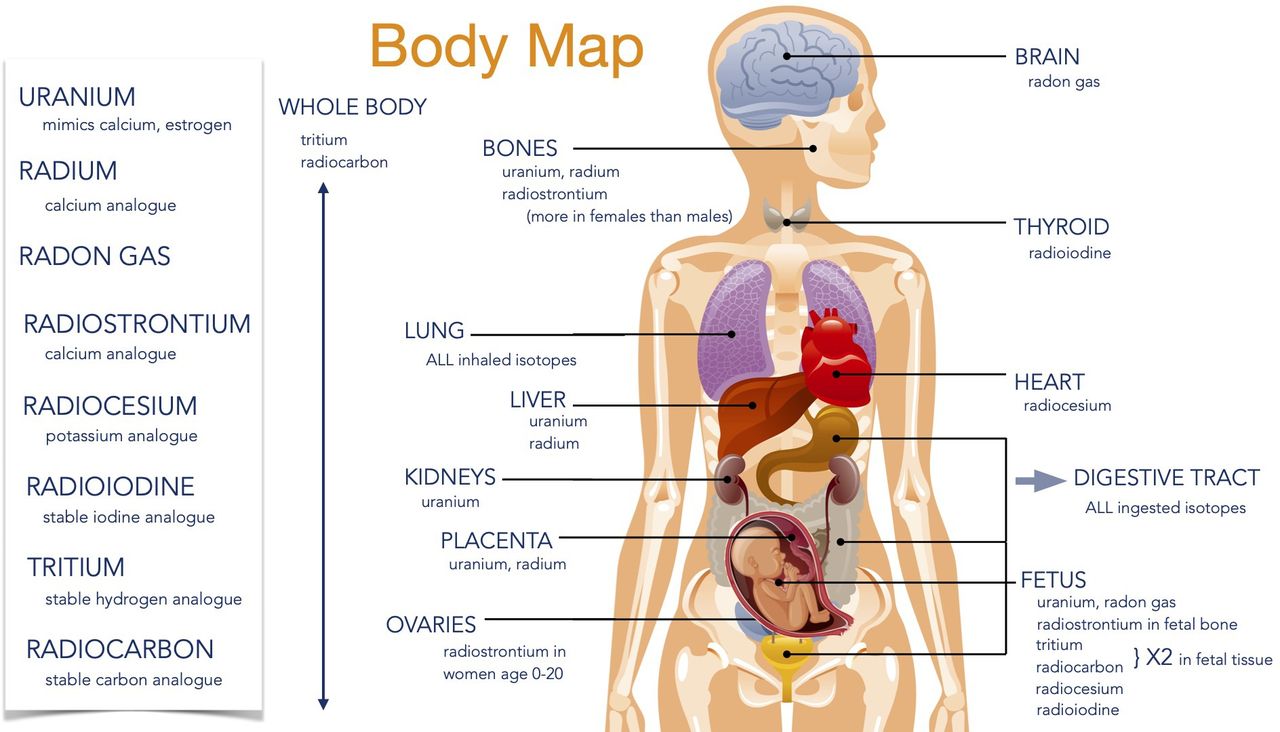
Why are children, and especially female children, as well as women and especially pregnant women, more susceptible to harm from radiation exposure? This is not fully understood and regulatory practices, particularly in the establishment of protective exposure standards, have failed to take this difference into account.
An examination of Navajo babies born between 1964 and 1981 showed that congenital anomalies, developmental disorders and other adverse birth outcomes were associated with the mother living near uranium mines and wastes.
Other studies — among Aboriginal communities in Australia and members of Indigenous tribes in India —showed similar outcomes. But so-called anecdotal evidence is invariably dismissed in favor of “statistical insignificance”.
Even perhaps the most famous study, in Germany, of children living near nuclear plants showing elevated rates of leukemia directly correlated to the proximity of their homes to the nuclear sites, was dismissed with claims that the doses were simply too low to have such an impact.
As we concluded in our BMJ article, which is fully accessible and can be read in its entirety here, “more independent studies are needed focused on children, especially those in vulnerable frontline and Indigenous communities. In conducting such studies, greater consideration must be applied to culturally significant traditions and habits in these communities.”
Linda Pentz Gunter is the international specialist at Beyond Nuclear and writes for and curates Beyond Nuclear International.
Tokyo Electric Power Co. announced that it has completed the third round of treated radioactive water discharge from the stricken Fukushima No. 1 nuclear power plant in this fiscal year. About 7,800 tons of filtered water were released from storage tanks into the Pacific Ocean after being diluted by a large volume of seawater, the company said on July 16. This was the seventh batch of treated water dumped into the sea since TEPCO began the discharge program in August last year. The utility plans four more rounds of discharge before the current fiscal year ends in March.