Putin warns the US of Cold War-style missile crisis
Reuters By Guy Faulconbridge and Dmitry Antonov, July 28, 2024
- Summary
- Russia warns United States over missiles in Germany
- Putin says Russia will deploy if plans are implemented
- Putin: United States risks Cold War-style crisis
- U.S. plans to deploy longer range missiles in Germany
MOSCOW, July 28 (Reuters) – Russian President Vladimir Putin on Sunday warned the United States that if Washington deployed long-range missiles in Germany then Russia would station similar missiles in striking distance of the West.
The United States said on July 10 that it would start deploying long-range missiles, opens new tab in Germany from 2026 in preparation for a longer-term deployment that will include SM-6, Tomahawk cruise missiles and developmental hypersonic weapons.
n a speech to sailors from Russia, China, Algeria and India to mark Russian navy day in the former imperial capital of St Petersburg, Putin warned the United States that it risked triggering a Cold War-style missile crisis with the move.
“The flight time to targets on our territory of such missiles, which in the future may be equipped with nuclear warheads, will be about 10 minutes,” Putin said.
“We will take mirror measures to deploy, taking into account the actions of the United States, its satellites in Europe and in other regions of the world.”………………………………………. Https://www.reuters.com/world/putin-warns-united-states-cold-war-style-missile-crisis-2024-07-28/
Controversy in France about future energy policy
Electricite de France SA Chief Executive Officer Luc Remont urged French
policymakers to review subsidies for solar power, saying the measures add
too much generation to the grid and undermine the nuclear giant’s
finances as electricity demand remains subdued.
The comments will fuel controversy among nuclear and renewable opponents as EDF seeks financial backing from the government for the construction of six new atomic plants,
which may cost €67.4 billion.
However, the lack of a clear parliamentary
majority that emerged from legislative elections raises questions about
France’s future energy policy, including support for nuclear projects in
the near term.
FFinancial Post 26th July 2024
https://financialpost.com/pmn/business-pmn/edf-chief-says-french-solar-power-subsidies-need-scrutiny
‘Atomic bomb hell must never be repeated’ say Japan’s last survivors

Atomic People will be broadcast on Wednesday 31 July on BBC Two and BBC iPlaye
Lucy Wallis, BBC News https://www.bbc.com/news/articles/crg5lyd25jno 26 July 24
It was early in the day, but already hot. As she wiped sweat from her brow, Chieko Kiriake searched for some shade. As she did so, there was a blinding light – it was like nothing the 15-year-old had ever experienced. It was 08:15 on 6 August 1945.
“It felt like the sun had fallen – and I grew dizzy,” she recalls.
The United States had just dropped an atomic bomb on Chieko’s home city of Hiroshima – the first time a nuclear weapon had ever been used in warfare. While Germany had surrendered in Europe, allied forces fighting in World War Two were still at war with Japan.
Chieko was a student, but like many older pupils, had been sent out to work in the factories during the war. She staggered to her school, carrying an injured friend on her back. Many of the students had been badly burnt. She rubbed old oil, found in the home economics classroom, onto their wounds.
“That was the only treatment we could give them. They died one after the next,” says Chieko.
“Us older students who survived were instructed by our teachers to dig a hole in the playground and I cremated [my classmates] with my own hands. I felt so awful for them.”
Chieko is now 94 years old. It is almost 80 years since the atomic bombs were dropped on Hiroshima and Nagasaki and time is running out for the surviving victims – known as hibakusha in Japan – to tell their stories.
Many have lived with health problems, lost loved ones and been discriminated against because of the atomic attack. Now, they are sharing their experiences for a BBC Two film, documenting the past so it can act as a warning for the future
After the sorrow, new life started to return to her city, says Chieko.
“People said the grass wouldn’t grow for 75 years,” she says, “but by the spring of the next year, the sparrows returned.”
In her lifetime, Chieko says she has been close to death many times but has come to believe she has been kept alive by the power of something great.
The majority of hibakusha alive today were children at the time of the bombings. As the hibakusha – which translates literally as “bomb-affected-people” – have grown older, global conflicts have intensified. To them, the risk of a nuclear escalation feels more real than ever.
“My body trembles and tears overflow,” says 86-year-old Michiko Kodama when she thinks about conflicts around the world today – such as the Russian invasion of Ukraine and the Israel-Gaza war.
“We must not allow the hell of the atomic bombing to be recreated. I feel a sense of crisis.”
Michiko is a vocal campaigner for nuclear disarmament and says she speaks out so the voices of those who have died can be heard – and the testimonies passed on to the next generations.
“I think it is important to hear first-hand accounts of hibakusha who experienced the direct bombing,” she says.
Michiko had been at school – aged seven – when the bomb was dropped on Hiroshima.
“Through the windows of my classroom, there was an intense light speeding towards us. It was yellow, orange, silver.”
She describes how the windows shattered and splintered across the classroom – the debris spraying everywhere “impaling the walls, desk, chairs”.
“The ceiling came crashing down. So I hid my body under the desk.”
After the blast, Michiko looked around the devastated room. In every direction she could see hands and legs trapped.
“I crawled from the classroom to the corridor and my friends were saying, ‘Help me’.”
When her father came to collect her, he carried her home on his back.
Black rain, “like mud”, fell from the sky, says Michiko. It was a mixture of radioactive material and residue from the explosion.
She has never been able to forget the journey home.
“It was a scene from hell,” says Michiko. “The people who were escaping towards us, most of their clothes had completely burned away and their flesh was melting.”
She recalls seeing one girl – all alone – about the same age as her. She was badly burnt.
“But her eyes were wide open,” says Michiko. “That girl’s eyes, they pierce me still. I can’t forget her. Even though 78 years have passed, she is seared into my mind and soul.”
Michiko wouldn’t be alive today if her family had remained in their old home. It was only 350m (0.21 miles) from the spot where the bomb exploded. About 20 days before, her family had moved house, just a few kilometres away – but that saved her life.
Estimates put the number of lost lives in Hiroshima, by the end of 1945, at about 140,000.
In Nagasaki, which was bombed by the US three days later, at least 74,000 were killed.
Sueichi Kido lived just 2km (1.24 miles) from the epicentre of the Nagasaki blast. Aged five at the time, he suffered burns to part of his face. His mother, who received more serious injuries, had protected him from the full impact of the blast.
“We hibakusha have never given up on our mission of preventing the creation of any more hibakusha,” says Sueichi, who is now 83 and recently travelled to New York to give a speech at the United Nations to warn of the dangers of nuclear weapons.
When he woke up after fainting from the impact of the blast, the first thing he remembers seeing was a red oil can. For years he thought it was that oil can that had caused the explosion and surrounding devastation.
His parents didn’t correct him, choosing to shield him from the fact it had been a nuclear attack – but whenever he mentioned it, they would cry.
Not all injuries were instantly visible. In the weeks and months after the blast, many people in both cities began to show symptoms of radiation poisoning – and there were increased levels of leukaemia and cancer.
For years, survivors have faced discrimination in society, particularly when it came to finding a partner.
“‘We do not want hibakusha blood to enter our family line,’ I was told,” says Michiko.
But later, she did marry and had two children.
She lost her mother, father and brothers to cancer. Her daughter died from the disease in 2011.
“I feel lonely, angry and scared, and I wonder if it may be my turn next,” she says.
Another bomb survivor, Kiyomi Iguro, was 19 when the bomb struck Nagasaki. She describes marrying into a distant relative’s family and having a miscarriage – which her mother-in-law attributed to the atomic bomb.
“‘Your future is scary.’ That’s what she told me.”
Kiyomi says she was instructed not to tell her neighbours that she had experienced the atomic bomb.
Since being interviewed for the documentary, Kiyomi has sadly died.
But, until she was 98, she would visit the Peace Park in Nagasaki and ring the bell at 11:02 – the time the bomb hit the city – to wish for peace.
Sueichi went on to teach Japanese history at university. Knowing he was a hibakusha cast a shadow on his identity, he says. But then he realised he was not a normal human being and felt a duty to speak out to save humankind.
“A sense that I was a special person was born in me,” says Sueichi.
It is something the hibakusha all feel that they share – an enduring determination to ensure the past never becomes the present.
Atomic People will be broadcast on Wednesday 31 July on BBC Two and BBC iPlaye
Young Changemakers Advocate for Nuclear-Free Future through Educational Journey in Kazakhstan

The Astana Times – bringing Kazakhstan to the world, By Assel Satubaldina , 29 July 2024
ASTANA—A group of 20 young changemakers from Kazakhstan and Germany recently embarked on a week-long educational journey through Kazakhstan to explore the country’s nuclear past, meet policymakers, and talk to affected communities.
The tour took the group to the ministerial halls in Astana, activists in Almaty, researchers, and the nuclear-affected communities in Semei, which was once the site for the Soviet-run nuclear test site. This educational tour, organized by the Friedrich Ebert Foundation in Kazakhstan, ICAN Germany, and Kazakhstan’s STOP (Steppe Organization for Peace) youth initiative, aimed to foster a deeper understanding of nuclear non-proliferation and amplify the voices of affected communities.
Kazakhstan’s Semipalatinsk nuclear test site was a venue for the Soviet Union to test nuclear weapons. Official data indicates that 456 nuclear tests between 1949 and 1989, including 340 underground and 116 atmospheric tests, were conducted at the test site, with an area of 18,300 square kilometers.
Around 1.5 million people have been affected by radiation exposure over the years, including health consequences such as an increase in cancer rates, birth defects, and other radiation-related illnesses among the local population. The long-term effects are still present for generations.
Meeting with government officials in Astana
Astana was the first stop on the trip. The group visited the Kazakh Ministry of Foreign Affairs. There, Arman Baissuanov, the head of the ministry’s international security department, briefed them on the country’s nuclear history and its leading role in global non-proliferation efforts. He also discussed Kazakhstan’s role in the Central Asian Nuclear Weapon Free Zone and the Treaty on the Prohibition of Nuclear Weapons (TPNW).
Among other officials, the group met with Roman Podoprigora, a judge of the Constitutional Court of Kazakhstan, who spoke about recommended changes to the 1992 law on those affected by the nuclear tests, and Nurlan Auesbaev, a member of the Parliament.
Yerdaulet Rakhmatulla, co-organizer of the study tour, described it as a positive sign that civil society representatives could visit the ministry and productively discuss the nuclear politics and more. According to him, it is quite a rare occasion.
“I think just this step from their side was a great sign of progress in our bilateral relationships as state, as government and civil society,” he said in a comment for this story.
Officially titled the law on social protection of citizens who suffered from nuclear tests at the Semipalatinsk nuclear test site, the document envisioned measures to address the severe health and social impacts. However, experts say the law has many shortcomings, including a limited scope of financial compensation, which is insufficient to cover the long-term health needs of the affected population. The law’s criteria to identify affected individuals have also been seen as too narrow.
Сonfronting the human impact of nuclear testing
Understanding Kazakhstan’s tragic nuclear past would not be complete without visiting the region where thousands of people witnessed the tests firsthand and have borne the consequences for many years since. In Semei, the young people met with people still grappling with the legacy of the Soviet-era tests, listening to their stories that, for some reason, often remain unheard.
Maira Abenova, a survivor of the Soviet nuclear tests in Semei and founder of the Polygon 21, an institution that advocates for the rights of Semipalatinsk nuclear test survivors, helped the group to meet those affected in Semei and Astana.
During the meeting in Semei, many of the survivors reported on their health problems, such as cancer and heart disease, according to a press report from ICAN Germany. They said they hope their voices will be heard internationally. Their voices “do not yet reach as far as those of Hiroshima and Nagasaki,” say the survivors.
For Rakhmatulla, these meetings were “extremely special………………………………………………………………………………………………..
Lessons learned
Janina Ruther, a participant of the tour and project manager at ICAN Germany, spoke to The Astana Times, sharing her impressions and key takeaways from the educational tour.
Because of her experience with ICAN, she got to know more about Kazakhstan and the country’s history with nuclear weapons.
Ruther said what made the trip so special was the variety of places they visited and the diverse range of people they spoke to in different contexts.
“That was so special, and it made it a once-in-a-lifetime experience,” she added. “I think I don’t have words for that because we talked to so many people who were actually surviving all these tests. It was so brave that they talked to us because I cannot imagine how hard it must be.”
She also shared meeting young people at the universities and experiencing the night train journey was unforgettable.
She described the tour using a quote from one of the meetings: “The more we educate young people, the greater the hope for a world without nuclear weapons.”
She stressed that the primary goal was to reach young people who could spread the message and educate others. Equally important was understanding the needs and desires of the people affected by nuclear testing in Kazakhstan and bringing their voices to an international level. https://astanatimes.com/2024/07/young-changemakers-advocate-for-nuclear-free-future-through-educational-journey-in-kazakhstan/
Hungary to allow nuclear plant to exceed Danube water temperature limit

By Reuters, July 27, 202 https://www.reuters.com/business/energy/hungary-allow-nuclear-plant-exceed-danube-water-temperature-limit-2024-07-27/
BUDAPEST, July 27 (Reuters) – Hungary is planning to allow the temperature limit for a section of the Danube which receives cooling water from the Paks nuclear power plant to be exceeded for security of supply reasons, the energy ministry said in a statement on Friday.
The plant’s four reactors operate by using the water of the Danube to cool its operations. Currently, according to the regulation, the river cannot receive water if its temperature exceeds 30 degree Celsius, in which case the operator must cut output and wait for the river to cool below the limit.
“In addition to environmental considerations, it may therefore be justified to exceed the limit value on a case-by-case basis if this is unavoidable for security of supply.”
The Paks plant has four Russian-built VVER 440 reactors with a combined capacity of about 2,000 megawatts. The reactors became operational between 1982 and 1987 and are scheduled to be retired in 2032-2037.
Hungary plans to expand the plant, with Russia’s Rosatom building two VVER reactors with a capacity of 1.2 gigawatts each, in addition to the currently working four reactors.
Hungary is planning to allow the temperature limit for a section of the
Danube which receives cooling water from the Paks nuclear power plant to be
exceeded for security of supply reasons, the energy ministry said in a
statement on Friday. The plant’s four reactors operate by using the water
of the Danube to cool its operations. Currently, according to the
regulation, the river cannot receive water if its temperature exceeds 30
degree Celsius, in which case the operator must cut output and wait for the
river to cool below the limit.
Reuters 27th July 2024
Scottish Greens warn that “Great Britain Energy” could funnel public money into subsidising non-viable nuclear power projects

Patrick Harvie warns of major devolution tests for GB Energy
By Nan Spowart , 28th July
LABOUR’S new flagship energy company will be an important test of the relationship between the new regime in Westminster and the devolved governments, according to Scottish Greens co-leader Patrick Harvie.
……………………….. He is now calling for more detail of the remit of GB Energy after it was revealed that the organisation could get involved in planning disputes…………………
“The real worry I have is that it ends up simply as a way of channelling
public money into subsidising otherwise non-viable nuclear developments
like small modular reactors which is a technology that the industry was
pushing very aggressively a few years ago but is failing at a commercial
level in a number of other countries. “We should not be going down that
route and the principal means Scotland has been saying no to new nuclear
has been through the planning system, so we need clarity early doors that
that is not their agenda.”
The National 28th July 2024
https://www.thenational.scot/news/24480590.patrick-harvie-warns-major-devolution-tests-gb-energy/
A $36.8 billion lesson from Georgia- “The most expensive electricity in the world”

In May, the plaintiffs along with four other prominent Georgia consumer groups released a report, Plant Vogtle: The True Cost of Nuclear Power in the United States. The analysis detailed how the U.S. Department of Energy, Georgia Power, and the Georgia Public Service Commission (PSC), conspired to force Georgians into purchasing the most expensive electricity in the world, costing ratepayers $10,784 per kilowatt, compared to $900 to $1,500 per kilowatt (KW) for wind or solar. Recent Georgia Power electricity bills have shown the bill increase to be in the 30-40% range.
Again and again, the Georgia Public Service Commission (PSC) was warned about the astronomical cost of the Vogtle reactors and the financial toll it will bear on Georgians for decades to come.
Ratepayers beware. New nuclear power plants will gouge customers
From Georgia Conservation Voters Education Fund and Georgia WAND
Georgia consumer groups have filed a major lawsuit against the State of Georgia [AF1] in federal court, alleging Georgia lawmakers violated the state’s constitution by unilaterally postponing Georgia Public Service Commission (PSC) elections. According to the lawsuit, the PSC election’s unlawful postponement allowed the sitting commission members to rubberstamp the largest utility rate increases in Georgia history and grant utility companies the authority to charge Georgians for cost-overruns and mishaps. The groups argue that the charges may not have been passed onto consumers if elections were held as regularly scheduled.
House Bill 1312, which Georgia legislators passed in April, delays the election of new PSC members until at least 2025, giving multiple sitting PSC members an extra two years in office. Georgia’s constitution requires that PSC terms shall be six years, and therefore cannot be lengthened without a constitutional amendment. All PSC members have had their office terms extended to eight years, and one nine years as a result.
…………………………………….Brionté McCorkle, plaintiff and executive director of Georgia Conservation Voters Education Fund, said: “Georgians are fighting every month to stay ahead of rising costs for food, housing, and now energy. These aren’t optional costs. They’re things we need to survive. Public Service Commissioners like Tricia Pridemore, Fitz Johnson, and Tim Echols have allowed Georgia Power to take money out of the pockets of hard-working Georgians – and it has to end.”
In May, the plaintiffs along with four other prominent Georgia consumer groups released a report, Plant Vogtle: The True Cost of Nuclear Power in the United States. The analysis detailed how the U.S. Department of Energy, Georgia Power, and the Georgia Public Service Commission (PSC), conspired to force Georgians into purchasing the most expensive electricity in the world, costing ratepayers $10,784 per kilowatt, compared to $900 to $1,500 per kilowatt (KW) for wind or solar. Recent Georgia Power electricity bills have shown the bill increase to be in the 30-40% range.
Additional Key findings in the May Vogtle report included:
- Plant Vogtle allowed Georgia Power to expand its rate base, the assets on which they earn a guaranteed rate of return, by over $11 billion. Yet their share of Vogtle is 1,020 megawatts, making it the most expensive electricity in the world at $10,784/KW. Normal (wind, solar, natural gas) generation prices range from $900 to $1500/KW.
- Vogtle Units 3 & 4 took 15 years to build and cost $36.8 billion, well over twice the projected timeline and cost.
- Vogtle independent construction monitors documented that Georgia Power provided materially false cost estimates for at least ten years, falsehoods used to justify expanding Plant Vogtle. Similar false cost estimates sent South Carolina utility executives to jail for that state’s failed nuclear plant, which started construction at the same time as Plant Vogtle.
Patty Durand, consumer advocate, founder of Cool Planet Solutions and a recent candidate for the Georgia PSC, said:
“Again and again, the Georgia Public Service Commission (PSC) was warned about the astronomical cost of the Vogtle reactors and the financial toll it will bear on Georgians for decades to come. Commissioners repeatedly declined to protect ratepayers from cost overruns and ignored PSC staff recommendations to cancel the project. People went to prison for actions like this in South Carolina, yet we have had no accountability for the same, and worse, behavior here. Instead, the state legislature decided to shield current commissioners from facing voters by delaying PSC elections indefinitely. This is clearly unconstitutional. This is un-American.” https://beyondnuclearinternational.org/2024/07/28/a-36-8-billion-lesson-from-georgia/
French nuclear giant ORANO slips into the red following Niger-French breakup

French nuclear giant Orano ended the first half of the year with a loss of €133 million, weighed down by difficulties in its mining activities in Niger due to a “highly degraded” political context since a military regime came to power a year ago.
Radio Free Europe: 29/07/2024 –
At the end of June 2024, the group noted “the deteriorated situation affecting mining operations in Niger,” Orano’s chief financial officer, David Claverie, said in a statement.
The coup d’état in Niger on 26 July last year led to a halt in imports of critical materials necessary for uranium exploitation in Orano’s Somaïr mine, such as soda ash, carbonate, nitrates and sulphur.
And although uranium extraction continued in the first quarter of 2024 “after several months of early maintenance,” Somaïr’s sales were unable to resume “due to a lack of logistics solutions approved by the Niger authorities”.
The blockage led the mine into “financial difficulty … weighing on its ability to continue its operations”, the statement read.
In late June, Niger decided to withdraw the licence of Imouraren SA, a company jointly operated by Orano, Niger Mining and Korea Electric Power, and which ran the Somaïr mine.
The situation could eventually lead to “insolvency in the short to medium term, in the coming months”, Claverie said……………………………… https://www.rfi.fr/en/international/20240729-french-nuclear-giant-slips-into-the-red-following-niger-french-breakup
Severe heatwave in Iran forces shops and public institutions to close

A heatwave blanketing Iran has forced authorities to cut operating hours at
various facilities on Saturday and order all government and commercial
institutions to close on Sunday, as hospitals received more than 200 people
for heatstroke treatment. Temperatures ranged from 37C (98.6F) to 42C
(107F) in the capital, Tehran, according to weather reports. The state-run
Islamic Republic News Agency (IRNA) said banks, offices and public
institutions across the country would close on Sunday to protect people’s
health and conserve energy and that only emergency services and medical
agencies would be excluded.
Guardian 27th July 2024
War Criminal Benjamin Netanyahu Addresses the US Congress

Lies proliferate and Congress cheers genocide in Gaza
The Unz Review, Philip Giraldi • July 26, 2024
To my surprise, last Thursday morning there was relatively little coverage of the address to the US Congress delivered by Israeli Prime Minister Benjamin Netanyahu last Wednesday afternoon apart from a critical opinion piece that appeared in the New York Times regarding Israel’s war on the Palestinians. The article, by Megan K. Stack, asserted:
“History will cast Mr. Netanyahu’s visit in deservedly ugly tones. He’s not a guest we should aspire to host, but he is a visitor we deserve. Gaza is our war, too, thanks to the indispensable military aid and political cover the US government has lavished on Israel as the death toll climbs… What exploded as a war of retribution against Hamas has looked increasingly like a broader campaign of annihilation — the slaughter of trapped civilians; the excruciating deaths of thousands of children; the destruction of hospitals, schools and much of the civilian infrastructure.”
Polls have shown for months that more Americans disapprove than approve of the Israeli onslaught in Gaza, but Congress and the White House are not interested in the views of the public when they are on the receiving end of hundreds of millions of dollars in “donations” from Jewish billionaires.
Much of the coverage of the Netanyahu appearance in the mainstream media was toothless and even adulatory. It generally reflected what was hailed as Bibi’s “fiery speech” that “did not give an inch” which vowed to continue fighting until “total victory” is achieved. There was some coverage of how Netanyahu went so far as to portray the many thousands of demonstrators, some of whom were pepper-sprayed and arrested, who surrounded the Capitol as “useful idiots paid for by Iran.” The jibe, together with other calls to go to war with Iran, produced cheers and other paroxysms of joy among the leaping and waving Congressmen. Bibi might have been particularly personally aggrieved by Pro-Palestinian protesters successfully having released insects into the Watergate Hotel where he was staying. Online video showed maggots running amok on the dinner table.
The Netanyahu speech was light on serious analysis, but heavy on emotional appeals, repeatedly invoking the assertion that he and the United States, in its “ironclad” support of Israel, are fighting to save “civilization” and that “our enemies are your enemies” and “our victory will be your victory.” Predictably, the Congressmen and guests who filled the chamber bobbed up and down applauding wildly after nearly every sentence, producing 53 standing ovations, far exceeding Netanyahu’s record 29 obtained the last time he addressed Congress in 2015.
Notably some Congressmen with active consciences skipped the event, including Nancy Pelosi, who, after the fact, denounced the address in a post on X:
“Benjamin Netanyahu’s presentation in the House Chamber today was by far the worst presentation of any foreign dignitary invited and honored with the privilege of addressing the Congress of the United States. Many of us who love Israel spent time today listening to Israeli citizens whose families have suffered in the wake of the October 7th Hamas terror attack and kidnappings. These families are asking for a ceasefire deal that will bring the hostages home – and we hope the Prime Minister would spend his time achieving that goal.”
nore https://www.sott.net/article/493515-War-criminal-Benjamin-Netanyahu-addresses-the-US-Congress
A substantial number of progressive and moderate Democrats, possibly as many as 136, also did not attend, suggesting that Netanyahu is not well regarded by many in the Democratic Party. Netanyahu spoke for an hour and the over-the-top reception he received from congress suggested that:
the government’s true loyalty is not to the voters who elected them but rather to a foreign leader who is a war-criminal, implying to some that Bibi is actually de facto the American president and Israel and the US are in practical terms one country, with Israel as the dominant partner in the arrangement.……………………………………………………………………
My particular gripe was over the fact that Netanyahu’s speech was full of uncontested lies and grossly exaggerated assumptions designed to get his audience roaring. The falsehoods were certainly recognizable as such by much of the audience, but Netanyahu was not challenged by anyone save only Representative Rashida Tlaib, a Democrat of Michigan and the sole Palestinian-American member of Congress, who attended the speech while holding up a sign while many of her colleagues applauded Netanyahu’s comments………………………………………………………………….more https://www.sott.net/article/493515-War-criminal-Benjamin-Netanyahu-addresses-the-US-Congress
Two legal actions against the hasty commissioning of Flamanville nuclear reactor

Flamanville EPR, still at the heart of scandals, is heading towards a hasty start,
Sortir du Nucleaire, CRIIRAD, CRILAN, Global Chance, Robin des Bois, and the “Exit from Nuclear Power” Network,23 July 24
On May 7, 2024, we denounced the decision to commission the Flamanville EPR. Today, we are raising the alarm through two legal actions about this hasty commissioning while questions remain unanswered. We are filing an appeal with the Council of State against this commissioning decision, and a complaint against X in order to shed full light on the irregularities noted by the Nuclear Safety Authority on parts of the EPR.
We are filing an appeal against the hasty commissioning of the EPR to the detriment of safety requirements
On 7 May 2024, the Nuclear Safety Authority (ASN) gave its approval for the Flamanville EPR to be commissioned, i.e. for it to receive its first fuel load. A decision taken above all to avoid the legal consequences of yet another postponement. Indeed, the commissioning of the Flamanville EPR has already been postponed by decree twice in the past , in 2017 and 2020 , because the facility was not ready to start up.
One might have thought that these two postponements would provide EDF with a comfortable margin to ensure that its installation could start up safely in 2024. However,
despite the additional time granted to the operator, it has not managed to commission the Flamanville EPR within the allotted time:
The nuclear reactor should have been commissioned before April 10, 2024, according to the creation authorization decree. It finally took place almost a month later, on May 7, 2024. Problem: the commissioning deadlines exist to protect the population and the environment from a project that has become too old. It was
the ASN itself that indicated in an opinion that these deadlines aim to
“avoid the commissioning of an installation whose environment would no longer be compatible with its operation and/or not to allow the creation authorization to continue for an installation whose operator would not be able to complete construction” .
The deadline for examining the commissioning application, which can last one or two years if the file is complex, was also not respected. …………………………………………
We are filing a complaint to shed light on the irregularities noted on certain parts of the EPR
This decision to put it into service is even more surprising in light of the revelations of the ASN, which, during its 2024 press wishes, revealed new problems of counterfeiting, falsification and suspicion of fraud (CFS) . [ 1 ]
These cases, according to the ASN, are distinguished by the significant scope of materials potentially affected, as well as by the potentially significant consequences for the safety of the reactors . The Nuclear Safety Authority has therefore reported these facts to the courts and has since refused to give us further information under cover of the confidentiality of the investigation [ 2 ] .
It was an
article from Reporterre that allowed us to obtain more information on this affair and learned that these cases concerned, among others, two companies producing materials intended for the EPR reactor in Flamanville. The article states that
“it was during the examination of the EPR commissioning authorization [that the ASN] allegedly noted irregularities in certificates of conformity, particularly for valves, pipes, etc.”
At this point, with the elements we have, we can ask ourselves:
- Have components that do not comply with essential safety requirements been placed on the market?
- Were false documents drawn up and used to cover up these defects?
- Did EDF properly monitor its suppliers to prevent the installation of non-compliant parts on its EPR?
We demand answers to these questions………………………………………………………………….more https://www.sortirdunucleaire.org/L-EPR-de-Flamanville-toujours-au-coeur-de
EDF looks towards future projects after flagging tough second half
French energy giant EDF aims to meet its schedule for future nuclear
reactor projects, its CEO said on Friday, with final tests ahead of the
start-up of its newest French reactor imminent after years of delays. The
group earlier reported a jump in first-half profit on higher electricity
production, but said regional market prices had fallen and warned core
earnings in the second half would decline year-on-year.
In Britain, EDF is continuing talks with the newly elected Labour government over its Hinkley
Point C and Sizewell C nuclear projects, Remont told reporters, adding it
is “a bit early” to give a date for a final investment decision on
Sizewell.
Reuters 26th July 2024
Sizewell A Nuclear Site: Direction to Nuclear Decommissioning Authority
The Secretary of State for Energy Security and Net Zero (Ed Miliband), 26 July 24 https://hansard.parliament.uk/commons/2024-07-26/debates/24072618000010/SizewellANuclearSiteDirectionToNuclearDecommissioningAuthority
I am today laying a new designation direction to the Nuclear Decommissioning Authority in respect of the Sizewell A nuclear site, which amends the existing direction. The direction has been given in accordance with sections 3 and 5 of the Energy Act 2004, with the consent of Nuclear Restoration Services Ltd, which controls the site.
This direction will end the Nuclear Decommissioning Authority’s responsibilities under the Energy Act 2004 for specific land and buildings on the Sizewell A nuclear site, so that the land can be sold to EDF and become part of the Sizewell B nuclear site. This will facilitate the development of new nuclear at the Sizewell C nuclear site.
Nuclear energy not the way to go: coalition Taiwan
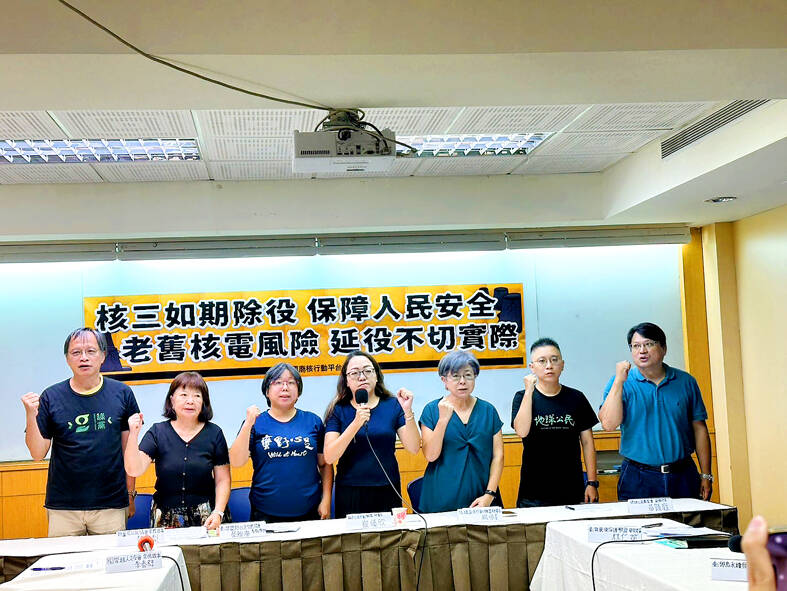
By Yang Yin-ting and Jonathan Chin / Staff reporter, with staff writer, https://www.taipeitimes.com/News/taiwan/archives/2024/07/27/2003821385
Relying on nuclear power is the wrong strategy for Taiwan to achieve net zero emissions, a coalition of environmental groups said yesterday, amid rising calls from some lawmakers and government officials in support of it.
The National Nuclear Abolition Action Platform held a news conference in Taipei yesterday — two weeks before the National Climate Change Response Committee’s inauguration meeting, which is expected to discuss nuclear power.
The Chinese Nationalist Party (KMT) has indicated that it would seek to extend the operations of the nation’s nuclear reactors, including the ones at the Ma-anshan Nuclear Power Plant in Pingtung County, a coalition spokesperson said.
The Ma-ashan plant’s first reactor, which has reached the end of its 40-year service life limit, is to be deactivated today, while its second reactor is scheduled for decommissioning in May next year, it said.
The KMT’s failure to acknowledge the public security risks posed by the nation’s aged reactors or the problem of nuclear waste disposal has exposed the recklessness of the party’s energy policy, it said.
Lawmakers should drop proposed amendments to the Nuclear Reactor Facilities Regulation Act (核子反應器設施管制法) and allow the Ma-anshan plant to be decommissioned as planned, the spokesperson said.
Green Citizens’ Action Alliance secretary-general Tsuei Su-hsin (崔愫欣) said that high operating costs and the lack of suitable sites for waste disposal make the bid to continue generating nuclear power impractical for Taiwan.
Taiwan Environmental Protection Union executive Lin Ren-pin (林仁斌) said that global energy production trends point to a decline in nuclear energy.
China — which has built more new nuclear reactors than any country in the world — reported that renewables experienced faster growth than nuclear energy, he added.
The Ma-anshan plant straddles a geological faultline in the Hengchun Peninsula and has a terrible safety record, Lin said.
The scarcity of land, high population density and propensity to build nuclear power plants on soft rock strata are a recipe for disaster on the scale of the partial meltdown at Japan’s Fukushima Dai-ichi nuclear power plant, he said.
Moms Love Taiwan Association secretary-general Yang Shun-me (楊順美) said that the Jinshan Nuclear Power Plant is practically decommissioned, as the lion’s share of its equipment and transmission towers had already been removed.
The remaining facilities at the power plant has not been maintained for many years, she added.
The Guosheng Nuclear Power Plant has two inoperable reactors, while the Ma-anshan plant cannot resume operations without a full shutdown and replacing critical components, Yan said.
This means none of the nation’s three nuclear power plants stand a chance of contributing to emissions reduction, she said.
Citizen of the Earth Taiwan deputy director Huang Ching-ting (黃靖庭) said opposition lawmakers were making untruthful claims about a purported energy shortage.
Citing Taiwan Power Co’s electricity supply report this month, he said that Taiwan has enough energy to keep the nighttime reserve margin above 10 percent through 2030, which does not indicate a shortage.
Nuclear power plants must obtain safety certifications and replace key components before lengthening their service life, he said, adding that the process is estimated to take five to 10 years.
The Ma-anshan plant is rightly decommissioned since the facility’s reactors generate a marginal amount of electricity compared with the safety risks they represent, he said.
Altogether, there is virtually no chance that Taiwan could get any of its old nuclear power plants back online before 2030, Huang said.
Using nuclear energy to reduce emissions is impractical and impossible to implement in time, he said
The World Court Has Cleared the Fog Hiding Western Support for Israel’s Crimes

The Unz Review, JONATHAN COOK • JULY 24, 2024
The legal ruling by the world’s highest court obliges western states not just to end their persecution of the boycott movement but to take up that cause as their own
Don’t be fooled. The ruling by the International Court of Justice (ICJ) on 19 July that Israel’s occupation of Palestine is unlawful is earth-shattering. Israel is a rogue state, according to the world’s highest court.
For that reason, the judgment will be studiously ignored by the cabal of western states and their medias that for decades have so successfully run cover for Israel.
Doubters need only watch the reception Israeli Prime Minister Benjamin Netanyahu receives during his visit to the United States this week.
Even though he is currently being pursued for war crimes by the chief prosecutor of the International Criminal Court, the US Congress will give him a hero’s welcome when he addresses its representatives on Wednesday.
The warm handshakes and standing ovations will be a reminder that Netanyahu has had the full backing of western powers throughout the nine-month slaughter of at least 16,000 Palestinian children in Gaza – with another 21,000 missing, most of them under rubble.
The welcome will be a reminder that western capitals are fully on board with Israel’s levelling of Gaza and the starvation of its population – in what the same court concluded way back in January amounted to a “plausible genocide”.
And it will serve as a heavy slap in the face to those like the World Court committed to international law – reminding them that the West and its most favoured client state believe they are untouchable.
Western politicians and columnists will keep emphasising that the World Court is offering nothing more than an “advisory opinion” and one that is “non-binding”.
What they won’t point out is that this opinion is the collective view of the world’s most eminent judges on international law, the people best positioned to rule on the occupation’s legality.
And it is non-binding only because the western powers who control our international bodies plan to do nothing to implement a decision that doesn’t suit them.
Nonetheless, the ruling will have dramatic consequences for Israel, and its western patrons, even if those consequences will take months, years or even decades to play out.
‘Top secret’ warning
Last week’s judgment is separate from the case accepted in January by the ICJ that put Israel on trial for genocide in Gaza. A decision on that matter may still be many months away.
This ruling was in response to a request from the United Nations General Assembly in December 2022 for advice on the legality of Israel’s 57-year occupation.
That may sound more mundane a deliberation than the one on genocide, but the implications ultimately are likely to be every bit as profound.
Those not familiar with international law may underestimate the importance of the World Court’s ruling if only because they had already assumed the occupation was illegal.
But that is not how international law works. A belligerent occupation is permitted so long as it satisfies two conditions.
First, it must be strictly military, designed to protect the security of the occupying state and safeguard the rights of the occupied people.
And second, it must be a temporary measure – while negotiations are conducted to restore civilian rule and allow the occupied people self-determination.
Astonishingly, it has taken 57 years for the world’s highest court to deliver a conclusion that should have been staring it – and everyone else – in the face all that time.
The military nature of the occupation was subverted almost from the moment Israel occupied the Palestinian territories in June 1967.
Within months, Israel had chosen to transfer Jewish civilians – mostly extreme religious nationalists – into the occupied Palestinian territories to help colonise them.
Israel knew that this was a gross violation of international law because its own legal adviser warned it of as much in a “top secret” memo unearthed by the Israeli journalist Gershom Gorenberg some two decades ago.
In a declaration enlarging on the ICJ’s reasoning, Court President Nawaf Salam specifically referenced the warnings of Theodor Meron, who was the Israeli foreign ministry’s legal expert at the time.
In September 1967, his memo cautioned that any decision to establish civilian settlements in the occupied Palestinian territories “contravenes explicit provisions of the Fourth Geneva Convention”. Those provisions, he added, were “aimed at preventing colonization”.
Nine days later, the Israeli government rode roughshod over Meron’s memo and assisted a group of young Israelis in setting up the first settlement at Kfar Etzion.
Sham peace-making
Today, hundreds of illegal settlements – many of them home to what amount to armed militias – control more than half of the West Bank and much of East Jerusalem.
Rather than protecting the rights of Palestinians under occupation, as international law demands, the Israeli military assists Jewish settlers in terrorising the Palestinians. The aim is to drive them off their land.
In the words of the Israeli government, the settlements are there to “Judaise” Palestinian territory. In the words of everyone else, they are there to ethnically cleanse the Palestinian population.
Which brings us to Israel’s second violation of the laws of occupation. In transferring hundreds of thousands of settlers into the occupied territories, Israel intentionally blocked any chance of a Palestinian state emerging.
The settlements weren’t makeshift encampments. Some soon developed into small cities, such as Ariel and Maale Adumim, with shopping malls, parks, public pools, synagogues, factories, libraries, schools and colleges.
There was nothing “temporary” about them. They were there to incrementally annex Palestinian territory under cover of an occupation that Washington and its European allies conspired to pretend was temporary.
The whole Oslo process initiated in the early 1990s was a switch-and-bait exercise, or a “Palestinian Versailles”, as the Palestinian scholar Edward Said warned at the time.
Israel was never serious about allowing the Palestinians meaningful statehood – a fact the then-Israeli prime minister, Yitzhak Rabin, admitted shortly before he was killed by a far-right settler in 1995………………………………………………………………………..
Apartheid rule……………………………………………………………………………………….
Acts of aggression……………………………………………………
Complicit in war crimes
But the implications don’t just apply to Israel………………………………………………………
The fog clears
Israel’s supporters will take comfort from the fact that an earlier judgment from the World Court on Israel was roundly ignored by both Israel and its western patrons.
Asked for an advisory opinion, the judges ruled in 2004 that, under cover of security claims, Israel was illegally annexing swaths of territory by building its 800km-long “separation wall” on Palestinian land………………………………………………………………………………………………..
Words have power. They are our route to understanding reality. And the World Court has just cleared away the fog. It has wiped clean the mist on the window.
The West will do its level best once again to shroud Israel’s crimes. But the World Court has done the Palestinians and the rest of mankind a service in unmasking Israel for what it is: a rogue, criminal state. https://www.unz.com/jcook/the-world-court-has-cleared-the-fog-hiding-western-support-for-israels-crimes/
-
Archives
- October 2026 (129)
- September 2026 (339)
- August 2026 (330)
- July 2026 (355)
- June 2026 (287)
- May 2026 (306)
- April 2026 (356)
- March 2026 (251)
- February 2026 (267)
- January 2026 (308)
- December 2025 (358)
- November 2025 (359)
-
Categories
- 1
- 1 NUCLEAR ISSUES
- business and costs
- climate change
- culture and arts
- ENERGY
- environment
- health
- history
- indigenous issues
- Legal
- marketing of nuclear
- media
- opposition to nuclear
- PERSONAL STORIES
- politics
- politics international
- Religion and ethics
- safety
- secrets,lies and civil liberties
- spinbuster
- technology
- Uranium
- wastes
- weapons and war
- Women
- 2 WORLD
- ACTION
- AFRICA
- Atrocities
- AUSTRALIA
- Christina's notes
- Christina's themes
- culture and arts
- Events
- Fuk 2022
- Fuk 2023
- Fukushima 2017
- Fukushima 2018
- fukushima 2019
- Fukushima 2020
- Fukushima 2021
- general
- global warming
- Humour (God we need it)
- Nuclear
- RARE EARTHS
- Reference
- resources – print
- Resources -audiovicual
- Weekly Newsletter
- World
- World Nuclear
- YouTube
-
RSS
Entries RSS
Comments RSS

