UN preparing for nuclear catastrophe ‘worst case scenario’ including use of nukes in Middle East
By ELIANA SILVER, SENIOR FOREIGN NEWS REPORTER, 18 March 2026
The United Nations is preparing for a nuclear catastrophe if the Middle East war escalates further.
World Health Organization officials are monitoring the consequences of joint US-Israeli strikes on Iranian atomic sites and are remaining ‘vigilant’ for nuclear threats in the region.
WHO director Hanan Balkhy said: ‘The worst-case scenario is a nuclear incident, and that’s something that worries us the most.’
‘As much as we prepare, there’s nothing that can prevent the harm that will come … the region’s way – and globally if this eventually happens – and the consequences are going to last for decades,’ she told POLITICO.
It comes as in recent days, Donald Trump‘s AI adviser David Sacks warned that Israel could be on a path to ‘escalate the war by contemplating using a nuclear weapon.’
The UN nuclear watchdog said Wednesday that Iranian authorities had reported projectile impact at the country’s only operational nuclear power plant that caused no damage.
The International Atomic Energy Agency (IAEA) ‘has been informed by Iran that a projectile hit the premises of the Bushehr NPP on Tuesday evening’, the Vienna-based agency posted on social media.
‘No damage to the plant or injuries to staff reported.’
Agency head Rafael Grossi ‘reiterates his call for restraint during the conflict to avoid any risk of a nuclear accident’, the statement said.
The Bushehr plant in southwestern Iran has the Islamic republic’s only operational nuclear power reactor and was first connected to the grid in 2011, according to the IAEA.
Tehran has been under biting US sanctions since 2018, when Washington withdrew from a deal that granted Iran sanctions relief in return for curbs on its nuclear activities designed to prevent it from developing an atomic warhead.
The US and Israel say that destroying whatever remains of Iran’s nuclear program is one of the central aims of the war.
They have long suspected Iran seeks nuclear weapons, while the Islamic Republic says its nuclear program is peaceful.
In June of last year, the US and Israel targeted shadowy nuclear infrastructure in Iran, hitting sites in Fordow, Natanz and Isfahan.
Balkhy explained that although there have not yet been any signs of radioactive contamination in the region, a nuclear incident could cause extreme health problems to those affected………………….
…………………….Donald Trump said those who claim Iran didn’t pose a threat are ‘not smart’ and ‘not savvy,’ adding, ‘We don’t want those people.’
His comments came after America’s top counterterrorism official resigned over the war with Iran.
In an extraordinary and unprecedented move for this administration, National Counterterrorism Center Director Joe Kent announced he was stepping down over his objections to the US launching joint strikes with Israel.
‘It’s a good thing that he’s out because he said that Iran was not a threat. Iran was a threat – every country realized what a threat Iran was,’ the President insisted.
Trump’s AI advisor recently warned that there are ‘risks’ of an ‘escalatory approach’ by Israel.
Speaking on a podcast, David Saks said: ‘Israel could get seriously destroyed.’
‘And then you have to worry about Israel escalating the war by contemplating using a nuclear weapon.’
Sacks urged Trump to find an ‘off-ramp’ and bring the war with Iran to a swift close.
‘This is a good time to declare victory and get out,’ he added. ‘I agree that we should try to find the off-ramp.’
Intelligence gathered in the months after the strikes in June revealed the Islamic Republic desperately reconstructing a program Trump said was obliterated.
The Daily Mail exposed Iranian ‘chillers’ – sophisticated industrial equipment essential for cooling uranium – being frantically moved back into fortified underground positions as early as September 2025…………………https://www.dailymail.co.uk/news/article-15656871/UN-preparing-nuclear-catastrophe-worst-case-scenario-including-use-nukes-Middle-East.html
Iran’s Bushehr Nuclear Power Plant ‘hit in strike’ as radiation update issued

A projectile struck the grounds of the Bushehr Nuclear Power Plant sparking fears of a terrifying nuclear incident, according to the CEO of the Russian company which runs the plant.
Joe Smith, 18 Mar 2026, https://www.mirror.co.uk/news/world-news/breaking-irans-bushehr-nuclear-power-36887601
An Iranian nuclear power plant has been hit, sparking fears of a nightmare radioactive incident.
A projectile struck the grounds of the Bushehr Nuclear Power Plant, both Russia and Iran said. Neither country has confirmed whether there has been a release of nuclear material in the incident on Tuesday evening.
Russia’s state-run Tass news agency quoted Rosatom CEO Alexey Likhachev late Tuesday as claiming “a strike hit the area adjacent to the metrology service building located at the Bushehr Nuclear Power Plant site, in close proximity to the operating power unit.” Russian technicians from Rosatom operate the plant, using Russian-made, low-enriched uranium.
Any strike on a nuclear plant risks radioactive material being released into the environment, a nightmare scenario in any war. Bushehr sits on the Persian Gulf meaning contamination of the waters could spell disaster for millions living in the Gulf States, which rely on desalination plants for their water supplies.
“There were no casualties among Rosatom State Corporation personnel,” Likhachev said. “The radiation situation at the site is normal.”
The Atomic Energy Organization of Iran later issued a statement saying “no financial, technical, or human damage occurred and no part of the plant was harmed.” Tass later reported that Iran blamed the strike on the United States and Israel.
The International Atomic Energy Agency said: “The IAEA has been informed by Iran that a projectile hit the premises of the Bushehr NPP on Tuesday evening.”
The United Nations agency added: “No damage to the plant or injuries to staff reported.”
It remains unclear what the “projectile” that hit the complex was and neither Iran nor Russia have published images of the damage.
Scottish Labour donation linked to ‘astroturf’ nuclear campaign

Anas Sarwar’s party accepted over £7,000 from Stonehaven, a lobbying firm which represents the owner of Scotland’s last nuclear power station. Scottish Labour has sought to make nuclear power a battleground in the May election.
Paul Dobson, Billy Briggs, March 19 2026, https://www.theferret.scot/scottish-labour-astroturf-nuclear/
Scottish Labour accepted a donation from a lobbying firm linked to a controversial “grassroots” campaign pushing to overturn Scotland’s ban on nuclear power.
The £7,200 contribution came from Stonehaven, a London-based public relations (PR) company which counts the French state-owned energy giant EDF as a paying client. EDF owns Scotland’s last nuclear plant at Torness and could be one of the biggest beneficiaries if the ban on new nuclear plants is overturned.
This week The Ferret revealed close ties between Stonehaven and Britain Remade, which claims it is a “grassroots”, “pro-growth” campaign group, and is leading calls for the Scottish Government to reverse its opposition to nuclear energy.

We found that the private company behind Britain Remade had appointed senior Stonehaven staff as directors, as well as other overlaps between the firms. Britain Remade has denied that it has ever taken corporate money and insists its campaigning is not influenced by funders.
Scottish Labour said the donation, made in May 2025, related to a commercial sponsorship. Stonehaven previously donated to the Conservative party while it was led by Boris Johnson.
We reported on the donation in January, but it was wildlife campaigner Danica Priest who first highlighted its potential significance in relation to Britain Remade and renewed pressure to overturn the nuclear ban.
Several figures in Scottish Labour have come out strongly in support of new nuclear power over the last few years, and the issue is set to be a battleground in May’s Holyrood election.
The party’s leader north of the border, Anas Sarwar, has described the SNP’s opposition to nuclear as “irrational” and accused first minister John Swinney of being “stuck in the politics of the 1970s”.
Labour argues that investing in new nuclear energy could create and protect jobs and provide important back up to renewable energy generation. The Scottish Government says it is too expensive and investment is “better placed” in renewable energy.
Norman Hampshire – the Labour leader of East Lothian council where Torness is located – was among the speakers at a launch event for the ‘Scotland for nuclear energy’ campaign which was organised by Britain Remade in Glasgow in February. Glasgow MSP Paul Sweeney was also in attendance.
Former co-leader of the Scottish Greens, Patrick Harvie, claimed Britain Remade was a “collection of the usual corporate suspects pretending to be a grassroots campaign”. He branded the group “radioactive astroturf”.
Macron names next $11.5 billion nuclear-powered aircraft carrier ‘France Libre’ as a symbol of independence

“a symbol of national independence“?
At $11.5 billion, it looks more like capture of the French government by the nuclear lobby
French President Emmanuel Macron on Wednesday named France´s next
nuclear-powered aircraft carrier the France Libre (“Free France”), framing
it as a symbol of national independence and a push to strengthen the
country´s naval forces, whose presence in the Middle-East region has been
significant since the start of the Iran war. Macron unveiled the warship´s
name during a visit to the shipyard in the Western town of Indret, where
its two nuclear reactors are to be built. The France Libre, which is to
enter service in 2038, will have a capacity for 30 Rafale fighter jets and
2,000 sailors, for an estimated cost of 10 billion euros ($11.5 billion).
Daily Mail 18th March 2026, https://www.dailymail.co.uk/wires/ap/article-15658609/Macron-names-nuclear-powered-aircraft-carrier-France-Libre-symbol-independence.html
UK’s nuclear research body consults on plans to cut about 200 jobs.
Britain’s national nuclear research body is consulting on plans to cut its
staffing by up to a fifth because of financial pressures, leading union
officials to question the government’s claims to be building a “golden
age” for the industry.
The United Kingdom National Nuclear Laboratory
(UKNNL) is looking at cutting about 200 jobs from a workforce of about
1,100 via a mixture of voluntary and compulsory redundancies. Described by
ministers as “the custodian of some of the UK’s most critical nuclear
skills and capabilities”, the public corporation’s research supports the
development of cutting-edge technologies in nuclear generation, defence and
other areas such as medicine.
The union Prospect, which represents staff at
UKNNL, said the proposed cuts appeared to be driven by funding problems
that had left the organisation unable to pursue its goals — and even, the
union claimed, to honour its own contractual redundancy terms — rather
than by any change of strategy.
FT 18th March 2026,
https://www.ft.com/content/fe8ac14a-0463-44ca-986b-a035a97b29ba
As Trump Talks of Taking Cuba, Havana Promises “Impregnable Resistance”
March 18, 2026, Joshua Scheer, https://scheerpost.com/2026/03/18/as-trump-talks-of-taking-cuba-havana-promises-impregnable-resistance/
As Miguel Díaz-Canel denounced escalating threats from Donald Trump, Havana made clear that any U.S. attempt to impose regime change by force would not go unanswered.
“The United States threatens Cuba publicly, almost daily, with overthrowing the constitutional order by force,” Díaz-Canel wrote, accusing Washington of manufacturing crisis conditions through an economic siege that has targeted the island for more than sixty years.
He argued that the same powers tightening sanctions and restricting fuel are now presenting Cuba’s hardship as justification for intervention — a pattern familiar across decades of U.S. policy toward governments unwilling to submit to Washington’s demands.
“They announce plans to seize the country, its resources, its property, even the economy they themselves are trying to suffocate,” Díaz-Canel said, warning that collective punishment of the Cuban people is being openly paired with renewed language of occupation. “Any external aggressor will collide with impregnable resistance.”
The warning came after Trump declared from the White House that he believed he would have “the honor of taking Cuba,” speaking as if sovereignty itself were negotiable.
The remark landed amid intensifying pressure on the island, where fuel shortages and blackout conditions have deepened under a tightening oil embargo imposed after the U.S. confrontation with Nicolás Maduro.
According to recent reporting, officials inside the administration are treating Díaz-Canel’s removal as a condition for any future talks, reviving a familiar regime-change formula dressed up as diplomacy.
Marco Rubio, long one of Washington’s most aggressive voices on Cuba, reinforced that message by saying the island “has to get new people in charge,” a statement widely read in Havana as confirmation that coercion — not negotiation — remains U.S. policy.
Yet public support inside the United States for another foreign intervention appears thin. Recent polling shows more Americans oppose than support the embargo, while only a small minority back military action against Cuba.
Meanwhile, the economic war continues to hit ordinary Cubans hardest: prolonged blackouts, fuel shortages, and collapsing infrastructure remain the immediate consequences of sanctions that Washington insists are aimed at the government.
Against that backdrop, the first delegation of the Nuestra América Convoy reached Havana this week carrying humanitarian aid — food, medicine, and energy supplies intended to bypass the blockade’s human toll.
Editors from Current Affairs joining the mission said the convoy is meant not only to deliver material support but to send a political message: that many Americans reject threats of annexation, strangulation, and forced political change carried out in their name.
“Words like “sanctions” and “restrictions” really don’t capture the reality. This is an undeclared economic war, and a lethal one. Trump and Secretary of State Marco Rubio want to bring about regime change in Cuba, and have demanded that President Miguel Díaz-Canel resign from office. So they’re inflicting as much pain and suffering on the Cuban people as they can, in hopes of bringing the entire nation to its knees. If the blackouts continue, they will kill people; it’s possible they already have.
Now, it’s the rest of the world’s turn to come to Cuba’s aid. This month, a coalition of activists from around the globe are launching a humanitarian aid mission to Cuba to break the siege. Modeled after the Global Sumud Flotilla that attempted to bring aid to Gaza last year, the Nuestra América Convoy will converge in Havana on March 21, with participants coming from around the world by air and sea… Alex Skopic and Nathan J. Robinson: Why We’re Going to Cuba
For many on the American left, the convoy is more than a humanitarian delivery — it is a direct rejection of a foreign policy that continues to treat economic deprivation as leverage and sovereignty as conditional. At a moment when Washington openly discusses who should govern Cuba while tightening measures that deepen daily hardship on the island, the mission underscores a longer political truth: sanctions are never merely abstract instruments of pressure. They land in darkened homes, empty pharmacies, strained hospitals, and disrupted food supplies, while officials in Washington frame that suffering as evidence that the system must collapse. In traveling to Havana, the delegation is asserting that solidarity means refusing the logic that punishment can be called diplomacy when an entire population is made to absorb its cost.
At a time when American officials speak casually of deciding Cuba’s future, the deeper question is whether empire still assumes it owns that right. For Cuba, the message from Havana is equally blunt: pressure may deepen, but surrender is not on offer.
Washington’s Public Swagger Meets Private Panic Over Iran
18 March https://scheerpost.com/2026/03/17/washingtons-public-swagger-meets-private-panic-over-iran/
The White House is denying that special envoy Steve Witkoff sent back-channel messages to Iranian officials during the current war—but the denial itself is beginning to look like another chapter in Washington’s increasingly frantic damage control.
In an interview with Breaking Points, Jeremy Scahill said Iranian officials told him that the Trump administration, only days into the bombing campaign, began using intermediaries and private communications to probe whether Tehran would accept talks over an “endgame.”
According to Scahill, Iran’s answer was silence.
That silence matters because it punctures one of the White House’s most repeated claims: that Tehran is “begging” Washington for negotiations while President Donald Trump supposedly holds firm from a position of strength.
Instead, the picture emerging from multiple channels suggests something far less triumphant: an administration that expected rapid capitulation, encountered resistance, and then quietly began searching for exits.
The Story the White House Wants—and the One It Can’t Control
Scahill reported that Iranian officials described third countries carrying messages from Washington almost immediately after the bombing began.
The request was simple enough: was Iran prepared to discuss terms?
The answer, according to those officials, was no—at least not until Tehran believed it had restored deterrence and raised the cost of future U.S.-Israeli attacks.
That refusal reportedly extended to direct outreach allegedly sent through WhatsApp by Witkoff to senior Iranian officials, including Foreign Minister Abbas Araghchi.
The White House responded not with evidence, but with fury.
Rather than issue a standard denial, Scahill said officials sent back a statement attacking Drop Site News as “abhorrent,” accusing it of carrying water for Iran and engaging in “America Last” journalism.
The intensity of that reaction may explain why the administration’s denial has drawn more scrutiny than reassurance.
In Washington, the louder the outrage, the more often it signals a pressure point.
A Diplomatic Reality Hidden Beneath Public Swagger
Trump has publicly insisted that Iran wants talks.
But if Tehran is refusing direct engagement while Washington privately tests channels through intermediaries, the public posture begins to look less like confidence and more like performance.
Scahill’s account suggests Iran’s leadership concluded that entering negotiations too early would validate a pattern it believes has defined recent U.S. policy: negotiate, strike, then negotiate again under coercion.
Their reported demands are expansive—ceasefire terms extending beyond Iran to Lebanon and Iraq, reparations for wartime destruction, and a U.N. Security Council resolution.
Those are not the demands of a government signaling surrender.
They are the demands of a government convinced it has leverage.
Assassinations and the Elimination of Moderates
The timing is especially volatile following reports that senior Iranian figure Ali Larijani may have been killed in Israeli strikes.
If confirmed, the killing would remove one of the few figures widely viewed as capable of mediating future de-escalation.
Scahill warned that each assassination of relatively pragmatic political actors hardens the internal balance inside Iran, strengthening factions less inclined toward diplomacy.
That pattern has repeated across the region for years: eliminate negotiators, then express surprise when negotiations become impossible.
The same logic has played out in Gaza, Lebanon, Iraq, and now appears to be repeating inside Iran itself.
Strait of Hormuz: The War’s Economic Fault Line
At the same time, Washington’s strategic problems are multiplying in the Strait of Hormuz.
Scahill described an administration struggling to recruit allies for maritime operations after Iran demonstrated it can selectively restrict shipping without imposing a total blockade.
That distinction matters.
A full closure would trigger universal backlash.
Selective disruption punishes adversaries while preserving Tehran’s own export routes, particularly toward China.
It also leaves Washington facing a dangerous choice: tolerate strategic embarrassment or escalate naval exposure near Iranian missile range.
Trump reportedly wants allied participation.
So far, major partners appear reluctant.
Even governments normally aligned with Washington are signaling caution.
That hesitation reflects what military planners already know: every additional vessel sent into contested waters increases the odds of casualties—and with them, political consequences at home.
The Familiar Machinery of Narrative Collapse
For now, the administration continues selling a narrative of control.
But the contradiction is becoming harder to conceal:
Publicly, Trump says Iran wants talks.
Privately, according to Iranian accounts, Washington is the one reaching out.
Publicly, officials frame escalation as strength.
Privately, they appear increasingly anxious about where escalation leads.
And as always, the press corps closest to power receives selective denials while independent reporters absorb the political blowback for asking whether the official story holds.
The deeper the war goes, the harder it becomes for the White House to keep its public narrative intact. Even as Trump claims Iran is “begging” for negotiations, reporting by Drop Site News indicates his own administration has been quietly reaching out through back channels, with envoy Steve Witkoff allegedly sending private messages that Tehran chose not to answer. In the account assembled by Jeremy Scahill, Iran’s refusal reflects a belief that Washington is again seeking a pause only after misjudging how costly escalation could become—for U.S. credibility, global energy markets, and a region already pushed to the edge. Here is the larger story from Drop Site News
Iranian Officials Say They Have Been Ignoring Witkoff’s Private Requests to Talk
Trump’s special envoy has been texting Iran’s foreign minister asking to start talks. Tehran says the war will end only when Iran believes it has established long-term deterrence.
Reader support is what makes Drop Site possible. Without it, this journalism wouldn’t exist. If you’re able, please consider making a tax-deductible donation or upgrading to a paid subscription today.
Principled: Trump-appointed counterterrorism director Joe Kent resigns in protest over US war with Iran
ZeroHedge, 17 Mar 2026
In a massive break from President Trump and MAGA, Joe Kent, Director of the National Counterterrorism Center (NCTC), announced his immediate resignation on Tuesday, citing irreconcilable opposition to the ongoing U.S. military operations against Iran.
Kent declared he could not “in good conscience support the ongoing war in Iran,” stating unequivocally that Iran posed “no imminent threat to our nation” and that the conflict was initiated “due to pressure from Israel and its powerful American lobby.” The move comes weeks into active strikes targeting Iranian nuclear sites, leadership, and infrastructure, with Iranian retaliation underway and global oil markets feeling the strain.
Kent, a retired Green Beret with 11 combat deployments, former CIA paramilitary officer, and Gold Star husband who lost his wife Shannon in a 2019 ISIS-claimed suicide bombing in Syria, framed his exit as a defense of the “America First” principles Trump championed during his 2016, 2020, and 2024 campaigns. He praised Trump’s first term for decisively striking Qasem Soleimani and defeating ISIS without escalating into endless wars, noting that until June 2025, Trump recognized Middle East conflicts as a “trap” draining American lives and wealth. However, Kent alleges that “early in this administration, high-ranking Israeli officials and influential members of the American media deployed a misinformation campaign” that undermined Trump’s platform, deceived him into believing Iran posed an imminent threat with a “clear path to a swift victory,” and echoed tactics used to draw the U.S. into the “disastrous Iraq war.” He explicitly compares the current situation to Iraq, warning against repeating the mistake that cost thousands of American lives.
“As a veteran who deployed to combat 11 times and as a Gold Star husband who lost my beloved wife Shannon in a war manufactured by Israel, I cannot support sending the next generation off to fight and die in a war that serves no benefit to the American people,” Kent wrote.
The resignation carries profound weight as Kent was a Senate-confirmed Trump loyalist installed in July 2025, not a career holdover. As head of the NCTC – tasked with assessing terrorist threats from Iranian proxies and beyond – Kent is directly challenging the administration’s justification for the conflict. The letter, addressed personally to the president and thanking DNI Tulsi Gabbard, signals deeper fractures in the MAGA coalition or prompts a policy pivot, Kent’s bombshell exit underscores the high personal and political stakes of America’s latest Middle East engagement.
The resignation effectively places Kent within a growing bloc of Republican lawmakers who have opposed the Iran campaign from the outset, elevating what had been a vocal but limited faction into a more institutionally significant challenge to the administration’s approach.
Rep. Thomas Massie (R-KY) and Sen. Rand Paul (R-KY), longtime advocates of non-interventionist “America First” foreign policy, were among the earliest critics of the strikes, warning they risk entangling the U.S. in another costly and open-ended Middle East conflict. Both have argued in recent weeks that the operation mirrors the strategic missteps that led to the Iraq and Afghanistan wars, calling for de-escalation and greater congressional oversight.
The most prominent political voice amplifying that message has been Rep. Marjorie Taylor Greene (R-GA), who has emerged as one of the war’s fiercest critics within Trump’s base. Since the first strikes in late February, Greene has repeatedly denounced the operation in media appearances and on social platforms, calling it a betrayal of Trump’s campaign pledge to avoid new foreign entanglements.
On Saturday, Greene told CNN that the Republican base is fractured“along generational lines.”
“Many of the older Americans from the Baby Boomer generation that watch Fox News all day long very much believe the talking points on Fox News, and they have spent decades of their lives convinced that fighting these wars is the right thing to do,” she explained.
Meanwhile, the knives are out. Trump’s former Deputy Chief of Staff Taylor Budowich said that Kent is a “crazed egomaniac who was often at the center of national security leaks, while rarely (never?) producing any actual work.”
Iran’s nuclear materials and equipment remain a danger in an active war zone
March 17, 2026 , Matthew Bunn, The Conversation
Before launching his war on Iran, President Donald Trump said his most important goal was that Iran would “never have a nuclear weapon.” Yet it is not clear what, if anything, his administration has planned for dealing with Iran’s stock of enriched uranium that could be used to make nuclear bombs – or its remaining deeply buried nuclear facilities and the nuclear equipment that might be in them, or hidden elsewhere.
U.S. and Israeli strikes in June 2025 seriously damaged Iran’s major nuclear facilities and killed several prominent scientists associated with the country’s nuclear program. However, contrary to Trump’s claim that the Iranian nuclear program had been “completely obliterated,” it appears that Iran had stored much or all of its enriched uranium in deep tunnels that were not destroyed.
The Trump administration’s demand, just two days before the attacks began, that Iran export its enriched uranium stocks represented a tacit acknowledgment that Iran’s government still had control of this material or could get access to it.
So, as airstrikes on Iran continue, an unclear fate faces several elements of Iran’s nuclear program, including:
- Its stock of enriched uranium.
- Its centrifuges for enriching more uranium, and parts for more centrifuges.
- Any equipment it may have for turning enriched uranium into metal, shaping it into nuclear weapons components and taking other weapons-assembly steps.
- The documents and expertise from its past nuclear weapons program.
- Its as-yet-intact nuclear facilities that are deep underground.
I have been studying steps to stop the spread of nuclear weapons – including managing the dangers of Iran’s nuclear program – for decades. My conclusion is that if all these capabilities remain in place, the war will have accomplished little in reducing Iran’s nuclear capability, while likely increasing the government’s belief that it needs a nuclear weapon to defend itself.
Where could Iran’s uranium be?
The most immediate concern is roughly 970 pounds (441 kilograms) of highly enriched uranium containing 60% of the U-235 isotope that is relatively easy to split. That’s what Iran was believed to have before the summer 2025 bombings, and much of it reportedly survived those strikes.
Over 440 pounds (200 kilograms) of it is reportedly stored in deep underground tunnels near Isfahan. Other stocks of this material are thought to be in a deep underground facility near Natanz known as Pickaxe Mountain, and in Fordow, one of the sites bombed in summer 2025.
Gen. Dan Caine, chairman of the U.S. Joint Chiefs of Staff, has reportedly acknowledged that the Isfahan tunnels are too deep to destroy with bunker-buster bombs like those used on the underground Fordow facility last summer. Pickaxe Mountain, under granite, would be at least as challenging a target.
What could the uranium be used for?
With just 100 centrifuges, Iran could further enrich the 60% enriched material to be 90% or more U-235 in a few weeks. That is the concentration needed for the nuclear weapon design that Iran was working on in the secret nuclear weapons program it largely stopped in late 2003.
Even without further enrichment, the 60% enriched material could be used in a bomb, either exploding with less power or using more material and explosives.
Beyond Iran using this material itself, there are other concerns. Nobody knows who might get it if Iran’s government collapses. Some lower-level people managing it might decide to try to sell it as part of trying to save themselves from the current crisis, as happened after the 1991 collapse of the Soviet Union. Government studies have warned that even a sophisticated terrorist group might be able to make a crude nuclear bomb if it had the needed uranium.
Could it be removed peacefully?
One possibility is that the current Iranian government, or a future one, might be willing to cooperate or at least acquiesce in getting rid of the country’s nuclear material. The existing Iranian government reportedly offered to blend it down to a lower concentration in the negotiations that Trump ended by attacking Iran in February 2026.
Highly enriched uranium has been removed from many cooperative countries over the years. One early example was Project Sapphire, in 1994, in which U.S. teams worked with Kazakhstan to fly some 1,280 pounds (580 kilograms) of highly enriched uranium to safe storage in Tennessee. Similar efforts have removed tons of plutonium and highly enriched uranium from scores of sites around the world, removing the risk that terrorists could get hold of that material.
Could it be captured?
Without cooperation, and with the uranium in tunnels too deep to destroy from the air, the only other option for eliminating them could be sending in a team of either U.S. or Israeli soldiers and experts while the war continues.
U.S. special forces troops have long trained with federal scientists and experts to disable or secure adversaries’ nuclear weapons and material. But it wouldn’t be easy: Mark Esper, a defense secretary in Trump’s first term, has warned that actually doing so in Iran would take a large force and be “very perilous.”
Trump has said he would only do so if Iran was “so decimated that they wouldn’t be able to fight on the ground level.”……………………………………………………………………………………………………………………
Fundamentally, Iran’s nuclear knowledge cannot be bombed away. Ultimately, I believe, U.S. security would be best served through agreements to limit Iran’s nuclear efforts, coupled with effective international inspection, keeping watch year after year. Provisions to do that were central to the 2015 Iran nuclear deal between China, France, Germany, Russia, the United Kingdom, the United States, the European Union and Iran. Trump pulled the U.S. out of the agreement in 2018, enabling Iran to make the highly enriched uranium that now poses a danger.
In my view, only diplomacy can again provide strict limits and effective monitoring in the future. But this war may well have ruined the chances for such diplomatic options for many years to come. https://theconversation.com/irans-nuclear-materials-and-equipment-remain-a-danger-in-an-active-war-zone-278008
Petition to revoke the licensing of the Near Surface Nuclear Disposal Facility (NSDF) at Chalk River.

The word is getting around that dumping a million cubic metres of long-lived radioactive waste 1 km from the Ottawa River is not a great idea, particularly without the free, prior and informed consent of Kebaowek First Nation, on whose unceded territory this flawed project would be located.
A new e-petition calls on the Government of Canada “to issue a directive under Section 19 (1) of the Nuclear Safety and Control Act to order the CNSC to revoke the licensing of the NSDF at Chalk River.” A very good idea.The link is
https://www.ourcommons.ca/petitions/en/Petition/Details?Petition=e-7247
Just one small correction — most of the radionuclides in the waste will remain radioactive for millennia, so the radioactivity will not “wear off” in 300 years.
Safety meltdown: Trump’s weakening of nuclear reactor regulations sparks opposition

Morning Star 16th March 2026, https://www.morningstaronline.co.uk/article/safety-meltdown-trumps-weakening-nuclear-reactor-regulations-sparks-opposition
Nuclear safety experts warn that sweeping cuts to oversight rules could undermine environmental safeguards as the White House races to bring new reactors online by 2026, says Chauncey K Robinson
ON MARCH 4, attorneys general from several states across the US announced they’d formed a coalition to oppose the Trump administration’s new rules slashing security and environmental requirements for experimental nuclear reactors.
The coalition asserts that the new rules incentivise the creation of “much more nuclear waste.” They argue that the fundamental nature of nuclear fission technology entails risks to the environment and public health, which the federal government is downplaying.
In January, exclusive reporting from National Public Radio revealed that President Donald Trump’s Department of Energy (DOE) quietly overhauled a set of safety directives related to nuclear power plants. The changes were shared with the companies the administration is charged with regulating, but not with the public, according to documents obtained by NPR.
As reported by the news outlet, the orders eliminate hundreds of pages of security requirements for reactors. The updated rules loosen protections for groundwater and the environment, cut back on record-keeping requirements, and raise the amount of radiation a worker can be exposed to before an official accident investigation is triggered.
The public announcement of this move didn’t come until early February, when the DOE finally disclosed the fact that it was establishing a categorical exclusion (CatEx) for the application of the National Environmental Policy Act (NEPA) procedures on the authorisation, construction, operation, reauthorisation, and decommissioning of advanced nuclear reactors.
The DOE defended the change, claiming that it is “based on the experience of DOE and other federal agencies, current technologies, regulatory requirements, and accepted industry practice.” In a statement sent to NPR after it broke the initial story, the DOE asserted that the “reduction of unnecessary regulations will increase innovation in the industry without jeopardizing safety.”
Yet the announcement, and the Trump administration’s rationale for it, have drawn immediate backlash from critics who say the move is dangerous and irresponsible.
Edwin Lyman, director of nuclear power safety for the Union of Concerned Scientists, asserted that the experimental reactors have insufficient operating experience “to justify a claim that you can just turn them on and they’re going to be safe and that you don’t have to worry.”
The scientist said that the administration was taking a “wrecking ball to the system of nuclear safety and security regulation oversight that has kept the US from having another Three Mile Island accident,” referencing the historic 1979 nuclear meltdown in Pennsylvania.
The overhaul of the reactor rules came about after the president signed an executive order in May last year titled “Reforming Nuclear Reactor Testing at the Department of Energy,” which called for three or more experimental reactors to come online in time for the 250th anniversary of US independence on July 4 2026. The new rules seem to be intended to help the administration meet the unprecedentedly tight deadline, despite warnings of danger.
According to the Nuclear Regulatory Commission (NRC), which has usually been in charge of regulating commercial nuclear reactors, “advanced reactors” are defined as next-generation nuclear fission systems that “differ from today’s reactors primarily by their use of inert gases, molten salt mixtures, or liquid metals to cool the reactor core.
“Advanced reactors can also consider fuel materials and designs that differ radically from today’s enriched uranium-dioxide pellets within zirconium cladding.”
While the DOE touts these new reactors as being designed for improved safety, economics and environmental impact, scientific reports paint a different picture. In 2021, a report by the Union of Concerned Scientists (UCS) found that “they [‘advanced’ non-light-water nuclear reactors] are no better — and in some respects significantly worse — than the light-water reactors in operation today.”
Critics also note that Trump’s push for more nuclear reactors by July 4 may have less to do with “advancement” or celebrating our nation’s birthday than with the demands of AI and the tech billionaires connected to it.
Billions of dollars in private equity, venture capital and public investments are reported to be backing the reactors. This includes tech giants Amazon, Google and Meta.
Last year, when numerous nuclear power industry executives visited the Oval Office, Trump called the industry “hot” and “brilliant.” This sentiment seems to align with his aggressive public rejection of renewable energy sources such as wind and solar power.
Yet, the coalition of attorneys general — from Washington, California, Illinois, Maryland, Massachusetts, Minnesota, New Mexico, New York, Nevada, Oregon, Vermont, and the District of Columbia — is sounding an alarm that the administration’s actions will be detrimental to the environment and communities.
“The words ‘exemptions,’ ‘exclusions,’ and ‘nuclear safety regulations’ should never be put together. When it comes to nuclear energy and public safety, there should be more safety regulations and environmental protections, not less,” said coalition participant California attorney general Rob Bonta.
“With this new exemption, the Trump administration is trying to run before it can walk by accelerating the development of certain experimental and largely unproven advanced nuclear reactors — just like the president himself acknowledged,” Bonta said in a statement.
Bonta noted that advanced nuclear reactors lack a proven track record of safety.
The coalition’s comment letter makes a number of key assertions. It states that the DOE failed to adequately consider the potential environmental impacts of advanced nuclear reactors and that the department provided no concrete data demonstrating the reactors do not have the potential to “create significant environmental impacts.” The letter also accuses the DOE of exceeding its authority to regulate nuclear reactors.
The recent expansion and deregulation of nuclear power around the globe, particularly in the United States, has been a cause of concern for many environmental and safety advocates who warn that the world is sliding further down a “slippery nuclear slope.”
This is an edited version of an article published at peoplesworld.org.
‘We deserve to know the truth’: 11 questions about US bases in Britain
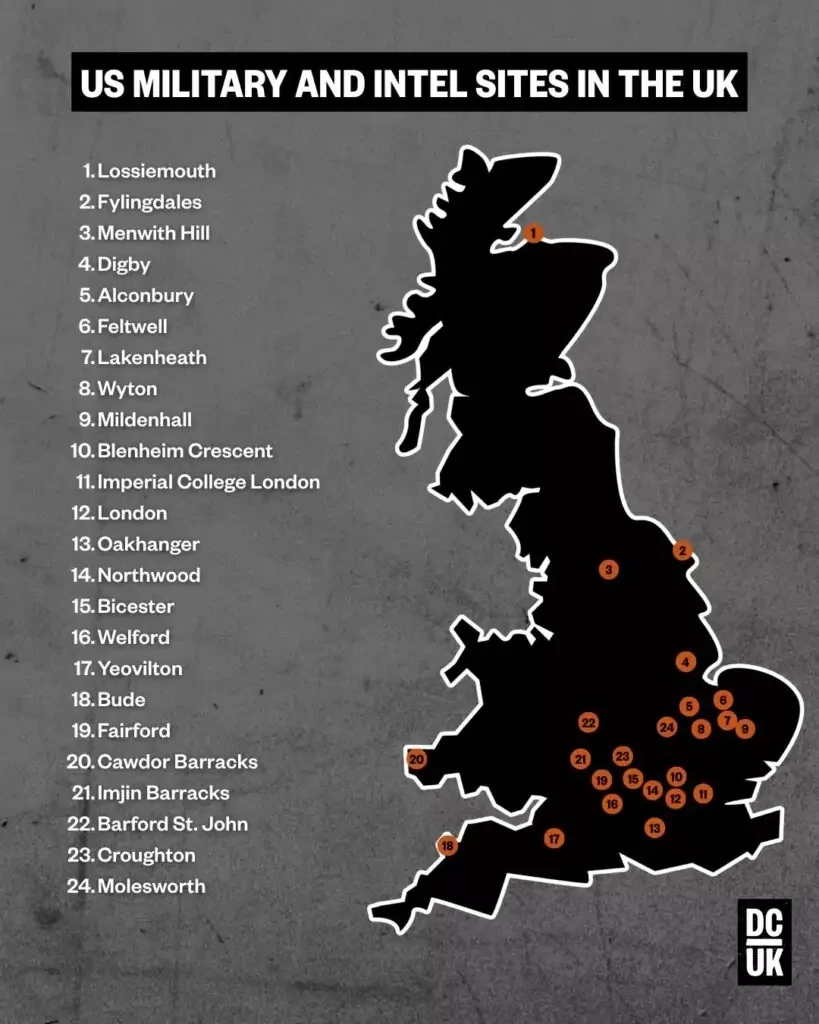
From where they are exactly to the laws governing them, here’s what we need to know to hold the UK government accountable for Trump’s use of British bases
MARK CURTIS , Declassified 4th March 2026
Keir Starmer has given his approval for Donald Trump’s US to attack Iran using British military bases.
But the UK government imposes a considerable veil of secrecy over the US use of these bases, keeping the British public in the dark about how its territory is used in foreign wars.
Former Labour Party leader and independent MP Jeremy Corbyn said: “From transferring equipment to refuelling planes to surveillance flights, we deserve to know the truth about exactly what these military bases are and have been used for, whether to benefit the US or Israel or both.
“There is a reason why the government is so reluctant to tell us: they know that this information could tip British complicity in genocide and war into active participation. We will continue to push for a full, public and independent inquiry into the use of these bases.”
Here are some of the things we need to know about the US military and intelligence presence in the UK and British territories.
Where exactly are they?
We don’t know where all US military personnel in Britain are. Whenever governments answer questions about the US presence in the UK, they mention major bases which the US Air Force operate – such as at Fairford, Mildenhall and Lakenheath – but have also referenced “undisclosed locations”.
The government also says that, in addition to the major air bases with a US presence, there are six other designated Nato facilities in the UK, where US military personnel can also be located.
But Declassified recently found a US War Department document highlighting 22 American military sites in Britain, some of which successive UK governments have failed to mention. It is not clear how many of these 22 sites are currently hosting US military personnel.
Declassified has identified other locations in Britain that are likely to host US military or intelligence personnel, bringing the total to 24.
Even this may not cover the full scale of the US military presence in the UK, since it is believed that US military personnel are frequently, if not permanently, stationed at still more sites, such as the key Royal Navy bases at Coulport, Devonport and Faslane.
Keir Starmer’s government is also refusing to tell parliament how many US forces are located at each of its major bases in Britain. The reason it gives for not saying is that “we are in a new era of threat that remains more serious and less predictable”.
The government also refuses to say where the US has any navy, army or marine detachments in the UK. Incredibly, it says “the overall US force composition across its UK footprint is a matter for the US”.
Who really owns the US military sites in Britain?
This is also unclear. The US War Department document we found states that, as of 2024, it owned, leased or otherwise controlled 22 military sites in Britain, and that these are worth £11bn. The UK government contends that the War Department owns no facilities in Britain, making the exact terms of the US presence even more unclear.
The US document, for example, said its War Department owns 12 buildings covering over 39,000 square feet at RAF Oakhanger in Hampshire, which is a satellite ground station.
Yet in answer to a recent parliamentary question, the MoD said it owns RAF Oakhanger.
The government also says it owns MOD Bicester, which is another site where the US War Department says it holds 261 buildings. What are the terms and conditions governing these holdings?
What military operations does the US conduct from Britain?
Governments have refused to give us the full picture. The standard response is: “The Ministry of Defence does not comment on the operational activity of other nations”, even when they’re operating in Britain.
When the US bombed Iran in June last year, the MoD refused to say if US aircraft based in Britain had been involved.
The MoD also refuses to say if the US has used its British bases to transport arms to Israel.
What US military operations need UK approval?
Britain has a vague agreement with the US on the use of British bases, going back to a 1952 communiqué between prime minister Winston Churchill and president Harry Truman. …………………………………………………………………………………………………………………………. https://www.declassifieduk.org/we-deserve-to-know-the-truth-11-questions-about-us-bases-in-britain/
Pro-nuclear group faces questions over ‘links’ to major London PR firm.

BRITAIN Remade is the apparently “grassroots” group leading the push
to overturn Scotland’s ban on nuclear power. But The Ferret has found
that two of its directors come from a firm which lobbies for the UK’s
biggest nuclear company.
Britain Remade organised the recent launch of the
“Scotland for nuclear energy” campaign and has repeatedly called for
Holyrood to reverse its long-standing opposition to new atomic energy. The
“pro-growth” group campaigns to make it easier to build things in the
UK – including housing, transport links and clean energy.
It says it is
“independent” and “grassroots”. But it has been alleged that
Britain Remade has close ties to the London-based public relations firm
Stonehaven. Stonehaven represents EDF – the French energy giant that owns
Scotland’s last operational nuclear power station at Torness in East
Lothian. EDF could be one of the biggest beneficiaries of any move to lift
the ban on new nuclear plants.
A Ferret investigation into the relationship
between Stonehaven and Britain Remade uncovered that BRM Futures Ltd –
the private company behind the campaign group – recently named two senior
Stonehaven figures as directors. We also found other overlaps including
that Britain Remade had been incorporated at an address that was previously
the registered office of Stonehaven, by an individual whose name resembles
that of Stonehaven’s finance director.
Critics argued the public has “a
right to know who is behind any campaign” otherwise there was a risk of
Scottish democracy being “undermined behind closed doors”. Britain
Remade told The Ferret it had “never taken a penny of corporate money”,
sets its own priorities and campaigns “on what we think matters for the
country”. It also said any claim that funders get a veto on anything it
writes or campaigns on is “categorically untrue”.
However, despite
direct questions, it did not confirm the nature of its relationship with
Stonehaven or whether it had been set up by anyone at the firm. Stonehaven
did not respond to a request for comment. Companies House filings –
updated on February 3, just two days before the Glasgow launch of the new
nuclear campaign – show that BRM Futures Ltd appointed Pandora Lefroy and
Rachel Wolf as directors in October 2024. Lefroy has worked at Stonehaven
for more than 10 years and is now the firm’s managing partner. Wolf is
the chief executive of Public First, another consultancy firm bought by
Stonehaven last year, and now sits on the board of the wider Stonehaven
Group Holdings Limited. Filings show that BRM Futures Ltd was incorporated
in February 2022 on the first floor of an office building called Thavies
Inn House, in the Holborn area of London. Until three months previously,
that same address had been Stonehaven’s registered office.
The sole
founding director listed on the incorporation document was Henry Frank
Lewis. He resigned in November 2022 when the campaign was officially
launched and current staff members Sam Richards, Sam Dumitriu and Jeremy
Driver were appointed. Stonehaven’s finance director is Harry Lewis.
Britain Remade did not respond to a question about whether he and Henry
Frank Lewis were the same individual. Like EDF, Britain Remade is named as
a client of Stonehaven on the professional lobbying register. It has also
reportedly used technology provided through Stonehaven to launch a petition
on onshore wind that secured more than 11,000 signatures. James Mitchell, a
professor of public policy at the University of Edinburgh, said the public
should be “very wary” of any organisation which was unwilling to
provide “such basic information”.
“The public has a right to know who
is behind any campaign pursuing a policy including, crucially, who funds
the campaign and with what level of funding,” he said.
The National 15th March 2026
Macron accosted
Moment rattled Emmanuel Macron is confronted by activists who storm stage during nuclear summit
By PERKIN AMALARAJ, FOREIGN NEWS REPORTER, Daily Mail,14 March 2026
The protesters, dressed sharply in black suits and ties, interrupted Macron and UN nuclear watchdog chief Rafael Grossi as they were greeting heads of state today.
They held banners bearing the Greenpeace logo and reading ‘Nuclear Power = Energy Insecurity’ and ‘Nuclear power fuels Russia‘s war.’
One of them shouted at Macron, ‘Why are we still buying uranium from Russia?’ to which the president replied, ‘We produce nuclear power ourselves.’
France has its own uranium enrichment capacity, but also imports enriched uranium for its power plants, including from Russia, according to the latest customs data published by the French government.
Russia’s state nuclear company Rosatom accounted for about 44% of the global uranium enrichment capacity in 2025, according to the World Nuclear Association.
European nuclear power producers have struggled to wean themselves off these supplies four years after Russia invaded Ukraine.
Around 15 Greenpeace activists blocked arriving convoys outside the venue in Boulogne-Billancourt on the outskirts of Paris on Tuesday, the environmental campaigning group said in a statement.
France is hosting the second world nuclear energy summit on Tuesday, where world leaders will meet to discuss and promote nuclear power.
The protesters, dressed sharply in black suits and ties, interrupted President Emmanuel Macron and UN nuclear watchdog chief Rafael Grossi as they were greeting heads of state today
One of them shouted at Macron, ‘Why are we still buying uranium from Russia?’
‘For Greenpeace France, the holding of such a summit is an anachronism, an event completely out of touch with reality and with the lessons to be learned from the tragic situations of the Russian aggression in Ukraine, the strikes on Iran, and the impacts of the worsening climate disruption,’ the group said.
EU chief Ursula von der Leyen today called Europe’s turn away from civilian nuclear power a ‘strategic mistake’, arguing that the Middle East war had exposed the continent’s fossil fuel ‘vulnerability’.
‘It was a strategic mistake for Europe to turn its back on a reliable, affordable source of low-emission power,’ she said at the opening of a nuclear energy summit just outside Paris as the US-Israeli war with Iran entered its second week.
‘For fossil fuels, we are completely dependent on expensive and volatile imports. They are putting us at a structural disadvantage to other regions,’ she said at the summit, which aims to boost the use of civilian nuclear energy.
‘The current Middle East crisis gives a stark reminder of the vulnerability it creates,’ she added.
‘We have home-grown low-carbon energy sources: nuclear and renewables. And together, they can become the joint guarantors of independence, security of supply, and competitiveness – if we get it right.’
Macron struck a similar note, saying civilian nuclear power helped provide energy sovereignty.
France has its own uranium enrichment capacity, but also imports enriched uranium for its power plants, including from Russia,…………………………………………………………………… https://www.dailymail.co.uk/news/article-15631733/Moment-rattled-Emmanuel-Macron-confronted-activists-storm-stage-nuclear-summit.html
1 This Month
6 June – WEBINAR- Get Inspired by Protests Against Military Bases!


Cuba Is Not a Failed State – It Is a Besieged State
PETITION: “Global Appeal to Endorse Palestinian Right of Return of Refugees”


of the week– Nuclear Reactor Information Task Force
To see nuclear-related stories in greater depth and intensity – go to https://nuclearinformation.wordpress.com
-
Archives
- June 2026 (34)
- May 2026 (306)
- April 2026 (356)
- March 2026 (251)
- February 2026 (268)
- January 2026 (308)
- December 2025 (358)
- November 2025 (359)
- October 2025 (376)
- September 2025 (257)
- August 2025 (319)
- July 2025 (230)
-
Categories
- 1
- 1 NUCLEAR ISSUES
- business and costs
- climate change
- culture and arts
- ENERGY
- environment
- health
- history
- indigenous issues
- Legal
- marketing of nuclear
- media
- opposition to nuclear
- PERSONAL STORIES
- politics
- politics international
- Religion and ethics
- safety
- secrets,lies and civil liberties
- spinbuster
- technology
- Uranium
- wastes
- weapons and war
- Women
- 2 WORLD
- ACTION
- AFRICA
- Atrocities
- AUSTRALIA
- Christina's notes
- Christina's themes
- culture and arts
- Events
- Fuk 2022
- Fuk 2023
- Fukushima 2017
- Fukushima 2018
- fukushima 2019
- Fukushima 2020
- Fukushima 2021
- general
- global warming
- Humour (God we need it)
- Nuclear
- RARE EARTHS
- Reference
- resources – print
- Resources -audiovicual
- Weekly Newsletter
- World
- World Nuclear
- YouTube
-
RSS
Entries RSS
Comments RSS
 nuclear-news