Is the new UK government prepared to rise to the challenge of investing in energy efficiency measures and reducing the country’s energy use?

Internationally, more recent UN assessments are placing much greater emphasis on changing demand for fuel, broadly supporting the CREDS’ analysis of the scale of the potential. The International Energy Agency consistently refers to energy efficiency as ‘the first fuel’, and the European Commission actively promotes ‘Energy Efficiency First’.
Is the new government prepared to rise to the challenge of investing in energy efficiency measures and reducing the country’s energy use? asks Andrew Warren.
The UK has a new government. It arrives determined to deliver the potential that greater investment in energy efficiency offers, and these are acknowledged to be ‘wins all round’ in economic, social and environmental terms. Every plausible scenario for delivering climate targets depends critically on delivering these improvements.
The key question remains – how best to deliver this potential? Fortunately, for the past six years, there has been a major project, funded by UK Research & Innovation, that has been exploring precisely these answers.
The Centre for Research into Energy Demand Solutions (CREDS) has been run by an Oxford University professor, Nick Eyre – a man with a very practical background in the subject. Prior to becoming an academic, he worked at a senior level for the Energy Saving Trust. An active County Councillor, he was a key figure seconded to the Cabinet Office, helping create the first energy White Paper for 30 years, launched by Tony Blair in 2003, which elucidated the entire case for an energy efficiency/renewables-based future.
And way back in 1989, he helped prepare the energy efficiency case for Margaret Thatcher’s government on the ‘greenhouse effect’. This included the identification of potential emission reductions of 477 Mt CO₂ within 30 years. These were deemed grossly over ambitious by the energy establishment at the time, but they have nonetheless been achieved. Practically half these savings have come from improvements in energy efficiency, which have been spread across the three major categories of energy use: electricity (32%, 123 Mt CO₂) heating (34%, 68 Mt CO₂) and transport (17%, 33 Mt CO₂).
Energy demand matters
A full analysis of what has actually been achieved to date can be found on the Centre’s website (www.creds.ac.uk/creds-research-findings/). In addition, there are approaching 500 other publications drawn from academics based throughout the UK involved in this initiative, the vast majority of these fully peer-reviewed. On the website, these have been grouped under nine different ‘themes’. The overall findings of the six-year project can be found in 15 one-page topic summaries, each of which provides links to the underlying evidence base.
The CREDS consortium has a wide range of perspectives. For a collection of academics this is inevitable, and healthy. But there are some insights that are commonly shared.
The first is that energy demand management matters. Use of energy is fundamental to a modern society, but it is currently the main cause of greenhouse gas emissions. The analysis confirms it has to be reduced, made more flexible and switched to decarbonised fuels. Reducing the amount of energy that needs to be decarbonised reduces the cost of the transition.
The work reasserts the importance of energy efficiency improvements, and importantly identifies the huge boost to its potential offered by electrification. But also established is that some of the broader benefits of demand reduction (e.g. for health, energy security and green employment) also require more fundamental change in the systems that drive energy use, in particular shifts to a circular economy.
Reducing consumption
Going forward, CREDS’ analyses show clearly that current UK energy consumption can be halved by 2050 – and, critically, the policy measures that need to be introduced, and enforced, to achieve this. The research has consistently found that fairness matters – not just because it is normatively important, but also because perceptions of fairness, or otherwise, affect public support for change.
All this means that managing demand for energy is central to the shift to sustainable energy within a zero emissions concept. Conceptualising changing energy demand purely in terms of ‘individual responsibility’, ‘greener choices’ or ‘behaviour change’ simply misses the point.
Just like changing energy supply, changing demand requires changes in infrastructure, technology and business models.
For many people, this may well be CREDS’ most surprising insight. It certainly also means that existing institutions and policies will not be adequate. Previous UK governments have failed to address this key conclusion. All significant change takes time and effort. Particularly in democracies, a ‘long march through the institutions’ is needed. And there are positive signs that these insights are beginning to have traction.
Efficiency first
Internationally, more recent UN assessments are placing much greater emphasis on changing demand for fuel, broadly supporting the CREDS’ analysis of the scale of the potential. The International Energy Agency consistently refers to energy efficiency as ‘the first fuel’, and the European Commission actively promotes ‘Energy Efficiency First’.
In the UK, some similar shifts can be seen in reports from the Climate Change Committee, the National Infrastructure Commission and the Government Office of Science. And there are positive signs in the Scottish and Welsh governments and many local authorities, as well as forward-thinking businesses and civil society organisations.
For research funders, the CREDS initiative has a clear message – inter-disciplinary approaches are still needed. They can be hard work, but the challenges of changing demand require multiple perspectives. As importantly, ‘changing energy demand’ is not a single topic; the challenges are diverse and require in-depth knowledge of specific sectors, technologies and energy services. Expertise matters and should be supported.
One of the biggest long term benefit of CREDS will be from the skills and commitment of the people its existence has brought together. They are part of the generation that will help government map the pathways through to complete decarbonisation.
As his professorship becomes ‘emeritus’, wise leaders in the new UK administration should be expressing considerable gratitude to Nick Eyre, for the very remarkable groundwork his foresight in creating the insightful CREDS initiative has provided for them.
Nuclear waste group spends £4,600 on logo to show it IS listening to Theddlethorpe views.
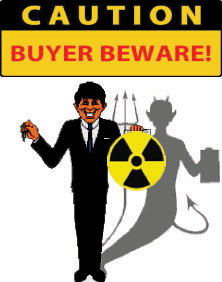
A probe has revealed that a group connected to plans
for an underground nuclear waste dump in Theddlethorpe spent £4,600 on a
new logo to demonstrate it is listening to residents’ views. The logo, with
two speech bubbles, signifying a conversation, has been created for the
Theddlethorpe GDF Community Partnership, which has been set up to help
locals understand why a GDF (geological disposal facility) might be
suitable for the area.
The former gas terminal at Theddlethorpe has been
identified as one of several potential locations in England for the dumping
of nuclear waste by the government agency, Nuclear Waste Services (NWS). It
would be stored beneath up to 1,000 metres of solid rock until its
radioactivity naturally decays.
Lincolnshire World 20th Sept 2024
https://www.lincolnshireworld.com/news/people/nuclear-waste-group-spends-ps4600-on-logo-to-show-it-is-listening-to-theddlethorpe-views-4790584
With US $billions and diplomatic support, Ukraine and Israel are destroying themselves.
Walt Zlotow, West Suburban Peace Coalition, Glen Ellyn IL 22 Sept 24
Joe Biden began his presidency doing a great thing for peace. Three years ago he ended America’s illegal, immoral, criminal war in Afghanistan.
But Biden is no friend of peace. He’s spent the last three years instigating and funding proxy war in Ukraine to weaken Russia, and funding and enabling Israel’s genocidal ethnic cleansing of Palestinians in Gaza.
Neither of these murderous wars could continue without America’s endless billions and fervent moral support in word and deed.
But both Ukraine and Israel have fallen for US support to head down the path to failed state status.
Ukraine is already there. A fifth of their land gone. Economy shattered. Military largely destroyed. Millions displaced internally or fled to o other countries. Dependent upon on massive, unrepayable loans from the US and NATO countries simply to function. Cancelled elections spell the end of Ukrainian democracy. It could hardly be worse.
This all could have been avoided had the US not demanded Ukraine join NATO to isolate Russia from the European political economy, and supported a coup toppling the Ukrainian president who sought economic relations with Russia. Nor would it have happened had Ukraine President Zelensky rebuffed Biden’s NATO membership overtures and provided regional autonomy to Donbas as promised under the 2015 Minsk II Accords.
While not the basket case Ukraine is, Israel appears hell bent to join it as a failed state. By exploiting the October 7 Hamas attack to initiate all out genocidal ethnic cleansing of Gaza, Israel is destroying itself as well. Outside of the Biden administration, it has lost worldwide support as a moral nation. It has greatly weakened Israel’s economy, overtaxed it military, irrevocably divided its populace, forced over 60,000 citizens to flee northern Israel, and embarked on a self destructive war it cannot win.
Make that 2 wars. Israel’s Prime Minister Benjamin Netanyahu’s genocidal campaign in Gaza has provoked blowback in northern Israel from both Hezbollah in Lebanon and the Houthis in Yemen. Like Hamas in Gaza, neither of these two additional opponents can be defeated by Israel alone. Just like with Ukraine, endless billions from Biden will not turn the tide.
Both Zelensky in Ukraine and Netanyahu in Israel have one Hail Mary toss to fling….bring the US directly into the battle on their side. Zelensky has been promoting this explicitly since his losing war with Russia began 31 month ago. Netanyahu, is more discreet, simply taking provocative actions like bombing Hezbollah leaders in Lebanon and Syria, engaging in terrorism using explosive cellphones and pagers, all designed to ignite regional war involving Iran that the US would feel compelled to join.
So far President Biden has resisted direct US involvement in both senseless wars. But either could blow up in his face at any moment, triggering direct US involvement. Should that occur, we’ll see much worse than Ukraine and Israel self destructing. America and the rest of the world’s 193 countries might well join them.
Israel’s Collapse Is Imminent Amid Escalation In Lebanon
September 22, 2024, By Mnar Adley / MintPressNews, https://www.mintpressnews.com/scott-ritter-lebanon-pager-attack-hezbollah-brics/288312/
It sometimes feels like the world is on the brink of war. Israel has just escalated the conflict in the Middle East with a massive attack on Lebanon, implanting bombs in hundreds of pagers and other electronic devices, killing many and injuring thousands.
Around the world, the action has been condemned as an act of terror.
Today’s guest, Scott Ritter, unequivocally denounced the move. “This is something that is unjustifiable under any circumstances. There is no element of the law of war that would allow this kind of indiscriminate attack,” he said. Ritter is a former United States Corps Intelligence Officer and UN Weapons Inspector in Iraq. He is an author and a geopolitical analyst, whose work you can find at ScottRitter.com. He has closely followed the wars in Ukraine and the Middle East.
The attack, he said, will have widespread implications, not least for Western corporations, who were caught unaware. “This is going to create a crisis of confidence among consumers that could end up costing Western companies billions of dollars,” he explained, adding:
Anybody with any shred of common sense will immediately throw away their Western-made electronic device and source one from a country such as China, where Israel is not going to be able to infiltrate and corrupt the integrity of the electronic device to achieve either intelligence collection goals or assassination [goals].”
While the Israeli military is vastly better armed and funded than Hamas, Ritter claimed that it was actually the Palestinian force that has come out on top after 12 months of fighting, stating:
“Hamas right now, in my opinion, is winning this conflict. They are winning it strategically. They are paying a horrible price for it. But on October 6, nobody was talking about the creation of a Palestinian state. Today, it is on the tip of the tongue of so many people around the world. Why? Because the world has seen the truth about Israel.”
Not only that, but Israel is eating itself from within. Its military is seriously depleted; its economy has been shattered by rocket attacks, and by 12 months of war economy; and its society is beginning to fragment.
The United States, too, has been damaged. It is increasingly isolated on the world stage, and its prestige is slipping. Fewer nations look to Washington for leadership and, instead, see organizations such as BRICS as the future.
Later this month, a BRICS summit will be held in Kazan, Russia, bringing its core member nations together with its new invitees. Palestine will be a key issue, and no doubt countries such as Saudi Arabia and the United Arab Emirates will be put under pressure to stop covertly aiding Israel and come to a solution to end the war.
BRICS has already succeeded in helping to lessen tensions between Iran and Saudi Arabia, and it is possible that the new bloc can act to bring about peace in a manner that many hoped the United Nations would be able to do.
Whatever happens, it is clear that October 7 fundamentally changed the situation for Israel and Palestine forever.
Labour backs nuclear – but at what cost?

for the UK consumer, nuclear new building means expensive electricity and offers little in terms of addressing climate change.
With new funding announced for the prospective Sizewell C plant, the government seems committed to nuclear power.
However, the cost of nuclear newbuild in the UK is staggering and,
even if built, sufficient new capacity will not arrive soon enough to help
mitigate climate change.
UK electricity consumers should hope that the
target of 24 GW of nuclear capacity by 2050 slips into obscurity. “We
will ensure the long-term security of the sector, extend the lifetime of
existing plants, and we will get Hinkley Point C over the line.” That was
Labour’s manifesto commitment to nuclear power, and the government has
already put money on the line.
In late August, it announced additional
funding of up to £5.5 billion for the proposed Sizewell C plant, which
would be only the UK’s second nuclear construction project since the
completion of Sizewell B in 1995, if built.
However, for the UK consumer, nuclear new building means expensive electricity and offers little in terms of addressing climate change. The UK’s operable nuclear capacity declined
from 12.2 GW in 1996 to 5.8 GW in 2023. Only nine reactors are still
generating power and two are under construction. Eight of the operable
reactors came online between 1983 and 1989, making the youngest 45 years
old. Last year, the Hartlepool and Heysham 1 plants gained modest life
extensions to 2026, and operator EdF hopes to extend the lives of its other
Advanced Gas Cooled (AGRs) reactors to 2028.
However, there is little likelihood that the eight remaining AGRs can continue in service beyond these dates. They were initially designed to last about 30 years, with the
decision to decommission based on the deterioration of irreplaceable
components such as the graphite core and boilers. Three AGRs – two built
in 1976 and one in 1983 – are already defueling, a preliminary step to
decommissioning. As a result, by 2030 at the latest, all of the UK’s AGRs
will be out of service.
Decommissioning costs the consumer money, and the
Nuclear Liabilities Fund has not kept up with the cost of decommissioning.
In its third report of 2022-23, the House of Commons Committee of Public
Accounts noted that the government had already been forced to provide
additional funding of £10.7 billion and that there remained “a strong
likelihood that more taxpayers’ money will be required”.
In addition, despite the first nuclear reactors coming into service in the 1950s, there
is still no clear plan for the permanent storage of the most hazardous
forms of radioactive waste.
The government’s most recent energy and
emissions projections, published in November 2023, forecast the
volume-weighted wholesale electricity price in 2030 at between £36.6/MWh,
in a low fuel price scenario, and £58.5/MWh in a high fuel price scenario.
The UK’s latest licensing round for renewable energy, the results of
which were announced in September, returned CfD prices for solar projects
of £50.07/MWh, onshore wind at £50.90/MWh and offshore wind at
£58.87/MWh (2012 prices).
At over £100/MWh in today’s money, even
without a further five years of inflation, Hinkley Point C is a chronic
deal for the UK electricity consumers. EdF wants a new funding model for
both the construction of Sizewell C and the lifetime extension of Sizewell
B, indicating that even the large CfD strike price for Hinkley Point C is
not enough to build new nuclear in the UK. This will almost certainly mean
UK consumers bearing more of the risk. The adoption of the proposed
Regulated Asset Base (RAB) model would see consumers paying for nuclear
plants years before they actually generate electricity.
Energy Voice 18th Sept 2024.
Biden’s Grand Alliance against Russia in Ukraine beginning to recognize the N word…Negotiations

Walt Zlotow, West Suburban Peace Coalition, Glen Ellyn IL, 20 Sept 24
The US 32 month long proxy war against Russia is not quite over. But everyone in America’s important NATO allies knows America’s Ukraine proxy is losing badly with its military near collapse. The two hundred billions the US and NATO have poured into Ukraine have made not a dent in achieving the ‘good guys’ war aims of taking back the Donbas and Crimea, receiving reparations from Russia, and gaining NATO membership.
While President Biden betrays nary a hint of that stark reality, his European NATO allies, greatly more affected by the economic consequences of this than America, certainly are.
German Chancellor Olaf Scholz recently said, “I believe that now is the time to discuss how to arrive at peace from this state of war, indeed at a faster pace.” Scholz further stated that he will impose a limit on open ended aid to Ukraine and is working on a diplomatic settlement that will include Ukraine ceding territory to Russia.
A senior French diplomat recently told Le Figaro the same thing, citing that the Donbas and Crimea are beyond Ukraine’s military capability and that France lines up with Germany that only a negotiated settlement will end the war.
Insulated from the economic angst of its Western European allies, the US sees no need to deal with reality. For President Biden and his war cabinet including VP Harris, the words ‘negotiated settlement’ and ‘ceding territory’ dare not pass the lips of US diplomats acting more like war generals than statespersons.
Biden and company are still running around like Chicken Little, chirping ‘The Russians are coming, the Russians are coming, to take over Poland on their march to the English Channel.’
That includes presidential candidate Kamala Harris who repeated that delusional meme in her presidential debate.
The US proxy war against Russia, with Ukrainians doing all the dying and the country in ruins, is headed to a negotiated settlement in spite of President Biden’s intransigence.
Microsoft deal propels Three Mile Island restart, with key permits still needed
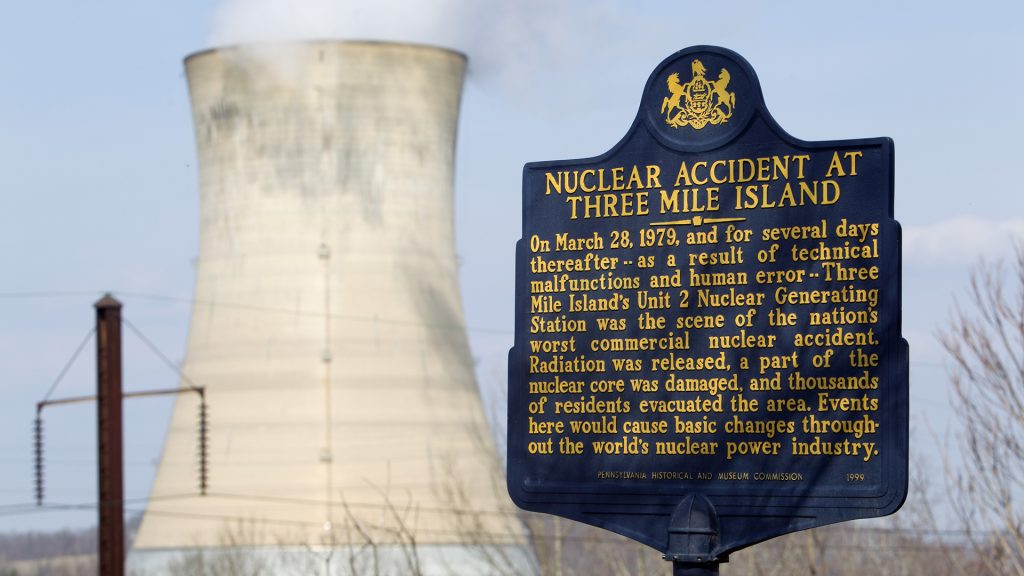
By Reuters, September 21, 2024
Sept 20 (Reuters) – Constellation Energy (CEG.O), opens new tab and Microsoft (MSFT.O), opens new tab have signed a power deal to help resurrect a unit of the Three Mile Island nuclear plant in Pennsylvania in what would be the first-ever restart of its kind, the companies said on Friday.
Key regulatory permits for the plant’s new life, however, haven’t been filed, regulators say.
Big tech has led to a sudden surge in U.S. electricity demand for data centers needed to expand technologies like artificial intelligence and cloud computing. ……………………………………..
Power from the plant would be used to offset Microsoft’s data center electricity use, the companies said.
A relaunch of Three Mile Island, which had a separate unit suffer a partial-meltdown in 1979 in one of the biggest industrial accidents in the country’s history, still requires federal, state and local approvals.
Constellation has yet to file an application with federal nuclear regulators to restart the plant.
“It’s up to Constellation to lay out its rationale for justifying restart, so we’re prepared to engage with the company on next steps,” said Nuclear Regulatory Commission (NRC) spokesperson Scott Burnell.
Constellation said it expected the NRC review process to be completed in 2027.
BILLION DOLLAR BET
The deal would help enable a revival of Unit 1 of the five-decades-old facility in Pennsylvania that was retired in 2019 due to economic reasons. Unit 2, which had the meltdown, will not be restarted. https://www.reuters.com/markets/deals/constellation-inks-power-supply-deal-with-microsoft-2024-09-20/
US Military Policy Is Stoking the Risk of Nuclear War on Korean Peninsula
As Trump and Harris bicker over North Korea, the US military lays plans that could bring nuclear tensions to a brink.
By Ju-Hyun Park , Truthout, September 19, 2024
U.S. politicians can’t stop talking about Kim Jong Un. The two major party conventions have come and gone, with both presidential candidates mentioning the North Korean leader by name. At the Republican National Convention (RNC), Donald Trump claimed Kim had endorsed him, adding, “He misses me.” Just weeks later at the Democratic National Convention (DNC), Kamala Harris alluded to her opponent’s claims, declaring before an enraptured audience that the “tyrant” Kim is “rooting for Trump.”
Neither candidate told the truth. The North Korea’s state news agency was swift to respond to Trump back in June, clarifying the position of the government with characteristically pointed remarks: “No matter what administration takes office in the U.S., the political climate, which is confused by the infighting of the two parties, does not change and, accordingly, we do not care about this.”
The fact-free treatment of North Korea by both parties is a sign of how the electoral cycle has reduced the Korean crisis to a political football. This is especially dangerous in a time when the risk of war in Korea is at its highest in decades. Significantly, neither Republicans nor Democrats seem interested in a public discussion about the concrete situation in Korea, or the major escalations the U.S. is undertaking there.
While the news cameras and the eyes of the electorate were trained on the DNC in Chicago, the U.S. military executed one of the largest war games on Earth in Korea: Ulchi Freedom Shield (UFS). UFS is the latest name for an annual series of military exercises conducted by the Combined Forces Command, the command structure under which the military of South Korea answers to U.S. generals. (The U.S. has had operational wartime command of South Korea’s armed forces since 1950.) Originating in 1976, UFS and its predecessors routinely deploy tens of thousands of troops, along with U.S. “strategic assets” such as aircraft carriers, heavy bombers and nuclear submarines.
This is a major, and widely misunderstood, component of the unfinished Korean War — that for over half a century, some of the largest military maneuvers on Earth are conducted on an annual basis in Korea within sight of the border bisecting the peninsula. Although the U.S. and Republic of Korea (ROK), South Korea’s official name, insist these exercises are defensive, many of them rehearse the invasion and occupation of North Korea.
These “war games,” by their very nature, look identical to the first steps of a real invasion. This year’s UFS featured a whopping 48 individual war drills, deploying 19,000 South Korean troops, 200 military aircraft and an unknown number of U.S. soldiers. What’s more, this year’s war games took place in the context of another significant escalation: emergent plans to potentially redeploy U.S. nuclear weapons to Korea.
Killing Peace
The Korean War was concluded with a ceasefire rather than a permanent peace treaty, making it the longest war in U.S. history. For over 50 years, relations between North and South Korea were structured through the paradigm of independent, peaceful reunification — a mutual commitment to nonviolently end both the Korean War and the division of the Korean people. And since the late 1980s, relations between the U.S. and North Korea were also based on the framework of denuclearization. Both of these diplomatic paradigms have now crumbled.
………………………………………………………………………………………………………………………………………… more https://truthout.org/articles/us-military-policy-is-stoking-the-risk-of-nuclear-war-on-korean-peninsula/
Why Putin’s nuclear saber-rattling on Ukraine sounds different this time

Christian Science Monitor, By Fred Weir, Special correspondent, September 19, 2024, Moscow
Over the course of the war in Ukraine, the Kremlin has drawn several “red lines” – with ostentatious references to Russia’s huge strategic nuclear arsenal – only to seemingly do nothing when these lines are crossed by Ukraine or its Western backers
Red lines:
- It happened when Ukraine acquired new and more powerful Western arms.
- It happened when Kyiv used its own drones to hit Russian airfields, refineries, and even the Kremlin itself.
- Most recently, it happened when Ukrainian forces actually invaded Russian territory. That has led Ukrainians, and many NATO officials, to conclude that Russian President Vladimir Putin’s nuclear saber-rattling is an elaborate bluff.
But when Mr. Putin warned last Thursday that Moscow will consider it a direct act of war by NATO if British, French, or U.S.-made missiles are used by Ukraine to strike targets deep inside Russia, he said this time is different.
Why We Wrote This
The Kremlin has had little success invoking its nuclear arsenal to deter Ukraine and the West from deploying new tactics and modern equipment to stop Russia’s invasion. But that may be changing.
Many Russian experts agree. And for now, Washington seems to be heeding his threat and holding off on permitting Ukraine to use the weapons.
“Russia’s frustration has been growing because the West appears to have lost all fear of nuclear war. Deterrence is absent,” says Sergei Strokan, an international affairs columnist with the Moscow daily Kommersant. During the Cold War, he says, that fear drove both sides to the bargaining table, aiming to limit conflicts and control nuclear weapons.
………………………………………………………………………………………………………………………………………………………….. more https://www.csmonitor.com/layout/set/amphtml/World/Europe/2024/0919/putin-ukraine-war-russia-nuclear-war-ww3?fbclid=IwY2xjawFZl3RleHRuA2FlbQIxMQABHTcSiRBIOeirIFfIogP4ISJt2uGrRaPn6u1PExNVwAUriNd55aENjnbTHw_aem_YYAKI4JyPWZbXh1b5xaDcw
MIT Coalition for Palestine Announces Major Divestment Win

09/17/2024, https://nlgmass.org/mit-coalition-for-palestine-announces-major-divestment-win/
The MIT Coalition For Palestine announces a major divestment win for its Scientists Against Genocide (SAGE) movement : MIT has ended the MISTI-Israel Lockheed Martin Fund. This is the first known shutdown of an American-Israeli weapons manufacturer partnership at a U.S. university since the war on Gaza has begun, and MIT has chosen to end this partnership despite renewing its other MISTI projects. The Fund had been a project by MIT International Science and Technology Initiative Israel (MISTI-Israel) to connect students and researchers at MIT to the global arms manufacturer’s Israeli offices.
Lockheed Martin has unquestionably profited from the genocide in Gaza, supplying the Israeli government with Hellfire missiles, attack aircraft, and heavy artillery directly used in destroying Palestinian lives, homes, and society, as well as enabling torture camps and a regime of apartheid. This win is a testament to the sustained pressure from activists, including MIT labor’s refusal to abet the apartheid state via contributing to its weapons research. NLG is proud to have supported and represented MIT SAGE via legal representation and legal observation, especially when they were under threat of police violence and unlawful arrests during the encampment of Apr-May 2024.
Israeli forces continue to escalate in their terror, and MIT maintains ongoing, direct research funding links to the Israeli military supply chain. MIT Coalition for Palestine will continue to fight and resist against the genocidal regime: the NLG will continue to support that fight. No science for apartheid, and free Palestine
Selling War: How Raytheon and Boeing Fund the Push for NATO’s Nuclear Expansion
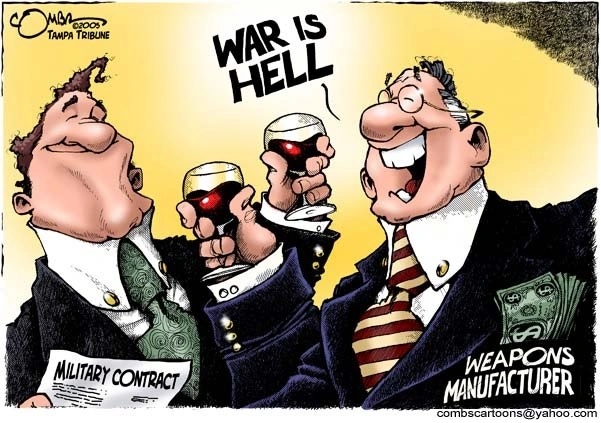
World Beyond War, By Alan Macleod, Mint Press, September 20, 2024
To “counter Russia’s nuclear blackmail,” the Atlantic Council confidently asserted, “NATO must adapt its nuclear sharing program.” This includes moving B-61 atomic bombs to Eastern Europe and building a network of medium-range missile bases across the continent. The think tank praised Washington’s recent decision to send Tomahawk and SM-6 missiles to Germany as a “good start” but insisted that it “does not impose a high enough price” on Russia.
What the Atlantic Council does not divulge at any time is that not only would this drastically increase the likelihood of a catastrophic nuclear war, but that the weapons they specifically recommend come directly from manufacturers that fund them in the first place.
The B-61 bombs are assembled by Boeing, who, according to its most recent financial reports, gave tens of thousands of dollars to the organization. And the Tomahawk and SM-6 are produced by Raytheon, who recently supplied the Atlantic Council with a six-figure sum.
Thus, their recommendations not only put the world at risk but also directly benefit their funders.
Unfortunately, this gigantic conflict of interest that affects us all is par for the course among foreign policy think tanks. A MintPress News investigation into the funding sources of U.S. foreign policy think tanks has found that they are sponsored to the tune of millions of dollars every year by weapons contractors. Arms manufacturing companies donated at least $7.8 million last year to the top fifty U.S. think tanks, who, in turn, pump out reports demanding more war and higher military spending, which significantly increase their sponsors’ profits. The only losers in this closed, circular system are the American public, saddled with higher taxes, and the tens of millions of people around the world who are victims of the U.S. war machine.
The think tanks receiving the most tainted cash were, in order, the Atlantic Council, CSIS, CNAS, the Hudson Institute, and the Council on Foreign Relations, while the weapons manufacturers most active on K-Street were Northrop Grumman, Lockheed Martin, and General Atomics.
These think tanks directly affect conflicts around the world. CSIS, for example, are among the loudest advocates for arming Ukraine, Taiwan and Israel, even as the latter carries out a genocide in Palestine. A recent report lays out a shopping list of U.S. weapons that would help the Israeli military, including Excalibur artillery projectiles, JDAM bomb guidance systems, and Javelin missiles. Those weapons are manufactured by Raytheon, Boeing, and Lockheed Martin, respectively, all of whom are among CSIS’ top funders.
U.S. arms are being used daily to carry out illegal and deadly attacks against civilian populations in Palestine, Lebanon, and Syria, making arms manufacturers directly complicit in war crimes.
One example of this is the recent Israeli bombing of the Al Mawasi humanitarian zone in Gaza. Israel dropped three one-ton MK-84 bombs on the camp, killing at least 19 people. Dozens more are still missing.
According to the UN, MK-84 bomb blasts rupture lungs, tear limbs and heads from bodies, and burst sinus cavities up to hundreds of meters away.
The MK-84 bombs were produced in the U.S. by General Dynamics and sent to Israel with Washington’s blessing. General Dynamics has made huge profits from the slaughter; the D.C.-based arms manufacturer’s stock price has jumped by 42% since October 7.
Conflicts and Conflicts of Interest
Think tanks are an essential part of K-Street, the collective term for the assembly of lobbyists, trade associations and other organizations that attempt to alter government policy……………………………………………………………………………………
There is obviously a massive conflict of interest if groups advising the U.S. government on military policy are awash with cash from the arms industry. This study attempts to quantify that conflict of interest. It analyzed the top 50 most influential foreign policy think tanks in the U.S., according to the University of Pennsylvania’s Global Go to Think Tank Index, and tracked the funding of these 50 organizations to ascertain how much money each received from the weapons industry. A comprehensive funding spreadsheet containing all the numbers used in this study can be found here.
Figures were taken from each group’s websites, funding lists, and financial declarations for the last financial year available. In total, the arms industry donated at least $7.8 million to those think tanks.
This, however, is certainly a significant underestimate for several reasons. ……………………………….
Tanks and Think Tanks
The results were both worrying and unsurprising, as this study found that giant arms manufacturers quietly bankrolled many of the largest and most influential groups advising the U.S. government on its foreign policy. The Atlantic Council alone is funded by 22 weapons companies, totaling at least $2.69 million last year. Even a group like the Carnegie Endowment for Peace, established in 1910 as an organization dedicated to reducing global conflict, is sponsored by corporations making weapons of war, including Boeing and Leonardo, who donate tens of thousands of dollars annually.
The five think tanks that received the most funding from the arms industry are: The Atlantic Council, $2.69 million; Center for Strategic and International Studies (CSIS), $2.46 million; Center for a New American Security (CNAS), $950,000; Hudson Institute, $635,000; and the Council on Foreign Relations, $300,000.
At least 36 weapons manufacturers provided funding to major American think tanks. The most “generous” among them were Northrop Grumman, $1.07 million; Lockheed Martin, $838,000; General Atomics, $510,000; Leonardo S.p.A., $485,000; and Mitsubishi, $443,000.
When presented with these findings, peace activist David Swanson, author of “War is a Lie,” appeared disgusted but not surprised. Swanson described the role of arms industry-funded think tanks as such:
They have to build up through endless repetition and through debates that remain within their bizarre parameters the idea that wars are won, that wars are defensive, that nuclear weapons deter wars, that enemies cannot be spoken with, that weapons spending is a public service that nations should do to the maximum extent possible while stripping funding away from human needs, and similar outrageous pieces of nonsense.”
He Who Pays the Piper
It is no coincidence that the groups receiving the most weapons industry money are home to some of the most hawkish, pro-war voices to be found anywhere. The arms industry, like all corporations, does not donate out of the goodness of their hearts but is instead looking for a return on their investments.
Influential think tanks like CSIS are certainly giving their benefactors bang for their buck, consistently agitating for more military spending and more war around the world, whatever the consequences.
………………………..European countries, CSIS also insisted, must “pull their weight” in NATO, transforming their societies into ones every bit as militarized as the U.S., for the sake of “global democracy.”
Meanwhile, writing in The Atlantic, Eliot A. Cohen, CSIS’ Arleigh A. Burke Chair in Strategy, demanded an escalation in the West’s involvement in Ukraine. “We need to see masses of Russians fleeing, deserting, shooting their officers, taken captive, or dead. The Russian defeat must be an unmistakably big, bloody shambles,” he wrote, adding that “To that end, with the utmost urgency, the West should give everything that Ukraine could possibly use.”
This included long-range missiles and F-16 and F-35 fighter jets.
What neither Cohen nor the Atlantic noted, however, was that the weapons he demanded to be bought and sent to Ukraine are made by General Dynamics and Lockheed Martin, groups that directly fund CSIS……………………….
the relentless pro-war voices were hardly limited to CSIS. In fact, every think tank taking substantial arms industry cash maintained a notably hawkish stance. The Atlantic Council, for instance, policed European nations’ NATO spending in an attempt to pressure them to purchase more arms and has advocated that the U.S. create a new “Indo-Pacific intelligence coalition” that would ramp up tensions with China. CNAS, meanwhile, has claimed that the U.S.’ supposedly muted response to “Chinese provocations” has eroded its “credibility” on the world stage.
Speaking on what think tanks have achieved, Swanson told MintPress:
They’ve normalized the idea of measuring war spending as a percentage of an economy, and the idea that there is no such thing as too much of it. They’ve normalized the idea of only one solution to all problems, even problems created by that one solution, namely war. [And] they present endlessly endlessly endlessly ‘defensive alliance NATO’ with not a soul noticing that NATO’s wars have all been blatantly aggressive.”
The American public is generally skeptical of war. Surveys show that two-thirds of the country wants Washington and Ukraine to directly engage in diplomacy with Russia, even if that means conceding Ukrainian territory. Most Americans are against sending more U.S. troops to the Middle East as well, even if it were only to “defend Israel.”
They hold these positions despite what they are constantly told in the media. A study by the Quincy Institute found that, when discussing Ukraine, 85% of all think tanks quoted in major outlets like the New York Times, Washington Post and The Wall Street Journal received funding from the military-industrial complex. Most prominent among these were CSIS and the Atlantic Council.
Making a Killing from Killing
In his hit 1970 song, “War,” Edwin Starr claimed that the practice was a “friend only to the undertaker.” But war has also been excellent news for weapons contractors. In the past five years, General Dynamics’ stock price has jumped by 103%, Lockheed Martin’s by 107%, and Northrop Grumman’s by 110%.
Arms industry shareholders have seen massive returns on investment, thanks to the actions of a nation addicted to conflict. The United States has been engaged in warfare for 231 of its 248 years as an independent country. According to a report by the Congressional Research Service, a U.S. government institution, America has launched 469 foreign military interventions between 1798 and 2022 and 251 since 1991 alone. This has included special operations, targeted assassinations of foreign leaders, military coups, and outright invasions and occupations of other countries.
More than half of all discretionary Federal spending goes to the military, whose budget is closing in on $1 trillion annually. American military spending rivals that of all other nations combined. The United States also maintains a network of around 1,000 bases around the world, including nearly 400 in a ring encircling China.
This feeds the insatiable appetites of weapons manufacturers, who, therefore, have even more money to spend buying influence and lobbying the government for more war and antagonistic policies that benefit them.
Part of their strategy is funding think tanks in Washington, D.C. For the likes of Lockheed Martin and Raytheon, it is a no-brainer, an astute business investment. A few hundred thousand dollars per year spent bankrolling think tanks like CSIS, CNAS or the Atlantic Council translates into billions of dollars worth of more orders for tanks, ships and aircraft.
By 2016, the United States was bombing seven countries simultaneously. And yet, militarism and the danger to the planet have only increased since then. The U.S. is currently gearing up for potential wars against both Russia and China – two of the largest and most populous states on the planet, and both ones with large stockpiles of atomic weapons. A war with either would risk Armageddon.
This is all great news for the military-industrial-complex, however, who are making a killing. And that is why it is imperative that they be stopped; it is literally a life-and-death issue for all of us.
Feature photo | The North Atlantic Council meeting begins to fill during the meeting of Defence Ministerials at NATO Headquarters, Brussels, Belgium, February 12, 2020. Photo |DVIDS
Alan MacLeod is Senior Staff Writer for MintPress News. After completing his PhD in 2017 he published two books: Bad News From Venezuela: Twenty Years of Fake News and Misreporting and Propaganda in the Information Age: Still Manufacturing Consent, as well as a number of academic articles. He has also contributed to FAIR.org, The Guardian, Salon, The Grayzone, Jacobin Magazine, and Common Dreams.
https://worldbeyondwar.org/selling-war-how-raytheon-and-boeing-fund-the-push-for-natos-nuclear-expansion/
World demands end to Israel’s illegal occupation of Palestine, in landslide UN vote
The vast majority of the world voted at the UN General Assembly to demand an end to Israel’s unlawful occupation of Palestinian territory within 12 months, with 124 countries (64%) in favor, 14 (7%) against, and 43 (22%) abstentions.
GeoPOliticalEconomy, By Ben Norton, 19 Sept 24
The countries that voted against the resolution, in effect supporting Israel’s illegal occupation, were the United States, Israel, Argentina, Czechia, Hungary, Malawi, Papa New Guinea, and Paraguay, plus the tiny Pacific island nations of Fiji, Micronesia, Nauru, Palau, Tonga, and Tuvalu.
These small island countries that consistently echo Washington’s unpopular votes in the UN are essentially unofficial US colonies, and mostly use the US dollar or Australian dollar as their currencies. Together, the six have a combined population of just over 1 million people, making them some of the smallest nations on Earth.
Among the large countries that abstained were India, Australia, Canada, the Democratic Republic of the Congo, and Ethiopia.
However, in a break with Washington, a few longtime US allies voted in support of the resolution, most notably Japan, as well as France, Ireland, Portugal, and Spain…………………………….
The resolution was not controversial; it simply called for the implementation of a decision by the International Court of Justice (ICJ), the UN’s top legal body.
On July 19, the ICJ issued a historic ruling stating:
– the State of Israel’s continued presence in the Occupied Palestinian Territory is unlawful;
– the State of Israel is under an obligation to bring to an end its unlawful presence in the Occupied Palestinian Territory as rapidly as possible;
– the State of Israel is under an obligation to cease immediately all new settlement activities, and to evacuate all settlers from the Occupied Palestinian Territory;
– the State of Israel has the obligation to make reparation for the damage caused to all the natural or legal persons concerned in the Occupied Palestinian Territory;
– all States are under an obligation not to recognize as legal the situation arising from the unlawful presence of the State of Israel in the Occupied Palestinian Territory and not to render aid or assistance in maintaining the situation created by the continued presence of the State of Israel in the Occupied Palestinian Territory.
The US government is essentially the only obstacle standing in the way of the implementation of international law, and the recognition of Palestine as a full UN member state.
In May, 143 countries voted in the General Assembly to admit Palestine as a full UN member. At present, it is only an observer state.
This May General Assembly vote came after an April session of the Security Council, in which the US used its veto power to kill a resolution that requested full membership for Palestine.
Since war broke out in Gaza in October 2023, Washington has repeatedly vetoed Security Council resolutions that call for peace and a ceasefire.
US President Joe Biden has strongly supported Israel as it has brutally bombed civilians in Gaza, in what UN experts say is a campaign of genocide.
In a press conference in Tel Aviv in October, Biden asserted that “if Israel didn’t exist, we’d have to invent it”, given how strategic the colonial state is for US imperial interests. https://geopoliticaleconomy.com/2024/09/19/end-israel-occupation-palestine-un-vote/
Putin ally warns West of nuclear war over Ukraine
By Reuters, September 20, 2024, Reporting by Reuters; writing by Mark Trevelyan and Guy Faulconbridge, Editing by William Maclean
Summary
Russian missile ‘could hit Strasbourg in minutes’
Volodin says Russia will use ‘more powerful weapons’
Lawmaker reinforces Putin warning
MOSCOW, Sept 19 (Reuters) – A close ally of President Vladimir Putin warned Western governments on Thursday that a nuclear war would ensue if they gave the green light for Ukraine to use long-range Western weapons to strike targets deep inside Russia.
Vyacheslav Volodin, speaker of the lower house of parliament and a member of Putin’s Security Council, was responding to a vote in the European Parliament urging EU countries to give such approval to Kyiv.
“What the European Parliament is calling for leads to a world war using nuclear weapons,” Volodin wrote on Telegram.
His message was entitled “For those who didn’t get it the first time” – an apparent reference to a warning by Putin last week that the West would be directly fighting Russia if it let Ukraine fire the long-range missiles onto Russian territory.
The Ukraine war has triggered the biggest confrontation between Russia and the West since the 1962 Cuban Missile Crisis, which is considered to be the time when the two Cold War superpowers came closest to intentional nuclear war.
The outgoing head of NATO, Jens Stoltenberg, told The Times this week that the Kremlin leader had declared “many red lines” before but not escalated conflict with the West when they were crossed. Putin’s spokesman said his comment was dangerous and provocative.
In a non-binding resolution adopted on Thursday, the European Parliament asked EU countries to “immediately lift restrictions on the use of Western weapons systems delivered to Ukraine against legitimate military targets on Russian territory.”
Volodin wrote: “If something like this happens, Russia will give a tough response using more powerful weapons. No one should have any illusions about this.” He said it appeared to Moscow that the West had forgotten the vast sacrifices made by the Soviet Union in World War Two.
He said Europeans should understand that it would take Russia’s RS-28 Sarmat intercontinental ballistic missile, known in the West as Satan II, just 3 minutes and 20 seconds to strike Strasbourg, where the European Parliament meets.
Three Mile Island nuclear reactor to restart to power Microsoft AI operations
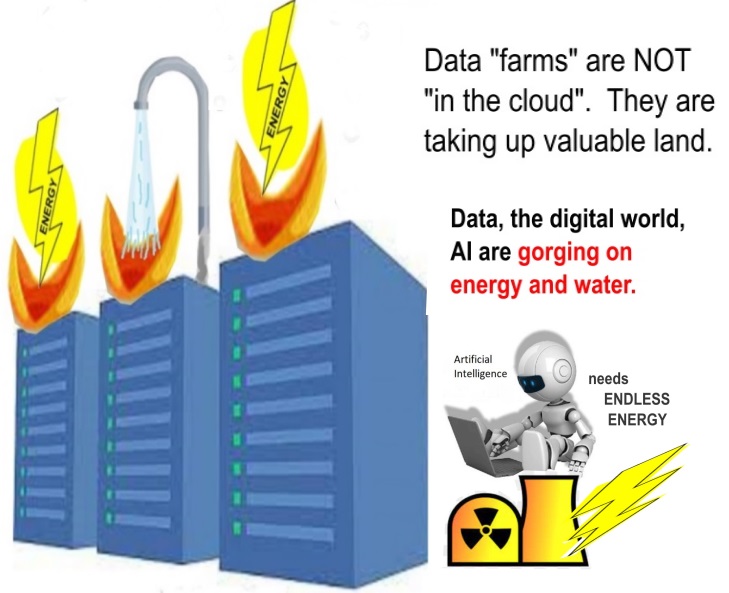
Three Mile Island will also be renamed the Crane Clean! Energy Center
Pennsylvania plant was site of most serious nuclear meltdown and radiation leak in US history in 1979
Guardian, Richard Luscombe, 21 Sept 24
A nuclear reactor at the notorious Three Mile Island site in Pennsylvania is to be activated for the first time in five years after its owners, Constellation Energy, struck a deal to provide power to Microsoft’s proliferating artificial intelligence operations.
The plant was the location of the most serious nuclear meltdown and radiation leak in US history, in March 1979 when the loss of water coolant through a faulty valve caused the Unit 2 reactor to overheat. More than four decades later, the reactor is still in a decommissioning phase.
Constellation closed the adjacent but unconnected Unit 1 reactor in 2019 for economic reasons, but will bring it back to life after signing a 20-year power purchase agreement to supply Microsoft’s energy-hungry data centers, the company announced on Friday……………
As part of the agreement, Three Mile Island will also be renamed the Crane Clean Energy Center to recognize Chris Crane, the former chief executive of Constellation’s parent company………………….
Significant investment will be required to restore the plant, including replacing or refurbishing the turbine, generator, main power transformer and cooling and control systems, Dominguez said.
There will also be a comprehensive safety and environmental review by the US Nuclear Regulatory Commission before it issues a permit for the restart of the reactor, which is scheduled to be online sometime in 2028. Constellation said it would seek licenses that will extend plant operations to at least 2054.
Tech giants including Microsoft, Google, Amazon, Meta and Apple are consuming ever-greater amounts of energy to power the boom in artificial intelligence. According to Goldman Sachs, demand will grow 160% by 2030, when data centers are expected to account for 8% of the power generated in the US.
With the spike in demand, however, comes rising concerns over the impact on the environment. An analysis by the Guardian published this week found that data center emissions of four of the biggest tech companies, Google, Microsoft, Meta and Apple, are probably about 662% – or 7.62 times – higher than officially reported. https://www.theguardian.com/environment/2024/sep/20/three-mile-island-nuclear-plant-reopen-microsoft
The World’s Chance To Confront US-Israeli Genocide
Popular Resistance, By Medea Benjamin and Nicolas J. S. Davies, Consortium News., September 18, 2024
As nations come together in the U.N. General Assembly on Wednesday, they face both a serious challenge and an unprecedented opportunity.
On Wednesday, the General Assembly is scheduled to debate and vote on a resolution calling on Israel to end “its unlawful presence in the Occupied Palestinian Territory” within six months.
Given that the General Assembly, unlike the exclusive 15-member Security Council, allows all members to vote and there is no veto in the General Assembly, this is an opportunity for the world community to clearly express its opposition to Israel’s brutal occupation of Palestine.
If Israel predictably fails to heed a General Assembly resolution calling on it to withdraw its occupation forces and settlers from Gaza, the West Bank and East Jerusalem, and the United States then vetoes or threatens to veto a Security Council resolution to enforce the ICJ ruling, then the General Assembly could go a step further.
It could convene an emergency session to take up what is called a Uniting For Peace resolution, which could call for an arms embargo, an economic boycott or other sanctions against Israel — or even call for actions against the United States.
Uniting for Peace resolutions have only been passed by the General Assembly five times since the procedure was first adopted in 1950.
The Sept. 18 resolution comes in response to an historic ruling by the International Court of Justice (ICJ) on July 19, which found that “Israeli settlements in the West Bank and East Jerusalem, and the regime associated with them, have been established and are being maintained in violation of international law.”
The court ruled that Israel’s obligations under international law include “the evacuation of all settlers from existing settlements” and the payment of restitution to all who have been harmed by its illegal occupation.
The passage of the General Assembly resolution by a large majority of members would demonstrate that countries all over the world support the ICJ ruling, and would be a small but important first step toward ensuring that Israel must live up to those obligations.
Israel’s President Benjamin Netanyahu cavalierly dismissed the court ruling with a claim that, “The Jewish nation cannot be an occupier in its own land.”
This is exactly the position that the court had rejected, ruling that Israel’s 1967 military invasion and occupation of the Occupied Palestinian Territories did not give it the right to settle its own people there, annex those territories, or make them part of Israel.
Settler Violence
While Israel used its hotly disputed account of the Oct. 7 events as a pretext to declare open season for the mass murder of Palestinians in Gaza, Israeli forces in the West Bank and East Jerusalem used it as a pretext to distribute assault rifles and other military-grade weapons to illegal Israeli settlers and unleash a new wave of violence there, too.
Armed settlers immediately started seizing more Palestinian land and shooting Palestinians. Israeli occupation forces either stood by and watched or joined in the violence, but did not intervene to defend Palestinians or hold their Israeli attackers accountable.
Since last October, occupation forces and armed settlers in the West Bank and East Jerusalem have now killed at least 700 people, including 159 children.
The escalation of violence and land seizures has been so flagrant that even the U.S. and European governments have felt obligated to impose sanctions on a small number of violent settlers and their organizations.
In Gaza, the Israeli military has been murdering Palestinians day after day for the past 11 months. The Palestinian Health Ministry has counted over 41,000 Palestinians killed in Gaza, but with the destruction of the hospitals that it relies on to identify and count the dead, this is now only a partial death toll.
Medical researchers estimate that the total number of deaths in Gaza from the direct and indirect results of Israeli actions will be in the hundreds of thousands, even if the massacre were to end soon.
Israel and the United States are undoubtedly more and more isolated as a result of their roles in this genocide. Whether the United States can still coerce or browbeat a few of its traditional allies into rejecting or abstaining from the General Assembly resolution on Sept. 18 will be a test of its residual “soft power.”……………………………………………………………………………………………………………….. more https://popularresistance.org/the-worlds-chance-to-confront-us-israeli-genocide/
-
Archives
- October 2026 (120)
- September 2026 (339)
- August 2026 (330)
- July 2026 (355)
- June 2026 (287)
- May 2026 (306)
- April 2026 (356)
- March 2026 (251)
- February 2026 (267)
- January 2026 (308)
- December 2025 (358)
- November 2025 (359)
-
Categories
- 1
- 1 NUCLEAR ISSUES
- business and costs
- climate change
- culture and arts
- ENERGY
- environment
- health
- history
- indigenous issues
- Legal
- marketing of nuclear
- media
- opposition to nuclear
- PERSONAL STORIES
- politics
- politics international
- Religion and ethics
- safety
- secrets,lies and civil liberties
- spinbuster
- technology
- Uranium
- wastes
- weapons and war
- Women
- 2 WORLD
- ACTION
- AFRICA
- Atrocities
- AUSTRALIA
- Christina's notes
- Christina's themes
- culture and arts
- Events
- Fuk 2022
- Fuk 2023
- Fukushima 2017
- Fukushima 2018
- fukushima 2019
- Fukushima 2020
- Fukushima 2021
- general
- global warming
- Humour (God we need it)
- Nuclear
- RARE EARTHS
- Reference
- resources – print
- Resources -audiovicual
- Weekly Newsletter
- World
- World Nuclear
- YouTube
-
RSS
Entries RSS
Comments RSS

