DoE awards next-gen nuclear fuel contracts backwards
‘Deconversion’ can begin now, but initial enrichment, transportation and storage to processors is still TBD
Brandon Vigliarolo, Tue 8 Oct 2024 /
The US Department of Energy has awarded shares of an $800 million contract for advanced nuclear fuel deconversion to four companies, but it’s unclear who will be in charge of getting refined fuel to those deconversion sites.
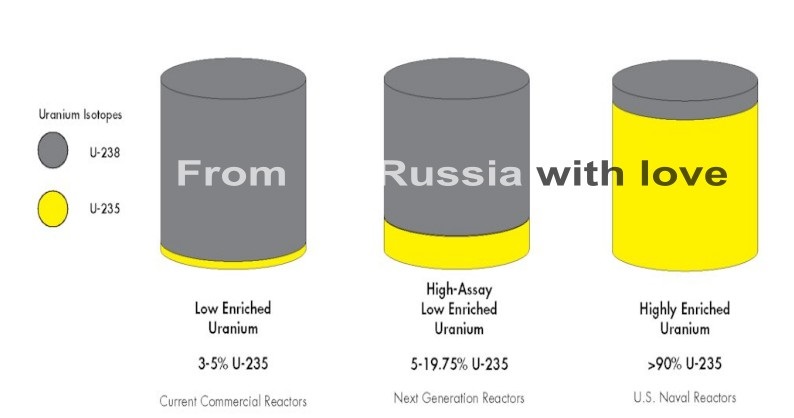
High-assay low-enriched uranium, or HALEU, is needed for nuclear reactor designs like small modular reactors (SMRs), molten salt reactors and other new variations that are supposed to be safer and more efficient. Unlike traditional nuclear fuel, which contains up to 5 percent uranium-235 (the isotope that’s used to power nuclear power plants), HALEU includes a large proportion of the fissile isotope (as much as 20 percent).
Unfortunately for American nuclear interests, HALEU production at scale is only really happening in two unfriendly countries: Russia and China. That situation has already caused delays for nuclear power projects like the Bill Gates-backed TerraPower plant in Wyoming.
With the DoE forecasting an annual need for 40 metric tons of the stuff per year by the end of the decade, the US has a serious need for US-made HALEU. The four deals announced Friday between the DoE and Global Nuclear Fuel – Americas, Nuclear Fuel Services, American Centrifuge Operating and Framatome for HALEU deconversion services will hopefully help do just that.
HALEU deconversion, which is conducted after the initial enrichment stage to ensure fuel has reached appropriate levels of U-235, turns enriched uranium hexafluoride gas into oxide, metal and other mineral forms usable as fuel. The DoE initially proposed the deconversion funding in October of last year.
Step 1: ???
Each company is guaranteed $2 million in funding at a minimum to deconvert and store HALEU fuel within the US, but whether they’ll be able to reach scale is another thing altogether.
As we’ve noted previously, American Centrifuge Operating was the only company in the United States creating HALEU fuel, which it only began doing late last year, producing the US’s first HALEU, but only 20 kilograms of it.
Israel Planning Major Attack on Iran
The US is coordinating with Israel on its plans.
by Dave DeCamp, October 2, 2024, https://news.antiwar.com/2024/10/02/israel-planning-major-attack-on-iran/#gsc.tab=0
Israel is planning to launch a “significant retaliation” attack against Iran over the Iranian missile barrage that targeted Israel on Tuesday, which was a response to several Israeli escalations in the region. Israeli officials acknowledged to Axios that the situation could lead to a full-blown regional war, which would involve the US.
According to the Axios report, Israel could target oil production facilities inside Iran or other strategic sites. Israeli officials say that if Iran hits back, then all options will be on the table, including strikes on Iran’s civilian nuclear facilities.
“We have a big question mark about how the Iranians are going to respond to an attack, but we take into consideration the possibility that they would go all in, which will be a whole different ball game,” an Israeli official told Axios.
Other options being considered are attacks on Iran’s air defenses or targeted assassinations. Israel has a history of killing people inside Iran, including the July 31 assassination of Hamas’s political chief, Ismail Haniyeh.
Israel would likely need US military support to launch significant strikes on Iranian territory, and the Israeli officials speaking to Axios say they are coordinating with the Biden administration. Israel wants more US support if it provokes another Iranian attack.
National Security Advisor Jake Sullivan said Tuesday that the US would work with Israel to ensure Iran faces “severe consequences.” President Biden has also said he is working with Israel on a response but said Wednesday that he wouldn’t support strikes on Iran’s nuclear facility.
“All seven of us agree that they have a right to respond, but they have to respond proportionally,” he said, referring to the Group of Seven nations. He said G7 leaders agreed to impose new sanctions on Iran, which will have little impact since Iran is already under so many.
Israel acknowledged on Wednesday that Iranian missiles made an impact on several military bases but claimed there was no significant damage. Israel is also claiming there were no major casualties, with only two Israelis suffering minor injuries. One Palestinian was killed in the Israeli-occupied West Bank when shrapnel from an intercepted missile hit him.
Iran fired about 180 ballistic missiles at Israel in response to the Israeli assassination of Haniyeh in Tehran and the Israeli killing of Hezbollah Secretary-General Hassan Nasrallah and Abbas Nilforoushan, an IRGC commander who was killed alongside Nasrallah.
‘Russia doesn’t want to use nuclear weapons’: The view from wartime Moscow
Putin is revising Russia’s nuclear doctrine at a critical juncture in Moscow’s full-scale invasion of Ukraine.
Aljazeera, By Niko Vorobyov, 7 Oct 2024
Russia, which holds the world’s largest stockpile of nuclear warheads, has unveiled its new nuclear doctrine, lowering its threshold for nuclear engagement while continuing its invasion of Ukraine.
The revised rules, outlined by President Vladimir Putin, say that an attack on Russia with “participation or support of a nuclear power” will be seen as their “joint attack on the Russian Federation”, seemingly responding to the possibility that Ukraine could strike targets deep within Russian territory using long-range weapons supplied by Western allies.
The United States, Ukraine’s most important ally, is the world’s second-largest nuclear power, with 5,224 warheads compared to Russia’s 5,889.
Alexey Malinin, the Moscow-based founder of the Center for International Interaction and Cooperation, told Al Jazeera that from the Russian perspective, a reassessment of nuclear capabilities was necessary in the face of encirclement by hostile powers.
But as panic sets in across some Western nations, Russian experts say Moscow does not want to tap into its arsenal.
“Russia does not want to use nuclear weapons, understanding the seriousness of the consequences of a conflict with the use of such weapons,” he said.
“However, at present, our country is forced to respond to the growing threats directed against us. The West continues to pump Ukraine with weapons, including F-16 fighters and long-range missiles like [US-made] ATACMS. Moreover, NATO is developing its infrastructure around the borders of Russia: new units are being created in Finland.”
He claimed that although Russia is trying to avoid the use of nuclear weapons, Moscow is “forced to demonstrate” that it is ready to defend “integrity and sovereignty” by any possible means”.
However, Kremlin critics worry that Putin is pushing closer towards, if not a nuclear apocalypse, then at least a regional humanitarian disaster.
“The USSR said that it would never strike first … Now Putin says that he will strike whenever he wants,” exiled politician Leonid Gozman wrote in the Novaya Gazeta newspaper…………………………..
During the Cold War, both Washington and Moscow operated on the principle of mutually assured destruction, the understanding that a nuclear strike from one side would prompt a response in kind, leading to an all-out atomic altercation and mass devastation on a global scale.
However, Putin is warning that Russia would use nuclear weapons in response to a “critical threat to our sovereignty” – referring to not necessarily a nuclear assault, but also a conventional one.
Alexandra, an everyday Russian in Moscow who works as an architect, told Al Jazeera: “I’m scared, but I don’t understand much of what’s going on.”
The Russian government and its supporters believe they are sending a strong signal to Ukraine’s Western allies, warning against interfering in the conflict.
Russian Foreign Minister Sergey Lavrov has warned the UN that should the West allow Ukraine to strike further into Russia, it will be dragging itself into a “suicidal escapade”.
“Whether or not they will provide the permission for Ukraine for long-range weapons, then we will see what their understanding was of what they heard,” he said recently.
Washington has recently greenlit additional aid for Ukraine, but permission to use US-supplied weapons does not yet go beyond what was previously agreed.
Writing on Telegram, the hawkish former President Dmitry Medvedev stated the new doctrine “could cool the passions of those opponents who have not yet lost their sense of self-preservation.”…………
https://www.aljazeera.com/news/2024/10/7/russia-doesnt-want-to-use-nuclear-weapons-the-view-from-wartime-moscow
Let’s remember the 365 days of genocide as well as October 7 attack.

Walt Zlotow, West Suburban Peace Coaliton, Glen Ellyn IL, 7 Oct 24
The Chicago Tribune editorial ‘Remember October 7, 2023’ was right to mourn the Israeli dead, injured and those taken hostage from the Hamas attack a year earlier.
But it’s unfortunate there was no mention of the of Israel’s genocidal ethnic cleansing that followed which has inflicted near total destruction on Gaza’s 139 square miles in the following 365 days. The Tribune ignores the over 40,000 officially dead (likely upwards of 100,000), nearly all schools universities, hospitals, homes destroyed and most food, water and medicine kept from reaching the most devastated people on earth.
It’s unfortunate that there is no mention that the year long genocide in Gaza could not be occurring without tens of billions in US weaponry flowing into Israel for their ‘defense.’ Genocide is not defense…it is genocide.
It is unfortunate there was no mention of the people Israeli genocide is designed to remove from Gaza and eventually the West Bank. Say the word Chicago Tribune Editorial Board…they are Palestinians.
For the Tribune to state that the horrors unleased over the past year “can no longer be contained” is an abrogation of the media’s role to provide a solution to the most grotesque destruction of a people in this century. To state “we suspect it (the anniversary) will not be seen as a day to discuss politics or even the ongoing conflict now raging on another front” is being blind to evil that must be confronted relentlessly.
This is precisely the day for the Chicago Tribune to engage its readership, regardless of ethnicity or religion, over the ongoing conflict. Had the Trib, along with the rest of mainstream media been doing just that for the past 365 days, this genocide might be over and negotiations for a Palestinian state underway.
At last – one corporate newsmedia admits there is no “cloud” – only dirty great steel structures

Stopping the great AI energy squeeze will need more than data centres
Amazon Web Services is currently rolling out €30bn of investments in
Europe amid a boom in artificial intelligence, according to Neil Morris,
its Irish head. But none of that bonanza is going to Ireland, because
Amazon officials worry about future energy constraints.
Indeed, there are reports that the company has already been rerouting some cloud activity
because of this. And while the Irish government has pledged to expand the
grid, mostly via wind farms, this is not happening fast enough to meet
demand. The water infrastructure is creaking too. Yes, you read that right:
an (in)famously wet and windy country is struggling to sustain tech with
water and wind power. There are at least four sobering lessons here. First,
this saga shows that our popular discourse around tech innovation is, at
best, limited and, at worst, delusional.
More specifically, in modern
culture we tend to talk about the internet and AI as if it they were a
purely disembodied thing (like a “cloud”). As a consequence,
politicians and voters often overlook the unglamorous physical
infrastructure that makes this “thing” work, such as data centres,
power lines and undersea cables.
But this oft-ignored hardware is essential
to the operation of our modern digital economy, and we urgently need to pay
it more respect and attention. Second, we need to realise this
infrastructure is also increasingly under strain. In recent years the
energy consumption of data centres has been fairly stable, because rising
levels of internet usage were offset by rising energy efficiency.
However, this is now changing fast: AI queries use around 10 times more energy than
existing search engines. Thus the electricity consumption of data centres
will at least double by 2026, according to the International Energy Agency
— and in the US they are expected to consume nine per cent of all
electricity by 2030. In Ireland the usage has already exploded to over a
fifth of the grid — more than households.
FT 4th Oct 2024,
https://www-ft-com.ezphost.dur.ac.uk/content/4fd66b27-f51b-4029-af3a-f5521368046f
Greenpeace warns of flooding risks at France’s biggest nuclear plant
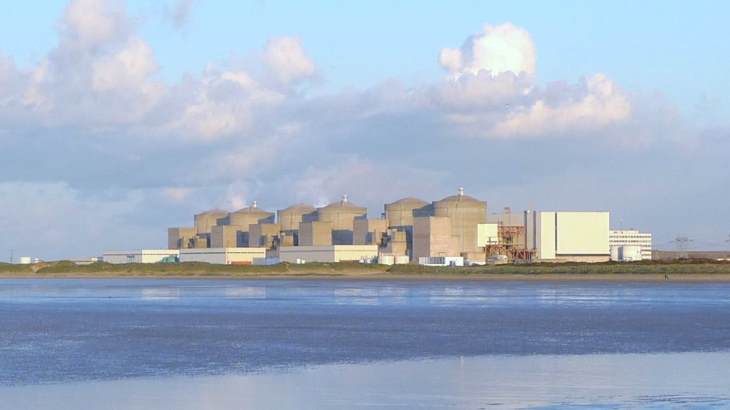
Greenpeace is urging French energy giant EDF to abandon its plans to build two new reactors at its Gravelines nuclear plant, citing the risk of flooding due to rising sea levels. The environmental group accuses the French nuclear industry of underestimating the threat to the coastal site.
04/10/2024 By:RFI
With six 900MW reactors, the Gravelines nuclear power plant on the Channel coast is already the most powerful in Western Europe.
EDF’s proposal to build two additional new generation pressurised water reactors (EPR2) of 1600 MW each is part of President Emmanuel Macron’s nuclear revival programme.
The new reactors are currently the subject of public debate. If they pass safety criteria laid down by France’s nuclear safety authority (ASN), construction would begin in 2031 and they could be on stream by 2040.
While they would be built on a 11-metre-high platform, Greenpeace claims there is a significant safety risk.
“The entire power plant site could find itself – during high tides and when there is a 100-year surge – below sea level” by 2100, it warned in a report published Thursday.
EDF refutes their calculations.
“The height of the platform chosen for the EPR2 reactors at Gravelines provides protection against “extreme” flooding, taking into account the effects of IPCC [Intergovernmental Panel on Climate Change] scenarios, which are among the most penalising with regard to sea-level rise”, EDF said in a statement to RFI.
Protective measures
Greenpeace argues that EDF’s calculations are outdated and do not fully account for the realities of global warming.
“We can’t think as if the current situation were going to remain stable and that sea levels were just going to rise a little”, says Pauline Boyer, Greenpeace’s energy transition campaigner.
The NGO has therefore based its projection on the IPCC’s most pessimistic scenario, which assumes that no action will be taken to reduce greenhouse gas emissions by 2100……………………….
Boyer believes a comprehensive risk study, factoring in climate change, “should govern the choice of site”, and be carried out before the public debate ends on 17 January.
While Greenpeace’s report centres on Gravelines, Boyer warned that climate change threatens other nuclear plants, with risks tied to rising temperatures and extreme weather events like storms.
She also pointed to potential conflicts over access to river water needed to cool reactors. https://www.rfi.fr/en/france/20241004-greenpeace-warns-of-flooding-risks-at-france-s-biggest-nuclear-plant
Fulsome bribery to communities – from Canada’s Nuclear Waste Management Organization (NWMO)

Frank Greening, 7 Oct 24
Canada’s Nuclear Waste Management Organization (NWMO) is using offers of money – and I’m talking about a lot of money in the millions of dollars range – to “persuade” local individuals or groups to vote in favor of constructing a DGR on their land. For example, consider the announcement by the township of Ignace after it agreed to allow NWMO to construct a used fuel DGR on its land:
There are of course many benefits to hosting the DGR in the area and these benefits will exceed the $170 Million monitory value of this agreement plus the cost of the Centre of Expertise, and thousands of dollars in housing, infrastructure, and capacity building studies to build the Township over the course of many years.
As we all know, NWMO is fond of saying that it will only proceed with the construction of a DGR at a particular location if there is a “willing host”. Now the dictionary definition of “willing” implies a readiness and eagerness to accede to or anticipate the wishes of another person or group. However, I’m sure if you asked the people of Ignace if they were ready and eager to host a DGR in their town, without any compensation or inducement, the answer would be a resounding NO! However, throw $170 million into the pot and everything changes! So, it’s obvious that the notion of “willingness” really means “a willingness to be bribed”.
Now some might argue that my use of the word bribe is too strong – dare I say offensive – but consider the dictionary definition of bribe: To give someone money or something else of value, to persuade that person to do something you want. In this case “you” means the NWMO, and what NWMO “wants” is a township’s approval of a DGR. I would argue, however, that the true meaning of willingness is acceptance without inducement!
I believe that NWMO know full well that, as the saying goes, “money talks”, and NWMO appears to have plenty of money to talk unwilling hosts into becoming willing hosts. In this regard, consider the opinion of a certain James Kimberly as expressed in his letter to the Fort Francis Times, dated December 6th, 2023:
The NWMOs proposed budget for 2023 is $162 million dollars. Projections to 2026 increase their budget to $299.8 million dollars increasing on average $40 million dollars per year. Their budget is broken into eight categories; engineering, site assessment, safety, regulatory decisions, engagement, transportation, communications, staffing and administration. All of the money the NWMO spends in their budget is derived from the public – people who pay the electricity bills. The interesting thing about their budget projection is the amount of money dedicated to the different activities.
Second to staffing and administration the next major expenditure is what they call “engagement”. There are no specific details on what “engagement” entails but I think one could safely state it is getting the public on side for their proposed dump. The engagement portion of their budget in 2023 is $47.8 million rising to $81.9 million by 2026. Other parts of their budget such as engineering, site assessment and safety come in at much lower costs literally a fraction of the staffing and engagement dollars.
According to NWMO’s projections over the next five years they will spend $359.3 million dollars of public money in trying to convince people their plan will work and that is just a part of their bottomless pit of money…..
So, I’m sure we can continue to present endless technical arguments against NWMOs plans to build a DGR, and I believe we are doing the right thing because we have the moral high-ground, but how can such arguments compete with NWMO’s bottomless pit of money?
and ……. it looks like Ignace is being short-changed!
Check out the South Bruce Hosting Agreement:
South Bruce stands to receive a stunning $418 million if it signs NWMO’s Hosting Agreement, (tabled in May of this year), and due to be voted on October 28th.
I would say, to quote a famous Mafia line, NWMO is making an offer South Bruce residents can’t refuse…
Carnegie nuclear expert James Acton explains why it would be counterproductive for Israel to attack Iran’s nuclear program
Bulletin, By John Mecklin | October 5, 2024
In the aftermath of Iran’s massive missile attack on Israel this week, it has become clear that Israeli missile defenses are robust. Of the estimated 180 ballistic missiles that Iran launched, only a small percentage evaded Israel’s anti-missile defenses, causing limited damage at or near some Israeli intelligence and military sites and apparently having little impact on Israeli military operations. But the attack marks a major escalation in the Israel-Iran conflict and has led to widespread speculation about when and where Israel will respond. Much of that speculation has centered on the question of whether Israel will attack facilities related to Iran’s nuclear program.
Late this week, I asked James Acton, a physicist and wide-ranging nuclear policy expert who co-directs the Nuclear Policy Program at the Carnegie Endowment for International Peace, for his assessment of the Israel-Iran situation, especially as regards the possibility of an Israeli attack on Iran’s nuclear facilities. His answers follow in a lightly edited and condensed Q&A format.
John Mecklin: I gather you think it would be a bad idea for Israel to attack Iran’s nuclear facilities. Can you explain why for our readers?
James Acton: Sure. If Israel or the United States tries to attack Iran’s nuclear facilities, my belief is that that will harden Iranian resolve to acquire nuclear weapons without eliminating Iran’s capability to do so. Israel would be motivated, in part, to punish Iran for its recent attack on Israel, using that as an opportunity to try and destroy Iran’s nuclear program, so the Israelis didn’t have to worry about it in the future. I think if they decide to attack Iran’s nuclear program, they will find themselves worrying much more about Iran’s nuclear program in the future. We’ll elaborate on this, but an attack would, I believe, simultaneously harden Iranian resolve to acquire nuclear weapons while also not destroying permanently their capability to achieve that goal…………………….
…………..If the Iranian program today comprised a single reactor that had not been turned on, I think you could make a fair argument that it could be in Israel’s interests to attack it. But that’s nothing like what the Iranian program actually looks like…..
……………..But the Iranian program today is based around centrifuges, which are very small and can be manufactured quickly and placed almost anywhere. So even if an Israeli attack destroys Iran’s current centrifuge plants at Fordow and Natanz—and it’s not obvious to me that Iran has the capability to destroy Fordow, which is buried inside a mountain—but even if Israel can destroy Iran’s existing centrifuge plants, Iran is almost certainly going to reconstruct centrifuge facilities………………………………………………………………….
So people tend to say the Israelis can destroy Iran’s nuclear weapons program. Even if that is true in the short term, the question they have to answer is: Then what?
Mecklin: Okay, the second question is: How likely do you think it is that Israel is actually contemplating attacking the nuclear facilities?
Acton: Let me distinguish between two ideas. Are they contemplating doing so? And will they do so?
I think there is an extremely high probability that there is a serious discussion going on right now in the Israeli Security Cabinet about whether to attack Iran’s nuclear facilities. Many Israeli leaders have openly called for that at this juncture. And you know, Netanyahu has been publicly mentioning this possibility on and off for many years now. So I would be staggered if there was not a serious discussion within Israel right now about attacking Iranian nuclear facilities.
Would Israel actually go ahead and do that? I think it would be tough without a lot of US support. And Biden has come out and said unequivocally, no. And doing it without US support would do enormous damage to the US Israeli relationship. And I think the Israelis understand that.
I think the Israelis fully understand that if they attack Iran’s nuclear program, Iran then attacks Israel in a much larger way than we’ve seen before. The Israelis are going to want America’s help in defending against those attacks, and there must be at least some uncertainty in their mind, if they just point blank defy an American president, whether that help would be forthcoming. So for all of those reasons, if the US is being as clear in private as it is in public, I do think it’s substantially less than 50/50 that the Israelis are going to attack Iranian nuclear facilities. I think it’s higher than 10 percent, but it’s not, I think, 50/50. Which I find somewhat reassuring.
………………………..one thing that I feel pretty confident in saying is that if Iran has not yet made a decision to build a nuclear weapon, an Israeli strike makes it much, much more likely that It will make that decision to do so—both for reasons of defending the state and for reasons of domestic politics…….. more https://thebulletin.org/2024/10/carnegie-nuclear-expert-james-acton-explains-why-it-would-be-counterproductive-for-israel-to-attack-irans-nuclear-program/?utm_source=Newsletter&utm_medium=Email&utm_campaign=MondayNewsletter10072024&utm_content=NuclearRisk_NuclearExpert_10062024#post-heading
US’ next-gen nuclear submarines suffer delay with costs soaring past $130 billion.

The US Navy’s next-generation nuclear submarines face delays and rising costs, surpassing $130 billion.
Interesting Engineering, Bojan Stojkovski Oct 05, 2024
A new report from the Government Accountability Office (GAO), a nonpartisan watchdog that reviews government operations for Congress, highlighted problems with the construction of the new submarines.
The GAO noted that both cost and schedule targets for the lead submarine have consistently been missed, according to the report released on Monday, Gizmodo reported.
“Our independent analysis calculated likely cost overruns that are more than six times higher than Electric Boat’s estimates and almost five times more than the Navy’s. As a result, the government could be responsible for hundreds of millions of dollars in additional construction costs for the lead submarine,” the GAO said in its report.Re-Timer and cold plasma, the best of IE this week
Navy plans to replace aging Ohio-class subs
The country’s nuclear weapons are deployed through three methods: intercontinental ballistic missiles launched from silos, bombs dropped from strategic bombers, and missiles fired from stealth submarines. …………………………………………………………………..
General Dynamics Electric Boat is currently building the first Columbia-class submarine, but the construction is facing significant challenges. According to the GAO report, the program has struggled with ongoing issues such as delays in materials and design products, despite efforts over the years to address these problems. The report also stated that swift and substantial action is needed to improve the construction performance.
Submarine construction faces skilled labor shortages
Some of the challenges are systemic, as there are few skilled workers in the US capable of building nuclear submarines. Between the 1980s and 2020, the submarine supplier base, which provides critical parts and materials, has drastically reduced from around 17,000 suppliers to just 3,500.
This has led Columbia-class shipbuilders to increasingly depend on single-source suppliers, limiting competition for contracts, according to the GAO.
As Defense One writes, the Navy and shipbuilders provide “supplier development funding” to support these critical suppliers. This funding is divided into two categories: “direct investments in suppliers,” which cover expenses like equipment, factory upgrades, and workforce development, and “specialized purchases to signal demand,” which involve placing orders to ensure that suppliers remain capable and motivated to produce, even when their products are not immediately required.
However, the GAO found that the Navy has not adequately assessed whether its financial investments in the supplier base are being utilized effectively. The GAO report outlined that the Navy has inconsistently defined the necessary information to evaluate whether these investments have led to increased production or cost savings and how these outcomes align with the program’s objectives https://interestingengineering.com/military/us-nuclear-submarines-delayed-exceeding-costs
Kazakhstan’s Nuclear Power Vote: Many Questions, But Just One On The Ballot

Radio Free Europe 5th Oct 2024
ALMATY, Kazakhstan — Kazakh voters will head to the polls on October 6 to decide whether to approve the construction of the first nuclear power plant in Kazakhstan — the world’s largest producer of uranium.
And the question on the ballot will be just that: “Do you agree to the construction of a nuclear power plant in Kazakhstan?”
But the debate surrounding nuclear energy is far more complex, taking in the heavy legacy of Soviet-era nuclear tests, long-standing nuclear-phobia, and unanswered questions around the companies — and countries — that would build the plant if voters endorse it.
Ahead of the first referendum in Central Asia on nuclear power, RFE/RL takes a closer look at that conversation.
What The Government Says
In many countries, national referendums can divide governing coalitions and spark cabinet resignations, but there is no sign of anything like that in Kazakhstan — the political elite is firmly behind the plan to build a nuclear power plant.
That extends from the government to the legislature, where all six parties support the idea, and where at least one lawmaker who initially opposed the plan now says he changed his mind.
The government’s main argument is that only nuclear power has the capacity to provide near-zero carbon energy on the scale required to cover a power deficit that grows year-on-year, especially in the southern half of the country.
Why Not Renewables?
While wind and solar’s overall share of the fossil-fuel-heavy national energy mix has grown to around 6 percent in recent years, Energy Minister Almasadam Satkaliev argues that renewables’ dependence on “natural and climatic conditions” make them too “unpredictable” on a large scale.
President Qasym-Zhomart Toqaev first floated the idea of using nuclear power in 2019.
Like other officials, he has assured Kazakhs that a future nuclear plant will be built with the latest technology to ensure the highest safety standards.
As the world’s largest uranium producer, he says it is time for Kazakhstan to move up the nuclear-fuel cycle.
Why Hold A Referendum?
That is a good question, given that any sort of popular vote carries a protest risk, and Kazakhstan’s authoritarian regime has only recently held parliamentary elections (March 2023) and a presidential election (November 2022).
But the country’s leadership knows that the issue is contentious — not least because the nation’s introduction to nuclear power began with the Soviet Union’s first nuclear bomb test in 1949, with hundreds more taking a terrible human and environmental toll in the northeastern Semei region……………………………………….
Is There A ‘No’ Campaign?
To the extent that Kazakhstan allows such things, there is.
But nuclear naysayers have been repeatedly blocked from holding demonstrations against the plan in various cities, and most recently found that a hotel in the largest city, Almaty — where they had earlier agreed to hold an event — was suddenly unwilling to host them.
At least five Kazakh activists opposed to nuclear power have been placed in pretrial detention on charges of plotting mass unrest early this month, while others have faced administrative punishment. https://www.rferl.org/a/kazakhstan-nuclear-power-referendum/33146657.html
On Army bases, nuclear energy can’t add resilience, just costs and risks
In this op-ed, Alan J. Kuperman argues that the risks of adding nuclear reactors to military bases outweigh any benefits.
By Alan J. Kupermanon October 07, 2024, https://breakingdefense.com/2024/10/on-army-bases-nuclear-energy-cant-add-resilience-just-costs-and-risks/?fbclid=IwY2xjawFxlwlleHRuA2FlbQIxMQABHZAdc8iogUaPZy6lBkxZanmlnIB3-Rh3nkB6DDMNuGH1snaqLwuI5-PJWA_aem_NL8jwrpce6F1ZUFkVDIG9A
Every now and then, the US government offers a huge subsidy to an industry on grounds that make no sense to anyone with even basic knowledge of the subject. The latest example, announced in June, is the Army’s Advanced Nuclear Power for Installations (ANPI) program to install small reactors on military bases, ostensibly to increase “energy resilience.”
This is perplexing for several reasons. First, such resilience can be provided much more effectively, safely, and cheaply with non-nuclear options. Second, nuclear reactors themselves cannot provide “resilience,” because their safe operation always has required input of electricity to the reactors from other power sources. Third, the Army’s planned reactors would lack a robust containment building, so an attack or accident could disperse radioactive waste, endangering base personnel and neighboring civilians.
Both the Army and taxpayers should cry foul on this indefensible waste of national security dollars.
Of course, energy resilience is a reasonable concern for Army bases, which now get their electricity from the commercial grid that is potentially subject to blackouts from bad weather or even cyberattacks. The simple and inexpensive solution, already utilized by military bases and other essential services including hospitals, is to maintain backup diesel fuel and generators for emergency use. It costs only about $2 million to $4 million for a set of diesel generators to produce 5 megawatts of electricity — the amount the Army seeks — and the diesel fuel would be cheap since the generators would operate only during rare emergencies.
By contrast, the price of a single nuclear reactor to produce the same five megawatts of electricity would be several hundred million dollars — roughly 100 times as expensive — according to government estimates and my previously published research. Even if, as the Army hopes, the reactor could replace the commercial grid as the primary source of power for the base, the electricity produced by the reactor would cost several times more than what the Army now pays for commercial electricity. So, regardless of whether the reactor was used for primary or backup power, Army costs would spike substantially.
What about resilience, which is the supposed justification for buying these expensive reactors? Well, even though reactors can produce electricity, they have always required an external source of electricity to keep them running safely — most crucially to cool the fuel to avoid a nuclear meltdown and radioactive release. The Army’s recent request for proposals seems to acknowledge this reality by saying that in addition to an external electricity source, the reactor must have an “alternative credited independent power source as a backup.”
Therefore, an Army base reactor would almost surely depend on drawing electricity from the commercial grid. But this means the reactor would be no more resilient than the existing power source it is supposed to replace to increase resilience. In the event of a blackout of the commercial grid, what would the reactor do to get essential electricity? Of course, it would turn on its backup diesel generators. However, if the base requires backup generators anyway, it has no need for the super-expensive reactor.
It gets even worse. To prevent costs from rising even higher, the nuclear industry has decided that its small reactors — the kind the Army is seeking — will be built without a containment building that could prevent radiation from escaping in the event of an accident. This also means the reactors would be more vulnerable to attack by aircraft, missiles, rockets, and drones.
A successful kinetic attack could spread radioactivity in at least two ways. First, like a “dirty bomb,” it could disperse the reactor’s solid irradiated fuel over a wide area into a few or many radioactive chunks that would be very hazardous if approached. Even worse, if the attack interrupted the reactor’s active or passive cooling, the fuel could overheat and breach its cladding, thereby allowing gaseous radioactivity to spread more widely.
Ironically, it is not clear if the Army even wants these nuclear reactors, which originally were proposed in 2018 by Congressional advocates of nuclear energy, who also have promoted nuclear reactors for Air Force bases and forward operating bases — including in war zones where they would be even more vulnerable.
Comments from Pentagon officials about these programs indicate that at least part of the motivation is to help America’s struggling nuclear reactor companies, which have yet to find a single private-sector customer for their small but pricey powerplants. The Defense Secretary’s manager for the Army’s mobile reactor project touts it as “a pathfinder to advanced nuclear reactors in the commercial sector.” A Deputy Assistant Secretary in the Air Force says, “We’re trying to … create a playbook of how other villages or communities and cities” can pursue “energy through a microreactor.”
But even if the civilian nuclear industry deserved additional subsidies, which is questionable, that would not justify wasting defense dollars on unnecessary reactors that could endanger our troops.
Truthfully, energy resilience for military bases is a real concern that deserves safe, effective, and economical solutions — but nuclear reactors satisfy none of those criteria.
Fortunately, we live in a democracy, so there is still a chance to stop these dangerous boondoggles. Service members and their dependents, communities near military bases, and taxpayers in general can and should call on Congress to suspend the ANPI program — and instead explore how its funding could be reprogrammed more productively.
Alan J. Kuperman is associate professor and coordinator of the Nuclear Proliferation Prevention Project (www.NPPP.org) at the LBJ School of Public Affairs, University of Texas at Austin.
It is Time to Expose the Great British Nuclear Fantasy Once and for All

Thomas, Stephen and Blowers, Andrew, It is Time to Expose the Great British Nuclear Fantasy Once and for All (September 30, 2024). Available at SSRN: https://ssrn.com/abstract=4971427 or http://dx.doi.org/10.2139/ssrn.4971427
Abstract
In April 2022, the then UK Prime Minister, Boris Johnson, set a target of 24GW of new nuclear capacity to be completed in Great Britain by 2050. At the heart of the proposal was the creation of a new government owned entity, Great British Nuclear (GBN), with a mission of ‘helping projects through every stage of the development process and developing a resilient pipeline of new builds’ designed to ensure energy security and to meet the UK’s commitment to achieving net zero.
Despite the sound and fury, the GBN project is bound to fail. Its contribution to achieving net zero by 2050 will be nugatory. No amount of political commitment can overcome the lack of investors, the absence of credible builders and operators or available technologies let alone secure regulatory assessment and approval
Moreover, in an era of climate change there will be few potentially suitable sites to host new nuclear power stations for indefinite, indeed unknowable, operating, decommissioning and waste management lifetimes. And there are the anxieties and fears that nuclear foments, the danger of accidents and proliferation and the environmental and public health issues arising from the legacy of radioactive waste scattered on sites around the country.
Finally Free, Assange Receives a Measure of Justice From the Council of Europe

In the U.S., “the concept of state secrets is used to shield executive officials from criminal prosecution for crimes such as kidnapping and torture, or to prevent victims from claiming damages,” the resolution notes. But “the responsibility of State agents for war crimes or serious human rights violations, such as assassinations, enforced disappearances, torture or abductions, does not constitute a secret that must be protected.”
In his first public statement since his release, Assange said, “I’m free today … because I pled guilty to journalism.”
By Marjorie Cohn , Truthout, October 4, 2024
he Parliamentary Assembly of the Council of Europe (PACE), Europe’s foremost human rights body, overwhelmingly adopted a resolution on October 2 formally declaring WikiLeaks founder Julian Assange a political prisoner. The Council of Europe, which represents 64 nations, expressed deep concern at the harsh treatment suffered by Assange, which has had a “chilling effect” on journalists and whistleblowers around the world.
In the resolution, PACE notes that many of the leaked files WikiLeaks published “provide credible evidence of war crimes, human rights abuses, and government misconduct.” The revelations also “confirmed the existence of secret prisons, kidnappings and illegal transfers of prisoners by the United States on European soil.”
According to the terms of a plea deal with the U.S. Department of Justice, Assange pled guilty on June 25 to one count of conspiracy to obtain documents, writings and notes connected with the national defense under the U.S. Espionage Act. Without the deal, he was facing 175 years in prison for 18 charges in an indictment filed by the Trump administration and pursued by the Biden administration, stemming from WikiLeaks’ publication of evidence of war crimes committed by the U.S. in Iraq, Afghanistan and Guantánamo Bay. After his plea, Assange was released from custody with credit for the five years he had spent in London’s maximum-security Belmarsh Prison.
The day before PACE passed its resolution, Assange delivered a powerful testimony to the Council of Europe’s Committee on Legal Affairs and Human Rights. This was his first public statement since his release from custody four months ago, after 14 years in confinement – nine in the Ecuadorian Embassy in London and five in Belmarsh. “Freedom of expression and all that flows from it is at a dark crossroads,” Assange told the parliamentarians.
A “Chilling Effect and a Climate of Self-Censorship”
The resolution says that “the disproportionately harsh charges” the U.S. filed against Assange under the Espionage Act, “which expose him to a risk of de facto life imprisonment,” together with his conviction “for — what was essentially — the gathering and publication of information,” justify classifying him as a political prisoner, under the definition set forth in a PACE resolution from 2012 defining the term. Assange’s five-year incarceration in Belmarsh Prison was “disproportionate to the alleged offence.”
Noting that Assange is “the first publisher to be prosecuted under [the Espionage Act] for leaking classified information obtained from a whistleblower,” the resolution expresses concern about the “chilling effect and a climate of self-censorship for all journalists, editors and others who raise the alarm on issues that are essential to the functioning of democratic societies.” The resolution also notes that “information gathering is an essential preparatory step in journalism” which is protected by the right to freedom of expression guaranteed by the European Court of Human Rights.
The resolution cites the conclusion of Nils Melzer, UN Special Rapporteur on torture and other cruel, inhuman or degrading treatment or punishment, that Assange had been exposed to “increasingly severe forms of cruel, inhuman or degrading treatment or punishment, the cumulative effects of which can only be described as psychological torture.”
Condemning “transnational repression,” PACE was “alarmed by reports that the CIA was discreetly monitoring Mr. Assange in the Ecuadorian embassy in London and that it was allegedly planning to poison or even assassinate him on British soil.” The CIA has raised the “state secrets” privilege in a civil lawsuit filed by two attorneys and two journalists over that illegal surveillance.
In the U.S., “the concept of state secrets is used to shield executive officials from criminal prosecution for crimes such as kidnapping and torture, or to prevent victims from claiming damages,” the resolution notes. But “the responsibility of State agents for war crimes or serious human rights violations, such as assassinations, enforced disappearances, torture or abductions, does not constitute a secret that must be protected.”
Moreover, the resolution expresses deep concern that, according to publicly available evidence, no one has been held to account for the war crimes and human rights violations committed by U.S. state agents and decries the “culture of impunity.”
The resolution says there is no evidence anyone has been harmed by WikiLeaks’ publications and “regrets that despite Mr Assange’s disclosure of thousands of confirmed — previously unreported — deaths by U.S. and coalition forces in Iraq and Afghanistan, he has been the one accused of endangering lives.”
Assange’s Testimony
The testimony Assange provided to the committee was poignant. “I eventually chose freedom over realizable justice … Justice for me is now precluded,” Assange testified. “I am not free today because the system worked. I am free today after years of incarceration because I pled guilty to journalism.” He added, “I pled guilty to seeking information from a source. I pled guilty to obtaining information from a source. And I pled guilty to informing the public what that information was.” His source was whistleblower Chelsea Manning, who provided the documents and reports to WikiLeaks. “Journalism is not a crime,” Assange said. “It is a pillar of a free and informed society.”………………………………………………………………………………
PACE Urges US to Investigate War Crimes
The resolution calls on the U.S., the U.K., the member and observer States of the Council of Europe, and media outlets to take actions to address its concerns.
It calls on the U.S., an observer State, to reform the Espionage Act of 1917 to exclude from its operation journalists, editors and whistleblowers who disclose classified information with the aim of informing the public of serious crimes, such as torture or murder. In order to obtain a conviction for violation of the Act, the government should be required to prove a malicious intent to harm national security. It also calls on the U.S. to investigate the allegations of war crimes and other human rights violations exposed by Assange and Wikileaks.
PACE called on the U.K. to review its extradition laws to exclude extradition for political offenses, as well as conduct an independent review of the conditions of Assange’s treatment while at Belmarsh, to see if it constituted torture, or inhuman or degrading treatment.
In addition, the resolution urges the States of the Council of Europe to further improve their protections for whistleblowers, and to adopt strict guidelines to prevent governments from classifying documents as defense secrets when not warranted.
Finally, the resolution urges media outlets to establish rigorous protocols for handling and verifying classified information, to ensure responsible reporting and avoid any risk to national security and the safety of informants and sources.
Although PACE doesn’t have the authority to make laws, it can urge the States of the Council of Europe to take action. Since Assange never had the opportunity to litigate the denial of his right to freedom of expression, the resolution of the Council of Europe is particularly significant as he seeks a pardon from U.S. President Joe Biden. https://truthout.org/articles/finally-free-assange-receives-a-measure-of-justice-from-the-council-of-europe/
Netanyahu’s dangerous gambit to start nuclear war

by Hakkı Öcal, Oct 07, 2024 more https://www.dailysabah.com/opinion/columns/netanyahus-dangerous-gambit-to-start-nuclear-war
He is doing everything to unite all Muslims and to sever the Western civilization’s centuries-old relations with the Islamic world.
My realism-in-international-relations-theory cap on: Unless you make it intentionally, peace cannot occur all by itself. But wars can. You don’t have to do anything special to start a war. But if there is a war you want to start and for some reason, you yourself cannot initiate it, then you find a dog. After all, why keep a dog and bark yourself?
Now, the cap off; back to what is really happening!
Israeli Prime Minister (or the prime suspect of the only genocide of the 21st century that has been going on for the last year) Benjamin Netanyahu started a deluge in his country, and now he is about to let in all those who facilitated his genocide on the prospect of exterminating at least 2 millions of Tehran residents and making about 100 million people injured and sick in Iran and neighboring countries that is on the path of the wind storms of the thermo-nuclear weapons he is going to drop on Iran.
That seems the only way for Netanyahu to keep himself out of Israeli prison: It would gratify the Zionist Armageddon troops in his coalition government who would never allow the Jerusalem District Court to put its claws on him in one count of bribery and three of fraud; he denies them all. His wife and other family members have been involved in all cases.
Netanyahu refused to resign for the trial; he argued that it would not contradict his work. His trial was suspended in October due to Hamas’s Oct. 7, 2023, raid in the occupied territories; his lawyers asked for another delay claiming he does not have time to prepare, and he will only be able to testify in March of next year. That is, Netanyahu needs to prolong that war to something large and endless like George W. Bush’s “War on Terror.”
As the Hamas Raid provided the favorable circumstances to begin his coalition partners’ plan for the “Final Solution in Palestine,” now he has ample opportunity to respond to the 200 plus rockets the Iranian Mullahs fired on Israel last week as retaliation to Israel’s killing Hezbollah leaders in Lebanon. Now it is Netanyahu’s turn to retaliate against Iran’s counterretaliation. That is his last opening to spread his war on Gaza to the entire Shiite Crescent, starting at the two ends of it, Lebanon and Yemen, and reaching to the center: Iran, itself.
Netanyahu’s Likud has seven coalition partners – United Torah Judaism, Shas, Religious Zionist Party, Otzma Yehudit, New Hope and Noam – and they actually keep him trapped inside the hardline coalition. His partners are spending billions of dollars in the Occupied Territories opening new settlements and religious schools. Hard-line religious parties allowed gun ownership without investigation. If Netanyahu ever objects to any of these government decrees, his National Security Minister Itamar Ben-Gvir the leader of the far-right Jewish Power party, threatened to end the coalition, which might mean Netanyahu goes to prison with his wife.
This political paralysis will not only keep him doing whatever Ben-Gvir wants him to do, but he has to gear up so that he keeps his allies at the U.N. Security Council, the U.S., Britain and France, on a leash. He knows that in America going to a fateful election would not allow him to keep the Israeli armed forces permanently in the Gaza Strip. America wants Israel to withdraw completely, to let the Palestinian Authority take control. Netanyahu cannot accept cooperation with the Palestinians and he can no longer oppose the U.S. demands. The only way out for him seems to raise the level of hostilities in the region.
State built on blood
Israel was created (at the expense of the Ottoman Empire) to provide a safe refuge for Jews. But it has never been what it was intended for. Since its establishment in 1948, over 20,000 Jews have been killed and over 100,000 of them injured and maimed in the wars the Israeli government started. Not all the Israeli prime ministers were warmongers. Yitzhak Rabin, the fifth prime minister of Israel, for instance, wanted to put an end to the violence caused by Israel’s rejection of the U.N.’s partition of Palestine between the Jews and native Muslims and Christians. He signed the Oslo Accords to finally make peace in Palestine. But Yigal Amir, an Israeli law student and ultranationalist who radically opposed Prime Minister Yitzhak Rabin’s peace initiative, particularly the signing of the Oslo Accords, killed him. Guess who benefited from this political murder?
After a brief interval of seven months with Shimon Peres, Netanyahu became the prime minister and again with a coalition of religious hardliners, he rejected the peace accords Rabin signed and began occupying the Palestinian villages and towns.
According to Mouin Rabbani, former senior analyst at the International Crisis Group and co-editor of Jadaliyya Ezine magazine, Netanyahu has three modi vivendi since his first tour of government in 1996. The first is to launch outrageous provocation guaranteed to elicit an armed response. The second is to use overwhelming firepower to kill Arabs and remind them who is boss. The third and the last is to mobilize foreign parties to quickly restore calm on improved conditions.
Forcing their hands
Now Netanyahu is the prime minister for the sixth time, and he has successfully paved the way to elicit any support not only from the U.S. but also from the British, French and German governments.
If, for any reason, he cannot drag the American generals with him into a disastrous war in Iran, there is a way to bring peace to Palestine. American politicians and their trigger-happy generals (who, overruling President Kennedy’s objection, helped Israel go nuclear in the first place) should understand that millions of dead people in Iran and their neighbors, a devastated Tehran and the misery that would follow would make all the Muslim people in the region, Türkiye included, turn their back on the West for good. Those generals should not even think that Iran is a Shiite country and most of the Arabs and Turks are not, so they won’t really bother about the mass killings and devastation in Iran! Even one single, small Jericho rocket with a nuclear bomb would not only demolish the years of efforts to win the hearts and minds of the Middle Eastern nations, but also any future cooperation between the West and the East would be impossible for the foreseeable future.
As professor Stephen Walt, whose realistic cap and basic teachings I borrowed here, says: “If you don’t want someone to do something, you don’t give them the means to do it. One must therefore conclude the U.S. government does not object to what Israel has been doing for the past year.”
We hope the U.S. still has the final control of Netanyahu’s push-button of those bombs which U.S. President Johnson acquiesced to be built in the Negev Desert in Israel after Kennedy was assassinated. (No, I don’t mean that Kennedy was killed by the Israeli Zionists!)
Nuclear Waste Storage Site in Texas Draws Supreme Court Review

by Bloomberg, Greg Stohr, Saturday, October 05, 2024 https://www.rigzone.com/news/wire/nuclear_waste_storage_site_in_texas_draws_supreme_court_review-05-oct-2024-178321-article/
The US Supreme Court will consider reviving a plan to store as much as 40,000 tons of highly radioactive waste at a temporary west Texas site, accepting a case that could be a turning point after decades of wrangling over spent fuel from the nation’s commercial reactors.
Agreeing to hear appeals from the Biden administration and the joint venture that would build and run the facility, the justices said they will review a federal appeals court ruling that the Nuclear Regulatory Commission lacked authority to issue a crucial license.
The above-ground site outside the town of Andrews in the Permian Basin oil field would be the first of its kind, designed to take waste from commercial reactors around the country until a long-running fight over a permanent storage location is resolved.
The plan has the backing of the nuclear power industry. It’s opposed by Texas Governor Greg Abbott and a coalition of landowners and oil and gas operators who call the planned facility a public-health hazard.
In its appeal, the Biden administration said the 5th US Circuit Court of Appeals upended more than 40 years of NRC practice by concluding the Atomic Energy Act didn’t authorize the license. The decision put the 5th Circuit, perhaps the country’s most conservative federal appeals court, in conflict with other appellate panels.
The ruling “disrupts the nuclear-power industry by categorically prohibiting the commission from approving offsite storage of spent fuel, despite the agency’s longstanding issuance of such licenses,” Solicitor General Elizabeth Prelogar argued. She also contends that Texas and other opponents lack the legal right to challenge the decision in court.
Texas Attorney General Ken Paxton urged the justices not to hear the case. He said federal law expressly requires the nation’s nuclear waste to be stored at Yucca Mountain, Nevada, where efforts to build a facility have been scuttled by local opposition.
“Congress specified that the nation would dispose of its nuclear waste at a government-owned facility at Yucca Mountain,” Paxton argued. “By no means can the commission solve its Yucca Mountain problem by disregarding clear statutory language.”
Fasken Land and Minerals Ltd., which owns hundreds of thousands of acres in the Permian Basin, told the justices that the NCR has never authorized a comparable facility, saying that existing temporary storage sites are either owned by the government, located on the sites of decommissioned reactors or in one case set up a half-mile from a working reactor.
The company that would run the site, Interim Storage Partners LLC, joined the federal government in urging Supreme Court review. Interim is a joint venture owned by a unit of Orano SA and J.F. Lehman & Co.’s Waste Control Specialists LLC. The joint venture envisions having nuclear waste shipped by rail from around the country and sealed in concrete casks.
The business-backed Nuclear Energy Institute said the 5th Circuit ruling “will have far-reaching and destabilizing consequences for the nuclear industry if allowed to remain standing.” The group told the justices in court papers that the Texas facility would save the industry more than $600 million as compared to continued onsite storage.
The fight is likely to determine the fate of Holtec International Corp.’s separate planned facility in New Mexico. The 5th Circuit blocked that project in March, pointed to its earlier decision in the Texas case.
The Supreme Court will hear arguments, likely early next year, and rule by early July.
The cases are Nuclear Regulatory Commission v. Texas, 23-1300, and Interim Storage Partners v. Texas, 23-1312.
-
Archives
- October 2026 (112)
- September 2026 (339)
- August 2026 (330)
- July 2026 (355)
- June 2026 (287)
- May 2026 (306)
- April 2026 (356)
- March 2026 (251)
- February 2026 (267)
- January 2026 (308)
- December 2025 (358)
- November 2025 (359)
-
Categories
- 1
- 1 NUCLEAR ISSUES
- business and costs
- climate change
- culture and arts
- ENERGY
- environment
- health
- history
- indigenous issues
- Legal
- marketing of nuclear
- media
- opposition to nuclear
- PERSONAL STORIES
- politics
- politics international
- Religion and ethics
- safety
- secrets,lies and civil liberties
- spinbuster
- technology
- Uranium
- wastes
- weapons and war
- Women
- 2 WORLD
- ACTION
- AFRICA
- Atrocities
- AUSTRALIA
- Christina's notes
- Christina's themes
- culture and arts
- Events
- Fuk 2022
- Fuk 2023
- Fukushima 2017
- Fukushima 2018
- fukushima 2019
- Fukushima 2020
- Fukushima 2021
- general
- global warming
- Humour (God we need it)
- Nuclear
- RARE EARTHS
- Reference
- resources – print
- Resources -audiovicual
- Weekly Newsletter
- World
- World Nuclear
- YouTube
-
RSS
Entries RSS
Comments RSS

