French State Spars With EDF Over Multibillion-Euro Reactor Plan
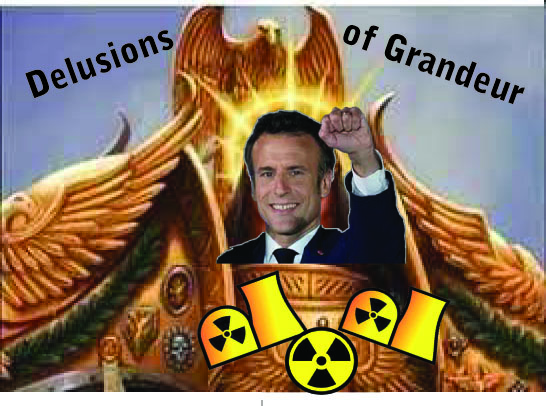
French government officials took issue with Electricite de France SA’s plan to build six nuclear plants, saying cost estimates are too broad and reactor designs not firmed up, according to people with knowledge of recent talks.
Bloomberg News, Francois de Beaupuy, Feb 14, 2025 – https://financialpost.com/pmn/business-pmn/french-state-spars-with-edf-over-multibillion-euro-reactor-plan
EDF’s board met with state representatives last week amid growing concern that the company and its suppliers are far from ready to launch a project deemed key to France’s long-term energy security. The world’s biggest nuclear-plant operator needs to prove it has a credible plan after long delays and cost overruns at other reactor developments caused debts to balloon.
Officials at the Feb. 5 meeting characterized state-owned EDF’s presentation as unconvincing on both budget and reactor design, the people said, asking not to be identified discussing private talks.
A French state auditor said last month that a final investment decision on the six reactors should be made only once their design is well advanced and funding finalized. It said the estimated bill for construction, excluding financing costs, had swelled to almost €80 billion ($84 billion) when accounting for inflation.
The criticism at last week’s presentation went both ways. EDF Chief Executive Officer Luc Remont railed against the government for enacting a finance bill that doesn’t specify tax rates on future windfall revenues, the people said. Several board members also expressed concerns about the uncertainty surrounding the level of state aid for reactor projects, the people said.
Spokespeople for EDF and the government’s shareholding agency declined to comment.
Slow progress is not only fueling tensions between EDF and the government. It also threatens to undermine preparations along the supply chain for reactor construction. In the past two years, EDF has seen US and Korean competitors make inroads in European markets as its own proposals were overlooked.
Nuclear Revival
The difficulties faced by a nuclear behemoth such as EDF may also raise questions over the speed and breadth of an atomic-power renaissance across Europe, with many countries planning new reactors to cut emissions from power generation and bolster energy security.
Back in July, EDF’s Remont expressed hope that a state support package for the six new reactors would be agreed upon by the end of 2024, paving the way for a final investment decision by the end of 2025 or early next year.
Already on the back foot, EDF must now move quickly to pin down costs and designs so that the government can work out the necessary support and seek approval from European competition authorities, the people said. The state aid needs to be fine-tuned to limit any remedies requested by Brussels, they said.
Netanyahu’s Quest to Attack Iran’s nuclear facilities with the ‘Mother of all Bombs’
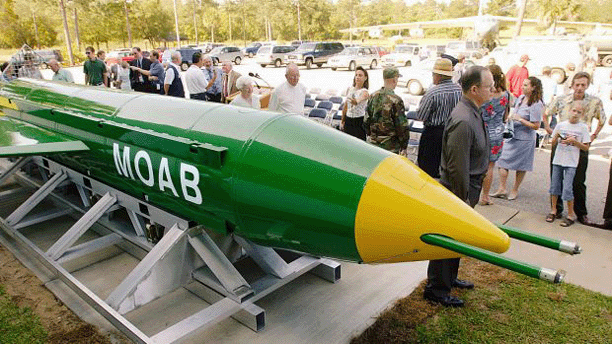
“Mother of all Bombs” into nuclear facilities?
Until recently, Israel lacked “bunker buster” bombs and the capacity to mount
a sustained air attack that would destroy Iran’s entire nuclear program. But
perhaps not anymore.
In January, US military intelligence already assessed that, absent an
agreement, Israel would probably strike Iran’s nuclear facilities, most likely the
Fordow enrichment plant, an Iranian underground uranium enrichment facility
20 miles (32 km) from the city of Qom, in the first half of 2025.
By Dan Steinbock, https://www.juancole.com/2025/02/netanyahus-attack-mother.html
The emboldened Netanyahu cabinet is in a war path, again. It is mobilizing to attack Iran and lobbying President Trump into a plan that presumably would use the ‘Mother of All Bombs.
In a press conference with US Secretary of State Marco Rubio, Israeli Prime
Minister Benjamin Netanyahu vowed to “finish the job” against Iran with the
support of President Trump.
Ever since his rise to power in the late 1990s, Israeli Prime Minister Benjamin
Netanyahu has worked toward a war with Iran, presumably to demolish
Tehran’s nuclear facilities but also to ensure its power projection in the region.
Now the emboldened Netanyahu wants to finish the job, decimate Iran’s
nascent nuclear capabilities, undermine Tehran’s future and overthrow its
rulers. After the misguided wars in Iraq and Afghanistan, Washington’s
neoconservative empire-builders are also back, pushing still another forever
war for a “paradigm shift in the Middle East.”
The Israel-Iran scenarios
Israeli Prime Minister Benjamin Netanyahu has discussed with Trump several
possible levels of American backing. According to Israeli observers, there are
now four viable scenarios for an Israeli attack against Iran’s nuclear facilities,
as seen in the light of US-Israeli relations. Let’s name them.
In the cooperative scenario, the US and Israel cooperate in an attack against
Iran’s nuclear sites, which will be followed by Trump’s ultimatum that Iran must
entirely dismantle its military nuclear program.
In the clash scenario, the Trump administration would build on diplomacy to
seal a nuclear deal. Yet, Israel would attack on its own and thereby undermine
Trump’s efforts causing a bilateral drift between the two countries.
In the investment scenario, Saudi Arabia would offer the US hundreds of
billions of dollars in investment, to avoid a destabilization in the region that
could undermine Riyadh’s 2030 modernization program.
In the solo scenario, Israel attacks Israel’s nuclear facilities without direct US
cooperation, but with the tacit consent of the White House. This would happen
after the Trump administration’s threats and coercive diplomacy against Iran.
Ultimately, US priorities will matter the most. But these can be elusive and
contradictory. Some in the Congress have called for more US military action,
including direct attacks against Iran. Others have echoed the Biden
Administration’s calls for restraint and de-escalation.
Here’s the problem: any escalation with Iran, whether by the US, Israel or
both would likely regionalize the Gaza devastation, which is mis-aligned with
Trumps’ economic and geopolitical goals in the Middle East.
Targeting Iran
Ever since the Islamic Revolution in 1979, when President Carter froze
billions of dollars in Iranian assets, Washington has sought to restore the
status quo ante of the Shah that had made Iran safe to American capitalism.
In the 1980s, US intelligence and logistics played a vital role in arming
Baghdad in the Iran-Iraq War, perhaps the most lethal conventional war
between developing countries yet, with total casualty estimates up to 1 to 2
million. In 1988, the US launched an attack against Iran, presumably in
retaliation for Iran’s laying mines in areas in the Gulf. In the mid-90s, the
Clinton administration declared a total embargo on dealings with Iran.
In 2002, President Bush included Iran in his “Axis of evil” speech.
Subsequently, US and Israel cooperated in training secessionist forces in
Iran’s Kurdistan province. In 2007, US reportedly vetoed an Israeli plan to
bomb Iranian nuclear facilities. Instead, during the next three years, the US
and Israel deployed the Stuxnet virus, the world’s first offensive cyber
weapon, to destroy almost a fifth of Iran’s nuclear centrifuges.
In 2015, years of challenging talks resulted in a nuclear deal (Joint
Comprehensive Plan of Action, JCPOA) between Iran, the US and a set of
world powers. Despite Iran’s adherence to it, the Trump administration pulled
the US out of the deal in 2018. As tensions escalated, the Trump
administration assassinated Iran’s most important general, Qasem Soleimani,
in a deadly drone strike in January 2020.
The longstanding quest for Iran War
While the covert war in the shadows has prevailed since the Islamic
Revolution, US regime change efforts moved to a new stage during the Bush
administration. Since 2003, US Army has conducted an analysis called
TIRANNT (Theater Iran Near-Term) for a full-scale war with Iran. Reportedly,
this plan (CONPLAN 8022) would be activated in the eventuality of a Second
9/11, on the presumption that Iran would be behind such a pivotal operation.
That may be one reason why Israeli UN ambassador Gilad Erdan and PM
Netanyahu explicitly compared Hamas’s October 7 offensive to the 9/11 terror
attacks, which sparked the US. global war on terror. Concurrently, many in
Washington sought a pretext for a link with Iran, to legitimize a major regional
conflict. In contrast, the U.S. Directorate of National Intelligence assessed that
Iran had no foreknowledge of or involvement in the October 7 attacks.
For its part, Netanyahu’s government calculated that an Iran conflict could
divert mounting negative public attention from atrocities in Gaza and the West
Bank.
There were precedents. In 2011 Netanyahu had ordered the Mossad and IDF
to prepare for an attack on Iran within 15 days. Yet, Mossad’s chief Tamir
Pardo and chief of staff Benny Gantz, the opposition’s key member in
Netanyahu’s war cabinet, questioned the PM’s legal authority to give such an
order without the cabinet’s approval. Netanyahu had backed off.
A month after the Hamas offensive, Netanyahu’s Mossad chief David Barnea
stated Iran had stepped up terror worldwide.” If Israelis or Jews are harmed,
he added, Israel’s response would go to Tehran’s “highest echelon.”
Using October 7 against Iran
In April 2024, Israel bombed Iranian embassy in Damascus in which 16
people were killed, including the targets, half a dozen high-level officers of the
Islamic Revolutionary Guard Corps (IRGC).
The IRGC launched a broad retaliatory attack against Israel and the Israeli-
occupied Golan Heights with successive waves of drones, cruise missiles,
and ballistic missiles. Giving full public notice that its response was on the
way, Tehran designed it carefully as a show of force that would not trigger a
wave of escalation. It caused minimal damage in Israel. However, as Israel
would later acknowledge, despite containment efforts by the US, the UK,
France and Jordan, some of Iran’s ballistic missiles penetrated Israel’s
defenses, hitting the Nevatim Airbase in southern Israel.
Iran’s attack targeted Israeli territory as a warning shot. It demonstrated
Tehran’s ability to counteract Israel’s huge air superiority, though lacking a
modern air force of its own. It also highlighted Israel’s dependency on major
Western powers to protect itself and the inadequacy of that protection.
So, how would Israel respond to a conventional “existential crisis” with Iran?
In late 2023, the hypothesis was tested in a high-level US war game.
Intriguingly, initially the US participants presumed that self-restraint would
prevail in this high-level war game. Yet, the simulation’s cold logic compelled
them into a sequence of steps that quickly went nuclear.
“Mother of all Bombs” into nuclear facilities?
Until recently, Israel lacked “bunker buster” bombs and the capacity to mount
a sustained air attack that would destroy Iran’s entire nuclear program. But
perhaps not anymore.
Recently, German newspaper “Bild” revealed that the US envoy to the Middle
East, Steve Witkoff, announced Washington’s intention to deliver one of the
most powerful non-nuclear weapons systems to Israel, known as the “Mother
of All Bombs.” Reportedly, Pentagon denies the story.
Weighing almost 10,000 kg, the GBU-43/B Massive Ordnance Air Blast
(MOAB) bomb can destroy deep underground bunkers. The explosive yield is
comparable to that of small tactical nuclear weapons.
In January, US military intelligence already assessed that, absent an
agreement, Israel would probably strike Iran’s nuclear facilities, most likely the
Fordow enrichment plant, an Iranian underground uranium enrichment facility
20 miles (32 km) from the city of Qom, in the first half of 2025.
First tested in 2003, the “Mother of All Bombs,” a 30,000-pound (14,000-
kilogram) monster was used for the first time in combat in 2017 in Afghanistan
by the Trump administration, despite the dire collateral damage.
Whether such use of the MOAB would spark a regional war or trigger waves
of new terror and insurgencies in the Middle East is a matter of debate. But it
would mean a potentially catastrophic escalation in the region and reshape
geopolitical landscape in the early 21 st century.
The author of The Fall of Israel (2025), Dr Dan Steinbock is the founder of
Difference Group and has served at the India, China and America Institute
(US), Shanghai Institute for International Studies (China) and the EU Center
(Singapore). For more, see https://www.differencegroup.net/
High-Explosive Drone Pierces Shell Of Chernobyl Nuclear Plant At Very Moment Trump Pushes Ukraine Toward Peace
by Tyler Durden, Saturday, Feb 15, 2025, https://www.zerohedge.com/geopolitical/high-explosive-drone-pierces-shell-chernobyl-nuclear-plant-very-moment-trump-pushes
On Friday just prior to high-level meetings among Western security officials and Ukrainian leadership commencing in Munich, including US Vice President J.D. Vance and Zelensky, there was a dangerous incident at the Chernobyl Nuclear Power Plant in Ukraine’s Kyiv oblast.
Ukraine’s President Zelensky accused Russia of launching a drone equipped with a high-explosive warhead at the historic, defunct power plant, site of the April 1986 nuclear disaster and meltdown. The drone reportedly hit the protective containment shell of the Chernobyl plant.
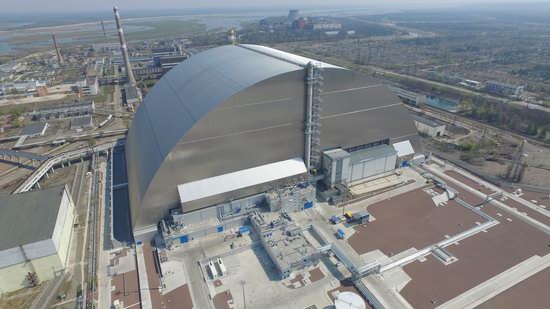
Zelensky’s office released footage showing an impact to the giant concrete and steel shield protecting the remains of the nuclear reactor. BBC writes that “The shield is designed to prevent further radioactive material leaking out over the next century. It measures 275m (900ft) wide and 108m (354ft) tall and cost $1.6bn (£1.3bn) to construct.”
And WaPo details further of the looming potential dangers:
In 2019, construction was completed on the New Safe Confinement — a $1.7 billion arch-shaped steel structure, which would contain the destroyed reactor. The site still contained some “200 tons of highly radioactive material,” according to the European Bank of Reconstruction and Development, which helped finance the project.
Thus the situation is deeply alarming given the potential for a new radiation leak at the site which could impact the region, or even Europe. An IAEA team on the ground said it heard an explosion at around 01:50 local time coming from the New Safe Confinement (NSC) shelter. Photos showed flames at the top of the huge structure.
The UN agency is on high alert, but issued a statement saying the drone strike did not breach the plant’s inner containment shell. The IAEA also did not attribute blame, not identifying who sent the drone.
The Kremlin strongly rejected that it was behind the incident:
“There is no talk about strikes on nuclear infrastructure, nuclear energy facilities, any such claim isn’t true, our military doesn’t do that,” Peskov told reporters in a call.
Russian state media has meanwhile been warning of efforts by bad actors to sabotage Trump’s peace plan for Ukraine, after he held a 90-minute phone call with President Vladimir Putin this week.
Serious damage to the protective shield remains, which could present an ongoing serious safety issue at the site:
Simon Evans from the European Bank for Reconstruction and Development (EBRD) was head of the Chernobyl Shelter Fund, which oversaw the construction of the protective dome in the 2010s.
He described the apparent strike as “an incredibly reckless attack on a vulnerable nuclear facility”.
The shield “was never built to withstand external drone attack”, he told the BBC.
Given this, why would Russia at this very moment while Trump and Putin are trying to line up peace talks launch a high-explosive drone at the Chernobyl Nuclear Power Plant?
Cui bono?…
Zelensky has asserted that Putin is not actually ready for or seeking legitimate negotiations, contradicting recent statements coming from the Trump White House.
On Friday, he claimed: “The only country in the world that attacks such sites, occupies nuclear power plants, and wages war without any regard for the consequences is today’s Russia.”
Meanwhile, Ukraine’s State Nuclear Regulatory Inspectorate has in a fresh statement said that while the drone damaged “the external integrity” of the New Safe Confinement “and equipment in the crane maintenance garage” – it remains that there are no observable radiation spikes. “Firefighting efforts and damage assessment are ongoing,” it added.
Was this a desperate CHERNOBYL 2.0 ATTEMPT? Whodunnit?
Given that Chernobyl is a name that has captured popular imagination for decades since the apocalyptic historic disaster left the vicinity basically a radiation death zone, it could present the perfect false flag opportunity for anyone wishing to prolong and escalate the war.
Starmer’s nuclear reactors won’t be small, cheap or popular

David Elliott and Arthur Stansfield on Labour’s plans for expanding nuclear power plants, https://www.theguardian.com/environment/2025/feb/16/starmers-nuclear-reactors-wont-be-small-cheap-or-popular
Labour’s plan for siting small nuclear reactor plants around the country (Keir Starmer unveils plan for large nuclear expansion across England and Wales, 6 February) feels almost like something Donald Trump would come up with. The reality is that they would not be small – for example, the system being developed by Rolls-Royce is 470 megawatts, larger than most of the old, now closed, magnox reactors that were built in the UK in the 1960s.
And they will not be cheap – even backers, like the Tony Blair Institute for Global Change, have admitted that they “could have higher costs per MW compared to gigawatt-scale reactors”. And there would be a range of safety- and security-risk issues with local deployment, adding to the cost – nuclear plants are usually located in remote sites. Will many people want one near them? By comparison, with costs falling, public support for renewables, like solar and offshore wind, has never been higher.
David Elliott
Emeritus professor of technology policy, the Open University
UK’s first new nuclear site since the 1970s begins licensing
China Daily By Bloomberg, February 17, 2025
The UK’s first new location for a commercial nuclear power plant since the 1970s is undergoing licensing from the country’s regulator, at a time when the government is making it easier to approve new projects.
Last Energy Inc’s microreactors are set to be built at a site of a former coal plant in South Wales. That would mark the first new site for a commercial reactor to begin licensing since 1978, as all projects since then have been built at locations on or next to sites that have had a plant there, the firm said…….
The government is taking steps to make it easier to approve and build nuclear plants, with an overhaul of planning rules giving developers more freedom over where they can build. Last Energy’s site still needs to be approved by the Office for Nuclear Regulation………….. https://www.chinadailyhk.com/hk/article/604745
Ancient historic sites under threat from South Copeland nuke waste dump.
The Nuclear Free Local Authorities have written to the prisons’ minister
seeking a government guarantee that Haverigg Prison, will remain open, and
local jobs saved, were the nuclear waste dump to be built in South
Copeland.
Nuclear Waste Services have recently identified ‘Areas of
Focus’ in each of the three Search Areas which are being investigated for
their potential to host a Geological Disposal Facility. The GDF shall be
the eventual ‘forever’ repository for Britain’s stockpile of legacy
and future high-level nuclear waste. The facility will require a surface
site which shall receive waste shipments before they are taken beyond
ground and out through tunnels under the seabed.
One of these ‘Areas of Focus’, designated ‘West of Haverigg’, wraps around the prison site.
In his letter to Lord Timpson, the Chair of the NFLAs, Councillor Lawrence
O’Neill, identifies that over 200 staff work at the prison, including
over 100 from the local area, and that many local businesses also supply
goods and services to HMP Haverigg.
NFLA 18th Feb 2025 https://www.nuclearpolicy.info/news/can-there-be-any-guaranteed-future-for-haverigg-prison/
Restless radioactive remains are still stirring in Chernobyl’s nuclear tomb.


‘It’s like the embers in a barbecue pit.’ Nuclear reactions are smoldering again at Chernobyl https://www.sciencemag.org/news/2021/05/nuclear-reactions-reawaken-chernobyl-reactor
By Richard Stone, May. 5, 2021 , Thirty-five years after the Chernobyl Nuclear Power Plant in Ukraine exploded in the world’s worst nuclear accident, fission reactions are smoldering again in uranium fuel masses buried deep inside a mangled reactor hall. “It’s like the embers in a barbecue pit,” says Neil Hyatt, a nuclear materials chemist at the University of Sheffield. Now, Ukrainian scientists are scrambling to determine whether the reactions will wink out on their own—or require extraordinary interventions to avert another accident.
Sensors are tracking a rising number of neutrons, a signal of fission, streaming from one inaccessible room, Anatolii Doroshenko of the Institute for Safety Problems of Nuclear Power Plants (ISPNPP) in Kyiv, Ukraine, reported last week during discussions about dismantling the reactor. “There are many uncertainties,” says ISPNPP’s Maxim Saveliev. “But we can’t rule out the possibility of [an] accident.”
The neutron counts are rising slowly, Saveliev says, suggesting managers still have a few years to figure out how to stifle the threat. Any remedy he and his colleagues come up with will be of keen interest to Japan, which is coping with the aftermath of its own nuclear disaster 10 years ago at Fukushima, Hyatt notes. “It’s a similar magnitude of hazard.”
The specter of self-sustaining fission, or criticality, in the nuclear ruins has long haunted Chernobyl. When part of the Unit Four reactor’s core melted down on 26 April 1986, uranium fuel rods, their zirconium cladding, graphite control rods, and sand dumped on the core to try to extinguish the fire melted together into a lava. It flowed into the reactor hall’s basement rooms and hardened into formations called fuel-containing materials (FCMs), which are laden with about 170 tons of irradiated uranium—95% of the original fuel.
The concrete-and-steel sarcophagus called the Shelter, erected 1 year after the accident to house Unit Four’s remains, allowed rainwater to seep in. Because water slows, or moderates, neutrons and thus enhances their odds of striking and splitting uranium nuclei, heavy rains would sometimes send neutron counts soaring. After a downpour in June 1990, a “stalker”—a scientist at Chernobyl who risks radiation exposure to venture into the damaged reactor hall—dashed in and sprayed gadolinium nitrate solution, which absorbs neutrons, on an FCM that he and his colleagues feared might go critical. Several years later, the plant installed gadolinium nitrate sprinklers in the Shelter’s roof. But the spray can’t effectively penetrate some basement rooms.
Chernobyl officials presumed any criticality risk would fade when the massive New Safe Confinement (NSC) was slid over the Shelter in November 2016. The €1.5 billion structure was meant to seal off the Shelter so it could be stabilized and eventually dismantled. The NSC also keeps out the rain, and ever since its emplacement, neutron counts in most areas in the Shelter have been stable or are declining.
But they began to edge up in a few spots, nearly doubling over 4 years in room 305/2, which contains tons of FCMs buried under debris. ISPNPP modeling suggests the drying of the fuel is somehow making neutrons ricocheting through it more, rather than less, effective at splitting uranium nuclei. “It’s believable and plausible data,” Hyatt says. “It’s just not clear what the mechanism might be.”
The threat can’t be ignored. As water continues to recede, the fear is that “the fission reaction accelerates exponentially,” Hyatt says, leading to “an uncontrolled release of nuclear energy.” There’s no chance of a repeat of 1986, when the explosion and fire sent a radioactive cloud over Europe. A runaway fission reaction in an FCM could sputter out after heat from fission boils off the remaining water. Still, Saveliev notes, although any explosive reaction would be contained, it could threaten to bring down unstable parts of the rickety Shelter, filling the NSC with radioactive dust.
Addressing the newly unmasked threat is a daunting challenge. Radiation levels in 305/2 preclude getting close enough to install sensors. And spraying gadolinium nitrate on the nuclear debris there is not an option, as it’s entombed under concrete. One idea is to develop a robot that can withstand the intense radiation for long enough to drill holes in the FCMs and insert boron cylinders, which would function like control rods and sop up neutrons. In the meantime, ISPNPP intends to step up monitoring of two other areas where FCMs have the potential to go critical.
The resurgent fission reactions are not the only challenge facing Chernobyl’s keepers. Besieged by intense radiation and high humidity, the FCMs are disintegrating—spawning even more radioactive dust that complicates plans to dismantle the Shelter. Early on, an FCM formation called the Elephant’s Foot was so hard scientists had to use a Kalashnikov rifle to shear off a chunk for analysis. “Now it more or less has the consistency of sand,” Saveliev says.
Ukraine has long intended to remove the FCMs and store them in a geological repository. By September, with help from European Bank for Reconstruction and Development, it aims to have a comprehensive plan for doing so. But with life still flickering within the Shelter, it may be harder than ever to bury the reactor’s restless remains.
US government tries to rehire nuclear staff it fired days ago
BBC, Brandon Drenon, 16 FEB 25
The US government is trying to rehire nuclear safety employees it had fired on Thursday, after concerns grew that their dismissal could jeopardise national security, US media reported.
The National Nuclear Security Administration (NNSA) workers were among hundreds of employees in the energy department who received termination letters.
The department is responsible for with designing, building and overseeing the US nuclear weapons stockpile.
The terminations are part of a massive effort by President Donald Trump to slash the ranks of the federal workforce, a project he began on his first day in office, less than a month ago.
US media reported that more than 300 NNSA staff were let go, citing sources with knowledge of the matter.
That number was disputed by a spokesperson for the Department of Energy, who told CNN that “less than 50 people” were dismissed from NNSA.
The Thursday layoffs included staff stationed at facilities where weapons are built, according to CNN.
The Trump administration has since tried to reverse their terminations, according to media outlets, but has reportedly struggled to reach the people that were fired after they were locked out of their federal email accounts.
A memo sent to NNSA employees on Friday and obtained by NBC News read: “The termination letters for some NNSA probationary employees are being rescinded, but we do not have a good way to get in touch with those personnel.”…………………………………………………..
https://www.bbc.co.uk/news/articles/c4g3nrx1dq5o
Start a Lasting Peace in Ukraine Now

Conflict Management, Demilitarization, Endangerment, Europe, NATO, Ukraine, World
By World BEYOND War, February 15, 2025, 2025, https://worldbeyondwar.org/start-a-lasting-peace-in-ukraine-now/
We are heartened to learn that the U.S. government is communicating with the Russian government, and are only sorry that such a basic step seemingly required a presidential election, when a glance at the Doomsday Clock ought to have been sufficient.
Having set the bar so low that speaking at all seems a tremendous accomplishment, we must nonetheless insist that the proper things be said, and be heard, and that they be followed with verifiable actions.
The popular demand in Western media that Ukraine be listened to in, and be part of, any negotiations should be applauded, but radically expanded. The president of Ukraine is severely violating the rights of the people of Ukraine to freedom of speech, freedom of assembly, conscientious objection, and the right to form political parties that represent their interests. He is preventing elections through the imposition of martial law. The nation of Ukraine is deeply divided in opinions, and those divisions often correspond with geographic locations. A majority of Ukrainians, according to polls — and despite crackdowns on speech that opposes warmaking — say they are open to peace negotiations that remove territory from Ukraine, something the President of Ukraine sides with a minority in opposing in the name of “democracy.” More Ukrainian voices than one should be at the negotiating table.
In fact, not everything should be decided at a single negotiating table. Disputed territories should be permitted to determine their own fates through public referenda, to be overseen by authorities acceptable to all interested parties. The options available to them should include limited or complete independence from any existing nation. Such autonomy is critical to achieving a lasting and sustainable peace, as well as for diminishing the risk of world-engulfing nuclear war, as well as to restore some dignity to a vocabulary that it has been rendered disreputable around the world through a gargantuan feat of hypocrisy — the vocabulary of “democracy,” “nonviolence,” and “rule of law.”
Also critical will be disarmament by all parties. And central to that must be restricting, if not scaling back, if not eliminating the reach of the world’s leading arms-dealing institution, NATO, which exists in gross violation of the United Nations Charter, and whose own rules forbid adding members without the uncoerced approval of all existing members. The acceptance of a neutral Ukraine outside of NATO would have prevented the war in the first place, according to countless authorities, including the then-Secretary General of NATO.
Peace negotiations in Ukraine would also be aided by, and in turn be of aid to, negotiations to take the steps recently promoted by the U.S. President, to cut military spending in half and get rid of nuclear weapons. These would be accomplishments worthy of the gratitude of all humanity.
Nuclear disarmament is required by law, and is readily available to negotiate or to begin unilaterally. When the United States engaged in unilateral disarmament under Presidents John F. Kennedy and George H.W. Bush, Russia quickly reciprocated. Negotiated multi-party disarmament has worked in the past and can work now — even more easily, given the extent to which surveillance technology has made cheating more difficult.
Of course, this agenda is at odds with President Trump’s demand for dramatically increased military spending, with the reconciliation legislation proposed in the U.S. Congress to dramatically increase military spending, with the ongoing U.S.-led nuclear arms race, with the new nuclear bombs being deployed by the United States in Europe, and with Trump’s penchant for threatening the use of nuclear weapons. We support the peace agenda and condemn the war agenda, regardless of them both coming out of the same mouth.
We also support the frequent expression of care for the lives of those being senselessly slaughtered in Ukraine and would like to see it acted on in Ukraine and applied equally to the rest of the world.
We also support the frequent expression of concern for not wasting money, yet — thus far — denounce the actions that have been defended by that rhetoric, as they have mostly been unlawful, immoral, destructive, and hypocritical. Trump was elected speaking against wars and corruption. We would like to cheer for the ending of wars and the targeting of corruption in its headquarters in the Pentagon — and we will do so the minute we see those things happen.
So Called Small Modular Reactors Would Be Nuclear Nightmares

Stanford-led research found that small modular reactors would exacerbate challenges of highly radioactive nuclear waste “We found that small modular reactors will generate at least nine times more neutron-activated steel than conventional power plants. These radioactive materials have to be carefully managed prior to disposal, which will be expensive.”
Note they took the word “Nuclear” out rather like the Geological Disposal Facility, lets not scare the horses!
Marianne Birkby, Radiation Free Lakeland 16th Feb 2025
There was an excellent letter in the Westmorland Gazette this week, a newspaper covering the South Cumbria area.
The letter from Philip Gilligan of South Lakeland and Lancaster District CND points out that the so called Small Modular Reactors would produce nuclear waste. This is true and bad enough but only tells part of the story. The waste from these new reactors would be far more dangerous than from existing reactors. Stanford-led research found that small modular reactors would exacerbate challenges of highly radioactive nuclear waste “We found that small modular reactors will generate at least nine times more neutron-activated steel than conventional power plants. These radioactive materials have to be carefully managed prior to disposal, which will be expensive.”
The study also found that the spent nuclear fuel from small modular reactors will be discharged in greater volumes per unit energy extracted and can be far more complex than the spent fuel discharged from existing power plants. Along with the increased radioactive wastes each site would require the presence of armed police from the Civil Nuclear Constabulary. As Noel Wauchope writes on the Australian Independent Media Network …
‘New Civil Engineer brought up a few points that have escaped notice, following the publication of the draft National Policy Statement for nuclear energy generation (EN-7) They note that; “Despite EN-7 being 64 pages, just two lines are dedicated to specifically addressing the security of SMRs.”
The new regulations for SMRs would allow for many new nuclear sites near communities.………… https://radiationfreelakeland.substack.com/p/so-called-small-modular-reactors
Starmer’s shortsighted push for more nuclear power.

So Starmer is going to sweep opposition aside in his shortsighted push for more nuclear power. Two good reasons why no nuclear power stations have been built since Sizewell B are the exorbitant cost and the impossibility of safe disposal of nuclear waste.
The nuclear industry is very good at promises, but poor on delivery. The size of nuclear power stations increased to get the savings of scale. We now see the nuclear industry rehashing technologies that were long abandoned because of cost or because the technology was too difficult.
Unbelievably, Sizewell C is progressing at pace and has been for two years, despite no investment decision having been made and an inadequate supply of water. We must not forget that the result of the inquiry recommended refusal of the development consent order application, but was overridden by the minister of state.
Arthur Stansfield
Wickham Market, Suffolk
Guardian 16th Feb 2025, https://www.theguardian.com/environment/2025/feb/16/starmers-nuclear-reactors-wont-be-small-cheap-or-popular
Trump open to Iran talks only if it abandons nuclear program, says US official
Iran International 16 Feb 25
US National Security Advisor Mike Waltz on Sunday said President Donald Trump is willing to engage in talks with Iran only on condition that Tehran fully abandon its nuclear program.
“The President has also expressed a willingness to take whatever action is necessary. All options are on the table,” Waltz told Fox News on Sunday, leaving the option of diplomatic channels open.
“They [Iran] are an irrational actor that we cannot allow to have their finger on the button,” he added.
He explained that Trump is willing “to talk to Iran” only on condition of giving up the “entire [nuclear] program and not play games as we’ve seen Iran do in the past”.
Waltz said that Iran’s nuclear program – which the head of the UN’s nuclear watchdog last year said is “weeks not months” from a weapon – could not only pose a threat to the region, but globally.
“President Trump is absolutely serious, deadly serious, when he says Iran can never have a nuke, and certainly not on his watch,” Waltz said.
“That not only would be existential for Israel, I think it would be existential for the entire world, because it could kick off a nuclear arms race in the Middle East,” he added.
‘No outreach from Iran’
Trump’s state secretary, Marco Rubio, told CBS later on Sunday that the US administration does not “have any outreach from Iran.”…………………………………………… more https://www.iranintl.com/en/202502164969
Will U.S. resume nuclear testing?

Experts warn of catastrophic fallout should atomic testing restart, writes Karl Grossman
“The United States may need to restart explosive nuclear weapons testing,” declared Robert Peters, research fellow for nuclear deterrence and missile defense at The Heritage Foundation, the right-wing organization close to the Trump administration, in a lengthy report last month. Issued on January 15, it was titled: “America Must Prepare to Test Nuclear Weapons.”
Peters stated that “the President may order the above-ground testing of a nuclear weapon….And while the United States leaving the [Nuclear] Test Ban Treaty may not be optimal and may indeed have negative downstream effects, doing so may be necessary to stave off further adversary escalation.”
There has not been a nuclear weapon tested above-ground in the United States since 1962, Peters said. That was a year before the Nuclear Test Ban Treaty of 1963 was signed by the U.S., Soviet Union and United Kingdom. It prohibits nuclear weapons tests in the atmosphere, underwater or in outer space. It allowed underground tests as long as they didn’t result in “radioactive debris to be present outside the territorial limits of the state under whose jurisdiction or control” the test was conducted.
“Resuming atmospheric testing of nuclear weapons would be disastrous,” says Joseph Mangano, executive director of the Radiation and Public Health Project. He cited the “lessons learned from above-ground nuclear weapons testing—the radioactive fall-out that harmed many people, especially infants and children.”
Testimony by a co-founder of the Radiation and Public Health Project, the late Dr. Ernest Sternglass, a physicist, before the then Congressional Joint Committee on Atomic Energy, was instrumental in President John F. Kennedy signing the Nuclear Test Ban Treaty of 1963. ……………………………………………………………………………………………………………………………………… more https://beyondnuclearinternational.org/2025/02/16/will-u-s-resume-nuclear-testing/
Secret terror blueprints for US NSC to ‘help Ukraine resist’ exposed.
The Grayzone, By Kit Klarenberg – February 15, 2025
Newly-leaked documents reveal a crew of military academics pitching the US National Security Council a series of extreme strategies for Ukraine, from IED’s inspired by Iraqi insurgents to sabotaging Russia’s infrastructure to propaganda “from ISIS’ playbook.”
Conceived under the auspices of the UK’s University of St. Andrews, the plans were outsourced through third parties to ensure “plausible deniability.”
Explosive leaked documents reviewed by The Grayzone show how a shady transatlantic collective of academics and military-intelligence operatives conceived schemes which would lead to the US “helping Ukraine resist,” to “prolong” the proxy war “by virtually any means short of American and NATO forces deploying to Ukraine or attacking Russia.”
The operatives assembled their war plans immediately in the wake of Russia’s invasion of Ukraine in February 2022, and delivered them directly to the highest-ranking relevant US National Security Council official in the Biden administration.
Proposed operations ranged from covert military options to jihadist-style psychological operations against Russian civilians, with the authors insisting, “we need to take a page from ISIS’ playbook.”
ISIS was not the only militant outfit upheld as a model for Ukraine’s military. The intelligence cabal also proposed modernizing IEDs, like those staged by Iraqi insurgents against occupying US troops, for a potential stay-behind guerrilla army in Russia, which would attack rail lines, power plants and other civilian targets.
Many of the cabal’s recommendations were subsequently enacted by the Biden administration, dangerously escalating the conflict and repeatedly crossing Russia’s clearly-stated red lines.
Included among the proposals were providing extensive training to “Ukrainian expatriates” in using Javelin and Stinger missiles, enabling “cyberattacks on Russia by ‘patriotic hackers’ with deniability,” and flooding Kiev with “unmanned combat air vehicles.” It was also foreseen that “replacement fighter aircraft” would be provided by “many sources,” and that “non-Ukrainian volunteer pilots and ground crews” would be recruited to fight air battles in the manner of the Flying Tigers, a World War II-era force composed of American Air Force pilots, which was formed in April 1941 to help the Chinese oppose Japan’s invasion before Washington’s formal entry into the conflict.
The document was written and cosigned by a quartet of academic armchair warriors with colorful pasts. They included historian Andrew Orr, the director of the University of Kansas Institute for Military History. His recent academic contributions include a chapter in an obscure academic volume entitled, “Who is a Soldier? Using Trans Theory to Rethink French Women’s Military Identity in World War II.”
Joining him was Ash Rossiter, assistant professor of international security at the United Arab Emirates’ Khalifa University, and described as “ex-British Army Intelligence Corps.” Also participating was Marcel Plichta, then a doctoral candidate at St. Andrews. He’s described as a veteran of the US Defense Intelligence Agency, and his LinkedIn profile indicates he interned at NATO before working in roles with Pentagon contractors, then joined the DIA as an intelligence analyst. Along the way, Plichta claims to have “[nominated] known or suspected terrorists to the national watchlisting and screening community.”
Also involved in the academic cabal was Zachary Kallenborn, a self-styled US Army “mad scientist” currently pursuing his PhD in War Studies at King’s College London, with a focus on drones, WMD, and other edgy forms of modern warfare. Kallenborn, who has moonlighted at the DC-based Center for Strategic and International Studies, contributed to the Ukraine war planning by offering proposals for Iraqi insurgent-style “smart” IED attacks on Russian targets, and planting bombs on Russian trains and railways.
The cabal appears to have been led by Marc R. DeVore, a senior lecturer at Britain’s St. Andrews University. Little about his personal or professional background can be ascertained online, although his most recent academic publications discuss military strategy. Around the time the secret proposal document was being drafted, he published an article with Orr for the Pentagon’s in-house Military Review journal entitled “Winning by Outlasting: The United States and Ukrainian Resistance to Russia.” Moreover, he is a fellow at the elite Royal Navy Strategic Studies Centre, a Ministry of Defence-run “think tank.”
Emails show DeVore passed the group’s handiwork directly to Col. Tim Wright, who was the Director for Russia in the Biden administration’s National Security Council (NSC) at the time the emails were sent, according to his LinkedIn profile. Since July 2022, Wright has been the Assistant Head for Research and Experimentation in the Futures Directorate of the British Army.
The Grayzone attempted to contact Orr, Rossiter, and Devore by phone and email in order to solicit comment about their role in proxy war scheme, and about whether St. Andrews University was aware it was being used as a base for planning terror attacks against Russia. None have responded to our requests.
Surging the Ukrainian diaspora to the front
…………………………………………………………………….. This diaspora, it was believed, could easily be identified and recruited due to their registration with Ukrainian “consulates or embassies” in the West, then given “intensive classes” in using “shoulder-launched missiles” before being dispatched to Kiev………..
“Volunteer cyber warriors” conceal state hacking
The quartet’s plans extended into the realm of cyberware, calling for “Western intelligence agencies” to “provide cyber tools and suggestions” to “volunteer hackers who want to strike their blow for Ukrainian independence, while also warning them what targets we do not want attacked.”
A “major task for these volunteer cyber warriors,” the four wrote, “could be to make certain that videos of Russian indiscriminate attacks, the use of objectionable weapons such as thermobarics, Ukrainian civilian casualties, Russian casualties and poor befuddled captured Russian conscripts” were made available to Russian audiences. Simultaneously, “patriotic hackers” could seek to bombard Russians with propaganda “about domestic opposition to the war.”
The intelligence cabal made clear they aimed to achieve the same psychological impact as the world’s most notorious terrorist organization, declaring, “we need to take a page from ISIS’ playbook in agilely communicating our message to Russians.”………………………………………………………………………………… more https://thegrayzone.substack.com/p/secret-terror-blueprints-for-us-nsc?utm_source=post-email-title&publication_id=474765&post_id=157234988&utm_campaign=email-post-title&isFreemail=true&r=4ds0bd&triedRedirect=true&utm_medium=email
Belgium’s oldest nuclear reactor shut down for good after 50 years
15 February 2025, https://www.belganewsagency.eu/oldest-nuclear-reactor-shut-down-for-good-after-50-years
The Doel 1 nuclear reactor was definitively shut down safely on Friday night, the Federal Agency for Nuclear Control (FANC) has confirmed. After 50 years of electricity production, Belgium’s oldest nuclear reactor, with a capacity of 445 megawatts, was disconnected from the high-voltage grid at 21.37.
The FANC said the operation was carried out in complete safety. “Technically, there is no difference from a temporary maintenance shutdown, except that the reactor will not be restarted to produce electricity,” it said in a press release.
A shutdown phase lasting approximately five years is now beginning, during which the fuel will be cooled in order to “significantly reduce the radiological risk to the environment”. The waste will also be removed and the pipes emptied and rinsed. Then the actual dismantling will begin, which could last up to 15 more years.
Lifespan extended
Doel 1 is the third reactor to be definitively decommissioned, after Doel 3 in 2022 and Tihange 2 in 2023. Tihange 1 will also be shut down in the autumn.
The shutdown phase for Doel 1 will be slightly different to that for the other reactors, as Doel 1 and 2 are “twin” reactors that share certain systems, such as the control room and the engine room. These parts will only be shut down when Doel 2 is definitively decommissioned on 30 November.
Belgium will then have only two active nuclear reactors: Doel 4 and Tihange 3. Their operating period has been extended by 10 years until 2035 and the new federal government hopes to extend them for another decade.
1 This Month





PLEASE OPPOSE HR 8255 AND S.3639 – bills would accelerate satellite deployment, with no environmental review or safeguards – https://ncstd5li.quorum.us/campaign/169331/
To see nuclear-related stories in greater depth and intensity – go to https://nuclearinformation.wordpress.com
-
Archives
- October 2026 (81)
- September 2026 (339)
- August 2026 (330)
- July 2026 (355)
- June 2026 (287)
- May 2026 (306)
- April 2026 (356)
- March 2026 (251)
- February 2026 (267)
- January 2026 (308)
- December 2025 (358)
- November 2025 (359)
-
Categories
- 1
- 1 NUCLEAR ISSUES
- business and costs
- climate change
- culture and arts
- ENERGY
- environment
- health
- history
- indigenous issues
- Legal
- marketing of nuclear
- media
- opposition to nuclear
- PERSONAL STORIES
- politics
- politics international
- Religion and ethics
- safety
- secrets,lies and civil liberties
- spinbuster
- technology
- Uranium
- wastes
- weapons and war
- Women
- 2 WORLD
- ACTION
- AFRICA
- Atrocities
- AUSTRALIA
- Christina's notes
- Christina's themes
- culture and arts
- Events
- Fuk 2022
- Fuk 2023
- Fukushima 2017
- Fukushima 2018
- fukushima 2019
- Fukushima 2020
- Fukushima 2021
- general
- global warming
- Humour (God we need it)
- Nuclear
- RARE EARTHS
- Reference
- resources – print
- Resources -audiovicual
- Weekly Newsletter
- World
- World Nuclear
- YouTube
-
RSS
Entries RSS
Comments RSS


