More than 200 environmental groups demand halt to new US datacenters.

Congress urged to act against energy-hungry facilities blamed for increasing bills and worsening climate crisis
Oliver Milman, Guardian 8 December 25
A coalition of more than 230 environmental groups has demanded a national moratorium on new datacenters in the US, the latest salvo in a growing backlash to a booming artificial intelligence industry that has been blamed for escalating electricity bills and worsening the climate crisis.
The green groups, including Greenpeace, Friends of the Earth, Food & Water Watch and dozens of local organizations, have urged members of Congress to halt the proliferation of energy-hungry datacenters, accusing them of causing planet-heating emissions, sucking up vast amounts of water and exacerbating electricity bill increases that have hit Americans this year.
“The rapid, largely unregulated rise of datacenters to fuel the AI and crypto frenzy is disrupting communities across the country and threatening Americans’ economic, environmental, climate and water security,” the letter states, adding that approval of new data centers should be paused until new regulations are put in place.
The push comes amid a growing revolt against moves by companies such as Meta, Google and Open AI to plow hundreds of billions of dollars into new datacenters, primarily to meet the huge computing demands of AI. At least 16 datacenter projects, worth a combined $64bn, have been blocked or delayed due to local opposition to rising electricity costs. The facilities’ need for huge amounts of water to cool down equipment has also proved controversial, particularly in drier areas where supplies are scarce.
These seemingly parochial concerns have now multiplied to become a potent political force, helping propel Democrats to a series of emphatic recent electoral successes in governor elections in Virginia and New Jersey as well as a stunning upset win in a special public service commission poll in Georgia, with candidates campaigning on lowering power bill costs and curbing datacenters.
This threatens to be a major headache for Donald Trump, who has aggressively pushed the growth of AI but also called himself the “affordability president” and vowed to cut energy costs in half in his first year………………………………………………………………………………………….
it is the growth of datacenters to service AI – with electricity consumption set to nearly triple over the next decade, equivalent to powering 190m new homes – that is the focus of ire for voters as well as an unlikely sweep of politicians ranging from Bernie Sanders on the left to Marjorie Taylor Greene on the far right…………………………………………………………………………………………….https://www.theguardian.com/us-news/2025/dec/08/us-data-centers
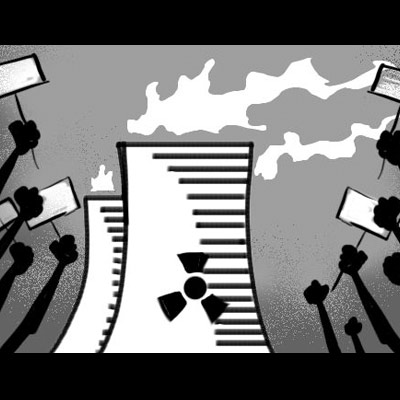
The Oldest Nuclear Power Plant In The World Is Facing Public Backlash
By Talia Roepel Dec. 14, 2025, https://www.bgr.com/2047450/oldest-nuclear-power-plant-world-controversy-beznau/
The oldest nuclear power plant in the world that is still operating is Beznau in Switzerland. With both units of the power plant fully operational in 1972, plans are for it to continue to operate until it is completely decommissioned in 2033. Switzerland has no policies in place to stop nuclear power plants after a set amount of time, instead, it is determined based on safety evaluations. However, because of Beznau’s age and its presence in general, it has come under plenty of backlash.
The Beznau nuclear power plant has seen its fair share of incidents. It has had nearly 100 safety incidents across its history, alarming the residents of the surrounding area. It was even temporarily closed for repairs from 2015 to 2018 due to issues with its steam generators, and its reactor was found to have cracks around it that same initial year.
The public isn’t entirely happy about Beznau still being in operation. Nuclear power tends to be controversial because of the danger accidents pose, as well as the fact that nuclear waste doesn’t ever truly go away. There have been gatherings of protestors around Beznau a couple of times in the past, with one protest attracting 20,000 people. Still, it doesn’t look like Beznau has plans to retire early.
Decades of Global Drone War Made Trump’s Caribbean Killing Spree Possible
“Suspicion of smuggling is not an imminent threat. Even if known traffickers were on board, it would not give the military the authority to launch missiles at a civilian vessel”
The Caribbean is not a war zone.
The so-called war on terror laid the foundations for Trump to turn international waters into one-sided battlefields.
By Emran Feroz , Truthout December 13, 2025
In September 2, 2025, a small fishing boat carrying 11 people was targeted by a U.S. Reaper drone off the coast of Venezuela. Hellfire missiles were fired. Two survivors clung to the wreckage. Their identities and motives were unknown. Their behavior showed no hostility. Moments later, the drone operator launched a second strike — the so-called “double tap” — killing the final survivors. This scene is shocking, but it should not be surprising to anyone who has followed the trajectory of the U.S.’s drone wars. This tactic is familiar from Afghanistan, Pakistan, Yemen, and, most recently, Gaza, where the Israeli military has used much worse violence to conduct genocide.
The U.S.’s first drone strike in the Caribbean, and the footage of the incident, reignited a debate about a conflict that Washington refuses to call a war — because it isn’t one. Instead, the Trump administration is using sheer violence to terrorize non-white populations and, as usual, has normalized lethal force far from declared battlefields and without any legal mandate.
U.S. Defense Secretary Pete Hegseth has approved at least 21 additional strikes in the Caribbean and eastern Pacific since September, killing at least 87 people. He has aggressively defended the very first operation, insisting he would have authorized the second strike as well — despite claiming he did not see it. Hegseth even misinterpreted the visible smoke on the video as the “fog of war,” seemingly unaware that the term refers to uncertainty in conflict, not the physical aftermath of a missile strike.
The details matter because they reveal something essential: the senior leadership overseeing these operations does not appear interested in the law, accuracy, or the basic meaning of proportionality. Instead, it has embraced escalation and mass murder as official policy.
Illegal Violence Dressed Up as Counter-Narcotics
Almost all legal experts agree that the U.S. strikes in the Caribbean violate international law. The Trump administration claims that suspected smugglers are “narco-terrorists” and therefore legitimate targets. But as Khalil Dewan, a legal scholar at London’s School of Oriental and African Studies who has studied U.S. and British drone programs for years, told me: “Drug trafficking is a crime, not an armed conflict.”
International law permits lethal force outside war zones only to prevent imminent threats to life. There is no indication that any of the boats the U.S. targeted — including the one in the September 2 video — posed such a threat. Dewan is clear: these are extrajudicial killings taking place on the high seas.
Former Air Force drone technician Lisa Ling, who left the program under the Obama administration due to the civilian casualties she witnessed, shares the same assessment. “Suspicion of smuggling is not an imminent threat. Even if known traffickers were on board, it would not give the military the authority to launch missiles at a civilian vessel,” she told me. Ling emphasizes a point that U.S. officials seem intent on ignoring: The Caribbean is not a war zone.
Ling also raises a question the military prefers not to confront: Who bears responsibility? “We were taught to disobey unlawful orders,” she said. “I’m still waiting to see that principle applied to those who carried out strikes on civilian boats in international waters.”
A Pattern With a Long History
The U.S. drone program did not begin with Trump. Its first lethal strike took place on October 7, 2001, in Kandahar province, targeting Taliban founder Mullah Mohammad Omar. It missed and killed civilians instead. That pattern — high-value targets declared dead, only to reappear alive — became common………………………………………………………………………………………………………………………………………………………….
Trump Escalation and Total Blowback
Trump has not only expanded the use of drone strikes but also removed the few modest oversight mechanisms Obama left behind. Now, under his second administration, the U.S. is openly striking vessels in international waters with almost no pretext.
…………………………….For years, critics of the war on terror have warned that a globalized drone program, paired with militarized domestic security agencies, would eventually produce consequences within the Americas too. That moment is here.
At least one family in Colombia has announced legal action after a fisherman, Alejandro Carranza, disappeared at sea. At the same time, Washington claimed to have killed “three violent drug-smuggling cartel members and narco-terrorists.” Carranza leaves behind a wife and five children.
What happens in the Caribbean today is not an anomaly. It is the outcome of two decades of policy decisions made by presidents of both parties. The world was declared a battlefield long before Trump returned to office. What we are seeing now is the cost of refusing to confront that reality. https://truthout.org/articles/decades-of-global-drone-war-made-trumps-caribbean-killing-spree-possible/?utm_source=Truthout&utm_campaign=f725ba5970-EMAIL_CAMPAIGN_2025_12_13_05_12&utm_medium=email&utm_term=0_bbb541a1db-f725ba5970-650192793
Radioactive fertilizer and the nuclear industry

Gordon Edwards. 14 Dec 25
CORRECTION
I wrote that
“…selling raffinate as fertilizer goes on all the time from the world’s largest uranium refinery owned by Cameco, situated at Blind River on the north shore of Georgian Bay.”
This sentence is incorrect. Raffinate from Blind River is not used as fertilizer. I apologize for the error.
Radioactive fertilizer from the Canadian uranium industry does not come from the Cameco Blind River refinery but from two other sources – the Cameco Key Lake uranium mill in Northern Saskatchewan, and the Cameo uranium dioxide conversion facility at Port Hope Ontario.
Moreover, the material that is being used in radioactive fertilizer is not raffinate (i.e. refinery waste). It is ammonium sulphate that is recovered from the Key Lake uranium processing circuits and sold as fertilizer, together with a liquid by-product of Cameco’s Port Hope uranium dioxide conversion plant – an ammonium nitrate solution – that is sold to a local agricultural supply company for use in fertilizer production.
The use of similar waste solutions from nuclear fuel facilities as fertilizer has been a concern in other jurisdictions as well. So at the present time, it is not raffinate but ammonium compounds that have been used in uranium processing that ends up in fertilizer. I apologize for not checking the facts much more carefully..
About radioactive fertilizer and the nuclear industry.
A lot of the phosphate used for fertilizer comes from Florida where the phosphate ore is mined. That ore is contaminated with uranium and its decay products, especially radium. Radium disintegrates to produce radon gas Radon-222) and this builds up in an enclosed space, without adequate ventiliation, reaching an “equilibrium” in about one month.
That’s why Florida was the first “hot spot” that alerted the US government to the major public health hazard posed by radon, which is estimated to kill about 20-30 thousand Americans every year. Every atom of radon comes from the disintegration of a radium atom, and in turn, every atom of radium started out as an atom of uranium.
Radioactive quilibrium means #becquerels of radium = #becquerels of radon. One becquerel being one disintegration per second. In a simiar way, if pure radon gas is in an enclosed container, it will reach equilibrium with its four short-lived decay products in a couple of hours – so the radioactivity in the container is about five times greater than it was originally, as all the short-lived decay products have attained roughly the same level of radioactivity as the radon.
When this radioactive fertilizer is used on tobacco crops, the radon from the soil and the fertilizer builds up under the thick canopy of tobacco leaves and hangs there for a time (radon being 7-8 times heavier than air). The radon atoms disintegrate to produce four airborne solid short lived decay products – polonium-218, bismuth-214, lead-214, polonium-214, all of which decay into lead-210 and polonium-210. [Note: the last two nuclides never reach equilibrium, unlike the first four.]
These radon decay products stick to the resinous (sticky) hairs on the undersides of the tobacco leaves and when the tobacco is harvested these radioactive materials are harvested along with the tobacco. By the time the tobacco is cured, rolled, and packaged, small quantities of lead-210 (22-year half-life) and its immediate successor polonium-210 are left in the tobacco/cigarettes for the unwitting smoker (or second-hand-smoke inhaler) to encounter.
When the cigarette is lit and the smoker draws on it, the temperature at the tip increases dramatically and it vaporizes the lead-210 and polonium-210 which is inhaled deep into the lungs, where polonium-210 sticks to and attacks the sensitive lung tissue with its very energetic alpha particles.
Polonium-210 is a very damaging radionuclide which Los Alamos Labs reckons is about 250 billion time more toxic than hydrogen cyanide. (It’s what was used to murder Alexander Litvenenko in London at the “request” of Putin who was openly criticized by Litvenenko).
Polonium-210 adds greatly to the cancer-causing characteristic of the tobacco residues lodged in the lung, making cigarettes smoke significantly more carcinogenic than it would otherwise be. (When the smoker is not inhaling, the lead-210/polonium-210 is wafted into the second-hand cigarette smoke as a respirable aerosol to endanger the health of those within sniffing distance,)
Inside the lung, some of the inhaled polonium-210 crosses the blood-air barrier end enters the bloodstream. Being solid, it attaches to pre-existing plaque build-up in the arteries of the smoker, usually near the arterial valves, where the alpha particle bombardment causes fibrosis of the arterial wall and valve, thus exacerbating the plaque build-up and increasing the restriction of blood flow, thereby contributing substantially to the incidence of heart attacks and strokes among smokers because of the alpha emitting polonium-210 in the plaque.
What you may not have heard is that voluminous sand-like radioactive waste from the uranium industry, called “raffinate” (leftovers from uranium refining), is also sold as fertilizer on the open market without any warnings about the radioactive content. The justification for this nefarious practice seems to be, that since “natural” phosphate from Florids is used to make fertilizer, and it is clearly radioactive (due to the radium-radon chain), and since raffinate from a uranium refinery is not much higher in radioactive content, then what the heck, we (the uranium industry) may as well turn this sow’s ear into a silk purse by selling the radioactive raffinate waste as fertilizer.
Extensive radioactive contamination – involving uranium raffinate – of the homes, schools, roadways, ravines, and the public beach in the town of Port Hope (prior to 1985) – has led to a $2.6 billion radioactive environmental cleanup of the town (by the federal government) resulting in over a million cubic metres (about a million tonnes) of radioactibve waste to be stored for 500 years in a gigantic earthen mound just north of the town. The subsequent fate of the still-radioactive waste will be decided at that time.
This practice of selling raddinate as fertilizer goes on all the time from the world’s largest uranium refinery owned by Cameco, situated at Blind River on the north shore of Georgian Bay. The Blind RIver plant turns uranium mill concentrates from Saskatchewan, Australia and South Africa, called “yellowcake” (mostly U3O8), into a product called “uranium trioxide” UO3. At that point the raffinate is the waste product, contaminated with radium. That’s what’s sold for fertilizer.
The trioxide then goes to Port Hope Ontario, where it is chemically converted into UO2 (uranium dioxide) for domestic use, about 15% of the total, and into UF6 (uranium hexafluoride or “hex”) for export to enrichment plants outside of Canada where the concentration of U-235 is increased to the level required by the customer.
At the enrichment plant, the “hex” is turned into a gas at a fairly low temperature so that the heavier U-238 atoms can be separated from the lighter U-235 atoms, resulting in an enriched uranium product that goes out the front door while the voluminous discarded U-238 (called depleted uranium or “DU”) goes out the back door.
For low enrichment in light water nuclear power plants, about 85% of the refined uranium is discarded as depleted uranium. The DU has important military uses, and a few civilian uses, but for the most part DU is part of the radioactive legacy of the nuclear age wth a half-life of 4.5 billion years.
Besides using DU in conventional bullets, shells, missiles, tanks, et cetera, used in the former Yugoslavia and in other conflicts, resulting in a battlefield litters with radioactive waste, the military also uses DU as “target rods” in plutonium production reactors to breed plutonium for nuclear warheads. In addition, the military uses DU metal in almost all nuclear warheads as a way of significantly multiplying the explosive power of the warhead by a sizable factor. These weapons are called “fission-fusion-fission” weapons,
The first fission is from a small ball of plutonium (usually with a tritium “spark-plug” inside) whose sole purpose is to ignite the fusion reaction by raising it to a temperature of about 100 million degrees. When fusion occurs, extremely energetic neutrons are goven off which fission the U-238 that has been used for that exact purpose in the construction of the warhead. That third stage, the fission of U-238, provides the bulk of the explosive power and the lion’s share of the radioactive fallout.
It is a sad story from beginning to end.
And, to add to this tale of woe, Canada currently has about 220 million tonnes of radioactive waste (tailings) stored at or near the surface from uranium milling (the operation that produces yellowcake) along with about 167 million tonnes of radioactive “waste rock”. Yet the Canadian authorities and others routinely and unabashedly declare that nuclear power is a “clean” source of energy and for the most part, Canadian academic scientists and sientific bodies say not a peep to the contrary.
Nuclear power: the courts put a stop to the project for two EPR2 reactors at Bugey

December 10, 2025
“ It’s a dramatic turn of events ” against the project to build two EPR2 reactors in the Ain region. Speaking by phone, Jean-Pierre Collet, from the Sortir du nucléaire ( SDN ) Bugey network, made no secret of his satisfaction. On Wednesday, December 10, 2025, the Lyon Administrative Court
overturned amendments to urban planning documents—
the SCOT ( Regional Planning Scheme ) in February 2023 and
the PLU ( Local Urban Development Plan ) in September 2024—that would have allowed the construction of these two new reactors on the EDF site at Bugey.
This decision follows a hearing on November 18th and sides with the anti-nuclear group Sortir du nucléaire Bugey and several residents. The court ruled that the ecological impact had not been sufficiently considered, particularly the presence of numerous protected species and the proximity of the Natura 2000 site of Isle Crémieux.
This decision comes as the project was already underway, with archaeological excavations already begun, according to Jean-Pierre Collet. A public debate held in early 2025 took place in a heated atmosphere, with the team in charge of organizing the debates lamenting the lack of data on the actual cost of the new facilities.
“
The construction site is suspended for a while,” Jean-Pierre Collet rejoiced.
“This shows that even on large-scale projects, you can’t ignore the rules. There are urban planning regulations, you can’t pretend they don’t exist. For us, this is very good news. ”……………………………………………………………………… https://reporterre.net/Nucleaire-la-justice-met-un-coup-d-arret-au-projet-de-deux-EPR2-au-Bugey
The worrying new detail in UK plans for nuclear-capable jets
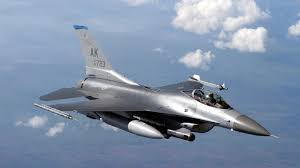
Bill Kidd MSP: Thanks to the publication of a new Nuclear Education Trust report, Stepping Back From The Brink: The Myths Of Tactical Nuclear Weapons And Limited Nuclear War, we have additional detail on how the Ministry of Defence is to spend billions reintroducing tactical nuclear weapons into
the RAF.
We also know that these are weapons the RAF will not own or control. Re-nuclearising the RAF requires much more than the purchase of an additional squadron of F-35A jets at around £1 billion. Creating the logistical and command and control infrastructure will be 10 times the cost of just the aircraft. What additional cuts to our already stretched public
services will that presage?
Going back on his word is, of course, how Starmer was elected. He conned the public with his slogan of change, when he really meant more of the same.
The National 13th Dec 2025, https://www.thenational.scot/politics/25695116.worrying-new-detail-uk-plans-nuclear-capable-jets/
How nuclear submarines could pave the way for nuclear weapons in South Korea
Bulletin, By Sharon Squassoni | December 12, 2025
Share
The mystique of nuclear-powered submarines has been captured by at least half a dozen popular Hollywood films. Some have centered on the drama of undersea warfare and the risk of global nuclear apocalypse should the nuclear-tipped missiles aboard most of them be launched. Others confront the issues of rogue submarine commanders or the dilemmas of decision-making when out of communication with national leadership. One or two, including Kathryn Bigelow’s K-19 Widowmaker, portray real-world disasters of a reactor meltdown aboard submarines. (Bigelow is also the director of the new film, A House of Dynamite, which depicts the last 20 minutes before a nuclear-armed missile of unknown origin falls on an American city.)
The underlying message of these fictional works is that nuclear submarines—powered by reactors and armed with atomic missiles—are a tightrope act. One misstep could endanger many, many lives.
The United States’ recent nuclear submarine deal with South Korea is a tightrope act for a different reason. Lost in the noise about nuclear submarines, the Trump administration has agreed to let South Korea enrich uranium and reprocess commercial nuclear spent fuel. This step—which could give South Korea a virtual or latent nuclear weapons capability—is needlessly destabilizing.
US nuclear technology exports. In the last five years, the United States has made deals with Australia and South Korea to hasten the day when some countries will deploy nuclear-powered submarines that don’t carry nuclear missiles. Under the 2021 AUKUS deal (a partnership between Australia, the United Kingdom, and the United States), Australia will build nuclear-powered submarines using UK reactors and US highly enriched uranium fuel at the latest estimated cost of $368 billion. And in October, South Korea scored a political coup in convincing US President Donald Trump to allow its pursuit of nuclear-powered submarines.
South Korea has sought nuclear-powered submarines for more than 30 years. Sparked by the first international crisis over North Korea’s nuclear weapons program, Seoul has dabbled in the relevant technologies in an on-again, off-again fashion. Past forays included a 1994 directive to the Korean Atomic Energy Research Institute to design a nuclear-powered submarine (cancelled in 1998) and the so-called “362” covert task force formed in 2003 that reportedly utilized Russian help to design a submarine reactor. This task force was disbanded in 2004 after South Korean officials revealed that scientists had enriched uranium without declaring it to the International Atomic Energy Agency.
More recently, Moon Jae-in campaigned on South Korea acquiring nuclear-powered submarines in 2017, and Korean officials since 2020 have suggested that their next generation of submarines would be nuclear-powered. Speculation persists over whether South Korean efforts to develop small modular reactors fueled with 19.5 percent high-assay low-enriched uranium could be adapted or modified for naval applications.
Many details about South Korea’s nuclear submarines are still unknown— when, where, and how they will be built. Those details will matter a great deal in terms of the proliferation implications. Allowing South Korea to indigenously produce its own nuclear submarines could be riskier than if South Korea were to purchase US subs or the reactors that go into these subs.
Nuclear-powered vs. nuclear-armed. Nuclear-powered submarines make total sense to nuclear weapon states, which weigh the risks and costs of these vehicles against the benefits of stealth, range, and having a platform for assured, nuclear retaliation. (In theory, such submarines can enhance stability because they provide assured destruction in case an opponent seeks advantage by striking first—the so-called delicate balance of terror.) Already engaged in high-cost and high-risk nuclear projects, nuclear-powered submarines are not a huge step up for countries with nuclear weapons.
For countries without nuclear weapons, however, the costs far outweigh the benefits.
Per unit, a single modern diesel-electric attack submarine with air-independent propulsion costs between $500 million and $900 million. A modern nuclear-powered attack submarine will cost between $3 billion and $4 billion each, based on the current cost of Virginia-class nuclear attack submarines in the United States, a country with experience in building such ships. This is on top of the considerable investment in shipbuilding that countries like South Korea and Australia would have to make. For instance, South Korea has vowed to invest $350 billion in the United States, of which half will be spent on US shipbuilding…………………………………………………………………………………………………………………………………………… https://thebulletin.org/2025/12/how-nuclear-submarines-could-pave-the-way-for-nuclear-weapons-in-south-korea/
Elections impossible under Zelensky’s ‘terrorist regime’ – exiled Ukrainian MP

Sat, 13 Dec 2025, https://www.sott.net/article/503481-Elections-impossible-under-Zelenskys-terrorist-regime-exiled-Ukrainian-MP
Presidential elections in Ukraine are impossible under the “terrorist regime” of Vladimir Zelensky and his cohort, exiled Ukrainian lawmaker Artyom Dmitruk has said.
Zelensky, whose presidential term expired over a year ago, has repeatedly refused to hold a new election, citing martial law – which was imposed after the conflict with Russia escalated in 2022 and has been regularly extended by parliament.
Earlier this week, Zelensky said he would hold an election within 90 days if Kiev’s Western backers can guarantee security. The shift came after US President Donald Trump accused the Ukrainian authorities of using the conflict as an excuse to delay elections, insisting that it’s time.
In a series of Telegram posts on Friday, Dmitruk argued that it is “completely pointless” to discuss elections now, calling Zelensky’s remarks “manipulation and hypocrisy” aimed at clinging to power.
“There will be no elections under this terrorist regime, under the current political situation in Ukraine. Under this regime, elections are impossible,” the exiled lawmaker wrote. “The political situation in Ukraine is vile and deceitful. Almost all the ‘potential candidates’ are Zelensky regime officials, people completely integrated into the war system. And at the head of this march – a parade of blood – is Zelensky himself.”
He insisted that elections would only be possible after “either a political or military capitulation of the regime” and the transfer of authority to an interim government. According to Dmitruk, Trump’s call to Zelensky was not really about elections: “It is a form of diplomatic signal… a polite, diplomatic way to show Zelensky the door.”
Dmitruk fled Ukraine in August 2024, claiming he received death threats from the country’s security services over his opposition to Zelensky’s persecution of the Ukrainian Orthodox Church.
Russia maintains that Zelensky is an illegitimate leader. President Vladimir Putin warned that it is “legally impossible” to conclude a peace deal with the current leadership due to Zelensky’s lack of a valid mandate.
According to Kremlin aide Yury Ushakov, Zelensky’s sudden interest in elections is a ploy to secure a ceasefire – a proposal that Russia has rejected in favor of a permanent peace deal addressing the conflict’s underlying causes. Moscow has warned that Kiev would use any pause in the fighting to rearm and regroup.
Comment: There is more pressure on Zelensky to hold elections from various stakeholders while a peace deal is in the works. One way or another Zelensky will have to hold elections soon.
Ottawa medical manufacturer giving up nuclear licence after defying regulator
Canadian Nuclear Safety Commission ordered Best Theratronics to comply over a year ago.

COMMENT.There are questions about lack of financial guarantee in the case where the plant in Kanata is decommissioned, i.e. cost of cleaning up the radioactive materials at the site. Next step is the CNSC is waiting for the decommissioning preliminary plan. The owner is moving the business to the U.S. and India, he says.
Campbell MacDiarmid · CBC News · Dec 14, 2025, https://www.cbc.ca/news/canada/ottawa/ottawa-medical-manufacturer-giving-up-nuclear-licence-after-defying-regulator-9.7014006
A storied Kanata medical manufacturer is in the process of relinquishing its nuclear licence, more than a year after Canada’s nuclear regulator placed it under orders for violating the terms of that certificate.
On Friday, the Canadian Nuclear Safety Commission (CNSC) confirmed that Best Theratronics is in the process of offloading the nuclear material it used to manufacture cancer treatment devices.
“Best Theratronics Limited has obtained an export licence to ship its Cobalt 60 sealed sources, as well as an export licence to ship its Cesium 137 sealed sources,” said Andrew McAllister, director of the CNSC’s nuclear processing facilities division, during a public meeting.
Best Theratronics was once a Crown agency that created the world’s first cancer treatment machine, but it has struggled in recent years under the private ownership of overseas businessman Krishnan Suthanthiran.
Suthanthiran says he has lost millions of dollars since buying the company from MDS Nordion in 2007. More recently, the company faced a protracted labour dispute that saw workers strike for nearly 10 months to demand better pay.
Last November, the CNSC issued orders against Best Theratronics after noticing that its financial guarantee had lapsed. The industry regulator ordered the company to make $1.8 million available to cover any cleanup costs in the event that its site was decommissioned.
But Suthanthiran never complied, telling CBC in October that the CNSC was in the wrong and that he lacked the funds to restore the guarantee.
Instead, Suthanthiran said he would give up his nuclear licence and shift the company toward activities that don’t involve nuclear materials.
CBC asked Suthanthiran whether staff at Best Theratronics would would be out of work as a result of the company surrendering its nuclear licence.
In an email, he wrote that he was being forced “to relocate to the USA and India” and that would result in “the loss of 200 high-tech jobs.” He also cited the high yearly cost of having the nuclear licence.
The CNSC has required Best Theratronics to submit monthly reports relating to its progress in offloading its nuclear material. But the company missed its December deadline, submitting its report several days later, McAllister said.
Manny Subramanian, a representative of Best Theratronics, told the CNSC the delay was due to Suthanthiran’s absence.
“One particular report, you know, we ended up sending about a day late or two days late because Krish, the president of the company, was travelling. We couldn’t get ahold of him,” Subramanian said.
The next deadline facing Best Theratronics comes Tuesday when it’s due to submit a preliminary plan for decommissioning its plant in Kanata.
High Court challenge to Sizewell C ‘cannot be right’, court told.

Lawyers representing the developers and government suggest the challenge could set a precedent for major infrastructure.
A High Court will decide on Friday whether to grant a judicial review of safety changes to nuclear project Sizewell C that could force developers to reapply for consent. The
project’s defence team claimed in court on Tuesday that the judgment will have an impact on how large-scale infrastructure adaptations are challenged in future. “It simply cannot be right for major infrastructure projects like this to face challenge every time it becomes possible that some
additional adaptation measure might be needed at some point into the distant future,” a defence lawyer on the side of developers and government said during a court hearing on Tuesday.
The hearing was held atthe Royal Courts of Justice to determine whether the nuclear plant, scheduled to be developed in Suffolk, can go ahead without a proper review
of two new overland flood barriers. Campaigners previously argued that the project lacked proper sea defences, and at the behest of the UK’s nuclear regulator, French developer EDF has since included plans for two new overland flood barriers, without releasing the details for public review through a formal assessment. At stake is whether the development consent
order would need to be revisited to accommodate the changes.
Energy Voice 12th Dec 2025, https://www.energyvoice.com/renewables-energy-transition/586858/high-court-challenge-to-sizewell-c-cannot-be-right-court-told/
What to do with Britain’s radioactive waste?

by Ian Fairlea, beyondnuclearinternational .
“………………………………………………………………………………… Radioactive nuclear waste is produced by all nuclear activities. For example, uranium mining produces a great deal of waste in the form of ore spoil like all mining. Since uranium is radioactive, so are its ore wastes. So also are all the processes of refining the ore, enriching the uranium, turning it into fuel for reactors, transportation, burning it in nuclear power stations, processing the used fuel, and its handling and storage. They all create more nuclear waste.
The reason is that everything that comes into contact with radioactive materials, including the containers in which they are stored or moved and even the buildings in which they are handled, become contaminated with radioactivity or are activated by radiation
All radioactive waste is dangerous to human life as exposure to it can cause leukaemia and other cancers. It is usually categorised as low, intermediate or high-level waste. As the radioactivity level increases, so does the danger. Extremely high levels of radioactivity can kill anyone coming into contact with it – or just getting too close to it – within a matter of days or weeks.
Radioactive materials slowly lose their radioactivity and so can become in theory safe to handle but in most cases this is a very slow process. Plutonium-239, for instance, has a half-life of over 24,000 years which means it will remain lethal for over 240,000 years. Other radio-isotopes remain radioactive for millions or even billions of years.
The safe, long-term storage of nuclear waste is a problem that is reaching crisis point for both the civil nuclear industry and for the military.
During the Cold War years of the 1950s and 1960s, the development of the British atomic bomb was seen as a matter of urgency. Dealing with the mess caused by the production, operating and even testing of nuclear weapons was something to be worried about later, if at all.
For example, the Ministry of Defence does not really have a proper solution for dealing with the highly radioactive hulls of decommissioned nuclear submarines, apart from storing them for many decades. As a result, 19 nuclear-powered retired submarines are still waiting to be dismantled, with more expected each year. Yet Britain goes on building these submarines.
This callous disregard for the future has spilled over to the nuclear power industry. For example, at Dounreay, in the north of Scotland, nuclear waste and scrap from the experimental reactor and reprocessing plants were simply tipped down a disused shaft for over 20 years. No proper records of what was dumped were kept and eventually, in 1977, an explosion showered the area with radioactive debris. In April 1998, it was finally announced that excavation and safe removal of the debris had cost £355 million.
The problems of long term, secure storage of nuclear waste are unsolved and growing more acute year by year. Earlier attempts by the nuclear industry to get rid of it by dumping it in the sea were stopped by environmental direct action, trades union protests and now by law.
All details concerning military nuclear waste are regarded as official secrets. However, large and growing quantities of radioactive waste exist at the Rosyth and Devonport dockyards and in particular at the Aldermaston and Burghfield Atomic Weapons Establishments.
One feature of Aldermaston and Sellafield in particular is that they are old sites, and have grown up in an unplanned, haphazard way. New buildings are fitted in between old, sometimes abandoned, buildings. Some areas and buildings are sealed off and polluted by radioactivity. Local streams, and in the case of Sellafield the sea shore, are polluted. The demolition of old radioactive buildings is a delicate, slow and dangerous process. In the circumstances it is hardly surprising that the amount of nuclear waste can only be estimated.
Civil intermediate level solid waste is mainly stored at Sellafield awaiting a decision on a national storage facility.
Military intermediate level solid waste is stored where it is created: dockyards, AWE plants etc. Both civil and military high level solid waste is generally moved to Sellafield for temporary storage.
The major problems are with the long-term storage of intermediate and in particular high-level wastes. Since these are very dangerous and very long-lived, any storage facility has to be very secure (i.e. well-guarded) and safer over a longer period – some tens of thousands of years – than anything yet designed and built by humanity.
Because of this very long time scale, it can never be sealed up and forgotten. Containers corrode with time. There are earth movements. Water seeps through rocks. The waste will have to be stored in such a form that it cannot be stolen and misused and in such a way that it can be inspected and if necessary retrieved and moved.
Plans to dig a trial deep storage facility under the Sellafield site were thrown out in 1997. Geological evidence suggested that the local rock is too fissured and liable to be affected by water seepage.
This threw all the nuclear industry’s plans into confusion. Instead of having a storage site ready by 2010, the date has been put back more or less indefinitely. No alternative site has even been identified.
Apart from the technical, geological problems, few communities seek a huge, long-term nuclear waste storage site in their neighbourhood. Indeed the original choice of Sellafield was as much political as technical. With most local jobs depending on nuclear industry already, there would have been less local opposition than elsewhere.
Nuclear waste is a problem that the nuclear industry has failed to consider seriously for over sixty years but one that can no longer be put off for future generations to cope with.
The effects of any nuclear accidents, such as those at Chernobyl in 1986 and Fukushima in 2011, are also very long-lasting and will affect future generations. The problems of nuclear waste are nowhere near solution. The history of the nuclear industry does not inspire confidence………………………………………………………. https://beyondnuclearinternational.org/2025/12/14/does-britain-really-need-nuclear-power/
Sizewell C — the last of its kind
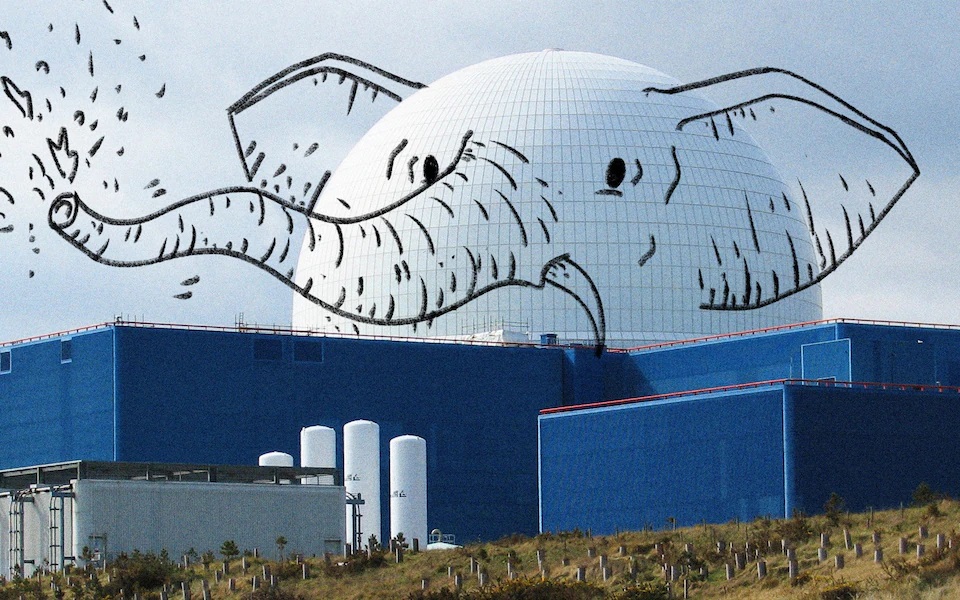
The deal to build the Sizewell C, two reactors using the European Pressurised Reactor (EPR) design, using the Regulated Asset Base (RAB) finance model was inevitably a bad one for the UK public. It gives guaranteed profits to investors by placing the risks on consumers while the EPR has an unenviable record of huge cost and time overruns. It requires consumers to pay the finance charges in the construction period – of the same order as the construction cost – as a surcharge on their bills. However, the additional subsidies and risk removal that were necessary to persuade private investors to take stakes are shocking.
The new finance deal for Sizewell C
RAB financing deal, developed from 2018, was announced in 2021 and legislated for in 2021-2022 when Kwasi Kwarteng was Secretary of State for Business, Energy and Industrial Strategy (BEIS) and completed under Ed Miliband at the Department for Energy Security and Net Zero (DESNZ) in July 2025. The Regulated Asset Base (RAB) finance model for nuclear power plants was sold to the public on the basis that it would provide cheaper power than using the fixed power price financial model under which the Hinkley Point C reactors1 are being built.
It was claimed the model would bring in new sources of investment, particularly institutional investors such as pension funds. The power price reduction would be achieved if the public shared the economic risks with the investors and offered limited subsidies and guarantees. Reducing the risk borne by investors would reduce the cost of capital, a major element in the cost of power from a nuclear power plant, and hence the price of electricity. The subsidies were portrayed not so much as paying costs that would be expected to have been borne by investors, as is normal for subsidies, but as giving the investors guarantees they were not at risk from the consequences of low-probability, high-consequence events and from volatile wholesale electricity market prices.
After five years of effort by government to complete the deal, a Final Investment Decision (FID) for Sizewell C was finally taken on July 22, 2025. The contracts were finalised on November 4, 20252. The largest investor is the UK government (44.9%). The other investors are the Canadian pension fund, La Caisse (20%), Centrica (15%), EDF (12.5%) and Amber Infrastructure (7.6%). Amber Infrastructure is acting on behalf of the UK’s Nuclear Liabilities Fund, NLF, (4.6%), arguably public funds, and International Public Partnerships Limited 3.0%. So only 23% of the investment will come from institutional investors, 27.5% from energy companies and about half (if we include the NLF) from public sources.
An analysis of the Sizewell C deal shows that balance of risks is one-sided with the risks falling almost entirely on taxpayers and consumers, with minimal penalties and generous incentives offered to investors. The subsidies offered are far more extensive than those acknowledged by government and represent large amounts of public money being given to the private investors for no public return. The price of power from Sizewell C is unknown and will vary unpredictably from year to year, but there can be little confidence the RAB model will produce a lower power price than Hinkley Point C even if the cost of the subsidies is not factored in. The incentives required to bring in private investors are so expensive and risky to consumers that the model should not be repeated, and, like the Hinkley Point C deal, it ought to be a one-off, not a door-opener for new nuclear investments.
The Risk/Reward balance
The plan to use the Hinkley Point C finance model for Sizewell C was abandoned by EDF in 2018. This was because it was not willing to accept the financial risks it had signed up to for Hinkley by agreeing a fixed power purchase price with all construction cost and time risks falling on itself. Costs have escalated dramatically at Hinkley since the deal was signed in 2016, by up to 90% but cannot be passed through to the power purchase price: and this commitment led to EDF writing off €12.9bn of its investment in Hinkley Point C in 20233.
The investors in the Sizewell project frequently talk about the project being ‘derisked’4 by which they mean not that the risk has been reduced, but that it falls on others………………………………………………………………………………………………………………………………………..
Subsidies…………………………………………………………………………………………………………………………… “The acknowledgement that ‘Difference’ payments will be substantial demonstrates that it is expected that consumers will be forced to buy power from Sizewell C that will cost more than alternatives in the market.”
…………………………………………………………………………………………….. Will the power be cheaper than for Hinkley?……………………………………………………………………….
Is the Sizewell deal repeatable?………………………………………………………………………………. If the deal proves not to be repeatable, the huge amount of government time and cost that has gone into completing the deal will, as with Hinkley Point C, have been a costly diversion of more than a decade from pursuing the cheaper, quicker and more reliable ways of meeting the government’s promises of net zero…………………………………………………………………………………………………………………………………….Is Sizewell the last large reactor for the UK?…………………………………………………………………………………
Endnotes -……… [copious] https://policybrief.org/briefs/sizewell-c-the-last-of-its-kind/
Could armed robots be the future of nuclear site security?

experiments to test the military potential of near-identical quadrupeds being carried out by the US armed forces, with Spot’s cousin converted into an armed platform by the addition of an artificial intelligence-enabled gun turret
16th October 2024, https://www.nuclearpolicy.info/news/spot-to-robocop-could-armed-robots-be-the-future-of-nuclear-site-security/
Robots are becoming increasingly employed in decommissioning operations at Sellafield and Dounreay. Whilst the UK/Ireland Nuclear Free Local Authorities welcome their use in hazardous environments which are too radioactive and otherwise contaminated for human operators, we have concerns that in the long-term their use might expand into on-site security.
The Atomic Energy Authority Special Constable Act 1976 first permitted the United Kingdom Atomic Energy Authority to raise an armed private police force. In 2005, the UKAEA Constabulary was replaced by the Civil Nuclear Constabulary. CNC officers are routinely armed with sub machine guns and authorised to use deadly force – in extremis – whilst guarding nuclear facilities, but also whilst engaged in hot pursuit outside.
However last month, seemingly to counter possible threats from sabotage or terrorism and the greater incidence of climate change protests, the Energy Secretary Ed Miliband instructed the CNC to redeploy officers from their traditional duties to protecting coastal gas plants with effect from April 2025[i]. It is likely that this role may further expand to cover oil depots.
In 2021, the NFLAs objected to planned legislation to widen the CNC’s remit to guarding non-nuclear sites. In our response to a consultation, we said that the ‘CNC’s role should continue to be explicitly confined to policing nuclear sites and facilities’ and that ‘protection of critical national infrastructure should be carried out by an adequately funded democratically controlled local police force’ rather than an unaccountable paramilitary police force.
If CNC numbers at nuclear sites are diluted, there could be pressure to employ robots on security duties in their stead, and in the long-term it is not inconceivable that they may even become armed and autonomous.
The ‘poster child’ of the robots is the quadruped first developed by Boston Dynamics in the United States, affectionately known as Spot the Dog. This variant is now routinely used in decommissioning operations in environments that are unsafe for human operators. The robot uses a specialist scanning system to create a 3D moveable image of its environment, allowing engineers to carry out remote inspections in support of clean-up operations[ii].
Spot can though operate entirely autonomously. Last month, it was reported that such a robot had completed a 35-day autonomous operation to inspect the UK Atomic Energy Authority’s Joint European Torus (JET) facility. Tasks successfully completed included ‘mapping the facility, taking sensor readings, avoiding obstacles and personnel involved in the decommissioning process, and collecting essential data on JET’s environment and overall status twice a day. The robot also knew when to dock and undock with its charging station, to ensure it could complete the task without humans having to intervene’.[iii]
So far, so benign, but a disturbing report appeared around the same time about experiments to test the military potential of near-identical quadrupeds being carried out by the US armed forces, with Spot’s cousin converted into an armed platform by the addition of an artificial intelligence-enabled gun turret to participate in exercises in Saudi Arabia. The flexible turret enabled ground fire, but also aerial fire against drones, which are also an increasing threat to civil nuclear facilities. The article in Military.Com records that robot dogs have already been engaged by the US Defence Department in several roles, including ‘boosting perimeter security at sensitive installations’, a task in which they excel as they can ‘patrol’ ‘without need to rest’.[iv]
The NFLAs cannot help thinking that in a dystopian nuclear future, in which the CNC increasingly overstretched and renamed the Civil Infrastructure Constabulary to reflect its ever-expanded role in providing armed protection to a wide range of critical sites, security forces might engage a force of armed Robocops to supplement the dwindling number of armed human officers, each charged with patrolling the perimeters of civil nuclear facilities, and granted autonomous decision-making to engage trespassers, protestors, and drones with deadly force.
The concept of Spot the Dog becoming SWAT the Dog, however unlikely, is truly terrifying.
Concerns about so-called killer robots animated the world community late last year. The Stop Killer Robots campaign, founded in October 2012, continues to work for a new international law to regulate autonomy in weapons systems. The coalition of over 250 civil society organisations in 70 countries successfully lobbied states to adopt the first ever resolution on autonomous weapons at the United Nations on December 22, 2023. 152 countries supported General Assembly Resolution 78/241 which acknowledged the ‘serious challenges and concerns’ raised by ‘new technological applications in the military domain, including those related to artificial intelligence and autonomy in weapons systems.’
Stop Killer Robots was recently awarded Archivio Disarmo’s Golden Dove for Peace Award at a ceremony in Rome on Saturday, 12 October. The award is given to an international figure or organisation which has made ‘a significant contribution to the cause of peace’.
More details of the campaign can be found at https://www.stopkillerrobots.org/
Trump’s Monroe Doctrine 2.0 Outlines Imperial Intentions for Latin America.

The National Security Strategy condemns U.S. foreign policy since the end of the Cold War. It champions the U.S. economy and military and says that the United States “must be preeminent” in the Americas and around the world. If there is one overarching principle it is the concept of “peace through strength.”
The administration’s National Security Strategy signals a return to more outwardly interventionist policies.
By Michael Fox , Truthout, December 12, 2025
n Wednesday, December 10, Donald Trump announced that the United States had seized a tanker in the Caribbean carrying more than 1.6 million barrels of Venezuelan crude oil.
“Large tanker, very large, largest one ever, actually, and other things are happening,” Trump told the press.
The seizure is only the latest move in a long build-up of U.S. military action in the Caribbean and increasing U.S. threats against Venezuela and its President Nicolas Maduro.
Trump — without evidence — says Maduro is the head of an international terrorist group running drugs into the United States. He has called Maduro’s days numbered.
Over the last three months, the United States has hit at least 22 alleged “drug boats” in the Caribbean and Pacific, killing more than 80 people. The campaign is the first unilateral lethal action the U.S. military has undertaken in Latin America since the 1980s.
The United States has now amassed the largest military buildup in the Caribbean in decades, including the world’s largest warship, the U.S. aircraft carrier USS Gerald R. Ford. Fifteen thousand U.S. troops are stationed in the region, on the ready.
Responding to news of the tanker seizure, Democratic Senator Chris Coons told NewsNation that he is “gravely concerned that [Trump] is sleepwalking us into a war with Venezuela.”
Even Congress has been shocked by how the administration has conducted the boat strikes. But a new document offers insight into the thought process behind Trump’s threats and actions in the region.
The United States has now amassed the largest military buildup in the Caribbean in decades, including the world’s largest warship, the U.S. aircraft carrier USS Gerald R. Ford. Fifteen thousand U.S. troops are stationed in the region, on the ready.
Responding to news of the tanker seizure, Democratic Senator Chris Coons told NewsNation that he is “gravely concerned that [Trump] is sleepwalking us into a war with Venezuela.”
Even Congress has been shocked by how the administration has conducted the boat strikes. But a new document offers insight into the thought process behind Trump’s threats and actions in the region.
The National Security Strategy condemns U.S. foreign policy since the end of the Cold War. It champions the U.S. economy and military and says that the United States “must be preeminent” in the Americas and around the world. If there is one overarching principle it is the concept of “peace through strength.”
“Strength is the best deterrent. Countries or other actors sufficiently deterred from threatening American interests will not do so,” it reads. “The United States must maintain the strongest economy, develop the most advanced technologies, bolster our society’s cultural health, and field the world’s most capable military.”
Front and center is the Western Hemisphere. It’s the first region mentioned in the document — China isn’t mentioned until page 23. The priority and focus on the Americas clearly marks a shift away from U.S. attention elsewhere around the world.
One detail in the document stands out more than any other — a reference to a new “Trump Corollary” to the Monroe Doctrine. This is made twice — first it’s included top among the overall policy goals and then again in the section on the Western Hemisphere.
The term “corollary” may seem like an odd choice to describe Trump’s embrace of the foreign policy position, but it is actually a clear historical nod to a moment when the Monroe Doctrine was used to justify widespread U.S. military actions in the region.
Now, analysts believe this is the direction we are headed again.
The Roosevelt Corollary
When U.S. President James Monroe issued his state of the union address on December 2, 1823, it included in it an articulation of a foreign policy position that would come to be known as the Monroe Doctrine.
Essentially, the doctrine was a message to European countries following the independence of most of the countries of the Americas: Foreign powers had no right to interfere in the politics of the newly independent nations of the Western Hemisphere.
But by the beginning of the 20th century, the United States had grown in prominence, power and ambition. President Theodore Roosevelt’s 1904 “Roosevelt Corollary” vastly reinterpreted the Monroe Doctrine, essentially turning it into a tool to justify U.S. intervention across the region.
……………………………………………………………………………………..the Trump Corollary reads as a veiled threat against countries who might be unwilling to bend to U.S. interests.
“We will assert and enforce a “Trump Corollary” to the Monroe Doctrine,” the National Security Strategy document states. “We want to ensure that the Western Hemisphere remains reasonably stable and well-governed enough to prevent and discourage mass migration to the United States; we want a Hemisphere whose governments cooperate with us against narco-terrorists, cartels, and other transnational criminal organizations; we want a Hemisphere that remains free of hostile foreign incursion or ownership of key assets, and that supports critical supply chains; and we want to ensure our continued access to key strategic locations.”
Analysts say the Trump administration’s visible actions toward Latin America in recent months — the seizure of the oil tanker, the boat attacks, threats of war with Venezuela, intervention into Honduran elections, tariffs on Brazil — all fit into this rubric.
…………………………………………………………………………………………Like the Roosevelt Corollary, which, following 1904, would be used for years to justify intervention after intervention across the region, the new National Security Strategy is a means of justifying the policies, threats, and attacks Trump may unleash across the region.
………………………………………………………………………………………………………………………Gone are the past U.S. pretexts of spreading democracy, or standing for the good of humanity, or civilization building……………………………………………………………………………. https://truthout.org/articles/trumps-monroe-doctrine-2-0-outlines-imperial-intentions-for-latin-america/?utm_source=Truthout&utm_campaign=e71842d601-EMAIL_CAMPAIGN_2025_12_12_07_18_COPY_01&utm_medium=email&utm_term=0_bbb541a1db-62fed5671d-650192793
FBI Labels Antifa a Major Terror Threat, but Lawmakers Say Evidence Is Lacking as Trump’s Obsession Distracts From Far-Right Extremism

December 12, 2025, Joshua Scheer, https://scheerpost.com/2025/12/12/fbi-labels-antifa-a-major-terror-threat-but-lawmakers-say-evidence-is-lacking-as-trumps-obsession-distracts-from-far-right-extremism/
At a recent House Homeland Security Committee hearing, FBI official Michael Glasheen — operations director of the Bureau’s National Security Branch — described the anti-fascist movement antifa as one of the most significant domestic terrorism threats facing the United States, echoing a Trump executive order that designated antifa as a domestic terrorist organization.
But when lawmakers pressed him for specifics, Glasheen struggled to provide concrete evidence about where antifa is organized, how many members it has, or how its activities are tracked. He repeatedly described the situation as “fluid” and emphasized that investigations are ongoing. The exchange underscored deep partisan divisions in Congress over how domestic threats are identified, and raised broader questions about how law enforcement defines and responds to politically motivated violence — particularly given that antifa lacks formal leadership, structure or membership rolls.
Despite the lack of clear data, Glasheen maintained that antifa remains the agency’s “primary concern” and “the most immediate violent threat that we’re facing.”
Democratic Rep. Bennie Thompson challenged those claims directly: “Where in the United States does antifa exist? What does that mean?” he asked. “We’re trying to get information. You said antifa is a terrorist organization. Tell us, as a committee, how did you come to that? Do they exist? How many members do they have in the United States as of right now?”
“Well, that’s very fluid,” Glasheen said.
“Sir, I just want you to tell us — if you said antifa is the No. 1 domestic terrorist organization operating in the United States, I just need to know where they are … how many people have you identified with the FBI that antifa is made of,” Thompson asked.
“Sir, you wouldn’t come to this committee to say something that you can’t prove,” Thompson said to Glasheen. “I know you wouldn’t do that. But you did.
Trump’s obsession with antifa is well-known, even though the evidence has long shown that the more significant threat comes from right-wing–aligned groups rather than activists who identify as anti-fascist. It’s not hard to understand why this president fixates on antifa, but the disconnect between his rhetoric and documented threats has been clear for years. The Intercept’s reporting — based on leaked documents from 2020 — “But while the White House beat the drum for a crackdown on a leaderless movement on the left, law enforcement offices across the country were sharing detailed reports of far-right extremists seeking to attack the protesters and police during the country’s historic demonstrations, a trove of newly leaked documents reveals.”
So there is a threat, just not from the group Trump focuses on. What this designation does, however, is clearly silence critics of his administration, using the “terror” label as a tool — especially if he can find a way to tie someone to foreign support
Because U.S. law does not criminalize membership in domestic terror groups, experts warn that the Trump administration could attempt to target American citizens under existing laws that apply to foreign organizations. Shayana Kadidal, an attorney at the Center for Constitutional Rights, told The Intercept that regulations allow the government to link domestic groups to foreign entities already designated as terrorist organizations, potentially creating legal obstacles for ordinary Americans. Kadidal highlighted past cases in which U.S. citizens were branded “specially designated terrorists” for alleged ties to foreign groups, which severely restricted their ability to conduct normal financial transactions.
Civil liberties advocates also caution that Supreme Court precedent allows individuals to be charged with providing “material support” to foreign terrorist organizations based on speech acts alone — a pathway the administration could exploit. One immediate consequence of this approach is the “chilling effect,” where protesters may hesitate to participate due to legal uncertainty, effectively discouraging civic engagement and dissent.
In the larger context of extremism, the focus on hunting antifa is largely a red herring, distracting from the far more serious threat posed by right-wing and white supremacist groups. We turn to Luke Baumgartner, a research fellow with George Washington University’s Program on Extremism discussing what the we are all taking about, from an interview on PBS :
“I would classify it more as a political scapegoat, honestly. There have been incidents of political violence linked to far left extremists in the U.S. in recent years, but the overwhelming majority of the data points towards far right extremism being a much more serious threat to national security.”
He continued, noting that any protest by the left — whether it’s No Kings or Black Lives Matter — is immediately labeled “antifa.” This represents a clear abuse of Trump’s power in his broader effort to crush the left and silence groups that challenge his warped worldview.
Trump did this with Black Lives Matter back in 2020 with the violent clearing of peaceful Black Lives Matter protesters from Lafayette Square — simply so he could stage a photo op. It remains one of the clearest demonstrations of state power being used to suppress constitutional rights in modern American history.
That wasn’t an anomaly, but part of a longstanding pattern in which protests are met with force, intimidation, and the machinery of government turned against them. Now, feeling more empowered than ever, the president appears to be attempting the same tactics under the guise of combating “terrorism,” despite evidence showing that left-wing movements are far less likely to pose the threats he claims to be targeting.
Needless to say, I’m glad that Bennie Thompson is still around and holding the line, but more action is needed to challenge what amounts to a high level of evil by some and foolishness by others and the belief that there is a real threat when, in reality, there is “no there there,” and that any supposed danger is merely a smokescreen.
1 This Month
To see nuclear-related stories in greater depth and intensity – go to https://nuclearinformation.wordpress.com/
12 February – Webinar The Big Push: New Nuclear Projects in Canada
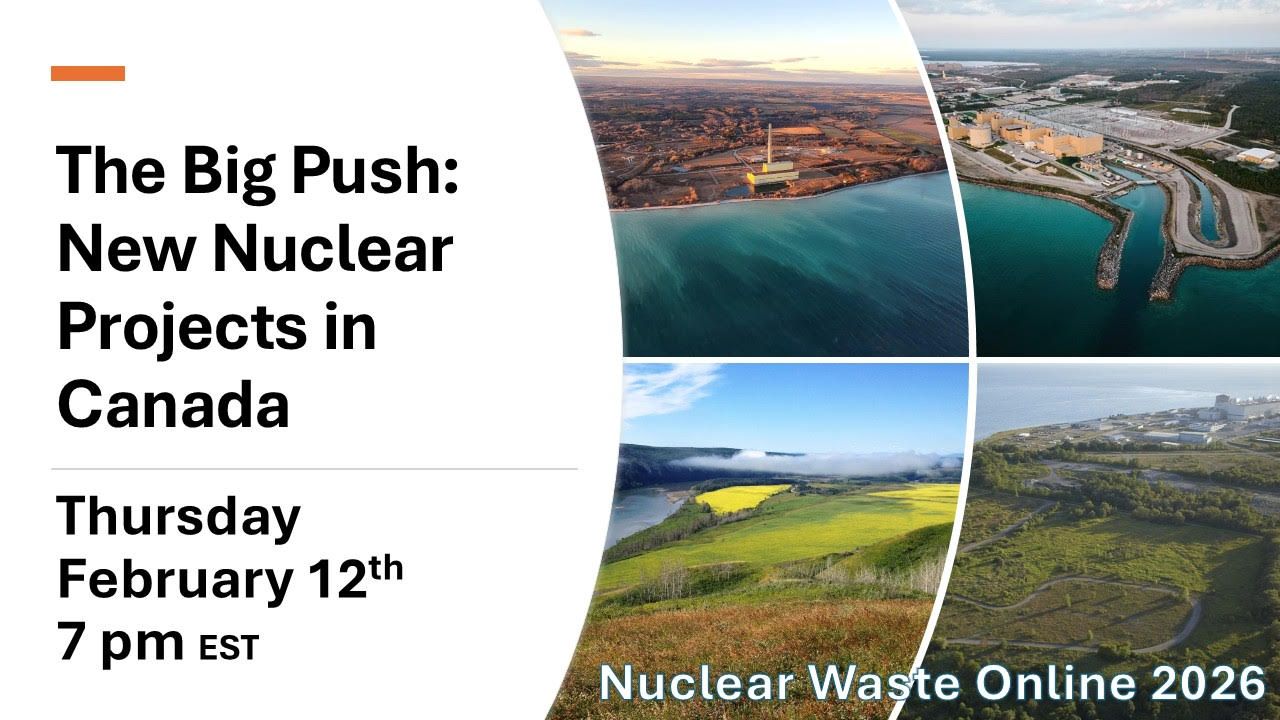
Thursday, February 12, 7 pm Eastern | 2nd of 4 sessions in the 2026 Nuclear Waste Online webinar series
Join a webinar on the push for new nuclear generation in Canada. Go to Northwatch.org to register or use the registration link https://us02web.zoom.us/webinar/register/WN_ZfWOf1GITqSRIZX8CB-A9w
-
Archives
- February 2026 (105)
- January 2026 (308)
- December 2025 (358)
- November 2025 (359)
- October 2025 (376)
- September 2025 (258)
- August 2025 (319)
- July 2025 (230)
- June 2025 (348)
- May 2025 (261)
- April 2025 (305)
- March 2025 (319)
-
Categories
- 1
- 1 NUCLEAR ISSUES
- business and costs
- climate change
- culture and arts
- ENERGY
- environment
- health
- history
- indigenous issues
- Legal
- marketing of nuclear
- media
- opposition to nuclear
- PERSONAL STORIES
- politics
- politics international
- Religion and ethics
- safety
- secrets,lies and civil liberties
- spinbuster
- technology
- Uranium
- wastes
- weapons and war
- Women
- 2 WORLD
- ACTION
- AFRICA
- Atrocities
- AUSTRALIA
- Christina's notes
- Christina's themes
- culture and arts
- Events
- Fuk 2022
- Fuk 2023
- Fukushima 2017
- Fukushima 2018
- fukushima 2019
- Fukushima 2020
- Fukushima 2021
- general
- global warming
- Humour (God we need it)
- Nuclear
- RARE EARTHS
- Reference
- resources – print
- Resources -audiovicual
- Weekly Newsletter
- World
- World Nuclear
- YouTube
-
RSS
Entries RSS
Comments RSS
 nuclear-news