They didn’t know their backyard creek carried nuclear waste. Now, they’re dying of cancer.
By Skyler Henry, Cait Bladt, https://www.cbsnews.com/amp/news/coldwater-creek-st-louis-missouri-nuclear-waste-manhattan-project/?fbclid=IwY2xjawJ5WlNleHRuA2FlbQIxMQBicmlkETE3b0JDR3JZZ0xqRkNqVU1oAR6r1OHnTIbzQszYmq5UdxWm2CDEhfSw2CBAqIbrvNc_QJ0mnVpSMlz18FoZ6A_aem_HBiqzbUxMZqObYI2gfOYx April 24, 2025
This story is part one of a two-part series that examines the effects of nuclear waste contamination in Coldwater Creek on the surrounding community in St. Louis, Missouri. Part two aired Wednesday, April 23 on “CBS Evening News.”
When Linda Morice and her family first moved to St. Louis in 1957, they had no idea they had anything to fear. Then, people started getting sick.
“It was a slow, insidious process,” Morice said.
After the death of Morice’s mother, her physician uncle took her aside and gave her a stark warning: “Linda, I don’t believe St. Louis is a very healthy place to live. Everyone on this street has a tumor.”
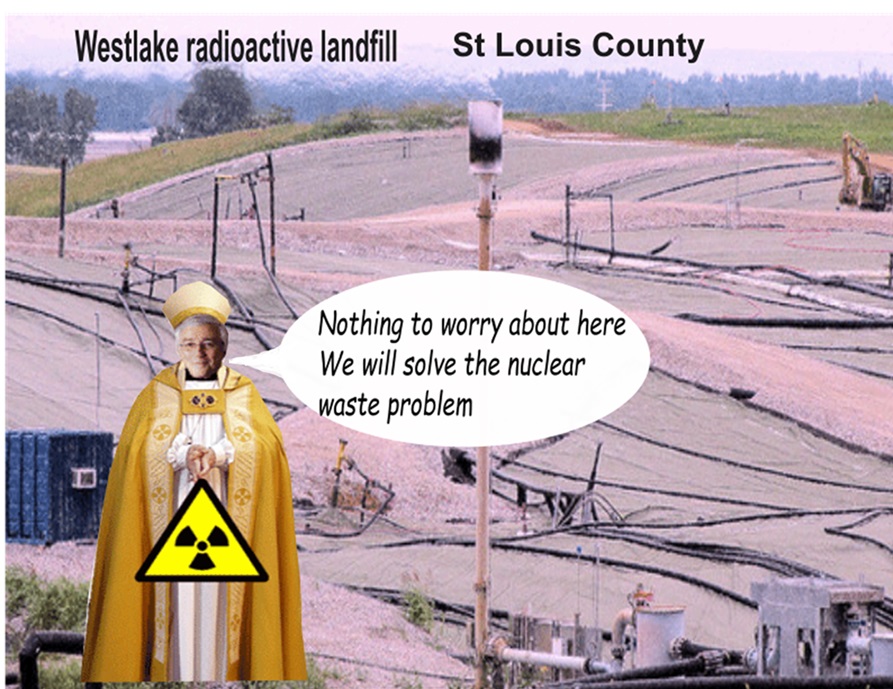
Their neighborhood was bordered by Coldwater Creek, a 19-mile tributary of the Missouri River It wound through their backyards, near baseball fields, schools and cemeteries — and past lots where leaking barrels and open-air dumps of nuclear waste leeched into its waters.
“It was shocking that this creek was likely making people sick,” Morice said.
Starting in 1942, roughly one ton of pure uranium was produced per day in downtown St. Louis. It was then shipped to labs across the country for the top secret Manhattan Project that created the first nuclear bomb.
The leftover waste was dumped around the city.
“That material was in 82 different spots throughout St. Louis County. It spilled. Children played in it. It seemed to me that there wasn’t an attempt to absolutely get to the bottom of it,” Morice said.
In Morice’s family alone, her mother, father and brother died of cancer, leaving her to think differently about her childhood.
“All that time, all those fun things were happening, but that whole time we, and the rest of the community were being exposed to some pretty dangerous stuff,” Morice said.
Now her husband, who also lived in the area, is fighting cancer. He’s being treated by urologic oncologist Dr. Gautum Agarwal. For the last several years, Agarwal has been tracking which of his patients lived near Coldwater Creek.
“I was seeing patients who are young, who had developed pretty significant cancers from areas that there’s been some contamination with nuclear waste,” Agarwal said.
While radiation is known to cause cancer, experts say they can’t pin down the specific cause of the disease in a given patient.
But a 2019 study from the Department of Health and Human Services found that people who lived and played near Coldwater Creek from the 1960s to 1990s “could be at an increased risk of developing lung cancer, bone cancer or leukemia.”
“The people there deserve for us to look at this much closer than we have,” Agarwal said.
The Campaign for Nuclear Disarmament will be shining a spotlight on theBritish government’s ongoing cover-up of plans for a US nuclear weapons deployment to Britain.

The Campaign for Nuclear Disarmament will be shining a spotlight on the British government’s ongoing cover-up of plans for a US nuclear weapons deployment to Britain, during a blockade of the main gate of RAF Lakenheath on Saturday, 26 April.
Campaigners will be joined by ‘Donald Trump’ and ‘Keir Starmer’ along with replicas of the B61-12 guided nuclear bomb. CND activists are coming from across the country to take part in the blockade of the main gate of the base from 12 noon.
• Saturday, 26 April
• Blockade starts at 12 noon
• RAF Lakenheath Gate 1, Brandon Road, Suffolk, IP27 9PN
The blockade takes place on the final day of the Lakenheath Alliance for Peace* peace camp, which has seen a continuous presence of campaigners outside the main gate of the base since 14 April, as well as events highlighting Lakenheath’s role in Israel’s ongoing genocide in Gaza, the role of the military in climate breakdown, and NATO’s nuclear network in Europe.
The blockade comes as CND’s lawyers forced the Ministry of Defence to declassify a significant nationwide exemption certificate, issued in March 2021 by former Defence Secretary, Ben Wallace, on the grounds of ‘national security’. The document shockingly exempts US Visiting Forces from adhering to British nuclear safety regulations at its bases across Britain, which includes RAF Lakenheath.
CND is calling on PM Keir Starmer to come clean about this cover-up and to publicly announce that US nuclear weapons will not be deployed to Britain.
CND General Secretary Sophie Bolt said:
“Trump’s reckless ‘America First’ agenda is increasing international tensions every day. Siting US nuclear bombs in Britain will put us on the frontline of any military confrontation. The British government needs to step back from its so-called ‘special relationship’ with the US and refuse to host these deadly bombs. The US has poured millions of dollars into upgrading the base in preparation for siting new nuclear bombs. Yet the government refuses to come clean.
“RAF Lakenheath has a history of near nuclear accidents which were covered up for decades. The best way to protect people in East Anglia and across the country is to not have nuclear weapons in the first place. With nuclear dangers on the rise, the presence of US nuclear weapons in Britain makes us a target in the event of a nuclear war – with catastrophic consequences. Any accidents involving a nuclear weapon would have a devastating environmental and humanitarian impact which no amount of drilling could prepare us for. CND is calling on everyone who is concerned about this to join us at the blockade on RAF Lakenheath’s main gate this Saturday, 26 April.”
The Ever-Expanding War Machine
Dismantling the Government While Pumping Up the Pentagon
By William D. Hartung, April 22, 2025 https://tomdispatch.com/the-ever-expanding-war-machine/
Under the guise of efficiency, the Trump administration is taking a sledgehammer to essential programs and agencies that are the backbone of America’s civilian government. The virtual elimination of the U.S. Agency for International Development (USAID) and plans to shut down the Department of Education are just the most visible examples of a campaign that includes layoffs of budget experts, public health officials, scientists, and other critical personnel whose work undergirds the daily operations of government and provides the basic services needed by businesses, families, and individuals alike. Many of those services can make the difference between solvency and poverty, health and illness, or even, in some cases, life and death for vulnerable populations.
The speed with which civilian programs and agencies are being slashed in the second Trump era gives away the true purpose of the Department of Government Efficiency (DOGE). In the context of the Musk-Trump regime, “efficiency” is a cover story for a greed-driven ideological campaign to radically reduce the size of government without regard for the human consequences.
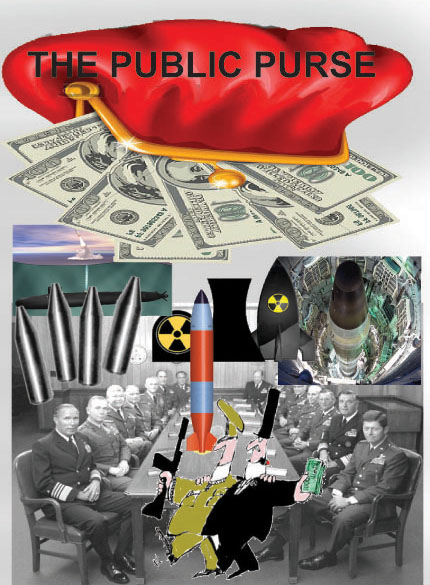
So far, the only agency that seems to have escaped the ire of the DOGE is — don’t be shocked! — the Pentagon. After misleading headlines suggested that its topline would be cut by as much as 8% annually for the next five years as part of that supposed efficiency campaign, the real plan was revealed — finding savings in some parts of the Pentagon only to invest whatever money might be saved in — yes! — other military programs without any actual reductions in the department’s overall budget. Then, during a White House meeting with Israeli Prime Minister Benjamin Netanyahu on April 7th, Trump announced that “we’re going to be approving a budget, and I’m proud to say, actually, the biggest one we’ve ever done for the military . . . $1 trillion. Nobody has seen anything like it.”
So far, cuts to make room for new kinds of military investments have been limited to the firing of civilian Pentagon employees and the dismantling of a number of internal strategy and research departments. Activities that funnel revenue to weapons contractors have barely been touched — hardly surprising given that Musk himself presides over a significant Pentagon contractor, SpaceX.
The legitimacy of his role should, of course, be subject to question. After all, he’s an unelected billionaire with major government contracts who, in recent months, seemed to have garnered more power than the entire cabinet combined. But cabinet members are subject to Senate confirmation, as well as financial disclosure and conflict-of-interest rules. Not Musk, though. Not only hasn’t he been vetted by Congress, but he’s been allowed to maintain his role in SpaceX.
A Hollow Government?
The Trump and Musk hollowing out of the civilian government, while keeping the Pentagon budget at enormously high levels of funding, means the United States is well on its way to becoming the very “garrison state” that President Dwight D. Eisenhower warned against in the early years of the Cold War. And mind you, all of that’s true before Republican hawks in Congress like Senate Armed Services Committee Chairman Roger Wicker (R-MS), who is seeking $100 billion more in Pentagon spending than its officials have asked for, even act.
What’s at stake, however, goes well beyond how the government spends its money. After all, such decisions are being accompanied by an assault on basic constitutional rights like freedom of speech and a campaign of mass deportations that already includes people with the legal right to remain in the United States. And that’s not to mention the bullying and financial blackmailing of universities, law firms, and major media outlets in an attempt to force them to bow down to the administration’s political preferences.In fact, the first two months of the Trump/Musk administration undoubtedly represent the most blatant power grab by the executive branch in the history of this republic, a move that undermines our ability to preserve, no less expand, the fundamental rights that are supposed to be the guiding lights of American democracy. Those rights have, of course, been violated to one degree or another throughout this country’s history, but never like this. The current crackdown threatens to erase the hard-won victories of the civil rights, women’s rights, labor rights, immigrant rights, and LGBTQ rights movements that had brought this country closer to living up to its professed commitments to freedom, tolerance, and equality.
Continue readingOn Neo-Nazi Influence in Ukraine

The Azov Battalion, which arose during the coup, became a significant force in the war against the Russian-speaking people of the Donbass, who resisted the coup. Its commander, Andriy Biletsky, infamously said Ukraine’s mission is to “lead the White Races of the world in a final crusade for their survival … against the Semite-led Untermenschen.”
the Azov backer’s television channel had by this time aired the hit TV show Servant of the People (2015-2019), which catapulted Volodymyr Zelensky to fame and ultimately into the presidency under the new Servant of the People Party. The former actor and comedian’s presidential campaign was bankrolled by Kolomoisky, according to multiple reports.
Zelensky was elected president on the promise of ending the Donbass war. About seven months into his term he traveled to the front line in Donbass to tell Ukrainian troops, where Azov is well-represented, to lay down their arms. Instead he was sent packing. The Kyiv Post
A short history of neo-Nazism in Ukraine in response to some who say, “There is no evidence that Nazism has substantial influence in Ukraine.” Joe Lauria reports.
By Joe Lauria, Consortium News, 20 Apr 25
The U.S. relationship with Ukrainian fascists began after the Second World War. During the war, units of the Organization of Ukrainian Nationalists (OUN-B) took part in the Holocaust, killing at least 100,000 Jews and Poles.
Mykola Lebed, a top aide to Stepan Bandera, the leader of the fascist OUN-B, was recruited by the C.I.A. after the war, according to a 2010 study by the U.S. National Archives.
The government study said, “Bandera’s wing (OUN/B) was a militant fascist organization.” Bandera’s closest deputy, Yaroslav Stetsko, said: ““I…fully appreciate the undeniably harmful and hostile role of the Jews, who are helping Moscow to enslave Ukraine…. I therefore support the destruction of the Jews and the expedience of bringing German methods of exterminating Jewry to Ukraine….”
The study says: “At a July 6, 1941, meeting in Lwów, Bandera loyalists determined that Jews ‘have to be treated harshly…. We must finish them off…. Regarding the Jews, we will adopt any methods that lead to their destruction.’”
Lebed himself proposed to “’cleanse the entire revolutionary territory of the Polish population,’ so that a resurgent Polish state would not claim the region as in 1918.” Lebed was the “foreign minister” of a Banderite government in exile, but he later broke with Bandera for acting as a dictator. The U.S. Army Counterintelligence Corps termed Bandera “extremely dangerous” yet said he was “looked upon as the spiritual and national hero of all Ukrainians….”
The C.I.A. was not interested in working with Bandera, pages 81-82 of the report say, but the British MI6 was. “MI6 argued, Bandera’s group was ‘the strongest Ukrainian organization abroad, is deemed competent to train party cadres, [and] build a morally and politically healthy organization….’” An early 1954 MI6 summary noted that, “the operational aspect of this [British] collaboration [with Bandera] was developing satisfactorily. Gradually a more complete control was obtained over infiltration operations …
Britain ended its collaboration with Bandera in 1954. West German intelligence, under former Nazi intelligence chief Reinhard Gehlen, then worked with Bandera, who was eventually assassinated with cyanide dust by the KGB in Munich in 1959.
Instead of Bandera, the C.I.A. was interested in Lebed, despite his fascist background. They set him up in an office in New York City from which he directed sabotage and propaganda operations on the agency’s behalf inside Ukraine against the Soviet Union. The U.S. government study says:
“CIA operations with these Ukrainians began in 1948 under the cryptonym CARTEL, soon changed to AERODYNAMIC. … Lebed relocated to New York and acquired permanent resident status, then U.S. citizenship. It kept him safe from assassination, allowed him to speak to Ukrainian émigré groups, and permitted him to return to the United States after operational trips to Europe. Once in the United States, Lebed was the CIA’s chief contact for AERODYNAMIC. CIA handlers pointed to his ‘cunning character,’ his ‘relations with the Gestapo and … Gestapo training,’ [and] the fact that he was ‘a very ruthless operator.’”
The C.I.A. worked with Lebed on sabotage and pro-Ukrainian nationalist propaganda operations inside Ukraine until Ukraine’s independence in 1991. “Mykola Lebed’s relationship with the CIA lasted the entire length of the Cold War,” the study says. “While most CIA operations involving wartime perpetrators backfired, Lebed’s operations augmented the fundamental instability of the Soviet Union.”
Bandera Revival

The U.S. thus covertly kept Ukrainian fascist ideas alive inside Ukraine until at least Ukrainian independence was achieved. “Mykola Lebed, Bandera’s wartime chief in Ukraine, died in 1998. He is buried in New Jersey, and his papers are located at the Ukrainian Research Institute at Harvard University,” the U.S. National Archives study says.
The successor organization to the OUN-B in the United States did not die with him, however. It had been renamed the Ukrainian Congress Committee of America (UCCA), according to the International Business Times (IBT).
“By the mid-1980s, the Reagan administration was honeycombed with UCCA members. Reagan personally welcomed [Yaroslav] Stetsko, the Banderist leader who oversaw the massacre of 7,000 Jews in Lviv, in the White House in 1983,” IBT reported. “Following the demise of [Viktor] Yanukovich’s regime [in 2014], the UCCA helped organise rallies in cities across the US in support of the EuroMaidan protests,” it reported.
That is a direct link between Maidan and WWII-era Ukrainian fascism.
Despite the U.S. favoring the less extreme Lebed over Bandera, the latter has remained the more inspiring figure in Ukraine.
In 1991, the first year of Ukraine’s independence, the neo-fascist Social National Party, later Svoboda Party, was formed, tracing its provenance directly to Bandera. It had a street named after Bandera in Liviv, and tried to name the city’s airport after him. (Svoboda won 10 percent of the Rada’s seats in 2012 before the coup and before Sen. John McCain and U.S. Assistant Secretary of State Victoria Nuland appeared with Svoboda’s leader the following year.)
In 2010, pro-Western Ukrainian President Viktor Yushchenko declared Bandera a Hero of Ukraine, a status reversed by President Viktor Yanukovych, who was overthrown with the help of Ukrainian neo-Nazis in 2014.
More than 50 monuments, busts and museums commemorating Bandera have been erected in Ukraine, two-thirds of which have been built since 2005, the year the pro-American Yuschenko was elected. A Swiss academic study says:
“On January 13, 2011, the L’vivs’ka Oblast’ Council, meeting at an extraordinary session next to the Bandera monument in L’viv, reacted to the abrogation [skasuvannya] of Viktor Yushchenko’s order about naming Stepan Bandera a ‘Hero of Ukraine’ by affirming that ‘for millions of Ukrainians Bandera was and remains a Ukrainian Hero notwithstanding pitiable and worthless decisions of the courts’ and declaring its intention to rename ‘Stepan Bandera Street’ as ‘Hero of Ukraine Stepan Bandera Street.’”
Torchlit parades behind Bandera’s portrait are common in Ukrainian cities, particularly on Jan. 1, his birthday, including this year.
Mainstream on Neo-Nazis
From the start of the 2013-2014 events in Ukraine, Consortium News founder Robert Parry and other writers began providing the evidence NewsGuard, which bills itself as a news-rating agency, says doesn’t exist. Parry began reporting extensively on the coup and the influential role of Ukraine’s neo-Nazis. At the time, corporate media also reported on the essential part neo-Nazis played in the coup. [See: ROBERT PARRY: Ukraine’s Inconvenient Neo-Nazis]
As The New York Times reported, the neo-Nazi group, Right Sector, had the key role in the violent ouster of Yanukovych. The role of neo-fascist groups in the uprising and its influence on Ukrainian society was well reported by mainstream media outlets at the time.
The BBC, the NYT, the Daily Telegraph and CNN all reported on Right Sector, C14 and other extremists’ role in the overthrow of Yanukovych. The BBC ran this report a week after his ouster:
After the coup a number of ministers in the new government came from neo-fascist parties. NBC News (100 percent NewsGuard rating) reported in March 2014: “Svoboda, which means ‘Freedom,’ was given almost a quarter of the Cabinet positions in the interim government formed after the ouster of President Viktor Yanukovych in February.”
Svoboda’s leader, Tyahnybok, whom McCain and Nuland stood on stage with, once called for the liberation of Ukraine from the “Muscovite-Jewish mafia.” The International Business Times (82.5 percent) reported:
“In 2005 Tyahnybok signed an open letter to then Ukrainian president Viktor Yushchenko urging him to ban all Jewish organisations, including the Anti-Defamation League, which he claimed carried out ‘criminal activities [of] organised Jewry’, ultimately aimed at the genocide of the Ukrainian people.”
Before McCain and Nuland embraced Tyahnybok and his social national party, it was condemned by the European Parliament, which said in 2012:
Continue reading‘I guarded Britain’s nuclear sites – our security can’t cope with new mini reactors’

mini reactors do not pose miniature hazards. “On security, size doesn’t matter. When it comes to the fuel and the byproducts, they are equally dangerous.”
“You get less energy, but you’re still going to have exactly the same security concerns,” says Okuhara. “How enthusiastic is a site operator going to be paying for security when that’s eating into their bottom line?”
INTERVIEW . Matthew Okuhara, a former armed officer with the Civil Nuclear Constabulary, fears that current security plans will be inadequate to protect the UK’s next generation of nuclear power plants..
Rob Hastings, Special Projects Editor , April 22, 2025
Sometimes he would patrol rural lanes on foot, carrying his assault rifle, looking out for any terrorists hiding in the countryside. On other assignments he would man machine guns mounted on armoured ships, watching for any sign of hostile vessels coming his way. Or he would drive in weapons-laden road convoys, monitoring potential threats from vehicles.
While serving as an armed officer with the Civil Nuclear Constabulary (CNC), Matt Okuhara saw every aspect of how the UK’s nuclear power stations and their radioactive fuel are protected from terrorists.
He spent years escorting the transport of uranium fuel to and from plants, which would be planned for months in advance. “Nuclear material is at its most vulnerable when it’s in transit,” he explains. “You’ve got to move it as secretly as possible.”
Working for the specialist force, Okuhara always felt confident the country’s civil nuclear programme was in safe hands. “Any threat has been detected long before it’s been able to cause any problems,” he says.
However, he believes the situation is “definitely more dangerous now” than when he was serving. Terrorism has become more advanced and there are new fears about so-called hybrid warfare from geopolitical adversaries including Russia.
“You don’t have to be a James Bond super-villain to realise where the vulnerable parts of a site are. You can just look on Google Maps and say, ‘We’ll attack that bit,’ especially now we’ve got drones. The threat has really shot up.”
With new technology also on the horizon, he believes the nuclear industry must face up to big security questions.
The CNC currently guards just a handful of sites, all in relatively remote locations. But experts believe the Government’s planned array of cutting-edge mini nuclear power stations could lead to a “proliferation” of reactors around the country, potentially much closer to towns and cities. This may also lead to their fuel being transported more often.
Small modular reactors (SMRs) are seen as an essential source of green energy for the UK in decades to come. Proponents say they will be quicker and cheaper to build than conventional plants, because they will be largely prefabricated.
But security experts are worried about the complex implications for how SMRs will be policed and protected, as The i Paper revealed this week. Analysts say that thousands more armed officers would have to be recruited, co-ordination with local police would have to be strengthened, and a new national infrastructure force may even have to be created.
Okuhara shares these concerns. “I don’t think the CNC’s current policing model would be able to cope with any more sites,” he says. “The generating sites, they’re kept well away from the public for good reasons.
“One, they’re easier to protect. And two, if something goes wrong, the contingency engineers have got some space to work with.”
What is the Civil Nuclear Constabulary?
- The CNC is a specialist armed force with about 1,600 officers and staff. It was created in 2005 to guard civil nuclear sites and material.
- “The CNC will deter any attacker whose intent is the theft, sabotage or destruction of nuclear material, whether static or in transit, or the sabotage of high consequence facilities,” its web page explains.
- It adds: “If an attack occurs, CNC will defend that material and those facilities and deny access to them. If material is seized or high consequence facilities are compromised, the CNC will recover control of those facilities and regain custody of the material.”
New small reactors, same big risks
After fighting in the Iraq War with British infantry, Okuhara joined the CNC in 2006 and served for six years. He describes how he helped to protect Gloucestershire’s Oldbury Power Station – which is now undergoing decommissioning – in his new book, Nuclear Copper. “Based within the high metal fences and fortress-like security measures of the power station, there was a heavily armed police presence on duty at any given time,” he writes.
To deter and prevent terrorism, the team patrolled surrounding roads and villages, wearing body armour and carrying G36C assault rifles. They benefited from the rural location by building relationships with local farmers and villagers, who “could recognise an unfamiliar car or person instantly” and knew to inform officers.
Rules currently state that nuclear power stations can only be placed in “semi-urban” settings. A spokesperson for the Department for Energy Security & Net Zero insists: “All new nuclear projects, including SMRs, are prevented from being built in densely populated areas.” The Government is loosening restrictions on them being built in the countryside.
But a majority of industry figures believe that “new nuclear technologies could be safely located closer to densely populated areas,” according to an official consultation paper.
The Whitehall document says that the semi-urban restriction will be reviewed every five years “to ensure it remains relevant and effective,” and the Government is “open to revising” this rule in future……………………….
The nuclear industry argues that SMRs will be small enough to build in urban settings, but Okuhara argues this would rob officers of a key advantage. “An intervention zone around a site gives you plenty of space where you can detect things,” he explains.
And he underlines that mini reactors do not pose miniature hazards. “On security, size doesn’t matter. When it comes to the fuel and the byproducts, they are equally dangerous.”
At the moment, energy companies cover much of the CNC’s costs. But having many smaller sites is likely to make security operations proportionately more expensive.
He continues: “If you think about the largest sites in the UK, places like Sellafield or Dounreay, they’ve got hundreds of officers. There are plenty of people out on patrol. Are these SMRs going to be given sufficient resources? Or are the companies going to be saying: ‘It’s a small reactor, we don’t need as many bodies on the ground’?”
The Government offers reassurance that any SMR will “need to have the highest levels of security in place.” A spokesperson said: “All operators are answerable to a robust and independent regulator – the Office for Nuclear Regulation – which must approve their security plan covering physical, personnel and cyber security.” The CNC declined to comment.
Vetting failures
If potentially thousands more armed officers must be recruited to guard SMRs, the CNC must improve its vetting procedures. That much is clear because of one man: Wayne Couzens.
Couzens’ name became infamous after he raped and murdered Sarah Everard in Surrey in 2021, having used his Metropolitan Police ID to falsely arrest her.
Couzens had previously been an authorised firearms officer with the CNC, serving at Sellafield and Dungeness. He had passed the CNC’s vetting procedures in 2011 despite previously being accused of numerous sexual offences, including harassment, assault and indecent exposure. He transferred to the Met in 2018.
The CNC’s Chief Constable, Simon Chesterman, apologised “unreservedly” on behalf of the force in 2024, “for the part CNC played in his entry as a full-time police officer.”………………………………………………
No matter whether they’re protecting groundbreaking SMRs, or conventional nuclear sites, or convoys of radioactive fuel, “every officer in the CNC should have the top level of vetting,” he says. “They’ve got access to firearms. They can access some of the most toxic material that has ever existed.”
It’s a reminder that when it comes to nuclear security, sometimes the biggest threats can come from insiders.
‘Nuclear Copper: The Secret World of Nuclear Policing’ by Matt Okuhara is out now (£22.99, Amberley Publishing) @robhastings.bsky.social https://inews.co.uk/news/crime/i-guarded-britains-nuclear-sites-security-mini-reactors-3649782
New Brunswick government rethinks nuclear reactor plans.

COMMENT. Thanks to our Green Party leader MLA David Coon for stating the case against, as he has been doing for more than a decade now. The article mentions that the government is also considering another CANDU reactor, which is interesting. I think the push is on now to buy Canadian… Unfortunately for the New Brunswick economy, the current CANDU 6 reactor has been a financial nightmare.
Matthew McClearn , April 22, 2025, https://www.theglobeandmail.com/business/article-new-brunswick-government-rethinks-nuclear-reactor-plans/
Small modular nuclear reactors remain part of New Brunswick’s plans for future power generation, the province’s Energy Minister says, but it may select more conventional models – and build them later – than originally envisioned.
New Brunswick originally intended to construct one or two reactors by 2030 at its Point Lepreau Nuclear Generating Station, Atlantic Canada’s only nuclear power plant. It has started predevelopment work for up to 600 megawatts of generation capacity from new SMRs, which would be roughly equivalent to the output of its current lone reactor.
But René Legacy, who became energy minister and deputy premier in November after the Liberals defeated the Conservatives in the provincial election, has been tasked with drawing up a new energy plan.
In an interview, Mr. Legacy said SMRs remain attractive because their output is better matched with the province’s needs than those of large reactors. However, he added, the government is considering different models from those of its existing partners, and expects a delayed construction timeline.
The province and its wholly owned utility, New Brunswick Power, partnered in 2018 with ARC Clean Technology and Moltex Energy Canada Inc. Both promoted reactors featuring novel coolants, fuels or moderators that are not traditionally used in commercial power generation, and neither had built reactors previously. However, both companies struggled to raise sufficient funds and recruit the hundreds of employees typically required for reactor development.
“The original plan to have one or two of the reactors built for 2030, that time frame is probably not going to happen,” Mr. Legacy said, adding that first-of-a-kind reactors are expensive while acknowledging the province’s fiscal constraints.
“So we’re looking at, probably, different options.”
Adjustments to New Brunswick’s SMR strategy arrive at a moment of great uncertainty for the province’s energy sector. Premier Susan Holt has promised a far-ranging consultation concerning the future of NB Power, which has struggled unsuccessfully to reduce its debt burden and faces significant spending to replace or refurbish aging infrastructure. Point Lepreau spent most of the past year out of service during planned and unplanned outages.
Mr. Legacy said that while the 2030 deadline for constructing SMRs is likely not achievable, changing circumstances have afforded more breathing room for the province to select a reactor technology. A new gas-fired power plant is scheduled to begin operating in 2028, and the federal government recently announced up to $1-billion in funding for up to 670 megawatts of Indigenous-led wind projects. Amendments to federal regulations have afforded the province “a little bit of a longer runway” to convert its coal-fired Belledune Generating Station, in Gloucester County, to burn biomass.
“At the very latest, we’re going to need some shovels in the ground around 2035, because some of our assets are going to come close to end of life, and we’re going to have to replace that generation,” he said.
“So we’ll have to make a decision and start moving towards a technology now.”
Mr. Legacy said New Brunswick Power is studying reactors already being considered for deployment in other provinces. These include the BWRX-300, which was designed by GE Hitachi Nuclear Energy; Ontario Power Generation plans to construct the first one at its Darlington Nuclear Generating Station by 2028. Another candidate is Westinghouse Electric Co. LLC’s AP300, a proposed design Westinghouse based on its larger AP1000, several of which have been constructed worldwide.
Mr. Legacy said the province is also considering a Candu reactor, which implies large reactors are not off the table. (SMRs are typically defined as having capacities below 300 megawatts, but there are no Candus currently marketed in that range. Point Lepreau’s existing reactor, a 660-megawatt Candu-6, entered service in 1983.)
ARC is still in the running, Mr. Legacy added, but the company must find a financial partner. Also, its ARC-100 reactor would require high-assay low-enriched uranium (HALEU), which is not produced commercially in North America. (Russia is the lone major supplier.) This month, the U.S. Department of Energy committed to provide HALEU to five U.S. reactor developers, with deliveries beginning as early as this fall; ARC was not among them. Mr. Legacy said ARC must ensure fuel availability as “part of their package.
As for Moltex, the province remains interested in its Waste To Stable Salt technology, which contemplates reprocessing spent nuclear fuel into new reactor fuel. But “Moltex is probably more of a longer play” than ARC, he added.
David Coon, leader of the province’s Green Party, said the former Conservative government regarded SMRs as an economic development and hoped to export them globally. The new Liberal government isn’t looking to subsidize SMR development, preferring reactor models that have already been constructed elsewhere.
Mr. Coon said SMRs aren’t appropriate for New Brunswick because they’re “extremely costly” and produce radioactive waste. Better bets, he said, would include improved energy efficiency, utility-scale battery storage, more wind generation and increased sharing of electricity with neighbouring provinces.
“We can’t afford it, it’s not clean and we don’t need it,” he said of nuclear energy.
Aid workers describe Gaza as “stuff of nightmares” as Israel’s mass forced displacements cause carnage and despair.

April 23, 2025, Oxfam. https://theaimn.net/aid-workers-describe-gaza-as-stuff-of-nightmares-as-israels-mass-forced-displacements-cause-carnage-and-despair/
Restrictions on movement and total siege making aid operations almost impossible
As Gaza enters the eighth week of an Israel-imposed siege, blocking aid, vital supplies and commercial goods, Oxfam staff are describing conditions as the “stuff of nightmares”, with Israel’s mass forced displacement orders spreading terror, Oxfam said.
Israel has issued repeated forced displacement orders to clear out civilian populations from its renewed airstrikes and attacks on Gaza since 18 March, which has left about 70% of the Strip under displacement orders or “no go” zones, affecting more than 500,000 people. Many have been pushed into inhospitable, unsafe and inaccessible areas.
Since 2 March, Israel has allowed no aid or commercial goods to enter Gaza. Many humanitarian agencies have been forced to pause their operations. Oxfam and its partners have not received a single aid truck, food parcel, hygiene kit or any other essential equipment since the siege began. Oxfam’s supplies are nearly exhausted, with only a few water tanks remaining in Gaza City.
Palestinians in Gaza are now emotionally and physically exhausted after 18 months of airstrikes and ground offensives, repeated forced displacement orders and restrictions on basic services since October 7, 2023.
The recent escalations in efforts by Israel to bombard, deprive and displace the Palestinian population of Gaza, sees Oxfam and partner organizations severely restricted and struggling to provide support to civilians, who are facing starvation and relentless violence.
One Oxfam staff member, who was displaced under fire twice in one weekafter the forced evacuation of Rafah, said nearly everything had been destroyed. She described the sounds of gunfire at night and people crying in the street, not knowing where to go. Another Oxfam worker said the experiences were “the stuff of nightmares” – people crying for help under piles of rubble, with others desperately trying to flee with injured family members, and others facing a daily struggle to find anything to drink or eat.
Clemence Lagouardat, Oxfam Response Lead in Gaza said:
“It’s hard to explain just how terrible things are in Gaza at the moment. Our staff and partners are witnessing scenes of carnage and despair every day. People are in terror, fearing for their lives as displacement orders tell them, with little notice, to move with whatever they can carry.
“The restrictions on internal movement are also making it very difficult to carry out vital, life-saving work. With so many people displaced, the strains on dwindling resources and operational needs are massive. What little aid we have left inside Gaza is hard to get to people living in makeshift shelters and tents when travel is so dangerous.”
Mohammad Nairab, Executive Manager, Palestinian Environmental Friends Association (PEF), one of Oxfam’s partners in Gaza said:
“Since the war resumed many of our teams have been displaced. We have had to continue our work, despite the lack of safety, as countless people rely on us for water, especially during these dire times. Nothing could have prepared us for such an unprecedented war. The damage we face—both psychological and physical—is profound and cannot be easily undone.”
Oxfam says that people are struggling to find safe drinking water, with facilities bombed or unable to operate since Israel cut the last remaining electricity supplies needed to run sanitation facilities. Backup generators are of little use because fuel stores are depleted. The prices of what little food is available have skyrocketed, and many people are at risk of extreme hunger.
Lagouardat said: “We must see an end to this terror and carnage right now, with a lifting of the siege to allow urgent humanitarian aid to reach all of those in need.”
Oxfam is calling for a renewed and permanent ceasefire, the safe return of Israeli hostages and illegally detained Palestinian prisoners, and immediate and unfettered aid access at scale in Gaza. Oxfam reiterates its call for justice and accountability for all those affected. States should stop selling arms to Israel, risking complicity in war crimes and crimes against humanity committed.
World’s first AI-powered nuclear power plant Diablo Canyon worries experts after Trump plan

AI technology being used to aid the running of a nuclear power plant has experts worried as Trump scraps AI regulation labelling them it ‘as barriers to American AI innovation’.
Daily Star 21st April 2025
Fears AI technology powering nuclear power plants could lead to catastrophe have been sparked experts caution the emergence of AI in the nuclear energy industry.
These fears come after Trump scraps AI regulation labelling it “as barriers to American AI innovation” as experts have begun to deploy AI to help run a once dead nuclear power plant.
Boffs at the Diablo Canyon, California’s sole remaining nuclear power plant, has begun exploring the frontier of AI to help aid them running the powerplant. In a venture with artificial intelligence start-up Atomic Canyon, a brand-new artificial intelligence tool designed for the nuclear energy industry.
Pacific Gas and Electricity who runs Diablo Canyon have announced a deal with the artificial intelligence start-up declaring the development of “the first on-site generative AI deployment at a U.S. nuclear power plant”.
Currently the artificial intelligence tool, dubbed Neutron Enterprise, is meant to help workers navigate extensive technical reports and regulations. Due to Neutron Enterprise’s use at the Diablo Canyon, both lawmakers and AI experts are requesting strong guardrails…………………..
Tamara Kneese, the director of tech policy non-profit Data & Society’s Climate, Technology, and Justice program commented on the use of AI in the field. “AI can be helpful in terms of efficiency,” the director said, praising the initial implementation.
“The idea that you could just use generative AI for one specific kind of task at the nuclear power plant and then call it a day, I don’t really trust that it would stop there. And trusting PG&E to safely use generative AI in a nuclear setting is something that is deserving of more scrutiny,” Kneese added…………………… https://www.dailystar.co.uk/news/world-news/worlds-first-ai-powered-nuclear-35093367
Nuclear Free Local Authorities sign letter asking leading banks to back our planet not the bomb!

The UK/Ireland Nuclear Free Local Authorities have endorsed an Open Letter
calling on five major banks to divest from nuclear weapons. The letter was
drafted by activists at Medact as the next action in their Don’t Bank on
the Bomb UK campaign. Barclays, HSBC, Lloyds, NatWest and Standard
Chartered have provided $30.5 billion to the nuclear weapons industry. For
the survival of humanity and the planet, the elimination of nuclear weapons
and prevention of their use is an urgent priority. This letter calls on the
five banks to stop choosing profit over people and end financing nuclear
weapons.
NFLA 22nd April 2025, https://www.nuclearpolicy.info/news/nflas-sign-letter-asking-leading-banks-to-back-our-planet-not-the-bomb/
China, Russia may build nuclear plant on moon to power lunar station, official says
China is considering building a nuclear plant on the moon to power the
International Lunar Research Station (ILRS) it is planning with Russia, a
presentation by a senior official showed on Wednesday. China aims to become
a major space power and land astronauts on the moon by 2030, and its
planned Chang’e-8 mission for 2028 would lay the groundwork for
constructing a permanent, manned lunar base.
Reuters 23rd April 2025, https://www.reuters.com/business/energy/china-led-lunar-base-include-nuclear-power-plant-moons-surface-space-official-2025-04-23/
Iran opens door to restoring nuclear surveillance, UN watchdog says

Iran has agreed to allow a technical team from the International Atomic
Energy Agency (IAEA) to discuss restoring camera surveillance in Iranian
nuclear facilities, the head of the UN nuclear watchdog said on Wednesday.
IAEA Director General Rafael Grossi confirmed the agency would send a
technical team to Iran following his visit to Tehran this month. Grossi
said his impression is that the Islamic Republic’s leaders are “seriously
engaged in discussions… with a sense of trying to get to an agreement.”
The UN body would be the party responsible for verifying Iran’s compliance
with a deal, Grossi said. “This will have to be verified by the IAEA.”
Iran International 23rd April 2025 https://www.iranintl.com/en/202504237179
Miliband explores cut-price clean-up of Britain’s deadliest nuclear waste.

The UK’s massive nuclear waste stockpile includes 110,000 tonnes of uranium, 6,000 tonnes of spent nuclear fuels and about 120 tonnes of plutonium – mostly stored at the Sellafield nuclear site in Cumbria in decaying containers and ageing buildings.
Space equivalent to eight Royal Albert Halls is required to dispose of highly toxic substances.
Ed Miliband is backing a cut-price clean-up of
the UK’s growing nuclear waste mountain. The Energy Secretary’s plans
involve highly radioactive used fuel rods being dropped into holes drilled
deep into the Earth’s crust.
The experimental approach, pioneered by Deep
Isolation, an American company, is being funded by the Department for
Energy Security and Net Zero (Desnz), which is helping develop the
toughened canisters needed to contain the deadly waste. If it works, the
method could offer a faster and cheaper way of dealing with the hundreds of
tonnes of high-level radioactive waste accumulated by the UK over the last
seven decades and the new waste generated by future reactors like Hinkley
Point C, under construction in Somerset.
The solution will see used fuel
rods from nuclear reactors placed into steel cylinders designed to fit into
boreholes drilled thousands of feet into deep rock formations. The UK’s
massive nuclear waste stockpile includes 110,000 tonnes of uranium, 6,000
tonnes of spent nuclear fuels and about 120 tonnes of plutonium – mostly
stored at the Sellafield nuclear site in Cumbria in decaying containers and
ageing buildings. UK Government Investments warned in its annual report
that the cost of “nuclear decommissioning threatens the Government’s
finances due to its inherent uncertainty.” The Office for Budget
Responsibility has issued similar warnings. A key problem for the UK is
that, despite decades of trying, it still has no way of permanently storing
nuclear waste. The current plan is to excavate a network of caverns under
the sea, filling them with nuclear waste and then sealing them with cement.
However, work is not expected to start till at least 2050 and will take
decades to complete. Deep boreholes could offer a faster and cheaper
solution for at least some of the waste. Under the Deep Isolation scheme,
boreholes would be drilled into rock using technology first developed by
the oil and gas industry for “fracking”.
Telegraph 21st April 2025,
https://www.telegraph.co.uk/business/2025/04/21/miliband-cut-price-clean-up-deadliest-nuclear-waste/
Framatome awarded backup power and remote sensing Sizewell C contract

Framatome has been awarded a contract to provide conventional field
instrumentation (CFI) and emergency backup power generation capacity to
Sizewell C. The company is 80.5% owned by EDF – a French state-owned
company, which is the minority owner of Sizewell C. The remaining 19.5% of
Framatome is owned by Mitsubishi Heavy Industries. The UK Government is
currently the majority owner of Sizewell C, which has sunk £6.4bn of
taxpayer cash into the project. Sizewell C has not yet achieved a final
investment decision (FID), which is a requirement before main construction
can take place. Framatome will be supplying “ultimate diesel
generators” which will be “controlled by Framatome’s digital control
systems”, according to a statement from the company. Ultimate diesel
generators provide emergency backup power capacity to nuclear power
stations in the event that grid power becomes unavailable.
New Civil Engineer 22nd April 2025
https://www.newcivilengineer.com/latest/framatome-awarded-backup-power-and-remote-sensing-sizewell-c-contract-22-04-2025/
Drawing inspiration from Vaclav Havel..

https://www.artistespourlapaix.org/3-ans-de-souffrances-ukrainiennes/
Par Pierre Jasmin, Artiste pour la Paix, 21 février 2025


1 Vaclav Havel and the Art of Compromise
Unfortunately, I never knew Vaclav Havel personally, even though I gave masterclasses (except for one in Piešťany, Slovakia), concertos, and recitals in the Czech Republic for fourteen summers between 1991 and 2005. I therefore had the privilege of experiencing the miracle of the Velvet Revolution in a country as Eastern European as Ukraine. The ruling communist party, allied with the Soviet army that had bloodily halted Dubcek's revolution, sought out a humanist playwright from prison in 1989 and installed him in the presidential seat. The new Havel government accepted the separation of Czecho-Slovakia less than three years later, without a drop of bloodshed.

Five years after the first Minsk Treaty (UN), mistreated by our Minister Baird, an accomplice of the fascist Poroshenko, a similar hope arose in Ukraine with the election of the comedian Zelensky in May 2019. This unprecedented electoral moment unfolded in the first round with the defeat of the comfortable Russian gas option (to prevent the elderly from dying in their poorly insulated homes) represented by the succession of the corrupt President Yanukovych, deposed by the Maidan revolution in 2014, and then, in the second round, of the outgoing head of state, Poroshenko.

But unlike Havel, Zelensky, with 73.2% of the vote, surrounded himself with nationalist Bandera supporters who threatened his life to force him to bomb Donbass and join his country to the militaristic NATO, thus provoking the Russian invasion of his country. In a context of devastating war, he avoided running for re-election.

Our government, Radio-Canada, and professors like Dominique Arel, the only ones authorized to speak (Artists for Peace are censored), are imposing the obstinacy of unconditional Canadian support for this Zelensky, corrupted by Biden's weapons and money, against the imposition of a peace desired by the sacrificed young people in the trenches of Donbass, those who survived, and by the improbable Putin-Trump duo. Other arguments can be read in ().
This point 1 was an “opinion” sent to Le Devoir on Wednesday, which did not publish it. On February 20, Arel was among six university colleagues who cowardly avoided contradicting his pro-Zelensky propaganda, except for Frédérik Gagnon of UQAM: see point 7.
Lviv and its troubled history
Putin is blamed for having wanted to invade the whole of Ukraine as early as the end of February 2022 with his advance near Kyiv, which aimed to bomb the arms factories and munitions located in the capital and in Lviv. Why this former capital of Galicia, which also bore the Austrian name of Lwow, the German name of Lemberg, and the Polish name of Lvov? The answer lies in the murky history revealed in two books I read by Philippe Sands, “Return to Lemberg” and “The Line.” With a complacent ambiguity that delighted his far-right readers at Albin Michel, the Franco-British lawyer recounts the romanticized saga of Charlotte, the Nazi wife of Otto von Wächter. A member of the Nazi Party since 1923, the latter became, after the outbreak of the Second World War, governor of Krakow in Poland, then governor of the district of Galicia, two territories that were noted for the mass extermination of Jews whom he saw as allies of the Bolshevik Soviet Union. “Handsome Otto” praised Lemberg, a place far more welcoming to his family than Berlin and Krakow, as it fully shared Nazi ideology. He evaded justice until 1949, notably due to complicity in the Vatican.
Before his two questionable books, Sands had worked on the horrors of the Rwandan genocide, the Bosnian-Serb massacres, Guantanamo, and the invasion of Iraq by Blair and Bush, but not Jean Chrétien, following our mass demonstrations in Montreal motivated by the UN’s refusal to endorse the war, given the conclusions of the Swede Hans Blix exonerating Saddam Hussein of possessing weapons of mass destruction. We should also read Sands’s 2006 book, prophetic of the recent marginalization of the UN by Biden, Trump, Macron, etc., Lawless World, subtitled Torture Made in the USA (Music And Entertainment Books, 2009), in which he denounced the use of music at Abu Ghraib by CIA agents and the American army, sentenced last November to pay millions of dollars to compensate three victims (who were better defended than the thousands of others).
February 21: A Ukrainian historian exposes the “real” Zelensky
Hosted by Clark University (Atlanta), historian Marta Havryshko, a graduate and professor at the University of Lviv (!), received death threats for criticizing the Ukrainian far right, to which she retorted:
“Every day, we lose parts of our territory. Every day, we lose people. Every day, our children suffer from missile and drone attacks. And we don’t know the consequences.”
She commented for Aaron Maté on the destruction of her homeland by a proxy war waged between Russia and the United States, with Zelensky’s complicity:
“Those who want to continue this disaster, this hell,” she said, addressing the foreign warriors and those who criticized her for seeking peace, “ARE THEY READY TO SACRIFICE THEIR LIVES, and those of their brothers, sons, and other beloved family members, FOR THE ABSURD IDEA OF ACHIEVING VICTORY? “Russia is bigger, resourceful, with powerful friends. I cannot conceive that anyone who is not mentally disturbed can truly believe that Ukraine can change the situation on the front and reconquer the lost territories.”
Marta observed family members forced to fight and die in this proxy war. She showed Aaron Maté newsreels showing the army Ukrainian forces hunting and kidnapping men to force them to become conscripts to replace soldiers who are dying (or being sent to hospitals).
“Who will recapture these territories? Several of my friends, several of my relatives, are conscripted now. They suffer from suicidal thoughts, they suffer from despair or intense frustration. No one can replace them because of the problems with forced mobilization, and because we simply lack manpower.“
And she explains that everyone (except the neo-Nazis) blames Zelensky:
“His popularity has plummeted (even though television channels are censored). Ukraine under Zelensky is no longer a democracy.“
American Caitlin Johnstone adds that anyone who doesn’t support a ceasefire is a monster (of ignorance, I might add, to soften her attack).
4 abi Yar
Western censorship of Russian music, even that of a genius like Dmitri Shostakovich, is applied, for example, to the excellent Italian film The Rape. Fortunately, in 2019, the Montreal Symphony Orchestra and Nagano programmed his thirteenth symphony with the choir featuring the composer David Sela. Through a long poem by the Ukrainian Yevtuchenko (whose ex-wife, the poet Bella Achmadulina, I met in Moscow in 1978 and 1987), the Babi Yar symphony, his masterpiece, denounces the worst pogrom of all time, perpetrated by Ukrainian einsatzgruppen: 33,771 Jews murdered on the night of September 29-30, 1941. Why don’t pro-Netanyahu activists say a word about this humanist work? Because NATO supports Israel?
5 – Chrystia Freeland vs. Glenn Michalchuk
We won’t dwell on the nefarious role played since 2015 by the granddaughter of a Ukrainian Nazi, up until the horrific House of Commons ceremony that gave a standing ovation to Zelensky and the old Nazi soldier Hunka, much to the dismay of our dear friend Glenn Michalchuk, National President of the Association of United Ukrainian Canadians and a peace activist in Winnipeg, who spoke with the Artists for Peace on November 24 at the Pan-Canadian Justice and Peace Network Counter-Summit ().
6 – Colleague David Mandel
and Sachs, Guterres, Swanson, Rabkin, Philpot, Saul, Seymour, Maté, Lorincz, Stone, etc.
A full professor of political science at UQAM, David, who is Jewish, had a devastating experience following Ukraine’s breach of the UN treaty signed in Minsk in 2014: he spent his summers with trade unionists in the Ukrainian Donbass who were being bombed by the Azov Battalion; here’s a photo that triggers warnings from the Royal Canadian Mounted Police on my computer every time I share it, even though my intention is not to claim that the Nazification of Ukraine was a major phenomenon in the population.

(on the original of this photo, the man on the left is making a NAZI salute)
But here as elsewhere, for example in Germany on this election day where the AfD is increasing its support through a fierce campaign against immigrants and the illusion that more money for the army will solve the problems, the vociferous extreme right is taking an exaggerated position.
Supported by Professor Jeffrey Sachs of Columbia University, also an advisor to Antonio Guterres, David Swanson of World Beyond War writes: “NATO is not what its defenders imagine it to be. NATO is neither legal nor legalistic. It is a violation of the UN Charter for a group of nations to swear to join each other’s wars, and it does not legalize, authorize, legitimize, or sanctify a war.” Amen to the British-American wars in Iraq, Syria, and Afghanistan, at the cost of hundreds of thousands of deaths. A warning to journalists who still lie about the obvious.
7 – UQAM and the Raoul Dandurand Chair – Forum on February 20 at 12:30
Seven guests, including six university professors, spoke, repeating media nonsense. Third, then first in line to ask questions, the organizers (who know me) interrupted the presentation four minutes before the scheduled start time of 2:00 p.m. PAIX’s opinion is not welcome among intellectuals, who find it too simplistic…and, above all, anti-government.
The APLP really don’t like dictators Putin and Trump, but if they stop the war, on this point alone, we will congratulate them. The same goes for Elon Musk, if he succeeds in cutting the American military budget in half as he says he intends to do. Are the left-wing ideologues disowning us? We reassure them that as soon as these two objectives are achieved (?), we will collaborate in the fight for equality, fraternity and liberty…
8. Good news in Berlin with the award of a special prize on February 18th to the following film, which we loved for its objectivity on Hamas and the fate of civilians in the Gaza Strip following the Israeli bombings that decimated the family of this great humanist
Russia’s Rosatom says will proceed with Myanmar nuclear plant despite quake.
Myanmar lies on the boundary between two tectonic plates and is one of the world’s most seismically active countries.
Reuters, By Panu Wongcha-um, April 22, 2025
Summary
Myanmar is one of the world’s most seismically active countries
Myanmar and Russia agreed in early March to build small-scale nuclear facility
Construction timeline and location have not been announced
Thousands were killed in March 28 earthquake
BANGKOK, April 22 (Reuters) – A plan to build a nuclear power plant will continue in Myanmar, a war-torn Southeast Asian country partly devastated by a massive earthquake in March, the Russian state-owned firm leading the project told Reuters.
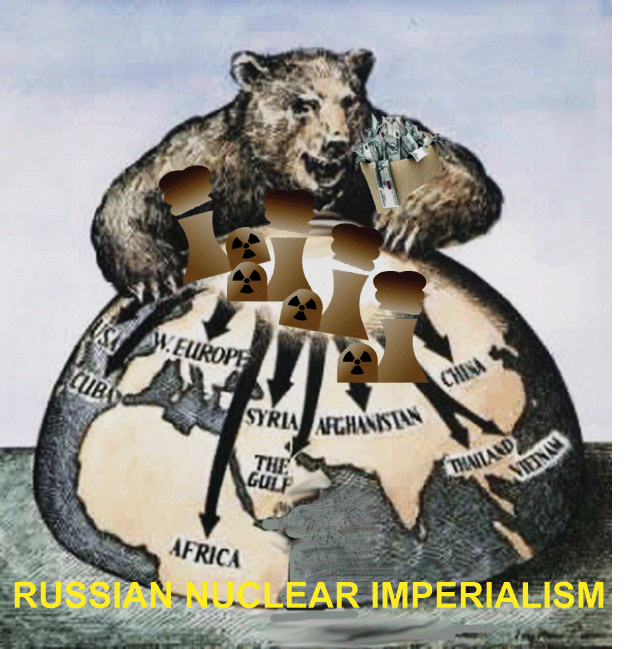
Myanmar’s junta chief Min Aung Hlaing and Russian President Vladimir Putin last month signed an agreement for a small-scale nuclear facility, three weeks before the 7.7 magnitude quake flattened communities and left more than 3,700 people dead – the country’s deadliest natural disaster in decades.
The agreement involves cooperation to build a Small Modular Reactor (SMR) in Myanmar with an initial 110 MW capacity, consisting of two 55 MW reactors manufactured by Russia’s state nuclear corporation Rosatom.
“The recent earthquake has not affected Rosatom’s plans in Myanmar,” the company’s press office said in an email.
“Rosatom adheres to the highest international safety and reliability standards, including strict seismic resistance requirements.”
The company’s intention to go ahead with the nuclear plan despite the quake, which crippled critical infrastructure, has not been previously reported.
Rosatom declined to provide any construction timeline or details of the location of the proposed nuclear facility that will be powered by RITM-200N reactors, which were made by the company for use initially on icebreaker ships.
A Myanmar junta spokesman did not respond to calls from Reuters seeking comment.
The push for nuclear power in Myanmar comes amid an expanding civil war triggered by a 2021 military coup that removed the elected government of Nobel laureate Aung San Suu Kyi.
Facing a collection of established ethnic armies and new armed groups set up in the wake of the coup, the ruling junta has lost ground across large parts of the country and increasing leaned on its few foreign allies, including Russia.
The conflict, which stretches from the border with China to the coast along the Bay of Bengal, has displaced more than 3.5 million people and left Myanmar’s mainly agrarian economy is tatters.
Myanmar is currently evaluating options for financing the Russia-backed nuclear power project. “This may involve both own and borrowed funds,” Rosatom said. In places such as Bangladesh and Egypt, Russia has funded conventional nuclear power projects through low interest loans.
Authorities in neighbouring Thailand, which is closely monitoring Myanmar’s nuclear developments, assess that a plant could be built in Naypyitaw, a fortified purpose-built capital that was heavily damaged by the earthquake, according to a security source briefed on the matter.
Two other potential sites include a location in the central Bago region and the Dawei special economic zone in southern Myanmar, where the junta and Russia have announced plans to build a port and an oil refinery, according to the Thai assessment.
Myanmar lies on the boundary between two tectonic plates and is one of the world’s most seismically active countries.
MONEY AND MANPOWER
Southeast Asia’s first nuclear facility – the 621 MW Bataan Nuclear Power Plant in the Philippines – was finished in 1984 with a price tag of $2.3 billion but mothballed in the wake of the Chornobyl disaster, opens new tab in the then Soviet Union two years later.
The Philippines and other regional countries have since mounted repeated efforts to explore nuclear energy but made limited progress.
Vietnam is, however, renewing a bet on nuclear power after it suspended its programme in 2016.
Russia and Myanmar have been collaborating in the sector for years, with Burmese students studying nuclear energy and related subjects in Russian universities under government quotas since 2019, according to Rosatom…………………
With the Myanmar junta prioritising exports of natural gas, which could be used to fuel cheaper domestic power generation, to earn foreign exchange, the nuclear plan makes no economic sense for a cash-strapped administration, said Richard Horsey, senior Myanmar adviser at International Crisis Group.
“Nuclear power is very expensive, and Myanmar simply can’t afford it,” he said.
Reporting by Panu Wongcha-um; Editing by Devjyot Ghoshal and Kate Mayberry, https://www.reuters.com/business/energy/russias-rosatom-says-will-proceed-with-myanmar-nuclear-plant-despite-quake-2025-04-22/
1 This Month





PLEASE OPPOSE HR 8255 AND S.3639 – bills would accelerate satellite deployment, with no environmental review or safeguards – https://ncstd5li.quorum.us/campaign/169331/
To see nuclear-related stories in greater depth and intensity – go to https://nuclearinformation.wordpress.com
-
Archives
- October 2026 (58)
- September 2026 (339)
- August 2026 (330)
- July 2026 (355)
- June 2026 (287)
- May 2026 (306)
- April 2026 (356)
- March 2026 (251)
- February 2026 (267)
- January 2026 (308)
- December 2025 (358)
- November 2025 (359)
-
Categories
- 1
- 1 NUCLEAR ISSUES
- business and costs
- climate change
- culture and arts
- ENERGY
- environment
- health
- history
- indigenous issues
- Legal
- marketing of nuclear
- media
- opposition to nuclear
- PERSONAL STORIES
- politics
- politics international
- Religion and ethics
- safety
- secrets,lies and civil liberties
- spinbuster
- technology
- Uranium
- wastes
- weapons and war
- Women
- 2 WORLD
- ACTION
- AFRICA
- Atrocities
- AUSTRALIA
- Christina's notes
- Christina's themes
- culture and arts
- Events
- Fuk 2022
- Fuk 2023
- Fukushima 2017
- Fukushima 2018
- fukushima 2019
- Fukushima 2020
- Fukushima 2021
- general
- global warming
- Humour (God we need it)
- Nuclear
- RARE EARTHS
- Reference
- resources – print
- Resources -audiovicual
- Weekly Newsletter
- World
- World Nuclear
- YouTube
-
RSS
Entries RSS
Comments RSS

