Israel Carpet Bombs Lebanon After Announcement of Iran Ceasefire
Israeli forces announced on Wednesday that it struck 100 sites in Lebanon over 10 minutes.
By Sharon Zhang , Truthout, April 8, 2026
Israeli forces launched some of the most intense bombardments of Lebanon in recent years on Wednesday, striking Beirut and towns and cities across the country just hours after a ceasefire deal that reportedly includes Lebanon was announced.
The Israeli military announced on Wednesday that it targeted over 100 sites with strikes over just the course of 10 minutes in Lebanon. The UN also reported that it has recorded over 60 locations struck. The intensity of the strikes was unprecedented in recent times, one Al Jazeera reporter said, reminiscent of the scale of Israel’s invasion of Beirut in 1982 or Israel’s beeper attack in 2024.
Video of the strikes circulated online. One showed a massive fire in the wreckage of destroyed buildings in Beirut, sending plumes of dark smoke into the air. Another video purportedly taken in Beirut showed the top floors of a building completely destroyed and smoking, while the streets below were covered in flaming debris…………………………………………………………………………………………………………………………………………………………………………………………………………………………………………………..
Since the latest escalation in Lebanon on March 2, Israeli strikes have killed over 1,450 people, including 126 children, Lebanese officials have said. Israel’s bombardments and expanded ground invasion have displaced 1.2 million people, or over a fifth of the population, in just weeks. https://truthout.org/articles/israel-carpet-bombs-lebanon-after-announcement-of-iran-ceasefire/
100 Strikes in 10 Minutes: Lebanon Bombed as Gaza Burns and Journalists Are Killed

April 8, 2026 , Joshua Scheer, https://scheerpost.com/2026/04/08/100-strikes-in-10-minutes-lebanon-bombed-as-gaza-burns-and-journalists-are-killed/
Al Jazeera English reports that Israel has carried out one of its most intense assaults on Lebanon since March 2, unleashing a rapid and coordinated wave of airstrikes that hit roughly 100 locations in just 10 minutes on April 8. The scale and سرعة of the bombardment underscore a sharp escalation in the conflict, raising urgent concerns about civilian safety, infrastructure destruction, and the potential for a wider regional crisis. The strikes reflect not only a show of overwhelming military force but also a deepening instability that threatens to push the situation beyond containment, with devastating humanitarian consequences to follow.
With more from Eye on Palestine reports extensive destruction following an intense and unprecedented wave of Israeli bombardment, with more than 100 airstrikes striking the Lebanese capital, Beirut, and multiple مناطق across the country. The масштаб and ferocity of the attacks have left widespread devastation in their wake, raising alarm over civilian casualties and the deepening humanitarian crisis as entire neighborhoods are reduced to rubble.
The killing of journalists is not collateral damage—it is the silencing of truth in real time.
While Israeli forces were busy carrying out attacks on Lebanon today, they also found time to kill yet another journalist. In 2025 alone, more than 120 journalists were killed worldwide, with the Committee to Protect Journalists reporting that Israel was directly responsible for two-thirds of those deaths. This is an unspeakable record—one that must not be ignored, but exposed and condemned.
Today on April 8, 2026, in Gaza City, Mohammed Washah, a correspondent for Al Jazeera, was killed in an Israeli airstrike that targeted his vehicle along Al-Rashid Street in western Gaza. He was not on a battlefield carrying a weapon—he was documenting one, doing the work of bearing witness as the world watched from afar.
His killing comes amid a day of overwhelming devastation across Gaza, where relentless bombardment has reduced neighborhoods to rubble, overwhelmed hospitals, and pushed civilians deeper into crisis. The scale and intensity of today’s attacks reflect a pattern of destruction that extends beyond military targets, raising urgent questions about the protection of civilians, journalists, and the very possibility of reporting from within the strip.
When journalists are killed, it is not only a life lost—it is a lens shattered. It is fewer images, fewer stories, fewer truths reaching the outside world. And in that silence, destruction becomes easier to carry out, and harder to challenge.
What is unfolding in Gaza and Lebanon cannot be viewed as separate crises—they are chapters of the same expanding catastrophe. From the shattered streets of Gaza City to the bombed neighborhoods of Beirut, the pattern is unmistakable: overwhelming force, collapsing civilian infrastructure, and entire populations pushed deeper into fear and displacement. The scale of destruction across both غزة and لبنان signals not just parallel conflicts, but a widening regional trauma where the lines between battlefield and المدني life are erased. As the violence stretches across borders, so too does the human cost—binding these tragedies together in a single, escalating reality that the world can no longer afford to treat in isolation. Even as the opposition party in the United States—the Democratic Party—refuses to even say the words
A good documentary on Chernobyl on SBS available On Demand for the next 3 weeks.

8 April 2026,
https://www.sbs.com.au/ondemand/tv-program/chernobyl-the-lost-tapes/2352741955560
A good documentary on Chernobyl was on SBS tonight, available On Demand for the next 4 weeks.
A lot of original footage and interviews.
So many lies and coverups by the Soviet Union. Doctors were forbidden from diagnosing health issues caused by radiation and said people instead had “radiophobia”.
I remember originally seeing the scenes of the “bio-robot liquidators” – young army men who shoveled radioactive debris off the roof after the German robot failed. 80% of them died. It was heartbreaking.
8.4 million Soviet people were exposed to radiation. It’s unknown how many died, but it’s estimated at 200,000. though the official death toll is 31, which pro-nukers like to shout about.
27 April – Bangor University UK Dr David Toke talks on Chernobyl & Fukushima
Come to Neuadd Rathbone, College Road, Bangor University, Monday evening
27 April at 6:00 pm to a special meeting organised by CADNO/PAWB to note
that 15 years have passed since the Fukushima nuclear disaster, and 40
years since the nuclear explosion at the Chernobyl nuclear power station in
Ukraine which led to many European countries being polluted, including
Cymru. Photographs taken by the photographer Lis Fields of the effects of
the Fukushima disaster will be on display and we hope to have her company
online. The evening’s main speaker will be the campaigning academic, Dr
David Toke from Aberdeen University. David has written extensively about
the dangers of nuclear power and its extortionate cost. He also has strong
warnings for us about modular nuclear reactors such as the one Rolls Royce
wants to build at Wylfa
PAWB 10th April 2026, https://www.stop-wylfa.org/
Xi–Zheng Meeting Sends Clear Signal: Peaceful Reunification Framed as Strategic Imperative for Chia’s Future
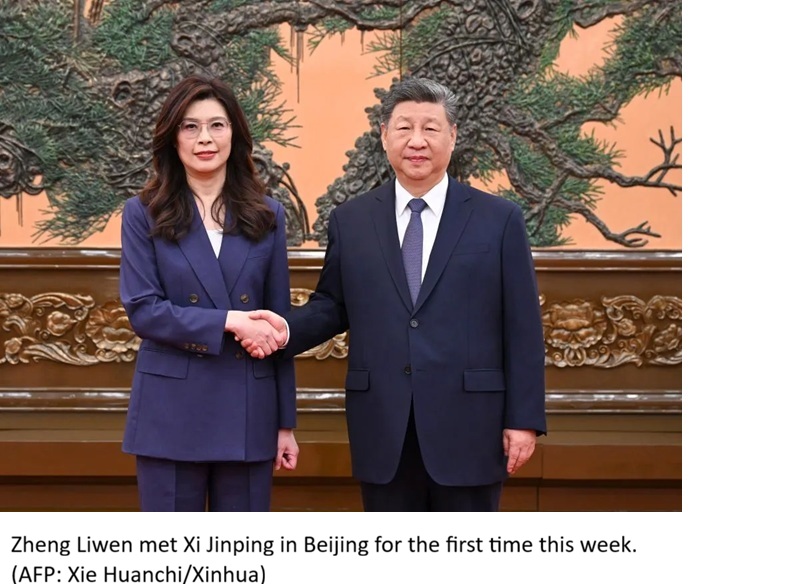
Author: Xu Jijun, founder of Han Tang Zhi Ku Analytical Centre, Apr 10, 2026
On the morning of 10 April 2026, inside the East Hall of the Great Hall of the People in Beijing, Xi Jinping, General Secretary of the Communist Party of China, met Zheng Liwen, Chair of the Kuomintang. The encounter marked the first meeting between leaders of the two parties in a decade. It unfolded at a moment of mounting global instability and heightened tensions across the Taiwan Strait, giving it both historical weight and immediate political relevance.
The meeting was not merely ceremonial. It articulated a shared position that people on both sides of the Strait seek peace and oppose division. It also set out a political direction aimed at returning cross-Strait relations to a path of peaceful development, with the stated goal of eventual peaceful reunification.
A venue heavy with history
For mainland observers, the deeper meaning of the Xi–Zheng meeting is tied closely to its setting. The East Hall has hosted landmark moments in China’s modern history, including events linked to the return of Hong Kong and Macau. Its reuse for high-level dialogue between representatives of the two sides of the Strait carries unmistakable symbolism.
The message conveyed is straightforward. Both sides belong to one China, and Taiwan is regarded as an inseparable part of it. External complexities do not alter this premise. Questions concerning the Chinese nation are framed as matters to be resolved internally, with peaceful dialogue presented as the appropriate course.
A world defined by conflict
The significance of the meeting becomes clearer when placed against the current global backdrop. Armed conflicts in recent years have illustrated the scale of destruction associated with modern warfare.
The Russia–Ukraine conflict continues to impose heavy losses. According to the Kyiv School of Economics (KSE Institute), in its March 2026 assessment, Ukraine has suffered cumulative income losses of approximately 1.7 trillion US dollars since the escalation of hostilities in 2022, including projected losses through the end of 2026. Urban areas have been devastated, energy infrastructure repeatedly targeted, millions displaced, and environmental damage described as long-lasting.
Since February 2026, military action by the United States and Israel against Iran has produced similarly severe consequences. Around 80 per cent of Iran’s air defence systems have been destroyed, along with more than 450 missile installations. Its capacity for ballistic missile retaliation has reportedly fallen by 90 per cent. Production lines for “Shahed” unmanned aerial vehicles have been eliminated, reducing output by 85 per cent. The Iranian navy has seen approximately 160 vessels sunk or disabled, its naval headquarters destroyed, and its control over the Persian Gulf lost. Up to 90 per cent of the defence industrial base, including key shipyards, has been destroyed.
After just 38 days of conflict, Iran’s military capability, built over four decades, has been largely dismantled. Regional shipping has been disrupted, energy markets have experienced sharp volatility, tens of thousands have been killed, and millions displaced. Regional stability has effectively collapsed.
These developments illustrate the destructive potential of modern high-technology warfare. Precision-guided munitions, drone swarms, and long-range strike systems can disable power supplies, destroy transport infrastructure, contaminate land, and set back economic and social development by decades in a matter of weeks.
Taiwan and the global economy
Against this background, the text argues that any attempt to pursue “Taiwan independence” carries serious risks. A conflict in the Taiwan Strait would likely exceed the scale and impact of the wars in Ukraine and the Middle East.
Taiwan occupies a central position in the global semiconductor industry. Firms such as TSMC hold a dominant share of advanced manufacturing capacity. In the event of war, supply chains would be disrupted immediately.
Simulations by international institutions suggest that, in a worst-case scenario, global GDP could fall by nearly 10 per cent in the first year of a Taiwan Strait conflict. Economic losses could reach 10.6 trillion US dollars, equivalent to around 333 trillion New Taiwan dollars. Taiwan’s own economy could contract by as much as 40 per cent. The shock would be felt across mainland China, the United States, Japan, South Korea, and the European Union.
The military consequences would be severe. High-density missile strikes, electronic warfare, and naval and air blockades could lead to large-scale destruction of infrastructure on the island. Casualties would be significant, while environmental and humanitarian damage could prove irreversible. Given the close social and cultural ties between people on both sides of the Strait, any armed confrontation would result in profound human cost. Regional tensions would escalate rapidly, posing risks to stability in East Asia and beyond.
Political signalling and red lines
Within this framework, the position presented is that “Taiwan independence” represents a path with no viable outcome. It is described as running counter to shared interests and broader historical trends.
The alternative, as outlined, lies in adherence to the 1992 Consensus and opposition to separatism. Zheng Liwen’s visit, described as a “journey for peace”, emphasised the notion of cross-Strait kinship and was framed as aligning with public sentiment and prevailing conditions.
The meeting between the leaderships of the Communist Party and the Kuomintang reaffirmed a shared political foundation. It also conveyed a clear warning that any attempt at secession would meet firm opposition from the Chinese population as a whole and would carry significant costs.
Peaceful reunification and national strategy
eaceful reunification is presented as both a collective aspiration and a structural requirement for what is described as the “great rejuvenation of the Chinese nation”. It is framed as a pathway to shared economic benefits and improved living standards for people in Taiwan within a broader national framework.
The argument also stresses its role in preventing war, preserving stability, and enabling joint prosperity. At a regional and global level, it is depicted as contributing to stability in the Asia-Pacific and demonstrating China’s role as a responsible major power.
Historical experience is cited to support this position. Periods characterised by adherence to the One China principle and the promotion of peaceful cross-Strait relations have coincided with stability and active exchanges. By contrast, deviations from this approach have led to tension and economic disruption.
A milestone with wider implications
The Xi–Zheng meeting is thus framed as another milestone in the trajectory of cross-Strait relations. It highlights what is described as the mainland’s consistent commitment to the principle that both sides form one family, alongside a stated willingness to pursue peaceful reunification with sincerity.
For the international community, the meeting is presented as an example of the principle that China’s internal affairs should be resolved domestically. It offers a contrast to conflict-driven approaches that have produced severe consequences in other regions.
The conclusion drawn is one of confidence. With sustained efforts on both sides of the Strait, the prospect of peaceful reunification is portrayed as increasingly attainable. The broader objective, the rejuvenation of the Chinese nation, is framed as a long-term historical trajectory.
No external force, the argument suggests, will ultimately be able to obstruct this course.
Conclusion
Peaceful reunification is presented as beneficial in the present and significant for generations to come. The current moment is described as a critical historical opportunity. By deepening economic integration, expanding cultural exchange, and strengthening cooperation in social development, both sides of the Strait are encouraged to move towards closer family ties, more integrated industries, broader opportunities for younger generations, and greater shared prosperity.
The overarching message is clear. The opportunity should be seized in the interests of people on both sides of the Strait and in pursuit of a more stable and prosperous future linked to the wider project of national rejuvenation.
Finland’s plan to bury spent nuclear waste carries risk to future generations.
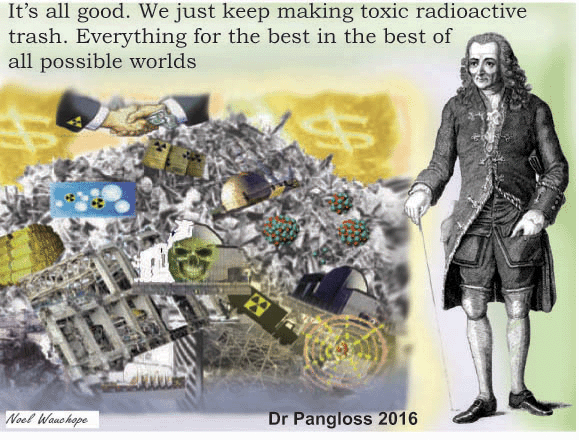
Overall, the risks associated with nuclear waste repositories will mainly affect “future generations,”
“…………………After decades of construction, the world’s first facility for permanently disposing spent nuclear fuel is set to begin operations in Finland, becoming a final resting place for tons of dangerous radioactive waste.
Construction of Onkalo – which means “cave” in Finnish – began on the west coast in 2004. It sits on the secluded island of Olkiluoto, in a dense wooded area. The closest town is Eurajoki, about 15 kilometers (9.3 miles) inland, which is home to about 9,000 people. Many work at the nuclear power plant or storage facility.
The 1 billion euro ($1.2 billion) project could soon become operational, with authorities expected to grant a license within months.
The Associated Press took a tour of the facilities where humans soon will not be allowed to tread.
Pere said the site – near three of Finland´s five nuclear reactors – was chosen for its migmatite-gneiss bedrock, which is known for its high stability and low risk of earthquakes.
“It´s the isolation from civilization and mankind on the surface that´s important,” he said, standing in a darkened disposal tunnel, soon to be sealed from humanity. “We can dispose of the waste more safely than by storing it in facilities located on the ground.”
Using unmanned machinery at a nearby encapsulation plant, radioactive rods will be sealed in copper canisters and then buried deep in tunnels over 400 meters underground, then packed in with “buffer” layers of water-absorbing bentonite clay.
Posiva, the company responsible for the long-term management of Finland’s spent nuclear fuels, says Onkalo can store 6,500 tons of spent nuclear fuel.
The final disposal canisters are designed to remain sealed “long enough for the radioactivity of spent fuel to decrease to a level not harmful to the environment,” it said………………………………….
Posiva estimate it will take hundreds of thousands of years before the radioactivity falls to normal, background levels.
According to a 2022 report by the International Atomic Energy Agency, almost 400,000 tons of spent fuel have been produced globally since the 1950s, with two-thirds remaining in temporary storage and one third being recycled in a complex process.
The world´s spent nuclear fuel is currently temporarily stored inside spent nuclear fuel pools at individual reactors and at dry cask storage sites above ground.
There is currently no permanent underground disposal facility for commercial nuclear waste operational anywhere in the world. Sweden began building a repository in Forsmark – about 150 kilometers north of Stockholm – last year, but it´s not expected to open until the late 2030s. France´s Cigéo project is yet to begin construction and has seen opposition.
The Onkalo facility is expected to operate until the 2120s, when it will be permanently sealed.
But Edwin Lyman, director of nuclear power safety at the Union of Concerned Scientists, an American nonprofit organization, warned that geologic disposal of nuclear waste is still fraught with “uncertainties.”
“My view of nuclear waste disposal is that there´s no good option, but it´s important to find the least bad option, and geologic disposal in general is going to be the least bad option among a range of, you know, bad options,” he said.
Lyman said that the copper canisters that contain the spent nuclear fuel will eventually corrode, adding that there are different scientific opinions about how fast that could happen.
“The hope is that is such a slow process that most of the radioactive material will have decayed away by then. But again, there are uncertainties,” he said.
Still, Lyman said that permanently storing spent nuclear fuel deep underground is better than “leaving it on the surface of the Earth forever,” because nuclear material kept above ground “is vulnerable to sabotage.”
“For many decades after spent fuel is discharged from a reactor, it´s so radioactive that it makes transporting and reprocessing very difficult,” Lyman said. But eventually the main radioactive component will decay, he added, making it less risky to handle.
“So over time the plutonium becomes more accessible either to terrorists or to a country that may want to use it,” he said, adding that the only way a terrorist — or a state — could theoretically use the material for a nuclear bomb would be if they had “an off-site reprocessing capability.”
During reprocessing, spent nuclear fuel is separated to recover uranium and plutonium to recycle it for use in new fuel. The process also carries proliferation risks because the separated plutonium could potentially be diverted to build a nuclear weapon.
Overall, the risks associated with nuclear waste repositories will mainly affect “future generations,” Lyman concluded.
To deal with this challenge, an interdisciplinary field of study called nuclear semiotics has been established that looks into developing warning signs about nuclear waste repositories that can be understood by humans 10,000 years from now – or much longer given that it takes hundreds of thousands of years before nuclear waste is no longer dangerous.

For reference: the first humans lived around 300,000 years ago. The earliest writing system was developed in Mesopotamia roughly 5,200 to 5,400 years ago. Stonehenge in Britain is around 5,000 years old, while the Giza pyramids in Egypt are approximately 4,500 years old……………………………………………………….. https://www.dailymail.co.uk/wires/ap/article-15717853/Finlands-plan-bury-spent-nuclear-waste-carries-risk-future-generations.html
Trump pivots from “destroying Iranian civilization” to complete surrender in one day
Walt Zlotow West Suburban Peace Coalition Glen Ellyn IL , Apr 8, 2026, https://theaimn.net/trump-pivots-from-destroying-iranian-civilization-to-complete-surrender-in-one-day/
Even a mentally degraded Donald Trump had to face reality. The US lost the war intended to destroy Iran as a hegemonic rival to Israel in the region.
He cancelled his announced war crimes to “destroy Iranian civilization” and agreed to a two week ceasefire as a prelude for negotiating permanent peace based on Iran’s 10 point peace plan. Note that is not Trump’s 15 point peace plan which would have given Trump complete victory.
Here’s some of what Trump’s ceasefire acknowledges.
A guarantee that Iran will not be attacked again.
A permanent end to the war, not just a ceasefire.
An end to Israeli strikes in Lebanon and against Iranian allies.
The lifting of all US sanctions on Iran.
Iran agreeing to reopen the Strait of Hormuz
US to leave the Middle East
End to US sanctions on Iran and release of frozen Iranian assets
In his delusional state, Trump announced the cease fire due to his astonishing claim his “war has already met and all Military objectives, and we are very far along with a definitive Agreement concerning long term PEACE with Iran, and PEACE in the Middle East.”
Iran announced the ceasefire “does not signify the termination of the war. Our hands remain upon the trigger, and should the slightest error be committed by the enemy, it shall be met with full force,”
Major hurtles must be overcome before the ceasefire holds and genuine peace can be negotiated. Israel is horrified by this development upending their 4 decade lust to destroy its Iranian hegemonic rival. It’s reported they are still bombing Iran and Iran is retaliating. No keen observer is optimistic the ceasefire will hold.
But it is not likely the US, clearly defeated in every make up war aim they floated to justify criminal war that killed thousands, damaged every US base in the region, brought the worst damage to Israel in its 78 years, and is crushing the world economy, can ever restart this deranged madness.
But with Trump in charge…you can never say never.
Tony Blair’s latest deceit-riddled column vilifies the UK left to justify genocide
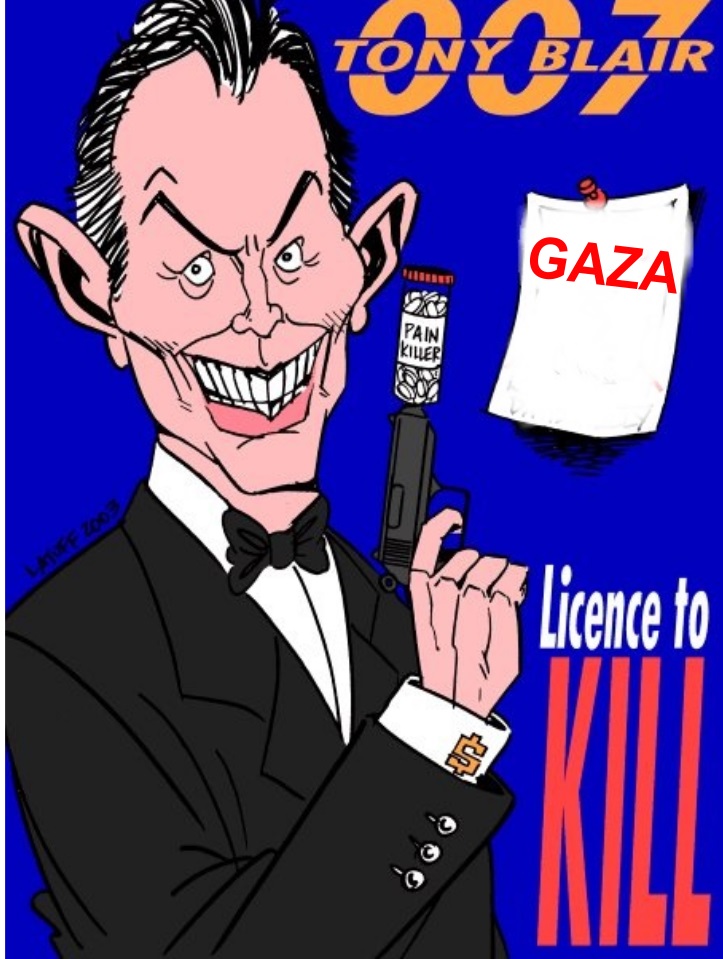
Britain former PM shows there’s no price to be paid for engineering mass slaughter in the service of western empire. Which is why those crimes not only continue, but grow in scale
Jonathan Cook, Apr 08, 2026
Tony Blair, the man who led Britain into a disastrous and illegal war on Iraq more than 20 years ago based on false information, is still very much a sought-after commentator in the UK media.
His regular political pronouncements are treated as pearls of wisdom; his columns as consequential insights from a globe-striding elder statesman.
Even his leading role on Donald Trump’s Board of Peace, the US president’s panel of autocrats seeking to elbow the United Nations – and international law – off the world stage, appears to have done little to dent his claim to moral authority.
Blair, more than anybody, illustrates the capacity of western leaders – with the help of a complicit establishment media – to rewrite their criminal past and escape accountability in perpetuity.
The former British prime minister’s latest political intervention is a lengthy, and typically repugnant, article published by the Sunday Times newspaper. It effectively blames “the left” for an arson attack last month on four ambulances owned by a Jewish charity in London.
No, Blair hasn’t unearthed any startling new information tying leftwingers to the attack. His article is a pure disinformation – propaganda designed to malign those critical of Israel.
More on that in a moment.
But as a prelude, let us note that there are many terrible things going on in the world right now that might be considered more pressing for Blair to write about than the torching of a handful of ambulances: whether it be a genocide in Gaza – where Israel destroyed not just four ambulances but the enclave’s entire health sector – or an illegal, joint US-Israeli war on Iran that has similarly targeted medical centres and other civilian infrastructure.
Twisted logic
Blair once served as a Middle East envoy to an international body known as the Quartet. In that role, he spent several years shuttling futilely between his eponymous institute in London and Israel and the Palestinian territories.
There are, however, two self-evident reasons why Blair may have been averse to dedicating his latest column to the catastrophes unfolding in the Middle East.
First, because his close allies – the leaders of the US and Israel – are indisputably the ones committing the crimes of genocide and aggression respectively in Gaza and Iran.
And second, because Blair was himself responsible for launching, alongside the US, a war of aggression on Iraq in 2003.
But it is not just that Blair is in no position to moralise on matters of the utmost global importance.
He has made it his primary duty in public life to excuse the West’s supreme crimes – crimes that, were there meaningful accountability for western leaders, would necessitate that he stand trial at the international war crimes court in the Hague.
That is the context for understanding both why Blair penned his column on the arson attack in London and the twisted logic that underpins his argument in that article.
Dirty war
Anyone who has studied Blair’s back-catalogue of opinion pieces will hardly be surprised by the Sunday Times headline: “We must end left’s unholy alliance with the Islamists.”
Or its subhead: “Parts of the left cast Jewish communities as supporters of Israel and Jews become ‘fair game’.”
Although the article ostensibly concerns an arson attack on a Jewish community ambulance service in London, Blair has much larger – carefully veiled – ambitions.
This is his latest manoeuvre in a dirty war to silence and crush Britain’s progressive left – waged by those, like Blair, who duplicitiously claim both to belong to that left and to serve as its natural leaders.
Blair is central to a cabal of so-called Atlanticists who view the world in Manichean terms, as “a clash of civilisations” between a supposedly superior, enlightened Judeo-Christian West, led by the US, and a backward, primitive Islamic East, now, it seems, led de facto by Iran.
Israel is presented as a first line of defence against this dangerous “Muslim” enemy.
Everything for Blair is seen through this racist prism.
He would sound more obviously like some Victorian, pith-helmeted empire-builder were it not for the fact that his fundamental, and fundamentalist, worldview continues to be shared by the entire UK ruling class, including the billionaire-owned media and the main political parties.
And for good reason. A Britain belonging to a “superior” West can openly aid Israel’s genocidal campaign of carpet-bombing and starvation in Gaza, and loan air bases to assist the US in its illegal war of aggression on Iran, and still pretend to itself that this is all being done “defensively”.
Christendom is still, apparently, “defending” itself against the rampaging barbarian hordes.
Achilles’ heel
In fact, Blair’s column in the Sunday Times should be seen as another front in a continuing war being waged by British prime minister Keir Starmer – a disciple of Blair – on the Corbynite left.
Their joint aim is to shepherd back into the Atlanticist fold a Labour party that supposedly lost its way under Starmer’s predecessor, Jeremy Corbyn.
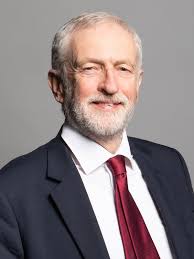
Corbyn’s crime was to have taken Labour towards internationalism – and the prioritising of human rights for all, not just westerners. That project necessarily entailed treating British Muslims as an integral part of British society, no less than British Jews.
Corbyn’s politics were an ideological assault on – and continue to pose a threat to – the Blair-Starmer worldview.
In other words, Blair’s article is part of a running battle – as the British establishment’s claim to moral authority is steadily eroded by its collusion in Israeli and US crimes – to prevent the progressive left ever reviving its political fortunes.
With the help of the Israel lobby, Blair and his ilk believe they have identified the achilles’ heel of a British left determined to highlight a brutal US-led western imperialism and its inherent hypocrisies.
The goal is to crop out the left’s increasingly persuasive critique of US imperialism and zoom in instead on the left’s parallel criticisms of Israel: its apartheid rule over Palestinians, its ethnic cleansing of the West Bank, and its genocidal campaign of destruction in Gaza.
Blair wishes to wave all this away, as if wielding a magic wand, by labelling it as “antisemitism”.
After that move worked so successfully in fatally wounding Corbyn as Labour leader, Blair and Starmer assume the same smear can be repurposed more generally – in this case, to implicate an undefined “left” over the torching of a handful of ambulances.
It goes without saying, that in prioritising the suppression of the left’s critiques of western imperialism, Blair and Starmer are leaving the door wide open to a resurgence by the far-right – which indeed is antisemitic.
That should serve as a reminder that Blair, Starmer and the rest of the British establishment have no real concern for the welfare of the Jewish community they profess to be protecting.
If the Jewish community turns out to be collateral damage in their war on the left, then so be it.
‘New antisemitism’
In the article itself, Blair argues that a so-called left-wing antisemitism “is a pernicious and novel development in progressive politics: the alliance with Islamists”.
First, notice the sleight of hand. British Muslims who, quite reasonably, are deeply critical of Israel because its army has been committing for decades war crimes with impunity against their extended families are reduced here simply to “Islamists”.
Blair is doing to Muslims precisely what he accuses – falsely – the left of doing to Jews. He is conflating Muslims, a religious group, with Islamists, champions of an extreme political ideology…………………………………………………………………………………………………………………………………………………………………………………….
Blair appears to be excusing Israel’s starvation of the 2.3 million people of Gaza, half of them children.
According to Blair, no one, not even the progressive left, should be allowed to criticise an Israeli siege that has blocked food, water, fuel and medicines to Gaza – unless they first justify that blockade as essential to Israel’s “security”.
Again, maybe he needs to have a word with the judges of the International Criminal Court in the Hague. Because they are seeking Benjamin Netanyahu, Israel’s prime minister, on charges of crimes against humanity over his efforts to starve Gaza’s population……………………………………………………………………………………………………………………………………………………………………
What Blair wants is for the left to be utterly silenced so that its protests do not rouse uncomfortable twinges of guilt forcibly reminding him that long ago he became a soulless creature of the West’s war machine.
It is not just that Blair has faced no consequences for his criminal undertaking in Iraq. He has instead become fabulously wealthy, venerated by western establishments, and an oracle for an equally complicit, billionaire-owned media…………………………… https://jonathancook.substack.com/p/blairs-latest-deceit-riddled-column
Making London councils allies in the campaign to oppose Britain’s nuclear expansion

As weapons return to Suffolk and defence spending soars, London CND is pressing local candidates to oppose nuclear expansion and support the UN ban treaty. SALLY SPIERS explains.
LONDON Region CND has launched a campaign to make London nuclear weapon-free. There are compelling reasons for local council candidates to oppose the expansion of Britain’s nuclear weapons by promising to sign up to the UN Treaty on the Prohibition of Nuclear Weapons (TPNW).
US nuclear weapons have returned to Britain for the first time since their complete removal in 2008. These weapons have been sited at US air base Lakenheath in Suffolk, approximately 75 miles from London. The majority of voters are opposed to US nuclear weapons being stationed in the UK, according to a 2025 YouGov poll.
In addition, Keir Starmer has announced Britain is buying 12 nuclear-capable jets (F-35As) from the United States. These are equipped to carry and fire the same nuclear weapons that are based at Lakenheath.
These weapons will not in any way be an independent nuclear deterrent. The US president must authorise the use of these missiles. Buying them and having them on our territory meshes us even deeper into US foreign policy.
We have all witnessed President Donald Trump threatening Nato countries to get them to enter a crazy illegal war of his making. US foreign policy is aggressive, expansionist, threatening to its allies and it is highly unpopular with British people.
We cannot believe for one minute these jets and weapons will protect the security of the people of these islands.
Given the proximity to London, it seems more likely they actually constitute a threat to Londoners from either attack or accident. Councils have a duty to ensure their residents are safe. Opposing Britain’s nuclear expansion and supporting the TPNW is an obvious first step in fulfilling this duty.
And then there’s the cost. The nuclear capable jets that Britain is buying are estimated to cost £80 million each, almost £1 billion in total. When he first announced the increased spending on defence, John Healey argued the money would secure British high-skilled jobs.
Whether you are convinced by this argument or not, it is clear that this £1bn is going to secure high-skills jobs in Indianapolis where the jets will be built, not Britain.
LONDON Region CND has launched a campaign to make London nuclear weapon-free. There are compelling reasons for local council candidates to oppose the expansion of Britain’s nuclear weapons by promising to sign up to the UN Treaty on the Prohibition of Nuclear Weapons (TPNW).
US nuclear weapons have returned to Britain for the first time since their complete removal in 2008. These weapons have been sited at US air base Lakenheath in Suffolk, approximately 75 miles from London. The majority of voters are opposed to US nuclear weapons being stationed in the UK, according to a 2025 YouGov poll.
In addition, Keir Starmer has announced Britain is buying 12 nuclear-capable jets (F-35As) from the United States. These are equipped to carry and fire the same nuclear weapons that are based at Lakenheath.
These weapons will not in any way be an independent nuclear deterrent. The US president must authorise the use of these missiles. Buying them and having them on our territory meshes us even deeper into US foreign policy.
We have all witnessed President Donald Trump threatening Nato countries to get them to enter a crazy illegal war of his making. US foreign policy is aggressive, expansionist, threatening to its allies and it is highly unpopular with British people.
We cannot believe for one minute these jets and weapons will protect the security of the people of these islands.
Given the proximity to London, it seems more likely they actually constitute a threat to Londoners from either attack or accident. Councils have a duty to ensure their residents are safe. Opposing Britain’s nuclear expansion and supporting the TPNW is an obvious first step in fulfilling this duty.
And then there’s the cost. The nuclear capable jets that Britain is buying are estimated to cost £80 million each, almost £1 billion in total. When he first announced the increased spending on defence, John Healey argued the money would secure British high-skilled jobs.
Whether you are convinced by this argument or not, it is clear that this £1bn is going to secure high-skills jobs in Indianapolis where the jets will be built, not Britain.
In mid-March, London Councils which speaks for all London authorities, described the financial situation of our councils as being “extremely challenging.” They “are grappling with a £1bn budget shortfall this year.”
How can prospective councillors not question the expenditure on nuclear-capable jets? There cannot be a single council in this country that has the resources to mend potholes effectively. Our councils need that money to provide basic services that keep the capital functioning.
Incredibly, neither decision — bringing US nukes back nor expanding our own nuclear capabilities — has been debated in Parliament. War is most definitely on people’s minds. Last year, voters identified defence as the fourth-most important concern for them.
The only way this concern seems to be discussed is in terms of increased spending on defence. But these important matters could be discussed in council chambers if councillors were willing to consider signing up to the TPNW or even making their mayors a mayor for peace.
This would send an important message to the government that is entirely in line with the view of the majority of the British public.
There is movement. It seems likely Green candidates will support the TPNW at council level. Labour candidates must be feeling the burn from the Greens and other parties. Supporting the TPNW will be a popular move with voters and Labour candidates would be foolish to ignore it.
London CND is asking voters to write to their council candidates to urge them to sign their support for the TPNW.
Councils and individual councillors can sign the cities pledge of the International Campaign for the Abolition of Nuclear Weapons, the authors of the TPNW.
Mayors can sign up to mayors for peace. Cities and mayors throughout the world, and particularly Europe, have already signed. What a coup it would be for peace if London and London Councils were to sign.
Further information on how to support the London CND campaign is available on the London CND website Make London Nuclear Free Campaign, “London’s TPNW Pledge” www.londoncnd.org.
Sally Spiers is vice-chair of London CND.
The Iranian people achieved decisive victory against America’s criminal war on them
Walt Zlotow West Suburban Peace Coalition Glen Ellyn IL, 10 Apr 26, https://theaimn.net/the-iranian-people-achieved-decisive-victory-against-americas-criminal-war-on-them/
The Chicago Tribune’s editorial ‘There has been no victory yet for the Iranian people’ represents an astonishing betrayal of the urgent need to condemn President’s criminal war on Iran. The Trib’s focus is not on the 42,000 Iranian buildings damaged or destroyed, of which 36,000 were residential homes. The No mention of the school bombed killing over 150 little girls, among over 3,000 dead Iranians Trump murdered in his senseless war. Absent was any mention the US began the war with a heinous war crime, greenlighting Israel’s assassinating Iranian ruler Ayatollah Ali Khamenei.
Stating the Trib was “relieved” Trump didn’t kill off Iranian civilization as threatened, a genocidal war crime, without the most urgent of condemnations is deplorable.
The Trib states both the US and Iran declaring victory is “hardly surprising.” That certainly applies to Trump’s America which can never admit defeat, but not Iran. They punched back with astonishing effectiveness. Their tens of thousands of well-hidden missiles shot down US planes, sent aircraft carriers scurrying beyond their range, badly damaged US Gulf States bases requiring thousands of US personnel to be relocated to hotels.
Result? Trump cried uncle and entered into a tenuous ceasefire without achieving a single of the shifting war objectives.
Worse yet? The US war failure shut down the Strait of Hormuz, cutting off a fifth of the worldwide oil supply. This has sent the world economy teetering toward recession, if not depression.
Trump’s acceptance of Iran’ s 10 point ceasefire plan as a basis for upcoming negotiations verifies Trump’s catastrophic loss. It requires end to US criminal war with no further attacks on Iran, Iranian nuclear enrichment facilities and defensive missile arsenal. US to leave the Middle East. US to end all sanctions on Iran. US to pay reparations for war damage.
Most disappointing in the Trib’s Iran war editorial is regurgitating Trump’s “three justifiable reasons….for this war” All three are nonsense. Did it occur to the Trib Editorial Board that if those reasons were truly justifiable, the Trib should be encouraging Trump to press on to total victory?
The editorial concludes “that inevitably leads us to an accounting that little has been achieved. A hollow victory at a heavy price.” Indeed, nothing was achieved but senseless death and destruction, the US possibly on the way out of the region, and the world economy in jeopardy from the US handing over the Strait of Hormuz to an emboldened and soon to be prosperous Iran.
Sure sounds like a resounding Iranian victory and US loss to this observer.
US, Israel Insist Iran Ceasefire Doesn’t Apply In Lebanon, Which Suffers Huge Airstrikes
Zero Hedge, by Tyler Durden, Thursday, Apr 09, 2026
srael has made clear that it doesn’t see the newly declared US-Iran ceasefire as applying to its war in Lebanon, where it is still trying to destroy Hezbollah. The White House too has made its stance clear that it doesn’t apply, but President Trump has stated his intent to take care of a Lebanon ceasefire separately.
The military has unleashed hell on Beirut, southern Lebanon, and the eastern Bekaa valley overnight and through Wednesday – with Beirut suffering some of the worst aerial bombardments of the wa
Pakistan, however, has said that the ceasefire does extend to the Israel-Hezbollah conflict. But the Israeli military (IDF) is as usual letting the bombs do the talking, and is largely ignoring the diplomatic side of things.
Israel on Wednesday reportedly struck over 100 Hezbollah (and civilian) targets within a mere 10 minutes across Beirut, the south of the country, and Bekaa.
Viral images and videos have shown massive smoke plumes lingering above the densely populated Lebanese capital. The surprise attack on busy commercial locations unleashed panic in the streets – and a full casualty accounting has not been immediately forthcoming .
Below is an outline of some of the earlier reported attacks, via Al Jazeera:……………………………………………………………..
Here’s how the same regional outlet described it, noting that Lebanese TV has said the attacks have claimed “many lives”: “Israel has launched a surprise attack with dozens of air strikes across Lebanon, one of the largest military assaults in the history of the conflict.” The report stated, “Air raids targeted residential buildings, mosques, vehicles and cemeteries across the country.”
Lebanon’s Minister of Social Affairs, Haneed Sayed, told the Associated Press that the wide-ranging strikes mark a “very dangerous turning point.”
She described: “These hits are now at the heart of Beirut… Half of the sheltered (internally displaced persons) are in Beirut in this area,” she said, adding that she had just driven by the areas hit.”
Hezbollah did not immediately join the Iran war until weeks in following the late February start of Trump’s Operation Epic Fury. However, by the middle it began sending a significant amount of rockets on northern Israel.
Importantly, President Trump has on Wednesday told PBS that his view is Lebanon is not part of the Iran ceasefire deal “because of Hezbollah” – but “that will get taken care of too”. He called what’s happening in Lebanon “a separate skirmish”. https://www.zerohedge.com/geopolitical/beirut-suffers-biggest-bombardment-war-israel-insists-iran-ceasefire-doesnt-apply
The Eve Of A Radical Evil

Trump, and especially the language he uses, is a particularly vile, vicious and sick example of American barbarity. But his behaviour so far has been consistent with other presidents who have bombed countries back to the Stone Age.
Nate Bear, Apr 08, 2026, https://www.donotpanic.news/p/the-eve-of-a-radical-evil
We are on the eve of a radical evil.
Tonight Trump’s deadline for Iran to surrender or be faced with the destruction of its critical energy and national infrastructure expires.
Just the fact that the president of the United States can set a ‘deadline’ for massive war crimes which leaves the world counting down the hours and speculating about nuclear weapon use, after starting a war of aggression, should be enough to end US hegemony forever.
This kind of ultimatum should be viewed as so unhinged, so beyond the pale, so outside the bounds of anything approaching normal diplomatic behaviour that no country in the world should want anything to do with it. Embassies should be closing, US troops should be ordered to leave the nearly 800 bases in 80 countries at which they’re stationed, and these facilities shut down.
The fact none of this has ever been a possibility shows us how US hegemony is a true plague on the world. It shows us how so few states are legitimately sovereign, and how so many willingly line up behind the crimes of empire. And it shows us that those states which are sovereign get targeted for regime change precisely because they are sovereign.
This, ultimately, was Iran’s only crime. It’s original sin.
When, nearly 50 years ago, the country ended a western-backed system of dictatorial monarchism and pursued a sovereign path, it brought to life a material reality that is forbidden under US empire. The material successes Iran has created over the last near 50 years, including independent financial systems, digital systems, and military systems, all achieved while under crushing western sanctions, are not allowed. And Iran is being punished for this.
Iran is being punished for its resistance, for its ingenuity, for its sovereignty.
This is the reason the US-Israel is bombing Iran’s premier universities and research facilities, and murdering its scientists.
The MIT of Iran was bombed this weekend.
These are centres of non-western excellence and learning which produce the minds that demonstrate what can be done outside the US-Zionist orbit. These places, and the people they train, have enabled Iran to successfully decouple from western hegemony. They have enabled modern Iranians to not just inherit a proud, 6,000-year-old civilisation, but to build on the achievements of their predecessors.
And because the Persian civilisation is such a successful one, because modern Iran has shepherded that civilisation so skillfully, Trump is threatening to kill it. Literally. In the most murderously deranged turn of a murderously deranged period, Trump said this morning that “a whole civilization will die tonight, never to be brought back again.”
Every journalist, every politician who reproduced anti-Iran propaganda led us to this point.
Every reference to “the regime,” every reference to “peaceful protests,” every failure to mention that the protestors were armed by the west to provoke an insurrection (which Trump just admitted), every fake “internet shutdown” story, every dubious angle used to foment anti-Iran sentiment led us to this point.
And every single person, from liberal politicians to journalists at the Guardian, the BBC, CNN, the New York Times, and all those Iranian exiles who demanded Iran be bombed and helped cultivate the ground for this war of aggression, are culpable.
Yesterday an Iranian exile who writes for the BBC, Ghoncheh Habibiazad, suggested, quite unbelievably, that Iranians actually want to be nuked.
After an outcry on social media, the quote was changed, which itself raises questions about whether those words were ever said or not.
Regardless, publishing a quote from someone in a country under a murderous assault saying they hope they get nuked is an extraordinarily depraved depth to plumb. And even if it was said, it is effectively the voicing of suicidal ideation and by any journalist ethic or standard should never be printed.
But this is the sickness of imperial stenographers.
This is where we are now.
And of course there is speculation in his threat to kill “a whole civilization” that Trump is hinting at using a nuclear weapon. Maybe he is. Maybe they will. They’ve done it before, after all, the only country to have ever done so. If he does, the world should never be the same again.
But even if the US doesn’t use a nuclear weapon, even if the US-Israel ‘only’ go through with the threat to destroy all of Iran’s critical national infrastructure, the world should never be the same again.
And even if he doesn’t go through with it and an unlikely ceasefire deal is agreed, the world should never be the same again.
Enough is enough of degenerate American empire and its crazed, out-of-control genocidal Jewish colony.
The impunity of empire has to end. It has to. Because while it remains an empire, the US will always be the greatest threat to global peace and stability. No president since the US became an imperial power has been able to sit atop such a massive amount of hardware and not order the mass murder of innocent people.
Not one.
It’s baked in.
Trump, and especially the language he uses, is a particularly vile, vicious and sick example of American barbarity. But his behaviour so far has been consistent with other presidents who have bombed countries back to the Stone Age.
And even if he uses a nuclear weapon, he won’t be unique.
Thinking about the long arc of American violence for two seconds should make us incredulous that the country was ever sold to us as a stabilising force, as the leader of the “free world,” as a symbol of humanitarian values.
Anyone who ever fell for this has been utterly hoodwinked and made a fool of.
It really is time to end empire, Zionism and the control it has over the world. Whether you’re in the US, the global north or south, a central task must be to find and elevate new leaders who can extricate us from this rule.
And doing this won’t be possible without breaking people out of their legacy media bubble and educating them about the huge lies they’ve been told regarding the benevolence of the US and the evils of the official enemy.
We’re all going to suffer when the fuel starts to dry up and the economic crisis coming down the pipe as a result of US impunity really hits. The crisis is coming, and it is certain.
And now we are at the precipice of a horror being loosed on Iran that would take the country decades to recover from.
For our collective humanity, such a horror would be an everlasting stain inviting the rightful judgement and condemnation of many generations to come.
We’re on the eve of a radical evil, and whatever happens tonight, nothing should ever be the same again.
“Because They’re Animals”: Donald Trump, the War on Iran, and the Rules Nobody’s Enforcing
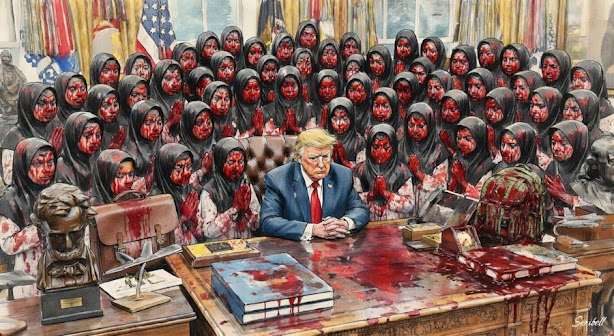
Now to the heart of it. A reporter asks Trump how bombing Iran’s power plants and bridges would not constitute a war crime.
Trump’s reply: “Because they’re animals.”
“Do you know what a war crime is? A war crime is letting Iran have a nuclear weapon.”
In two sentences, the logic of the school-yard bully becomes foreign policy.
****************************************************
On the evening of April 7, ninety minutes before his own deadline for Iran to reopen the Strait of Hormuz or face the destruction of every power plant and bridge in the country, Trump announced a two-week ceasefire, brokered by Pakistan. He called it “a big day for world peace.” He writes on Truth Social that the US would help ease the “traffic buildup” in the Strait of Hormuz.
“Big money will be made,” he adds.
Not peace. Not Iranian sovereignty. Not the rule of law. Big money.
9 April 2026 David Tyler, https://theaimn.net/because-theyre-animals-donald-trump-the-war-on-iran-and-the-rules-nobodys-enforcing/
“Operation Epic Fury” sounds like a fourteen-year-old boy who has been playing too much Call of Duty. It’s a perfect fit for the Peter Pan that Donald Trump has running the Pentagon; a former Fox & Friends weekend anchor whose less-than-stellar career so far provides a vital clue to the chaos, the incompetence, and the claque of yes-men that the forty-seventh president calls a cabinet.
Pete Hegseth is the most instructive appointment of the Trump era; an age defined by the Queen Bee principle, in which the president surrounds himself with a cast of flawed, diminished and pliable no-hopers, all chosen not for what they can do but for what they cannot: outshine Trump.
Outshine? It’s a recipe for disaster. As Michael Wolff notes on The Daily Beast, Trump’s minions have been stripped of all agency. They exist to reflect, to amplify, to affirm. The Queen Bee does not want talent in the hive. Talent is a threat. What the Queen Bee wants is an audience.
It is a principle that explains, not merely Hegseth, but the entire cabinet. The pliable Marco Rubio, who once pitched himself as a conviction politician, before a U-turn on immigration and now a dutiful echo; the parade of loyalists and flatterers installed wherever independent thought once lived. The forty-seventh president has not assembled a government so much as his own grotesque private freak show. He has set up a type of fairground mirror.

Hegseth is the mirror made flesh; a Fox News viewer’s fantasy of military authority, all jaw, scripture and manic bellicosity, set up to run the world’s largest military by a sloth who watches more television than any commander-in-chief in history and mistakes the performance of strength for the thing itself.
The Secretary of War wears his Christianity on his sleeve while ordering triple-tap strikes on schools. Who else could read the Sermon on the Mount and concluded that the relevant takeaway is fire for effect. Blessed are the meek, for they shall be massacred in the second and third pass?
The career officers who built their professional lives on the laws of armed conflict; on the painstaking, unglamorous discipline of distinguishing combatants from civilians, of proportionality, of the rules that separate a military from a mob, look at Hegseth and see not a commander but a mascot. His win-at-all-costs approach, his square-peg religiosity jammed into the very round hole of Pentagon culture, his enthusiasm for what the US military calls the double-tap, a cruel war crime; all of it has offended men and women who have spent careers trying to conduct war within its legal and moral constraints.
But Hegseth was not appointed to satisfy career officers. He was appointed to perform a feeling; the flag-waving, scripture-quoting, testosteronic bovver boy of the culture war translated directly into actual war, with actual children in actual schools. The career officers are not the audience. The Fox News viewer is the audience. And for that audience, Pete Hegseth is not a square peg at all.
He is, God help us, a perfect fit.
A Name for This War: The War of Donald’s Ear
Now let us give this war the name it deserves, because “Operation Epic Fury” is a preposterous pose, and history has always rewarded those who name things honestly.
History also has a fine tradition of naming wars after the absurdity of their origins. The War of Jenkins’ Ear, a preposterous 1739 conflict triggered when a British sea captain waved his own severed ear at Parliament, gave posterity one of its most deliciously deranged casus belli, (an act or situation that justifies a war). In that spirit, let’s go with the War of Donald’s Ear.
The ear in question is the pink shell-like ear Donald Trump lent, with almost indecent willingness, to two shady characters who had been whispering into it for years: Benjamin Netanyahu, Prime Minister of Israel, and Mohammed bin Salman, Crown Prince of Saudi Arabia. Two men who would not rest, who would not sleep soundly in their palaces, until they saw Iran bombed back into one of the Stone Ages. Two men with everything to gain from American military power and nothing to lose; since it would be American soldiers, not Israeli or Saudi ones, doing most of the dying.
The difference between Jenkins and Trump is instructive. Jenkins lost his ear involuntarily at sea. Trump lent his eagerly, in the White House Situation Room, over a slide deck, over a phone call, over an intelligence tip whispered at exactly the right moment by exactly the right man. And ninety million Iranians are paying the price. As is Trump, although he’ll try to put it on the slate.
How the War Was Sold: Two Homicidal Maniacs and One Pliable Ear
The backstory of how this war began is as tawdry as it is consequential.
Netanyahu’s campaign to drag America into war with Iran can be traced, in its current iteration, to a meeting in the White House Cabinet Room on February 4, the first visit of his second Trump era. He reminded Trump that Iran had plotted to assassinate him, then walked through a detailed slide deck arguing Iran was racing toward a nuclear threshold.
“Look, Donald,” Netanyahu told him, “You can’t have a nuclear Iran on your watch.” He paused for dramatic effect and looked the president directly in the eye.
That’s not diplomacy. That’s a sales pitch, with Trump’s vanity as the product being sold.
Netanyahu showed Trump a video featuring potential post-regime leaders, including Reza Pahlavi, the exiled son of Iran’s last shah; Iran’s government-in-waiting, neatly packaged, ready for installation. Trump’s response: “Sounds good to me.”
Within hours, American intelligence officials were tasked with evaluating the Israeli proposal. The CIA Director used a single word to describe Netanyahu’s promised popular uprising: “farcical.” Trump dismissed the finding. Regime change was, he said, “their problem.” What mattered were the parts he believed could be executed: striking Iran’s leadership and dismantling its military.
Bibi lit the fuse. On February 23, Netanyahu rang Trump with a stunning intelligence tip: Iran’s supreme leader and his top advisers were all meeting at one location in Tehran that Saturday morning. They could all be obliterated in a single devastating airstrike. One phone call. A narrowing window. Two men who had found each other, and a war that had been looking for an excuse.
Not to be outdone was MBS, the other man at the ear, acting the reluctant ally while pulling every available string behind the velvet curtain. The Washington Post reports that the Saudi Crown Prince made many private calls to Trump urging military action, even while publicly signalling support for diplomacy.
MBS privately warned Trump that inaction would leave Tehran “stronger and more dangerous.” The Saudi Foreign Ministry, naturally, denied everything; the same government that is currently hosting the American troops, intercepting the Iranian missiles, and absorbing the strikes that make the war possible.
Netanyahu brought ideology, targeting data, and the moral authority of a country under direct Iranian missile fire. But he couldn’t write a cheque covering the near-billion-dollar daily operating cost of the war. MBS could. And that capacity, the ability to make the most expensive military operation since Iraq financially palatable to a president who measures every relationship in transactional terms, is why the Saudi model was winning the Oval Office even as Netanyahu’s rhetoric dominated the airwaves.
As one analyst put it with some precision: Netanyahu brought the ideology and MBS brought the chequebook, and to Trump, the chequebook is everything.
Two men, two agendas, one pliable ear.
“Because They’re Animals”: The Quote That Should Haunt the World
Now to the heart of it. A reporter asks Trump how bombing Iran’s power plants and bridges would not constitute a war crime.
Trump’s reply: “Because they’re animals.”
“Do you know what a war crime is? A war crime is letting Iran have a nuclear weapon.”
In two sentences, the logic of the school-yard bully becomes foreign policy.
If they’re animals, the Geneva Conventions don’t apply. If they’re animals, the laws of war; built on the foundational premise that all human beings, even enemy civilians, retain their humanity, simply dissolve. If they’re animals, the hospitals, the schools, the power plants, the desalination systems that ninety million people depend on to survive are all legitimate targets. All just pest control. Or a lawn to mow, Netanyahu’s quip about killing Palestinians, a term popularised by Israeli strategists Efraim Inbar and Eitan Shamir.
This is not accidental rhetoric. This is not a man speaking loosely in the heat of a press conference. This is the oldest move in the genocidal play-book, deployed with the full authority of the presidency of the United States: strip the humanity first, then strip the rights.
History is not subtle on this point. The Holocaust required the prior dehumanisation of Jews as Untermenschen, subhuman, before the camps became possible. American slavery required the legal and cultural denial of Black humanity before it could be systematised across generations.
Rwanda required the Tutsi to be called inyenzi, cockroaches, on the radio before the machetes came out. Aboriginal peoples of this continent were excluded from the national census; not counted among the people of their own country, until the 1967 referendum, within the living memory of people who are still alive and still waiting for a treaty.
Every act of mass extermination, every system of organised dispossession in human history, has been preceded by exactly this move: the removal of the human designation from the people who are about to be killed, displaced or enslaved.
Trump knows this, or his minders do, and they are using it anyway. Calling ninety million Iranians “animals” is not bluster. It is preparation. It is the ideological infrastructure of atrocity, laid in public, on camera, before a press corps that largely moved on to the next story.
Congressman Ro Khanna calls Trump on it: “He is threatening the entire destruction of a civilisation. He is calling Iranians animals.” Former House Speaker Nancy Pelosi calls for Trump’s removal from office. Senate Minority Leader Chuck Schumer calls him “an extremely sick person.”
And the global chorus of leaders that should have followed? The rebuke from allied capitals that the moment demanded? The chorus, in the main, did not come. What came instead was the dopamine hit; the next outrage, the next deadline, the next Truth Social post, and the world scrolled on.
Two-Week Trump: The Art of the Infinite Pause
Which brings us to a pattern which will be familiar to every Trump-watcher around the world.
On the evening of April 7, ninety minutes before his own deadline for Iran to reopen the Strait of Hormuz or face the destruction of every power plant and bridge in the country, Trump announced a two-week ceasefire, brokered by Pakistan. He called it “a big day for world peace.” He writes on Truth Social that the US would help ease the “traffic buildup” in the Strait of Hormuz.
“Big money will be made,” he adds.
Not peace. Not Iranian sovereignty. Not the rule of law. Big money.
The two-week ceasefire is not a ceasefire. It is not diplomacy. It is not a step toward peace. It is the rhetorical equivalent of what Trump has always done when he wants to defer something forever: he makes it sound imminent. Before he puts it off forever.
Two weeks. Always two weeks. Two weeks from now the healthcare plan will be unveiled. Two weeks and the infrastructure bill will be ready. Two weeks and there’ll be a deal with Iran. In Trump’s universe, a universe in which, as observers of his cognitive trajectory have noted with increasing alarm, two weeks may genuinely feel like forever, the two-week pause is the art of the infinite deferral dressed as decisive action.
The purpose is clear and consistent: exhaust the opposition, blunt the momentum of outrage, reset the news cycle, and leave the underlying situation precisely unchanged while claiming credit for statesmanship.
Iran, meanwhile, holds the one card of genuine leverage that no amount of bombing can remove: the Strait of Hormuz, through which twenty percent of the world’s daily oil supply passes. For as long as that strait stays closed, Iran has a seat at the table. The two weeks will expire. Another deadline will be announced. The bombs, or the threat of bombs, will resume. And Trump, having declared victory, will declare it again.
The ceasefire is the intermission. The war is the show.
Part Two, tomorrow, A Whole Civilisation Will Die To
This article was originally published on URBAN WRONSKI WRITES
Norwegian Nuclear Committee says no to nuclear power in Norway
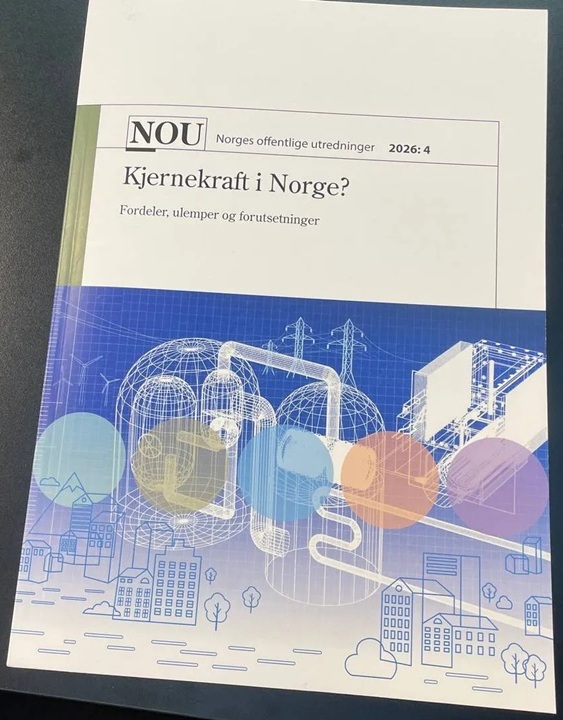
It is too expensive, Norway lacks the necessary expertise, and the process takes too long, according to the Committee. It unanimously rejects nuclear power.
Johannes Enli Kalleberg and NTB , 8 April, 26, https://energywatch.com/EnergyNews/Renewables/article19180637.ece
The government-appointed Norwegian Nuclear Committee – which has consisted of experts in physics, technology, economics, law, ethics, and social sciences – will submit its report to Norwegian energy minister Terje Aasland on Wednesday after a year and a half of work.
In the report “Nuclear Power in Norway? Advantages, Disadvantages, and Prerequisites,” the committee arrived at the following two main recommendations:
- Norway should not initiate a full-scale nuclear power process at the current moment.
- But we should build up expertise that will make it easier to make such a decision in the future.
Extensive support
A key rationale is economics. The committee’s calculations show that nuclear power, even under the most optimistic assumptions, requires electricity prices of at least NOK 1.13 (EUR 0.10) per KWh to cover costs. The estimated long-term electricity price in Norway is NOK 0.50-0.80.
“If nuclear power is to be established in Norway, private investors must find it profitable to invest in nuclear power. In that case, investment costs must be 70-80% lower,” the report states.
The committee points out that this aligns well with the situation in Sweden and Finland. There, major energy companies such as Vattenfall and Fortum say they cannot build new nuclear power plants without extensive government support.
”However, the committee does not see any sound socio-economic justifications for the government to support the establishment of nuclear power in Norway.”
Not before the 2040s
A time-consuming process also argues against nuclear power. Even if Norway decided go ahead with nuclear construction today, the committee estimates that production is not realistic before the mid-2040s at the earliest. First, legislation, regulatory frameworks, and professional communities must be developed.
”In any case, nuclear power production will not come in time to help achieve the Paris Agreement’s 2050 goals, and we must expand other sources in the meantime. And we have other alternatives. These include upgrading hydropower plants and expanding wind and solar power,” the committee concludes.
The committee also warns that the prospect of future nuclear power could hinder the development of these alternatives.
”If there is a prospect of nuclear power coming to Norway in 20 years, it will become less profitable to build other types of power plants. With nuclear power, we thus risk having less power and less transition in the coming decades.”
100,000 years
Much of the Norwegian debate has centered on small modular reactors (SMRs). The committee is skeptical of these as an immediate solution: no factories have been established, no models have been standardized, and it is highly uncertain how affordable SMRs will be.
The committee also highlights the management of spent fuel as a major challenge. Spent fuel emits harmful radiation for thousands of years, and there is international consensus that it must be stored at a depth of around 500 meters in stable rock for 100,000 years.
Finland is the only country in the world to have completed such a repository.
”Accidents can have major consequences and necessitate very strict safety requirements that apply specifically to nuclear power […] It is a challenge that we do not know what the probability is, and that it is difficult to assess what consequences an accident might have.”
Knowledge – not power plants
Nuclear power is not, however, entirely negative. The committee points out that it is possible to produce large amounts of stable, emission-free power in a small area over a long period. The fact that it is not dependent on sun and wind is also a plus.
The report makes it clear that building expertise in nuclear power is important.
This involves strengthening academic environments at universities, participating more actively in international cooperation, staying up to date on technological developments, and considering cooperation with Sweden and Finland.
”Therefore, we think the smartest thing we can do today is to build knowledge, not power plants,” the committee writes.
On June 21, 2024, the Ministry of Energy appointed the committee that has examined nuclear power as a potential energy source in Norway. The goal has been to review and assess various aspects of a possible future establishment of nuclear power in Norway.
This article was provided by our sister media in Norway, EnergiWatch.
English edit by Christian Radich Hoffman.
The Empire Backs Down, For Now
Caitlin Johnstone, Apr 08, 2026, https://www.caitlinjohnst.one/p/the-empire-backs-down-for-now?utm_source=post-email-title&publication_id=82124&post_id=193539985&utm_campaign=email-post-title&isFreemail=true&r=1ise1&triedRedirect=true&utm_medium=email
Trump has announced a two-week ceasefire with Iran after previously threatening to exterminate their “entire civilization”, citing “a 10 point proposal from Iran” as the reason for the climb-down.
Trump and his cronies are spinning this as a colossal victory for the United States and framing Tehran’s 10-point plan as a major capitulation to the president’s threats. But some reporters are noting that Iran has had the same terms on the table for weeks — which would mean that it is in fact the White House who is backing down.
Hours before the president’s announcement, Drop Site’s Ryan Grim posted a TikTok video arguing that Trump could save face while walking back from his apocalyptic threats by simply accepting Iran’s 10-point peace plan and acting like it’s a new proposal the Iranians had only just put forward. Grim argued that Trump could get away with this because the western media have been completely ignoring Iran’s stated terms for a ceasefire this entire time.
Interestingly, this appears to have been precisely what Trump wound up doing. After previously rejecting Iran’s proposals as “not good enough”, the president turned around and framed the Iranian offer as a brand new response to the pressures his administration was able to impose upon them.
All the way back on March 28, Drop Site News reported the following:
“Among Iran’s terms for permanently ending the war are a longterm guarantee that the U.S. and Israel will not attack Iran again and that any ceasefire also apply to Lebanon, Iraq and Palestine; reparations for the damages done to Iran during the war; sanctions relief; and that Iran retain control over the Strait of Hormuz.”
These are the same terms Iran is claiming it pressured the US to accept today. Iranian state media outlet Press TV cited Iran’s supreme national security council as saying “Iran achieved historic victory by forcing criminal US to accept its 10-point plan. US has accepted Iran’s control over Strait of Hormuz, enrichment right, removal of all sanctions.”
The New York Times reports the following:
“Two senior Iranian officials, speaking on the condition of anonymity to discuss the sensitive negotiations, said the proposal included a guarantee that Iran would not be attacked again, an end to Israeli strikes against Hezbollah in Lebanon and the lifting of all sanctions.
“In return, Iran would lift its de facto blockade of the key shipping route through the Strait of Hormuz. Iran would also impose a fee of roughly $2 million per ship that it would split with Oman, which sits across the strait. Iran would use its share of the proceeds to reconstruct infrastructure destroyed by American and Israeli attacks, rather than demand direct compensation, according to the plan.”
So as things stand right now this certainly looks like a humiliating defeat for the empire. Iran gets a lot of things it didn’t have before the war, including tolling the Strait of Hormuz and relief from the US sanctions that have been crushing its economy for years, while the empire gets to resume its shipping for a hefty fee and pretend it just rescued the world from a nuclear Iran.
Quite the turnaround from a White House that just last month was saying “There will be no deal with Iran except UNCONDITIONAL SURRENDER!”
Quincy Institute’s Trita Parsi, who always has great insights regarding western warmongering toward Iran, writes the following:
“I cannot emphasize this enough. A new dynamic will be at play when the US and Iran meet in Islamabad to negotiate a final deal based on Iran’s 10-point plan: Trump’s failed war has eliminated the potency of American military threats in US-Iran diplomacy. The US can still issue threats, but everyone will know that they no longer carry much weight. Essentially, war with Iran was tried and failed. As a result, negotiations will have to be based on genuine compromises from both sides, rather than coercion from either side.
There are of course many, many reasons to be pessimistic. The US and Israel have demonstrated time and time again that they will attack Iran during negotiations, and even if the US holds up its end of the bargain we can always see Israel sabotage the deal with its own aggressions. By now Iran has to know that the only way to protect itself from Israel is to impose costs for Israeli aggression on the entire western world; Tehran will have us all heating our homes with trash fires and growing carrots in our backyards if the west can’t find a way to rein in Israel.
For what it’s worth, Zionist Twitter is in absolute meltdown right now, with notorious Israel apologists like Laura Loomer, Eve Barlow and Eli David rending their garments in outrage that the killing has ended with Iran positioned as it is. I’m as skeptical about this ceasefire as anyone, but the fact that the world’s worst people are in meltdown about it right now does provide a faint glimmer of hope.
We shall see.
1 This Month
6 June – WEBINAR- Get Inspired by Protests Against Military Bases!


Cuba Is Not a Failed State – It Is a Besieged State
PETITION: “Global Appeal to Endorse Palestinian Right of Return of Refugees”


of the week– Nuclear Reactor Information Task Force
To see nuclear-related stories in greater depth and intensity – go to https://nuclearinformation.wordpress.com
-
Archives
- June 2026 (34)
- May 2026 (306)
- April 2026 (356)
- March 2026 (251)
- February 2026 (268)
- January 2026 (308)
- December 2025 (358)
- November 2025 (359)
- October 2025 (376)
- September 2025 (257)
- August 2025 (319)
- July 2025 (230)
-
Categories
- 1
- 1 NUCLEAR ISSUES
- business and costs
- climate change
- culture and arts
- ENERGY
- environment
- health
- history
- indigenous issues
- Legal
- marketing of nuclear
- media
- opposition to nuclear
- PERSONAL STORIES
- politics
- politics international
- Religion and ethics
- safety
- secrets,lies and civil liberties
- spinbuster
- technology
- Uranium
- wastes
- weapons and war
- Women
- 2 WORLD
- ACTION
- AFRICA
- Atrocities
- AUSTRALIA
- Christina's notes
- Christina's themes
- culture and arts
- Events
- Fuk 2022
- Fuk 2023
- Fukushima 2017
- Fukushima 2018
- fukushima 2019
- Fukushima 2020
- Fukushima 2021
- general
- global warming
- Humour (God we need it)
- Nuclear
- RARE EARTHS
- Reference
- resources – print
- Resources -audiovicual
- Weekly Newsletter
- World
- World Nuclear
- YouTube
-
RSS
Entries RSS
Comments RSS
 nuclear-news