£127M wasted on failed UK nuclear cleanup plan

Don’t worry, only 100 more years of Sellafield nuclear site cleansing to go
Lindsay Clark, Sat 7 Jun 2025,
https://www.theregister.com/2025/06/07/mps_find_127_million_wasted_sellafield/
The center for the UK’s nuclear industry wasted £127 million ($172 million) during delays and replanning as it scrambled to find alternatives for facilities which treat and repackage plutonium, a Parliamentary report found.
In the face of a 2028 deadline to replace its 70-year-old analytical lab, Sellafield Limited, part of a group of companies and government bodies on the northwest England Sellafield site, has abandoned plans for its Replacement Analytical Project (RAP). Ditching RAP was chalked up to multiple expected delays from 2028 until at least 2034 and a half-a-billion-pounds cost increase to £1.5 billion ($1.93 billion).
A new report from the Parliament’s public spending watchdog says RAP “has been managed very poorly indeed.”
Sellafield, formerly known as Windscale, has been the center of the UK’s nuclear industry since the 1950s. While the site is home to a number of companies, and the government’s Nuclear Decommissioning Authority, Sellafield Limited, is a British nuclear decommissioning Site Licence Company controlled by the NDA.
In October last year, the UK’s public spending watchdog said Sellafield depends on an on-site laboratory that is “over 70 years old, does not meet modern construction standards and is in extremely poor (and deteriorating) condition.”
The National Audit Office said [PDF] the laboratory is “not technically capable of carrying out the analysis required to commission the Sellafield Product and Residue Store Retreatment Plant (SRP)” to treat and repackage plutonium.
Sellafield’s plan in 2016 was to convert a 25-year-old laboratory on the site, which would replace the 70-year-old lab, under the “Replacement Analytical Project.” The outline business case was approved in 2019 with an estimated cost of between £486 million and £1 billion ($626 million – $1.3 billion).
It later emerged that it could take until December 2034 to deliver the full capability, while cost could reach £1.5 billion ($1.93 billion). Sellafield “strategically paused” RAP in February 2024.
In a report this week, the House of Commons’ Public Accounts Committee said: “Sellafield Ltd’s performance in delivering major projects (such as new buildings to store waste or make it safe) has historically been very poor, with large cost increases and delays occurring all too frequently.
“There are signs of improvement – however, given Sellafield’s track record, we are yet to be fully convinced that this is not another false dawn. Another reason to be skeptical is Sellafield’s poor management of the RAP. At the point it paused work, the forecast cost had risen by £820 million, and the project was five years delayed,” the PAC report said.
After abandoning the RAP, Sellafield plans to convert a different building to support a Store Retreatment Plant, which re-treats and repackages existing plutonium material, making it more suitable for durable, long-term storage. It also plans to refurbish the 70-year-old existing building — including replacing the roof — so it can carry on using it until 2040. The alternative plan would provide a service until 2040, whereas the RAP was expected to remain in use until 2070.
However, the Nuclear Decommissioning Authority told PMs the new plan would cost between £420 million and £840 million ($570 million – $1.1 billion), much less than the RAP. Although some of the costs from the early projects could be recouped in the new plan, the PAC said £127 million ($172 million) spent on RAP will have been wasted.
The NDA expects the clean-up of the Sellafield site to go on until 2125 and cost £136 billion ($184 billion), an estimate which has increased nearly 19 percent since March 2019. ®
Nuclear power: a dream not worth having
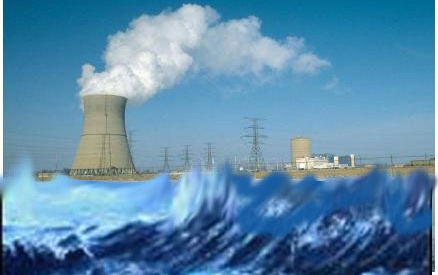
The Government wants more nuclear power stations, but renewable energy is cheaper, safer, and more sustainable.
by Steve Dawe, 7 June 2025, https://westenglandbylines.co.uk/business/energy/nuclear-power-a-dream-not-worth-having/
Labour is committed to building new nuclear power stations on eight coastal sites. Margaret Thatcher was also an enthusiast for nuclear power. She wanted one new nuclear power station built each year in the UK during the 1980s. Only one, Sizewell B, was built. Why? Because it cost too much, as was obvious in 1990:
Mr Illsley: “The Secretary of State must be aware that recent estimates have put the final cost of Sizewell B at about £3.8 bn, taking into account the cost overruns, delays and lack of economies of scale… £2bn can be saved by cancelling the project now. Does the Secretary of State agree that the time to cancel Sizewell B is right now?”
(House of Commons Debates, 25 June 1990).
Renewables are cheaper
Sizewell B did not come online until 1995. The Government admitted in 2020 that renewables can be cheaper than they thought. Given decades of nuclear industry propaganda intended to obscure the deficiencies of this sector, support for nuclear appears less about stating a technology preference than an indirect political statement in favour of nuclear weapons.
We need electricity; we don’t need it to come from nuclear. But successive UK governments have used public money to subsidise the industries involved, instead of using it for things actually sustainable, cost-effective, and with minimal pollution. Keir Starmer has even ignored the nuclear watchdog when he blamed regulations for implementation delays.
The extensive range of reasons to oppose nuclear power
Here is a short list of some of the reasons to oppose new nuclear power stations, and phase out existing ones:
- Nuclear power is too slow to implement to be relevant to the climate emergency. Construction times are an average of 10 years per nuclear power station.
- Nuclear power stations are at risk of terrorist sabotage or attack in war, as has been demonstrated in Ukraine.
There are comprehensive reasons to oppose nuclear power, based partly on the British experience and that of other states recently. These also include:
The radioactive waste that needs storage for at least 100,000 years makes the true costs of nuclear power incalculable.- Part of the reason for this storage is the known health effects of radiation.
- Since major nuclear accidents have continued to occur and spread radioactive material into the environment, preference for other means of generating electricity and for radically improving insulation in buildings to reduce energy needs is unarguable.
- This is especially the case when the water implications are considered: nuclear power stations require water for cooling, on a planet with increasing droughts and extreme weather events. Nuclear power stations using water from watercourses have had to shut down during periods of drought, emphasising the desirability of solar and wind power which do not require water to operate.
- Making it easier to build more nuclear power stations on the eight coastal sites the Government prefers completely ignores the risk of sea level rise discussed below. It is extraordinary that these sites have been chosen.
Hence, to quote from one of the recent critical analyses, new nuclear power is “doomed to fail“. It is certainly prone to extreme weather events such as storms, if the proposed sites are used.
Nuclear power supports nuclear weapons
Most countries in the world do not have nuclear weapons. Today, 120 countries belong to the Non-Aligned Movement, committing themselves not to belong to alliances which perpetuate long-term confrontations between states.
The UK Government admits part of its support for existing and new nuclear power stations is to maintain essential supplies to its nuclear weapons programme. What is true for the UK clearly applies to other states with nuclear weapons.
Since nuclear weapons proliferation is against the general interest of all species on the planet, phasing out both nuclear power and nuclear weapons would be rational when alternatives exist, are becoming cheaper, and are expanding in use year after year.
New nuclear is too expensive to consider
Nuclear power is notoriously expensive. The International Energy Agency reported in 2023 that new solar and on-shore wind are cheaper than fossil fuels. Greenpeace has summarised the current situation, comparing renewables to nuclear, as follows:
“The cost of generating solar power ranges from $36 to $44 per megawatt-hour (MWh), the World Nuclear Industry Status Report said, while onshore wind power comes in at $29–$56 per MWh. Nuclear energy costs between $112 and $189 per MWh. Over the past decade, the World Nuclear Industry Status Report estimates levelised costs… for utility-scale solar have dropped by 88% and for wind by 69%. According to the same report, these costs have increased by 23% for nuclear.”
Worse for the British Government, an authoritative report asserts that the new nuclear power in the UK would actually be the world’s most expensive. Support by political parties in the UK for nuclear power is therefore a choice of the most expensive of options under consideration.
Jonathon Porritt, former head of the Government’s Sustainable Development Commission, has indicated that the cost of Hinkley C and Sizewell C are both likely to rise to about £75bn each. Others have argued that nuclear power may simply not be cost-effective in relation to realistic cost assessments including paying for very long-term radioactive waste storage.
The toxic twins: Hinkley C and Sizewell C
“Hinkley C in Somerset will cost the energy bill payer up to £17.6bn in subsidies. The agreed price of £92.50 per MW/hour is over double the current wholesale price at just over £41 per MW/hour.” (People Against Wylfa-B)
The construction costs were already predicted to rise by a third in early 2024, illustrating the general problem of high-cost infrastructure in the UK. Sizewell C costs were also predicted to double in early 2025.
Nuclear is never ‘clean’
The UK is going ‘all out’ to be a clean energy superpower, said Keir Starmer. But nuclear power has never been a ‘clean’ technology. Essentially, many alleged solutions to the problem of radioactive nuclear waste need to rely on perfect storage for 100,000 years.
This is a conception worthy of science fiction. Uranium mining is known to cause health problems in proximate populations, often to indigenous peoples.
Small modular nuclear reactors – why bother?
The nuclear industry has problems with scaling up to reduce costs. Nuclear power construction and related expense means reduced costs do not materialise.
The small modular reactor (SMR) is allegedly going to change this. However, a US Department of Energy report of September 2024 suggested a cost per megawatt more than 50% higher than for large reactors.
There are only three operating SMRs: one in China, with a 300% cost overrun, and two in Russia, with 400% cost overrun. In March, a Financial Times analysis labelled such small reactors “the most expensive energy source.” Others concur that SMRs are very expensive, and slow to construct, with negative environmental implications.
Sea level rise and nuclear sites
All eight of the Government’s preferred sites for new nuclear power development are coastal. There are concerns about the impact of sea-level rises for all the sites. There should also be concerns about storms increasing in power and frequency too as the climate changes.
Hinkley and Sizewell are already in development. Will an island be created to protect the proposed Sizewell C site from the sea? Does the Government privately think this might be necessary for all eight sites?
The Intergovernmental Panel on Climate Change(IPCC) may have under-estimated sea level rise up to 2100. Scientific papers have been predicting higher sea level rises than the IPCC since at least 2012. It has been suggested that: “All energy-related infrastructure is at risk from the impacts of climate change, especially due to the changing frequency and intensity of surface water and coastal flooding.”
And the rate of sea level rise has been increasing. Very low-lying sites like that of Sizewell C should be abandoned. And back in 1981, the Hinkley Point site was flooded, forcing closure of a nuclear power station there for a week.
Communities with nuclear legacies need alternatives
Communities with declining nuclear industry work would need alternative jobs. This is a general need for all localities experiencing employment transitions.
Each district and unitary council should have its own Green New Deal to promote and directly support just transitions. This would involve re-introducing a version of the Community Programme of the 1980s to employ people in projects and programmes, in cooperation with local voluntary bodies where possible. This should both support existing sustainability initiatives and help introduce new ones.
Training on the job should feature, to provide a better range of local skills appropriate to a just transition in areas like construction, forestry and nature, gardening, agriculture, energy efficiency, installing heat pumps in homes and more.
Just transition or another failure to future-proof the UK?
The colossal financial impact of nuclear power in the past and future in the UK is difficult to calculate, especially when radioactive waste storage is considered. The repercussions of public spending on this technology and its aftermath include inadequate spending on sustainable retrofitting of the existing built environment.
We certainly need electricity. We have never needed it to be specifically from nuclear power. The scale and diversity of energy alternatives are more than enough to meet future needs, including by increasing battery storage to address any potential problems in maintaining baseload supply.
Political will is absent. The long shadow of nuclear power remains in place over the major political parties, at public expense and with zero long-term vision.
To Trump, a million casualties in Ukraine war he’s enabling, is nothing more than a kids’ fistfight

Actually, it takes three to tango since the war goes on because Trump continues enabling it with billions in weapons, logistics and Intel support. Pull that away and Ukraine’s Zelensky would have to negotiate the peace he ran away from in April 2022 at America’s behest. Had he made peace then Zelensky would still control the 45,000 square miles annexed and not incurred over a million senseless casualties.
Walt Zlotow, West Suburban Peace Coalition, Glen Ellyn IL 7 June 25
The depravity of Trump’s view of catastrophic war was on full display in his White House meeting with fellow Ukraine war enabler, German Chancellor Friedrich Merz. Trump told reporters present about the million plus dead and wounded in the largely degraded Ukraine:
To Trump, a million casualties in Ukraine war he’s enabling is nothing more than a kids’ fistfight
The depravity of Trump’s view of catastrophic war was on full display in his White House meeting with fellow Ukraine war enabler, German Chancellor Friedrich Merz. Trump told reporters present about the million plus dead and wounded in the largely degraded Ukraine:
Actually, it takes three to tango since the war goes on because Trump continues enabling it with billions in weapons, logistics and Intel support. Pull that away and Ukraine’s Zelensky would have to negotiate the peace he ran away from in April 2022 at America’s behest. Had he made peace then Zelensky would still control the 45,000 square miles annexed and not incurred over a million senseless casualties.
And cruel, clueless, delusional Trump sits back pretending he’s still concerned about ending a catastrophic war he’s enabled for the past 137 days.
Defence review dodges Britain’s nuclear blind spot.

THE UK’s nuclear enterprise is in crisis. Not just because of cost
overruns or ageing submarines, but because of the deepening secrecy and
silence that surrounds it. That silence should have been broken by the
Labour Government’s new Strategic Defence Review 2025.
Instead, it was quietly reinforced. Presented as a roadmap to “Make Britain Safer”, the
review promised clarity and accountability, but it fails to confront the
most pressing truths: that the UK’s nuclear programme is financially
unsustainable, strategically unbalanced, increasingly unaccountable and a
real and present danger to us all.
These concerns are not hypothetical. In
the final months of the last Parliament, I raised them on the floor of the
House of Commons, not out of party dogma, but in response to serious and
public allegations from Dominic Cummings, former chief adviser to the then
prime minister, remember him? He described Britain’s nuclear
infrastructure as a “dangerous disaster”, responsible for the secret
“cannibalisation” of other national security budgets and shielded from
meaningful scrutiny. Instead of confronting the truth, the review restates
familiar platitudes and leaves the public and Parliament no wiser about the
scale cost, or consequences of the UK’s nuclear commitment. The Defence
Secretary, who heard these warnings first-hand from the opposition bench,
is now in a position to act – he has chosen not to.
The National 8th June 2025,
https://www.thenational.scot/politics/25222635.defence-review-dodges-britains-nuclear-blind-spot/
Protesters raise environmental fears as wait continues for Sizewell C funding announcement
ITV 8 June 2025
Hundreds of people voiced their concerns over the multi-billion pound Sizewell C nuclear power station on the Suffolk coastline ahead of an expected announcement from the Government.
The rally on Sizewell Beach on Saturday, organised by Stop Sizewell C and Together Against Sizewell C, included speeches from campaigners against the major project including Greenpeace members, and musical performances.
The peaceful protest ended with the 300-strong crowd walking to the Sizewell complex and tying ribbons with messages, emphasising people’s concerns, to the gates.
Plans for Sizewell C were given the go ahead by the then Chancellor in November 2022 but the funding is yet to be approved by the Government, although an announcement on the project is expected in Labour’s Spending Review on Wednesday 11 June.
Construction has already started for the nuclear site and surrounding infrastructure on the Suffolk coast which will sit next to the Sizewell B plant, and has already been given £250m in local funding……………….
many people fear the environmental impact of Sizewell C and believe it will destroy the area.
Jenny Kirtley, from Together Against Sizewell C, said: “You’ve only got to look around the area and see the devastation that’s happened. I’ve been fighting this for 12 years. We knew it would be bad, but we didn’t know it would be so devastating. A whole area is changing before our very eyes and it’s heartbreaking.
“There are a huge mountains of earth everywhere and of course the wildlife is suffering. The deers don’t know where to go. They’re rambling around everywhere. The birds are leaving their nests.
“It’s all very well saying it’s going to create thousands of jobs but who’s going to work in the supermarkets, the care homes, the restaurants? This is a small area.
“We’ve got 6,000 people living around here so where are people going to live? We know rents are going sky-high so it’s going to get worse. It’s going to be a real problem.”
Alison Downes, from Stop Sizewell C, also believed the project would be a waste of tax-payers money and said there were better options to provide renewable energy.
She said: “We’ve always had people behind us in the local area. I think a lot of new people have woken up and seen the destruction that’s been caused by the project. They are now feeling the same sense of outrage that we do.
“Sizewell C is too slow, risky and expensive to be the solution to our climate emergency. This is the wrong type of reactor. It’s in the wrong place on an eroding coastline so we are here to express our outrage about Sizewell C.”
The outrage rally, which was the third of it’s kind, was also a tribute to Pete Wilkinson – a former chairman of campaign group, Together Against Sizewell C, who died in January 2025
His daughters Emily and Amy Wilkinson were at the event and spoke about their father.
Emily Wilkinson, 29, said: “Dad was such a fantastic human being. He was a passionate and courageous man who spent his entire life fighting whatever he saw is wrong. That’s what drove him in life. He saw the beauty in the planet and fought for it every single time.”…………………………………………………………….. https://www.itv.com/news/anglia/2025-06-07/protesters-take-to-suffolk-beach-against-sizewell-c-plans
US Vice President JD Vance announces new strategy of blatant imperialism, aimed at China
So now, the Trump administration is redirecting US foreign policy to prepare for potential war on China.
“when we send you to war, we do it with a very specific set of goals in mind”.
Vance indicated that the US empire will continue to wage wars, and will try to win those wars through the use of “overwhelming force”. However, this will no longer be done in the name of “democracy” or “human rights”.
US Vice President JD Vance revealed the Trump administration’s “generational shift in [foreign] policy”, emphasizing “great power competition” and preparation for war with China. They’re abandoning soft power and focusing on “hard power” and “overwhelming force”, in a return to blatant, 19th century-style imperialism.
Geopolitical Economy, By Ben Norton, 2 June 25
US Vice President JD Vance has announced what he calls a “new era” in military strategy.
“What we are seeing from President Trump is a generational shift in [foreign] policy”, he claimed.
The Donald Trump administration is abandoning the US government’s previous emphasis on soft power, Vance explained, and is instead focusing on “hard power” and “overwhelming force”, in a return to blatant, 19th century-style imperialism.
According to Vance, Washington’s top priority is now “great power competition”, and preparation for potential war with China.
The vice president laid this out in a speech at the commissioning ceremony of the US Naval Academy on 23 May.
The “era of uncontested US dominance is over”
JD Vance lamented the fact that the US empire has lost its unipolar dominance, as the world has become more multipolar.
“In the wake of the Cold War, America enjoyed a mostly unchallenged command of the commons, airspace, sea, space and cyberspace”, Vance recalled.
“Following the collapse of the Soviet Union, our policymakers assumed that American primacy on the world stage was guaranteed. For a brief time, we were a superpower without any peer, nor did we believe any foreign nation could possibly rise to compete with the United States of America”, he added.
“But the era of uncontested US dominance is over”, Vance warned. “Today we face serious threats in China, Russia, and other nations, determined to beat us in every single domain.
Preparing for war on China
The US vice president complained that, in the past, “our leaders traded hard power for soft power”. He argued that this was an error, and that the US empire should have focused on containing China.
“Instead of devoting our energies to responding to the rise of near-peer competitors like China, our leaders pursued what they assumed would be easy jobs for the world’s preeminent superpower”, Vance said.
“Our government took its eye off the ball of great power competition and preparing to take on a peer adversary, and instead, we devoted ourselves to sprawling, amorphous tasks, like searching for new terrorists to take out while building up far away regimes”, he added.
The vice president argued that it was a mistake to think that, by deepening economic integration and trade with China, the US could pressure Beijing to change its socialist system.
“Too many of us believed that economic integration would naturally lead to peace by making countries like the People’s Republic of China more like the United States”, he lamented.
In other words, Vance was acknowledging that many officials in Washington wanted China to become an obedient proxy, like Japan. They thought they could pressure Beijing to subordinate itself to the US, but they ultimately failed.
So now, the Trump administration is redirecting US foreign policy to prepare for potential war on China.
A return to a more blatant form of imperialism
Some Trump supporters have taken Vance’s comments out of context to claim that the Trump administration is supposedly moving away from a hyper-interventionist foreign policy and toward a more restrained, isolationist one. But that is not what is happening.
Vance’s speech made it clear that the Trump administration wants to return to a more overt, traditional form of imperialism.
What is changing is that the Trump administration is dropping the cynical propaganda narrative that US foreign policy is supposedly motivated by “democracy promotion” or “human rights”.
Vance indicated that the US empire will continue to wage wars, and will try to win those wars through the use of “overwhelming force”. However, this will no longer be done in the name of “democracy” or “human rights”.
Vance warned US Naval Academy graduates that they are in a “very dangerous era”, and will have a new “mission”.
The vice president stated openly that US troops will be sent to more wars, and that it is not a matter of if, but rather when.
“We’re returning to a strategy grounded in realism and protecting our core national interests”, Vance said. “Now this doesn’t mean that we ignore threats, but it means that we approach them with discipline, and that when we send you to war, we do it with a very specific set of goals in mind”.
Trump admin’s military strategy: “Overwhelming force” and $1 trillion budget
As an example of the new Trump Doctrine, Vance proudly pointed to the Pentagon’s bombing campaign in Yemen, the poorest country in West Asia.
Vance boasted that the Trump administration used “overwhelming force against Houthi military targets”. This was a reference to the so-called “Houthis”, the armed group officially known as Ansarallah that governs northern Yemen.
Trump’s war on Yemen was “how military power should be used: decisively, with a clear objective”, Vance said.
“We ought to be cautious in deciding to throw a punch, but when we throw a punch, we throw a punch hard, and we do it decisively, and that’s exactly what we may ask you to do“, he told the Naval Academy graduates.
Vance added, “With the Trump administration, our adversaries now know when the United States sets a red line, it will be enforced, and when we engage, we do so with purpose, with superior force, with superior weapons, and with the best people anywhere in the world”.
In fact, instead of promoting isolationism and opposing interventionism, the Trump administration is boosting the US military budget to more than $1 trillion per year.
“I’ll be supporting a record-setting $1 trillion investment in our national defense”, Trump said in a speech at a US military base in April. “We’re going to go $1 trillion, the largest in the world, the largest ever in our country”.
“No other country has invested that much”, Trump bragged. “We have a $1 trillion budget for military this year, and we have tremendous plans”.
US ideological crusades
In one of the most hypocritical parts of his speech at the US Naval Academy graduation ceremony, JD Vance claimed that the Trump administration is carrying out a “shift in thinking, from ideological crusades to a principled foreign policy”.
This was deeply ironic, because Trump’s extremely hawkish secretary of defense, Pete Hegseth, is a self-declared “crusader”.
In his 2020 book “American Crusade”, Hegseth — a former Fox News host — wrote with pride that the US right wing is waging a “holy war” against China, the international left, and Islam.
Hegseth, an ardent hawk, has sought to rebrand US soldiers as “warfighters”, constantly using the term in his public remarks.
In his speech at the Naval Academy, Vance did the same, repeatedly praising US soldiers as “warfighters”.
Marco Rubio: China is the main target of the US government
Top officials in the Trump administration have made it clear that the main target of the US empire is China.
JD Vance conveyed this in his speech at the US Naval Academy.
It has also been repeatedly emphasized by Marco Rubio, a lifelong neoconservative war hawk, who is serving simultaneously as Trump’s secretary of state and national security advisor (making him only the second person in US history to hold both positions at the same time, following Henry Kissinger).
In his Senate confirmation hearing in January, Rubio stressed that this entire century will be built on Washington’s new cold war against China……………………………….https://geopoliticaleconomy.com/2025/05/31/us-vp-jd-vance-strategy-imperialism-china/
The Hidden Story: Israeli ‘Aid’ Is Part of Genocide Plan

Western corporate media have somehow found it difficult to report in straightforward fashion that the food-distribution massacres have left Palestinians with a rather bleak choice: either die of starvation or die trying to obtain food aid.
Belén Fernández, June 6, 2025
Israeli tanks opened fire last Sunday on a crowd of thousands of starving Palestinians at an aid distribution center in the city of Rafah in the southern Gaza Strip. The victims had gathered in hopes of finding food for themselves and their families, following a nearly three-month total Israeli blockade of the territory. At least 31 people were killed; one Palestinian was also killed by Israeli fire the same day at another distribution site in central Gaza.
On Monday, June 2, three more Palestinians lost their lives to Israeli projectiles while trying to procure food, and on Tuesday there were 27 fatalities at the aid hub in Rafah. This brought the total number of Palestinian deaths at the newly implemented hubs to more than 100 in just a week.
‘Not possible to implement’
Mass killing in the guise of food distribution is occurring under the supervision of the so-called Gaza Humanitarian Foundation (GHF), a sketchy-as-hell organization registered in Switzerland and Delaware. It boasts the participation of former US military and intelligence officers, as well as solid Israeli endorsement and armed US security contractors escorting food deliveries.
Jake Wood—the ex-US Marine sniper who had taken up the post of GHF executive director—recently resigned after reasoning that “it is not possible to implement this plan while also strictly adhering to the humanitarian principles of humanity, neutrality, impartiality and independence.”
Indeed, the GHF, which has temporarily suspended operations to conduct damage control, has managed to align its activities entirely with the genocidal vision of the state of Israel, whose military has killed more than 54,600 Palestinians in Gaza since October 2023. In May, Israeli Prime Minister Benjamin Netanyahu determined that “minimal” aid should be let into Gaza, lest mass starvation force the US to scale back its support for genocide (which is somehow less problematic than enforced famine).
By entrusting the delivery of this “minimal” aid to the brand-new GHF, rather than the United Nations and other groups that have decades of experience doing such things, the Israelis have in fact been able to call the shots in terms of strategic placement of the aid hubs. Only four are currently in place for a starving population of 2 million, requiring many Palestinians to walk long distances—those that are able to walk, that is—across Israeli military lines.
The hubs are mainly in southern Gaza, which is conveniently where Israel has schemed to concentrate the surviving Palestinian population, in order to then expel them in accordance with US President Donald Trump’s dream of a brand-new Palestinian-free “Riviera of the Middle East” in the Gaza Strip. Even as he authorized the resumption of aid, Netanyahu reiterated his vow to “take control” of all of Gaza. As UNRWA Commissioner-General Philippe Lazzarini has observed, “Aid distribution has become a death trap.”
Leading with denials
And yet despite all of this, Western corporate media have somehow found it difficult to report in straightforward fashion that the food-distribution massacres have left Palestinians with a rather bleak choice: either die of starvation or die trying to obtain food aid.
So it is that we end up with, for example, the Washington Post’s Tuesday dispatch (6/2/25) from Jerusalem, headlined “Israel Says It Fired ‘Warning Shots’ Near Aid Site; Health Officials Say 27 Dead,” which charitably gave Israel the privilege of refuting what the health officials have said before they even say it. The article quoted the Israeli army as claiming that its soldiers had fired at suspects “who advanced toward the troops in such a way that posed a threat.” It also quoted the following statement from the GHF:
While the aid distribution was conducted safely and without incident at our site today, we understand that [Israeli army] is investigating whether a number of civilians were injured after moving beyond the designated safe corridor and into a closed military zone.
Anyway, that’s what happens when you put your aid distribution site in the middle of an Israeli military zone.
Then there was the BBC report (5/31/25) on Sunday’s massacre, headlined “Israel Denies Firing at Civilians After Hamas-Run Ministry Says 31 Killed in Gaza Aid Center Attack,” which went on to underscore that the ministry in question was the “Hamas-run health ministry.” Given Hamas’s role as the governing authority in the Gaza Strip, this is sort of like specifying that the US Department of Health & Human Services is “run by the US government”—except that, in Gaza’s case, the “Hamas-run” qualifier is meant to cast doubt on the ministry’s claims. Never mind that said ministry’s death counts have over time consistently “held up to UN scrutiny, independent investigations and even Israel’s tallies,” as the Associated Press (11/6/23) has previously acknowledged.
On Tuesday, though, the AP (6/3/25) chimed in with its own headline, “Gaza Officials Say Israeli Forces Killed 27 Heading to Aid Site. Israel Says It Fired Near Suspects.” The text of the article details how Gaza’s Health Ministry, which is “led by medical professionals but reports to the Hamas-run government,” has calculated that the majority of the more than 54,000 Palestinian fatalities in Israel’s current war on Gaza are women and children, but hasn’t said “how many of the dead were civilians or combatants.”
Meanwhile, Reuters (6/1/25) reported that an Israeli attack near a GHF-run aid distribution point had “killed at least 30 people in Rafah, Palestinian news agency WAFA and Hamas-affiliated media said on Sunday.” In a separate article on Sunday’s massacre, the news wire (6/1/25) wrote that
the Hamas-controlled Gaza health ministry said 31 people were killed with a single gunshot wound to the head or chest from Israeli fire as they were gathered in the Al-Alam district aid distribution area in Rafah.
The latter dispatch was headlined “Gaza Ministry Says Israel Kills More Than 30 Aid Seekers, Israel Denies.”
‘No shortage’
There is pretty much no end to the crafty sidelining by Western corporate media of truthful assertions by “Hamas-run” entities—and the simultaneous provision of ample space to the Israeli military to continue its established tradition of propagating outright lies. Recall that time not so long ago that Israeli officials insisted that there was “no shortage” of aid in the Gaza Strip, despite a full-blown blockade, and the glee directly expressed by various Israeli ministers about not letting an iota of food, or anything else necessary for survival, into the besieged enclave (FAIR.org, 4/25/25)
It is furthermore perplexing why there is even a perceived need to cast doubt on massacres of 31 or 27 or three individuals, in the context of a genocide that has killed more than 54,600 people in 20 months—a war in which Israel has exhibited no qualms in slaughtering starving people, as in the February 2024 incident when at least 112 Palestinians were massacred while queuing for flour southwest of Gaza City (FAIR.org, 3/22/24). Against a backdrop of such wanton slaughter, what are 100 more Palestinian deaths to Israel? Indiscriminate mass killing is, after all, the objective here.
Just as GHF is now engaged in micro-level damage control operations vis-à-vis their militarized distribution of food in Gaza, Israel, too, appears to be in a similar mode, since it’s a whole lot simpler—and helpfully distracting—to bicker over dozens of casualties rather than, you know, a whole genocide.
And the Western establishment media are, as ever, standing by to lend a helping hand. Perhaps we should start calling them the “Israel-affiliated media.”
What’s Really Happening in Palestine
srael is escalating its genocide in Gaza. Entire families are being wiped out, famine is spreading, and airstrikes are targeting shelters and schools. In the West Bank, killings and settler violence are surging as Israel tightens its grip on the territory. Yet despite these atrocities, international media coverage has diminished. While a handful of European governments have begun to question their complicity, meaningful action is still missing. In this livestream, Palestinian writer and organiser Mohammed El-Kurd joins Yanis Varoufakis to cut through the noise: What’s really happening on the ground? Why has the West been so slow, or unwilling, to act? And what can we, as citizens, do about it?
The United States and Greenland, Part I: Episodes in Nuclear History 1947-1968
National Security Archive, 4 June 25
Greenland “Green Light”: Danish PM’s Secret Acquiescence Encouraged U.S. Nuclear Deployments
Pentagon Approved Nuclear-Armed B-52 Flights Over Greenland
State Department: U.S. Can Do “Almost Anything, Literally, That We Want to in Greenland”
Danish Officials Worried About Danger of U.S. Nuclear Accidents
Washington, D.C., June 3, 2025 – The Trump administration’s intention to acquire Greenland, including possibly by force, has put a focus on the history of its strategic interest to U.S. policymakers. Today, the National Security Archive publishes the first of a two-part declassified document collection on the U.S. role in Greenland during the middle years of the Cold War, covering the decisions that led to the secret deployment of U.S. nuclear weapons in the Danish territory in 1958 to the 1968 crash of a nuclear-armed B-52 bomber near Thule Air Base that left plutonium-laced debris scattered across miles of Arctic sea ice.[1]
The radioactive mess caused by the accident required a major clean-up and caused a serious controversy in U.S.-Denmark relations. The U.S. had never officially told Denmark that it was flying nuclear weapons over Greenland, although Danish officials suspected it; nor had the U.S. informed the Danes that it had once stored nuclear weapons in Greenland, although in 1957 they had received a tacit “green light” to do so from the Danish prime minister, according to documents included in today’s posting. But both the nuclear-armed overflights of Greenland and the storage of nuclear weapons there were in strong contradiction to Denmark’s declared non-nuclear policy. When the bomber crash exposed the overflights, Denmark tried to resolve the conflict by seeking a U.S. pledge that Greenland would be nuclear free.
This new publication revisits the nuclear and strategic history of the United States and Greenland as it emerged during the late 1940s through the crash in 1968, highlighting key declassified documents from the archival record, FOIA releases, the Digital National Security Archive (DNSA), and other sources. The analysis draws on the work of U.S. and Danish scholars who have written about the B-52 crash and the history of the U.S., Denmark, and Greenland during the Cold War, including revelations in the 1990s that prompted Danish experts to revisit the historical record.[2]
Part I, below, looks at U.S. strategic interests in Greenland in the early Cold War period, including Danish government acquiescence to the storage of nuclear weapons there, U.S. nuclear-armed airborne alert flights over Greenland, and the 1968 B-52 crash. Part II will document the aftermath of the accident, including the clean-up of contaminated ice, the U.S.-Denmark government nuclear policy settlement, and the failed search for lost nuclear weapons parts deep in the waters of North Star Bay.
Background
Greenland has been seen as an important strategic interest to United States defense officials and policymakers since World War II. After the fall of France in June 1940, the Nazis seized Denmark, and the Roosevelt administration feared that Germany would occupy Greenland, threatening Canada and the United States. In response, the U.S. insisted that Greenland was part of the Western Hemisphere and thus a territory that had to be “assimilated to the general hemispheric system of continental defense.” The U.S. began talks with Danish Ambassador Henrik Kauffmann, who was acting on his own authority as “leader of the Free Danes” and in defiance of the German occupiers. On 9 April 1941, Kauffmann signed an extraordinary agreement with Washington giving the United States almost unlimited access to build military facilities in Greenland and would remain valid as long as there were “dangers to the American continent,” after which the two parties could modify or terminate it. By the end of World War II, the U.S. had 17 military facilities in Greenland. After the liberation of Denmark from German rule, the Danish Parliament ratified the Kauffmann-U.S. agreement on 23 May 1945, but it assumed its early termination, with Denmark taking over Greenland’s defense.[3]
In 1946, the Truman administration gave brief consideration to buying Greenland because it continued to see it as important for U.S. security.[4] During 1947, with the U.S. beginning to define the Soviet Union as an adversary, defense officials saw Greenland as an important “primary base,” especially because they were unsure about long-term access to Iceland and the Azores.[5] Thus, maintaining U.S. access was an important concern, as exemplified in an early National Security Council report that U.S. bases in Greenland, along with Iceland and the Azores, were of “extreme importance” for any war “in the next 15 or 20 years.” For their part, Danish authorities had no interest in selling Greenland but sought to restore their nation’s sovereignty there; having joined NATO, they dropped their traditional neutrality approach and were more willing to accept a limited U.S. presence. In late 1949, the U.S. and Denmark opened what became drawn out negotiations over Greenland; during 1950, the U.S. even returned some facilities to Denmark, including Sandrestrom air base. But in late 1950, with Cold War tensions deepening, the Pentagon gave the negotiations greater priority, seeking an agreement that would let the U.S. develop a base at Thule as part of an air strategy designed to reach Soviet targets across the Arctic.[6]
In April 1951, the two countries reached an agreement on the “defense of Greenland” that superseded the 1941 treaty, confirmed Danish sovereignty, and delineated three “defense areas” for use by the United States, with additional areas subject to future negotiations. Under the agreement, each signatory would “take such measures as are necessary or appropriate to carry out expeditiously their respective and joint responsibilities in Greenland, in accordance with NATO plans.” Consistent with that broad guidance, the U.S. would be free to operate its bases as it saw fit, including the movement of “supplies,” and with no restrictions on its access to airspace over Greenland. With this agreement, Washington had achieved its overriding security goals in Greenland. To move the agreement through Parliament, the Danish government emphasized its defensive character, although the negotiators and top officials understood that U.S. objectives went beyond that.[7]
In 1955, a few years after the 1951 agreement, the Joint Chiefs of Staff tried to revive interest in purchasing Greenland to ensure U.S. control over the strategically important territory and without having to rely on an agreement with another government. But the JCS proposal never found traction in high levels of the Eisenhower administration. The State Department saw no point to it, since the United States was already “permitted to do almost anything, literally, that we want to in Greenland.” The 1951 agreement stayed in place for decades. Denmark and the United States finally modified it in 2004, limiting the “defense area” to Thule Air Base and taking “Greenland Home Rule” more fully into account.
Nuclear Issues
When the U.S. negotiated the 1951 agreement, nuclear deployments were not an active consideration in official thinking about a role for U.S. bases for Greenland. Yet by 1957, when U.S. government agencies, including the State Department, became interested in deploying nuclear bombs at Thule, they used the agreement’s open-ended language to justify such actions. According to an August 1957 letter signed by Deputy Under Secretary of State Robert Murphy, the Agreement was “sufficiently broad to permit the use of facilities in Greenland for the introduction and storage of [nuclear] weapons.” The problem was to determine whether Danish leaders would see it that way.
without consulting the Danish Government, Murphy thought it best to seek the advice of the U.S. ambassador, former Nebraska Governor Val Peterson. Peterson recommended bringing the question to Danish authorities and, having received the Department’s approval, in mid-November 1957 he asked Prime Minister Hans Christian Hansen if he wished to be informed about nuclear deployments. By way of reply, Hansen handed Peterson a “vague and indefinite” paper that U.S. and Danish officials interpreted as a virtual “green light” for the deployments. Hansen raised no objections, asked for no information, and tacitly accepted the U.S. government’s loose interpretation of the 1951 agreement. He insisted, however, that the U.S. treat his response as secret because he recognized how dangerous it was for domestic politics, where anti-nuclear sentiment was strong, and for Denmark’s relations with the Soviet Union, which would have strongly objected.[8]
When Prime Minister Hansen tacitly approved the deployment of U.S. nuclear weapons in Greenland, he was initiating what Danish scholar Thorsten Borring Olesen has characterized as a “double standard” nuclear policy. On the one hand, in a May 1957 address, Hansen had stated that the government would not receive nuclear weapons “under the present conditions.” Thus, Denmark abstained from NATO nuclear storage and sharing plans as they developed in the following years. On the other hand, the Danish leadership treated Greenland differently with respect to nuclear weapons even though, as of 1953, it was no longer a colony but a county represented in Parliament. This double standard was not necessarily a preference for Denmark’s leaders but they felt constrained by the need to accommodate U.S. policy goals in Greenland. Thus, by keeping their Greenland policy secret, Hansen and his successors kept relations with Washington on an even keel while avoiding domestic political crises and pressure from the Soviet Union.[9]
In 1958, the Strategic Air Command deployed nuclear weapons in Greenland, the details of which were disclosed in a declassified SAC history requested by Hans Kristensen, then with the Nautilus Institute. According to Kristensen’s research and the Danish study of “Greenland During the Cold War,” during 1958 the U.S. deployed four nuclear weapons in Greenland—two Mark 6 atomic bombs and two MK 36 thermonuclear bombs as well as 15 non-nuclear components. That SAC kept bombs there for less than a year suggests that it did not have a clear reason to continue storing them in Greenland. Nevertheless, the U.S. kept nuclear air defense weapons at Thule: 48 nuclear weapons were available for Nike-Hercules air missiles through mid-1965. There may also have been a deployment of nuclear weapons for Falcon air-to-air missiles through 1965, but their numbers are unknown.[10]
Airborne Alert and the January 1968 Crash
If it had only been an issue of the U.S. storing nuclear weapons on the ground in Greenland for a few years, the matter might have been kept under wraps for years. But the crash of a U.S. Air Force B-52 on 21 January 1968 near Thule Air Base exposed another nuclear secret and caused serious difficulties in U.S.-Denmark relations…………………………………………………………………………………………………………………………………………………
The Documents………………………………………………………………………………………………………………………………………. https://nsarchive.gwu.edu/briefing-book/nuclear-vault/2025-06-03/united-states-and-greenland-part-i-episodes-nuclear-history?eType=EmailBlastContent&eId=1b16b82b-2b4e-4a93-9ceb-91f5cda9b942
Opposition to Sizewell C Nuclear Power Station sea defence plans lodged
Campaign group Together Against Sizewell C (TASC) has filed a legal claim
over plans for additional coastal flood defences at Sizewell C Nuclear
Power Station, which were omitted from the original planning application
and which the group says could negatively impact local wildlife. The claim
comes after it emerged that developer Sizewell C Ltd had committed to
potentially building additional flood barriers which weren’t included in
the power station’s development consent order. TASC has raised concerns
that the construction of the additional barriers could disrupt nearby
protected areas of wildlife and says other less invasive flood defence
options were not pursued.
Leigh Day 5th June 2025, https://www.leighday.co.uk/news/news/2025-news/opposition-to-sizewell-c-nuclear-power-station-sea-defence-plans-lodged/
Revulsion for Israel surges worldwide, new survey finds
Ali Abunimah Rights and Accountability 4 June 2025, https://electronicintifada.net/blogs/ali-abunimah/revulsion-israel-surges-worldwide-new-survey-finds
Twenty months into its livestreamed and accelerating genocide in Gaza, it would hardly be controversial to conclude that Israel is one of the world’s most hated countries.
But a new global survey from the US-based Pew Research Center indicates just how unpopular it has become, especially in the North American and European states where Tel Aviv has always drawn its main sources of financial, military and political support.
“In 20 of the 24 countries surveyed, around half of adults or more have an unfavorable view of Israel,” Pew reported on 3 June. “Around three-quarters or more hold this view in Australia, Greece, Indonesia, Japan, the Netherlands, Spain, Sweden and Turkey.”
Pew says it last asked the question in 10 of the countries included in its new survey in 2013. “In seven of these countries, the share of adults with a negative view of Israel has increased significantly.”
Israel was most unpopular in Turkey, with 93 percent of respondents viewing it unfavorably. Turkey was the only country in the immediate region of Palestine to be surveyed by Pew.
Among European publics surveyed, Israel was viewed most negatively in the Netherlands (78 percent), a remarkable fact in a country whose governments have traditionally been staunchly pro-Israel.
Even in Hungary – whose leader Viktor Orban welcomed Benjamin Netanyahu to Budapest earlier this year in spite of the international arrest warrant for the Israeli prime minister – 53 percent of the public views Israel negatively.
Historic shift in US
In the United States – Israel’s biggest financier and arms supplier – 53 percent of those surveyed now have a negative view of Israel – an 11-point surge since 2022, according to Pew.
In recent years, surveys have consistently found that Israel is overwhelmingly unpopular with majorities of Democrats, younger Americans and people of color.
But it is an entirely new phenomenon for a majority of the US population overall to view Israel negatively.
The erosion of support for Israel in the United States – particularly among younger people – has long worried Israel and its lobby groups as a potential threat to long-term US support for Israel.
That likely explains why the Trump administration has focused its unconstitutional crackdown on free speech critical of Israel on college campuses, in an effort to scare the younger generation into line.
The turn to heavy-handed censorship, not just in the US but across Europe, is also an admission that efforts to equate disapproval of Israel’s crimes with anti-Semitism, or to burnish its brand with expensive PR campaigns, can do nothing against the horrific reality streamed daily from Gaza to peoples phones.
Break on the American right?
In many of the countries where it conducted surveys, Pew observes that “people who place themselves on the left have a more negative view of Israel than those on the right.”
But that ideological gap is most pronounced in the US, according to Pew, where “74 percent of liberals have a negative view of Israel, compared with 30 percent of conservatives.”
Still, in an April survey of Americans, Pew found a sharp rise in the number of Republican voters who view Israel unfavorably – from 27 percent to 37 percent – indicating that Israel is losing support across the political spectrum.
In recent years, there has been a notable new phenomenon of prominent right-wing commentators, like Tucker Carlson, Candace Owens and Judge Andrew Napolitano, voicing skepticism and sometimes harsh criticism of Israel and US support for it that once seemed unthinkable.
The rise of Israel skeptics within the Trump administration and the US right more generally has reportedly led Netanyahu to confide in close aides that “that he misjudged the direction the US was taking on Israel and the broader Middle East,” Israel’s Ynet reported.
With notable standouts like Napolitano, a vocal supporter of Palestinian rights on moral grounds, the break in the pro-Israel consensus on the American right is driven more by disagreements about where Israel fits into an “America First” vision and a perception that Israel pushes for the US to engage in disastrous wars on its behalf.
To be sure, whatever ill feeling there may be in the White House toward Israel and its leader has not resulted in any US pressure on Israel to halt the genocide.
Israel’s reputation tanks in Europe
Public pressure does nevertheless seem to be having an effect in other Western countries, where staunchly pro-Israel governments are stepping up their criticism of Israel.
In May, France, the United Kingdom and Canada threatened Israel with unspecified “concrete actions” if it does not end its starvation siege of Gaza.
And just last week, Ireland became the first Western country and member of the EU to declare at the highest level that Israel is perpetrating genocide in Gaza.
The European Union is also “reviewing” its Association Agreement with Israel, amid growing calls to suspend the lucrative trade deal.
Given that the EU recently bragged about adopting its 17th sanctions “package” against Russia since 2022, these declarations about Israel appear woefully late and inadequate.
With Israel openly exterminating Palestinians, through relentless bombing and starvation, Brussels has yet to impose anything other than token sanctions on Tel Aviv.
And yet, there are signs of movement. Spain this week canceled a $310 million arms purchase from Israeli weapons company Rafael amid reported moves by Madrid “to reduce Spain’s reliance on Israeli defense technology in light of Israel’s ongoing military operations in Gaza.”
In Spain, according to Pew, 75 percent of the public holds a negative view of Israel.
These moves may be little and late, but they would likely not have happened at all without constant, vocal public outrage at Israel’s crimes and the complicity of European and other governments.
They are signs that public pressure and protest matter and are more important than ever to bring a halt to this genocide.
Will Russia’s Retaliation To Ukraine’s Strategic Drone Strikes Decisively End The Conflict?
Andrew Korybko, Jun 02, 2025, https://korybko.substack.com/p/will-russias-retaliation-to-ukraines
Tonight will be fateful for the conflict’s future.
Ukraine carried out strategic drone strikes on Sunday against several bases all across Russia that are known to house elements of its nuclear triad. This came a day before the second round of the newly resumed Russian-Ukrainian talks in Istanbul and less than a week after Trump warned Putin that “bad things..REALLY BAD” might soon happen to Russia. It therefore can’t be ruled out that he knew about this and might have even discreetly signaled his approval in order to “force Russia into peace”.
Of course, it’s also possible that he was bluffing and the Biden-era CIA helped orchestrate this attack in advance without him every finding out so that Ukraine could either sabotage peace talks if he won and pressured Zelensky into them or coerce maximum concessions from Russia, but his ominous words still look bad. Whatever the extent of Trump’s knowledge may or may not be, Putin might once again climb the escalation ladder by dropping more Oreshniks on Ukraine, which could risk a rupture in their ties.
Seeing as how Trump is being left in the dark about the conflict by his closest advisors (not counting Witkoff) as proven by him misportraying Russia’s retaliatory strikes against Ukraine over the past week as unprovoked, he might react the same way to Russia’s inevitable retaliation. His ally Lindsey Graham already prepared legislation for imposing 500% tariffs on all Russian energy clients, which Trump might approve in response, and this could pair with ramping up armed aid to Ukraine in a major escalation.
Everything therefore depends on the form of Russia’s retaliation; the US’ response; and – if they’re not canceled as a result – the outcome of tomorrow’s talks in Istanbul. If the first two phases of this scenario sequence don’t spiral out of control, then it’ll all depend on whether Ukraine makes concessions to Russia after its retaliation; Russia makes concessions to Ukraine after the US’ response to Russia’s retaliation; or their talks are once again inconclusive. The first is by far the best outcome for Russia.
The second would suggest that Ukraine’s strategic drone strikes on Russia’s nuclear triad and the US’ response to its retaliation pressured Putin to compromise on his stated goals. These are Ukraine’s withdrawal from the entirety of the disputed regions, its demilitarization, denazification, and restoring its constitutional neutrality. Freezing the Line of Contact (LOC), even perhaps in exchange for some US sanctions relief and a resource-centric strategic partnership with it, could cede Russia’s strategic edge.
Not only might Ukraine rearm and reposition ahead of reinitiating hostilities on comparatively better terms, but uniformed Western troops might also flood into Ukraine, where they could then function as tripwires for manipulating Trump into “escalating to de-escalate” if they’re attacked by Russia. As for the third possibility, inconclusive talks, Trump might soon lose patience with Russia and thus “escalate to de-escalate” anyhow. He could always just walk away, however, but his recent posts suggest that he won’t.
Overall, Ukraine’s unprecedented provocation will escalate the conflict, but it’s unclear what will follow Russia’s inevitable retaliation. Russia will either coerce the concessions from Ukraine that Putin demands for peace; the US’ response to its retaliation will coerce concessions from Russia to Ukraine instead; or both will remain manageable and tomorrow’s talks will be inconclusive, thus likely only delaying the US’ seemingly inevitable escalated involvement. Tonight will therefore be fateful for the conflict’s future.
RAY McGOVERN: Putin Would Not Rise to the Bait

June 4, 2025, https://consortiumnews.com/2025/06/04/ray-mcgovern-putin-would-not-rise-to-the-bait/
The black-eye given Russian security services will eventually heal while the artful destruction of a handful of bombers – like earlier high-profile, but misguided operations – will have zero effect on the war in Ukraine.
By Ray McGovern, Consortium News
Ukraine’s drone attacks on air bases deep inside Russia on Sunday were timed to provoke Russia into shunning the Russia-Ukraine talks set for the next day in Istanbul. Volodymyr Zelensky and his European puppeteers also may have thought they could provoke Vladimir Putin to escalate attacks on Ukraine to such a degree that the U.S. could not “walk away” from Ukraine without appearing cowardly.
The PR benefits of destroying Russian aircraft far from Ukraine was part of Kyiv’s calculus. It was a huge embarrassment and a tactical victory in a short-lived, narrow sense.
But the black-eye given Russian security services will eventually heal. Most important, the artful destruction of a handful of bombers – like earlier high-profile, but misguided operations – will have zero effect on the war in Ukraine.
Doing Diplomacy For Once
Russian Foreign Minister Sergei Lavrov called U.S. Secretary of State Marco Rubio immediately after the drone attacks on the Russian air bases and the sabotage/destruction of two rail bridges in Russia earlier that day.
The Russian readout said that Secretary Rubio “conveyed sincere condolences on the civilian casualties from the rail infrastructure blasts in Russia’s Bryansk and Kursk regions.” This is a sign that Lavrov did not come in with accusatory guns blazing, so to speak.
It does seem certain that Lavrov asked Rubio whether he knew of the drone attacks beforehand. And what did President Trump know?
In my view, it is conceivable that neither had prior knowledge. When the drone operation was planned the geniuses working for Joe Biden were in charge of such things – the ones who destroyed the Nord Stream pipelines.
Most likely the U.S. was kept informed, but the operation itself bears the earmarks of the sabotage the British are so fond of carrying out – with particular lust after bridges.
They did so famously during World War II and they are quite good at it. Then, as now, such sabotage had little-to-no effect on the war – merely a transitory strengthening of their proverbial upper lip.
The Talks Went On, and Will Continue
Putin and Donald Trump wanted the negotiations in Istanbul to proceed, and those were their instructions to Lavrov and Rubio. They did, and with some tangible progress on small, but significant matters like the exchange of bodies. There was a highly important exchange of papers on the terms sought by each side, and a pledge to study them before the next meeting.
Bottom Line
The driving issue is bigger than Ukraine. Both Trump and Putin want improved U.S.-Russia relations. Other matters, including Ukraine, are secondary. As of now, at least, both sides seek a negotiated settlement to the war as the primary option.
And each side will do its best to avoid escalation and show a measured flexibility – and even patience – until such time as Ukraine’s army disintegrates.
It appears that this will happen soon. I believe that, at that point, Putin will be happy to supply as much lipstick as may be needed to conceal the pig of defeat for Ukraine-and-the-West.
Ray McGovern’s first portfolio as a C.I.A. analyst was Sino-Soviet relations. In 1963, their total trade was $220 MILLION; in 2023, $227 BILLION. Do the math.
Nuclear Power will ruin France

Nuclear power will ruin France , by Laure Nouahlat, published by Seuil , May 16, 2025, 224 p., 13.50 euros.
Neither the French population, nor any parliamentarian or senator had their say, as if nuclear power were democratically held above ground.
Reporterre 16th May 2025,
https://reporterre.net/Le-nucleaire-va-ruiner-la-France
Despite the staggering cost of all-nuclear power, France is stuck in this impasse. Here are the excerpts from the investigative book ”
Nuclear Power Will Ruin France
.” Laure Noualhat dissects the mechanisms of this waste.
Is nuclear revival reasonable ? According to Emmanuel Macron and many others, the nuclear ” holy grail “ would be the only solution to slow climate change and preserve our comfort. While the government is making savings at every turn, the sector seems to benefit from an unlimited budget.
It was announced Monday that the Cigéo nuclear waste disposal facility in Bure will cost up to €37.5 billion. To revive the industry, the bill will climb to at least €80 billion. As delays mount, these amounts are continually revised upwards. All this while EDF is already heavily in debt.
Where will the tens of billions of euros for these new EPRs be found ? And the necessary investments in the existing fleet ? It will be the State, that is, the taxpayer, who will pay.
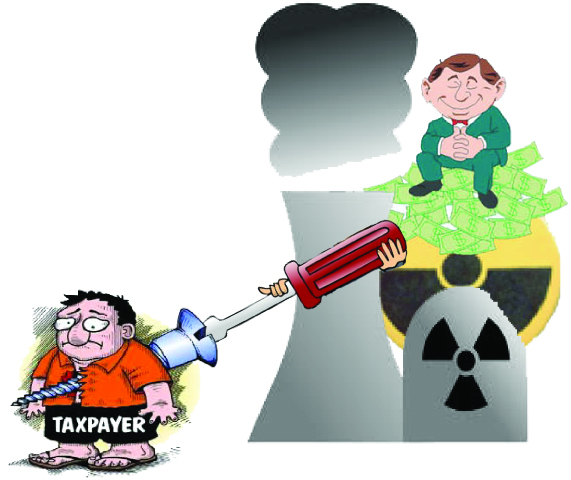
This is what journalist Laure Noualhat demonstrates in her relentless investigative book, Nuclear Power Will Ruin France . The result of six months of investigation, it is published today in the Seuil- Reporterre collection and will be accompanied by a documentary broadcast on YouTube in early June. Through this extensive work, Reporterre is tackling a crucial issue for the future of the country, largely absent from public debate. Because these choices are made in total secrecy, Reporterre is shedding light on a subject that concerns us all.
Here are the previews of “ Nuclear Power Will Ruin France ”:
What were you doing on February 10, 2022 ? For the small world of energy, it was a memorable day. On that day, presidential candidate Emmanuel Macron stood behind a lectern under the immense tin roof of the General Electric plant in Belfort. His voice echoed like a cathedral. Behind him, GE teams had positioned a gigantic Arabelle turbine, 300 tons of gleaming steel lit as if it were an industrial museum piece.
A group of masked employees, all wearing the same electric blue construction jackets, listens learnedly to the president. Four years earlier, these women and men were part of Alstom’s energy division, the industrial flagship that former Economy Minister Emmanuel Macron had conscientiously dismantled during his time at the Ministry of Finance.
No matter, on this Thursday, February 10, the now President has just announced the ” rebirth “ of French nuclear power, boasted of national ” sovereignty “ and praised the merits of ” planning “ to address the challenges of the moment: reducing our CO2 emissions by 55 % by 2050, ensuring France’s industrial development, and controlling the French people’s energy bill.
No law regulates presidential will
Regardless of the background—environmental, energy, nuclear, activist, industrial, or political—this speech hit the mark and is historic. With its delivery, President-candidate Macron has just rescued France from decades of uncertainty by relaunching the mass construction of nuclear reactors. Since its approval in 2003 by the National Assembly, the Flamanville EPR project has been mired in endless setbacks. In 2012, President Hollande chose a contrary path by enshrining in law the reduction of nuclear power’s share to 50 % of the electricity mix by 2025 (compared to 65-70 %) and to 30 % by 2030. In short, the socialist planned a slow phase-out of nuclear power, allowing for the preparation of the decommissioning of the oldest reactors, the ramp-up of renewables, and an unprecedented effort toward energy efficiency.
In February 2017, candidate Macron – a former minister under Hollande – took up this promise.
”
I will maintain the framework of the energy transition law. I am therefore maintaining the 50
% target,
“ he confided to the
WWF during a Facebook Live broadcast watched by 170,000 people and interviewed by… Pascal Canfin, who will join the President’s list for the 2019 European elections.
Five years later, facing General Electric employees, the Jupiterian president performed an about-face. Six
EPR2s will emerge, he promises, built in pairs on three sites: in Penly in Normandy, in Gravelines in the North, and in Bugey in the Ain. And eight more will be under consideration. Neither the French population, nor any parliamentarian or senator had their say, as if nuclear power were democratically held above ground. Since this announcement, the program of the six EPR2s
has still not been validated by any legal decision, much less by an ”
energy and climate programming law
” (
PPE ), which should have been revised for the occasion.
To date, in 2025, no law governs the presidential will shaped by long years of lobbying (by associations such as Xavier Moreno’s Cérémé or Bernard Accoyer’s Nuclear Heritage & Climate, but also Voies du nucléaire or the French Nuclear Energy Society) since his arrival in power.
A colossal cost
Knocking down walls or hiding the misery, insulating here or repainting there, moving the pipes, changing the door… it’s difficult to ask a tradesman for a quote for work if you don’t know what you’re going to do. It’s the same with nuclear reactors.
As these lines are being written, in March 2025, three years after the Belfort speech, no one knows how much the EPR2 will cost . This is normal: their detailed design has not been completed despite the 10.5 million hours of engineering already devoted to the project.
In February 2022, the government had put forward a construction cost of 51.7 billion (2020 euros). In 2023,
EDF made two updates to the costing, noted by the Court of Auditors in its report on the
EPR sector in January 2025:
”
The overnight construction cost [as if the reactor were completed in a single night] of three pairs of
EPR2s rose from 51.7 to 67.4 billion euros [2020 euros], an increase of 30
% under unchanged economic conditions and excluding the effect of inflation.
“ In 2023 euros, the bill reaches 80 billion. For comparison, this figure of 80 billion already represents four times the annual deficit of the Social Security…
Ukrainian attack on Russian bombers shows how cheap drones could upset global security
The June 1 Spider Web operation likely marks the largest attack on a nuclear-armed state’s nuclear assets to date, one that was executed using laptop-sized drones.
While this represents an operational success for Ukraine, it is still unclear whether and how the drone attack will impact Russia’s conduct of the war. Some fear this operation could lead to a nuclear escalation
By Julien de Troullioud de Lanversin | June 5, 2025, https://thebulletin.org/2025/06/ukrainian-attack-on-russian-bombers-shows-how-cheap-drones-could-upset-global-security/?utm_source=ActiveCampaign&utm_medium=email&utm_content=Drones%20attack%20on%20Russian%20bombers%20upset%20global%20security&utm_campaign=20250605%20Thursday%20Newsletter
On Sunday, social media started broadcasting videos of airfields shrouded with columns of smoke and parked airplanes on fire. These were not common airplanes but Russian strategic bombers capable of delivering nuclear weapons virtually anywhere on the globe. Behind these attacks were small drones, like those used to capture scenic social media videos, remotely operated by Ukrainian pilots.
The day after, some Russian media and influential figures called for retaliation with nuclear strikes. On Wednesday, Russian President Vladimir Putin reportedly said in a phone call with President Donald Trump that he planned to retaliate against Ukraine for its surprise attack. According to a reading of the Russian nuclear doctrine, the Ukrainian attacks could technically prompt a nuclear retaliation by Russia.
This military operation is the latest illustration of how cheap, accessible drones are changing modern warfare. It also exposed another reality: Drones will wreak havoc on global stability if nobody controls their proliferation.
A turning point. Last week’s drone operation, which the Ukrainian military called “Operation Spider’s Web” and which was 18 months in the making, looked like it came straight out of a James Bond movie: More than a hundred first-person view drones were secretly shipped inside containers on commercial trucks sent toward locations deep inside Russian territory, nearby highly sensitive military airfields. With just a click from operators based in Ukraine, all containers’ roofs simultaneously opened, and drones navigated to their targets to unleash destruction. The number of aircraft damaged or destroyed is still unclear. (Ukrainian authorities claim 41 aircraft were destroyed.) What is certain, however, is that several of Russia’s most critical and advanced strategic nuclear-capable bombers were damaged.
The drones were likely “Osa” quadcopters, 13-15 inches in length and developed and assembled in Ukraine at a cost of around $600 to $1000 each, according to an early analysis of the attack by the Center for Strategic and International Studies. Each drone likely carried an explosive payload of about 3.2 kilograms and detonated on impact with the targeted airplanes. To communicate with the drones, Ukrainian operators are believed to have used Russian mobile telecommunication networks, such as 4G and LTE connections. It is also likely that the drones were supported by artificial intelligence systems to give them autonomy in case the telecommunication with the operators would break, and to assist in precisely targeting identified weak spots on the airplanes.The drones were likely “Osa” quadcopters, 13-15 inches in length and developed and assembled in Ukraine at a cost of around $600 to $1000 each, according to an early analysis of the attack by the Center for Strategic and International Studies. Each drone likely carried an explosive payload of about 3.2 kilograms and detonated on impact with the targeted airplanes. To communicate with the drones, Ukrainian operators are believed to have used Russian mobile telecommunication networks, such as 4G and LTE connections. It is also likely that the drones were supported by artificial intelligence systems to give them autonomy in case the telecommunication with the operators would break, and to assist in precisely targeting identified weak spots on the airplanes.
The June 1 Spider Web operation likely marks the largest attack on a nuclear-armed state’s nuclear assets to date, one that was executed using laptop-sized drones. It also stands as the most significant demonstration of drones’ ability to penetrate deeply into heavily defended territory with significant strategic impact. While this represents an operational success for Ukraine, it is still unclear whether and how the drone attack will impact Russia’s conduct of the war. Some fear this operation could lead to a nuclear escalation.
For decades, major powers have pursued so-called strategic stability, a situation in which nuclear adversaries are deterred from launching direct military attacks against one another due to their mutually destructive nuclear capabilities. States also realized that continuing to develop more weapons in a never-ending arms race was costly and increased the risks of conflicts. This is why they agreed to engage in arms control and arms reduction, while making sure to maintain strategic stability.
But this fragile balance between great powers has always been vulnerable to new and disruptive technologies such as microchips, precision-guided missiles, or cybertechnology. Drones, especially small and cheap ones, represent a unique challenge to this balance, one that often evades the grasp of major powers.
‘Cheap drone’ warfare. Drone technology is not new. It was already used during the Cold War and has been a hallmark of the war in Iraq, with its precision strikes in the middle of the desert. Military powers such as the United States, Russia, and China have long invested in and developed expensive, highly advanced drones for various missions. Enhanced by artificial intelligence and increasing autonomy, modern drones have already promised to transform warfare by enabling operations without risking human pilots and possibly transforming the decision-making of those using them.
Things took another turn in the 2010s.
Enabled by advances in microelectronics and battery technologies, smaller and cheaper drones started to be mass-produced for commercial purposes by companies like DJI and others. It did not take long for the military to adapt these drones for warfare purposes. Combined with cutting-edge telecommunication technology, these smaller drones could form intelligent swarms and offer real-time video feeds to their operators.
This time, the nuclear powers were not the only ones to engage in the arms race. Unlike other delivery systems, such as missiles or jet fighters that have significantly higher entry costs, smaller states and even non-state actors could acquire inexpensive drones and transform them into rudimentary but effective “air force” and delivery systems.
The simplicity of their acquisition, use, and diffusion into the hands of actors of various sizes around the globe is what makes cheap drones such a game-changer for modern warfare—and now also for global security.
These inexpensive drones enable smaller states to conduct effective asymmetric warfare against more powerful opponents. It is in great part thanks to its drone force that Ukraine has stood its ground against the world’s second-largest military since 2022. Reports indicate that small drones may have contributed to up to 70 percent of Russian equipment losses so far in the conflict—and this number is likely to become higher if the war continues, given Ukraine’s rapidly growing drone production capacity.
More crucially, cheap drones can be used to sabotage well-defended strategic assets. In what is often described as terrorist acts, Yemen’s Houthis have used drones to attack commercial and military vessels in the Red Sea and the Gulf of Aden, thereby disrupting about 12 percent of global trade in 2024. Houthis’ drones also destroyed Saudi Arabia’s critical oil infrastructure, disrupting 5 percent of global oil supply in 2019.
But the most striking instance of their strategic reach remains the Ukrainian operation of June 1. This operation also foreshadows a dangerous shift in global stability.
Risk of escalation. Historically, only major nuclear powers had effective means to inflict damage on the nuclear capabilities of other major powers. And for most nuclear-armed states, an attack on their nuclear capabilities, even a conventional one, called for nuclear retaliation. To avoid nuclear escalation, nuclear powers have carefully crafted doctrines, strategies, and agreements between themselves to create predictability and increase strategic stability. But to a certain extent, this system of balance was not designed with the expectation that smaller actors could threaten critical nuclear assets of the nuclear-armed states.
Smaller states with no nuclear capabilities and less familiar with the game of strategic stability, like Ukraine, might not fully realize the direct or indirect risk of nuclear escalation that their drone operations could entail. More alarming, non-state actors could also potentially actively seek to initiate a nuclear escalation between nuclear adversaries with drone-enabled false flag operations.
Discussions around drone regulation in war often center around their ethical uses and their level of AI-powered autonomy, which are certainly crucial issues to tackle. But states must also recognize the highly disruptive impact that cheap and widely accessible drones can have not only on warfare but on global security and stability.
One way forward is to implement strict export control and purchase regulations on small drones, such as those implemented for small firearms. Such policies will inevitably collide with the booming industry and market of small, cheap drones that are increasingly popular for commercial purposes and leisure activities. But states will need to work on some form of control of drone export and weaponization, lest they are willing to risk more nuclear crises.
1 This Month





PLEASE OPPOSE HR 8255 AND S.3639 – bills would accelerate satellite deployment, with no environmental review or safeguards – https://ncstd5li.quorum.us/campaign/169331/
To see nuclear-related stories in greater depth and intensity – go to https://nuclearinformation.wordpress.com
-
Archives
- October 2026 (29)
- September 2026 (339)
- August 2026 (330)
- July 2026 (355)
- June 2026 (287)
- May 2026 (306)
- April 2026 (356)
- March 2026 (251)
- February 2026 (267)
- January 2026 (308)
- December 2025 (358)
- November 2025 (359)
-
Categories
- 1
- 1 NUCLEAR ISSUES
- business and costs
- climate change
- culture and arts
- ENERGY
- environment
- health
- history
- indigenous issues
- Legal
- marketing of nuclear
- media
- opposition to nuclear
- PERSONAL STORIES
- politics
- politics international
- Religion and ethics
- safety
- secrets,lies and civil liberties
- spinbuster
- technology
- Uranium
- wastes
- weapons and war
- Women
- 2 WORLD
- ACTION
- AFRICA
- Atrocities
- AUSTRALIA
- Christina's notes
- Christina's themes
- culture and arts
- Events
- Fuk 2022
- Fuk 2023
- Fukushima 2017
- Fukushima 2018
- fukushima 2019
- Fukushima 2020
- Fukushima 2021
- general
- global warming
- Humour (God we need it)
- Nuclear
- RARE EARTHS
- Reference
- resources – print
- Resources -audiovicual
- Weekly Newsletter
- World
- World Nuclear
- YouTube
-
RSS
Entries RSS
Comments RSS

