80 Years After Trinity

No longer represented as a plausible deterrent, the bomb now stood poised to become what Los Alamos Director J. Robert Oppenheimer would describe shortly after the war as “weapons of terror, of surprise, of aggression… [used] against an essentially defeated enemy.”
Why Was There So Little Dissent at Los Alamos and What Does It Mean Today?
By Eric Ross, 17 July 25, https://tomdispatch.com/80-years-after-trinity/
In recent months, nuclear weapons have reemerged in global headlines. Nuclear-armed rivals India and Pakistan approached the brink of a full-scale war, a confrontation that could have become an extinction-level event, with the potential to claim up to two billion lives worldwide.
The instability of a global order structured on nuclear apartheid has also come into sharp relief in the context of the recent attacks on Iran by Israel and the United States. That system has entrenched a dangerous double standard, creating perverse incentives for the proliferation of world-destroying weaponry, already possessed by nine countries. Many of those nations use their arsenals to exercise imperial impunity, while non-nuclear states increasingly feel compelled to pursue nuclear weapons in the name of national security and survival.
Meanwhile, the largest nuclear powers show not the slightest signs of responsibility or restraint. The United States, Russia, and China are investing heavily in the “modernization” and expansion of their arsenals, fueling a renewed arms race. And that escalation comes amid growing global instability contributing to a Manichean world of antagonistic armed blocs, reminiscent of the Cold War at its worst.
The nuclear threat endangers not only global peace and security but the very continuity of the human species, not to speak of the simple survival of life on Earth. How, you might wonder, could we ever have arrived at such a precarious situation?
The current crisis coincides with the 80th anniversary of the Trinity Test, the first detonation of an atomic weapon that would soon obliterate the Japanese cities of Hiroshima and Nagasaki and so inaugurate the atomic age. So many years later, it’s worth critically reassessing the decisions that conferred on humanity such a power of self-annihilation. After all, we continue to live with the fallout of the choices made (and not made), including those of the scientists who created the bomb. That history also serves as a reminder that alternative paths were available then and that another world remains possible today.
A Tale of Two Laboratories
In the summer of 1945, scientists and technicians at Los Alamos National Laboratory in New Mexico worked feverishly to complete the construction of the atomic bomb. Meanwhile, their colleagues at the University of Chicago’s Metallurgical Laboratory mounted a final, ultimately unsuccessful effort to prevent its use.
The alarm spreading in Chicago stemmed from a sobering realization. The Manhattan Project that they had joined on the basis of a belief that they were in an existential arms race with Nazi Germany had, by then, revealed itself to be a distinctly one-sided contest. Until then, the specter of a possible German atomic bomb had conferred a sense of urgency and a veneer of moral legitimacy on what many scientists otherwise recognized as a profoundly unethical undertaking.
Prior to the fall of Berlin, Allied intelligence had already begun to cast serious doubt on Germany’s progress toward developing an atomic weapon. By April 1945, with the Nazi regime in a state of collapse and Japan’s defeat imminent, the threat that served as the original justification for the bomb’s development had all but vanished.
No longer represented as a plausible deterrent, the bomb now stood poised to become what Los Alamos Director J. Robert Oppenheimer would describe shortly after the war as “weapons of terror, of surprise, of aggression… [used] against an essentially defeated enemy.”
By that point, it was evident that the bomb would be used not to deter Germany but to destroy Japan, and not as the final act of World War II but as the opening salvo of what would become the Cold War. The true target of the first atomic bomb wasn’t, in fact, Tokyo, but Moscow, with the people of Hiroshima and Nagasaki sacrificed on the altar of American global imperial ambition.
For the scientists at Chicago, that new context demanded new thinking. In June 1945, a committee of physicists led by James Franck submitted a report to Secretary of War Henry Stimson warning of the profound political and ethical consequences of employing such a bomb without exhausting all other alternatives. “We believe,” the Franck Report stated, “that the use of nuclear bombs for an early, unannounced attack against Japan [would be] inadvisable.” The report instead proposed a demonstration before international observers, arguing that such a display could serve as a gesture of goodwill and might avert the need to use the bombs altogether.
One of that report’s signatories, Leo Szilard, who had been among the bomb’s earliest advocates, further sought to prevent what he had come to recognize as the catastrophic potential outcome of their creation. With Germany defeated, he felt a personal responsibility for reversing the course he had helped set in motion. Echoing concerns articulated in the Franck Report, he drafted a petition to be circulated among the scientists. While acknowledging that the bomb might offer short-term military and political advantages against Japan, he warned that its deployment would ultimately prove morally indefensible and strategically self-defeating, a position which would also be held by six of the seven U.S. five-star generals and admirals of that moment.
Szilard emphasized that the atomic bomb wasn’t just a more powerful weapon but a fundamental transformation in the nature of warfare, an instrument of annihilation. He already feared Americans might come to regret that their own government had sown the seeds of global destruction by legitimizing the sudden obliteration of Japanese cities, a precedent that would render a heavily industrialized, densely populated country like the United States especially vulnerable.
Moreover, he concluded that using such weapons of unimaginable destructive power without sufficient military justification would severely undermine American credibility in future arms control efforts. He observed that the development of the bomb under conditions of extreme wartime secrecy had created an abjectly anti-democratic situation, one in which the public was denied any opportunity to deliberate on such an irrevocable and consequential decision.
As Eugene Rabinowitch, a co-author of the Franck Report (who would later co-found The Bulletin of Atomic Scientists), would note soon after, the scientists in Chicago were growing increasingly uneasy in the face of escalating secrecy: “Many scientists began to wonder: against whom was this extreme secrecy directed? What was the sense of keeping our success secret from the Japanese? Would it have helped them to know that we had an atomic bomb ready?”
Rabinowitch concluded that the only “danger” posed by such a disclosure was that the Chicago scientists might be proven right, and Japan might surrender. “Since there was no justifiable reason to hold the bomb secret from the Japanese,” he argued, “many scientists felt that the purpose of deepened secrecy was to keep the knowledge of the bomb… from the American people.”
In other words, officials in Washington were concerned that a successful demonstration might deprive them of the coveted opportunity to use the bomb and assert their newly acquired monopoly (however temporary) on unprecedented power.
The Road to Trinity and the Cult of Oppenheimer
Seventy scientists at Chicago endorsed the Szilard Petition. By then, however, their influence on the project had distinctly diminished. Despite their early contributions, notably the achievement of the first self-sustained nuclear chain reaction in December 1942, the project’s center of gravity had shifted to Los Alamos.
Recognizing this, Szilard sought to circulate the petition among his colleagues there, too, hoping to invoke a shared sense of scientific responsibility and awaken their moral conscience in the critical weeks leading up to the first test of the weapon. Why did that effort fail? Why was there so little dissent, debate, or resistance at Los Alamos given the growing scientific opposition, bordering on revolt, that had emerged in Chicago?
One answer lies in Oppenheimer himself. In popular culture and historical scholarship, his legacy is often framed as that of a tragic figure: the reluctant architect of the atomic age, an idealist drawn into the ethically fraught task of creating a weapon of mass destruction compelled by the perceived exigencies of an existential war.
Yet the myth of him as a Promethean figure who suffered for unleashing the fundamental forces of nature onto a society unprepared to bear responsibility for it obscures the extent of his complicity. Far from being a passive participant, in the final months of the Manhattan Project, he emerged as a willing collaborator in the coordination of the coming atomic bombings of Hiroshima and Nagasaki.
When Oppenheimer and physicist Edward Teller (who would come to be known as “the father of the hydrogen bomb”) received Szilard’s petition, neither shared it. While Oppenheimer offered no response, Teller provided a striking explanation: “The things we are working on are so terrible that no amount of protesting or fiddling with politics will save our souls.” He further rejected the idea that he held any authority to influence the bomb’s use. “You may think it is a crime to continue to work,” he conceded, “but I feel that I should do the wrong thing if I tried to say how to tie the little toe of the ghost to the bottle from which we just helped it escape.”
Teller later claimed to be in “absolute agreement” with the petition, but added that “Szilard asked me to collect signatures… I felt I could not do so without first seeking Oppenheimer’s permission more directly. I did so and Oppenheimer talked me out of it, saying that we as scientists have no business meddling in political pressure of that kind… I am ashamed to say that he managed to talk me out of [it].”
Teller’s explanation was likely self-serving given his later acrimonious rift with Oppenheimer over the hydrogen bomb. Yet further evidence indicates that Oppenheimer actively sought to suppress debate and dissent. Physicist Robert Wilson recalled that upon arriving at Los Alamos in 1943, he raised concerns about the broader implications of their work and the “terrible problems” it might create, particularly given the exclusion of the Soviet Union, then an ally. The Los Alamos director, Wilson remembered, “didn’t want to talk about that sort of thing” and would instead redirect the conversation to technical matters. When Wilson helped organize a meeting to discuss the future trajectory of the project in the wake of Germany’s defeat, Oppenheimer cautioned him against it, warning that “he would get into trouble by calling such a meeting.”
The meeting nonetheless proceeded, with Oppenheimer in attendance, though his presence proved stifling. “He participated very much, dominating the meeting,” Wilson remembered. Oppenheimer pointed to the upcoming San Francisco Conference to establish the United Nations and insisted that political questions would be addressed there by those with greater expertise, implying that scientists had no role to play in such matters and ought to abstain from influencing the applications of their work.
Reflecting on his mindset at the time, Oppenheimer explained, “When you see something that is technically sweet, you go ahead and do it and you argue about what to do about it only after you have had your technical success. That is the way it was with the atomic bomb.” In a similar vein, his oft-quoted remark that “the physicists have known sin” was frequently misinterpreted. He was not referring, he insisted, to the “sin” of the destruction of Hiroshima and Nagasaki, but to pride for “intervening explicitly and heavy-handedly in the course of human history.”
When situated within this broader context of a professed commitment to scientific detachment, Oppenheimer’s behavior becomes more intelligible. In practice, however, his stated ideals stood in stark contrast to his conduct. While he claimed to reject political engagement, he ultimately intervened in precisely such a manner, using his position to advocate forcefully for the bomb’s immediate military use against Japan without prior warning. He emerged as a leading opponent of any prospective demonstration, cautioning that it would undermine the psychological impact of the bomb’s use, which could only be realized through a sudden, unannounced detonation on a relatively untouched, non-military target like the city of Hiroshima. This position stood in sharp contrast to that of the Chicago scientists, of whom only 15% supported using the bomb in such a manner.
That climate of deference fostered a culture of complicity, where questions of social responsibility were subordinated to uncritical faith in authority. Reflecting on that dynamic, physicist Rudolf Peierls acknowledged, “I knew that Oppenheimer was on a committee and was briefing with the high-ups. I felt there were two things one could rely on: Oppenheimer to put the reasonable ideas across, and that one could trust people. After all, we are not terrorists at heart or anything… Both these statements might now be somewhat optimistic.”
Ultimately, the only member of Los Alamos to register dissent was Joseph Rotblat, who quietly resigned on ethical grounds after learning in November 1944 that there was no active Nazi atomic bomb program. His departure remained a personal act of conscience, however, rather than an effort to initiate a broader moral reckoning within the scientific community.
“Remember Your Humanity”
The legacy of Oppenheimer, a burden we all now carry, lies in his mistaking proximity to power for power itself. Rather than using his influence to restrain the bomb’s use, he exercised what authority he had to facilitate its most catastrophic outcome, entrusting its consequences to political leaders who soon revealed their recklessness. In doing so, he helped lay the groundwork for what President Dwight D. Eisenhower would, in his farewell address to Congress in 1961, warn against as “the disastrous rise of misplaced power.”
Yet we are not doomed. This history should also remind us that the development and use of nuclear weapons was not inevitable. There were those who spoke out and a different path might well have been possible. While we cannot know exactly how events would have unfolded had dissent been amplified rather than suppressed, we can raise our own voices now to demand a safer, saner future. Our collective survival may well depend on it. How much longer a world armed with nuclear weapons can endure remains uncertain. The only viable path forward lies in renewing a commitment to, as Albert Einstein and Bertrand Russell urged, “remember your humanity, and forget the rest.” With ever more nations developing increasingly powerful arsenals, one thing remains clear: as the Doomsday Clock moves ever closer to midnight, there is no time to waste.
Trump sprang Ukraine surprise on NATO states – Reuters

Trump noted that the plan is seen by Washington as a business opportunity.
16 July 25, https://www.rt.com/news/621575-trump-ukraine-weapons-surprise/
Several bloc members reportedly only learned they were supposed to fund American weapons for Kiev when it was announced by the US president.
Several NATO member states were not notified in advance that they would be asked to fund new arms deliveries to Ukraine under US President Donald Trump’s latest proposal, Reuters has reported, citing European officials.
On Monday, Trump pledged to provide more US-made weapons to Kiev through a new scheme funded by European NATO members. “We’re not buying it,” Trump said during an Oval Office meeting with the bloc’s secretary-general, Mark Rutte. “We will manufacture it, and they’re going to be paying for it.”
Trump noted that the plan is seen by Washington as a business opportunity.
Rutte said six countries – Finland, Denmark, Sweden, Norway, the Netherlands, and Canada – were willing to take part in the arms procurement scheme. However, high-ranking sources at the embassies of two of those countries told Reuters they only learned of their supposed participation when the announcement was made.
“It is my clear sense that nobody has been briefed about the exact details in advance,” one European ambassador told Reuters. “And I also suspect that internally in the administration they are only now beginning to sort out what it means in practice.”
Several countries have already distanced themselves from Trump’s plan. According to Politico and La Stampa, France and Italy will not be financially supporting the effort. Hungary and the Czech Republic have also declined to participate, with Czech Prime Minister Petr Fiala saying Prague is focusing on other projects.
EU foreign policy chief Kaja Kallas, on the other hand, has welcomed the proposal but emphasized that Washington should “share the burden,” stating that if European countries pay for the weapons, it should be considered as “European support.”
Since taking office in January, Trump has renewed pressure on NATO members to increase defense spending and warned that the US may not defend allies who do not meet their obligations.
Russia has repeatedly condemned Western arms supplies to Ukraine, arguing that it only prolongs the bloodshed and does not change the course of the conflict. The Kremlin maintains that foreign military aid is being used to escalate the hostilities rather than seek a diplomatic resolution.
Call for evidence on building nuclear for a new UK “golden age of clean energy abundance”
The UK is embarking on an ambitious programme of
investment in nuclear energy, seeking to reverse decades of declining
capacity. The Government is counting on new nuclear to help deliver energy
security and decarbonise electricity generation. Announcing funding for the
Sizewell C nuclear power plant in June, the Energy Secretary said “we
need new nuclear to deliver a golden age of clean energy abundance.”
But past promises of a golden age of nuclear energy have failed to materialise.
A new reactor has not been connected to the grid for 30 years. Nuclear
projects have historically faced unique barriers, including complex
regulatory and planning processes. The Government now aims to deliver
reforms to streamline planning approvals and give greater certainty to
developers. The Energy Security and Net Zero Committee is now inviting
written submissions to help assess whether EN-7 provides a coherent and
effective framework for enabling the UK’s nuclear ambitions.
Energy Security and Net Zero Committee 17th July 2025, https://committees.parliament.uk/committee/664/energy-security-and-net-zero-committee/news/208378/call-for-evidence-on-building-nuclear-for-a-new-uk-golden-age-of-clean-energy-abundance/
We’ll stop Nimbys from blocking nuclear power stations, say Tories.
The rule changes would see planning officers ignore all environmental
considerations when building a new nuclear site,
Party wants to make it impossible to challenge plans using environmental impact assessments or habitat regulations
Nimbys will be stopped from blocking nuclear power stations in their area
under Tory plans. The party wants to end the “absurd” blocking of new
nuclear sites through environmental impact assessments or regulations on
habitats, and would make it impossible to challenge a new power station in
court.
The Tories have submitted amendments to the Government’s Planning
and Infrastructure Bill that would exempt nuclear power stations from being
blocked or delayed on environmental grounds, to speed up energy production
in the UK. They accused Ed Miliband, the Energy Secretary, of presiding
over “the highest prices for offshore wind in a decade” and called for
more nuclear power to meet the UK’s growing demand for electricity.
The rule changes would see planning officers ignore all environmental
considerations when building a new nuclear site, which is likely to anger
locals and lead to public opposition. Writing for The Telegraph, Claire
Coutinho, the shadow energy secretary, said the new Hinkley Point C power
station in Somerset is set to be the most expensive in history because of
“bureaucracy and rampant lawfarism”. “[There is] Endless lawfare,
environmental paperwork, and legal challenges that do little to protect
nature but create plenty of expensive work for planning consultants and
pencil-pushing bureaucrats,” she said. “Every single delay and absurd
mitigation measure adds more cost.”
The amendments would only become law
with the support of Labour MPs, which is not expected to happen. Labour has
previously said it will reform the same rules raised by the Conservatives,
but will not exempt them from judicial review or all environmental
assessments.

Responding to the Conservative proposal, Sam Richards, chief
executive of pro-growth campaign group Britain Remade, said the UK had the
“worst of both worlds” with a planning system that does not protect
nature and slows down infrastructure projects. “These amendments are
radical, but the status quo where safe, clean nuclear power projects are
delayed and made more expensive due to repeated legal challenges and poorly
drafted environmental legislation is intolerable,” he said.
Telegraph 18th July 2025, https://www.telegraph.co.uk/news/2025/07/18/tories-stop-nimbys-block-nuclear-power-hinkley-fish-disco/
Ominous Plans: Making Concentration Camp Gaza
18 July 2025, Dr Binoy Kampmark, https://theaimn.net/ominous-plans-making-concentration-camp-gaza/
The odious idea of a camp within a camp. The Gaza Strip, with an even greater concentration of Palestinian civilian life within an ever-shrinking stretch of territory. These are the proposals ventured by the Israeli government even as the official Palestinian death toll marches upwards to 60,000. They envisage the placement of some 600,000 displaced and houseless beings currently living in tents in the area of al-Mawasi along Gaza’s southern coast in a creepily termed “humanitarian city”. This would be the prelude for an ultimate relocation of the strip’s entire population of over 2 million in an area that will become an even smaller prison than the Strip already is.
The preparation for such a forced removal – yet another among so many Israel has inflicted upon the Palestinians – is in full swing. The analysis of satellite imagery from the United Nations Satellite Centre (UNOSAT) by Al Jazeera’s Sanad investigations unit found that approximately 12,800 buildings were demolished in Rafah between early April and early July alone. In the Knesset on May 11 this year, Prime Minister Benjamin Netanyahu gave words to those deeds: “We are demolishing more and more [of their] homes, they have nowhere to return to. The only obvious result will be the desire of the Gazans to emigrate outside the Strip.”
Camps of concentrated human life – concentration camps, in other words – are often given a different dressing to what they are meant to be. Authoritarian states enjoy using them to re-educate and reform the inmates even as they gradually kill them. Indeed, the proposals from the Israel’s Defense Department carry with them plans for a “Humanitarian Transit Area” where Gazans would “temporarily reside, deradicalize, re-integrate, and prepare to relocate if they wish to do so.”
The emetic candy floss of “humanitarian” in the context of a camp is a self-negating nonsense similar to other experiments in cruelty: the relocation of Boer civilians during the colonial wars waged by Britain to camps which saw dysentery and starvation; the movement of Vietnamese villagers into fortified hamlets to prevent their infiltration by the Vietcong in the 1960s; the creation of Pacific concentration camps to detain refugees seeking Australia by boat in what came to be called the “Pacific Solution.”
Those in the business of doing humanitarian deeds were understandably appalled by Israel’s latest plans. Philippe Lazzarini, head of the United Nations agency for Palestinian refugees (UNRWA), stated that this would “de facto create massive concentration camps at the border with Egypt for the Palestinians, displaced over and over across generations.” It would certainly “deprive Palestinians of any prospects of a better future in their homeland.” Self-evidently and sadly, that would be one of the main aims.
A few of Israeli’s former Prime Ministers have ditched the coloured goggles in considering the plans for such a mislabelled city. Yair Lapid, who spent a mere six months in office in 2022, told Israeli Army Radio that it was “a bad idea from every possible perspective – security, political, economic, logistical.” While preferring not to use the term “concentration camp” with regards such a construction, incarcerating individuals by effectively preventing their exit would make such a term appropriate.
Ehud Olmert’s words to The Guardian were even less inclined to varnish the matter. “If they [the Palestinians] will be deported into the new ‘humanitarian city’, then you can say that this is part of an ethnic cleansing.” To create a camp that would effectively “clean” more than half of Gaza of its population could hardly be understood as a plan to save Palestinians. “It is to deport them, to push and to throw them away. There is no other understanding that I have at least.”
Israeli political commentator Ori Goldberg was also full of candour in expressing the view that the plan was “for all facts and purposes a concentration camp” for Gaza’s Palestinians, “an overt crime against humanity under international humanitarian law”. This would also add the burgeoning grounds of illegality already being alleged in this month’s petition by three Israeli reserve soldiers of Israel’s Supreme Court questioning the legality of Operation Gideon’s Chariots. Instancing abundant examples of forced transfer and expulsions of the Palestinian population during its various phases, commentators such as former chief of staff of the IDF, Moshe “Bogy” Ya’alon, are unreserved about how such programs fare before international law. “Evacuating an entire population? Call it ethnic cleansing, call it transfer, call it deportation, it’s a war crime,” he told journalist Lucy Aharish. “Israel’s soldiers had been sent in “to commit war crimes.”
There is also some resistance from within the IDF, less on humanitarian grounds than practical ones. To even prepare such a plan in the midst of negotiations for a lasting ceasefire and finally resolving the hostage situation was the first telling problem. The other was how the IDF could feasibly undertake what would be a grand jailing experiment while preventing the infiltration of Hamas.
This ghastly push by the Netanyahu government involves an enormous amount of wishful thinking. Ideally, the Palestinians will simply leave. If not, they will live in even more carceral conditions than they faced before October 2023. But to assume that this cartoon strip humanitarianism, papered over a ghoulish program of inflicted suffering, will add to the emptying well of Israeli security, is testament to how utterly desperate, and delusionary, the Israeli PM and his cabinet members have become.
New reports cast doubt on impact of US strikes on Iran’s nuclear sites
Citing intelligence assessments, NBC News and Washington Post report that only Fordow site was destroyed in US attack.
US Secretary of Defense attacks media for questioning Iran strikes
By Al Jazeera Staff, 18 Jul 202518 Jul 2025, https://www.aljazeera.com/news/2025/7/18/new-reports-cast-doubt-on-impact-of-us-strikes-on-irans-nuclear-sites
Washington, DC – New media reports in the United States, citing intelligence assessments, have cast doubt over President Donald Trump’s assertion that Washington’s military strikes last month “obliterated” Iran’s nuclear programme.
The Washington Post and NBC News reported that US officials were saying that only one of the three Iranian nuclear sites – the Fordow facility – targeted by the US has been destroyed.
The Post’s report, released on Friday, also raised questions on whether the centrifuges used to enrich uranium at the deepest level of Fordow were destroyed or moved before the attack.
“We definitely can’t say it was obliterated,” an unidentified official told the newspaper, referring to Iran’s nuclear programme.
Trump has insisted that the US strikes were a “spectacular” success, lashing out at any reports questioning the level of damage they inflicted on Iran’s nuclear programme.
An initial US intelligence assessment, leaked to several media outlets after the attack last month, said the strikes failed to destroy key components of Iran’s nuclear programme and only delayed its work by months.
But the Pentagon said earlier in July that the attacks degraded the Iranian programme by one to two years.
While the strikes on Fordow – initially thought to be the most guarded facility, buried inside a mountain – initially took centre stage, the NBC News and Washington Post reports suggested that the facilities in Natanz and Isfahan also had deep tunnels.
‘Impenetrable’
The US military did not use enormous bunker-busting bombs against the Isfahan site and targeted surface infrastructure instead.
A congressional aide familiar with intelligence briefings told the Post that the Pentagon had assessed that the underground facilities at Isfahan were “pretty much impenetrable”.
The Pentagon responded to both reports by reiterating that all three sites were “completely and totally obliterated”.
Israel, which started the war by attacking Iran without direct provocation last month, has backed the US administration’s assessment, while threatening further strikes against Tehran if it resumes its nuclear programme.
For its part, Tehran has not provided details about the state of its nuclear sites.
Some Iranian officials have said that the facilities sustained significant damage from US and Israeli attacks. But Supreme Leader Ali Khamenei said after the war that Trump had “exaggerated” the impact of the strikes.
The location and state of Iran’s highly enriched uranium also remain unknown.
Iran’s nuclear agency and regulators in neighbouring states have said they did not detect a spike in radioactivity after the bombings, suggesting the strikes did not result in uranium contamination.
But Rafael Grossi, the head of the United Nations nuclear watchdog, the IAEA, did not rule out that the uranium containers may have been damaged in the attacks.
“We don’t know where this material could be or if part of it could have been under the attack during those 12 days,” Grossi told CBS News last month.
According to Grossi, Iran could resume uranium enrichment in a “matter of months”.
The war
Israel launched a massive attack against Iran on June 13, killing several top military officials, as well as nuclear scientists.
The bombing campaign targeted military sites, civilian infrastructure and residential buildings across the country, killing hundreds of civilians.
Iran responded with barrages of missiles against Israel that left widespread destruction and claimed the lives of at least 29 people.
The US joined the Israeli campaign on June 22, striking the three nuclear sites. Iran retaliated with a missile attack against an air base housing US troops in Qatar.
Initially, Trump said the Iranian attack was thwarted, but after satellite images showed damage at the base, the Pentagon acknowledged that one of the missiles was not intercepted.
“One Iranian ballistic missile impacted Al Udeid Air Base June 23 while the remainder of the missiles were intercepted by US and Qatari air defence systems,” Pentagon spokesperson Sean Parnell told Al Jazeera in an email last week.
Advertisement
“The impact did minimal damage to equipment and structures on the base. There were no injuries.”
After a ceasefire was reached to end the 12-day war, both the US and Iran expressed willingness to engage in diplomacy to resolve the nuclear file. But talks have not materialised.
Iran and the US were periodically holding nuclear talks before Israel launched its war in June.
During his first term in 2018, Trump withdrew the US from the 2015 multilateral nuclear agreement, known as the Joint Comprehensive Plan of Action (JCPOA).
The agreement saw Iran scale back its nuclear programme in exchange for lifting international sanctions against its economy.
In recent days, European officials have suggested that they could impose “snap-back” sanctions against Iran as part of the deal that has long been violated by the US.
Tehran, which started enriching uranium beyond the limits set by the JCPOA after the US withdrawal, insists that Washington was the party that nixed the agreement, stressing that the deal acknowledges Iran’s enrichment rights.
On Friday, Iranian Foreign Minister Abbas Araghchi said he held talks with the top diplomats of France, the United Kingdom and Germany – known as the E3 – as well as the European Union’s high representative.
Araghchi said Europeans should put aside “worn-out policies of threat and pressure”.
“It was the US that withdrew from a two-year negotiated deal – coordinated by EU in 2015 – not Iran; and it was US that left the negotiation table in June this year and chose a military option instead, not Iran,” the Iranian foreign minister said in a social media post.
“Any new round of talks is only possible when the other side is ready for a fair, balanced, and mutually beneficial nuclear deal.”
Tehran denies seeking a nuclear bomb. Israel, meanwhile, is widely believed to have an undeclared nuclear arsenal.
Miliband bets on nuclear fusion in bid to lead (?)clean power race.

Energy Secretary to make it easier for developers to build reactors with planning shake-up
Ed Miliband has taken a bet on nuclear fusion one day powering Britain by
making it easier for developers to build new reactors with minimal planning
restrictions.
Fusion plants are to be included in the UK’s national
infrastructure planning system, meaning they can be built in any part of
Britain without needing consent from local authorities and with little
opportunity for local people to object. Mr Miliband said the aim was to
ensure fusion, if it ever works, could rapidly become part of the UK energy
system.
Telegraph 18th July 2025, https://www.telegraph.co.uk/business/2025/07/18/miliband-bets-on-nuclear-fusion-by-making-it-easier-to-buil/
Trump’s nuclear power push weakens regulator and poses safety risks, former officials warn

Spencer Kimball, Jul 17 2025
Key Points
Former NRC commissioners say the order threatens the regulator’s independence, raising safety concerns that could undermine public confidence.
President Donald Trump has ordered an overhaul of the Nuclear Regulatory Commission, part of his push to quadruple nuclear power in the U.S. by 2050.
The order requires the NRC to make decisions on nuclear plants within 18 months, completely revise its regulations and reduce its staff.
Former NRC commissioners say the order threatens the
regulator’s independence, raising safety concerns that could undermine
public confidence. President Donald Trump’s push to approve nuclear
plants as quickly as possible threatens to weaken the independent regulator
tasked with protecting public health and safety, former federal officials
warn.
Trump issued four sweeping executive orders in May that aim to
quadruple nuclear power by 2050 in the U.S. The White House and the
technology industry view nuclear as powerful source of reliable electricity
that can help meet the growing energy needs of artificial intelligence.
The most consequential of Trump’s orders aims to slash regulations and speed
up power plant approvals through an overhaul of the Nuclear Regulatory
Commission. The NRC is an independent agency established by Congress in
1975 to make sure that nuclear reactors are deployed and operated safely.
Trump accuses the NRC of “risk aversion” in his order, blaming the
regulator for how few nuclear plants have been built in the U.S. over the
past three decades. The president says that the NRC is focused on
protecting the public from “the most remote risks,” arguing that such a
cautious approach to approving plants restricts access to reliable
electricity.
CNBC 17th July 2025, https://www.cnbc.com/2025/07/17/trumps-nuclear-power-push-weakens-regulator-and-poses-safety-risks-former-officials-warn.html
Sizewell C | Investor withdraws from consortium set for 25% stake.

17 Jul, 2025 By Tom Pashby, https://www.newcivilengineer.com/latest/sizewell-c-investor-withdraws-from-consortium-set-for-25-stake-17-07-2025/
One of the investors reported to be considering a stake in Sizewell C has decided to withdraw, while the government is no longer planning to classify nuclear energy as “sustainable”.
Schroders Greencoat, which describes itself as “a specialist renewables infrastructure investor”, was previously reported to be one of the companies considering an ownership stake in Sizewell C.
It was widely reported that Schroders Greencoat was one of the companies in the consortium led by Brookfield Asset Management, which was in total considering a 25% stake in the nuclear power plant.
In an email dated 16 July seen by NCE, the investor said it no longer wishes to invest in the project on the Suffolk coast.
Wait for final investment decision continues
Sizewell C must achieve its final investment decision (FID) before main construction can start.
Despite the delay, Sizewell C has committed over £2.5bn on contracts.
It is now expected that the final investment decision will be taken this summer.
Nuclear dropped from sustainable finance classification plans
The UK Government recently decided to not go ahead with plans to create a UK Green Taxonomy for financial investments, meaning that it won’t have a specific classification of certain areas of activity, like nuclear power, as “sustainable”.
This had been a plan hatched by former chancellor Jeremy Hunt in the 2023 Spring Budget, but NCE found that no work had gone towards this 16 months later.
HM Treasury economic secretary to the treasury and city minister Emma Reynolds announced the decision in the UK Green Taxonomy Consultation Response.
“To make sure the UK is well-positioned to capture [growth in the green economy], the government is delivering a world-leading sustainable finance framework,” Reynolds said.
“This includes ensuring that we have the right tools in place and the proportionate regulation that is needed to support the transition, strengthening the UK’s position as the sustainable finance capital of the world so that the UK can lead the clean energy transition at home and abroad.
“That is why, after careful consideration, the government has concluded that a UK Taxonomy would not be the most effective tool to deliver the green transition and should not be part of our sustainable finance framework.
“Whilst our ambitions to continue as a global leader remain unchanged, the consultation responses showed that other policies were of higher priority to accelerate investment into the transition to net zero and limit greenwashing.”
It is understood that the decision to drop plans for the taxonomy may have contributed to Schroders Greencoat’s withdrawal from investing in Sizewell C.
Anti-Sizewell C campaign attributes withdrawal to taxonomy decision
Stop Sizewell C executive director Alison Downes said: “It’s welcome news that Schroders Greencoat won’t be investing in Sizewell C.
Based on our dialogue with Schroders, we attribute this to the government deciding not to adopt a green taxonomy, which thankfully has the outcome that nuclear energy cannot be erroneously labelled ‘green’.
“We wish that other investors would take the same view and exit Sizewell C forthwith.”
No comment from parties to negotiations
The negotiations around the final investment decision are often described as commercially sensitive, and as such the government doesn’t tend to comment.
This hasn’t stopped sources informing the media about certain parts of the negotiations, like the report in the FT that the government is now taking a minority ownership stake.
The Department for Net Zero and Energy Security, Sizewell C and Schroders Greencoat did not supply a comment.
THE END FOR ZELENSKY?
Washington wants the Ukrainian president to leave office—will it happen?
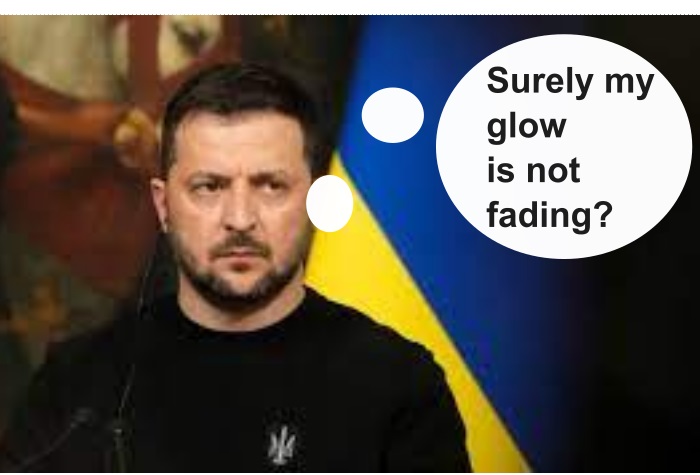
Seymour Hersh, Jul 19, 2025
In fall of 2023, Ukrainian General Valerii Zaluzhnyi, the commander in chief of the country’s armed forces, gave an interview to the Economist and declared the war with Russia had become a “stalemate.” It took three months for President Volodymyr Zelensky to fire him. The general, who is the most popular public figure in Ukraine, was named ambassador to London a month later and has served there with distinction, if quietly.
Zaluzhnyi is now seen as the most credible successor to Zelensky. I have been told by knowledgeable officials in Washington that that job could be his within a few months. Zelensky is on a short list for exile, if President Donald Trump decides to make the call. If Zelensky refuses to leave his office, as is most likely, an involved US official told me: “He’s going to go by force. The ball is in his court.” There are many in Washington and in Ukraine who believe that the escalating air war with Russia must end soon, while there’s still a chance to make a settlement with its president, Vladimir Putin………………………………………………………… (Subscribers only) https://seymourhersh.substack.com/p/the-end-for-zelensky?utm_source=post-email-title&publication_id=1377040&post_id=168643905&utm_campaign=email-post-title&isFreemail=true&r=ln98x&triedRedirect=true&utm_medium=email
∙
Trump Asked Zelensky If He Could Strike Moscow If the US Provided Longer-Range Weapons.

Trump later denied that he was considering sending long-range weapons to Ukraine and said that Ukraine shouldn’t target Moscow
by Dave DeCamp | Jul 15, 2025, https://news.antiwar.com/2025/07/15/trump-asked-zelensky-if-he-could-strike-moscow-if-the-us-provided-longer-range-weapons/
President Trump has encouraged Ukraine to step up strikes deep inside Russia and even asked Ukrainian President Volodymyr Zelensky if his forces were capable of striking Moscow if the US provided longer-range weapons, the Financial Times reported on Tuesday.
Sources told the FT that the conversation occurred during a July 4 phone call. “Volodymyr, can you hit Moscow? . . . Can you hit St Petersburg too?” Trump asked. Zelensky replied that his forces could “absolutely” strike the Russian cities if the US provided the necessary weapons.
The report said that Trump signaled backing for the idea of providing long-range weapons in order to “make them [Russians] feel the pain” to pressure Moscow at the negotiating table. In comments to reporters, Trump later denied that he was considering providing Ukraine with long-range weapons and said that Zelensky “shouldn’t target Moscow.”
The White House confirmed that the conversation about striking Moscow took place, but insisted Trump wasn’t encouraging Ukrainian attacks inside Russia. A White House official told the BBC that Trump was “merely asking a question, not encouraging further killing. He’s working tirelessly to stop the killing and end this war.”
The FT report said that US officials have also provided Zelensky with a list of potential long-range weapons the US could supply. The Ukrainians have been asking for Tomahawk missiles, which have a range of over 1,000 miles, making them capable of hitting Moscow from Ukrainian territory.
Last year, the Biden administration gave Ukraine the green light to use ATACMS missiles in strikes on Russian territory. The ATACMS have a range of about 190 miles, which is not far enough to hit Moscow. Russia has made clear that attacks on its territory risk nuclear escalation since it lowered the threshold for its use of nuclear weapons in response to the US backing the ATACMS attacks.
The revelation about the Trump-Zelensky call came after the US president announced a new plan to provide Ukraine with “billions of dollars” worth of weapons by selling arms to NATO countries that will then transfer them to the war-torn nation. He also threatened major tariffs on Russia and its trading partners if a peace deal isn’t reached in 50 days, an ultimatum Moscow has rejected.
U.S. Military Launches MASSIVE Drills to Prepare for WAR with China | KJ Noh
https://www.youtube.com/watch?v=UfHiRlHD3ZY
The U.S. launched massive military drills focused on war with China in the Pacific theater this week, involving 12,000 personnel from the Air Force and Space Force, and more than 350 aircraft, with the Secretary of the Air Force noting that this exercise is “the first of its kind since the Cold War.”
- US conducts Department-level War drills not seen in a generation aimed at China
- How Trump’s Tariff Tantrum and Rubio in ASEA are part of this escalation; Beijing’s countermove: ASEAN-China FTA
- History: Tariffs as economic warfare & as continuation of the TPP: Hybrid warfare and continuity of war agenda
- 4 phases of Taiwan’s history/4 phases of US-China relation: Taiwan’s proxy role
- Weaponization and provocation: does China have to respond?
- Russia-China two-front-war accusations; strategic sequencing, division of labor, separation anxiety
“If we make no effort to change direction, we will end up where we are heading.”
Hungary Refuses To Finance US Weapons for Ukraine

Donald Trump has shifted the financial burden of new US weapons to the EU, raising tensions among member states
News Desk, JUL 14, 2025, https://thecradle.co/articles/hungary-refuses-to-finance-us-weapons-for-ukraine
Hungarian Foreign Minister Péter Szijjártó said on 14 July that Hungary will not participate in financing US weapons for Ukraine, even if Washington formally proposes the initiative to the EU.
“I would like to emphasize that Hungarian money, Hungarian weapons, and Hungarian soldiers will not be sent to Ukraine.
Nothing will be sent there,” Szijjártó stated during a press conference in Budapest following a meeting with Moroccan Minister of Industry and Trade Ryad Mezzour.
Despite this, he expressed support for US President Donald Trump’s so-called peace efforts, stating: “No one has done as much for peace in Ukraine as Trump.”
He added that these efforts “could have been much more successful in recent months if they hadn’t been obstructed by European and Ukrainian leaders.”
Szijjártó’s remarks came shortly after Trump announced on 14 July that the US would deliver Patriot air defense missiles to Ukraine, saying the EU would cover the full cost.
“We will send them Patriots, which they desperately need … The EU is going to pay us 100 percent for that, and that’s the way we want it,” Trump told reporters at Joint Base Andrews.
Trump framed the weapons transfer as part of a broader strategy to pressure Moscow into negotiations, but did not specify how many systems would be delivered.
“Putin really surprised a lot of people. He talks nice and then bombs everybody in the evening. But there’s a little bit of a problem there. I don’t like it,” he said.
The announcement coincided with the arrival of Trump’s special envoy, retired Lt. Gen. Keith Kellogg, in Kiev. Ukrainian officials confirmed that discussions would center on weapons, sanctions on Russia, and deepening ties with Washington.
Ukrainian President Volodymyr Zelensky earlier confirmed Kiev’s readiness to purchase Patriot systems and long-range missiles from the US.
A significant announcement on further arms support is expected from Trump later this week, according to Axios.
Small Nuclear Reactor company’s focus turns to raising $500+ million.

COMMENT. The ask for $500-million has been out there for about two years. Deadbeats, all of them involved in this sorry excuse for a project. It’s pathetic.
It comes after review by Canadian Nuclear Safety Commission that it hopes to parlay into newfound investment
Adam Huras, Jul 10, 2025,
https://tj.news/new-brunswick/smr-companys-focus-turns-to-raising-millions-to-finish-design-work
ARC Clean Technology says its focus is now raising what is likely still the hundreds of millions of dollars it needs to finish the design work of its small modular nuclear reactor.
It’s a figure that’s likely upwards of $500 million, according to two former ARC CEOs.
That’s with the aim to enable NB Power to submit a license to construct application hopefully by 2027, with a target commercial deployment at Point Lepreau in the early 2030s.
It comes after the completion of a review by the Canadian Nuclear Safety Commission that it hopes to parlay into newfound private investment.
Earlier this week, the country’s safety commission said it identified “no fundamental barriers” to licensing the ARC’s proposed sodium-cooled fast neutron reactor, after completing a second design review that had stretched on for over three years.
It’s a result that ARC is calling a “pivotal step” toward commercial deployment.
That’s while adding it gives the company new “global credibility” in a race to market.
Its focus now is raising new money.
“Our current focus is on advancing strategic partnership and investment discussions to set the stage for the next phase of design work to support a license to construct application,” ARC Clean Technology spokesperson Sandra Donnelly told Brunswick News.
Asked specifically how much money is needed, Donnelly declined to say.
“We continue to evaluate the going forward cost estimate through current discussions with strategic partners,” she said.
“We are not sharing specific numbers.”
ARC’s former CEO Bill Labbe had previously said the ARC-100 would cost $500 million to develop and needed an additional $600 million more in power purchase agreements to move the project forward.
That was after the Higgs government gave $20 million to ARC, while the feds awarded the company another $7 million.
Ottawa also provided NB Power with $5 million to help it prepare for SMRs at Point Lepreau.
The Gallant Liberal government also first spent $10 million on ARC and Moltex, the province’s other company pursuing SMR technology, as they set up offices in Saint John now roughly eight years ago.
In an interview with Brunswick News on Thursday, another former ARC president and CEO, Norm Sawyer, who left the company in 2021 and is now a board member at the National Research Council Canada, pegged the figure needed to likely be between US$500 and $700 million.
“A preliminary design is almost essentially complete,” Sawyer said of the Phase 2 review. “Obviously, the next step needs money.
“They would also have to staff up.”
Sawyer said further design work could involve upwards of 100 employees with intensive final engineering to be completed.
That doesn’t include the construction of a facility at Lepreau, Sawyer said.
Brunswick News first reported last spring that ARC had handed out layoff notices to employees, while confirming that, in parallel, its president and CEO since 2021, Labbe, was leaving the company.
Asked if staffing levels will now change, Donnelly said that’s now “being reviewed as part of preparations for the next phase of design work.”
“It’s a positive step for them, it’s just can they leverage it now to get to the next step which is really investment,” Sawyer said. “I think there’s value there for investors.
“It’s also up to how much risk investors are willing to take. I think the investor would want a PPA (power purchase agreement) first.”
A power purchase agreement is a long-term contract where a nuclear power plant sells electricity to a buyer, often a utility, government, or large energy consumer.
NB Power CEO Lori Clark told a committee of MLAs at the provincial legislature earlier this year that ARC is “looking for investors now.”
Clark herself travelled to South Korea last December to promote ARC’s “commercialization possibilities,” in part to drum up new financial support.
A trilateral collaboration agreement was announced last year between South Korea’s utility, ARC, and NB Power with the goal of establishing “teaming agreements for global small modular reactor fleet deployment.”
ARC also said that it welcomed in February “multiple delegations” from South Korea’s utility.
No financial agreement has been revealed as of yet.
Finding the money necessary to finish design work is integral to building timelines.
“Our next objective is to complete the required design work by 2027 to enable NB Power to submit a license to construct application, with a target commercial deployment in early 2030s,” Donnelly said.
“Timelines will continue to be reviewed as design work and partnership discussions progress.”
The company still faces other challenges.
Brunswick News has also reported that ARC is still in search of a new enriched uranium supplier, after it originally planned to buy from Russia. It’s a problem Sawyer has suggested might result in a redesign of the company’s small modular nuclear reactor technology.
Asked if the concern over an enriched uranium source has been resolved, Donnelly said that “the availability of HALEU (high-assay low-enriched uranium) fuel remains an overall market issue.
“We are encouraged that the HALEU supply chain has advanced significantly over the past year with strong government support in multiple countries, and we continue to evaluate multiple options to secure a fuel supply for the first ARC unit,” she added.
The enriched uranium is an integral component of the company’s ARC-100 sodium-cooled fast reactor.
But it’s not as simple as finding that enriched uranium closer to home. While Canada mines uranium, and there are currently five uranium mines and mills operating in Canada, all located in northern Saskatchewan, it does not have uranium enrichment plants.
The U.S. opened its first and only enrichment plant, operated by Centrus Energy in Ohio, amid a federal push to find a solution to the Russia problem. It remains the only facility in the U.S. licensed to enrich uranium, and has a lineup for SMR firms seeking its fuel.
That said, there appeared to be a glimmer of hope on the uranium front late last year as the Trudeau federal government’s fall economic statement promised support to strengthen nuclear fuel supply chains.
“To support demand for allied enriched nuclear fuel and bolster supply chain resiliency, the 2024 fall economic statement announces the government’s intent to backstop up to $500 million in enriched nuclear fuel purchase contracts from the United States or other allied countries, including high-assay low-enriched uranium (HALEU), subject to further consultations with industry stakeholders on program details, and provide $4 million over 10 years, starting in 2024-25, for Natural Resources Canada to administer the program,” reads the fall mini budget.
The current Carney government has yet to table a budget laying out whether that commitment will continue to go ahead.
U.S. and Israeli strikes on Iran could fuel a new wave of nuclear proliferation
In the wake of recent strikes by Israel and the United States on Iranian
cities, military sites and nuclear facilities, a troubling paradox has
emerged: actions intended to prevent Iran from acquiring nuclear weapons
may actually be accelerating its pursuit of them and encouraging other
countries to follow suit.
The Conversation 14th July 2025, https://theconversation.com/u-s-and-israeli-strikes-on-iran-could-fuel-a-new-wave-of-nuclear-proliferation-260897
1 This Month




PLEASE OPPOSE HR 8255 AND S.3639 – bills would accelerate satellite deployment, with no environmental review or safeguards – https://ncstd5li.quorum.us/campaign/169331/
To see nuclear-related stories in greater depth and intensity – go to https://nuclearinformation.wordpress.com
-
Archives
- September 2026 (339)
- August 2026 (330)
- July 2026 (355)
- June 2026 (287)
- May 2026 (306)
- April 2026 (356)
- March 2026 (251)
- February 2026 (267)
- January 2026 (308)
- December 2025 (358)
- November 2025 (359)
- October 2025 (375)
-
Categories
- 1
- 1 NUCLEAR ISSUES
- business and costs
- climate change
- culture and arts
- ENERGY
- environment
- health
- history
- indigenous issues
- Legal
- marketing of nuclear
- media
- opposition to nuclear
- PERSONAL STORIES
- politics
- politics international
- Religion and ethics
- safety
- secrets,lies and civil liberties
- spinbuster
- technology
- Uranium
- wastes
- weapons and war
- Women
- 2 WORLD
- ACTION
- AFRICA
- Atrocities
- AUSTRALIA
- Christina's notes
- Christina's themes
- culture and arts
- Events
- Fuk 2022
- Fuk 2023
- Fukushima 2017
- Fukushima 2018
- fukushima 2019
- Fukushima 2020
- Fukushima 2021
- general
- global warming
- Humour (God we need it)
- Nuclear
- RARE EARTHS
- Reference
- resources – print
- Resources -audiovicual
- Weekly Newsletter
- World
- World Nuclear
- YouTube
-
RSS
Entries RSS
Comments RSS

