Trump’s Fantasy Bid for the Nobel Peace Prize

1 August 2025 Michael Taylor, https://theaimn.net/trumps-fantasy-bid-for-the-nobel-peace-prize/
In what may go down as one of the most surreal moments of Donald Trump’s second presidency, White House Press Secretary Karoline Leavitt stood before the press corps and delivered a speech so dripping with delusion that it would have made even the most seasoned propagandist blush.
With a straight face and a tone of practiced reverence, she read from a statement that claimed:
“The President has now ended conflicts between Thailand and Cambodia, Israel and Iran, Rwanda and the Democratic Republic of the Congo, India and Pakistan, Serbia and Kosovo, and Egypt and Ethiopia. This means President Trump has brokered, on average, about one peace deal or ceasefire per month during his six months in office. It is well past time that President Trump was awarded the Nobel Peace Prize.”
The language bore all his hallmarks: self-congratulation, historical revisionism, and the casual rewriting of reality. If you closed your eyes, you could practically hear Trump dictating it himself, likely from a golf cart: “No president has ever done more for peace… The world is calmer because of President Trump.”
Meanwhile, America burns.
Cities across the country remain divided and anxious. Violent crime is rising in some areas. Racial tensions have intensified under his inflammatory rhetoric. Migrants are being plucked off the streets and separated from their families under legally murky executive actions. The economy, battered by trade wars and broken promises, limps along. The climate crisis – arguably the greatest threat to long-term peace – continues to be denied by the administration altogether.
And yet, here we are, talking about a Nobel Peace Prize.
It’s not that Americans don’t value peace. It’s that they can see through a bad sales pitch. The spectacle was not only cringeworthy, it was offensive. Offensive to genuine peacemakers. Offensive to Americans living pay to pay. Offensive to veterans of actual wars.
To be clear, this isn’t the first time Trump has floated his Nobel ambitions. He’s been obsessed with the prize since taking office the first time. He has tweeted about it. Endlessly. He rages that Obama – a lesser president than himself – has one in his trophy cabinet while his own cupboard is bare. But now, with his second term spiraling and his political capital shrinking, the pursuit of a symbolic trophy has become a sad distraction – a transparent bid for legacy over substance.
This press conference wasn’t about peace. It was about ego. It was about shifting the narrative from legal troubles and legislative failures to a grandiose alternate reality where Donald Trump is not just a divisive figure but a global peacemaker.
The Nobel Peace Prize stands for something: diplomacy, de-escalation, justice. Not manufactured press releases. Not fantasies of greatness. And certainly not a list of imaginary accomplishments recited by a spokesperson who knows better, but has clearly chosen not to care.
Russian nuclear submarine base hit by tsunami.
Waves triggered by 8.8 magnitude earthquake damaged base that houses Pacific Fleet
Russia’s far east nuclear submarine base appears to have been damaged by
the tsunami that swept the country’s Pacific coast on Wednesday,
according to satellite imagery obtained by The Telegraph. The waves,
triggered by an 8.8 magnitude earthquake, hit the Rybachiy base in
Kamchatka peninsula, which houses most of the nuclear submarines in
Russia’s Pacific Fleet. A section of one pier has bent away from its
original position, possibly indicating that it was detached from its
moorings, images taken by the Umbra Space satellite on Thursday morning
have revealed.
It does not appear that a submarine was moored alongside at
the time of impact and experts said damage to the structure alone would
have little military significance. However, questions were raised about
whether the tsunami caused any further harm to the base, which was thought
to have been hit within 15 minutes of the earthquake.
Telegraph 1st Aug 2025, https://www.telegraph.co.uk/world-news/2025/08/01/russian-nuclear-submarine-base-earthquake-satellite/
Radiation dangers at “Sea Fest” in Cumbria
Campaigners have sent a letter to Cumbria Wildlife Trust urging them to
inform families of the dangers at “Sea Fest” on 2nd August. Radiation
Free Lakeland have been writing to the wildlife charity for many years and
even taken direct action at the Sand Sculpture events on St Bees Beach
producing their own sand sculpture of “The Scream” and presenting
Cumbria Wildlife Trust with a “Blinky” statue.
The letter asks that
Cumbria Wildlife Trust inform families of the risks of encountering
radioactive particles whilst spending hours digging sand sculptures.
Campaigners point to Sellafield’s own recent Particles in the Environment
Reports which outline alpha and beta rich finds one of which is Cesium-137
with an activity of 1.23 ± 0.25 MBq “the 2nd highest Cs-137 activity
measured in any find since the programme (of monitoring and retrieval)
began”. Also stated by Sellafield: “Alpha-rich particle find rates at
Sellafield beach and Northern Beaches appear higher than those measured in
recent years” as reported in Sellafield Particles in the Environment
Update (1-Jan to 1-April 2025).
Radiation Free Lakeland 1st Aug 2025, https://mariannewildart.wordpress.com/2025/08/01/cumbria-wildlife-trust-sand-castle-event-where-alpha-rich-particle-find-rates-at-sellafield-beach-and-northern-beaches-appear-higher-than-those-measured-in-recent-years/
Debris removal at Fukushima nuclear plant pushed back to 2037 or later

30 July 25, https://www.japantimes.co.jp/news/2025/07/30/japan/fukushima-nuclear-plant-debris-removal/
Full-scale removal of nuclear fuel debris from the No. 3 reactor of Tokyo Electric Power Company Holdings’ crippled Fukushima No. 1 nuclear power plant will not start before fiscal 2037, officials said Tuesday.
The removal was previously planned to begin in the early 2030s. This delay may push the completion of the plant’s decommissioning process beyond the target year of 2051 set by the government and Tepco.
The new timeline for the work was announced by Tepco and Nuclear Damage Compensation and Decommissioning Facilitation, or NDF, at separate news conferences. They determined that preparations for the work, such as the demolition of an adjacent building, will take about 12 years to 15 years.
“We aren’t in a situation where we should deny (the feasibility of) the decommissioning target,” said Akira Ono, head of Tepco’s in-house company in charge of the decommissioning work. “We remain committed to the goal of completing (the decommissioning process by 2051.)”
A total of 880 metric tons of debris, or a mixture of melted nuclear fuel and reactor structures, is believed to be in the No. 1 to No. 3 reactors at the nuclear plant, which suffered a triple meltdown following the March 2011 massive earthquake and tsunami.
Tepco began to extract debris from the No. 2 reactor on a trial basis last year, and has collected a total of about 0.9 gram so far.
According to Tepco and the facilitation organization, debris removal will be carried out using a combination of what is known as the nonsubmerged method, in which the debris is collected from the air, and what is called the filling and solidification method, which involves pouring a filling agent into the reactor and solidifying it.
A small hole will be opened in the upper part of the reactor building to insert a device that will crush the debris into fine pieces, while a filling agent will be injected as needed. The debris will be collected using a device inserted from the side of the building.
Tepco and the organization said demolishing a waste treatment building on the north side of the No. 3 reactor is necessary to ensure work safety and create space for new equipment. They also said that necessary facilities need to be built in the upper part of the reactor building, and such preparations are expected to take about 12 years to 15 years.
Report Slams Canada’s “Systematic Deception” Over Weapons Transfers to Israel

Activists say the government is misleading the public as Canadian weapons flow to Israel despite pledged restrictions.
By Jillian Kestler-D’Amours , Truthout, July 29, 2025, https://truthout.org/articles/report-slams-canadas-systematic-deception-over-weapons-transfers-to-israel/?utm_source=Truthout&utm_campaign=dd4ceeb9ab-EMAIL_CAMPAIGN_2025_07_29_09_02&utm_medium=email&utm_term=0_bbb541a1db-dd4ceeb9ab-650192793
Rights advocates in Canada are accusing the government of misleading the public by allowing huge amounts of weapons to be sent to Israel despite a pledge to curtail such transfers.
In a new report issued on July 29, a coalition of advocacy groups released new details about the scope of Canadian-made arms exports to Israel amid the country’s war on the Gaza Strip.
Using commercial shipping and Israeli import data, the report found that at least 47 shipments of military related components were sent from Canadian weapons manufacturers to Israeli arms companies between October 2023 and July 2025.
That’s only a few months after the Canadian government said it was opposed to Canadian-made weapons being used in Gaza, where Israeli forces have killed tens of thousands of Palestinians.
Rachel Small, the Canada lead at World Beyond War, one of the groups behind the report, told Truthout that the findings expose “one of the biggest propaganda campaigns in Canadian foreign policy in many decades”.
“What we’ve seen over the past 21 months is, over and over again, Liberal [government] ministers standing in parliament, making public statements, claiming that Canada had paused or restricted or limited or was no longer sending arms to Israel,” Small told Truthout in an interview.
“And while Palestinian families were literally burying their children [in Gaza] … we now know that fighter jet parts literally flew from Halifax to Israel on Air Canada flights, hidden in the cargo underneath passenger seats,” Small said.
“What this report reveals is not bureaucratic oversight; what this looks like is systematic deception. It makes Canada directly complicit in what scholars and organizations all agree is a genocide.”
Pressure to Suspend Exports
The report’s findings come as Israel faces a fresh wave of global condemnation over its blockade of Gaza, which has led to a starvation crisis across the bombarded coastal enclave.
According to Gaza’s Health Ministry, nearly 150 Palestinians have died of hunger since the war began in October 2023, including dozens in recent days.
More than half of those casualties are children, and the United Nations has warned that the number of starvation-linked deaths could rapidly rise unless aid is allowed into the territory in a sustained way.
But long before Israel’s escalation of its blockade in March, people around the world had been calling on their governments to stop sending weapons to Israel that could be used in deadly attacks on Palestinian civilians in Gaza.
In Canada, Palestinian rights advocates and other civil society groups demanded an arms embargo against Israel and called on the government to uphold its obligations under the UN Arms Trade Treaty.
That pact stipulates that signatories cannot send arms to a country when they have knowledge that those weapons could be used in war crimes, genocide, and attacks on civilians, among other violations of international law.
In March 2024, Canada’s parliament passed a non-binding motion urging the government to suspend further arms sales to Israel.
As pressure continued to mount, in September of last year, then-Canadian Foreign Minister Mélanie Joly announced that the government had not approved any new export permits for Israel since January 8, 2024.
Joly said Ottawa had suspended “around 30” existing permits. She also said the government was opposed to a planned sale by the United States of Canadian-made weapons parts to Israel that was made public just a few weeks earlier.
“Our policy is clear: We will not have any form of arms or parts of arms be sent to Gaza, period,” Joly told reporters at the time.
Millions in Arms Sent in 2024
Still, human rights advocates immediately questioned why the government didn’t suspend all permits that had been granted for weapons destined for Israel.
The report also noted that, under a decades-old defense pact between Canada and the U.S., most Canadian-made weapons and weapons parts do not need permits to be exported to the country’s southern neighbor.
That has created what some experts have described as a black hole in terms of reporting requirements — and raised concerns that Canadian weapons components could end up in Israel if they are shipped via the U.S.
In fact, in March, anti-war group Project Ploughshares reported that a Canadian Crown corporation — a government contracting agency — had signed a contract in September 2024 with the U.S. Department of Defense to provide artillery propellants used to launch explosive 155m shells that will be sent to Israel.
“This agreement was finalized while the intensive bombardment of Gaza continued,” Project Ploughshares noted, as well as after Canada announced it was suspending weapons exports to Israel.
Tuesday’s report focused on direct military exports from Canada to Israel, not weapons that reach Israel via the U.S.
In an emailed statement sent to Truthout on Wednesday afternoon, Global Affairs Canada, Canada’s foreign affairs department, said it could not confirm the details included in the report, including the number of shipments of items to Israel as well as their method of transit. The department also did not directly answer Truthout’s question about why it hasn’t cancelled all existing weapons export permits to Israel.
“Canada has not approved any new permits for items to Israel that could be used in the current conflict in Gaza since January 8, 2024,” it said, adding that the approximately 30 export permits that were suspended last year “remain suspended and cannot be used to export to Israel”.
“Global Affairs Canada continues to assess all permit applications on a case-by-case basis under Canada’s risk assessment framework, including the criteria set out in the Arms Trade Treaty and enshrined in the Export and Import Permits Act. Any items requiring an export permit adhere to Canada’s rigorous export permit regime,” it said.
The government’s own data shows that Canada exported $13.8 million ($18.9 million Canadian) in direct military supplies and technology to Israel last year.
The weapons were authorized for transfer through 164 permits issued before the January 8 freeze, the government said.
“Global Affairs Canada’s approach since January 8, 2024, has been to not issue permits and to suspend a limited number of export permits for military items destined for Israel,” the ministry said in its report on 2024 exports.
“These suspensions allow for further review into whether the authorized items could be used in the ongoing conflict in a manner inconsistent with Canada’s foreign policy objectives.”
Two-Way Arms Embargo
Tuesday’s report calls on the Canadian government to impose a two-way arms embargo that would cancel all existing arms export permits from Canada and prevent Canada from importing weapons from Israel.
That’s because advocates say the Canadian government should not be buying weapons marketed as “battle tested” on Palestinians or providing profits to Israeli arms manufacturers.
The report also urges Canada to end indirect weapons transfers to Israel through the U.S., including by requiring “end-use assurances” that no arms sent to the U.S. will end up in Israel.
Corey Balsam, national coordinator of Independent Jewish Voices Canada, another one of the groups involved in the report, said arms embargoes are tools the Canadian government has used before in other circumstances.
“I think the government recognizes that it has a responsibility to stop the arms [to Israel], and that’s why they’ve taken some limited measures. But those measures are obviously insufficient,” Balsam told Truthout.
“We’ve grown up with this idea of never again post-Holocaust and that’s something that we hear politicians in Canada repeating,” he said. “And here we are, just letting this happen, and worse, actually contributing. It’s really shameful.”
Balsam added that “if Canada really supports international law and human rights, it needs to be applied across the board”, including to its ally, Israel.
Small also said Canada is at a crossroads.
“I think they are really going to have to choose whether they’re going to continue to try to hide the Canada-Israel arms trade … or whether they’re going to take action and actually stop the flow of these weapons,” Small said.
“We’re not asking them to move mountains,” she added. “It’s the bare minimum to [ask them to] stop Canada from being deeply complicit in what I would say is one of the greatest moral crises of our time.”
An unwanted visitor to Britain’s shores – a harbinger of death

28th July 2025, https://www.nuclearpolicy.info/news/an-unwanted-visitor-to-britains-shores-a-harbinger-of-death/
Not reference to the recent visit of US President Donald Trump to Scotland, but instead the Nuclear Free Local Authorities are highlighting the delivery of US nuclear weapons to RAF Lakenheath earlier this month. Fortunately Mr Trump will be leaving after a short stay, unfortunately the B-61 nuclear weapons will not.
RAF Lakenheath is, despite its cover name, the United States Air Force’s largest airbase in the United Kingdom, a home to two squadrons of the F35A nuclear capable fighter bomber able to carry the B61-12 ‘tactical’ nuclear bomb. Rather than being a weapon designed for delivery as part of a strategic nuclear exchange, the B-61 is intended for use as a ‘battlefield’ weapon for more immediate employment in a direct conflict in Europe with Russia.
Given the current ongoing war between Ukraine and Russia with heightened tensions between Russia and the USA and its NATO allies, this makes it employment frightening more likely in the present than it was in the past.
Anti-nuclear campaigners at Nukewatch have published a detailed expose of a recent flight of a giant C-17 Globemaster from the United States which observed by the Nukewatchers on its arrival at the Suffolk airbase. As the aircraft was operated by a specialist unit authorised to transport nuclear weapons and had travelled in-bound from the US Air Force’s main nuclear weapons storage site at the Kirtland Air Force base in New Mexico to Suffolk, Nukewatch believe that this aircraft was carrying nuclear weapons. This would be the first deployment of US nuclear weapons in the UK since 2008.
Nukewatch ‘judge that the evidence publicly available from our observations and flight-tracking data now supports the conclusion that nuclear weapons are based at the Lakenheath US airbase.’
Their excellent report can be found at https://www.nukewatch.org.uk/how-the-us-air-force-brought-nuclear-weapons-to-lakenheath-air-base-the-inside-story/
In response, the Campaign for Nuclear Disarmament has launched a campaign calling on the UK Government to make a full public disclosure and hold a debate and a vote in Parliament about the acceptance of this deployment. These nuclear weapons will be available for use at the command of US President with the British Prime Minister Starmer has zero say on the matter. This makes Lakenheath an obvious future target for a pre-emptive nuclear attack in the event of a future conflict with Russia. In recent polling, 61% of Britons surveyed were opposed to any deployment of US nuclear weapons in the UK.
CND is inviting its supporters to sign an online petition to their local MP at https://cnd.eaction.org.uk/dontmakeusatarget
CND previously uncovered through a legal challenge that the US military – as ‘visiting forces’ – have a blanket exemption from nuclear safety regulations. This was issued in March 2021 by the former Defence Secretary Ben Wallace. It means that there is no requirement for the USAF to carry out emergency planning on nuclear matters.
UK Government abandons plan to greenwash nuclear in a new taxonomy

28th July 2025, https://www.nuclearpolicy.info/news/government-abandons-plan-to-greenwash-nuclear-in-a-new-taxonomy/
Much to the delight of the Nuclear Free Local Authorities, the UK Government has abandoned the latest plan to introduce a new taxonomy for ‘green’ energy technologies. Why? Because, in the small print, Ministers wanted to include nuclear so the plan would have amounted to ‘greenwashing’ the industry.
The government recently published its response to a consultation conducted earlier this year by the Treasury. In the consultation, a taxonomy was described as ‘a classification tool which provides its users with a common framework to define which economic activities support climate, environmental or wider sustainability objectives.’
It should have been a mechanism to facilitate further investment in ‘green’ energy projects, but the proposal was in the NFLA’s view fatally flawed as in the small print the consultation document obliquely included nuclear.
28th July 2025
Government abandons plan to greenwash nuclear in a new taxonomy
Much to the delight of the Nuclear Free Local Authorities, the UK Government has abandoned the latest plan to introduce a new taxonomy for ‘green’ energy technologies. Why? Because, in the small print, Ministers wanted to include nuclear so the plan would have amounted to ‘greenwashing’ the industry.
The government recently published its response to a consultation conducted earlier this year by the Treasury. In the consultation, a taxonomy was described as ‘a classification tool which provides its users with a common framework to define which economic activities support climate, environmental or wider sustainability objectives.’
It should have been a mechanism to facilitate further investment in ‘green’ energy projects, but the proposal was in the NFLA’s view fatally flawed as in the small print the consultation document obliquely included nuclear.
The NFLAs opposed this plan and Dr Paul Dorfman, who kindly drafted our response, explained why: ‘The ‘UK Green Consultation’ document stated that, ‘Subject to stakeholder feedback on the value and use cases of a UK Green Taxonomy, the government proposes that nuclear energy will be classified as green in any future UK Green Taxonomy’ – a ‘horse and cart’ situation that brought into question the role, process and purpose of consultation, with all that has implications for trust in government.
Now Emma Reynolds MP, Economic Secretary to the Treasury, has stated that Ministers have abandoned the plan: ‘the government has concluded that a UK Taxonomy would not be the most effective tool to deliver the green transition and should not be part of our sustainable finance framework.’ Ms Reynolds claimed that ‘other policies were of higher priority to accelerate investment into the transition to Net Zero and limit greenwashing.’
The NFLAs support the aspiration to achieve Net Zero, but nuclear, as a technology associated with resource intensive activities, environmental damage and contamination, and a deadly legacy of radioactive waste, is in the NFLA’s view most certainly not ‘green’ and its inclusion would have amounted to ‘greenwashing’.
Dr Paul Dorfman succinctly expressed our relief at the government’s U-turn: ‘In this contest, it seems fair that Government has taken a considered step back and has made the right decision not to pursue this Taxonomy.’
The decision appeared to have a near immediate impact with Schroders Greencoat, which describes itself as ‘a specialist renewables infrastructure investor’, widely reported to have decided to withdraw as a prospective investor in Sizewell C. Stop Sizewell C executive director Alison Downes said: “It’s welcome news that Schroders Greencoat won’t be investing in Sizewell C. Based on our dialogue with Schroders, we attribute this to the government deciding not to adopt a green taxonomy, which thankfully has the outcome that nuclear energy cannot be erroneously labelled ‘green’”.
Netanyahu Is Reportedly Planning to Annex Gaza Strip, With Trump Admin’s Backing

Israeli sources say the plan has already been presented to U.S. Secretary of State Marco Rubio and has the approval of the White House.
Israeli sources say the plan has already been presented to U.S. Secretary of State Marco Rubio and has the approval of the White House.
If Netanyahu’s plan goes forward, Israel will be in the process of annexing the entirety of Palestine.
By Sharon Zhang , Truthout, July 29, 2025, https://truthout.org/articles/netanyahu-is-reportedly-planning-to-annex-gaza-strip-with-trump-admins-backing/
Israeli Prime Minister Benjamin Netanyahu is reportedly prepared to propose a plan to annex the entire Gaza Strip that has the backing of the Trump administration, signalling the next horrific phase in Israel’s genocide as it also moves forward with annexing the occupied West Bank.
On Tuesday, Israeli outlet Haaretz reported that Netanyahu is expected to propose the plan to his cabinet soon. The plan would entail giving Hamas a few days to accept a ceasefire deal — likely one designed for Hamas to reject, given Netanyahu’s history — and beginning annexation if Hamas rejects the deal.
The Israeli military would first annex parts of the “buffer zone,” an area spanning all of Gaza’s border created by the military amid its genocide. The zone encompasses over half of Gaza’s land area, and Israeli forces have bulldozed everything inside it, including homes, schools, farming sites, and more.
The military would then move to annex parts of northern Gaza, which Israel has worked diligently to isolate from the rest of Gaza, and move gradually until Israel has annexed the entirety of the Gaza Strip, Haaretz reports.
Netanyahu is reportedly presenting the plan in order to keep Finance Minister Bezalel Smotrich in his government, following the prime minister’s longtime pattern of taking drastic military actions in order to maintain his coalition and stay in power. Citing sources familiar, Haaretz says that Smotrich has said that he will stay in his position if the annexation plan goes forward.
Israeli sources say the plan has already been presented to U.S. Secretary of State Marco Rubio and has the approval of the White House.
Numerous military officials in Netanyahu’s government have said in recent months that annexation has long been the goal of Israel’s genocide, forcible removal of Palestinians, and near-complete destruction of Gaza. Israel has previously distanced itself from an Israeli general’s comments about Israel’s intentions for total occupation in the Strip, but has recently become even more emboldened.
The genocide has accelerated in the past weeks, with Israel’s near-total blockade on all basic resources reaching a breaking point last week, causing at least dozens of starvation deaths.
If Netanyahu’s plan goes forward, Israel will formally begin the process of annexing the entirety of Palestine. In many ways, however, Israel has already been carrying out an annexation plan in all but name.
Israeli officials have vastly accelerated settlement-building and violence in the occupied West Bank throughout their genocide, and last week, the Israeli Knesset passed a nonbinding measure calling for the annexation of the West Bank. Smotrich is a key architect of this plan, and has been pushing for annexation alongside many of the most extremist Israeli politicians for years.
In light of Israel accelerating its genocide and moving to annex Palestine, human rights advocates and experts have issued urgent calls for the world to act.

“The absolute incapacity of Western leaders to enforce international law when it comes to Israel is EPIC,” said UN special rapporteur for the occupied Palestinian territory Francesca Albanese on Tuesday. “Ministers, Prime Ministers, Presidents of Republic: Doing NOTHING, diverting attention, sanctioning individual ministers IS NOT enforcing the [international] law that was developed after the Holocaust and WWII to prevent another Holocaust and WWII.”
Trump puts Putin on ‘Double Secret Probation’ for not ending Ukraine war.

31 July 2025 AIMN Editorial By Walt Zlotow, https://theaimn.net/trump-puts-putin-on-double-secret-probation-for-not-ending-ukraine-war/
President Trump channeled Animal House’s Dean Vernon Wormer in trying to reign in the out of control John ‘Bluto’ Blutarsky, a.k.a. Vladimir Putin.
Trump is livid over Putin’s refusal to cave into his demand he end the Ukraine war. And what will Trump do if Putin doesn’t enact ceasefire in “10 to 12” days?
Send in American troops to replace the rapidly disappearing Ukraine soldiers filling up numerous freshly dug Ukraine cemeteries? Nope.
Pour another $170 billion in US weapons that have done nothing but cause loss of one fifth of Ukraine territory to Russia? Nope.
Threaten Russia with nuclear annihilation? Nope.
Trump is planning something so horrific Putin will cave the moment Trump drops it on him… the Mother of all Sanctions. Only Trump knows what horrifying sanctions he has in store for Putin. Hence, Double Secret Probation (DSP).
Putin’s Bluto simply thumbed his nose at Trump’s Dean Wormer, hurling hundreds of drone bombs into Ukraine every day since Trump imposed DSP.
Trump’s Ukraine war policy is as chaotic as the administration of Faber College in Animal House. Big difference? Trump’s presiding over a catastrophe, destroying Ukraine in the lost cause to weaken Russia. All things considered, I prefer John Landis’ ‘Animal House’ to the Donald Trump version.
Radioactive wasps discovered at South Carolina nuclear facility

By Julian Agnew and Christopher J. Teuton. Jul. 29, 2025 , https://www.wtoc.com/2025/07/28/radioactive-wasps-discovered-south-carolina-nuclear-facility/
AIKEN, SC (WTOC) – A radioactive wasp nest was discovered earlier this month in South Carolina by workers at a nuclear facility, according to a report from the US Department of Energy.
The report states that on July 3, 2025, workers found a wasp nest on a stanchion near a tank at the F-Area tank farm at the Savannah River Site.
When the nest was probed it was discovered to be highly radioactive, according to the DOE’s report. While it does sound like something out of a comic book or horror movie, the report says this is not related to a loss of contamination control at the nuclear facility.
Instead, the wasp nest is considered a victim of “legacy radioactive contamination.”
The nest was sprayed (in order to kill the wasps) and was then bagged as radiological waste.
The report states the ground and surrounding area did not have any contamination.
The Savannah River Site was built in the 1950s near Aiken, South Carolina and covers more than 300 square miles.
During the Cold War, the Savannah River Site produced nuclear material and nuclear weapons components.
It became an EPA Superfund site in 1989, with cleanup and environmental remediation going on ever since.
In recent years, the National Nuclear Security Administration has begun work on a facility there to produce new plutonium cores for American nuclear weapons.
The NNSA plans to build at least 50 new plutonium cores per year in the new facility.
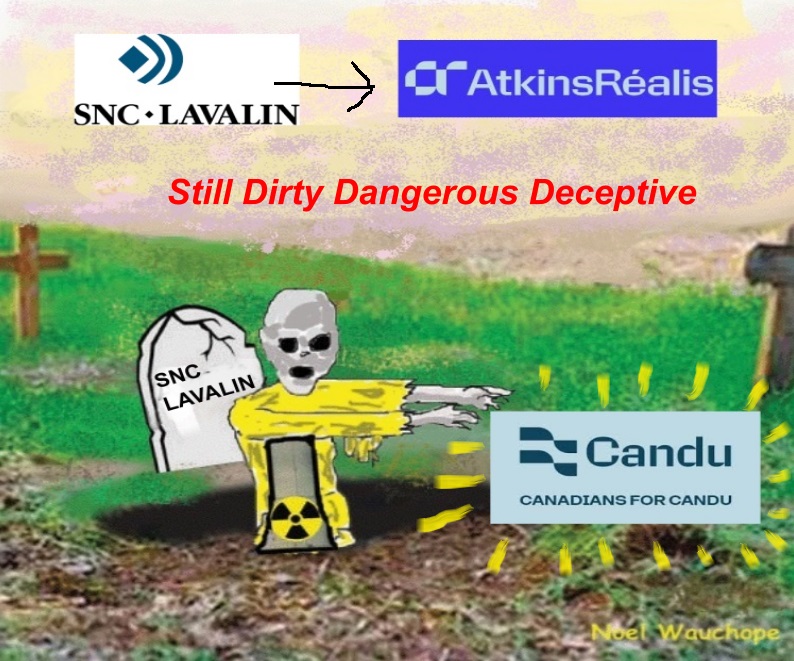
AtkinsRéalis eyeing U.S. market for nuclear technology push.

COMMENT -For nuclear industry trackers…
Re the last two paragraphs, you have to wonder, do they really believe this stuff or are they shameless grifters?
Nicolas Van Praet, July 28, 2025, https://www.theglobeandmail.com/business/article-atkinsrealis-eyeing-us-market-for-nuclear-technology-push/

AtkinsRéalis Group Inc. is moving to deploy its nuclear-reactor technology into the United States, a surprise push one analyst said could bolster the company’s revenue and exposure to American investors if it manages to clinch deals against growing competition.
The Canadian engineering company has “begun to explore opportunities for alternative large nuclear reactor technologies, notably Candu reactors, in the U.S.,” Joe St. Julian, president of the nuclear operations at AtkinsRéalis, said in an e-mailed statement Monday. Talks have started with U.S. regulatory agencies, including the Nuclear Regulatory Commission and the National Nuclear Security Administration, to assess licensing and other potential concerns, the company said.
The Financial Times was first to report on the corporation’s plans.
AtkinsRéalis chief executive Ian Edwards has reshaped the engineering company, previously known as SNC-Lavalin, by selling oil and gas assets and pivoting toward a simplified business model centred on engineering services and consulting work. Pushing its nuclear business hard is a big part of the new strategy.
AtkinsRéalis joins several nuclear energy multinationals weighing moves into the U.S., attracted by President Donald Trump’s aim to quadruple America’s atomic energy capacity over the next 25 years to meet rising demand for electricity. The President signed executive orders in May directing the Department of Energy to expedite construction of 10 large reactors by 2030, heralding what the White House science policy director called an “American nuclear renaissance.”
AtkinsRéalis holds an exclusive licence for Canada’s Candu reactor, which uses a heavy water technology to process natural uranium as fuel. It is marketing the 740-megawatt Enhanced Candu 6 along with a proposed 1,000-megawatt model called the Monark.
Executives with the Montreal-based company acknowledge that countries typically favour their own sovereign nuclear technology, which would give Pennsylvania-based reactor builder Westinghouse home-field advantage in any new contracts (Westinghouse is Canadian-owned). But they’re betting Westinghouse won’t be able to build 10 reactors at the same time, leaving room for Candu.
“We are positively surprised by this development,” Desjardins Securities analyst Benoît Poirier said in a note. He had believed a U.S. contract was not possible for AtkinsRéalis given past failed attempts to bring Candu reactors stateside as well as “the current protectionist geopolitical climate” in Canada and the U.S.
On top of that, the competitive landscape is more intense in the U.S., the analyst said, with international players such as Kepco (Korea Electric Power Corp.), legacy firms such as Westinghouse, and small modular reactor disruptors such as GE Vernova Hitachi Nuclear Energy, NANO Nuclear Energy Inc., NuScale Power Corp., Oklo Inc., TerraPower, X-Energy Inc. and newcleo all vying for a piece of the pie.
“If AtkinsRéalis does secure a new-build reactor south of the border, it would not only represent incremental growth but also boost visibility with U.S. investors,” Mr. Poirier said. Despite the company’s share price run-up over the past two years, the stock remains significantly “under-owned” outside Canada, with U.S. ownership at just 8 per cent of the total, he said.
By comparison, Canadian companies such as Canadian Pacific Kansas City Ltd.
CP-T -1.07%decrease
and TFI International Inc.
TFII-T -3.15%decrease
have U.S. ownership levels above 30 per cent. Plane maker Bombardier Inc.
BBD-B-T -0.02%decrease
has grown its U.S. investor base to nearly 20 per cent in recent years from about 5 per cent as it recentred the business to focus on luxury jet sales, defence, and service and maintenance.
AtkinsRéalis said the U.S. is one of its core markets for engineering services and that it has taken the current trade negotiations between Canada and the U.S. into account in its strategic evaluations for ramping up its nuclear offering there. It said it intends to use its new technology centre in Richland, Wash., to further develop and apply “innovative nuclear and environmental cleanup technologies.”
Nuclear accounted for 12 per cent of revenues at AtkinsRéalis last year. The business is growing rapidly, however, and now employs about 4,000 people, up from 3,000 in 2022. Much of its recent hiring is in preparation for anticipated new reactor sales in Canada and abroad.
Last fall, the company won a joint contract to build two nuclear reactors in Romania, the first Candu reactors to be built in the world since 2007. The Canadian government will loan $3-billion to Romania’s nuclear power operator to finance the deal – funds that will be directed exclusively to Canadian providers of goods and services working on the project.
Executives with the engineering firm estimate that countries will need 1,000 new nuclear reactors by 2050. Assuming the company’s Candu solution nabs 5 per cent of that business (there are six large-scale reactor technologies globally, including Candu), they peg the market potential at $750-billion.
Meet Charles Emond, the Canadian backing Sizewell C with £1.7bn

The chief executive of La Caisse, the second biggest infrastructure investor in
the world, is a fan of the UK and wants to put another £6bn into British
assets. “There’s always risk in a transaction,” says Charles Emond.
The chief executive of La Caisse is keen to stress that he and the other
equity investors named last week in the financing of the Sizewell C nuclear
power station project are not getting a completely free ride from British
taxpayers and electricity billpayers.
Billpayers will have £1 a month
added to their electricity bills from this autumn to help finance the
gigantic project. UK taxpayers will stand ready to foot the bill if the
construction costs rise above a certain point. But the equity investors
putting in £8.5 billion aren’t entirely free of exposure if things go
wrong, he says.
Times 27th July 2025, https://www.thetimes.com/business-money/energy/article/meet-charles-emond-the-canadian-backing-sizewell-c-with-17bn-t9hdhkspn
When Israelis Call It Out: Finding Genocide in Gaza
29 July 2025 Dr Binoy Kampmark, https://theaimn.net/when-israelis-call-it-out-finding-genocide-in-gaza/
It’s been almost an article of faith among Israeli officials: the state they represent is incapable of genocide, their actions always spurred by the noblest, necessary motivations of self-defence against satanic enemies who wish genocide upon Jews. Over time, as Holocaust scholar Omer Bartov writes, “Ethical concerns and moral qualms were brushed aside as either marginal or distracting in the face of the ultimate cataclysm that is the genocide of the Jews.”
This form of reasoning, known otherwise as “Holocaust-ism” or “Shoah-tiyut”, is a moral conceit left bare in the war of annihilation being waged in Gaza against the Palestinian populace. Israeli human rights groups have taken note of this, despite the drained reserves of empathy evident in the Israel proper. (A Pew Research Center poll conducted last month found that a mere 16% of Jewish Israelis thought peaceful coexistence with Palestinians was possible.)
In its latest report pointedly titled Our Genocide, the Israeli human rights organisation B’Tselem offers a blunt assessment: “Israel’s policy in the Gaza Strip and its horrific outcomes, together with statements by senior Israeli politicians and military commanders about the goals of the attack, leads us to the unequivocal conclusion that Israel is taking coordinated action to intentionally destroy Palestinian society in the Gaza Strip. In other words: Israel is committing genocide against Palestinians in the Gaza Strip.”
The infliction of genocide, the organisation acknowledges, is a matter of “multiple and parallel practices” applied over a period of time, with killing being merely one component. Living conditions can be destroyed, concentration camps and zones created, populations expelled and policies to systematically prevent reproduction enacted. “Accordingly, genocidal acts are various actions intended to bring about the destruction of a distinct group, as part of a deliberate, coordinated effort by a ruling authority.”
Our Genocide suggests that certain conditions often precede the sparking of a genocide. Israel’s relations with Palestinians had been characterised by “broader patterns of settler-colonialism”, with the intention of ensuring “Jewish supremacy over Palestinians – economically, politically, socially, and culturally.”
B’Tselem draws upon three crucial elements centred on ensuring “Jewish supremacy over Palestinians”: “life under an apartheid regime that imposes separation, demographic engineering, and ethnic cleansing; systemic and institutionalized use of violence against Palestinians, while the perpetrators enjoy impunity; and institutionalized mechanisms of dehumanization and framing Palestinians as an existential threat.” The attacks on Israel by Hamas and other militant groups on October 7, 2023 was a violent event that created a “sense of existential threat among the perpetrating group” enabling the “ruling system to carry out genocide.” As B’Tselem Executive Director Yuli Novak notes, this sense of threat was promoted by an “extremist, far-right messianic government” to pursue “an agenda of destruction and expulsion.”
Israeli policy in the Strip since October 2023 could not be rationalised as a focused, targeted attempt to destroy the rule of Hamas or its military efficacy. “Statements by senior Israeli decision-makers about the nature and assault in Gaza have expressed genocidal intent throughout.” Ditto Israeli military officers of all ranks. Gaza’s residents had been dehumanised, with many Jewish-Israelis believing “that their lives are of negligible value compared to Israel’s national goals, if not worthless altogether.”
The report also notes the use of certain terminology that haunts the literature of genocidal euphemism: the creation of “humanitarian zones” that would still be bombed despite supposedly providing protection for displaced civilians; the use of “kill zones” by the Israeli military and the absence of any standardised rules of engagement through the Strip, often “determined at the discretion of commanders on the ground or based on arbitrary criteria.”
Wishing to be comprehensive, the authors of the report do not ignore Israel’s actions in the West Bank and occupied East Jerusalem. Airstrikes regularly take place against refugee camps in the northern part of the territory since October 2023. Even more lethal open-fire policies have been used in the West Bank, with the use of kill zones suggesting “the broader ‘Gazafication’ of Israel’s methods of warfare.”
Another group, Physicians for Human Rights-Israel (PHRI), has also published a legal-medical appraisal on the intentional destruction of Gaza’s healthcare system, finding that the Israeli campaign in Gaza “constitutes genocide under the 1948 Genocide Convention.” The evidence examined by the group “shows a deliberate and systematic dismantling of Gaza’s healthcare system and other vital systems necessary for the population’s survival.” The evolving nature of the campaign suggested a “deliberate progression” from the initial bombing and forced evacuation of hospitals in the northern part of the Strip to calculated collapse of the healthcare system across the entire enclave. The dismantling of the health system involved rendering hospitals “non-functional”, the blocking of medical evaluations and the elimination of such vital services as trauma care, surgery, dialysis and maternal health.
Added to this has been the direct targeting of health care workers, involving the death and detention of over 1,800 members “including many senior specialists” and the deliberate restriction of humanitarian relief through militarised distribution points that pose lethal risks to aid recipients. “This coordinated assault has produced a cascading failure of health and humanitarian infrastructure, compounded by policies leading to starvation, disease and the breakdown of sanitation, housing, and education systems.”
PHRI contends that, at the very least, three core elements of Article II of the Genocide Convention are met: the killing of members of a group (identified by nationality, ethnicity, race or religion); causing serious bodily or mental harm to members of that group and deliberately inflicting on the group those conditions of life to bring about its destruction in whole or in part.
In accepting that genocide is being perpetrated against the Palestinians, Our Genocide makes that most pertinent of points: the dry legal analysis of genocide tends to be distanced from a historical perspective. “The legal definition is narrow, having been shaped in large part by the political interests of the states whose representatives drafted it.” The high threshold of identifying genocide, and the international jurisprudence on the subject, had produced a disturbing paradox: genocide tends to be recognised “only after a significant portion of the targeted group has already been destroyed and the group as such has suffered irreparable harm.” The thrust of these clarion calls from B’Tselem and PHRI is urgently clear: end this state of affairs before the Palestinians become yet another historical victim of such harm.
Trump Shows Strong Support for Israel as Palestinians in Gaza Starve to Death
Trump has been claiming that a ceasefire deal was close, but now he is appearing to suggest that Israel should escalate its genocidal war.
After the US and Israel quit ceasefire talks, Trump suggested it was time for Israel to ‘finish the job’
by Dave DeCamp | July 27, 2025, https://news.antiwar.com/2025/07/27/trump-shows-strong-support-for-israel-as-palestinians-in-gaza-starve-to-death/
President Trump has shown strong support for Israel in recent days, while much of the world has been outraged over the images of Palestinians who are starving to death due to the US-backed Israeli siege on Gaza.
After the US and Israel quit ceasefire talks, Trump blamed the lack of progress on Hamas and suggested it was time for Israel to “finish the job” in Gaza. “I think they want to die, and it’s very, very bad,” Trump said on Friday, referring to Hamas.
For its part, Hamas has said that it was surprised by the US and Israel quitting the truce talks and that it was committed to continuing the process until a deal was reached.
In recent weeks, Trump has been claiming that a ceasefire deal was close, but now he is appearing to suggest that Israel should escalate its genocidal war. “They’re gonna have to fight, and they’re gonna have to clean it up. You’re gonna have to get rid of [Hamas],” he said.
Israeli officials told Axios that they weren’t sure if Trump’s comments were a negotiating tactic or a “green light” for Israeli Prime Minister Benjamin Netanyahu to use even more extreme military measures. The report said the Trump administration was rethinking its Gaza strategy, but there’s no sign it’s considering putting pressure on Israel to reach a ceasefire.
Israeli officials also told Axios that Trump has applied virtually no pressure on Netanyahu to end the slaughter in Gaza in recent months. “In most calls and meetings, Trump told Bibi, ‘Do what you have to do in Gaza.’ In some cases, he even encouraged Netanyahu to go harder on Hamas,” one official said.
While meeting with European Commission President Ursula von der Leyen in Scotland on Sunday, Trump was asked about the images of starving children in Gaza. The president said people were “stealing the food,” a reference to Israel’s unfounded claims that Hamas has been stealing massive amounts of aid, then quickly pivoted to different topics.
In other comments, Trump said the issue of food shortages in Gaza was an “international problem,” not a “US problem.” But Israel is reliant on US military aid to sustain its military operations in Gaza, and Trump has the power to end the genocidal war by leveraging that support.
All energy costs rise but small nuclear most reactive.

Small modular nuclear reactors proved the most expensive technology of the eight options by a large margin, with the report basing its costs on Canada’s Darlington nuclear project, announced in May.
Small modular nuclear reactors proved the most expensive technology of the eight options by a large margin, with the report basing its costs on Canada’s Darlington nuclear project, announced in May.
By Jennifer Dudley-Nicholson, July 29 2025 , https://www.canberratimes.com.au/story/9027259/all-energy-costs-rise-but-small-nuclear-most-reactive/
Next-generation nuclear reactors are the most expensive of all energy-producing technologies, a report has found, and would significantly increase electricity prices in Australia.
Establishing a large-scale nuclear power plant for the first time would also require more than double the typical costs, and estimates for wind projects had inflated by four per cent due to unforeseen requirements.
The CSIRO, Australia’s national science agency, released its GenCost report on Tuesday, revealing rising construction and finance costs would push up prices for energy projects of all kinds in the coming years.
The findings come after a heated debate about introducing nuclear power to Australia and after members of the federal coalition questioned the nation’s reliance on renewable energy projects to achieve net zero by 2050.
The final GenCost report for 2024-2025 analysed the cost of several energy-generating technologies, including variations of coal, gas, nuclear, solar and wind projects.
Renewable technology continued to provide the cheapest energy generation, the report’s lead author and CSIRO chief energy economist Paul Graham said.
“We’re still finding that solar PV and wind with firming is the lowest-cost, new build low-emission technology,” he told AAP.
“In second place is gas with (carbon capture storage) … then large-scale nuclear, black coal with CCS, then the small modular reactors.”
Small modular nuclear reactors proved the most expensive technology of the eight options by a large margin, with the report basing its costs on Canada’s Darlington nuclear project, announced in May.
The 1200-megawatt development is estimated to cost $23.2 billion and will be the first commercial small modular reactor built in a Western country.
The new reactors produce one-third the power of typical nuclear reactors and can be built on sites not suitable for larger plants, but have only been built in China and Russia.
“This is a big deal for Canada – it’s their first nuclear build in 30 years,” Mr Graham said.
“It’s not just about meeting electricity demand … they’ve said a few things that indicate they’re trying to build a nuclear SMR industry and export the technology.”
In addition to the cost of different technologies, the report estimated “premiums” for establishing first-of-a-kind energy projects, with the first large-scale nuclear project expected to command 120 per cent more and the first offshore wind development expected to cost an extra 63 per cent.
The cost of wind projects also grew by four per cent as researchers factored in building work camps to accommodate remote employees, and capital financing costs rose by one per cent.
Developing energy projects was also expected to cost between six and 20 per cent more by 2050, the report found, due to the rising price of materials such as cement and wages, as detailed in a report by Oxford Economics Australia.
Findings from the CSIRO report would help inform the design of future energy infrastructure, Australian Energy Market Operator system design executive general manager Merryn York said.
“We’ll use the capital costs for generation and storage from GenCost in the upcoming Draft Integrated System Plan in December,” she said.
Nuclear technology is banned as an energy source in Australia, which has a target of achieving 82 per cent renewable energy in the national grid by 2030 and reaching net zero by 2050.
1 This Month




PLEASE OPPOSE HR 8255 AND S.3639 – bills would accelerate satellite deployment, with no environmental review or safeguards – https://ncstd5li.quorum.us/campaign/169331/
To see nuclear-related stories in greater depth and intensity – go to https://nuclearinformation.wordpress.com
-
Archives
- September 2026 (330)
- August 2026 (330)
- July 2026 (355)
- June 2026 (287)
- May 2026 (306)
- April 2026 (356)
- March 2026 (251)
- February 2026 (267)
- January 2026 (308)
- December 2025 (358)
- November 2025 (359)
- October 2025 (375)
-
Categories
- 1
- 1 NUCLEAR ISSUES
- business and costs
- climate change
- culture and arts
- ENERGY
- environment
- health
- history
- indigenous issues
- Legal
- marketing of nuclear
- media
- opposition to nuclear
- PERSONAL STORIES
- politics
- politics international
- Religion and ethics
- safety
- secrets,lies and civil liberties
- spinbuster
- technology
- Uranium
- wastes
- weapons and war
- Women
- 2 WORLD
- ACTION
- AFRICA
- Atrocities
- AUSTRALIA
- Christina's notes
- Christina's themes
- culture and arts
- Events
- Fuk 2022
- Fuk 2023
- Fukushima 2017
- Fukushima 2018
- fukushima 2019
- Fukushima 2020
- Fukushima 2021
- general
- global warming
- Humour (God we need it)
- Nuclear
- RARE EARTHS
- Reference
- resources – print
- Resources -audiovicual
- Weekly Newsletter
- World
- World Nuclear
- YouTube
-
RSS
Entries RSS
Comments RSS

