Moscow reveals potential timeline for trilateral Ukraine talks

Negotiations between Russian, Ukrainian, and US representatives could begin in October, Kremlin spokesman Dmitry Peskov has said
13 Sep, 2026, https://www.rt.com/russia/645646-moscow-reveals-potential-timeline-trilateral-ukraine-talks/
Trilateral talks between Russian, Ukrainian, and US representatives could begin in October, Kremlin spokesman Dmitry Peskov has said.
Speaking to reporters on Sunday, the official stated that Moscow “does not rule out such a possibility.”
“We’re specifically talking about the foreseeable future. That is, presumably of course, October,” Peskov clarified.
Earlier this week, the Kremlin spokesman stated that Moscow hopes “for a restart of negotiations between three parties – Russia, Ukraine, and America.”
The trilateral format was last used in Geneva in February, following two earlier rounds in Abu Dhabi. However, the talks later stalled without any significant breakthroughs, as the US shifted its focus to its war against Iran.
Peskov’s recent comments have followed a fresh round of shuttle diplomacy by US President Donald Trump’s special envoys Steve Witkoff and Jared Kushner, who held a meeting with Russian President Vladimir Putin in Moscow last week before visiting Kiev for talks with Vladimir Zelensky.
The Kremlin described the discussions with the US negotiators as constructive and “extremely candid,” while Witkoff said that progress had been made toward scheduling a three-way meeting. The potential resumption of talks in this format was also among the topics Putin and Trump discussed by phone on Tuesday, according to Kremlin aide Yury Ushakov.
At around the same time, Zelensky suggested that the next round of trilateral negotiations could take place in the UAE, Türkiye, Switzerland, or another country as early as September or October.
Moscow has repeatedly said it remains open to diplomacy, as long as the root causes of the conflict are addressed and the new realities on the ground are respected. Ukraine has in turn ruled out making territorial concessions to Russia.
The New German Militarism
what makes “The Tank” interesting and a sign of the times is not only that it invites its viewers to identify with German soldiers fighting against Soviets, certain to be read as Russians, and for Nazism, but that the film has coincided with the rise of a new German militarism.
This New Militarism is a phenomenon that goes beyond the fact of massive, debt-driven re-armament, disturbing as that may be: by the end of the decade, Berlin is planning to have a defense budget the size of those of France and Britain combined and be in self-asphyxiating debt for it. Half of the state budget will go to the military, while Germans are being shell-shocked by ever more austerity, already including a ruthless pension “reform,” that is, in reality, a demolition. A policy that will produce masses of Germans who are very deprived but also very well armed – what could go wrong?
The delusions come and go, German militarism abides
Tarik Cyril Amar, Sep 13, 2026, https://www.newglobalpolitics.org/the-new-german-militarism/
It is the summer of 1943. After catastrophic defeat in the Battle of Stalingrad, Nazi Germany’s legions are retreating before the Red Army. That’s the backdrop to the German – and Amazon–produced–movie “Der Tiger” (English title: “The Tank”). Officially billed as an antiwar movie, “The Tank” is anything but. Yet the fact that it is really about five tough men on a lonely commando mission is trivial.
For, just like “The Tank,” most so-called “antiwar” movies are, in reality, war movies, fascinating their Homo sapiens primate audiences with the action, suspense, and drama of fighting, while inviting identification with at least some of those who do that fighting, be they cast as heroes or anti-heroes. Consider, for instance, the American films “Platoon” and “Full Metal Jacket” (both set it Vietnam) or the Russian “9th Company” (set in Afghanistan). Indeed, it is hard to think of any genuine and consistent anti-war movies. Two that probably qualify are the American “Paths of Glory” (World War One on what the Germans called the Western Front) and the Soviet “Come and See” (World War Two on what the next generation of Germans called the Eastern Front).
“The Tank” certainly has heroes, and they form a classical “band of brothers,” Hollywood-style. There is the brave stoic (the commander) with ice in his veins but a humane, even self-sacrificing side reserved for his men, the intellectual and – mild – doubter (in civilian life a teacher of Latin with eternal-student glasses), the urban proletarian (the cursing driver, speaking not with a New York accent but in the demotic Berlin version of German), the man from the country (just not Kentucky or Alabama, but the Austrian Wachau and its vineyards), and, of course, the youngster, innocent, frightened, but, ultimately, up to a – German – man’s job (removing a booby-trapped tank mine).
At the end of the movie (spoiler alert), it is true, the fantastically implausible story of the men in the tank on their way to their own heart of darkness on the “Ostfront” has an unsurprising twist: “The Tank” is really a “Schauergeschichte,” a tale of sublime dread, a sort of “Erlkönig with Tanks” or “Sleepy Hollow and Nazis.” The crew’s militarily bizarre special mission is not, it turns out, real but a near-death experience or vision – think “Jacob’s Ladder” (1990) – confronting the commander with his responsibility for burning to death women and children in Stalingrad. The gray zone crossed by the “Tiger” to retrieve a mysterious and inexplicably important German officer holed up in a remote bunker – think Colonel Kurtz from “Apocalypse Now” (1979) – turns into the equivalent of either purgatory or the road to hell.
The horror, the horror: The audience has been watching, in essence, virtual ghosts mistaking themselves for the living – think “The Sixth Sense” (1999) and also the Russian “White Tiger” (2012), another spooky World War Two tank story that must have inspired “The Tank” but is, unsurprisingly, never mentioned.
But before (and despite) these revelations, the men in the tank are stereotypically attractive in a well-worn, macho way, baiting our sympathy. They also, of course, happen to serve Nazi Germany or, as they keep saying, the “Reich.” Indeed, the tank men are not merely members of the regular German military, the Wehrmacht, but the Waffen-SS, skull-and-crossbones emblems included.
Notwithstanding its especially striking form, this plot device is nothing special. In the 1980s, the extremely successful “Das Boot,” for instance, about a German World War Two submarine sinking merchant ships and their sailors while battling the British in the Atlantic, offered the same artless yet effective combination of identification with German soldiers and a plot that signaled some sanitizing distance from the regime they were actually fighting for: Yes, strictly speaking they are fascists burning and drowning literal antifascists, but you can still root for them. In “Das Boot,” as in “The Tank,” the effect is reinforced by everyone or almost everyone dying in the end, adding the pity that spectacles of futility among the brave may inspire.
Finding ways to feature German World War Two soldiers as heroes and victims while adroitly, or not so much, airbrushing their allegiance to a monstrous state waging often genocidal war has been a special skill of postwar (West) German film-making and succeeded with large audiences at home. Not so much Rainer-Maria Fassbinder, as it were, but the very popular kitsch of Peter May’s “08/15” trilogy, for instance.
Film-making in the former East Germany, incidentally, had its own, different, complicated as well as almost touchingly transparent ways of putting victims and even heroes into German World War Two uniforms, such as in the “Geheimkommando” miniseries.
Hence, what makes “The Tank” interesting and a sign of the times is not only that it invites its viewers to identify with German soldiers fighting against Soviets, certain to be read as Russians, and for Nazism, but that the film has coincided with the rise of a new German militarism.
This New Militarism is a phenomenon that goes beyond the fact of massive, debt-driven re-armament, disturbing as that may be: by the end of the decade, Berlin is planning to have a defense budget the size of those of France and Britain combined and be in self-asphyxiating debt for it. Half of the state budget will go to the military, while Germans are being shell-shocked by ever more austerity, already including a ruthless pension “reform,” that is, in reality, a demolition. A policy that will produce masses of Germans who are very deprived but also very well armed – what could go wrong?
Erdogan hints at larger nuclear partnership with Russia, unsettling Turkey’s allies
rfi, 12/09/2026
Turkish President Recep Tayyip Erdogan is signalling a move to expand nuclear power cooperation with Russia, just as his country’s first Russian-built nuclear station prepares to go live later this year. The deepening partnership is likely to unsettle Turkey’s western allies.
On the sidelines of a recent gathering of regional leaders in Kyrgyzstan, Erdogan told his Russian counterpart, Vladimir Putin, that Russia and Turkey “will take steps together to open some new power plants, along with the opening of the Akkuyu nuclear power plant”.
The Akkuyu nuclear power plant, built by Russia’s state nuclear company Rosatom on Turkey’s Mediterranean coast, is due to go online later this year.
Erdogan’s announcement comes amid strained ties with Russia, as the Turkish leader has deepened relations with United States President Donald Trump.
Ozgur Unluhisarcikli, head of the Ankara office of US think tank the German Marshall Fund, describes Erdogan’s move as a “gesture” to Putin.
“Although Turkey is competing with Russia geopolitically, and although Turkey is firmly anchored in NATO and is improving its relationship with the United States, it does not intend to sever all ties with Russia,” Unluhisarcikli explained.
“Indeed, Turkey sees the Turkey-Russia relationship as a long-term strategic one. And this is, by the way, consistent with Turkey’s balancing act.”………………………………………………………………………………… https://www.rfi.fr/en/podcasts/international-report/20260912-erdogan-hints-at-larger-nuclear-partnership-with-russia-unsettling-turkey-s-allies
Drone Attacks On Chornobyl Could Have Endangered The Safety Of Millions: UN
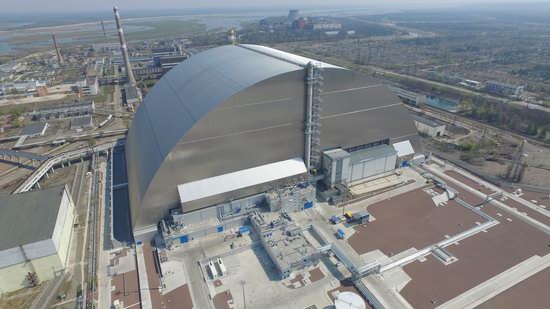
By Joji Xavier : 9/11/2026, https://www.rttnews.com/3690349/drone-attacks-on-chornobyl-could-have-endangered-the-safety-of-millions-un.aspx
A top UN official has expressed concern that a drone strike on the protective structure at Ukraine’s Chornobyl Nuclear Power Plant could have endangered the safety of millions of people.
UN Development Program Administrator Alexander De Croo is visiting Ukraine, with his mission focused primarily on restoring energy infrastructure and preparing the country for its fifth winter of full-scale war.
De Croo was talking to the media after visiting the Chornobyl Nuclear Power Plant and going inside the protective structure over Reactor Four, which was destroyed in 1986. He saw firsthand the damage caused recently by the drone strike.
“Anyone who’s attacking those protective structures – and those protective structures around a nuclear structure – is really gambling with the safety of millions of people.
“A nuclear installation can never be a target. There can absolutely be no excuse. There can absolutely be no ambiguity. This has to stop,” the UNDP chief said.
According to De Croo, the origin of the drone must be formally established through an investigation. At the same time, military personnel guarding the site told him that Russian drones fly over the facility on a daily basis.
“Whether it was a deliberate attack or an accident, this is something which is unacceptable. Making sure that drones are not flying above that site is one way of avoiding that things like this could happen,” he said.
During his visit to Chornobyl, the head of UNDP also took part in the opening of a new solar power plant. The project was implemented with support from Lithuania and Japan, in cooperation with the Ukrainian authorities and with technical expertise from the UN’s development agency. The plant will supply electricity to the cooling systems of Reactor Four.
Energy was one of the main focuses of De Croo’s visit. Over the past four years, UNDP has mobilised $1.3 billion to assist Ukrainians, with the restoration of the country’s energy system becoming its largest area of work.
Pack your suitcases’: Israel’s far right unveils its blueprint for emptying Gaza

Ben-Gvir’s party is demanding a new ministry dedicated to “voluntary migration.” Those living amid the rubble say they will not leave.
8 Sep, 2026 , By Elizabeth Blade, RT Middle East correspondent, https://www.rt.com/news/645274-pack-your-suitcases-israels-gaza/
Israel’s far-right national security minister has put a seven-year timetable on emptying Gaza of most of its people, and dressed it up as choice. Gazans RT spoke to call it what international law already names it: forced displacement.
Last week, Jewish Power chairman and National Security Minister Itamar Ben-Gvir unveiled ‘Disengagement 710’, a policy blueprint for what he calls the voluntary migration of Gaza residents to countries willing to take them. Destinations floated by his party include Türkiye, unspecified Arab states, Ethiopia, and Congo.
The numbers are not modest. The plan foresees the departure of about 250,000 people in the first year, 1.11 million within three years, and some 1.86 million within seven, encompassing the bulk of the Strip’s population.
To run it, Jewish Power wants the next government to create a dedicated ministry for “voluntary migration,” complete with a minister, a director-general, its own budget, an international negotiating team, and an implementation apparatus.
Ben-Gvir vows to make the ministry a coalition demand after Israel’s October 27 election. “Instead of illusions of peace now, we need actions of emigration now,” he said. “Instead of them digging tunnels, it’s time to pack suitcases.”
This idea is not new for the Jewish state.
A Zionist through-line
In 1937, David Ben-Gurion, then a leading Zionist figure, promoted the transfer of Palestinians and argued they should be moved to Transjordan. In the 1980s, the same ‘voluntary’ formula was championed by far-right politicians Rehavam Ze’evi – nicknamed ‘Gandhi’– and Meir Kahane. Their schemes never left the drawing board.
Ben-Gvir now presents his version as newly realistic, citing earlier public backing from US President Donald Trump. Trump floated mass relocation from Gaza in early 2025, then walked the idea back under Arab and international pressure.
His later 20-point framework stated that no one would be forced to leave and that residents should be encouraged to stay. Ben-Gvir treats the first Trump remark as political cover and the second as an inconvenience.
Gazans RT interviewed rejected the initiative as illegal under international law and a crime against humanity.
”People in Gaza and across Palestine know Ben-Gvir’s plans go far beyond our existence in the Strip,” said Abdallah Ali, a resident of central Gaza.
Ali said that is why Gazans, himself included, intend to stay put.
Rami Al Meghari, from Al-Maghazi camp in central Gaza, reached the same conclusion for a different reason: memory of exile.
“Many Palestinians found life in other countries, especially Arab states, awkward and humiliating,” he said. “They will not leave Gaza for a destination that cannot guarantee dignity, whether an Arab capital or some African country Israel has long suggested, like Somalia.”
Polls, rubble, and the meaning of ‘voluntary’
A PCPSR poll last year found 56% of Gazans interviewed unwilling to emigrate. A substantial minority, some 43%, said they would.
Ali and Al Meghari were not surprised. Despair is real, and the findings of various UN reports show it clearly.
As of June 16, 2026, satellite analysis by the UN Satellite Centre found 201,290 structures damaged, an estimated 82% of all buildings in Gaza. Of those, 134,422 were assessed as destroyed, 13,848 severely damaged, 28,096 moderately damaged and 24,924 possibly damaged.
Most of Gaza’s 2.1 million people remain displaced. The Shelter Cluster, surveying in June 2026, said 1.98 million people, 94% of the population, need shelter and household items.
Food and water continue to be an issue. Between mid-April and June 30, 2026, more than 1.2 million people (59%) were still in dire need of assistance.
Assessments in 2026 found 43% of households below the 15-liter humanitarian minimum per person per day, and 62% below the 6-liter drinking-water floor.
But Ali and Al Meghari insist the pull of the land is much stronger.
“Whatever the suffering, even with around 97 percent of cropland destroyed and most of the built environment gone, people are putting up tents and staying in displacement camps. They are not packing to leave,” Ali said.
Al Meghari still hopes the political weather will change. “Life can move forward in Gaza if there is serious international and Arab pressure to implement the second phase of the ceasefire. The United States has a particular responsibility to make that happen. Russia also needs to play a pivotal role to bring the suffering of the Palestinians to an end.”
Reconstruction as leverage
There is little movement on reconstruction. Israel is blocking construction materials, demanding that Hamas disarm and demilitarize first. The Board of Peace has pushed for weapons to be collected and placed under international supervision, a formula Israel rejects.
Ali sees the stalled effort as a policy, not an accident. “This is taking a very long time. I do not think Israel will accept Gaza’s reconstruction anytime soon. It will keep complicating reality until leaving becomes the only realistic option.”
Ahmed Al-Masri, a lawyer in Gaza, argues Israel has played this hand before and lost. “We lived this in 2014 [Operation Protective Edge – ed.]. Israel said Gaza should not be rebuilt. Then, under international pressure and with UN supervision, it was forced to comply.”
And he also pins some hope on Israel’s October 27 parliamentary vote. “If the far-right government is removed, there might be a beginning, a glimmer on the horizon, and a better political reality for people here, if Palestinians also insist on rebuilding political, social and economic life.”
That is the wager Gaza is making: that endurance outlasts a plan that needs other countries to open their doors, Washington to revive an idea it already shelved, and two million people to accept that ‘voluntary’ means leaving home because the alternative has been made unlivable.
Ben-Gvir is betting the opposite – that the wreckage, a ministry, and a slogan about suitcases can finish what earlier transfer schemes could not. Gazans say they have heard that speech before.
CIA ‘Proxy’: Unravelling Saudi Arabia’s True 9/11 Role
Kit Klarenberg Substack September 12, 2026, https://scheerpost.com/2026/09/12/cia-proxy-unravelling-saudi-arabias-true-9-11-role/
In the leadup to 9/11’s silver anniversary, it was widely reported a forthcoming New York District Court civil case brought against notorious Saudi government operative Omar Bayoumi would deliver “smoking gun” proof tying Riyadh directly to the attacks. Compelling evidence Saudi Arabian intelligence not only managed several hijackers as agents, but did so as a “proxy” for the CIA, has lain unexamined in plain sight for years. Yet, the Agency’s sinister shadowplay remains eerily absent from media consideration, despite mounting recognition of Riyadh’s role.
Bayoumi has long-been accused by major news outlets and US officials of maintaining an intimate and suspicious relationship with hijackers Nawaf Hazmi and Khalid Mihdhar, immediately upon their arrival to the US in January 2000. A subsequent FBI investigation, dubbed Operation Encore, ruled there was a “50/50 chance” Bayoumi – and the House of Saud by extension – had detailed advance knowledge of the 9/11 attacks. This explosive finding was not publicly divulged until March 2022.
However, the media remained steadfastly silent a year later when a bombshell filing from the Office of Military Commissions – the legal body overseeing prosecutions of 9/11 defendants – was released. The document summarises classified government discovery disclosures, and private interviews conducted with anonymous high-ranking US intelligence officials. Its contents shed unprecedented light on how the CIA recruited at least Hazmi and Mihdhar if not others who participated in the 9/11 attacks, “via a liaison relationship” with Riyadh’s General Intelligence Directorate (GID).
The same document elucidates how the 9/11 Commission was deliberately sabotaged by its chief Philip Zelikow, who personally endeavoured “to blunt” inquiries “into Saudi involvement with the hijackers.” Concurrently, senior FBI officials tasked with investigating the attacks were prohibited from interviewing Saudi nationals, despite “many” leads pointing directly to Riyadh’s Washington DC embassy. No wonder – probing those connections would’ve amply revealed how the GID was acting as a “cutout” for the CIA, in all its clandestine dealings with the 9/11 hijackers.
High-ranking FBI officials quoted in the filing discuss how the GID was a longstanding CIA “proxy”, exploited by the Agency whenever it was “unwise or not practical…to undertake an operation directly.” This need was particularly pronounced in the context of cloak-and-dagger CIA connivances conducted “on US soil.” After 25 years, it appears Riyadh could finally take the fall for a dastardly CIA operation that one way or another resulted in 9/11. As planned, there is little chance of the Agency itself landing in the dock.
‘CIA Team’
Among the court filing’smost dynamite excerpts is the insider testimony of an FBI special agent, who was posted to Alec Station – the CIA’s Al Qaeda tracking unit, ultimately responsible for recruiting Hazmi and Mihdhar as assets. When in January 2000 the special agent learned the pair – known Al Qaeda operatives under intensive CIA and NSA surveillance – had multi-entry visas to the US, they produced a report warning Bureau headquarters. Its dispatch was blocked by an unnamed CIA analyst.
The same analyst not only directed the GID to make contact with Hazmi and Mihdhar upon their arrival, but falsely claimed to subsequent US government inquiries into 9/11 they had personally informed the FBI about the pair’s presence in the US. The FBI special agent personally witnessed CIA director George Tenet and Agency operations director James Pavitt bragging about how they “conspired to obstruct the 9/11 Commission,” by concealing the analyst’s activities and identity from investigators.
In the process, an extraordinary, hitherto unreported component of Riyadh’s relationship with the hijackers remained determinedly unexplored. The FBI special agent alleged Hazmi and Mihdhar were explicitly provided US visas by the American consulate in Jeddah, “to facilitate the operation run by the Saudis’ GID and the CIA team.” This disclosure is all the more tantalising given 14 of the 19 hijackers all received their visas from the same consulate. In many cases, the paperwork shouldn’t have been granted at all.
Adding to the mystery, 12 of the 14 visas were approved by a single consular official, named Shayna Steinger. Almost immediately after being appointed to the Jeddah consulate in July 2000 with zero diplomatic background, she began rubberstamping applications of future 9/11 hijackers. At the time, the consulate’s approach to issuing visas was strict, specifically due to local “terrorism” concerns. Internal guidelines stated applicants – particularly young male Saudis – should always be interviewed in person, and have clear grounds for travel.
However, Steinger personally took it upon herself to reverse this policy. Moreover, she issued visas to future 9/11 hijackers despite their applications frequently being incomplete or error-strewn, based on forged documents, and their contents giving ample grounds for suspicion. Steinger nonetheless interviewed Hani Hanjour, who purportedly piloted Flight 77, which struck the Pentagon. Afterwards, she rejected his application for a three-year US visa, due to apparent doubts over his stated purposes in the country. Nonetheless, Steinger approved Hanjour’s renewed application two weeks later.
In ensuing official investigations, she offered wildly contradictory accounts of why the hijackers’ visas were granted. In Hanjour’s case, Steinger initially claimed he provided requested supporting documentation. She subsequently admitted he actually hadn’t, but Hanjour’s “middle class” background purportedly led her to conclude he was trustworthy. Thanks to the court filing, we know in reality future 9/11 hijackers were granted entry to the US so they could be recruited by the CIA upon arrival, suggesting Steinger was acting on Agency orders.
‘Local Dissidents’
Once Hazmi and Mihdhar touched down in Los Angeles in January 2000, almost immediately they crossed paths with Omar Bayoumi at an airport restaurant. FBI reports cited in the court filing indicate a witness who observed their meeting saw Bayoumi “dropping a piece of paper” near the pair’s table, “then striking up a conversation with them” in a manner that appeared “unnatural.” The witness relayed this account to the Bureau in 2002, but it was never publicised.
In interviews with Operation Encore investigators years later, Bayoumi maintained his meeting with Hazmi and Mihdhar was pure happenstance. The extraordinary assistance he gave them immediately thereafter – including finding them an apartment, cosigning their lease, setting them up bank accounts, and gifting them substantial sums towards their rent – was simply charity for fellow Muslims who could barely speak English and were unfamiliar with Western culture, Bayoumi asserted. But the filing offers numerous striking insights into the dark reality of his contact with the future hijackers.
For example, it appears Bayoumi was secretly instructed to recruit Hazmi and Mihdhar at the Saudi Consulate in Los Angeles, by extremist cleric and Saudi Ministry of Islamic Affairs official Fahad Thumairy. The filing cites evidence indicating Bayoumi was himself in California “to spy on local dissidents” of Saudi extraction. He was seen with the two 9/11 hijackers “on numerous occasions,” at one stage organising “a social gathering for the hijackers.” We can only guess who may also have been in attendance.
Another stunning exposure in the filing concerns Hazmi and Mihdhar lodging with longtime FBI informant and asset Abdussattar Shaikh from September 2000 onwards. That Shaikh failed to provide their surnames to his handler despite being asked has been known for many years. The joint congressional and senate intelligence committee probe into 9/11 ruled the pair’s stay with Shaikh was “the [US] intelligence community’s best chance to unravel the September 11 plot.” Insulating Hazmi and Midhar from Bureau scrutiny may have been his explicit objective.
The filing indicates he himself “was receiving funds” from Riyadh, while simultaneously serving as an FBI informant. “Prominent” Saudis “would stay at Shaikh’s boarding house while visiting California,” it states. His mission was “to monitor the activities of [Saudi] citizens while they were abroad.” Hani Hanjour also stayed with Shaikh alongside Hazmi, after Mihdhar returned to Saudi Arabia in late 2000. It appears at every stage Stateside, the hijackers were in intimate proximity with figures connected to Saudi intelligence.
Given the GID was acting directly on the CIA’s behalf, this contact raises the obvious prospect the Agency – via its Riyadh “proxy” – was directly monitoring the movements of Hazmi, Midhar, and Hanjour if not other Saudi-born hijackers from the moment they entered the US at the Agency’s direction, until 9/11 itself. The extent to which the CIA could’ve influenced their actions, behaviour and movements throughout is unknown, but the scope was self-evidently massive.
Saudi Involvement’
All along, Alec Station deliberately concealed the presence of Hazmi and Mihdhar in the US from the FBI, until it was too late. The filing records how in June 2001 Station representatives showed senior Bureau officials photographs of three Al Qaeda operatives, including Hazmi and Mihdhar. However, the CIA refused to answer questions about the individuals in the photos, or provide identifying information. Had they done so, the FBI could’ve readily found Hazmi and Mihdhar’s names and addresses listed in San Diego’s local phone directory.
This was a flagrant dangle, obviously intended to gauge the Bureau’s cognisance of the identities of the individuals pictured, and their presence in the US. The filing also indicates the FBI conducted a dedicated counterintelligence investigation into Omar Bayoumi prior to 9/11, due to suspicions “he was operating as an intelligence officer.” Yet, when the Bureau contacted the CIA for information on Bayoumi, they were told the Agency “held no files” on him at all – a “falsehood”.
In reality, the CIA maintained plentiful “operational” records on Bayoumi, which were “never passed to the FBI.” Such brazen stonewalling persisted long after 9/11. Upon learning tens of thousands of dollars had been sent from Haifa bin Faisal, wife of Saudi ambassador to the US Bandar bin Sultan, to Bayoumi’s wife, the Bureau attempted to subpoena their financial records from Washington DC’s Riggs Bank. Per the filing, “officials at Riggs thwarted the FBI’s efforts to obtain the records for a year.”
Riggs Bank – which counted US Presidents and CIA-installed Chilean dictator Augusto Pinochet as clients – collapsed amid major money laundering scandals, in 2005. Post-9/11 investigations identified financial improprieties in accounts held by several wealthy Saudis – including a lack of required background checks, and consistent failure to alert regulators over large transactions violating federal banking laws. Riggs’ downfall precisely mirrors the unceremonious end of many confirmed CIA front banks past, such as Bank of Credit and Commerce International, which assisted criminal cloak-and-dagger connivances including Iran/Contra.
Perhaps unsurprisingly, the filing records how “diplomatic pressure” was exerted on the FBI not to investigate Riyad’s myriad connections to 9/11. Bureau agents testifying to the joint inquiry into the attacks were moreover “instructed not to reveal the full extent of Saudi involvement with Al-Qaeda.” Senior officials at FBI headquarters knew “of both Bayoumi’s affiliation with Saudi intelligence and…the existence of the CIA’s operation to recruit Hazmi and Mihdhar,” but “suppressed investigations” into these burning matters.
The filing concludes by noting Bayoumi was subsequently arrested in Britain on immigration charges immediately after 9/11, with authorities finding “extremist literature in his apartment.” The significance of this disclosure has gone entirely unnoticed, since 2022. Only now, as a result of the New York court case, has the media acknowledged how within days of the attacks, “game-changing” evidence directly implicating Bayoumi in 9/11 was seized from his British home by counter-terror police, then shared with the FBI, which actively buried the information.
Quite unbelievably, the incriminating haul supposedly included a phonebook listing over two dozen Saudi government officials in the US and Saudi Arabia; flight simulator software; tickets and travel documents; and a notepad featuring a sketch of an aircraft. An accompanying note from a British counter-terror officer stated of the latter: “contains handwritten notes mathematical calculations re height of planes.” A member of the 9/11 families’ legal team behind the court action boldly informed the BBC, “it’s the mathematical calculation of the [Pentagon] crash.”
By September 22nd 2001, this seemingly incontrovertible windfall was in the Bureau’s possession. So too highly illuminating home video tapes of Bayoumi roaming around Washington DC in 1999, highlighting security measures in place at the Capitol building, openly discussing nearby Reagan National Airport, and referencing an unspecified “plan” on camera. Other tapes feature Bayoumi in close quarters with senior Al Qaeda figures such as Anwar Awlaki, assassinated in a September 2011 US drone strike.
While British detectives apparently believed they possessed “more than sufficient evidence” to extradite Bayoumi to stand trial, Washington ordered him freed, and he returned to Saudi Arabia. US authorities’ resistance is understandable, given the overwhelming abundance of evidence pointing ineluctably to the CIA at the very least actively facilitating the 9/11 attacks, if not carrying them out, using the Saudis as scapegoats. Media determination to avoid mentioning how Bayoumi et al provably acted as “proxies” for the CIA shows the coverup continues today.
Britain stands against oppression in Palestine… by supplying F-35s
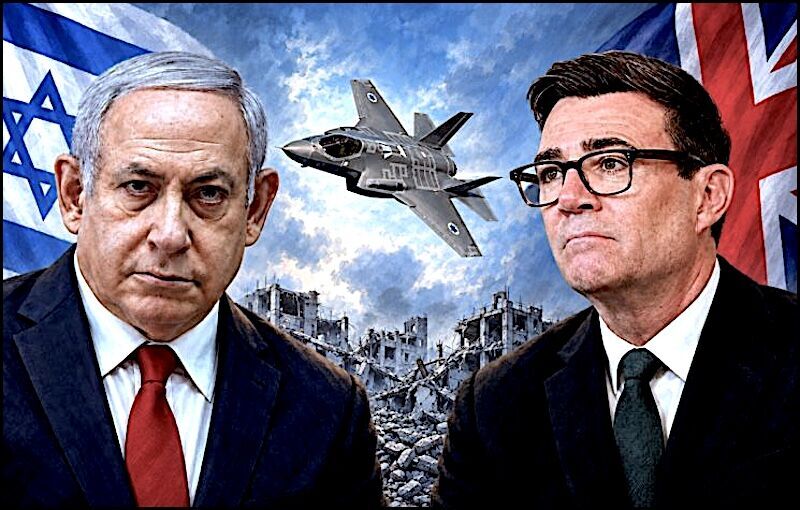
Finian Cunningham, September 11, 2026, https://strategic-culture.su/news/2026/09/11/britain-stands-against-oppression-in-palestine-by-supplying-f-35s/
Britain is fuelling the genocide by Israel, as it is with the NATO proxy war in Ukraine against Russia.
So, Britain announced with much fanfare this week that it was imposing sanctions on Israel’s illegal settlements in Palestine. Note that the sanctions are not against the Israeli state, but rather a much narrower definition: Israeli entities in the Occupied Territories.
British Prime Minister Andy Burnham claimed that the move was an example of Britain giving international leadership to stand against oppression and injustice.
Addressing the British Parliament, Burnham said: “In this difficult and dangerous world, Britain has to stand for something, Britain has to show leadership, Britain has to stand for fairness against injustice… That is what the British people expect of us, and that is what this government will do.”
Several other European states and Canada have also joined the British-led initiative to ban trade and investment with companies doing business in the Occupied Territories of the West Bank.
Israel’s occupation is illegal under international law, yet Britain, the European Union and the United States have done nothing in the way of imposing sanctions. Sanctions are something the West prefers to impose on Russia, Iran, China, Cuba, North Korea, among others.
In announcing the sanctions, the United Kingdom’s foreign minister Ed Miliband told the House of Commons that “Britain was a country that upholds its values at home and around the world, fighting against oppression and suffering, and standing up for what is right.”
The pious tones from London about Israel’s “ethnic cleansing” are not convincing.
For starters, the supposed sanctions do not cover British components for the F-35 fighter jets that the United States sells to Israel. The British parts are crucial for flying the US-made stealth aircraft. The warplane has played a major role in razing Gaza to the ground. Also not included in the sanctions are drones and surveillance equipment that British firms supply to the Israeli military. All those components are crucial for enabling the nearly three-year genocidal violence that Israel has conducted in Gaza.
If the British government were serious about “standing against oppression,” it would go a lot further than focusing on violations by Israeli settlers in the Occupied Territories. The pogroms and construction of new settlements are carried out with the full assistance of the Israeli state, not just by gun-wielding fanatical settlers. Britain and other Western states have provided the legal and diplomatic cover for Israeli war crimes.
In any case, the supposed measures against Israeli business and exports from the West Bank are minimal. A recent Al Jazeera investigation found that Britain has billions of dollars invested in companies that are intimately involved in illegal settlement building. We can be sure that London is not going to cancel investments.
Total British-Israeli trade is estimated at $8 billion a year, including lucrative military items. The amount of business that Britain does with the Occupied Territories is about 1 per cent of its total trade with Israel.
Burnham and Miliband said the British government did not support boycott and divestment sanctions against the state of Israel. Both of them were at pains to emphasize that the measures are nominally limited to the violations going on in the Occupied Territories, not what Israel is doing right across Palestinian land, including Gaza, which is a genocide.
So there you have it. Britain’s “moral leadership” is nothing but tokenism and duplicity.
Should we expect anything else? After all, as former British diplomat Craig Murray pointed out this week, Burnham’s government has decided to give top-secret information for building cruise missiles to the corrupt Kiev regime. Murray warns that the Storm Shadow missiles will soon end up being sold on the black market, given the rampant corruption of Ukraine under the Zelensky cabal.
Britain is also supplying this NeoNazi regime with long-range drones that are being used to target Moscow and Russian civilians.
Is this standing up against oppression and for supposed British values?
What’s really behind London’s belated show of concern for Palestinians?
As Burnham and Miliband alluded, it’s all about Britain appearing to show international leadership. It’s a cheap way to burnish London’s “moral posturing” as a defender of “humanitarian values.”
Israel has hit back with the usual denunciations of “anti-semitism” and by closing down the British consulate in East Jerusalem. But for London, these repercussions are bearable for the bigger gains of British international PR.
As noted above, the lion’s share of its lucrative trade with Israel will go on, business as usual.
The other key motive for the Burnham government is that it realizes that a majority of the British public has become staunchly opposed to the Israeli regime. The three-year genocide has opened the eyes of many Britons (and those of other Western nations) to the historical injustices and illegal occupation of Palestinian lands. Israel is increasingly seen as a pariah, apartheid state that should be prosecuted for war crimes.
Britain’s role as the former colonial power in the Zionist annexation of Palestine is one of deep complicity and shame.
Andy Burnham was shoehorned into Downing Street to take over from the hopeless and hapless Labour leader Keir Starmer. The British establishment has bet on Burnham to shore up its imperialist interests by boosting military spending and deepening involvement in the NATO proxy war against Russia in Ukraine.
However, Burnham’s popularity has quickly worn off as he looks like Starmer 2.0.
The tokenistic moves to support Palestinian rights and oppose Israeli violations are a cynical electioneering ploy. By talking up sanctions against Israeli illegal settlements, Burnham is calculating that it will garner votes from the growing public anger over the genocide.
But the measures that London is taking are negligible. They amount to a polite tap on the wrist of the Netanyahu regime as it continues its genocide.
Britain is fuelling the genocide by Israel, as it is with the NATO proxy war in Ukraine against Russia. British duplicity is as legion as its hypocrisy.
The case for declassifying 9/11 records

Government secrecy on intelligence related to the attacks impedes the justice process for some and allows conspiracy theories to fester.
MS Now By Lauren Harper, Sept. 10, 2026,
New York Mayor Zohran Mamdani recently ordered the release of more than 170,000 pages of city records about the air quality in Lower Manhattan after the 9/11 attacks. This release, the first in a series of planned disclosures, shows how opening decades-old records, including those that expose government wrongdoing, is in the public interest. Political will to expand such efforts elsewhere is crucial
Thousands of 9/11 survivors and victims’ families in Lower Manhattan have fought for more than two decades to hold foreign entities liable for the terrorist attacks — only to find that one of the biggest obstacles is their own government. While successive U.S. administrations have promised closure for victims, critical records remain classified 25 years after 9/11, delaying justice and accountability.
The executive order governing classification, EO 13526, mandates that most historical records must be automatically declassified at 25 years, unless they meet certain strict criteria.
In theory, this means the records of the defining national tragedy of this century should start becoming public on Dec. 31. In practice, the declassification system is so ineffective that millions of pages are all but certain to remain hidden in agency archives from Quantico to Langley for years, possibly even decades, whether or not they require continued protection.
This impedes justice on multiple fronts.
In the Southern District of New York, for example, thousands of people have been fighting since 2002 to hold a variety of defendants — from the Kingdom of Saudi Arabia to members of Al Qaeda — responsible for the attack. They have been impeded in part by the Justice Department, which has aggressively invoked the state-secrets privilege to block the release of records discussing, among other things, whether Saudi officials aided the hijackers when they arrived in the United States in 2000. While a Biden-era executive order forced the partial declassification of some records relevant to this case, many interagency communications and witness interviews remain heavily redacted or fully classified.
At Guantánamo Bay, enduring secrecy has complicated the prosecution of alleged 9/11 mastermind Khalid Sheikh Mohammed and several co-conspirators. The military commission has dragged on for nearly 25 years, costing taxpayers billions of dollars, in part because the government’s evidence was obtained from the CIA’s torture program. Although classification rules explicitly prohibit keeping records classified to conceal violations of law, including torture, the federal government has withheld records from the agency’s black-site prisons for years, ultimately prolonging proceedings. In doing so, the government prioritizes its need for secrecy over ensuring the commission’s tribunals proceed at a reasonable speed toward justice………………………………………………………………………………………………………………………….
Although the summary and the closed-door interviews have not reached the 25-year mark, having been compiled by the 9/11 Commission in 2003 and 2004, releasing them would help promote public understanding of the attacks and government intelligence. It could also help dismantle agency pretexts for withholding the older, underlying intelligence………………………………………………………………………………………………………………………… https://www.ms.now/opinion/9-11-victims-declassifying-records-intelligence-threats
Putin boosts his stock of nuclear warheads to nine-year high as he threatens West that putting troops into Ukraine ‘means war with Russia’.
Daily Mail, By WILL STEWART and WILL HALLOWELL, NEWS REPORTER, 12 September 2026
Vladimir Putin has boosted the number of nuclear warheads in his arsenal as he warns Nato countries that sending troops to Ukraine ‘means war’.
Over the past year, Russia has increased its stock of nuclear warheads deployed on missiles and bombers by 78 to 1,796, marking a nine-year high, according to the Stockholm International Peace Research Institute.
Mr Putin has increased the number every year since the beginning of the war with Ukraine in 2022.
But the US saw no rise and Britain and France did not deploy additional warheads, with 170 and 280 respectively.
Mr Putin, however, denied that Russia posed a threat to Nato allies in Europe and then warned of war.
Speaking at the BRICS summit in New Delhi, he said: ‘Now they [the West] are talking about how they are thinking about bringing troops to the territory of Ukraine. This means war with Russia.’
His threat coincides with former Russian president Dmitry Medvedev’s warning that Mr Putin could use nuclear weapons to turn Nato state Lithuania into ‘scorched earth’ and remove it from the ‘world map’.
Mr Putin, who once claimed he had no aggressive intentions against Ukraine, said he had no plan to invade or threaten existing Nato states in Europe.
He said: ‘There is no such threat, and there has never been. We are not threatening European countries, nor are we going to threaten them. Why would we?
‘No one seems to even consider that we have no grounds for any conflict with Europe.’
Yet Mr Medvedev, Mr Putin’s number two on the Russian Security Council, said the deployment of nuclear weapons in Lithuania, a former part of the Soviet Union, could trigger a doomsday response from the president.
He said: ‘They would like to amend their constitution, which stated the non-nuclear nature of this large Baltic state, and thus open the door to the possible deployment of any weapons, including nuclear weapons.
‘No one will stand up for them. Even if it becomes a scorched earth, no other [Western] countries will go to war for them.
‘And the well-known Article 5 of the North Atlantic Treaty will not be implemented, everyone recognises this……………………https://www.dailymail.com/news/article-16125435/Putin-boosts-nuclear-warheads-nine-year-high.html
Labour delays ordering new attack submarines
Government accused of ‘kicking the can’ after putting off decision on building subs to 2028
Telegraph Pieter Snepvangers Political Reporter. Tony Diver Political Editor, 2 September 2026
Labour has delayed ordering new attack submarines until 2028, The Telegraph
can reveal. Sir Keir Starmer pledged last year to build “up to 12”
nuclear-powered submarines. He said Labour would decide how many vessels to
commission by the time its defence investment plan (DIP) was published.
Despite finally releasing the delayed DIP in June, the Government has
deferred its deadline for committing to buying the subs until 2028, The
Telegraph has learnt. Wes Streeting, the Defence Secretary, wrote to James
Cartlidge, his Conservative shadow: “The DIP clearly sets out our
intention to buy up to 12 SSN-A submarines, but a decision on exact hull
numbers does not need to be taken at this stage. “The programme is
currently midway through its design phase and we anticipate that the number
of submarines will be confirmed before the end of this phase in 2028.”………………………………………………….
https://www.telegraph.co.uk/politics/2026/09/12/labour-delays-buying-new-attack-submarines/
Rolls-Royce boss bets big on new engines and small nuclear

he declared that Rolls-Royce was a “burning platform”.
The second big bet is on small modular reactors (SMRs),
analysts say the promised cost savings of SMRs have yet to be proven.
Having led an extraordinary turnaround since 2023, Tufan Erginbilgiç is staking the company’s continued growth on small modular reactors and a return to the single-aisle commercial jet market
Jeevan Vasagar, Observer 6th Sept 2026
he chief executive of Rolls-Royce was in typically forthright form at the Farnborough International Airshow in July. More than a decade after exiting the market for narrow-body aircraft, the British engineering company planned to return to making engines for the single-aisle planes that are the world’s bestselling commercial jets – but the CEO wanted government support to do so.
If it were not forthcoming, Tufan Erginbilgiç added, then Rolls-Royce had other options.
Erginbilgiç, a former BP executive, has led an extraordinary turnaround. At his first town hall meeting as chief executive, he declared that Rolls-Royce was a “burning platform”. The pandemic, which brought global air travel shuddering to a halt, could not be blamed for the engine-maker’s troubles, Erginbilgiç said, telling staff: “We underperform every key competitor out there.”
Rolls-Royce’s share price has soared from about 99p when Erginbilgiç took the helm in January 2023 to £14.67 this week, an increase similar to Nvidia’s surge in that time. “Rolls is a great business, and Tufan has played the City like a piano,” one aviation industry insider said.
The question is: can it last?
……………………………………………………………………………………………………………………………………………………………………………………………………………………………………Rolls-Royce’s defence business, making power and propulsion systems for combat aircraft and submarines, has benefited from the increase in defence spending. The power systems division, supplying diesel generators and gas engines, has thrived with the boom in data centre construction. But here too Rolls-Royce is not just surfing the rising market. Profit margins have gone up as well, analysts point out……………………………………………………………………………………………………………………
The second big bet is on small modular reactors (SMRs), a technology that’s meant to reduce the time and cost of delivering nuclear fission at a moment when the uncertainty of fossil fuel markets, soaring electricity demand and emissions goals are driving renewed interest in nuclear power.
Delivering emissions-free energy is a valuable sideline for a company that relies for most of its business on burning kerosene. But analysts say the promised cost savings of SMRs have yet to be proven.
If Erginbilgiç can pull off either of these moonshots, the post-pandemic surge in Rolls-Royce’s valuation might just be the beginning.
https://observer.co.uk/news/business/article/rolls-royce-boss-bets-big-on-new-engines-and-nuclear
The Dancing Israelis: Newly Released FBI Docs Shed Light on Apparent Mossad Foreknowledge of 9/11 Attacks
Signs of the Times, Whitney Webb, Mint Press News, Sun, 19 May 2019
Four of the Israeli nationals arrested for “puzzling behavior” during the September 11 attacks are seen casually posing together in front of the Manhattan skyline while the September 11 attacks were in progress
New information released by the FBI has brought fresh scrutiny to the possibility that the “Dancing Israelis,” at least two of whom were known Mossad operatives, had prior knowledge of the attacks on the World Trade Center.
For nearly two decades, one of the most overlooked and little known arrests made in the aftermath of the September 11 attacks was that of the so-called “High Fivers,” or the “Dancing Israelis.” However, new information released by the FBI on May 7thhas brought fresh scrutiny to the possibility that the “Dancing Israelis,” at least two of whom were known Mossad operatives, had prior knowledge of the attacks on the World Trade Center.
Shortly after 8:46 a.m. on the day of the attacks, just minutes after the first plane struck the World Trade Center, five men – later revealed to be Israeli nationals – had positioned themselves in the parking lot of the Doric Apartment Complex in Union City, New Jersey, where they were seen taking pictures and filming the attacks while also celebrating the destruction of the towers and “high fiving” each other. At least one eyewitness interviewed by the FBI had seen the Israelis’ van in the parking lot as early as 8:00 a.m. that day, more than 40 minutes prior to the attack. The story receivedcoverage in U.S. mainstream media at the time but has since been largely forgotten.
The men – Sivan Kurzberg, Paul Kurzberg, Oded Ellner, Yaron Shimuel and Omar Marmari – were subsequently apprehended by law enforcement and claimed to be Israeli tourists on a “working holiday” in the United States where they were employed by a moving company, Urban Moving Systems. Upon his arrest, Sivan Kurzberg told the arresting officer, “We are Israeli; we are not your problem. Your problems are our problems, The Palestinians are the problem.”
For years, the official story has been that these individuals, while they had engaged in “immature” behavior by celebrating and being “visibly happy” in their documenting of the attacks, had no prior knowledge of the attack. However, newly released FBI copies of the photos taken by the five Israelis strongly suggest that these individuals had prior knowledge of the attacks on the World Trade Center. The copies of the photos were obtained via a FOIA request made by a private citizen.
According to a former high-ranking American intelligence official who spoke to the Jewish daily Forward in 2002, the FBI concluded in its investigation that the five Israelis arrested “were conducting a Mossad surveillance mission and that their employer, Urban Moving Systems of Weehawken, NJ, served as a front.” At least two of the men arrested were determined to have direct links to the Mossad after their names appeared in a CIA-FBI database of foreign intelligence operatives. According to one of their lawyers, one of the men, Paul Kurzberg, had previously worked for the Mossad in another country prior to arriving in the United States. Another of those arrested, Oded Ellner, subsequently stated on Israeli TV that the five Israelis had been in New York at the time “to document the event,” meaning the attack on the World Trade Center.
The FOIA release of the photos is notable because responses to prior FOIA requests to the Department of Justice, which oversees the FBI, had previously claimed that all of the photos taken by the Israeli nationals had been destroyed in January 2014. The photos themselves are heavily redacted, making it impossible to see the Israelis’ facial expressions. However, previously declassified yet heavily redacted FBI reports state that the Israelis are “visibly happy” in nearly every photo, even when the burning towers are in the background. The photos released are also not original copies and instead appear to be photocopies of photocopies of the original pictures. In addition, of the original 76 pictures developed by authorities from the camera in the Israelis’ possession, only 14 were released.
FOIA Release of 9/11 Dancin… by on Scribd
However, three of these photos – despite the heavy redaction and poor quality – are damning. Since 2001, even though the photos were never released until now, it had been known that one of the Israelis arrested – Sivan Kurzberg – was seen in a photo “holding a lighted lighter in the foreground, with the smoldering wreckage [of the twin towers] in the background,” according to Steven Noah Gordon, then-lawyer for the five Israelis, as cited in a New York Times report from November 2001…………………………………………………………………………………………………………………………………………………………………………………………………………………………………………….. https://www.sott.net/article/413373-The-Dancing-Israelis-Newly-Released-FBI-Docs-Shed-Light-on-Apparent-Mossad-Foreknowledge-of-9-11-Attacks
Gazans Feel Despair as Israeli Officials Cement Plans for Permanent Occupation

September 12, 2026, By Shahad Ali, https://scheerpost.com/2026/09/12/gazans-feel-despair-as-israeli-officials-cement-plans-for-permanent-occupation/
Israeli Defense Minister Israel Katz has described a plan to remove Palestinians from the Gaza Strip to other countries.
Nearly a year after Donald Trump announced the creation of the “Board of Peace,” which was ostensibly charged with ending Israel’s genocidal assault on Gaza and overseeing reconstruction, one of the figures most centrally involved in the body has warned that a complete collapse of the so-called ceasefire in Gaza could lead to a “point of no return.”
Nickolay Mladenov, the Bulgarian diplomat who serves as Gaza’s High Representative on the Board of Peace, made the comments during a UN Security Council session on Wednesday, August 26. Casualty numbers in Gaza have dropped, he noted, but have not ceased, offering a pointed critique of Israel’s continued bombardment despite the supposed cessation of hostilities.
“If this ceasefire collapses and the strip spirals into another full escalation, there will be no road map to return to, there will be no administration to deploy, and there will be nothing left on the ground to rebuild,” he said.
In his remarks, Mladenov also noted that Hamas and armed factions in the Gaza Strip had agreed to disarm and transfer civilian and security responsibilities to a transitional authority recognized by the United Nations. This was the first time Hamas and the armed factions within Gaza had agreed to such a step, Mladenov announced, which is part of a plan for a new phase of the ceasefire in Gaza. The road map also includes the dismantling of all weapons in the Strip and its demilitarization, subject to verification and monitoring; the complete transfer of civilian and security governance in Gaza; the reconstruction of destroyed areas so people can return to normal life; and a gradual Israeli withdrawal from Gaza tied to progress in disarmament.
The full implementation of this 15-point comprehensive plan, which Mladenov had outlined to the council earlier this year, would provide an opportunity to “dramatically improve the lives of Palestinians in Gaza in a sustainable way, provide durable security for Israelis, and move from a conflict that has destabilized the region toward an environment that provides peace, prosperity and economic opportunities for the entire Middle East.”
These comments spread rapidly across Gaza. In displacement camps, Gazans gathered to discuss the details of the road map and the extent to which it might improve the horrific conditions they endure in overcrowded and flimsy tents, deprived of even the basic necessities of life. More than 2 million Palestinians concentrated in only around 30 percent of the Gaza Strip have been left so desperate that we scan news headlines for any indication of a possible end to our suffering. For many, the renewed interest in the Board of Peace plan became a lifeline they could cling to — hoping for a chance to live in peace, rebuild their destroyed lives, and return to areas now controlled by Israel beyond the so-called “Yellow Line.”
However, Mladenov’s announcement has been met with statements from Israeli officials that contradict the Board of Peace’s vision for Gaza’s future and reflect their unwillingness to withdraw from areas under Israeli control.
Before Mladenov’s address, Israeli Prime Minister Benjamin Netanyahu had already said he would reject the plan, despite the road map’s connection to U.S. President Donald Trump. During a September 2 visit to Israeli forces in the Gaza Strip, Netanyahu also said he had no plans to withdraw from territory under Israeli control. “We are not withdrawing. We are staying along this line, and we control more than 60 percent of the Strip, and there is more still to come,” he said, stressing that military operations against those he described as threatening Israel’s security would continue.
Israeli Defense Minister Israel Katz also confirmed in a statement on September 1 that Israeli troops would remain inside the Gaza Strip even after Hamas is disarmed and Gaza is demilitarized. Moreover, at a September 2 conference hosted by the Israeli news outlet Yedioth Ahronoth, Katz described a plan to remove Palestinians from the Gaza Strip to other countries — which some Israeli officials falsely describe as voluntary migration rather than ethnic cleansing.
“There is no real solution for Gaza in the end without this migration. Hamas isn’t allowing them to leave, and there are no countries in the world taking them in,” he said. He also added that Israel was prepared to carry out the plan “by sea, by air, and by any means,” and suggested that Trump had only “frozen” the plan for ethnic cleansing due to the lack of countries willing to receive Palestinians from Gaza.
These statements have crushed the little glimmer of hope Gazans had clung to and deepened our collective fear that we will be forced to continue living amid rubble, tents, and an ever-expanding Israeli military occupation for years, with no end in sight — all while also facing the even greater threat of being displaced entirely from the Gaza Strip.
Diana Al Ajoz, 41, was displaced from her neighborhood in Al-Zaytoun, which is now under Israeli military control, and is being forced to live in a tent near Gaza City beach. She told me she felt optimistic when she first heard about the Board of Peace’s plan for Gaza, hoping that she would be able to return to a normal life in her beloved neighborhood where she was born and raised. However, when she heard about Israel’s intention not to withdraw from the so-called “Yellow Line,” which encompasses Al-Zaytoun, she felt even more desperate.
“The statements I heard about Hamas disarmament, Israeli withdrawal, reconstruction, and the return of life to Gaza gave me hope that we might finally live in lasting peace, away from war and suffering. But then, when I hear statements from Israeli officials saying the opposite — that they intend to keep their forces in Gaza, seize more land, and continue our displacement — it deeply devastated me.”
“After hearing the Israeli statements, I doubt that our living conditions will improve quickly. My biggest fear is that we will continue living in tents for the coming years while dreaming of living in a home that protects us from the cold of winter and the heat of summer,” Al Ajoz added.
“At the same time, I fear that we might continue to suffer the same hardships we face every day just to access the basic necessities of life, whether it is standing in a long line to use the bathroom or to get our share of food or water. I also fear continuing to live away from my beautiful neighborhood, Al-Zaytoun, and keep thinking about the day when I might be able to return to it.”
Alaa Zuatair, 39, lives in a tent in Khan Younis after Israeli forces destroyed her home in Jabalia and took control of her entire neighborhood within the so-called “Yellow Line.” She also told me that she had lost all hope in the plan proposed by the Board of Peace.
“Each time negotiations and talks about improving living conditions in Gaza and bringing an end to our suffering begin, Israel meets them with delays and rejections,” she said.
“I could talk to you endlessly about the harsh reality we are living through here. We have written, appealed, and pleaded with the world to put an end to our suffering, but nothing changes. We are living a life deprived of any stability or even a sense of safety. We have literally reached a point where we think about death every minute and go to sleep without knowing what might happen tomorrow.”
Zuatair also added that her current location offers her no real safety. The area in which she and her family have been displaced to is near the Yellow Line, and they hear gunfire from Israeli forces almost every day and remain at risk of further displacement at any moment.
“We always hear a new statement and a new plan about ending our suffering, while ultimately, we continue to live through the same harsh reality,” she said. “So, honestly, when you talk to me about a ‘Board of Peace,’ I ask: What peace are you talking about? How can there be peace while, at the same time, Israeli officials are talking about displacing Palestinians and seizing more land? How are we supposed to make sense of this equation?”
“I do not have any answers about what our future will look like,” Zuatair concluded. “The only thing we ask for is to live in peace. We want to wake up knowing that the day ahead will pass without fear, without bombardment, and without new displacement.”
Trump Is Planning Round Three of the US-Israeli War Against Iran — But Will Tehran Strike First?
In conversation with Trita Parsi, Executive Vice President of the Quincy Institute
Ian Proud, Sep 11, 2026, https://thepeacemonger.substack.com/p/trump-is-planning-round-three-of?utm_source=post-email-title&publication_id=3221990&post_id=215182894&utm_campaign=email-post-title&isFreemail=true&r=1ise1&triedRedirect=true&utm_medium=email
This conversation with Trita Parsi, Executive Vice President of the Quincy Institute for Responsible Statecraft, was recorded before President Trump promised Americans $5,000 if he wins the midterms. That pledge does not change the argument. It sharpens it. With round three of the US-Israeli war against Iran looming, the big question is who will strike first?
Trita argues that the slow military escalation and economic warfare now under way are not the third round of the war against Iran. They are the preparation for it.
In his view, the United States and Israel are planning a much larger campaign after November. Trump believes he has already tried diplomacy, sanctions and what might generously be called limited war. What he has not tried is the menu of threats he issued and then abandoned: taking an island, striking desalination plants, hitting critical infrastructure.
After the midterms, Trita fears, that is the direction he will go. Israel is likely to be part of it. Washington kept the Israelis out of round two because it did not trust them to stay inside the box. If the United States no longer wants a box, Trump and Netanyahu may have another crack, despite prior efforts having proved a catastrophic failure.
That, Trita argues, is why Iran is hitting American bases in Jordan. Those sites matter because they help shoot down missiles bound for Israel. Tehran is clearing the path so that, when round three comes, more of its missiles get through.
The obvious objection is that Trump may emerge from the midterms a bruised lame duck. Trita does not think that restrains him. American institutions, he says, are weaker now than ever before. Congress has shown no appetite to defund the war. A Democratic House, and perhaps a Democratic Senate, would mean impeachment of Trump and a president playing defence at home.
However, that is when Trump has been most reckless before. After he lost to Biden in 2020, Mark Milley later said his fear was that Trump would look for an Iran war to block a peaceful transfer of power. He did not get that war. He got 6 January instead. Humiliation makes Trump dangerous, rather than cautious.
But the problem is that Tehran understands this and can see how critical the midterms will be to Trump’s power in the second half of his term. Trita therefore thinks there is a high likelihood that Iran starts the third round of the war a week or two before the midterms, to inflict the maximum political cost on Trump.
That may well damage Trump at the polls. But it may also leave him with fewer constraints and a taste for risk.
The escalation trap is now familiar. Washington reads every tactical gain — more oil leaving the Gulf, a weaker Iranian economy — as proof that time is on its side.
Trita’s warning is the opposite. If the squeeze actually works, Iran will not crumble. It will escalate. It has the options which it is demonstrating daily. Even if Iran fully reopened the Strait of Hormuz, the United States would not lift the blockade. The key demand on the American side has ratcheted up to state collapse, which appears no more likely to happen now than in February.
The Pentagon talks of bombing Iran periodically to degrade its ability to close the Strait. That is not a strategy, but rather “mowing the lawn”.
Yet, no one will be able to sell this war as a victory if in practice it means an on-off air campaign and no diplomacy as the world economy sinks further into depression. Which brings us back to the midterms and the fact that Trump may find that, despite the inducement of a $5000 bribe, many Americans will realise that what they need is a new lawnmower.
You can watch the full conversation here:
You can find Trita’s analysis on his Substack: tritaparsi.substack.com.
Wherever you are in the world, whatever your nationality and religion, I wish you much peace.
Poland First: Why More Poles Are Turning Against Ukraine and the EU
“Poland first” here does not mean indifference to Russian power. It means refusing to pretend that every demand from Kyiv or every directive from the Commission is automatically a Polish interest.
(and how Radek Sikorski doesn’t have the cojones to defy Anne Applebaum)
In conversation with Dr Mike Krupa
Ian Proud, Sep 12, 2026, https://thepeacemonger.substack.com/p/poland-first-why-more-poles-are-turning?utm_source=post-email-title&publication_id=3221990&post_id=215255902&utm_campaign=email-post-title&isFreemail=true&r=1ise1&triedRedirect=true&utm_medium=email
In 2022 Poland was Ukraine’s most important European ally. Polish families opened their homes to refugees. The state sent weapons and money. Four years on, that story is breaking. In conversation with historian and Do Rzeczy columnist Dr Mike Krupa, the question is no longer whether Polish support has cooled. It is how far the backlash now affects issues beyond the war itself including Ukraine’s future and Poland’s continued EU membership.
Mike makes the case for a Poland first approach. Ordinary Poles, he says, were told that arming Ukraine, hosting refugees and following Brussels was an act of national self-defence. Many no longer believe it.
They see a long war they cannot end, a bill they are still paying, and a political class more fluent in the language of European solidarity than in the language of Polish interest.
Nowhere is that class more visible than in Radosław Sikorski. Poland’s foreign minister talks as if Warsaw were still the engine of the Ukraine war and the conscience of Europe. The unkind version, and it is widely whispered in Warsaw, is that Sikorski does not have the cojones to take a step that has not first been cleared by his wife. Anne Applebaum. She is one of the most connected Atlanticist voices in the English-speaking world, and the Sikorski–Applebaum household is less a marriage than a transatlantic foreign-policy firm.
Whether the joke is fair is almost beside the point. It sticks because Poles can see the product: a foreign ministry that sounds more at home in Washington and Brussels than in provincial Poland. And it is ironic given Sikorski’s remarks in 2014 that were secretly caught on tape, that the US Poland relationship was worthless and that “we’ll get in conflict with the Germans, Russians and we’ll think that everything is super, because we gave the Americans a blow job. Losers. Complete losers.”
History has come back into the room. The 2026 rupture between Warsaw and Kyiv did not come from nowhere. When President Zelenskyy honoured a unit as “Heroes of the UPA”, he touched the rawest nerve in Polish memory: the Volhynia massacres. For most Poles the UPA is not a footnote in someone else’s independence struggle. It is the organisation that murdered their grandparents. President Karol Nawrocki’s decision to strip Zelenskyy of the Order of the White Eagle was not a diplomatic tantrum. It was an attempt to speak for a public that felt insulted.
That public is also tired. Support for Ukrainian refugees has fallen. Sympathy has hardened into irritation. Farmers have already shown what happens when Ukrainian produce and EU rules collide with Polish livelihoods. Krupa’s point is that this is not a fringe mood. It is running ahead of the Tusk government, which still talks as if the Ukraine war is winnable and a defining Polish priority.
The more uncomfortable claim is the second one. Krupa sees the EU as a constraint on Polish sovereignty and prospertiy. In his telling, Warsaw has outsourced strategy to Brussels, Berlin and Washington, then wondered why Polish priorities are often ignored. A country on NATO’s eastern flank that cannot define its own end-state in the war is not a frontline success. It is a frontline client.
“Poland first” here does not mean indifference to Russian power. It means refusing to pretend that every demand from Kyiv or every directive from the Commission is automatically a Polish interest.
I have written before that Poland’s Janus face on Ukraine is untenable: fight Russia to the last, but keep Ukraine out of the EU. That contradiction is now visible to voters
Whether Krupa is right about the scale of the turn will be tested in Polish politics during elections in 2027. What is already clear is that the old script — Poland as the uncomplaining engine of European support for Ukraine — is finished.
The public has moved. The government in Warsaw and the Eurocrats in Brussels have not.
Watch the conversation here:
1 This Month


Shut down the radiation-damaged Heysham nuclear reactors now
To see nuclear-related stories in greater depth and intensity – go to https://nuclearinformation.wordpress.com

Say No to NASA’s Reckless Nuclear Reactor on the Moon
Say No to NASA’s Reckless Nuclear Reactor on the Moon
-
Archives
- October 2026 (256)
- September 2026 (339)
- August 2026 (330)
- July 2026 (355)
- June 2026 (287)
- May 2026 (306)
- April 2026 (356)
- March 2026 (251)
- February 2026 (267)
- January 2026 (308)
- December 2025 (358)
- November 2025 (359)
-
Categories
- 1
- 1 NUCLEAR ISSUES
- business and costs
- climate change
- culture and arts
- ENERGY
- environment
- health
- history
- indigenous issues
- Legal
- marketing of nuclear
- media
- opposition to nuclear
- PERSONAL STORIES
- politics
- politics international
- Religion and ethics
- safety
- secrets,lies and civil liberties
- spinbuster
- technology
- Uranium
- wastes
- weapons and war
- Women
- 2 WORLD
- ACTION
- AFRICA
- Atrocities
- AUSTRALIA
- Christina's notes
- Christina's themes
- culture and arts
- Events
- Fuk 2022
- Fuk 2023
- Fukushima 2017
- Fukushima 2018
- fukushima 2019
- Fukushima 2020
- Fukushima 2021
- general
- global warming
- Humour (God we need it)
- Nuclear
- RARE EARTHS
- Reference
- resources – print
- Resources -audiovicual
- Weekly Newsletter
- World
- World Nuclear
- YouTube
-
RSS
Entries RSS
Comments RSS

