THE SNP have demanded urgent answers in a letter to the Ministry of Defence (MoD) after the UK Government confirmed a serious nuclear incident took place at Faslane earlier this year. Figures released to The Herald last week revealed that a Category A event – the most serious category – took place between January 1 and April 22 this year.
The MoD have since claimed it posed no risk to the public. It came a week after it was also forced to admit that Loch Long, which is next to the UK’s nuclear bomb store at Coulport, is now contaminated with radioactive tritium following years of infrastructure decay. Bill Kidd, a longtime campaigner against nuclear weapons and SNP MSP (below), has condemned these revelations as a “damning indictment of Westminster’s disregard for Scotland’s safety and environment” and said it was proof that nuclear weapons are “dangerous, immoral, and completely incompatible with the values of the people of Scotland”.
It’s so revealing how Israelis keep begging Trump to end the killing in Gaza, because they understand that the US president has the power to force Israel to stop. It seems like Israelis understand this far better than Americans do.
Six former Israeli hostages and the widow of a slain hostage have released a video pleading with President Trump in English to support a comprehensive deal to make peace in Gaza so that the remaining hostages can be freed.
“You have the power to make history, to be the president of peace, the one who ended the war, ended the suffering, and brought every hostage home, including my little brother,” implores one of the hostages.
“President Trump, please act now before it’s too late for them, too,” pleads the widow.
This is not the first time Israelis have begged Trump to force an end to the slaughter. Earlier this month more than 600 former senior Israeli security officials from Mossad and Shin Bet sent Trump a letter urging him to compel Netanyahu to make peace in Gaza. They did this because they understand something that many Americans do not: that the US president has always had the power to end the Gaza holocaust.
It’s crazy how many times I’ve encountered Americans telling me that this is “Israel’s war” and there’s nothing the president can do to end it. It was mostly Democrats doing this back when Biden was president and I was slamming Genocide Joe for continuing this mass atrocity, and now that Trump is in office it’s his supporters who show up in my comments section white knighting for the president.
“It’s not our war and we should stay out of it,” they sometimes claim, mistakenly thinking that critics of the US-backed genocide are asking for some kind of US intervention.
But the call isn’t for the US to intervene, it’s for the US to stop intervening. To end the US interventionism that has been underway for two years. The Gaza holocaust can be ended by the US simply ceasing to add wood to the fire.
Israeli military insiders have been saying again and again that the onslaught in Gaza would not be possible without US support.
A senior Israeli air force official told Haaretz last year that “without the Americans’ supply of weapons to the Israel Defense Forces, especially the air force, Israel would have had a hard time sustaining its war for more than a few months.”
In November 2023 retired Israeli Major General Yitzhak Brick told Jewish News Syndicate that, “All of our missiles, the ammunition, the precision-guided bombs, all the airplanes and bombs, it’s all from the US. The minute they turn off the tap, you can’t keep fighting. You have no capability. … Everyone understands that we can’t fight this war without the United States. Period.”
“The entire Israel Air Force relies completely on American aircraft: fighter planes, transport planes, refueler planes and helicopters. All of Israel’s air power is based on the American commitment to defend Israel. We have no other reliable source for essential supplies of equipment, munitions and advanced weapons that Israel cannot manufacture on its own. In recent months, hundreds of American transport planes have landed at IAF bases carrying thousands of tons of advanced, vital military equipment and munitions.”
The Israelis clearly understand that they’ve been entirely dependent on the US for the IDF’s acts of butchery in Gaza this entire time, and they clearly understand that the US president has the ability to turn off the tap whenever he wants.
And now they are begging the president to do so with increasing urgency, because it’s been made clear to them that their own government isn’t going to stop until it is forced to stop. They can’t stop the gunman, so they’re turning to the man who’s feeding him the ammo.
It would be good if Americans understood this as well. Trump is committing genocide in Gaza, just as surely as Netanyahu is, and he could end it at any time. The fact that he still has not chosen to do so makes him one of the most evil people on earth.
The 80th anniversary of the harrowing Hiroshima and Nagasaki bombings in 1945 was earlier this month. As you know, since then the spread of nuclear weapons has largely occurred under the guise of ‘peaceful use’ reactors and uranium, for which Canada has been deeply complicit.
Despite this, Canada is now helping to underwrite the development of a new wave of reactors intended for domestic use and export. All will produce plutonium, embed proliferation risks (such as India’s use of a Candu to build its first bomb in 1974), and magnify the dangers of a global ‘plutonium economy’ which advocates are shamelessly promoting as a solution to the climate crisis.
Below is a link to a historical essay which will be a new chapter of “Atomic Accomplice”. I hope it will serve as a warning against such reckless pending public policy. It documents the secret, virtually unreported atomic weapons linkages between Canada and Israel during several decades – in which both countries mutually courted catastrophe while pursuing global reactor sales or atomic weaponry.
This essay contains much alarming (but accurate) material. The pending risks of vastly increased plutonium use warrant circulating. The 80th anniversary of the harrowing Hiroshima and Nagasaki bombings in 1945 was earlier this month. As you know, since then the spread of nuclear weapons has largely occurred under the guise of ‘peaceful use’ reactors and uranium, for which Canada has been deeply complicit.
Despite this, Canada is now helping to underwrite the development of a new wave of reactors intended for domestic use and export. All will produce plutonium, embed proliferation risks (such as India’s use of a Candu to build its first bomb in 1974), and magnify the dangers of a global ‘plutonium economy’ which advocates are shamelessly promoting as a solution to the climate crisis.
Attached is a historical essay which will be a new chapter of “Atomic Accomplice”. I hope it will serve as a warning against such reckless pending public policy. It documents the secret, virtually unreported atomic weapons linkages between Canada and Israel during several decades – in which both countries mutually courted catastrophe while pursuing global reactor sales or atomic weaponry.
South Korea’s state-run nuclear power firm has been banned from bidding for new power plant projects in North America and Europe over an intellectual property (IP) dispute, the Seoul-based Yonhap News reported on Tuesday.
Korea Hydro & Nuclear Power (KHNP) faces the IP dispute under its agreement with the US energy firm Westinghouse, signed in January, according to industry sources.
The sources mentioned that the KHNP cannot sign for new nuclear power plant deals in North America and the UK, Japan, Ukraine, and EU nations, excluding the Czech Republic.
The agreement was signed after Westinghouse accused the KHNP of infringing on its IP, claiming that the plant designs of the South Korean company utilize its licensed technology.
The deal had cleared a major obstacle for the KHNP-led Korean consortium to finalize a 26 trillion won ($18.7 billion) contract in June to build two nuclear power units in the Czech Republic.
The report came as the KHNP President Whang Joo-ho confirmed on Tuesday that the company had closed operations in Poland.
“After the new Polish administration took office … the country decided to drop the state-owned enterprise projects (in the nuclear power sector),” Whang said.
Poland became the fourth European country where the KHNP confirmed its business closure, following Sweden, Slovenia, and the Netherlands.
it is something Trump understands but Ukraine, the Europeans and the hawks in Washington simply refuse to accept: However long the fighting may drag pointlessly on, Ukraine is the vanquished in this war; Russia the victor.
No Western leader, if you have not noticed, has ever called for an end to the war. None among them has ever mentioned a peace accord for the simple reason the Western powers do not want peace with Russia.
Zelensky’s intent as he made plans to see Trump Monday was to persuade him to pull him back from the frightening idea of a peace agreement
SCHEERPOST, Patrick Lawrence: August 19, 2025,
No, the Trump–Putin summit at a joint-forces military base in Anchorage last Friday did not produce an agreement on a ceasefire in Ukraine. President Trump made no reference to “severe consequences” if Vladimir Putin did not consent to such an accord. Nothing was said about new sanctions against Russia and nothing about sanctions against nations that trade with Russia. Trump appears not to have mentioned those nuclear-armed submarines he ordered to “appropriate regions” a couple of weeks ago, and Putin seems not to have asked about them.
No, there was no such talk at Joint Base Elmendorf–Richardson. After not quite three hours behind closed doors with the Russian president, Trump departed Anchorage ahead of schedule, dropping the thought that he and Putin might linger so that Volodymyr Zelensky, president of the autocratic Ukrainian regime, could join them for further talks.
How yesterday, how swiftly passé all that early coverage proves but three days after Trump returned to Washington and Putin to Moscow. As of follow-on talks at the White House Monday with Zelensky and a swarm of European leaders, Trump seems to have rendered a ceasefire utterly beside the point in favor of an agreement he is fashioning with Putin that, if it comes to be — and we must stay with “if” for now — will prove stunningly concrete. Trump is after an enduring peace now — this as a subset of a new era in U.S.–Russian relations. Pull this off and he will improve his place in the history texts by magnitudes.
We do not know, and may never know, precisely what the two leaders said to one another behind closed doors as their interpreters and their foreign ministers, Sergei Lavrov and Marco Rubio, sat beside them. But it did not take long for Trump to start unpacking the plan he and Putin began to fashion during their talks. In post-summit interviews and social media posts, and in his encounters with Zelensky and his European sponsors at the White House Monday, Trump has made it plain as rain that an awful lot of something was discussed at a summit where nothing was reported to get done.
Within hours of the summit, Trump said in an interview with Fox News that he and Putin were near an agreement on an exchange of territories between Russia and Ukraine and that there would be security guarantees for the latter after the cessation of hostilities. “There are points that we negotiated and those points that we largely have agreed on,” Trump told Sean Hannity.
There is no telling how close or far Washington, Moscow, Kiev and (to the extent they matter) the Europeans may be from a comprehensive settlement. “Largely” covers an infinitude of near misses and failures, and Donald Trump is, after all, Donald Trump. But I read in this quick pencil-sketch a suggestion of the give-and-take dynamic between Trump and Putin: Russia will get some of the land it has fought for these past three years, which, if you look at a map, amounts to a security guarantee against the aggressions of viscerally Russophobic Ukrainians; the United States and the Western powers will cease arming the Kiev regime — another kind of guarantee. The Ukrainians will give up land but get security guarantees of their own.
Does this strike you as an unbalanced proposition? It should. Implicit in it is something Trump understands but Ukraine, the Europeans and the hawks in Washington simply refuse to accept: However long the fighting may drag pointlessly on, Ukraine is the vanquished in this war; Russia the victor.
We have had a slow roll of revelations since the Fox News interview. Reuters reported a day after the summit that Trump told Zelensky during a post-summit telephone call that it was time to “make a deal” with Moscow, which must include ceding some land to Russian sovereignty. “Russia is a very big power, and you’re not,” Trump reportedly told the Ukrainian president. Reuters said it reflected Putin’s demand in Anchorage that the Kiev regime recognize Russian sovereignty over all of the Donbas, the eastern regions of Ukraine that Russia formally annexed in September 2022 and parts of which, but not all, are under Russian military control.
Later Saturday came the big one, or a big one, as the post-summit situation is nothing if not kinetic. “It was determined by all,” Trump declared on his Truth Social platform, “that the best way to end the horrific war between Russia and Ukraine is to go directly to a Peace Agreement, which would end the war, and not a mere Ceasefire Agreement, which oftentimes do not hold up.”
“A mere ceasefire.” Wow. So much for that. A peace agreement instead of a ceasefire, cap “P” and cap “A,” if you please. Wow times 10. This is a major, major departure from the demands long advanced by all of the Western powers and Ukraine — an implicit rejection, this is to say, of the prevalent anti–Russian orthodoxy. No Western leader, if you have not noticed, has ever called for an end to the war. None among them has ever mentioned a peace accord for the simple reason the Western powers do not want peace with Russia. It is with this statement, then, that Trump signaled his determination to chart new territory.
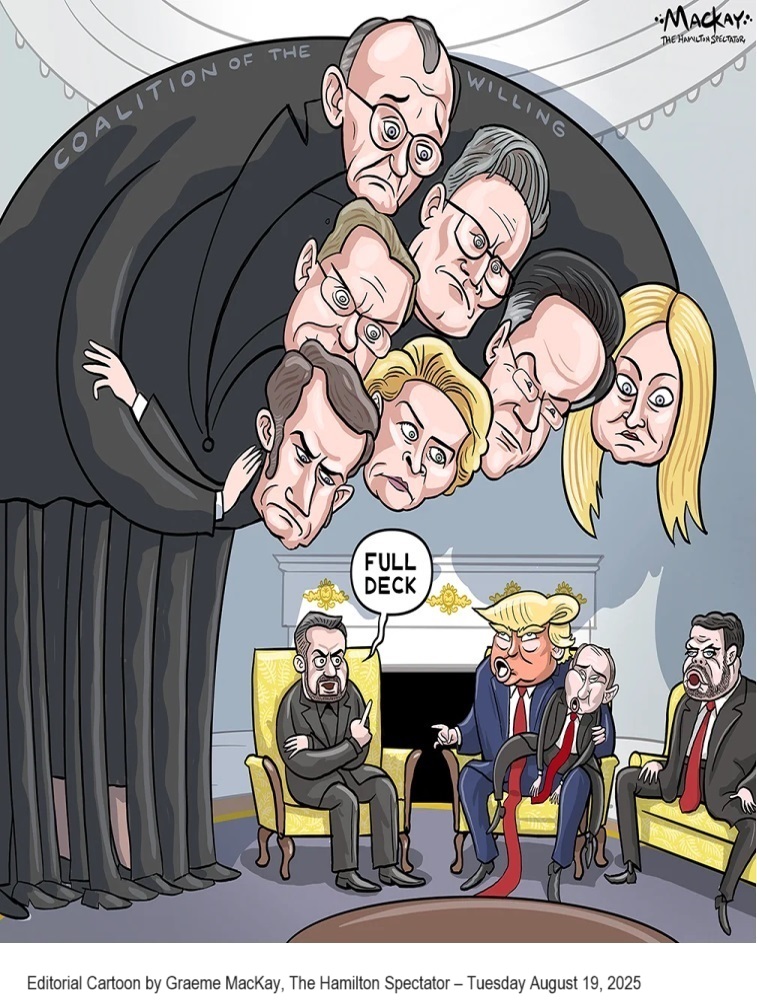
Zelensky’s intent as he made plans to see Trump Monday was to persuade him to pull him back from the frightening idea of a peace agreement and reinvest in the demand for a ceasefire. This was also what the crew from across the Atlantic had in mind. Kier Starmer, Emmanuel Macron, Friedrich Merz: The British, French and German leaders were there. So were Mark Rutte, the NATO sec-gen, and Ursula von der Leyen, the president of the European Commission. Hawks all, this crowd. They arrived, as news reports indicated, in a state somewhere between alarm and panic.
Trump appears to have heard these people out on the ceasefire question, as was to be expected. But there is no indication that the thought went much beyond hypothetical notions of what might be discussed in an also hypothetical summit between Zelensky and Putin. And there is every indication Trump holds to his early post-summit disclosures, of which there is now more yet-to-be-confirmed detail, notably in the land-for-guarantees line and what Trump has meant in his mentions of “land swaps.”………………………………………………………………
…………………………………………………….. The “centrist” leadership in Washington and the European capitals has refused to listen to Moscow for many years now; the media that publish the bulletins of these trans–Atlantic elites routinely make the case that anything Putin says is by definition the opposite of true and that listening to the Russians on any topic is beyond all the fence posts, irretrievably out-of-bounds. It is hard to overstate the magnitude of Trump’s transgression against this background.
Trump’s second sin is his evident embrace of reality. And reality, like listening, has also been off-limits for the centrist elites and those clerking for them in media on both sides of the Atlantic. This has been so at last since the U.S.–cultivated coup that brought the current regime of crooks and neo–Nazis to power 11 years ago. Those dwelling in the Kingdom of Pretend have carried on for months as if the Kiev regime can set the terms for any kind of settlement and Moscow will have no choice but to accept them. “Ukraine is also determined not to let Russia set the terms and structure of future peace talks,” The Times reported from Kiev in a pre-summit curtain raiser.
Not to let Russia…?
……………………………………………….. To say Trump aligned with Putin, or got played or otherwise capitulated, is another way, a simpleton’s or cynic’s way, of denying or veiling reality. In my read, Trump listened to Putin’s case and has concluded, Yes, he is right. This is the ultimate reality long at issue and long unsayable. Trump has done no less and no more than speak this truth at last. The rest is rubbish.
Let us sin along with Trump, then, if we haven’t already. Let us all look past the mountain ranges of propaganda, cognitive warfare, perception management and what have you and say what Trump is now saying: It is time to acknowledge forthrightly that Putin is right about the war and its causes, about the Biden regime’s purposeful provocations, about the larger questions of which it is merely a subset and about how most sensibly to negotiate a lasting settlement in the borderlands between Europe and Russia and altogether between West and East. https://scheerpost.com/2025/08/19/patrick-lawrence-that-big-beautiful-summit-in-alaska/
“It was determined by all that the best way to end the horrific war between Russia and Ukraine is to go directly to a Peace Agreement, which would end the war, and not a mere Ceasefire Agreement, which often times do not hold up.”
The Dwarfs had to slink away. Will they, at long last, tell Zelensky they cannot back up their rhetoric with the needed arms and financial support?
I shall not make the de-rigueur disclaimer lest anyone infer that I think President Donald Trump is Snow White. Nor do I feel a need to assure readers that I am not “in Putin’s pocket.” In the tradition of a “current intelligence” analyst, I shall simply “call ‘em like I see ‘em.” And there are lots of dots to put together.
It has been clear since the Alaska summit that Trump and Russian President Vladimir Putin have come to an overall agreement on Ukraine and that it is now being fleshed out in plain sight. And both are acutely aware of the many forces wishing to sabotage moves toward a negotiated settlement.
They have agreed to call it “Biden’s war” and then to conduct themselves as though they have bigger fish to fry – first and foremost improving U.S.-Russia relations.
Why have so many observers been unable to grasp the significance of this key sentence in the first paragraph of the readout from the Aug. 6 Putin-Witkoff meeting – the meeting that set these hopeful events in train?
“Once again, it was noted that Russia-US relations could be placed on a totally different, mutually beneficial footing, which would be in stark contrast with the way these relations have evolved in recent years.” (Emphasis added.)
(Pardon the pedantry, but it is not widely known that the Kremlin’s Russian-to-English translator erred in using the subjunctive could. The word in the Russian readout is stronger; it means can – the indicative, not the subjunctive mood.) This is, well, indicative.
The shared, overriding objective to improve bilateral ties came through clearly both at the summit on Friday and at the “March of the Gnomes” on Monday when seven European leaders arrived at the White House to back Volodymyr Zelensky (no offense to garden gnomes – or dwarfs).
Enroute Alaska
On Air Force One, Trump told Fox’s Bret Baier, “I won’t be happy if I walk away without some form of a ceasefire.” Nyet, was Putin’s answer.
Perhaps the president thought he could work his persuasive powers on Putin one-on-one and change his mind. More likely, Trump knew his gambit had zero prospect of success, and merely wanted to be able to tell the foot-draggers later that he had thrown one last Hail Mary pass, but in vain.
Just a few hours later Trump wrote on truthsocial:
“It was determined by all that the best way to end the horrific war between Russia and Ukraine is to go directly to a Peace Agreement, which would end the war, and not a mere Ceasefire Agreement, which often times do not hold up.”
The New York Times and other media were quick to point out that Trump was “siding with Putin.”
Maps … and Charts
While Putin used the Alaska summit to make clear Russia’s core interests on Ukraine and to argue that he had no option other than to invade, it is a safe bet that he also showed Trump a map depicting the “order of battle;” that is, the disposition of forces along the contact line and in reserve.
This morning Trump hinted that Russia should be allowed to hold onto the territory it has occupied in Ukraine, a concept so far anathema to Zelensky and most of the European leaders.
THE Map
“The Ukrainian soldiers were brave as hell because it’s fighting a force that’s much, much bigger and clearly much more powerful,” Trump said of the Russian military … “And you know, it’s not like they’ve stopped. If you, I assume you’ve all seen the map, you know, a big chunk of territory is taken, and that territory has been taken.
“Now they’re talking about Donbas. But Donbas, right now, as you know, is 79 percent owned and controlled by Russia,” Trump added. “So they understand that.”
Zelensky and the Seven Dwarfs
The Dwarfs had to slink away. Will they, at long last, tell Zelensky they cannot back up their rhetoric with the needed arms and financial support? It will take a while, but in the end they will have to do so.
The end is near.
Ray McGovern works with Tell the Word, a publishing arm of the ecumenical Church of the Saviour in inner-city Washington. His 27 years as a C.I.A. analyst included leading the Soviet Foreign Policy Branch and conducting the morning briefings of the President’s Daily Brief. In retirement he co-founded Veteran Intelligence Professionals for Sanity (VIPS).
Electricite de France SA will likely cut nuclear power production in northern parts of the country this week because of forecast shallow waters on the Meuse River.
Low flows may affect output from the Chooz plant located near the Belgian border starting Friday, according to a company statement.
“The Meuse is quite far north for this sort of restriction, so it’s notable for that reason,” said William Peck, senior power analyst at Energy Aspects Ltd. “But given the weather forecasts and the time of year, I don’t think we’ll see a major ongoing issue or much additional upside risk from it.”
The country’s atomic power plants have been disrupted recently amid weather-related pressures. A heat wave forced several reactors to curb output because the river water used to cool them became too warm.
In addition, four reactors were shut down after a swarm of jellyfish clogged the filter drums. Their growing numbers can be linked to climate change.
Enabling Israeli theft of US nuclear material, spying on America
Angleton’s role in enabling Israel’s wanton theft of nuclear material from an American facility is one of the more shocking episodes in the US-Israeli relationship.……………………………………………..
Veteran CIA counterintelligence chief James Angleton secretly oversaw a top-level spy ring involving Jewish émigrés and Israeli operatives without “any clearances” from Congress or Langley itself, according to recently declassified documents published as part of the Trump administration’s pledge to disclose all available information on the assassination of President John F. Kennedy.
The files provide a fresh and often disturbing look at a spy described by historian Jefferson Morley as “a leading architect of America’s strategic relationship with Israel,” detailing Angleton’s role in transforming the Mossad into a fearsome agency with global reach, while assisting Israel’s theft of US nuclear material and protecting Zionist terrorists.
Angleton established the Jewish emigre spying network in the aftermath of WWII, with the apparent goal of infiltrating the Soviet Union. But as the files show, the spymaster considered his “most important” task to be maintaining the supply of Jewish immigrants flowing from the Soviet Union towards the burgeoning Israeli state.
According to Angelton, his Jewish assets were responsible for 22,000 reports on the USSR, generating several intelligence masterstrokes. Chief among them was the publication of Soviet Prime Minister Nikita Kruschev’s famous 1956 secret speech denouncing Stalin, which the spymaster boasted “practically created revolutions in Hungary and Poland.” Elsewhere, Angleton bragged that his arrangement with Israel had produced “500 Polish intelligence officers who were Jewish” who “knew more about Polish intelligence than the Poles.”
Other passages appear to show Angleton taking credit for securing the “release” of several Zionist terrorists affiliated with the Irgun militia before they could be convicted for bombing the British embassy in Rome. Though the group had been captured by Italian authorities, the newly-disclosed files indicate the terror cell was freed on the orders of the CIA.
The information was originally divulged in 1975 to senators serving on the Church Committee, which probed widespread abuses by US intelligence in the decades prior. Congress was particularly interested in claims by New York Times foreign correspondent Tad Szulc, who testified under oath that Angleton had personally informed him that the US provided technical information on nuclear devices to Israel in the late 1950s. The new documents show that Angleton was deceptive under questioning, and evaded questions on Israel’s nuclear espionage efforts on the record.
Additional unsealed FBI documents, which refer to Israel’s Mossad as Angleton’s “primary source” of information, confirm that the CIA’s head of counterintelligence relied heavily on Tel Aviv to solidify his position within the Agency – and also add to the growing body of evidence that Angleton may not have been operating with US interests in mind throughout his 21-year tenure.
Other newly declassified files from the FBI have shown that Angleton maintained a wildly lopsided relationship with the Bureau, which saw federal agents deferring to the CIA counterintelligence chief after they caught him surveilling the correspondence of huge numbers of Americans. The files show Angleton openly admitting he would have been fired if Langley caught wind of his leaks to the Bureau.
A side-by-side analysis of the now-unredacted Church Committee files compared with their previously-released versions from 2018 demonstrates that even after 70 years, Washington felt compelled to conceal details of its real relationship with Israel’s founders. Over a dozen references to “Israel,” “Tel Aviv,” or descriptions of figures as “Jewish,” which were scrubbed from the 2018 release, can now be viewed on the National Archives site.
The documents reveal that Angleton repeatedly lied to multiple Congressional bodies, including the Church Committee, which investigated CIA abuses, and the House Select Committee on Assassinations, which probed the murders of John F. Kennedy and Martin Luther King, Jr. Angleton was similarly evasive when interrogated over Israel’s nuclear weapons program, and about CIA knowledge or complicity in the scheme.
Those documents also reveal that Angleton’s CIA counterintelligence staff ordered Lee Harvey Oswald’s removal from federal watchlists six weeks before Kennedy’s assassination, despite his classification as a high security risk. The surveillance of Oswald was personally overseen by a member of Angleton’s intelligence network of Jewish emigres, Reuben Efron, a CIA spy from Lithuania. Angleton had placed Efron in charge of an Agency program called HT/Lingual which intercepted and read correspondences between Oswald and his family. ………………………………………………………………………………………………………………………………………………………………..
Enabling Israeli theft of US nuclear material, spying on America
Angleton’s role in enabling Israel’s wanton theft of nuclear material from an American facility is one of the more shocking episodes in the US-Israeli relationship. The scene of the crime was the Nuclear Materials and Equipment Corporation, or NUMEC, a uranium processing facility in Apollo, Pennsylvania owned by a Zionist financier named David Lowenthal. In 1965, Zalman Shapiro, a fellow Zionist hired by Lowenthal to run the plant, illegally diverted hundreds of kilograms of nuclear fissile material to Israel. Posing as a scientist, the notorious Mossad spy Rafi Eitan visited NUMEC three years later to continue the heist.
As Jefferson Morley documented in his biography of Angleton, “The Ghost,” the late CIA counterintelligence chief made sure the CIA looked the other way as Israel constructed its first nuclear weapon out of the stolen fissile material. According to Morley, “Angleton, it is fair to say, thought collaboration with Israel was more important than U.S. non-proliferation policy.”
A 1977 investigation by the US Government Accountability Office found that the CIA withheld information about the NUMEC nuclear theft from the FBI and Department of Energy, and “found that certain key individuals had not been contacted by the FBI almost 2 years into the FBI’s current investigation.”
The latest batch of Church Committee files add new detail about Angleton’s compromising of US national security to benefit Israel, and his attempts to cover up his betrayal.
During his testimony before the Committee, Angleton was pressed about media reports alleging that he and his counterintelligence unit provided Israel with technical support for constructing nuclear weapons. He strenuously denied the charges, insisting the CIA had never played any role in providing Tel Aviv with nuclear materials. However, when questioned about whether “Israeli intelligence efforts” were ever conducted in the US “aimed at acquiring… nuclear technology,” Angleton equivocated………………………………………………………………………………………………………………….. https://thegrayzone.com/2025/08/15/cias-angleton-israeli-spy-ring-files/
Walmart has recalled some of its shrimp products in the US after radioactive material was detected in a shipment of seafood.
The US Food and Drug Administration (FDA) warned the public not to eat frozen shrimp sold under Walmart’s Great Value label, as it could have been exposed to a dangerous isotope in shipping containers.
One sample of breaded shrimp tested positive for the substance, the FDA said, but this positive sample “did not enter US commerce”.
Consumers in 13 US states where the shrimp products are sold have been advised to throw any recently bought products among three batches……………………………………
The recalled shrimp was sold at Walmart locations in Alabama, Arkansas, Florida, Georgia, Kentucky, Louisiana, Missouri, Mississippi, Ohio, Oklahoma, Pennsylvania, Texas and West Virginia, and shoppers in those states were advised to be cautious.
It came from an Indonesian supplier that has since had a number of shipping containers denied entry to the US, the FDA said.
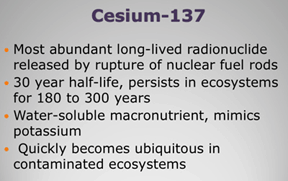
One shipment tested positive for Caesium-137, the radioactive form of the periodic element Caesium.
The amount contained in the tested shipment held by the FDA was not enough to pose acute harm to consumers, exposure over time could pose an elevated risk of cancer by damaging living cells in the body, said officials from the agency.
Caesium-137 is made through nuclear reactions and is present in trace amounts in soil, food and air worldwide. It is one of the principal sources of radiation around Chernobyl in Ukraine and Fukushima in Japan.
The troupe arrived to “daddy’s” DC office for their official dressing down. If nothing else, we must marvel at the fact that the meeting produced some of the most remarkable political optics, perhaps, in history:
Has there ever been anything like this? The entire pantheon of the European ruling class reduced to sniveling children in their school principal’s office. No one can deny that Trump has succeeded in veritably ‘breaking Europe over his knee’. There is no coming back from this turning point moment, the optics simply cannot be redeemed.
But even snide ridicule aside, objectively speaking, we must point to how absolutely defeated and low-energy the delegation looked……………
Hands in pockets, looks of mild confusion or disinterest, vacant eyes, and that bizarre ‘dead-space’ atmosphere like a “TV tuned to a dead station” (hat tip Mr. Gibson). It’s clear that no one wants to be there, and everyone knows the artificial charade looks and feels forced. The real punchline comes at the 1:00 mark where it becomes eminently obvious the entire hollow exercise is nothing more than an ego-stroke for the cunning Ringmaster himself, as he bids his abject pupils to veer their gaze at the carefully-situated artwork presiding over the gilded humiliation ritual.
Volumes could be written on the implications of such a low point in European influence. But we’ll suffice with concluding that it’s clear the matter of the Ukrainian conflict’s resolution is of such existential importance to the behind-the-scenes cabal which writes the Euro-puppets’ orders, that this cabal is willing to risk everything, including politically sacrificing its “compradors” posing as elected leaders.
It’s pointless to even granularize it, but there were many small moments of humiliation in the meeting: from Trump’s seeming non-recognition of Finland’s president—unable to find him despite his sitting directly across from him—to Trump humbling Ursula, who came armed with a prescripted spiel about Russians kidnapping Ukrainian children; Trump slapped her silent by pointing out they had convened to talk about something else entirely, i.e. your propaganda is irrelevant and unwanted here.
It should also be noted that Trump did not greet a single one of the European messengers personally as they arrived, having a chaperone escort them like children from the White House playground instead. It was in sharp contrast to the pomp and ceremony of the Putin visit. This, of course, is by design, with Trump effectively showing the craven European compradors their subordinate place as part of his slow restructuring of the world order; Trump respects only power—mealy and servile leaders repulse him and earn his boot-print on their foreheads.
So what did the meeting actually accomplish, other than raising Trump’s prestige and smothering inconvenient media narratives from the news cycle?
What we saw was another rehash of the same routine as in Alaska: talks are held, major “progress” announced, yet no concrete details or evidence is provided. In this case, the big achievement is said to be the agreement on a meeting between Putin and Zelensky, followed by a “trilat” as Trump calls it. The problem is, there is zero evidence the Russian side has agreed to any such thing.
Firstly, press outlets blared that Trump “phoned Putin” in the midst of his meeting with the Europeans—Trump himself promptly shot this down:
I post this example to again illustrate just how much disinfo noise is clogging the airwaves around this issue. And this contextualizes the remainder of the analysis, surrounding what Russia may or may not have agreed to. You see, just as easily as mainstream outlets lied about Trump’s call, they may be doing so about the now-circulating claims that Putin has “agreed to” meet with Zelensky.
The Russians have been playing things extremely close to their chests, even more than usual. It appears they have adopted a strategy of deliberate strategic ambiguity in order to give Trump the license he needs to play his game against the Europeans—and Ukraine—while the Russians sit back and watch.
In this case, in confirming Trump’s attempt to get Putin and Zelensky to sit down together, Putin aide Ushakov very subtly modified the language to state that Putin and Trump discussed raising the level of “negotiators” and mentioned the possibility of Russia studying this proposal—as I wrote on X:
An interestingly evasive word-salad as non-answer in customary “Politburo-speak”. He doesn’t really confirm anything other than Trump and Putin discussed “raising the level of negotiators” between Russia and Ukraine (specifically omitting what level that would be). And in fact, he didn’t even say raising the level itself was discussed but rather the possibility of “studying” this proposal. It seems Russia for now continues to play strategic ambiguity to give Trump the arm space he needs to “work” on the Europeans and Zelensky.
In this case, in confirming Trump’s attempt to get Putin and Zelensky to sit down together, Putin aide Ushakov very subtly modified the language to state that Putin and Trump discussed raising the level of “negotiators” and mentioned the possibility of Russia studying this proposal—as I wrote on X:
An interestingly evasive word-salad as non-answer in customary “Politburo-speak”. He doesn’t really confirm anything other than Trump and Putin discussed “raising the level of negotiators” between Russia and Ukraine (specifically omitting what level that would be). And in fact, he didn’t even say raising the level itself was discussed but rather the possibility of “studying” this proposal. It seems Russia for now continues to play strategic ambiguity to give Trump the arm space he needs to “work” on the Europeans and Zelensky.
Israel apologists always attack anti-Zionists by saying “Zionism just means self-determination for Jews! If you hate Zionism then you hate Jews!”
No, that’s not what Zionism means. Zionism means exactly what we see before us today. Genocide. Ethnic cleansing. Apartheid. Nonstop violence and abuse. That’s what Zionism means. And anti-Zionism means opposing these things.
There is simply no argument to the contrary. This is indisputably what Zionism looks like. There is no other alternate reality iteration of Zionism you can point to where genocide, ethnic cleansing, apartheid and nonstop violence and abuse are not happening. This is the only way Zionism looks. The Zionist experiment has been run, and these are the results.
Trying to argue that Zionism doesn’t mean genocide, ethnic cleansing, apartheid, and nonstop violence and abuse is exactly the same as trying to argue that Nazism doesn’t mean all the things that happened when the Nazism experiment was run. Nazism means all the things that happened under Nazism. You can’t legitimately tell me “No, actually, Nazism just means a safe and prosperous homeland for the German people.” We’ve seen what Nazism looks like, and we’ve seen what Zionism looks like. To argue otherwise is to argue with reality.
It’s just so obnoxious how Israel supporters are like “Zionism means these nice things and nice words, so if you’re against Zionism you’re against the nice things and nice words!” No, asshole, that’s not how it works. You’re entitled to your own opinion, but not your own reality.
Israel is what it does. Zionism is what it does. You can’t separate them from their actions. The debate about the true nature of these things has been settled by the reality of what is happening.
It doesn’t matter if you believe Israel just wants to live in peace. It doesn’t matter if you believe Zionism is just the idea that Jews deserve self-determination. Reality says you’re wrong. Reality says Israel and Zionism mean nonstop violence and abuse. Reality says Israel and Zionism necessarily entail genocide, apartheid and ethnic cleansing. Because that’s the reality on the ground.
Them’s the facts. If you disagree with them, you are objectively wrong.
I saw a clip of ABC host Patricia Karvelas raking Netanyahu policy advisor Ophir Falk over the coals for his denialism of Israel’s atrocities in Gaza, and the thought occurred to me that Israel really has lost the normies. All the mainstream western empire loyalists who dutifully toe the imperial line under normal circumstances are dropping away, one by one.
The fact that Israel has managed to alienate western liberals is so funny, because they’d be Israel’s biggest cheerleaders if they were given the tiniest bit of justification for that position.
So much about Israel fits in perfectly with western liberal mythology. A US-aligned capitalist democracy run by a plucky religious minority who survived horrific persecution, which embraces secular progressive values and reinforces the dominant western narratives about the wonderful things the US-led order has been able to accomplish since its triumphant glorious victory in the second world war. All Israel had to do was give them something, anything, and they’d still think Israel is the greatest thing in the world. They just needed an excuse — even a very meager one.
But Israel couldn’t even give them that. Genocide, racism, apartheid, ethnic cleansing and expansionism were just too important to its driving ideology. The Zionist project simply could not continue without going mask-off at some point, so now they’ve lost all the mainstream moderate liberals and pretty much everyone besides the “killing Muslims is good” far right extremists and the “we have to support Israel because God commands it” Christian Zionists.
Eventually all the contradictions had to come out into the light.
The Israeli press are pushing the narrative that if people in Gaza are suffering so bad they should leave, which is precisely the narrative I said we’d soon be hearing from Israel in facilitation of its longstanding ethnic cleansing agenda.
“Western governments are beginning to speak out against the mass atrocity in Gaza, far too little and far too late. We can expect Israel and the United States to respond to this outcry by saying that Palestinians need to be evacuated out of Gaza as quickly as possible in order to rescue them from this deliberately manufactured humanitarian crisis. We can expect them to denounce anyone who opposes this ethnic cleansing operation as evil monsters who want to starve the poor Palestinians.”
The Jerusalem Post has just published an opinion piece titled “Gaza humanitarian crisis should expedite Trump’s relocation plan,” subtitled “Now that there is public awareness of a humanitarian crisis in Gaza, it should be leveraged to garner support for Trump’s Gaza relocation proposal.”
The article’s author, Gol Kalev, complains that “the Gazans” are being “denied the basic human right to flee a war” by the mean, nasty Europeans who just want to accuse Israel of war crimes and atrocities.
“They are needed under the rubble in Gaza — not just by Hamas, who uses them as human shields, but also by Europe and its proxies, who use them as pawns in their age-old opposition to the Jewish state, and as a proxy assault on America,” Kalev writes, arguing that public frustration “should not be directed at Israel, but at those standing in the way of Trump’s relocation plan, including European leaders.”
“Now that there is public awareness of a humanitarian crisis in Gaza, it should be leveraged to garner support for Trump’s Gaza relocation proposal — which could lead to safety and prosperity for Gazans, and peace for the entire region,” writes Kalev. “The public message must be clear: Let the Gazans be free — let them flee.”
Just as I said they would do, they’re disguising a naked ethnic cleansing operation as humanitarianism and denouncing anyone who wants to provide Palestinians with a massive relief effort in their historic homeland as an uncaring monster. We can expect to see more of this messaging going forward.
Anyone who tells you they support Israel for religious reasons is telling you to stop trying to reason with them. They’re saying their position is not based on facts, evidence, logic or morality, but their blind faith in a collection of made up stories. So there’s nothing you could possibly say to them that would change their mind or convince them that they are wrong.
Trying to debate or reason with such a person would be the same as trying to convince someone that there is no God. It’s an entirely unfalsifiable position about which no argument can be made using facts and evidence.
Someone like Mike Huckabee is never telling the truth or saying what he really thinks is going on when it comes to Israel and the Palestinians, he’s just making whatever mouth noises he needs to make to help fulfill a Biblical prophecy and secure his eternal reward. Such people have no place in the conversation. They should be completely excluded from the debate, because they are not actually participating in it. They’re just lying and manipulating for reasons that have nothing to do with truth or morality.
President Trump said on Monday that he was working on arranging a meeting between Russian President Vladimir Putin and Ukrainian President Volodymyr Zelensky, comments that came after a day of hosting the Ukrainian leader and several European officials at the White House.
“At the conclusion of the meetings, I called President Putin, and began the arrangements for a meeting, at a location to be determined, between President Putin and President Zelensky,” the president wrote on Truth Social.
Trump said that once Putin and Zelensky meet, he would join them for a three-way talk. “After that meeting takes place, we will have a Trilat, which would be the two Presidents, plus myself,” he wrote.
Yury Ushakov, an aide to Putin, said that during the call with Trump, the Russian leader “expressed support for direct negotiations between the delegations of Russia and Ukraine.”
Trump said that one topic of discussion with Zelensky and European leaders on Monday was the potential security guarantees Ukraine would receive from Western nations as part of a peace deal, which will likely be a major sticking point in negotiations with Russia.
“During the meeting we discussed Security Guarantees for Ukraine, which Guarantees would be provided by the various European Countries, with a coordination with the United States of America,” he said.
European leaders, led by British Prime Minister Keir Starmer and French President Emmanuel Macron, are calling for a troop deployment to Ukraine to uphold any potential peace deal. When asked if the US would send troops to Ukraine, Trump didn’t rule out the idea.
But Russia has made clear that it’s strongly opposed to the idea of the deployment of troops from NATO countries to Ukraine, a position it reiterated on Monday. “We reiterate our repeatedly expressed position that we deny any scenarios that envisage the deployment of a military contingent to Ukraine with the participation of Nato states, which could lead to an uncontrollable escalation of the conflict with unpredictable consequences,” said Russian Foreign Ministry spokeswoman Maria Zakharova.
The other major sticking point is the issue of territory. Russia has reportedly offered to end the war if Ukraine withdraws from the Donbas region and the lines are frozen in the southern Kherson and Zaporizhzhia oblasts, but Zelensky continues to publicly reject the idea of ceding territory.
Zelensky has received strong backing from the European leaders who joined him in Washington and held talks with them to coordinate their position ahead of the meetings with Trump. According to a press release from Zelensky’s office, he and the Europeans “stressed their firm support for Ukraine’s sovereignty and territorial integrity and the unacceptability of changing internationally recognized state borders by force.”
The statement said they also “welcomed the readiness of the United States to participate in guaranteeing security for Ukraine” and that “one of the key issues in the negotiations with President Trump will be the joint participation of the United States and Europe in creating the future security architecture for Ukraine and, consequently, for the entire European continent.”
Zelensky was joined in Washington by Starmer, Macron, German Chancellor Friedrich Merz, Italian Prime Minister Giorgia Meloni, Finnish President Alexander Stubb, European Commission President Ursula von der Leyen, and NATO Secretary-General Mark Rutte.
history….will remember whether statesmen had the courage to talk instead of continuing to fight, to compromise instead of escalating, to think beyond the next election cycle or arms shipment.
The war hawks may laugh, but in a world teetering on the edge, diplomacy is no joke
The Alaska summit between Donald Trump and Vladimir Putin was never going to please the usual suspects. The war hawks in Washington, London, and their loyal stenographers in the mainstream press had sharpened their knives long before the meeting even began. For them, diplomacy is weakness, dialogue is treason, and peace is always suspicious. Yet for all their noise, the very fact that the U.S. and Russia sat down to talk is of historic importance—and a step that no amount of scaremongering can erase.
From the beginning, the Atlantic establishment mocked the very idea of dialogue with Moscow. They repeated their tired mantra: Russia is “isolated,” Russia must be “contained,” Russia should be “punished.” But as
Tarik Cyril Amar rightly pointed out during our Cold 2.0 conversation, Russia has never been isolated—except in the fever dreams of Western editorial boards. It is integrated into the world, it has options, and it has a professional diplomatic corps that runs circles around its Western counterparts.
The real absurdity is that some critics, even among multipolarists, argued that Russia should have boycotted the summit—that engaging with Washington is a trap, that agreements will only be broken, that the American “blob” never changes course. Of course, the caution is justified: America is unreliable, aggressive, and deeply arrogant. But the conclusion is wrong. Diplomacy is not about naivety. It is about leveraging one’s strength. And Russia today, unlike in the 1990s, is not a supplicant. It can negotiate from a position of power.
This is what the hawks cannot stand: that Russia walked into the room with Trump as an equal, and walked out with its position strengthened. That reality alone triggered the predictable chorus of whining from the likes of John Bolton—who begrudgingly admitted that “Putin clearly won.” Well, if even the mustached high priest of regime change says it, perhaps we should take note.
Meanwhile, Britain’s Telegraph solemnly declared that Ukraine has lost the war but that Britain must “prepare for Russia’s next onslaught.” These are the same people whose government cannot even keep its nuclear submarines from rusting in Scottish ports. Perhaps Whitehall should focus less on imaginary Russian invasions and more on fixing the crumbling infrastructure at home. But then again, blaming Russia is so much easier than admitting neoliberal Britain has sabotaged daily life all by itself.
The mainstream press, too, embarrassed itself. Journalists shouted at Putin about “killing civilians”—but I have yet to see the same bravery directed at Benjamin Netanyahu as he presides over the ruins of Gaza. The double standards are glaring, the hypocrisy suffocating. As I said during the show, neoliberal rot has sabotaged daily life in Britain and America far more effectively than any Russian plot ever could. But instead of confronting their own failures, the West’s talking heads project blame outward and cling to the fantasy of a “rules-based international order” that exists only on paper.
Let us be clear: breaking the ice between Washington and Moscow is not a concession to empire. It is a recognition that wars end not with hashtags or think tank white papers, but at the negotiating table. Trump’s shift toward demanding a peace deal—not just a ceasefire—mirrors Russia’s own position and marks a fundamental break from the stale Western script. If he sticks to it, this could be a turning point.
Of course, the hawks will howl. They always do. But history will not remember their op-eds. It will remember whether statesmen had the courage to talk instead of continuing to fight, to compromise instead of escalating, to think beyond the next election cycle or arms shipment.
The Alaska summit was not about personal chemistry between leaders. It was about something much bigger: the possibility of reversing a dangerous spiral. The war hawks may laugh, but in a world teetering on the edge, diplomacy is no joke.
—Kevork Almassian is a Syrian geopolitical analyst and the founder of Syriana Analysis.
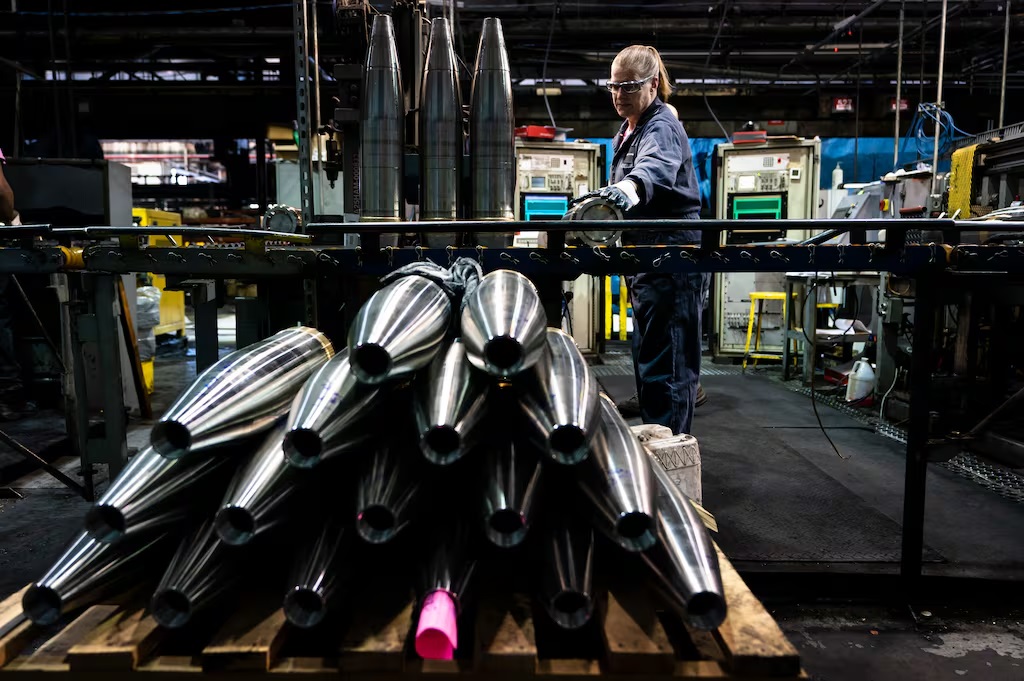
THE HAGUE, Netherlands — European military industrial production in support of Ukraine has overtaken American output for the first time since Russia’s invasion, new numbers released Tuesday show.
According to the tally by the German Kiel Institute for the World Economy, Europe allocated at least €35.1 billion ($41.1 billion) in military industrial output to Ukraine between the start of the war in February 2022 and the end of June 2025. This is €4.4 billion ($5.15 billion) more than the U.S. committed in the same period.
The continent also overtook the U.S. in terms of total military aid in the spring, following a sharp rise in European support for Ukraine in response to America’s withdrawal under the nascent Trump administration. EU countries have allocated over $65 billion in military assistance to Ukraine, according to the Union’s own tally. Additionally, several non-EU European countries are major donors, bringing up the European total.
The numbers do not include the recently announced American weapons deliveries, which are the first large batch approved by President Donald Trump’s administration, because they will be purchased by Kyiv, rather than donated.
The disparity is even greater when accounting for other forms of aid, too. Europe has allocated €167.4 billion ($196.1 billion) in government aid to Kyiv and pledged another €90 billion ($105.4 billion), according to the Kiel Institute’s tracker. The U.S. has allocated and pledged €114.6 billion ($134.3 billion) and €4.35 billion ($5.1 billion), respectively.
Although Europe’s combined clout has consolidated to buttress Ukraine, the U.S. nonetheless remains the single largest donor. Its combined total is nearly twice that of the second-largest donor, the European Union, which has provided €60.5 billion ($70.9 billion) in financial aid and €2.7 billion ($3.2 billion) in humanitarian assistance.
The U.S. has also provided to Ukraine more infantry fighting vehicles and howitzers than any other single country, as well as multiple launch rocket systems and air defense systems. However, European tallies combined surpass the U.S. in all of these categories.
The No. 1 European donor country is Germany, although as a portion of their gross domestic product, Denmark, Estonia, Lithuania and Latvia lead the pack. Denmark’s aid to Ukraine amounts to 2.9% of the country’s GDP, plus a further 0.4% if EU-provided assistance is considered in the tally.
Poland has also been a significant supporter, including coming out as the No. 1 tank provider for Ukraine, having sent Kyiv a total of 354 tanks. The Netherlands has provided 104 and Denmark 94.
Kiel Institute researchers noted that many of the weapons now going to Ukraine come straight from the military-industrial output of the sending countries, rather than from preexisting stockpiles, as had been the case in the earlier days of the war.
Early on, stockpiles of weapons and gear had run low across many Western countries as the systems were rushed to the frontlines in Ukraine in defense against the Russian invasion.
Unlike unpredictable American assistance, European support has remained consistent — and even expanded — as fighting in Ukraine dragged on into its fourth year.
In May and June 2025 alone, European governments allocated €10.5 billion ($12.3 billion) in new military assistance, of which at least €4.6 billion ($5.4 billion) is being routed through procurement contracts, rather than pulled from existing stockpiles, underscoring the growing centrality of industrial output over surplus arsenals.
Linus Höller is Defense News’ Europe correspondent and OSINT investigator. He reports on the arms deals, sanctions, and geopolitics shaping Europe and the world. He holds a master’s degrees in WMD nonproliferation, terrorism studies, and international relations, and works in four languages: English, German, Russian, and Spanish.