Finland backs green hydrogen as Fortum pauses nuclear expansion

28 March 2025, Helsinki Times
Finnish utility Fortum has ruled out new investments in nuclear power in the near term, citing low electricity prices in the Nordic market and high construction costs. The announcement came as Finland inaugurated its first industrial-scale green hydrogen plant, marking a shift in focus toward alternative energy technologies.
Fortum concluded a two-year study into the feasibility of building new nuclear reactors and determined that such investments are not commercially viable under current market conditions.
New nuclear could provide new supply to the Nordics earliest in the second half of the 2030s, if market and regulatory conditions are right,” said Markus Rauramo, CEO of Fortum.
The company will instead focus on expanding renewable power generation, increasing storage capacity, and extending the life of existing nuclear facilities, including the Loviisa nuclear plant.
The company’s Vice President for New Nuclear, Laurent Leveugle, said a risk-sharing model would be required to make future nuclear investments possible.
“We are not saying that the state has to pay for it, but that the risk must be shared with the different parties: technology providers, investors, utilities, and also the state,” Leveugle told Reuters…………………….
While Fortum has paused new nuclear plans, Finland is pressing ahead with new green energy initiatives. On 26 March 2025, P2X Solutions inaugurated the country’s first industrial-scale green hydrogen production plant in Harjavalta. The event was attended by Alexander Stubb, President of the Republic of Finland.
“Finland has everything it takes to become a clean energy superpower,” Stubb said during his speech at the inauguration……………………………………………………………………………
As Fortum turns to renewables and lifetime extensions for existing nuclear facilities, and P2X accelerates hydrogen development, Finland’s energy policy is shifting toward flexible and decentralised solutions.
The Nordic power market has experienced prolonged periods of low electricity prices, driven by increased renewable capacity and lower demand growth. Fortum has warned that these conditions are not sufficient to support capital-intensive projects like nuclear reactors without regulatory reforms or direct financial support……………………………………………..
Finland’s approach to energy diversification comes amid broader European efforts to reduce reliance on fossil fuels and improve energy security. Green hydrogen and advanced storage systems are seen as essential components of this transition.
Fortum’s position reflects growing caution among European utilities over the costs and risks associated with new nuclear builds. The company has yet to release any cost estimates for new reactors, but industry analysts say capital requirements often exceed €10 billion per unit and construction timelines stretch over a decade.
By contrast, modular hydrogen projects like those developed by P2X Solutions involve lower upfront costs and shorter lead times. They also benefit from growing political and financial support across the EU…………………….https://www.helsinkitimes.fi/business/26416-finland-backs-green-hydrogen-as-fortum-pauses-nuclear-expansion.html
Risks posed by hole in protective shell over Chernobyl
Lilia Rzheutska, DW, March 29, 2025,
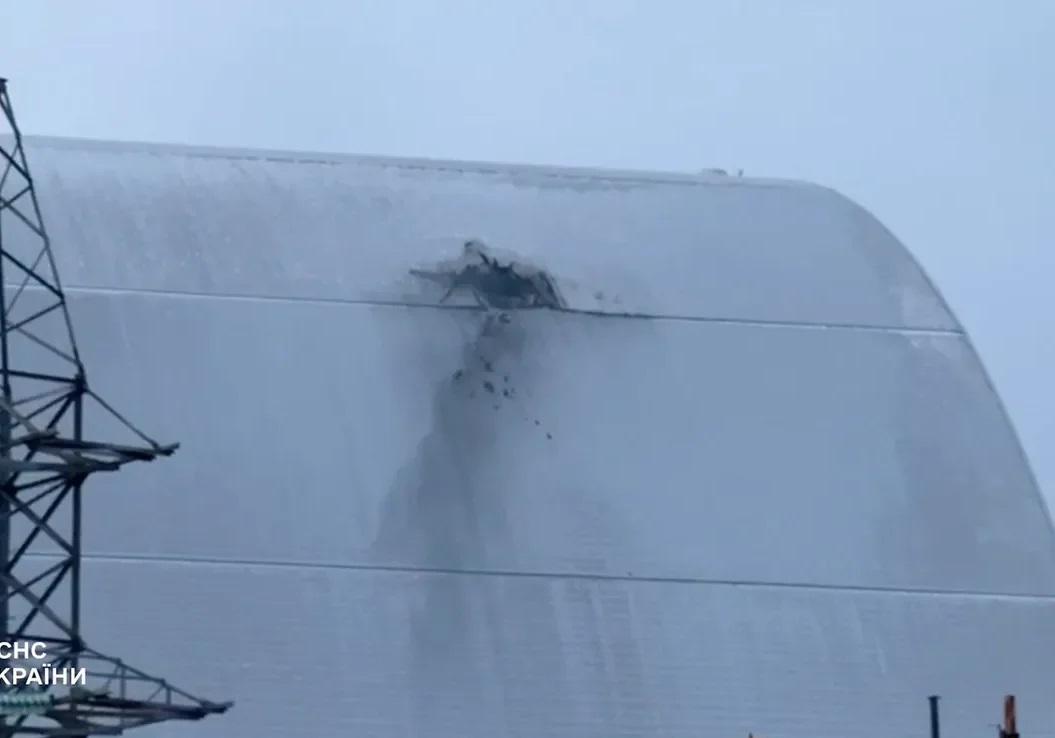
When it was erected in 2019, the giant shell over the damaged nuclear reactor in Chernobyl was one of the biggest structures ever moved by humans. In February a Russian drone put a hole in it.
For weeks, the Ukrainian authorities have been looking for ways to repair a large hole in the protective shell that covers the fourth reactor of the decommissioned Chernobyl nuclear plant. On February 14, a Russian drone hit the structure, which is called the New Safe Confinement, or NSC, because it is meant to “confine” the reactor’s radioactive remains. The drone started a fire that caused considerable damage and was only extinguished three weeks later on March 7.
“The main mission is to close the hole, which is about 15 square meters [around 162 square feet] in size, but also the more than 200 small holes that the State Emergency Service of Ukraine drilled into the shell during firefighting operations,” said Hryhoriy Ishchenko, the head of the State Agency of Ukraine on Exclusion Zone Management, which is responsible for the area around the Chernobyl power plant.
He told DW that experts would soon be arriving on site to examine the structure and that “preliminary recommendations on the repair work should be available within a month.”
A €1.5 billion megaproject
The NSC was erected over a pre-existing protective shell called the sarcophagus, which is there to prevent the release of radioactive contaminants from the reactor, which exploded in 1986. The NSC was built after 45 donor countries came together and gathered around €1.5 billion for the project. Eventually 10,000 people from 40 countries would play a part in the shell, which took 12 years, from the signing of contracts to the moment the NSC was ready in 2019. …………………………
Although experts say the drop in pressure in the NSC does not pose any immediate threat, there are other dangers. Dmytro Humeniuk, a safety analysis expert at Ukraine’s State Scientific and Technical Center for Nuclear and Radiation Safety said it was currently impossible to dismantle the old sarcophagus. The NSC was built in part to replace the old shell but inside the old shell, there are still 18 unstable beams. Three of the main beams could reportedly collapse at any time. If this were to happen under the new-but-now-damaged protective structure, radioactive dust could be stirred up and radioactivity released, Humeniuk said. “The protective shell is currently not fulfilling its function, which is to contain the nuclear fission products beneath it.”………………………….
For Jan Vande Putte, a nuclear expert at Greenpeace Ukraine, there are very few options. “Due to the high radiation levels above the sarcophagus, the entire Chernobyl protective shell will probably have to be moved back to the place where it was built on rails before the expensive repairs can be carried out,” he said adding that the costs of doing this were completely unknown.
Representatives of the European Bank for Reconstruction and Development visited Chernobyl on March 18 and spoke with the power plant’s directors, according to a report on the power plant’s website. They also inspected the technical units of the NSC and the area under the protective shell.
After the meeting, €400,000 from the International Chernobyl Cooperation Account, which the European Bank manages, was approved for a specialist-led damage assessment. https://www.dw.com/en/risks-posed-by-hole-in-protective-shell-over-chernobyl/a-72078360?fbclid=IwY2xjawJV0VZleHRuA2FlbQIxMQABHfhIgvFmxHhPebzUFjc8wxY4HEGBSRbgMxQdAOL2rCSoRY-S4A1j5U8wvw_aem_qeZu8AA
EUROPE’S DESPERATE GAMBIT
Russian and Eurasian Politic,sby Gordonhahn, March 31, 2025, https://gordonhahn.com/2025/03/31/europes-desperate-gambit/
Ukraine’s battlefronts and army continue to slowly crumble under the pressure of the Russian army’s advance east. The Maidan regime is beginning to eat itself. Yuliya Tymoshenko is being courted by Kiev’s former key backer, Donald Trump’s new America. Former president and Zelenskiy-indicted opposition leader Petro Poroshenko calls Zelenskiy “a dictator.” Kiev’s Mayor Vitaliy Klichko and Zelenskiy’s former aide Oleksiy Arestovich have done much the same, and the latter has announced his intent to run for president. And well-armed neofascist army units, some at the corps level, await their moment to ‘finish Ukraine’s nationalist revolution, which the oligarch-dominated Maidan regime, they say, only began.
On this catastrophic background, Europe is radically opposed to Trump’s new détente with Vladimir Putin’s Russia and rather than pursuing an end to the NATO-Russia Ukrainian War is planning what will prove to be an only partially realizable rearmament campaign to restock its own weapons stores and refill those of Ukraine’s deteriorating army. By supplying military and financial aid to Kiev, Europe can block any ceasefire and prolong Ukraine’s agony. At the same time, Britain and France are spearheading a reckless plan to deploy ‘peacekeeping troops’ from a ‘coalition of the willing’ recruited from among the EU’s member-states.
Moscow has repeatedly warned that any troops from NATO member-states will be regarded as legal military targets. This European ‘maximum plan’ would not only undermine U.S. President Donald Trump’s ceasefire and peace treaty efforts but would create a ‘trip wire’ that Paris and London hope Moscow will touch so the U.S. will be compelled to intervene militarily in direct rather than by proxy fashion as hitherto. Thus, Europe hopes to continue a policy orientation that has helped to destroy Ukraine, pushed the West towards authoritarianism, and weakened many of its own ruling parties and governments.
However, this policy orientation of NATO expansion, Ukrainian victory at seemingly all costs, and subjugation of Russia has begun to split not just the Trans-Atalantic core of NATO and the Western community. It is driving a wedge into Europe, forcing a schism, generally speaking, between Western, Central, and Northern Europe, on the one hand, and Eastern and Southern Europe, on the other hand.
In the north and west, Great Britain, France, Portugal, Germany, Poland, the Baltic states, and Scandinavia prefer to continue the Ukrainian war for years in the hope that Putin wil leave the scene, an upheaval will occur in Moscow, and a new Russian administration or even regime will be weaker on the battlefield or more amenable to compromises.
Countries in Eastern and Southern Europe such as Hungary, Serbia, Slovakia, and Croatia support an end to the war outright and Trump’s general effort to achieve it. Romania’s population has moved in this direction, but the election of anti-war Calin Giorgescu has been blocked by the government and, apparently, the EU itself.
Italy (Germany too) has balked at Anglo-Franco plans to organize European peacekeeping contingents for deployment to Ukraine, even as Washington rejects the idea and Russia has given to understand in no uncertaine terms that any such troops will be treated as legitimate, legal military targets by Russia’s armed forces. Italy, Portugal, Spain, and even France are opposing the EU proposal to provide up to 40 billion euros ($43.67 billion) in military aid for Ukraine this year, which would be a doubling of its support ion 2024 (https://t.me/stranaua/189942).
Yet France is leading the effort to deploy ‘peacekeepers’ in Ukraine. While Denmark, Estonia, and Lithuania are leaders in backing Ukraine, having devoted more than 2 percent of their GDPs to the war since February 2022, support has been limited from Italy, Slovenia, Spain, Portugal, Greece and Cyprus, each of which has provided less than 0.5% of their GDPs (www.reuters.com/world/europe/italy-spain-not-ready-back-eu-plan-boost-ukraine-military-aid-2025-03-17/).
EU member states will be tested as Trump follows through on his threat to level high tarriffs against European states for any continuation of their support for Kiev or at least for their resistance to Trump’s peace efforts.
What Europe should be doing is joining the Trump administration in attempting to put an end to the bloodshed in and ruin of Ukraine. More generally, as Trump seems to understand, a more benign Western policy vis-à-vis Russia’s national security, NATO expansion, and a new security architecture that will serve all from Vladivostok to Vancouver, inlcuding Kiev.
A general peace formula in Eastern Europe must be based on two fundamental principles:
(1) States on Russia’s borders should seek modus vivendi with great power neighbor and
(2) other great powers refrain from drawing adjacent neighbors out of Moscow’s orbit, which is impossible without putting the local neighbors’ national security at risk.
Some might counter: But at the end of the Cold War the West succeeded in removing from Moscow’s orbit numerous East European states without provoking Moscow to war. This was an anomaly in world history in which a declining power prioritized good relations with a former foe over maintenance of its external empire, which was crumbling from within in as Moscow’s USSR was.
Russia is not crumbling from within, despite the West’s best efforts; rather, it is strengthening on the basis of effective leadership and robust relations, including profitable foreign trade with the Rest or non-Western world. The USSR had little economically effective trade relations with the outside world and squandered its finances and economic growth in the attempt to support ‘color’ revolutions by comunist and national liberation movements in the ‘Third World’, today’s Rest. Under such a scheme Kiev, Kishinev, Tbilisi, Baku, Yerevan, and, yes, Riga, Tallinn, Vilnius, and Warsaw should follow the Cold War Finnish model and profit therefrom. NATO is a troublemaker in the region, and the trouble it incites will rain down on the Eastern European states first and foremost.
Western and Eastern Europeans. Their arrogant leaders, deluded by visions of granduer and a Woke dystopia, are drunk on their own generously spiked Cool Aid: a mixture of Western superiority and rights to remake the world as the West sees proper (and profitable) at any minute in time and a perverse, historical russophobia that clouds the mind, inuring it of all realism and simple common sense.
Britain sent over 500 spy flights to Gaza
Exclusive: New study reveals the scale of British intelligence gathering above Gaza, raising fears of complicity in Israeli war crimes
DECLASSIFIED UK, IAIN OVERTON, 27 March 2025
- Flights have continued even after Israel broke the ceasefire
The Royal Air Force (RAF) has conducted at least 518 surveillance flights around Gaza since December 2023, an investigation by Action on Armed Violence (AOAV) for Declassified UK has found.
The flights, carried out by 14 Squadron’s Shadow R1 aircraft from RAF Akrotiri in Cyprus, have been shrouded in secrecy, raising concerns about whether British intelligence has played a role in Israeli military operations that have resulted in mass civilian casualties in Gaza.
These revelations come as Israel faces allegations of genocide at the International Court of Justice (ICJ) and war crimes at the International Criminal Court (ICC), with warrants issued for Israeli prime minister Benjamin Netanyahu and former defence minister Yoav Gallant.
The UK government insists that the flights are purely for hostage recovery, but the lack of transparency has done little to allay suspicions that the intelligence gathered may be facilitating Israeli attacks.
Surveillance sorties continued during and after the ceasefire, despite Israel’s renewed bombing of Gaza killing hundreds of children.
Over 500 missions in 15 months
AOAV’s analysis of flight-tracking data shows that between 3 December 2023 and 27 March 2025, the RAF carried out at least 518 Intelligence, Surveillance, and Reconnaissance (ISR) flights over or close to Gaza’s airspace.
Both Labour and Conservative governments have enacted the policy, with at least 215 flights taking place during Keir Starmer’s tenure as prime minister and 303 under Rishi Sunak’s administration.
The frequency of flights remained high throughout 2024, with some months seeing as many as 49 sorties. The missions have typically lasted up to six hours, with the longest flight recorded at seven hours and four minutes.
While the Ministry of Defence (MoD) claims these flights are solely for locating Israeli hostages held by Hamas, AOAV found that the RAF conducted 24 flights in the two weeks leading up to and including the day of Israel’s deadly attack on the Nuseirat refugee camp on 8 June 2024, which reportedly killed 274 Palestinians and injured over 700.
Four Israeli hostages were rescued in the operation; it remains unclear whether British intelligence directly contributed to the attack or was solely used to locate hostages…………………………………
Parliamentary stonewalling
Parliamentary efforts to probe the true purpose of these flights have been repeatedly stonewalled by the UK government. ………………………………
This lack of transparency raises serious questions about whether the UK is complicit in violations of international law. If intelligence gathered by the RAF was used to facilitate war crimes, the UK could itself be liable under the Rome Statute of the ICC.
The ICJ’s genocide case against Israel, brought by South Africa, highlights mass civilian deaths, deliberate destruction of infrastructure, and obstruction of humanitarian aid as key components of the allegations.
The UK, as a signatory to the Arms Trade Treaty and the Geneva Conventions, is legally obligated to ensure its military intelligence is not used to facilitate war crimes. However, the UK government has admitted in court that “Israel is not committed to upholding international humanitarian law” – yet surveillance flights continue…………………………………………….
Calls for a public inquiry
Pressure is growing for a full public inquiry into the UK’s role in Israel’s bombardment of Gaza. This month, Independent MP Jeremy Corbyn called for a ‘Chilcot-style’ investigation into the UK’s military collaboration with Israel, warning that “parliament has been kept in the dark”.
Human rights groups, including Amnesty International and Human Rights Watch, have also demanded full transparency regarding UK surveillance flights and their potential role in Israeli operations.
Nuvpreet Kalra from campaign group CODEPINK told Declassified that when a bomb “massacres Palestinians sheltering in tents or a drone shoots dead a journalist, we have to ask where the intelligence to target these attacks come from…Britain must immediately stop the spy flights and shut down their colonial military bases on Cyprus.”……………………….
If UK intelligence has been used in any Israeli strikes that resulted in civilian deaths, the British government could be found complicit in war crimes. https://www.declassifieduk.org/britain-sent-over-500-spy-flights-to-gaza/?utm_source=Email&utm_medium=Button&utm_campaign=ICYMI&utm_content=Button
Trump Threatens Iran With ‘Bombing’ If Nuclear Deal Is Not Reached

no evidence Iran is trying to build a nuclear weapon or that Iranian Supreme Leader Ayatollah Ali Khamenei has reversed his 2003 fatwah that banned the production of weapons of mass destruction.
The threat comes after US intelligence agencies reaffirmed that Iran is not building a nuclear weapon
by Dave DeCamp March 30, 2025, https://news.antiwar.com/2025/03/30/trump-threatens-iran-with-bombing-if-no-nuclear-deal-is-reached/
President Trump on Sunday threatened to bomb Iran if a deal isn’t reached on the country’s civilian nuclear program.
“If they don’t make a deal, there will be bombing. It will be bombing the likes of which they have never seen before,” Trump told NBC News in a phone interview.
The president has made similar threats toward Iran, but Sunday’s marked the most explicit one yet, and it comes as the US is sending more bombers to the region and pounding Yemen with daily airstrikes. Trump also said the US could hit Iran with “secondary tariffs” if a deal isn’t reached.
Trump’s threat comes after US intelligence agencies said in their annual threat assessment that there’s no evidence Iran is trying to build a nuclear weapon or that Iranian Supreme Leader Ayatollah Ali Khamenei has reversed his 2003 fatwah that banned the production of weapons of mass destruction.
Iran recently responded to a letter Trump sent to Khamenei proposing nuclear talks and giving Tehran a two-month deadline to reach a deal. A US official told Axios that the deployment of US B-2 bombers to Diego Garcia was “not disconnected” from that deadline.
Iranian officials have repeatedly rejected the idea of direct talks with the US in the face of Trump’s so-called “maximum pressure campaign” but have left the door open to indirect negotiations.
Iranian President Masoud Pezeshkian said Sunday that Iran’s response to Trump’s letter made indirect talks possible but that the US’s behavior would determine how things would move forward.
“While Iran’s response rules out the possibility of direct talks between the two sides, it states that the path for indirect negotiations remains open,” Pezeshkian said. Iranian officials have been noting the fact that Trump was the one who tore up the 2015 nuclear deal by reimposing sanctions on Iran.
“As we have stated before, Iran has never closed the channels of indirect communication. In its response, Iran reaffirmed that it has never shied away from engaging in negotiations, but rather, it has just been the United States’ repeated violations of agreements and commitments that have created problems on this path,” Pezeshkian said.
“It’s the behavior of the Americans that will determine whether the negotiations can move forward,” the Iranian leader added. In his interview with NBC, Trump said that US and Iranian officials were talking but didn’t elaborate further.
Resistance to nuke dump grows in South Copeland

NFLA 31st March 2025
Kirksanton and Bankhead residents in the South Copeland GDF Search Area will be heartened by the support of Millom Town Councillors who approved a motion at their 26 March meeting to ‘reject the area of focus as being beneficial to Bank Head’.
In January, Nuclear Waste Services announced that a site surrounding the prison West of Haverigg was its ‘Area of Focus’, the preferred inland site for a Geological Disposal Facility, a deep repository for Britain’s legacy and future high-level radioactive waste. This site borders the village of Kirksanton and the Bank Head housing estate.
The Council also agreed to a request that a public meeting be held to examine the ‘positives and negatives’ of bringing the GDF to the area. In September 2023, a Community Forum attended by the public and organised by the South Copeland GDF Community Partnership drew up an initial list. In response to this NWS promised to commission an ‘impacts report’ from an independent consultant, but this has never materialised.
Councillors also agreed to send a letter of complaint to NWS about the size of the Area of Focus and how the announcement has impacted house sales and affected residents of the area. At the meeting, the Chair conceded that, after speaking to estate agents, he believed the area to be ‘blighted’. Since the announcement, one house sale in nearby Silecroft has fallen through and a house owner in Bank Head has been forced to significantly reduce their asking price in make a sale.
Jan Bridget, who co-founded Millom and District against the GDF in 2022, was delighted at the level of attendance from the public and at the outcome:
“Well, what can I say, we have won a battle but not the war. And I am thrilled that around 40 people turned up at the Millom Town Council meeting, demonstrating that Bank Head and Kirksanton are not willing communities”.
Millom and District Against the Nuclear Dump organised a meeting of Bank Head residents to meet their local councillors from Cumberland and Millom Town Councils in February. Thirty-nine people attended the meeting, most from the Bank Head estate. Residents asked the councillors for their help after sharing their very moving concerns.
We reported on this meeting:…………………………………..
https://www.nuclearpolicy.info/news/resistance-to-nuke-dump-grows-in-south-copeland/
Nuclear waste centre delayed

Nuclear center must replace roof on 70-year-old lab so it can process radioactive waste.
Project sees 7-year delay and budget swell to £1.5B, but nuclear leadership ‘confident’ it has an alternative
Lindsay Clark, 28 Mar 25, The Register
The center of the UK’s nuclear industry has agreed on alternatives for how it will process waste into the next decade after delays and overspending hit a lab project.
In the face of a 2028 deadline to put facilities in place to treat and repackage plutonium, Sellafield paused a delayed project to build a replacement for its 70-year-old analytical lab.
Speaking to MPs last week, Euan Hutton, CEO of Sellafield Ltd, said he was “confident” in an alternative that involves refurbishing its old lab and borrowing facilities from another onsite lab.
This comes after the go live date for its Replacement Analytical Project (RAP) was delayed from 2028 until at least 2034 and costs ballooned to £1.5 billion ($1.93 billion).
The center of the UK’s nuclear industry has agreed on alternatives for how it will process waste into the next decade after delays and overspending hit a lab project.
In the face of a 2028 deadline to put facilities in place to treat and repackage plutonium, Sellafield paused a delayed project to build a replacement for its 70-year-old analytical lab.
Speaking to MPs last week, Euan Hutton, CEO of Sellafield Ltd, said he was “confident” in an alternative that involves refurbishing its old lab and borrowing facilities from another onsite lab.
This comes after the go live date for its Replacement Analytical Project (RAP) was delayed from 2028 until at least 2034 and costs ballooned to £1.5 billion ($1.93 billion).
Sellafield, formerly known as Windscale, has been the center of the UK’s nuclear industry since the 1950s. While the site is home to a number of companies, and the government’s Nuclear Decommissioning Authority, Sellafield Limited is a British nuclear decommissioning Site Licence Company controlled by the NDA.
In October last year, the UK’s public spending watchdog said Sellafield depends on an on-site laboratory that is “over 70 years old, does not meet modern construction standards and is in extremely poor (and deteriorating) condition.”
The National Audit Office said [PDF] the laboratory is “not technically capable of carrying out the analysis required to commission the Sellafield Product and Residue Store Retreatment Plant (SRP)” to treat and repackage plutonium.
Sellafield’s plan in 2016 was to convert a 25-year-old laboratory on the site, to replace the 70 year-old lab, under the “Replacement Analytical Project.” The outline business case was approved in 2019 with an estimated cost of between £486 million and £1 billion ($626 million – $1.3 billion).
However, that project was “strategically paused” in February 2024 after it emerged Sellafield believed it could take until December 2034 to deliver the full capability, while cost could reach £1.5 billion ($1.93 billion).
Speaking to Parliament’s Public Accounts Committee last week, Hutton said: “Fundamentally, around December 2023, there was an incoherence that came out between the availability of the analytical services and when I needed to have those available for the plutonium repack plant…………………………………………
https://www.theregister.com/2025/03/28/uk_nuclear_center_waste_project_delayed/
Disappointing but predictable: Government minister’s reply on nuke treaty
In February 2025, the UK/Ireland Nuclear Free Local Authorities was a
signatory alongside academics and peace campaigners to a letter drafted by
the United Nations Association UK (UNAUK) that was sent to Prime Minister
Sir Keir Starmer and Foreign Secretary David Lammy.
NFLA Chair Cllr Lawrence O’Neill and NFLA Secretary Richard Outram co-signed for the
NFLAs as did signatories from twenty-five other organisations, including
community advocates from Kiribati, an island nation impacted by British
nuclear weapons testing carried out in the 1950’s and by the United
States in 1962.
As the islanders were not evacuated both they and the
participating servicemen were impacted by radiation. The letter called on
the UK Government to send an observer to the 3rd Meeting of States Parties
(3MSP) to the Treaty on the Prohibition of Nuclear Weapons (TPNW) which was
held in New York until 7 March. The UK Government did not take up this
opportunity.
NFLA 29th May 2025,
https://www.nuclearpolicy.info/wp/wp-content/uploads/2025/05/A434-NB320-Disappointing-but-predictable-Government-ministers-reply-on-nuke-treaty-ban.-May-2025.pdf
‘Greedy landlords are cashing in and forcing us out of town’.
The construction of the Sizewell C nuclear power plant on the Suffolk
coast is a key part of the government’s growth programme. But some locals
fear being forced out, accusing landlords of cashing in on a jobs boom by
evicting tenants and raising rents to unaffordable levels. The plant is due
to open in 2031, and although a final investment decision has not yet been
made, groundwork is already well under way.
The construction project will
require a predicted workforce of 7,900, of which about two-thirds will be
from outside the area. About 2,400 workers will be based on site with 500
others living at the former Pontins holiday park at Pakefield, near
Lowestoft. The remaining contractors, however, will have to move into
properties in or around the town of Leiston – population 5,508 – where some
rents have doubled to more than £3,000 a month.
BBC 31st March 2025,
https://www.bbc.co.uk/news/articles/ce98ljn1gzno
Quakers condemn police raid on Westminster Meeting House

Quakers 28th March 2025, https://www.quaker.org.uk/news-and-events/news/quakers-condemn-police-raid-on-westminster-meeting-house
Police broke into a Quaker Meeting House last night (27 March) and arrested six young people holding a meeting over concerns for the climate and Gaza.
Quakers in Britain strongly condemned the violation of their place of worship which they say is a direct result of stricter protest laws removing virtually all routes to challenge the status quo.
Just before 7.15pm more than 20 uniformed police, some equipped with tasers, forced their way into Westminster Meeting House.
They broke open the front door without warning or ringing the bell first, searching the whole building and arresting six women attending the meeting in a hired room.
The Police, Crime, Sentencing and Courts Act 2022 and the Public Order Act 2023 have criminalised many forms of protest and allow police to halt actions deemed too disruptive.
Meanwhile, changes in judicial procedures limit protesters’ ability to defend their actions in court. All this means that there are fewer and fewer ways to speak truth to power.
Quakers support the right to nonviolent public protest, acting themselves from a deep moral imperative to stand up against injustice and for our planet.
Many have taken nonviolent direct action over the centuries from the abolition of slavery to women’s suffrage and prison reform.
Paul Parker, recording clerk for Quakers in Britain, said: “No-one has been arrested in a Quaker meeting house in living memory.
“This aggressive violation of our place of worship and the forceful removal of young people holding a protest group meeting clearly shows what happens when a society criminalises protest.
“Freedom of speech, assembly, and fair trials are an essential part of free public debate which underpins democracy.”
Will Texas Become ‘the Epicenter of a National Nuclear Renaissance’?
A new bill would create a taxpayer-funded incentive program of at least $2 billion for nuclear power plants.
By Arcelia Martin, 24Mar 25
Texas lawmakers are considering a bill to
resuscitate the state’s nuclear power industry through a taxpayer-funded
incentives program. State Rep. Cody Harris, a Republican from Palestine in
East Texas, proposed allocating $2 billion toward a fund to create the
Texas Advanced Nuclear Deployment Office. The bill proposes using public
dollars to help fund nuclear construction, provide grants for reactors and
fund development research. HB 14 would also create a state coordinator to
assist in the state and federal permitting processes.
Inside Climate News 24th March 2025,
https://insideclimatenews.org/news/24032025/texas-national-nuclear-renaissance/
Behind the hype -“New wave of smaller, cheaper nuclear reactors sends US states racing to attract the industry “

No modular reactors are operating in the U.S. and a project to build the first, this one in Idaho, was terminated in 2023, despite getting federal aid.
The U.S. remains without a long-term solution for storing radioactive waste
Nuclear also has competition from renewable energies.
New wave of smaller, cheaper nuclear reactors sends US states racing to attract the industry, By ASSOCIATED PRESS, 29 March 2025 https://www.dailymail.co.uk/wires/ap/article-14549543/New-wave-smaller-cheaper-nuclear-reactors-sends-US-states-racing-attract-industry.html
HARRISBURG, Pa. (AP) – With the promise of newer, cheaper nuclear power on the horizon, U.S. states are vying to position themselves to build and supply the industry’s next generation as policymakers consider expanding subsidies and paving over regulatory obstacles.
Advanced reactor designs from competing firms are filling up the federal government’s regulatory pipeline as the industry touts them as a reliable, climate-friendly way to meet electricity demands from tech giants desperate to power their fast-growing artificial intelligence platforms.
The reactors could be operational as early as 2030, giving states a short runway to roll out the red carpet, and they face lingering public skepticism about safety and growing competition from renewables like wind and solar. Still, the reactors have high-level federal support, and utilities across the U.S. are working to incorporate the energy source into their portfolios.
Last year, 25 states passed legislation to support advanced nuclear energy and this year lawmakers have introduced over 200 bills supportive of nuclear energy, said Marc Nichol of the Nuclear Energy Institute, a trade association whose members include power plant owners, universities and labor unions.
“We´ve seen states taking action at ever-increasing levels for the past few years now,” Nichol said in an interview.
Smaller reactors are, in theory, faster to build and easier to site than conventional reactors. They could be factory-built from standard parts and are touted as flexible enough to plunk down for a single customer, like a data center or an industrial complex.
Advanced reactors, called small modular reactors and microreactors, produce a fraction of the energy produced by the conventional nuclear reactors built around the world for the last 50 years. Where conventional reactors produce 800 to 1,000 megawatts, or enough to power about half a million homes, modular reactors produce 300 megawatts or less and microreactors produce no more than 20 megawatts.
Tech giants Amazon and Google are investing in nuclear reactors to get the power they need, as states compete with Big Tech, and each other, in a race for electricity.
For some state officials, nuclear is a carbon-free source of electricity that helps them meet greenhouse gas-reduction goals. Others see it as an always-on power source to replace an accelerating wave of retiring coal-fired power plants.
Tennessee Gov. Bill Lee last month proposed more than $90 million to help subsidize a Tennessee Valley Authority project to install several small reactors, boost research and attract nuclear tech firms.
Long a proponent of the TVA’s nuclear project, Lee also launched Tennessee’s Nuclear Energy Fund in 2023, designed to attract a supply chain, including a multibillion-dollar uranium enrichment plant billed as the state’s biggest-ever industrial investment.
In Utah, where Gov. Spencer Cox announced “Operation Gigawatt” to double the state’s electricity generation in a decade, the Republican wants to spend $20 million to prepare sites for nuclear. State Senate President J. Stuart Adams told colleagues when he opened the chamber’s 2025 session that Utah needs to be the “nation´s nuclear hub.”
Texas Gov. Greg Abbott declared his state is “ready to be No. 1 in advanced nuclear power” as Texas lawmakers consider billions in nuclear power incentives.
Michigan lawmakers are considering millions of dollars in incentives to develop and use the reactors, as well as train a nuclear industry workforce.
One state over, Indiana lawmakers this month passed legislation to let utilities more quickly seek reimbursement for the cost to build a modular reactor, undoing a decades-old prohibition designed to protect ratepayers from bloated, inefficient or, worse, aborted power projects.
In Arizona, lawmakers are considering a utility-backed bill to relax environmental regulations if a utility builds a reactor at the site of a large industrial power user or a retired coal-fired power plant.
Still, the devices face an uncertain future.
No modular reactors are operating in the U.S. and a project to build the first, this one in Idaho, was terminated in 2023, despite getting federal aid.
The U.S. Department of Energy last year, under then-President Joe Biden, estimated the U.S. will need an additional 200 gigawatts of new nuclear capacity to keep pace with future power demands and reach net-zero emissions of planet-warming greenhouse gases by 2050 to avoid the worst effects of climate change.
The U.S. currently has just under 100 gigawatts of nuclear power operating. More than 30 advanced nuclear projects are under consideration or planned to be in operation by the early 2030s, Nichol of the NEI said, but those would supply just a fraction of the 200 gigawatt goal.
Work to produce a modular reactor has drawn billions of dollars in federal subsidies, loan guarantees and more recently tax credits signed into law by Biden.
Those have been critical to the nuclear industry, which expects them to survive under President Donald Trump, whose administration it sees as a supporter.
The U.S. remains without a long-term solution for storing radioactive waste, safety regulators are under pressure from Congress to approve designs and there are serious questions about industry claims that the smaller reactors are efficient, safe and reliable, said Edwin Lyman, director of nuclear power safety at the Union of Concerned Scientists.
Plus, Lyman said, “the likelihood that those are going to be deployable and instantly 100% reliable right out of the gate is just not consistent with the history of nuclear power development. And so it´s a much riskier bet.”
Nuclear also has competition from renewable energies.
Brendan Kochunas, an assistant professor of nuclear engineering at the University of Michigan, said advanced reactors may have a short window to succeed, given the regulatory scrutiny they undergo and the advances in energy storage technologies to make wind and solar power more reliable.
Those storage technologies could develop faster, bring down renewables’ cost and, ultimately, make more economic sense than nuclear, Kochunas said.
The supply chain for building reactors is another question.
The U.S. lacks high-quality concrete- and steel-fabrication design skills necessary to manufacture a nuclear power plant, Kochunas said.
That introduces the prospect of higher costs and longer timelines, he said. While foreign suppliers could help, there also is the fuel to consider.
Kathryn Huff, a former top Energy Department official who is now an associate professor at the University of Illinois Urbana-Champaign, said uranium enrichment capacity in the U.S. and among its allies needs to grow in order to support reactor production.
First-of-their-kind reactors need to get up and running close to their target dates, Huff said, “in order for anyone to have faith that a second or third or fourth one should be built.”
France’s UK energy apathy poses nuclear problem for Labour
France’s public spending watchdog is advising the country to cut back on its involvement in UK nuclear projects
Brad Gray, Tortoise 27th March 2025, https://www.tortoisemedia.com/2025/03/26/frances-uk-energy-apathy-poses-nuclear-problem-for-labour
EDF has reduced its stake in the Sizewell C nuclear power plant by a further 7.7 per cent, leaving the UK government with an 83.8 per cent share.
In 2022, a government buy-out to allow the Chinese state to exit the project made the UK the leading investor.
Last week Emmanuel Macron fired the EDF chief following a row over energy prices, and France’s public spending watchdog is advising the country to cut back on its involvement in UK nuclear projects and focus on small modular reactors instead.
As France reduces its investment, taxpayers are likely to foot more of the bill than anticipated – a tough pill to swallow as the chancellor slashes public funding.
When complete, Sizewell C is forecast to provide up to 7 per cent of the country’s electricity needs, with reactors lasting 60 years. Right now it’s a political headache.
Dounreay more likely to build up than knock down.

By Iain Grant, 26 March 2025
People are being warned not to expect any of Dounreay’s former fuel or
waste buildings to be levelled any time soon. NRS Dounreay managing
director Dave Wilson was responding to a query posed at the latest meeting
of Dounreay Stakeholder Group (DSG). Mr Wilson said none of the cluster of
buildings deployed in the former fast reactor complex is slated for
demolition in the next couple of years. He added: “Skyline changes in the
short term might be a building going up to store material.
John O Groat Journal 26th March 2025, https://www.johnogroat-journal.co.uk/news/dounreay-more-likely-to-build-up-than-knock-down-377882/
**Plutonium**
1 This Month
26 April – Chernobyl: Inside the Meltdown airs on National Geographic on Sunday 26th April from 4pm


29 April – Nuclear Expert Webinar #1 – Radiation Impacts on Families with Mary Olson and Cindy Folkers
- 12:15 PM MT – 1:45 PM MT
- Location: Virtual – REGISTER TODAY

4 May -West Suburban Peace Coalition to discuss Iran war at May Educational Forum
Monday, May 4, 7:00 – 8:00 PM Central Standard Time
Title: : How Trump’s Narrative Tries to Shape the Reality of the War on Iran.
Contact Walt Zlotow, zlotow@hotmail.com 630 442 3045 for further information
14 May – online event From Bombs to Data Centres: the Face of Nuclear Colonialism


Pine Ridge Uranium is the real threat, not Tehran- Tell Burgum: Stop the Extraction.
Chernobyl: The Lost Tapes – A good documentary on Chernobyl on SBS available On Demand for the next 3 weeks– https://www.sbs.com.au/ondemand/tv-program/chernobyl-the-lost-tapes/2352741955560
To see nuclear-related stories in greater depth and intensity – go to https://nuclearinformation.wordpress.com
-
Archives
- April 2026 (346)
- March 2026 (251)
- February 2026 (268)
- January 2026 (308)
- December 2025 (358)
- November 2025 (359)
- October 2025 (376)
- September 2025 (257)
- August 2025 (319)
- July 2025 (230)
- June 2025 (348)
- May 2025 (261)
-
Categories
- 1
- 1 NUCLEAR ISSUES
- business and costs
- climate change
- culture and arts
- ENERGY
- environment
- health
- history
- indigenous issues
- Legal
- marketing of nuclear
- media
- opposition to nuclear
- PERSONAL STORIES
- politics
- politics international
- Religion and ethics
- safety
- secrets,lies and civil liberties
- spinbuster
- technology
- Uranium
- wastes
- weapons and war
- Women
- 2 WORLD
- ACTION
- AFRICA
- Atrocities
- AUSTRALIA
- Christina's notes
- Christina's themes
- culture and arts
- Events
- Fuk 2022
- Fuk 2023
- Fukushima 2017
- Fukushima 2018
- fukushima 2019
- Fukushima 2020
- Fukushima 2021
- general
- global warming
- Humour (God we need it)
- Nuclear
- RARE EARTHS
- Reference
- resources – print
- Resources -audiovicual
- Weekly Newsletter
- World
- World Nuclear
- YouTube
-
RSS
Entries RSS
Comments RSS
 nuclear-news