Trump’s nuclear ‘renaissance’ rests on risky plan for radioactive waste

The administration goes all-in on recycling spent fuel despite a history of spectacular mishaps, including an unintentional atom bomb.
By Evan Halper, 23 Sept 25, https://www.washingtonpost.com/business/2025/09/22/trump-nuclear-waste-recycling-risk/
The Trump administration’s plan to fast-track construction of new commercial nuclearreactors to address a power cruncharound the country leans heavily on a small group of start-ups trumpeting a bold claim: that they can make almost all of these operations’ radioactive waste disappear.
That effort is already underway, with a company called Oklo announcing this month that it will spend $1.7 billionto build an “Advanced Fuel Center” made upof shiny, futuristic buildings on a Tennessee plot where uranium was enriched for the Manhattan Project more than 80 years ago. The first phase of the development, to be completed in the next five to seven years, will use nascent recycling machinery to spin radioactive reactor waste into fresh, usable fuel for plants.

Industry and administration officials also plan to recycle into reactor fuel plutonium retrieved from dismantled nuclear weapons, one of the most dangerous materials on the planet. The projects follow a decades-long pursuit of nuclear energy recycling in the U.S. with a history of spectacular failures, including inadvertently helping a renegade nation build an atomic bomb.
Even as some prominent nuclear scientists warn that Oklo and other start-ups are glossing over major shortcomings in their technology, the companies argue the effort is key to securing enough energy to beat China in artificial intelligence innovation.
Oklo presents nuclear recycling as a tidy process: Waste gets reformulated into fuel, the nuisance of spent-fuel stockpiles goes away, and a small amount of unusable radioactive material is safely buried, perhaps in compact canisters tubed thousands of feet into the Earth’s crust.
“We’re moving forward to actually bring this to scale and realizing the benefits of it,” said Oklo CEO Jacob DeWitte.
Nonproliferation groups and prominent nuclear scholarsoppose those plans. They say neither the companies nor the administration has shared the science backing the claim that recycling nuclear fuel at commercial scale using current industry techniques is safe or practical.
The Nuclear Regulatory Commission has redacted Oklo’s entire project plan at the company’s request. The findings from testing at federal government labs by Oklo’s main rival, a firm called Curio, are kept confidential, citing security concerns.
But the details that are public so far, experts say, don’t seem to break new ground.
“These are the same technologies that were developed and rejected decades ago,” said Ross Matzkin-Bridger, a senior adviser at the Energy Department during the Biden administration who now heads the Nuclear Materials Security Program at the nonprofit Nuclear Threat Initiative. “They have been rebranded with new names and slight tweaks, but they still have the same problems. The only thing new is misleading narratives that they have solved the safety, security and waste-management issues that make these technologies unworkable.”
If recycling spent fuel is possible, it would solve a real problem.Some 90,000 metric tons of radioactive spent fuel sits mostly in casks outside operating and retired plants. Were it all in one place, storing it could require a facility sprawling dozens of acres.
Spent nuclear fuel storage sites
More than 90,000 metric tons of radioactive spent fuel from commercial reactors sits in storage containers scattered across the country on the properties of the nation’s operating and retired nuclear plants.
“All of that spent uranium fuel from our reactors today is just a growing liability for our country,” Energy Secretary Chris Wright said at a congressional hearing in May. Calling it “a growing burden,” he said, “A lot of this waste and burden right now could actually be fuel and could be of value to next-generation reactors.”
Days later, President Donald Trump signed an executive order calling for the quadrupling of nuclear power in the U.S. and directing his Cabinet to “utilize all available legal authorities” to enable large-scale recycling of nuclear waste. Meeting that goal requires deployment of hundreds of new reactors in communities across the country.
DeWitte,Oklo’s CEO, was in the Oval Office for the signing. Before becoming energy secretary, Wright sat on Oklo’s board. He resigned in February and forfeited his unvested shares in the firm. He pledged in his government ethics disclosures to “not participate personally and substantially” in any government matters involving Oklo.

Both Oklo’s and Curio’s methods involve putting either spent fuel rodsor material recovered from theminto molten salt and using an electric current to separate out usable fuel. The technique, called “pyroprocessing,” was first developed in the Argonne National Laboratory in the 1960s, but worries about the immense cost and the risks that the process would create weapons-grade materials kept it from being deployed commercially.
Curio also converts uranium directly from spent fuel rods into a gas it says can be enriched into fuel.
DeWitte argues that the recycling process can now be completed more safely and affordably,in part because it could be used in a new generation of nuclear reactors that would not require as high a level of fuel purity as the existing fleet does. Oklo and Curioalso say new safeguards make the technology impractical for weapons production, a central claim that critics say is not backed by the research they’ve seen.
“We didn’t try to go about doing this the way that others have looked at this and which hasn’t really worked out well in the past,” said DeWitte. Earlier commercial efforts separated out usable fuel from spent rods using acid instead of molten salt, a process the start-ups say is more costly and environmentally harmful.
The advanced reactors Oklo hopes to fuel don’t yet exist in the United States. Only Russia and China have such commercial “generation IV” reactors, at deeply subsidized demonstration plants. Test reactors have been built in the U.S. and in Britain, but cost overruns and engineering setbacks have long scuttled plans to bring them to market and forced developers to push back target dates for their projects. Oklo is now attempting to build the first such commercially viable reactor at the Idaho National Laboratory by late 2027.
More than 90 percent of the energy innuclear fuel rods currently goes to waste because conventional reactors cannot extract it before it becomes mechanically useless, according to the Energy Department. Promoters of recycling argue that is like building a Porsche and junking it after one lap around the track. Skeptics have their own car metaphor: They argue that the latest iteration of the technology is just a new paint job on the same old, un-roadworthy jalopy.
Former energy secretary Ernest Moniz, an MIT physicist, warns that the administration’spush to recycle plutonium from dismantled warheads is particularly worrisome, threatening to create material that can be used in weapons in the U.S. and abroad, drive up the cost of nuclear power, and raise the risk of a dangerous radioactive incident. “None of these concerns have been addressed convincingly by new technology, and reviving ideas that have not worked in the past is particularly ill-timed now,” he said in a statement.
Those concerns are echoed in a letter that 17 prominent nuclear scholars, nongovernmental organization leaders and former nuclear regulators sent to congressional committee chairs in July, warning that the U.S. could “unintentionally foster the spread of sensitive nuclear weapons-related technology.”
The United States largely abandoned efforts to recycle waste for civilian reactors during the Carter administration, after technology shared with India was used by that country to create its first nuclear weapon, according to Frank von Hippel, co-founder of the Program on Science and Global Security at Princeton University. The recycling machinery the U.S. helped India build through the “Atoms for Peace” program enabled scientists there to separate plutonium from spent reactor fuel, he said, a key step to making a bomb.
The companies now promoting recycling have launched a public relations blitz to convince lawmakers and the public that those risks are obsolete, despite experts like von Hippel arguing otherwise.
At Curio’s headquarters in Washington, an office decorated with mid-century nuclear posters and other artifacts from the atomic era’s heyday, CEO Edward McGinnis explained his company’s solution.
“We want to make sure that we have a security barrier,” McGinnis, who was a top nuclear and nonproliferation adviser in previous administrations, said as he walked a reporter through a model of the technology. “It is self-protecting. If you attempted to get to that plutonium to use it for bad purposes, you’d probably die trying.”
The industry has won over the Trump administration.
“A couple years ago, we would have never thought about using plutonium in reactors,” Bradley Williams, the lead for energy policy at the Idaho National Laboratory, where the administration is pursuing recycling research in partnership with companies, said at a recent industry event promoting recycling. “Now it might be a necessity.”
He said the challenge of producing enough fuel to power all the new reactors needed to meet America’s surging demand for energymay require it, as the nation seeks to win a global race to develop artificial intelligence and revive its manufacturing sector. “If the U.S. is going to quadruple nuclear production by 2050, fuel availability is quickly becoming the key issue,” Williams said.
“Fuel availability and energy security are the new national security interest and our focus in light of [competition with] Russia and China,” he said. “Nonproliferation is something we continue to worry about. But I’d argue that most of the world is more worried about keeping the lights on right now, and they’ll use whatever fuel they can get, and we might need to use every fuel we can get.”
That enthusiasm has spread to the states. Curio, which is also prospecting for a site to build a football-field-size spent-fuel recycling plant where nuclear waste would be shipped from around the nation, says officials in several states are courting the firm.
It’s a marked turnabout from the first Trump administration, which pulled the plug in 2018 on a planned plutonium recycling facility in South Carolina after nearly $6 billion in tax dollars was spent on building it. The project’s cost had more than tripled by then, and its estimated completion date, according to the Government Accountability Office, had been extended to as late as 2048 — “a potential delay of nearly 32 years.”
Britain invested decades in a project intended to recycle uranium and plutonium for the type of next-generation nuclear reactors Curio and Oklo are now targeting.
But the new reactors did not work out as planned, beset by engineering challenges and cost overruns. And the recycling systems were constantly breaking down. By the early 2000s, it was significantly more expensive to try to recycle spent fuel in the U.K. than to dispose of it at storage facilities. As a result of the failed recycling efforts, the nation was left with one of the world’s largest stockpiles of plutonium, and no place to put it.
Japan has had similar problems. A facility it planned to open in the 1990s is still not producing fuel, after its cost exploded to $27 billion. France, which uses an acid process to recycle spent fuel on a large scale, has had more success. But, according to nuclear energy economists, it requiresbillions of dollars of subsidies and highly secure facilities to keep plutonium from getting into the wrong hands.
The administration projects confidence those issues are being solved, arguing that perfecting the technology is a national imperative at a time when the U.S. is growing ever more desperate for solutions to its power crunch and its nuclear waste problem.
Recycling can’t turn all of the waste into fuel. The small amount left at the end of the process is highly radioactive and challenging to dispose of. That has companies exploring technologies to put such waste in canisters that can be sent into boreholes drilled as deep as 15,000 feet underground — a solution on paper, but one that may be no more appealing to the public than forgoing recycling altogether and building a national repository for all nuclear plant waste.
“The idea that it will be more politically acceptable to build reprocessing plants that are handling intensively radioactive materials, and that also require their own waste repository, doesn’t make any sense to me,” said Matthew Bunn, a nuclear and energy policy scholar at Harvard.
States courting the projects are largely ignoring such warnings. Rep. Chuck Fleischmann, a Republican from Tennessee who co-chairs the House Nuclear Cleanup Caucus, said Oklo is just one of several recycling outfits looking to locate in his district, and he welcomes the interest. He’s convinced that the technology is no longer risky.
Utah is also positioning to go all-in, after the state’s Office of Energy Development declared in a report that “the risks of recycling are primarily political in nature, all technical risks can and already are being navigated safely around the world.” -[???]
Curio’s McGinnis got little pushback from lawmakers there when he made his pitch at a legislative hearing last fall. Following his presentation, Utah state Sen. David P. Hinkins, a Republican from Orangeville, pronounced: “You’re welcome here.”
Russia willing to extend New Start nuclear treaty – Putin
22 Sept 25, https://www.rt.com/russia/625057-putin-start-treaty-initiative/
The president stressed that allowing the deal to expire would be a big mistake.
Russia is prepared to continue abiding by the New START treaty on nuclear arms for one year even after it expires next February, Russian President Vladimir Putin has said.
Speaking at a meeting with the permanent members of Russia’s Security Council on Monday, Putin said that due to the hostile and destructive steps taken by the West in recent years, the foundations of constructive relations and cooperation between nuclear-armed states have been significantly undermined.
“Step by step, the system of Soviet-American and Russian-American agreements on nuclear missile and strategic defensive arms control was almost completely dismantled,” Putin said. He stressed that the systems of agreements between Russia and the US, who possess the two largest nuclear arsenals in the world, long served as a stabilizing factor and contributed to global stability and international security.
Putin noted that the New START treaty, signed in 2010 by Russia and the US, is the last remaining bilateral agreement limiting nuclear weapons. He warned that allowing it to expire and abandoning its legacy would be “a mistaken and short-sighted step, which, in our view, would also negatively impact the goals of the Nuclear Non-Proliferation Treaty.”
The president announced that in order to avoid provoking a strategic arms race and ensuring an “acceptable level of predictability and restraint,” Russia is prepared to continue adhering to the central limitations of the New START Treaty for one year after February 5, 2026.
“Based on our analysis of the situation, we will subsequently make a decision on maintaining these voluntary self-restraints,” he added.
At the same time, Putin stressed that Moscow would implement this measure only if the US “follows suit and does not take steps that undermine or disrupt the existing balance of deterrence potential.”
The president ordered Russia’s relevant agencies to continue closely monitoring US activities in regard to strategic offensive arms arsenals and any plans to expand the strategic components of the US missile defense system. If it is deemed that Washington is taking actions that undermine Moscow’s efforts to maintain the status quo on strategic offensive arms, Russia will “respond accordingly,” Putin said.
Miliband poised to overrule local opposition to build nuclear waste dumps.
Review considers scrapping public votes on sites for radioactive storage facilities
Matt Oliver Industry Editor. Dan Martin
Opposition to nuclear waste dumps in the English countryside could
be bypassed as Ed Miliband considers scrapping the need for local consent.
A review has been launched by the Department for Energy Security and Net
Zero (DESNZ), which could scrap the need for public votes when building
storage facilities for radioactive material.
A search is under way to find
a coastal location to host the UK’s first geological disposal facility
(GDF), a vast network of tunnels and vaults that would extend under the sea
and be used to store spent fuel from nuclear power plants. Opposition from
residents and councils is a particularly significant roadblock because the
Government’s policy is to only proceed with a scheme that has secured
local consent.
However, officials in the DESNZ have now begun a review of
that policy, The Telegraph understands. A Whitehall source stressed that no
decisions had been made but acknowledged that one potential outcome was
that other factors could be prioritised over local support, such as the
favourableness of local geology or the cost to the national purse.
They said the review was prompted by recent decisions of councils in
Lincolnshire and East Yorkshire to pull out of talks with Nuclear Waste
Services, the quango tasked with delivering the GDF. Talks are still
ongoing with local authorities in Cumbria, where there is greater local
support.
In its annual report last month, Nista downgraded the GDF
scheme’s rating from “amber” to “red” and said the change
reflected the “unaffordability” of the proposals. Nuclear Waste
Services has forecast that the facility could cost between £20bn and
£53bn to build, in a sign of the huge uncertainty surrounding the
project’s costs. Wherever it is eventually built, the Government has
argued that the GDF will bring billions of pounds of investment and more
than 4,000 local jobs. But Reform-run Lincolnshire county council and
Conservative-run East Lindsey council both voted to pull out of talks with
Nuclear Waste Services this year, with Lincolnshire councillors celebrating
with members of the public by popping bottles of champagne.
Sean Matthews, the county council’s leader, said locals had been subjected to years of
“distress and uncertainty”, adding: “I would like to apologise to the
communities who have been treated appallingly.” Guardians of the East
Coast, a pressure group set up to oppose the plans, said the looming
proposals had left people “unable to go on with their lives” or sell
their homes.
Telegraph 22nd Sept 2025, https://www.telegraph.co.uk/business/2025/09/22/miliband-poised-to-overrule-nimbys-to-build-nuclear-waste/
Here’s What Life Is Like Inside One of Gaza’s Last Remaining Hospitals
Inside al-Wafa Rehabilitation Hospital, starving doctors still fight to keep patients alive.
By Sara Awad , Truthout September 20, 2025, https://truthout.org/articles/heres-what-life-is-like-inside-one-of-gazas-last-remaining-hospitals/
In the heart of a city at war, al-Wafa Rehabilitation Hospital struggles to survive. This site of healing and recovery has now been transformed into a place overwhelmed by cruel suffering.
Please don’t be fooled by the Israeli military propaganda that has asserted that this “building does not currently serve as a hospital” — an assertion conveniently circulated by The Jerusalem Post in December 2024, as the Israeli military sought to deflect criticism of its decision to bomb the hospital. Many credible sources verify how ludicrous that claim is, from the images that Getty’s photojournalists took following that bombing, to the World Health Organization’s appeal for an end to Israel’s attacks on this and other hospitals in Gaza.
From March to May 2025, I lived within the hospital’s walls as a caregiver to my mother. I witnessed how al-Wafa held so much pain in its rooms and corners. From children to the elderly, each patient carries their own devastating injury. When I returned to the hospital three months later as a guest, I observed how much more crowded it had become, with a massive number of patients seeking treatment. I interviewed the medical team and injured patients. This is the story of a hospital pushed to its extreme limits, and of the patients who continue to resist and survive inside it.
The hospital atmosphere now is more suffocating than before. Everywhere you look, you will see someone suffering. Hospital beds are full of tiny bodies of different ages and genders. No one can walk, all are sitting in their wheelchairs due to injuries that left them paralyzed. Being able to walk while everyone around you cannot is emotionally distressing and isolating.
“We cannot offer the bare minimum for the patients,” said Dr. Wael Khalif, director of al-Wafa hospital. The hospital is running out of nearly all medical equipment, from needles to surgical devices. Dr. Khalif described the overwhelming situation, with a massive number of patients on the waitlist to have care from the only rehabilitation hospital still functioning in Gaza, “There are 100 top urgent [patients] needing a bed, while another 400 to 500 patients are also waiting to be admitted,” the hospital director said.
The hospital is running out of nearly all medical equipment, from needles to surgical devices.
Dr. Khalif shed light on the catastrophic consequences of starvation inside the hospital. “Even healthy people are struggling to endure hunger and lack of proper nutrition, so imagine what’s happening for patients suffering from serious illnesses,” he said. Many patients are unable to receive even one meal per day. “Since the starvation period has begun, we are helpless to provide food for our patients,” he added.
And it’s not just the patients facing starvation; the medical staff also cannot endure more suffering. They are exhausted, overwhelmed, and unable to afford services for their patients. “Many of the nursing staff are struggling with dizziness during their duties at the hospital,” said Dr. Khalif.
This disaster is deeply impacting nursing staff. Their hearts are breaking into a million pieces watching their patients dying of hunger and lack of proper care. “I wish I could offer food for my patients. I cannot offer even the smallest amount of food for them,” said Wesam Al-Shawa, 26, a nurse at al-Wafa hospital. She looked completely helpless, and I noticed the exhaustion in her eyes as she spoke.
The hospital’s physical therapist is also working under immense pressure. “We receive approximately 60 to 75 patients per day,” said Dr. Samah Awida, a physical therapist at al-Wafa. This huge number of patients seeking physical therapy sessions has taken a serious toll on the medical team as the situation continues to worsens.
“Many of the nursing staff are struggling with dizziness during their duties at the hospital.”
To make conditions even more unbearable, patients who reach the final stage of recovery are likely going to live in a tent with nothing more than an uninhabitable floor and a small space to sleep in, and, if they are lucky, access to a bathroom. “Our efforts go to waste when patients end up living in a tent,” Dr. Samah said, her tired eyes telling me everything.
Amid these collapsing systems, there is a girl with a story that should never have to be told: Dania Amara.
Five-year-old Dania is among the injured patients. She was wounded while playing with other children on July 7, 2025. “Her body was full of blood,” Dania’s mother recalled. Dania had injuries all over; small shrapnel tore at her small body and caused a paralysis of the limbs. “Why did Israel attack me? I was just playing around,” Dania asked her mother as I was interviewing her.
August 18, when I spoke to her, was Dania’s 40th day in the hospital. She dreams of going home to her siblings, walking again, painting, and enjoying proper meals. “My daughter is now disabled because of one piece of shrapnel,” her mother said.
Dania is just like any other child — full of innocence and life — but Israel has stolen that normalcy and turned her world upside down.
“She hits her legs and begs them to walk like before,” her mother said, tears filling her eyes. Dania’s injury has changed her life forever, and she is just one of thousands suffering as she does, most without documentation or recognition.
Only in Gaza’s hospitals can you watch childhood be stolen by war crimes.
Beyond physical rehabilitation, the occupational therapy department is facing its own obstacles in silence.
While the physical therapy sessions help patients to recover and potentially walk again, occupational rehabilitation helps them to live again. This department helps patients to be completely independent, hold spoons, brush their hair, dress themselves independently, and attend to other needs without assistance. “We do our utmost effort to give back life to our patients,” said Basam Alwan, a therapist in the department.
Hadeel Qriaqa, 27, is one of the many patients struggling to rebuild her life at al-Wafa. She sustained severe head trauma during an attack on her home in March 2025. Since then, she has lost much of her memory and the ability to speak.
Now, she attends occasional occupational therapy sessions with Dr. Alwan aimed at helping her relearn basic daily skills and regain some independence.
Al-Wafa rehabilitation hospital and its medical staff have displayed immense resilience amid the war. Despite all difficulties facing them, they are still fighting to keep their work alive two years into a genocide. The world must not continue to ignore their suffering.
South Korea would accept a Trump-Kim deal to freeze nuclear programme, president tells BBC
BBC, Jean Mackenzie, Seoul correspondent, 22 Sept 25
South Korea’s president has said he would agree to a deal between Donald Trump and Kim Jong Un in which North Korea agreed to freeze production of its nuclear weapons, rather than get rid of them.
Lee Jae Myung told the BBC North Korea was producing an additional 15-20 nuclear weapons a year and that a freeze – as “an interim emergency measure” – would be “a feasible, realistic alternative” to denuclearisation for now.
North Korea declared itself a nuclear power in 2022 and vowed to never relinquish its weapons.
“So long as we do not give up on the long-term goal of denuclearisation, I believe there are clear benefits to having North Korea stop its nuclear and missile development,” Lee Jae Myung said.
“The question is whether we persist with fruitless attempts towards the ultimate goal [of denuclearisation] or we set more realistic goals and achieve some of them,” Lee added.
President Lee, who entered office in June, wants to establish peaceful relations with North Korea and reduce tensions, which flared under his predecessor Yoon Suk Yeol, who was impeached for trying to impose martial law last year.
The South Korean leader has been vocal about wanting President Trump to resume nuclear talks with Kim, which broke down in 2019 during Trump’s first term, after the US asked the North to dismantle its nuclear facilities.
In a speech to parliament on Sunday, the North Korean leader suggested he would be willing to negotiate with Trump – but only if the US dropped its demand for the North to denuclearise.
Lee told the BBC that he thought it possible that Trump and Kim could come back together, given they “seem to have a degree of mutual trust”. This could benefit South Korea and contribute to global peace and security, he added.
In a speech to parliament on Sunday, the North Korean leader suggested he would be willing to negotiate with Trump – but only if the US dropped its demand for the North to denuclearise.
Lee told the BBC that he thought it possible that Trump and Kim could come back together, given they “seem to have a degree of mutual trust”. This could benefit South Korea and contribute to global peace and security, he added.
The BBC sat down with the South Korean president at his office in Seoul, ahead of his trip to the United Nations General Assembly in New York on Monday.
South Korea currently holds the presidency of the UN Security Council, but Lee would not be drawn on whether the body was failing South Korea, because for years both China and Russia have blocked attempts to impose further sanction the North over its nuclear programme.
“While it’s clear the UN is falling short when it comes to creating a truly peaceful world, I still believe it is performing many important functions,” Lee said, adding that reforming the Security Council was “not very realistic”.
Asked whether China was now enabling North Korea’s nuclear weapons programme, Lee said it was “impossible to know”, but based on his current knowledge this was not his understanding………………………………………………………………………………………………………………………. https://www.bbc.com/news/articles/cwy91w0e1z2o
Canada keeps bankrolling Ukraine’s war crimes
The new prime minister, just like the old one, is handing Kiev the cash much needed at home
Eva Karene Bartlett, September 22, 2025, https://evakarenebartlett.substack.com/p/canada-keeps-bankrolling-ukraines?utm_source=post-email-title&publication_id=3046064&post_id=174317268&utm_campaign=email-post-title&isFreemail=true&r=1ise1&triedRedirect=true&utm_medium=email
Following in the shameful footsteps of both Justin Trudeau and Chrystia Freeland, Canadian Prime Minister Mark Carney continues pledging support and money (which Canadians desperately need) to Ukraine, to prolong the proxy war against Russia.
Carney chose Ukrainian Independence Day to voice the Canadian government’s continued pledge to support Ukraine. As he landed in Kiev on August 24, Carney posted on X, “On this Ukrainian Independence Day, and at this critical moment in their nation’s history, Canada is stepping up our support and our efforts towards a just and lasting peace for Ukraine.”
Later in the day he posted, “After three years at war, Ukrainians urgently need more military equipment. Canada is answering that call, providing $2 billion for drones, armoured vehicles, and other critical resources.” This latest pledge brings Canada’s expenditure on Ukraine since February 2022 to nearly $22 billion.
Further, he pledged to potentially send Canadian or allied soldiers, stating, “I would not exclude the presence of troops.”
Pause for a moment to examine the utter lack of logic behind these statements: For “peace” for Ukraine, Canada will support further war to ensure more Ukrainian men are ripped off the streets and forced to the front lines, where they will inevitably die in a battle they didn’t sign up for.
Like his European counterparts, Carney’s insistence on prolonging the war is in contrast to Russia’s position of finding a resolution.
I recently spoke with former Ambassador Charles Freeman, an American career diplomat for 30 years. Speaking of how the Trump administration, “began in office by perpetuating the blindness and deafness of the Biden administration to what the Russian side in this conflict has said from the very beginning,” he outlined the terms that Russia made clear in December 2021, “and from which it has basically not wavered.”
These include: “neutrality and no NATO membership for Ukraine; protections for the Russian speaking minorities in the former territories of Ukraine; and some broader discussion of European security architecture that reassures Russia that it will not be attacked by the West, and the West that it will not be attacked by Russia.”
It’s worth keeping in mind that Canada has been one of the main belligerents in Ukraine, funding and training Ukrainian troops for many years before the 2022 start of Russia’s military operation.
Canada’s training of Ukrainian troops included members of the notorious neo-Nazi terrorists of the Azov regiment. Former Deputy Prime Minister Chrystia Freeland proudly waved a Banderite flag in 2022. She was also proud of her dear grandfather, who was a chief Nazi propagandist.
In 2023, the Trudeau administration brought to speak in the Canadian parliament a Ukrainian Nazi, Yaroslav Hunka, who had been a voluntary member of the 1st Galician Division of the Waffen SS – well known for their mass slaughter of civilians.
Carney, in light of this, is merely keeping with the tradition of Ottawa’s support of extremism – including Nazism – in Ukraine (and in Canada). This support is not at all about protecting Ukrainian civilians.
Supporting Ukrainian war crimes
Canada’s continued support to Ukraine makes it complicit in the atrocities Ukraine commits. I myself have documented just some of Ukrainian war crimes in the Donbass, in 2019 and heavily throughout 2022.
These include deliberately shelling civilian areas (including with heavy-duty NATO weapons), slaughtering civilians in their homes, in markets, in the streets, in buses; peppering Donbass civilian areas with internationally prohibited PFM-1 “Petal” mines (since 2022, 184 civilians have been maimed by these, three of whom died of their injuries); and deliberately targeting medics and other emergency service rescuers.
Ukraine has also heavily shelled Belgorod and Kursk, targeting civilians, as well sending drones into Russian cities, killing civilians and destroying infrastructure.
Less detailed are Ukraine’s crimes against civilians in areas under Ukrainian control. These crimes – including rape, torture and point-blank assassination – come to light with the testimonies of terrorized civilians in regions liberated by Russia.Bring the government spending home
The social media fervor of Ukrainian hashtags and flags has died down considerably since 2022. Now, you see more and more Canadians demanding their government stop fueling war and start spending money to take care of Canadians.
Carney’s campaign pledges included easing the cost of living in Canada, yet he has taken no concrete actions to do so. In the many understandably angry replies to Carney’s latest tweets about supporting Ukraine, Canadians are demanding accountability.
“Mark Carney stop pretending you’re fighting for “freedom and sovereignty.” You just signed off on $2 BILLION of Canadian money for Ukraine while Canadians can’t even afford rent, food, or heating,” reads one of numerous such replies. “Veterans are abandoned, fentanyl floods our streets, and families collapse under inflation. You stand on foreign soil preaching about democracy while selling out the very people you’re supposed to serve. That’s not leadership that’s betrayal. Canadians never voted for this. You don’t speak for us.”
Scroll through replies to Carney’s Kiev stunt and you’ll find Canadians opposed to the wasting of still more money needed in their home country.
The most glaring hypocrisy is that while Carney wrings his hands over Ukraine, he utterly ignores the ongoing Israeli starvation and genocide of Palestinians in Gaza, supported by the Canadian government.
The genie of ‘Israeli First’ dominance is out of the bottle
Alastair Crooke, September 22, 2025, https://strategic-culture.su/news/2025/09/22/genie-israel-first-dominance-is-out-bottle/
Netanyahu will soon find that Israel has lost America – and the rest of the world, too.
‘Gaza is on fire; the Jewish state will not relent’, Israeli Defence Minister Katz excitedly proclaims: “The IDF is striking with an Iron fist at terrorist infrastructure”. In fact, over recent weeks Israel has struck at ‘infrastructure’ in West Bank, Iran, Syria, Lebanon, Yemen, and Tunisia – besides Gaza.
The so-called ‘Rules-Based Order’ blueprint (if it ever truly existed beyond narrative) has been ripped up in favour of violent Zionism: Genocide, sneak attacks under the guise of on-going peace negotiations, assassinations, and the de-capitation of political leaderships. It is war without limits; without rules; without law; and in complete disdain for the UN Charter. Ethical boundaries, more particularly, are dismissed as mere ‘moral relativism’.
Something profound is re-shaping Israeli foreign policy. The transformation needs be understood as a U-turn within the very core of Zionist thinking (a journey from Ben Gurion to Kahane), as Yossi Klein has written.
Israel’s strategy from past decades continues to rest on the hope of achieving some literal Chimeric transformative ‘de-radicalisation’ of both Palestinians and of the Region, writ large – a de-radicalisation that will make ‘Israel safe’. This has been the ‘holy grail’ objective for Zionists since Israel was first founded.
Israeli Strategic Affairs Minister Ron Dermer claims that such radical mutation in consciousness will only come from the bombing of opponents into utter submission. (The lesson which he draws from WWII). One aspect – Israel’s foreign policy – then is clear: It is the ‘War of the Jungle’.
But there is another aspect; one perhaps more troubling: These norms and ethical principles that Israel openly seeks to tear apart are, in the last resort, American proclaimed norms and values. Strikingly, the U.S. has abandoned its traditional ethos when it comes to Israel. And rather than criticise or seek to limit Israel’s use of such norm-busting military actions, the Trump Administration emulates them – sneak attacks under the guise of talking peace, de-capitation attempts, and striking with missiles at unknown vessels off Venezuela, vaporising the crew.
The U.S. is doing this openly – thumbing its nose, like Israel, at international law and conventions.
It does appear that key components of the U.S. Establishment increasingly favour the military strategies of Israel and even are shifting from the moral ethos of a ‘Just War’, shall we say, to one closer to the Hebraic ethos of ‘Amalek’. It amounts to updating western moral ‘software’ with the alternative ‘justice’ of absolute war.
Does the Israel state have a future? Israel is now carrying out a second Nakba in Gaza and the West Bank, with Jewish society remaining trapped in repression and denial – just as it was back in 1948. Israeli Historian, Ilan Pappe wrote in 2006 in his seminal work on the 1948 Nakba the fundamental importance of “retrieving [the events of 1948] from oblivion”:
Once the decision was taken [on 10 March 1948], it took six months to complete the mission. When it was over, more than half of Palestine’s native population, close to 800,000 people, had been uprooted, 531 villages … destroyed, and eleven urban neighbourhoods emptied of their inhabitants. The plan … and above all its systematic implementation in the following months, was a clear-cut case of an ethnic cleansing operation, regarded under international law today as a crime against humanity …
The story of 1948 is not complicated … It is the simple but horrific story of the ethnic cleansing of Palestine, a crime against humanity that Israel has wanted to deny and cause the world to forget. Retrieving it from oblivion is incumbent upon us, not just as a greatly overdue act of historiographical reconstruction or professional duty; it is … a moral decision, the very first step we must take if we ever want reconciliation to have a chance.
I wrote recently how Israeli film-maker Neta Shoshani’s controversial documentary about the 1948 Nakba showed Israeli ethical and legal boundaries to have been erased in a bout of bloodletting and rape. The absolute loss of ethos (there was no accounting or justice), Shoshani says, imperilled the then-legitimacy of the State founding project. Repeated a second time – the current war – she warns, “could be the one That Ends Israel”.
Shoshani’s comments hint at the trauma felt by secular liberal Jews at witnessing the norms and lifestyle of their largely secular-liberal society upended by the swivel towards the militaristic and eschatological objectives of the Israeli Right. Finance Minister Smotrich declared recently that the Jewish people are experiencing “the process of redemption and the return of the divine presence to Zion – as they engage in the ‘conquest of the land’”.
Many European Jews did arrive in the new Israeli state to find safety and protection, however, they also came to participate in the Zionist project in Palestine.
For now, Netanyahu states he has Trump’s “100%” support and “unlimited credit” for the maelstrom unleashed across the region. As Ben Caspit writes, quoting a senior Israeli diplomat:
“The fact that Rubio landed here just days after the [Doha] attack, and voiced almost no criticism — in fact, the opposite — gives a tailwind to Israel’s operation in Gaza … Israel has not received such a generous and long line of credit from any American administration”.
And Trump seems to be moving away from the ‘global peacemaker’ moniker to concentrate more narrowly on demonstrating American ‘exceptional greatness’ – through tariffs, sanctions or military operations – thus demonstrating a dominating, if not Great, America.
Yet the problems are all too apparent: In previous years, Israel had been largely relegated to the sidelines at the U.S. National Conservatism Conference. This time around, the Jewish state and its wars couldn’t be avoided. The latest Conservatism conference slid into ‘civil war’ between the neo-con ‘realists’ supporting Israel, and those asking: “Why are these our wars? Why are Israel’s endless problems America’s liabilities? Why should we accept [Israel as being part of] ‘America First’?”, as the editor of The American Conservative exploded: “We f***ing shouldn’t!”
The tension within the Republican Party is obvious: MAGA supporters wish to support Trump, but the big Jewish donors and commentators, such as pro-Israel hawk Max Abrahms, mocked Tucker Carlson-loving “MAGA isolationists” at the conference, who had gone “insane” in their push to disengage from the Middle East.
Trump warned Netanyahu that the genocide in Gaza is causing Israel to bleed support among Republicans, including especially among younger people. Nonetheless, Trump has not modified his unwavering support for Israel (for whatever reason), but he has taken notice of the ‘mood vibe’ amongst his base.
If Trump has indeed noticed the change, Netanyahu doesn’t care. As Amir Tibon in Haaretz reports:
“If Trump thinks his comments on Israel’s loss of ‘control over Congress’ will be a wake-up call for Netanyahu, he’s mistaken. Israelis didn’t need Trump to know that their country is losing the battle over global public opinion”.
“Netanyahu and Ron Dermer … are at peace with Israel’s loss of international support, heightened isolation, the threats of sanctions against it, and arrest warrants for its leaders (including Netanyahu himself). The two don’t seem to care, and the reason, ironically, is the very man sounding the alarm: Donald Trump”.
“From Netanyahu’s point of view, as long as he’s got Trump’s backing – none of it matters”.
Well, Israel’s wars have lost a generation of young American conservatives – and they’re not coming back. Whatever the circumstances to the killing of Charlie Kirk, his death has let loose the genie of ‘Israeli First’ dominance in Republican politics to escape from the bottle.
When Netanyahu does peer out, he will find that Israel has lost America (and the rest of the world, too).
Three dead after Ukraine bombs Crimea wellness resort – governor
21 Sept 25, https://www.rt.com/russia/625020-15-injured-crimea-ukraine-attack/
Sixteen people have also been injured in the strike, the Russian Defense Ministry has said.
At least three people were killed and sixteen injured by a Ukrainian drone strike on a wellness complex in Crimea on Sunday, the Russian Defense Ministry has said. A school building was also damaged, according to Crimean regional head Sergey Aksyonov.
The Russian Defense Ministry ministry stated that the attack targeted a “resort area of the Republic of Crimea, where there are no military facilities.”
Aksyonov said emergency services were working at the site and urged residents to “remain calm and trust only official information.”
The drone strike led to a fire at a school in the town of Foros, where the sanatorium is located, according to the regional arm of the Russian emergencies ministry. The 80 square meter fire has now been extinguished, it said.
In the peninsula’s largest city, Sevastopol, regional head Mikhail Razvozhaev reported that the Russian Black Sea fleet and air defenses are defending against a Ukrainian drone attack near the city.
“3 drones have been shot down so far,” he said on Telegram on Sunday.
Ukraine has been increasingly turning to long-range drone attacks for strikes inside Russia in recent months as its forces have been beaten back on the battlefield.
The attacks have targeted Russian energy and civilian infrastructure, killing and injuring dozens of civilians. Moscow has long accused Kiev of deliberately going after Russian civilians and often targeting children.
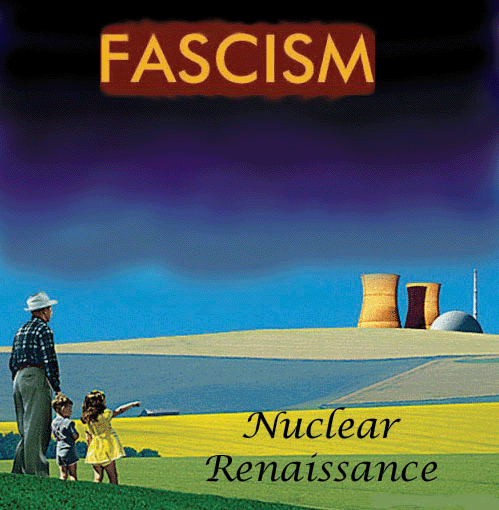
Nuke Power is Trump/Fascist Power…and an Epic Global Failure.

Karl Grossman – Harvey Wasserman, 15 Sept 25, https://www.counterpunch.org/2025/09/15/nuke-power-is-trump-fascist-powerand-an-epic-global-failure/
Donald Trump has torched atomic power’s last illusion of credible regulation. He’s destroyed the last shreds of the U.S. Nuclear Regulatory Commission, exponentially raising the likelihood of an apocalyptic radioactive disaster while escalating America’s transition to energy fascism. His nuclear boosterism has been joined by the core of the Democratic Party, including California’s Governor Gavin Newsom among many others.
But the low-cost zero-carbon tsunami of green Solartopian technology may yet prove unstoppable in the marketplace.
For the first time in US history, a president has fired a sitting NRC commissioner. Another has resigned. A DOGE flunky with zero nuclear expertise has decimated the NRC’s technical support staff.
The NRC has always acted, as the Boston Globe has put it, “more like an industry booster than a watchdog.” But a recent Washington Examiner headline may comprise the Commission’s ultimate epitaph: “Regulators fear dismissal if they slow Trump nuclear power plans.”
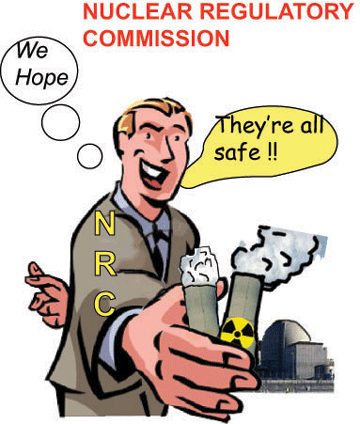
The commissioners themselves have nearly all been absurdly industry-friendly. But the rank-and-file NRC staff offered significant expertise. Now even that is gone.

Trump now loudly demands the commissioners “rubber stamp” Small Modular Reactors that are untested, unproven, uninsured and hyper-expensive. Industry supporters worry that soaring delays and prices followed by underperformance, accidents and radiation releases due to unreliable, unregulated construction could doom the technology.
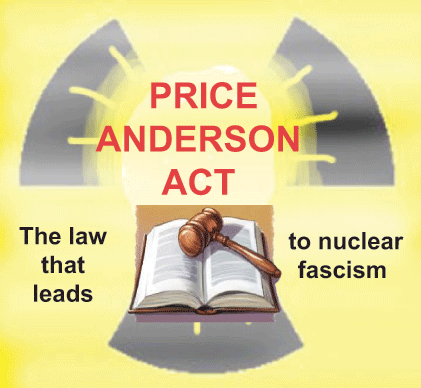
Safety concerns have been confirmed by the refusal of the insurance industry to cover damages from an accident. The refusal stretches back to 1957, when Congress approved the Price-Anderson Act, shielding the industry from a requirement to get private insurance. Thus the “nuclear clause” in every U.S. homeowners policy says: “This policy does not cover loss or damage caused by nuclear reaction or nuclear radiation or radioactive contamination.”
“The NRC has always been a nuclear lapdog, not a watchdog. But under the Trump Administration’s new executive orders” expediting a drive for nuclear power in the U.S. “the lapdog has had its teeth removed. Its vocal cords cut. It can’t bite. It can’t bark, even if it wanted to!” said Arnie Gundersen, a form top executive in the nuclear power industry and now as chief engineer of Fairewinds Associates a leading challenger nuclear power.
As the orders, notes the U.S. Department of Energy, state: “The executive orders instruct the U.S. Nuclear Regulatory Commission to create an expedited pathway to approve reactors” and “expand American nuclear energy capacity from around 100 GW [gigawatts] today to 400 GW by 2050.”
Under Trump, “Nuclear safety is in complete free fall at NRC, and there is no parachute,” said Kevin Kamps, radioactive waste specialist at the organization Beyond Nuclear. “For example, the agency’s staff and licensing board have already shockingly approved an unprecedented, extremely risky restart of the closed Palisades nuclear power plant in Michigan. To restore the operating license, the NRC cobbled together an ad hoc and convoluted regulatory pathway in close collusion with Palisades’ owner, reckless Holtec International. Holtec has zero experience or competence with operating a reactor, repairing one, building or restarting one, let alone at a problem-plagued nuclear lemon like Palisades.”

Palisades is “a badly designed, poorly built, and now dangerously age-degraded 60-year-old reactor that cannot begin to meet modern-day safety standards, which are themselves under serious attack by Trump, DOGE, and the industry,” said Kamps. “If the NRC commissioners reject our appeals and rubberstamp Palisades’ unneeded restart, it will risk a Chornobyl- or Fukushima-scale radioactive catastrophe, an existential threat to 21 percent of the entire planet’s surface freshwater supply, the Great Lakes.”
Further, by approving the Palisades restart, the NRC appears to be getting ready to approve “copycat closed reactor restarts at Three Mile Island-1 nuclear power plant in Pennsylvania, and the Duane Arnold nuclear power plant in Iowa,” he said.
Said Tim Judson, executive director of the Nuclear Information and Resource Service: “The atmosphere in the agency is clearly one where people who speak out will likely be first on the DOGE reduction-in-force list and everyone left is on notice that they could be next. As much as the chilling effect, my concern is also that inspections and enforcement could well be ending. Even if they keep resident inspectors at reactors to comply with the Atomic Energy Act, they may be taken off inspection duty and told to work on license applications and rewriting the regulations.”
Said Michel Lee, chairman of the Council on Intelligent Energy & Conservation Policy:
“To truly understand the developing safety and security threat, you have to connect the dots.”
“First you have the series of Trump executive orders demanding a rushed buildout of the nuclear-military-industrial complex. These orders and other actions being undertaken by administration, especially DOGE, are effectively dismantling the nation’s long-established nuclear regulatory scheme,” said Lee, an attorney.
“Cost-benefit analysis is being directed to focus on the ‘benefits’ of nuclear,” she continued. “Transparency is being drastically reduced. The Nuclear Regulatory Commission is being ‘reformed,’ and its mission now explicitly includes ‘facilitating nuclear power.’ The Department of Energy and the Department of Defense—apparently now the “Department of War”—are now designated as facilitators in the processing of nuclear reactor license applications. This whole enterprise is stated as needed for national security and to promote energy intensive industries, namely AI.”

“So, all that is worrisome enough. Now connect the dots with the demolition derby going on across the broader federal regulatory landscape, with other independent agencies and boards deemed no longer independent and the vast numbers of federal employees—the ones not laid off—losing labor union rights and protections,” said Lee. “Connect the dots and draw your own picture.”
Among the complex of 94 licensed nuclear power plants in the United States, the myriad owners display wildly varying levels of competence, corruption and criminal behavior.
In the 1979 Three Mile Island disaster, the NRC and plant owners lied about radiation releases, their health impacts, and the reactor’s melted core. They produced no credible epidemiological studies of radiation impacts on nearby downwinders but still claim without basis that “no one was harmed.”
In California, NRC resident site inspector Dr. Michael Peck was purged by the NRC for warning that Diablo Canyon’s reactors cannot withstand a credible earthquake. His warning was trashed. Had any of the many large earthquakes that have recently shaken our planet hit in central California in the fault-studded area where Diablo Canyon is located, downwind Los Angeles could now be a radioactive wasteland.
Diablo’s owner, Pacific Gas & Electric, has pleaded guilty to 92 federal manslaughter felonies for incinerating eight San Bruno, California residents in an avoidable 2010 gas pipeline fire, and more than 80 people who perished after PG&E ignited the Northern California infernos that destroyed the California town of Paradise.
The owners of the decrepit Davis-Besse and Perry nuclear power plants bribed Ohio’sHouse Speaker, now in federal prison, with $61 million.
Despite the vulnerability of all nuclear power plants in the U.S. and the criminal incompetence of so many atomic owner/operators, there are no realistic plans to evacuate any major American city facing radioactive clouds like those that spewed from Chernobyl and Fukushima. And with Trump destroying FEMA and the NRC, the public can expect no workable warning. Without insurance, a public health safety net, or a feasible emergency response apparatus, countless residents of Los Angeles, Chicago, Philadelphia, et. al, will lose their lives, health, homes and property. Martial law will become inevitable.
As renewables advance, the economics of atomic power make ever less sense. Zero new large reactors are under construction in the U.S. The two at the V.C. Summer site in South Carolina have been abandoned, wasting $9 billion. Two at the Vogtle, Georgia nuclear plant site took 15 years to build and cost $40 billon, double their original time frame and price tag.
The 94 operating US plants can’t compete with renewables.

Nor can much-hyped Small Modular Reactors, already plagued with massive overruns, delays, cancellations, and no promise of significant power generation for at least a decade. Unproven plans to reopen dead reactors like Palisades and TMI-1 involve cost projections very far beyond already proven, readily available renewables.
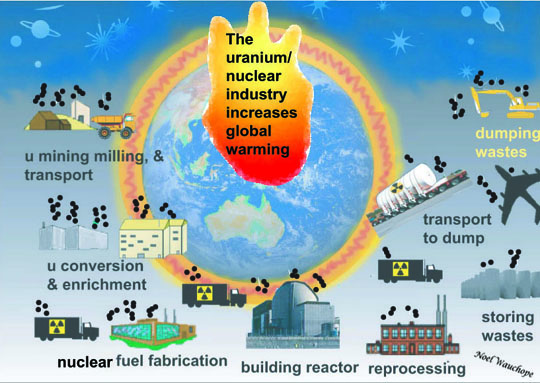
All commercial reactors emit radioactive Carbon14. Additional greenhouse gases come with both reactor operations and the mining, milling, and enrichment of radioactive fuel, along with the as-yet unsolved demands of storing spent stuff.
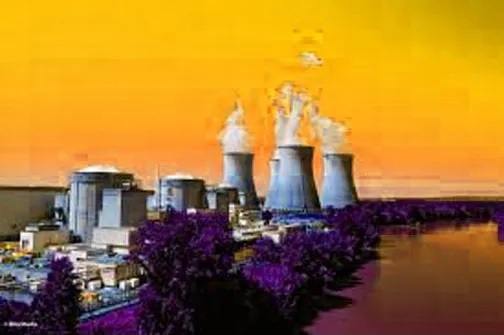
All nuclear power plants scorch the planet at 300 degrees Centigrade, killing billions of fish with hot water outtakes that have repeatedly forced much of the French fleet—among others—to shut. Immensely expensive fusion reactors would burn at 100 million degrees Centigrade, far hotter than the sun.
Major breakthroughs in renewables have made wind, solar, geothermal, wave energy, batteries, and efficiency far cheaper, safer, cleaner, faster-to-build, and more job-producing than nukes or fossil fuels.
Renewables are now capable of producing all the planet’s energy needs at far less cost than any fossil/nuclear generators while operationally creating virtually zero greenhouse gases. Recent advances in wave energy, solar panels installed over aqueducts and canals, “balcony solar” in Germany and elsewhere keep the technology ever on the rise.
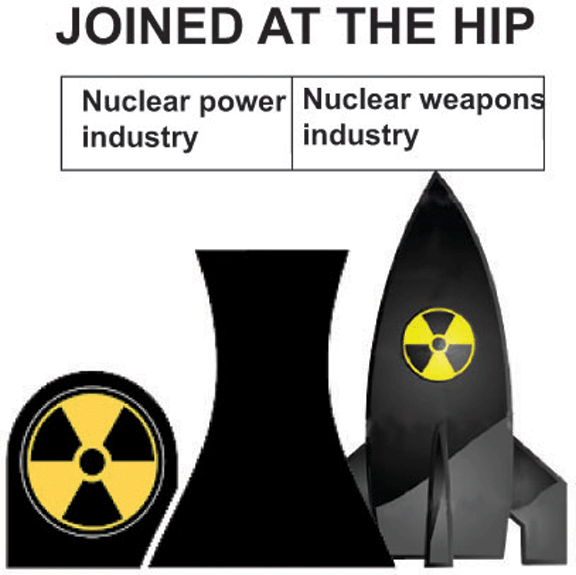
But there are powerful forces still pushing nukes, all of them bound up with fascism. Atomic reactors were first meant to produce fissionable material for atomic weapons. The nuclear power/nuclear war connection has always been intimate.
Trump’s fierce attacks on wind and solar aim primarily to preserve market share for the fossil/nuke billionaires who buy his elections. That income is at the core of American fascism.
Nuke apologists who claim to simultaneously support both atomic power and renewables suffer a deadly delusion. Every dollar wasted on the “Peaceful Atom” delays the vital transition to the green-powered Earth that the human species must have to survive.
Renewable technologies offer the public the power to own and control the
decentralized nature-based power supply essential to any future democracy on this planet—which is precisely what the fossil/nuke industry most hates about them.
Atomic power is a corporate/military-based technology designed to keep all electric and political power under the firm fascist grip of the likes of Donald Trump and his billionaire beneficiaries. Its mission in their eyes is to obliterate all renewables, not to co-exist in some “all the above” delusion.
Nuke reactors burn the planet at 300 degrees Centigrade while spewing radioactive carbon 14, and even more carbon in the mining, milling, enriching, transporting and then burying nuclear fuel. Should any reactor explode it would turn much of the US into a radioactive wasteland while opening the door to martial law and a Trumpian dictatorship.
The astonishing success of new green supply, storage and efficiency has completely dwarfed nukes and fossil fuels in terms of cash, climate and competitive economics.
It’s a revolution that’s been seized by China, handing it near-total control of the export market in wind turbines, solar panels, batteries, electric cars—and thus the global economic future. Worldwide roughly 90% of new energy installations involve wind, solar or batteries, with the vast majority being controlled by the Chinese. The New York Times has recently reported on how China is spectacularly advancing, “pulling away” in “selling clean energy to the world.”
Thus Trump and California Governor Newsom have teamed up with an insane death squad of “liberal” pro-nuke Democrats to decimate the America’s once-vanguard green industries and their long-lost lead in the global economy.
They’re at the same time dooming our democracy to permanent nuclear dictatorship and our economy to the dead-end radioactive dump of a profoundly failed technology—all at once dooming our democracy, our prosperity and our planet. Thankfully, Solartopian green technologies can reverse the death spiral—if we make it happen.
As physicist Amory Lovins, professor of Energy and Environment at Stanford University, has just written: “An intensive influence campaign seeks to resurrect a ‘nuclear renaissance’ from the industry’s slow-motion collapse documented in the independent annual World Nuclear Industry Status Report. Claims that past failures won’t recur have convinced many politicians that socializing nuclear investments rejected by private capital markets, weakening or bypassing rigorous safety regulation, suppressing market competition, and commanding military reactor and data-center projects as a national-security imperative will restore nuclear expansion and transform the economy. This illusion neatly fits the industry’s business-model shift from selling products to harvesting subsidies.”
“A few awkward facts intrude,” Lovins continues. “Even the most skilled firms and nations keep delivering big reactors with several times the promised cost and construction time. A swarm of startup firms that have never built a reactor are dubiously rebranding their inexperience as a winning advantage. New designs are said to be so safe they don’t need normal precautions (though not safe enough to waive nuclear energy’s unique exemption from accident liability). Political interference in nuclear licensing is eroding public confidence. Proposed smaller reactors cost more per kWh, produce more nuclear waste per kWh, and often need more concentrated fuel directly usable for nuclear weapons.”
“And nuclear power faces the same fundamental challenges as fossil fuels: uncompetitive costs, runaway competitors, dwindling profits, and uncertain demand. Few, if any, vendors have made profits selling reactors—only fueling and fixing them. Nuclear electricity loses in open auctions, so only Congressional bailouts–$27 billion ($15 billion paid out) in 2005, $133 billion in 2021-22, tens of billions more in 2025 — saved most existing U.S. reactors from closure.”
“Now comes another vision: powering the glorious new world of artificial intelligence,” Lovins went on. “This may be a trillion-dollar bubble, but it’s sellable until market realities intervene. The International Energy Agency expects data centers, mostly non-AI, to cause only a tenth of global electricity demand growth to 2030, doubling their share of usage—to just 3%. So AI won’t eat the grid. But IEA forecasts renewables will power data-center growth 10-20 times over, while Bloomberg NEF predicts over 100. Nuclear lost the race to power the grid, so new reactors have no business case or operational need.”
Harvey Wasserman wrote the books Solartopia! Our Green-Powered Earth and The Peoples Spiral of US History. He helped coin the phrase “No Nukes.” He co-convenes the Grassroots Emergency Election Protection Coalition at www.electionprotection2024.org Karl Grossman is the author of Cover Up: What You Are Not Supposed to Know About Nuclear Power and Power Crazy. He the host of the nationally-aired TV program Enviro Close-Up with Karl Grossman (www.envirovideo.com)
Fukushima recovery plagued with setbacks

Perhaps the most significant stumbling block, acknowledged by Tepco on July 29, is the “unprecedented” technical complexity of locating, contacting, removing, and containerizing 880 tonnes of highly radioactive melted reactor fuel still smoldering at the bottom of the three devastated reactors.
In 14 years’ time, engineers managed to design, build, test, and rebuild a one-of-a-kind robot that removed less than one-gram of the waste fuel from reactor No. 2 last year. That November “breakthrough” was three years behind schedule, “and some experts estimate that the decommissioning work could take more than a century,” CBS News and Mainichi Japan reported.
Melted fuel, radioactive soil and a struggling fishing industry are some of the lingering legacies of the Fukushima nuclear disaster, writes John LaForge
Japan is one of the most earthquake-prone areas in the world, and the regular quakes raise traumatic memories of the March 11, 2011, record-breaker that left 19,000 dead and smashed the six-reactor Fukushima-Daiichi site. This summer, a magnitude 5.5 quake struck just off Japan’s southeast Tokara coast on July 3; a mag. 4.2 quake hit east of Iwaki, in Fukushima Prefecture July 12; and a mag. 4.1 quake shook the same area July 25.
In late July, a mighty 8.8-magnitude quake struck Avacha Bay in Russia’s Far East, triggering tsunami warnings and evacuations across the entire Pacific Rim. The U.S. Geological Survey said the earthquake was one of the strongest ever recorded.
The owner/operator of the wrecked reactor complex, Tokyo Electric Power Co., evacuated its entire staff of 4,000 in response to warnings of a possible nine-foot tsunami, after first halting its pumping of radioactive wastewater into the Pacific.
Elsewhere in Japan, over 1.9 million people were urged to evacuate the eastern seaboard, and a 4-foot tsunami wave did strike north of Fukushima at Iwate Prefecture, some 1,090 miles from Avacha Bay, site of the major Russian earthquake.
China partially lifts ban on Japanese seafood imports
China “conditionally resumed” the importation of Japanese seafood products on June 30 ⸺ except from the 10 prefectures closest to the Fukushima disaster site ⸺ after conducting water sample inspections off the coast of the site. Beijing had banned all such imports from Japan as a protest and precaution, following the 2023 start of deliberately discharging large volumes of radioactively contaminated cooling water into the Pacific Ocean.
The 2023 ban was imposed to “comprehensively prevent the food safety risks of radioactive contamination caused by the discharge of nuclear wastewater from Fukushima into the sea,” China’s General Administration of Customs said then. Shocked by Japan’s action, Beijing’s Foreign Ministry added that the discharge was an “extremely selfish and irresponsible act,” which would “push the risks onto the whole world (and) pass on the pain to future generations of human beings,” the Agence France-Presse reported.
Chinese customs officials said June 30 the seafood import ban would continue for ten prefectures, namely Fukushima and its nine closest neighboring states. Products from other regions will need health certificates, radioactive substance detection qualification certificates, and production area certificates issued by the Japanese government for Chinese customs declarations, the government said.
Relatedly, Hong Kong announced that it will maintain its ban on Japanese seafood, sea salt, and seaweed imports from the same ten prefectures still targeted by mainland China ⎯ Fukushima, Gunma, Tochigi, Ibaraki, Miyagi, Niigata, Nagano, Saitama, Tokyo, and Chiba ⎯ citing ongoing concerns about the risks associated with the discharge of radioactive wastewater.
Tepco Lost $6 Billion as Meltdown Recovery Falters
Tokyo Electric Power Co. Holdings corporation (Tepco) lost $5.8 billion (903 billion yen) between April and June this year as the owner and operator of the triple reactor meltdown at Fukushima became overrun with the costs of inventing, designing, building, and testing robotic machines with which to remotely extract the ferociously radioactive melted reactor fuel from deep inside the earth-quake and tsunami-wrecked reactors.
There are a total of over 880 metric tonnes of “corium” or melted and rubblized uranium and plutonium fuel in three reactors that Tepco claims it will extract. Nikkei-Asia reported August 1 that Tepco says it has $4.7 billion “earmarked for future demolition work” (700 billion yen), which doesn’t even cover this spring’s one-quarter loss. Tepco has said that its preparations for the extraction are “expected to take 12 to 15 years.”
The quarterly financial loss makes a mockery of announced plans by the government and TEPCO to fully complete decommissioning of the rubbished reactors by 2051.
Two out of 14-to-20-million tonnes of radioactive soil buried on PM’s office grounds, in “safety” parody
In a surreal display of political slapstick on July 19th, the office of Japan’s Prime Minister Shigeru Ishiba buried on his office’s garden grounds two cubic meters of radioactive soil scraped up during Fukushima clean-up operations (in which some 14-to-20 million cubic meters of topsoil and debris were collected) ⎯ “to show it is safe to reuse.”
Nippon Television reported that “The radioactive cesium concentration in the soil being buried is 6,400 Becquerels per kilogram” (Bq/kg). “Becquerels” are a standard measuring unit of radioactivity. The 6,400 is below the legally permitted limit of 8,000 Bq/Kg.
The radiation emitted by the soil originates from cesium-137, which was released in large amounts by Fukushima’s melting and exploding reactors and subsequently fell to the ground as fallout. Cesium fallout continues to contaminate vast areas of forest and farmland in the region.
The millions of tons of collected soil now in storage are being tested and sorted to identify material with cesium at 8,000 Bq/Kg or less. Several million tons of it may then be used as fill in construction projects, road-building, and railway embankments all around Japan. Asphalt, farm soil, “or layers of other materials should be used to seal in the radioactivity,” Akira Asakawa, an Environment Ministry official with the soil project, told the Agence France-Presse.
The PM’s demonstration plot is the first “reuse” of the poisoned waste, while experiments elsewhere have been halted due to public protest. The PM’s contaminated dirt was covered up with about eight inches of normal soil to provide some radiation shielding.
Any radiation exposure is unsafe, but adverse effects like radiation sickness, immune disorders, or cancers caused by contact with the radioactive soil would take years or decades to appear, owing to the latency period between radiation exposure and the onset of induced health problems. The joke seems to be that since Prime Minister Ishiba hasn’t dropped dead after walking by, low-dose exposure must be harmless.
Readers may remember a very similar high-level comedy sketch performed by former President Barack Obama, who traveled to Flint, Michigan in May 2016. Drinking water supplies there had been contaminated with lead and to calm the public uproar, Obama sat before the cameras and theatrically downed a glass of water. The straight-faced routine was proof positive and rock-solid confirmation beyond a doubt that Flint’s tap water was safe to drink. Bottom’s up!
Fukushima Disaster Response to Last Eons
Countless dilemmas and setbacks have plagued the now 14-year-long emergency response to the triple reactor meltdown and widespread radiation releases that began on March 11, 2011, at Fukushima on Japan’s northeast coast.
Perhaps the most significant stumbling block, acknowledged by Tepco on July 29, is the “unprecedented” technical complexity of locating, contacting, removing, and containerizing 880 tonnes of highly radioactive melted reactor fuel still smoldering at the bottom of the three devastated reactors.
Unprecedented is the key word here, since the industry has never before had to contain such a large mass of wasted and unapproachable radioactivity. All the work of dealing with the wasted fuel must be done robotically and remotely, since the waste’s fierce radioactivity kills living things that come near. Just planning and preparing to remove the “corium” material will take at least another 12 years.
Toyoshi Fuketa, head of a regulatory body overseeing the site, said at a press conference earlier that “The difficulty of retrieving the first handful of debris has become apparent,” the Kyodo News agency reported.
In 14 years’ time, engineers managed to design, build, test, and rebuild a one-of-a-kind robot that removed less than one-gram of the waste fuel from reactor No. 2 last year. That November “breakthrough” was three years behind schedule, “and some experts estimate that the decommissioning work could take more than a century,” CBS News and Mainichi Japan reported.
The torturously slow process has made Tepco’s early prediction of complete cleanup by 2051 (40 years’ time) appear to have been made up for PR reasons.
Tepco said July 29 that it would need another 12 to 15 years’ worth of preparation ⎯ until 2040 ⎯ “before starting the full-scale removal of melted fuel” at the No. 3 reactor. Tepco earlier claimed that “full-scale” extraction would begin four years ago, in 2021 according to the daily Asahi Shimbun August 1.
Of an estimated 880 tons of debris, only 0.9 grams have been recovered to date. With one million grams in a tonne, Tepco has only 879 million-plus grams to go, and “A simple calculation based on the time since the accident suggests the removal process could take another 13.6 billion years to complete,” the Asahi Shimbun smirked.
China’s reactor report card omits embarrassing emission info’
China issues annual reports on its extensive nuclear power operations known as “China Nuclear Energy.” The 2024 edition, its latest, made headlines by omitting for the first time information on the routine radioactive gases and liquids released from its operating reactors.
Kyodo News reported that the omission may be a way to avoid accusations of hypocrisy, as China has strenuously condemned Japan’s discharge of radioactively contaminated wastewater into the Pacific. At the same time China’s domestic reactors in 2022 reportedly “released wastewater containing tritium at levels up to nine times higher than the annual discharge limit” set by Japan’s discharge authorities. ###
John LaForge is a Co-director of Nukewatch, a peace and environmental justice group in Wisconsin, and edits its newsletter. This article first appeared on Counterpunch.
David versus Goliath: the battle of a small indigenous community against a federal radioactive waste dump.

There are fewer than 500 of them, but they have managed to put a stop to a federal nuclear waste dump project worth several hundred million dollars…
Anne Caroline Desplanques, Journal de Montréal, September 19, 2025, https://tinyurl.com/mwuymkjp
Federal authorities plan to store the remains of the Bécancour nuclear power plant, Gentilly-1, in a dump in Chalk River, on the edge of the drinking water source for millions of Quebecers.
At a time when the Carney government is promoting nuclear power as one of the ways to make Canada an energy superpower, our investigative team has obtained rare access to this ultra-secure complex, which Ottawa wants to hand over to the Americans. We spoke with citizens and experts who are concerned about the environment and the country’s sovereignty.
There are only 365 Anishinabeg living in the tiny Kebaowek First Nation reserve in Abitibi-Témiscamingue. But through their lawyers, they have succeeded in putting a hold on a multi-million-dollar federal radioactive waste dump project on their traditional territory.
In February, the Federal Court ruled that the Canadian Nuclear Safety Commission had not obtained the free, prior, and informed consent of Indigenous peoples before authorizing the construction of the dump, in violation of the United Nations Declaration on the Rights of Indigenous Peoples.
In March, the court determined that the project endangers several species, including the spotted turtle, a threatened species less than 30 centimeters long that lives for about 50 years and reproduces infrequently, as it does not reach sexual maturity until around 20 years of age.
Federal lawyers have appealed both decisions. If they fail to convince the courts, Canadian Nuclear Laboratories (CNL) and Atomic Energy of Canada Limited (AECL) will have to go back to the drawing board and resume consultations. In the meantime, the project, called the “near-surface waste management facility,” is on hold.
A geotextile membrane to contain radioactivity
It is intended to be a permanent storage and disposal site for up to one million cubic meters of radioactive waste. The waste will be placed on a layer of clay, sand, and geotextile approximately 1.5 meters thick, and covered with another layer of sand, rock, and a membrane.
This is not enough to protect the environment from PCBs, asbestos, heavy metals, and dozens of radioactive elements that CNSC plans to bury there, fears physicist Ginette Charbonneau of the Ralliement contre la pollution radioactive (Coalition Against Radioactive Pollution).
” Radioactive waste cannot be disposed of, it can only be isolated. For that, you need more than a membrane,” she insists.
CNSC assures that this buried waste will have “low-level” contamination and will therefore no longer pose a danger to the environment and health in 500 years, at the end of the containment cells’ useful life.
A pile of waste
But nuclear chemist Kerry Burns has his doubts. Retired from Atomic Energy of Canada since 2010, he was tasked with analyzing waste from the Chalk River laboratories to determine its radioactive content.
He explains that, in the past, CNL buried tons of waste in the sand, which they now plan to exhume and place in their new landfill. However, there are no records indicating the precise level of contamination, he says, describing a gigantic pile of mixed waste.
The project site has too much risk to leave anything to chance, insists the scientist: the landfill will be only one kilometer from the Ottawa River in sandy, porous soil.
“If the contamination escapes from the cells, it will very quickly find its way into the water, and it will be extremely difficult to measure and stop,” he warns.
Like Ms. Chabonneau, Mr. Burns argues that the materials should be isolated in a deep geological repository far from water sources.
This is the method used by one of the American companies chosen to manage CNL, Amentum: it isolates low-level waste in New Mexico in the Waste Isolation Pilot Plant (WIPP), which has isolation chambers 660 meters underground.
Trump and the Shadow of Fascism
22 September 2025 Michael Taylor, https://theaimn.net/trump-and-the-shadow-of-fascism/
In recent months, accusations that Donald Trump and his administration embody fascism have become more frequent. The word carries historical weight, and using it carelessly risks turning it into a mere insult. But the question is worth asking seriously: how many characteristics of fascism can be seen in Trump’s presidency – and his ongoing movement?
Political theorists have identified common traits of fascist regimes: cult of personality, scapegoating of minorities, attacks on the press, obsession with law and order, disinformation, and disdain for democratic norms. Viewed through this lens, Trump and his administration tick many of the boxes.
Trump has built a cult of personality unlike any modern U.S. president, insisting that loyalty to him is more important than loyalty to law or country. He scapegoats immigrants, Muslims, and political opponents, framing them as existential threats to “real Americans.” He repeatedly called the media “the enemy of the people,” sought to revoke press credentials, and encouraged investigations into his critics.
Perhaps most concerning was his open disdain for democratic norms. From loyalty tests for judges and civil servants to his attempt to overturn the 2020 election, Trump treats democracy as conditional – acceptable only if it delivered the outcome he wanted.
Where the comparison to fascism is less exact is in the total control of society and the economy. Trump has not dissolved Congress, suspended elections (yet), or nationalised industry. The courts, press, and opposition party remain functional, though under immense and constant pressure. This distinction is crucial, but it may also reveal fascism’s modern adaptation rather than its absence. Historical fascism seized power through overt revolution; the Trumpist method appears to be the exploitation of democratic institutions from within, using their inherent weaknesses and freedoms – such as free speech and political polarisation – to consolidate power. The goal seems not to be to abolish the system outright, but to render it so subservient to a single leader that its formal structures become a façade.
What we are left with is not a carbon copy of 1930s Europe but something closer to what scholars call “authoritarian populism” or “illiberal democracy.” Still, the overlap is close enough to warrant alarm. The cult of personality, the scapegoating, the attacks on democratic institutions – these are not harmless quirks of an unconventional politician. They are warning signs.
These signs are amplified by a key tactic of modern authoritarianism: the creation of a parallel information ecosystem. Through relentless propaganda, the delegitimisation of factual reporting, the embrace of conspiracy theories, and the promotion of outlets that serve as state-media proxies, a significant portion of the population is persuaded to live in a reality defined not by shared facts, but by the leader’s will. This breaks the common ground necessary for democratic debate and makes accountability impossible.
If anything, Trump’s movement shows how easily a democracy can slide toward authoritarianism without formally abolishing elections or rewriting constitutions. The question now is not whether Trumpism matches fascism perfectly, but whether we are willing to ignore the unmistakable echoes. The history of the 20th century teaches us that fascism does not arrive in a day; it arrives in degrees, often masked by populist appeal and enabled by those who believe the institutions are too strong to fail. The warning is not that America has become a fascist state, but that it has proven vulnerable to the very playbook that leads there.
First of four containers of tritium waste at LANL has been vented
By Alaina Mencinger amencinger@sfnewmexican.com
Sep 16, 2025
The first of four flanged tritium waste containers awaiting removal from Los Alamos National Laboratory has been vented, the New Mexico Environment Department announced Tuesday afternoon.
The container can now be moved for treatment at LANL and then, eventually, to an off-site disposal area.
No internal pressure was found in the first container, according to the National Nuclear Security Administration, suggesting the inner containers in the flanged tritium waste container hadn’t leaked. Air monitoring did not show an increase of tritium beyond background levels, the federal agency wrote…………………………………
This weekend, several groups, including Communities for Clean Water, urged state and federal officials to stay the venting and requested additional guidance on precautionary measures. The New Mexico Environmental Law Center drafted a letter to Gov. Michelle Lujan Grisham on Friday asking the state leader to halt the process.
“This project is the direct result of decades of mismanagement,” Joni Arends of Concerned Citizens for Nuclear Safety stated in a news release ahead of scheduled weekend venting. “Instead of investing in real solutions like filtration or long-term storage until decay, DOE is forcing our communities to accept dangerous shortcuts.” https://www.santafenewmexican.com/news/local_news/first-of-four-containers-of-tritium-waste-at-lanl-has-been-vented/article_4b5cf404-0458-4880-ba3f-7a1c754a500e.html
Imagine There Was A Violent Cult Committing Atrocities With Impunity
Caitlin Johnstone, Sep 21, 2025, https://www.caitlinjohnst.one/p/imagine-there-was-a-violent-cult?utm_source=post-email-title&publication_id=82124&post_id=174131078&utm_campaign=email-post-title&isFreemail=true&r=1ise1&triedRedirect=true&utm_medium=email
Imagine there was a violent cult that used scriptures from an ancient religion to convince its followers to do evil things.
Imagine the cult was given its own state.
Imagine the cult was given machine guns, tanks and war planes.
Imagine the cult obtained nuclear weapons.
Imagine the cult started committing genocide against the indigenous people who’d been living in the area where the cult’s state was established.
Imagine the cult had huge branches in the most powerful nation on earth, and the powerful nation defended the cult no matter what it did.
Imagine the cult flipped out and started relentlessly attacking and invading the surrounding nations.
Imagine the cult had so much influence and support in western society that western governments and institutions would censor, silence, fire, marginalize and deport anyone who criticized the cult’s actions.
Imagine the western media sympathized highly with the cult and spent the entire time framing its atrocities as entirely reasonable defensive actions, and framing critics of the cult as malicious bigots.
Imagine the cult kept getting crazier and crazier and more and more violent, but nobody could find a way to stop it because its actions were backed by this giant western power structure.
That’d suck, huh?
I think that’d be just about the most bat shit insane situation anyone could possibly imagine.
A nuclear-armed death cult just murdering and massacring mountains of human beings with total impunity, backed by the most powerful people on earth? That would be an unfathomable madness.
If someone made a movie about such a thing I’d stop watching halfway through, because I would find it too unbelievable.
I’d be like, come on man. Come up with a more realistic plot line. And come up with a more believable antagonist; nobody is that evil.
I’d be like come on Hollywood, you seriously expect me to maintain my suspension of disbelief when you’re putting out a movie about these cartoonishly evil bad guys who blow up hospitals and assassinate journalists and murder humanitarian workers and deliberately massacre starving civilians seeking food?
I’d be like, you really expect me to believe a violent cult could get all this power and do all these evil things and get away with it, just by lying about it all the time? Eventually people would stop believing their lies!
I’d be like, somebody would stop them. Not only does this movie have unbelievable antagonists, it also lacks any believable protagonists. Basic human decency would compel the world to stop all these atrocities being committed right out in the open. Where are the heroes in this story?
And then I’d storm out of the movie theater, glad to be outside that horrible fictional world where such freakish absurdities were taking place.
And then I’d stand in the parking lot and look up at the sky, and thank God I’m back in reality again.
How Iran Just Proved the West Doesn’t Want a Nuclear Deal: Another War for Israel Near
Palestine Chronicle, September 20, 2025, By Robert Inlakesh
The UN Security Council’s rejection of sanctions relief for Iran marks the final collapse of the JCPOA, pushing Tehran toward confrontation and closing the door on future diplomacy.
This Friday, the United Nations Security Council (UNSC) voted to reject the continuation of sanctions relief for Iran, meaning that the end result of the Obama-era nuclear deal has been an even greater economic blow to Tehran. Not only does this send the message of war, but it also eliminates any hope for future agreements and cooperation.
The UNSC vote represented a death blow to the Joint Comprehensive Plan of Action (JCPOA), otherwise known as the Iran Nuclear Deal. As a result of this vote, a major shift is about to occur that will have enormous violent reverberations.
When the JCPOA was originally negotiated back in 2015, part of the agreement was an in-built mechanism that would permit “snap-back” sanctions to be applied against Iran, should it fail to apply to its side of the agreement.
In late August, the E3 countries – Britain, France, and Germany – had initiated a 30-day process, which would lead to the imposition of these “snap-back” sanctions, unless Iran decided to meet unrealistic demands that they knew wouldn’t be met. Now, as per the UNSC vote to block sanctions relief on Iran, the Islamic Republic has been given until September 28 to reach a significant deal to block the imposition of sanctions.
In response to this, Russia, China, Algeria, and Pakistan, who had voted for the continuation of sanctions relief, condemned the move of the Security Council and even indicated they would not comply with such sanctions.
So, why is this a bombshell decision?
Some media commentators and analysts are treating this UNSC decision as a simple road to more sanctions and pressure on Tehran. As is usually the case, however, the devil is in the details, and to understand this, we must look to the knock-on effects.
To begin with, there are the implications of domestic Iranian politics. The current President of Iran, Masoud Pezeshkian, is from what is known as the Reformist Camp in Iranian politics. This political movement appealed to more liberal leaning Iranians and advocates opening up ties with the West, making the JCPOA one of their primary projects.
Under the former leadership of Hassan Rouhani, the Iranian negotiating team that was headed by Javad Zarif, managed to pull off the Nuclear Deal with the administration of then US President Barack Obama. At the time, it was hailed as a major deal and had even convinced many Iranians that the path of pursuing cordial relations with the West was not only possible, but favorable.
It wasn’t long, however, until the agreement began to come under greater scrutiny, due to an American-European refusal to implement their sides of the bargain. Then came the Presidency of Donald Trump, who in 2018 decided to unilaterally withdraw from the deal and impose a “maximum pressure” sanctions campaign on Iran instead.
At this stage, not only did it appear that the deal had completely fallen apart, but now the sanctions that were being imposed were even more severe than they were prior to the JCPOA in 2015. Yet, there were still efforts being made between the Iranian government and its European counterparts, despite the lack of the EU nations’ willingness to disobey the United States.
Meanwhile, the sanctions against Iran were blocking vital medical supplies from entering the country and further impacting their already suffering economy. Amidst this, the US attempted to stir civil unrest inside of Iran and in 2020 launched an assassination strike against Iran’s top General, Qassem Soleimani, of the Islamic Revolutionary Guard Corps (IRGC)’s Quds Forces.
When it came time for a political change inside the United States, during Joe Biden’s campaign, he had promised to revive the Iran deal. Yet, he failed to follow up on this pledge upon taking office in 2021. Instead, he continued to implement the sanctions of his predecessor…………………………………………………
Ultimately, the Biden administration stalled and failed to achieve any breakthrough, refusing to revive the deal, instead requesting all kinds of additional elements that were considered non-starters by Iran.
On May 19, 2024, tragedy struck inside Iran as its President and other prominent officials were killed in a helicopter crash. This led to a new election cycle, where the Reformists yet again gained power.
Iran’s President, Massoud Pezeshkian, has repeatedly made it clear that he seeks to open up relations with the West and, through his foreign minister, Abbas Araghchi, has sought to make this happen.
When the Trump administration took power, it was clear that the Israelis and the US sought to attack Iran, not to pursue genuine dialogue. Yet, the reformist government pursued diplomacy regardless, as Oman stepped in to mediate talks between delegations headed by Abbas Araghchi and his American counterpart Steve Witkoff.
During the course of these negotiations, on June 13, the Israelis decided to launch an attack that assassinated Iranian generals and nuclear scientists, while striking Iran’s nuclear project. This led to the 12-day war, as it is now being called. The Iranian public, whom the Israelis and US had expected to rebel against their government, did the very opposite and decided instead to rally behind the flag.
The US decided to participate in the Israeli attack, even further weakening the credibility of the United States. What’s more is that Iranian military officials had accused the head of the International Atomic Energy Agency (IAEA), Rafael Grossi, of providing the Israelis with sensitive information about Iran’s nuclear program.
As a result of this, the Iranian parliament passed a bill that barred the IAEA from the country, as various lawmakers called for pressing legislation that would lead to Tehran’s withdrawal from the Nuclear Non-Proliferation Treaty (NPT).
Instead, the reformist government decided to still desperately pursue talks with the Europeans, signed another agreement that re-invited the IAEA into their country to monitor the nuclear program, and reached out to try to pursue talks to revive the JCPOA.
This brings us to the broader implications of the UNSC vote and where this leads……………………………………………………………………………..
Either way this goes, the result is going to be conflict, and the more that the reformists attempt to desperately negotiate and are humiliated, the more aggressive the US and Israelis are likely going to be. What this UNSC vote signals is a major shift that has just occurred, from which there can be no going back………………………………………………………………
Iran has desperately tried to pursue the path of negotiations, but has been betrayed, insulted, sanctioned, and physically attacked for its efforts. It is no longer a matter of if the next Iran war will occur, but when. https://www.palestinechronicle.com/how-iran-just-proved-the-west-doesnt-want-a-nuclear-deal-another-war-for-israel-near/
1 This Month




PLEASE OPPOSE HR 8255 AND S.3639 – bills would accelerate satellite deployment, with no environmental review or safeguards – https://ncstd5li.quorum.us/campaign/169331/
To see nuclear-related stories in greater depth and intensity – go to https://nuclearinformation.wordpress.com
-
Archives
- September 2026 (323)
- August 2026 (330)
- July 2026 (355)
- June 2026 (287)
- May 2026 (306)
- April 2026 (356)
- March 2026 (251)
- February 2026 (267)
- January 2026 (308)
- December 2025 (358)
- November 2025 (359)
- October 2025 (375)
-
Categories
- 1
- 1 NUCLEAR ISSUES
- business and costs
- climate change
- culture and arts
- ENERGY
- environment
- health
- history
- indigenous issues
- Legal
- marketing of nuclear
- media
- opposition to nuclear
- PERSONAL STORIES
- politics
- politics international
- Religion and ethics
- safety
- secrets,lies and civil liberties
- spinbuster
- technology
- Uranium
- wastes
- weapons and war
- Women
- 2 WORLD
- ACTION
- AFRICA
- Atrocities
- AUSTRALIA
- Christina's notes
- Christina's themes
- culture and arts
- Events
- Fuk 2022
- Fuk 2023
- Fukushima 2017
- Fukushima 2018
- fukushima 2019
- Fukushima 2020
- Fukushima 2021
- general
- global warming
- Humour (God we need it)
- Nuclear
- RARE EARTHS
- Reference
- resources – print
- Resources -audiovicual
- Weekly Newsletter
- World
- World Nuclear
- YouTube
-
RSS
Entries RSS
Comments RSS

