EDF’s plan to decommission Hinkley Point B approved despite regulator’s concerns
31 Oct, 2025 By Tom Pashby
The Office for Nuclear Regulation (ONR) has approved EDF’s plans for the
decommissioning of its Hinkley Point B nuclear power station, despite
wide-ranging concerns raised by organisations, including the Environment
Agency, which regulates the nuclear sector.
New Civil Engineer 31st Oct 2025, https://www.newcivilengineer.com/latest/edfs-plan-to-decommission-hinkley-point-b-approved-despite-regulators-concerns-31-10-2025/
Trump’s testing plans for US nuclear weapons won’t include explosions, energy secretary says
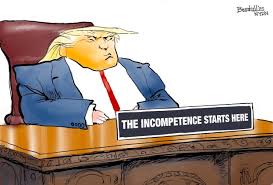
Confusion does, too!
By AAMER MADHANI, November 3, 2025, https://apnews.com/article/trump-nuclear-weapons-testing-explosions-wright-energy-a920fc10aff85243cb6895fad55b2839
New tests of the U.S. nuclear weapons system ordered up by President Donald Trump will not include nuclear explosions, Energy Secretary Chris Wright said Sunday.
It was the first clarity from the Trump administration since the president took to social media last week to say he had “instructed the Department of War to start testing our Nuclear Weapons on an equal basis.”
“I think the tests we’re talking about right now are system tests,” Wright said in an interview on Fox News’ “Sunday Briefing.” “These are not nuclear explosions. These are what we call noncritical explosions.”
Wright, whose agency is responsible for testing, added that the planned testing involves “all the other parts of a nuclear weapon to make sure they deliver the appropriate geometry and they set up the nuclear explosion.”
The confusion over Trump’s intention started minutes before he held a critical meeting in South Korea with Chinese President Xi Jinping. Trump took to his Truth Social platform and appeared to suggest he was preparing to discard a decades-old U.S. prohibition on testing the nation’s nuclear weapons.
Later that day, as he made his way back to Washington, Trump was coy on whether he really meant to say he was ordering the resumption of explosive testing of nuclear weapons — something only North Korea has undertaken this century — or calling for the testing of U.S. systems that could deliver a nuclear weapon, which is far more routine.
He remained opaque on Friday when asked by reporters about whether he intended to resume underground nuclear detonation tests.
“You’ll find out very soon,” Trump told reporters aboard Air Force One on Friday, as he headed to Florida for a weekend stay.
The U.S. military regularly tests its missiles that are capable of delivering a nuclear warhead, but it has not detonated the weapons since 1992. The Comprehensive Nuclear Test Ban Treaty, which the U.S. signed but did not ratify, has been observed since its adoption by all countries possessing nuclear weapons, North Korea being the only exception.
Trump announced his plans for nuclear tests after Russia announced it had tested a new atomic-powered and nuclear-capable underwater drone and a new nuclear-powered cruise missile.
Russia responded to Trump’s nuclear testing comments by underscoring that it did not test its nuclear weapons and has abided by a global ban on nuclear testing.
The Kremlin warned though, that if the U.S. resumes testing its weapons, Russia will as well — an intensification that would restart Cold War-era tensions.
Pentagon Tells Congress It Doesn’t Know Who It’s Killing in Latin American Boat Strikes
by Dave DeCamp | October 30, 2025 , https://news.antiwar.com/2025/10/30/pentagon-tells-congress-it-doesnt-know-who-its-killing-in-latin-american-boat-strikes/
US War Department officials don’t know the identities of the 61 people who have been extra-judicially executed in US military strikes on boats in the waters near Venezuela and in the Eastern Pacific Ocean, POLITICO reported on Thursday, citing House Democrats who attended a classified briefing on the campaign.
“[The department officials] said that they do not need to positively identify individuals on these vessels to do the strikes, they just need to prove a connection to smuggling,” said Rep. Sara Jacobs (D-CA). “When we tried to get more information, we did not get satisfactory answers.”
While the Trump administration has cited overdose deaths in the US related to fentanyl to justify the bombing campaign, lawmakers were told in the briefing that the boats that have been targeted were allegedly smuggling cocaine, though the Pentagon has not provided evidence to back up its claims about what the vessels were carrying.
“They argued that cocaine is a facilitating drug of fentanyl, but that was not a satisfactory answer for most of us,” Jacobs said.
The briefing on Thursday came after the Pentagon shut out Democrats from another briefing it held with Republicans a day earlier, which left Democratic senators fuming. Democrats who attended Thursday’s briefing said Pentagon lawyers were pulled from the meeting at the last minute.
“Am I leaving satisfied? Absolutely not. And the last word that I gave to the admiral was, ‘I hope you recognize the constitutional peril that you are in and the peril you are putting our troops in,’” Rep. Seth Moulton (D-MA) told reporters after the briefing, according to CNN.
Jacobs said that, based on what she was told, even if Congress authorized the bombing campaign, it would still be illegal. “[T]here’s nothing that we heard in there that changes my assessment that this is completely illegal, that it is unlawful and even if Congress authorized it, it would still be illegal because there are extrajudicial killings where we have no evidence,” she said.
Criticism of the US bombing campaign has also come from Republicans, most prominently from Sen. Rand Paul (R-KY). “No one said their name, no one said what evidence, no one said whether they’re armed, and we’ve had no evidence presented,” Paul said this week of the people who have been targeted. “They summarily execute people without presenting evidence to the public … so it’s wrong.”
Paul has joined Senate Democrats in introducing a War Powers Resolution aimed at preventing the Trump administration from starting a war with Venezuela amid threats of US strikes on the country aimed at ousting President Nicolas Maduro and a major US military buildup in the region. A vote on the bill is expected to happen next week.
Francesca Albanese names over 60 states complicit in Gaza genocide

The special UN rapporteur was sanctioned by the US earlier this year for naming companies profiting from the genocide
News Desk, OCT 29, 2025, https://thecradle.co/articles/francesca-albanese-names-over-60-states-complicit-in-gaza-genocide
The UN special rapporteur for the occupied Palestinian territories, Francesca Albanese, told the General Assembly on 28 October that 63 countries, including key western and Arab states, have fueled or were complicit in “Israel’s genocidal machinery” in Gaza.
Speaking remotely from the Desmond and Leah Tutu Legacy Foundation in Cape Town, Albanese presented her 24-page report, ‘Gaza Genocide: A Collective Crime,’ which she said documents how states armed, financed, and politically protected Tel Aviv as Gaza’s population was “bombed, starved, and erased” for over two years.
Her findings place the US at the center of Israel’s war economy, accounting for two-thirds of its weapons imports and providing diplomatic cover through seven UN Security Council vetoes.
The report cited Germany, Britain, and a number of other European powers for continuing arms transfers “even as evidence of genocide mounted,” and condemned the EU for sanctioning Russia over the war in Ukraine while remaining Israel’s top trading partner.
Albanese accused global powers of having “harmed, founded, and shielded Israel’s militarized apartheid,” allowing its settler-colonial project “to metastasize into genocide – the ultimate crime against the indigenous people of Palestine.”
She said the genocide was enabled through “diplomatic protection in international fora meant to preserve peace,” military cooperation that “fed the genocidal machinery,” and the “unchallenged weaponization of aid.”
The report also identified complicity among Arab states, including the UAE, Egypt, Bahrain, and Morocco, which normalized ties with Tel Aviv.
Egypt, she noted, maintained “significant security and economic relations with Israel, including energy cooperation and the closing of the Rafah crossing,” tightening the siege on Gaza’s last humanitarian route.
Albanese warned that the international system now stands “on a knife-edge between the collapse of the rule of law and hope for renewal,” urging states to suspend all military and trade agreements with Tel Aviv and build “a living framework of rights and dignity, not for the few, but for the many.”
Her presentation provoked an outburst from Israel’s envoy Danny Danon, who called her a “wicked witch.”
Frascnesca fired back, saying, “If the worst thing you can accuse me of is witchcraft, I’ll take it. But if I had the power to make spells, I would use it to stop your crimes once and for all and to ensure those responsible end up behind bars.”
Human rights experts described the report as the UN’s most damning indictment yet of Israel’s ongoing genocide in Gaza.
Albanese had previously been sanctioned by the US in July, after releasing a report that exposed western corporations profiting from Israel’s genocide in Gaza.
The 27-page report, ‘From Economy of Occupation to Economy of Genocide,’ named over 60 companies, including Lockheed Martin, Caterpillar, Microsoft, Palantir, and Hyundai, for aiding and profiting from Israel’s settlements and military operations, and called for their prosecution at the International Criminal Court (ICC).
US Secretary of State Marco Rubio accused Albanese of waging a “campaign of political and economic warfare against the United States and Israel,” announcing the sanctions as part of Washington’s effort to counter what he called “lawfare.”
The move drew sharp condemnation from UN officials and rights groups, who warned that it threatened global accountability mechanisms.
Donald Trump’s Nuclear Announcement Sparks Alarm: ‘He Is Misinformed’

“It’s incoherent, it’s illogical and when it comes to nuclear weapons, we simply cannot afford the kind of zig-zagging policies that we’re seeing from Trump on so many other topics.”
Oct 30, 2025,
https://www.newsweek.com/donald-trumps-nuclear-announcement-sparks-alarm-10967374
The resumption of nuclear weapons testing by the United States will undermine national security, arms control advocates told Newsweek.
Daryl Kimball, executive director of the Arms Control Association, denounced President Trump’s directive for the Department of War to immediately restart nuclear weapons testing for the first time in more than 30 years as reckless and unclear.
“Somebody needs to talk to an adult at the White House and find out what the heck he’s talking about,” Kimball told Newsweek early Thursday. “I can’t discern his grumblings beyond what you can. If he’s talking about resuming weapons test explosions for the first time since 1992, he is misinformed about what that’s for and whether it’s necessary.”
Kimball said Trump’s announcement on Truth Social on Wednesday was likely to spark strong opposition in Nevada, where the last nuclear detonations in the U.S. occurred underground, as well as potential ramifications abroad.
“It’s not militarily, technically or politically necessary,” Kimball continued. “It would lead to a chain reaction of nuclear tests by other countries, including Russia, probably North Korea, maybe China, and it would undermine U.S. security because the United States has conducted more nuclear tests — 1,030 — than any other country.”
Trump’s proposal will also face “tremendous opposition” from Congress, Kimball said, including legislators in Nevada like U.S. Rep. Dina Titus, who indicated late Wednesday she intends to introduce legislation to “put a stop” to Trump’s proposed shift.
The resumption of nuclear testing at the former site in Nevada would take up to 36 months and cost up to “hundreds of millions,” Kimball said.
“Many hundreds of millions of dollars,” he said. “If you can imagine, you’ve got to drill a vertical shaft, you have to bring in cranes, equipment, drillers, personnel. You have to make sure that containment is right and you have to get federal reviews, etcetera, etcetera. Congress would have an opportunity at some point to block this.”
North Korea is the lone country to have conducted a nuclear test explosion this century and the United States signed the Comprehensive Nuclear Test Ban Treaty in 1996, Kimball said.
“Most of all, we need to be asking why,” Kimball added. “What is the purpose? How does this advance our interests? This would take us back to the worst days of the Cold War where the U.S. and the Soviet Union were conducting tit-for-tat atmospheric nuclear test explosions to simply show the other side that we’ve got big bombs too.”
Kimball said Trump’s announcement represented an “incoherence and inconsistency” regarding nuclear weapons, citing prior recent calls to denuclearize.
“And now he’s talking about responding with our own nuclear tests,” he explained. “It’s incoherent, it’s illogical and when it comes to nuclear weapons, we simply cannot afford the kind of zig-zagging policies that we’re seeing from Trump on so many other topics.”
A message seeking additional details from the White House on Trump’s directive was not immediately returned on Thursday.
Alicia Sanders-Zakre, policy and research coordinator for the International Campaign to Abolish Nuclear Weapons (ICAN), characterized Trump’s announcement as “incoherent, untrue and alarming,” alleging his misrepresented the size of arsenals in the U.S., Russia and China.
Trump has also mistakenly claimed that China and Russia are currently testing nuclear weapons and directed the incorrect agency — the Department of War — to resume testing rather than the Department of Energy, which oversees the nation’s nuclear warheads, Sanders-Zakre said.
“The fact that Trump referenced Russian and Chinese activities and the Department of War could be interpreted as signaling that he was referring to testing nuclear-capable missiles, which all three countries do regularly test,” she told Newsweek.
The most recent nuclear test in the United States took place at the Nevada National Security Site, where nearly 1,000 detonations have occurred. Other U.S.-led detonations have happened in New Mexico, the Marshall Islands and Kiribati in the central Pacific, where joint testing occurred with the United Kingdom, Sanders-Zakre said.
In 2005, the National Cancer Institute estimated that 22,000 cancers resulting in 11,000 U.S. deaths would be caused in the aftermath of the Nevada nuclear tests, Sanders-Zakre added.
“Nuclear detonations in the Pacific obliterated entire atolls, and left others uninhabitable to this day,” she wrote in an email. “It was due in large part to the nationwide and global opposition to nuclear test detonations – and their clear devastating impacts for people and the environment – that nuclear test detonations were prohibited by the Comprehensive Test Ban Treaty in 1996.”
Any move by the United States to restart nuclear testing will evoke “widespread national and global condemnation,” Sanders-Zakre said.
The United States is slated to spend $95 billion on its nuclear arsenal per year over the next decade and ICAN estimated global nuclear spending last year at $100 billion, she said.
“Any additional funds wasted on weapons of mass destruction is diverting resources that could address real security needs,” Sanders-Zakre wrote in an email.
A senior Russian lawmaker, meanwhile, also warned Thursday that any move by the United States to resume nuclear testing could trigger global instability.
Dr. Emma Belcher, a nuclear proliferation expert at Ploughshares, a nonprofit that aims to reduce nuclear threats, described Trump’s directive as “reckless, needless and dangerous” for national and world security.
“While the details of this policy shift are unclear, including whether Trump is referring to missile testing or explosive nuclear tests, it threatens to upend relations between nuclear-armed states and push the world deeper into a new arms race,” Belcher told Newsweek in a statement. “If the U.S. breaks its 30-year moratorium on nuclear tests, China and Russia will likely return to wide-scale explosive testing. On the international level, this will heighten the risks of great power competition and increase the likelihood that strategic tensions lead to nuclear catastrophe.”
Hegseth to Congress: “I have no idea…”
3 November 2025 AIMN Editorial, By Walt Zlotow , https://theaimn.net/hegseth-to-congress-i-have-no-idea/
Hegseth might as well have told Congress that: “I have no idea who I’m murdering on the high seas… and I don’t care.”
Pete Hegseth’s War Dept held a briefing Wednesday for Congress on their criminal, unconstitutional bombings of small, unarmed boats in the Caribbean and Pacific killing 61 unidentified US murder victims.
Pete’s Murder Unincorporated not divulge the names of the dead, saying that was unnecessary since they were obviously drug smugglers bringing in fentanyl to kill thousands of unsuspecting US drug users. And in Hegseth’s newly renamed Department of War, suspected drug smugglers aren’t interdicted, boats searched and actual drug smugglers arrested. They and their boats are simply blown to bits.
Morally centered Democrats arrived at the hearing poised to object to Hegseth’s murderous lawlessness… but they were turned away. Only high seas murder supporting Republicans were allowed in. Democratic Senator Mark Warner blasted this show hearing:
“It’s not optional (to allow in Democrats). It’s a freakin’ duty. When an administration decides it can pick and choose which elected representatives get the understanding of their legal argument of why this is needed for military force and only chooses a particular party, it ignores all the checks and balances.”
Next day Pete pivoted and allowed Dems in… but barred War Department attorneys who would have to offer legal justification for their boss’ ongoing mass murder on the high seas. Likely reason? If they had an iota of moral, ethical and professional decency they’d say… “Absolutely none.”
Don’t fuel Riyadh’s nuclear weapons cravings
By: Henry Sokolski, October 31, 2025, https://npolicy.org/dont-fuel-riyadhs-nuclear-weapons-cravings-breaking-defense/
Since 2017, US diplomats have tried unsuccessfully to devise ways to help Saudi Arabia enrich uranium — a dangerous nuclear activity that can bring a state to the very brink of making bombs. Next month, they get another chance: Crown Prince Mohammed bin Salman is coming to the White House on Nov. 18 to sign a formal US-Saudi nuclear cooperative agreement. Will this agreement finally help the Kingdom make nuclear fuel? Let’s hope not.
Tehran making nuclear fuel is scary enough. Encouraging others to do the same is scarier still.
That’s why the Pentagon bombed Iran this June. Certainly, the White House understood that nuclear fuel-making was too close to nuclear bomb-making: By the time inspectors might detect a military diversion at such plants, it would be too late to intervene to prevent a weapon from being built.
This insight prompted Trump’s termination of Obama’s 2015 nuclear deal with Iran, which allowed Iran to enrich uranium. It’s also why Trump’s nuclear emissary, Steve Witkoff, backed off trying to negotiate a new inspections regime for Iranian nuclear fuel-making, conceding that “enrichment enables weaponization.” Energy Secretary Chris Wright went further: At the International Atomic Energy Agency’s (IAEA) September general conference, he insisted that Iran’s uranium enrichment program be “completely dismantled.”
But what of the Nuclear Nonproliferation Treaty (NPT) “right” to make nuclear fuel? Iran maintains this entitlement is inalienable. As I’ve explained elsewhere, nuclear fuel-making is not mentioned anywhere in the treaty. Some NPT negotiators proposed language to assure a right to “the entire fuel cycle,” but the NPT conference rejected it. Even the Biden administration, which wanted to revive the 2015 Iran nuclear deal, only implicitly recognized such a “right” — never explicitly.
Iran, unfortunately, never bought this view. Nor has Saudi Arabia. In 2017, Prince Turki Al-Faisal, former Saudi ambassador to Washington, noted that “the NPT tells us all we can enrich.” He, bin Salman, and his lieutenants have consistently demanded that America help it exercise this “right.”
Fortunately, Congress refused. Back in 2018, Senators from the left, like Ed Markey, and the right, like Lindsey Graham, understood helping Iran enrich uranium was too dangerous. They all cited bin Salman’s warning that if Saudi Arabia thought Iran was getting a bomb, it would too, despite any NPT pledge the Saudis may have made. The Hill’s recommended fix: Get the Saudis to forswear making nuclear fuel, just as their neighbor, the UAE, had in their US nuclear agreement in 2009.
Now, it should be easier to get the Saudis to forswear as well. Why? In September, the Saudis struck a mutual defense pact with Pakistan. Pakistani Defense Minister Khawaja Mohammad Asif said that as part of this pact Pakistan would make its nuclear weapons available to Saudi Arabia if needed. So, Riyadh no longer needs its own bomb.
Meanwhile, the White House is said to be negotiating binding, NATO-like security assurances for the Saudis similar to those recently granted to Qatar. Then there is the Trump administration’s “obliteration” of Iran’s nuclear fuel-making capacity and the president’s commitment to bomb it again, if necessary.
All of this should be dispositive against Riyadh’s will to enrich and American inclinations to bend to it. But it’s not. In April, Secretary of Energy Chris Wright visited Riyadh. When asked if a deal would include “sensitive” nuclear technologies, he replied, “It certainly looks like there is a pathway to do that. … Are there solutions to that that involve enrichment here in Saudi Arabia? Yes.”
He should have said no. Keeping timely, accurate track of the powders, liquids, and gases involved in making nuclear fuel is not yet good enough to safeguard against military diversions. Nor is American ownership or operation of Saudi nuclear fuel making a fix. As America’s experience in Iran demonstrates, the United States can operate bases and own companies in foreign nations and still be thrown out. This has happened before and can happen again in Saudi Arabia.
Another headache if America helps Riyadh make nuclear fuel is the example it sets. Saudi Arabia’s neighbors, who also have US nuclear cooperative will demand the same.
They’ll all race to develop bomb options. Saying no to Riyadh’s fuel-making demands is our best chance to skirt this.
Nuclear waste removal under way at silo.

“Because the removal of the waste had not been planned when the building was opened, engineers had to retrofit an exit route for it.“
COMMENT. Doesn’t that tell you everything about the stupidity of the men who design the nuclear industry?
Jonny Manning, Local Democracy Reporting Service, 1 Nov 25, https://www.bbc.com/news/articles/cvgvq930vwpo
Seventy tonnes of radioactive waste have been removed from a nuclear site’s most hazardous building.
Teams at Sellafield in Cumbria have removed the waste from the Magnox Swarf Storage Silos with the company saying it has placed it into safe storage.
The work began in 2022 after two decades of preparation, because when the building was constructed in the 1960s no-one had considered how the waste would be removed.
Sellafield’s head of legacy silos Phil Reeve said so much waste had been removed that a 7m (23ft) crater had been dug in the middle of the pile.
However, the crater presents a risk of the waste around the edges collapsing inwards.
To fix the issue, Sellafield has created its own version of a garden rake – a 1.4 tonne machine which uses its stainless steel arms to pull the nuclear waste into the centre.
“It’s a big moment to see it successfully deployed in an active environment for the first time,” said Mr Reeve.
“It allows us to crack on with confidence.”
Because the removal of the waste had not been planned when the building was opened, engineers had to retrofit an exit route for it.
This involved assembling huge retrieval machines on top of the building’s 22 waste compartments.
One machine is currently up and running with another two set to start soon.
But while work is well under way, the Sellafield team still has about 10,000 tonnes of waste to remove.
Remediation work through £4.6bn Sellafield framework
US engineering and technology firm Amentum and a joint venture of Altrad
Support Services and Atkins Réalis will deliver remediation work at the
Sellafield nuclear power station over the next 15 years. The two bidders
were named for Lot 1 of a £4.6bn Decommissioning and Nuclear Waste
Partnership (DNWP) framework, which covers four lots. Procured by
Sellafield Ltd, the agreement will see chosen contractors support
high-hazard risk reduction programmes at the Cumbrian plant.
Ground Engineering 3rd Nov 2025. https://www.geplus.co.uk/news/pair-bag-remediation-work-through-4-6bn-sellafield-framework-03-11-2025/
Trump Is Moving Relentlessly Toward Illegal War in Venezuela

The lawful procedure would have been to arrest people if there was probable cause they were involved in drug trafficking and bring them to justice in accordance with due process.
Venezuela isn’t even mentioned in the U.S. Drug Enforcement Administration’s National Drug Threat Assessment 2024.
The Trump administration’s murderous strikes on small boats at sea constitute unlawful extrajudicial killings.
By Marjorie Cohn , Truthout, October 30, 2025
s the Trump administration continues to murder people in small boats on the high seas and mounts the largest U.S. military buildup in decades in the Caribbean, it is moving inexorably toward an all-out, illegal attack and forcible regime change in Venezuela.
Despite Team Trump’s feeble attempts to legally justify its ocean strikes, which have now killed 57 people since early September, those extrajudicial killings are also unlawful.
Donald Trump’s murderous campaign came into focus on February 20, when the State Department designated eight drug trafficking organizations, including Tren de Aragua, as foreign terrorist organizations. Although the administration has attempted — so far unsuccessfully — to use that designation to justify sending immigrants to a notorious prison in El Salvador, Trump is now invoking it in an effort to validate his illegal strikes at sea.
Moreover, on March 15, Trump issued “A Proclamation,” alleging that Tren de Aragua has been engaged, in association with Venezuelan President Nicolás Maduro, in “irregular warfare” in the United States, with no explanation of what is meant by irregular warfare. But on February 26, most U.S. intelligence agencies had made a finding that Tren de Aragua was neither controlled by the Venezuelan government, nor was it committing crimes in the United States on its orders.
On September 2, Trump announced that the U.S. had conducted a “kinetic strike” against an alleged drug smuggling vessel in the Caribbean, even though Secretary of State Marco Rubio said the U.S. military could have interdicted the vessel rather than killing all of those on board. Trump wanted to “send a message,” hardly an excuse for premeditated murder.
The lawful procedure would have been to arrest people if there was probable cause they were involved in drug trafficking and bring them to justice in accordance with due process. Both U.S. and international law provide for the arrest of alleged drug traffickers or individuals suspected of acts of terrorism, both on the high seas and in U.S. territorial waters.
In a post on social media accompanied by a video clip of the strike, Trump declared that the attack was “against positively identified Tren de Aragua Narcoterrorists” and referred to the February 20 foreign terrorist organization designation. This did not provide a lawful basis for murdering alleged drug dealers.
Although Trump’s stated rationale is preventing drugs from Venezuela entering the United States, Venezuela isn’t even mentioned in the U.S. Drug Enforcement Administration’s National Drug Threat Assessment 2024.
No State of Armed Conflict, No Unlawful Combatants, No Self-Defense
It was reported in early October that Trump had notified several congressional committees that the U.S. is engaged in a formal “armed conflict” with drug cartels that his administration has branded terrorist organizations, and that suspected drug smugglers are “unlawful combatants” in order to justify the strikes as self-defense………………………………………………………………………………………………………………………………………………………………………………………..
There is no current state of armed conflict, there is no evidence that the people on the boats were combatants, and it is illegal to deliberately attack civilians. “This is not stretching the envelope,” Geoffrey Corn, a retired judge advocate general lawyer who was formerly the Army’s senior adviser for law-of-war issues, told The New York Times. “This is shredding it. This is tearing it apart.”
The strikes on boats also violate the right to life enshrined in the International Covenant on Civil and Political Rights, which the U.S. has ratified, making it part of U.S. law under the Supremacy Clause of the Constitution. The covenant says that “no one shall be arbitrarily deprived of his life.” It outlaws extrajudicial killing outside the context of armed conflict or by law enforcement when necessary to protect against an imminent threat to life.
An Attack on Venezuela Would Be an Unlawful Act of Aggression
In addition to its increasing numbers of murders of alleged drug smugglers at sea, the Trump administration is positioning tremendous military firepower for what appears to be an imminent attack on Venezuela.
Hegseth ordered the USS Gerald R. Ford aircraft-carrier strike group with five destroyers to deploy to the region to “bolster U.S. capacity to detect, monitor, and disrupt illicit actors and activities that compromise the safety and prosperity of the United States,” according to a Pentagon spokesperson.
“The only thing you could use the carrier for is attacking targets ashore, because they are not going to be as effective at targeting small boats at sea,”……………………………………………………………………………………………………………..
Forcible Regime Change Violates Venezuela’s Right to Self-Determination
During his first term, Trump repeatedly voiced his desire to invade Venezuela and change its regime. He was preoccupied with the idea of an invasion, the AP reported.
In 2019, the Trump administration orchestrated an unsuccessful strategy led by Rubio to carry out a coup d’état, seize power from Maduro, and install Juan Guaidó as “interim president” of Venezuela…………………………………………………………………………………………………………..
National courts around the world should investigate and charge U.S. officials, including Trump, Rubio, and Hegseth, with murder under well-established principles of universal jurisdiction.
And we must mobilize a powerful antiwar movement to demand that the U.S. government stop the illegal boat murders and stay out of Venezuela. https://truthout.org/articles/trump-is-gunning-to-illegally-attack-venezuela-and-change-its-regime/?utm_source=Truthout&utm_campaign=33e1b56faa-EMAIL_CAMPAIGN_2025_10_30_09_26&utm_medium=email&utm_term=0_bbb541a1db-33e1b56faa-650192793
If the US resumes nuclear weapons testing, this would be extremely dangerous for humanity
Tilman Ruff, Honorary Principal Fellow, School of Population and Global Health, The University of Melbourne, October 30, 2025, https://theconversation.com/if-the-us-resumes-nuclear-weapons-testing-this-would-be-extremely-dangerous-for-humanity-268661?utm_medium=email&utm_campaign=Latest%20from%20The%20Conversation%20for%20October%2031%202025%20-%203566936381&utm_content=Latest%20from%20The%20Conversation%20for%20October%2031%202025%20-%203566936381+CID_7ad11048cc6a12b2fcdd641252fbcae9&utm_source=campaign_monitor&utm_term=If%20the%20US%20resumes%20nuclear%20weapons%20testing%20this%20would%20be%20extremely%20dangerous%20for%20humanity
US President Donald Trump has instructed the Pentagon to resume nuclear weapons testing immediately, “on an equal basis” with other countries’ testing programs.
If Trump is referring to the resumption of explosive nuclear testing, this would be an extremely unfortunate, regrettable step by the United States.
It would almost inevitably be followed by tit-for-tat reciprocal announcements by other nuclear-armed states, particularly Russia and China, and cement an accelerating arms race that puts us all in great jeopardy.
It would also create profound risks of radioactive fallout globally. Even if such nuclear tests are conducted underground, this poses a risk in terms of the possible release and venting of radioactive materials, as well as the potential leakage into groundwater.
The Comprehensive Nuclear Test Ban Treaty has been signed by 187 states – it’s one of the most widely supported disarmament treaties in the world.
The US signed the treaty decades ago, but has yet to ratify it. Nonetheless, it is actually legally bound not to violate the spirit and purpose of the treaty while it’s a signatory.
What testing is used for, and why it stopped
In earlier years, the purpose of testing was to understand the effects of nuclear weapons – for example, the blast damage at different distances, which provides confidence around destroying a given military target.
Understanding the consequences of nuclear weapons helps militaries plan their use, and to some extent, protect their own military equipment and people from the possible use of nuclear weapons by adversaries.
But since the end of the second world war, states have mostly used testing as part of the development of new weapons designs. There have been a very large number of tests, more than 2,000, mostly seeking to understand how these new weapons work.
The huge environmental and health problems caused by nuclear testing prompted nations to agree a moratorium on atmospheric testing for a couple of years in the early 1960s. In 1963, the Partial Test Ban Treaty banned nuclear tests in all environments except underground.
Since then, nuclear-armed states have stopped explosively testing at different times. The US stopped in 1992, while France stopped in 1996. China and Russia also aren’t known to have conducted any tests since the 1990s. North Korea is the only state to have openly tested a nuclear weapon this century, most recently in 2017.
These stoppages came in the 1990s for a reason: by that time, it became possible to test new nuclear weapon designs reliably through technical and computer developments, without having to actually explode them.
So, essentially, the nuclear states, particularly the more advanced ones, stopped when they no longer needed to explosively test new weapon designs to keep modernising their stocks, as they’re still doing.
Worrying levels of nuclear proliferation
There is some good news on the nuclear weapons front. The Treaty on the Prohibition of Nuclear Weapons has now been signed by half the world’s nations. This is a historic treaty that, for the first time, bans nuclear weapons and provides the only internationally agreed framework for their eventual elimination.
With the exception of this significant development, however, everything else has been going badly.
All nine nuclear-armed states (the US, China, Russia, France, the United Kingdom, India, Pakistan, North Korea and Israel) are investing unprecedented sums in developing more accurate, stealthier, longer-range, faster, more concealable nuclear weapons.
This potentially lowers the threshold for their use. And it certainly gives no indication these powers are serious about fulfilling their legally binding obligations to disarm under the Nuclear Non-Proliferation Treaty.
Moreover, multiple nuclear-armed states have been involved in recent conflicts in which nuclear threats have been made, most notably Russia and Israel.
Worryingly, we have also seen the numbers of nuclear weapons “available for use” actually start to climb again.
This includes those in military stockpiles, those that have been deployed (linked to delivery systems such as missiles), and those on high alert, which are the ones most prone to accidental use because they can be launched within minutes of a decision to do so. All of these categories are on the increase.
Russia, in particular, has weapons we haven’t seen before, such as a nuclear-powered, nuclear-armed cruise missile that President Vladimir Putin said on Sunday his country has successfully tested. China, too, is embarking on a rapid build-up of nuclear weapons.
And the US has just completed assembling a new nuclear gravity bomb.
A new START treaty also not moving forward
Nearly all of the hard-won treaties that constrained nuclear weapons since the end of the Cold War have been abrogated.
There’s now just one remaining treaty constraining 90% of the world’s nuclear weapons, which are in the hands of the US and Russia. This is the New START Treaty, which is set to expire in February next year.
Putin offered to extend that treaty informally for another year, and Trump has said this is a good idea. But its official end is just four months away, and no actual negotiations on a successor treaty have begun.
The US has also said China needs to be involved in the successor treaty, which would make it enormously more complicated. China has not expressed a willingness to be part of the process.
Whether anything will be negotiated to maintain these restraints beyond February is unclear. None of the nuclear-armed states are negotiating any other new treaties, either.
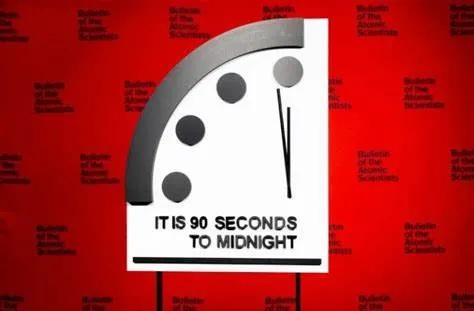
All of this means the Doomsday Clock – one of the most authoritative and best-known assessments of the existential threats facing the world – has moved forward this year further than it has ever done before.
It’s really an extraordinarily dangerous time in history.
Trump Is Very Confused About Nuclear Weapons.
The president says he wants to resume nuclear testing but doesn’t seem to know why.
By Tom Nichols, https://www.theatlantic.com/ideas/archive/2025/10/trump-nuclear/684758/
Just before heading to his meetings with the leader of China, the president of the United States issued some comments about nuclear weapons, or “nuclear,” as he tends to call them. He wants to resume nuclear-bomb tests, something no nuclear state except North Korea has done since the last century. But his reasoning is a bit confused: In the space of one short announcement, he managed to get a lot wrong, which is worrisome, because he’s the only person in America who has the authority to order the use of nuclear arms.
On Wednesday evening, the president placed this post on his Truth Social site:
The United States has more Nuclear Weapons than any other country. This was accomplished, including a complete update and renovation of existing weapons, during my First Term in office. Because of the tremendous destructive power, I HATED to do it, but had no choice! Russia is second, and China is a distant third, but will be even within 5 years. Because of other countries testing programs, I have instructed the Department of War to start testing our Nuclear Weapons on an equal basis. That process will begin immediately. On Wednesday evening, the president placed this post on his Truth Social site:
The United States has more Nuclear Weapons than any other country. This was accomplished, including a complete update and renovation of existing weapons, during my First Term in office. Because of the tremendous destructive power, I HATED to do it, but had no choice! Russia is second, and China is a distant third, but will be even within 5 years. Because of other countries testing programs, I have instructed the Department of War to start testing our Nuclear Weapons on an equal basis. That process will begin immediately. On Wednesday evening, the president placed this post on his Truth Social site:
The United States has more Nuclear Weapons than any other country. This was accomplished, including a complete update and renovation of existing weapons, during my First Term in office. Because of the tremendous destructive power, I HATED to do it, but had no choice! Russia is second, and China is a distant third, but will be even within 5 years. Because of other countries testing programs, I have instructed the Department of War to start testing our Nuclear Weapons on an equal basis. That process will begin immediately. Thank you for your attention to this matter! PRESIDENT DONALD J. TRUMP
Almost none of this is right. Russia has the world’s largest stockpile of nuclear bombs, largely because the Russians are still holding on to a lot of smaller tactical weapons designed for use on a battlefield. Trump is correct that China is much further back; the People’s Republic probably has something like 600 warheads, meaning that it would have to produce almost 1,000 bombs a year to reach parity with the U.S. or Russia by the end of the decade. (Possible? Maybe, but Beijing has only added about 100 warheads in the past two years.) Also, the United States did not create some shiny new arsenal during Trump’s first term. It is true that America is about to spend a gigantic amount of money—roughly $1 trillion—to modernize its strategic nuclear arsenal, but that plan has been in the works since the Obama administration.
So what, exactly, is Trump talking about? Parsing the president’s posts is never easy, but Trump is probably nettled about Russia’s claim to have tested a long-range, nuclear-powered cruise missile, the Burevestnik.
Trump shouldn’t worry too much: The Burevestnik is a truly stupid idea. Cruise missiles are stealthy and difficult to counter, because they can fly low and hug terrain—but they are basically just unpiloted small aircraft using regular fuel, and so they have a far more limited range than ballistic missiles. The Russians, however, now claim that they have a cruise missile powered by a nuclear reactor that can fly halfway around the world. Russian President Vladimir Putin first announced this project back in 2018, and the Burevestnik has all the hallmarks of Soviet-era boasting about a great technical achievement that doesn’t provide a lot of strategic advantage. (In the old days, the Soviets had a compulsion to claim that the Soviet Union had the biggest and best of everything, leading to the Cold War–era joke that the Kremlin bragged about making the world’s biggest microchips.)
In any case, resuming nuclear testing is a terrible idea, not only because it would undermine America’s long-standing commitment to restraining a global arms race, but because detonating warheads to see if they actually work hasn’t been necessary in a very long time. Nuclear tests don’t make much sense for U.S. national security, but they’re a great way to raise international tensions. During the Cold War, the superpowers sometimes engaged in nuclear tests as a way of signaling nerve and resolve. Unfortunately, these tests served mostly to put both East and West on edge, pollute parts of the United States and the former Soviet Union, and make a lot of people sick.
Trump may be stuck in this sort of Cold War mentality, trying to show his toughness by resuming testing, especially because he seems to take it personally when Russia engages in occasional nuclear swaggering. But Trump is not alone on this issue. Some nuclear hawks will claim that the U.S. deterrent lacks credibility because none of its bombs have been detonated in decades, as if other nations are emboldened by the possibility that America is fielding weapons that won’t work. In fact, America and other nuclear states have ways of testing every component of their arsenal—and every nuclear-armed nation knows it. Nuclear stability rests on many policies, but no one is contemplating an attack on the United States based on some mad assumption that the response will be a rain of duds.
Of course, another possibility is that Trump’s announcement means nothing. Before Trump, statements by the president were policy. But Trump says a lot of things, and he reverses course regularly; often, what look like important pronouncements turn out to be random thoughts that have escaped the weak gravity of Trump’s attention span. In any case, resuming nuclear testing isn’t easy: Such tests require a lot of preparation and infrastructure, unless Trump’s goal is merely to explode some weapons and call it a “test.”
For now, this announcement about nuclear testing seems to be yet another example of Trump reflexively taking Russian bait. Resuming nuclear testing looks weak and petulant, not strong and confident. No American president should ever let the Kremlin get under his skin—especially not where nuclear weapons are concerned.
Donald Trump’s nuclear testing order sparks pushback from Russia, China and the UN.
SBS World News, 31 Oct 25
Trump said the Pentagon will immediately resume testing the US nuclear arsenal on an “equal basis” with other nuclear powers.
United States President Donald Trump has landed back in the US after a surprise directive to begin nuclear weapons testing that has raised the spectre of renewed superpower tensions.
Trump announced the order on social media, just as he was entering a summit with Chinese leader Xi Jinping in South Korea on Thursday.
It came days after Russia declared it had tested nuclear-capable, nuclear-powered cruise missiles and sea drones.
The blunt statement from Trump, who boasts frequently about being a “peace” president, left much unanswered.
Chiefly, it was unclear whether he meant testing weapons systems or actually conducting test explosions — something the US has not done since 1992.
“Because of other countries’ testing programs, I have instructed the Department of War to start testing our Nuclear Weapons on an equal basis,” Trump said in a post on his Truth Social platform.
Trump also said that the US has more nuclear weapons than any other country and that he had achieved this in his first term as president.
The Stockholm International Peace Research Institute said in its latest annual report that Russia possesses 5,489 nuclear warheads, compared to 5,177 for the United States and 600 for China.
In his post, Trump said — minutes ahead of his meeting with Xi — that China was expected to “be even within 5 years”, without substantiating the claim.
China, Russia express concerns
In response to Trump’s announcement, Chinese foreign ministry spokesperson Guo Jiakun urged the US to “earnestly abide” by a global nuclear testing ban.
Russia questioned whether Trump was well-informed about its activities.
“President Trump mentioned in his statement that other countries are engaged in testing nuclear weapons. Until now, we didn’t know that anyone was testing,” Kremlin spokesman Dmitry Peskov told reporters.
Russia’s recent weapons drills “cannot in any way be interpreted as a nuclear test”, Peskov said. “We hope that the information was conveyed correctly to President Trump.”
Peskov then implied that Russia would conduct its own live warhead tests if Trump did it first.
“If someone departs from the moratorium, Russia will act accordingly,” Peskov said.
Russian President Vladimir Putin has repeatedly said that if any country tests a nuclear weapon, then Russia will do so too.
Both countries observe a de facto moratorium on testing nuclear warheads, though Russia and the United States do regularly run military drills involving nuclear-capable systems.
The US has been a signatory since 1996 to the Comprehensive Nuclear-Test-Ban Treaty, which bans all atomic test explosions, whether for military or civilian purposes.
United Nations secretary-general António Guterres said through his deputy spokesman that “nuclear testing can never be permitted under any circumstances”………………………………………… https://www.sbs.com.au/news/article/trump-nuclear-testing-order-pushback/a21zghnl1
Trump cuts Westinghouse reactors deal

one thing should be clear, significant financial risks are still there. Only four Westinghouse AP1000 units were ever financed in the US and remain a testament to nuclear power high risk, recurring and gross failure to financially control runaway cost-of-completion and time-to-completion estimates.
October 30, 2025, https://beyondnuclear.org/trump-cuts-westinghouse-reactors-deal/
On October 28, 2025, the Trump White House announced its commitment to stake at least $80 billion of US federal dollars to initiate yet another very risky run at new construction of Westinghouse Electric Company’s AP1000 nuclear stations. This is the follow-up to his May 23, 2025 executive orders to “unleash” more atomic power in the nation. Only this time, the Trump deal entitles the federal government, the designated buyer of the new reactors, to a 20% equity stake thereafter in Westinghouse’s returns in excess of $17.5 billion. Trump’s financing deal was cut with Westinghouse’s newest parent companies Brookfield Asset Management and Cameco, after the March 29, 2021 Westinghouse bankruptcy as of “the largest historic builder of nuclear power plants in the world.” At the time of the bankruptcy, Westinghouse was a wholly owned subsidiary of Japan’s Toshiba Corporation. Toshiba itself only narrowly escaped the financial meltdown.
On his latest visit to Asia, President Trump signed a nuclear deal with Japan newest, most hawkish and first woman Prime Minister, Saneae Takaichi, also announced on October 28th with an agreement to invest hundreds of billions of dollars in US critical infrastructure including in Trump’s pledge to domestically build new Westinghouse AP1000 reactor units and small modular reactors in the United States conditional on the involvement of Japanese contractors.
The Trump deal doesn’t specify just how much US taxpayer money will be spent on the new Westinghouse units Trump wants to build.
But one thing should be clear, significant financial risks are still there. Only four Westinghouse AP1000 units were ever financed in the US and remain a testament to nuclear power high risk, recurring and gross failure to financially control runaway cost-of-completion and time-to-completion estimates. Those new AP-1000 project orders were the only four units that managed to muster financing in South Carolina (V.C. Summer Units 2 & 3) and Georgia (Vogtle Units 3 & 4) of 34 US units announced in the 2007 launch with much ballyhoo of a so-called “nuclear renaissance.” The two projects’ financing was only made possible by the two state regulators indenturing their electricity ratepayers to Construction Work In Progress (CWIP) charges through their respective Public Utility Commissions levying a series of customer rate hikes in advance of electricity usage to guarantee construction financing. Otherwise, without public ratepayer on the hook for the advanced financing, a total of 30 other proposed new “advanced” reactor units (including 8 additional AP1000 units) were cancelled and withdrawn nationwide without a shovel in the ground.
South Carolina’s V.C. Summer AP1000 construction project was abandoned in 2017 with $10 billion in sunk costs and shrouded in FBI arrests, federal criminal convictions and guilty pleas by two high ranking SCANA utility executives, CEO Kevin Marsh, and Vice President Stephen Byrne, pleaded guilty to defraud South Carolina state regulators and its ratepayers after being charged with the crime by the U.S. Attorney’s office. Additionally, two Westinghouse Electric executives, Carl Churchman, a Vice President, pled guilty to making related false statements to the FBI investigators and sentenced to serve house detention and Jeffrey A. Benjamin, Senior Vice President for new plants and major products, who plead guilty to conspiracy to commit wire and securities fraud and serving one year and a day in federal prison.
Georgia’s Vogtle AP1000 two-unit project was eventually completed seven years behind the schedule to start operations in 2023 and 2024 with their original estimated combined cost of construction ballooning from $14 billion to an estimated $36.8 billion. Due to the expansion, massive rate hikes and prolonged delay, the Vogtle nuclear power station is now the largest and most expensive generator of electricity by atomic power in the United States.
In other related news, on Friday, October 24, 2025, South Carolina’s Santee Cooper Board of Directors unanimously voted to authorized the state-owned utility to sign a letter of intent to ask Brookfield Assets Management, previously mentioned as one of Westinghouse’s parent companies, to sign a Memorandum of Understanding (MOU) to take over the completion of the previously abandoned and only partially built nuclear reactors.
Santee Cooper’s CEO Jimmy Stanton was quoted by The State news service to pledge that, “There are no additional financial risks for our customers at all”. The Letter of Intent is meant to be the first step in a new permitting for the completion of construction project and then obtaining a federal license for full power operations. The original Nuclear Regulatory Commission (NRC) combined construction and operating license that Santee Cooper and SCE&G held is no longer valid following their 2017 abandonment of construction. The new licensee, assuming that to be Brookfield Assets or its qualified proxy, will need to go back to the US NRC and the state to reacquire the necessary permits to restart what is now called “the greatest construction failure in state history.” Santee Cooper has said it does not plan to hold the federal construction permit. Customers of Dominion Energy, the VC Summer Unit 1 new operator, are already on the hook to pay roughly 5% of their monthly bills for the original expansion project.
How Russia is risking nuclear catastrophe with attempts to syphon power from Ukraine’s biggest plant
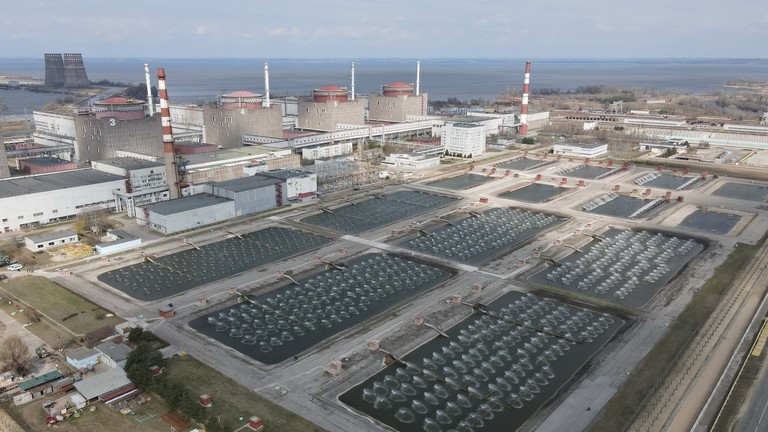
The exiled mayor of Enerhodar, close to Zaporizhzhia, reveals his fear of an ecological catastrophe
Sam Kiley, In Zaporizhzhia, Wednesday 29 October 2025, https://www.independent.co.uk/news/world/europe/zaporizhzhia-nuclear-plant-ukraine-russia-war-b2855001.html
Europe’s biggest nuclear reactor has become a battlefield in Ukraine’s defence against Russian invaders as they risk a catastrophic meltdown in its efforts to connect it to Moscow’s national grid.
The Zaporizhzhia nuclear power plant (ZNPP), which has six reactors, was captured by Russian troops early in the invasion of Ukraine in 2022. It has remained a dangerous potential flashpoint for a nuclear disaster ever since.
Fighting and bombardments by both sides of the complex and the power station itself, which has been entirely occupied by Russian forces who base troops in its buildings, have forced the “cold shutdown” of the reactors.
This means that its nuclear material is not used to generate power but needs to be constantly cooled.
The fighting cut electricity from Ukraine, meaning that the cooling system had to rely entirely on diesel generators and a skeleton staff for a month.
Regular power was only restored in the last week, after the longest period the ZNPP had been disconnected from electricity to drive its cooling systems.
Russia needs to cut the Ukrainian power link in order to install its connection into the Russian network – a long-stated ambition.
“The Russian Federation is putting in its power line, but elements of it have been successfully damaged by Ukraine,” explained Mykhailo Shuster, nuclear expert and former director of procurement at Energoatom – Ukraine’s nuclear power agency.
“Russia is now at a high level of readiness, and to connect it, the power supply from Ukraine must be interrupted.”
It is unclear whether Russia has been able to connect the Ukrainian plant to its own network during the 30-day outage. If it did so, it would then have to install converter stations to synchronise the two grids.
But the power cuts to the cooling systems, combined with the near collapse of the water supplies there after Russia blew up the Kakhova Dam – the main water source for the ZNPP – is causing jitters among local leaders.
The exiled mayor of the now-occupied Enerhodar, the town next to Zaporizhzhia, told The Independent he fears nuclear fallout could melt into the groundwater around the plant, contaminate the Dnipro River and eventually the Black Sea.
“Kakhovka Dam is destroyed; there is nothing to cool it with – even if they miraculously restore the equipment in the future,” he said.
“Worst case scenario: the water will eventually evaporate from the cooling pond, and there will be nothing to cool nuclear fuel.”
“It can melt the concrete and go into the groundwater,” Dmytro Orlov added from his office in Zaporizhzhia. Mayor Orlov runs humanitarian programmes for the thousands of people, mostly nuclear power workers, who fled the advancing Russians from his town to safety here.
The mayor recalled the 1986 Chernobyl disaster, which remains the worst nuclear disaster in history.
“The estimated amount of nuclear fuel there is about 10 times more than in Chernobyl,” he warned.
A small team of inspectors from the International Atomic Energy Authority regularly inspects the power station and has reported military training and explosions in and around the facility.
Russian artillery and mortars have been seen shelling and bombing Ukrainian towns and villages on the opposite bank of the Dnipro.
After power was restored, IAEA director general Mario Grossi said: “What was once virtually unimaginable – a nuclear power plant regularly losing off-site power – has unfortunately become a common occurrence during this devastating war. However, this was the most challenging loss of power event we have experienced so far.
“There is still much work to do to further reduce the risks of a nuclear accident.”
1 This Month
26 September – International Day for the Total Elimination of Nuclear Weapons





PLEASE OPPOSE HR 8255 AND S.3639 – bills would accelerate satellite deployment, with no environmental review or safeguards – https://ncstd5li.quorum.us/campaign/169331/
To see nuclear-related stories in greater depth and intensity – go to https://nuclearinformation.wordpress.com
-
Archives
- September 2026 (305)
- August 2026 (330)
- July 2026 (355)
- June 2026 (287)
- May 2026 (306)
- April 2026 (356)
- March 2026 (251)
- February 2026 (267)
- January 2026 (308)
- December 2025 (358)
- November 2025 (359)
- October 2025 (375)
-
Categories
- 1
- 1 NUCLEAR ISSUES
- business and costs
- climate change
- culture and arts
- ENERGY
- environment
- health
- history
- indigenous issues
- Legal
- marketing of nuclear
- media
- opposition to nuclear
- PERSONAL STORIES
- politics
- politics international
- Religion and ethics
- safety
- secrets,lies and civil liberties
- spinbuster
- technology
- Uranium
- wastes
- weapons and war
- Women
- 2 WORLD
- ACTION
- AFRICA
- Atrocities
- AUSTRALIA
- Christina's notes
- Christina's themes
- culture and arts
- Events
- Fuk 2022
- Fuk 2023
- Fukushima 2017
- Fukushima 2018
- fukushima 2019
- Fukushima 2020
- Fukushima 2021
- general
- global warming
- Humour (God we need it)
- Nuclear
- RARE EARTHS
- Reference
- resources – print
- Resources -audiovicual
- Weekly Newsletter
- World
- World Nuclear
- YouTube
-
RSS
Entries RSS
Comments RSS

