European Russophobia and Europe’s Rejection of Peace: A Two-Century Failure
CRISD, December 23, 2025
Jeffrey D. Sachs is University Professor and Director of the Center for Sustainable Development at Columbia University, and President of the UN Sustainable Development Solutions Network.
Europe has repeatedly rejected peace with Russia at moments when a negotiated settlement was available, and those rejections have proven profoundly self-defeating. From the nineteenth century to the present, Russia’s security concerns have been treated not as legitimate interests to be negotiated within a broader European order, but as moral transgressions to be resisted, contained, or overridden. This pattern has persisted across radically different Russian regimes—Tsarist, Soviet, and post-Soviet—suggesting that the problem lies not primarily in Russian ideology, but in Europe’s enduring refusal to recognize Russia as a legitimate and equal security actor.
My argument is not that Russia has been entirely benign or trustworthy. Rather, it is that Europe has consistently applied double standards in the interpretation of security. Europe treats its own use of force, alliance-building, and imperial or post-imperial influence as normal and legitimate, while construing comparable Russian behavior—especially near Russia’s own borders—as inherently destabilizing and invalid. This asymmetry has narrowed diplomatic space, delegitimized compromise, and made war more likely. Likewise, this self-defeating cycle remains the defining characteristic of European-Russian relations in the twenty-first century.
A recurring failure throughout this history has been Europe’s inability—or refusal—to distinguish between Russian aggression and Russian security-seeking behavior. In multiple periods, actions interpreted in Europe as evidence of inherent Russian expansionism were, from Moscow’s perspective, attempts to reduce vulnerability in an environment perceived as increasingly hostile. Meanwhile, Europe consistently interpreted its own alliance building, military deployments, and institutional expansion as benign and defensive, even when these measures directly reduced Russian strategic depth. This asymmetry lies at the heart of the security dilemma that has repeatedly escalated into conflict: one side’s defense is treated as legitimate, while the other side’s fear is dismissed as paranoia or bad faith.
Western Russophobia should not be understood primarily as emotional hostility toward Russians or Russian culture. Instead, it operates as a structural prejudice embedded in European security thinking: the assumption that Russia is the exception to normal diplomatic rules. While other great powers are presumed to have legitimate security interests that must be balanced and accommodated, Russia’s interests are presumed illegitimate unless proven otherwise. This assumption survives changes in regime, ideology, and leadership. It transforms policy disagreements into moral absolutes and renders compromise as suspect. As a result, Russophobia functions less as a sentiment than as a systemic distortion—one that repeatedly undermines Europe’s own security.
I trace this pattern across four major historical arcs. First, I examine the nineteenth century, beginning with Russia’s central role in the Concert of Europe after 1815 and its subsequent transformation into Europe’s designated menace. The Crimean War emerges as the founding trauma of modern Russophobia: a war of choice pursued by Britain and France despite the availability of diplomatic compromise, driven by the West’s moralized hostility and imperial anxiety rather than unavoidable necessity. The Pogodin memorandum of 1853 on the West’s double standard, featuring Tsar Nicholas I’s famous marginal note—“This is the whole point”—serves not merely as an anecdote, but as an analytical key to Europe’s double standards and Russia’s understandable fears and resentments.
Second, I turn to the revolutionary and interwar periods, when Europe and the United States moved from rivalry with Russia to direct intervention in Russia’s internal affairs. I examine in detail the Western military interventions during the Russian Civil War, the refusal to integrate the Soviet Union into a durable collective-security system in the 1920s and 1930s, and the catastrophic failure to ally against fascism, drawing especially on the archival work of Michael Jabara Carley. The result was not the containment of Soviet power, but the collapse of European security and the devastation of the continent itself in World War II.
Third, the early Cold War presented what should have been a decisive corrective moment; yet, Europe again rejected peace when it could have been secured. Although the Potsdam conference reached an agreement on German demilitarization, the West subsequently reneged. Seven years later, the West similarly rejected the Stalin Note, which offered German reunification based on neutrality. The dismissal of reunification by Chancellor Adenauer—despite clear evidence that Stalin’s offer was genuine—cemented Germany’s postwar division, entrenched the bloc confrontation, and locked Europe into decades of militarization.
Finally, I analyze the post-Cold War era, when Europe was offered its clearest opportunity to escape this destructive cycle. Gorbachev’s vision of a “Common European Home” and the Charter of Paris articulated a security order based on inclusion and indivisibility. Instead, Europe chose NATO expansion, institutional asymmetry, and a security architecture built around Russia rather than with it. This choice was not accidental. It reflected an Anglo-American grand strategy—articulated most explicitly by Zbigniew Brzezinski—that treated Eurasia as the central arena of global competition and Russia as a power to be prevented from consolidating security or influence.
The consequences of this long pattern of disdain for Russian security concerns are now visible with brutal clarity. The war in Ukraine, the collapse of nuclear arms control, Europe’s energy and industrial shocks, Europe’s new arms race, the EU’s political fragmentation, and Europe’s loss of strategic autonomy are not aberrations. They are the cumulative costs of two centuries of Europe’s refusal to take Russia’s security concerns seriously.
My conclusion is that peace with Russia does not require naïve trust. It requires the recognition that durable European security cannot be built by denying the legitimacy of Russian security interests. Until Europe abandons this reflex, it will remain trapped in a cycle of rejecting peace when it is available—and paying ever higher prices for doing so.
The Origins of Structural Russophobia
The recurrent European failure to build peace with Russia is not primarily a product of Putin, communism, or even twentieth-century ideology. It is much older—and it is structural. Repeatedly, Russia’s security concerns have been treated by Europe not as legitimate interests subject to negotiation, but as moral transgressions. In this sense, the story begins with the nineteenth-century transformation of Russia from a co-guarantor of Europe’s balance into the continent’s designated menace.
After the defeat of Napoleon in 1815, Russia was not peripheral to Europe; it was central. Russia bore a decisive share of the burden in defeating Napoleon, and the Tsar was a principal architect of the post-Napoleonic settlement. The Concert of Europe was built on an implicit proposition: peace requires the great powers to accept one another as legitimate stakeholders and to manage crises by consultation rather than by moralized demonology. Yet, within a generation, a counterproposition gained strength in British and French political culture: that Russia was not a normal great power but a civilizational danger—one whose demands, even when local and defensive, should be treated as inherently expansionist and therefore unacceptable…………………………………………………………………………………………………………………………………………………………………
The tragedy of Europe’s denial of Russia’s security concerns is that it becomes self-reinforcing. When Russian security concerns are dismissed as illegitimate, Russian leaders have fewer incentives to pursue diplomacy and greater incentives to change facts on the ground. European policymakers then interpret these actions as confirmation of their original suspicions, rather than as the utterly predictable outcome of a security dilemma they themselves created and then denied. Over time, this dynamic narrows the diplomatic space until war appears to many not as a choice but as an inevitability. Yet the inevitability is manufactured. It arises not from immutable hostility but from the persistent European refusal to recognize that durable peace requires acknowledging the other side’s fears as real, even when those fears are inconvenient.
The tragedy is that Europe has repeatedly paid heavily for this refusal. It paid in the Crimean War and its aftermath, in the catastrophes of the first-half of the twentieth century, and in decades of Cold War division. And it is paying again now. Russophobia has not made Europe safer. It has made Europe poorer, more divided, more militarized, and more dependent on external power,
The added irony is that while this structural Russophobia has not weakened Russia in the long run, it has repeatedly weakened Europe. By refusing to treat Russia as a normal security actor, Europe has helped generate the very instability it fears, while incurring mounting costs in blood, treasure, autonomy, and cohesion. Each cycle ends the same way: a belated recognition that peace requires negotiation after immense damage has already been done. The lesson Europe has yet to absorb is that recognizing Russia’s security concerns is not a concession to power, but a prerequisite for preventing its destructive uses.
The lesson, written in blood across two centuries, is not that Russia or any other country must be trusted in all regards. It is that Russia and its security interests must be taken seriously. Europe has rejected peace with Russia repeatedly, not because it was unavailable, but because acknowledging Russia’s security concerns was wrongly treated as illegitimate. Until Europe abandons that reflex, it will remain trapped in a cycle of self-defeating confrontation—rejecting peace when it is possible and bearing the costs long after.https://www.cirsd.org/en/news/european-russophobia-and-europes-rejection-of-peace-a-two-century-failure
Canada’s double standard on tritium emissions
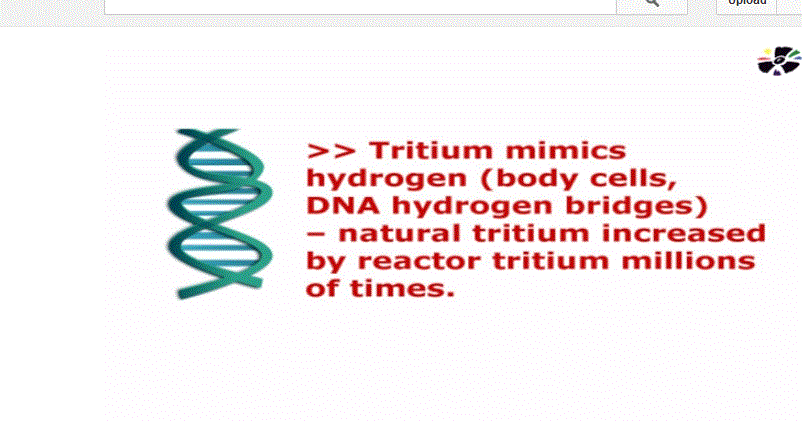
Frank Greening, 24 Dec 25
Here is an example of how Canada allows all kinds of tritium emissions while other nations are criticized for almost trivial releases.
Thus, it was reported today that the Japanese reactor at Fugen had a leak that spilled tritiated water. The amount released? A staggering 20 ml:
By comparison a CANDU reactor at Bruce NGS suffered a steam generator release back in 2007. Steam generator tube leaks involve the escape of primary heat transport heavy water contaminated with tritium. In the case of Bruce Unit 8, a steam generator leak was detected in June 2007 but was allowed to continue until the first week of November. The monthly heavy water losses associated with this leak were as follows:
June 2007: 484 kg
July 2007: 2157 kg
Aug 2007: 2832 kg
Sept 2007: 4339 kg
Oct 2007: 5036 kg
Nov 2007: 1115 kg
Thus, in total, 15,963 kg of tritiated heavy water was lost to Lake Huron over a six-month period in 2007. This leak created a giant plume of tritiated water that was carried northwards by the prevailing currents towards the townships of Saugeen Shores, Port Elgin and Southampton. By September 2007, the concentration of tritium in the water intake of the Port Elgin Water Treatment Plant, 17 km north of the Bruce site, had increased by more than a factor of three compared to the normal levels of tritium in lake water at this location.
But remarkably this increase in the tritium concentration in the drinking water supply to residents to the north of the Bruce site was not the reason that the Unit 8 steam generator leak was finally fixed. On the contrary, the leak was plugged to prevent further loss of a valuable commodity – heavy water – which at $300/kg had already cost Bruce Power almost $5 million. And besides, thanks to the CNSC’s lax tritium emission standards, Bruce B’s waterborne emission action level for tritium is a staggering 130,000 Ci per month; thus the station was well below its regulatory limit in this regard. Nevertheless, one has to wonder how such a liberal action level is permitted when it allows a station to discharge tritiated water that is 5000 times higher than the Ontario Drinking Water Objective.
Studsvik Calls Extraordinary Meeting to Add UK Nuclear Executive Julia Pyke to Board
Tipranks – Tue Dec 23, 2025
Studsvik AB ( (SE:SVIK) ) has issued an announcement.
Studsvik AB has called an extraordinary general meeting for January 23, 2026, in Stockholm, inviting shareholders to resolve on changes to the board of directors, including registration, proxy and attendance procedures in line with Swedish corporate governance rules. The nomination committee proposes expanding the board to seven members and appointing UK nuclear executive Julia Pyke, noted for her leadership of the Sizewell C and involvement in Hinkley Point C projects, with her remuneration aligned pro rata to the levels set at the 2025 annual general meeting, underscoring Studsvik’s strategic ambition to strengthen its board with international nuclear infrastructure expertise……… https://www.theglobeandmail.com/investing/markets/markets-news/Tipranks/36764331/studsvik-calls-extraordinary-meeting-to-add-uk-nuclear-executive-julia-pyke-to-board/
How reporting facts can now land you in jail for 14 years as a terrorist

Jonathon Cook Blog, 22 December 2025
Starmer’s government has set the most dangerous of precedents: it can now outlaw any political group it chooses as a terrorist organisation – and thereby make it impossible to defend it
The moment the British government began proscribing political movements as terrorist organisations, rather than just militant groups, it was inevitable that saying factual things, making truthful statements, would become a crime.
And lo behold, here we are.
The Terrorism Act 2000 has a series of provisions that make it difficult to voice or show any kind of support for an organisation proscribed under the legislation, whether it is writing an article or wearing a T-shirt.
Recent attention has focused on Section 13, which is being used to hound thousands of mostly elderly people who have held signs saying: “I oppose genocide, I support Palestine Action.” They now face a terrorism conviction and up to six months in jail.
But an amendment introduced in 2019 to Section 12 of the Act has been largely overlooked, even though it is even more repressive. It makes it a terrorism offence for a person to express “an opinion or belief that is supportive of a proscribed organisation” and in doing so be “reckless” about whether anyone else might be “encouraged to support” the organisation.
It is hard to believe this clause was not inserted specifically to target the watchdog professions: journalists, human rights groups and lawyers. They now face up to 14 years in jail for contravening this provision……………………………………………………………………………………………………………………………………….
the reality is that social media is awash with posts from people echoing outrageous official disinformation. This spreads unchallenged because to challenge it is now cast as a terrorism offence.
In truth, since proscription, any statements about the political aims of a deeply political organisation like Palestine Action occupy a grey area of the law.
Is it a terrorism offence to point out the fact, as I have done above, that Palestine Action targeted Elbit factories that send killer drones to Israel for use in Gaza. In doing so, may I have “recklessly” encouraged you to support Palestine Action?
Can I express any kind of positive view about the hunger strikers or their actions without violating the law?
The truth is that the law’s greyness is its very point. It maximises the chilling effect on those who are supposed to serve as the public’s watchdogs on power: journalists, human rights groups, lawyers. https://www.jonathan-cook.net/blog/2025-12-22/reporting-facts-14-years-jail/
Hawai‘i Has a Rare Opportunity to Reclaim Land From the US Military
The US military is abusing Hawaiian land. Will residents be able to exert Indigenous sovereignty and get it back?
By Christine Ahn & Davis Price , Truthout, December 22, 2025
Since 1964, the U.S. military has leased roughly 47,000 acres of land from the State of Hawai‘i — for a token $1. The leases, which account for 18 percent of military lands in Hawai‘i, are set to expire in 2029, offering Hawai‘i a rare opportunity to reclaim land from the war machine. As the expiration date looms, Hawai‘i residents are at a crossroads: remain a staging ground for U.S. imperialism or pivot toward community well‑being, environmental sustainability, and economic self‑determination.
But that decision may arrive sooner than 2029: Allegedly faced with pressure from federal officials to fast-track lease renewals by the end of this year, Democratic Gov. Josh Green signed a statement of principles in September with Army Secretary Dan Driscoll expressing the intention to “explore the feasibility of land use that aligns national security and Army readiness needs with the State’s priorities for public benefit.” A month later, Green sent Driscoll a proposal for a $10 billion plan that included a “community benefits” package. He argued that this sum would be favorable should the Army pursue “condemnation,” the use of eminent domain to seize Hawai‘i’s land for “national security.”
Native Hawaiian groups swiftly condemned the move in a September 2 statement signed by 40 organizations. They opposed fast-tracking the leases and pointed out that Green and Driscoll sidestepped federal and state statutes that require a thorough review — a process the Army and Navy had already failed to complete earlier that year.
After mounting pressure from the Office of Hawaiian Affairs, state legislators, and numerous environmental and civic organizations, Green walked back the end-of-year deadline and extended the negotiation timeline into 2026. Still, the episode highlighted how easily the U.S. military can bypass democratic debate in the name of “national security,” and how vital it is for the public to have informed discussions about the military’s impact on Hawai‘i.
How Hawai‘i Became Occupied
The U.S. military controls roughly 254,000 acres across Hawai‘i, making it the most militarized state per capita in the country. On O‘ahu alone, the military occupies 86,000 acres, or 25 percent of the island. These lands were part of the “ceded” territories illegally seized from the Hawaiian Kingdom.
Once a sovereign nation, Hawai‘i was the starting point for America’s century of imperialism and conquest in the Pacific. In the late-19th century, American missionaries and plantation owners, seeking to avoid U.S. tariffs on Hawaiian sugar, conspired with the U.S. Navy to orchestrate a coup to overthrow Queen Lili‘uokalani in 1893.
Although the coup was condemned by President Grover Cleveland as illegal, in 1898 President William McKinley signed the Newlands Resolution, illegally annexing Hawai‘i as a U.S. territory through a joint congressional resolution, bypassing the legally required two-thirds majority in the Senate to ratify a treaty between two nations.
After annexation, the provisional government reclassified Crown and government lands as “public” property and transferred them to the U.S. Interior Department………………………………………………………………………………………………………………………………………………………………………………………..Native Hawaiian advocates are building momentum toward a shift in the governance of resources in Hawaiʻi, which has been dominated by extractive and abusive industries, such as the military, for too long. While large‑scale stewardship projects exist, they are often treated as side ventures, and lack long‑term capital investments, like roads or schools. Investing in regenerative economies, Lee argues, could create thousands of place‑based jobs in restoration, farming, and renewable energy. “We’d keep more money circulating locally instead of leaking out, building real security from the inside out,” Lee explains. “Hawai‘i’s resilience is national security.”
By engaging in informed public debate about the economic, environmental, and cultural costs of the military’s footprint — and exploring repurposing the military’s footprint for community-driven, sustainable uses — Hawai‘i can transform from a base preparing for war into a beacon of peace, resilience, and Indigenous innovation. https://truthout.org/articles/hawaii-has-a-rare-opportunity-to-reclaim-land-from-the-us-military/
UK’s largest planned data centre ‘could use 50 times more water’ than developer claims.
The developer of the UK’s largest proposed data
centre is likely significantly understating the scale of its planned water
footprint, teams of investigative journalists have claimed.
US-based data
centre developer QTS recently secured permission from the local council for
its campus in Cambois, Northumberland. It plans to build 10 data halls
across a 133-acre site, at a cost of $13.5bn. The site had previously been
home to Britishvolt, which had intended to develop a battery gigafactory
for the electric car sector before it folded. QTS’s proposals also
include cooling systems and dozens of diesel-powered generators to act as
an emergency backup, the BBC reports. These should only be used
“occasionally” on a “temporary basis”.
Edie 22nd Dec 2025, https://www.edie.net/uks-largest-planned-data-centre-could-use-50-times-more-water-than-developer-claims/
Scottish Government urged to intervene in Edinburgh AI data centre plans
THE Scottish Government has been urged to intervene after council
officials ruled that an environmental impact assessment for a huge
artificial intelligence data centre is not required.
Edinburgh City Council
is currently considering plans for a new AI data centre on the site of the
former RBS headquarters in South Gyle, near Edinburgh Airport. Shelborn
Drummond Ltd, an offshoot of Shelborn Asset Management, is behind the plans
for the “Green Data Centre”.
We previously told how the Shelborn data
centre, and another proposed by Apatura near to Heriot-Watt University,
would demand the equivalent amount of energy as building five cities the
same size as the capital within its boundaries. The revelation about the
vast amount of electricity the sites will consume has sparked concerns from
environmental campaigners, and had previously raised concerns that there
would be no requirement for the firms behind the plans to carry out an
environmental impact assessment (EIA).
A screening opinion published on
Friday December 18, by a senior planner at the local authority, ruled that
an EIA would not be required. Action to Protect Rural Scotland (APRS) said
the Shelborn data centre will use the same amount of energy as a quarter of
a million households, and it was “gobsmacking” that the impact on the
local environment would not be taken into consideration.
The National 22nd Dec 2025, https://www.thenational.scot/news/25715123.scottish-government-urged-intervene-edinburgh-ai-data-centre/
Trump orders return to Moon by 2028, lunar base with nuclear power by 2030.
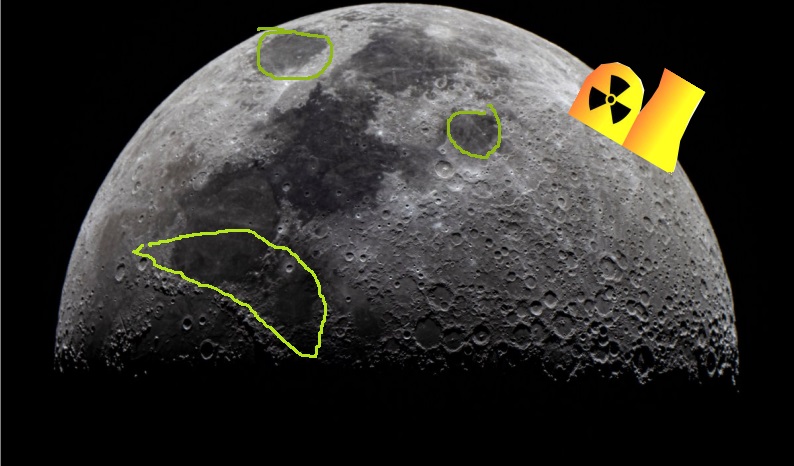
NASA is directed to pursue a commercial pathway to replace the International Space Station by 2030, continuing the transition toward privately owned and operated orbital platforms.
By Stephen Pope, December 19, 2025, https://www.aerotime.aero/articles/trump-moon-2028-lunar-base-golden-dome
In a sweeping reset of US space policy, President Donald Trump on December 18, 2025, signed an executive order directing NASA to return astronauts to the Moon by 2028, establish the first elements of a permanent lunar base by 2030, deploy nuclear power systems on the Moon and in orbit, and accelerate development of the administration’s “Golden Dome” missile defense program.
The order, titled Ensuring American Space Superiority, sets some of the most aggressive space and defense timelines ever laid out in a single White House directive, blending civil exploration, national security, and commercial space development into one policy framework.
Under the order, NASA is instructed to land Americans on the Moon by 2028 through the Artemis program, and then move quickly toward establishing an initial, sustained lunar presence by the end of the decade. The administration frames the Moon not only as a destination, but as strategic infrastructure — a platform for economic activity, scientific research, and preparation for future missions to Mars.
Lunar nuclear reactors
A central and notable element of the policy is nuclear power. The order calls for deploying nuclear reactors on the lunar surface and in orbit, with a lunar surface reactor required to be ready for launch by 2030. The White House argues that nuclear power is essential to sustaining long-duration operations on the Moon, where solar energy alone may not support continuous activity.
The executive order also reiterates Trump’s push for the Golden Dome missile defense initiative, directing the government to develop and demonstrate prototype next-generation missile defense technologies by 2028. It also calls for improved detection and countermeasures against threats to US space assets, extending from low Earth orbit to the moon, including concerns over nuclear weapons placed in orbit.
The order places heavy emphasis on accelerating procurement and integrating commercial space capabilities. NASA and the Department of Commerce are directed to reform their space acquisition processes within 180 days, with a stated preference for commercial solutions, faster contracting methods, and reduced bureaucratic friction. The policy also seeks to attract at least $50 billion in additional private investment into US space markets by 2028.
Compressed timelines
Commercial space involving many companies is positioned in Trump’s order as a replacement, not just a partner, for legacy government programs. NASA is directed to pursue a commercial pathway to replace the International Space Station by 2030, continuing the transition toward privately owned and operated orbital platforms.
The order also makes structural changes to space governance. It revokes the National Space Council and shifts coordination of national space policy to the White House Office of Science and Technology Policy. Several agencies are given near-term reporting deadlines, including a 90-day requirement for NASA to outline how it will meet the Moon and exploration goals within existing funding levels.
In addition, the order revises prior space traffic management policy by removing language that had described government-provided tracking services as free, potentially opening the door to paid or commercially supported models in the future.
Taken together, the executive order outlines an expansive vision with compressed timelines, placing pressure on NASA, the Pentagon, and industry to deliver rapid progress.
Hiroshima urges Japanese government to uphold non-nuclear principles
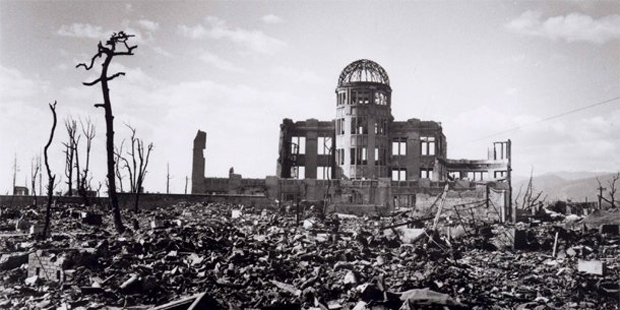
Japan’s Hiroshima Prefecture on Monday issued a statement urging the national government to uphold the country’s non-nuclear principles, after a security official recently suggested the country should possess nuclear weapons.
The Hiroshima prefectural assembly unanimously adopted the written opinion, citing local concerns about reviewing the long-standing Three Non-Nuclear Principles, which prohibit possessing, producing or permitting the introduction of nuclear arms into Japanese territory, Kyodo News reported.
“It is our duty, as the only country to have suffered atomic bombings, to continue striving toward the realization of a world without nuclear weapons,” the statement said.
The statement comes after an official involved in devising security policy under the government led by Prime Minister Sanae Takaichi recently said that Japan should possess nuclear weapons, inciting backlash from locals, including atomic bomb survivors.
It is the first written opinion by the prefectural or city assemblies of Hiroshima or Nagasaki, both devastated by U.S. atomic bombs, regarding the country’s reconsideration of the non-nuclear principles, the report said.
Itsunori Onodera, head of the ruling Liberal Democratic Party’s security research council, said on a TV program on Sunday that Japan needs to debate the future of its non-nuclear principles.
Last month, Japanese media quoted government sources as saying that, as the Takaichi administration gears up to revise the country’s key national security documents by the end of 2026, Takaichi was considering reviewing the third of the Three Non-Nuclear Principles, which prohibits nuclear weapons from entering Japan’s territory, raising strong doubts and concerns at home.
The EU’s top diplomat casually rewrites WWII history on her way to WWIII
Kaja Kallas’ striking ignorance – or willful revisionism – is precisely why no one is taking the bloc seriously anymore.
By Tarik Cyril Amar, a historian from Germany working at Koç University, Istanbul, on Russia, Ukraine, and Eastern Europe, the history of World War II, the cultural Cold War, and the politics of memory 1 Dec, 2025, https://www.rt.com/news/628731-kaja-kallas-ww2-ww3/
Oops. Kaja Kallas, the de facto EU foreign minister already notorious for her chirpy incompetence, has done it again: displayed such elementary ignorance that you have to rub your eyes and double-check before you believe it’s true. But – as always with her – it is. This time, she has informed the world that Russia has not been attacked by anyone for a hundred years.
Those Nazi generals who planned Operation Barbarossa – the 1941 attack on the Soviet Union (and thus very much Russia) that left 27 million Soviet citizens dead – are probably spinning in their graves. Yes, blinded by prejudice and ideology (“values”) they badly underestimated the Russians (sounds familiar?) and lost (catastrophically). But having your whole 3-million-men-150-division operation wiped out Orwell-style?
And what about the many other Europeans who joined the Nazis, either from the beginning or later, with official contingents or as volunteers? The Romanians, Finns, Italians, Spanish, Croatians, Belgians, French, Norwegians, Slovaks, Bulgarians, Hungarians, and, last but not least, Balts, such as from Kallas’s native Estonia?
And let’s not even start about those prickly Japanese! They, too, got a drubbing at the 1939 Nomonhan/Khalkhin Gol clash (and yes, it took place on the edge of Mongolia, a Soviet client state), but, again, pretending they never even tried?
Being historically illiterate to such an extent seems almost pitiable. Where geometry has made former German Foreign Minister Annalena “360 degrees” Baerbock intellectually immortal, it is history where Kallas reaches peak benightedness.
That is especially disturbing because failing so badly, in particular in the history of last century’s great wars, makes Kallas a very dangerous person. The reason is as simple as 1,2,3: Together, the last two World Wars – both caused by Europeans – cost up to over 81 million lives. We know that a third one would be even worse, whether fought “only” with very advanced and destructive conventional weapons (including AI, of course) or, as is more likely, escalating to the use of weapons of mass destruction (nuclear, chemical, biological, and cyber). A Third World War is likely to literally be our last, either forever or for the exceedingly long time it would take the survivors to make their way back from their caves to civilizations sophisticated enough to blow each other up again.
The Ukraine war – in reality, a Western proxy war against Russia and the emerging multipolar order, executed through misled, betrayed, sold-out, and now almost used-up Ukraine – has had the real potential to turn into World War Three. This risk has diminished with the second Trump administration, but it will only be gone once the war ends.
The NATO-EU Europeans, meanwhile, are doing their best to keep this war, its destruction, and its apocalyptic escalation potential going: they provide ever more weapons, cannot stop looking for sleazy ways to steal frozen Russian assets and fleece their own tax payers, urge for more Ukrainians to be thrown into the futile meatgrinder, and, last but not least, embolden the Zelensky regime to continue, no matter how much of its ubiquitous corruption is exposed.
The Atlanticists, i.e., deranged European “elites” that are staying this insane course, are hard to understand, since they do not follow reason, as their suicidal and yet persistent sanctions policy proves; their ethics are also utterly perverse, as their equally persistent complicity in Israel’s ongoing Gaza genocide illustrates.
Yet we can observe facets of their madness. One is that, clearly, to work so obstinately toward World War Three requires never having understood World War Two. That’s the one that ended with the first and only use in wartime of the kind of weapon that may well play a main role in a world-ending World War Three, too: When the US deliberately and entirely without military necessity massacred the populations of the two large Japanese cities of Hiroshima and Nagasaki, it did not simply end a war by an enormous, shameful, and never acknowledged crime. It also opened the door to a future we all must pray will never arrive.
Regarding World War Two, EU de facto foreign minister Kallas, as so often, embodies NATO-EU European group-non-think as few others, revealing carelessly what slightly less ham-fisted operators still try to conceal.
Currently, she is doing her very worst to prevent peace from breaking out. While many leaders of NATO-EU Europe display what the Germans now call “Friedensangst” (the fear of peace), Kallas is second-to-none in her denial of reality, Russophobia, and, last but not least, bizarre over-estimation of the EU’s and her own personal influence. Demanding a place in negotiations the EU has deliberately stonewalled and calling for “concessions” from Russia as if the West and Ukraine were winning the war, Kallas has been publicly snubbed by the US.
Yet there is a method to her madness. Kallas’s inability to adequately process the present reflects her unusually pronounced inability to learn from the past. Only recently, speaking at a conference on security studies, she shared her dumb surprise at the fact that Russia and China believe they are among the victors of World War Two. Ironically, for Kallas, this is a dangerous “narrative,” clearly factually false in her eyes, and only successful with those who read little and don’t remember history all that well. She has felt “many question marks” in her head, she has informed us. If only she could grasp why.
In reality, both Russia and China played key roles in defeating the global fascist offensive that was at the core of World War Two. This is not the place for details – Kallas should feel strongly invited to finally read up on them (if she can) – but a few key facts will be enough: In Asia, World War Two started even earlier than in Europe, with Japanese aggression against China; the war also lasted longer.
Kallas is displaying a narrow-minded provincialism and a lousy education by reducing the struggle to that, as she put it, against the “Nazis.” That was the main story in Europe, but not in Asia, where the fight against Japanese fascism cost China an estimated 35 million lives. Kallas’s English is infamously rudimentary. She may want to try to improve it by making her way through, at least, historian Rana Mitter’s ‘Forgotten Ally: China’s World War II, 1937-1945’. I am not sure she has ever read a whole book. If not, this would be a good first time. If she has, a second one is clearly required. And, for once, not some neo-Noltean tract by American history mangler and Ukraine War booster Tim Snyder.
The Soviet Union, with Russia at its core, suffered 27 million deaths. And without its staggering sacrifice and equally stunning efforts, Nazi Germany would not have been defeated: the preponderant share of its military forces were destroyed by Soviet soldiers on what the Germans called the Eastern Front. If they had not been ground down there, only two outcomes would have been possible: a Nazi empire would have survived or the US would have dropped atomic bombs on Germany as well.
Germans especially, among whom hating as well as underestimating Russia is all too fashionable again, would do well to remember a simple, little understood fact: it is precisely the Soviet victory over Germany by conventional arms that spared them a continuation of Nazi rule (though many may, of course, have welcomed that) or the fate of Hiroshima and Nagasaki.
Kallas, in any case, is not one for learning. Clearly combining the worst of bigoted eastern European nationalism and Brussels’s simple-minded hubris, she can’t even sense when she has made a fool of herself. How do we know? Because when challenged, she made things worse again.
Kallas produced her display of incompetence and condescension on the occasion of China’s 80th victory celebrations. Unsurprisingly, its representatives have been clear. Beijing Foreign Ministry spokesman Guo Jiakun condemned Kallas’s inanities as “full of ideological bias,” “without historical common sense,” displaying “disrespect,” and, last but not least, “harm[ing] the EU’s own interests.” The latter, of course, has never stopped Estonia’s most embarrassing export.
German EU parliamentarian Fabio de Masi, now co-leader of the New-Left BSW party, requested a clarification. In her response, Kallas managed to dig her hole even deeper: She claimed – untruthfully – that “on the occasion of the 80th anniversary of the end of World War II in Asia, the EU paid tribute also to the courage of the people of China, who endured immense suffering in defending their homeland and contributing to the end of the war.” In reality, she – and therefore the EU – had just done exactly the opposite: insulted China by explicitly denying its contribution. Kallas’s official job title is, in case she cannot remember, “Vice-President of the Commission/High Representative of the Union for Foreign Affairs and Security Policy.” She speaks and mis-speaks for the EU, even if that is a catastrophe that should never have happened.
Regarding Russia, Kallas did not even make the effort to pretend. Instead, she simply continued her silly attempt to deny its key contribution to defeating Nazism. Accusing Russia of “manipulating” history, she felt this was also the right occasion to also once again repeat the absurdity that the West did not provoke the war in Ukraine.
Clearly, Kallas’s latest sally is shocking but not a surprise. It fits perfectly with her personal record of blithely chattering about breaking up Russia. It also fits with a widespread mood among NATO-EU Europe’s “elites,” where disparaging Russia and Russians is as much de rigueur as a stupid romanticization of Ukraine, its far right, and nationalism. Where Kallas can hold high office, normality is anything but.
The real question is when this nightmare of ignorance, war hysteria, and arrogance will finally end in Europe. Because if it does not, Europeans will only have themselves – or, to be precise, their “elites” – to blame when most of the world will write them off not only as the people who helped Israel commit genocide in Gaza but also as simply very unserious: yesterday’s privileged, now economic lightweights led by political lightweights who are too lazy to notice how silly they look.
Iran, UK foreign ministers discuss nuclear issue in phone call
Dec 20, 2025, https://www.iranintl.com/en/202512192167
ranian Foreign Minister Abbas Araghchi spoke by phone with UK Foreign Secretary Yvette Cooper on Friday, saying Tehran is open to diplomacy based on respect.
“Iran has never rejected negotiations and dialogue based on respect for the Iranian nation’s legal rights and legitimate interests, but considers talks based on one-sided imposition unacceptable,” official media cited Araghchi as saying.
Araghchi criticized the “irresponsible” stance of the three European powers on Iran’s nuclear program, saying that Tehran is open to talks respecting its legal rights and legitimate interests but rejects unilateral imposition.
Cooper underlined Britain’s commitment to diplomacy on the nuclear dossier. No UK readout of the call has been issued.
The three European countries—France, Germany, and the United Kingdom—triggered the Iran nuclear deal snapback mechanism in August, leading to the reimposition of UN sanctions in September.
Iran and the International Atomic Energy Agency (IAEA) reached a technical understanding in Cairo in September, mediated by Egypt, aimed at gradually restoring inspectors’ access to nuclear sites.
Following the return of UN sanctions on Iran, Foreign Minister Abbas Araghchi said that the United States and three European powers had “killed” the Cairo nuclear agreement through what he called a sequence of hostile actions.
Araghchi said last month that Washington’s approach amounted to “dictation, not negotiation,” accusing the US of trying to achieve through diplomacy what it failed to gain by force.
“They want us to accept zero enrichment and limits on our defense capabilities,” he said. “This is not negotiation.”
Trump said Iran could avoid past and by reaching a nuclear deal, adding that any attempt to revive its program without an agreement would prompt further US action. He has repeatedly said Iran missed an earlier chance to avert the strikes by accepting a deal.
Trump Announces Nuclear-Armed Battleships for the U.S. Navy.

The ships, named after President Donald Trump as the Trump-class…….
23/12/2025, By Carter Johnston, https://www.navalnews.com/naval-news/2025/12/trump-announces-nuclear-armed-battleships-for-the-u-s-navy/
The U.S. Navy will take delivery of new-build battleships, the largest in modern existence, in an announcement from President Trump in Florida.
U.S. President Donald Trump, Secretary of Defense Pete Hegseth, Secretary of State Marco Rubio, and Secretary of the Navy John Phelan, were all in attendance for the President’s announcement declaring a new class of battleships under the ‘Golden Fleet’ initiative, an effort designed to restore American shipbuilding. All four gave remarks during the announcement emphasizing the need for the new battleship class.
The ships, named after President Donald Trump as the Trump-class, will be 30-40,000 ton warships surpassing the largest surface combatants in service today, including the largest existing Russian Navy Kirov-class nuclear-powered battlecruiser. A rendering of the lead ship, the USS Defiant, features large SPY-6 radar arrays, lasers firing at targets out of view, and at least 100 VLS cells, all equipped on a historically large hull.
“We’re desperately in need of ships, and I have approved a plan for the Navy to begin construction of two large battleships. We used to build the Iowa, the Missouri, the Alabama. These will be 100 times the force and power. Each one of these will be the largest battleships built in the history of our country.” U.S. President Donald Trump during the USS Defiant announcement
Trump-class Battleships / USS Defiant Design
Renderings show USS Defiant built with an integrated superstructure and several remote weapon systems, as well as an unidentified gun system similar in appearance to the Zumwalt-class 155mm Advanced Gun System (AGS). The gun appears to be a railgun, which President Trump confirmed would be equipped on the ships.
At least four Block III SEWIP electronic attack systems, all integrated into the superstructure, are visible, providing electronic attack and deception against incoming missiles. In higher resolution renderings provided to Naval News by the U.S. Navy, two 21-cell Rolling Airframe Missile launchers are visible amidships on the port and starboard side, with a VLS bank in the center barely visible.
The three vertical launch cell banks will be capable of firing a mix of standard Mark 41 VLS missiles, including Tomahawks and Standard Missiles shown in renderings, with a single larger bank farthest towards the bow capable of firing Conventional Prompt Strike (CPS) hypersonic missiles currently being fitted to the Zumwalt-class ships at Huntington Ingalls Industries Pascagoula.
“The [design] started with me in my first term. These will be 100 times more powerful than any battleship ever built before.” U.S. President Donald Trump during the USS Defiant announcement
The renderings show two Mark 45 5-inch cannons towards the bow on the starboard and port side, with a large number of VLS cells behind the guns. Forward are larger VLS cells, similar to what is seen on the Zumwalt-class to fire CPS missiles. The cells could also be similar to Lockheed Martin’s Growth VLS (G-VLS), a larger size VLS cell for future growth and multi-pack potential for existing missiles.
Ahead of the larger diameter hypersonic VLS bank, which is shown launching a hypersonic missile, is an unidentified gun closely resembling a railgun. General Atomics recently pitched railguns for air and missile defense, highlighting design advancements that solve the previous barrel wear concerns. President Trump confirmed the ship will be armed with railguns during his statement.
President Trump also confirmed the ships will be armed with the Sea-Launched Cruise Missile – Nuclear (SLCM-N) nuclear-tipped cruise missile being developed for the fleet, adding a new element of the nuclear triad to the surface force.
President Trump and Secretary of the Navy Phelan declared the class as future flagships of the U.S. Navy serving as fleet command platforms for admirals.
Japan set to restart world’s biggest nuclear power plant.
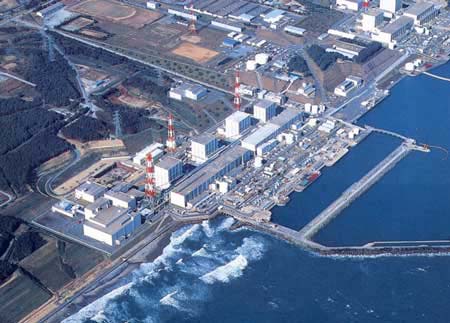
Kashiwazaki-Kariwa will be the latest plant to restart 15 years after the Fukushima disaster shut down the country’s nuclear energy programme.
Aljazeera, By Lyndal Rowlands and News Agencies, 22 Dec 25
Japan is set to resume operations at the world’s largest nuclear power plant: Kashiwazaki-Kariwa.
The partial restart of the plant got the green light in a vote on Monday by the Niigata local government. Japan has reopened several nuclear facilities as it seeks to reduce emissions, reversing policy 15 years after 54 reactors were shut in the wake of the Fukushima disaster despite public opposition.
Niigata prefecture’s assembly passed a vote of confidence on Governor Hideyo Hanazumi, who backed the restart last month, effectively allowing the plant to begin operations again.
The 2011 triple meltdown at Fukushima, following an earthquake and tsunami, destroyed Japan’s trust in its nuclear energy infrastructure…………..
Fourteen of the 33 nuclear plants that remain operable in the country have been resurrected. However, Kashiwazaki-Kariwa is the first to be operated by Tokyo Electric Power Co (TEPCO), which ran the Fukushima plant.
TEPCO is considering reactivating the first of seven reactors at the plant on January 20, Japanese public broadcaster NHK reported……………………
While lawmakers voted in support of Hanazumi, the assembly session showed that the community remains divided over the restart, despite the promise of new jobs and potentially lower electricity bills.
About 300 protesters rallied to oppose the vote, holding banners reading “No Nukes”, “We oppose the restart of Kashiwazaki-Kariwa” and “Support Fukushima”.
Farmer and antinuclear activist Ayako Oga, 52, joined the protests on Monday in her new home of Niigata, where she settled after fleeing the area around the Fukushima plant in 2011 with 160,000 other evacuees. Her old home was within the 20km (12-mile) radius irradiated exclusion zone.
“We know firsthand the risk of a nuclear accident and cannot dismiss it,” said Oga, adding that she still struggles with post-traumatic stress disorder-like symptoms……………………………… https://www.aljazeera.com/news/2025/12/22/japan-set-to-restart-worlds-biggest-nuclear-power-plant
Israeli Cabinet Approves 19 New Apartheid Colonies in Occupied West Bank.
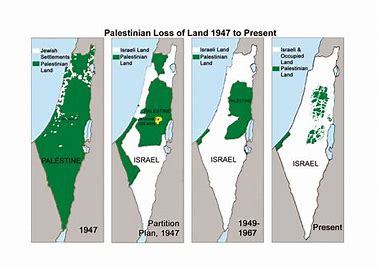
“The ONLY reason Israel gets away with this naked thievery is US military and political support,” said one observer.
Brett Wilkins, Dec 21, 2025, https://www.commondreams.org/news/israel-19-new-settlements
Israel’s Cabinet on Sunday finalized approval of 19 new Jewish-only settler colonies in the illegally occupied West Bank, a move the apartheid state’s far-right finance minister said was aimed at thwarting Palestinian statehood.
Cabinet ministers approved the legalization of the previously unauthorized settler outposts throughout the occupied Palestinian territory, bringing the total number of new settlements in recent years to 69.
The move will bring the overall total number of exclusively or overwhelmingly Jewish settlements—which are illegal under international law—to more than 200, up from around 140 just three years ago.
Included in the new approval are two former settlements—Kadim and Ganim—that were evacuated in compliance with the now effectively repealed 2005 Disengagement Law, under which Israel dismantled all of its colonies in the Gaza Strip and four in the West Bank.
“This is righting a historic injustice of expulsion from 20 years ago,” Israeli Finance Minister Bezalel Smotrich—who is a settler—said on Sunday. “We are putting the brakes on the rise of a Palestinian terror state.”
Israel’s Cabinet on Sunday finalized approval of 19 new Jewish-only settler colonies in the illegally occupied West Bank, a move the apartheid state’s far-right finance minister said was aimed at thwarting Palestinian statehood.
Cabinet ministers approved the legalization of the previously unauthorized settler outposts throughout the occupied Palestinian territory, bringing the total number of new settlements in recent years to 69.
RECOMMENDED…

‘No More Military Aid for Netanyahu,’ Says Sanders as Israel Ramps Up West Bank Takeover
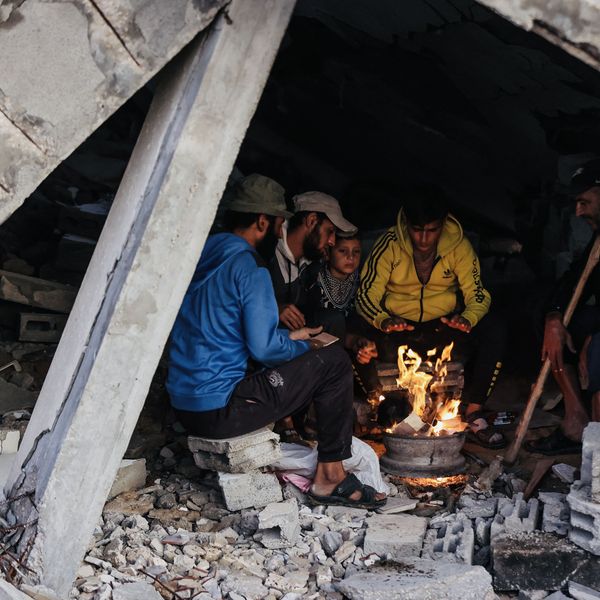
Trump Gaza Plan Condemned as ‘Concentration Camps Within a Mass Concentration Camp’
The move will bring the overall total number of exclusively or overwhelmingly Jewish settlements—which are illegal under international law—to more than 200, up from around 140 just three years ago.
Included in the new approval are two former settlements—Kadim and Ganim—that were evacuated in compliance with the now effectively repealed 2005 Disengagement Law, under which Israel dismantled all of its colonies in the Gaza Strip and four in the West Bank.
“This is righting a historic injustice of expulsion from 20 years ago,” Israeli Finance Minister Bezalel Smotrich—who is a settler—said on Sunday. “We are putting the brakes on the rise of a Palestinian terror state.”
Our people-powered journalism cannot survive without you
Your support allows Common Dreams to continue covering the stories and amplifying the voices that the corporate media never will. Make a tax-deductible year-end gift to ensure we can sustain the reporting needed to meet the challenges of 2026.
“We will continue to develop, build, and settle the inherited land of our ancestors, with faith in the righteousness of our path,” Smotrich added.
Following an earlier round of approval for the new settlements last week, Palestinian presidential spokesperson Nabil Abu Rudeineh said, “All Israeli settlement activity is illegal and constitutes a violation of international law and international legitimacy resolutions.”
United Nations Secretary-General António Guterres earlier this month denounced Israel’s “relentless” settlement expansion.
Such colonization, said Guterres, “continues to fuel tensions, impede access by Palestinians to their land, and threaten the viability of a fully independent, democratic, contiguous, and sovereign Palestinian state.”
Israeli Prime Minister Benjamin Netanyahu and other Israeli officials—some of whom, including Smotrich, deny the very existence of the Palestinian people—have vowed that such a state will not be established.
While Netanyahu—who is wanted by the International Criminal Court for alleged war crimes and crimes against humanity in Gaza—is under pressure from right-wing and far-right government officials, settlers, and others to annex all of the West Bank, US President Donald Trump recently said that “Israel would lose all of its support from the United States if that happened.”
Some doubted Trump’s threat, with Democracy for the Arab World Now (DAWN) executive director Sarah Leah Whitson reacting to the new settlements’ approval by posting on X that “the ONLY reason Israel gets away with this naked thievery is US military and political support.”
Israel seized and occupied the West Bank including East Jerusalem along with Gaza in 1967, ethnically cleansing around 300,000 Palestinians. Many of these forcibly displaced people were survivors of the Nakba, the Jewish terror and ethnic cleansing campaign that saw more than 750,000 Palestinians flee or be forced from Palestine during the foundation of the modern state of Israel.
Since 1967, Israel has steadily seized more and more Palestinian land in the West Bank while building and expanding colonies there. Settlement population has increased exponentially from around 1,500 colonists in 1970 to roughly 140,000 at the time of the Oslo Accords in 1993—under which Israel agreed to halt new settlement activity—to around 770,000 today.
Settlers often attack Palestinians and their property, including in deadly pogroms, in order to terrorize them into leaving so their land can be stolen. Israeli colonists have also attacked Israel Defense Forces soldiers they view as standing in the way of their expansion.
In July 2024, the International Court of Justice—where Israel is currently facing a genocide case related to the Gaza war—found the occupation of Palestine to be an illegal form of apartheid that must be ended as soon as possible. The ICJ also ruled that Israeli settler colonization of the West Bank amounts to annexation, also a crime under international law. Article 49 of the Fourth Geneva Convention states that an “occupying power shall not deport or transfer parts of its own civilian population into the territory it occupies.”
As the world’s attention focused on Gaza during the past two years, Israeli soldiers and settlers have killed at least 1,039 Palestinians—at least 225 of them children—in the West Bank. This year, at least 233 Palestinians, including at least 52 children, have been killed so far, according to the United Nations Relief and Works Agency for Palestinian Refugees in the Near East.
On Saturday, Israeli occupation forces shot and killed two Palestinians in the northern West Bank, including a 16-year-old boy, Rayan Abu Muallah, who the Israel Defense Forces said was shot after he threw an object at its troops.
Report: Netanyahu To Ask Trump To Support Another Attack on Iran

The Israeli PM is expected to make the case during a December 29 meeting at Mar-a-Lago
by Dave DeCamp | December 21, 2025 , https://news.antiwar.com/2025/12/21/report-netanyahu-to-ask-trump-to-support-another-attack-on-iran/
Israeli Prime Minister Benjamin Netanyahu is expected to ask President Trump to support another US-Israeli war on Iran, according to an NBC News report from Saturday.
The report said that Netanyahu will stress Israel’s concern over Iran’s production of ballistic missiles and will present Trump with options for the US to join or assist Israel with an attack on Iran. Israeli officials are also warning that Iran is reconstituting its nuclear sites that were bombed by the US during the war in June, but that was not their immediate concern.
According to a report from Israel Hayom, Israeli officials are preparing an “intelligence dossier” on Iran to present to Trump. Netanyahu’s office has said the meeting will take place at Mar-a-Lago on December 29, though President Trump suggested last week that it wasn’t finalized, saying, “We haven’t set it up formally, but he’d like to see me.”
Trita Parsi, Executive Vice President of the Quincy Institute for Responsible Statecraft, has been warning that another war with Iran was likely since Israel didn’t achieve all of its goals during its previous attack on the country, pointing to the fact that Iran’s missile strikes forced Israel to agree to a ceasefire quickly.
“The June war resulted in mutual deterrence, a situation Iran can accept, but one that is intolerable for Netanyahu and his legacy. Ultimately, the conflict was neither a victory for Israel nor for Iran,” Parsi wrote in Responsible Statecraft on Sunday, responding to the NBC report.
“It is precisely this balance of terror that prompts Israel to seek a new round – Israel’s military doctrine does not allow for any of its regional foes to deter it or challenge its military dominance. Iran’s missile program currently does exactly that,” Parsi added. “And this is precisely why Trump must say no to Netanyahu. Because Israel’s objective is not security in the conventional sense, but rather absolute dominance.”
Earlier this month, Trump suggested the US could destroy Iran’s ballistic missiles when a reporter said Iran was “reconstituting” its missile program. “Well, they can try, but it’s going to take them a long time to come back,” Trump said.
“But if they do want to come back and they want to come back without a deal, then we’re going to obliterate that one too. We can knock out their missiles very quickly. We have great power. And we helped Israel a lot. We were shooting down the drones. We were doing a lot of things for Israel. We did a good job for Israel. But Israel did a good job, they fought, they all fought bravely,” the president added.
1 This Month
26 September – International Day for the Total Elimination of Nuclear Weapons





PLEASE OPPOSE HR 8255 AND S.3639 – bills would accelerate satellite deployment, with no environmental review or safeguards – https://ncstd5li.quorum.us/campaign/169331/
To see nuclear-related stories in greater depth and intensity – go to https://nuclearinformation.wordpress.com
-
Archives
- September 2026 (290)
- August 2026 (330)
- July 2026 (355)
- June 2026 (287)
- May 2026 (306)
- April 2026 (356)
- March 2026 (251)
- February 2026 (267)
- January 2026 (308)
- December 2025 (358)
- November 2025 (359)
- October 2025 (375)
-
Categories
- 1
- 1 NUCLEAR ISSUES
- business and costs
- climate change
- culture and arts
- ENERGY
- environment
- health
- history
- indigenous issues
- Legal
- marketing of nuclear
- media
- opposition to nuclear
- PERSONAL STORIES
- politics
- politics international
- Religion and ethics
- safety
- secrets,lies and civil liberties
- spinbuster
- technology
- Uranium
- wastes
- weapons and war
- Women
- 2 WORLD
- ACTION
- AFRICA
- Atrocities
- AUSTRALIA
- Christina's notes
- Christina's themes
- culture and arts
- Events
- Fuk 2022
- Fuk 2023
- Fukushima 2017
- Fukushima 2018
- fukushima 2019
- Fukushima 2020
- Fukushima 2021
- general
- global warming
- Humour (God we need it)
- Nuclear
- RARE EARTHS
- Reference
- resources – print
- Resources -audiovicual
- Weekly Newsletter
- World
- World Nuclear
- YouTube
-
RSS
Entries RSS
Comments RSS

