Sellafield is Awash with Acid Chemicals – Rivers, Sea, Soil, Nothing is Off Limits for “Disposal” of This Toxic Brew Mixed with Dangerous Radioactive Isotopes at the Arse End of Atomic “Clean Energy”.
Sellafield’s Latest £22 MILLION Chemical Tender for wiping the Arse End of “Clean Energy”
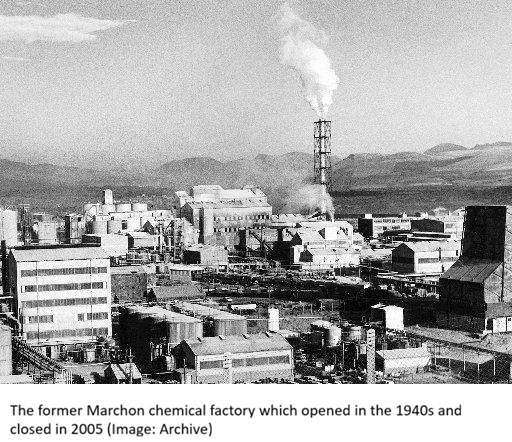
Marchon Chemical Works , contaminated industrial site, which supplied Sellafield with a sea of acid used in processes on site, is now insanely earmarked for housing!……………………………………………………………………………………………………………………………………………………..
There is a requirement for Sellafield Ltd to implement a Contract for Bulk and Packaged Chemicals to support site-wide operations and decommissioning activities across the Sellafield site.
This will include, but is not limited to, the following scope:
- Sodium Hydroxide 22% – IBC 1000L/1245kg
- Aluminium Sulphate 8% – Delivered via road tanker.
- Ferric Nitrate Solution – Delivered via road tanker.
- Praestol DW-31-EU – 1L/1.1kg
- Hydrochloric Acid 14% – IBC 1000L/1071kg
- Hydrated Lime – Per kg
- Nickel Nitrate – 10kg
- Sodium Carbonate Light – 25kg
- Sodium Hypochlorite (14/15%) – IBC 1000L/1255kg
- Pure Dried Vacuum Salt – Per kg
- Sodium Nitrate 36% – 834L/1068kg
- Granulated Sugar – 1000kg
- Sulphuric Acid 77% – IBC 1000L/1698Kg
- Sulphuric Acid 96% – Per kg
- Silver Zeolite Cartridges
- Silver Zeolite – 35g
- Brenntamer CL 845 – 25kg
- Lithium Nitrate – Per kg or 1230kg
…………………………………………………………………..
CPV classifications
24960000 – Various chemical products
24311521 – Caustic soda
24411000 – Nitric acid and salts
24311520 – Sodium hydroxide
24311410 – Inorganic acids
24311470 – Hydrogen chloride
24313100 – Sulphides, sulphites and sulphates
24311500 – Hydroxides as basic inorganic chemicals
24312120 – Chlorides
24311522 – Liquid soda
24311411 – Sulphuric acid
24313000 – Sulphides, sulphates; nitrates, phosphates and carbonates
24313120 – Sulphates
24313300 – Carbonates
24962000 – Water-treatment chemicals………………………………………………………………………………………………………………………………………………………………………………………………………………………….. https://mariannewildart.wordpress.com/2026/01/31/sellafield-is-awash-with-acid-chemicals-rivers-sea-soil-nothing-is-off-limits-for-disposal-of-this-toxic-brew-mixed-with-dangerous-radioactive-isotopes-at-the-arse-end-of-atomic/
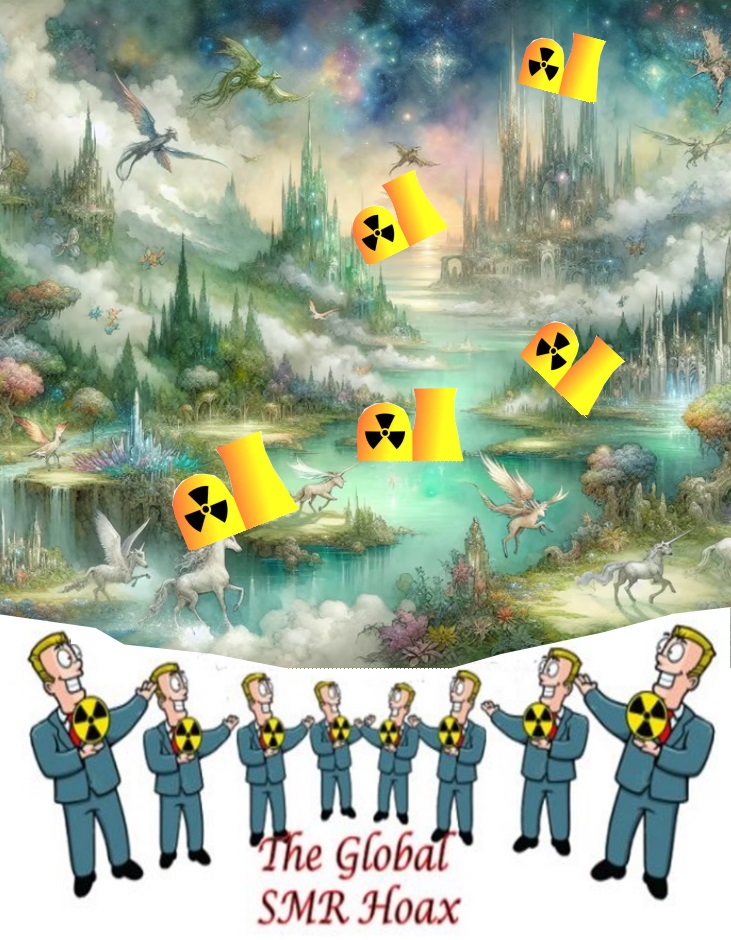
There’s a lot of hype around small modular reactors.
From Steve Thomas, Emeritus Professor of Energy Policy, University of Greenwich, London SE10, UK, 30 Jan 26 https://www.ft.com/content/085e92e6-2f7f-4381-9416-0aa59fa3a3
Richard Ollington (“Small nuclear reactors are worth the wait”, Opinion, January 16) makes three claims. First, that small modular reactors (SMRs) will get quicker and easier to build, citing the French programme as evidence. Second, Russia is building large numbers of SMRs and third, improving existing reactors and reviving retired ones could add 40GW of nuclear capacity. None of these claims stands up to scrutiny. Over the 15 years of the French programme, the real cost of reactors increased by some 60 per cent. Construction of the first eight reactors averaged 70 months while the last eight averaged 135 months.
Russia has completed only two SMRs and has one under construction. The two completed ones are barge-mounted reactors providing heat and power to an isolated Siberian community. They took 13 years to build and have a reliability of 40 per cent. Restarting two retired reactors (1.6GW), one owned by Meta, the other by Microsoft, is actively being considered, but awaits approval from the US Nuclear Regulatory Commission before decisions can be taken to bring them back to life. The increasing concentration of carbon in the atmosphere will not wait a decade to see if the ambitious claims for SMRs are met. So even if we were to believe the hype surrounding SMRs, we cannot afford to wait to see if they prove viable.
US military action in Iran risks igniting a regional and global nuclear cascade.

The Conversation, Farah N. Jan, Senior Lecturer in International Relations, University of Pennsylvania, January 30, 2026
The United States is seemingly moving toward a potential strike on Iran.
On Jan. 28, 2026, President Donald Trump sharply intensified his threats to the Islamic Republic, suggesting that if Tehran did not agree to a set of demands, he could mount an attack “with speed and violence.” To underline the threat, the Pentagon moved aircraft carrier USS Abraham Lincoln – along with destroyers, bombers and fighter jets – to positions within striking distance of the country.
Foremost among the various demands the U.S. administration has put before Iran’s leader is a permanent end to the country’s uranium enrichment program. It has also called for limits to the development of ballistic missiles and a cutting off of Tehran’s support for proxy groups in the Middle East, including Hamas, Hezbollah and the Houthis.
Trump apparently sees in this moment an opportunity to squeeze an Iran weakened by a poor economy and massive protests that swept through the country in early January.
But as a scholar of Middle Eastern security politics and proliferation, I have concerns. Any U.S. military action now could have widespread unintended consequences later. And that includes the potential for accelerated global nuclear proliferation – regardless of whether the Iranian government is able to survive its current moment of crisis.
Iran’s threshold lesson
The fall of the Islamic Republic is far from certain, even if the U.S. uses military force. Iran is not a fragile state susceptible to quick collapse. With a population of 93 million and substantial state capacity, it has a layered coercive apparatus and security institutions built to survive crises. The Islamic Revolutionary Guard Corps, the regime’s military wing, is commonly estimated in the low-to-high hundreds of thousands, and it commands or can mobilize auxiliary forces.
After 47 years of rule, the Islamic Republic’s institutions are deeply embedded in Iranian society. Moreover, any change in leadership would not likely produce a clean slate. ……………………………………………….
What strikes teach
Whether or not regime change might follow, any U.S. military action carries profound implications for global proliferation.
Iran’s status as a threshold state has been a choice of strategic restraint. But when, in June 2025, Israel and the U.S struck Iran’s nuclear facilities, that attack – and the latest Trump threats – sent a clear message that threshold status provides no reliable security.
The message to other nations with nuclear aspirations is stark and builds on a number of hard nonproliferation lessons over the past three decades. Libya abandoned its nuclear program in 2003 in exchange for normalized relations with the West. Yet just eight years later, NATO airstrikes in support of Libyan rebels led to the capture and killing of longtime strongman Moammar Gaddafi……………………………………………………………………………………………………………………………………………………………………………
The domino effect
Every nation weighing its nuclear options is watching to see how this latest standoff between the U.S. and Iran plays out.
Iran’s regional rival, Saudi Arabia, has made no secret of its own nuclear ambitions, with Crown Prince Mohammed bin Salman publicly declaring that the kingdom would pursue nuclear weapons if Iran did.
Yet a U.S. strike on Iran would not reassure Washington’s Gulf allies. Rather, it could unsettle them. The June 2025 U.S. strikes on Iran were conducted to protect Israel, not Saudi Arabia or Iran. Gulf leaders may conclude that American military action flows to preferred partners, not necessarily to them. And if U.S. protection is selective rather than universal, a rational response could be to hedge independently………………………………………………………………………………………………………………………………………………………..
And the nuclear cascade would not likely stop at the Middle East. ………………………………………… https://theconversation.com/us-military-action-in-iran-risks-igniting-a-regional-and-global-nuclear-cascade-274599
Barring last-minute nuclear deal, US and Russia teeter on brink of new arms race.

Reuters, By Mark Trevelyan and Jonathan Landay. January 30, 2026
- Summary
- New START treaty set to expire on February 5
- Trump hasn’t responded to Putin’s offer to extend missile limits
- End in sight to more than 50 years of mutual constraints
- Chinese build-up leaves US facing two big nuclear rivals
LONDON/WASHINGTON, Jan 30 (Reuters) – The United States and Russia could embark on an unrestrained nuclear arms race for the first time since the Cold War, unless they reach an eleventh-hour deal before their last remaining arms control treaty expires in less than a week.
The New START treaty is set to end on February 5. Without it, there would be no constraints on long-range nuclear arsenals for the first time since Richard Nixon and Soviet leader Leonid Brezhnev signed two historic agreements in 1972 on the first-ever trip by a U.S. president to Moscow.
Russian President Vladimir Putin has proposed the two sides should stick to existing missile and warhead limits for one more year to buy time to work out what comes next, but U.S. President Donald Trump has yet to formally respond.
Trump said this month that “if it expires, it expires”, and that the treaty should be replaced with a better one.
Some U.S. politicians argue Trump should reject Putin’s offer, freeing Washington to grow its arsenal to counter a rapid nuclear build-up by a third power: China.
Trump says he wants to pursue “denuclearisation” with both Russia and China. But Beijing says it is unreasonable to expect it to join disarmament talks with two countries whose arsenals are still far larger than its own.
WHY DO NUCLEAR TREATIES MATTER?
Since the darkest Cold War days when the United States and the Soviet Union threatened each other with “mutually assured destruction” in the event of nuclear war, both have seen arms limitation treaties as a way to prevent either a lethal misunderstanding or an economically ruinous arms race.
The treaties not only set numerical limits on missiles and warheads, they also require the sides to share information – a critical channel to “try to understand where the other side is coming from and what their concerns and drivers are”, said Darya Dolzikova at the RUSI think-tank in London.
With no new treaty, each would be forced to act according to worst-case assumptions about the weapons the other is producing, testing and deploying, said Nikolai Sokov, a former Soviet and Russian arms negotiator.
“It’s a self-sustaining kind of process. And of course, if you’ve got an unregulated arms race, things will get quite destabilising,” he said.
NEW TREATY NO SIMPLE TASK
Since the fall of the Soviet Union, Russia and the United States have repeatedly replaced and updated the Cold War-era treaties that limited the so-called strategic weapons they point at each other’s cities and bases.
The most recent, New START, was signed in 2010 by U.S. President Barack Obama and Dmitry Medvedev, a Putin ally who was then serving as Russian president for four years.
It caps the number of deployed strategic warheads at 1,550 on each side, with no more than 700 systems to deliver them from land, sea or air, by intercontinental ballistic missile, submarine-launched missile or heavy bomber.
Replacing it with a new treaty would be no simple task. Russia has developed new nuclear-capable systems – the Burevestnik cruise missile, the hypersonic Oreshnik and the Poseidon torpedo – that fall outside New START’s framework. And Trump has announced plans for a space-based “Golden Dome” missile defence system that Moscow sees as an attempt to shift the strategic balance……………………………………………………………………………………………………………………………………. https://www.reuters.com/business/aerospace-defense/barring-last-minute-nuclear-deal-us-russia-teeter-brink-new-arms-race-2026-01-30/
The Trump administration has secretly rewritten nuclear safety rules.
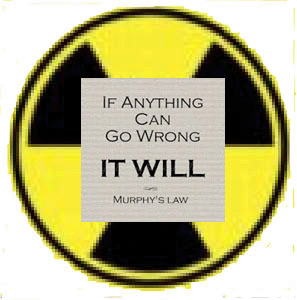
Removing the standard means that new reactors could be constructed with less concrete shielding, and workers could work longer shifts, potentially receiving higher doses of radiation
January 28, 2026, NPR
The Trump administration has overhauled a set of nuclear safety directives and shared them with the companies it is charged with regulating, without making the new rules available to the public, according to documents obtained exclusively by NPR.
The sweeping changes were made to accelerate development of a new generation of nuclear reactor designs. They occurred over the fall and winter at the Department of Energy, which is currently overseeing a program to build at least three new experimental commercial nuclear reactors by July 4 of this year.
The changes are to departmental orders, which dictate requirements for almost every aspect of the reactors’ operations — including safety systems, environmental protections, site security and accident investigations.
NPR obtained copies of over a dozen of the new orders, none of which is publicly available. The orders slash hundreds of pages of requirements for security at the reactors. They also loosen protections for groundwater and the environment and eliminate at least one key safety role. The new orders cut back on requirements for keeping records, and they raise the amount of radiation a worker can be exposed to before an official accident investigation is triggered.
Over 750 pages were cut from the earlier versions of the same orders, according to NPR’s analysis, leaving only about one-third of the number of pages in the original documents.
The new generation of nuclear reactor designs, known as small modular reactors, are being backed by billions in private equity, venture capital and public investments. Backers of the reactors, including tech giants Amazon, Google and Meta, have said they want the reactors to one day supply cheap, reliable power for artificial intelligence. (Amazon and Google are financial supporters of NPR.)
Outside experts who helped review the rules for NPR criticized the decision to revise them without any public knowledge.
“I would argue that the Department of Energy relaxing its nuclear safety and security standards in secret is not the best way to engender the kind of public trust that’s going to be needed for nuclear to succeed more broadly,” said Christopher Hanson, who chaired the Nuclear Regulatory Commission from 2021 to 2025, when he was fired by President Trump.
“They’re taking a wrecking ball to the system of nuclear safety and security regulation oversight that has kept the U.S. from having another Three Mile Island accident,” said Edwin Lyman, director of nuclear power safety at the Union of Concerned Scientists. “I am absolutely worried about the safety of these reactors.”………………………………………………
A new nuclear path
The origins of the changes can be traced to the Oval Office. In May of last year, Trump sat behind the Resolute Desk and signed a series of executive orders on nuclear energy……………………………………………………………………………………..
Sites across the country will host new reactor designs……………………………………………………………
Rules rewritten
The documents reviewed by NPR show just how extensive the streamlining effort has been.
The new orders strip out some guiding principles of nuclear safety, notably a concept known as “As Low As Reasonably Achievable” (ALARA), which requires nuclear reactor operators to keep levels of radiation exposure below the legal limit whenever they can. The ALARA standard has been in use for decades at both the Department of Energy and the Nuclear Regulatory Commission.
Removing the standard means that new reactors could be constructed with less concrete shielding, and workers could work longer shifts, potentially receiving higher doses of radiation, according to Tison Campbell, a partner at K&L Gates who previously worked as a lawyer at the Nuclear Regulatory Commission……………………………………………………………………………………………………
The new rules also remove a requirement to use the “best available technology” to protect water supplies from the discharge of radioactive material……………………………………………………………………
Security rules slashed
Hundreds of pages of security rules were trimmed from the new orders, including a requirement to issue body armor to security police officers (SPOs).
Gone are detailed requirements for firearms training, emergency drills, officer-involved shooting procedures and limits on how many hours security force officers can work in a day or week. Entire chapters specifying how nuclear material should be secured and what sorts of physical barriers should be built to protect it have been reduced to bullet points……………………………………………………..
Loosening protections for the environment and workers
NPR’s review of the new orders shows that, in certain cases, they also appear to loosen rules about discharging radioactive material.
For example, the previous version of an order titled “Radiation Protection for the Public and the Environment” states that discharging radioactivity “from DOE activities into non-federally owned sanitary sewers are prohibited,” then provides a limited series of exceptions…………………………………
above all, the fact that the rewrites were done without public knowledge could be the most damaging, said Huff. In the past, public distrust has been a huge barrier to the development of nuclear power, and transparency is an important way to counter that mistrust………. https://www.npr.org/2026/01/28/nx-s1-5677187/nuclear-safety-rules-rewritten-trump
Upcoming Trump attack on Iran likely to kill thousands of Americans and Israelis.
Walt Zlotow West Suburban Peace Coalition Glen Ellyn IL 30 Jan 26
In word and deed President Trump appears on the cusp of attacking Iran to decapitate its regime and destabilize the entire country of 93 million.
Trump threatens war and moves massive military might into the region near Iran. Trump did the same thing to Venezuela last September. On January 3, he pulled the trigger, attacking Venezuela, killing a hundred Venezuelans and kidnapping its president to stand trial in the US.
The criminal Venezuelan campaign would be small potatoes should Trump pull the trigger to utterly destroy the Iranian regime, consigning Iran to failed state status.
The US and Israel tried and failed to do that during the June Twelve Day War. Trump suckered Iran into complacency by scheduling negotiations, allowing Israel to launch a sneak attack June 13. Tho suffering massive destruction, Iran struck back, firing over 1,500 missiles and drones into Israel. It caused enough damage and chaos that Israel begged Trump to negotiate a ceasefire.
Israel and the US tried again last December by using provocateurs to support domestic Iranian government protests. Trump threatened military intervention based on protecting the protesters from death. But when Iran crushed the protests Trump backed down once again.
This time it appears Trump may go for broke with all out war. Big mistake. Iran understands, ‘Fool me once shame on Iran.’ This time they’re ready with tens of thousands of missiles and drones widely dispersed and impossible to neutralize.
Iran realizes America and Israel’s existential threat to Iran cannot be negotiated away. Any attack will likely inflict thousands of casualties in Israel and to US forces in the region. The US aircraft carrier Abraham Lincoln may end up in Davy Jones Locker. Iran could shut down the Strait of Hormuz, sending oil prices into the stratosphere and US economy into the dumpster.
War with Iran has nothing to do with America’s national security interests. It has to do with Israel’s determination to destroy its last hegemonic rival in the Middle East. For America, it has to do with acquiescing in whatever madness Israel demands of both parties under near total control by the Israeli government and its American lobby.
‘Deeply ideological’: the rationale behind Iran’s insistence on uranium enrichment
Tehran’s nuclear ambitions date back to the shah and the 1970s and remains undimmed despite the damage caused by sanctions.
A desperate effort to avert war between the US and Iran is once again under way, but trying to locate common ground between the two countries over Tehran’s nuclear programme has been made more difficult by escalating US demands, and by Iran’s ideological, deeply nationalist attachment to the right to enrich uranium.
Iran’s ambitions to run its own nuclear programme pre-date the arrival of the theocratic state in 1979, and can be traced back to the mid-1970s when the shah announced plans to build 20 civil nuclear power stations. This prompted an undignified scramble among western nations to be part of the action, with the UK energy secretary at the time, Tony Benn, having more than a walk-on part. At the heart of the programme was a desire for national sovereignty and power, symbolised by the ability
to enrich uranium.
Guardian 30th Jan 2026, https://www.theguardian.com/world/2026/jan/30/rationale-behind-iran-uranium-enrichment-nuclear-ambitions
From the ashes, arises a Phoenix: Scottish NFLAs resolve to chart a new path
The UK/Ireland Nuclear Free Local Authorities will tomorrow pass into history as the Manchester-based Secretariat will cease to function and the post of NFLA Secretary will be disestablished.
But now at least there is the expectation that from out of the ashes a new phoenix will arise; for today our Scottish affiliated authorities took the decision ‘in principle’ to reform a Scottish Nuclear Free Local Authorities network with a Glasgow-based Secretariat.
NFLA Policy Advisor Pete Roche, known to many
of you for his invaluable daily and weekly information bulletins published
through No 2 Nuclear Power www.no2nuclearpower.org.uk, will continue to
support the new body. Over the next two months, the leadership of the
Scottish NFLAs will take legal and financial advice to best place the new
SNFLAs on a secure footing for the future. And, with Scotland facing
increasing nuclear threats from Ministers at Whitehall and a looming
Scottish Parliament election, the decision could not be timelier.
NFLA 30th Jan 2026, https://www.nuclearpolicy.info/news/from-the-ashes-arises-a-phoenix-scottish-nflas-resolve-to-chart-a-new-path/
SNP rules out any new nuclear power plants in Scotland

By Neil Smith, Largs & Millport Weekly News 30th Jan 2026
THE Scottish Government has again ruled out building new nuclear power plants, despite a plea from West Scotland MSP Jamie Greene.
At Holyrood on Thursday, the Liberal Democrat member asked if the SNP government would continue its opposition to new nuclear plants.
A new plant to replace Hunterston A and B in North Ayrshire has been called for in recent years – to no avail.
Cabinet Secretary for Climate Action and Energy, Gillian Martin, responded: “We do not support the construction of new nuclear power stations in Scotland under current technologies.
“And while we recognise the role that nuclear has played, new nuclear would take decades to deliver, comes at a very high cost and creates long-term radioactive waste liabilities.
“Scotland has abundant resources with the clear potential to meet electricity demand through continued deployment of renewable energy and storage, and we are prioritising technologies that are quicker to deliver, lower cost and proven to maintain security of supply rather than the new nuclear projects that would take decades to materialise.”……………………….
“I have to point out the cost of nuclear, if you look at Hinkley Point C. It was expected to be completed in 2025 at a cost of £18 billion. Now the cost is estimated at £46 billion and it is delayed until 2031. I think that’s a lesson for all” https://www.largsandmillportnews.com/news/25808021.snp-rules-new-nuclear-power-plants-scotland/
UN watchdog warns Ukraine war remains world’s biggest threat to nuclear safety.

30 January 2026, https://news.un.org/en/story/2026/01/1166863
The war in Ukraine remains the world’s biggest threat to nuclear safety as a fifth year of combat looms, the head of the UN nuclear watchdog warned on Friday, citing continued risks to power supplies at nuclear sites vulnerable to fighting nearby.
Addressing the International Atomic Energy Agency (IAEA) Board of Governors, Director General Rafael Grossi said the agency remains focused on preventing a nuclear accident as fighting continues to endanger critical infrastructure.
“The conflict in Ukraine is about to enter its fifth year,” Mr. Grossi said. “It continues to pose the world’s biggest threat to nuclear safety.”
IAEA teams remain deployed at all nuclear power plants affected by the conflict and publish regular updates on nuclear safety and security conditions.
The Board of Governors is the IAEA’s main decision-making body, bringing together representatives of 35 countries to oversee nuclear safety, security and safeguards, and to guide the work of the UN nuclear watchdog. Its current membership includes, among others Russia, the United States, United Kingdom, and France.
Off-site power a critical safety lifeline
Mr. Grossi stressed that a central safety requirement is reliable off-site power – the electricity a plant receives from the national grid. Without it, nuclear sites must rely on backup systems to run cooling and other essential safety functions.
“There must be secure off-site power supply from the grid for all nuclear sites,” he said, pointing to the IAEA’s “Seven Pillars” guidance for nuclear safety during armed conflict, where off-site power is pillar number four.
He also cited Principle 3 of the IAEA’s Five Principles for protecting the Zaporizhzhya Nuclear Power Plant (ZNPP) that “all efforts should be made to ensure off-site power remains available and secure at all times.”
Mr. Grossi said both sets of guidance have broad international support, including from the parties directly involved, and that he has repeatedly called for adherence to them, including at the UN Security Council.
Progress at Zaporizhzhya amid ongoing risks
He reported recent progress at ZNPP, where Europe’s biggest plant was reconnected on 19 January to its last remaining 330-kilovolt backup power line after repairs were carried out under a temporary ceasefire negotiated with Ukrainian and Russian counterparts.
The line had been damaged and disconnected since 2 January, reportedly due to military activity.
Until the reconnection, ZNPP relied on its last remaining 750-kilovolt main line to provide off-site power for safety systems needed to cool its six shutdown reactors and spent fuel pools. IAEA teams are also monitoring the plant’s ability to manage winter conditions, including keeping water in cooling and sprinkler ponds from freezing.
Beyond the plants themselves, Mr. Grossi warned that Ukraine’s electrical substations are also crucial to nuclear safety. “Damage to them undermines nuclear safety and must be avoided,” he said. An IAEA expert mission is now assessing 10 substations vital to nuclear safety amid ongoing strikes on the country’s power infrastructure.
Other nuclear sites also affected
IAEA teams have also reported military activity near other nuclear facilities, including the Chornobyl site, where damage to a critical substation disrupted multiple power lines and forced temporary reliance on emergency diesel generators. The affected lines have since been reconnected.
Mr. Grossi said the IAEA has shown how international institutions can help reduce risks and provide predictability in a volatile war. But, he added, technical measures have limits.
“The best way to ensure nuclear safety and security,” he said, “is to bring this conflict to an end.”
The US Is Pushing So Many Regime Change Agendas It’s Hard To Keep Up.
Caitlin Johnstone, 30 Jan 26, https://www.caitlinjohnst.one/p/the-us-is-pushing-so-many-regime?utm_source=post-email-title&publication_id=82124&post_id=186298268&utm_campaign=email-post-title&isFreemail=true&r=1ise1&triedRedirect=true&utm_medium=email
It’s just incredible how quickly and aggressively the US is advancing longstanding agendas of global conquest under the Trump administration. Now they’re racing to take out Cuba.
The US president has signed an executive order to impose new tariffs on countries which supply oil to Cuba, even indirectly, which is expected to dramatically increase the pressure on the already struggling island nation. This comes as Financial Times reports that “Cuba only has enough oil to last 15 to 20 days at current levels of demand and domestic production” after the US cut off the supply from Venezuela and Mexico shelved a planned oil shipment.
Trump’s order itself contains the usual excuses we’ve come to expect from the empire of propaganda and lies, with its authors babbling without evidence about Hamas and Hezbollah and “transnational terrorist groups” receiving support from Havana, thereby making this crushing act of siege warfare a self-defense measure implemented in protection of the American people.
We’re being asked to believe that Cuba is Hamas, so Washington needs to strangle it to death in self-defense. The fact that the US has been pursuing regime change in Cuba for generations, we are told, is merely a coincidence.
The lies get dumber and dumber with each new imperial power grab. It’s just insulting at this point.
Last week The Wall Street Journal published an article titled “The U.S. Is Actively Seeking Regime Change in Cuba by the End of the Year” which cited anonymous senior US officials saying they viewed the operation to remove Maduro from Caracas as a “blueprint” for bringing down Havana.
Here’s an excerpt:
“Emboldened by the U.S. ouster of Venezuelan President Nicolás Maduro, the Trump administration is searching for Cuban government insiders who can help cut a deal to push out the Communist regime by the end of the year, people familiar with the matter said.
“The Trump administration has assessed that Cuba’s economy is close to collapse and that the government has never been this fragile after losing a vital benefactor in Maduro, these people said. Officials don’t have a concrete plan to end the Communist government that has held power on the Caribbean island for almost seven decades, but they see Maduro’s capture and subsequent concessions from his allies left behind as a blueprint and a warning for Cuba, senior U.S. officials said.”
The Wall Street Journal reports that administration officials have been meeting with “Cuban exiles and civic groups in Miami and Washington” with the goal of “identifying somebody inside the current government who will see the writing on the wall and want to cut a deal,” in a way similar to how assets within the Maduro government were recruited to facilitate his removal.
In a new segment on Trump’s frenzied efforts to topple Havana, CNN’s Patrick Oppmann reports from Cuba that he’s “heard from a US embassy source that diplomats there have been advised to quote ‘have their bags packed’ as the Trump administration explores new ways to destabilize the communist-run government.”
The US likes to immiserate the populations of targeted nations using economic strangulation with the goal of fomenting unrest and turning people against their leaders. In 2019 Trump’s previous secretary of state Mike Pompeo openly acknowledged that the goal of Washington’s economic warfare against Iran was to make the population so miserable that they “change the government”, cheerfully citing the “economic distress” the nation had been placed under by US sanctions. Economic distress has been widely cited as a primary factor in the deadly protests that have rocked Iran in recent weeks.
Starvation sanctions are the only form of warfare where it is widely considered both normal and ethical to deliberately target a civilian population with deadly force. Deliberately impoverishing an entire nation so that it erupts in conflict and civil war is one of the most evil things you can possibly imagine, but it’s the go-to Plan A for the US empire when it comes to removing foreign leaders who refuse to kiss the imperial boot.
From Palestine to Lebanon to Yemen to Syria to Venezuela to Cuba to Iran, these last couple of years the US has been in a mad scramble to eliminate governments and resistance groups which attempt to insist on their own sovereignty. There’s a new excuse every time, but the end goal is always the same: the furtherance of planetary domination.
The US empire is the single most tyrannical and murderous power structure on this planet. If any regime is in need of changing, it’s that one.
The U.S. plan for Gaza has nothing in it for Palestinians

The U.S. plan for Gaza envisions a Gaza for investors, not Palestinians.
By Qassam Muaddi January 28, 2026 , https://mondoweiss.net/2026/01/the-u-s-plan-for-gaza-has-nothing-in-it-for-palestinians/
The latest iteration of the future U.S. plan for Gaza was revealed last week by U.S. President Trump’s son-in-law, Jared Kushner, at the inaugural ceremony of the so-called “Board of Peace,” which is tasked with overseeing the reconstruction and administration of the Strip. Kushner’s presentation included a map of what Gaza would look like after reconstruction, including industrial zones, residential blocks, and tourism beaches. The plan advertises a new Rafah and a new Gaza City, completely separate from one another. Meanwhile, the edges of the Strip — which once served as Gaza’s farmland and bread basket — would now be home to industrial complexes. Kushner’s plan doesn’t foresee any restoration of Palestinian neighborhoods or villages, and offers no place for natural Palestinian life to exist. Only fixed residential blocks, surrounded by investments.
After two years of genocide, the outcome that is being laid out for the people of Gaza — and the Palestinian people as a whole — is the creation of a dystopian reality that sees the building of luxury resorts on top of their destroyed homes and communities.
The only role for Palestinians in this vision is to be managed — controlled, “concentrated” in confined zones, and later possibly expelled. All of this is masked as a “historic” humanitarian effort.
A Gaza without Palestinians
Soon, it will be four months since the ceasefire in Gaza went into effect. On Monday, the first phase of the agreement officially ended after the Israeli government announced that Israeli forces had found the body of the last dead Israeli soldier held captive in Gaza. Israel had refused to move to the second phase of the ceasefire before Hamas handed over the remaining body, which the Israeli army reportedly found on the Israeli-controlled side of the Strip.
Coincidentally, in the past few days, U.S. President Trump announced the formation of the Board of Peace, initially planned to oversee the transition in Gaza during the second phase of the ceasefire. Simultaneously, the Israeli government agreed to reopen the Rafah crossing, a crucial step for the second phase. A week earlier, the Palestinian technocratic committee for the administration of Gaza was also announced.
But what’s actually happening on the ground started well before the technocratic committee was formed. Israel’s longstanding plans for Gaza — to corral its population into concentrated zones ahead of their possible expulsion — have been silently unfolding on the ground. Last week, Drop Site News revealed documents obtained from the U.S.-Israeli military and civil command center in Israel showing preparations for a residential area to be built in Rafah. According to Drop Site, if developed, the “planned community” in Rafah “would contain and control its residents through biometric surveillance, checkpoints, monitoring of purchases, and educational programs promoting normalization with Israel,” comparing it to a panopticon. Rafah was completely leveled by the Israeli army earlier in 2025.
Based on an analysis of satellite imagery conducted by Forensic Architecture, the Drop Site report indicates that the new “community” is being prepared on a 1-square-kilometer plot of land in Rafah at the intersection of two military corridors.
Jonathan Whittall, a senior UN official in Palestine between 2022 and 2025, said that “this is the next phase in the weaponization of aid,” after reviewing the materials obtained by Drop Site
This idea to “concentrate” Palestinians into a highly surveilled area is in line with previous statements made by Israeli Defense Minister, Israel Katz, who said last July that Palestinians who would be allowed into the so-called “humanitarian city” — proposed to be built over Rafah’s ruins — would not be allowed to leave it. The scheme was widely decried by human rights groups as a thinly-disguised plan to build a “concentration camp,” and was seen as a first step toward pushing Palestinians to leave Gaza entirely. Israeli Prime Minister Benjamin Netanyahu explicitly told his cabinet as much in September, under the label of “voluntary emigration.”
Meanwhile, the National Committee for the Administration of Gaza (NCAG), the body of Palestinian technocrats set to oversee day-to-day governance in the Strip, is about to enter Gaza. It has so far garnered the support of all Palestinian factions, yet remains subordinate to Trump’s Board of Peace, with only limited executive powers. The Board of Peace, on the other hand, plays a political role in drafting plans for Gaza.
The NCAG is the first-ever Palestinian governing body in Palestine that is not part of the PLO’s institutional structure, which effectively splits Gaza politically from the rest of Palestine. Instead, its ultimate political reference now lies in a Board of Peace headed by Trump and, among others, Israel. The vision it is advancing for Gaza is one without Palestinians.
In fact, all the unfolding information about the U.S. plan for Gaza shows that it treats the Palestinian question as a purely humanitarian issue shorn of any political content. It completely ignores the centrality of Gaza to the Palestinian cause as a political question and fails to address the basic element of the “conflict” — Palestinian self-determination.
This should not be surprising, given that decision-making is dominated by U.S. business interests, ambitions of regional control and power, and Israel’s ideological drive to push Palestinians out. In the midst of all this, no Palestinian voice is present.
The BBC pushes the case for an illegal war on Iran with even bigger lies than Trump’s.
Notice too – though the BBC won’t point it out – that the US sanctions are a form of collective punishment on the Iranian population that is in breach of international law and that last year’s strikes on Iran were a clear war of aggression, which is defined as “the supreme international crime”.
29 January 2026, https://www.jonathan-cook.net/blog/2026-01-29/bbc-illegal-war-iran-lies/
The UK state broadcaster streams disinformation into our living rooms – deceptions that not only leave us clueless about important international events but drive us ever closer to global conflagration
Here is another example of utterly irresponsible journalism from the BBC on tonight’s News at Ten.
Diplomatic correspondent Caroline Hawley starts by credulously amplifying a fantastical death toll of “tens of thousands of dead” from recent protests in Iran – figures provided by regime opponents. Contrast that with the BBC’s constant, two years of caution and downplaying of the numbers killed in Gaza by Israel.
The idea that in a few days Iranian security forces managed to kill as many Iranians as Israel has managed to kill Palestinians in Gaza from the prolonged carpet-bombing and levelling of the tiny enclave, as well as the starvation of its population, beggars belief. The figures sound patently ridiculous because they are patently ridiculous.
Either the Iran death toll is massively inflated, or the Gaza death toll is a massive underestimate. Or far more likely, both are intentionally being used to mislead.
Watch Caroline Hawley’s two-minute report here: [on original]
The BBC has a political agenda that says it is fine to headline a made-up, inflated figure of the dead in Iran because our leaders have defined Iran as an Official Enemy. While the BBC has a converse political agenda that says it’s fine to employ endless caveats to minimise a death toll in Gaza that is already certain to be a huge undercount because Israel is an Official Ally.
This isn’t journalism. It’s stenography for western governments that choose enemies and allies not on the basis of whether they adhere to any ethical or legal standards of behaviour but purely on the basis of whether they assist the West in its battle to dominate oil resources in the Middle East.
Notice something else. This news segment – focusing the attention of western publics once again on the presumed wanton slaughter of protesters in Iran earlier this month – is being used by the BBC to advance the case for a war on Iran out of strictly humanitarian concerns that Trump himself doesn’t appear to share.
Trump has sent his armada of war ships to the Gulf not because he says he wants to protect protesters – in fact, missile strikes will undoubtedly kill many more Iranian civilians – but because he says he wishes to force Iran to the negotiating table over its nuclear programme.
There are already deep layers of deceit from western politicians regarding Iran – not least, the years-long premise that Iran is seeking a nuclear bomb, for which there is still no evidence, and that Tehran is responsible for the breakdown of a deal to monitor its civilian nuclear power programme. In fact, it was Trump in his first term as president who tore up that agreement.
Iran responded by enriching uranium above the levels needed for civilian use in a move that was endlessly flagged to Washington by Tehran and was clearly intended to encourage the previous Biden administration to renew the deal Trump had wrecked.
Instead, on his return to power, Trump used that enrichment not as grounds to return to diplomacy but as a pretext, first, to intensify US sanctions that have further crippled Iran’s economy, deepening poverty among ordinary Iranians, and then to launch a strike on Iran last summer that appears to have made little difference to its nuclear programme but served to weaken its air defences, to assassinate some of its leaders and to spread terror among the wider population.
Notice too – though the BBC won’t point it out – that the US sanctions are a form of collective punishment on the Iranian population that is in breach of international law and that last year’s strikes on Iran were a clear war of aggression, which is defined as “the supreme international crime”.
The US President is now posturing as though he is the one who wants to bring Iran to the negotiating table, by sending an armada of war ships, when it was he who overturned that very negotiating table in May 2018 and ripped up what was known as the Joint Comprehensive Plan of Action.
The BBC, of course, makes no mention whatsoever of this critically important context for judging the credibility of Trump’s claims about his intentions towards Iran. Instead its North America editor, Sarah Smith, vacuously regurgitates as fact the White House’s evidence-free claim that Iran has a “nuclear weapons programme” that Trump wants it to “get rid of”.
Watch Sarah Smith’s one-minute report here: [on original]
But on top of all that, media like the BBC are adding their own layers of deceit to sell the case for a US war on Iran.
First, they are doing so by trying to find new angles on old news about the violent repression of protests inside Iran. They are doing so by citing extraordinary, utterly unevidenced death toll figures and then tying them to the reasons for Trump going on the war path. Its reporting is centring once again – after the catastrophes of Afghanistan, Iraq, Libya and elsewhere – bogus humanitarian justifications for war when Trump himself is making no such connection.
And second, the BBC’s reporting by Sarah Smith coolly lays out the US mechanics of attacking Iran – the build-up to war – without ever mentioning that such an attack would be in complete violation of international law. It would again be “the supreme international crime”.
Instead she observes: “Donald Trump senses an opportunity to strike at a weakened leadership in Tehran. But how is actually going to do that? I mean he talked in his message about the successful military actions that have definitely emboldened him after the actions he took in Venezuela and earlier last year in Iran.”
Imagine if you can – and you can’t – the BBC dispassionately outlining Russian President Vladimir Putin’s plans to move on from his invasion of Ukraine into launching military strikes on Poland. Its correspondents note calmly the number of missiles Putin has massed closer to Poland’s borders, the demands made by the Russian leader of Poland if it wishes to avoid attack, and the practical obstacles standing in the way of the attack. One correspondent ends by citing Putin’s earlier, self-proclaimed “successes”, such as the invasion of Ukraine, as a precedent for his new military actions.
It is unthinkable. And yet not a day passes without the BBC broadcasting this kind of blatant warmongering slop dressed up as journalism. The British public have to pay for this endless stream of disinformation pouring into their living rooms – lies that not only leave them clueless about important international events but drive us ever closer to the brink of global conflagration.
What does the US want from Iran? Tracking one month of Trump’s changing demands.
After saying the US would attack if protesters were harmed, the president appears now to be tying the threat of airstrikes to Iran’s nuclear programme.
Jonathan Yerushalmy, Thu 29 Jan 2026 , https://www.theguardian.com/us-news/2026/jan/29/trump-iran-usa-one-month-demands-protesters-nuclear
Donald Trump has warned that Iran must come to the table to negotiate a deal over its nuclear programme or face the possibility of airstrikes and regime change, capping off a month of bellicose posturing and whiplash inducing u-turns from the US president.
The US president’s demands threaten to open a new chapter in America’s long and tumultuous relationship with Iran, which in just over a decade has seen rapprochement, broken deals, targeted assassinations and unprecedented airstrikes.
Here’s a recap of just the last 31 days:
29 December : ‘We’ll knock the hell out of them’
At the end of December, Trump suggested that Iran was “building up weapons” again, just six months after the US launched unprecedented strikes against the country’s nuclear sites.
Speaking beside Israeli prime minister Benjamin Netanyahu in Florida, Trump said if Iran was working to build up again “we’ll knock the hell out of them. But, hopefully, that’s not happening.” He added that the consequences of such a move would be “more powerful than the last time”.
After Netanyahu suggested that Iran may be attempting to rebuild its nuclear programme, the country’s foreign minister called for renewed talks with the US.
2 January: ‘We are locked and loaded and ready to go’
After Iranians took to the streets in the largest national demonstrations in years, Trump said that if protesters were killed, the US would “come to their rescue”.
“We are locked and loaded, and ready to go,” he said.
The unrest, triggered by an unprecedented decline in the value of the national currency, prompted a renewed escalation in tensions between the US and Iran.
6 January: ‘Make Iran Great Again’
Days after Trump launched strikes on Venezuela and captured the country’s president Nicolás Maduro, Trump was pictured posing with a “Make Iran Great Again” hat.
With protests in Iran spreading and reports of dozens dead, Trump again said that if Tehran “violently kills peaceful protesters” the US would “come to their rescue”.
10 January: ‘The USA stands ready to help!!!’
As the reported death toll in the protests soared into the hundreds, Trump was said to be weighing a response. “Iran is looking at FREEDOM, perhaps like never before. The USA stands ready to help!!!,” the US president said on the Truth Social platform.
The speaker of Iran’s parliament warned that Israeli and US interests in the Middle East would be “legitimate targets” if Washington attacked Iran.
13 January: ‘Help is on its way
Trump announced new 25% tariffs on countries that do business with Iran, but there was no official documentation from the White House and it appears they were never implemented.
Amid reports of a brutal regime crackdown on the protesters, Trump had initially claimed Iran wanted to negotiate, but later went on to say that he had cancelled all meetings with officials.
“Iranian Patriots, keep protesting – take over your institutions!!! … help is on its way,” Trump said in a post on Truth Social on Tuesday.
14 January: ‘The killing in Iran is stopping’
Despite reports that as many as 3,428 Iranians had been killed and that executions as punishment were imminent, Trump said he had been told that “the killing in Iran is stopping … And there’s no plan for executions.”
It was understood he had reviewed the full range of options to strike Iran but was unconvinced by any single action. His administration had also been lobbied by Middle Eastern allies not to go ahead with strikes, with fears that an attack would lead to a major and intractable conflict across the region.
In the days that followed the huge protest movement slowed under the weight of the regime’s brutal crackdown. Mass arrests followed and many Iranians said they felt betrayed and confused by the president’s sudden about turn.
22 January: ‘We have a lot of ships going that direction’
After several days which saw Trump distracted by anti-ICE protests in Minneapolis and a breakdown in relations with European allies over the fate of Greenland, Trump returned to the issue of Iran, saying “We have a lot of ships going that direction, just in case.”
With the death toll from the protests now said to be more than 5,000 – and reports it could be many times higher than that – Trump’s decision to send the aircraft carrier USS Abraham Lincoln and several guided-missile destroyers to the Middle East were thought to be in response to the regime’s brutal crackdown.
28 January: ‘Time is running out’
With US ships now in position in the Middle East, Trump issued an extraordinary threat to Iran, saying of the armada, “like with Venezuela, it is, ready, willing, and able to rapidly fulfill its mission, with speed and violence, if necessary.”
Warning that Iran must “make a deal”, Trump said that the country would have “NO NUCLEAR WEAPONS”.
The statement marked a shift in his administration’s rationale for sending the armada to the region, with no mention of the protesters, their demands or the regime’s brutal crackdown.
1 This Month

18 March Webinar @ 1 PM EST: An Assessment of SMR Projects: The Case of Canada
register for the zoom:
https://us02web.zoom.us/webinar/register/WN_o8BIIOUvQ2ONJR1nta65DQ#/registration

of the week – STOP SMALL MODULAR REACTORS IN CANADA
To see nuclear-related stories in greater depth and intensity – go to https://nuclearinformation.wordpress.com
-
Archives
- February 2026 (256)
- January 2026 (308)
- December 2025 (358)
- November 2025 (359)
- October 2025 (376)
- September 2025 (258)
- August 2025 (319)
- July 2025 (230)
- June 2025 (348)
- May 2025 (261)
- April 2025 (305)
- March 2025 (319)
-
Categories
- 1
- 1 NUCLEAR ISSUES
- business and costs
- climate change
- culture and arts
- ENERGY
- environment
- health
- history
- indigenous issues
- Legal
- marketing of nuclear
- media
- opposition to nuclear
- PERSONAL STORIES
- politics
- politics international
- Religion and ethics
- safety
- secrets,lies and civil liberties
- spinbuster
- technology
- Uranium
- wastes
- weapons and war
- Women
- 2 WORLD
- ACTION
- AFRICA
- Atrocities
- AUSTRALIA
- Christina's notes
- Christina's themes
- culture and arts
- Events
- Fuk 2022
- Fuk 2023
- Fukushima 2017
- Fukushima 2018
- fukushima 2019
- Fukushima 2020
- Fukushima 2021
- general
- global warming
- Humour (God we need it)
- Nuclear
- RARE EARTHS
- Reference
- resources – print
- Resources -audiovicual
- Weekly Newsletter
- World
- World Nuclear
- YouTube
-
RSS
Entries RSS
Comments RSS
 nuclear-news