EU and UK make contributions to EBRD-managed Chornobyl ICCA fund
EBRD 26th June 2025,
https://www.ebrd.com/home/news-and-events/news/2025/eu-and-uk-make-contributions-to-ebrd-managed-chornobyl-icca-fund.html
- EU and United Kingdom pledge up to €31.7 million to EBRD-managed International Chernobyl Cooperation Account
- Contributions will help fund emergency repairs to New Safe Confinement
- Total cost of emergency repairs could exceed €100 million
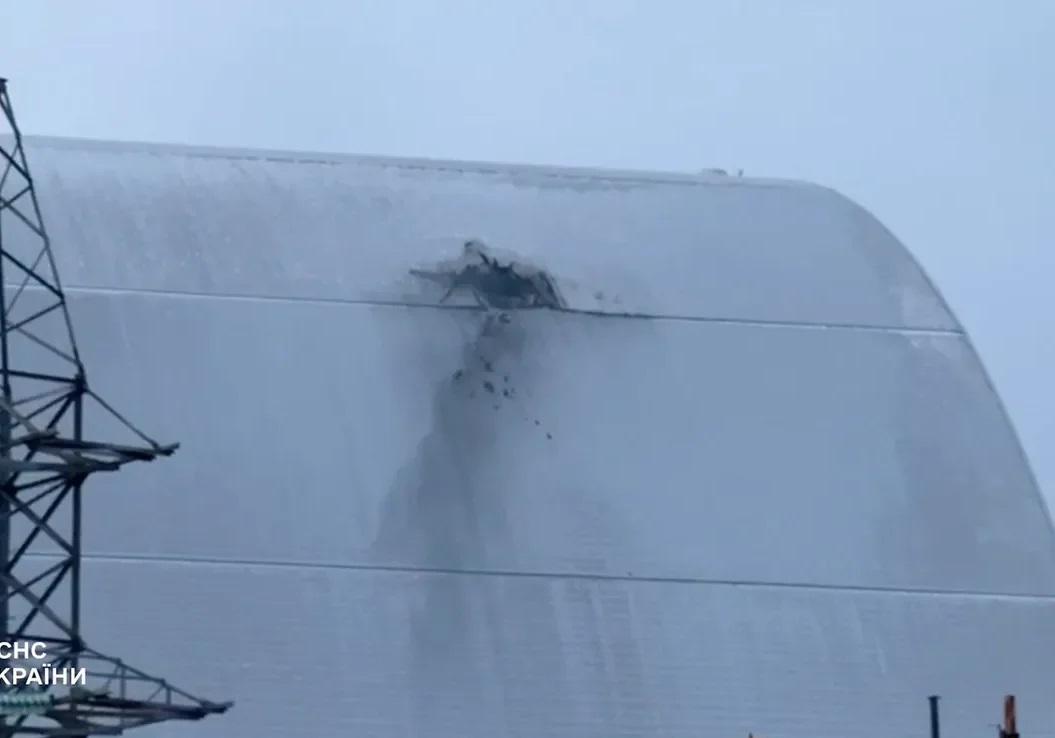
The European Union (EU) and the United Kingdom will make contributions to the EBRD-managed International Chernobyl Cooperation Account (ICCA) as part of ongoing international efforts to support the restoration of the key functions of the New Safe Confinement (NSC) at the Chornobyl nuclear power plant (ChNPP) in Ukraine.
The EU will contribute up to €25 million, while the United Kingdom will contribute up to €6.7 million, with both pledges being made at today’s ICCA Assembly meeting in London. The money will be used to fund emergency repairs to the NSC following the Russian drone attack in February 2025.
That strike has severely affected the NSC’s two primary functions: (i) containing radiological hazards and (ii) supporting long-term decommissioning. Key systems designed to ensure the NSC’s 100-year lifespan have been rendered non-operational, with a significant risk of further deterioration in the absence of swift emergency repairs. While it is difficult to provide an accurate estimate of the cost of repairs to the NSC at the moment, the scale of the damage and the complex radiological environment suggest that the total cost of the emergency works could exceed €100 million.
Balthasar Lindauer, EBRD Nuclear Safety Department Director, said, “These new pledges to the ICCA are a manifestation of the international community’s unwavering support for Chornobyl and its togetherness in the face of the major radiological threat that the damaged NSC poses. We are grateful to the EU and the United Kingdom for their contributions to the ICCA.”
The ICCA was established by the EBRD in November 2020 at the request of the Ukrainian government. It was set up as a multilateral fund to support the development of a comprehensive plan for Chornobyl. The EBRD manages the ICCA, which currently holds some €25 million in donor funds. Following the occupation of the Chornobyl Exclusion Zone (CEZ) at the start of Russia’s war on Ukraine, the scope of the ICCA was broadened to support the restoration of safety and security within the CEZ, as well as wider nuclear safety measures across Ukraine.
The international community has contributed around €2 billion to EBRD-managed programmes in Chornobyl since 1995. In addition, the Bank has made more than €800 million of its net income available for Chornobyl-related projects.
Centrica set to take 15% stake in Sizewell C nuclear project.
All sides are keen to reach an investment decision in July after years of delay and
months of negotiations. Centrica is set to take a 15 per cent stake in the
UK’s Sizewell C nuclear project after years of delay and months of drawn
out negotiations. All sides are keen to reach a final investment decision
on the project before parliament’s recess on July 21, according to people
familiar with the discussions.
The final cost of Sizewell — set to be
only the second new nuclear plant built in a generation in Britain —
could be close to £40bn, the Financial Times reported in January based on
assumptions from industry experts. Sizewell’s management has rejected
that figure although no new estimate has been given.
The planned investment
by Centrica means that the FTSE 100 energy company behind British Gas would
have the same size stake in Sizewell C as French state-owned energy group
EDF, which has progressively reduced its position in the Suffolk project to
15 per cent.
Centrica already holds a 20 per cent stake in the parent
company of the entity that operates EDF’s existing nuclear assets in the
UK. The investment in Sizewell could still come in time for French
President Emmanuel Macron’s visit to London for an Anglo-French summit on
July 8. However, timetables have slipped, according to the people familiar
with the situation, putting that goal in doubt.
FT 27th June 2025 , https://www.ft.com/content/5e107953-7f93-4a0d-ba73-6f28213e943c
How Torness will decommission and what it means for jobs.
.The power plant is due to stop generating by the end of March 2030. However, that will not
be the end of the story, with decommissioning work expected to get under
way there afterwards. A spokesperson for EDF, which manages the plant,
said: “Decommissioning happens in stages. “Removing all the spent fuel
from the reactors will take about four years and will be carried out by
EDF.
“The site will then transfer to Nuclear Restoration Services (NRS)
to carry out deconstruction. “It will take around 15 years to remove all
the buildings from site, with the exception of the reactor building.
“It will be left in situ, in a state called ‘Safestore’, for around 70 years,
until final site clearance.” The decommissioning staffing structure is
yet to be agreed at the power station, which currently employs about 550
full-time EDF employees, plus more than 180 full-time contract partners.
Staff consultation is yet to begin, but the spokesperson added: “Every
site is different but, as a rough guide, at Hunterston B, the number of EDF
staff being transferred to NRS is about 250, which is around half the
generation headcount. “This has been a managed reduction which has been
taking place over a number of years and has largely been accommodated
through redeployment, retirement and voluntary redundancy.
“During defueling, we will go through formal consultation with staff to see who
wants to stay at site and who would like to leave. “Decommissioning
offers lots of new opportunities, but we have found at other sites that not
everyone who works at a site during generation wants to stay and be part of
deconstruction. “Those who do want to stay and secure a role in the
decommissioning structure will transfer over to NRS.
Herald 28th June 2025, https://www.heraldscotland.com/news/25260842.torness-will-decommission-means-jobs/
Why Trump’s Golden Dome must be opposed – Bruce Gagnon & Dae-Han Song
19 Jun 2025
In January 2025, Donald Trump signed an executive order directing the US armed forces to construct a missile defense system – the ‘Golden Dome’ – a proposed multi-layer defense system, comparable to the Iron Dome system in Israel. It aims to place and maintain space weapons orbit, for the first time in history.
The proposed system will be exorbitant. According to US Congress sources it could cost several trillion dollars. This would require the US to cut every one of its remaining social programs. Such a military system would inflict ever more damage to the environment both on and around our planet.
Trump wants such a system, so that the US can launch a nuclear attack on another nuclear armed country and the US be confident that it has sufficient defenses to reduce the impact of any retaliatory missiles launched against US to levels deemed acceptable to US military planners. As the US advances its war drive, it is developing its military alliances with other countries and locking them into its war preparations.
Military coordination is being stepped up with increased ‘interoperability’ of hardware. In these alliances, such as NATO, it is always the US that is ‘in charge of the tip of the spear’.
Bruce Gagnon, in discussion with Dae-Han Song, explains why the proposed Golden Dome should be opposed. Bruce Gagnon has been organizing to stop the new arms race in space (Star Wars) since 1982. He began by coordinating the Florida Coalition for Peace and Justice from 1983-1998. During those years, in 1992, he co-founded the Global Network Against Weapons & Nuclear Power in space that he now coordinates. Bruce began his organizing career working for the United Farm Workers Union. He is a Vietnam war era veteran. He lives in Brunswick, Maine.
Website of The Global Network Against Weapons & Nuclear Power in Space: https://space4peace.org/ The petition against the Golden Dome is here: https://space4peace.org/global-networ… Dae-Han Song is a part of the International Strategy Center and the Korea Policy Institute. He is a member of the international No Cold War collective.
The Chris Hedges Report: Starvation and Profiteering in Gaza (w/ Francesca Albanese)
Francesca Albanese joins Chris Hedges to break down the current starvation campaign in Gaza, and her upcoming report detailing the profiteering corporations capitalizing on the erasure of Palestinians
Chris Hedges, Jun 26, 2025
This interview is also available on podcast platforms and Rumble.
There is not much more that can be said about the unfathomable levels of devastation the genocide in Gaza has reached. Francesca Albanese, the United Nations Special Rapporteur on the Occupied Palestinian Territories, has been chronicling the genocide and joins host Chris Hedges on this episode of The Chris Hedges Report to shed light on the current situation in Gaza, including parts from her upcoming report on the profiteers of the genocide.
Israel’s siege on the Palestinians is leaving the population starving, and Albanese lambasts other nations for not stepping up and completing their obligations under international law. “[Countries] have an obligation not to aid, not to assist, not to trade with Israel, not to send weapons, not to buy weapons, not to provide military technology, not to buy military technology. This is not an act of charity that I’m asking you. This is your obligation,” she explains.
Albanese compares Gaza and Israel’s siege to a concentration camp, stating it is unsustainable but also allows the world to witness how a Western settler colonial entity functions. “There is a global awareness of something that has for a long time been a prerogative, a painful prerogative of the global majority, the Global South, meaning the awareness of the pain and the wounds of colonialism,” Albanese tells Hedges.
In her forthcoming report, Albanese will detail exactly how Palestine has been exploited by the global capitalist system and will highlight the role certain corporations have played in the genocide. “[T]here are corporate entities, including from Palestine-friendly states, who have for decades made businesses and made profits out of the economy of the occupation, because Israel has always exploited Palestinian land and resources and Palestinian life,” she says.
“The profits have continued and even increased as the economy of the occupation transformed into an economy of genocide.”……………………………………………TRANSCRIPT………………………………….. …………..https://scheerpost.com/2025/06/25/the-chris-hedges-report-starvation-and-profiteering-in-gaza-w-francesca-albanese/
Why Limit Iranian Enrichment Peacefully When You Can Bomb Them Instead?
A deal was limiting Iran’s enrichment of uranium until Donald Trump pulled the U.S. out of it. Instead the Dealmaker bombed Iran, threatening to set the region on fire, writes Joe Lauria. With a ceasefire what does he do now?
By Joe Lauria, Consortium News. June 24, 2025, https://consortiumnews.com/2025/06/24/why-limit-iranian-enrichment-peacefully-when-you-can-bomb-them-instead/
In the last great achievement of international diplomacy, the United States and its allies Britain, France and Germany, concluded a deal in 2015 with Russia, China and Iran — something that today would be unthinkable — to limit Iran’s nuclear enrichment to purely civilian uses at 3.67 percent.
Negotiations on the deal began in November 2013, just three months before the U.S.-backed unconstitutional change of government in Kiev that started the long slide in U.S.-Russian relations. That did not prevent the nuclear deal from being concluded in July 2015 and endorsed by the Security Council in October of that year.
Seven years later, Washington and its European allies began fighting a hot war against Moscow through its proxy Ukraine. Relations with China have also sharply deteriorated. The idea of such cooperation on Iran now is unthinkable.
But in 2013 such wise diplomacy was still possible and the result was a peaceful resolution of the Iranian enrichment issue.
Iran agreed to stringent monitoring by the International Atomic Energy Agency and in exchange, the United States, Europe and the United Nations lifted economic sanctions against Tehran.
The IAEA certified that the deal was working. Iran was sticking to 3.67 percent enrichment. Diplomacy worked. Iran’s nuclear program was in check.
But the Israelis had opposed it all along because Israel’s aim has long been to overthrow the government in Iran in Israel’s quest for regional dominance.
Netanyahu could not stop Barack Obama from working with the Chinese and the Russians to conclude the deal that solved the nuclear issue and left the Iranian government in a more secure position.
Then Donald Trump became president. He did what Netanyahu wanted. He pulled the U.S. out of the deal, saying it was a lousy agreement and he could do better. But there was no new deal. Iran continued to cooperate with the existing agreement for a year before increasing enrichment, eventually to 60 percent for leverage in the negotiation. (90 percent is needed for a bomb, but U.S. intelligence and the IAEA said in recents months that Iran is not pursuing a bomb).
Obama’s vice president, Joe Biden, did nothing to return the U.S. to the deal to save it when he got into the White House, dishonoring probably Obama’s greatest achievement.
Trump 2.0’s idea of a better deal to limit Tehran’s enrichment was to demand zero percent after Iran agreed to return to 3.67 percent. Trump would look like a fool if he accepted 3.67 percent, as that would mean agreeing to the very deal that was working well before he tore it up.
So it was bombs away instead.
Clearing Smoke Reveals Trump’s Lies
More than 24 hours after the smoke cleared above Fordow, Natanz and Isfahan nuclear facilities Trump’s lies during his address Saturday night came clearly into view.
The strikes were not “a spectacular military success.” Iran’s “key nuclear enrichment facilities” were not “completely and totally obliterated.” There is no evidence that a single centrifuge was damaged and Iran’s 60 percent enriched fuel had already been removed and is in a location unknown to Israel, the U.S. and the IAEA.
Trump called Iran the “bully of the Middle East” when any neutral person knows that bully is Israel backed by the U.S., the bully of the world.
In just the past few months, with U.S. backing, Israel has invaded Lebanon and Syria, launched an unprovoked attack on Iran and is committing genocide in Gaza. The last time Iran invaded anyone was Iraq in 1982 but only after Iraq had invaded it first in 1980.
Israel gets away with this by portraying itself as the perpetual victim of an imminent new Holocaust 80 years after the fact and thus needs to invade and bomb its neighbors in “self defense” to pre-empt this from happening.
Regional hostility toward Israel does not stem from a reaction to its decades of aggression against Palestinians and its neighbors but purely from anti-semitic hatred. These countries must constantly be attacked to wipe out this hatred, not to reconstitute an ancient Hebrew empire from (beyond) the River to the Sea.
One power that empire never conquered was Persia
With their overlapping empires — Israel’s regional and the U.S.’s global — Iran, the land of Darius and Cyrus, is the prime target. The U.S. has sought to control it since at least its 1953 coup restored the shah to power for its oil and because of its Cold War rivalry with Russia.
Trump mimicked Israel, calling Iran “the world’s number one state sponsor of terror,” when an objective analysis would correctly award that title to the Gulf Sunni monarchies, principally Saudi Arabia, all allied with the United States.
They have sponsored al-Qaeda and ISIS and all their offshoots and rebrandings, while Iran has mostly supported militia resisting occupations in Lebanon, Iraq, Syria and Gaza.
Though formed in 1982 in response to Israel’s invasion and occupation of Lebanon, Hezbollah was only designated a terrorist organization by the European Union in 2013, for instance. Though founded in 1987, the EU did not view Hamas as a terrorist group until 2001.
Then Trump said of Iran:
“They have been killing our people, blowing off their arms, blowing off their legs with roadside bombs. That was their specialty. We lost over 1,000 people, and hundreds of thousands throughout the Middle East and around the world have died as a direct result of their hate.”
This is a bizarre statement that can only be related to attacks by militia against U.S. occupation forces in Iraq after the U.S. 2003 invasion. But only some of these groups were Iranian-backed and they killed not a thousand, but 169 U.S. soldiers, whom Trump referred to as “our people,” as if they were tourists and not an occupying army.
Trump’s thousand U.S. victims appears to come from propaganda put out by the Jerusalem Center for Public Affairs, which calls itself “a leading independent research institute, serving as Israel’s global embassy for national security and applied diplomacy.”
It combats what it calls “apartheid antisemitism.” It falsely called the 2015 nuclear agreement that Trump withdrew from “a deal that would allow Iran to become a nuclear-armed state.” In 2015, Haaretz named Sheldon Adelson, Trump’s principal donor, “one of the main financers of JCFA in recent years.”
Israel had to cut short its ambitions to conquer Iran (at least overtly) and agree to a ceasefire because it was running out of interceptor missiles; it’s economy, already weakened by Gaza, was threatened at $200 million a day; and it sustained far more damage than it will admit.
Now that there is a ceasefire, Trump is back to square one. The New York Times reported:
“Rafael Mariano Grossi, the director of the U.N.’s nuclear watchdog, welcomed news of a cease-fire. In a social-media post, he said he has invited Iran’s foreign minister Abbas Araghchi to meet to discuss a diplomatic solution on Iran’s nuclear program.”
That solution would be a return to 3.67 percent enrichment and Iran giving up its 60 percent stockpile, in other words, returning exactly to the deal Trump tore up to plunge the region into extreme danger with his bombing stunt.
Where will he turn now?
Joe Lauria is editor-in-chief of Consortium News and a former U.N. correspondent for The Wall Street Journal, Boston Globe, and other newspapers, including The Montreal Gazette, the London Daily Mail and The Star of Johannesburg. He was an investigative reporter for the Sunday Times of London, a financial reporter for Bloomberg News and began his professional work as a 19-year old stringer for The New York Times. He is the author of two books, A Political Odyssey, with Sen. Mike Gravel, foreword by Daniel Ellsberg; and How I Lost By Hillary Clinton, foreword by Julian Assange.
Iran Shows Us Why The US And Israel Should Not Be Allowed To Have Nukes.
Caitlin Johnstone, Jun 25, 2025
Well it’s been a crazy couple of days.
Trump bombed Iran’s civilian nuclear energy facilities in an attack that CNN reports did no lasting damage, and Iran exercised extraordinary restraint with symbolic retaliatory strikes on US military bases coordinated to avoid American casualties — a move many are comparing to Iran’s non-lethal response to the US assassination of General Qassem Soleimani in 2020.
After pumping out deception and fake diplomacy for weeks in order to assist Israel’s unprovoked war on Iran and launch an unprovoked attack on his own, Trump took to social media to proudly celebrate his administration’s facilitation of a ceasefire to the war he himself needlessly started, like an arsonist giving himself a trophy for extinguishing one of his own house fires.
And, for the moment at least, the ceasefire appears to be holding. Which is good. There are a lot of terrible people who did everything they could to get Iran to kill US troops and spark a horrific war, but Iran didn’t take the bait. Iran doesn’t want war at all. Trump found out that Americans disapproved of the airstrikes and opposed war with Iran. And Israel found out that fighting an actual military force is a lot less easy than fighting hospital patients and children.
So for now we’ve got a ceasefire.
We have never been shown any evidence that Iran was working on obtaining nuclear weapons, which given the US empire’s extensive history of lying about this sort of thing means we should assume it was not. But it has certainly been given every incentive to obtain them now, given that that’s probably the only thing that can stop the US and Israel from casually committing these egregious acts of aggression whenever they feel like it.
And isn’t it interesting how Iran keeps demonstrating a degree of restraint that we all know we’d never see from the United States or Israel if another country bombed their energy infrastructure or assassinated their military leaders, and yet Iran is the country we’re told can never be trusted with nuclear weapons?
The US empire and Israel both exist in a perpetual state of war and attack other countries constantly; Iran never invades other countries and avoids war like Melania Trump avoids missionary position. But we’re meant to accept that it’s fine for the US and Israel to have nukes and do anything necessary to prevent Iran from getting any?
Even if you accept the evidence-free premise that Iran would do crazy and reckless things if it became a nuclear-armed state, there is no rational argument that Trump and his handlers have been going about preventing this outcome intelligently. As Joe Lauria explains in Consortium News, the Iran nuclear deal was a remarkable achievement of international diplomacy that was working fine until Trump shredded it in 2018. Iran was following all the agreed upon rules and its nuclear enrichment was capped at 3.67 percent, but Trump killed it because the Zionists and warmongers who brought him to power want more aggression toward Iran instead of less.
It’s so intensely stupid that we have to keep doing this horrifying dance every few years just because there are too many war-horny freaks with way too much power inside the US empire. And every time they get closer to getting their wish. Iran is being given more and more reasons to view the US and Israel as an existential threat, more and more motive to obtain nuclear weapons, and less and less reason to negotiate anything with Washington.
These bastards keep pushing us toward something very ugly. Let’s hope people keep waking up to the depravity of Israel and the US empire before the warmakers succeed in obtaining their long-sought prize.
2
Trump rejects leaked intelligence that says strikes did not destroy Iran nuclear programme.
Donald Trump insists nuclear sites in Iran were
“completely destroyed” by US military strikes, despite an intelligence
report casting doubt on their success The leaked damage assessment from the
Pentagon’s Defense Intelligence Agency estimates the attack only set Iran’s
nuclear programme back “a few months”
BBC 25th June 2025,
https://www.bbc.co.uk/news/live/c20xel1e97gt
Policy Exchange launches its new high level international Nuclear Enterprise Commission today

Policy Exchange launches its new Nuclear Enterprise Commission today, which will study how the Government should combine and amplify its civil and military nuclear programmes.
The Commission will be chaired by former Cabinet Secretary Rt Hon Simon Case CVO – a leading authority on the nuclear deterrent – and will include other internationally renowned nuclear experts.
As many nuclear states seek to update their capabilities, the Commission will examine the UK’s force posture in a multipolar world, the future of the NATO Nuclear Planning Group, the US nuclear shield and tactical nuclear weapons.
The overlapping civil and military benefits of expanded nuclear capacity must be encouraged, and Policy Exchange’s Commission will address how the Government can break-out of over-regulation to get building.
The Commission will bring together internationally renowned experts on civil and military nuclear, with representation from the UK, America, Europe, and Asia. The programme will run for six months, holding public and private events and publishing Research Notes on the key themes pertaining to the nuclear enterprise.
To mark the launch of the commission, Policy Exchange today publishes two studies on the history of the UK’s civil and military nuclear programmes.
Policy Exchange 24th June 2025, https://policyexchange.org.uk/policy-exchange-launches-new-nuclear-enterprise-commission/
Why do we pretend heatwaves are fun – and ignore the brutal, burning reality?

An estimated 600 people will die as a result of this one heatwave. Those
kinds of numbers from a virus would spark at least a localised lockdown,
and in a plane crash, a national day of mourning.
But it’s hard to respond to climate fatalities proportionately without confronting global
heating and taking on the underlying inequalities that make some people
more vulnerable than others. High temperatures are much more dangerous when
you’re disabled, when you’re homeless, when you’re incarcerated, when
you’re old. It would be pretty rum to be squeezing disability benefits at
the same time as worrying about whether disabled people are at greater risk
from the weather, and need more care – better to imagine this an act of
God, in which the deaths cannot possibly be prevented.
Guardian 23rd June 2025, https://www.theguardian.com/commentisfree/2025/jun/23/why-do-we-pretend-heatwaves-are-fun-and-ignore-the-brutal-burning-reality
‘Conspicuous’ Small Modular Nuclear Reactors need fresh police funding model, security expert warns
23 Jun, 2025 By Tom Pashby New Civil Engineer 23rd June 2025
A proliferation of small modular reactors (SMRs) across England and Wales, expanding the number of reactors and types of locations they are deployed in, means the country needs a fresh police funding model for SMR security, an expert has said.
https://www.newcivilengineer.com/latest/conspicuous-smrs-need-fresh-police-funding-model-security-expert-warns-23-06-2025/
Meet the Israeli fanatic running Ted Cruz’s office

Wyatt Reed·June 23, 2025, The Grayzone
After Ted Cruz’s humiliation by Tucker Carlson, attention has focused on a top staffer of the self-proclaimed “leading defender of Israel in the United States Senate.”
On June 18, former Fox host Tucker Carlson published a video which, though marketed as an interview, was more of a snuff film. Over the course of two hours, Carlson can be seen rhetorically disemboweling his debate opponent, US Senator Ted Cruz, on the politician’s determination to see the US attack Iran on Israel’s behalf.
While Cruz presents himself as a Christian Zionist moved by his own zealotry to support Israel, the politician’s Tel Aviv-driven policy line can also be traced back to his Senior Advisor for Policy and Communications, an Israeli-born Zionist lobbyist named Omri Ceren.
Before overseeing Cruz’s public relations, Ceren managed his foreign policy docket as his national security advisor. Prior to joining the Senator’s staff, Ceren served as the press director for The Israel Project, a Zionist pressure group which was forced to close down after being exposed as a de facto Israeli government front by Al Jazeera’s groundbreaking undercover investigation, The Lobby. Before that, Ceren cut his teeth lobbying for Ivory Coast dictator Laurent Gbagbo, who relied on Ceren as a registered foreign agent lending his marketing expertise to the embattled regime.
Ceren has consistently opposed a nuclear deal with Iran since at least 2015, when he declared that any agreement would simply ensure Tehran was “able to cheat with impunity.” At a talk hosted by the neocon Hudson Institute think tank in 2018, he suggested Washington should continue preaching about “freedom” and encouraging Iranian protesters to pursue regime change while simultaneously maintaining Trump’s ban on Iranians entering the US…………………………………………….
Since the attack, Cruz has posted 14 comments on Twitter/X. 12 of them consisted of breathless statements cheering the bombing or attacks on opponents of the war, whom he branded as “the death to America crowd.”… https://thegrayzone.com/2025/06/23/israeli-fanatic-ted-cruz-office/
Donald Trump dominated extraordinary NATO summit that saw European defence spending increase – NATO chief calls Trump ‘Daddy’
ABC News, By Europe correspondent Elias Clure at The Hague, 26 June 25
Donald Trump was given a royal welcome by the monarch of the Netherlands as he arrived at the NATO summit in The Hague.
He left feeling like a king.
Member nations agreed to lift their defence spending to 5 per cent of GDP over 10 years and Mr Trump was quick to take credit, describing it as a “big win” for the United States.
He’d been calling for more spending and had made threats about the future of the alliance if it wasn’t agreed upon.
“They said, ‘You did it, sir, you did it sir.’ Well, I don’t know if I did it, but I think I did,” Mr Trump said.
When the commitment was finalised by members in an official summit declaration, NATO members proclaimed the summit a huge success.
But the event, which aims to hear from delegations of the 32 NATO countries and many more partners and allies, seemed to revolve around the presence of one man.
Trump insists damage was done
Mr Trump’s first official engagement at the NATO summit HQ was with Secretary-General Mark Rutte.
The president arrived at the meeting with US Defense Secretary Pete Hegseth and State Department boss Marco Rubio. The meeting began with Mr Rutte lauding America’s actions in Iran.
“The great thing is you took out the nuclear capability of Iran. This was crucial. You did it in a way which is extremely impressive. But the signal it sends to the rest of the world that this president, when it comes to it, yes, he is a man of peace, but if necessary, he is willing to use strength,” Mr Rutte said.
When the American delegation was probed by the press on the validity of the White House’s claims that Iran’s nuclear capabilities had been comprehensively demolished, it pushed back.
Mr Hegseth accused sceptics of being “politically motivated”, saying the damage was, in fact, “severe”.
Mr Rubio declared that the damage to the enrichment facilities was so bad “you can’t even find it on the map … it’s totally wiped out”.
Not to be outdone, Mr Trump then provided the most vivid description of Operation Midnight Hammer’s success, comparing the raid to the most destructive bombing in history.
“That hit ended the war. I don’t want to use an example of Hiroshima. I don’t want to use an example of Nagasaki. But that was essentially the same thing. That ended that war. This ended that war,”
Mr Trump said.
Mr Rutte watched on in silence.
NATO chief calls Trump ‘Daddy’
The NATO secretary-general has been quite transparent in his attempts to flatter the president.
Mr Trump seemed so taken by the gushing display of admiration by Mr Rutte that he leaked a text message reportedly sent to him by the alliance boss.
“Mr. President, dear Donald, Congratulations and thank you for your decisive action in Iran, that was truly extraordinary, and something no one else dared to do. It makes us all safer,” Mr Rutte reportedly wrote in the message.
Mr Rutte said at the summit that he was not embarrassed by the message, and he was actually happy for it to be made public.
“There’s nothing in it that had to stay secret,” he said.
At Mr Rutte’s meeting with Mr Trump, he was asked about what he thought about the commander-in-chief’s use of the f-word when describing Israel and Iran.
Mr Trump said that the two countries “had a big fight, like two kids in a schoolyard”.
Mr Rutte’s response was light-hearted but telling.
“Daddy has to sometimes use strong language.”……………………………………….
https://www.abc.net.au/news/2025-06-26/donald-trump-dominates-extraordinary-nato-summit/105461646
US didn’t destroy Iran’s nuclear programme: Here’s what new intel says
US President Trump doubles down on his assertion that the Iranian nuclear programme has been set back by decades.
By Al Jazeera Staff, 25 Jun 2025, https://www.aljazeera.com/news/2025/6/25/us-didnt-destroy-irans-nuclear-programme-heres-what-new-intel-says
The United States’ strikes on three key Iranian nuclear sites on Sunday failed to destroy underground facilities, and set Tehran’s nuclear programme back only by a few months, according to an assessment of a confidential American intelligence report.
The “top secret” document prepared by the Defense Intelligence Agency (DIA) – the intelligence arm of the Pentagon – and published by major US news outlets on Tuesday is at odds with President Donald Trump’s claims about the strikes. Trump has insisted that the nuclear facilities at Fordow, Natanz, and Isfahan were “obliterated” by a combination of bunker busting and conventional bombs.
Trump and his administration’s senior officials are dismissing the intelligence report and calling out the reporting over the DIA’s assessment as “fake news”.
Speaking at a NATO summit in The Hague, the US president said he believed Iran’s nuclear programme was set back by decades.
So, what did the DIA assessment say about US strikes? What has Iran said about the attacks? And how does the intelligence report contrast with the Trump administration’s public claims?
What did the DIA report say?
A preliminary report prepared by the DIA noted that rather than obliterating Iran’s nuclear programme, the US bombings had only set it back by a few months.
Before Israel attacked Iran on June 13, US agencies had noted that if Iran rushed to assemble a nuclear weapon, it would take it about three months.
The DIA’s five-page report now estimates this to be delayed by less than six months, reported The New York Times. As per the early findings, the US strikes blocked the entrances to two of the facilities but did not collapse the underground facilities.
The DIA report also reveals that the US agency believes that Iran’s stockpile of enriched uranium was moved before the strikes, which destroyed little of the nuclear material.
Shortly after the US strikes on June 22, Mehdi Mohammadi, an adviser to the chairman of the Iranian parliament, claimed that the authorities had evacuated the Fordow facility in advance. “Iran has been expecting strikes on Fordow for several days. This nuclear facility was evacuated, no irreversible damage was sustained during today’s attack,” Mohammadi had said.
The US president on Wednesday said he doesn’t buy Iranian claims that they moved enriched uranium out of the Fordow nuclear facility. “I believe they didn’t have a chance to get anything out because they acted fast,” said Trump. “If it would have taken two weeks, maybe, but it’s very hard to remove that kind of material… and very dangerous.
“Plus, they knew we were coming,” Trump added. “And if they know we’re coming, they’re not going to be down there.”
CNN first reported on the DIA report, quoting unnamed officials that the US strikes’ effect on all three sites – Fordow, Natanz, and Isfahan – was largely restricted to aboveground structures, which were severely damaged.
On Tuesday, the Trump administration told the United Nations Security Council that the US strikes had “degraded” the Iranian facilities – short of Trump’s earlier assertion that the attacks had “obliterated” the sites.
The strikes have reportedly badly damaged the electrical system at the Fordow facility. However, it was not immediately clear how long Iran could take to gain access to the underground facilities and repair these systems.
On Monday, Rafael Grossi, the head of the UN nuclear watchdog IAEA, said that while “no one, including the IAEA, is in a position to have fully assessed the underground damage at Fordow”, it is expected to be “very significant”.
Two people familiar with the DIA’s assessment told CNN that Iran’s stockpile of enriched uranium was not destroyed and the centrifuges are largely “intact”.
Some analysts cautioned against drawing final conclusions. Analysts told the Reuters news agency that the extent of damage to the Fordow uranium enrichment facility would not necessarily be revealed if the assessment was based on satellite imagery.
How did the US strike Iranian nuclear sites?
After 10 days of fighting between Israel and Iran, the US had militarily intervened on June 22 by hitting the Iranian nuclear sites.
Fordow is a highly fortified underground uranium enrichment facility reportedly buried hundreds of metres deep in the mountains in northwestern Iran. While Natanz is Iran’s largest and most central enrichment complex, containing vast halls of centrifuges, some underground, Isfahan is a major nuclear research and production centre that includes a uranium conversion facility and fuel fabrication plants.
How did the US strike Iranian nuclear sites?
After 10 days of fighting between Israel and Iran, the US had militarily intervened on June 22 by hitting the Iranian nuclear sites.
Fordow is a highly fortified underground uranium enrichment facility reportedly buried hundreds of metres deep in the mountains in northwestern Iran. While Natanz is Iran’s largest and most central enrichment complex, containing vast halls of centrifuges, some underground, Isfahan is a major nuclear research and production centre that includes a uranium conversion facility and fuel fabrication plants.
The US forces dropped 14 30,000-pound (13,000kg) bunker-buster bombs, while Navy submarines are said to have coordinated strikes by cruise missiles at the Natanz and Isfahan sites.
The GBU-57 Massive Ordnance Penetrator (MOP) – the most powerful bunker-buster bomb in the US military arsenal weighing nearly 13,000kg (30,000lb) – was used in the strike.
The US intervention was understood to be critical for the Israeli campaign against Iranian nuclear facilities, especially Fordow, due to its depth that kept it out of reach for the Israeli military.
How did the DIA report contrast with Trump’s claims?
In March this year, the US spy chief Tulsi Gabbard had informed Congress that there was no evidence Iran was building a nuclear weapon, and Iranian Supreme Leader Ali Khamenei had not authorised the nuclear weapons programme that he had earlier suspended in 2003.
On June 17, as Israel and Iran continued to trade ballistic missiles, Trump was returning to Washington from the G7 summit in Canada, when he snubbed his own administration, including the spy chief Gabbard, saying she and the intel agencies had gotten it “wrong”.
He claimed that Iran was “very close” to having a nuclear weapon. On June 22, the US struck Iranian nuclear facilities. “The strikes were a spectacular military success,” Trump said in a televised address. “Iran’s key nuclear enrichment facilities have been completely and totally obliterated.”
The next day, Trump wrote on his Truth Social platform, “The damage to the Nuclear sites in Iran is said to be ‘monumental.’ The hits were hard and accurate. Great skill was shown by our military. Thank you!”
On Wednesday, at the NATO summit, he reiterated his stance. “The last thing they [Iran] want to do is enrich anything right now… They’re not going to have a bomb and they’re not going to enrich,” he said at The Hague.
Top officials from his administration, including Vice President JD Vance and Defense Secretary Pete Hegseth, have repeated the obliteration claims since then.
“Based on everything we have seen – and I’ve seen it all – our bombing campaign obliterated Iran’s ability to create nuclear weapons,” Hegseth said in a statement provided to Reuters.
“Our massive bombs hit exactly the right spot at each target – and worked perfectly. The impact of those bombs is buried under a mountain of rubble in Iran; so anyone who says the bombs were not devastating is just trying to undermine the President and the successful mission.”
How has Trump, the White House reacted?
Trump spent a good amount of time letting off steam on his Truth Social platform after the DIA report dropped.
“THE NUCLEAR SITES IN IRAN ARE COMPLETELY DESTROYED! BOTH THE TIMES AND CNN ARE GETTING SLAMMED BY THE PUBLIC!” Trump wrote in all-caps, referring to the reporting by The New York Times and CNN.
“FAKE NEWS CNN, TOGETHER WITH THE FAILING NEW YORK TIMES, HAVE TEAMED UP IN AN ATTEMPT TO DEMEAN ONE OF THE MOST SUCCESSFUL MILITARY STRIKES IN HISTORY,” Trump said in a post.
The US president also posted a series of apparently bizarre videos, including one of B-2 bombers taking off to a “bomb Iran” song in the background.
Trump is currently in the Netherlands, attending this week’s NATO summit, and reiterated to reporters that the damage from the strikes was significant. “I think it’s been completely demolished,” he said, adding, “Those pilots hit their targets. Those targets were obliterated, and the pilots should be given credit.
“That place is under rock. That place is demolished,” Trump responded to a question on the possibility of Iran rebuilding its nuclear program.
He took further shots at CNN, saying: “These cable networks are real losers. You’re gutless losers. I say that to CNN because I watch it – I have no choice. I got to watch it. It’s all garbage. It’s all fake news.”
He said the intelligence following the strikes in Iran was “inconclusive”. “The intelligence says we don’t know. It could’ve been very severe. That’s what the intelligence suggests.”
“It was very severe. There was obliteration,” he reiterated on Wednesday.
The White House press secretary, Karoline Leavitt, called the DIA assessment “flat-out wrong” and leaked to the press “by an anonymous, low-level loser in the intelligence community”.
“The leaking of this alleged assessment is a clear attempt to demean President Trump, and discredit the brave fighter pilots who conducted a perfectly executed mission to obliterate Iran’s nuclear program,” she said in a statement. “Everyone knows what happens when you drop 14 30,000 pound bombs perfectly on their targets: Total obliteration.”
Plutonium Levels in Sediments Remain Elevated 70 Years After Nuclear Tests

June 24, 2025,
https://www.marinetechnologynews.com/news/plutonium-levels-sediments-remain-650328
Researchers from Edith Cowan University (ECU) in Australia have confirmed plutonium levels in sediment up to 4,500 times greater than the Western Australian coastline.
Three plutonium-based nuclear weapons tests were conducted at the Montebello Islands in the 1950’s, which introduced radioactive contamination to the surrounding environment. The first nuclear test, coded Operation Hurricane, had a weapon’s yield of some 25kT, and formed a crater in the seabed, while the second and third tests, dubbed Operation Mosaic G1 and G2, had weapons yields of around 15kT and 60kT, respectively.
The three tests released radioactive isotopes including plutonium, strontium (90Sr) and caesium (137Cs) into the surrounding marine environment.
“Plutonium is anthropogenic, which means that it doesn’t exist on its own in nature. The only way it is introduced into an environment is through the detonation of nuclear weapons and from releases from nuclear reprocessing plants and, to a lesser extent, accidents in nuclear power plants,” said ECU PhD student and lead author Madison Williams-Hoffman.
“When plutonium is released into a coastal setting in the marine environment, a significant fraction will attach to particles and accumulate in the seabed, while some may be transported long distances by oceanic currents.”
The region is not inhabited by humans and has not been developed, however it is visited by fishing boats, so collecting data on the levels of contamination in the marine environment is important.
Currently, the protected island archipelago and surrounding marine areas also reside within the Montebello Islands Marine Park (MIMP). The MIMP is ecologically significant due to the presence of numerous permanent or migratory species, and its high-value habitat is used for breeding and rearing by fish, mammals, birds and other marine wildlife.
The water and sediment quality within the MIMP are currently described as ‘generally pristine’, and it is fundamental to maintain healthy marine ecosystems in the region.
The concentrations of plutonium at Montebello Islands were between 4 to 4,500 times higher than those found in sediment from Kalumburu and Rockingham from the Western Australian coastline, with the northern area of the archipelago, close to the three detonation sites, having four-fold higher levels than the southern area.
The concentrations of plutonium found in the sediment at Montebello Islands were similar to those found in the sediment at the Republic of Marshall Islands (RMI) test sites, despite 700-fold higher detonation yields from nuclear testing undertaken at RMI.
Plutonium is an alpha emitter so, unlike other types of radiation, it cannot travel through the skin and is most dangerous when ingested or inhaled.
The research was undertaken by Williams-Hoffman, under the co-supervision of Prof. Pere Masqueand at ECU and Dr Mathew Johansen at ANTSO.
1 This Month
19 February – VIRTUAL EVENT-Decision Time: AI and Our Nuclear Arsenal
12:45 p.m. Central / 1:45 p.m. Eastern
To see nuclear-related stories in greater depth and intensity – go to https://nuclearinformation.wordpress.com
-
Archives
- February 2026 (181)
- January 2026 (308)
- December 2025 (358)
- November 2025 (359)
- October 2025 (376)
- September 2025 (258)
- August 2025 (319)
- July 2025 (230)
- June 2025 (348)
- May 2025 (261)
- April 2025 (305)
- March 2025 (319)
-
Categories
- 1
- 1 NUCLEAR ISSUES
- business and costs
- climate change
- culture and arts
- ENERGY
- environment
- health
- history
- indigenous issues
- Legal
- marketing of nuclear
- media
- opposition to nuclear
- PERSONAL STORIES
- politics
- politics international
- Religion and ethics
- safety
- secrets,lies and civil liberties
- spinbuster
- technology
- Uranium
- wastes
- weapons and war
- Women
- 2 WORLD
- ACTION
- AFRICA
- Atrocities
- AUSTRALIA
- Christina's notes
- Christina's themes
- culture and arts
- Events
- Fuk 2022
- Fuk 2023
- Fukushima 2017
- Fukushima 2018
- fukushima 2019
- Fukushima 2020
- Fukushima 2021
- general
- global warming
- Humour (God we need it)
- Nuclear
- RARE EARTHS
- Reference
- resources – print
- Resources -audiovicual
- Weekly Newsletter
- World
- World Nuclear
- YouTube
-
RSS
Entries RSS
Comments RSS
 nuclear-news