‘Gunboat Diplomacy’: U.S. War in Latin America Feared as Hegseth Launches ‘Operation Southern Spear’
SCHEERPOST, November 15, 2025 By DemocracyNow!
Defense Secretary Pete Hegseth has announced the launch of Operation Southern Spear to target suspected drug traffickers in South America, Central America and the Caribbean. The U.S. now has 15,000 military personnel in the region. Over the past two months the U.S. has blown up at least 20 boats in the Caribbean and eastern Pacific. “80 people have been killed in what are extrajudicial executions under international law,” says Juan Pappier, Americas deputy director at Human Rights Watch. The Pentagon claims the boats were carrying drugs but officials have acknowledged they don’t know who has been killed.
“Progressives and people of goodwill — of the U.S. and Puerto Rico — it’s time for those of us here to stand up and say that where we will not support any attempt to bring back the old gunboat diplomacy and to invade another Latin American country, and we need to do it soon, because this stuff is moving very quickly,” says Democracy Now!’s Juan González.
Transcript
………………………..AMY GOODMAN: Defense Secretary Pete Hegseth has announced the launch of Operation Southern Spear to target suspected drug traffickers, he says. In a post on X, Hegseth wrote, quote, “Today, I’m announcing Operation Southern Spear led by Joint Task Force Southern Spear and SOUTHCOM. This mission defends our homeland, removes narcoterrorism from our hemisphere, and secures our homeland from the drugs that are killing our people,” unquote.
The announcement comes as the Pentagon continues to amass warships in the Caribbean. The USS Gerald R. Ford aircraft carrier arrived earlier this week. The U.S. now has 15,000 military personnel in the region. It’s the largest buildup in the region in decades, according to the New York Times. Over the past two months, the U.S. has blown up at least 20 boats in the Caribbean and Eastern Pacific. The latest strike killed four people on Thursday.
The Pentagon claims the boats were carrying drugs, but officials have acknowledged they don’t know who’s been killed. Critics have denounced the strikes as illegal extrajudicial killings. We begin today’s show with Juan Pappier, the Americas Deputy Director at Human Rights Watch. We welcome you to Democracy Now!, Juan. Begin by talking about Operation Southern Spear and what this means.
JUAN PAPPIER: Amy, thank you for having me. We don’t know what Operation Southern Spear means. The Secretary has not provided details. But we have every reason to be concerned because in the buildup of this announcement, as you mentioned, 80 people have been killed in what are extrajudicial executions under international law…………………………………………………………………………………………………………………..
JUAN GONZÁLEZ: Yeah, well, Amy, I think with the – especially now, not only with these attacks on boats and these killings, but now with the arrival of an unprecedented military force – we’re talking the largest aircraft carrier in the world, the USS Gerald Ford, has just arrived in the Caribbean with another 5,000 troops and several other battleships accompanying it.
We now have 15,000 U.S. troops in the region, thousands of them based in Puerto Rico. The government has reopened Roosevelt Roads Naval Base, which they had closed, and U.S. planes at the old Ramey Air Force Base in Aguadilla. All of these soldiers are not there to hang out. They’re there to take military action. We have to be clear.
Even though the government hasn’t announced it, it’s clear that this is what’s coming. Our government is embarking on a totally unprovoked military assault and regime change operations in Latin America. The Trump administration has openly accused not one but two Latin-American presidents of drug dealing without any proof, Nicolas Maduro of Venezuela and Gustavo Petro of Colombia and threatened to kill Maduro. This is a bizarre return to the gunboat diplomacy of the early 20th century.
And the big prize being not democracy or not stopping drug trafficking, but grabbing the Venezuelan oil fields, the largest oil reserves in the world. The problem is, this is not the old Latin America that the U.S. could bully at will. The countries at the region are today independent sovereign states………………………………………………………………………………………………………
Yes, it’s a clear continued policy of the United States to control oil production as much as it can as the Trump administration continues on this crazy, bizarre attempt to corner as much oil supply as they can as it continues to deny the existence of climate change or the climate catastrophe we face, https://scheerpost.com/2025/11/15/gunboat-diplomacy-u-s-war-in-latin-america-feared-as-hegseth-launches-operation-southern-spear/
Finally Some Accountability for Georgia’s Costly Nuclear Power Mistake

Vogtle stands as the only new nuclear reactor built in the last 30 years, and its fallout offers a bleak prognosis for any supposed “renaissance” and its supporters in statehouses across the country. We can look back to 2017 when the main contractor, Westinghouse, filed for bankruptcy due to the extreme cost overruns at Vogtle. At that critical moment, the Georgia PSC ignored its own staff, energy experts, and public outcry, choosing to burden ratepayers with the project’s continuation.
By Kim Scott.15 Nov 25 https://nuclearcosts.org/finally-some-accountability-for-georgias-costly-nuclear-power-mistake/
The story of Plant Vogtle’s two new nuclear reactors in Georgia is not a triumph of a “nuclear renaissance”; it’s a cautionary tale written in soaring electric bills and a growing political fallout. The people of Georgia are paying the price, literally, as their utility bills have skyrocketed by over 40% – and now, following last Tuesday’s Public Service Commission election in Georgia, it seems those that allowed this to happen in the first place are starting to feel the pinch as well. It’s about damn time!
Georgia voters delivered a stunning message by unseating two Republican utility commissioners, Tim Echols and Fitz Johnson, who rubber stamped and championed the costly mistakes leading to a 41% increase in Georgians’ electric bills. This election, which saw Democrats Alicia Johnson and Peter Hubbard championing fair rates, affordability and renewable energy, was a clear referendum on Plant Vogtle’s enormous price tag and more importantly, nuclear power as a not so clean future power resource both here in Georgia and elsewhere.
The stunning defeat of utility backed incumbents sends a powerful signal to utility regulators nationwide that consumers will not tolerate being forced to pay for multi-billion-dollar nuclear boondoggles. If they aren’t paying attention, Wall Street sure is, downgrading Southern Co.’s stock immediately following the election, citing the increased risk and the new difficulty the company will face in pushing through further rate hikes to pay for Plant Vogtle and other projects in their pipeline. Georgia customers will pay an additional $36 billion to $43 billion over the 60-80 year lifespan of the two Vogtle reactors compared to cheaper alternatives.
Vogtle stands as the only new nuclear reactor built in the last 30 years, and its fallout offers a bleak prognosis for any supposed “renaissance” and its supporters in statehouses across the country. We can look back to 2017 when the main contractor, Westinghouse, filed for bankruptcy due to the extreme cost overruns at Vogtle. At that critical moment, the Georgia PSC ignored its own staff, energy experts, and public outcry, choosing to burden ratepayers with the project’s continuation.
The consequences of those decisions, subsequent rate increases and soaring electric bills are not abstract—they are impacting the most vulnerable among us and the most overlooked i.e. middle class/working class Georgians. Disconnection rates for the inability to pay have soared by 30% in 2024. For retirees on fixed incomes, the rate increases to pay for Plant Vogtle mean the difference between making ends meet and falling into destitution. This summer, when brutal heat waves descended, vulnerable Georgians had their power shut off, creating life-threatening conditions because they could no longer afford to cool their homes.
The ratepayer backlash in Georgia is also being fueled by the projected massive energy demands of AI data centers, which are forcing utilities like Southern Co. to reckon with costly new generation and transmission projects. Instead of aggressively pushing nuclear power—as evidenced by the Trump administration’s recent $80 billion deal to buy reactors from Westinghouse, the same company bankrupted by Vogtle—we must demand that elected politicians focus on fast and affordable energy solutions like solar and battery energy storage systems.
The painful lesson learned in Georgia is that new nuclear power is simply too expensive and takes too long. The reality is that for half the cost and in less than a quarter of the time, we could have built more than twice the capacity using solar, wind, or battery storage technologies. But corruption won out and Vogtle is here for the foreseeable future. Georgians will be paying for this mistake for decades to come… I’m just glad there’s finally some accountability headed our way.
Kim Scott is Executive Director of Georgia WAND, is a native Georgian, and has a Chemical Engineering degree from Vanderbilt University in Nashville, TN.
Non Government Organisations Warn that Recent Executive Orders Would Harm Public Health, Disproportionately Impacting Women and Children

“Young men like the Reference Man are harmed by radiation, but they’re more resistant to harm than are women and children. Radiation causes cancer in women at twice the rate of adult men, while the same exposure in early childhood, will, across their lifetimes, produce seven times more cancer in young females, and four times more in young males.”
Asheville, North Carolina – November 14, https://www.radiationproject.org/blog/ngos-warn-that-recent-executive-orders-would-harm-public-health-disproportionately-impacting-women-and-children?ss_source=sscampaigns&ss_campaign_id=6917d62bc4477007efdd4b63&ss_email_id=6917db9d43e3de1cada92627&ss_campaign_name=Welcome+to+GRIP%E2%80%99s+NEW+Blog&ss_campaign_sent_date=2025-11-15T01%3A47%3A30Z

Over forty citizen’s sector organizations including the national nonprofit Physicians for Social Responsibility have sent a joint letter to federal officials warning of public health consequences of a series of executive orders by President Trump which direct the NRC to dramatically weaken Standards for Protection Against Radiation in the US federal code. The letter points out sharply disproportionate impacts on women and children from weakening existing radiation exposure standards and calls for strengthening them.
The letter is posted here. It was spearheaded by the nonprofit Generational Radiation Impact Project (GRIP) and sent to US Nuclear Regulatory Commissioners, Health and Human Services Secretary Robert F. Kennedy Jr., Surgeon General Denise Hinton, and other key elected and appointed officials.
Recent Trump executive orders direct the NRC to “reconsider” the linear no-threshold (LNT) model. The joint letter argues that this “would undermine public trust by falsely claiming that the NRC’s radiation risk models lack scientific basis, despite decades of peer-reviewed evidence and international consensus.” The widely accepted LNT model has no limit “below regulatory concern,” i.e. no level below which radiation exposure can be treated as negligible or zero-risk. Where applied, LNT takes account of proportional cancer and health risks of all tiny exposures no matter how small.
Trump executive orders direct the NRC to undertake new rulemaking and “wholesale revision” of existing radiation regulations, which would likely lead to the NRC abandoning LNT and raising allowable exposure limits.
But past NRC opposition to such changes stands to be reversed by the Trump executive orders. If federal radiation regulations were weakened to permit exposures of 10 Rems a year, scientists estimate that over a 70-year lifetime, four out of five people would develop cancer they would not otherwise get.
Today’s joint letter stresses that health damage would not be evenly distributed across the population, but would disproportionately affect women and children, who are biologically more susceptible to ionizing radiation than men. And an article published today in the Bulletin of Atomic Scientists cites several lines of evidence “that women and young girls are significantly more vulnerable to radiation harm than men—in some cases by as much as a ten-fold difference” and that “infants are especially vulnerable to radiation harm.”
A July 2025 Idaho National Laboratory report commissioned by the Department of Energy recommended loosening the public radiation standard fivefold to 500 millirems. In 2021 the NRC roundly rejected a petition to raise allowable radiation exposures for all Americans, including children and pregnant women, to 10 Rems a year, 100 times the current limit.
“[NRC] bases its risk assessments on Reference Man, a model that represents a young adult male and fails to reflect the greater impacts to infants, children, and women—pregnant or not,” the joint letter states. “Newer research has shown that external radiation harms children more than adults and female bodies more than male bodies. Research on internal exposures…has not yet been sufficiently analyzed to discover if there are broad age-based or male/female differences in impact…. Existing standards should therefore be strengthened to account for these life-stage and gender disparities…not weakened. Radiation causes infertility, loss of pregnancy, birth complications and defects, as well as solid tumor cancer, leukemia, non-cancer outcomes including cardiovascular disease, increased incidence of autoimmune disease and ongoing new findings.”
In cases where cancer, heart disease, and vascular degradation including stroke are caused by radiation, they are documented at higher rates in women than in men, according to 2024 UNIDIR report Gender and Ionizing Radiation.
The joint letter urges the NRC to “to stand up to the Executive Order’s marching orders to ‘promote’ nuclear power—a mission outside its legal regulatory mandate,” and adopt “stronger, science-based radiation protections….Contemporary research shows that radiation’s impact is far greater on females, children, and fetuses—the most at-risk postnatal group being girls from birth to age five. A truly protective framework would replace Reference Man with a lifecycle model.”
“All US radiation regulations and most radiation risk assessments are based on outcomes for the Reference Man,” said Mary Olson, CEO of GRIP, the organization which spearheaded the joint letter, and co-author of Gender and Ionizing Radiation. “Young men like the Reference Man are harmed by radiation, but they’re more resistant to harm than are women and children. Radiation causes cancer in women at twice the rate of adult men, while the same exposure in early childhood, will, across their lifetimes, produce seven times more cancer in young females, and four times more in young males.”
“We know that exposure to radiation causes disproportionate harm from both cancer and non-cancer related disease outcomes over the course of the lifetime to women and especially to little girls, but radiation is dangerous for everyone,” said Amanda M. Nichols, Ph.D., lead author of Gender and Ionizing Radiation. “[President Trump’s] executive order will allow the industry to relax the current standards for radiological protection, which are already far from adequate. This will have detrimental health consequences for humans and for our shared environments and puts us all at higher risk for negative health consequences. “
“Living near nuclear power facilities doubles the risk of leukemia in children; and radiation is also associated with numerous reproductive harms including infertility, stillbirths and birth defects.,” said Cindy Folkers, Radiation and Health Hazard Specialist with the NGO Beyond Nuclear, a signatory to the joint letter. “Exposing people to more radiation, as this order would do if implemented, would be tantamount to legitimizing their suffering as the price of nuclear expansion.”
Trump stupidly brags about committing war crimes against Iran

Walt Zlotow, West Suburban Peace Coalition, Glen Ellyn IL, Nov 15, 2025, https://theaimn.net/trump-stupidly-brags-about-committing-war-crimes-against-iran/
Rule 1 for leaders committing war crimes is to refrain from bragging about them. President Trump jettisoned that wise rule regarding his criminal involvement in Israel’s 12 day war on Iran last June.
When Israel attacked, Trump trotted his obedient Secretary of State Marco Rubio who issued this lie to America and world. “Israel had taken unilateral action to defend itself. We are not involved in strikes against Iran and our top priority is protecting American forces in the region. Let me be clear: Iran should not target U.S. interests or personnel.”
Of course Iran had every right to target US interests and personnel since the US knew about and aided Israel’s crazed war that backfired on Israel. How so? Iran was wise to ignore US perfidy to launch a massive rocket attack on Israel that could not be defended against. After 12 days Israel threw in the towel. Israel now knows Iran will never be a genocidal punching bag like the Palestinians in Gaza and the West Bank.
US involvement was overt and covert. The former included refueling Israeli bombers during the entire 12 day war. The covert consisted of holding fake negotiations with Iran about their nuclear program to lull them into false security that no attack, which the US knew about, was imminent. Just 2 days beforehand Trump scheduled another negotiation and proclaimed “I am committed to a “diplomatic solution” with Iran.”
The US maintained the ‘not involved’ charade for nearly 5 months. Alas, Trump, an inveterate braggart on everything he maliciously touches from business partners, women wishing to be left alone, political enemies among others, just couldn’t contain his glee in assisting Israel’s unprovoked, murderous attack. ”Israel attacked first. That attack was very, very powerful. I was very much in charge of that. When Israel attacked Iran first, that was a great day for Israel because that attack did more damage than the rest of them put together.”
Iran took note of Trump’s confession of international criminality. Iranian Foreign Minister Abbas Araghchi fired off a letter to UN officials demanding the US be held to account for enabling Israel’s attacks on Iran that killed more than 1,000 people. In the letter Araghchi cited Trump’s recent comments about how he was “in charge” of the Israeli attacks. “The Islamic Republic of Iran reserves its full and unimpeachable right to pursue, through all available legal means, the establishment of accountability for the responsible States and individuals and to secure compensation for the damages sustained.”
Araghchi can Faggedaboudit. If the UN and the International Criminal Court can do nothing Trump’s complicity in Israel’s monstrous genocide in Gaza, there is zero chance they will even glance at his war crimes in Iran.
US, South Korea to ‘move forward’ on building nuclear-powered submarines
South Korean President Lee Jae Myung says the US supports Seoul’s bid to secure uranium enrichment and spent nuclear fuel reprocessing capabilities.
By Kevin Doyle and News Agencies 14 Nov 2025, https://www.aljazeera.com/news/2025/11/14/us-south-korea-to-move-forward-on-building-nuclear-powered-submarines
The United States and South Korea have released details of a trade agreement that includes a $150bn Korean investment in the US shipbuilding sector, and both countries agree to “move forward” on building nuclear-powered submarines.
Under the agreement, President Lee Jae Myung said on Friday that South Korea will build nuclear-powered submarines as part of a new partnership with Washington on shipbuilding, artificial intelligence and the nuclear industry.
A fact sheet released by the White House said the US gave approval for Seoul to build nuclear-powered submarines and that South Korea will invest an additional $200bn in US industrial sectors in addition to the $150bn in shipbuilding.
South Korea’s official Yonhap news agency said Seoul’s investment was in return for Washington’s lowering of trade tariffs on Korean goods to 15 percent from 25 percent.
“One of the greatest variables for our economy and security – the bilateral negotiations on trade, tariffs and security – has been finalised,” President Lee said at a news conference on Friday, adding the two countries had agreed to “move forward with building nuclear-powered submarines”.
“The United States has given approval for the ROK [Republic of Korea] to build nuclear-powered attack submarines,” Lee said.
Seoul also secured “support for expanding our authority over uranium enrichment and spent-fuel reprocessing”, he said.
The joint fact sheet outlining the deal said both sides would “collaborate further through a shipbuilding working group” to “increase the number of US commercial ships and combat-ready US military vessels “.
Yonhap also reported that South Korea is seeking to acquire “four or more 5,000-ton conventionally armed, nuclear-powered submarines by the mid-2030s “.
South Korea’s development of nuclear-powered vessels would provide a significant boost to its naval and defence industries, allowing Seoul to join a select group of countries with such technological capabilities, analysts say.
China had already voiced concern over a Washington-Seoul deal on nuclear submarine technology.
Such a partnership “goes beyond a purely commercial partnership, directly touching on the global nonproliferation regime and the stability of the Korean Peninsula and the wider region,” China’s Ambassador in Seoul Dai Bing told reporters on Thursday.
North Korea did not immediately comment on the development, but is likely to respond. Pyongyang has consistently accused Washington and Seoul of building up military forces on the North’s borders in preparation for an invasion one day.
Details remain murky on where the nuclear submarines will be built.
US President Donald Trump said on social media last month that “South Korea will be building its Nuclear Powered Submarine in the Philadelphia Shipyards, right here in the good ol’ U.S.A”.
However, Seoul’s national security adviser Wi Sung-lac said on Friday that “from start to finish, the leaders’ discussion proceeded on the premise that construction would take place in South Korea”.
“So the question of where construction will take place can now be considered settled,” Wi said.
UK’s New nuclear siting policy criticised by industry as ‘missed opportunity’
The highly anticipated National Policy Statement for Nuclear Energy
Generation EN-7, which will dictate where new nuclear reactors can be
deployed, has been published by the government, but it has been criticised
by the Nuclear Industry Association (NIA) as a “missed opportunity”.
New Civil Engineer 14th Nov 2025, https://www.newcivilengineer.com/latest/new-nuclear-siting-policy-criticised-by-industry-as-missed-opportunity-14-11-2025/
The Empire Only De-Escalates In One Area So It Can Escalate In Another, And Other Notes
Caitlin Johnstone, Nov 15, 2025, https://www.caitlinjohnst.one/p/the-empire-only-de-escalates-in-one?utm_source=post-email-title&publication_id=82124&post_id=178942591&utm_campaign=email-post-title&isFreemail=true&r=1ise1&triedRedirect=true&utm_medium=email
Just as things cool down a bit in the middle east, the US has relocated the USS Gerald Ford from the Mediterranean Sea to the Caribbean while the Trump administration discusses plans to bomb Venezuela.
The violence of the empire remains constant. Peace is never the goal. You get happy they’re pulling the world’s largest aircraft carrier away from Iran, then it turns out they’re only doing it so they can move it to Venezuela. You get happy they’re pulling out of Afghanistan, then suddenly they’re waging a proxy war in Ukraine.
These days whenever you see the imperial war machinery getting pulled from one area, you know it’s just going to be sent someplace else.
Peace is never pursued for its own sake, because there’s nothing in it for the empire. There’s too much power and money in nonstop warmongering for peace to be allowed to become the norm.
Which is just insane if you think about it. Every normal person wants peace in their own lives. None of us want our time on this planet to be disturbed by violence, chaos and bloodshed.
The western world has created a machine whose behavior goes against every healthy human impulse. The US-led world order has given birth to an out of control monster with an insatiable appetite for human flesh.
❖
Reuters reports that in 2024 the Biden administration had intelligence showing that the IDF was using Palestinians as human shields in Gaza. But Biden continued shipping genocide weapons to the Israelis the entire time he was in office.
You’ll still periodically see online liberals trying to shame leftists for not voting for Kamala, but the more information comes out about what the Biden administration was up to during that time the more genocidal they look. Biden-Harris are looking worse with time, not better.
When you see what a large-scale power broker Jeffrey Epstein was for Israeli intelligence, you understand why it’s entirely reasonable to suspect that extensive state resources would be put toward an elaborate plot to murder him in his prison cell and make it look like a suicide.
Generative AI stuff only looks impressive to mediocre people for the same reason a chess novice couldn’t tell you whether they were playing against a Grandmaster or just someone who’s pretty good at chess. We can only appreciate something up to the level of our own adeptness.
To someone who’s not very bright, an AI’s imitation of reasoning looks sharp. Someone with no aptitude for writing or appreciation for great literature will think its prose reads brilliantly. Its poetry looks good to those who don’t understand poetry. Its “art” looks great to those with no artistic sensibility. It’s music sounds awesome to those with no musical depth. Only those who are emotionally stunted and incapable of meaningful human connection will find them to be stimulating conversationalists and companions.
Like so much else capitalism produces, it’s a product that’s designed to appeal to the lowest common denominator. For everyone else it looks vapid and gross, just like daytime talk shows, Hollywood blockbusters, and trashy tabloids always have.
That’s just how it works in a society which only elevates that which can generate profits. The food is designed to induce craving rather than facilitate health. The entertainment is designed to distract and sedate rather than to edify. The social media is designed to be addictive rather than to help people connect with each other. It’s all geared to appeal to our baser instincts rather than to improve and inform us.
Anyone who is interested in actually growing as a person will have less and less use for anything GenAI has to offer. Past a certain point of personal development, it simply cannot satisfy.
BBC News Has a Long Record of Disinformation. But This Time It Chose the Wrong Target.

We are now in a death loop in which the BBC becomes ever more craven to the billionaires, thereby shifting the political centre of gravity ever further rightwards. Much of the British public have been convinced by the billionaire-owned media that the BBC is actually “leftwing”. And as a result, the right grows ever more confident in advancing the billionaires’ self-interested agenda, knowing there will be no pushback.
British politics, as Keir Starmer illustrates only too keenly, is in exactly the same death loop. The billionaires are in charge, whoever leads. The main political battle is over image-laundering: where to direct the hate.
SCHEERPOST, November 15, 2025 , By Jonathan Cook / Jonathan Cook Blog
The BBC is in turmoil, its director-general and head of news forced to resign after a memo leaked to the Daily Telegraph highlighted editorial malpractice at the state broadcaster’s flagship news programme Panorama. The documentary had spliced together two separate clips of Donald Trump speaking on 6 January 2021, shortly before a riot at the Capitol building in Washington. The speech’s sentiments that day may not have been much misrepresented, but its contents technically were.
But Panorama, and the BBC more generally, have been exposed peddling far worse misinformation. In those cases, there have been precisely no consequences for such out-in-the-open journalistic abuses.
The reason heads have rolled at the BBC this time are not because it made a journalistic blunder – it makes them all the time. It is because the corporation foolishly offered an open goal to the billionaire right and its media outlets. This is just the latest, particularly damaging skirmish in a years-long battle by the right to bring down the BBC – while, in the meantime, ensuring that the corporation turns even more pliant than it already is in promoting the right’s interests.
We are now in a death loop in which the BBC becomes ever more craven to the billionaires, thereby shifting the political centre of gravity ever further rightwards. Much of the British public have been convinced by the billionaire-owned media that the BBC is actually “leftwing”. And as a result, the right grows ever more confident in advancing the billionaires’ self-interested agenda, knowing there will be no pushback.
British politics, as Keir Starmer illustrates only too keenly, is in exactly the same death loop. The billionaires are in charge, whoever leads. The main political battle is over image-laundering: where to direct the hate.
Open-for-business, austerity-affirming Starmer wants us hating chiefly on those who criticise him from the left, such as opponents of his support for Israel’s genocide. Open-for-business, austerity-affirming Nigel Farage wants us hating chiefly on the immigrants. But, of course, both hate the left and immigrants.
If anyone is falling for the manufactured “furore” over Panorama’s latest journalistic gaffe, there are examples of far graver malpractice by Panorama – especially on issues related to Israel and Palestine. These editorial crimes have barely caused a ripple, even after they were exposed.
Why? Because the billionaires love Israel and hate its critics. Israel is their vision of the future: the model of a fortress state in which they believe they can protect themselves from the people whose lives they are destroying around the globe.
Israel is also the laboratory where they can test and refine the surveillance technology, the weapons and the policing methods they will need if they are to keep their own publics controlled and subdued as austerity bites ever deeper. Gaza may be coming to street near you soon.
Here are two examples of crimes against journalism from Panorama that illustrate what you can get away with as long as you keep the billionaires happy.
The first gave Israel cover for the crimes it committed against peace activists trying to bring aid to Gaza in 2010 – thereby setting the tone for subsequent coverage that would ultimately lead to, and justify, the Gaza genocide.
The second marshalled disinformation to cement Jeremy Corbyn’s reputation as a supposed “antisemite” in the immediate run-up to 2019 general election. Starmer would go on to use the confected antisemitism row to seize control of Labour, oust Corbyn, approve as opposition leader of Israel’s starvation of Gaza’s population, and back Israel’s genocide as prime minister.
Death in the Med (2010)
In 2010 reporter Jane Corbin fronted Panorama’s “Death in the Med”, about an Israeli commando raid a few months earlier on the lead aid ship, the Mavi Marmara, in a humanitarian flotilla that was trying to reach Gaza, despite an illegal Israeli blockade.
(The programme now serves as an unwelcome reminder that the “conflict” between Israel and Hamas did not begin on 7 October 2023, as the western media would have us believe. For the proceeding 17 years, Israel had been trapping the people of Gaza inside the tiny enclave while blocking food and medicine from reaching them – what Israel referred to as “putting them on a diet”.)
The commandos attacked the ship in international waters and killed nine activists on board, several with close-range shots to the head. The illegality of invading a ship in international waters was not mentioned by Panorama, nor were the execution-style killings. Instead the programme featured “exclusive” interviews with some of the commandos, largely presenting them as the victims………………………………………………………………………………………………………….
By the time Panorama aired “Death in the Med” three months later, the Israeli-imposed fog had lifted further. Israel had been forced to make a “correction”, admitting that it had doctored the incendiary “Auschwitz” recording and that it had no idea who had made the comment. The voice was from someone with a strong southern US accent, but none of the people on the Marmara with access to the radio were American.
It was quite extraordinary that the programme posed as the central question whether this was a case of “self-defence or excessive force” by Israel. Israel had no right to “defend” itself in international waters from unarmed peace activists. But the question was even more preposterous given all the critically important evidence that emerged subsequently but that Panorama chose to ignore……………………………………………………………………..
Panorama was effectively helping Israel to justify an act of piracy on the high seas, the siege of Gaza, and the murder of nine humanitarian activists.
Is Labour Antisemitic? (2019)
In the run-up to the 2019 election, Panorama broadcast a special, hour-long episode on the state of the Labour party under the leadership of Jeremy Corbyn. For the programme-makers, the question mark in the title was entirely redundant. Panorama was bent on proving that Labour was indeed antisemitic, whatever the evidence.
Corbyn, the first leader of a major British political party to place the right of Palestinians to be free of Israel’s illegal occupation ahead of Israel’s supposed “right” to continuing its illegal occupation, had been the target of relentless criticism since he was elected leader in 2015. The media accused him of overseeing – and encouraging – a supposed “plague of antisemitism” among party members……………
But the malicious purpose of the antisemitism smears should be far clearer by now. Millions of Britons who have gone out to protest against the Gaza genocide have been defamed as antisemites. As have students setting up encampments to stop their universities from colluding with the genocide. As have Jews who oppose Israel’s genocide. As have the West Midlands police for trying to stop Israeli football hooligans, many of them likely to be Israeli soldiers who have helped carry out the genocide, from bringing their brand of racist violence to the UK’s streets. We could go on.
The Panorama programme on Corbyn made its case through serial misrepresentations – too many to document here. But the case against the Panorama episode is dealt with fully in this documentary here.
Those deceptions included a series of interviews with unidentified “party members” who claimed to have faced antisemitism in Labour. What Panorama did not tell viewers was that these talking heads belonged to an aggressively pro-Israel lobby group inside Labour called the Jewish Labour Movement………………………………………………………………………………………………………………………………………………………………………..
Proper checks weren’t done in the case of “Death in the Med” or “Is Labour Antisemitic?” because Panorama editors knew that no one in power would care. Defaming peace activists trying to bring aid to a besieged population; smearing a socialist standing to be prime minister. No one would hold the BBC to account.
Why? Because those weren’t errors by the BBC. That’s its job. That is what it is there to do. It is there to uphold narratives that support the interests of the British establishment, as its founder, Lord Reith, explained in the 1920s. “They [the government] know they can trust us not to be really impartial.”
The fact that the BBC is now in hot water for editing a Trump speech – altering its contents without altering its sentiments – is a sign that its senior staff have been misreading the political climate. The establishment itself is now at war – over strategy. Between the traditional right, desperately trying to enforce a crumbling popular, liberal consensus, and the MAGA far-right trying to exploit the crumbling consensus to their own advantage.
It is a sign that the far right is now too far in the ascendant to be given even a small taste of the treatment regularly faced by the left or Israel’s critics. The far right – backed by, and serving, the billionaires – is winning. Time for the BBC to catch up, and bow even lower. https://scheerpost.com/2025/11/15/bbc-news-has-a-long-record-of-disinformation-but-this-time-it-chose-the-wrong-target/
COP30 won’t save us, but China might.

From Fix the News, 17 Nov 25
We’ve been writing about China’s renewable energy revolution here for years, so we know it’s not news to you. But it does feel like something has shifted in the last few weeks; that mainstream outlets seem to have finally woken up to what’s actually happening and more importantly, what it means. It’s not just that China is building lots of solar and wind. It’s that China might actually be the country that saves us from climate catastrophe.
This is a difficult thing for many of us in the West to get our heads around. China has been the world’s collective climate bogeyman for so long, the largest emitter, still pumping out coal, refusing to make the commitments everyone else has agreed to. But, as negotiations kick off in earnest at COP30 in Belém, the story has flipped. China’s emissions are plateauing and more crucially, they’re now supplying the technology for the energy transition to everyone else.
The Economist says China is “a new type of superpower: one which deploys clean electricity on a planetary scale;” already home to a terawatt of installed solar capacity, more than double what the United States and Europe have combined. It makes more money from exporting green technology than America (the world’s biggest petrostate) makes from exporting fossil fuels.
Reuters notes that China now dominates clean energy supply chains and files three times more clean-tech patents than the rest of the world combined. “China is now the main engine of the global clean energy transition.”
The New York Times reports that China’s overseas investments in clean energy have exceeded $225 billion since 2011, more than the Marshall Plan, adjusted for inflation. In Pakistan, a standalone panel costs farmers $125, and they never have to worry about buying diesel again. In Nepal, electric vehicles now make up 76% of new car sales because the Chinese Seres Mini EV sells for $10,000. These aren’t moral decisions. They’re economic ones.
But the journalist who captures it best is Ambrose Evans-Pritchard in The Telegraph. He starts with the grim reality that CO2 emissions hit record levels last year, oceans are the warmest ever recorded, and forests are burning at unprecedented rates. Then he introduces the idea of a “second derivative” – the early signs of an energy shift most people are missing.
Global fossil use in industry peaked in 2014. Sales of petrol and diesel cars peaked in 2017. Transport emissions are finally rolling over. China’s coal use appears to have peaked. Its emissions have fallen by 1% this year.
His conclusion is worth repeating: “We may or may not avert a scorching runaway world of two degrees plus, but whether we succeed will have nothing to do with anything said or agreed to by the 50,000 people descending on Belém. It will be decided by geopolitics, market prices and the tidal force of technological change.”
Try not to worry too much about the climate summits. What matters far more is that China is now playing midwife to a clean energy transition that makes economic sense for the 80% of humanity that lives in countries that import fossil fuels. Those 6.4 billion people have no reason to stay dependent on shipments from petrostates anymore, when they can import solar panels made by the world’s first electrostate.
This doesn’t mean the problem is solved, energy is too big and complicated for that. China and India are still building coal plants. Almost every country is building fossil gas. But the trajectory has changed. And it’s changed not because of international agreements or appeals to the better angels of our nature, but because national self-interest is finally aligning with climate action.
Lab Chromium Contamination Confirmed on San Ildefonso Pueblo Land.

Since chromium contamination was first reported in 2004, the Lab’s nuclear weapons budget has more than doubled to $5 billion (now 84% of LANL’s ~$6 billion annual budget). Cleanup is being cut to $278 million (less than 5% of the Lab’s total budget), as are virtually all non-nuclear weapons programs (research into renewable energies is being eliminated).[6]
Comprehensive Cleanup Needed Instead of More Nuclear Weapons
November 14, 2025, nuclear watch , New Mexico, nukewatch.org
| Santa Fe, NM – The New Mexico Environment Department has announced: “A toxic chromium plume from Los Alamos National Laboratory has spread beyond Lab boundaries onto Pueblo de San Ildefonso land for the first time, with contamination exceeding state groundwater standards… These new results are conclusive evidence that the U.S. Department of Energy’s efforts to contain the chromium plume have been inadequate.” In reality, chromium groundwater contamination probably migrated beyond the LANL/San Ildefonso Pueblo boundary long ago, with Lab maps of the plume “magically’ stopping at the border. In the past, tribal leadership has commented that it was fortunate that the contamination stopped there, but that any future indications of groundwater contamination on Pueblo land could have serious consequences. The San Ildefonso Pueblo is a sovereign Native American tribal government. |
| As late as the late 1990s the Lab was falsely claiming that groundwater contamination was impossible because underlying volcanic tuff is “impermeable.” [1] This ignored the obvious fact that the Parajito Plateau is heavily seismically fractured, providing ready pathways for contaminant migration to deep groundwater. By 2005 even LANL acknowledged that continuing increasing contamination of the regional aquifer is inevitable.[2] Some 300,000 northern New Mexicans rely upon the aquifer for safe drinking water. The potential serious human health effects (including cancer) caused by chromium contamination was the subject of the popular movie Erin Brockovich. LANL’s chromium contamination plume is at least one mile long, a half mile wide and 100 feet thick.[3] It is commonly regarded as the Lab’s most serious environmental threat. One drinking water supply well for Los Alamos County has already been shut down because of the plume. But even two decades after it was first reported, the Lab still doesn’t know how big the chromium plume is. On December 30, 2024, in the middle of the holiday season, the Lab posted the report Independent Review of the Chromium Interim Measures Remediation System to its largely unknown Legacy Cleanup Electronic Public Reading Room. The Report’s bottom line was: “…at this time the plume is not sufficiently characterized to design a final remedy… data gaps and uncertainties need to be addressed before committing to an alternative or final remedy.” From 1956 to 1972, water containing potassium dichromate was used to prevent corrosion in cooling towers, releasing as much as 160,000 pounds of potassium dichromate into the headwaters of Sandia Canyon.[4] Over a 3-year period ending in November 2022, the Department of Energy extracted, treated and reinjected more than 400 million gallons of groundwater. But the December 2024 chromium report stated that only ~680 pounds of chromium was actually removed.[5] At this rate it will take more than a century to treat and remediate the chromium plume. |
While failing to recommend a final remedy, the new chromium report did argue that extraction and treatment of groundwater should be continued. However, in order to speed up cleanup as part of any final remedy, Nuclear Watch New Mexico argues for pumping or trucking the treated groundwater uphill to flush out the chromium contamination at its source. In addition, more monitoring wells should be installed to finally determine the true depth and breadth of the chromium contamination that threatens northern New Mexico’s largest supply of drinking water.
Since chromium contamination was first reported in 2004, the Lab’s nuclear weapons budget has more than doubled to $5 billion (now 84% of LANL’s ~$6 billion annual budget). Cleanup is being cut to $278 million (less than 5% of the Lab’s total budget), as are virtually all non-nuclear weapons programs (research into renewable energies is being eliminated).[6]
According to the independent Government Accountability Office, expected completion of Lab cleanup has been repeatedly pushed back, most recently to 2043 with an estimated cost of $7 billion.[7] But even this is a false cleanup with the Lab planning to “cap and cover” some 800,000 cubic yards of radioactive and toxic wastes, leaving them permanently buried in unlined pits and shafts as a perpetual threat to groundwater. As the Lab becomes more and more a nuclear weapons production site for plutonium “pit” bomb cores, it remains woefully ignorant over the extent and depth of the contamination it has caused to the regional groundwater aquifer. At the same time, LANL continues to downplay widespread plutonium contamination in soil, water and plants.[8]
Jay Coghlan, Director of Nuclear Watch New Mexico, commented: “LANL’s expanding nuclear weapons programs are a two-fold threat. First, they fuel the new nuclear arms race that threatens all of humanity. At the same time, they rob funding from vitally needed cleanup that would permanently protect our irreplaceable groundwater. As is commonly said in northern New Mexico, “Aqua es Vida!” Nuclear weapons can destroy both.”
Could Small Modular Nuclear Reactors add supply-side grid flexibility?

It would make sense in the UK for SMRs to be load
following only if there were vast numbers of SMRs deployed,
13 Nov, 2025 By Tom Pashby New Civil Engineer
Small modular reactors (SMRs) could have the capability of providing the British electricity grid with flexible supplies, the government has said.
Supply-side grid flexibility is the ability of electricity sources to
adjust their output to match fluctuations in power demand in real-time. The
statement came in response to a question from an MP about whether SMRs
could be used as “load-following energy sources”.
Liberal Democrat spokesperson for energy security and net zero Pippa Heylings MP asked what assessment the Department for Energy Security and Net Zero (DESNZ) “has made of the potential merits of small modular reactors being made as load-following energy sources”.
Responding, DESNZ minister of state
Michael Shanks said: “The next generation of nuclear, including SMRs,
offers new possibilities, including faster deployment, lower capital costs
and greater flexibility. “Whilst nuclear energy has a unique role to play
in delivering stable, low-carbon baseload energy, SMRs may be able to serve the electricity grid more flexibly than traditional nuclear, as well as
unlock a range of additional applications in energy sectors beyond grid
electricity.”
It would only make sense in the UK for SMRs to be load
following if there were vast numbers of SMRs deployed, representing a
significant proportion of the electricity generation capacity on the
national electricity transmission system of Great Britain, for them to be
load-following.
University of Sussex professor of science and technology
policy Andy Stirling told NCE: “This parliamentary answer repeats a
longstanding malaise in UK energy policy. “For far too long,
eccentrically strong official nuclear attachments have been dominated by
reference to claimed ‘new possibilities’, to what nuclear ‘may be
able’ to do, and to an unsubstantiated ‘unique role’. “
Whichever side of these debates one is on, it is clear that what is needed most is what used to be routine – but has been lacking for more than a decade.
“Questions over cost, security or flexibility claims can only be settled
by detailed comparative analysis that includes balanced attention to
non-nuclear strategies as well as nuclear ‘possibilities’. “
When such a picture is looked at in a fair way, current trends are making it
impossible even for formerly nuclear-enthusiastic bodies (like the Royal
Society) to conclude – even when looking at UK Government data –
anything other than that there is no rational need for any nuclear
contribution.”
New Civil Engineer 13th Nov 2025,
https://www.newcivilengineer.com/latest/could-smrs-add-supply-side-grid-flexibility-13-11-2025/
Trump’s Ploy at the UN Is American Imperialism Masquerading as a Peace Process

Jeffrey D. SachsSybil Fares, Nov 13, 2025, https://www.commondreams.org/opinion/trump-s-ploy-at-the-un-is-american-imperialism-masquerading-as-a-peace-process
Palestine remains the endless victim of US and Israeli maneuvers. The results are not just devastating for Palestine, which has suffered an outright genocide, but for the Arab world and beyond.
The Trump administration is pushing an Israeli-crafted resolution at the UN Security Council (UNSC) this week aimed at eliminating the possibility of a State of Palestine. The resolution does three things. It establishes US political control over Gaza. It separates Gaza from the rest of Palestine. And it allows the US, and therefore Israel, to determine the timeline for Israel’s supposed withdrawal from Gaza–which would mean: never.
This is imperialism masquerading as a peace process. In and of itself it’s no surprise. Israel runs US foreign policy in the Middle East. What is a surprise is that the US and Israel might just get away with this travesty unless the world speaks up with urgency and indignation.
The draft UNSC resolution would establish a US-UK-dominated Board of Peace, chaired by none other than Donald Trump himself, and endowed with sweeping powers over Gaza’s governance, borders, reconstruction, and security. This resolution would sideline the State of Palestine and condition any transfer of authority to the Palestinians on the indulgence of the Board of Peace.
This would be an overt return to the British Mandate of 100 years ago, with the only change being that the US would hold the mandate rather than Britain. If it weren’t so utterly tragic, it would be laughable. As Marx said, history repeats itself, first as tragedy, then as farce. Yes, the proposal is farce, yet Israel’s genocide is not. It is tragedy of the first order.
Incredibly, according to the draft resolution, the Board of Peace would be granted sovereign powers in Gaza. Palestinian sovereignty is left to the discretion of the Board, which alone would decide when Palestinians are “ready” to govern themselves – perhaps in another 100 years? Even military security is subordinated to the Board, and the envisioned forces would answer not to the UN Security Council or to the Palestinian people, but to the Board’s “strategic guidance.”
The US-Israel resolution is being put forward precisely because the rest of the world—other than Israel and the US—has woken up to two facts. First, Israel is committing genocide, a reality witnessed every day in Gaza and the West Bank, where innocent Palestinians are murdered to the satisfaction of the Israel Defense Forces and the illegal Israeli settlers in the West Bank. Second, Palestine is a state, albeit one whose sovereignty remains obstructed by the US, which uses its veto in the UNSC to block Palestine’s permanent UN membership. At the UN this past July and then again in September, the UN General Assembly voted overwhelmingly for Palestine’s statehood, a fact that put the Israel-US Zionist lobby into overdrive, resulting in the current draft resolution.
For Israel to accomplish its goal of Greater Israel, the US is pursuing a classic divide-and-conquer strategy, squeezing Arab and Islamic states with threats and inducements. When other countries resist the US-Israel demands, they are cut off from critical technologies, lose access to World Bank and IMF financing, and suffer Israeli bombing, even in countries with US military bases present. The US offers no real protection; rather, it orchestrates a protection racket, extracting concessions from countries wherever US leverage exists. This extortion will continue until the global community stands up to such tactics and insists upon genuine Palestinian sovereignty and US and Israeli adherence to international law.
Palestine remains the endless victim of US and Israeli maneuvers. The results are not just devastating for Palestine, which has suffered an outright genocide, but for the Arab world and beyond. Israel and the US are currently at war, overtly or covertly, across the Horn of Africa (Libya, Sudan, Somalia), the Eastern Mediterranean (Lebanon, Syria), the Gulf region (Yemen), and Western Asia (Iraq, Iran).
If the UN Security Council is to provide true security in accordance with the UN Charter, it must not yield to US pressures and instead act decisively in line with international law. A resolution truly for peace should include four vital points. First, it should welcome the State of Palestine as a sovereign UN member state, with the US lifting its veto. Second, it should safeguard the territorial integrity of the State of Palestine and Israel, according to the 1967 borders. Third, it should establish a UNSC-mandated protection force drawn up from Muslim-majority states. Fourth, it should include the defunding and disarmament of all belligerent non-state entities, and it should ensure the mutual security of Israel and Palestine.
The two-state solution is about true peace—not about the politicide and genocide of Palestine, or the continued attacks by militants on Israel. It’s time for both Palestinians and Israelis to be safe, and for the US and Israel to give up the cruel delusion of permanently ruling over the Palestinian people.
One month in, the ‘ceasefire’ in Gaza exists only in name

Noor Alyacoubi, Mondoweiss, Thu, 13 Nov 2025
Palestinians hoped the Gaza ceasefire with Israel would offer a chance to recover from two years of genocide, but a month later, Israel continues to strike with impunity, the economic crisis remains, and nutritious food is nearly impossible to find.
When the ceasefire was declared in mid-October 2025, many in Gaza believed it might finally signal a return to peace — an end to the explosions, the airstrikes, and the constant buzzing of the Zannana (unmanned reconnaissance aircraft) overhead.
But the reality on the ground has been very different.
Almost every morning, the sounds of Israeli bombing can still be heard. Breaking news headlines continue to report rising numbers of martyrs and injured civilians. According to Gaza’s Ministry of Health, since the so-called end of the war, over 236 civilians have been killed and nearly 600 have been wounded. Israeli tanks continue to block access to large parts of the territory, restricting civilian movement through what is referred to as “the yellow line,” preventing thousands from returning to their homes. Surveillance drones still hover above. Bombs still fall — only now under the label of a “ceasefire.”
According to the Government Media office, Israel shot at civilians 88 times, raided residential areas beyond the “yellow line” 12 times, bombed Gaza 124 times, and demolished people’s properties on 52 occasions. It added that Israel also detained 23 Palestinians from Gaza over the past month.
Meanwhile, Israeli authorities continue to issue public threats about resuming full-scale military operations in Gaza. These threats, combined with ongoing violence, have raised a serious question among Palestinians: Is there really a ceasefire? And if there is, why are we still suffering? Why are we still deprived of food, medicine, and safety? Why are we still hungry?
and debris surround their shelters in Gaza City • November 5, 2025A life of displacement and debt
For the past 24 months, 29-year-old Raheel has lived in constant displacement — evacuating, relocating, and returning again and again, crossing Gaza from north to south and back. Her most recent displacement brought her to Al-Nusairat Camp in central Gaza, designated by Israeli authorities as a “safe zone.” There, she, her husband, and her in-laws lived in a single tent. For nearly 20 days, that fragile patch of fabric was their only shelter.
Their departure from Gaza City was not voluntary — it was a desperate decision taken under fire. As Israeli ground forces advanced and bombing intensified across the city in a systematic campaign to seize control, Raheel and her husband were forced to flee.
“We didn’t have the money to leave,” she recalled. “But we couldn’t afford to stay either.”
With no stable income, they borrowed what little they could — from some dear friends — and joined the hundreds of thousands of displaced people heading south in search of safety.
But safety was temporary.
“When the ceasefire was declared, I didn’t feel relief,” Raheel said. “I felt panic. I couldn’t think of anything but the debts we were carrying. We could barely afford the going, how would we afford now the coming back?”
Like many others, she and her family had to borrow again — this time to return to what remained of Gaza City. The pressure of surviving displacement was replaced by the pressure of returning to ruin. Just before they made it back, Raheel received the news that their home in eastern Gaza had been destroyed……………………………………………………………………………………………………………………… https://www.sott.net/article/502968-One-month-in-the-ceasefire-in-Gaza-exists-only-in-name
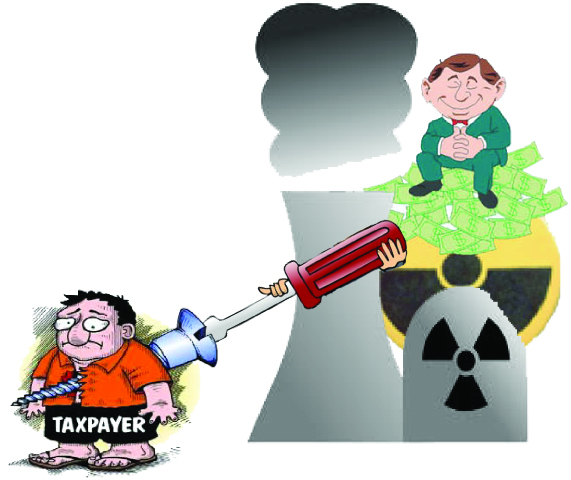
Bechtel Chief Says U.S. Must Subsidize Trump’s Nuclear Revival.
By Leonard Hyman & William Tilles – Nov 153, 2025 https://oilprice.com/Alternative-Energy/Nuclear-Power/Bechtel-Chief-Says-US-Must-Subsidize-Trumps-Nuclear-Revival.html5,
- Bechtel CEO Craig Albert said the U.S. government should help cover the costs of new nuclear plants under Trump’s proposed expansion.
- Nuclear power relies on layers of government subsidies for insurance, fuel, and waste disposal.
- If more reactors are truly needed, the government—not private firms—should build and operate them to lower capital costs
Well, someone important finally said it. Craig Albert, head of construction firm Bechtel, credited by the Financial Times for “rescuing” the Vogtle nuclear project in Georgia (we think “finishing“ it would be a better description), told that august paper that if the government wanted to get Donald Trump’s nuclear construction expansion going, it should be willing to pick up part of the costs. That is, subsidize the seemingly inevitable cost overruns? All the stories that followed talked about encouraging the “early movers” as if nobody had been building nuclear plants for the past seventy years, with cost overruns a common feature of construction in the US and Europe for at least 40 years.
We’ve said, and written in blogs and books, that building nuclear power plants in the USA (and a lot of other places) is not and has never been a commercial business venture. And maybe not a rational one, either. (The list of government subsidies for the industry like insurance, fuel procurement, nuclear waste disposal etc. go on and on.)
And Mr. Albert’s comments seem to bear that out. Just about every other electricity source is cheaper. If you don’t believe in climate change, then why not build more coal and gas? The USA has large domestic supplies of both. They run around the clock, too. If you believe in climate change, wind and solar assisted by batteries and better transmission can do the same job as a base load plant at about the same price points. And the wind and sun don’t have to be imported. But the Chinese control the rare earths that go into those facilities. Yes, but there are plenty of rare earths to be found elsewhere (“rare” being a misnomer). The problem is that the Chinese control the processing. So, would it take more time to build a nuclear plant or to build rare earth processing facilities in friendly places?
Or, if we really were worried about national security or the climate and were looking for an economical way out, we might want to do something about our outsize consumption of electricity, roughly 50-100% higher than in similarly developed countries in similar climates. For years, energy economists have argued that saving energy is a lot cheaper than producing it. A nonstarter nowadays. (Ever since 1977 when Jimmy Carter caused a controversy by turning down the thermostats and putting on a sweater in the White House to encourage energy conservation this has been a political nonstarter. Sad.)
Here’s the point. We need lots of electricity, but we don’t need nuclear power. So why should we subsidize the risk? This is not a new technology. Our first commercial reactor entered service in 1957. It’s an old, extremely complicated technology that never met its promised potential. A workable fusion reactor might change the world, but not more fission nukes. However, if the powers that be really want more nukes, we suggest that the government build and run them. It couldn’t do worse than the private generating companies. It would open the nuclear subsidy to public scrutiny and it would save a bundle on capital costs. (The government can always finance things much more cheaply than the private sector.) Our conclusion is that nuclear power is not a place for the private sector because it is not, and has never been, a commercially viable business.
Why should Scotland pay billions for nuclear when renewables exist?

Dr Ian Fairlie: Why should Scotland pay billions for nuclear when
renewables exist?
Prime Minister Keir Starmer and Anas Sarwar this week
made further statements in support of more nuclear power in Scotland.
Scottish CND believe their claims about a “golden age of nuclear” are
pie in the sky and should be treated with a pinch (or more) of salt
A proper assessment of our energy situation requires us to look at what is
happening in the rest of the world. Last year, a record 582GW of renewable
energy generation capacity was added to the world’s supplies – but
there was almost no new nuclear. Indeed, each year, new renewables add
about 200 times more global electricity than new nuclear does.
Powerful economic arguments exist for renewables over nuclear. The main one is that the marginal (ie fuel) costs of renewable energy are next to zero, whereas nuclear fuel is extremely expensive. Nuclear costs – for both
construction and generation – are very high and rising, plus long delays
are the norm.
For example, the proposed Sizewell C nuclear station in
England is now predicted to cost £47 billion, with the UK Government and
independent experts acknowledging even this estimate may rise
significantly. And just this week, the Hinkley C station still under
construction in England added yet more costs to its anticipated huge bill.
Must Scotland follow these poor English examples? The reality is that new
nuclear power in Scotland would mean massive costs, a poisoned legacy to future generation and yet more radioactive pollution of our air and seas.
Given these manifest disadvantages, many independent commentators have questioned the UK Government’s seeming obsession with nuclear power.
The National 15th Nov 2025, https://www.thenational.scot/politics/25624042.scotland-pay-billions-nuclear-renewables-exist/
1 This Month

22 June – Virtual Event –Climate Change: New Data, New Debate

Monday, June 22, 2026 2:30 p.m. – 3:15 p.m. CT
YouTube. Register here

Protect Sazan Island from the Trump family! https://secure.avaaz.org/campaign/en/protect_sazan_island_from_the_trump_family_loc/?bqFCVab&v=174511&cl=22707147157&_checksum=5e9dde668860e8231c33699735e16a1fbf22ab2cb01da50c999fe8732b9775ef&utm_source=email&utm_medium=blast_email&utm_campaign=174511
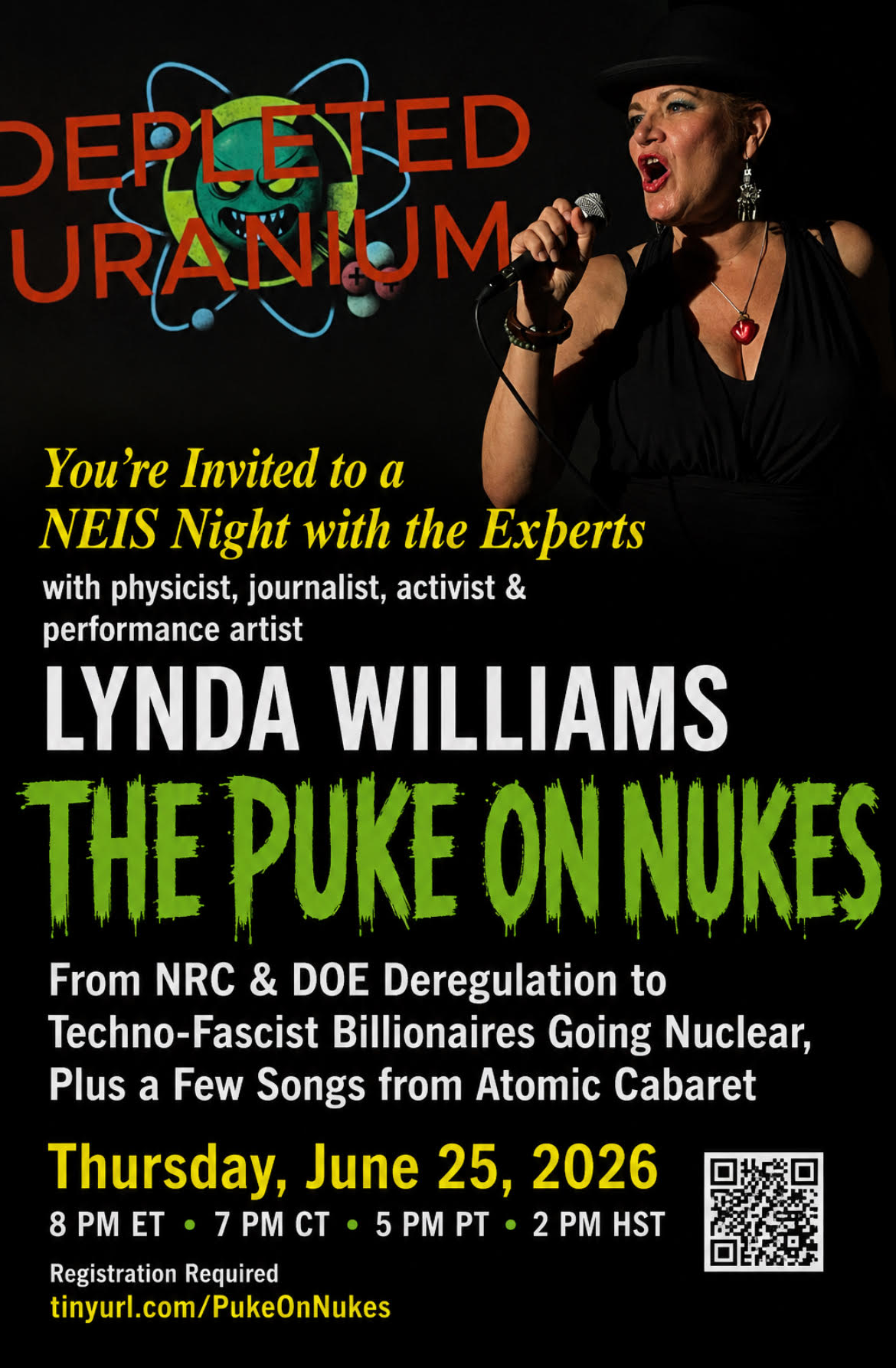
25 June- THE PUKE ON NUKES
Thursday, June 25, 2026
7pm Central Time (8pm ET, 6pm MT, 5pm PT) UTC – 5
From NRC & DOE Deregulation to Techno-Fascist Billionaires Going Nuclear, Plus a Few Songs from Atomic Cabaret REGISTER
26 June – Radiation Trainwreck at the NRC / Join the Protect Better Campaign – https://us02web.zoom.us/meeting/register/4ZlZ5_qLSHGiLSCg8FF6Bg#/registration


Cuba Is Not a Failed State – It Is a Besieged State
PETITION: “Global Appeal to Endorse Palestinian Right of Return of Refugees”
To see nuclear-related stories in greater depth and intensity – go to https://nuclearinformation.wordpress.com
-
Archives
- June 2026 (193)
- May 2026 (306)
- April 2026 (356)
- March 2026 (251)
- February 2026 (268)
- January 2026 (308)
- December 2025 (358)
- November 2025 (359)
- October 2025 (376)
- September 2025 (257)
- August 2025 (319)
- July 2025 (230)
-
Categories
- 1
- 1 NUCLEAR ISSUES
- business and costs
- climate change
- culture and arts
- ENERGY
- environment
- health
- history
- indigenous issues
- Legal
- marketing of nuclear
- media
- opposition to nuclear
- PERSONAL STORIES
- politics
- politics international
- Religion and ethics
- safety
- secrets,lies and civil liberties
- spinbuster
- technology
- Uranium
- wastes
- weapons and war
- Women
- 2 WORLD
- ACTION
- AFRICA
- Atrocities
- AUSTRALIA
- Christina's notes
- Christina's themes
- culture and arts
- Events
- Fuk 2022
- Fuk 2023
- Fukushima 2017
- Fukushima 2018
- fukushima 2019
- Fukushima 2020
- Fukushima 2021
- general
- global warming
- Humour (God we need it)
- Nuclear
- RARE EARTHS
- Reference
- resources – print
- Resources -audiovicual
- Weekly Newsletter
- World
- World Nuclear
- YouTube
-
RSS
Entries RSS
Comments RSS
 nuclear-news