Tokyo Electric Power Company Holdings said Sunday that it has completed the second round of its fiscal 2025 release of treated water into the ocean from the Fukushima No. 1 nuclear power plant.
The discharge of the water, containing radioactive tritium, was suspended due to a tsunami caused by a major earthquake near Russia’s Kamchatka Peninsula last week, but there were no problems with the facilities involved in the operation. In the second round, which began on July 14, Tepco diluted 7,800 tons of treated water with large amounts of seawater before releasing it about 1 kilometer off the coast of Fukushima Prefecture through an undersea tunnel. In the current fiscal year through next March, a total of 54,600 tons will be released into the sea in seven rounds, at the same pace as the previous year.
Hundreds of ex-offenders will be hired to work on the construction of the Sizewell C nuclear power station as part of a drive to generate broader social and economic benefits from big public infrastructure projects. Sizewell C, which was given the final go-ahead last month, is already working with local prisons in Suffolk to design training courses in welding, construction, engineering and hospitality that are aimed at equipping inmates with the skills needed to work on the plant.
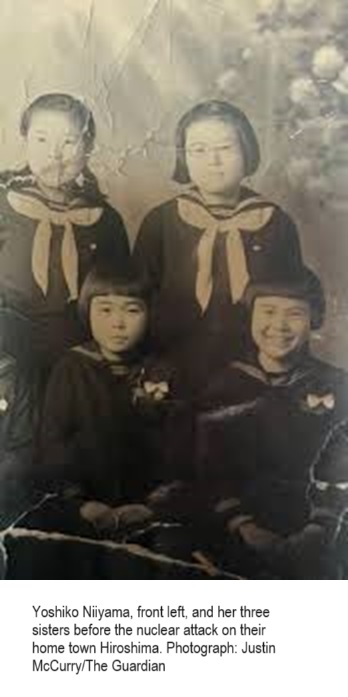
The fires were still burning, and the dead lay where they had fallen, when a 10-year-old Yoshiko Niiyama entered Hiroshima, two days after it was destroyed by an American atomic bomb.
“I remember that the air was filled with smoke and there were bodies everywhere … and it was so hot,” Niiyama says in an interview at her home in the Hiroshima suburbs. “The faces of the survivors were so badly disfigured that I didn’t want to look at them. But I had to.”
Niiyama and her eldest sister had rushed to the city to search for their father, Mitsugi, who worked in a bank located just 1km from the hypocentre. They had been evacuated to a neighbourhood just outside the city, but knew something dreadful had happened in Hiroshima when they saw trucks passing their temporary home carrying badly burned victims.
As Hiroshima prepares to mark 80 years since the city was destroyed in the world’s first nuclear attack, the 90-year-old is one of a small number of hibakusha – survivors of the atomic bombings – still able to recall the horrors they witnessed after their home was reduced to rubble in an instant.
At 8:15am on 6 August, the Enola Gay, a US B-29 bomber, dropped a nuclear bomb on the city. “Little Boy” detonated about 600 metres from the ground, with a force equivalent to 15,000 tonnes of TNT. Between 60,000 and 80,000 people were killed instantly, with the death toll rising to 140,000 by the end of the year as victims succumbed to burns and illnesses caused by acute exposure to radiation.
Three days later, the Americans dropped a plutonium bomb on Nagasaki, killing 74,000. And on 15 August, a demoralised Japan surrendered, bringing an end to the second world war.
Niiyama, one of four sisters, never found her father or his remains, which were likely incinerated along with those of his colleagues. “My father was tall, so for a long time whenever I saw a tall man from behind, I would run up to him thinking it might be him,” she says. “But it never was.”
With the number of people who survived the bombing and witnessed its immediate aftermath dwindling by the year, it is being left to younger people to continue to communicate the horrors inflicted on Hiroshima and Nagasaki.
For decades Niiyama, who is a registered hibakusha, said nothing of the trauma she had suffered as a schoolgirl, not even to members of her own family. “I didn’t want to remember what had happened,” she says. “And many hibakusha stayed quiet as they knew they might face discrimination, like not being able to marry or find a job. There were rumours that children born to hibakusha would be deformed.”
It was only when her granddaughter, Kyoko Niiyama, then a high school student, asked her about her wartime experiences that Niiyama broke her silence.
“When my children are older, they’ll naturally ask about what happened to their grandmother,” says the younger Niiyama, 35, a reporter for a local newspaper and the mother of two young children. “It would be such a shame if I wasn’t able to tell them … that’s why I decided to ask my grandmother about the bomb.”
She is one of a growing number of people in Hiroshima and Nagasaki studying to become “family successors” – a local government initiative that certifies the descendants of first-generation hibakusha to record and pass on the experiences of the only people on earth to have lived through nuclear warfare.
“Now that the anniversary is approaching, I can talk to her again,” Kyoko says. “This is a really precious time for our family.”
‘I don’t want to think about that day’
Last year, survivors of the Hiroshima and Nagasaki attacks won recognition for their campaign to rid the world of nuclear weapons when Nihon Hidankyo – a nationwide network of hibakusha – was awarded the Nobel peace prize.
But survivors face a race against time to ensure that their message lives on in a world that is edging closer to a new age of nuclear brinkmanship.
The world’s nine nuclear states are spending billions of dollars on modernising, and in some cases expanding, their arsenals. The Russian president, Vladimir Putin, has refused to rule out the use of tactical nuclear weapons in his war against Ukraine, and last week a veiled nuclear threat by the country’s former leader, Dmitry Medvedev, prompted Donald Trump – who had earlier compared US strikes on Iran’s nuclear facilities to the Hiroshima and Nagasaki attacks – to claim that he had moved two nuclear submarines closer to the region. North Korea’s development of nuclear weapons continues unchecked.
“The hibakusha have spent their lifetimes courageously telling their stories again and again, essentially reliving their childhood traumas – to make sure the world learns the reality of what nuclear weapons actually do to people and why they must be abolished, so that no one else goes through what they have suffered,” says Melissa Parke, executive director of the International Campaign to Abolish Nuclear Weapons.
“These brave hibakusha deserve to have their decades of campaigning vindicated and to witness the elimination of nuclear weapons in their lifetimes. This would provide some nuclear justice.”
The number of registered survivors of both attacks fell to just below 100,000 this year, according to the health ministry, compared with more than 372,000 in 1981. Their average age is 86. Just one of the 78 people confirmed to have been within 500 metres of the hypocentre of the blast in Hiroshima is still alive – an 89-year-old man.
On the eve of the anniversary, the ministry said it would no longer conduct a survey every 10 years to assess the living conditions and health of hibakusha, saying it wanted to “lessen the burden” on ageing survivors.
Niiyama, who struggles to walk, will watch Wednesday’s ceremony at home and pause to remember her father, whose memory is represented by a teacup he used that was retrieved from the devastation.
“I don’t like the month of August,” she says. “I have nightmares around the anniversary. I don’t want to think about that day, but I can’t forget it. But I’m glad I still remember that I’m a hibakusha.”
Niiyama, who struggles to walk, will watch Wednesday’s ceremony at home and pause to remember her father, whose memory is represented by a teacup he used that was retrieved from the devastation.
“I don’t like the month of August,” she says. “I have nightmares around the anniversary. I don’t want to think about that day, but I can’t forget it. But I’m glad I still remember that I’m a hibakusha.”
Walt Zlotow, West Suburban Peace Coalition, Glen Ellyn IL, 5 Aug 25
Ukraine’s military is being systematically obliterated on the battlefield. US President Trump knows this. Ukraine President Zelensky does as well.
Yet, both are pretending the war can be won on terms favorable to the US and Ukraine. Trump is threatening secondary sanctions on nations buying Russian oil if Russia doesn’t end the war by August 8. Zelensky applauds this threat. Trump is also selling additional weapons to NATO allies to give to Ukraine’s lost cause.
Neither of Trump’s actions will have any effect on Ukraine’s impending battlefield defeat. Trump gets the ‘rat’ designation because he broke his campaign pledge to end the war by withdrawing US support and forcing Ukraine to negotiate the war’s end. But since that signals defeat of the US proxy war to weaken Russia, he clearly has decided it’s better to keep the war going rather than suffer a humiliating defeat. That merely ensures Ukraine’s near complete destruction as a functioning state.
Zelensky earned his ‘rat’ designation when he bailed out of ending the war in April 2022. He was on the cusp of a negotiated settlement with Russia that would have ended Ukraine’s effort to join NATO and guaranteed regional independence for Russian cultured Ukrainians in Donbas. For Ukraine it would have mean no lost territory and no massive casualties or infrastructure destruction. That is classic diplomacy achieving win-win.
But the rat Zelensky caved to US/UK pressure to dump that deal because Zelensky believed US/UK lies he could win simply with continued Western weapons. That, along with Trump’s refusal to end the war after promising to end it, has put Ukraine into a death spiral.
So with no way to win on the battlefield, our cornered rats are risking nuclear war every day this catastrophe continues. Zelensky keeps begging for long range NATO missies to attack deep into Russia. While that has no strategic value, it has value in provoking a Russian nuclear response, something to which Zelensky remains oblivious.
The nuclear risk Trump has embarked upon is even more reckless. He responded to a harmless Russian social media comment about a potential US/Russia nuclear confrontation, by sending two Ohio Class nuclear submarines toward Russian waters. Just as provocative and reckless, Trump’s sent B61-12 nuclear gravity bombs to the UK. These are offensive weapons having nothing do with will standard NATO defensive weaponry. They are the first delivery of these offensive weapons to the UK since removing them in 2008.
To Trump, reckless action is an appropriate response to relatively harmless words. Particularly since Trump is he world champ at using social media to threaten, browbeat friends and foes alike.
It’s not just the beleaguered people of Ukraine whose lives are threatened by the two cornered rats with no sane, safe way out of the lost war in Ukraine. It is all of us.
Trump has announced plans to quadruple U.S. nuclear power by 2050, pushing for rapid approval of new reactors and slashing regulatory barriers.
Experts warn that undermining the independent Nuclear Regulatory Commission could erode essential safety standards and risk public backlash.
Critics argue the slow growth of U.S. nuclear energy stems from high costs, not overregulation, citing costly delays at projects like Plant Vogtle.
The President of the United States, Donald Trump, is betting big on nuclear power and aims to fast-track projects to prepare for the massive increase in electricity demand over the next decade. However, experts fear that his plans to accelerate project development could compromise safety standards, particularly as the independent U.S. Nuclear Regulatory Commission comes under threat.
Trump’s orders establish arbitrary deadlines for decisions on construction permits and operating licenses, even for new designs that have not yet been assessed; demand a review of all NRC regulations within 18 months; and allow for the construction of nuclear reactors on federal lands without NRC review.
While deploying more nuclear power could help the U.S. respond to the rising domestic electricity demand, there are widespread concerns that President Trump’s rapid approval of new nuclear projects threatens to weaken the independent Nuclear Regulatory Commission (NRC), which assesses projects for health and safety and ensures reactors operate securely. The objective of Trump’s executive orders is to reduce regulations and accelerate the approval of nuclear plants by overhauling the NRC…………………………………………..
………………. Weakening the powers of the independent NRC to give greater control to the government’s Department of Energy and Defence undermines the stringent safety standards that were previously enforced for the development and running of nuclear plants. At worst, this could lead to another nuclear disaster, which could jeopardise the health, or even lives, of people across the U.S. https://oilprice.com/Energy/Energy-General/Trumps-Nuclear-Energy-Overhaul-Sparks-Alarms-Over-Safety.html
At least 100,000 Australians, including WikiLeaks founder Julian Assange, marched for Gaza across the Sydney Harbour Bridge in the pouring rain at a demonstration on Sunday.
It wasn’t that long ago when I sincerely wondered if we’d ever see Assange’s face again, let alone in public, let alone in Sydney, let alone heading up what had to be one of the largest pro-Palestine rallies ever held in Australia. Dare to be encouraged. The light is breaking through.
The western political/media class is fuming with outrage about images of Israeli hostages who are severely emaciated, which just says so much about how dehumanized Palestinians are in western society. Everyone stop caring about hundreds of thousands of starving Palestinians, it turns out two Israeli hostages are starving in the same way for the same reason.
Israel’s Foreign Ministry has announced that in order to improve “public diplomacy” efforts the term “hasbara” will no longer be used, because people have come to associate it with lies and propaganda.
“Long referred to as hasbara, a term used to denote both public relations and propaganda that has been freighted with negative baggage in recent years, the ministry now brands its approach as toda’a — which translates to ‘awareness’ or ‘consciousness’ — an apparent shift toward broader, more proactive messaging.
That “negative baggage” would of course be public disgust at the nonstop deluge of lies that Israel and its apologists have been spouting for two years to justify an act of genocide. Westerners have grown increasingly aware that Israel and its defenders have a special word for their practice of manipulating public narratives about their beloved apartheid state, so they’re changing the word.
Simply stopping the genocide is not considered as an option. Simply ceasing to lie is not considered as an option. They’re just changing the word they use for their lies about their genocide.
One of the reasons Israel’s supporters love to hurl antisemitism accusations at its critics is because it’s a claim that can be made without any evidence whatsoever. It’s not an accusation based on facts, it’s an assertion about someone’s private thoughts and feelings, which are invisible. Support for Israel doesn’t lend itself to arguments based on facts, logic and morality, so they rely heavily on aggressive claims about what’s happening inside other people’s heads which cannot be proved or disproved.
It’s entirely unfalsifiable. I cannot prove that my opposition to an active genocide is not in fact due to an obsessive hatred of a small Abrahamic religion. I cannot unscrew the top of my head and show everyone that I actually just think it’s bad to rain military explosives on top of a giant concentration camp full of children, and am not in fact motivated by a strange medieval urge to persecute Jewish people. So an Israel supporter can freely hurl accusations about what’s going on in my head that I am powerless to disprove.
It’s been a fairly effective weapon over the years. Campus protests have been stomped out, freedom of expression has been crushed, entire political campaigns have been killed dead, all because it’s been normalized to make evidence-free claims about someone’s private thoughts and feelings toward Jews if they suggest that Palestinians deserve human rights.
“I once asked someone I casually know, an ardent Zionist, ‘what could Israel do that would cause you not to support it?’. He was silent for a moment before looking at me and said, ‘Nothing.’”
This is horrifying, but facts in evidence indicate that it’s also a very common position among Zionists. If you’re still supporting Israel at this point, there’s probably nothing it could do to lose your support.
The Israeli media has decided not to report on the horrors that the IDF [Israel Defense Forces] is perpetrating in Gaza. You simply will not see it on Israeli television………………….. the vast majority of the population simply does not want to know about it.”
The politics of genocide in the United States involves papering over the big gap between the opinions of the electorate and the actions of the U.S. government. While the partnership between the governments of Israel and the United States has never been stronger, the partnership between the people of Israel and the United States has never been weaker. But in the USA, consent of the governed has not been necessary to continue the axis of genocide.
For decades, countless U.S. officials have proclaimed that the bonds between the United States and Israel are unbreakable. Now, the ties that bind are laced with genocide. The two countries function as accomplices while methodical killing continues in Gaza, with both societies directly – and differently – making it all possible.
The policies of Israel’s government are aligned with the attitudes of most Jewish Israelis. In a recent survey, three-quarters of them (and 64 percent of all Israelis) said they largely agreed with the statement that “there are no innocent people in Gaza” – nearly half of whom are children.
“There is no more ‘permitted’ and ‘forbidden’ with regard to Israel’s evilness toward the Palestinians,” dissident columnist Gideon Levy wrote three months ago in the Israeli newspaper Haaretz. “It is permitted to kill dozens of captive detainees and to starve to death an entire people.” The biggest Israeli media outlets echo and amplify sociopathic voices. “Genocide talk has spread into all TV studios as legitimate talk. Former colonels, past members of the defense establishment, sit on panels and call for genocide without batting an eye.”
Last week, Levy provided an update: “The weapon of deliberate starvation is working. The Gaza ‘Humanitarian’ Foundation, in turn, has become a tragic success. Not only have hundreds of Gazans been shot to death while waiting in line for packages distributed by the GHF, but there are others who don’t manage to reach the distribution points, dying of hunger. Most of these are children and babies…. They lie on hospital floors, on bare beds, or carried on donkey carts. These are pictures from hell. In Israel, many people reject these photos, doubting their veracity. Others express their joy and pride on seeing starving babies.”
Unimpeded, a daily process continues to exterminate more and more of the 2.1 million Palestinian people who remain in Gaza – bombing and shooting civilians while blocking all but a pittance of the food and medicine needed to sustain life. After destroying Gaza’s hospitals, Israel is still targeting healthcare workers (killing at least 70 in May and June), as well as first responders and journalists.
The barbarism is in sync with the belief that “no innocent people” are in Gaza. A relevant observation came from Aldous Huxley in 1936, the same year that the swastika went onto Germany’s flag: “The propagandist’s purpose is to make one set of people forget that certain other sets of people are human.” Kristallnacht happened two years later.
Renowned genocide scholar Omer Bartov explained during an interview on Democracy Now! in mid-July that genocide is “the attempt to destroy not simply people in large numbers, but to destroy them as members of a group. The intent is to destroy the group itself. And it doesn’t mean that you have to kill everyone. It means that the group will be destroyed and that it will not be able to reconstitute itself as a group. And to my mind, this is precisely what Israel is trying to do.”
Bartov, who is Jewish and spent the first half of his life in Israel, said:
“What I see in the Israeli public is an extraordinary indifference by large parts of the public to what Israel is doing and what it’s done in the name of Israeli citizens in Gaza. In part, it has to do with the fact that the Israeli media has decided not to report on the horrors that the IDF [Israel Defense Forces] is perpetrating in Gaza. You simply will not see it on Israeli television. If some pictures happen to come in, they are presented only as material that might be used by foreign propaganda against Israel. Now, Israeli citizens can, of course, use other media resources. We can all do that. But most of them prefer not to. And I would say that while about 30 percent of the population in Israel is completely in favor of what is happening, and, in fact, is egging the government and the army on, I think the vast majority of the population simply does not want to know about it.”
In Israel, “compassion for Palestinians is taboo except among a fringe of radical activists,” Adam Shatz wrote last month in the London Review of Books. At the same time, “the catastrophe of the last two years far exceeds that of the Nakba.” The consequences “are already being felt well beyond Gaza: in the West Bank, where Israeli soldiers and settlers have presided over an accelerated campaign of displacement and killing (more than a thousand West Bank Palestinians have been killed since 7 October); inside Israel, where Palestinian citizens are subject to increasing levels of ostracism and intimidation; in the wider region, where Israel has established itself as a new Sparta; and in the rest of the world, where the inability of Western powers to condemn Israel’s conduct – much less bring it to an end – has made a mockery of the rules-based order that they claim to uphold.”
The loudest preaching for a “rules-based order” has come from the U.S. government, which makes and breaks international rules at will. …………………………………
Israel’s grisly performance as “a new Sparta” in the region is coproduced by the Pentagon, with the military and intelligence operations of the two nations intricately entangled. The Israeli military has been able to turn Gaza into a genocide zone with at least 70 percent of its arsenal coming from the United States.
………………………………..The politics of genocide in the United States involves papering over the big gap between the opinions of the electorate and the actions of the U.S. government. While the partnership between the governments of Israel and the United States has never been stronger, the partnership between the people of Israel and the United States has never been weaker. But in the USA, consent of the governed has not been necessary to continue the axis of genocide. https://znetwork.org/znetarticle/the-genocidal-partnership-of-israel-and-the-united-states/
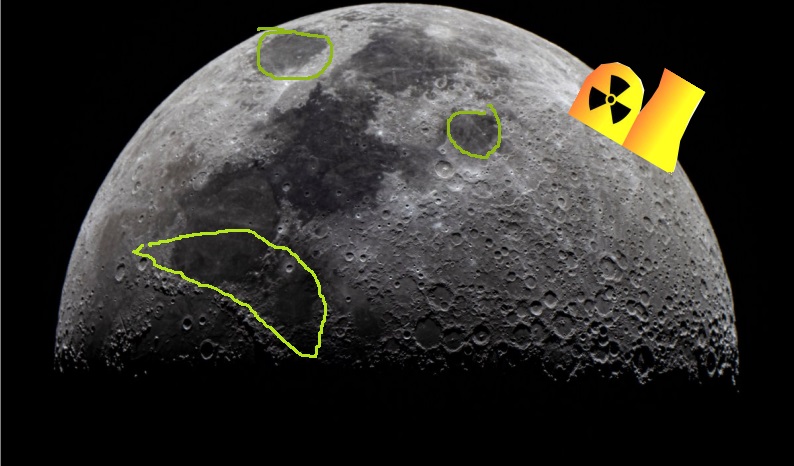
US space agency Nasa will fast-track plans to build a nuclear reactor on the Moon by 2030, according to US media. It is part of US ambitions to build a permanent base for humans to live on the lunar surface. According to Politico, the acting head of Nasa referred to similar plans by China and Russia and said those two countries “could potentially declare a keep-out zone” on the Moon. But questions remain about how realistic the goal and timeframe are, given recent and steep Nasa budget cuts, and some scientists are concerned that the plans are driven by geopolitical goals.
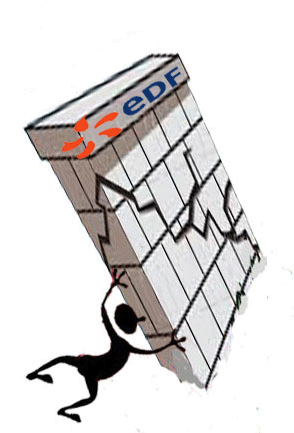
rance’s state-run utility EDF is planning to reduce its overseas sales workforce by 60 positions including 10 in management, and withdraw from certain international nuclear projects to concentrate on a domestic construction programme under its new CEO Bernard Fontana, as reported by Reuters. France is retreating from its position as a global leader in nuclear power, amid rising global demand, allowing new competitors to emerge as high costs and design challenges hinder its international competitiveness.
M. Fontana aims to accelerate the modernisation of France’s nuclear fleet, expressing a commitment to focus on domestic projects rather than the international operations that have previously included reactor construction in China, Finland and Britain. Recent changes include focusing on tenders in the Netherlands, Sweden and Finland, while deprioritising projects in Poland, India and Canada. This shift is expected to cut costs and reallocate resources to higher-priority initiatives. EDF’s recent international projects have experienced significant delays and cost overruns. In 2024, it lost a bid for two new reactors in the Czech Republic to South Korea’s KHNP.
The French government identifies the new French nuclear programme as a priority. President Emmanuel Macron announced plans in early 2022 for six new reactors to replace ageing plants, with projected costs of €67bn ($78.7bn). But the company is indebted owing to costly repairs made to its nuclear fleet in recent years. EDF is considering the sale of certain renewable energy assets in North America and Brazil.
Workers supplying the Sellafield nuclear site have voted in favour of strike action over pay.
Almost 40 workers at Fellside Combined Heat and Power facility, the plant supplying the steam and power to the Cumbria site, will take industrial action on 19 and 20 August after rejecting two pay offers.
Owned by PX Ltd, Unite workers are also undertaking an overtime ban.
PX Ltd said it was unable to comment as another meeting was due to take place with the union on Wednesday. A spokesperson for Sellafield said the site was not “directly involved in the dispute”.
The final pay offer was 3.5 to 5% depending on a set of criteria, Unite said.
Unite general secretary, Sharon Graham, said: “PX Limited can clearly afford to pay our members for the vital work they do but is choosing to put profits over people.
“This dispute is completely caused by the employer’s greed.”
A spokesperson for Sellafield added: “As always, the safety and security of the Sellafield site, our workforce and the local community will be our priority during any industrial action.”
Ukraine claims to have pulled off a major hacking operation, obtaining classified data on a new Russian nuclear submarine and revealing potential vulnerabilities as Moscow intensifies its military presence in the Arctic.
Boeing lands $2.8 billion deal to build next-gen nuclear communications satellites
The ESS satellites are central to U.S. nuclear command, control and communications.
Space News, 3 Aug 25,
WASHINGTON — Boeing won a $2.8 billion contract to develop a new generation of secure military satellites (Evolved Strategic Satellite Communications spacecraft) that will serve as the backbone of the United States’ nuclear command, control and communications network, the U.S. Space Force announced July 3.
The award marks a major milestone in the Pentagon’s effort to modernize its most hardened space-based communication infrastructure. The contract is part of the Evolved Strategic Satellite Communications program, or ESS, which will ultimately replace the current constellation built by Lockheed Martin under the Advanced Extremely High Frequency (AEHF) program.
Boeing edged out Northrop Grumman after a nearly five-year competition that began in 2020, when both aerospace giants were selected to develop prototype systems. The Space Force selected Boeing as the prime contractor for the next phase of the ESS program, which includes development and production of two satellites, with options for two more. If all options are exercised, the contract could reach $3.75 billion.
The first satellite delivery is slated for 2031.
Critical infrastructure for nuclear command
The ESS satellites are designed to provide jam-resistant, always-on communications for the U.S. military’s nuclear command, control, and communications (NC3) architecture. These satellites must function under the most extreme conditions — including in the wake of a nuclear strike — ensuring the President and senior military leaders can communicate securely with deployed forces anywhere in the world.
“The strategic communication mission requires protection, power and always-available capability, even through adversary attempts to interrupt our connectivity,” said Cordell DeLaPeña, the Space Force’s program executive officer overseeing the ESS effort.
Broader $12 billion program
While Boeing’s $2.8 billion development contract is the most visible component, it is only part of a broader $12 billion ESS program that also includes ground systems, cryptographic infrastructure, and user terminals. The terminals, which allow individual military branches to access the ESS network, are acquired separately.
Boeing said its satellite design draws on technology developed for its Wideband Global SATCOM (WGS) satellites and commercial spacecraft it built for SES’s O3b mPOWER broadband constellation.
“This win validates all the investments and innovations we’ve made in our satellite technology,” said Michelle Parker, vice president of Boeing Space Mission Systems.
The ESS satellites will operate in geostationary orbit — 22,000 miles above Earth — where they can provide persistent coverage to specific regions. The full constellation is expected to support global coverage, including the Arctic, an area of growing strategic interest.
The ESS constellation is being built to replace the AEHF network, which was designed and launched over the last two decades to provide similar survivable communications capabilities. Military leaders say growing threats from advanced anti-satellite weapons and electronic warfare systems demand more modern, flexible platforms.
The Space Force is using a cost-reimbursement contracting model for the initial satellite development, a structure more suited to high-risk, high-complexity projects. Under this arrangement, the government pays for allowable costs plus a negotiated profit margin — an approach often used when requirements are not yet fully known and involve extensive non-recurring engineering.
However, future satellites under the ESS program may be procured using fixed-price contracts, which shift more cost risk to the contractor and are generally used once designs mature and production stabilizes.
It was obvious in October 2023 that Israel intended to eliminate all Palestinians in Gaza, in part because you would never treat a population that way if you intended to leave survivors on your border. Because you’d know they’d seek revenge later on.
Call it the Inigo Montoya problem — if you kill someone’s father right in front of him, it’s a safe bet that he’s going to spend the rest of his life trying to kill you. If you intend to act in monstrous ways that fill young children with thoughts of revenge, then you need to get rid of the children, and you need to get rid of the women who will give birth to them. Otherwise you’re just creating a problem for your own children and grandchildren down the road.
The Nazis understood this. Heinrich Himmler famously said, “I did not feel I had a right to exterminate the men — i.e. kill them or have them killed — while allowing the children to grow up and take revenge upon our sons and grandsons. We had to reach the difficult decision of making this nation vanish from the face of the earth.”
The savagery of Israel’s post-October 7 onslaught was so horrific right off the bat that it was clear they didn’t intend to leave anyone alive in Gaza. It was clear they intended to kill as many people as possible and force any survivors to leave, because there’s no way they’d be acting with such sadistic bloodlust if they had any plans to leave survivors within striking distance of themselves.
And that is exactly how it has played out. They’ve intentionally turned Gaza into an uninhabitable wasteland while creating a waking nightmare of death and unfathomable suffering, and Trump and Netanyahu are openly saying that it’s not going to end until all the Palestinians have been removed one way or another.
If you’re going to rape and torture a child, you probably don’t intend to then drop them off at the nearest hospital when you are done with them, because you know the police will be at your door the next day. If you’re going to murder your enemy’s wife and kids in front of him, you probably don’t intend to leave him alive to seek revenge at a later date. Once you’ve gone all-in on perpetrating a sufficiently terrible act, you often need to do some extra killing on top of it to protect yourself from the consequences of your actions.
That’s one of the many reasons why it has always been clear that Israel’s intentions for Gaza are genocide and ethnic cleansing. Even if Israeli officials hadn’t been making openly genocidal statements, and even if genocidal sentiments hadn’t been proliferating throughout the collective consciousness of apartheid Israel for many years — hell, even if you knew absolutely nothing about Israel and Palestine and just looked at the reality on the ground in Gaza — it would still have been obvious to you that Israel did not intend to leave any of those people there. Just because of where they were located and how Israel was treating them.
So when people claim at this late date that they are coming to the reluctant conclusion that Israel is committing genocide in Gaza, I have a hard time believing them. It was obvious to anyone with a basic understanding of human nature that Israel had no intention of leaving any survivors of this mass atrocity on its border. People are just covering their own asses and trying to wash their hands of their guilt for their complicity in a 21st century holocaust over the past 22 months.
In the course of a week, Canada accused Israel of violating international law, announced Ottawa will recognize a Palestinian state, and sent aid to be airlifted to Gaza. But a shocking new report makes clear that the proposed 51st state still arms Israel’s death machine.
Canada sent at least 391 shipments containing bullets, military equipment, weapons parts, aircraft components, and communication devices to Israel since late 2023, despite Ottawa’s repeated claims to have ended weapons deliveries to the apartheid state, a new report has revealed.
By sifting through data from the Israel Tax Authority, researchers at Arms Embargo Now discovered what they called “a continuous, massive pipeline of Canadian weapons flowing directly to Israel” comprising over 400,000 bullets, multiple shipments of cartridges, and a variety of parts for Israel’s fleet of F-35 fighter jets. Since mid-2024, Israel received four shipments of Doppler Velocity Sensors, which provide navigation data needed for the F-35’s target acquisition and weapons delivery systems, five shipments of lightweight composite panels used by the planes, and two shipments of Modular Product Testers, which are used to diagnose problems on Israel’s air force fleet.
Of the 391 deliveries identified, the report’s authors were able to track direct 47 shipments of military gear with detailed commercial shipping records sent by Canadian companies to Israeli companies. 38 of those shipments were sent to Israel’s biggest military firm, Elbit Systems, and its various subsidiaries.
In March 2024, the previous Canadian administration claimed to have halted all permits for arms shipments to Tel Aviv, after the legislature passed a non-binding motion declaring that “Israel must respect international humanitarian law” and that “the price of defeating Hamas cannot be the continuous suffering of all Palestinian civilians.” In the following months, then-Prime Minister Justin Trudeau insisted Canada no longer facilitated Israel’s horrors, going as far as publicly chiding one concerned Palestinian, “we’ve stopped exports of arms to Israel.”
But just before the apparent shift in policy, Ottawa greenlit a massive number of permits for Israeli-bound weapons deliveries, front-loading hundreds of orders in an apparent attempt to preemptively circumvent their own ban. Of the $30.6 million in military equipment sent to Israel in 2023 – the highest yearly total on record – $28.5 million was approved between October and December. Even today, many of those shipments continue to be fulfilled. To date, just 30 permits for military deliveries have been cancelled by Canada, which made that decision following a similar move by the UK in mid-2024 after the International Court of Justice ruled that Israel was violating international law.
“The Canadian government appears to have pursued a strategy of rushing through a record-breaking number of arms export permit approvals to Israel prior to publicly committing to pause approving any new ones,” Arm Embargo Now explained in their report. “This was then quietly undermined by a series of exceptions and loopholes,” researchers wrote, suggesting “the government’s policy shifts were… aimed at diffusing public criticism while maintaining material support.”
Other Canadian institutions to have assisted Israel’s genocidal siege include a number of its universities. A separate report published by Just Peace Advocates found that in 2023 up to $100 million went completely untaxed as it was funneled to Israeli universities from their ‘charitable’ arms in Canada. The money went to a variety of schools with strong ties to occupation forces, including Israel’s self-described “academic home of soldiers,” Bar-Ilan University, which took in around $4 million that year.
In addition, nearly $17 million was sent tax-free to Ben-Gurion University in 2023, which bragged of having “transformed itself into a back office for war” in October that year. Months later, Ben-Gurion announced the creation of two new “elite academic programs for future [Israeli military] recruits, as part of preparations for the transfer of IDF technological units to southern Israel.” The university says it works “in tandem” with the Israeli Air Force Flight School and claims to have trained around 1,000 pilots for military service.
Also receiving untaxed funds was Israel’s Weizmann Institute of Science, which has been described as “the incubator of most nuclear weapons work in Israel.” Weizmann has well-documented ties to a variety of Israeli spies implicated in efforts to steal nuclear secrets, and drew international attention after it was partially destroyed in a retaliatory Iranian airstrike on June 15.
According to Just Peace Advocates, Canadian sources delivered over $36 million to the Weizmann Institute in 2023.
Melting glaciers threaten to wipe out European villages – is the steep cost to protect them worth it? Switzerland spends almost $500m a year on protective structures, but a report carried out in 2007 for the Swiss parliament suggested real protection against natural hazards could cost six times that. Is that a worthwhile investment? Or should the country – and residents – really consider the painful option of abandoning some of their villages?








 nuclear-news