Distributed solar energy plan launched in the Philippines
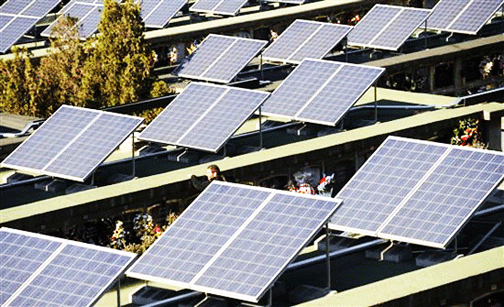 Such facilities in the Philippines should be installed mostly on rooftops because there is a lot of arable and productive land which should be used for food production rather than for solar power generation,
Rooftop solar power project launched to prove viability, Business World, 5 June 12, THE ASIAN Development Bank (ADB) said yesterday it expects solar power capacity in the Philippines to reach up to 115 megawatts (MW) by next year, as it launched yesterday its solar rooftop facility to prove the viability of this renewable energy thrust.
The multilateral lender said it estimates most of solar projects in the country will consist of small clusters that generate lower capacities of electricity rather than large facilities. ADB installed 2,040 solar panels on its rooftop which can generate around 500 kilowatts of energy or around 613 MW a year. Continue reading
Danger of uranium and plutonium use by terrorists
 Resolution on the use of uranium, plutonium to be tackled at summit, Business World, Philippines, 5 Mar 12, THE GOVERNMENT will be pushing for an international resolution that would tighten security measures and prevent nuclear resources such as uranium and plutonium from being used for terrorist activities, a high-ranking Executive official said late last week.
Mr. Binay remarked that with the pressing threat of nuclear terrorism, member states of the IAEA — a specialized United Nations body comprising 153 countries and aims to promote safe and peaceful nuclear technologies — “should not only focus on the possibility of terrorists being able to use nuclear bombs in the future, but should urgently improve their respective security and safety measures in the storing and keeping of their uranium and plutonium resources.”…. http://www.bworldonline.com/content.php?section=Nation&title=Resolution-on-the-use-of-uranium,-plutonium-to-be-tackled-at-summit&id=47788
Asia and Pacific powering ahead with decentralised renewable eneergy
The Asian Development Bank (ADB), United Nations Economic and Social Commission for Asia and the Pacific (ESCAP) and the United Nations Environment Program (UNEP) released the report “Green Growth, Resources, and Resilience” this week.
 On the road to green economies, Malaya Business Insights, 24 Feb12, Net metering is empowering electric consumers in the Philippines. The scheme is embodied in the Philippines’ Renewable Energy Act of 2008 – considered to be the most comprehensive renewable energy law in Southeast Asia.
It allows electric consumers to sell power to the grid at an approved feed-in tariff and buy power as necessary at the normal retail tariff. The feed-in tariff will provide a guaranteed fixed price for at least 12 years for electricity produced from emerging renewable resources: wind, solar power, ocean, run-of-river hydropower, and biomass.
With net metering, the consumer generates electricity at the point of use, and is able to supply excess electricity generated into the grid, either earning revenue or reducing net payable consumption.
Net metering provides a regulatory basis for distributed and decentralized energy systems and at the same time provides a powerful incentive for end-use efficiency improvements. Net metering can be combined with feed-in-tariffs to promote renewable energy generation in decentralized applications. Continue reading
Renewables supply 39% of Philippines energy needs, and thousands of jobs
Aquino optimistic on renewable energy, Business World, Johanna D. Poblete, 13 Jan 12, PRESIDENT BENIGNO S.C. Aquino III is optimistic the Energy department will achieve an increase in the production of alternative renewable energy that would redound to an increase in employment by 2015.
He noted, for instance, that nearly 39% of the country’s energy requirements are now provided by renewable sources, namely, hydropower, geothermal, solar, wind and biomass.
“We project that the contribution of the biomass sector will increase from 39 megawatts of energy in 2010 to more than 300 megawatts by 2015,” Mr. Aquino said in his speech at the opening of the 1st Philippine International BioEnergy Conference on Thursday.
“Our projections also indicate that in achieving this goal, around 89,000 more jobs will be generated for Filipinos,” he added.
The President said that the development of the industry has a “multiplier effect” not just in terms of empowering consumers, but also by stimulating attendant sectors. “The effects of advancing the biomass sector will also reach close to 577,000 farm families who can benefit, for example, by gaining additional income [from] the sale of agriwaste or forest residues that
can be used in the development of biomass resources,” Mr. Aquino said…. http://www.bworldonline.com/content.php?section=Economy&title=Aquino-optimistic-on-renewable-energy&id=44991
Philippines ditches nuclear power study
DoE shelves P100M nuclear safety study, Budget to be channeled to other energy programs, Amy R. Remo, Philippine Daily Inquirer, November 28th, 2011 The Department of Energy (DoE) has completely shelved its P100-million nuclear safety study and will instead channel the full amount to more important energy programs of the government.
Energy Secretary Jose Rene D. Almendras told the Inquirer that the bulk, or 40 percent, of the budget would go to the Fueling Sustainable Transport Program (FSTP). With the program, DoE hopes to reduce greenhouse gas emissions while providing cheaper alternatives to gasoline and diesel….. http://business.inquirer.net/32403/doe-shelves-p100m-nuclear-safety-study
Nuclear power not cost effective for the Philippines
Nuclear power deemed not a viable option for Mindanao, BusinessWorld, 13 Feb 2011, DESPITE THE NEED to look beyond hydro power as a source of electricity for Mindanao, there is just not enough demand on the island to justify the cost of building a nuclear plant there, the top executive of a major power producer told reporters late last week. Continue reading
Lack of civil liberties on a national scale – Philippines and nuclear weapons
 The problem is that under the US-RP Visiting Forces Agreement, which allows US military forces to enter the country supposedly for specific non-combat activities for a limited period, Philippine authorities are not allowed to inspect America’s military vessels....This is aggravated by the US’s standard policy on these matters, which is to neither confirm nor deny whether its visiting military vessels and aircraft are nuclear-armed or not..
China, US making Southeast Asia a nuclear neighborhood, JUN VERZOLA, GMANews.TV , 3 Feb 2011, “…..According to Roland G. Simbulan, a long-standing advocate of nuclear disarmament: “Given the nuclear-free policy laid down by the Philippine Constitution, even transient visits by nuclear-armed vessels or aircraft are prohibited. Continue reading
The Southeast Asia nuclear weapons free zone
 China, US making Southeast Asia a nuclear neighborhood.JUN VERZOLA, GMANews.TV, 3 Feb 2011, “……...The Southeast Asia nuclear weapons free zone The prohibition of nuclear weapons in Philippine territory is, in fact, not only mandated by the 1987 Constitution but by the Southeast Asian Nuclear-Weapon-Free Zone Treaty (SEANWFZ), forged in Bangkok in 1995 by 10 Southeast Asian member-states: Brunei Darussalam, Cambodia, Indonesia, Laos, Malaysia, Myanmar, Philippines, Singapore, Thailand, and Vietnam.
The SEANWFZ or Bangkok Treaty of 1995, which took effect in 1997, commits its members to the following (Article 3):
- Anywhere inside or outside the nuclear weapons-free zone (NWFZ), not to develop, manufacture, acquire, possess or have control over nuclear weapons; not to station or transport nuclear weapons; and not to use or test nuclear weapons.
- In each member’s territory, not to allow any other state to develop, manufacture, acquire, possess or have control over nuclear weapons, nor to station nuclear weapons, nor to test or use nuclear weapons.
In short, the Bangkok Treaty binds all 10 member-states not to allow nuclear weapons—whether self-acquired or held by any other state—within their combined territory………….
Since China has rapidly increased its military strength in the past decade, its naval fleets have been projecting Chinese armed might—and presumably, its nuclear capabilities—beyond the internationally-recognized Chinese coastline, into the high seas beyond.
This problem is further aggravated in the case of the Philippines, where the most basic questions about the area of Philippine jurisdiction remain ambiguous. As discussed in his recent book, veteran diplomat Rodolfo Severino said, “Philippine law enforcement agencies have not been sure of what to allow and what to prohibit, particularly by way of sea passage, overflight, fishing activities, and environmental protection.” (See: Veteran diplomat asks: Where in the world is the Philippines?)
China, US making Southeast Asia a nuclear neighborhood – Nation – GMANews.TV – Official Website of GMA News and Public Affairs – Latest Philippine News
Smuggling of uranium in Philippines
 WikiLeaks document claims uranium smuggled out of PH, By Jerry E. Esplanada, Philippine Daily Inquirer 02/02/2011 MANILA, Philippines—A smuggling incident involving uranium, a nuclear material, took place in the Philippines in 2007, according to a cable from the US Embassy in London that was released by the online whistle-blower WikiLeaks……..
The release of the WikiLeaks files comes at a crucial moment for Philippine-US ties when the Visiting Forces Agreement is being reviewed by Malacañang…..WikiLeaks document claims uranium smuggled out of PH – INQUIRER.net, Philippine News for Filipinos
No to progress or peril? Revisiting the case for or against nuclear energy
what’s the case against nuclear power? Business Mirror 25 May 09 “……………………It boils down to two things: safety and economics, according to Prof. Roland Simbulan of the University of the Philippines, National Chairman of the Nuclear-Free Philippines Coalition (NFPC). “The major issue is safety considering that we do not have an effective disaster management culture especially to handle nuclear technology,” Simbulan told the BusinessMirror.
“Even industrialized countries have difficulty confronting this problem.” Simbulan adds that the safety issue concerning storage of nuclear waste will hound the country considering the Philippines is an agricultural country dependent on a fishing industry.
He also argued that the BNPP was constructed under a “conspiracy of corruption” as it is an overpriced, unsafe plant and one that has left the Filipinos with $2.2 billion of debt. Simbulan suggests that the best alternative to nuclear power is safe, clean and less expensive renewable energy such as solar, wind, wave, tidal, geothermal energy, among others.
“We have an eternal abundance of these renewables. Also, energy conservation and efficient technologies that require less energy to generate can be considered such as light bulbs that consume less energy for more light. We also have to simplify lifestyles,” he explained. Simbulan adds that renewables are easier to utiilize compared to nuclear energy. “In the long run, they are cheaper…………………..
……………. “It is a known fact that nuclear power is an expensive technology that is risky to operate and creates deadly radioactive waste. Congress must realize that every Filipino citizen aspires for a safe and secure future. This will not be achieved through nuclear power technology,” said Greenpeace Southeast Asia campaigner Francis de la Cruz.
Greenpeace argued that the history of nuclear power in the world shows us that aside from being costly and risky, it discourages energy efficiency and impedes the development of renewable energy sources that are cleaner, sustainable and safe.
No to progress or peril? Revisiting the case for or against nuclear energy
Quake prompts group to warn against BNPP operation anew
Earthquake prompts group to warn against BNPP operation anew
Business Mirror by Jonathan Mayuga / Correspondent Wednesday, 22 April 2009 22:20THE earthquake near Iba, Zambales, on Tuesday should serve as a warning to the government about the hazards of operating the Bataan Nuclear Power Plant (BNPP).Frances Quimpo of the Center for Environmental Concerns-Philippines, a co-convenor of the No to BNPP Revival, said the earthquake, which registered 5.3 in the Richter scale, stressed the warnings of scientists that active faults lie within the range of the mothballed nuclear power plant.The earthquake, she said, may cause surface ruptures, which could spell disaster anytime another such earthquake occurs in the area.“Let us recall that the earthquakes in 1990 and 1994 caused substantial damage to structures and properties, as well as people’s lives,” she added.The Network Opposed to Bataan Nuclear Power Plant Revival (NO to BNPP!) commemorated Earth Day through a protest rally in front of the House of Representatives on Wednesday…………………………..revival.
“It will be a huge crime against the Earth and the environment if BNPP starts operating. The legislators should realize the grave consequence of running a defective and dangerous nuclear plant and should not be swayed by the strong influence of its proponents into making a decision of blunder,” said Giovanni Tapang, spokesman for NO to BNPP Revival! and chairman of the scientists’ group Agham.
One island for nuke waste?
One island for nuke waste?
Mb.com .ph By Atty. Romeo V. Pefianco
March 10, 2009, 12:00am
(Editor’s note: Telling 92.2 M of us that one island, of our 7,000, can be converted into a safe nuclear waste facility won’t do as noted by the author.
EVERYTHING seems easy to some proponents to make the Bataan nuclear plant generate energy for the first time in the unseen future: 1) only $1 billion R48,500,000,000) is needed and 2) just one of our 7,000 islands for waste disposal will suffice……………….. Of course, the 113,000 people living within 50 miles of Carlsbad, and the many New Mexicans beyond that radius were understandably opposed and fought its operation since the site was first proposed in 1974.
Carlsbad is not a facility for hazardous/radioactive waste from nuclear plant/reactor fuel as represented by the geologist………………
Protest passage of nuke waste
Lawyer: Protest passage of nuke waste
MANILA, Philippines — A lawyer has urged President Gloria Macapagal-Arroyo to place the Philippines among the countries that are protesting the shipment of radioactive waste, supposedly enough to make 225 nuclear bombs, which is intended for reprocessing in Japan.
Harry Roque of the Center for International Law (CenterLaw) said the shipment of Mixed-Oxide (Mox) fuel has been denied passage by Latin American countries because of the risks it present.
The only remaining route the shipment can take is from France to South Africa, across the Tasman Sea between New Zealand and Australia, and the waters of South Pacific nations, including the Philippines, Roque said.
But the lawyer pointed out that several countries along this route, including Australia, are protesting the shipment.
“It is imperative…that the Philippines, together with other countries where the shipment would pass, should protest this shipment,” Roque said.
During a conference on Maritime Security in France, Roque said a member of the State Council, Edwige Belliard, made it clear that France feels it is under no obligation to clean up in case there anything goes wrong with the Mox shipment.
In case of doubt, No to nuke | Manila Bulletin
In case of doubt, No to nuke mb.com.ph By Atty. Romeo V. Pefianco March 5, 2009, “……………………
Radioactive for thousands of years
There’s a great insurmountable problem with nuclear waste: It’s radioactive and can remain that way for years, in some cases, thousands of years………………
One large issue in Bataan and RP
The raging debate here is about the structural safety of the Bataan nuclear plant. So far the zone/site for waste disposal has not been identified. One possible site is the South China Sea, with fierce opposition expected from China, Indonesia, Malaysia, Brunei, Vietnam, Thailand, Cambodia, etc.
Or the government may search for a cluster of sites on the mainland of Luzon Island.
No way
In both possible sites of nuclear waste disposal most readers foresee real/heated and fierce opposition from promdis in Bataan, Zambales, all of Central Luzon and such islands as Mindoro, etc.
There’s no way for this project to win approval!
The geological hazards of the Bataan Nuclear Power Plant
The geological hazards of the Bataan Nuclear Power Plant (Third of a series)STAR SCIENCE By Kelvin S. Rodolfo, PhD Updated March 05, 2009
New earthquake data
Since 1973, many more earthquakes have occurred around and even under Mt. Natib; one on June 24, 1991 with a magnitude of 4.6 occurred directly under Napot Point. Since 1981, six have occurred within 25 kilometers of the BNPP. Note that the largest nuclear complex in the world, the Kashiwazaki-Kariwa plant in Japan, was shut down by a magnitude 6.6 earthquake in July 2007 only 19 kilometers away. It is still inactive today.
The Lubao lineament
In 1997, Prof. Fernando Siringan, his students and I began to study land subsidence in coastal Bataan, Pampanga, Bulacan and Camanava. Very early, we noticed a sharp lineament in Lubao, Pampanga that trends southwest to Mt. Natib, where it abruptly disappears. Many earthquake epicenters plot along the lineament which, if extended farther, trends to Napot Point. The possibility that the lineament is a fault, and the possibility that it extends under Mt. Natib need urgently to be explored by scientists of Phivolcs and other institutions.
Professor Mahar Lagmay has established genetic relationships between faults and volcanoes, including Mt. Pinatubo and the volcanoes in Bicol.
Spent fuel pools
No country in the world has yet solved the problem of how to store nuclear waste permanently and safely for tens and hundreds of thousands of years. In the meantime, spent fuel is stored next to the plants, in pools of water that absorb the radiation and disperse the heat. The need for huge volumes of water to absorb excess heat from the reactor and from spent fuel is why the BNPP was built on the coast.
1 This Month


18 March Webinar @ 1 PM EST: An Assessment of SMR Projects: The Case of Canada
register for the zoom:
https://us02web.zoom.us/webinar/register/WN_o8BIIOUvQ2ONJR1nta65DQ#/registration


of the week – STOP SMALL MODULAR REACTORS IN CANADA
To see nuclear-related stories in greater depth and intensity – go to https://nuclearinformation.wordpress.com
-
Archives
- March 2026 (146)
- February 2026 (268)
- January 2026 (308)
- December 2025 (358)
- November 2025 (359)
- October 2025 (376)
- September 2025 (258)
- August 2025 (319)
- July 2025 (230)
- June 2025 (348)
- May 2025 (261)
- April 2025 (305)
-
Categories
- 1
- 1 NUCLEAR ISSUES
- business and costs
- climate change
- culture and arts
- ENERGY
- environment
- health
- history
- indigenous issues
- Legal
- marketing of nuclear
- media
- opposition to nuclear
- PERSONAL STORIES
- politics
- politics international
- Religion and ethics
- safety
- secrets,lies and civil liberties
- spinbuster
- technology
- Uranium
- wastes
- weapons and war
- Women
- 2 WORLD
- ACTION
- AFRICA
- Atrocities
- AUSTRALIA
- Christina's notes
- Christina's themes
- culture and arts
- Events
- Fuk 2022
- Fuk 2023
- Fukushima 2017
- Fukushima 2018
- fukushima 2019
- Fukushima 2020
- Fukushima 2021
- general
- global warming
- Humour (God we need it)
- Nuclear
- RARE EARTHS
- Reference
- resources – print
- Resources -audiovicual
- Weekly Newsletter
- World
- World Nuclear
- YouTube
-
RSS
Entries RSS
Comments RSS
 nuclear-news