Catholic diocese urges prayer, public witness against proposed nuclear plant in northern Philippines.
A northern Philippine diocese has urged Catholics to gather for prayer and public witness as it reiterates its opposition to a proposed nuclear power plant in Labrador town, Pangasinan province.
Jan 02, 2026, By Mark Saludes, Herald Malaysia Online,
In a video message circulated ahead of the gathering, Fr. Ed Inacay of the Diocese of Alaminos called on residents to take part in a Holy Mass on Sunday, Jan. 4, 2026, at 8 a.m. at St. Isidore Parish, to be presided over by Bishop Napoleon Sipalay Jr.
The priest said the Mass is linked to the Church’s discernment on the proposed nuclear facility and reflects the diocese’s opposition to the project.
“It is good that we reflect on this and pray over this plan, and I encourage you to join our bishops, especially here in our diocese, our beloved bishop, where the Diocese of Alaminos does not agree with the construction of a nuclear power plant here in our town of Labrador,” he said.
Caritas Philippines expressed support for the Diocese of Alaminos and urged the public to “demand an energy policy that prioritizes human safety, ecological integrity, and the constitutional right to a balanced and healthy environment.”
In a video message released on Jan. 2, Caritas Philippines president Bishop Gerardo Alminaza of San Carlos, warned that nuclear energy “remains a perilous energy source that poses long-term risks to our communities and our ‘common home.’”…………………..
In December 2025, Catholic dioceses across the country expressed collective opposition to the proposed construction of a nuclear power plant in Western Pangasinan, citing moral responsibility, environmental risk, and the protection of life as central concerns.
In a pastoral letter, the bishops, particularly those of the Metropolitan See of Lingayen-Dagupan, said the proposal came as communities were still recovering from Typhoon Uwan, which left the province under a state of calamity and affected more than 233,000 people.
The bishops said the Philippines’ vulnerability to earthquakes and typhoons, its location along the Pacific “Ring of Fire,” and the lack of a secure, long-term solution for radioactive waste make nuclear facilities an “unacceptable risk,” especially in disaster-prone areas.
They warned that nuclear energy carries “irreversible, long-term risks” that outweigh projected benefits and said radioactive waste, which remains deadly for thousands of years, would impose a burden on future generations.
Drawing from the experiences of bishops in Japan after the Fukushima nuclear disaster, the prelates said nuclear power generation is fundamentally incompatible with a vision of society that respects all life.
Echoing Pope Francis, the bishops stressed prudence, human safety, and environmental protection over immediate economic gains, urging government officials and the public to pursue renewable energy paths that safeguard communities, ecosystems, and the common good.—licas.news https://www.heraldmalaysia.com/news/catholic-diocese-urges-prayer-public-witness-against-proposed-nuclear-plant-in-northern-philippines/86844/2
Philippines Says US Will Pull Out Controversial Mid-Range Missile System
The US deployed the Typhon missile system for annual military drills
by Dave DeCamp July 4, 2024 ore https://news.antiwar.com/2024/07/04/philippines-says-us-will-pull-out-controversial-mid-range-missile-system/
On Thursday, the Philippines said the US was pulling out a new missile system it deployed to the Southeast Asian country for annual military exercises.
The US sent the Typhon missile system for the Balikatan exercises, which were held in April and May. The Typhon is a controversial launcher since it would have been banned by the Intermediate-Range Nuclear Forces (INF) Treaty, a treaty between the US and Russia that the Trump administration withdrew from in 2019.
The INF prohibited land-based missile systems with a range between 310 and 3,400 miles. The Typhon can launch nuclear-capable Tomahawk missiles, which have a range of about 1,000 miles. It can also fire SM-6 missiles, which can hit targets up to 290 miles away.
Philippine Col. Louie Dema-ala told AFP that the US planned to withdraw the Typhon from the Philippines following the military exercises. “As per plan… it will be shipped out of the country in September or even earlier,” he said. “The US Army is currently shipping out their equipment that we used during Balikatan and Salaknib (exercises).”
China strongly condemned the deployment of the Typhon system, which US officials have acknowledged was developed to prepare for a future conflict with Beijing over Taiwan or the South China Sea.
Russian President Vladimir Putin also recently mentioned the deployment. He made the comments when calling for Moscow to follow the US and develop missile systems previously banned by the INF.
“We need to start production of these strike systems and then, based on the actual situation, make decisions about where — if necessary to ensure our safety — to place them,” Putin said last week.
“Today it is known that the United States not only produces these missile systems, but has already brought them to Europe for exercises, to Denmark. Quite recently it was announced that they are in the Philippines,” the Russian leader added.
US, Philippines, Japan, and Australia Conduct First Joint Military Exercise in South China Sea
China launched patrols in the South China Sea in response
by Dave DeCamp April 7, 2024
https://news.antiwar.com/2024/04/07/us-philippines-japan-and-australia-conduct-first-joint-military-exercise-in-south-china-sea/
The US, Japan, the Philippines, and Australia conducted joint military exercises in the South China Sea on Sunday in a provocative show of force aimed at China.
According to Japan’s Kyodo News, the drills marked the first “full-scale exercise” between the four nations. The US has been looking to increase military cooperation between its treaty allies in the region as part of its military build-up to prepare for a future war with China.
The four countries released a joint statement that made clear the drills were meant to push back on China’s claims to the South China Sea. “We stand with all nations in safeguarding the international order based on the rule of law that is the foundation for a peaceful and stable Indo-Pacific region,” the statement said.
According to The South China Morning Post, the drills included two Philippine vessels, one American ship, one Australian ship, and a Japanese ship and focused on anti-submarine warfare training, tactical exercises, and photo exercises.
China launched patrols in the South China Sea on the same day in what appeared to be a response to the drill. “The Southern Theatre Command of the People’s Liberation Army will conduct a joint air and sea combat patrol in the South China Sea on April 7,” the Chinese military’s Southern Theater Command said.
The joint drills come as tensions are soaring between China and the Philippines over disputed rocks and reefs in the South China Sea. Chinese and Philippine vessels frequently have tense encounters in the waters, which often end in collision. In the most recent incident, a Chinese vessel fired a water cannon at a Philippine supply boat, injuring several crew members.
The incidents in the South China Sea could potentially spark a major war as the US has repeatedly affirmed that the US-Philippine Mutual Defense Treaty applies to attacks on Philippine vessels in the disputed waters.
President Biden is hosting Philippine President Ferdinand Marcos Jr. and Japanese Prime Minister Fumio Kishida in Washington this Thursday for the first-ever trilateral summit between the three nations. They’re expected to announce the launch of regular joint patrols in the South China Sea.
Halt the US-Philippines Nuclear Deal
Sign on to Letter to US Congress
Full statement and sign on: tinyurl.com/haltUSPHdeal
While thousands gathered in San Francisco to protest the Asia Pacific Economic Cooperation (APEC) and Philippine President Ferdinand Marcos Jr.’s presence at its meetings, United States Secretary of State Anthony Blinken signed a new Section 123 Nuclear Agreement with the Philippine Energy Secretary Raphael Lotilla. This agreement would allow the United States to export nuclear technology and material to Manila. Negotiations for the agreement began upon Kamala Harris’ November 2022 trip to the Philippines, making it the fastest Section 123 agreement ever signed, according to Blinken.
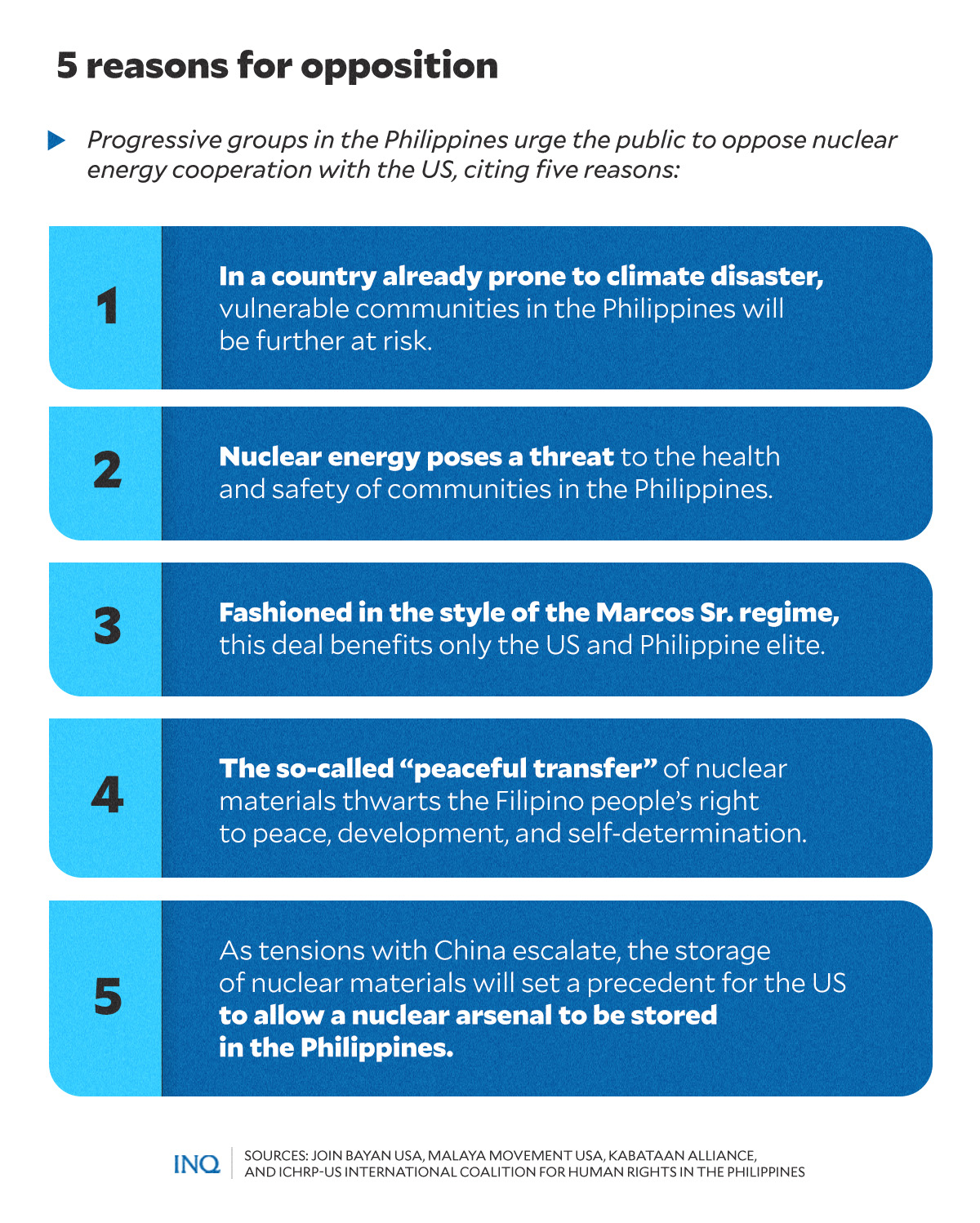
President Marcos Jr. portends the so-called “peaceful nuclear cooperation,” to be an alternative energy solution for the Philippines. The agreement must now go before the US Congress for approval.Here are five reasons why we must act now to oppose it:
- In a country already prone to climate disaster, vulnerable communities in the Philippines will be further at risk. Located in the notoriously active seismic zone known as the “ring of fire,” the Filipino people are among those that climate change and natural disasters most endanger, seen in the yearly typhoons and major disasters such as Typhoon Haiyan in 2013, which some estimate affected around 16 million people. History meanwhile provides no doubt about the potential disasters that can come with nuclear energy; we are already witness to the devastation caused by the nuclear accidents in Chernobyl and Fukushima. US-based nuclear companies are pivoting their projects to the Philippines, making the country a guinea pig for their untested and risky technologies.
2 Nuclear energy poses a threat to the health and safety of communities in the Philippines. Exposure to toxic nuclear waste is linked to increased rates of cancer, cardiovascular disease and other adverse health effects, particularly in sensitive populations including children. The Philippines is highly abundant in safer forms of renewable energy, and it is better to use precautionary principles than put already vulnerable communities at further risk. There is no confidence in the Philippine government to handle this type of radiation processing of energy, especially if they are privatized and the main objective is profit.
3 Fashioned in the style of the Marcos Sr. Dictatorship, this deal benefits only the US and Philippine elite. This is not the first attempt of the Philippine government to prioritize nuclear energy with the United States. Marcos Sr., following his declaration of Martial Law, worked with US companies to begin the building of the Bataan Nuclear Plant. The Bataan Plant, a point of protest for activists in the Philippines, quickly failed and was mothballed when the Marcos dictatorship, full of corruption and plundering of public funds for personal use, could not complete the construction. Now, Marcos Jr., known for his lavish spending on global travel, has sought to revive a nuclear project like his father’s to earn foreign investment. House of Representatives Member Mark Cojuangco, a billionaire and long-time supporter of the Marcos family, has been a proponent of nuclear projects. These families support said nuclear project because it benefits their widespread power over land and profit in the Philippines Creating a deal with the US and foreign corporations will serve their business interests, not those of the Filipino people. For the US and US based corporations, it gives the opportunity to control and profit further from the resources in the Philippines, a country which, since 2022, has allowed 100 percent foreign ownership over “clean” energy projects.
4 The so-called “peaceful transfer” of nuclear materials thwarts the Filipino people’s right to peace, development and self-determination. Known as the deadliest country for land defenders, environmental activists, indigenous people, farmers and people in rural areas of the Philippines are currently facing brutal attacks under the Marcos’ counterinsurgency program – recently documented by UN Special Rapporteur Ian Fry. In its attempts to squash the CPP-NPA-NDF, the Marcos regime has continued the US-designed counterinsurgency policy of Duterte and many presidents before him that result in the militarization of indigenous and rural communities, indiscriminate aerial bombings, forced surrender of civilians and mass displacement of people from their homelands. At the roots of the armed conflict in the Philippines is the Filipino people’s struggle for land and sustainable, national development, free from foreign intervention and control. The transfer of nuclear materials paves the way for more displacement of indigenous people, land grabbing for the sake of foreign corporations and further militarization of the countryside. The potential monopoly of foreign ownership over energy in the Philippines further aggravates the people’s aspiration to control and determine the development of their own economy. The US agreement with the Marcos regime gives further approval of Marcos’s policies and rewards his family for their ongoing plunder and exploitation of the Filipino people.5 As tensions with China escalate, the storage of nuclear materials will set a precedent for the US to allow a nuclear arsenal to be stored in the Philippines. The required technology and infrastructure for facilities to hold nuclear materials will open up the door for conversations to allow for the potential storage of US nuclear weapons on Philippine soil. President Marcos has already allowed the ongoing Kamandag war game exercises between the US, Philippines, South Korea, and Japan, only serving to escalate tensions in the region and drag the Philippines into conflict between the US and China. By allowing the US to store nuclear materials in the Philippines, Marcos is setting the stage to welcome US nuclear weapons as an opportunity to advance his foreign affairs relationship with US President Biden.
For these reasons, we, members of the Filipino community and allies in solidarity, demand that members of US Congress halt the Section 123 US-PH Nuclear Deal.
Nuclear energy in Philippines? Group says there’s not even a Filipino expert on safety, radiation.
By: Cristina Eloisa Baclig – Content Researcher Writer / @inquirerdotnet, INQUIRER.net / 03:08 PM November 27, 2023
MANILA, Philippines—In a convergence of scientific and environmental dissent, progressive groups, scientists, and climate activists expressed strong opposition to the newly signed nuclear deal between the Philippines and the United States (US).
Last Nov. 17, Energy Secretary Raphael Lotilla and US Secretary of State Anthony Blinken signed the 123 agreement, or the “peaceful nuclear cooperation agreement,” on the sidelines of the Asia-Pacific Cooperation (Apec) Summit.
It took a year to negotiate the breakthrough agreement between the two countries. Blinken described it as “the fastest that the United States has ever negotiated this kind of agreement.”
The deal, which awaits approval by the US Congress, establishes a legally binding framework allowing the transfer of nuclear material and the export of nuclear fuel, reactors, and equipment from the US to the Philippines…………………………
A ‘reckless decision’
The group Advocates of Science and Technology for the People (AGHAM) said the government’s decision to “impulsively” enter into the agreement was a “reckless decision that lacks careful consideration.”
The group explained that despite its promised and expected benefits, there is still no detailed study on whether nuclear power is necessary and appropriate for the country.
“This omission leaves the Marcos administration without a solid foundation to justify their nuclear aspirations, as the International Atomic Energy Agency (IAEA) emphasizes the importance of such studies in assessing a country’s needs and potential for nuclear energy,” the group added.
AGHAM argued that nuclear energy will only worsen the energy crisis in the country, where, according to the group, other indigenous sources of energy remain largely untapped or with inefficient and incomplete distribution systems.
It also described the agreement as “dangerously premature,” considering that the science and technology sector in the country remains severely underfunded and understaffed.
“To illustrate, as of this moment, there is no Filipino expert in nuclear safety or in radiological environmental impact assessment in the country,” the group explained.
“This means that we will have to disproportionately rely on the US nuclear regulatory mechanism, which will lead to us being clueless guinea pigs for their new nuclear technologies; since we do not have our own way of technically assessing future implementations.”
Not a solution for clean energy security
President Ferdinand “Bongbong” Marcos Jr., who witnessed the signing of the pact, said the deal would ensure a “more energy secure and green Philippines.”
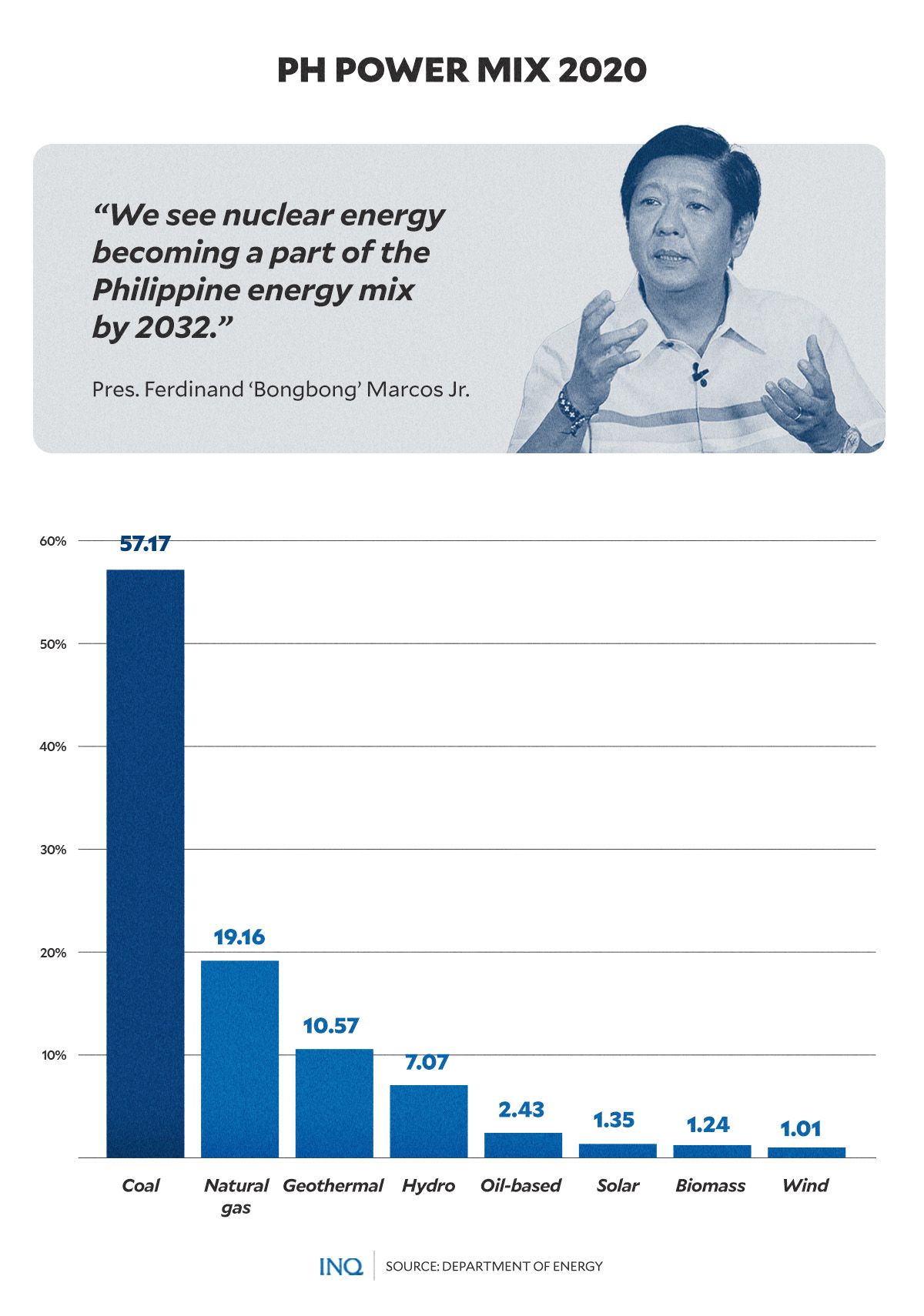
“We see nuclear energy becoming a part of the Philippine energy mix by 2032, and we would be more than happy to pursue this path with the United States as one of our partners,” said Marcos Jr. in a speech.
“The signing of the Philippines-United States Agreement for Cooperation Concerning Peaceful Uses of Nuclear Energy, or the 123 Agreement, is the first major step in this regard, taking our cooperation on capacity building further and actually opening the doors for U.S. companies to invest and participate in nuclear power projects in the country,” he added.
However, according to the Philippine Movement for Climate Justice (PMCJ), the 123 Agreement poses a threat by acquiring risky nuclear technologies, misleadingly promoted as a remedy for clean energy security.
“[T]he agreement’s purported benefits are debunked. Nuclear energy, touted for clean energy, releases pollutants worsening the planet’s temperature. The resulting radioactive waste persists for years, often irresponsibly dumped or stored, lacking proper technology for disposal,” PMCJ said in a statement.
PMCJ said that it “vehemently opposes nuclear energy in the country, advocating for a shift towards sustainable solutions.”
Despite the supposed benefits, the International Coalition for Human Rights in the Philippines (ICHRP-US), along with progressive groups — Bayan USA, Malaya Movement USA, Kabataan Alliance — demanded that members of the US Congress halt the nuclear deal, citing five reasons:
- In a country already prone to climate disaster, vulnerable communities in the Philippines will be further at risk.
- Nuclear energy poses a threat to the health and safety of communities in the Philippines.
- Fashioned in the style of the Marcos Sr. regime, this deal benefits only the US and Philippine elite.
- The so-called “peaceful transfer” of nuclear materials thwarts the Filipino people’s right to peace, development, and self-determination.
- As tensions with China escalate, the storage of nuclear materials will set a precedent for the US to allow a nuclear arsenal to be stored in the Philippines.
Renewable vs nuclear energy
Both PMCJ and AGHAM questioned Marcos Jr. and his administration’s plans to use more renewable energy while also pushing for the use of nuclear power……………………………………………………………………………………………………………..
“As with his other policies, this will just be an edifice to be used as a talking point for the purposes of extending the Marcoses’ cling to power; with no real positive contribution, and even potentially dangerous, to the Filipino people,” the group continued.
Environmental group Greenpeace Philippines has previously called out Marcos Jr. for showing mixed signals on his stance on energy.
“He used renewable energy when he ran for president, and continues to talk about it like he means it, but it’s all a game of pretend. If you look at his actions, he’s actually out to promote nuclear energy and fossil gas–both of which will block major RE development,” said Greenpeace Philippines country director Lea Guerrero.
“Greenpeace believes this is climate hypocrisy at its most dangerous,” she added.
https://newsinfo.inquirer.net/1866612/nuclear-energy-in-ph-group-says-theres-not-even-a-filipino-expert-on-safety-radiation#ixzz8KL4mjfe6
Follow us: @inquirerdotnet on Twitter | inquirerdotnet on Facebook
Philippines House panel OKs bill outlining nuclear damage compensation
By: Gabriel Pabico Lalu – Reporter / @GabrielLaluINQ INQUIRER.net August 07, 2023
MANILA, Philippines — A proposed measure that outlines civil liability and compensation in case of nuclear damage was approved by a House of Representatives panel on Monday.
During the hearing of the House Special Committee on nuclear energy, House Bill (HB) No. 8623, or the proposed Philippine Nuclear Liability Act, was approved, subject to discussions on the plenary.
A technical working group was also formed to reconcile differences between the original bill, authored by committee chairman and Pangasinan 2nd District Rep. Mark Cojuango, and the changes that would be made on the floor.
If enacted, the base version of the bill places that operators of nuclear installations would be liable for nuclear damage if there is proof that the incident was caused:
- in such nuclear installation or involving nuclear material coming from or originating in such nuclear installation
- involving nuclear material sent to such nuclear installation
It also specifies what conditions would require a joint liability — or when there is more than one operator handling the installation that caused the damage.
………………………………………………………………………………………………….. In a statement last May, the House of Representatives said IAEA informed lawmakers who hosted a forum on nuclear energy and international legal instruments that the law should contain the following provisions:
- regulatory control
- safe and secure uses
- offenses and penalties
- international cooperation
- peaceful uses
- compensation and liability
The IAEA said this after the House panel invited the Vienna-based organization to help Filipino lawmakers trying to come up with the necessary legal framework and policies for nuclear energy use.
https://newsinfo.inquirer.net/1813407/fwd-panel-oks-bill-outlining-compensation-in-case-of-nuclear-damage#ixzz89luKgXEL
Freak May typhoon shows Philippines is now in constant state of climate emergency
‘Super typhoons have become our new normal,’ activists say
Stuti Mishra, 30 May 23 https://www.independent.co.uk/climate-change/news/typhoon-mawar-philippines-climate-change-b2348165.html—
Typhoon Mawar, an unusually intense cyclone that has struck Guam and the Philippines before heading towards Taiwan and southern Japan, shows the southeast Asian country is in a “constant state of climate emergency”, activists have said, demanding reparations for vulnerable nations.
In a statement released on Monday, Greenpeace International demanded fossil fuel companies take responsibility for the intensifying extreme weather events seen worldwide and pay reparations for climate impacts.
The typhoon left Guam flooded and without power for days and has prompted evacuations and amid extreme weather warnings in the Philippines.
Mawar, known locally in the Philippines as typhoon Betty, is the strongest typhoon of the year so far and the strongest northern hemisphere cyclone ever recorded in the month of May.
“The Philippines is in a constant state of climate emergency,” said Greenpeace Philippines campaigner Jefferson Chua.
The Philippines to be the South East Asian guinea pig for NuScam’s small nuclear reactors?

New in Marcos’ nuclear push: US firm seeks site in Philippines for costly small reactors Cristina Chi – Philstar.com, May 2, 2023 |
MANILA, Philippines (Corrected, May 3; 10:33 a.m.)— A top nuclear energy firm from the United States that has been developing a type of nuclear reactor flagged for being potentially financially risky as renewable energy becomes more affordable has expressed interest in putting up a site in the Philippines.
This comes as President Ferdinand “Bongbong” Marcos Jr. takes his aggressive nuclear energy push to talks with US officials during his visit there this week — an agenda backed by his cousin House Speaker Martin Romualdez but roundly criticized by environmental groups………………………
Too expensive, too risky’
NuScale Power was flagged by independent think-tank Institute for Energy Economics and Financial Analysis in 2022 for developing SMR technology that is “too expensive, too risky and too uncertain.”
The group also recommended that SMR “should be abandoned” given that the costs of available renewable sources are falling rapidly and that the SMR wouldn’t generate electricity before 2029.
Marcos is on a four-day trip to the United States that began last weekend, and he has so far met with US President Joe Biden and other business leaders, including executives of the energy firm.
…………. Clayton Scott, NuScale executive vice president for business, also expressed confidence that NuScale’s small modular reactor (SMR) technology “will perform as expected.” NuScale was also accompanied by local partner Enrique Razon, representing Prime Infrastructure Capital, Inc.
Marcos first met with NuScale executives in 2022 on the sidelines of the 77th United Nations General Assembly.
Among the deals clinched during Marcos’ meeting with US officials is the US Agency for International Development’s commitment to invest $5 million to support the Philippines’ exploration of the potential for nuclear energy to meet the country’s need for clean energy, “consistent with the highest standards of nuclear security, safety and nonproliferation.”
Environmental groups’ pushback
A financially unrewarding nuclear energy deal may not be the only risk posed by NuScale Power’s entry in the Philippines, according to environmental group Greenpeace.
Nuclear energy companies are “practically making the Philippines the guinea pig for untested risky technologies to promote their business” despite other local options for safer and cheaper renewable energy, Greenpeace campaigner Khevin Yu said.
Yu warned of the potential consequences of tapping nuclear energy for electricity in the Philippines given that Germany, like other developed countries, has weaned off nuclear power — an undertaking that it began in 2002 and was accelerated in 2011 after the Fukushima nuclear disaster in Japan.
Italy also permanently shut down all of its functioning nuclear plants in 2022.
Yu said that risks related to nuclear technology remain unresolved, and SMRs “are still untested and unproven.”
“(And) there is currently no way to safely store nuclear waste,” Yu said.
“Even if they actually succeed in putting up nuclear plants, it will take a long time before we are able to use it. Furthermore, we will be stuck with maintaining a ticking time-bomb, which will endanger the lives of nearby communities should an accident occur,” Yu added.
Yu, meanwhile, pointed out that the pivot to renewable energy became a topic of discussion between Marcos and Bide, which he said should now “be the focus of the current administration.” https://www.philstar.com/headlines/climate-and-environment/2023/05/02/2263238/new-marcos-nuclear-push-us-firm-seeks-site-philippines-costly-small-reactors
Nuclear research center reiterates need for separate regulatory body

Business World, March 12, 2023,
THE creation of a new agency that will oversee nuclear power will assure objective regulation of the development of the industry, especially in the areas of safety and security, the head of a nuclear research institution said.
Responding to claims that a separate regulator is unnecessary, Carlo A. Arcilla, director of the Philippine Nuclear Research Institute (PNRI), told BusinessWorld by phone: “You don’t normally want to have a situation where a body will regulate itself.”
The PNRI is an arm of the Department of Science and Technology tasked with conducting research into the safe and peaceful use of nuclear energy in the Philippines. Mr. Arcilla said that transferring regulatory powers to a different agency would help avoid conflict of interest.
The House nuclear energy committee is currently discussing a bill proposing to create the Philippine Atomic Energy Regulatory Authority or PhilATOM, which will take on the regulatory functions that the PNRI currently holds.
A science advocacy organization has called the bill unnecessary, calling instead for the expansion of the PNRI’s powers……………….
The proposed agency will be headed by a director general and deputy director-general, who will be appointed by the President of the Philippines.
Advocates of Science and Technology for the People, the group that opposed the bill, also said that nuclear waste disposal could affect the safety of nearby communities. ……. https://www.bworldonline.com/economy/2023/03/12/510115/nuclear-research-center-reiterates-need-for-separate-regulatory-body/
US set to boost military presence near China
Washington and the Philippines have announced plans for four more American bases. 5 Feb 23, https://www.rt.com/news/570878-us-philippines-military-bases/
The US military will be deployed to four new bases in “strategic areas” of the Philippines, the two countries announced on Thursday. The agreement was reached during the ongoing visit of US Defense Secretary Lloyd Austin, who met Philippine President Ferdinand ‘Bongbong’ Marcos Jr in Manila.
The two nations are set to “accelerate the full implementation” of the Enhanced Defense Cooperation Agreement (EDCA), a framework regulating the deployment of US troops to the Philippines, which is listed among Washington’s “major” non-NATO allies.
“The United States has allocated over $82 million toward infrastructure investments at the existing five sites under the EDCA, and is proud that these investments are supporting economic growth and job creation in local Philippine communities,” the Pentagon said in a statement.
Apart from further development of the existing bases, the US military will be deployed to four new sites in unspecified “strategic areas of the country.”
“The United States and the Philippines have committed to moving quickly in agreeing to the necessary plans and investments for the new and existing EDCA locations. The Philippine-US Alliance has stood the test of time and remains ironclad. We look forward to the opportunities these new sites will create to expand our cooperation together,” the Pentagon added.
The move comes amid mounting tensions in the region, namely around Taiwan and the South China Sea, a busy waterway subject to overlapping maritime and territorial claims by multiple nations, including China. The Philippines, a former US colony and long-standing Washington ally, has maintained close economic ties with Beijing.
China has already condemned the US-Philippines plan, accusing Washington of stirring up further tension. The Chinese Embassy in the Philippines expressed hope that Manila would be “vigilant and resists from being taken advantage of.”
“The United States, out of its self interests and zero-sum game mentality, continues to step up military posture in this region. Its actions escalate regional tension and undermine regional peace and stability,” the embassy said in a statement.
“Such moves contradict the common aspiration of regional countries to seek peace, cooperation and development, and run counter to the common aspiration of the Filipino people to pursue sound economic recovery and a better life in cooperation with China,” it added.
Philippines looking at Chinese investors for cooperation on nuclear energy
By JON VIKTOR D. CABUENAS, GMA Integrated News, January 9, 2023 The Philippines is banking on Chinese investors to participate in the planned venture into nuclear energy, along with cooperation in other areas such as renewable energy, the Department of Energy (DOE) said Monday…………………………………..
The briefing was made after a state visit by President Ferdinand “Bongbong” Marcos Jr. to Beijing, China last week, where Malacañang said he secured $13.76-billion worth of investments in the energy sector.
………………………………… Malacañang last week said the government is set to update its nuclear energy roadmap, with Marcos pushing for its adoption in a bid to lower power rates.
The President, along with his running mate Vice President Sara Duterte, have been pushing for the adoption of nuclear energy, which they said would lower electricity rates and help secure a steady power source.
His predecessor, former President Rodrigo Duterte, last March issued Executive Order 164, directing the conduct of relevant studies for the adoption of a National Position for a Nuclear Energy Program.
The DOE in November said, however, that the Philippines will have to wait a decade to see a working nuclear power plant given the time needed for feasibility studies and other factors.
“At this point we cannot say how fast they (Chinese commitments) will be implemented but the President has committed that he’s going to make sure that there will be a systematic handholding of investors,” Lotilla said…… https://www.gmanetwork.com/news/money/economy/856790/philippines-looking-at-chinese-investors-for-cooperation-on-nuclear-energy/story/
The problem with nuclear energy advocates

There is something curiously bewitching about nuclear power that makes its backers disciples rather than advocates. They become nuclear champions first rather than energy champions (which is what everyone should be), and are either unaware of or intentionally ignoring the fact that most of the time, they are putting their efforts into a solution that is looking for a problem.
ROUGH TRADE, By Ben Kritz, January 10, 2023
I WAS asked over the weekend if I planned to respond to a recent letter to the editor (“SMR issues addressed,” published on January 5), which said it was a reaction to my December 29 column about small modular reactor (SMR) technology and the problems that have been encountered in trying to make it commercially practical.
No, I responded, I had not planned to react to the letter because I could not see much in it to actually react to; while polite and thoughtful, it essentially boiled down to the same long-on-enthusiasm and short-on-specifics kind of pitch for SMR technology I see every day.
Maybe that’s exactly the point you need to address, my annoying yet helpful self-appointed consultant suggested.
I realized she’s right; there’s a bigger problem with nuclear energy and its advocates than just the technical and economic details that make it difficult to develop and use. There is something curiously bewitching about nuclear power that makes its backers disciples rather than advocates. They become nuclear champions first rather than energy champions (which is what everyone should be), and are either unaware of or intentionally ignoring the fact that most of the time, they are putting their efforts into a solution that is looking for a problem.
For the record, my December 29 column dealt with two more exotic forms of SMR technology, the traveling wave reactor (TWR) and the Natrium reactor; the basic difference between the two being that the latter uses uranium fuel that is enriched to a concentration that is four or five times what is used in a conventional reactor, and the former is designed to use unenriched or depleted uranium fuel. For a variety of reasons, both of those technologies are at least eight to 10 years from even being functional, and whether or not they can be made economical at all is still an open question.
The discussion about the less extreme and more common form of SMR technology was in the column prior to that, on December 27, and detailed obstacles with the development of commercial-ready SMRs that have been identified through actually trying to build an SMR plant, on the one hand, and a couple of reliable studies by nuclear experts (Stanford University and the Argonne National Laboratory) on the other.
The first obstacle is cost. A plant being constructed in rural Idaho by SMR developer NuScale — which is designed to eventually consist of six 77-megawatt units — has run into massive cost overruns, despite the assumption that SMRs are relatively inexpensive due to being smaller and simpler than conventional nuclear plants. NuScale is hoping to have the first of the six units online by 2029, but the per-megawatt-hour cost of the plant has hit $58, the threshold set by the consortium of six utilities in the western US which are financing the project to decide whether or not to continue.
The reason for this is that at that cost, there are already a variety of conventional and renewable energy generation sources available, so there is nothing to be gained by building the SMR complex, no matter how cutting-edge its technology may be.
The second obstacle is waste management. Again, because SMRs are smaller and less complex than conventional nuclear power plants, it is assumed that they would produce less radioactive waste, both of the more dangerous high-level variety in the form of spent fuel and the low-level variety in the form of wastewater and contaminated discarded equipment and other materials.
This, however, is not the case, according to the Stanford and Argonne studies, both published last year. Both studies found the same result, that SMRs produce about as much waste as conventional light-water reactors, but differed in their subjective interpretation. The Stanford researchers concluded that this contraindicated the use of SMRs since they do not offer any improvement in waste management, while Argonne’s lead scientist suggested that the result was more positive, as it demonstrated using SMRs wouldn’t be any worse than conventional nuclear power.
Contrary to our recent reader-correspondent’s assertions, neither of those issues — the only two I focused on concerning SMRs, because they are not hypothetical, but demonstrated by real-world experience or analysis — are “addressed” at all by what he presented, which is “a unique approach to SMRs” being developed by an unnamed enterprise only identified as being Seattle-based. The design, according to him, uses “widely available, cheap low-enriched uranium” (as I have pointed out more than once, except for reactors running on exotic fuel like the Natrium, fuel is actually the least of the cost issues for a nuclear plant); do not need to be refueled (are they then considered disposable?); and “are safe enough that their ‘plug-and-play’ generators can be placed anywhere with little infrastructure investment and without any special security.”
As for the application of this mysterious miracle technology in the Philippines, the company in question is “confident that they can satisfy all the requirements of the Philippine government regulators, the power companies and the public. They could even achieve the objective of having the current president preside over the ribbon-cutting ceremony before he leaves office.”
First of all, if the developer of this game-changing technology has created something that is ready enough that they are actively seeking a foothold in the Philippine market, one would think that they would be willing, even eager, to be clearly identified. I suspect I know who it is, and if I’m right, I’m going to be very disappointed because then this sly press release in the form of a letter to the editor (and yes, that’s exactly what it is; I get three or four press releases a day from different companies or trade publications that sound exactly like this) doesn’t even begin to answer questions that have already been raised about this specific company’s technology.
Second, even if this is just a standard-design SMR, we already know that a commercial version in its own country of origin will not be operational by the time President Marcos steps down, let alone be available to the Philippines. Local requirements might indeed be satisfied, but before that can even happen, the hoops that both US and Philippine stakeholders will have to jump through in order to secure export authorization from the US government — with the resulting agreement also needing approval from the Philippine Senate, the sort of thing it never acts quickly on — will take a couple of years at a minimum.
The Philippines could use nuclear energy, and it’s rational not to completely discount the future possibility of its doing so, provided a very long list of conditions are satisfactorily met. But it is in no position to serve as a test site for novel ideas that have been clearly demonstrated to be years from being a viable, let alone a practical, best option. Trying to mislead the public into believing that a magical solution is available for the asking — proselytizing for nuclear energy, rather than seeking actual attainable solutions for the country’s rather more immediate energy problems — is going to achieve very little, except to disappoint people and ensure this won’t be a market for whatever you’re selling.
USA trying to use Philippines as a guinea pig for its unviable small nuclear reactors – and for military purposes.

“With recent plans by the US Department of Defense to build an advanced mobile nuclear microreactor prototype in Idaho, Manila should not allow Washington to use Philippine military bases as prototype areas for these reactors.
Save the country from the perils of nuclear reactors, NAKED THOUGHT
By Charlie V. Manalo, December 3, 2022
AS the United States government, invoking provisions of the Enhanced Defense Cooperation Agreement (EDCA), requests for additional military bases, five on the island of Luzon alone, the idea of the country playing host to mobile nuclear reactors is not far-fetched.
This is for the simple reason that whoever crafted the agreement made it so vague, it did not provide for any restrictions on the type of facilities and materials the US would be using in constructing its bases in the Philippines.
And this has been aggravated further by the enactment of the Public Service Law which opens the country’s airports to foreign ownership, giving the US all the resources needed to construct its own airports which it could use as military bases under the guise of a commercial airport.
Anyway, former congressman Terry Ridon, convenor of Infrawatch Philippines, sent me a copy of an article he wrote on the subject, explaining clearly its implications. It’s entitled, “Reject mobile nuclear reactors in PH bases-Infrawatch Philippines,” which I’m publishing in its entirety.
“With recent plans by the US Department of Defense to build an advanced mobile nuclear microreactor prototype in Idaho, Manila should not allow Washington to use Philippine military bases as prototype areas for these reactors.
According to an April report by The Associated Press, the US DoD ‘signed off on the Project Pele plan to build the reactor and reactor fuel outside of Idaho and then assemble and operate the reactor at the lab.’
As this is a project initiated by the US defense department, its military objectives had been disclosed by Jeff Waksman, project manager for Project Pele, saying, “Advanced nuclear power has the potential to be a strategic game-changer for the United States, both for the (Department of Defense) and for the commercial sector.”
The US DoD further said that the reactor designs are ‘high-temperature gas-cooled reactors using enriched uranium for fuel.’
PH microreactor deployment
Under the Enhanced Defense Cooperation Agreement between the Philippines and the United States, there are no restrictions to Washington on the type of facilities and materials it will construct and install in Philippine military bases, except a specific restriction against installing nuclear weapons.
However, Philippine authorities should be reminded that this restriction does not assuage fears that the country will not be involved in regional military conflicts because EDCA allows the installation of conventional military weapons which may approximate the breadth and fatal impact of nuclear weapons.
More importantly, in the event that nuclear microreactors are produced by the US DoD at scale, these small nuclear plants can, in fact, be installed in EDCA locations in different parts of the country.
This is alarming because the country has yet to decide and implement its national policy on nuclear development based on the policy direction of President Ferdinand Marcos Jr.
In fact, it needs to be made clear that nuclear microreactors in EDCA locations in the country will not be used for civilian purposes but for military objectives by the United States in the Indo-Pacific.
This distinction alone should give the current government pause on allowing nuclear microreactors to be deployed in EDCA locations in the future.
More importantly, military nuclear microreactors will allow Washington to deploy different kinds of weapons to influence the security arrangement in the South China Sea and the greater Indo-Pacific.
Military purposes
Further, as nuclear microreactors in EDCA areas will certainly be used for military purposes, this might prompt other regional actors to accuse Manila of violating the Bangkok Treaty, the treaty declaring Southeast Asia as a nuclear weapons-free zone and other weapons of mass destruction.
With a military nuclear microreactor in Philippine soil, Washington may be able to operate high-powered conventional military weapons which may be equivalent to weapons of mass destruction.
Certainly, Manila should follow its treaty obligations in the region, particularly as other strong powers are also looking at Manila to temper its pivot toward Washington.
Finally, allowing this kind of deployment in EDCA areas diminishes the current call of President Marcos to carefully proceed with nuclear research and development for civilian purposes.
The focus of the government should be considering whether nuclear energy should be part of the current energy mix and whether the Bataan Nuclear Power Plant should be revived.
It should also consider developing other aspects of nuclear technology, which can benefit health care and other critically important sectors.
As such, allowing nuclear microreactors in EDCA areas or anywhere in the Philippines should not be on the agenda.”
Lawmaker says Filipinos will be ‘guinea pigs’ in nuclear pact with US

ABS-CBN News Nov 24 2022
MANILA — House Deputy Minority Leader France Castro is against negotiations for a civilian nuclear pact between the United States and the Philippines, saying it poses threat to the health and safety of Filipinos.
According to the ACT Teachers party-list representative, the Filipinos will become “guinea pigs” in this nuclear energy cooperation deal known as “123 agreement”.
The pact, among initiatives announced during US Vice President Kamala Harris’s recent trip to the Philippines, can lead to the future sale of US nuclear reactors to Manila.
“The US and the Philippines agreed to have a… testing of what we call the nuclear equipment here in the Philippines,” Castro told ANC’s “Headstart” Thursday.
“So, we are being made as guinea pigs in this experiment. This would affect our health, of course, our safety and the environment,” she added.
The Makabayan bloc, led by Castro, has filed House Resolution 582 to investigate the “123 agreement”.
The group said modular or microreactor nuclear power plants are still at an experimental stage and are only legally being made in US bases…………………… https://news.abs-cbn.com/video/news/11/24/22/filipinos-will-be-guinea-pigs-in-nuclear-pact-with-us-solon
Philippines to be America’s nuclear guinea-pig for experimental small modular nuclear reactors?
Philippines’ Makabayan bloc files resolution seeking to probe US-Philippines nuclear energy deal By CNN Philippines Staff.Nov 23, 2022,
— The Makabayan bloc in the House of Representatives has filed a resolution seeking to investigate the nuclear energy cooperation deal announced by United States Vice President Kamala Harris, citing threats to the health and safety of Filipinos and the environment.
ACT Teachers party-list Rep. France Castro, Gabriela Women’s Party Rep. Arlene Brosas, and Kabataan party-list Rep. Raoul Danniel Manuel warned that Filipinos may be used as “guinea pigs” for testing nuclear equipment.
“Ang mahirap dito baka tayong mga mamamayang Pilipino ang ma-1-2-3 at maging mga guinea pig ng teknolohiyang ito na tine-testing pa lang ng US,” Castro said in a statement.
[Translation: The problem here is that Filipinos may be duped and served as guinea pigs for a technology still being tested by the US.]
According to the White House fact sheet released on Monday, the 123 Agreement, or the nuclear energy cooperation deal, will provide the legal basis for US exports of nuclear equipment and material to the Philippines.
The 123 Agreement also aims to support expanded partnerships on zero-emission energy and nonproliferation of nuclear weapons.
According to Philippine Ambassador to the US Jose Manuel Romualdez, the Marcos administration is considering bringing in US-developed small modular reactors to the country.
“As it is, modular or microreactor nuclear power plants are still at an experimental stage and are only legally being made in US bases. Early this year, the Pentagon’s Strategic Capabilities Office announced the construction and testing decision that followed the office’s Environmental Impact Statement work for Project Pele,” Castro said………….more https://www.cnnphilippines.com/news/2022/11/23/Makabayan-bloc-US-PH-nuclear-energy-deal-probe.html
1 This Month

of the week – Shut Down Drone Warfare!


Tell the Ukrainian Government to Drop Prosecution of Peace Activist Yurii Sheliazhenko

Petition to revoke the licensing of the Near Surface Nuclear Disposal Facility (NSDF) at Chalk River. https://www.ourcommons.ca/petitions/en/Petition/Details?Petition=e-7247
To see nuclear-related stories in greater depth and intensity – go to https://nuclearinformation.wordpress.com
-
Archives
- March 2026 (237)
- February 2026 (268)
- January 2026 (308)
- December 2025 (358)
- November 2025 (359)
- October 2025 (376)
- September 2025 (257)
- August 2025 (319)
- July 2025 (230)
- June 2025 (348)
- May 2025 (261)
- April 2025 (305)
-
Categories
- 1
- 1 NUCLEAR ISSUES
- business and costs
- climate change
- culture and arts
- ENERGY
- environment
- health
- history
- indigenous issues
- Legal
- marketing of nuclear
- media
- opposition to nuclear
- PERSONAL STORIES
- politics
- politics international
- Religion and ethics
- safety
- secrets,lies and civil liberties
- spinbuster
- technology
- Uranium
- wastes
- weapons and war
- Women
- 2 WORLD
- ACTION
- AFRICA
- Atrocities
- AUSTRALIA
- Christina's notes
- Christina's themes
- culture and arts
- Events
- Fuk 2022
- Fuk 2023
- Fukushima 2017
- Fukushima 2018
- fukushima 2019
- Fukushima 2020
- Fukushima 2021
- general
- global warming
- Humour (God we need it)
- Nuclear
- RARE EARTHS
- Reference
- resources – print
- Resources -audiovicual
- Weekly Newsletter
- World
- World Nuclear
- YouTube
-
RSS
Entries RSS
Comments RSS
 nuclear-news