USA quietly reveals extent of massive nuclear bombing of Marshall Islands
The Fallout from Nuclear Secrecy , Consortium News, July 23, 2013 During the Cold War’s early years, the U.S. government detonated dozens of nuclear explosions on Pacific atolls, spreading nuclear fallout around the globe and making some areas uninhabitable, a grim legacy captured in secret documents finally being shared with the Marshall Islands’ government, reports Beverly Deepe Keever.

More than a half century after U.S. nuclear tests shattered the tranquility of Pacific Ocean atolls — rendering parts of them uninhabitable – the U.S. government has quietly released secret fallout results from 49 Pacific hydrogen-bomb blasts with an explosive force equal to 3,200 Hiroshima-size bombs. Continue reading
Operation Redwing saga: the radioactive pollution of the Marshall Islands
The Fallout from Nuclear Secrecy , Consortium News, July 23, 2013 “……….As the Redwing tests continued, radiation badges were handed out, which Harris described as “small rectangular plastic discs three inches by an inch and a half.” Even with these, Harris wondered about the future impact of the radiation: “Had our genetic code been compromised? Would we get leukemia or some other form of cancer?”
His answer came decades later. Those present at Operations Redwing or Hardtack or for six months afterward who succumb to one of 19 primary cancers are eligible for $75,000 compensation made available by Congress.
At the time of Operation Redwing in 1956, the U.S. government under President Dwight Eisenhower released very little information. This secrecy was politically significant because it kept voters in the dark during the presidential election campaign in which Democratic candidate Adlai Stevenson advocated stopping the H-bomb tests being conducted by the Eisenhower administration.
During the election year, U.S. officials announced only two of the 17 blasts in the Redwing series. This virtual blackout hid from U.S. voters over 77 summertime days during the presidential election campaign Redwing’s 20,820 kilotons of explosive force — or the equivalent of 1,388 Hiroshima-size bombs. That tonnage is the equivalent of 18 Hiroshima-size bombs per day over 77 days.
Seven Redwing tests received no public notice and the remaining eight blasts were disclosed by Japanese scientists in news articles datelined Tokyo. Thus the fastest and most accurate information about U.S. Redwing testing was disclosed from Tokyo by Japanese, an immense irony given that only a decade earlier, U.S. atomic bombs had contributed to Japan’s surrender by destroying two of its cities. Eisenhower handily won re-election.
The more powerful 32 detonations in Operation Hardtack were launched in 1958 as the U.S. and the Soviets raced toward declaring a moratorium on such experiments and the U.S. accelerated testing missile warheads. Washington disclosed only nine of the 32 blasts that produced a total yield of 28,026 kilotons, or the equivalent of 1,868 Hiroshima-size bombs – an average of 35 per week in 1958 or five per day. That was the lowest disclosure rate of any U.S. Pacific testing operation.
Even more ironic than the Japanese disclosures in 1956 were the Soviet ones about the 1958 Hardtack detonations. The Soviets charged that the U.S. had concealed most of the tests being conducted, which even U.S. officials deemed accurate.
In doing so, the Soviets made huge propaganda gains as they announced their initiative of stopping their nuclear testing that year. Surprisingly, New York Times columnist James Reston wrote that “the United States, which pamphleteered its way to independence and elevated advertising and other arts of persuasion into a national cult, should be unable to hold its own in the battle for the headlines of the world.”
Samples made during several Hardtack tests showed that fractions of the radioactive elements of strontium and cesium were dispersed over distances of more than 4,000 miles, according to a report titled “Operation Hardtack: Fallout Measurements by Aircraft and Rocket Sampling” dated 1961 and declassified in 1985. The U.S. gave a newly declassified version of this report to RMI officials.
That 4,000-miles range means the radioactive elements could have descended on San Francisco and other West Coast areas. Both radioactive elements pose serious health problems.
The decades-long delay in receiving a full accounting of these fallout results helps to substantiate the contention of the RMI that its negotiators were denied vital information when they agreed in 1986 with President Ronald Reagan to form an independent nation, thus ending the American administration of the U.N.-sanctioned trust territory established in 1947.
Kept in the dark about the fallout results, the Marshallese agreed to terms so insufficient that a U.S.-financed $150 million nuclear-claims trust fund is now penniless, unable to compensate fully Marshallese for health and property damages presumed to have resulted from the tests. RMI’s appeals to Congress, the U.S. courts and the Bush administration have been turned back and the Obama administration has yet to help them.
Last September, Special Rapporteur Calin Georgescu of the United Nations reported to its Human Rights Council that the U.S. government should:
–Remedy and compensate Marshall Islanders for its nuclear weapons testing that has caused “immediate and lasting effects” on their human rights,
–Open up still-secret information and records regarding the environmental and human health effects of past and current U.S. military use of the islands,
–Grant Marshallese full access to their medical and other records, and
–Consider issuing a presidential acknowledgment and apology to victims adversely affected by the 66 weapons tests it conducted when it administered the Marshall Islands as a U.N. strategic trust territory.
Over the decades, the Marshallese have not been alone in wanting more information about the nuclear tests. In 1954, the Association of State Health Officials voted to ask the federal government to give health officials with security clearances access to classified atomic energy information so as to prevent health hazards.
From 1945 to 1992, the United States carried out 1,054 nuclear tests worldwide. Beverly Deepe Keever is the author of News Zero: The New York Times and The Bomb and the newly released Death Zones and Darling Spies: Seven Years of Vietnam War Reporting. http://consortiumnews.com/2013/07/23/the-fallout-from-nuclear-secrecy/
Mururoa nuclear veterans meeting
Veterans to gather for Mururoa nuclear testing http://tvnz.co.nz/national-news/veterans-gather-mururoa-nuclear-testing-5515297 July 20, 2013 The men who watched the French Polynesia nuclear testing from New Zealand navy boats will be gathering at the 40th anniversary reunion today.
A New Zealand Labour Government sent two warships, HMNZS Canterbury and HMNZS Otago, to monitor the nuclear tests in Mururoa and Fangataufa in French Polynesia between 1966 and 1974.
It was not believed, at the time, that they may have received nuclear dusting.
However newly declassified French military documents released this month detail the 46 atmospheric nuclear tests, revealing that warships near the tests were hit by higher levels of radioactivity than known.
A 1974 test, code named Centaur, dumped 500 times the maximum allowed level of plutonium fallout on Tahiti, 1250 kilometres away, the documents show.
There were also 140 more incidents of nuclear fallout above the 209 incidents already known. Tahiti, home to around 178,000 people, was hit 37 times by fallout.
Radiation levels frequently rose in New Zealand 4700 kilometres away following each test.The reunion will be held at the Tauranga RSA.
New Zealand’s and other countries’ veterans, victims of Mururoa nuclear tests
In April 2006, the Herald reported Dr Rowland saying a small but statistically significant level of genetic damage had been found.
“Taking all confounding factors [like smoking, alcohol and medical x-rays] into account, we are left with only one other interpretation of what it is about this group that’s different to the control group: they went to Operation Grapple.”
His work on chromosome damage – the first step in the formation of cancer – gave hope of compensation to thousands of men from Britain, Australia, Fiji and New Zealand.
The research was commissioned by Nuclear Test Veterans’ Association chairman Roy Sefton, who sought Government acknowledgment that men were harmed in their teens and had no choice on whether they went to Mururoa.
Tony Cox, who was on HMNZS Otago and heads the Rimpac veterans’ rights organisations, said an attempt was being made to convert Dr Rowland’s findings to apply to the Mururoa veterans.
“Just because the Government did not accept the Rowland study does not mean that it can’t come up for a review.”
Mr Cox said he had cancer of a type that was contracted only through exposure to ionised radiation…
Mururoa – our darker legacy New Zealand Herald By Wayne Thompson Jul 19, 2013 A band of men who “drove the taxis” – the naval frigates carrying the official New Zealand protesters against French nuclear testing in the air of the Pacific Ocean – will be in a sombre and angry mood at their 40th anniversary reunion in Tauranga tomorrow.
“Our feeling in 1973 was there was one protester, Government minister Fraser Colman,” said one of the former crew members of HMNZS Canterbury, Wayne O’Donnell.
“We were there just to keep the ship going and do what we were employed to do.
“By the time the blast was observed we were glad to head home.
“We did not expect any major radiation fallout, which has been proven wrong.” Continue reading
Fiji’s solar expert grandmothers show the way
 AUDIO Fijian grandmothers educating locals on solar panel installation http://www.abc.net.au/news/2013-07-17/fiji-grandmothers-educating-younger-generation-on-solar-pane/4826594 Jul 17, 2013 A group of grandmothers in Fiji are educating the younger generation on solar panel installation to generate electricity in their villages.
The elderly women underwent training at the Barefoot College in India, an NGO that provides rural communities with training and education. Fiji’s Womens Minister, Dr Jiko Luveni, has told Radio Australia’s Pacific Beat program the training programme was specifically for grandmothers.
“The idea behind it is that these women are already established in the villages,” Dr Luveni said.
“They have their homes and they are not likely to leave the village as soon as they come back with their skill. Dr Luveni says the elderly women are now celebrated as solar experts and are supervising their young trainees as they install the solar equipment.
“After the training, it was these young people who actually installed the equipment in each house,” she said.
“The grandmothers were merely supervising what they did.
She says the initiative is bringing about various other social benefits to the villages.
“In this particular village that I went into, I could see that the moral of the villagers were boosted as they have a product that is an evidence of development in their villages,” Dr Luveni said.
“That village has gone into some income generating activity…They are more development oriented in their thinking.
“That particular village now has established a canteen and he young people are being recruited to help in the assemblage and installation of the solar equipment in those villages. Thereby, gaining an income,” she said.
The Maldives: imperative that it moves to renewable energy
Maldives and its renewable energy sector The Frontier Post, Muhammad Omar Iftikhar, 14 July 13 The island of the Maldives is facing an energy crisis, which if left unimpeded, can jeopardize the proper functioning of the island. Although the island has enough resources to generate alternate energy, there seems to be lack of private sector funding, a dearth of international investment, and the Maldivian government’s inefficiency to promote the sector, which is only serving to accentuate the energy crisis.
The Maldives is focusing on generating renewable energy and becoming less dependent on fossil fuel and carbon fuel because of the Maldivian government’s plan to become a carbon neutral country by 2020. If the country realizes its carbon neutral dream, then it will become the second South Asian country after Bhutan to imply carbon free strategies. Bhutan is on the verge of becoming an organic country by banning the use of pesticides and herbicides and relying on its animals and farm waste for fertilizers. With the same thought in mind to use natural resources, the Maldives is moving forward with a single-minded approach to become a carbon free country. ……
In order to develop its renewable energy sector, the Maldives is searching for international investment and it has received a positive response from the World Bank and the Asian Development Bank as both financial institutions have assured to provide the Maldives with the needed monetary assistance. They have already funded the $138 million renewable energy project in the Maldives, which began in October 2012. According to the plan, the project will produce nearly 26MW of energy and will benefit fifty islands. How successful will this project be is yet to be seen. …..http://www.thefrontierpost.com/article/26861/
Deadly plutonium fallout over Mururoa – truth now revealed
Mururoa fallout worse than first thought http://www.stuff.co.nz/world/south-pacific/8872214/Mururoa-fallout-worse-than-first-thought 3 July 13 MICHAEL FIELD Newly declassified French military documents have revealed that nuclear tests at Mururoa Atoll were far more deadly than has previously been admitted with plutonium fallout at much higher levels and over wider areas.
The documents cover the 46 atmospheric nuclear tests conducted at Mururoa and Fangataufa in French Polynesia between 1966 and 1974 and reveal that warships near the tests were hit by higher levels of radioactivity than known.
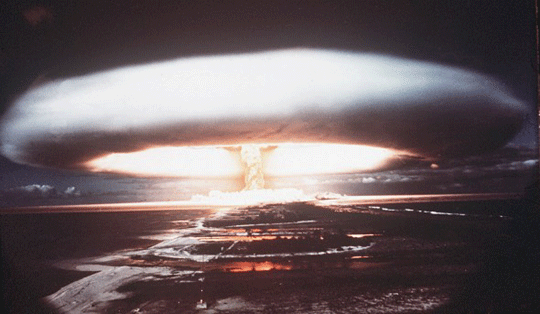
A New Zealand Labour Government in 1973 sent two warships, HMNZS Canterbury and HMNZS Otago, to monitor the Mururoa tests. It was not believed, at the time, that they may have received nuclear dusting but these new documents reveal there were much higher levels of radiation than were known.
A 1974 test, code named Centaur, dumped 500 times the maximum allowed level of plutonium fallout on Tahiti, 1250 kilometres away, the documents show.
There were also 140 more incidents of nuclear fallout above the 209 incidents already known. Tahiti, home to around 178,000 people, was hit 37 times by fallout. Continue reading
Radioactive fallout on Polynesia, from French atomic testing, far greater than they said
 French nuclear tests ‘showered vast area of Polynesia with radioactivity’ http://www.guardian.co.uk/world/2013/jul/03/french-nuclear-tests-polynesia-declassified Angelique Chrisafis in Paris The Guardian, Thursday 4 July 2013
Declassified papers show extent of plutonium fall-out from South Pacific tests of 60s and 70s was kept hidden, says French paper French nuclear tests in the South Pacific in the 1960s and 1970s were far more toxic than has been previously acknowledged and hit a vast swath of Polynesia with radioactive fallout, according to newly declassified ministry of defence documents which have angered veterans and civilians’ groups. Continue reading
Enewetak coral atoll transformed by US atomic bomb testing
Cactus Dome: A Concrete Cap for a Nuclear Crater http://www.slate.com/blogs/atlas_obscura/2013/06/25/the_cactus_dome_is_enormous_concrete_structure_built_over_a_nuclear_crater.html By Atlas Obscura , June 25, 2013, With its ring of verdant islands surrounding a deep sapphire lagoon, the Enewetak coral atoll was a beautiful place to launch the world’s first hydrogen bomb. After capturing the atoll from the Japanese during World War II, the U.S. evacuated the islands, exhumed its fallen soldiers to send them home for reburial, and conducted a series of nuclear tests.
Between 1948 and 1958, 43 weapons exploded over Enewetak. Among these was Ivy Mike, a world-first hydrogen bomb, 500 times bigger than Hiroshima’s Little Boy, that destroyed the entire island of Elugelab. By the time testing ceased, the entire atoll was highly radioactive, its reefs and islands dotted with craters that each measured several hundred feet in diameter. (Off the coast of Runnit what looks like a natural blue hole is the Lacrosse Crater, the results of an earlier fission test.)
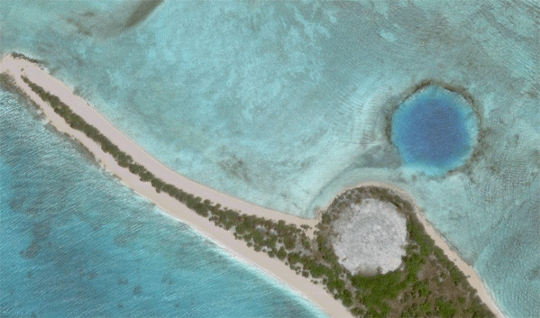
Evacuated residents began returning to Enewetak during the 1970s. It was at this time that the U.S. government determined it ought to decontaminate the islands. In 1979, a military team arrived to gather up contaminated soil and debris, mixing it with cement and piling the sludge into a 350-foot-wide blast crater on Runit Island in the atoll’s east. When the mound reached 25 feet high, army engineers covered it with a saucer-shaped concrete cap. It was dubbed the Cactus Dome, after the Cactus bomb that caused the crater.
The U.S. declared Enewetak safe for habitation in 1980. Currently, about 900 people live on the atoll though none live on the Cactus Dome. A 2008 field survey of the Cactus Dome noted that 219 of its 357 concrete panels contained defects such as cracks, chips, and vegetation taking root in joints.
Climate change on top of Marshall Islands’ nuclear disasters
 Pacific islands’ deadly threat from climate change http://www.washingtonpost.com/opinions/pacific-islands-face-a-deadly-threat-from-climate-change/2013/05/30/86ff1956-c7a9-11e2-9245-773c0123c027_story.html By Phillip Muller, May 30 2013 Phillip Muller is foreign minister of the Marshall Islands.
For almost 70 years, my country, the Marshall Islands, has been fighting for its survival. Unfortunately, the threats we face are the result of forces we cannot control.
From 1946 to 1958, we endured the horror of 67 atmospheric nuclear tests. The most powerful was the “Bravo shot,” equivalent in power to 1,000 Hiroshima bombs. Now our residents are confronted by a different kind of atmospheric danger: the existential threat posed by climate change.
After a prolonged and unseasonable droughtthat began late last year, the severe lack of drinking water in our northern atolls led my government to declare a disaster area on May 7. This humanitarian crisis is climate-induced. Continue reading
Continuing problems for the people of atomic bomb tested Marshall Islands
Complexity abounds in U.S.-Marshallese compact The City Wire , 03/26/2013 story and photos by Kim Souza
It’s been 57 years since the U.S. military performed nuclear missile testing within the Marshall Islands located in far South Pacific and situated roughly halfway between Australia and Hawaii.
The tiny island nation consists of 29 atolls and five small islands and is still economically dependent upon the $100 million it receives in U.S. aid annually. The financial reparations are part of the Compact of Free Association that was signed between the two nations in 1986 and an attempt to support and help the region recover from highly toxic levels of radiation that rendered four of the atolls uninhabitable even today. Continue reading
A criminal betrayal of Australian servicemen – British atomic bomb tests “down under”
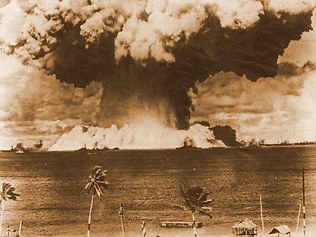 With the enthusiastic connivance of the Australian Government (more precisely, prime minister Robert Menzies, who bypassed his cabinet), the British detonated about a dozen nukes in our backyard. More than 8000 servicemen were involved in the tests and the measures for their safety were perfunctory at best and criminal at worst.
‘Death ash’ rains on betrayed men, Courier Mail Terry Sweetman , The Sunday Mail (Qld) February 24, 2013
ONE of the great ironies of history is that the Japanese fishing boat that took 23 men into the fiery breath of America’s first hydrogen bomb was called the Lucky Dragon No 5.
That was on March 1, 1954, which is ancient history to most Australians, but there is a tragic echo right here and right now.
Lucky Dragon was fishing off Bikini Atoll, outside the declared danger zone, when the Castle Bravo thermonuclear device was detonated.
Oops. The blast was about twice as powerful as the boffins had calculated and the Lucky Dragon was showered with radioactive dust, which the Japanese poetically called death ash.
Soon the fishermen began to suffer nausea, pain and skin inflammation and, in September, radio operator Kuboyama Aikichi died.
It was a shocking incident but more shocking was the initial cover-up and official disinformation. Continue reading
Little New Zealand stood up to nuclear bully USA
 Flashback: When David stood up to Goliath stuff.co New Zealand, 9 Feb 13, The Dominion Post, TOM HUNT ”,,,,,It may have soured our relationship with Washington and provided a dramatic end to a paradisiacal trip to Tokelau, but it certainly set Lange up as New Zealand’s David versus America’s Goliath.
 February 4, 1985 was the day the New Zealand Government backed overwhelming public anti-nuclear sentiment and effectively became officially nuclear free – even if legislation was still two years away.
”I felt so proud,” long-standing anti-nuclear protester Barney Richards said this week.
”We stood up against the most powerful nation in the world. And we had a major victory.”
He remembers a reporter travelling all the way from Britain ”to see for himself the little country that snubbed its nose to the world”. Continue reading
Toxic nuclear waste dumps in the Arctic Kara Sea
Russia explores old nuclear waste dumps in Arctic By Laurence Peter BBC News, 24 Jan 13, The toxic legacy of the Cold War lives on in Russia’s Arctic, where the Soviet military dumped many tonnes of radioactive hardware at sea.
For more than a decade, Western governments have been helping Russia to remove nuclear fuel from decommissioned submarines docked in the Kola Peninsula – the region closest to Scandinavia.
But further east lies an intact nuclear submarine at the bottom of the Kara Sea, and its highly enriched uranium fuel is a potential time bomb.
This year the Russian authorities want to see if the K-27 sub can be safely raised, so that the uranium – sealed inside the reactors – can be removed.
They also plan to survey numerous other nuclear dumps in the Kara Sea, where Russia’s energy giant Rosneft and its US partner Exxon Mobil are now exploring for oil and gas.Seismic tests have been done and drilling of exploratory wells is likely to begin next year, so Russia does not want any radiation hazard to overshadow that. Rosneft estimates the offshore fossil fuel reserves to be about 21.5bn tonnes.
‘Strategic imperative’
The Kara Sea region is remote, sparsely populated and bitterly cold, frozen over for much of the year. The hostile climate would make cleaning up a big oil spill hugely challenging, environmentalists say.

Those fears were heightened recently by the Kulluk accident – a Shell oil rig that ran aground in Alaska…….. “In the US the Arctic gets great public scrutiny and it’s highly political, but in Russia there is less public pressure.” Continue reading
Costly expense of maintaining Philippines non-operational nuclear power plant
Nuclear plant gets funds By Amy R. Remo Philippine Daily Inquirer,
http://business.inquirer.net/101475/nuclear-plant-gets-funds January
6th, 2013 MANILA, Philippines—State-run National Power Corp. has
secured lawmakers’ nod to allocate P50 million this year for the
upkeep of the mothballed 630-megawatt Bataan Nuclear Power Plant
(BNPP).
In an interview with the Inquirer, Napocor president Froilan A.
Tampinco said that both houses of Congress as well as the Department
of Budget and Management (DBM) had agreed to reinstate the proposed
budget for the maintenance of the country’s first and only nuclear
facility.
Tampinco said that with sufficient explanation, Napocor was able to
convince Congress of the necessity of such an allocation for a
government asset that has remained idle for decades, yet one that the
Department of Energy said cannot be neglected.
The BNPP was built during the Marcos era by Westinghouse Electric at a
cost of $2.2 billion. It was mothballed in 1986 due to safety
concerns, even before it could begin operations.
1 This Month


10 March A LIVE WEBINAR THE REAL EFFECTS OF NUCLEAR POWER
What the Industry Isn’t Telling Us
1:00 PM Mountain, 2 pm Central, 3 pm Eastern. Live on the Keepers of the Water Facebook page


18 March Webinar @ 1 PM EST: An Assessment of SMR Projects: The Case of Canada
register for the zoom:
https://us02web.zoom.us/webinar/register/WN_o8BIIOUvQ2ONJR1nta65DQ#/registration


of the week – STOP SMALL MODULAR REACTORS IN CANADA
To see nuclear-related stories in greater depth and intensity – go to https://nuclearinformation.wordpress.com
-
Archives
- March 2026 (62)
- February 2026 (268)
- January 2026 (308)
- December 2025 (358)
- November 2025 (359)
- October 2025 (376)
- September 2025 (258)
- August 2025 (319)
- July 2025 (230)
- June 2025 (348)
- May 2025 (261)
- April 2025 (305)
-
Categories
- 1
- 1 NUCLEAR ISSUES
- business and costs
- climate change
- culture and arts
- ENERGY
- environment
- health
- history
- indigenous issues
- Legal
- marketing of nuclear
- media
- opposition to nuclear
- PERSONAL STORIES
- politics
- politics international
- Religion and ethics
- safety
- secrets,lies and civil liberties
- spinbuster
- technology
- Uranium
- wastes
- weapons and war
- Women
- 2 WORLD
- ACTION
- AFRICA
- Atrocities
- AUSTRALIA
- Christina's notes
- Christina's themes
- culture and arts
- Events
- Fuk 2022
- Fuk 2023
- Fukushima 2017
- Fukushima 2018
- fukushima 2019
- Fukushima 2020
- Fukushima 2021
- general
- global warming
- Humour (God we need it)
- Nuclear
- RARE EARTHS
- Reference
- resources – print
- Resources -audiovicual
- Weekly Newsletter
- World
- World Nuclear
- YouTube
-
RSS
Entries RSS
Comments RSS
 nuclear-news