Nuclear power – simply unaffordable for the Philippines
|
DOE to submit ‘nuclear power plan’ to Duterte this December, Manila Bulletin, November 6, 2020, by Myrna M. Velasco” For BNPP’s repowering, Duterte previously instructed the energy department to also undertake a study on that proposal; and to assess the cost impact that will have on consumers’ pockets.
But on that particular sphere, Senate Committee on Energy Chairman Sherwin T. Gatchalian sounded off cynicism on claims that electricity rates in the Philippines will go down with the proposed repowering of the mothballed 620-megawatt BNPP project. “It’s not true that prices are lower because of the layers of technology that shall be integrated into the nuclear power facility to ensure its safe operations,” he claimed. Gatchalian noted that in Vietnam’s case, that country shelved its planned nuclear power development after determining that the resulting power price will just be comparable with other electric generating facilities — and yet there’s great degree of risk that they have to manage on the safety aspect of technology deployment. ………In the Philippines, the propounded revival of BNPP’s operations had been hurdled by concerns of ‘social acceptance’ in the many years that already passed; and there are also questions on where to source the US$1.0 billion to US$2.0 billion funding for BNPP’s rehabilitation.The other major issue is which entity shall be designated to operate the plant, since the Electric Power Industry Reform Act (EPIRA) already prohibits state-run National Power Corporation (NPC) from engaging into operation or investments in power generation… |
Now climate change, rising seas, swamping Kiribati and the Marshall Islands, victims of nuclear racism
Losing paradise, Atomic racism decimated Kiribati and the Marshall Islands; now climate change is sinking them, Beyond Nuclear https://wordpress.com/read/feeds/72759838/posts/2998141589–1 Nov 20, This is an extract from the Don’t Bank on the Bomb Scotland report “Nuclear Weapons, the Climate and Our Environment”.
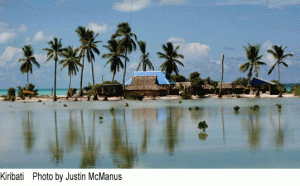 Kiribati. In 1954, the government of Winston Churchill decided that the UK needed to develop a hydrogen bomb (a more sophisticated and destructive type of nuclear weapon). The US and Russia had already developed an H-bomb and Churchill argued that the UK “could not expect to maintain our influence as a world power unless we possessed the most up-to-date nuclear weapons”.
The governments of Australia and New Zealand refused to allow a hydrogen bomb test to be conducted on their territories so the British government searched for an alternative site. Kiritimati Island and Malden Island in the British Gilbert and Ellice Islands Colony in the central Pacific Ocean (now the Republic of Kiribati) were chosen. Nine nuclear weapons tests – including the first hydrogen bomb tests – were carried out there as part of “Operation Grapple” between 1957 and 1958.
Military personnel from the UK, New Zealand and Fiji (then a British colony) and Gilbertese labourers were brought in to work on the operation. Many of the service personnel were ordered to witness the tests in the open, on beaches or on the decks of ships, and were simply told to turn their backs and shut their eyes when the bombs were detonated. There is evidence that Fijian forces were given more dangerous tasks than their British counterparts, putting them at greater risk from radiation exposure. The local Gilbertese were relocated and evacuated to British naval vessels during some of the tests but many were exposed to fallout, along with naval personnel and soldiers.
After Grapple X, the UK’s first megaton hydrogen bomb test in November 1957, dead fish washed ashore and “birds were observed to have their feathers burnt off, to the extent that they could not fly”. The larger Grapple Y test in 1958 spread fallout over Kiritimati Island and destroyed large areas of vegetation.
Despite evidence that military personnel and local people suffered serious health problems as a result of the tests, including blindness, cancers, leukaemia and reproductive difficulties, the British government has consistently denied that they were exposed to dangerous levels of radiation and has resisted claims for compensation.
Like the Marshall Islands, the low-lying Republic of Kiribati is now bearing the brunt of the effects of climate change. Salt water washed in on king tides has contaminated the islands’ scarce freshwater resources. Pits that are used to grow taro plants have been ruined and the healthy subsistence lifestyle of local people is under threat.
It is predicted that rising sea levels will further impact freshwater resources and reduce the amount of agricultural land, while storm damage and erosion will increase. Much of the land will ultimately be submerged. In anticipation of the need to relocate its entire population, the government of Kiribati bought 20km2 of land on Fiji in 2014.
The UK is set to spend £3.4 billion a year on Trident nuclear weapons system between 2019 and 2070. If Trident were scrapped, a portion of the savings could be provide to the Republic of Kiribati in the form of climate finance (see section 1.2.1). Scrapping Trident would also allow money and skills to be redirected towards measures aimed at drastically cutting the UK’s carbon emissions (see section 1.2.2) – action that Pacific island nations are urgently demanding.
The Marshall Islands. The most devasting incident of radioactive contamination took place 8,000 km from the US mainland during the Castle Bravo test in 1954. The US detonated the largest nuclear weapon in its history at Bikini Atoll in the Marshall Islands, causing fallout to spread over an area of more than 11,000km. Residents of nearby atolls, Rongelap and Utirik, were exposed to high levels of radiation, suffering burns, radiation sickness, skin lesions and hair loss as a result.

Castle Bravo was just one of 67 nuclear weapons tests conducted by the US in the Marshall Islands between 1946 and 1958. Forty years after the tests, the cervical cancer mortality rate for women of the Marshall Islands was found to be 60 times greater than the rate for women in the US mainland, while breast and lung cancer rates were five and three times greater respectively. High rates of infant mortality have also been found in the Marshall Islands and a legacy of birth defects and infertility has been documented. Many Marshallese were relocated by the US to make way for the testing.
Some were moved to Rongelap Atoll and relocated yet again after the fallout from Castle Bravo left the area uninhabitable.
Rongelap Atoll was resettled in 1957 after the US government declared that the area was safe. However, many of those who returned developed serious health conditions and the entire population was evacuated by Greenpeace in 1984. An attempt to resettle Bikini Atoll was similarly abandoned in 1978 after it became clear that the area was still unsafe for human habitation.
A 2019 peer-reviewed study found levels of the radioactive isotope caesium-137 in fruits taken from some parts of Bikini and Rongelap to be significantly higher than levels recorded at the sites of the world’s worst nuclear accidents, Chernobyl and Fukushima.
Compounding the injustice of nuclear weapons testing, the Republic of the Marshall Islands is now on the frontline of the climate emergency. The government declared a national climate crisis in 2019, citing the nation’s extreme vulnerability to rising sea levels and the “implications for the security, human rights and wellbeing of the Marshallese people”.
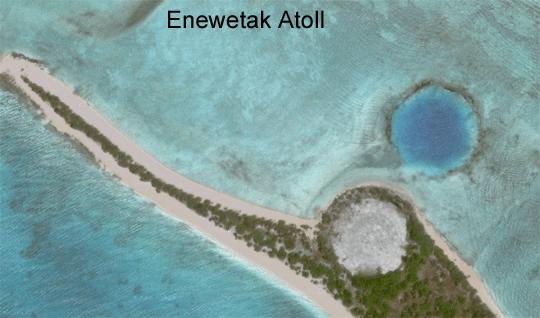
At Runit Island, one of 40 islands in the Enewetak Atoll, rising sea levels are threatening to release radioactive materials into an already contaminated lagoon. In the late 1970s, the US army dumped 90,000 cubic metres of radioactive waste, including plutonium, into a nuclear blast crater and covered it with a concrete cap. Radioactive materials are leaking out of the crater and cracks have appeared on the concrete cap. Encroaching salt water caused by rising sea levels could collapse the structure altogether. The Marshallese government has asked the US for help to prevent an environmental catastrophe but the US maintains that the dome is the Marshall Islands’ responsibility. Hilda Heine, then President of the Republic of the Marshall Islands, said of the dome in 2019: “We don’t want it. We didn’t build it. The garbage inside is not ours. It’s theirs.”
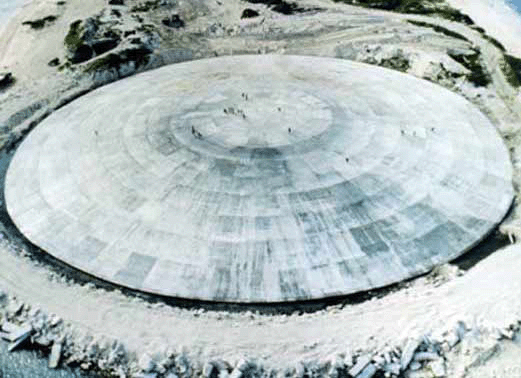
The Runit Island dome offers a stark illustration of the ways in which the injustices of nuclear weapons testing and climate change overlap. Marshall Islanders were left with the toxic legacy of nuclear weapons testing conducted on their territory by another state. The country is now being forced to deal with the effects of a climate crisis that they did not create, including the erosion of the Runit dome.
The nations that contributed most to the crisis are failing to cut their emissions quickly enough to limit further global heating, leaving the Marshallese at the mercy of droughts, cyclones and rising seas. A recent study found that if current rates of greenhouse gas emissions are maintained, the Marshall Islands will be flooded with sea water annually from 2050. The resulting damage to infrastructure and contamination of freshwater supplies will render the islands uninhabitable.
If the US scrapped its nuclear weapons programme, it could give a portion of the billions of dollars that would be saved to the Republic of the Marshall Islands to help the country mitigate and adapt to climate disruption (see section 1.2.1 on international climate finance). The US could also use the freed-up funds to invest in its own Just Transition away from a fossil-fuel powered economy. Read the full report.
A bit of good news – Chameleon last seen a century ago rediscovered in Madagascar
|
Chameleon last seen a century ago rediscovered in Madagascar https://www.theguardian.com/environment/2020/oct/30/voeltzkow-chameleon-rediscovered-madagascar
Scientists find several living specimens of Voeltzkow’s chameleon during expedition Scientists have found an elusive chameleon species that was last spotted in Madagascar 100 years ago.Researchers from Madagascar and Germany said on Friday they had discovered several living specimens of Voeltzkow’s chameleon during an expedition to the north-west of the African island nation. In a report published in the journal Salamandra, the team, led by scientists from the Bavarian State Collection of Zoology (ZSM), said genetic analysis determined that the species was closely related to Labord’s chameleon. Researchers believe that both reptiles only live during the rainy season – hatching from eggs, growing rapidly, sparring with rivals, mating and then dying during a few short months. “These animals are basically the mayflies among vertebrae,” said Frank Glaw, the curator of reptiles and amphibians at the ZSM. Researchers said the female of the species, which had never previously been documented, displayed particularly colourful patterns during pregnancy, when encountering males and when stressed. The scientist say the Voeltzkow’s chameleons’ habitat is under threat from deforestation. |
|
Pacific islands demand truth on the decades of nuclear testing, now that nuclear weapons are becoming illegal
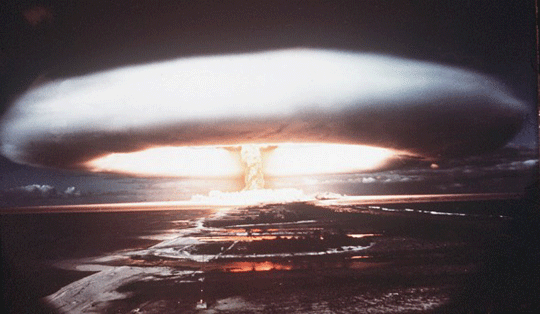
Guardian 25th Oct 2020, Now that nuclear weapons are illegal, the Pacific demands truth on decades of testing. Nuclear weapons will soon be illegal. Just over 75 years since their devastation was first unleashed on the world, the global community has rallied to bring into force a ban through the Treaty on the Prohibition of Nuclear Weapons.
Late on Saturday night in New York, the 50th country – the central American nation of Honduras – ratified the treaty. It will become international law in 90 days. For many across the Pacific region, this is a momentous achievement and one that has been long called
for. Over the second half of the 20th century 315 nuclear weapons tests were conducted by so-called “friendly” or colonising forces in the Marshall Islands, Kiribati, Australia and Maohi Nui (French Polynesia).
The United States, Britain and France used largely colonised lands to testtheir nuclear weapons, leaving behind not only harmful physical legacies but psychological and political scars as well. Survivors of these tests and their descendants have continued to raise their voices against these weapons. They are vocal resisters and educators, the reluctant but intense knowledge holders of the nuclear reality of our region.
Tuvalu – the 47th nation to ratify the Treaty on the Prohibition of Nuclear Weapons


|
|
Tuvalu ratifies the Treaty on the Prohibition of Nuclear Weapons, https://www.rnz.co.nz/international/pacific-news/428354/tuvalu-ratifies-the-treaty-on-the-prohibition-of-nuclear-weapons
7:20 pm on 14 October 2020 Tuvalu has ratified the Treaty on the Prohibition of Nuclear Weapons, bringing it closer to being in force.
Tuvalu was the 47th nation to make the move, meaning only three more ratifications are needed to empower the treaty. The treaty establishes a comprehensive ban on the weapons of mass destruction and aims to help pave the way to their elimination. Earlier this month, Tuvalu and 11 other Pacific small island developing states delivered a joint statement to the UN on the occasion of the International Day for the Total Elimination of Nuclear Weapons. They noted their region has suffered from the effects of decades of nuclear testing by the United States, the United Kingdom and France.
The 12 nations appealed to all nations that have not yet done so to ratify the Treaty on the Prohibition of Nuclear Weapons, as well as the Comprehensive Nuclear-Test-Ban Treaty of 1996. “We Pacific small island developing states say no to nuclear weapons, and we reiterate our commitment to the elimination of nuclear weapons everywhere.” Tuvalu is the ninth Pacific island nation to join the nuclear weapon ban treaty so far, following Palau, New Zealand, the Cook Islands, Samoa, Vanuatu, Kiribati, Fiji and Niue. Nauru has signed but not yet ratified the treaty.
|
|
Pacific Island Nations determined to say NO to nuclear weapons, and support UN Treaty Ban

|
Pacific will continue to say no to nuclear weapons, UN told, https://www.rnz.co.nz/international/pacific-news/427663/pacific-will-continue-to-say-no-to-nuclear-weapons-un-told 5 Oct 20, Marking International Day Against Nuclear Explosions last weekend, the island nations agreed they had all suffered the effects of nuclear testing in the region.Presenting a joint statement from 12 Pacific countries to the United Nations General Assembly, Fiji’s Prime Minister said more than 300 nuclear tests were carried out in the Pacific from 1946 to 1996 – in the atmosphere, underground and underwater.
Frank Bainimarama told the online event communities living close to ‘ground zero’ were relocated from their ancestral homes and restricted from using the ocean resources for their livelihoods. Mr Bainimarama says those impacted also faced an increase in related health problems. “At the end of these nuclear tests, radioactive waste and machinery were either buried or dumped into the Pacific Ocean. Today, we still do not know the full impact of these nuclear tests on our environment and communities,” Frank Bainimarama said. Bainimarama said Pacific islanders considered themselves the custodians of the vast blue Pacific Ocean. “The Pacific Ocean defines who we are; it serves as the foundation of our economies, our environment, and the well-being of our communities,” he said. “We have a vision that the blue Pacific Ocean will become an ocean of peace and prosperity for our people and the world.” Bainimarama said protecting the blue Pacific continent was of paramount importance to the islanders’ future. He said it could only become an ocean of peace if it was nuclear-free. He said stopping the development of nuclear weapons and eliminating them altogether would free up much-needed global resources to assist vulnerable communities, and those around the world, in fighting the effects of climate change. “The world does not need nuclear weapons,” Bainimarama said. The challenges of nuclear disarmament can only be resolved by a strengthened multilateral system that sets the conditions for transparency, confidence-building, and co-operation.” The Fijian leader said the Treaty on the Non-Proliferation of Nuclear Weapons (NPT), the Comprehensive Nuclear Test Ban Treaty (CTBT) and the Treaty on the Prohibition of Nuclear Weapons (TPNW) were crucial if Pacific islands, which he refers to as PSIDS, were to further reduce and eliminate nuclear weapons. “Today, we PSIDS say no to nuclear weapons and we reiterate our commitment to the elimination of nuclear weapons everywhere,” Bainimarama said. “We encourage member states to ratify the Comprehensive Nuclear Test Ban Treaty (CTBT) and the Treaty on the Prohibition of Nuclear Weapons (TPNW). “It is morally right, and we owe it to ourselves and our future generations.” The Fijian leader presented a joint statement to the UN Assembly from the PSIDS’ members including the Federated States of Micronesia (FSM), Fiji, Kiribati, Nauru, Palau, Papua New Guinea, Marshall Islands, Samoa, Solomon Islands, Tonga, Tuvalu and Vanuatu. Bainimarama said their statement was also aligned with the message sent by the Tuvalu Mission at the UN on behalf of the Pacific Islands Forum. The online event was hosted by UN President Tijjani Muhammad-Bande from Nigeria. |
|
Cost and safety dangers should rule out nuclear power for the Philippines
A report this year placed the cost of reviving the BNPP, as estimated by a foreign group, at $3 billion to $4 billion. Reviving it will go against a trend in other countries to reduce nuclear power in their energy mix, because of safety concerns in the power plants as well as the risks posed by nuclear waste, which remains radioactive and cannot be destroyed or recycled……..
Like Japan, the Philippines sits along the Pacific Ring of Fire. Before the start of this year’s pandemic, Taal Volcano’s powerful phreatic explosion emptied surrounding communities, displaced thousands and blanketed towns and cities all the way to Metro Manila with toxic, suffocating ash. Earthquakes and aftershocks continue to be recorded in Taal, with seismologists warning of the possibility of a cataclysmic eruption.
If the BNPP is revived, at great cost to a cash-strapped government, what happens if Mount Natib also acts up, or if an earthquake hits Bataan? If all the proponents of nuclear energy will live together with their immediate families near the BNPP – and not just for show, buying a house nearby while the kids live in an exclusive village far from harm’s way – then by all means, go ahead with the project. https://www.philstar.com/opinion/2020/10/03/2046802/editorial-going-nuclear
Marshall Islands in danger of being overcome by rising sea levels
Star of the day: David Kabua, President of the Marshall Islands, believes his territory will disappear under rising sea levels, https://pledgetimes.com/star-of-the-day-david-kabua-president-of-the-marshall-islands-believes-his-territory-will-disappear-under-rising-sea-levels/ by Bhavi Mandalia, September 22, 2020 The Marshall Islands facing rising waters. (HILARY HOSIA / AFP)
David Kabua, 71, president for nine months of the Marschall Islands is worried. This small confetti of land lost in the Pacific Ocean, 180 km², perched just two meters from sea level, is threatened by rising waters. There is not much on the 30 atolls that make up the archipelago, nothing to covet, nothing to export, no natural resources, only small farms, fishing boats and a huge radioactive waste storage site. , memory of the American nuclear tests of the 1960s.
This little piece of land, so coveted during the wars for its strategic location, no longer has any leverage to attract attention. And yet, it will soon no longer appear on the world maps. This is the warning cry launched by David Kabua on Monday September 21 at the UN, a simple cry: “My country will disappear if the world does not keep its promises, those made during the Paris agreement.” He recounted the impact of climate change, the increasingly devastating tides, population evacuations, the intense droughts which generate another plague: swarms of mosquitoes carrying various diseases. And then there is the money that is lacking to build the necessary infrastructure to protect its 75,000 inhabitants. Money promised five years ago, and which does not arrive. Finally, there is worse:“The fact, he said, that industrialized countries continue to finance fossil fuels, oil, gas and coal. We are doing our part, but alone we can do nothing. “
David Kabua addresses the United Nations. The UN that the Marschall Islands joined in 1991 but that they could well leave, in fact, not voluntarily, but by force of circumstances, because the atolls will end up submerged. So he concluded by asking: “Will we still be here for the UN’s 100th anniversary in 2045? How about you? Are you going to help us keep our islands in this world?” In the assembly, the question created a long silence. David Kabua, for his part, has nothing more to give than a warning, a prophecy for all. We know. But we look elsewhere. Hope does exist, however, it is in the motto of the Marschall Islands: “Achievement through joint effort“. And we have 25 years ahead of us.
Duterte asks nations to reject war, eliminate nuclear weapons
Duterte asks nations to reject war, eliminate nuclear weapons, Darryl John Esguerra – Reporter / @DJEsguerraINQ
No goals, however lofty, can justify weapons that destroy with such unforgiving brutality,” Duterte said.
The video, which also featured messages by other world leaders, was originally posted on YouTube by the City of Hiroshima to commemorate the 75th anniversary of the atomic bombing last Aug. 6, which was followed by the bombing of Nagasaki on Aug. 9.
“We must not forget: Nuclear weapons will not make us freer, stronger, or more secure. We must not waver. All nations should reject war and do everything to pave the path for peace. We must be firm. All nations must work together to eliminate nuclear weapons,” Duterte said……….Other world leaders in the video were World Health Organization Director-General Tedros Ghebreyesus, Belgium Foreign Affairs and Defense Minister Philippe Goffin, and Lithuanian President Gitanas Nauseda. https://globalnation.inquirer.net/190853/on-75th-anniv-of-hiroshima-bombing-duterte-asks-nations-to-reject-war-eliminate-nuclear-weapons
Philippines wary of nuclear power: costs to be borne by tax-payer
|
Ahmed said that of the top 10 major nuclear developments in the world, most of them were 10 to 15 years behind schedule, “and they are double or triple the original investment and the cost to consumers are prohibitively expensive without a lock-in subsidy.” |
|

The lingering human suffering after nuclear testing in Australia and Oceania
Death in paradise: the aftermath of nuclear testing in Australia and Oceania https://diem25.org/death-paradise-the-aftermath-nuclear-testing-australia-and-oceania/ 10/08/2020 by Aleksandar Novaković The United States of America is the first nuclear power — and the only one to have used its weapons for a military purpose. During World War 2 in 1945, two Japanese cities were bombed by US nuclear bombs (Hiroshima on August 6th and Nagasaki August 9th ). The devastating result was approximately 225,000 people either dead or wounded. The number of deaths in Hiroshima and Nagasaki due to exposure to lethal radiation is still being discussed, but it is certainly in the thousands.
However, even though nuclear weapons were never used again for military purposes, nuclear testing took (and continues to take) a toll on thousands of lives in Australia and Oceania.
The United States conducted about 1,054 nuclear tests from 1945 to 1992, and 105 of them (1945-1962) were made at Pacific Test Sites (Marshall Islands, Kiribati) causing the contamination of huge areas controlled by US troops. In the Pacific, this caused rising numbers of cancer and birth defects, especially on the Marshall Islands where 67 tests were made and many Marshallese were forced to leave their homes in contaminated areas.
European nuclear powers, such as France and the UK, have also “contributed” to the deaths of thousands.
France has made over 193 nuclear tests in the Pacific between 1960 and 1996, mostly on Mururoa and Fangataufa atolls that belong to French Polynesia, as well as 17 tests in Algerian Sahara. Tahiti, the most populated island of French Polynesia, was exposed to 500 times the maximum accepted levels of radiation. The impact has spread as far as to the tourist island of Bora Bora.
Civilians and the military participating in nuclear tests (more than 100,000 of them) have experienced diarrhea, skin injuries, blindness, and cancer. Their children have additionally suffered from birth defects.
From 1953 to 1963, there were over 20 bigger and smaller British A- bomb tests in Emu Farm, and the Maralinga and Montebello Islands of Australia. Overall, over 1200 peoples were exposed to radiation in the country, most of them Anangu people living in the Maralinga area. The UK has also made nuclear tests on overseas territories such as the Malden Islands and Christmas Island ( the present Republic of Kiribati).
So, what was done by the governments of the US, UK, Australia and France to help those who have suffered from radiation related illnesses, or those who lost their loved ones?
There are two answers. One is that loss of loved ones, of the way you live your life, of the nature that surrounds you, the loss of home cannot be repaid or replaced with anything else. The other is that aforementioned governments did little.
The US has awarded more than $63 million to Marshallese with radiogenic illnesses despite the fact that the Tribunal only has $45.75 million to award for both health and land claims. France is still avoiding paying reparations to Tahitians.
As for the “joint venture” of the UK and Australia, the truth is that tests were approved and conducted in the first place because British officials were misinforming Australians. The Maralinga Tjarutja (Council) of Anangu people has a compensation settlement with the Australian government, and they are receiving $13.5 million.
75 years after Hiroshima and Nagasaki, we must ask ourselves: Why are we so callous about many “Hiroshimas” and “Nagasakis” that happened over the following decades? Did we let them happen just because they took place in far-off islands in the Pacific or in the Australian desert?
The only way to deal with these existing and future horrors that can eradicate life on Earth is to heal these existing wounds.
This means that the governments of the US, UK, France and Australia must pay just reparations to the affected countries and regions. Progressives of the world must act united against the threat of nuclear holocaust and create a political climate in which it would be possible to take action on an international level in order to ban the production, storage and use of nuclear weapons.
This can be done if nuclear powers, followed by all member states, sign the United Nation’s Treaty on the Prohibition of Nuclear Weapons.
Aleksandar Novaković is a historian and dramatist. He is a member of DSC Belgrade 1 and the thematic DSC Peace and International Policy 1
Glaciers in New Zealand – extreme melting due to global heating

|
Human-induced climate change is causing ‘extreme’ melting in New Zealand glaciers, The study is only the second to draw a direct link between glacier melt and human-induced climate change. SBS NEWS 4 AUG 20 BY BIWA KWAN New analysis of data and photo records of melting glaciers in New Zealand has found human-induced climate change increased the likelihood of mass ice melt. The new modelling techniques were applied to 10 glaciers in New Zealand to reveal a more detailed picture of what is driving the accelerating rates of ice melt in the region. Lead researcher Lauren Vargo said the analysis compared ice melt under pre-industrial greenhouse gas emissions and current-day emissions to uncover “a quite extreme result”. “Some of the glaciers were at least six times more likely to have experienced that high mass loss because of humans,” said Dr Vargo, who is based at the Victoria University of Wellington. “We’re really confident with that number because that is the low end. The high end is 350 times more likely. “But with the high ice mass loss event we saw [in 2018], it would not have happened at all without humans.” The first study to make a direct link between human-induced climate change and glacier melt focused on glaciers in the Northern Hemisphere where more robust data records exist. The study – published in the journal Science in 2014 – looked at records between 1851 and 2010 using a running mean over 20-year periods. Dr Vargo said the rate of ice melt has resulted in the loss of a quarter of New Zealand’s glaciers since the 1970s. Rapid melt events in 2011 and 2018 prompted the study. …… The study accounted for years like 2013 when some glaciers in New Zealand actually gained mass, but not at a rate to combat the overall decline. ……. HTTPS://WWW.SBS.COM.AU/NEWS/HUMAN-INDUCED-CLIMATE-CHANGE-IS-CAUSING-EXTREME-MELTING-IN-NEW-ZEALAND-GLACIERS |
|
Marshall Islands leaders hope for better help over radioactively polluted weapons tests sites
This week leaders of four nuclear test-affected atolls spoke of the building movement movement to issues surrounding the actions of the US from 1946 to 1958.
Elected leaders from Bikini and Enewetak, the ground zeroes for 67 nuclear weapons tests, and Rongelap and Utrok, two atolls heavily contaminated with radioactive fallout from the 1954 Bravo hydrogen bomb test, described separate meetings in the past few days with US Ambassador to the Marshall Islands, Roxanne Cabral, and Marshall Islands President, David Kabua, as “productive and positive.”
The push for action on compensation, health care and cleanups of radioactive islands comes against the backdrop of negotiations between the Marshall Islands and US governments to extend expiring grant funding in a Compact of Free Association.
Island leaders said nuclear test legacy issues had languished for years and they wanted the Marshall Islands to pursue them during the upcoming talks.
It was preferred that a solution was found that benefitted both the Marshall Islands and the United States…….
US-provided compensation fell far short of funds needed to meet compensation awards for this nuclear test-affected nation……
Utrok Mayor Tobin Kaiko said he personally, as well as other nuclear test-affected islanders, continued living with health problems caused by exposure to radioactive fallout.
He said their suffering had been exacerbated by US authorities consistently downplaying the hazards of radiation and the potential for health problems among affected islanders………. https://www.rnz.co.nz/international/pacific-news/422407/nuclear-affected-atolls-in-marshalls-see-promise-in-us-talks
U.S. Rep. Tulsi Gabbard refutes the claim that Marshall Islands nuclear waste site is safe
|
Gabbard dismisses US claim that Marshall Islands nuclear waste site is safe https://www.westhawaiitoday.com/2020/07/28/nation-world-news/gabbard-dismisses-us-claim-that-marshall-islands-nuclear-waste-site-is-safe/
By Susanne Rust Los Angeles Times | Tuesday, July 28, 2020 One of Hawaii’s high-profile politicians has dismissed a recent Department of Energy report concluding that a leaking U.S. nuclear waste repository in the Marshall Islands is safe for people there.
She called for the department to convene a more independent assessment of the waste site. “I think it’s time the Department of Energy relied on someone with fresh eyes to examine the situation,” said U.S. Rep. Tulsi Gabbard, one of Hawaii’s two Democratic House members, in a recent interview with the Los Angeles Times. Gabbard, who gained national attention by launching what some called a quixotic campaign for the Democratic presidential nomination, has been outspoken in Congress on behalf of the Marshall Islands, which the United States used as a testing site for scores of nuclear weapons during the Cold War. She’s pushed to reinstate Medicaid eligibility to people from the Marshall Islands, Micronesia and Palau who are working and living in the United States but lack access to healthcare. She also was instrumental in requiring the Department of Energy to reexamine the safety of Runit Dome, a leaking nuclear waste repository in the Marshall Islands, as part of the 2019 National Defense Authorization Act. “The U.S. government is responsible for this storage site and must ensure the protection of the people and our environment from the toxic waste stored there,” Gabbard said in a news release announcing her amendment to the defense bill. In calling for “fresh eyes” on the waste site, Gabbard was referring to Terry Hamilton, who has been the Energy Department’s go-to contractor for nuclear issues in the Marshall Islands since 1990. Hamilton was a contributor to the Department of Energy report, which concluded that while sea level rise could increase storm surge and “lead to wave-induced over-wash of lower sections of the dome,” there is not enough definitive data to determine “how these events might impact on the environment.” Neither Hamilton nor his employer, the Lawrence Livermore National Laboratory, responded to a request for comment. But in an earlier email, Hamilton said the risk posed by the waste site is low “based on the argument that the total amount of fallout contamination contained in Runit Dome is dwarfed by residual amounts of fallout contamination deposited in marine sediments inside Enewetak lagoon.” He added that, though he did not write the document, he provided the “reports, publications and data” that informed the Energy Department’s conclusions. Published at the start of July, the assessment referenced 27 papers and reports, 25 of which were not peer-reviewed, including 13 by Hamilton. All were published by agencies within the U.S. government. The lack of independent review frustrated both Gabbard and some Marshallese leaders. “The Department of Energy is well aware of the public mistrust for their research in the Marshall Islands, but they have never demonstrated any interest in doing anything about it, i.e. including independent scientists in their studies or consulting with Marshallese communities for their knowledge on the environment,” Rhea Christian-Moss wrote in an email to The Times. “I’m not sure credibility is their goal,” she said. Runit Dome, located in the Marshall Island’s Enewetak Atoll, holds more than 3.1 million cubic feet — or 35 Olympic-sized swimming pools — of U.S.-produced radioactive soil and debris, including lethal amounts of plutonium, produced by 67 bomb tests between 1946 and 1958. Spurred by “moral obligation,” the U.S. government cleaned the atoll of irradiated debris and soil before handing the islands back to the Marshallese, in 1980. The Marshallese had been involuntarily removed during the 1940s. The waste — metal and concrete debris, as well as irradiated topsoil — were dumped in an atomic bomb crater on Runit Island, and capped with concrete. Last year, Hamilton told a small audience of Marshallese and American politicians and regulators that the dome was probably leaking, and that it was vulnerable to rising sea levels and increased storm surge. Congress, in its approval of last year’s defense bill, ordered the Energy Department to provide a written report on the risks that Runit Dome poses to the people, environment and wildlife of Enewetak lagoon. In addition, the report required an assessment of how climate change could affect the site. “I think they’d be reacting very differently if it was in their backyard,” she said of the report’s authors. Gabbard said she would continue to press the issue with the Energy Department “and try to get answers that were not addressed in this report.” Although outspoken on the Marshall Islands and the U.S. radiation legacy there, Gabbard has often been publicly alone on the issue. Other key Democrats, including Sens. Mazie Hirono of Hawaii and Jack Reed of Rhode Island, ranking member of the Armed Services Committee, declined to comment for this story. |
|
Scepticism over USA Dept Energy report that the Runit nuclear waste dome is “safe”
The new report does not include a plan to repair the dome, which was required by Congress.
In 1981, the U.S. government declared in a report that the island should be quarantined indefinitely and that the “possibility would always exist that high levels of plutonium-contaminated subsurface soil could be exposed by wave or storm action.”
The DOE report found that Runit Dome, a repository for atomic waste the United States produced during Cold War weapons testing, is sound and that radioactive leakage into the nearby lagoon is not significant.
After Congress grew concerned last year about the leaking dome, it ordered the DOE to produce a report on the dome’s structural integrity amid climate change and rising sea levels.
The report noted that while sea level rise could increase storm surge, swells, and “lead to wave-induced over-wash of lower sections of the dome,” there is not enough definitive data to determine “how these events might impact on the environment.”
One Marshallese leader was disappointed the DOE again downplayed the risks and declined to take responsibility for Runit Dome and its leaking contents.
“We don’t expect the Enewetak community to feel any safer based on this report as it doesn’t contain any new information from what they’ve seen…and don’t trust,” said Rhea Christian-Moss, the chairperson of the Marshall Islands’ National Nuclear Commission, a government-operated nuclear waste and radiation oversight panel.
“The report offers nothing new and is more or less what we expected to see,” she said, lamenting the Senate’s redaction of a critical line in the House’s mandate, which stipulated that the Department of Energy provide a plan detailing the removal of the radioactive waste into a “safer and more stable location.”
The Department of Energy report is signed by Dan Brouillette, the agency’s secretary. Terry Hamilton, the department’s lead contractor on the project, was not available for comment.
In November last year, The Times published an investigation of the lingering radiation legacy in the Marshall Islands, and the refusal of U.S. authorities to take ownership for the hazards posed by Runit Dome
In December, Congress signed the National Defense Authorization Act for 2020, which required the DOE to provide a plan to repair the dome, evaluate the environmental effects of the dome on the lagoon over the next 20 years, and assess its structure and the potential risk to the people who live near it.
The department was also required to assess how rising sea levels could affect the dome.
Christian-Moss noted data gaps in the report, as well, including the level of radiation in groundwater leaking from the dome into the lagoon.
In 2019, at a presentation delivered in the Marshall Islands to Marshallese and U.S. officials, the DOE’s contractor, Hamilton, mentioned elevated levels of radioactivity in giant clams living near the dome.
The new report does not mention the clams but states that not enough information is available to understand how leakage from the dome is affecting marine life. However, according to the energy department, studies of people living nearby show normal levels of radiation — suggesting they are not being adversely affected.
“The absence of data to show any risk does not mean that there is no risk.” she said. “So my main takeaway from the report is that many risks are still ‘unknown.’”
Nowhere else has the United States saddled another country with so much of its nuclear waste, a product of its Cold War atomic testing program.
The waste site, known alternatively as the Tomb, holds more than 3.1 million cubic feet — or 35 Olympic-size swimming pools — of U.S.-produced radioactive soil and debris, including lethal amounts of plutonium.
The radioactive material was collected, moved and contained by U.S. soldiers during the late 1970s. Many of those veterans say they were unaware of the contents and did not wear protective equipment.
“All in all the message seems to be that we should be concerned but not alarmed,” said Michael Gerrard, a legal scholar at Columbia University’s law school. “It is as if Runit is like a radioactive sore in the middle of the Pacific, but one that can get by with band-aids for the foreseeable future unless they find more bleeding.”
The DOE authors also maintain that the lagoon’s sediments are so contaminated with radioactive elements that any additional spillage from the dome would be undetectable.
“It remains to be seen whether the Marshallese will accept this report by the Americans, given how poorly the U.S. has treated the Marshallese in so many ways since 1945,” said Gerrard.
In July 2019, DOE officials responded claiming they didn’t have the funding to build a fence and installation of a perimeter would be logistically too complex.
In 1981, the U.S. government declared in a report that the island should be quarantined indefinitely and that the “possibility would always exist that high levels of plutonium-contaminated subsurface soil could be exposed by wave or storm action.”
1 This Month

of the week – Shut Down Drone Warfare!


Tell the Ukrainian Government to Drop Prosecution of Peace Activist Yurii Sheliazhenko

Petition to revoke the licensing of the Near Surface Nuclear Disposal Facility (NSDF) at Chalk River. https://www.ourcommons.ca/petitions/en/Petition/Details?Petition=e-7247
To see nuclear-related stories in greater depth and intensity – go to https://nuclearinformation.wordpress.com
-
Archives
- March 2026 (244)
- February 2026 (268)
- January 2026 (308)
- December 2025 (358)
- November 2025 (359)
- October 2025 (376)
- September 2025 (257)
- August 2025 (319)
- July 2025 (230)
- June 2025 (348)
- May 2025 (261)
- April 2025 (305)
-
Categories
- 1
- 1 NUCLEAR ISSUES
- business and costs
- climate change
- culture and arts
- ENERGY
- environment
- health
- history
- indigenous issues
- Legal
- marketing of nuclear
- media
- opposition to nuclear
- PERSONAL STORIES
- politics
- politics international
- Religion and ethics
- safety
- secrets,lies and civil liberties
- spinbuster
- technology
- Uranium
- wastes
- weapons and war
- Women
- 2 WORLD
- ACTION
- AFRICA
- Atrocities
- AUSTRALIA
- Christina's notes
- Christina's themes
- culture and arts
- Events
- Fuk 2022
- Fuk 2023
- Fukushima 2017
- Fukushima 2018
- fukushima 2019
- Fukushima 2020
- Fukushima 2021
- general
- global warming
- Humour (God we need it)
- Nuclear
- RARE EARTHS
- Reference
- resources – print
- Resources -audiovicual
- Weekly Newsletter
- World
- World Nuclear
- YouTube
-
RSS
Entries RSS
Comments RSS
 nuclear-news