World shouldn’t give up on nuclear disarmament, says Prime Minister Jacinda Ardern
25/09/2022 NewsHub, By Craig McCulloch for RNZ
After a two-year Covid-induced hiatus, the United Nations’ leaders’ summit returned with gusto this week, but against a far darker backdrop than Jacinda Ardern’s last time there.
The general assembly has been dominated by Russia’s invasion of Ukraine, with attention fuelled this week by Vladimir Putin’s barely veiled nuclear threats and expanded war effort.
In an end-of-trip interview with RNZ, the Prime Minister noted the conflicted emotions among leaders in New York: pleased to have “come through” the pandemic, only to then “smack up against such significant hurdles”.
“Everyone was talking in some form about issues like inflation… climate action, and the persistent security threats in Europe,” Ardern told RNZ.
The mere mention of nuclear war added gravity; the conflict was “absolutely” on everyone’s lips, Ardern said.
“It is a worrying time.”… https://www.newshub.co.nz/home/politics/2022/09/world-shouldn-t-give-up-on-nuclear-disarmament-says-prime-minister-jacinda-ardern.html
New Zealand will push for total ban on nuclear weapons – Jacinda Ardern
https://www.nzherald.co.nz/nz/new-zealand-will-push-for-total-ban-on-nuclear-weapons-jacinda-ardern/KMAJHPQARBHVY3ETZGUGOI7COA/ By Thomas Coughlan, 24 Sep, 2022
Prime Minister Jacinda Ardern said there is an “outlier” amongst countries that have nuclear weapons because Russia now appears to believe that a nuclear war can be won and fought, as she continued to push for the abolition of nuclear weapons.
Speaking to media after her address to the United Nations General Assembly, Ardern said New Zealand never believed the doctrine of Mutual Assured Destruction (MAD), which meant that countries would not start a nuclear war, because they believed they would be annihilated by their enemy in retaliation.
“New Zealand – no one wants to be proven right on this issue,” Ardern said.
“We’ve always had the view that so long as everyone holds them [nuclear weapons] that no one will push the button – New Zealand has never had the view that that is a good strategy or a safe strategy.”
arlier in the day, she told the United Nations that one country – a reference to Russia – believed it could fight and win a nuclear war.
“It takes one country to believe that their cause is nobler, their might stronger, their people more willing to be sacrificed,” Ardern said.
“None of us can stand on this platform and turn a blind eye to the fact that there are already leaders amongst us who believe this,” she said.
Russia’s apparent belief that it could start and win a nuclear war is a reversal from its position in January, when it made a pledge with other nuclear powers who were signatories to the Nuclear Non-Proliferation Treaty that “a nuclear war cannot be won and must never be fought”.
American and Russian leaders have been making some version of this statement since leaders Ronald Reagan and Mikhail Gorbachev first said it in 1985.
If the doctrine of MAD is gone, then the world could be closer to a nuclear war than ever before.
Ardern said Russia was an “outlier” and other countries had a far more stable nuclear policy.
“I wouldn’t take Russia’s position as indicative of the rest of the world.”
The world stands on a nuclear precipice – we must avoid catastrophe- Jacinda Ardern

https://www.theguardian.com/commentisfree/2022/aug/25/the-world-stands-on-a-nuclear-precipice-we-must-avoid-catastrophe 25 Aug 22, The world can still step back from the abyss. The nuclear weapon states – the US, Russia, China, France and the UK – must lead the way
In 1945 nuclear weapons were used in armed conflict for the first and only time. 355,000 people were killed in Hiroshima and Nagasaki by two nuclear bombs.
Two. That number alone puts in stark perspective the world’s current arsenal of about 13,000 nuclear weapons.
And yet in many ways the 13,000 weapons held globally represents progress; it’s less than a quarter of the more than 63,000 weapons in circulation in 1985 during the cold war.
But what John F Kennedy said in 1961 at the United Nations is as urgent now as it ever was: “We must abolish these weapons before they abolish us.”
Over the more than 50 years since the inception of the nuclear non-proliferation treaty it’s played an important role in lowering the risk of these weapons abolishing us. In addition to the near 80% reduction in nuclear weapons, the treaty has also contributed to keeping a lid on the number of countries acquiring them. More countries have ratified the treaty than any other arms limitation and disarmament agreement.
Right now in New York, there is an opportunity to go even further. And we must.
Our world is at greater risk of nuclear catastrophe than at any time since the height of the cold war. Growing superpower tensions and two decades of stalled progress on arms control have pushed the risk of these weapons closer to reality.
Currently 191 countries are meeting at the UN to renew the nuclear non-proliferation treaty and negotiations are going down to the wire. These talks offer a chance to breathe new life into nuclear disarmament at a time when the world needs that more than ever.
Nuclear catastrophe is not an abstract threat but a real world risk. Nuclear weapons could be deployed in a conflict, as Russia’s president, Vladimir Putin, has intimated, or they could be deployed by miscalculation or mistake – real possibilities in times of heightened tension.
New Zealand is calling on the nuclear weapons states – the US, Russia, China, France and the UK – to step back from the nuclear abyss, and provide that leadership by committing to negotiate a new multilateral nuclear disarmament framework.
But from one of the best geographical positions in the world to be should nuclear fallout occur, why does New Zealand feel so strongly about this issue?
We are a Pacific nation. Our region bears the scars of decades of nuclear testing, on both the people and the lands and waters of our region. That’s why for 35 years New Zealand has been proudly nuclear-free and an international advocate for a world free of nuclear weapons.
This does not mean we are naive to real world dynamics, nor does our geographic location mean we have the luxury of a moral stance that others do not. In fact, New Zealand’s message – that nuclear weapons do not make anyone safer and no longer have a place in our world – reflects the view of the overwhelming majority of countries. We just need to believe a different approach is possible.
We only have to look back in our history to map a path to a safer future. The lessons of Hiroshima and Nagasaki, and of testing in the Pacific, are reminder enough that there is never justification for the deployment of nuclear weapons.
The challenges of agreeing multilateral nuclear disarmament can seem overwhelming. But it’s not a task that can be put off indefinitely.
Right now, the treaty is under stress. It is affected by geopolitical developments including tension between the nuclear weapon states. But, more fundamentally, there is growing scepticism and frustration about the intention of the nuclear weapon states to ever fully implement their nuclear disarmament commitments under the treaty, with those states arguing the global security environment makes doing so too difficult.
If this continues, there is a real prospect of countries losing faith in the treaty – putting at risk both the treaty’s role in progressing nuclear disarmament, and in preventing the spread of nuclear weapons material.
There is a lot at stake in New York this week. Some might say that in the current global environment a new nuclear arms race is inevitable, and with it a further undermining of our nuclear disarmament and non-proliferation efforts. But I cannot accept a logic that suggests insecurity and instability render us incapable of doing the very thing that would help make the world less insecure and less unstable – an idea that the history of the treaty itself shows is false.
There can and should be a different trajectory – one of urgent leadership, of recognition of the nuclear precipice on which we are all standing, and of continued progress in our efforts to rid the world of nuclear weapons. It’s not only possible – it’s necessary.
- Jacinda Ardern is the prime minister of New Zealand
This world of pandemic and climate change can no longer afford the luxury of nuclear weapons proliferation
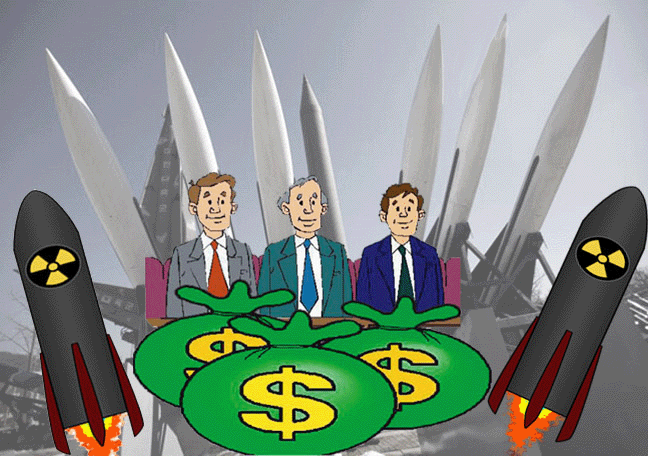
Aotearoa must stand apart as others amass nuclear weapons https://www.stuff.co.nz/national/politics/opinion/127065066/aotearoa-must-stand-apart-as-others-amass-nuclear-weapons, Nov 23 2021 EDITORIAL You’d be forgiven for not thinking about the threat of nuclear war during the past couple of years.
The pandemic, climate change – it seems there are enough dangers threatening our existence, without adding a nuclear holocaust to the list.
Unfortunately, ignoring the steady proliferation of nuclear weapons is a luxury we can no longer afford.
As geopolitical tensions rise, many of them centred on our own Indo-Pacific region, so do nuclear arsenals
Russia and the US continue to own more than 90 per cent of the world’s nuclear weapons, and it seems they have no plan to give those up. Earlier this month, the Pentagon estimated China will have up to 700 deliverable nuclear warheads by 2027. Estimates currently put its arsenal at about 350.
Meanwhile, the UK has reversed a policy of reducing the country’s nuclear arsenal, increasing the planned cap on nuclear warheads. There are reports that India, Pakistan and North Korea are also expanding their capabilities
At the same time, our traditional allies, Australia, the US and the UK, have a new strategic agreement enabling Australia to build nuclear-powered submarines. While they won’t carry nuclear arms, they are not without risk/
It’s no wonder Phil Twyford, Minister for Disarmament and Arms Control, says the risk of nuclear warfare is as bad – if not worse – now than at vany time since the Cuban Missile Crisis. In a recent speech, he was blunt in his criticism of nuclear states the US, France, China, Russia and the UK for their lack of efforts to work towards disarmament. But one speech does not a meaningful security policy make.
Aotearoa has long prided itself on its independent foreign policy, and nuclear-free stance. Lest we forget the great Lange speech from the 1985 Oxford Union debate.
Aside from his memorable uranium comment, the late prime minister was clear in communicating the position of the New Zealand people: the nuclear weapons which would defend us caused more alarm, and accordingly, we deemed it pointless to be defended by them.
Over the years, Kiwis have become disconnected from this element of our foreign policy. We assume we are safe, and that with the end of the Cold War came the end of the imminent threat of nuclear war.
But with the threat on our doorstep, thanks to the US, North Korea and China, now is the time to start caring again.
The global nuclear weapons race is back on: New Zealand needs to continue its stance for disarmament.
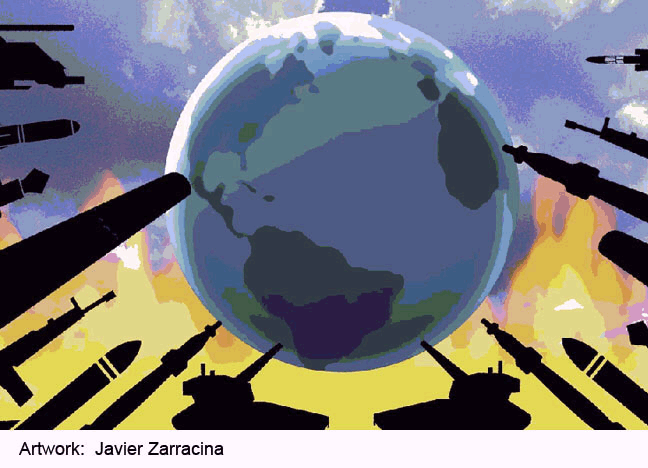
Nuclear weapons back ‘in’ as countries up stakes in complex global tussle, Stuff, Lucy Craymer, Nov 22 2021 China is believed to be building missile silos and accelerating its nuclear programme; the UK has increased the cap on its overall nuclear weapon stockpile; and the US is undertaking a multibillion-dollar nuclear modernisation programme. Are we seeing a new weapons race, and what is nuclear-free New Zealand doing to cool the situation? National Correspondent Lucy Craymer reports.
A worrying global trend is emerging that indicates disarmament is stalling and in some cases countries are now accumulating more weapons. In 2020, despite an overall decline in the number of nuclear warheads, more have been deployed with operational forces, according to the Stockholm International Peace Research Institute (SIPRI) year book.
Furthermore, earlier this month a US Pentagon report found China was accelerating its nuclear armament programme and is on track to have 1000 warheads by 2030. This follows the release of satellite imagery of north-central China that shows, according to analysts, the appearance of at least three vast missile silo fields under construction. China has not confirmed the facilities or increases in arsenal.
The build-up is against a backdrop of geopolitical competition. Rivalry between the US and China continues to simmer; tensions between China and India are getting worse, with skirmishes reported at their border; and the relationship between India and Pakistan remains volatile.
“The risk of nuclear warfare is as bad – if not worse – now than at any time since the Cuban Missile crisis,” says Phil Twyford, Minister for Disarmament and Arms Control.
Renewed interest in nuclear weapons heralds a shift away from a period little more than a decade ago when US President Barack Obama spoke publicly about his deep interest in reducing nuclear arms, and broadly there was an appetite for disarmament.
Maria Rost Rublee, associate professor in international relations at Monash University says in the past decade geopolitics have shifted. Now, the likes of Russia are relying more heavily on their nuclear stockpiles for military security.
“What’s different today [from during the Cold War] is that we don’t just have two countries facing off, we have a lot more countries with nuclear weapons, including countries that might be more willing to use them,” Rublee says.
Earlier this month, the Pentagon estimated China will have up to 700 deliverable nuclear warheads by 2027. It currently has around 350, according to the Pentagon estimates.
However, Russia and the US continue to own over 90 per cent of the world’s nuclear weapons.
The US and Russia had more warheads in operation in January 2021 than a year earlier, even though they had reduced the overall number of weapons they had, according to SIPRI, an independent institute that does research in disarmament.
This year, the UK reversed a policy of reducing the country’s nuclear arsenal and increased the planned cap on nuclear warheads; and there are reports that India, Pakistan and North Korea are expanding their capabilities……………..
Tanya Ogilvie-White, senior research adviser at the Asia-Pacific Leadership Network, says China’s decision to expand its nuclear arsenal is a worrying development. But, she says, it’s partly a response to the nuclear modernisation going on in the likes of the US and Russia. Beijing has refrained from fielding some of the riskiest nuclear weapons, such as nuclear-capable cruise missiles, even though it has the capability to do so.
Ogilvie-White adds there has been a shift recently in the thinking of some decision makers globally, who now think actually firing a small nuclear weapon could de-escalate a situation as it would show a willingness to use such weapons.
“It’s deeply troubling,” says Ogilvie-White, who studies nuclear deterrence. “You don’t need many nuclear weapons to cause total havoc and kill millions of people. The idea that you could use them to win wars is a dangerous fallacy.”…….
How does Aukus fit within this?
Australia, the US and the UK have announced a new strategic partnership. As part of the agreement, Australia will get the technology required to build nuclear-powered submarines.
These are not nuclear weapons. However, it does raise concerns. Accidents happen. An increase in nuclear-propelled submarines boosts the risk that something could go wrong. It also raises questions about whether other countries could reach agreements for similar types of hardware.
It’s not all bad news
In January, a United Nations treaty banning nuclear weapons came into force. The treaty has been ratified by more than 55 countries – none of the nuclear powers have signed it.
Angela Woodward, who is deputy executive director of non-profit Verification Research, Training and Information Centre (Vertic), says while the treaty applies only to those who sign it, it makes nuclear weapons less acceptable and will hopefully create pressure in the same way treaty bans on chemical weapons and cluster munitions did.
According to an ICAN report, 127 financial institutions stopped investing in nuclear weapons this year, many due to the pressure that came about as a result of the treaty.
“The power of this treaty is only just starting to be realised,” says Woodward, who specialises in arms control and disarmament………………..
But is there more New Zealand can do?
New Zealand remains globally respected on nuclear issues due to its strong, and long-standing, stance against such weapons. Analysts say that New Zealand needs to continue to add its voice to concerns about non-proliferation and to speak out against activities by all nuclear-powered countries.
Twyford says he also believes New Zealand needs to continue to call out the nuclear weapon states for what they’re doing and not allow the diplomatic niceties or friendships and alliances to mute our voice. We do this, he says, in both multinational and bilateral forums.
“We are trying to build a renewed commitment to disarm. We’ve got to get out of this downward spiral.” https://www.stuff.co.nz/national/explained/127039453/nuclear-weapons-back-in-as-countries-up-stakes-in-complex-global-tu
Keep space for peace – opposition to New Zealand’s space industry and its military connections
NZ’s $1.7 billion space industry rockets away, but a law review sparks more debate about controversial military payloads, Stuff Amanda Cropp, Oct 17 2021 ”……………….. how far and how fast the New Zealand space industry has come since Rocket Lab’s first test launch blasted off in 2017 from its Māhia Peninsula launch site, with millions being invested by the Government and the private sector.A review of the Outer Space and High-Altitude Activities Act that regulates launches and payloads received only 17 responses last month, but consultation on the “peaceful, sustainable and responsible” use of space, delayed until next year because of Covid-19, is likely to get a much more heated reception.
Peace groups, the Green Party and members of the Māhia community have already been vocal about their opposition to Rocket Lab’s military work in the wake of the controversial Gunsmoke-J satellite it launched for the United States Army Space and Missile Defence Co………….
…… The Outer Space and High-Altitude Activities Act outlaws payloads that contribute to nuclear weapons programmes or capabilities, harm, interfere with or destroy other spacecraft or systems on earth; support or enable specific defence, security or intelligence operations that are contrary to government policy, or are likely to cause serious or irreversible harm to the environment…………….
Space for Peace
In March, 17 peace groups wrote an open letter to Prime Minister Jacinda Ardern saying the Gunsmoke-J launch appeared to breach both the New Zealand Nuclear Free Zone, Disarmament and Arms Control Act and the Cabinet-approved to payload assessments.
They argued that because US military strategy was increasingly using satellite systems to control and direct nuclear, as well as non-nuclear, weapons, it was extremely difficult to determine whether any given satellite was contributing to supporting this weapons system.
……… In mid-September the Anti-Bases Campaign had about 100 attendees at a Keep Space for Peace webinar, and organiser Murray Horton says they were primarily concerned Rocket Lab’s Auckland and Māhia operations effectively constituted a US base in New Zealand, albeit a privately owned one.
Sonya Smith of the Māhia’s Rocket Lab Monitoring Group says they want future regulations to include a clause outlawing payloads that will “assist in the operation of a weapon”.
Professor Kevin Clements is a member of the Peace Foundation International Affairs and Disarmament Committee, which was a signatory to the letter to the prime minister, and he does not believe MBIE is the appropriate agency to vet payloads.
“They have a vested interest in seeing [space] is a thriving industry bringing dollars into the New Zealand economy. This needs to be handled by the prime minister’s department.”…….. https://www.stuff.co.nz/business/126560061/nzs-17-billion-space-industry-rockets-away-but-a-law-review-sparks-more-debate-about-controversial-military-payloads
New Zealand PM says Australian nuclear subs will NOT be welcome in country’s waters
New Zealand PM says Australian nuclear subs will NOT be welcome in country’s waters, https://7news.com.au/politics/federal-politics/australian-nuclear-subs-not-welcome-in-nz-c-3978704 7 News, Ben McKay, 16/09/20
Australia’s planned nuclear submarine fleet won’t be welcome in New Zealand, according to Prime Minister Jacinda Ardern.
The new submarines are the centrepiece of the new AUKUS security tie-up of Australia, the United States and the United Kingdom.
NZ has been left out of the AUKUS alliance, despite being a member of the Five Eyes intelligence-sharing network, along with AUKUS members and Canada.
The country has been staunchly nuclear-free for decades, earning the ire of treaty partner US by declining visits from its nuclear-powered ships.
“We weren’t approached by nor would I expect us to be,” Ardern said.
“Prime Minister Morrison and indeed all partners are very well versed and understand our position on nuclear-powered vessels and also nuclear weapons.
Australia’s planned nuclear submarine fleet won’t be welcome in New Zealand, according to Prime Minister Jacinda Ardern.
The new submarines are the centrepiece of the new AUKUS security tie-up of Australia, the United States and the United Kingdom.
NZ has been left out of the AUKUS alliance, despite being a member of the Five Eyes intelligence-sharing network, along with AUKUS members and Canada.
The country has been staunchly nuclear-free for decades, earning the ire of treaty partner US by declining visits from its nuclear-powered ships.
“We weren’t approached by nor would I expect us to be,” Ardern said.
“Prime Minister Morrison and indeed all partners are very well versed and understand our position on nuclear-powered vessels and also nuclear weapons.
That of course means that they well understood our likely position on the establishment of nuclear-powered submarines and their use in the region.”
Ardern said by law, and by a consensus of NZ’s major political parties, nuclear-powered vessels would not be welcome.
“Certainly they couldn’t come into our internal waters,” she said.
Ardern declined to say whether it would be appropriate for Australia’s new fleet to sail in the Pacific but welcomed interest from the US and the UK in the “contested region”.
“I am pleased to see that the eye is being tuned to our region, from partners that we work closely with.”
Some Kiwi experts believe the AUKUS formation shows an Australian acquiescence to US foreign policy.
“It highlights that much deeper level of Australian integration into US defence and security planning and thinking,” Victoria University professor David Capie told The Guardian.
“New Zealand and Australia were in a different space to begin with and this has perhaps just made that look sharper again.”
Ardern said the new alliance “in no way changes our security and intelligence ties with these three countries”.
NZ’s opposition is less sure, with leader Judith Collins saying other aspects of the defence alliance would be worth involvement.
Mururoa nuclear test veterans fight for their children and grandchildren
Mururoa nuclear test veterans fight for their children and grandchildren, Stuff Jimmy Ellingham, Sep 11 2021 Forty-eight years after 500 Kiwi sailors were sent to French Polynesia to protest French nuclear testing in the Pacific the effects on their health and families continue to reverberate.
Those aboard the HMNZS Otago and HMNZS Canterbury were several dozen kilometres away from the atmospheric tests they witnessed at Mururoa Atoll.
The sailors drank, washed in and cleaned their clothes in desalinated water from the fallout zone, and the ships’ decks were washed down with it.
In 2020, an Otago University study of 83 sailors and 65 children published in the New Zealand Medical Journal found they were at higher risk of transferring genetic illnesses across generations.
The research found 30 per cent of veterans had cancer and 31 per cent joint problems. Among their children, 40 per cent reported fertility problems, while many chose not to have offspring of their own because their fathers were exposed to radiation.
The veterans can get help or certain health conditions. Their descendants can’t get anything.
The Mururoa Nuclear Veterans Group, an incorporated society representing the men from the two frigates and HMAS Supply, is working to change this.
Retired Rear Admiral Jack Steer, who didn’t serve at Mururoa but works with the group to advocate for veterans, said children and grandchildren were affected by their fathers and grandfathers being exposed to radiation on the protest mission.
The group wants to see as many veterans and descendants as possible tested to see if there is a link.
“A number of the veterans have died of various forms of cancer and some of them are very unwell. They believe they were eradiated. This test will prove beyond reasonable doubt whether they were.”
The group wanted to collect blood samples, so they’re available for scrutiny as science advances. It’s a costly process. Each sample costed $117, although the group had secured a place to store them, Steer said.
The group was hoping to secure government funding for testing, as had happened for Operation Grapple veterans, who witnesses British nuclear testing in the Pacific in the 1950s.
Steer said the Mururoa veterans weren’t after compensation.
“What they want is that testing proves that their children and grandchildren were exposed to radiation or affected by their dads’ exposure to radiation.”
The group had recently secured $50,000 funding from the Returned and Services’ Association to start the testing project……. https://www.stuff.co.nz/national/300404527/mururoa-nuclear-test-veterans-fight-for-their-children-and-grandchildren
Pacific Nuclear test veterans encouraged quest for apology will succeed
Nuclear test veterans encouraged quest for apology will succeed https://www.stuff.co.nz/national/300309768/nuclear-test-veterans-encouraged-quest-for-apology-will-succeed, Jimmy Ellingham May 17 2021 Pacific nuclear test veterans are encouraged their quest to gain a long-awaited apology for being exposed to radiation appears to have ministerial support
Kiwi sailors on the decks of the HMNZS Rotoiti and HMNZS Pukaki witnessed atomic explosions and collected weather data during Operation Grapple, Britain’s Pacific nuclear testing programme of the 1950s.
The New Zealand Nuclear Test Veterans’ Association, which represents the more than 500 Kiwi sailors involved, is pushing for a meeting with Prime Minister Jacinda Ardern.
The association wants an apology for the sailors, and help for medical problems in their children and grandchildren.
To lay the groundwork for the prime ministerial audience the association’s chairman, Tere Tahi, of Bulls, has met with Veterans’ Affairs Minister Meka Whaitiri.
Tahi said last week’s audience with the minister, her secretary and head of Veterans’ Affairs Bernadine Mackenzie went well, a feeling he hadn’t had from meetings with previous ministers.
“They were mighty to talk to. The minister was really good and she said that she’ll do what she can for the veterans.”
The trio listened to arguments about how what the navy veterans went through had affected their children and grandchildren. Tahi and his son James represented the association.
At present the veterans can get help for medical problems, but their offspring cannot.
Tahi said Whaitiri was asked if she could approach Ardern about a meeting, and she said she would try.
“We put our case across to her [Whaitiri], which is what we wanted to do. She was very good.
“We want recognition. We want an apology.”
The association’s plan was to argue its case to Ardern on humanitarian grounds, telling the stories of its members.
It’s thought about 60 of the Kiwi sailors are still alive.
The association’s plan was to argue its case to Ardern on humanitarian grounds, telling the stories of its members.
It’s thought about 60 of the Kiwi sailors are still alive.
The association was formed in the 1990s. At a reunion about that time it became clear many veterans were affected by cancer and other health
New Zealand nuclear veterans want apology and compensation from the government
New Zealand’s nuclear horror still not acknowledged say vets Stuff, Janine Rankin May 02 2021 Photos on a wall, names on a board and an academic study will ensure the radiation damage to 551 men who witnessed Britain’s nuclear bomb explosions in the Pacific is never forgotten.
But what the New Zealand survivors of those blasts really want is an apology and compensation from the Government.
The stories of the nuclear veterans and the subsequent heartache and illness affecting them and the off-spring of those who had families have been retold in Palmerston North this weekend.
It was the third opening of Denise Baynham’s exhibition of the photographs and stories of navy veterans “Operation Grapple, We were There” at Te Manawa art gallery……………
…….. The men exposed to those bomb blasts, many times more powerful than the bombs that ended World War II in Japan, suffered radiation damage, and still do.
A carefully controlled sample of 50 veterans showed three times the frequency of genetic damage, technically called total chromosome translocations, than the control group.
Rowland is now the association’s patron, and he and Sefton’s close friend and successor Tere Tahu are determined to have the Government acknowledge the harm done.
They have a meeting with Veterans’ Affairs Minister Meka Whaitiri on May 10, with the goal of gaining an audience with Prime Minister Jacinda Ardern.
Veteran John Purcell said until now, they had only received “a wall of silence” from successive ministers.
“It is my belief that the Crown abrogated its duty of care by dispatching HMNZS Pukaki and Rotoiti to take part in the British nuclear testing, being fully aware that we were being sent into harm’s way.”
What he wants is a public apology, a public acceptance of the research findings, urgent research regarding the children and grandchildren of veterans, and compensation., https://www.stuff.co.nz/national/125002784/new-zealands-nuclear-horror-still-not-acknowledged-say-vets
Growing opposition to Rocket Lab in New Zealand
Rocket Lab: Growing opposition in New Zealand. By Murray Horton, 18 Apr 21,
Rocket Lab started life as a small New Zealand company but is now much bigger and has become the local subsidiary of a US company, with its owners including arms industry behemoths such as Lockheed Martin.
It specialises in frequent launches of small satellites for clients including a range of US military and intelligence agencies. These launches are conducted from New Zealand, which prides itself on being nuclear free (it was kicked out of the ANZUS Treaty in 1986 by the other two parties – the US and Australia – for having banned US nuclear warships from entering. That remains the status quo today).
NZ also claims to have an independent foreign policy. But it remains the most junior of the Five Eyes global electronic spying network (with the US, UK, Canada and Australia). Having Rocket Lab operating a private enterprise space port in New Zealand for US military and intelligence agencies, with the active backing of Jacinda Ardern’s Government, totally undermines that claim.
Rocket Lab has, up until recently, received uncritical, even adulatory, coverage by the NZ news media. That, plus the fact that its’ launch pad is in a very remote, sparsely populated area (the Mahia Peninsula on the North Island’s east coast) means that it has been off the radar (pardon the pun) of the NZ public.
In 2021 that is now changing. Mainstream media coverage has become more critical, the best example being “Mahia, We Have A Problem”, by Ollie Neas in the March 2021 North & South (a national monthly magazine). And opposition has started, right in Rocket Lab’s back yard, in the Mahia area, led by local Maori women (Maori are the indigenous people of New Zealand).
There was a protest against Rocket Lab’s most recent military satellite launch; the group – Rocket Lab Monitor – has taken its case to the local media; and, via billboards, etc, directly to the people. They have set up a Website.
Opposition is also being organised on a more national scale – New Zealand is one of the most urbanised countries in the world and Rocket Lab’s assembly plant and headquarters is situated in the country’s biggest city, Auckland.
Murray Horton
Secretary/Organiser
Anti-Bases Campaign
Christchurch, New Zealand
New Zealand groups oppose launch of U.S. military nuclear satellite

a security expert has suggested it puts New Zealand into “the kill chain” and makes New Zealand a military target.
|
NZ rocket launches may breach nuclear-free laws, say peace groups, The Spinoff
Ollie Neas | 8 Mar 21, Rocket Lab launches of satellites honing US military targeting capabilities have been criticised by the Peace Foundation, which is calling on the PM to step in.Peace groups are calling on the prime minister, Jacinda Ardern, to stop the launch of a controversial US military satellite that is scheduled for lift-off from Mahia this month, saying it may contravene nuclear-free legislation.Rocket Lab’s next mission is due to carry a satellite for the US Army’s Space and Missile Defence Command, called the Gunsmoke-J. The satellite is designed to improve US military targeting capabilities by improving how data is provided to “warfighters”.The satellite has previously been condemned by the Green Party, while a security expert has suggested it puts New Zealand into “the kill chain” and makes New Zealand a military target. Non-profit group The Peace Foundation has now added to those concerns: the launch may breach New Zealand’s nuclear-free laws. In an open letter to the prime minister, the Peace Foundation’s International Affairs and Disarmament Committee says Rocket Lab’s launches for US military agencies risk drawing New Zealand “into supporting the weaponisation of space and the related nuclear arms race”. Satellites contributing to nuclear weapons programmes cannot be approved under New Zealand law. But the Peace Foundation says New Zealand may lack the technical expertise and information necessary to properly assess whether a satellite is making such a contribution. As a result, the Peace Foundation says approvals of US military satellites should be suspended, and approval of the Gunsmoke-J satellite revoked, until greater oversight of space launches is implemented. The letter has been endorsed by 17 civic, peace and religious groups, as well as members of the public………… The US Army says the technology being demonstrated could, among other purposes, assist in “long-range precision fires” – a type of missile used to provide “precision surface-to-surface deep-strike capability”. The minister responsible for approving the satellite, Stuart Nash, told parliament last month that he was “unaware” of its “specific military capabilities”. Otago University conflict resolution and disarmament expert Kevin Clements said it is “astonishing” that Nash was unaware of the Gunsmoke-J’s specific military capabilities. “It is even worse that he is willing to rely on the US Army alone to provide the information required by him and New Zealand’s space agency in relation to the approval process,” Clements said in a statement. “Rocket Lab’s launch programme is increasingly opaque. The precise content of each payload seems intentionally ambiguous and approvals do not seem to take New Zealand’s anti-nuclear legislation into account.” Strong parallel’ with nuclear ships issue The Peace Foundation says there is a “strong parallel” between the launch of US military satellites from New Zealand and the “neither confirm nor deny” issue of the 1980s. The US policy of neither confirming nor denying whether its ships were nuclear armed led to a ban on US warships visiting New Zealand ports – the seminal moment in the anti-nuclear campaign. As with that issue, the Peace Foundation says New Zealand cannot be confident that US military satellites launched from New Zealand are not contributing to nuclear weapons systems. The Peace Foundation says assessing whether the Gunsmoke-J complies with the nuclear free law would require detailed technical knowledge of how the technology might be used in the future. “Increasingly, space-based US military assets are ‘dual-capable’ (can support nuclear and non-nuclear weapons), and dual-capable satellites used for non-nuclear targeting today can easily be used for nuclear targeting tomorrow………. Call to reform space law In light of its concerns, the Peace Foundation says greater oversight is needed over New Zealand’s space regime. It proposes assigning oversight of space launches to the prime minister, strengthening space regulations, and mandating oversight of space-launch activity to the Public Advisory Committee on Disarmament and Arms Control (PACDAC) – a body set up by the Nuclear Free Zone Act to advise the government on disarmament matters. Minutes of PACDAC meetings obtained by The Spinoff under the Official Information Act show the committee has had ongoing concerns about the consistency of space activity with New Zealand’s nuclear free law. Space Agency officials have met with the committee to assure members of the legality of launches. The Peace Foundation also calls for changes to the Technology Safeguards Agreement that New Zealand signed with the US to allow for the transfer of sensitive rocket technology. The treaty requires the US to provide “sufficient information” about its spacecraft to allow New Zealand to assess them, but also allows the US government to veto any space launch from New Zealand. “There are some very big moral questions at stake here,” says Clements. “Is this current Labour government willing for New Zealand soil to be used by Rocket Lab in order to assist US government targeting in conventional and nuclear warfare?” The Peace Foundation’s letter comes a week after Rocket Lab announced that it would list publicly on the Nasdaq stock exchange, with a valuation of $5.7 billion. Although its main launch site and production facility is in New Zealand, Rocket Lab is US owned. Its investors include major US venture capital firms as well as aerospace and defence company Lockheed Martin, which produces nuclear weapons. Rocket Lab also unveiled plans to launch a larger rocket called the Neutron, which will allow it to launch astronauts. Since 2018, Rocket Lab has launched military or intelligence payloads on seven different missions for agencies ranging from US Special Operations Command to the National Reconnaissance Office, a major US spy agency. Rocket Lab says around 30% of its business is for defence agencies. https://thespinoff.co.nz/politics/09-03-2021/nz-rocket-launches-may-breach-nuclear-free-laws-say-peace-groups/ |
|
Glaciers in New Zealand – extreme melting due to global heating

|
Human-induced climate change is causing ‘extreme’ melting in New Zealand glaciers, The study is only the second to draw a direct link between glacier melt and human-induced climate change. SBS NEWS 4 AUG 20 BY BIWA KWAN New analysis of data and photo records of melting glaciers in New Zealand has found human-induced climate change increased the likelihood of mass ice melt. The new modelling techniques were applied to 10 glaciers in New Zealand to reveal a more detailed picture of what is driving the accelerating rates of ice melt in the region. Lead researcher Lauren Vargo said the analysis compared ice melt under pre-industrial greenhouse gas emissions and current-day emissions to uncover “a quite extreme result”. “Some of the glaciers were at least six times more likely to have experienced that high mass loss because of humans,” said Dr Vargo, who is based at the Victoria University of Wellington. “We’re really confident with that number because that is the low end. The high end is 350 times more likely. “But with the high ice mass loss event we saw [in 2018], it would not have happened at all without humans.” The first study to make a direct link between human-induced climate change and glacier melt focused on glaciers in the Northern Hemisphere where more robust data records exist. The study – published in the journal Science in 2014 – looked at records between 1851 and 2010 using a running mean over 20-year periods. Dr Vargo said the rate of ice melt has resulted in the loss of a quarter of New Zealand’s glaciers since the 1970s. Rapid melt events in 2011 and 2018 prompted the study. …… The study accounted for years like 2013 when some glaciers in New Zealand actually gained mass, but not at a rate to combat the overall decline. ……. HTTPS://WWW.SBS.COM.AU/NEWS/HUMAN-INDUCED-CLIMATE-CHANGE-IS-CAUSING-EXTREME-MELTING-IN-NEW-ZEALAND-GLACIERS |
|
New Zealand stood up to the nuclear bullies- the Rainbow Warrior story

NZ gained ‘international creds’ as nuclear-free nation with Rainbow Warrior bombing, says author, Asia Pacific Report
New Zealand established its credentials as an independent small nation after the fatal bombing of the Greenpeace flagship Rainbow Warrior in 1985, says an author and academic who spent weeks on the vessel shortly before it was attacked.
On 10 July 1985, the Rainbow Warrior was sunk at an Auckland wharf by two bombs planted on the hull of the ship by French secret agents.
The event is often referred to as the first act of terrorism in New Zealand.
LISTEN: The Afternoons with Jesse Mulligan Crime NZ interview with David Robie
WATCH: Eyes of Fire archival videos
READ: The Eyes of Fire book
Two French agents planted two explosives on the ship while it was berthed at Marsden wharf, the second explosion killing Greenpeace photographer Fernando Pereira.
Dr David Robie, who is an AUT professor of journalism and communication studies, as well as the director of the university’s Pacific Media Centre, had spent more than 10 weeks on the ship as a journalist covering its nuclear rescue mission in the Pacific.
He wrote about his experience in Eyes of Fire, a book about the last voyage of the first Rainbow Warrior – two other Rainbow Warrior ships have followed.
In 1985, Rongelap atoll villagers in the Marshall Islands asked Greenpeace to help them relocate to a new home at Mejato atoll. Their island had been contaminated by radioactive fallout from US atmospheric nuclear weapons testing in the Pacific.
Environmental journalism
“At the time I was very involved in environmental issues around the Pacific and in those days Greenpeace was very small, a fledgling organisation,” he tells Jesse Mulligan.
“They had a little office in downtown Auckland and Elaine Shaw was the coordinator and she was quite worried that this was going to be a threshold voyage.
“It was probably the first campaign by Greenpeace that was humanitarian, it wasn’t just environmental – to rescue basically the people who had been suffering from nuclear radiation.” ……….
Moruroa protest planned
The US had carried out 67 nuclear tests at the Marshall Islands. France was also carrying out 193 tests in the Pacific and Greenpeace had planned on confronting that situation at Moruroa Atoll after its Marshall Islands rescue effort.
New Zealand had already voiced disapproval of the testing in the region, with then Prime Minister David Lange in 1984 rebuking the French for “arrogantly” continuing the programme in the country’s backyard.
Dr Robie left the ship when it docked in Auckland after the Marshall Islands stage of the mission. Three days after the ship had docked, a birthday celebration was held for Greenpeace campaign organiser Steve Sawyer onboard. The attack happened after the party.
Just before midnight on the evening of 10 July 1985, two explosions ripped through the hull as the ship.
Portuguese crew member Fernando Pereira was killed after returning on board after the first explosion……..
Thirteen foreign agents were involved, operating in three teams. The first team brought in the explosives, the second team would plant these and the third was on stand-by in case anything went wrong with the first two teams.
“A commanding officer kept an overview of the whole operation. I think there was an element of arrogance, the same arrogance as with the testing itself. There was a huge amount of arrogance about taking on an operation like this in a peaceful country – we were allies of France at the time – and it is extraordinary that they assumed they could get away with this outrageous act.”
Two of the spies were caught. Two General Directorate for External Security (DGSE) officers, Dominique Prieur and Alain Mafart, were arrested on July 24. Both were charged with murder, pleaded guilty to manslaughter and were sentenced to 10 years’ imprisonment.
Repression of independence movements
“You have to see it within the context of the period of the time,” Dr Robie says.
He says that the French policy of repression against independence movements in New Caledonia and Tahiti, with assassinations of Kanak leaders like Eloi Machoro, needed to be understood to put the Rainbow Warrior attack in perspective. France was bitterly defending its nuclear force de frappe.
“New Zealand was unpopular with the major nuclear powers and there was certainly no sympathy for New Zealand’s position about nuclear testing. So, there wasn’t really any co-operation, even from our closest neighbour, Australia……..
The case was a source of considerable embarrassment to the French government.
“They did pay compensation after arbitration that went on with the New Zealand government and Greenpeace. But justice was never really served… the 10 years were never served, both Prieur and Mafart were part of the negotiations with French government.
NZ was held ‘over a barrel’
“Basically, France had New Zealand over a barrel over trade and the European Union, so compromises were reached and Prieur and Mafart were handed over to France for three years. Essentially house arrest at Hao atoll, the rear base of the French nuclear operations in Polynesia.”
Dr Robie said the rear base was widely regarded as a military “Club Med”.
He says they didn’t even spend three years there, but left for France within the time period.
While the attack was on an international organisation rather than New Zealand itself, most New Zealanders saw it as an attack on the sovereignty of the nation
Dr Robie says it left a long-lasting impression on New Zealanders.
“It was a baptism of fire. It was a loss of innocence when that happened. And in that context, we had stood up as a small nation on being nuclear-free. Something we should have been absolutely proud of, which we were, with all those who campaigned for that at the time. I think that really established our independence, if you like, as a small nation.
“I think we have a lot to contribute to the world in terms of peace-making and we shouldn’t lose track of that. The courage that was shown by this country, standing up to a major nuclear power. We should follow through on that kind of independence of thought.” https://asiapacificreport.nz/2020/06/29/nz-gained-international-creds-as-nuclear-free-nation-with-rainbow-warrior-bombing-says-author/
1 This Month

of the week – Shut Down Drone Warfare!


Tell the Ukrainian Government to Drop Prosecution of Peace Activist Yurii Sheliazhenko

Petition to revoke the licensing of the Near Surface Nuclear Disposal Facility (NSDF) at Chalk River. https://www.ourcommons.ca/petitions/en/Petition/Details?Petition=e-7247
To see nuclear-related stories in greater depth and intensity – go to https://nuclearinformation.wordpress.com
-
Archives
- March 2026 (237)
- February 2026 (268)
- January 2026 (308)
- December 2025 (358)
- November 2025 (359)
- October 2025 (376)
- September 2025 (257)
- August 2025 (319)
- July 2025 (230)
- June 2025 (348)
- May 2025 (261)
- April 2025 (305)
-
Categories
- 1
- 1 NUCLEAR ISSUES
- business and costs
- climate change
- culture and arts
- ENERGY
- environment
- health
- history
- indigenous issues
- Legal
- marketing of nuclear
- media
- opposition to nuclear
- PERSONAL STORIES
- politics
- politics international
- Religion and ethics
- safety
- secrets,lies and civil liberties
- spinbuster
- technology
- Uranium
- wastes
- weapons and war
- Women
- 2 WORLD
- ACTION
- AFRICA
- Atrocities
- AUSTRALIA
- Christina's notes
- Christina's themes
- culture and arts
- Events
- Fuk 2022
- Fuk 2023
- Fukushima 2017
- Fukushima 2018
- fukushima 2019
- Fukushima 2020
- Fukushima 2021
- general
- global warming
- Humour (God we need it)
- Nuclear
- RARE EARTHS
- Reference
- resources – print
- Resources -audiovicual
- Weekly Newsletter
- World
- World Nuclear
- YouTube
-
RSS
Entries RSS
Comments RSS
 nuclear-news