New Zealand’s Rocket Lab ‘ready to serve’ Pentagon

RNZ Phil Pennington, Reporter 19 Feb 25
Rocket Lab is poised to launch a satellite from Mahia Peninsula for a US company which is looking to bolster military and spying operations.
BlackSky’s plan is to add laser optic links later to its Gen-3 satellites to give “war-fighters real-time access to imagery during time-sensitive military operations worldwide”.
This comes shortly after Rocket Lab won a part in a mega-deal to help develop hypersonic weapons for the Pentagon, prompting the firm to state it was “ready to serve the US Department of Defense”.
The New York-listed, New Zealand-born company has also completed a design review for 18 military satellites in a contract worth more than $800 million, for the Proliferated Warfighter Space Architecture (PWSA), which is putting up a web of low-orbit satellites for missile tracking and battlefield comms.
That deal, which was signed last year, cemented Rocket Lab as a “prime” – or lead – defence contractor in the US.
The Mahia launch is set down for some time from Tuesday, and will be the first of several Gen-3s for BlackSky, which has used the site near Gisborne since 2019.
The government last year dismissed pro-Palestinian protesters complaints it breached rules on launches…………………………………..
Six months ago, BlackSky said it would make Gen-3s compatible with military networks. It won a $175m satellite contract with an unnamed international defence customer last month.
Its constellation of small satellites also has civilian uses, such as in mapping natural disasters.
Rocket Lab’s share price in the US has surged since it won big Pentagon contracts………………………………………………………….. more https://www.rnz.co.nz/news/national/542305/rocket-lab-ready-to-serve-pentagon
—
New Zealand is under siege by the Atlas Network
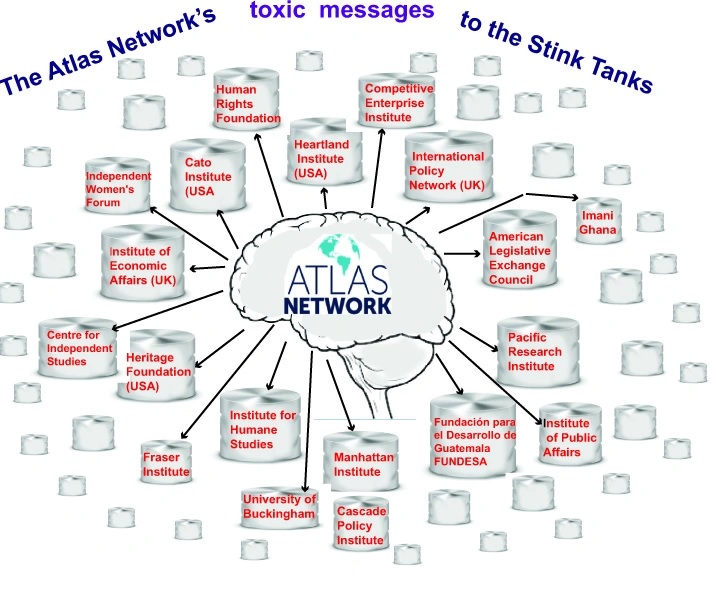
We have a handful of years to achieve a monumental shift from fossil fuel towards renewable energy: Atlas partners aim to ensure this does not take place.

March 3, 2024, by: Lucy Hamilton, https://theaimn.com/new-zealand-is-under-siege-by-the-atlas-network/—
Just as the Atlas Network-connected Advance body intervened in the Voice referendum in Australia and, in recent weeks, a by-election, similar organisations spawned from the American model are distorting New Zealand’s politics from within as well as from without.
One of the key researchers into the Atlas Network, Lee Fang, observed that it has “reshaped political power in country after country.” In America, every Republican president since Ronald Reagan has begun office with a Roadmap provided by the Heritage Foundation, primary Atlas Network partner. The “Mandate” for 2025 puts America on a hard path to fascism should a Republican win in November. Britain’s economy and standing have been savaged by Atlas partners’ impacts on the Tories. In New Zealand, the recently-elected rightwing coalition government is aping the new “Atlas president” of Argentina, aiming to privatise national assets, but is increasingly also imitating Atlas strategies recently seen in Australia, inflaming racial tensions and harming the wellbeing of Māori people.
Dr Jeremy Walker called Australia’s attention to the local Atlas partner organisations’ impact on the Voice to Parliament referendum and is now helping draw together the focus on the New Zealand partners’ very similar distortion of their national debate. There is a deep racism at the heart of this ultra-free market ideology that has licensed the international right to exploit resources and people around the globe untrammelled, largely in American corporate interest, but more broadly for any corporation or allied sector big enough to be a contender. (They do not, by contrast, fight for the renewable energy sector’s interests, as a competitor to their dominant fossil fuel donors; this shapes their climate crisis denial and delay, and colours their loathing of First People’s capacity to interfere with their profits by environment-driven protest. A sense of Western Civilisation as the apex of human existence and deep disdain for non-Western cultures also pervade the network.)
The Atlas model is to connect and foster talent in the neoliberal sphere. Young men (mostly) are funded or trained to replicate the talking points that Ultra High Net Worth Individuals (UHNWI) and lobbyists have built into a global network of over 500 bodies in 100 nations. The fact that neoliberal orthodoxies are more religious ideology that fact-based theories explains why their impact has been so utterly disastrous everywhere they have reshaped societies. The goal is to spawn replicating bodies with benign-sounding names that promote the UHNWI and corporate talking points – but with a veil hiding the self-interest that is obvious when those groups speak for themselves. Some of the bodies feign being thinktanks, which George Monbiot recently renamed junktanks to clarify their disingenuousness. Others are “astroturf” organisations that pretend to be grass roots bodies representing popular opinion. Another model is the beach-head in universities, an independent organisation within those institutions intended to dignify the neoliberal religion and the chosen strategies, including climate denial. All these produce material to fill civic debate and train more acolytes to enter politics, strategy companies and junktanks. Mainstream media elevates their standing by hosting their operatives as experts without explaining that the benign-sounding organisation to which they belong is a foreign-influence operation’s local outlet.
These groups damage local conditions to favour international corporations. They lobby for the removal of the “regulations” that are actually protections for the public – as workers, as consumers, as residents. They push for the privatisation of national treasures so that (often foreign) corporations can exploit the profits at the expense of the public. The greater the damage to the local democracy, the easier it is for them to act unimpeded. The stronger their infiltration of the media, the harder it is for the local electorate to understand the stakes. The politicians and strategists that emerge from the sphere (or are its allies) know that none of this wins votes, so they fill the space with culture war division to distract the voter from paying attention. Race and sexuality are their most obvious targets, as reactionary nostalgia for a mythical past of white picket fences pervades their ideology: a valorisation of “Christianity” and “family” and the “sacredness of marriage” (preached by adulterous politicians) is equally apparent in their propaganda.
The coalition that took power in NZ late in 2023, after a campaign centred on attacking the country’s founding Waitangi Treaty, has considerable Atlas infiltration. There is concern about Atlas fossil fuel and associated tobacco interests perverting policy in parliament, as well as senior ministerial aides who might be compromised. The government has promised to repeal Jacinda Ardern’s ban on offshore gas and fuel exploration, plans to sell water to private interests, not to mention planning to enable the selling off of “sensitive” NZ land and assets to foreign corporations, just as Argentinian Milei is intending.’
One of the government members, the Act Party, began its existence as an Atlas partner thinktank and continues that close connection. It was founded by former parliamentarian Denis Quigley with two members of the Mont Pelerin Society (MPS), the Atlas Network’s inner sanctum. One, Roger Douglas, was responsible for Rogernomics in NZ which has been described as a “right wing coup” that worked to “dismantle the welfare state.” The other, Alan Gibbs, who has been characterised as the godfather of the party, and a major funder, argued Act ought to campaign for government to privatise “all the schools, all the hospitals and all the roads.” This may not be surprising since he made much of his fortune out of the privatisation of NZ’s telecommunications.
The Act Party is currently led by David Seymour who functions as a co-deputy prime minister in the government. He has worked almost his entire adult life within Atlas partner bodies in Canada and boasts a (micro) MBA dispensed by the Network.
In Seymour’s 2021 Waitangi Day speech, he acknowledged his “old friends at the Atlas Network.” In light of that, his recent disdainful and absolute dismissal of the party’s connection to Atlas in an interview was telling: he clearly felt the association was damaging enough to lie outright.
Seymour is also deeply antagonistic to policies dedicated to repairing the disadvantage suffered by Māori people, disingenuously describing provisions that work cooperatively with Māori people as the “dismantling of democracy.” He appears antagonistic to Māori culture.
Another Atlas partner that has been key to distorting debate in NZ is the Taxpayer Union (TPU) which is emblematic of the production of metastasising bodies central to the Atlas strategy. Its co-founder and executive director is another graduate of the Atlas (micro) MBA program. Jordan Williams (currently “capo di tutti capi” of the Atlas global alliance of anti-tax junktanks) laughably depicts Atlas as a benign “club of like-minded think tanks.” He created, however, a body called the Campaign Company which helped radicalise the established farmer power base in NZ politics, planting sponsored material in the media. Williams claimed to grant the farmers “world-class campaign tools and digital strategies.” He also co-founded the Free Speech Union (FSU), which is unsurprisingly fighting regulation of the damaging impact of internet disinformation as well as fostering culture war battles.
A further spin-off of the bodies illustrates the increasing ugliness of the populist strategies. A former Act Party MP has founded the New Zealand Centre for Political Research which is fomenting civic division against Māori interests, including placing hate-mongering advertisements in the media.
The Act Party (alongside the populist New Zealand First party) is at the heart of the coalition government’s intention to destroy NZ’s admirable efforts to promote Māori interests for the betterment of the commonwealth, including the co-governance innovation. Efforts to undo disadvantage and programs that have promoted the distinctive NZ democratic experiment are set to be dismantled. A “massive unravelling” of Māori rights is at stake.
It is not only Māori people who will suffer. The NZ coalition government is also attempting a kind of “shock therapy” that did so much to tip first Chile and then other “developing” nations into brutal pain in pursuit of market “freedom.” The MPS was at the heart of Pinochet’s neoliberal brutality, resulting from Nixon’s injunction to make the Chilean economy scream.[1] New Zealand now faces cuts to a range of services, welfare and disability payments, even while the new PM, one of NZ’s wealthiest ever holders of the role, charged the taxpayer NZD 52,000 to live in his own property. It’s important to remember that this kind of entitlement is the sort that the neoliberals like, alongside subsidies to industry and corporations.
Lord Hannan (one of Boris Johnson’s elevations to the peerage, and a junktank creature) recently spoke in NZ, welcoming “all the coalition partners around this table” to hear his oration. There he celebrated the small percentage of GDP that NZ’s government spends on its people, cheering on the TPU’s power. He also disdained the “tribalism” that has dictated recognition of First Peoples’ suffering. There is grand (but unsurprising) irony in a graduate of three of Britain’s preeminent educational institutions dictating that humanity’s essential equality is all that can be considered when devising policy, particularly in settler-colonial nations.
Amusingly the weightier debunking of the Atlas connections has come from: Chris Trotter, formerly centre left, now a council member of Williams’ FSU; Eric Crampton, chief economist of the New Zealand Initiative, NZ’s leading Atlas partner and Sean Plunkett whose “anti-woke” vanity media platform, Platform, is plutocrat funded and regularly platforms the NZI talking heads.
While Atlas’s system largely functions to connect and train operatives, as well as acting as an extension of American foreign policy, this modest-seeming program must not be ignored. We have a handful of years to achieve a monumental shift from fossil fuel towards renewable energy: Atlas partners aim to ensure this does not take place.
And Atlas partners will push us at each other’s throats while we procrastinate.
[1] That MPS intervention resulted in massive unemployment, extraordinary inequality, and fire-sale prices of national assets to cronies. Much of Chile’s later success is as likely to be attributable to the trade requirements of (statist) China whose demand for copper has done so much to enrich Chile.
Grazing sheep among solar panels could produce higher quality wool, study finds
Sophie Vorrath, Nov 1, 2024,
https://reneweconomy.com.au/grazing-sheep-among-solar-panels-could-produce-higher-quality-wool-study-finds/
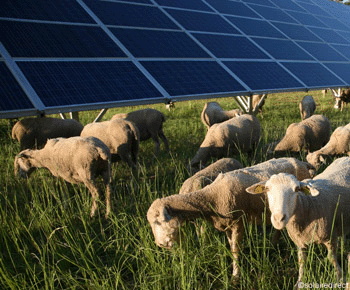
The co-location of solar farming with sheep grazing does not have a negative affect on wool production and could even improve the quality of the wool produced, a new study has found.
The study is based on the results of a second round of wool testing at the Wellington solar farm, south east of Dubbo in New South Wales, which has shared its site with 1,700 merino sheep for the past three years.
Legend has it that the decision to graze sheep at the solar farm came about when an employee of Lightsource bp, the owner of the Wellington project, complained to a local, sixth-generation wool farmer about the hassle and cost of mowing the solar farm six times a year.
According to Tony Inder, who heads up the Allendale Merino Stud, the effect on his sheep has been a lot better than he thought it would be – he says the wool quality they are producing has “increased significantly.”
But Lightsource bp – which is now wholly owned by the oil and gas giant BP, after completing the acquisition of the remaining 50.03% interest – has used the opportunity to gather some formal data.
The study, conducted by EMM Consulting with support from Elders Rural Services, compares two groups of merino sheep – one group grazed in a regular paddock and the other at the Wellington solar farm.
The latest findings show grazing sheep among solar panels does no harm to wool production, even in the case of pre-existing high-quality standards. And it says that some parameters even indicate an improvement in wool quality, although conclusive benefits require further long-term measurement.
Lightsource bp says that while the study at the Wellington solar farm is ongoing, it is another indication that solar farms can exist side-by-side with sheep farming, for the benefit of both enterprises.
“These results are very encouraging and highlight the potential for solar farms to complement agricultural practices,” says Emilien Simonot, Lightsource bp’s head of agrivoltaics.
“By integrating sheep farming with solar energy production, we can achieve dual benefits of sustainable energy together with agricultural output.” . By co-locating grazing with renewable energy, land can remain in agricultural use, offering farmers additional revenue while contributing to cleaner energy for the planet.
“Finding ways for agriculture and clean energy to work together is crucial for a more sustainable future,” says Brendan Clarke, interim head o environmental planning Australia and NZ at Lightsource bp.
“The promising results from this study indicate that we are on the right path, and working closely with farmers to grow our knowledge in this area is paramount.”
As for the sheep, Inder says they “just do really well” when grazing among the Wellington solar farm panels.
“I like to say that panel sheep are happy sheep.”
Sophie is editor of One Step Off The Grid and deputy editor of its sister site, Renew Economy. She is the co-host of the Solar Insiders Podcast. Sophie has been writing about clean energy for more than a decade.
Waihopai is a Secret U.S. Spy Base in New Zealand Designed for War-fighting
Global Peace and Justice A0TEAROA) By Murray Horton, August 29, 2024
Murray Horton is organiser of the Campaign Against Foreign Control of Aotearoa (CAFCA) and an advocate of a range of progressive causes for the past five decades.
He can be reached at: cafca.
Reprinted from Covert Action Magazine
The news that the Waihopai spy base was going to be built led to the birth of the Anti-Bases Campaign (ABC) in 1987. ABC has campaigned for the closure of Waihopai ever since (our most recent protest there was in 2023).
We have consistently said that it is a U.S. spy base in all but name, i.e., that the New Zealand Government Communications Security Bureau (GCSB, NZ’s spy agency in the Five Eyes international spy alliance) works as directed by the U.S. National Security Agency (NSA). We have also consistently said that it is a war-fighting base, not just a spy base. The powers that be in New Zealand’s covert state, and their political mouthpieces, have always denied this and/or asked for evidence?
Soothing Reassurances from GCSB Bosses
For example, this from The New Zealand Herald, (April 9, 2010), with the eye-catching title “It’s ours and it’s not evil, say spy-base masters”:
“New Zealand’s secret spies emerged from the shadows yesterday to deny their Waihopai station is an American spy base contributing to torture and war. Present and past Directors of the Government Communications Security Bureau took the unusual step of commenting publicly on allegations made during and after last month’s trial in which a jury acquitted teacher Adrian Leason, 45, Dominican friar Peter Murnane, 69, and farmer Sam Land, 26, of charges of burglary and willful damage after they broke into the base in Marlborough.”
“Father Murnane said after the verdict: ‘We have shown New Zealanders there is a U.S. spy base in our midst.’ In court, he said the trio felt strongly about the evil caused by activities of spy bases, such as torture, war and use of weapons of mass destruction such as depleted uranium. Air Marshal Sir Bruce Ferguson, the Bureau’s Director, and his predecessor, Dr. Warren Tucker, said the allegations demanded a response because they brought into question the integrity of New Zealand’s security and intelligence apparatus. ‘The Waihopai station is not a U.S.-run spy base,’ they said. ‘It is totally operated and controlled by New Zealand, through the GCSB as an arm of the New Zealand Government.’”
Waihopai Hosted U.S. NSA Spying/War-Fighting System for Nearly a Decade
Case closed? Not so fast. The year 2024 has unearthed fresh revelations. According to RNZ News, “The operation—that the Government Communications Security Bureau (GCSB) did not tell government ministers about—ran from 2013-20, but was only exposed by an official watchdog last month [March 2024)]. Intelligence documents strongly suggest the bureau hosted—but exercised virtually no oversight over—a system run by the U.S. National Security Agency [NSA] to help acquire targets classified as terrorists for killer drones, bombs and raids using GCSB data.”
The article continued: “An important aspect of the deal document—called a memorandum of understanding (MOU)—was that it dealt with concerns that arose within the GCSB about the system’s military capabilities. The Inspector-General of Intelligence and Security (IGIS) said the system was ‘largely controlled by the partner agency,’ even though the bureau could have vetoed operations it did not like under the MOU. It chose instead not to keep track of them, the inspector-general’s report last month showed.”
“The public report did not identify the foreign agency, and the inspector-general later told RNZ he did not ask if the system was used for military operations. His report revealed the MOU was signed with the foreign agency in March 2012 by a GCSB deputy director. An internal GCSB document from 2012 showed it signed an MOU with the NSA that year to host the APPARITION system.”
“‘The decision to host the capability on the terms set out in the MOU was significant, particularly given the potential uses of the capability to support military operations,’ said the inspector-general report. The MOU was poorly implemented, it said. A subsequent policy requires the bureau to get ministerial approval for an international agreement that deals with new policy. The inspector-general said this should be triggered if the bureau looked at a hosting deal like this again.”
Nicky Hager Explains APPARITION
So, what was this all about? Fortunately, we could rely on Nicky Hager to flesh out the details. Here’s what he wrote: “The IGIS [Inspector-General of Intelligence and Security] report said the GCSB decision to host a foreign system from 2012-2020 was ‘improper’ and that the GCSB ‘could not be sure the tasking of the capability was always in accordance with…New Zealand law.’ The Inspector-General said: ‘I have found some of the GCSB’s explanations about how the capability operated and was tasked to be incongruous with information in GCSB records at the time.’”
Hager continued: “But the Inspector-General could not reveal details of the system to the public because they are ‘highly classified.’ The name and function of the foreign spy spying equipment, the identity of the ‘foreign partner agency’ and the location of the ‘GCSB facility’ where foreign equipment was hosted all remained secret.”
“The mystery spy equipment appears strongly to be a top-secret U.S. surveillance system that was installed at the GCSB’s Waihopai base at the same time as the equipment in the IGIS investigation was installed at a ‘GCSB facility.’ The top-secret NSA spy equipment had the ghostly codename ‘APPARITION’ and fits with all the details presented in the IGIS report.”
“APPARITION was owned by and controlled by the U.S. National Security Agency—the world’s largest intelligence gathering agency and head of the Five Eyes intelligence alliance that includes the GCSB. A[n] NSA internal report, written after the launch of the APPARITION system in 2008, said that it ‘builds on the success of the GHOSTHUNTER prototype…a tool that enabled a significant number of capture-kill operations against terrorists.’”
“Capture-kill operations involve lethal attacks on targeted people using drones, bombs and special forces raids. Human rights organisations have documented numerous deaths of civilians during capture-kill operations—many of them ‘algorithmically targeted’ by electronic surveillance systems such as APPARITION. They are also criticised as being ‘extra-judicial killings.’”……………………………………………………………………………………………………………………………………………….
Waihopai Domes Gone But It Continues Spying
RNZ News reported that “[t]he various NSA and GCSB reports quoted were part of the trove of top secret reports released by the U.S. whistleblower Edward Snowden in 2013. The APPARITION documents do not say what the NSA used the Waihopai-based APPARITION equipment to target. However GCSB used the equipment for its own targeting as well.”
“Another 2012 Snowden document suggests that the Waihopai base was intercepting VSAT communications in the Pacific by targeting the NSS-9 satellite, which was located at 183 degrees east. The 2012 report discusses technology changes affecting Waihopai’s ‘South Pacific mission’ including the ‘ViaSat Skylink VSAT links,’ the NSS-9 satellite. It’s unclear whether this VSAT surveillance involved APPARITION.”…………………………………………………..
In 2022 the GCSB announced ‘Removal of Waihōpai spy base surveillance domes begins’ and media reported that the ‘virtually obsolete’ Waihopai spy domes were being dismantled.” “Some people, including journalists, assumed that the Waihopai station was ceasing to be an intelligence base. However Waihopai continues to intercept a range of satellites with more modern antennas and processing equipment as part of the Five Eyes intelligence alliance.”
New Zealand Has Blood on Its Hands. Shut Waihopai and GCSB
So, there we have it. While the GCSB spy bosses have been making reassuring noises all along, the reality is that, for nearly a decade (and a very recent decade at that), the GCSB was hosting, at Waihopai, a U.S. NSA system over which the GCSB had no control—by choice—and which was not known to the various Ministers who were nominally “in charge” of the GCSB. This period spanned both the Key National government and the Ardern Labour government, so both major parties were equally ignorant and culpable.
Furthermore, this NSA system was not only for spying but for capturing and/or killing targets via drones, missiles, bombs or attacks by special forces in countries far removed from New Zealand. Such military strikes inevitably kill family members, neighbors, bystanders and innocent civilians in general. This means that New Zealand very much has blood on its hands.
As the ABC has said from the outset, Waihopai is a U.S. spy base and a war-fighting one. The GCSB is a willingly complicit junior partner of the NSA. This is the proof. And it makes even more urgent the case for shutting down both Waihopai and the GCSB. https://gpja.org.nz/2024/08/29/waihopai-is-a-secret-u-s-spy-base-in-new-zealand-designed-for-war-fighting/
Opposition to Aukus – especially from New Zealand, but also from Australia and the Pacific, and across the political spectrum

Military Initiative by Australia, the United Kingdom and the United States (AUKUS) is Another Major Step in Prospective War on China
Covert Action Magazine, By Murray Horton, June 29, 2023
“………………………………………………“We Are Not at War, But Neither Are We at Peace”
New Zealanders may not have appreciated the degree of militarization in Australia, much more so than here. AUKUS should jolt us out of any complacency about what is going on with our nearest neighbor—it is preparing for war. Australian media commentary at the time of the AUKUS launch made that clear. “The monumental price tag of the AUKUS pact has made it clear. We are not at war, but neither are we at peace…”
“Almost $A400b, even over three decades, is not peacetime spending in anyone’s book—a fact Government ministers concede privately. Rather, we are navigating a dangerous and unpredictable new grey zone of superpower rivalry between China and the United States. It’s a contest in which we are poised to be a central player despite our geographical isolation and relatively small population.”
“Accepting such a role will require tough spending decisions the nation as a whole is not yet ready to confront. Already, Opposition Leader Peter Dutton is flagging his willingness to support reduced spending on the National Disability Insurance Scheme to pay for the submarine programme. Other unsettling trade-offs will need to be discussed. Even in the short term, before the big bills start arriving, difficult calls will have to be made….This is because…it will cut $A3b from existing defence programmes…This is likely to anger other branches of the military, such as the Army, while the Navy is lavished with money.”[2]
Albanese tried to put a positive spin on it,……………………………………..
Criticism from Inside the Political Elite
Pleasingly, AUKUS was not unopposed among Australia’s political elite (or, at least, former leading members of it). Paul Keating, who was Labor Prime Minister from 1991 to 1996, really put the boot into the good submarine AUKUS and all who sail in her. He did so in a March 2023 speech, the day after the AUKUS announcement. “Former prime minister Paul Keating has launched an extraordinary attack on the Albanese government over its adoption of the AUKUS pact, accusing it of making the worst foreign policy decision by a Labor government since the attempted introduction of conscription in World War I.”
“He said signing up to AUKUS had broken Labor’s long ‘winning streak’ on foreign policy over the past century and was a ‘deeply pathetic’ moment in the Party’s history. ‘Falling into a major mistake, Anthony Albanese, befuddled by his own small-target election strategy, emerges as prime minister with an American sword to rattle at the neighbourhood to impress upon it the United States’ esteemed view of its untrammelled destiny…’”
“‘Naturally, I should prefer to be singing the praises of the government in all matters, but these issues carry deadly consequences for Australia and I believe it is incumbent on any former prime minister, particularly now, a Labor one, to alert the country to the dangerous and unnecessary journey on which the Government is now embarking.’”
“‘This week, Anthony Albanese screwed into place the last shackle in the long chain the United States has laid out to contain China…I don’t think I suffer from relevance deprivation, but I do suffer concern for Australia as it most unwisely proceeds down this singular and dangerous path,’ he said.”
“Keating presented a largely benign view of China’s rise, saying it was ‘not the old Soviet Union’ and was ‘not seeking to propagate some competing international ideology’ to the United States. The fact is China is not an outrider,’ he said. ‘China is a world trading state—it is not about upending the international system,’”
“Keating said: ‘Every Labor Party branch member will wince when they realise that the party we all fight for is returning to our former colonial master, Britain, to find our security in Asia—236 years after Europeans first grabbed the continent from its Indigenous people. That of all things, a contemporary Labor government is shunning security in Asia for security in and within the Anglosphere’”[3]
Nor was Keating alone in his criticism from within the elite. “The Australian National University’s Hugh White, an emeritus professor of strategic studies, unleashed a quite extraordinary criticism of Australia’s nuclear submarine plan…Professor White, a former deputy secretary of the Defence Department, said Australia was not only going to ‘hand over some serious dollars’ to the US but also pay with ‘a promise’ to enter any future conflict with China.’”
“‘This is a very serious transformation of the nature of our alliance with the United States,’ White said in an interview recorded for the ANU’s politics podcast Democracy Sausage. ‘The US don’t really care about our submarine capability—they care deeply about tying Australia into their containment strategy against China.’”
“White said he couldn’t see why the US would sell its own submarines—of which they have fewer than they need—unless it was absolutely sure Australia’s submarines would be available to it in the event of a major conflict in Asia. He said a war between America and China over Taiwan would be ‘World War III’ and have a ‘very good chance’ of being a nuclear conflict.”
“‘Australia’s experience of war [is] shaped by the fact that we’ve tended to be on the winning side, but there is no reason to expect America to win in a war with China over Taiwan,’ he warned. He suggested there was also a high chance the AUKUS deal could fall over under [sic] a future American administration and a worsening strategic environment.”
“White said there were cheaper, quicker, less risky and less demanding ways for Australia to get the submarines it needed, labelling the AUKUS plan a waste of money that ‘doesn’t make sense. There’s going to be no actual net increase in the number of submarines available until well into the 2040s, even if it goes to plan—which it probably won’t,’ he said.”[4]……………………………………………………………………………………………………………………………………………………………………..
Former New Zealand Prime Ministers from Rival Parties Dissent
When AUKUS was first announced in 2021, New Zealand, which was not invited to join, simply confined itself to saying that nuclear-powered submarines would not be allowed into New Zealand territorial waters, or ports, because of our nuclear-free law dating back to the 1980s. So, the issue flew below the radar (or sailed under the water, to put it more appropriately). However, once AUKUS really kicked off in March 2023, debate and disquiet started in New Zealand.
Helen Clark was the Labour Prime Minister (1999-2008) who has dined out for 20 years on having refused to let New Zealand join the U.S., UK and Australia in the illegal and disastrous 2003 invasion of Iraq (in all other aspects Clark was a very loyal servant of the U.S.). She came out quickly and said that New Zealand is better off outside AUKUS (the word she used was “entanglement”).
She was not alone as the only former New Zealand Prime Minister to criticize it. “…[F]ormer National prime minister Jim Bolger [1990-97] participated in a forum about New Zealand’s foreign policy in Wellington, in which he is reported by the Herald’s Audrey Young to have criticised the Australian submarine buy up as ‘beyond comprehension’ because of the cost and the damage to peace in the Pacific region.”
“Bolger said that New Zealand certainly doesn’t want any such submarines, and challenged proponents of the AUKUS deal to defend it: ‘If you can find any Australian official who can explain why they need nuclear-powered submarines, come and tell me. I’d like to know.’ And Young reported Bolger asking rhetorically, ‘How mad are we getting?’ She says ‘he spoke with despair about the near-daily threats of nuclear war, which had the potential to destroy the planet.’”[7]
Opposition Across the Political Spectrum
“As part of the AUKUS deal Western Australia will play host to US and UK nuclear submarines from 2027. With nuclear-capable American B52 bombers and thousands of American marines rotating through the Northern Territory, Australia is lining up as a loyal lieutenant to the United States in the Pacific and would be expected to fight should war break out.”
“Would New Zealanders fight in a war between the nuclear superpowers? While we aren’t required by treaty obligations to act if America or Taiwan are attacked we are if Australia is. It is not an exaggeration to say Australia could be a target in a future war and already the country has been threatened with missile attacks in that scenario.”
“The risks of New Zealand being dragged in are real. Unlike in Australia, the conversation in New Zealand has been much more muted with limited discussion on the likelihood of war. Why aren’t we talking about it? New Zealand is in a difficult situation contemplating conflict between our largest trading partner and traditional security partner.”
“We weren’t invited to join AUKUS and Australian nuclear submarines won’t be allowed to berth here under our nuclear-free legislation. That same legislation sees New Zealand as only a friend and not an ally of the United States, but we are increasingly acting like we are an ally. In the years since New Zealand’s principled decision not to join the invasion of Iraq we have become more enmeshed with the United States defence apparatus.”
………………………………………………………………………………………………….. “New Zealanders need to talk more about the risks, our decision-makers need to explain why New Zealand is aligning more closely with the United States military and as a sovereign country we have to ask are we acting independently or as a cog in a machine? Our role could be focused on reducing tensions, finding solutions and building trust. War is never inevitable.”[8]
Former politicians across the spectrum have come out against AUKUS. For example, Richard Prebble, one-time Labour Cabinet Minister and later ACT Party founder and Leader.
He is currently a relentless right-wing critic of the current Labour government. His take on AUKUS is the classic mercantilist one. “China is New Zealand’s biggest trading partner. This country has joined China’s Belt and Road initiative. China has signed a free trade agreement with New Zealand, something the U.S. Senate refuses to consider.”
“Foreign Minister Nanaia Mahuta has warned that New Zealand’s exports to China could be caught up in a ‘storm,…………….. New Zealand’s exporters are only too aware of their dependency. There is no other obvious alternative to the New Zealand-China trade.”
“New Zealand has no territorial disputes with China. When we recognised the Government of China 50 years ago, we acknowledged Taiwan is part of China. Paul Keating and Helen Clark are correct. New Zealand’s strategic interest is in the peaceful resolution of conflicts with China rather than sleepwalking into anti-Chinese alliances.”[9]
Academic Skepticism
Leading academic Robert Patman spelled it out in an article entitled “Why New Zealand Should Remain Sceptical About AUKUS.” He wrote that “the basic problem facing AUKUS is that it is based on a binary assumption that the fate of the Indo-Pacific will be largely shaped by the outcome of U.S.-China rivalry and, in particular, by the capacity of America and its closest allies to counterbalance Chinese ambitions in the region.”[10]
“Such a perspective is problematic on a number of counts. First, it exaggerates the influence of great powers in the 21st century in a large, diverse region like the Indo-Pacific. The region contains 60% of the world’s population including significant economic players like Japan, South Korea and fast-growing economies such as Vietnam and India.”
“Second, AUKUS does not factor in the Indo-Pacific and European nations’ quite distinctive security and economic interests in countering China. While countries like Malaysia, Indonesia and Vietnam and EU states like Germany and France are deeply worried about China’s forceful diplomacy in the Indo-Pacific, they remain sceptical that a security arrangement involving three English-speaking states, two of whom have baggage in the region, is an adequate response.”
“Third, China’s global ambitions are very real, but they should not be over-hyped. AUKUS states depict China as a ‘systemic threat’ and, according to US Secretary of Defence Lloyd Austin, the ‘only competitor out there with both the intent to reshape the international order and, increasingly, a power to do so.’ Really?…”
“Fourth, the provision of nuclear-powered submarines to Australia has raised very real fears in the Indo-Pacific about nuclear proliferation. In 1995, ASEAN [Association of Southeast Asian Nations] member states signed the Treaty of Southeast Asia Nuclear Weapon-Free Zone (SEANWFZ). Furthermore, Singapore is now the only ASEAN state yet to sign or ratify the Treaty on the Prohibition of Nuclear Weapons (TPNW), a diplomatic initiative heavily promoted by New Zealand.”
………………………………………………………………………. New Zealand remains sceptical that China is a systemic threat to US dominance, sees a good fit between its non-nuclear security policy and the Indo-Pacific region, and views detachment from AUKUS as both consistent with the goal of diversifying New Zealand’s trade ties and building a diplomatic network of like-minded states to strengthen the international rules-based order through measures like UN Security Council reform.”
Madness to Support U.S. War Against China
Mike Treen, veteran union leader and left-wing activist, put it all very succinctly in an article in the Daily Blog on April 21, 2023. He wrote: “The US is going to war against China because it is losing the international economic competition that previously enabled its military and economic bullying to dominate the globe. The empire is in slow decline.”[11]
“China’s extraordinary rise as an economic powerhouse over the past few decades means that it is now the top international trading partner for 120 countries. This has given the world the freedom to act in ways they have never before—politically and economically.
………………………………………………………………………………. “New Zealand was wrong to join the war against Afghanistan. We were wrong to join the occupation of Iraq. We were wrong to become an ‘observer’ at NATO. And it would be foolish and dangerous to become a participant in any way with the AUKUS military provocation against China. New Zealand should be a neutral power that offers medical aid to the world not a tiny jumped-up militarised puppet of the US empire like Australia has become.”
Defence Minister Tempted by AUKUS
The AUKUS carrot that is being dangled in front of New Zealand and Defence Minister Andrew Little is keen to take a bite……………………………………………………..
But Not PM or Minister of Foreign Affairs
However, both the Prime Minister, Chris Hipkins, and the Minister of Foreign Affairs, Nanaia Mahuta, have since “dismissed suggestions the Government has shown interest in joining aspects of the pact.”
Mahuta made a May 2023 speech stressing that New Zealand’s nuclear-free position is a “cornerstone of our independent stance” ………………………
AUKUS Causing Alarm in the Pacific.
“[T]he Pacific Islands Forum warns ‘AUKUS will bring war much closer to home and goes against the Blue Pacific narrative on nuclear proliferation and the cost to climate change.’ Forum secretary-general Mark Brown said AUKUS would heighten geopolitical tensions and disturb the peace and security of the region.”…………………………………………………………………….
New Zealand Needs to Be Aware of War Drums Next Door
…………………………. New Zealand is actively supporting Ukraine in its war against Russia. There is an irony in our government being so invested in a war, and its attendant geopolitics, on the other side of the world while, right next door to home, our Aussie Big Brother is making a major push toward war via AUKUS and accompanying militarization.
………Make no mistake—AUKUS is a major lurch toward war with China and it is unfolding before our eyes.
The Australian peace movement is waging a vigorous and very active campaign against AUKUS. Independent and Peaceful Australia Network (IPAN) https://ipan.org.au/
References:………………………………………………………..
Safe or septic – Japan’s nuclear wastewater dumping
RNZ, From The Detail, Tom Kitchin, co-host of The Detail @inkitchnz tom.kitchin@rnz.co.nz 11 July 23
There are diplomatic headaches and heated scientific debates after Japan revealed plans to dump the wastewater it’s been using to cool the Fukushima nuclear power plant – in the Pacific.
…………………………… Sea and ground water has been used to cool the damaged reactors, and now there’s about 1.3 million tonnes of that sitting in tanks while the Japanese government and plant operator Tokyo Electric Power Company (TEPCO) figure out what to do with it.
They want to release the wastewater into the ocean – diluting all the cancer-causing nuclear fission products out of it – such as caesium, which can build up in muscles, strontium-90 which can build up in bones and iodine-129 which can build up in the thyroid.
…………………………………………. journalist Nic Maclellan, a Melbourne-based correspondent with Islands Business Magazine, tells The Detail.
“The Pacific Islands Forum has been especially critical, and appointed an independent scientific panel to investigate safety issues around the proposed dumping,” he says.
“The panel has raised a series of issues around the quality of the sampling, the cost of the sampling, the cost of the programme over decades, the maintenance of safety sampling and the fact that they really don’t know whether Japan can maintain the quality that will stop other radioactive isotopes being released into the ocean.”
There are also questions over whether the wastewater dump is a breach of the Treaty of Rarotonga, signed in 1985, which created a South Pacific nuclear-free zone.
It was largely about nuclear weapons, but article seven talks about preventing nuclear waste dumping.
“Japan has been acting as if these safety concerns are not serious and it’s taken a lot of pressure for Japan to be dragged kicking and screaming into addressing questions, many of which are still unresolved,” Maclellan says.
AUKUS is also a factor now – a security pact between Australia, the United Kingdom and United States. The main news out of that is the US and UK will help Australia get nuclear-powered submarines.
“The nuclear submarines are a breach of the spirit of the Rarotonga treaty. There’s going to be interesting debates about a technical definition of whether this is… a breach of the letter as well as the spirit,” Maclellan says. https://www.rnz.co.nz/programmes/the-detail/story/2018897817/safe-or-septic-japan-s-nuclear-wastewater-dumping
Andrew Little tells nuclear powers New Zealand’s stance isn’t just ‘wishful thinking’
Thomas Manch in Singapore , 3 June 23 https://www.stuff.co.nz/national/politics/132221789/andrew-little-tells-nuclear-powers-new-zealands-stance-isnt-just-wishful-thinking
Defence Minister Andrew Little has told the nuclear powers that New Zealand’s nuclear-free stance is not “wishful thinking”, and the country will gear up to defend “our free and democratic way of life”.
Little gave a speech on nuclear threats at the Shangri-La Dialogue, a summit held in Singapore, on Friday evening. He told an audience that New Zealand had “clear eyes” about challenges to security and was increasing its military spending.
“Do not confuse my country’s moral clarity with wishful thinking,” he said.
“New Zealanders must be prepared to equip ourselves … to protect our own national security. And we are
“We will stand prepared, and will maintain the military capability necessary to contribute to the rules- based international order and protection of our free and democratic way of life now and in the future.”
Little was part of a panel discussion on nuclear issues that included General Sahir Shamshad Mirza of Pakistan, a nuclear state; Kim Gunn, a South Korean special representative; and Angus Lapsley, assistant secretary general of the nuclear deterrent alliance Nato.
On the sidelines of the summit on Friday, he also met Chinese Defence Minister Li Shangfu, Ukraine’s defence minister Oleksiy Reznikov, Singapore Defence Minister Ng Eng Hen and the East Timor Defence Minister Filomeno da Paixão de Jesus.
Speaking at the panel discussion, Little said a range of regional issues, including “destabilising” actions in the South and East China Seas and “Pacific Rim state” Russia invading of Ukraine, had heightened tensions – and increased nuclear threats.
He said there had been a “false” categorisation of “so-called tactical or battlefield nuclear weapons”. Reuters reported last week that Russia was progressing plans to station such weapons in neighbouring Belarus.
“There are no circumstances in which their use could be morally justified,” he said.
”It is not possible to confine all of the effects of the use of nuclear weapons to a period of kinetic engagement or a zone of conflict.”
Little said there was “no ambiguity” in New Zealand’s position on nuclear weapons, and its nuclear ban would remain, including for nuclear-powered vessels. New Zealand’s only formal defence ally, Australia, is planning to obtain nuclear-powered submarines in the coming decades.
“For small, liberal democracies like New Zealand, we do not get to avoid the real-life effects of geostrategic competition,” Little said.
“Our way of life, including the freedoms we cherish … can never be fully safeguarded from the effects of nuclear conflict in a world that tolerates nuclear weapons.”
The Shangri-La Dialogue is the Asia region’s premier defence summit, attended by defence minister and military leaders from 40 countries. It is hosted by London-based think-tank International Institute for Strategic Studies.
Security and access to the event is tight. Singapore has closed the airspace within 1 kilometre of the Shangri-La hotel, and its special police force of Gurkhas from Nepal are guarding the event. There is no space afforded for media in the rooms where delegates are speaking, except for limited photo and video opportunities.
The headline speakers at the event will be Australian Prime Minister Anthony Albanese, giving the keynote speech late on Friday evening, United States defence secretary Lloyd Austin and China’s defence minister Li, speaking on Saturday and Sunday respectively.
New Zealand won’t give up its nuclear-free stance, says Prime Minister Chris Hipkins
Mark Quinlivan, 23 May 23, https://www.newshub.co.nz/home/politics/2023/05/new-zealand-won-t-give-up-its-nuclear-free-stance-says-prime-minister-chris-hipkins.html
“New Zealand’s nuclear-free position is long-standing and it’s not going to change.”
Chris Hipkins is refusing to budge on New Zealand’s nuclear-free status and says there are still no plans for Aotearoa to join a non-nuclear arm of a US-led defence alliance.
The Prime Minister appeared on AM on Tuesday, having just returned from a trip to Papua New Guinea to meet with US Secretary of State Antony Blinken and Pacific leaders.
“I was pretty clear [with Blinken]; New Zealand’s nuclear-free position is long-standing and it’s not going to change,” he told host Ryan Bridge.
Hipkins noted that position would prevent New Zealand from “ever” being directly involved in a defence alliance between Australia, the UK and the US – known as AUKUS.
“The US is still committed to a security relationship with New Zealand regardless of our nuclear-free status – I think that’s a good thing.”
Hipkins would not be drawn on even considering the possibility of allowing US nuclear submarines into New Zealand waters.
“We don’t allow those in New Zealand waters and that’s not going to change,” he said. “Many other Pacific nations have similar concerns.”
Bridge asked Hipkins what New Zealand’s specific concerns were.
The Prime Minister said New Zealand was “concerned about nuclear energy… because of the environmental impact of it, and the potential for environmental disaster”.
As for New Zealand joining a second, nuclear-free tier of AUKUS, Hipkins reiterated it remained unclear how that would work.
It comes after Defence Minister Andrew Little earlier this year confirmed Washington had raised the possibility of New Zealand becoming a non-nuclear partner of the alliance.
‘New Zealand should say sorry’ – sailors posted to watch nuclear tests
RNZ Jimmy Ellingham, Manawatū reporter, jimmy.ellingham@rnz.co.nz 1 May 23
New Zealand sailors exposed to British nuclear tests in the Pacific in the 1950s remain unhappy they have never had a government apology for being placed in harm’s way.
On the weekend the veterans, now aged at least in their 80s, held a reunion in Palmerston North.
For many of them it could be their last chance to catch up with their mates from Operation Grapple, which happened in 1957 and 1958, when New Zealand vessels HMNZS Pukaki and Rotoiti observed tests near Christmas Island, now part of Kiribati……………………………….
In the mid-1990s, Tahi and fellow veteran, the late Roy Sefton, organised the first reunion in Palmerston North, which revealed four decades of suffering.
“They stood up and spoke about the defects they had with their children, and that was terrible.
“A guy stood up and said, ‘How come I lost my two boys? They were 18 years old. They had cancer.’ He was carrying the genes, you see.”
Sefton and Tahi led the veterans’ association and have lobbied successive governments for an apology for being exposed to radiation, to no avail……………
The lack of acknowledgement from New Zealand’s government was particularly frustrating for the veterans, given the effects the tests had on them were confirmed by a scientific study.
It was done by now-retired Massey University associate professor Dr Al Rowland.
“I conducted a big research programme on the nuclear test veterans and I discovered alarming evidence of long-term genetic damage.”
This damage was a consequence of Operation Grapple, he said.
Rowland is the veterans’ association patron and he said it saddened him that they still had not received an apology.
“What we are looking for is recognition of the research, from the government.
“The international scientific community have accepted the work and I’ve received a lot of plaudits. In fact, I received an ONZM for the research from John Key’s government.”
Despite that, he said the veterans’ association had regular meetings with ministers, but was making no progress.
Roy Sefton died two years ago, but down the years he fought for pensions for veterans and their families, said his daughter, Anu……………………………………… https://www.rnz.co.nz/news/national/489021/new-zealand-should-say-sorry-sailors-posted-to-watch-nuclear-tests
New Zealand’s nuclear test veterans seek recognition
More than 500 sailors on New Zealand navy ships were exposed to tests of hydrogen bombs in the late 1950s. Aaron Smale spoke to one ahead of Anzac Day.
newsroom, Aaron Amale 23 Apr 23
He was a 17-year-old kid from Te Kuiti when he was ordered onto the deck of a Navy ship and told to sit down with his back facing out to sea. He and his mates donned dark glasses and wore what was grossly inadequate protection. Then he saw the bones in his hands from the flash of a hydrogen bomb being detonated.
Ordered to stand up and turn around, Tere Tahi saw what should have been a frightening sight but his reaction was one of awe and wonder.
“It was the most beautiful thing. It was fantastic. It was fantastic seeing all the different colours in the blast. It was a marvellous experience to see something like that, but we didn’t know what effects it would have on us after that. We went in close to the fallout when the sea was being drawn towards the mushroom.”
Tahi had joined the Navy as a teenager and was stationed on the ship Rotoiti, one of two New Zealand ships that was sent to Christmas Island and witnessed the British testing hydrogen bombs in 1958. The legacy of those tests continues to affect those who saw them and has been passed down through their families.
“We were told to get on to the upper deck with anti-flash gear, put on dark glasses and to have our backs towards the detonation and when that was completed, we were told to turn and watch the blast. We had all this gear on and dark glasses and when it went off we could see the bones in our fingers, in our hands, with our hands over the dark glasses.”
“I wasn’t scared, because we didn’t know what the after effects would be.”…………
Tahi is now the president of the Nuclear Test Veterans Association in New Zealand and has taken on the fight to try and help veterans and their families affected by the impacts of being exposed to radiation. The association is having a reunion on April 28-30 in Palmerston North.
“I’ve set up some projects to help our veterans that have illnesses. What I want to do is give them some assistance helping them out with the illnesses. Some of them are finding it difficult to finance.”
The illnesses are not limited to the veterans themselves.
“Another problem that we faced with is a lot of our children, a lot of the veterans’ children have been born with deformities. It’s been very bad too. And that’s my final legacy – if you try and do something for them.”………………………
It wasn’t only New Zealand personnel who were exposed to the blasts. British sailors were also present and have been waging the same war to get recognition.
“I went to England to a nuclear test veterans association commemoration. I was invited by the English government to go over there, this was in November of last year. It was the British. It was them that dropped the bomb.”
He says in hindsight he believes they were being used in an experiment. He worked as a radio operator and heard the secret communications coming through.
“As a radio man we receive secret signals saying that the reason they wanted troops there was to see what effects it would have on the equipment, which would have been our ships and the equipment on the ships, and to what see what effects it would have on the men. It was terrible. They wanted to see what effects it would have on us. It was obvious we were guinea pigs.
“Hiroshima and Nagasaki, our bomb was a hundred times worse than that. A hundred times worse.”……………………………….
An estimated 20,000 British servicemen, 524 New Zealand soldiers and 300 Fijian soldiers were deployed to “Christmas Island” from 1956 to 1962.
Between May 1957 and September 1958 the British government tested nine thermonuclear weapons on Kiritimati for Operation Grapple. In 1962, the UK cooperated with the US on Operation Dominic, detonating another 31 bombs on Kiritimati.
The long-term impact on their lives and families largely hasn’t been formally acknowledged. The inhabitants of the islands have never been acknowledged either. https://www.newsroom.co.nz/nuclear-test-veterans-still-waiting-for-recognition—
Maori workers exposed to radiation in cleaning up USA’s failed nuclear reactor in Antarctica
Detour: Antarctica – Kiwis ‘exposed to radiation’ at Antarctic power plant, https://www.nzherald.co.nz/travel/detour-antarctica-kiwis-exposed-to-radiation-at-antarctic-power-plant/NY5WTQ72JF4OFUW4F35ZSUCB6U/ 8 Jan, 2022 By Thomas Bywater, Thomas Bywater is a writer and digital producer for Herald Travel
In a major new Herald podcast series, Detour: Antarctica, Thomas Bywater goes in search of the white continent’s hidden stories. In this accompanying text series, he reveals a few of his discoveries to whet your appetite for the podcast. You can read them all, and experience a very special visual presentation, by clicking here. To follow Detour: Antarctica, visit iHeartRadio, or wherever you get your podcasts.
The Waitangi Tribunal will consider whether NZ Defence Force personnel were appropriately warned of potential exposure to radiation while working at a decommissioned nuclear reactor in Antarctica.
It’s among a raft of historic claims dating from 1860 to the present day before the Military Veterans Inquiry.
After an initial hearing in 2016, the Waitangi Tribunal last year admitted the Antarctic kaupapa to be considered alongside the other claims.
“It’s been a bloody long journey,” said solicitors Bennion Law, the Wellington firm representing the Antarctic claimants.
Between 1972 and the early 1980s, more than 300 tonnes of radioactive rubble was shipped off the continent via the seasonal resupply link.
Handled by US and New Zealand personnel without properly measuring potential exposure, the submission argues the Crown failed in its duty of care for the largely Māori contingent, including NZ Army Cargo Team One.
“This failure of active protection was and continues to be in breach of Te Tiriti o Waitangi,” reads the submission.
The rubble came from PM3A, a portable nuclear power unit on Ross Island, belonging to the US Navy. Decommissioned in 1972, its checkered 10-year operating history led it to be known as ‘Nukey Poo’ among base inhabitants. After recording 438 operating errors it was shut off for good.
Due to US obligations to the Antarctic Treaty, nuclear waste had to be removed.
Peter Breen, Assistant Base Mechanic at New Zealand’s Scott Base for 1981-82, led the effort to get similar New Zealand stories heard.
He hopes that NZDF personnel involved in the cleanup of Ross Island might get medallic recognition “similar to those who were exposed at Mururoa Atoll”. Sailors were awarded the Special Service Medal Nuclear Testing for observing French bomb sites in the Pacific in 1973, roughly the same time their colleagues were helping clear radioactive material from Antarctica.
A public advisory regarding potential historic radiation exposure at McMurdo Station was published in 2018.
Since 1975 the Waitangi Tribunal has been a permanent commission by the Ministry of Justice to raise Māori claims relating to the Crown’s obligations in the Treaty of Waitangi.
The current Military Veterans’ Kaupapa includes hearings as diverse as the injury of George Nepata while training in Singapore, to the exposure of soldiers to DBP insecticides during the Malayan Emergency.
Commenced in 2014 in the “centenary year of the onset of the First World War” the Māori military veterans inquiry has dragged on to twice the duration of the Great War.
Of the three claimants in the Antarctic veterans’ claim, Edwin (Chaddy) Chadwick, Apiha Papuni and Kelly Tako, only Tako survives.
“We’re obviously concerned with time because we’re losing veterans,” said Bennion Law.
Detour: Antarctica is a New Zealand Herald podcast. You can follow the series on iHeartRadio, Apple Podcasts, Spotify or wherever you get your podcasts.
At last! While cowardly Australian corporate media fawns all over the nuclear submarine deal – New Zealand has the guts to criticise it.

the Australian order will be filled with a new and advanced SSN® model still in development. This is where the British come in. In a sense, Australia will be (a) serving as a test run and (b) will be creating extra economies of scale for the British Navy’s plans to develop and build SSN( R) models to replace its Astute class submarines by the early to mid 2040s.
On AUKUS And Australia’s Decision On Nuclear Subs
Monday, 13 March 2023, Scooop, Gordon Campbell
China may well regard Taiwan as a renegade province. Yet the invasion of Taiwan – as the Australian economist and commentator John Quiggin points out – would pose massive challenges for the forces or Xi Jinping……………………………………………………What Quiggin is getting at here is that a concerted campaign is currently being waged by sections of the Aussie media with the aim of scaring the pants off the Australian public about the imminent threat from China in the Pacific, in the South China Sea and with regard to Taiwan.
The aim of this campaign is to justify a sky-high level of new defence spending by the Australian government. New Zealand is at risk of being carted along by the same momentum into authorising increases in our own defence spending that we don’t need, and can’t afford.
Acting the part
The campaign kicks into high gear today. As the Oscars get handed out in Los Angeles, another pantomime of power will be playing out on the docks just down the coast, in San Diego. Anthony Albanese, Rishi Sunak and Joe Biden will be standing shoulder to shoulder as they announce the first concrete manifestation of the AUKUS pact – a military alliance between Australia, Britain and the Americans that has China as its common target……………………………………
. As Reuters put it:
….[The] AUKUS pact, will have multiple stages with at least one U.S. submarine visiting Australian ports in the coming years and end in the late 2030’s with a new class of submarines being built with British designs and American technology, one of the officials said….after the annual port visits, the United States would forward deploy some submarines in Western Australia by around 2027.
In the early 2030’s, Australia would buy 3 Virginia class submarines and have the option to buy two more. AUKUS is expected to be Australia’s biggest-ever defence project and offers the prospect of jobs in all three countries.
That last bit is very important. Like his predecessors, Albanese will be treating Australia’s defence policy as a cutting edge ingredient of its manufacturing policy.
Australia’s defence policy as a cutting edge ingredient of its manufacturing policy. For Australian politicians, military policy and defence spending is as much about (a) creating jobs for Aussie workers, (b) gaining technology upgrades for Aussie industry and (c) scoring lucrative contracts for Aussie goods and services firms as it is about the actual defence of the nation.
…………………………………………………………………. In a worst case scenario, the Australians could well invite New Zealand to join AUKUS and assign us some “friend of AUKUS” status, as an observer. Our anti-nuclear legislation would complicate such a role. That aside, and given the ocean currents and prevailing winds, New Zealand has every good reason to feel nervous about the prospect of our near-neighbour learning on the job about how to build and maintain the nuclear reactors on its new submarine fleet.
Luckily, most of the new Aussie subs won’t be delivered until the early to mid 2030s. That means these massively expensive new purchases probably wouldn’t arrive in time to deter China from invading Taiwan, given that this is supposed to be imminent.
In the US, the building of Virginia-class subs are shared between two shipyards, one in Groton Connecticut and the other in Newport News, Virginia. Reportedly, the design variant that Australia has in mind will have been a three-headed upgrade project to the Virginia-class that will have been co-designed by Britain and the US, as amended to Australian specifications, with at least some of the subs being built by US-trained Australians who had no prior experience in this sort of construction. On top of these complications, all participants will be coming under pressure to deliver every stage of the project at the lowest cost possible. I mean, what could possibly go wrong with such a design and construction plan? And in this case, I don’t just mean the danger of cost blowouts.
Attack and defence
AUKUS is likely to make New Zealanders feel more unsafe in a number of other ways as well. For starters, AUKUS is not a “defend the homeland” pact. It is a forward projection alliance, to attack enemy targets and stifle the enemy’s ability to defend itself and respond. (Enemy = China.) Before we bow to the pressure coming from our traditional allies to join in with their chest-bumping rivalries with China, it is probably worth looking at the Aussie nuclear submarine deal in more detail.
The Albanese government has said the Aussie subs will not be nuclear-armed. (Not yet, anyway) However, the roughly 40 Tomahawk cruise missiles (the final design will limit the number) that each submarine will carry can all carry nuclear warheads. Only previous treaty commitments with Russia have prevented the cruise missiles carried on Virginia-class subs from being nuclear-armed.
Yet with the scrapping of nuclear proliferation treaties with Russia in the wake of the war in Ukraine, we could well be sailing in a few years time into “neither confirm nor deny” territory with our Australian neighbours. Regardless of their potential for carrying nuclear tipped Tomahawk cruise missiles alongside the usual torpedoes, mines, autonomous undersea drones, etc etc ….Would these nuclear-powered Australian subs be barred from docking at New Zealand ports under the terms of our anti-nuclear legislation? Yes, they would.
Therefore, it would be good to know if our current political leaders share a bi-partisan agreement to preserve our anti-nuclear stance in its current form and thereby ban those Aussie subs from our ports, now and forever more. Even if Labour and National did agree, the reality is that our new and expensive Poseidon anti-submarine surveillance aircraft will still be taking part in exercises which will increasingly have (a) a nuclear component and (b) an anti-submarine (ASW) component, courtesy of our ANZAC buddies. Lest we forget. (The growing ASW role for Virginia-class SSN category subs is mentioned on page 9 of the Congressional Review Service evaluation of the SSN programme. )
From what can be gleaned at this point i.e. prior to the formal announcement, the Australian order will be filled with a new and advanced SSN® model still in development. This is where the British come in. In a sense, Australia will be (a) serving as a test run and (b) will be creating extra economies of scale for the British Navy’s plans to develop and build SSN( R) models to replace its Astute class submarines by the early to mid 2040s.
To repeat: It would be unwise for New Zealand to be stampeded by the “defence” lobbyists both here and offshore into making significant increases to the allocations for Defence in the May Budget. If nothing else, the Aussie subs saga is a useful reminder that the regional tensions in the Pacific and the China bogey are both being driven and monetised by firms within the military-industrial complex, via the pork barrel politicking (lucrative jobs and contracts for our neighbourhood! ) that is so rife among our traditional military allies.
Footnote: While we spend billions on a fleet of new Poseidon anti-submarine aircraft, and the Aussies buy their fleet of mega-expensive nuclear submarines, the future of underwater warfare is seen by some observers to rest with unmanned underwater vehicles (UUVs). Apparently, the Australian military has a programme to develop UUVs called Ghost Shark, cutely named after the US Ghost Bat programme.
UUVs are being developed to do some of the dirty and dangerous work previously done by crewed submarines under their ASW air cover. Some see UUVs as an adjunct to conventional below- surface warfare. Others see UUVs as making those conventional tools redundant. You can read about these unmanned underwater military drones here. https://www.scoop.co.nz/stories/HL2303/S00018/on-aukus-and-australias-decision-on-nuclear-subs.htm
Rocket Lab: Helping the US wage endless wars from space

https://thedailyblog.co.nz/2022/10/25/rocket-lab-helping-the-us-wage-endless-wars-from-space/By John Minto, October 25, 2022
It’s clear local mana whenua were misled by Rocket Lab founder Peter Beck when iwi land at Mahia Peninsula was leased to launch satellites into space.
At the time Peter Beck was clear Rocket Lab would be used for civilian purposes only and would not take up military contracts, despite this being a particularly lucrative path to take.
Fast forward a few years and we find Beck has abandoned any principles he may have had and his company is now majority owned by the US military and is launching satellites for US military purposes.
The government has to sign off on each launch to make sure it is in line with what’s acceptable to this country but it’s clearly a rubber stamp process conducted by Stuart Nash.
Any assurances from Peter Beck or Economic and Regional Development Minister Stuart Nash, who signs off on the launches for the government, that Rocket Lab’s work is for the betterment of mankind are not credible.
Peter Beck sets up straw man arguments saying claims of Rocket Lab weaponizing space are “misinformation” and the company would “not deal in weapons”. “We’re certainly not going to launch weapons or anything that damages the environment or goes and hurts people,” he told Newshub last year.
What nonsense. These are “straw-man” arguments. No-one has claimed the rockets contain weapons but what is absolutely clear is that the US military launches rockets for military purposes and this is what is happening at Mahia.
The NZ Herald reported last year on the capabilities of “Gunsmoke-J satellites”, which have been launched from Mahia for the US military, saying:
The other is the “Gunsmoke-J” satellite being launched for the US Army’s Space and Missile Defence Command (SMDC).
Gunsmoke-J is a prototype for a possible series of nano-satellites that will collect targeting data “in direct support of Army combat operations” according to a US Army fact sheet and a US Department of Defence budget document.
Green MP and party spokesperson for security and intelligence, Teanau Tuiono, is right to speak out:
“Weaponising space is not in our national interest and goes against our international commitments to ensuring peace in space,”
“The government should put in place clear rules that stop our whenua being used to launch rockets on behalf of foreign militaries”
“We should not be a launching pad for satellites for America’s military and intelligence agencies,” Green Party security and intelligence spokesman Teanau Tuiono said.
Rocket Lab is donkey deep with US strategies for “full spectrum dominance of the planet – including space. In doing so Beck and the government have made Mahia a target for conventional or even tactical nuclear weapons if hostilities break out between the US and another world power.
It’s ironic that the government provided start-up funds for Beck to get Rocket Lab off the ground only for Aotearoa New Zealand to find the company has put us to bed with a foreign military and made us target for conventional or nuclear attack.
Mana whenua in Mahia are right to be concerned – and so should the rest of us.
The government is “consulting” at the moment on these issues in their Space Policy Review.
Make a submission for the peaceful use of space here (Deadline 31 October)
New Zealand MP says Rocket Lab launches could betray country’s anti-nuclear stance
The commercial space company rejects criticism of satellite launches for the US military,
Guardian, Eva Corlett in Wellington, @evacorlett 17 Oct 22,
A New Zealand commercial space company, Rocket Lab, has faced new opposition to its activities on behalf of foreign militaries, with one New Zealand Green MP saying its actions could fly in the face of the country’s anti-nuclear stance.
The American-New Zealand company, founded by Peter Beck in 2006, provides rockets to deliver payloads into orbit from its launch site on the Māhia Peninsula, in New Zealand’s north. A third of Rocket Lab’s activities have been on behalf of defence and national security agencies. These include launching US and Australian spy satellites, the controversial “Gunsmoke J” satellite, and most recently Nasa’s capstone spacecraft.
The company’s contracts with the US have been flagged as concerning by the Māhia community, the Green party, and Rocket Lab Monitor – a watchdog group.
In 2019, the New Zealand government banned launch activities that were not in the country’s national interest, or were a breach of both domestic and international laws. The minister for economic and regional development, Stuart Nash, who is also the MP for the area that covers the Māhia Peninsula, has the ability to veto space launches that are not considered to be in the national interest, including payloads that contribute to nuclear weapons programmes or support or enable specific defence, security or intelligence operations contrary to government policy.
But the Green party’s security and intelligence spokesperson, Teanau Tuiono warned last week that it is “unclear when the national interest test should be invoked” and that there is no guarantee the satellites will not be used to assist nuclear programmes.
“Weaponising space is not in our national interest and goes against our international commitments to ensuring peace in space,” he said.
“Launching space satellites from Aotearoa could improve the ability of foreign actors to control a nuclear explosive device,” Tuiono said. “But right now, the government is allowing operators like Rocket Lab to put payloads into space for the US Army Space and Missile Defense Command and the US Space Force.”
Tuiono said that this poses a risk to New Zealand’s nuclear-free stance, which was enshrined in law more than 35 years ago and is considered a defining moment in the country’s history.
“We risk betraying the anti-nuclear generation and handing our kids a less safe world,” Tuiono said………………………………………………………
Watchdog group, Rocket Lab Monitor, has said it’s skeptical that this is a fail-proof system and worries the country’s space agency lacks in-house expertise to assess if satellites are contributing to nuclear weapon programmes.
“It all relies on the ‘intent’ of a payload rather than monitoring what it actually ends up being used for,” its spokesperson Sonya Smith said.
Smith pointed to Rocket Lab’s 2021 launch of the “Gunsmoke-J” satellite – an experimental satellite that, according to the US army, can “provide tactically actionable targeting data” to “warfighters”, and to which Minister Nash admitted he was “unaware of [its] specific military capabilities”.
Last month, the government announced a new aerospace strategy, that includes further financial support for the emerging sector. At the same time, it opened a review to allow the public to give feedback on the future of New Zealand’s space policy. https://www.theguardian.com/world/2022/oct/17/new-zealand-mp-says-rocket-lab-launches-could-betray-countrys-anti-nuclear-stance
1 This Month


Petition to revoke the licensing of the Near Surface Nuclear Disposal Facility (NSDF) at Chalk River. https://www.ourcommons.ca/petitions/en/Petition/Details?Petition=e-7247


of the week – STOP SMALL MODULAR REACTORS IN CANADA
To see nuclear-related stories in greater depth and intensity – go to https://nuclearinformation.wordpress.com
-
Archives
- March 2026 (163)
- February 2026 (268)
- January 2026 (308)
- December 2025 (358)
- November 2025 (359)
- October 2025 (376)
- September 2025 (258)
- August 2025 (319)
- July 2025 (230)
- June 2025 (348)
- May 2025 (261)
- April 2025 (305)
-
Categories
- 1
- 1 NUCLEAR ISSUES
- business and costs
- climate change
- culture and arts
- ENERGY
- environment
- health
- history
- indigenous issues
- Legal
- marketing of nuclear
- media
- opposition to nuclear
- PERSONAL STORIES
- politics
- politics international
- Religion and ethics
- safety
- secrets,lies and civil liberties
- spinbuster
- technology
- Uranium
- wastes
- weapons and war
- Women
- 2 WORLD
- ACTION
- AFRICA
- Atrocities
- AUSTRALIA
- Christina's notes
- Christina's themes
- culture and arts
- Events
- Fuk 2022
- Fuk 2023
- Fukushima 2017
- Fukushima 2018
- fukushima 2019
- Fukushima 2020
- Fukushima 2021
- general
- global warming
- Humour (God we need it)
- Nuclear
- RARE EARTHS
- Reference
- resources – print
- Resources -audiovicual
- Weekly Newsletter
- World
- World Nuclear
- YouTube
-
RSS
Entries RSS
Comments RSS
 nuclear-news