The omnicidal and unnecessary Nuclear Triad
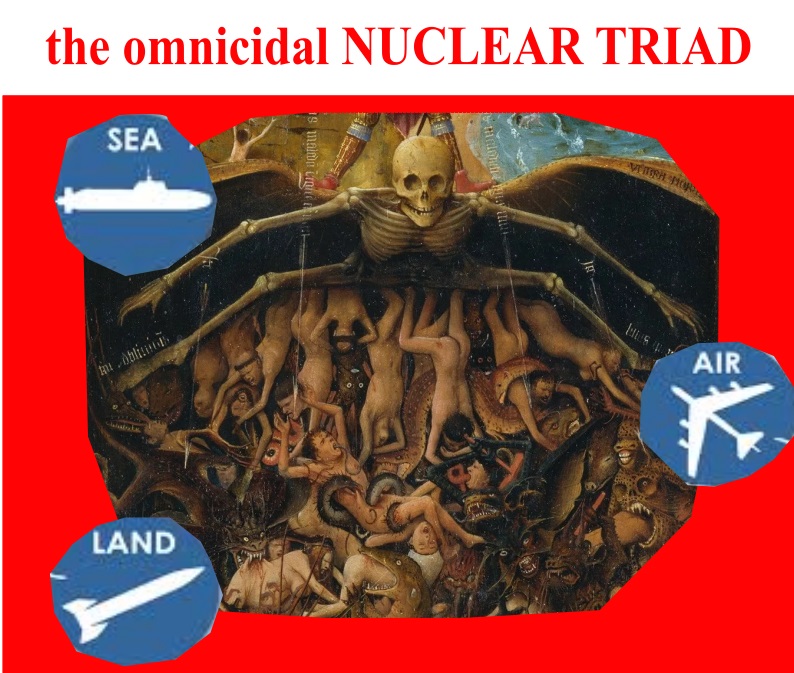
the U.S. military no longer needs nuclear strategic bombers and land-based ICBMs in order to threaten to destroy the planet.
that triad of potentially ultimate nuclear death had become so sacrosanct that it was untouchable
Even as the nuclear clock ticks ever closer to midnight, nobody is ducking and covering in America’s classrooms anymore (except against mass shooters).
Ending My Thermonuclear Odyssey
WILLIAM J. ASTORE, JUN 6, 2024, https://www.laprogressive.com/war-and-peace/ending-my-thermonuclear-odyssey
As a late-stage baby boomer, a child of the 1960s, I grew up dreaming about America’s nuclear triad. You may remember that it consisted of strategic bombers like the B-52 Stratofortress, land-based intercontinental ballistic missiles (ICBMs) like the Minuteman, and submarine-launched ballistic missiles (SLBMs) like the Poseidon, all delivery systems for what we then called “the Bomb.” I took it for granted that we needed all three “legs” — yes, that was also the term of the time — of that triad to ward off the Soviet Union (aka the “evil empire”).
It took me some time to realize that the triad was anything but the trinity, that it was instead a product of historical contingency. Certainly, my mind was clouded because two legs of that triad were the prerogative of the U.S. Air Force, my chosen branch of service. When I was a teenager, the Air Force had 1,054 ICBMs (mainly Minutemen missiles) in silos in rural states like Montana, North Dakota, and Wyoming, along with hundreds of strategic bombers kept on constant alert against the Soviet menace. They represented enormous power not just in destructive force measured in megatonnage but in budgetary authority for the Air Force. The final leg of that triad, the most “survivable” one in case of a nuclear war, was (and remains) the Navy’s SLBMs on nuclear submarines. (Back in the day, the Army was so jealous that it, too, tried to go atomic, but its nuclear artillery shells and tactical missiles were child’s play compared to the potentially holocaust-producing arsenals of the Air Force and Navy.)
When I said that the triad wasn’t the trinity, what I meant (the obvious aside) was this: the U.S. military no longer needs nuclear strategic bombers and land-based ICBMs in order to threaten to destroy the planet. As a retired Air Force officer who worked in Cheyenne Mountain, America’s nuclear redoubt, during the tail end of the first Cold War, and as a historian who once upon a time taught courses on the atomic bomb at the Air Force Academy, I have some knowledge and experience here. Those two “legs” of the nuclear triad, bombers and ICBMs, have long been redundant, obsolete, a total waste of taxpayer money — leaving aside, of course, that they would prove genocidal in an unprecedented fashion were they ever to be used.
Nevertheless, such thoughts have no effect on our military. Instead, the Air Force is pushing ahead with plans to field — yes! — a new strategic bomber, the B-21 Raider, and — yes, again! — a new ICBM, the Sentinel, whose combined price tag will likely exceed $500 billion. The first thing any sane commander-in-chief with an urge to help this country would do is cancel those new nuclear delivery systems tomorrow. Instead of rearming, America should begin disarming, but don’t hold your breath on that one.
A Brief History of America’s Nuclear Triad

It all started with atomic bombs and bombers. In August 1945, the Japanese cities of Hiroshima and Nagasaki were obliterated by two atomic bombs carried by B-29 bombers, ending World War II. However, in the years that followed, as the Cold War with the Soviet Union heated up, the only “delivery system” the military had for its growing thermonuclear arsenal was the strategic bomber. Those were the glory days of the Strategic Air Command, or SAC, whose motto (believe it or not) was “Peace Is Our Profession” — the “peace” of a mass nuclear grave, had those hydrogen bombs ever been dropped on their intended targets in the Soviet Union and China.
However, as this country’s weapons makers produced ever more powerful hydrogen bombs and strategic bombers, a revolution was afoot in missile technology. By the late 1950s, missiles tipped with nuclear warheads became a practical reality. By the 1960s, the Air Force was already lobbying for 10,000 ICBMs, even if my old service had to settle for a mere thousand or so of them during the administration of President John F. Kennedy. Meanwhile, the Navy was maneuvering its way into the act by demonstrating that it was indeed possible for mobile, difficult-to-detect submarines to carry nuclear-tipped missiles.
By the late 1960s, that triad of potentially ultimate nuclear death had become so sacrosanct that it was untouchable. More than half a century later, America’s nuclear triad has endured and, all too sadly, is likely to do so far longer than you or me (if not, of course, used).
You might wonder why that should be so. It’s not for any sensible military or strategic reason. By the 1980s, if not before, bombers and ICBMs were obsolete. That was why President Jimmy Carter canceled the B-1 bomber in 1977 (though it would be revived under President Ronald Reagan, with the Air Force buying 100 of those expensive, essentially useless aircraft). That was why the Air Force developed the “peacekeeper” MX ICBM, which was supposed to be mobile (shuffled around by rail) or hidden via an elaborate shell game. Such notions were soon abandoned, though not the missiles themselves, which were stuffed for a time into fixed silos. The endurance of such weapons systems owes everything to Air Force stubbornness and the lobbying power of the industrial side of the military-industrial complex, as well as to members of Congress loath to give up ICBM and bomber bases in their districts, no matter how costly, unnecessary, and omnicidal they may be.
In that light, consider the Navy’s current force of highly capable Ohio-class nuclear submarines. There are 14 of them, each armed with up to 20 Trident II missiles, each with up to eight warheads. We’re talking, in other words, about at least 160 potentially devastating nuclear explosions, each roughly five to 20 times more powerful than the Hiroshima bomb, from a single sub. In fact, it’s possible that just one of those submarines has an arsenal with enough destructive power not just to kill millions of us humans, but to tip the earth into a nuclear winter in which billions more of us could starve to death. And America has 14 of them!
Why, then, does the Air Force argue that it, too, “needs” new strategic bombers and ICBMs? The traditional arguments go like this: bombers can be launched as a show of resolve and, unlike missiles, recalled. They are also, allegedly, more flexible. In Air Force jargon, they can be rerouted against “targets of opportunity” in a future nuclear war. Of course, generals can always produce a scenario, however world-ending, to justify any weapons system, based on what an enemy might or might not do or discover. Nonetheless, strategic bombers were already nearing obsolescence when Stanley Kubrick made his classic antinuclear satire, Dr. Strangelove (1964), so prominently featuring them.
And what about land-based ICBMs? Once, the claim was that they had more “throw-weight” (bigger warheads) than SLBMs and were also more accurate (being launched from fixed silos rather than a mobile platform like a submarine). But with GPS and other advances in technology, submarine-launched missiles are now as accurate as land-based ones and “throw-weight” (sheer megatonnage) always mattered far less than accuracy.
Worse yet, land-based ICBMs in fixed silos are theoretically more vulnerable to an enemy “sneak” attack and so more escalatory in nature. The U.S. currently has 400 Minuteman III ICBMs sitting in silos. If possible incoming enemy nuclear missiles were detected, an American president might have less than 30 minutes — and possibly only 10 or so — to decide whether to launch this country’s ICBM force or risk losing it entirely.
That’s not much time to determine the all-too-literal fate of the planet, is it, especially given the risk that the enemy attack might prove to be a “false alarm“? Just before I arrived at Cheyenne Mountain, there were two such alarms (one stemming from a technical failure, the other from human error when a simulation tape was loaded into computers without any notification that it was just a “war game”). Until they were found to be false alarms, both led to elevated DEFCONs (defense readiness conditions) in preparation for possible nuclear war.
New ICBMs will only add “use them or lose them” pressure to the global situation. Mobile, elusive, and difficult to detect, the Navy’s submarine force is more than sufficient to deter any possible enemy from launching a nuclear attack on the United States. Strategic bombers and ICBMs add plenty of bang and bucks but only to the Air Force budget and the profits of the merchants of mass nuclear death who make them.
A Sane Path Forward for America’s Nuclear Force
I still remember the nuclear freeze movement, the stunningly popular antinuclear protest of the early 1980s. I also remember when President Reagan and Soviet leader Mikhail Gorbachev met in 1986 and seriously discussed total nuclear disarmament. I remember Barack Obama, as a 2008 presidential candidate, being joined by old Cold War stalwarts like Henry Kissinger and Sam Nunn in calling for the eventual elimination of nuclear weapons.
Today, we’re not supposed to recall any of that. Instead, we’re told to focus on the way a developing “new cold war” with Russia and China is driving a “requirement” for a “modernized” U.S. nuclear triad that could cost $2 trillion over the next 30 years. Meanwhile, we’re discouraged from thinking too much about the actual risks of nuclear war. The Biden administration, for example, professes little concern about the possibility that arming Ukraine with weaponry capable of hitting deep inside Russia could lead to destabilization and the possible use of nuclear weapons on the battlefield (something Vladimir Putin has threatened to do). Nor are we to fret about surrounding China with ever more U.S. military bases and sending ever more weaponry to Taiwan, while the Chinese are enlarging their own force of ICBMs; or, for that matter, about the fact that the last nuclear agreement limiting the size of the American and Russian arsenals will run out in less than 1,000 days.
To such issues, the only response America’s “best and brightest” ever have is this one: give us more/newer strategic bombers, more/newer ICBMs, and more/newer nuclear submarines (whatever the cost)! To those men, it’s as if nuclear war were a theoretical (and distinctly money-making) chess match—and yes, they are indeed still mostly men!—a challenging game whose only components are profits, jobs, money, and power. Yet when the only story to be told is one featuring more nuclear warheads and more delivery systems, it’s hard not to conclude that, in some horrific fashion, nuclear Armageddon is indeed us (or at least them).
And though few spend much time thinking about it anymore, that’s madness personified. What’s needed instead is a new conviction that a nuclear Armageddon must not be our fate and, to make that so, we must act to eliminate all ICBMs, cancel the B-21 bomber, retire the B-1s and B-2s, work on global nuclear disarmament, start thinking about how to get rid of those nuclear subs, and begin to imagine what it would be like to invest the money saved in rebuilding America. It sure beats destroying the world.
And again, in the most practical terms possible, if we’re set on preserving Armageddon, America’s existing force of Ohio-class nuclear submarines is more than enough both to do so and undoubtedly to “deter” any possible opponent.
There was a time, in the early stages of the first Cold War, when America’s leaders professed fears of “bomber” and “missile” gaps vis-à-vis the Soviet Union — gaps that existed only in their minds; or rather only in the reverse sense, since the U.S. was ahead of the Soviets in both technologies. Today, the bomber and missile “gaps” are, in fact, gaps in logic wielded by a Pentagon that insists strategic bombers and ICBMs remain a “must” for this country’s safety and security.
It’s all such nonsense, and I’m disgusted by it. I want my personal thermonuclear odyssey to come to an end. As a kid in the 1970s, I built a model of the B-1 bomber. As a ROTC cadet in the early 1980s, I made a presentation on the U.S./Soviet nuclear balance. As a young Air Force officer, I hunkered down in Cheyenne Mountain, awaiting a nuclear attack that fortunately never came. When I visited Los Alamos and the Trinity Test Site at Alamogordo, New Mexico, in 1992, I saw what J. Robert Oppenheimer’s original atomic “gadget” had done to the tower from which it had been suspended. When the Soviet Union collapsed, I genuinely hoped that this country’s (and the world’s) long nuclear nightmare might finally be coming to an end.
Tragically, it was not to be. The gloomy Los Alamos of 1992, faced with serious cuts to its nuclear-weapons-producing budget, is once again an ebullient boom town. Lots of new plutonium pits are being dug. Lots more money is flooding in to give birth to a new generation of nuclear weapons. Of course, it’s madness, sheer madness, yet this time, it’s all happening so quietly.
U.S. Considers Expanded Nuclear Arsenal, a Reversal of Decades of Cuts.
By Julian E. Barnes and David E. Sanger, Reporting from Washington, June 7, 2024 https://www.nytimes.com/2024/06/07/us/politics/us-nuclear-russia-china.html
A senior Biden administration official warned on Friday that “absent a change” in nuclear strategy by China and Russia, the United States may be forced to expand its nuclear arsenal, after decades of cutting back through now largely abandoned arms control agreements.
The comments on Friday from Pranay Vaddi, a senior director of the National Security Council, were the most explicit public warning yet that the United States was prepared to shift from simply modernizing its arsenal to expanding it. They were also a warning to President Vladimir V. Putin of Russia about the likely U.S. reaction if the last major nuclear arms control agreement, called New START, expires in February 2026 with no replacement.
Mr. Vaddi, speaking at the annual meeting of the Arms Control Association, a group that advocates limits on nuclear weapons, confirmed what officials have been saying in private conversations and closed congressional testimony for more than a year. It is the inevitable outgrowth, they have argued, of China’s rapid nuclear expansion and Russia’s repeated threats to use tactical nuclear weapons in Ukraine.
But it would be an epochal shift, and one fraught with dangers that many Americans thought they had left behind at the end of the Cold War and the collapse of the Soviet Union.
Fifteen years ago, President Barack Obama outlined a vision of moving toward a world without nuclear weapons, and he took steps to reduce their role in American strategy and defenses. While the nation’s nuclear complexes were improved and made safer, and old weapons were swapped out for more reliable or updated versions, the United States insisted it was only “modernizing” its arsenal, not expanding it.
As vice president in the Obama administration, President Biden became the spokesman for this strategy.
At the time, China was still maintaining its “minimum deterrent” policy, which dates back to its first nuclear test in 1964, and Mr. Putin appeared to have little interest in fiscally ruinous arms races. That has now changed.
China is on a path to match the number of American and Russian deployed nuclear weapons by 2035, according to the Pentagon’s public estimates. Mr. Putin has fixated on unusual weapons, including an undersea nuclear torpedo that could be launched across the Pacific to destroy the West Coast of the United States. And the United States has warned in recent months that Russia has a program underway to put a nuclear bomb into orbit.
There have been no discussions with Russia since it invaded Ukraine about negotiating a replacement for New START, which limits each country to 1,550 deployed strategic nuclear weapons, the kind that can be launched from one continent to another.
China has been unwilling to engage in deep nuclear talks with the United States, making it clear that it is not interested in arms control until its own arsenal is comparable to that of the two biggest nuclear powers. (Britain, France, India, Pakistan, Israel and North Korea all have arsenals of their own, though with much smaller numbers.)
While the Biden administration has not abandoned its rhetorical support of a world without nuclear weapons, officials have acknowledged that the prospects of new arms control deals are now so remote that they have to think about new strategies.
“Absent a change in the trajectory of the adversary arsenal, we may reach a point in the coming years where an increase from current deployed numbers is required, and we need to be fully prepared to execute if the president makes that decision,” he said.
The United States remains ready to pursue arms control agreements to reduce nuclear threats by “limiting and shaping” adversaries’ nuclear forces, Mr. Vaddi said. And citing the history of separate diplomatic tracks for such agreements, he suggested Russia’s war in Ukraine would not be a barrier to a discussion.
But he said Russia’s rejection of talks to a successor agreement to New Start has “cast a shadow” over diplomatic issues.
“At least in the near term, the prospects for strategic arms control are dim,” he said.
A year ago, at the same conference, Jake Sullivan, the national security adviser, pledged a renewed effort to bring China into arms control talks. Since that speech, the United States has tried to engage the Chinese on nuclear safety issues and recently conducted the first talks, in Geneva, to address whether it would be possible to reach an accord that artificial intelligence should never control nuclear weapons, among other limitations.
That meeting was preliminary, and it is unclear if others are to follow. While China has urged the United States to adopt what it calls its “no first use” policy for employing nuclear weapons, it has not engaged substantively with the American proposals.
One of the complications of the current nuclear environment, administration officials say, is the potential that Russia and China may coordinate their nuclear policies, part of the “partnership without limits” that Mr. Putin and Xi Jinping, the Chinese leader, announced in 2022.
The failure of Russia and China to engage in meaningful negotiations, Mr. Vaddi said, was “forcing the United States and our close allies and partners to prepare for a world where nuclear competition occurs without numerical constraints.”
Modernizing the American nuclear arsenal, he argued, will give both Russia and China an incentive to go back to the negotiating table and put Washington at a stronger place in those talks.
“We need to persuade our adversaries that managing rivalry through arms control is preferable to unrestrained competition,” he said.
Julian E. Barnes covers the U.S. intelligence agencies and international security matters for The Times. He has written about security issues for more than two decades. More about Julian E. Barnes
David E. Sanger covers the Biden administration and national security. He has been a Times journalist for more than four decades and has written several books on challenges to American national security. More about David E. Sanger
US Bombs Used in Israeli Massacre of 40 in Gaza Refugee Camp
By Sharon Zhang / Truthout June 7, 2024, https://scheerpost.com/2024/06/07/us-bombs-used-in-israeli-massacre-of-40-in-gaza-refugee-camp/
The targeting of the UN school-turned-shelter is a “blatant” violation of international law, one UN official said.
n Israeli bombing that killed 40 Palestinians and wounded 74 sheltering in a UN school-turned-shelter in a refugee camp in central Gaza on Thursday was carried out using U.S.-made weapons, an analysis finds.
Fragments of at least two U.S.-made GBU-39 small diameter bombs were found at the scene of the bombing on the Nuseirat refugee camp, CNN found in a review that concluded they were used in the devastating overnight strike.
The bombing, which Gaza officials say killed at least 14 children and wounded 23, is a “blatant” violation of international law, human rights groups have said. International law prohibits targeting civilians and civilian infrastructure in war.
“Attacking, targeting or using UN buildings for military purposes are a blatant disregard of International Humanitarian law,” said UN Relief and Works Agency for Palestine Refugees (UNRWA) Commissioner-General Philippe Lazzarini. “UNRWA shares the coordinates of all its facilities (including this school) with the Israeli Army and other parties to the conflict. Targeting UN premises or using them for military purposes cannot become the new norm.”
Israeli human rights group B’Tselem said that the attack is a “suspected war crime.”
If these assessments are correct, this represents direct evidence that U.S. military assistance is being used by Israeli forces to commit war crimes. U.S. weapons have been used in many war crimes committed by Israeli forces in recent months, previous reports have found.
These assessments run contrary to a recent report released by the State Department concluding that it’s “reasonable to assess” that U.S. weapons have been used in violation of international law, but that there is not enough direct evidence of Israel’s culpability in slaughtering civilians en masse. If that report had directly concluded that U.S. weapons are being used to commit Israeli war crimes, it would have spurred the U.S. to consider withholding military aid to Israel in accordance with U.S. and international law.
The conclusions of the report raised an uproar. A U.S. State Department official who quit after the release of the report said that its conclusions were fabricated by higher ups in the department to provide cover for U.S. officials working to send Israel yet more aid to be used to commit atrocities against Palestinians.
Eyewitnesses say the attack on the Nuseirat school was horrific, with Israeli forces releasing two bombs on the building that was sheltering 6,000 Palestinians who had been displaced multiple times over the course of Israel’s genocide. At the site of the attack, the smell of blood hangs heavy in the air, reported Palestinian journalist Hind Khoudary.
“We were inside the school and suddenly we were bombed, people here turned to pieces on a harsh night … this building housed families and young people, and the shelling took place without warning,” survivor Anas al-Dahouk told Al Jazeera.
The school is one of the many UNRWA facilities that have been targeted by Israeli forces since October. According to Lazzarini, 180 UNRWA buildings have been attacked, killing at least 450 Palestinians in UN facilities alone.
According to the official death toll, Israel’s genocidal assault has killed at least 36,600 Palestinians. But the true death toll is likely far higher, as thousands more Palestinians are missing and presumed to be dead under the rubble of buildings bombed by Israel. The count also doesn’t include those who have died for reasons like starvation or illness outside of health facilities in the region.
CNN’s Israel bias has been laid bare. But CNN is the norm, not the exception
Middle East Eye, By Jonathan Cook, 9 February 2024
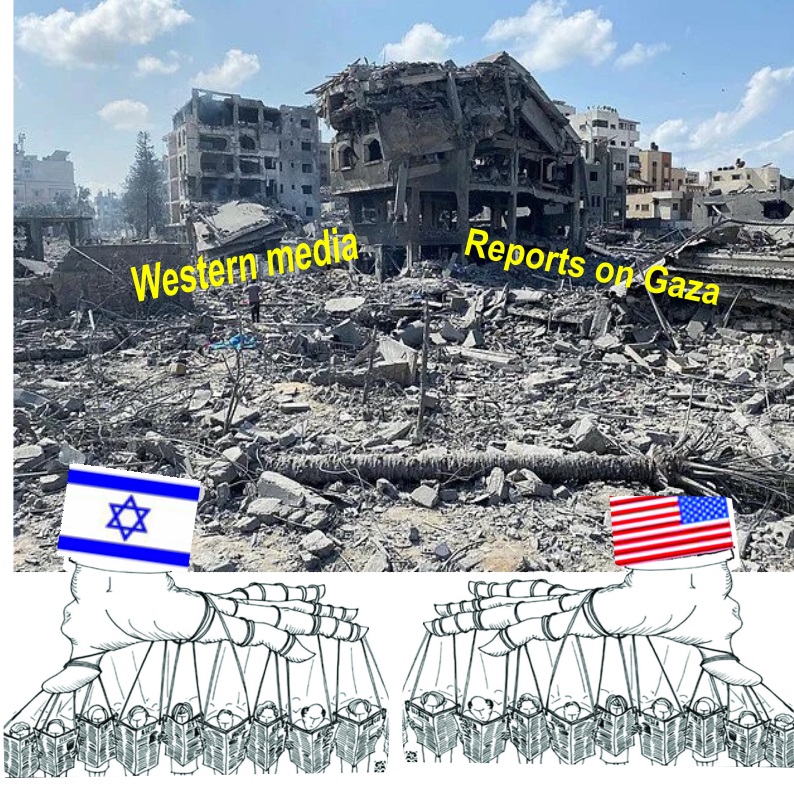
Western media can never truly report the extent of Israel’s criminality because to do so would be to expose their long-running complicity in those crimes
eaks from within CNN reveal that for months its executives have been actively imposing an editorial line designed to reinforce Israel’s framing of events in Gaza, to the point of obscuring atrocities by the Israeli military.
The dictates, say insiders, have resulted in senior staff refusing to accept assignments to the region “because they do not believe they will be free to tell the whole story”. Others suspect they are being kept away by editors who fear they will fight the restrictions.
Internal memos insist that stories be approved by the station’s Jerusalem bureau, where staff are widely seen as partisans who slant reports in Israel’s favour. Palestinian perspectives are tightly restricted.
“Ultimately, CNN’s coverage of the Israel-Gaza war amounts to journalistic malpractice,” one staffer told an investigation by the Guardian newspaper.
According to staff accounts, CNN’s pro-Israel directives come from the very top – Mark Thompson, a TV executive who was hired from the BBC. Thompson, the Guardian article notes, was remembered by BBC staff for “bowing to Israeli government pressure on a number of occasions” – presumably one of the qualifications that won him the job heading CNN.
It was he who notoriously championed in 2009 the BBC’s controversial decision for the first time not to air the annual fundraising appeal of the Disasters Emergency Committee, which is a group of major British charities, because the monies were going to Gaza after Israeli bombing had devastated it.
Alongside the unhappiness at CNN, there is reported to be disquiet at the BBC. Staff, including senior presenters, held a meeting last month with Director General Tim Davie, one of Thompson’s successors, to accuse the corporation of anti-Palestinian bias.
They expressed concerns about the “dehumanising” language used to describe Palestinians killed in Gaza and the BBC’s failure to cover important stories reported by Al Jazeera and other networks.
A source told the Deadline website that the group of dissenters was surprised by Davie’s candour. He is said to have admitted that the pro-Israel lobby “was more organised than Palestinian supporters in its dealings with the BBC”.
Skewed agendas
None of this should come as a surprise.
Middle East Eye has highlighted the clearly skewed priorities of western news agendas since Hamas broke out of Gaza on 7 October – some 17 years after Israel began imposing a military siege that had already left the enclave barely habitable.
In the carnage that day caused by Hamas’ attack – as well as Israel’s indiscriminate violent response – some 1,139 people in Israel were killed.
As MEE has noted previously, the entire western press corps, not just CNN and the BBC, has failed in its basic duty to present a balanced picture of what has been going on over the past four months.
It has also failed to treat Israeli claims with the scepticism they deserve, especially since Israel has a long track record of being caught out in lies and deceptions.
Paradoxically, given its exposure of concerns at CNN, many of the accusations of journalistic failure levelled at CNN and the BBC could be directed at the Guardian newspaper too – or any other establishment media organisation.
Following Hamas’ 7 October break-out, Israel unleashed a devastating assault on Gaza’s population – so far leaving tens of thousands of Palestinians dead or missing under rubble.
Yet all western media misleadingly continue to frame Israel’s rampage in Gaza – including the collective punishment inflicted on civilians by denying them food and water – variously as “retaliation”, “a war with Hamas”, and “an operation to eliminate Hamas”.
Western media have also largely avoided characterising as “ethnic cleansing” the Israeli military’s order for Palestinians to leave their homes. As a result, 1.7 million have been trapped in a small area in southern Gaza where they face relentless bombing.
Similarly, there has been almost no mention of a long-held plan by Israel – which it now appears close to realising – to drive Gaza’s population into the Sinai desert, in neighbouring Egypt.
And the same media outlets have refused to connect the all-too-obvious dots that Israel – in destroying most of Gaza’s homes, forcibly shutting almost all of its medical facilities and cutting off food and water, while also demanding international defunding of Unrwa, the United Nations’ main aid agency to Gaza – is pursuing an openly genocidal policy.
Israel is making Gaza unlivable, just as Giora Eiland, adviser to the Israeli defence minister, vowed Israel would do at the outset of its assault: “Gaza will become an area where people cannot live.”
When the media do refer to genocide, it is strictly in the context of the International Court of Justice’s decision to put Israel on trial for the “crime of crimes”. Even then, the establishment media have largely minimised the significance of the World Court’s ruling, or even spun it as a victory for Israel.
Astonishingly, the ICJ’s panel of 17 justices has proven to be far more courageous than western media journalists. ……………………………………………………………………………………………………………………………..
Career suicide
The problem is not just that the western media have acted as one in blanking out persuasive evidence of the crimes Israel committed on 7 October. They have also, again as one, been credulously ascribing particularly barbarous crimes to Hamas on the most tenuous of evidence – unsubstantiated claims that Israel has then been using to justify its genocidal rampage.
That started in the immediate wake of 7 October with allegations that Hamas had variously beheaded babies, hung them from washing lines and roasted them in ovens. These claims were even echoed by the White House.
There is still zero evidence for any of them.
CNN staff are upset that Hadas Gold, one of its reporters in Jerusalem – part of the unit vetting all copy about Gaza – uncritically recycled lies from the office of Israeli Prime Minister Benjamin Netanyahu………………………………………………………………………………………………………………………..
The real pressures
The Guardian offers various explanations for why CNN has failed so dismally to cover properly the slaughter in Gaza. All have an element of truth about them.
CNN is indeed afraid of antagonising the US government and challenging a critical part of its foreign policy agenda.
There are undoubted commercial pressures from advertisers. The Israel lobby can be confident its threats will be taken seriously when journalists face being accused of antisemitism for stepping out of line. And all of these pressures are compounded by the difficulties its journalists face in accessing Gaza.
But what the Guardian does not want its readers to notice is that all of these pressures apply not just to CNN but to every other corporate media outfit, including the Guardian itself. Which is why the failures are across the board, not confined to one or two broadcasters. …………………………………………………………….
The large corporations and billionaires that own the media are heavily invested in the arms and fossil fuel industries that require the West’s continuing colonial-style, military dominance of the planet and its resources……………………………… more https://www.middleeasteye.net/big-story/cnn-israel-bias-laid-bare-norm-not-exception
Speaker Johnson, hear the prayers of nuclear weapons testing victims. It’s time to act.
2 B1 Radiation Exposure Compensation for impacted downwind communities is expiring Friday. Speaker Johnson, bring it to a vote.
James Moylan and Leslie Begay, https://www.usatoday.com/story/opinion/2024/06/04/congress-radiation-exposure-compensation-act-extension/73910553007/
The 20th century saw no shortage of patriotic Americans stepping up to serve our nation. We both know this well: As young men, we served in the U.S. military – Mr. Leslie Begay as a combat Marine in Vietnam, and Rep. James Moylan as a veteran of the Army. As a country, it is our solemn responsibility to support those who have made sacrifices on our behalf.
We should also honor many thousands of Americans who did not enlist yet also sacrificed for our national security.
These patriots of the Manhattan Project and Cold War were unknowingly poisoned by their own government in the creation of our nuclear arsenal, and they deserve our support. The Radiation Exposure Compensation Act (RECA), which aims to address those harms, will expire Friday unless Congress acts immediately.
This is urgent: Congress has only a few working days left to act before RECA expires.
As we mined uranium and built and tested nuclear weapons that defended our country, we exposed countless service members and communities across the country to dangerous, often deadly levels of radiation without their knowledge or consent. In some cases, we’re only just learning the full extent of that harm, with impacted Americans succumbing to new cancers every day.
RECA was created in 1990 to provide an apology and a small reimbursement for critical medical care for some victims. It is a valuable program, but it has excluded far too many Americans who were harmed, and nearly 35 years later, it is still woefully inadequate despite years of studies and reports proving the need for improvement.
In Guam, for example, a 2005 report determined that residents during nuclear testing in the Pacific received substantial unwarranted radiation and should be eligible for RECA. Yet nearly 20 years later, they are still awaiting recognition and support.
Additionally, uranium workers are only eligible for RECA if they were employed through 1971, despite a flood of studies showing that they faced just as grave health impacts after that year. This means that patriotic Americans like Mr. Begay have been suffering for decades with no avenues for support.
Uranium miner lost both lungs due to radiation exposure
Mr. Begay was born and raised in the Navajo Nation. After serving in Vietnam, he came home and spent eight years mining the uranium that built our nuclear weapons. He was given a hard hat and no mask, was never told he was being poisoned, and he ended up losing both lungs due to radiation exposure. Given just a month to live, he received a double lung transplant. As he recovered, he decided to dedicate his remaining years to helping his people and improving RECA.
As lucky as he feels to have a new set of lungs, his health issues are far from over. With no cancer center or veterans’ hospital on the Navajo Nation, he had to move away from his wife and grandkids to live near a hospital in Mesa, Arizona, so that he could attend almost weekly medical appointments. He is on 22 medications that he’ll take for the rest of his life – and they don’t come cheap.
He has had to sell all his cattle to pay for these expenses, and sometimes he and his wife don’t know where the money will come from to cover his next medical bill. Even worse – he’s just had a biopsy because of a possible new cancer diagnosis.
Oppenheimer nuclear fallout still kills:Time is running out for American victims of nuclear tests. Congress must do what’s right.
The people of Guam and miners like Mr. Begay are far from alone.
Across the West, communities living downwind of nuclear testing – including those downwind of the very first nuclear test in New Mexico – were excluded from RECA seemingly arbitrarily.
Victims of illegally stored nuclear waste in Missouri have also suffered from devastating illnesses, with nowhere to turn.
US creation of nuclear arsenal sacrificed our own people
The United States asked its people for a great deal of sacrifice to win the Cold War – some willingly as part of their service and many thousands unknowingly.
We have a duty now to take care of everyone sickened by their own government in the creation of our nuclear arsenal. It’s long past time that Congress does its job and improves RECA so these patriotic Americans can get the recognition and help they so richly deserve.
Oscar honors ‘Oppenheimer,’but what about Americans still suffering from nuke tests?
Some have called for a plain extension of RECA as is, but we know that would only be an extension of injustice. We must not blindly extend such an obviously flawed program, knowing that it would leave so many Americans behind.
On May 16, we stood together with dozens of advocates who had traveled to Washington, D.C., from across America to fight for RECA. They traveled on behalf of their loved ones – many of whom are sick and dying – and pleaded with Congress: Don’t let us go home without good news; don’t keep letting our people die.
In March, armed with new information about the true scope of Americans harmed by our Cold War nuclear program, the Senate passed a bill with overwhelming bipartisan support to hugely improve RECA.
Now, that bill is sitting on House Speaker Mike Johnson’s desk waiting to be brought to a vote.
Speaker Johnson: Please hear our prayers. It’s time to finally support these patriots, harmed by their own government, and get them the justice they deserve.
Rep. James Moylan, Guam’s delegate in the 118th Congress, is a lead sponsor of the Radiation Exposure Compensation Act Amendments of 2023. He is an Army Veteran and a native of Guam from the village of Tumon.
Mr. Leslie Begay is an enrolled member of the Navajo Nation and a resident of Coyote Canyon, New Mexico. He is a post-1971 uranium miner, Vietnam War veteran and volunteer member of the Navajo Uranium Radiation Victims Committee. He previously worked at Fort Wingate Army Depot.
What’s Next for Battlefield America? Israel’s High-Tech Military Tactics Point the Way

“I did not know Israel was capturing or recording my face. [But Israel has] been watching us for years from the sky with their drones. They have been watching us gardening and going to schools and kissing our wives. I feel like I have been watched for so long.”—Mosab Abu Toha, Palestinian poet
If you want a glimpse of the next stage of America’s transformation into a police state, look no further than how Israel—a long-time recipient of hundreds of billions of dollars in foreign aid from the U.S.—uses its high-tech military tactics, surveillance and weaponry to advance its authoritarian agenda.
Military checkpoints. Wall-to-wall mass surveillance. Predictive policing. Aerial surveillance that tracks your movements wherever you go and whatever you do. AI-powered facial recognition and biometric programs carried out with the knowledge or consent of those targeted by it. Cyber-intelligence. Detention centers. Brutal interrogation tactics. Weaponized drones. Combat robots.
We’ve already seen many of these military tactics and technologies deployed on American soil and used against the populace, especially along the border regions, a testament to the heavy influence Israel’s military-industrial complex has had on U.S. policing.
Indeed, Israel has become one of the largest developers and exporters of military weapons and technologies of oppression worldwide.
Journalist Antony Loewenstein has warned that Pegasus, one of Israel’s most invasive pieces of spyware, which allows any government or military intelligence or police department to spy on someone’s phone and get all the information from that phone, has become a favorite tool of oppressive regimes around the world. The FBI and NYPD have also been recipients of the surveillance technology which promises to turn any “target’s smartphone into an intelligence gold mine.”
Yet it’s not just military weapons that Israel is exporting. They’re also helping to transform local police agencies into extensions of the military.
According to The Intercept, thousands of American law enforcement officers frequently travel for training to Israel, “one of the few countries where policing and militarism are even more deeply intertwined than they are here,” as part of an ongoing exchange program that largely flies under the radar of public scrutiny.
A 2018 investigative report concluded that imported military techniques by way of these exchange programs that allow police to study in Israel have changed American policing for the worse. “Upon their return, U.S. law enforcement delegates implement practices learned from Israel’s use of invasive surveillance, blatant racial profiling, and repressive force against dissent,” the report states. “Rather than promoting security for all, these programs facilitate an exchange of methods in state violence and control that endanger us all.”
“At the very least,” notes journalist Matthew Petti, “visits to Israel have helped American police justify more snooping on citizens and stricter secrecy. Critics also assert that Israeli training encourages excessive force.”
Petti documents how the NYPD set up a permanent liaison office in Israel in the wake of 9/11, eventually implementing “one of the first post-9/11 counterterrorism programs that explicitly followed the Israeli model. In 2002, the NYPD tasked a secret ‘Demographics Unit’ with spying on Muslim-American communities. Dedicated ‘mosque crawlers’ infiltrated local Muslim congregations and attempted to bait worshippers with talk of violent revolution.”
That was merely the start of American police forces being trained in martial law by foreign nations under the guise of national security theater. It has all been downhill from there.
As Alex Vitale, a sociology professor who has studied the rise of global policing, explains, “The focus of this training is on riot suppression, counterinsurgency, and counterterrorism—all of which are essentially irrelevant or should be irrelevant to the vast majority of police departments. They shouldn’t be suppressing protest, they shouldn’t be engaging in counterinsurgency, and almost none of them face any real threat from terrorism.”
This ongoing transformation of the American homeland into a techno-battlefield tracks unnervingly with the dystopian cinematic visions of Steven Spielberg’s Minority Report and Neill Blomkamp’s Elysium, both of which are set 30 years from now, in the year 2054.
In Minority Report, police agencies harvest intelligence from widespread surveillance, behavior prediction technologies, data mining, precognitive technology, and neighborhood and family snitch programs in order to capture would-be criminals before they can do any damage.
While Blomkamp’s Elysium acts as a vehicle to raise concerns about immigration, access to healthcare, worker’s rights, and socioeconomic stratification, what was most striking was its eerie depiction of how the government will employ technologies such as drones, tasers and biometric scanners to track, target and control the populace, especially dissidents.
With Israel in the driver’s seat and Minority Report and Elysium on the horizon, it’s not so far-fetched to imagine how the American police state will use these emerging technologies to lock down the populace, root out dissidents, and ostensibly establish an “open-air prison” with disconcerting similarities to Israel’s technological occupation of present-day Palestine.
For those who insist that such things are celluloid fantasies with no connection to the present, we offer the following as a warning of the totalitarian future at our doorsteps.
Facial Recognition
Fiction: One of the most jarring scenes in Elysium occurs towards the beginning of the film, when the protagonist Max Da Costa waits to board a bus on his way to work. While standing in line, Max is approached by two large robotic police officers, who quickly scan Max’s biometrics, cross-check his data against government files, and identify him as a former convict in need of close inspection. They demand to search his bag, a request which Max resists, insisting that there is nothing for them to see. The robotic cops respond by manhandling Max, throwing him to the ground, and breaking his arm with a police baton. After determining that Max poses no threat, they leave him on the ground and continue their patrol. Likewise, in Minority Report, police use holographic data screens, city-wide surveillance cameras, dimensional maps and database feeds to monitor the movements of its citizens and preemptively target suspects for interrogation and containment.
Fact: We now find ourselves in the unenviable position of being monitored, managed, corralled and controlled by technologies that answer to government and corporate rulers. This is exactly how Palestinian poet and New Yorker contributor Mosab Abu Toha found himself, within minutes of passing through an Israeli military checkpoint in Gaza with his wife and children in tow, asked to step out line, only to be blindfolded, handcuffed, interrogated, then imprisoned in an Israeli detention center for two days, beaten and further interrogated. Toha was finally released in what Israeli soldiers chalked up to a “mistake,” yet there was no mistaking the AI-powered facial recognition technology that was used to pull him out of line, identify him, and label him (erroneously) as a person of interest.
Drones
Fiction: In another Elysium scene, Max is hunted by four drones while attempting to elude the authorities. The drones, equipped with x-ray cameras, biometric readers, scanners and weapons, are able to scan whole neighborhoods, identify individuals from a distance—even through buildings, report their findings back to police handlers, pursue a suspect, and target them with tasers and an array of lethal weapons.
Fact: Drones, some deceptively small and yet powerful enough to capture the facial expressions of people hundreds of feet below them, have ushered in a new age of surveillance. Not even those indoors, in the privacy of their homes, will be safe from these aerial spies, which can be equipped with technology capable of peering through walls. In addition to their surveillance capabilities, drones can also be equipped with automatic weapons, grenade launchers, tear gas, and tasers.
Biometric scanners and national IDs
Fiction: Throughout Elysium, citizens are identified, sorted and dealt with by way of various scanning devices that read their biometrics—irises, DNA, etc.—as well as their national ID numbers, imprinted by a laser into their skin. In this way, citizens are tracked, counted, and classified. Likewise, in Minority Report, tiny sensory-guided spider robots converge on a suspected would-be criminal, scan his biometric data and feed it into a central government database. The end result is that there is nowhere to run and nowhere to hide to escape the government’s all-seeing eyes.
Fact: Given the vast troves of data that various world governments, including Israel and the U.S., is collecting on its citizens and non-citizens alike, we are not far from a future where there is nowhere to run and nowhere to hide. In fact, between the facial recognition technology being handed out to law enforcement, license plate readers being installed on police cruisers, local police creating DNA databases by extracting DNA from non-criminals, including the victims of crimes, and police collecting more and more biometric data such as iris scans, we are approaching the end of anonymity. It won’t be long before police officers will be able to pull up a full biography on any given person instantaneously, including their family and medical history, bank accounts, and personal peccadilloes. It’s already moving in that direction in more authoritarian regimes.
Predictive Policing
Fiction: In Minority Report, John Anderton, Chief of the Department of Pre-Crime, finds himself identified as the next would-be criminal and targeted for preemptive measures by the very technology that he relies on for his predictive policing. Consequently, Anderton finds himself not only attempting to prove his innocence but forced to take drastic measures in order to avoid capture in a surveillance state that uses biometric data and sophisticated computer networks to track its citizens.
Fact: Precrime, which aims to prevent crimes before they happen, has justified the use of widespread surveillance, behavior prediction technologies, data mining, precognitive technology, and snitch programs. As political science professor Anwar Mhajne documents, Israel has used all of these tools in its military engagements with Palestine: deploying AI surveillance and predictive policing systems in Palestinian territories; utilizing facial recognition technology to monitor and regulate the movement of Palestinians; subjecting Palestinians to facial recognition scans at checkpoints, with a color-coded mechanism to dictate who should be allowed to proceed, subjected to further questioning, or detained.
Making the Leap from Fiction to Reality
When Aldous Huxley wrote Brave New World in 1931, he was convinced that there was “still plenty of time” before his dystopian vision became a nightmare reality. It wasn’t long, however, before he realized that his prophecies were coming true far sooner than he had imagined.
Israel’s military influence on the United States, its advances in technological weaponry, and its rigid demand for compliance are pushing us towards a world in chains.
Through its oppressive use of surveillance technology, Israel has erected the world’s first open-air prison, and in the process, has made itself a model for the United States.
What we cannot afford to overlook, however, is the extent to which the American Police State is taking its cues from Israel.
As I make clear in my book Battlefield America: The War on the American People and in its fictional counterpart The Erik Blair Diaries, we may not be an occupied territory, but that does not make the electronic concentration camp being erected around us any less of a prison.
The Military-Industrial Complex Is Killing Us All
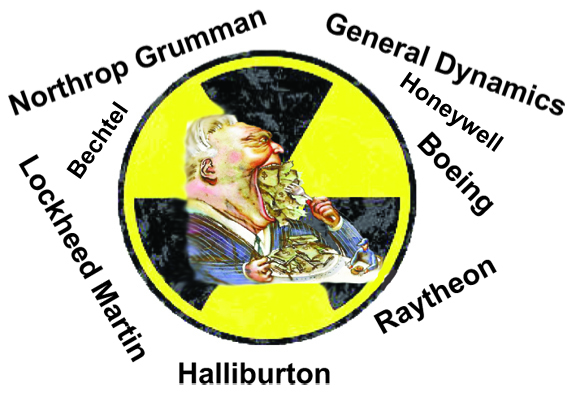
The bulk of our taxpayer dollars are seized by a relatively small group of corporate war profiteers led by the five biggest companies profiting off the war industry: Lockheed Martin, Northrop Grumman, Raytheon (RTX), Boeing, and General Dynamics.
The basic system works like this: First, Congress takes exorbitant sums of money from us taxpayers every year and gives it to the Pentagon. Second, the Pentagon, at Congress’s direction, turns huge chunks of that money over to weapons makers and other corporations via all too lucrative contracts, gifting them tens of billions of dollars in profits. Third, those contractors then use a portion of the profits to lobby Congress for yet more Pentagon contracts, which Congress is generally thrilled to provide, perpetuating a seemingly endless cycle.
Freeing Ourselves from the Monster Destroying Our Planet and Our Futures
TomDispatch, BY DAVID VINE AND THERESA (ISA) ARRIOLA, 2 June 24
We need to talk about what bombs do in war. Bombs shred flesh. Bombs shatter bones. Bombs dismember. Bombs cause brains, lungs, and other organs to shake so violently they bleed, rupture, and cease functioning. Bombs injure. Bombs kill. Bombs destroy.
Bombs also make people rich.
When a bomb explodes, someone profits. And when someone profits, bombs claim more unseen victims. Every dollar spent on a bomb is a dollar not spent saving a life from a preventable death, a dollar not spent curing cancer, a dollar not spent educating children. That’s why, so long ago, retired five-star general and President Dwight D. Eisenhower rightly called spending on bombs and all things military a “theft.”
The perpetrator of that theft is perhaps the world’s most overlooked destructive force. It looms unnoticed behind so many major problems in the United States and the world today. Eisenhower famously warned Americans about it in his 1961 farewell address, calling it for the first time “the military-industrial complex,” or the MIC.
Start with the fact that, thanks to the MIC’s ability to hijack the federal budget, total annual military spending is far larger than most people realize: around $1,500,000,000,000 ($1.5 trillion). Contrary to what the MIC scares us into believing, that incomprehensibly large figure is monstrously out of proportion to the few military threats facing the United States. One-and-a-half trillion dollars is about double what Congress spends annually on all non-military purposes combined.
Calling this massive transfer of wealth a “theft” is no exaggeration, since it’s taken from pressing needs like ending hunger and homelessness, offering free college and pre-K, providing universal health care, and building a green energy infrastructure to save ourselves from climate change. Virtually every major problem touched by federal resources could be ameliorated or solved with fractions of the cash claimed by the MIC. The money is there.
The bulk of our taxpayer dollars are seized by a relatively small group of corporate war profiteers led by the five biggest companies profiting off the war industry: Lockheed Martin, Northrop Grumman, Raytheon (RTX), Boeing, and General Dynamics. As those companies have profited, the MIC has sowed incomprehensible destruction globally, keeping the United States locked in endless wars that, since 2001, have killed an estimated 4.5 million people, injured tens of millions more, and displaced at least 38 million, according to Brown University’s Costs of War Project.
The MIC’s hidden domination of our lives must end, which means we must dismantle it. That may sound totally unrealistic, even fantastical. It is not. And by the way, we’re talking about dismantling the MIC, not the military itself. (Most members of the military are, in fact, among that the MIC’s victims.)
While profit has long been part of war, the MIC is a relatively new, post-World War II phenomenon that formed thanks to a series of choices made over time. Like other processes, like other choices, they can be reversed and the MIC can be dismantled.
The question, of course, is how?
The Emergence of a Monster
To face what it would take to dismantle the MIC, it’s first necessary to understand how it was born and what it looks like today. Given its startling size and intricacy, we and a team of colleagues created a series of graphics to help visualize the MIC and the harm it inflicts, which we’re sharing publicly for the first time.
The MIC was born after World War II from, as Eisenhower explained, the “conjunction of an immense military establishment” — the Pentagon, the armed forces, intelligence agencies, and others — “and a large arms industry.” Those two forces, the military and the industrial, united with Congress to form an unholy “Iron Triangle” or what some scholars believe Eisenhower initially and more accurately called the military-industrial–congressional complex. To this day those three have remained the heart of the MIC, locked in a self-perpetuating cycle of legalized corruption (that also features all too many illegalities).
The basic system works like this: First, Congress takes exorbitant sums of money from us taxpayers every year and gives it to the Pentagon. Second, the Pentagon, at Congress’s direction, turns huge chunks of that money over to weapons makers and other corporations via all too lucrative contracts, gifting them tens of billions of dollars in profits. Third, those contractors then use a portion of the profits to lobby Congress for yet more Pentagon contracts, which Congress is generally thrilled to provide, perpetuating a seemingly endless cycle.
But the MIC is more complicated and insidious than that. In what’s effectively a system of legalized bribery, campaign donations regularly help boost Pentagon budgets and ensure the awarding of yet more lucrative contracts, often benefiting a small number of contractors in a congressional district or state. Such contractors make their case with the help of a virtual army of more than 900 Washington-based lobbyists. Many of them are former Pentagon officials, or former members of Congress or congressional staffers, hired through a “revolving door” that takes advantage of their ability to lobby former colleagues. Such contractors also donate to think tanks and university centers willing to support increased Pentagon spending, weapons programs, and a hyper-militarized foreign policy. Ads are another way to push weapons programs on elected officials.
Such weapons makers also spread their manufacturing among as many Congressional districts as possible, allowing senators and representatives to claim credit for jobs created. MIC jobs, in turn, often create cycles of dependency in low-income communities that have few other economic drivers, effectively buying the support of locals.
For their part, contractors regularly engage in legalized price gouging, overcharging taxpayers for all manner of weapons and equipment. In other cases, contractor fraud literally steals taxpayer money. The Pentagon is the only government agency that has never passed an audit — meaning it literally can’t keep track of its money and assets — yet it still receives more from Congress than every other government agency combined.
As a system, the MIC ensures that Pentagon spending and military policy are driven by contractors’ search for ever-higher profits and the reelection desires of members of Congress, not by any assessment of how to best defend the country. The resulting military is unsurprisingly shoddy, especially given the money spent. Americans should pray it never actually has to defend the United States.
No other industry — not even Big Pharma or Big Oil — can match the power of the MIC in shaping national policy and dominating spending. ……………………………
Endless Wars, Endless Death, Endless Destruction…………………………………………………………………………..
The Environmental Toll…………………………………………..
Endless Wars at Home
As the MIC has fueled wars abroad, so it has fueled militarization domestically. Why, for example, have domestic police forces become so militarized? At least part of the answer: since 1990, Congress has allowed the Pentagon to transfer its “excess” weaponry and equipment (including tanks and drones) to local law enforcement agencies…………………………………..
An Existential Threat…………………………………………………………………….. members of the MIC are increasingly encouraging direct confrontations with Russia and China, aided by Putin’s war and China’s own provocations. In the “Indo-Pacific” (as the military calls it), the MIC is continuing to cash in as the Pentagon builds up bases and forces surrounding China in Australia, Guam, the Federated States of Micronesia, Japan, the Marshall Islands, the Northern Mariana Islands, Palau, Papua New Guinea, and the Philippines……………………………………………
The Urgency of Dismantling
The urgency of dismantling the military-industrial complex should be clear. The future of the species and planet depends on it.
…………………………………………………….In short, we’re working on the answers. With the diverse group of experts who helped produce this article’s graphics, we’re exploring, among other ideas, divestment campaigns and lawsuits; banning war profiteering; regulating or nationalizing weapons manufacturers; and converting parts of the military into an unarmed disaster relief, public health, and infrastructure force……………………………………………………… we must take on the MIC to build a world focused on making human lives rich (in every sense) rather than one focused on bombs and other weaponry that brings wealth to a select few who benefit from death. https://tomdispatch.com/the-military-industrial-complex-is-killing-us-all/—
Journalist, critic of U.S. Ukraine policy, pulled off plane, U.S. seizes his passport
Judge Napolitano of Judging Freedom was also escorted off the plane according to some reports.
https://www.rt.com/news/598711-us-seizes-scott-ritters-passport/, 3June 24
The RT contributor was stopped from visiting Russia
The US State Department has seized the passport of former Marine and UN weapons inspector Scott Ritter, he told RT on Monday.
Ritter was on his way to Russia for the St. Petersburg International Economic Forum (SPIEF) when he was pulled off the plane and had his documents confiscated.
“I was boarding the flight. Three [police] officers pulled me aside. They took my passport. When asked why, they said ‘orders of the State Department’. They had no further information for me,” Ritter told RT. “They pulled my bags off the plane, then escorted me out of the airport. They kept my passport.”
“Was this done in accordance with the First Amendment, or the Fourth,” Russian Foreign Ministry spokeswoman Maria Zakharova said, commenting on the news. The first amendment to the US constitution protects freedom of speech, press and assembly, while the fourth bars the government from “unreasonable searches and seizures.”
Ritter is a former US Marine Corps intelligence officer, who later served as the US and UN weapons inspector in Iraq. He is also a RT contributor, writing about international security, military affairs, Russia, and the Middle East, as well as arms control and nonproliferation.
He most recently visited Russia in January, spending time in Chechnya, Moscow and St. Petersburg, among other places.
The most recent post on Ritter’s Telegram channel put the Clooney Foundation for Justice on notice for its alleged crusade against “Russian propagandists.”
“Here I am. In your face. If telling the truth about Russia makes me a propagandist in your book, then I accept the title,” he wrote. “Bring it on. I’ll school you on the First Amendment.”
“You have zero concept of what free speech is. Try and arrest me and you’ll find out. In spades. It’s war,” he added.
Senior U.S. Diplomats, Journalists, Academics and Secretaries of Defense Say: the U.S. Provoked Russia in Ukraine
Progressive Memes, by Donald A. Smith, PhD 3 June 24
It took some years for Americans to realize they’d been lied to about the war in Vietnam. Thanks to the publication of the Pentagon Papers, and thanks to the antiwar movement, Americans eventually learned about the injustices and failures of that war.
Likewise, it took several years after the starts of the wars in Iraq and Afghanistan for Americans to realize they’d been lied to about those wars as well.
Americans are just now starting to realize that they’ve been lied to about the war in Ukraine. (The propaganda effort has been quite effective, with the New York Times, in particular, acting as a mouthpiece for the government’s position.) More and more mainstream publications are exposing the lies, and a majority of Americans now oppose further arming of Ukraine.
This essay is a summary of what the U.S. government has been hiding about the war in Ukraine, with links to sources for further information.
According to Brown University’s Costs of War project, U.S. military actions since 9/11 directly killed over 900,000 people, with an additional 3.5 million people dying from indirect effects. The wars cost Americans at least $8 trillion and displaced over 38 million people from their homes. The U.S. spends over a trillion dollars a year on its military, if you count all expenditures.
If we go back to the 1960s, the number killed by U.S. wars includes the several million killed in the Vietnam war, the approximately 1 million killed by U.S. support for Indonesian military’s attacks on left wing groups, and the hundreds of thousands, at least, killed in proxy wars and government overthrows in Latin America.
The wars, overthrows, and associated sanctions caused mass migrations worldwide — particularly in Europe and at the southern U.S. border — and destabilized politics. Yet almost nobody (except for whistleblowers) was held accountable for these disasters; indeed, many of the same people are in Congress or work for the government or the weapons industry.
Moreover, the U.S. government lied about almost all the wars — in particular, about the wars in Vietnam, Iraq, and Afghanistan, but also about the war in Yugoslovia, as documented in Harper’s Magazine and here. (In short, the Kosovo Liberation Army that the U.S. supported was, basically, a terrorist organization funded by the CIA, and U.S. propaganda greatly overstated the nobility of the U.S. intervention.)
So, it should come as no surprise that our government is lying now about the war in Ukraine. Specifically, claims by President Biden and others that the Russian invasion was “unprovoked” are greatly exaggerated.
Read what these diplomats, secretaries of Defense, journalists, academics, and politicians have to say:
Former U.S. Ambassador to the USSR Jack Matlock says in Ukraine: Tragedy of a Nation Divided:
“Interference by the United States and its NATO allies in Ukraine’s civil struggle has exacerbated the crisis within Ukraine, undermined the possibility of bringing the two easternmost provinces back under Kyiv’s control, and raised the specter of possible conflict between nuclear-armed powers. Furthermore, in denying that Russia has a ‘right’ to oppose extension of a hostile military alliance to its national borders, the United States ignores its own history of declaring and enforcing for two centuries a sphere of influence in the Western hemisphere.”
Diplomat and historian George Kennan, quoted in Thomas Friedman’s This Is Putin’s War. But America and NATO Aren’t Innocent Bystanders, discussing NATO expansion:
“I think it is the beginning of a new cold war. I think the Russians will gradually react quite adversely and it will affect their policies. I think it is a tragic mistake. There was no reason for this whatsoever. No one was threatening anybody else. This expansion would make the founding fathers of this country turn over in their graves.”
William J. Perry, Secretary of Defense under President Bill Clinton, wrote How the US Lost Russia – and How We Can Restore Relations in Sept. of 2022:
“Many have pointed to the expansion of NATO in the mid-1990s as a critical provocation. At the time, I opposed that expansion, in part for fear of the effect on Russian-U.S. relations….Still, the first step in finding a solution [to the war in Ukraine] is acknowledging the problem and recognizing that our actions have contributed to that hostility.”
Robert Gates, Secretary of Defense under George W. Bush, in We Always Knew the Dangers of NATO Expansion:
“[T]rying to bring Georgia and Ukraine into NATO was truly overreaching, … recklessly ignoring what the Russians considered their own vital national interests.”
Ambassador Michael Gfoeller and David H. Rundell: in Newsweek‘s Lessons From the US Civil War Show Why Ukraine Can’t Win:
“Before the war, far right Ukrainian nationalist groups like the Azov Brigade were soundly condemned by the US Congress. Kiev’s determined campaign against the Russian language is analogous to the Canadian government trying to ban French in Quebec. Ukrainian shells have killed hundreds of civilians in the Donbas and there are emerging reports of Ukrainian war crimes. The truly moral course of action would be to end this war with negotiations rather than prolong the suffering of the Ukrainian people in a conflict they are unlikely to win without risking American lives.”
Christopher Caldwell: in the New York Times‘ The War in Ukraine May Be Impossible to Stop. And the US Deserves Much of the Blame:
“In 2014 the United States backed an uprising – in its final stages a violent uprising – against the legitimately elected Ukrainian government of Viktor Yanukovych, which was pro-Russian.”
Chas W. Freeman, former U.S. Ambassador to Saudi Arabia and a Lifetime Director of the Atlantic Council, says in The Many Lessons of the War in Ukraine: “Less than a day after the US-engineered coup that installed an anti-Russian regime in Kyiv in 2014, Washington formally recognized the new regime… The United States and NATO began a multi-billion-dollar effort to reorganize, retrain, and re-equip Kyiv’s armed forces. The avowed purpose was to enable Kyiv to reconquer the Donbas and eventually Crimea…. Crimea was Russian-speaking and had several times voted not to be part of Ukraine.” And: “From 2014 to 2022, the civil war in Donbas took nearly 15,000 lives.” Freeman says that the U.S. undermined several possible peace deals. “Ukraine is being eviscerated on the altar of Russophobia” but Russia has not, after all, been weakened. See this.
William J. Burns, then Ambassador to Russia, current director of the CIA, wrote in a 2008 cable, as revealed by Wikileaks:
Foreign Minister Lavrov and other senior officials have reiterated strong opposition, stressing that Russia would view further eastward expansion as a potential military threat. NATO enlargement, particularly to Ukraine, remains “an emotional and neuralgic” issue for Russia, but strategic policy considerations also underlie strong opposition to NATO membership for Ukraine and Georgia. In Ukraine, these include fears that the issue could potentially split the country in two, leading to violence or even, some claim, civil war, which would force Russia to decide whether to intervene.
MFA: NATO Enlargement “Potential Military Threat to Russia”
Thomas Friedman: in the New York Times‘ This Is Putin’s War. But America and NATO Aren’t Innocent Bystanders:
“The mystery was why the US – which throughout the Cold War dreamed that Russia might one day have a democratic revolution and a leader who, however haltingly, would try to make Russia into a democracy and join the West – would choose to quickly push NATO into Russia’s face when it was weak. A very small group of officials and policy wonks at that time, myself included, asked that same question, but we were drowned out.”America and NATO Aren’t Innocent Bystanders [from the title]
U.S. Senator Chris Murphy said in an interview in 2014:
“With respect to Ukraine, we have not sat on the sidelines. We have been very much involved. Members of the Senate have been there, members of the State Department who have been on the square …. I really think that the clear position of the United States has been in part what has helped lead to this change in regime…. I think it was our role, including sanctions and threats of sanctions, that forced, in part, Yanukovich from office.”
Henry Kissinger in an interview with The Wall Street Journal:
“We are at the edge of war with Russia and China on issues which we partly created, without any concept of how this is going to end or what it’s supposed to lead to.”
Neoconservative Robert Kagan writes in an otherwise hawkish Foreign Affairs essay from May, 2022, The Price of Hegemony: Can America Learn to Use its Power?:
“Although it is obscene to blame the United States for Putin’ inhumane attack on Ukraine, to insist that the invasion was entirely unprovoked is misleading. …. the invasion of Ukraine is taking place in a historical and geopolitical context in which the United States has played and still plays the principal role, and Americans must grapple with this fact.”
Fiona Hill, former official at the U.S. National Security Council during the administration of George W. Bush, in the New York Times’ Putin has the U.S. right where he wants it:
“At the time, I was the national intelligence officer for Russia and Eurasia, part of a team briefing Mr. Bush. We warned him that Mr. Putin would view steps to bring Ukraine and Georgia closer to NATO as a provocative move that would likely provoke pre-emptive Russian military action. But ultimately, our warnings weren’t heeded.”
Pope Francis in Yahoo News’ Pope Francis Says NATO Started War in Ukraine by “Barking at Putin’s Door”:
The real “scandal” of Putin’s war is NATO “barking at Putin’s door.”
James W. Carden, journalist and former adviser to the US-Russia Bilateral Presidential Commission at the U.S. Department of State, in Simone Weil Center’s America’ Crisis of Reality and Realism: A Symposium (Part I):
“The de facto alliance of Ukrainian westernizing liberals and the fascist Ukrainian far-Right which together drove the so-called Revolution of Dignity in 2013-14 ignored their obligation to respect the democratic process.”
John J. Mearsheimer, University of Chicago
“The West is leading Ukraine down the primrose path, and the end result is that Ukraine is going to be wrecked.” (2015)
Former Ambassador Thomas Graham, who served under six U.S. presidents and is a member of the Council on Foreign Relations, wrote in Was the Collapse of US-Russia Relations Inevitable?: “US hubris and Russian paranoia undermined partnership.” After the collapse of the Soviet Union, a weakened Russia sought closer ties to the West and even helped George W. Bush fight the war on terror. But instead of helping Russia fight Chechen rebels, which Russia considered to be terrorists, the U.S. lent support to those rebels. The U.S. pressed its advantage, aggressively expanding NATO, instigating regime change operations in countries friendly to Russia, and undermining Russian energy exports.
Finally, in light of the growing problems with Russia in the former Soviet bloc, the US push in 2008 to bring Georgia and Ukraine into NATO was ill-advised at best. It tied together the two strands of the Bush administration’s hedging policy—NATO expansion and Eurasian geopolitical pluralism—in a way guaranteed to provoke a powerful Russian backlash. Key allies, notably France and Germany, were adamantly opposed. Bush’s own ambassador in Moscow warned that extending an invitation to Ukraine would cross the “brightest of red lines” and elicit sharp condemnation across the political spectrum.
NATO Secretary Jens Stoltenberg, in Opening remarks at the joint meeting of the European Parliament’s Committee on Foreign Affairs (AFET) and the Subcommittee on Security and Defence (SEDE):
Putin “went to war to prevent NATO, more NATO, close to his borders.”
Stephen M. Walt, professor at Harvard University’s Kennedy School, in an essay in Foreign Policy:
“This war would have been far less likely if the United States had adopted a strategy of foreign-policy restraint…. The Biden Administration and its predecessors are far from blameless.”
Michael Brenner, professor at University of Pittsburgh, in How to Think about the Ukraine War after 18 Months:
“[T]he provocations as you enumerated them were very great. And whether there was any alternative for Russia other than this recourse to a military solution, is a difficult question.”
Richard Sakwa, Professor at Univ. of Kent and author of multiple books on Russia and Ukraine in Book Talk: The Lost Peace:
“The argument that the invasion was unprovoked is completely false.”
“The global north, once again, it’s got this obsession, obsessive tendency to fall into war, endlessly. So the global north clearly is shooting itself in the foot. Blowback is going to be massive.”
Ted Galen Carpenter of the Cato Institute in The US and NATO Helped Trigger the Ukraine War. It’s Not ‘Siding With Putin’ to Admit It:
“One can readily imagine how Americans would react if Russia, China, India, or another peer competitor admitted countries from Central America and the Caribbean to a security alliance that it led – and then sought to add Canada as an official or de facto military ally. It is highly probable that the United States would have responded by going to war years ago. Yet even though Ukraine has an importance to Russia comparable to Canada’s importance to the United States, our leaders expected Moscow to respond passively to the growing encroachment.They have been proven disastrously wrong, and thanks to their ineptitude, the world is now a far more dangerous place.”
Alfred de Zayas, a former senior lawyer with the Office of the UN High Commissioner for Human Rights, says in The Ukraine War in the Light of the UN Charter:
“The war in Ukraine did not start on 24 February 2022, but already in February 2014. The civilian population of the Donbas has endured continued shelling from Ukrainian forces since 2014, notwithstanding the Minsk Agreements. These attacks on Lugansk and Donetsk significantly increased in January-February 2022, as reported by the OSCE Special Monitoring Mission to Ukraine.”
George Beebe, former director of the CIA’s Russia analysis group and former advisor to Dick Cheney, writes in When does NATO actually promote US interests?:
“NATO’s eastward expansion exacerbated the threat of Russian aggression that the alliance was originally intended to prevent. …. While not the sole cause of Medvedev’s invasion of Georgia in 2008 and Putin’s invasion of Ukraine in 2022, the desire to block a Western military presence in these key states was a fundamental Kremlin motivation.”
Beebe said that NATO was unwilling to “respect Russia’s concerns.”……………………………………………………………………………………………………………………………………………..
………………………………………………………….For copious detail about U.S. provocations see How the U.S. provoked Russia in Ukraine: A Compendium.
The propagandists who continue to push for arming Ukraine say that the people of Ukraine were eager to join the West and that the Maidan Revolution was a grassroots expression of pro-Western sentiment. Instead, there is evidence that the revolution was largely the creation of U.S. regime change meddling, aided by the so-called National Endowment for Democracy (a CIA offshoot); see the Compendium above for documentation. Certainly, most of the people in Eastern Ukraine and Crimea did not want closer ties with the West. (Carnegie Endowment for Peace and Foreign Affairs documented that a majority of the people of Crimea welcomed Russia’s annexation of their territory in 2014: Denis Volkov and Andrei Kolesnikov’s My Country, Right or Wrong: Russian Public Opinion on Ukraine (Carnegie Endowment for International Peace, September 7, 2022); John O’Loughlin, Gerad Toal and Kristin M. Bakke’s To Russia With Love: A Majority of Crimeans are Still Glad for Their Annexation (Foreign Affairs, April 3, 2020).) Likewise, in Afghanistan, Yugoslavia, Syria, Libya, Chechnya and elsewhere, the U.S. instigated military and interference operations to bring down pro-Russian governments.
So, the U.S. intervened to aid “liberation” movements against Russian allies in Afghanistan, Yugoslavia, Libya, and Syria — allying with Muslim extremists to do so — but the U.S. condemns Russia for intervening to aid Russian-speaking people along Russia’s own borders, in a conflict against Nazi militias supported by the U.S. and driven by aggressive NATO expansion.
Moreover, the U.S. occupies one third of the sovereign nation of Syria, with help from its proxy army, the Syrian Defense Forces. In fact, the U.S. allied with al Qaeda and other extremist groups in Syria, as reported here, here and here.
Likewise, U.S. troops remain in Iraq, despite the opposition of the Iraqi government. So, it’s quite hypocritical for the U.S. to reject a ceasefire which allows Russia to occupy Russian-speaking areas of Ukraine which voted overwhelmingly for closer ties with Russia.
These facts and opinions do not justify Russia’s brutal invasion, but they certainly give the lie to statements by President Biden and others that the invasion was “unprovoked.” Even the Russian occupation of Crimea in 2014 was provoked: it occurred after, and partially in response to, the U.S.-backed overthrow of the pro-Russian government of Ukraine.
And the facts expose amazing hyprocrisy. The U.S. launched numerous unjustified wars and proxy wars; surrounded Russia and China with pro-US allies and military bases (about 800 worldwide); exited multiple arms treaties; and increased military spending to about $1 trillion a year despite $34 trillion in debt and dire domestic needs. Yet we accuse Russia and China of being the aggressors.
Both sides can be at fault in a conflict. The U.S. too has blood on its hands.
Finally, the facts are strong reasons why the U.S. should not be arming Ukraine to the teeth, pushing it to fight to the last Ukrainian and risking a nuclear war. Instead, it should push for a negotiated end to the war.
https://progressivememes.org/senior-US-diplomats-academics-journalists-and-secretaries-of-defense-say-the-US-provoked-Russia-in-Ukraine.html
The US Empire Isn’t A Government That Runs Nonstop Wars, It’s A Nonstop War That Runs A Government

CAITLIN JOHNSTONE, JUN 01, 2024,
It clears up a lot of confusion when you understand that the US empire is not a national government which happens to run nonstop military operations, it’s a nonstop military operation that happens to run a national government.
The wars are not designed to serve the interests of the United States, the United States is designed to serve the interests of the wars. The US as a country is just a source of funding, personnel, resources and diplomatic cover for a nonstop campaign to dominate the planet with mass military violence and the threat thereof.
This campaign is not waged to benefit the American people or their security, but to benefit the loose international alliance of plutocrats and unelected empire managers whose wealth and power are premised on the world order of continuous violence, exploitation and extraction which the campaign of global domination upholds. This campaign of global domination and its manifestations as a whole may be referred to as the US empire, which has very little in common with the US as an individual nation
Until you understand this, nothing the US government or the US war machine does will make sense. You won’t understand why military operations are being waged which don’t seem to benefit the American people in any way, and which if anything actually harm the national security interests of the United States. You won’t understand why US foreign policy remains the same no matter who’s in office, regardless of party or platform. You won’t understand why the US and its allies do crazy things that otherwise make no sense for governments to do, like backing an increasingly unpopular genocide in Gaza, starting a cold war with China, or tempting nuclear armageddon with Russia.
And the answer is that these aggressions are not happening because they benefit the US as a nation, or even because they serve the political agendas of any elected officials. The nonstop violence is a means to a completely different end, and is almost an end in and of itself — benefiting war profiteers, shoring up geostrategic control, and expanding the sphere of the US empire’s particular brand of global capitalism.
There’s the nonstop worldwide military operation, and then there’s the theatrical set pieces of an official government slapped together in the foreground which we’re all meant to pretend has something to do with all the wars and militarism we are seeing. In reality the war machine just does what it’s going to do while the official elected suits in Washington put on these performances where they argue about abortion and Donald Trump to make it look like the US has a real government that’s making real decisions.
It was decided long ago that war is too important to be left to the will of the electorate, so now there’s this fake dummy political system that the American people are given to play with so they won’t meddle with the gears of the imperial machine. The local inhabitants of the hub of the globe-spanning empire are kept too propagandized, entertained, distracted, busy, poor, and sick to have a truth-based relationship with what’s being done in their name around the world, and if they do make some space in their life to become politically engaged they are herded into a kayfabe two-party system where both factions support war, militarism, imperialism, plutocracy and ecocidal capitalism but put immense amounts of energy into empty culture warring over issues that nobody with any real power cares about.
Trying to talk about this to people who are still plugged into the mainstream imperial worldview is like if Amazon had a children’s cartoon show called Andy Amazon & Friends, and the public believed the cartoon show was Amazon — they didn’t know anything about the sprawling trillionaire megacorporation that’s devouring the global economy. You’d try to talk about the gargantuan e-commerce company and they’d think you were talking about the cartoon, and object that what you’re saying doesn’t line up with what they know about the show and its characters.
Once you see the corporation behind the cartoon, once you see the empire behind the performative puppet show of official politics, you see it everywhere. You see it in the movements of the imperial war machine. You see it in the news headlines. You see it in the phony justifications and narratives that are being spouted by the western political-media class. You see it in our education system. You see it throughout our vapid mainstream western culture of interminable diversion and capitalist indoctrination.

And you stop caring about the puppet show. You stop caring about presidential elections, about Stormy Daniels and Donald Trump, about the culture war wedge issue of the day and the latest hot topic that everyone’s saying you need to take a position on. It becomes as interesting to you as some Youtube video your kid has on in the background when you’re busy dealing with a home emergency.
And the behavior of the empire absolutely is an emergency. The escalations against Russia and China that these freaks are pushing have the world on a trajectory that’s going to get us all killed, and the horrors they are inflicting in Gaza and elsewhere are creating a nightmare on earth right here and now. The empire is only getting crazier and more violent as its planetary domination becomes more challenged, and until people can see it for what it really is, it’s going to be very hard to build up the necessary public opposition against it to use the power of our numbers to force them to stop.
US Energy Secretary calls for more nuclear power while celebrating $35 billion Georgia reactors

AP News, BY JEFF AMY, June 3, 2024
WAYNESBORO, Ga. (AP) — U.S. Energy Secretary Jennifer Granholm on Friday called for more nuclear reactors to be built in the United States and worldwide. But the CEO of the Georgia utility that just finished the first two scratch-built American reactors in a generation at a cost of nearly $35 billion says his company isn’t ready to pick up that baton.
Speaking in Waynesboro, Georgia, where Georgia Power Co. and three other utilities last month put a second new nuclear reactor into commercial operation, Granholm said the United States needs 98 more reactors with the capacity of units 3 and 4 at Plant Vogtle to produce electricity while reducing climate-changing carbon emissions. Each of the two new reactors can power 500,000 homes and businesses without releasing any carbon.

COMMENT. That’s if you don’t count radioactive emissions, and the huge carbon emissions from the entire nuclear fuel chain.
“It is now time for others to follow their lead to reach our goal of getting to net zero by 2050,” Granholm said. “We have to at least triple our current nuclear capacity in this country.”
The federal government says it is easing the risks of nuclear construction, but the $11 billion in cost overruns at Plant Vogtle near Augusta remain sobering for other utilities. Chris Womack is the CEO of Southern Co., the Atlanta-based parent company of Georgia Power. He said he supports Granholm’s call for more nuclear-power generation, but he added that his company won’t build more soon………….
Friday’s event capped a week of celebrations, where leaders proclaimed the reactors a success, even though they finished seven years late…….
The new Vogtle reactors are currently projected to cost Georgia Power and three other owners $31 billion, according to calculations by The Associated Press. Add in $3.7 billion that original contractor Westinghouse paid Vogtle owners to walk away from construction, and the total nears $35 billion.
Electric customers in Georgia already have paid billions for what may be the most expensive power plant ever. The federal government aided Vogtle by guaranteeing the repayment of $12 billion in loans, reducing borrowing costs…………..

The Biden administration promised that the military would commission reactors, which could help drive down costs for others. It also noted support for smaller reactors, suggesting small reactors could replace coal-fueled electric generating plants that are closing. The administration also pledged to further streamline licensing.
………………………… In Michigan, where Granholm was a Democratic governor, she announced in March up to $1.5 billion in loans to restart the Palisades nuclear power plant, which was shut down in 2022 after a previous owner had trouble producing electricity that was price-competitive.
But with much of the domestic effort focused on building a series of smaller nuclear reactors using mass-produced components, critics question whether they can actually be built more cheaply. Others note that the United States still hasn’t created a permanent repository for nuclear waste, which lasts for thousands of years. Other forms of electrical generation, including solar backed up with battery storage, are much cheaper to build initially.
…………….Regulators in December approved an additional 6% rate increase on Georgia Power’s 2.7 million customers to pay for $7.56 billion in remaining costs at Vogtle, with the company absorbing $2.6 billion in costs. That is expected to cost the typical residential customer an additional $8.97 a month in May, on top of the $5.42 increase that took effect when Unit 3 began operating. https://apnews.com/article/georgia-nuclear-plant-energy-secretary-granholm-05a6e2444a8b5a9e9c7c61b111b87192
US doubtful it could help Korea on nuclear-powered subs
Korea Times 3 June 24
The United States is unlikely to help Korea build nuclear-powered submarines at the moment, as it is stretched by AUKUS commitments to Australia, U.S. Defense Secretary Lloyd Austin said at the Shangri-La security dialogue in Singapore.
In 2021 the United States signed the AUKUS pact with Britain and Australia to share nuclear-powered submarine technology and to sell at least three Virginia-class boats to Australia in the 2030s.
Several other allies, including Korea, have expressed interest in involvement.
Asked on Saturday at the security summit how he would respond to a direct Korean request for help obtaining nuclear submarines, Austin said it would be “very, very difficult” for Washington to accommodate that “on top of what we do right now.”
“(AUKUS) is no small endeavour,” he said. “We just started down this path with Australia. (It’s) highly doubtful that we could take on another initiative of this type anytime in the near future.”…………………….. https://www.koreatimes.co.kr/www/nation/2024/06/113_375778.html
To continue the Gaza genocide, Israel and the US must destroy the laws of war
Israel presumably dared to defy the court only because it was sure it had the Biden administration’s backing.
Israel has sought to close down Palestinian legal and human rights groups by designating them as “terrorist organisations”.
Middle East Eye Jonathan Cook, 31 May 2024
The world’s two highest courts have made an implacable enemy of Israel in trying to uphold international law and end Israeli atrocities.
Separate announcements last week by the International Court of Justice (ICJ) and the International Criminal Court (ICC) should have forced Israel on to the back foot in Gaza.
A panel of judges at the ICJ – sometimes known as the World Court – demanded last Friday that Israel immediately stop its current offensive on Rafah, in southern Gaza.
Instead, Israel responded by intensifying its atrocities.
On Sunday, it bombed a supposedly “safe zone” crowded with refugee families forced to flee from the rest of Gaza, which has been devastated by Israel’s rampage for the past eight months.
The air strike set fire to an area crammed with tents, killing dozens of Palestinians, many of whom burnt alive. A video shows a man holding aloft a baby beheaded by the Israeli blast.
Hundreds more, many of them women and children, suffered serious injuries, including horrifying burns.
Israel has destroyed almost all of the medical facilities that could treat Rafah’s wounded, as well as denying entry to basic medical supplies such as painkillers that could ease their torment.
This was precisely the outcome US President Joe Biden warned of months ago when he suggested that an Israeli attack on Rafah would constitute a “red line”.
But the US red line evaporated the moment Israel crossed it. The best Biden’s officials could manage was a mealy-mouthed statement calling the images from Rafah “heart-breaking”.
Such images were soon to be repeated, however. Israel attacked the same area again on Tuesday, killing at least 21 Palestinians, mostly women and children, as its tanks entered the centre of Rafah.
‘A mechanism with teeth’
The World Court’s demand that Israel halt its attack on Rafah came in the wake of its decision in January to put Israel effectively on trial for genocide, a judicial process that could take years to complete.
In the meantime, the ICJ insisted, Israel had to refrain from any actions that risked a genocide of Palestinians. In last week’s ruling, the court strongly implied that the current attack on Rafah might advance just such an agenda.
Israel presumably dared to defy the court only because it was sure it had the Biden administration’s backing.
UN officials, admitting that they had run out of negatives to describe the ever-worsening catastrophe in Gaza, called it “hell on earth”.
Days before the ICJ’s ruling, the wheels of its sister court, the ICC, finally began to turn.
Karim Khan, its chief prosecutor, announced last week that he would be seeking arrest warrants for Israel’s prime minister, Benjamin Netanyahu, and his defence minister, Yoav Gallant, along with three Hamas leaders.
Both Israeli leaders are accused of war crimes and crimes against humanity, including attempts to exterminate the population of Gaza through planned starvation.
Israel has been blocking aid deliveries for many months, creating famine, a situation only exacerbated by its recent seizure of a crossing between Egypt and Rafah through which aid was being delivered.
The ICC is a potentially more dangerous judicial mechanism for Israel than the ICJ.
The World Court is likely to take years to reach a judgement on whether Israel has definitively committed a genocide in Gaza – possibly too late to save much of its population.
The ICC, on the other hand, could potentially issue arrest warrants within days or weeks.
And while the World Court has no real enforcement mechanisms, given that the US is certain to veto any UN Security Council resolution seeking to hold Israel to account, an ICC ruling would place an obligation on more than 120 states that have ratified its founding document, the Rome Statute, to arrest Netanyahu and Gallant should either step on their soil.
That would make Europe and much of the world – though not the US – off-limits to both.
And there is no reason for Israeli officials to assume that the ICC’s investigations will finish with Netanyahu and Gallant. Over time, it could issue warrants for many more Israeli officials.
As one Israeli official has noted, “the ICC is a mechanism with teeth”.
‘Antisemitic’ court
For that reason, Israel responded by going on the warpath, accusing the court of being “antisemitic” and threatening to harm its officials.
Washington appeared ready to add its muscle too.
Asked at a Senate committee hearing whether he would support a Republican proposal to impose sanctions on the ICC, Antony Blinken, Biden’s secretary of state, replied: “We want to work with you on a bipartisan basis to find an appropriate response.”
Administration officials, speaking to the Financial Times, suggested the measures under consideration “would target prosecutor Karim Khan and others involved in the investigation”.
US reprisals, according to the paper, would most likely be modelled on the sanctions imposed in 2020 by Donald Trump, Joe Biden’s predecessor, after the ICC threatened to investigate both Israel and the US over war crimes, in the occupied Palestinian territories and Afghanistan respectively.
Then, the Trump administration accused the ICC of “financial corruption and malfeasance at the highest levels” – allegations it never substantiated.
Fatou Bensouda, the chief prosecutor at the time, was denied entry to the US, and Trump officials threatened to confiscate her and the ICC judges’ assets and put them on trial. The administration also vowed to use force to liberate any Americans or Israelis who were arrested.
Mike Pompeo, the then US secretary of state, averred that Washington was “determined to prevent having Americans and our friends and allies in Israel and elsewhere hauled in by this corrupt ICC”.
Covert war on ICC
In fact, a joint investigation by the Israeli website 972 and the British Guardian newspaper revealed this week that Israel – apparently with US support – has been running a covert war against the ICC for the best part of a decade.
Its offensive began after Palestine became a contracting party to the ICC in 2015, and intensified after Bensouda, Khan’s predecessor, started a preliminary investigation into Israeli war crimes – both Israel’s repeated attacks on Gaza and its building of illegal Jewish settlements in the West Bank and East Jerusalem to ethnically cleanse Palestinians from their lands.
Bensouda found herself and her family threatened, and her husband blackmailed. The head of Israel’s Mossad spy agency, Yossi Cohen, became personally involved in the campaign of intimidation. An official briefed on Cohen’s behaviour likened it to “stalking”. The Mossad chief ambushed Bensouda on at least one occasion in an attempt to recruit her to Israel’s side.
Cohen, who is known to be close to Netanyahu, reportedly told her: “You should help us and let us take care of you. You don’t want to be getting into things that could compromise your security or that of your family.”
Israel has also been running a sophisticated spying operation on the court, hacking its database to read emails and documents. It has tried to recruit ICC staff to spy on the court from within. There are suspicions at the ICC that Israel has been successful.
Because Israel oversees access to the occupied territories, it has been able to ban ICC officials from investigating its war crimes directly. That has meant, given its control of the telecommunications systems in the territories, that it has been able to monitor all conversations between the ICC and Palestinians reporting atrocities.
As a result, Israel has sought to close down Palestinian legal and human rights groups by designating them as “terrorist organisations”.
The surveillance of the ICC has continued during Khan’s tenure – and it is the reason Israel knew the arrest warrants were coming. According to sources that spoke to the Guardian and 972 website, the court came under “tremendous pressure from the United States” not to proceed with the warrants.
Khan has pointed out that interference in the court’s activities is a criminal offence. More publicly, a group of senior US Republican senators sent a threatening letter to Khan: “Target Israel and we will target you.”
Khan himself has noted that he has faced a campaign of intimidation and has warned that, if the interference continues, “my office will not hesitate to act”.
The question is how much of this is bravado, and how much is it affecting Khan and the ICC’s judges, making them wary of pursuing their investigation, expediting it or expanding it to more Israeli war crimes suspects.
Legal noose
Despite the intimidation, the legal noose is quickly tightening around Israel’s neck. It has become impossible for the world’s highest judicial authorities to ignore Israel’s eight-month slaughter in Gaza and near-complete destruction of its infrastructure, from schools and hospitals to aid compounds and bakeries.
Many tens of thousands of Palestinian children have been killed, maimed and orphaned in the rampage, and hundreds of thousands more are being gradually starved to death by Israel’s aid blockade.
The role of the World Court and the War Crimes Court are precisely to halt atrocities and genocides before it is too late.
There is an obligation on the world’s most powerful states – especially the world’s superpower-in-chief, the United States, which so often claims the status of “global policeman” – to help enforce such rulings.
Should Israel continue to ignore the ICJ’s demand that it end its attack on Rafah, as seems certain, the UN Security Council would be expected to pass a resolution to enforce the decision.
That could range from, at a minimum, an arms embargo and economic sanctions on Israel to imposing no-fly zones over Gaza or even sending in a UN peacekeeping force.
Washington has shown it can act when it wishes to. Even though the US is one of a minority of states not a party to the Rome Statute, it has vigorously supported the arrest warrant issued by the ICC against Russian leader Vladimir Putin in 2023…………………………………………………
Divisions in Europe
It is not just that the US is missing in action as Israel advances its genocidal goals in Gaza. Washington is actively aiding and abetting the genocide, by supplying Israel with bombs, by cutting funding to UN aid agencies that are the main lifeline for Gaza’s population, by sharing intelligence with Israel and by refusing to use its plentiful leverage over Israel to stop the slaughter.
And the widespread assumption is that the US will veto any Security Council resolution against Israel.
According to two former ICC officials who spoke to the Guardian and 972 website, senior Israeli officials have expressly stated that Israel and the US are working together to stymie the court’s work.
Washington’s contempt for the world’s highest judicial authorities is so flagrant that it is even starting to fray relations with Europe.
The EU’s foreign policy chief, Josep Borrell, has thrown his weight behind the ICC and called for any ruling against Netanyahu and Gallant to be respected.
Meanwhile, on Monday, French President Emmanuel Macron expressed his outrage over Israel’s attacks on Rafah and called for them to stop immediately.
Three European states – Spain, Ireland and Norway – announced last week that they were joining more than 140 other countries, including eight from the 27-member European Union, in recognising Palestine as a state.
The coordination between Spain, Ireland and Norway was presumably designed to attenuate the inevitable backlash provoked by defying Washington’s wishes.
Among the falsehoods promoted by the US and Israel is the claim that the ICC has no jurisdiction over Israel’s military actions in Gaza because neither of them have recognised Palestine as a state.
But Palestine became a state party to the ICC way back in 2015. And, as Spain, Ireland and Norway have highlighted, it is now recognised even by western states usually submissive to the US-imposed “rules-based order”.
Another deception promoted by Israel and the US – a more revealing one – is the claim that the ICC lacks jurisdiction because Israel, like the US, has not ratified the Rome Statute. ……………………..
Might makes right
Both the ICJ and the ICC are fully aware of the dangers of taking on Israel – which is why, despite the dissembling complaints from the US and Israel, each court is treading so slowly and cautiously in dealing with Israeli atrocities.
…………………………………………………………………………………………………………… Taking on Goliath
In making the case against Israel, Khan clearly knew he was taking on a Goliath, given Israel’s stalwart backing from the US. He had even recruited a panel of legal experts to give its blessing, in the hope that might offer some protection from reprisal.
The panel, which unanimously endorsed the indictments against Israel and Hamas, included legal experts like Amal Clooney, the nearest the human rights community has to a legal superstar. But it also included Theodor Meron, a former legal authority in the Israeli government’s foreign ministry.
In an exclusive interview with CNN’s Christiane Amanpour, explaining his reasoning, Khan seemed keen to preempt the coming attacks. He noted that an unnamed senior US politician had already tried to deter him from indicting Israeli leaders. The prosecutor suggested that other threats were being made behind the scenes. ………………………………………………….
The ICC prosecutor made clear that he understands all too well what is at stake if the ICC and ICJ turn a blind eye to the Gaza genocide, as Israel and the US want. He told Amanpour: “If we don’t apply the law equally, we’re going to disintegrate as a species.”
The uncomfortable truth is that such disintegration, in a nuclear age, may be further advanced than any of us cares to acknowledge.
The US and its favourite client state give no sign of being willing to submit to international law. Like Samson, they would prefer to bring the house down than respect the long-established rules of war.
The initial victims are the people of Gaza. But in a world without laws, where might alone makes right, all of us will ultimately be the losers. https://www.middleeasteye.net/opinion/gaza-genocide-continue-israel-us-must-destroy-laws-war?utm_source=substack&utm_medium=email
Plutonium found in Indiana Street air filters near Rocky Flats; Boulder Commissioners reconsider trail project

High winds carry plutonium-laden dirt from former weapons plant to filters on Indiana Street, experts say
ARVADA PRESS, by Rylee Dunn, May 30, 2024
A recent discovery of plutonium in air filters on Indiana Street near Rocky Flats has given Boulder County Commissioners pause as they appear to reconsider involvement in the Rocky Mountain Greenway Project trail system.
The Greenway project began in 2016 as an effort to connect three National Wildlife Refuges — Rocky Mountain Arsenal, Two Ponds and Rocky Flats — through an interconnected trail system.
The project calls for the installation of an underpass connecting Rocky Flats to Boulder Open Space through the Rock Creek Corridor and an overpass to connect Westminster trails to the Greenway.
When gale-force winds hit on April 6, chemist and DU Professor Michael Ketterer and retired FBI agent Jon Lipsky — who led the 1989 raid of Rocky Flats that eventually led to the plant being shut down and designated as an EPA Superfund site — set up air filters in three locations nearby to conduct a study on the contaminated soil’s activities in high winds.
Ketterer said he has taken air filter samples near Rocky Flats a handful of times, but that the high wind event of April 6 drew special interest because dirt was visibly moving in the air.
“We both observed large, rapidly moving suspended dust clouds extending from ground level up to heights of hundreds of feet, originating from areas on the (Central Operating Unit of Rocky Flats) and/or contaminated buffer zone,” Ketterer said in an affidavit written after collecting the samples.
Two samples were collected along Indiana Street while high winds were blowing from the west. Ketterer sent the samples to the radiochemistry lab at Northern Arizona University, where scientists used mass spectronomy to study the filters.
“Plutonium was unequivocally detected in the two Indiana Street air filters,” a statement from Ketterer said. “With less than 30 minutes sample collection time, quantities ranging from 47 to 128 milligrams of filter ash were recovered from air filters; plutonium was detected in all six of the individual preparations of ash from the two Indiana Street samples.”
The concern surrounding Ketterer’s findings, he says, is that if the Greenway is constructed, increased foot traffic will spread the contaminated soil to neighboring communities.
“The more that people walk on the refuge, and the more land use that is taking place… undisturbed soil is pretty well protected against wind erosion, but once people and animals start walking on the development, then the erodibility, if you will, of the soil surface is going to greatly increase,” Ketterer said.
He added that this could mean more contaminated soil being transported off the refuge toward neighboring properties.
Radioactive plutonium is a material that is produced by nuclear reactors, and has been known to cause lung, bone and liver cancer in people exposed to it, according to the CDC.
The two isotopes of plutonium Ketterer found near Rocky Flats are 239 and 240, which have a “fingerprint” that confirms they originated at the former nuclear weapons plant.
Now, Ketterer’s findings are giving some governmental agencies pause about the construction of the Greenway Project, which calls for the Federal Highway Administration to install the underpass and overpass.
At an April 4 Boulder County Commissioners meeting, Lipsky warned county leaders of the dangers of building such structures on the site, referencing the Colorado State construction standard that forbids building when more than 0.9 picocuries per gram are found in soil.
Ketterer’s recent samples ranged from 0.15 to 1.19 picocuries of plutonium per gram of soil.
“I have a couple concerns: there is going to be digging, and the standard at Rocky Flats changes dramatically, exponentially, when it goes below three feet,” Lipsky said. “If it goes below six feet, there is no standard, and there’s no consideration for the workers, no consideration for the residents, like Superior, that will be receiving contaminants from this digging.”
Ketterer also gave comment at the April 4 meeting and did not mince words in his caution to commissioners.
“Commissioners, it’s not a marvelous idea to dig up and disturb plutonium-contaminated soils,” Ketterer said. “It’s all very unsettling to me. Not only do the soils near Rocky Flats and the Indiana Street corridor have plutonium in them, but a lot of it is in these discreet particles… I think this whole area is generously sprinkled with that.
“Commissioners,” Ketterer continued, “Rocky Flats is just one of the unsettling places in the U.S. and the world that we should worry about plutonium at — there’s a whole mess of uncontained plutonium at the central operating unit (of Rocky Flats) buried under… and we’re seeing a few breadcrumbs on the surface.”
………………………………………………………. legal action was brought in January when the advocacy group Physicians for Social Responsibility Colorado filed a lawsuit that seeks to block construction of trails in and around Rocky Flats. That litigation is ongoing as of press time…………………………………. https://coloradocommunitymedia.com/2024/05/30/plutonium-found-in-indiana-street-air-filters-near-rocky-flats-boulder-commissioners-reconsider-trail-project/
Presidents Who Gamble With Nuclear Armageddon
Each of the last five presidents, both Democrats and Republicans, have brought us closer to the brink. We desperately need leaders with a knack for peace who can steer the nation, and the world, toward a more secure and less dangerous future.
JEFFREY D. SACHS, May 29, 2024, https://www.commondreams.org/opinion/nuclear-armageddon
The overriding job of any U.S. president is to keep the nation safe. In the nuclear age, that mainly means avoiding nuclear Armageddon. Joe Biden’s reckless and incompetent foreign policy is pushing us closer to annihilation. He joins a long and undistinguished list of presidents who have gambled with Armageddon, including his immediate predecessor and rival, Donald Trump.
Talk of nuclear war is currently everywhere. Leaders of NATO countries call for Russia’s defeat and even dismemberment, while telling us not to worry about Russia’s 6,000 nuclear warheads. Ukraine uses NATO-supplied missiles to knock out parts of Russia’s nuclear-attack early-warning system inside Russia. Russia, in the meantime, engages in nuclear drills near its border with Ukraine. U.S. Secretary of State Antony Blinken and NATO Secretary-General Jens Stoltenberg give the green light to Ukraine to use NATO weapons to hit Russian territory as an increasingly desperate and extremist Ukrainian regime sees fit.
These leaders neglect at our greatest peril the most basic lesson of the nuclear confrontation between the U.S. and Soviet Union in the Cuban Missile Crisis, as told by President John F. Kennedy, one of the few American presidents in the nuclear age to take our survival seriously. In the aftermath of the crisis, Kennedy told us, and his successors:
Above all, while defending our own vital interests, nuclear powers must avert those confrontations which bring an adversary to a choice of either a humiliating retreat or a nuclear war. To adopt that kind of course in the nuclear age would be evidence only of the bankruptcy of our policy—or of a collective death-wish for the world.
Yet this is exactly what Biden is doing today, carrying out a bankrupt and reckless policy.
Nuclear war can easily arise from an escalation of non-nuclear war, or by a hothead leader with access to nuclear arms deciding on a surprise first strike, or by a gross miscalculation. The last of these nearly occurred even after Kennedy and his Soviet counterpart Nikita Khrushchev had negotiated an end to the Cuban Missile Crisis, when a disabled Soviet submarine came within a hair’s breadth of launching a nuclear-tipped torpedo.
The Doomsday Clock was at 17 minutes to midnight when Clinton came to office, but just 9 minutes when he left it. Bush pushed the clock to just 5 minutes, Obama to 3 minutes, and Trump to a mere 100 seconds. Now Biden has taken the clock to 90 seconds.
Most presidents, and most Americans, have little idea how close to the abyss we are. The Bulletin of Atomic Scientists, which was founded in 1947 in part to help the world avoid nuclear annihilation, established the Doomsday Clock to help the public understand the gravity of the risks we face. National security experts adjust the clock depending how far or how close we are to “midnight,” meaning extinction. They put the clock today at just 90 seconds to midnight, the closest that it’s ever been in the nuclear age.
The clock is a useful measure of which presidents have “gotten it” and which have not. The sad fact is that most presidents have recklessly gambled with our survival in the name of national honor, or to prove their personal toughness, or to avoid political attacks from the warmongers, or as the result of sheer incompetence. By a simple and straightforward count, five presidents have gotten it right, moving the clock away from midnight, while nine have moved us closer to Armageddon, including the most recent five.
Truman was president when the Doomsday Clock was unveiled in 1947, at 7 minutes to midnight. Truman stoked the nuclear arms race and left office with the clock at just 3 minutes to midnight. Eisenhower continued the nuclear arms race but also entered into the first-ever negotiations with the Soviet Union regarding nuclear disarmament. By the time he left office, the clock was put back to 7 minutes to midnight.
Kennedy saved the world by coolly reasoning his way through the Cuban Missile Crisis, rather than following the advice of hothead advisors who called for war (for a detailed account, see Martin Sherwin’s magisterial Gambling with Armageddon, 2020). He then negotiated the Partial Nuclear Test Ban Treaty with Khrushchev in 1963. By the time of his death, which may well have been a government coup resulting from Kennedy’s peace initiative, JFK had pushed the clock back to 12 minutes to midnight, a magnificent and historic achievement.
It was not to last. Lyndon Johnson soon escalated in Vietnam and pushed the clock back again to just 7 minutes to midnight. Richard Nixon eased tensions with both the Soviet Union and China, and concluded the Strategic Arms Limitation Treaty (SALT I), pushing the clock again to 12 minutes from midnight. Yet Gerald Ford and Jimmy Carter failed to secure SALT II, and Carter fatefully and unwisely gave a green light to the CIA in 1979 to destabilize Afghanistan. By the time Ronald Reagan took office, the clock was at just 4 minutes to midnight.
The next 12 years marked the end of the Cold War. Much of the credit is due to Mikhail Gorbachev, who aimed to reform the Soviet Union politically and economically, and to end the confrontation with the West. Yet credit is also due to Reagan and his successor George Bush, Sr., who successfully worked with Gorbachev to end the Cold War, which in turn was followed by the end of the Soviet Union itself in December 1991. By the time Bush left office, the Doomsday clock was at 17 minutes to midnight, the safest since the start of the nuclear age.
Sadly, the U.S. security establishment could not take “Yes” for an answer when Russia said an emphatic yes to peaceful and cooperative relations. The U.S. needed to “win” the Cold War, not just end it. It needed to declare itself and prove itself to be the sole superpower of the world, the one that would unilaterally write the rules of a new U.S.-led “rules-based order.” The post-1992 U.S. therefore launched wars and expanded its vast network of military bases as it saw fit, steadfastly and ostentatiously ignoring the red lines of other nations, indeed aiming to drive nuclear adversaries into humiliating retreats.
Since 1992, every president has left the U.S. and the world closer to nuclear annihilation than his predecessor. The Doomsday Clock was at 17 minutes to midnight when Clinton came to office, but just 9 minutes when he left it. Bush pushed the clock to just 5 minutes, Obama to 3 minutes, and Trump to a mere 100 seconds. Now Biden has taken the clock to 90 seconds.
Biden has led the U.S. into three fulminant crises, any one of which could end up in Armageddon. By insisting on NATO enlargement to Ukraine, against Russia’s bright red line, Biden has repeatedly pushed for Russia’s humiliating retreat. By siding with a genocidal Israel, he has stoked a new Middle East arms race and a dangerously expanding Middle East conflict. By taunting China over Taiwan, which the U.S. ostensibly recognizes as part of one China, he is inviting a war with China.
Trump similarly stirred the nuclear pot on several fronts, most flagrantly with China and Iran.Washington seems of a single mind these days: more funding for wars in Ukraine and Gaza, more armaments for Taiwan. We slouch ever closer to Armageddon. Polls show the American people overwhelmingly disapprove of U.S. foreign policy, but their opinion counts for very little. We need to shout for peace from every hilltop. The survival of our children and grandchildren depends on it.
1 This Month

of the week – Shut Down Drone Warfare!


Tell the Ukrainian Government to Drop Prosecution of Peace Activist Yurii Sheliazhenko

Petition to revoke the licensing of the Near Surface Nuclear Disposal Facility (NSDF) at Chalk River. https://www.ourcommons.ca/petitions/en/Petition/Details?Petition=e-7247
To see nuclear-related stories in greater depth and intensity – go to https://nuclearinformation.wordpress.com
-
Archives
- April 2026 (7)
- March 2026 (251)
- February 2026 (268)
- January 2026 (308)
- December 2025 (358)
- November 2025 (359)
- October 2025 (376)
- September 2025 (257)
- August 2025 (319)
- July 2025 (230)
- June 2025 (348)
- May 2025 (261)
-
Categories
- 1
- 1 NUCLEAR ISSUES
- business and costs
- climate change
- culture and arts
- ENERGY
- environment
- health
- history
- indigenous issues
- Legal
- marketing of nuclear
- media
- opposition to nuclear
- PERSONAL STORIES
- politics
- politics international
- Religion and ethics
- safety
- secrets,lies and civil liberties
- spinbuster
- technology
- Uranium
- wastes
- weapons and war
- Women
- 2 WORLD
- ACTION
- AFRICA
- Atrocities
- AUSTRALIA
- Christina's notes
- Christina's themes
- culture and arts
- Events
- Fuk 2022
- Fuk 2023
- Fukushima 2017
- Fukushima 2018
- fukushima 2019
- Fukushima 2020
- Fukushima 2021
- general
- global warming
- Humour (God we need it)
- Nuclear
- RARE EARTHS
- Reference
- resources – print
- Resources -audiovicual
- Weekly Newsletter
- World
- World Nuclear
- YouTube
-
RSS
Entries RSS
Comments RSS
 nuclear-news