Extreme’ levels of plutonium contamination found in Los Alamos
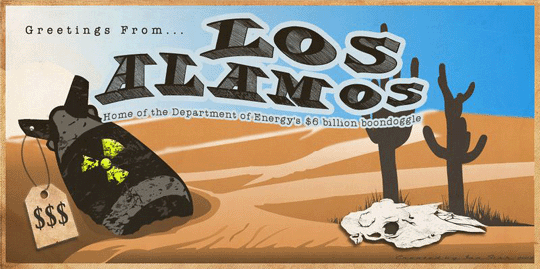
- Levels are comparable to Chernobyl nuclear disaster in Ukraine: Researcher
- Government says area remains safe
- Researchers say area visitors must be warned
Safia Samee Ali, Aug 28, 2024, https://www.newsnationnow.com/science/extreme-levels-plutonium-contamination-los-alamos/
NewsNation) — High levels of plutonium have been found around Los Alamos, the birthplace of the atomic bomb, raising alarms ahead of plans by the federal government to restart nuclear weapons manufacturing in the same area.
Michael Ketterer, a Northern Arizona University professor emeritus who analyzed soil, water and vegetation samples taken along a popular hiking and biking trail in Acid Canyon, said that there were more extreme concentrations of plutonium found there than at other publicly accessible sites he has ever researched.
Ketterer has compared the levels to those found at the site of the Chernobyl nuclear disaster in Ukraine.
“This is one of the most shocking things I’ve ever stumbled across in my life,” he said.
“It’s just an extreme example of very high concentrations of plutonium in soils and sediments. Really, you know, it’s hiding in plain sight.”
The Department of Energy’s Environmental Management Los Alamos Field Office said that the findings are consistent with department data that has been publicly available for years and that the canyon remains safe for unrestricted use.
But Nuclear Watch, a group Ketterer worked with, said officials need to warn people against coming in contact with water in Acid Canyon.
From 1943 until 1963, liquid and often radioactive waste was dumped down a canyon near Los Alamos National Laboratory, which gave it the name Acid Canyon.
Jay Coghlan, director of Nuclear Watch, said plutonium contamination in the heart of Los Alamos is a concern, particularly as the Energy Department and the National Nuclear Security Administration are slated to begin producing plutonium pits once again in an effort to build up nuclear weaponry.
The federal government began cleaning up Acid Canyon in the late 1960s and eventually transferred the land to Los Alamos County.
Officials determined in the 1980s that conditions within the canyon met DOE standards and were protective of human health and the environment.
The Associated Press contributed to this story.
Democratic Party platform a catastrophe for world peace

https://heartlandprogressive.blogspot.com/—Walt Zlotow, 26 Aug 24,
Last Monday the Democratic National Committee (DNC) adopted likely the worst foreign policy platform in US history.
It voted “ironclad” support for Israel’s genocidal ethnic cleansing of Gaza. Nothing new here as America has long been supplying tens of billions in genocide weapons for Israel to ‘finish the job’. The Democratic platform’s promise of a “commitment to Israel’s qualitative military edge” ensures that hundreds of thousands of Palestinians will die and likely no Palestinian will be left in Gaza unless the US ends its conveyor belt of genocide weapons.
The platform further boasts about the US bombing campaign against Yemen for tying up Red Sea shipping in support of Palestine. Alas, the platform mischaracterized the multibillion-dollar campaign as a success when it has utterly failed to reopen the Red Sea to worldwide shipping. And until America stops supplying Israel the genocide weapons, it never will.
Another false achievement the platform touts is America’s proxy war against Russia in Ukraine which has backfired spectacularly, elevating the former while deeply degrading the latter.
One more imagined platform achievement for good measure: America’s massive multi billion dollar buildup in the Asia Pacific to defeat China, “America’s most consequential strategic competitor.”
The world will be damn fortunate if the 2024 Democratic Platform doesn’t serve as a blueprint for America blowing up the Middle East, blowing up Europe, blowing up the Asia Pacific.
A party platform on foreign affairs should build a sturdy foundation to promote world peace. The 2024 Democratic platform on foreign affairs ensures more instability, more spending of precious treasure on weapons of death, more war; possibly even nuclear winter. That represents a party platform servicing a gallows for peoplekind.
Australia offers U.S. a vast new military launchpad in China conflict

Australia is expanding its northern military bases, with U.S. support, to counter China’s growing threat. Critics quip it’s become the “51st state.”
Washington Post, By Michael E. Miller, August 24, 2024
ROYAL AUSTRALIAN AIR FORCE BASE TINDAL, Australia — Deep in the outback, a flurry of construction by Australia and the United States is transforming this once quiet military installation into a potential launchpad in case of conflict with China.
Runways are being expanded and strengthened to accommodate the allies’ biggest airplanes, including American B-52 bombers. A pair of massive fuel depots is rising side by side to supply U.S. and Australian fighter jets. And two earth-covered bunkers have been built for U.S. munitions.
But the activity at RAAF Tindal, less than 2,000 miles from the emerging flash points of the South China Sea,isn’t unique. Across Australia, decades-old facilities — many built by the United States during World War II — are now being dusted off or upgraded amid growing fears of another global conflict.
“This isabout deterrence,” Australia’s defense minister, Richard Marles, said in an interview. “We’re working together to deter future conflict and to provide for the collective security of the region in which we live.”
The United States has ramped up defense ties with allies across the region, including with the Philippines and Japan, as it tries to fend off an increasingly assertive and aggressive China. Australia offers the United States a stable and friendly government, a small but capable military, and a vast expanse from which to stage or resupply military efforts.
U.S. Secretary of Defense Lloyd Austin, hailing the “the extraordinary strength of our unbreakable alliance with Australia,” said after a meeting with Marles earlier this month that deepercooperation — including base upgrades and more frequent rotational bomber deployments — would help build “greater peace, stability, and deterrence across the region.”
Australia has also joined the AUKUS agreement, under which the United States and Britain will provide it with nuclear-propelled submarines, some of the world’s most closely guarded technology.
These moves underscore a bigger shift, as Canberra has grown increasingly tight with Washington as they both grow wary of Beijing. Military cooperation has become so extensive that critics quip Australia is becoming the United States’ “51st state.”
Mihai Sora, a former Australian diplomat who is an analyst at the Lowy Institute, a Sydney think tank, has a different metaphor. Australia is “an unsinkable aircraft carrier right at the bottom of the critical maritime sea lanes.”
“As the stakes increase in the South China Sea, as the risk over conflict in Taiwan increases, northern Australia in particular becomes of increasing strategic value for the United States,” Sora said.
American representatives ona recent congressional delegation to Darwin,onAustralia’s northern coast, agreed.
“This provides a central base of operations from which to project power,” Rep. Michael McCaul (R-Tex.), chairman of the House Foreign Affairs Committee, said during the trip.
Some Australian experts, however, argue that the growing U.S. military footprint doesn’t deter conflict with China so much as ensure Australia will be involved.
“I have deep misgivings about the whole enterprise” of increased U.S. military activity in Australia, said Sam Roggeveen, a former Australian intelligence analyst who is also at the Lowy Institute. “It conflates America’s strategic objectives in Asia with ours, and it makes those bases a target.”
……………………………………….Australia has spent roughly $1 billion on upgrading the Tindal air force base. Built by U.S. Army engineers in 1942 to stage bombing raids on Japanese targets in Papua New Guinea and Indonesia, Tindal is now the site of dozens of construction projects. A key one is the new parking apron capable of accommodating four of Australia’s biggest planes: KC-30 tankers that can refuel fighter jets and allow for far more distant attacks.
But there are also plans for the United States to build its own parking apron here, big enough for six B-52 bombers capable of reaching mainland China.
“That is absolutely something China would pay attention to,” Roggeveen said.
Marles declined to comment on the increasing rotations mentioned by Austin but said the trajectory is “an increasing American force posture in Australia.” We see that as very much in Australia’s national interest,” he said. “People understand that we are living through challenging times, when the global rules-based order is under pressure.”………………………………………………………………..
Australia is also surveying three “bare bases” — skeleton facilities in remote parts of western Australia and Queensland — with an eye to upgrading them so heavier Australian and American airplanes can use them, said Brigadier Michael Say, who leads Australia’s Force Posture Initiative. He said it’s still being determined whether the United States will pay for some of the improvements. [WHAA-A-AT!]
In the Cocos Islands, tiny coral atolls in the Indian Ocean northwest of the Australian continent and just south of Indonesia, Canberra will soon begin upgrading the airstrip to accommodate heavier military aircraft, including the P-8A Poseidon, a “submarine hunter” that could monitor increased Chinese naval activity in the area. A U.S. Navy construction contract published in June listed the Cocos as a possible project location, but Say said it hasn’t yet been decided whether the United States will contribute.
Diversifying — or redistributing?
These “bare bases,” which stretch for 3,000 miles from east to west, fit a new U.S. strategy of dispersing forces to prevent China from delivering a knockout blow.
“If one location gets taken out, the U.S. can still project force, it can still replenish and resupply and reinforce its troops,” Sora said. “Australia is fundamental to that but is just one plank in America’s regional force posture.”
Roggeveen questioned, however, whether the United States is actually increasing its capabilities in the region or merely moving assets out of places like Guam that are more immediately threatened by China’s improving missile capability. Under AUKUS, the United States will begin rotating up to four nuclear-powered submarines through western Australia in 2027………………………………………
Some concerns linger in Washington over Australia’s commitment, however. During the visit to Darwin, McCaul and other representatives asked about the 99-year lease a Chinese company holds over the port surrounding the Australian naval base. Australian officials said two reviews had found there wasn’t a security concern, and that in the case of a conflict, the port could be nationalized.
“Australia relies on China for prosperity and on America for security,” Rep. Jimmy Panetta (D-Calif.) told The Post. “That’s the balance they are playing.” https://www.washingtonpost.com/world/2024/08/24/us-military-base-australia-china/—
—
The western way of war – Owning the narrative trumps reality
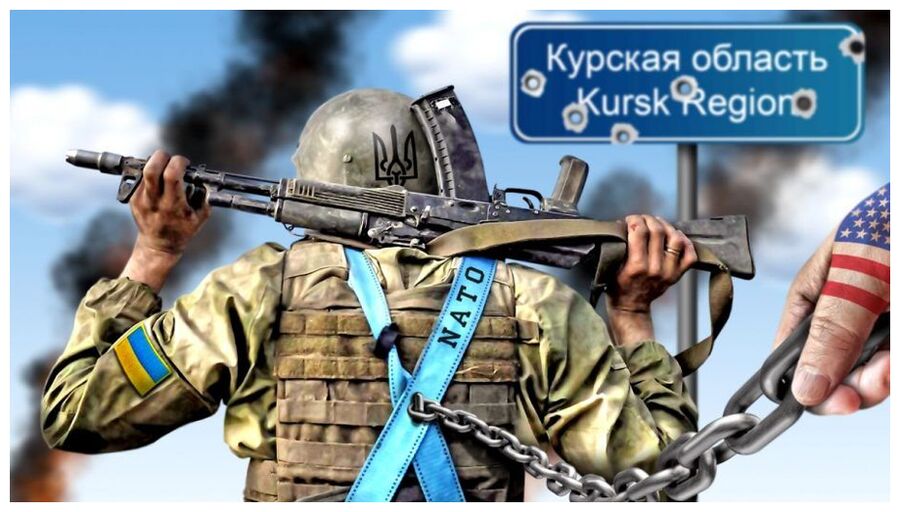
Take, for example, the NATO-orchestrated and equipped incursion into the symbolically significant Kursk Oblast. In terms of a ‘winning narrative’, its appeal to the West is obvious: Ukraine ‘takes the war to into Russia’.
Alastair Crooke, Strategic Culture Foundation, Mon, 26 Aug 2024
War propaganda and feint are as old as the hills. Nothing new. But what is new is that infowar is no longer the adjunct to wider war objectives – but has become an end in and of itself.
The West has come to view ‘owning’ the winning narrative – and presenting the Other’s as clunky, dissonant, and extremist – as being more important than facing facts-on-the ground. Owning the winning narrative is to win, in this view. Virtual ‘victory’ thus trumps ‘real’ reality.
Had the Ukrainian forces succeeded in capturing the Kursk Nuclear Power Station, they then would have had a significant bargaining chip, and might well have syphoned away Russian forces from the steadily collapsing Ukrainian ‘Line’ in Donbas.
And to top it off, (in infowar terms), the western media was prepped and aligned to show President Putin as “frozen” by the surprise incursion, and “wobbling” with anxiety that the Russian public would turn against him in their anger at the humiliation.
Bill Burns, head of CIA, opined that “Russia would offer no concessions on Ukraine, until Putin’s over-confidence was challenged, and Ukraine could show strength“. Other U.S. officials added that the Kursk incursion – in itself – would not bring Russia to the negotiating table; It would be necessary to build on the Kursk operation with other daring operations (to shake Moscow’s sang froid).
Of course, the overall aim was to show Russia as fragile and vulnerable, in line with the narrative that, at any moment Russia, could crack apart and scatter to the wind, in fragments. Leaving the West as winner, of course.
In fact, the Kursk incursion was a huge NATO gamble: It involved mortgaging Ukraine’s military reserves and armour, as chips on the roulette table, as a bet that an ephemeral success in Kursk would upend the strategic balance. The bet was lost, and the chips forfeit.
So, war becomes rather the setting for imposing ideological alignment across a wide global alliance and enforcing it via compliant media.
This objective enjoys a higher priority than, say, ensuring a manufacturing capacity sufficient to sustain military objectives. Crafting an imagined ‘reality’ has taken precedence over shaping the ground reality.
The point here is that this approach – being a function of whole of society alignment (both at home and abroad) – creates entrapments into false realities, false expectations, from which an exit (when such becomes necessary), turns near impossible, precisely because imposed alignment has ossified public sentiment. The possibility for a State to change course as events unfold becomes curtailed or lost, and the accurate reading of facts on the ground veers toward the politically correct and away from reality.
The cumulative effect of ‘a winning virtual narrative’ holds the risk nonetheless, of sliding incrementally toward inadvertent ‘real war’.
Take, for example, the NATO-orchestrated and equipped incursion into the symbolically significant Kursk Oblast. In terms of a ‘winning narrative’, its appeal to the West is obvious: Ukraine ‘takes the war to into Russia’.
Plainly put, this Kursk affair exemplifies the West’s problem with ‘winning narratives’: Their inherent flaw is that they are grounded in emotivism and eschew argumentation. Inevitably, they are simplistic. They are simply intended to fuel a ‘whole of society’ common alignment. Which is to say that across MSM; business, federal agencies, NGOs and the security sector, all should adhere to opposing all ‘extremisms’ threatening ‘our democracy’.
This aim, of itself, dictates that the narrative be undemanding and relatively uncontentious: ‘Our Democracy, Our Values and Our Consensus’. The Democratic National Convention, for example, embraces ‘Joy’ (repeated endlessly), ‘moving Forward’ and ‘opposing weirdness’ as key statements. They are banal, however, these memes are given their energy and momentum, not by content so much, as by the deliberate Hollywood setting lending them razzamatazz and glamour.
It is not hard to see how this one-dimensional zeitgeist may have contributed to the U.S. and its allies’ misreading the impact of today’s Kursk ‘daring adventure’ on ordinary Russians.
‘Kursk’ has history. In 1943, Germany invaded Russia in Kursk to divert from its own losses, with Germany ultimately defeated at the Battle of Kursk. The return of German military equipment to the environs of Kursk must have left many gaping; the current battlefield around the town of Sudzha is precisely the spot where, in 1943, the Soviet 38th and 40th armies coiled for a counteroffensive against the German 4th Army.
Over the centuries, Russia has been variously attacked on its vulnerable flank from the West. And more recently by Napoleon and Hitler. Unsurprisingly, Russians are acutely sensitive to this bloody history. Did Bill Burns et al think this through? Did they imagine that NATO invading Russia itself would make Putin feel ‘challenged’, and that with one further shove, he would fold, and agree to a ‘frozen’ outcome in Ukraine – with the latter entering NATO? Maybe they did.
Ultimately the message that western services sent was that the West (NATO) is coming for Russia. This is the meaning of deliberately choosing Kursk. Reading the runes of Bill Burns message says prepare for war with NATO.
Just to be clear, this genre of ‘winning narrative’ surrounding Kursk is neither deceit nor feint. The Minsk Accords were examples of deceit, but they were deceits grounded in rational strategy (i.e. they were historically normal). The Minsk deceits were intended to buy the West time to further Ukraine’s militarisation – before attacking the Donbas. The deceit worked, but only at the price of a rupture of trust between Russia and the West. The Minsk deceits however, also accelerated an end to the 200-year era of the westification of Russia.
Kursk rather, is a different ‘fish’. It is grounded in the notions of western exceptionalism. The West perceives itself as tacking to ‘the right side of History’. ‘Winning narratives’ essentially assert – in secular format – the inevitability of the western eschatological Mission for global redemption and convergence. In this new narrative context, facts-on-the-ground become mere irritants, and not realities that must be taken into account.
This their Achilles’ Heel.
The DNC convention in Chicago however, underscored a further concern:………………………………………………………………….
The Kursk ploy no doubt seemed clever and audacious to London and Washington. Yet with what result? It achieved neither objective of taking Kursk NPP, nor of syphoning Russian troops from the Contact Line. The Ukrainian presence in the Kursk Oblast will be eliminated.
What it did do, however, is put an end to all prospects of an eventual negotiated settlement in Ukraine. Distrust of the U.S. in Russia is now absolute. It has made Moscow more determined to prosecute the special operation to conclusion. German equipment visible in Kursk has raised old ghosts, and consolidated awareness of the hostile western intentions toward Russia. ‘Never again’ is the unspoken riposte. https://www.sott.net/article/494279-The-western-way-of-war-Owning-the-narrative-trumps-reality
NYT Uncritically Reported Israel’s Version of Golan Bombing

Despite multiple eyewitnesses describing an Israeli Iron Dome interceptor missile falling on the field during the time of the Majdal Shams strike (Cradle, 7/28/24), the New York Times insisted on spotlighting Israeli and US claims in its headlines, rather than genuinely assessing the facts on the ground.
FAIR, Bryce Greene and Lara-Nour Walton, 26 Aug 24
As the US-backed genocide in Gaza continues, US media assist in Israeli Prime Minister Benjamin Netanyahu’s plan to widen the war, parroting the words of the aggressor. A consequential example of US press support for escalation was Western media’s coverage of the July 27 strike that killed 12 Druze children on a soccer field near the town of Majdal Shams in the Israeli-occupied Syrian Golan Heights.
Israel and the US immediately blamed the Iran-backed Lebanese organization Hezbollah for the strike—citing Israeli intelligence reports of an Iranian Falaq-1 missile being found at the soccer field (BBC, 7/28/24).
But, in a move that Hezbollah expert Amal Saad called “uncharacteristic” (Drop Site, 7/30/24), the group adamantly denied responsibility for the attack. Saad, a lecturer in politics at Cardiff University, noted that targeting the Syrian Golan Heights—where many inhabitants are hostile towards Israel—would be “illogical” and “provocative” for Hezbollah. Further, if the organization had accidentally committed an attack, Saad pointed to a precedent of the group issuing a public apology in a case of misfire, with the organization’s leader, Hassan Nasrullah, visiting families of victims.
Despite multiple eyewitnesses describing an Israeli Iron Dome interceptor missile falling on the field during the time of the Majdal Shams strike (Cradle, 7/28/24), the New York Times insisted on spotlighting Israeli and US claims in its headlines, rather than genuinely assessing the facts on the ground.
On July 28, the Times published “Fears of Escalation After Rocket From Lebanon Hits Soccer Field,” pinning the blame squarely on Lebanon’s Hezbollah. The next day, reporting on the potential escalations, the Times headline (7/29/24) described the strike as a “Deadly Rocket Attack Tied to Hezbollah.”
While the July 29 subhead acknowledged that Hezbollah denied responsibility, the assertion in the headline undermined any reference to alternative explanations. Attribution to Hezbollah was then repeated without qualification in the first paragraph of the story.
Rebroadcasting government talking points not only does a disservice to newsreaders as Israel has a long history of misleading the public, but it also serves Netanyahu’s goals of justifying an escalation against Hezbollah. Predictably, the New York Times did not contextualize accusations of Hezbollah responsibility with information about Israel’s current objectives for wider war. This continues a long trend of US media outlets obscuring and distorting reality in order to downplay Israel’s aggressive regional ambitions (FAIR.org, 8/22/23).
Israel an unreliable source
The first problem is that the New York Times accepts narratives from Israeli military and government officials at face value. From peddling evidence-free claims about Palestinian use of human shields during Operation Cast Lead in 2009 (Amnesty International, 2009; Human Rights Watch, 8/13/09), to dodging responsibility for its assassination of Palestinian journalist Shireen Abu Akleh in 2022 (Al Jazeera, 5/22/22), to consistently attempting to conceal its use of illegal white phosphorus munitions across the Middle East (Haaretz, 10/22/06; Human Rights Watch, 3/25/09; Guardian, 10/13/23), the Israeli military has been known to circulate disinformation to the international public for decades. Neither in headlines nor in the text of its pieces does the Times acknowledge this well-established history.
The current assault on Gaza has made the central role of lies in Israel’s public relations arsenal clearer than ever. As early as October 17, there was controversy over the origin of a rocket strike on the Al-Ahli Arab hospital that killed hundreds of Palestinians (FAIR.org, 11/3/23). In the media confusion, Israel released audio it said captured two Hamas militants discussing Palestinian Islamic Jihad responsibility for the strike. However, an analysis by Britain’s Channel 4 news (10/19/23) found that the audio was the result of two separate channels being edited together. In other words, Israel engineered a phony audio clip to substantiate the notion that it had not committed a war crime……………………………………………………………………………………………………………………………………………………………………………………..
It is not possible that the writers and the editors at the Times—the supposed newspaper of record—are ignorant of this seemingly unending series of deceptions. The decision to uncritically accept the word of the IDF regarding the Golan Heights strike demonstrates a deliberate editorial decision to knowingly advance the deceitful public relations goals of a genocidal state.
Justifying a wider war
In light of Israel’s past lies, serious journalism ought to refrain from regurgitating Israeli claims without significant context or qualification. This is especially true when doing so would advance goals as disastrous as Netanyahu’s current aims.
In the case of the Majdal Shams strike, media proliferation of Israeli propaganda manufactures consent for escalating the war on the northern border—something Israel has long stated as its goal, and something American officials have long been concerned about…………………………………………………………………………………………………..
On top of neglecting to acknowledge Israel’s flimsy credibility in their Majdal Shams analysis, Times reporters failed to address this readily available information about Israeli military objectives. By ignoring Israel’s strategic aims, they are ensuring the reader doesn’t encounter further reasons to question Israel’s account about the strike.
Who fired the rocket?
When reporting on Israel’s “reprisal” assaults on Lebanon following the strike on the soccer field, the New York Times (7/28/24) again asserted Israeli claims as fact, saying in the first paragraph that “a rocket from Lebanon on Saturday killed at least 12 children and teenagers in an Israeli-controlled town,” which “prompted Israel to retaliate early Sunday with strikes across Lebanon.”
Was Lebanon—and implicitly Hezbollah—the source of the explosion that killed the 12 children? The Times does not care to examine this question, which warrants exploration. which warrants exploration. Israel’s military chief of staff declared that the damage was done with an Iranian-made Falaq-1 rocket fired by Hezbollah, a claim that was uncritically repeated as fact by the New York Times (7/30/24), despite the lack of independent corroboration. While there has been fighting in the area, and Hezbollah acknowledged that they fired Falaq-1 rockets at the nearby IDF barracks, there is significant reason to doubt that one of these rockets struck the soccer field.
The Falaq-1 was described by Haaretz (7/28/24) as a munition that targets bunkers. But, images from the aftermath of the attack show that the damage to physical structures was far from bunker-busting. In an interview with Jeremy Scahill (Drop Site, 7/30/24), the Hezbollah expert Saad cited military specialists who told her that “if [Hezbollah] had used the Falaq-1, we would have seen a much larger crater…. It would be much, much bigger and there would be much more destruction.”
As discussed above, Israel, well-known for planting or fabricating evidence for propagandistic ends, released images of rocket fragments that it alleged were found at the impact site, though the Associated Press (7/30/24) was unable to verify their authenticity.
A substantial case can be made that the projectile came from the IDF. In the immediate aftermath of the attacks, multiple eyewitnesses told Arab news outlets the projectile was a misfired Iron Dome missile (Cradle, 7/28/24; Drop Site, 7/30/24). The New York Times omitted this from its coverage of this event.
Contrary to the mythos behind the high-tech defense system, there have already been several cases of Iron Dome missiles falling on populated areas within Israel since October 7 (Al Jazeera, 6/11/23; Jerusalem Post, 12/2/23, 7/25/24; Times of Israel, 5/4/23, 8/9/24) with many such instances resulting in civilian injuries and deaths. There was even a report of an Iron Dome malfunction near Majdal Shams, months before the recent July strike.
Bolstering the case for an Iron Dome malfunction, OSINT researcher Michale Kobs noted that the sound profile of the projectile suggested that its speed was constant until it hit the ground. Hezbollah’s projectiles constantly accelerate as they fall on their targets, since they are driven by gravity, whereas Iron Dome missiles are propelled throughout their entire flight.
For their part, the Druze people in the Golan Heights—an Arabic-speaking religious community which has largely declined offers of Israeli citizenship—repudiated Israel’s displays of sympathy for their slain children, rejecting the use of their suffering to advance Israel’s plans for a broader war (Democracy Now!, 7/30/24). Locals even protested a visit from Netanyahu, chanting “Killer! Killer!” and demanding he leave the area (New Arab, 7/29/24).
In the Times reporting on the strike, Lebanese and Syrian denials of Hezbollah’s responsibility for the strikes were acknowledged and reported, but portrayed as predictable denials that did nothing to alter the narrative. By omitting the evidence pointing to Israeli responsibility for the strikes, the New York Times assists Israel in yet another propaganda campaign to mislead the public in order to justify further regional strife and bloodshed. https://fair.org/home/nyt-uncritically-reported-israels-version-of-golan-bombing/
Farewell, the American Century

What flag-wavers tend to leave out of their account of the American Century is not only the contributions of others, but the various missteps perpetrated by the United States — missteps, it should be noted, that spawned many of the problems bedeviling us today.
Rewriting the Past by Adding In What’s Been Left Out
By Andrew Bacevich TomDispatch, 25 Aug 24
In a recent column, the Washington Post’s Richard Cohen wrote, “What Henry Luce called ‘the American Century’ is over.” Cohen is right. All that remains is to drive a stake through the heart of Luce’s pernicious creation, lest it come back to life. This promises to take some doing.
To solve our problems requires that we see ourselves as we really are. And that requires shedding, once and for all, the illusions embodied in the American Century.
When the Time-Life publisher coined his famous phrase, his intent was to prod his fellow citizens into action. Appearing in the February 7, 1941 issue of Life, his essay, “The American Century,” hit the newsstands at a moment when the world was in the throes of a vast crisis. A war in Europe had gone disastrously awry. A second almost equally dangerous conflict was unfolding in the Far East. Aggressors were on the march.
With the fate of democracy hanging in the balance, Americans diddled. Luce urged them to get off the dime. More than that, he summoned them to “accept wholeheartedly our duty and our opportunity as the most powerful and vital nation in the world… to exert upon the world the full impact of our influence, for such purposes as we see fit and by such means as we see fit.”
Read today, Luce’s essay, with its strange mix of chauvinism, religiosity, and bombast (“We must now undertake to be the Good Samaritan to the entire world…”), does not stand up well. Yet the phrase “American Century” stuck and has enjoyed a remarkable run. It stands in relation to the contemporary era much as “Victorian Age” does to the nineteenth century. In one pithy phrase, it captures (or at least seems to capture) the essence of some defining truth: America as alpha and omega, source of salvation and sustenance, vanguard of history, guiding spirit and inspiration for all humankind.
In its classic formulation, the central theme of the American Century has been one of righteousness overcoming evil. The United States (above all the U.S. military) made that triumph possible. When, having been given a final nudge on December 7, 1941, Americans finally accepted their duty to lead, they saved the world from successive diabolical totalitarianisms. In doing so, the U.S. not only preserved the possibility of human freedom but modeled what freedom ought to look like.
Thank You, Comrades
So goes the preferred narrative of the American Century, as recounted by its celebrants.
The problems with this account are two-fold. First, it claims for the United States excessive credit. Second, it excludes, ignores, or trivializes matters at odds with the triumphal story-line.
The net effect is to perpetuate an array of illusions that, whatever their value in prior decades, have long since outlived their usefulness. In short, the persistence of this self-congratulatory account deprives Americans of self-awareness, hindering our efforts to navigate the treacherous waters in which the country finds itself at present. Bluntly, we are perpetuating a mythic version of the past that never even approximated reality and today has become downright malignant. Although Richard Cohen may be right in declaring the American Century over, the American people — and especially the American political class — still remain in its thrall.
Constructing a past usable to the present requires a willingness to include much that the American Century leaves out.
For example, to the extent that the demolition of totalitarianism deserves to be seen as a prominent theme of contemporary history (and it does), the primary credit for that achievement surely belongs to the Soviet Union. When it came to defeating the Third Reich, the Soviets bore by far the preponderant burden, sustaining 65% of all Allied deaths in World War II.
By comparison, the United States suffered 2% of those losses, for which any American whose father or grandfather served in and survived that war should be saying: Thank you, Comrade Stalin.
For the United States to claim credit for destroying the Wehrmacht is the equivalent of Toyota claiming credit for inventing the automobile. We entered the game late and then shrewdly scooped up more than our fair share of the winnings. The true “Greatest Generation” is the one that willingly expended millions of their fellow Russians while killing millions of German soldiers.
Hard on the heels of World War II came the Cold War, during which erstwhile allies became rivals. Once again, after a decades-long struggle, the United States came out on top…………………………………………….
What flag-wavers tend to leave out of their account of the American Century is not only the contributions of others, but the various missteps perpetrated by the United States — missteps, it should be noted, that spawned many of the problems bedeviling us today.
The instances of folly and criminality bearing the label “made-in-Washington” may not rank up there with the Armenian genocide, the Bolshevik Revolution, the appeasement of Adolf Hitler, or the Holocaust, but they sure don’t qualify as small change. To give them their due is necessarily to render the standard account of the American Century untenable.
Here are several examples, each one familiar, even if its implications for the problems we face today are studiously ignored:
Cuba. In 1898, the United States went to war with Spain for the proclaimed purpose of liberating the so-called Pearl of the Antilles. When that brief war ended, Washington reneged on its promise. If there actually has been an American Century, it begins here, with the U.S. government breaking a solemn commitment, while baldly insisting otherwise. By converting Cuba into a protectorate, the United States set in motion a long train of events leading eventually to the rise of Fidel Castro, the Bay of Pigs, Operation Mongoose, the Cuban Missile Crisis, and even today’s Guantanamo Bay prison camp. The line connecting these various developments may not be a straight one, given the many twists and turns along the way, but the dots do connect.
The Bomb.…………………..the role the United States played in afflicting humankind with this scourge.
The United States invented the bomb. The United States — alone among members of the nuclear club — actually employed it as a weapon of war. The U.S. led the way in defining nuclear-strike capacity as the benchmark of power in the postwar world, leaving other powers like the Soviet Union, Great Britain, France, and China scrambling to catch up. Today, the U.S. still maintains an enormous nuclear arsenal at the ready and adamantly refuses to commit itself to a no-first-use policy, even as it professes its horror at the prospect of some other nation doing as the United States itself has done.
Iran. Extending his hand to Tehran, President Obama has invited those who govern the Islamic republic to “unclench their fists.” Yet to a considerable degree, those clenched fists are of our own making………………….
Afghanistan.………………………………………………………………..
……………………………………..All we know for sure is that policies concocted in Washington by reputedly savvy statesmen now look exceedingly ill-advised.
What are we to make of these blunders? The temptation may be to avert our gaze, thereby preserving the reassuring tale of the American Century. We should avoid that temptation and take the opposite course, acknowledging openly, freely, and unabashedly where we have gone wrong. We should carve such acknowledgments into the face of a new monument smack in the middle of the Mall in Washington: We blew it. We screwed the pooch. We caught a case of the stupids. We got it ass-backwards.
Only through the exercise of candor might we avoid replicating such mistakes.
……………………………………………………….. apologize to them, but for our own good — to free ourselves from the accumulated conceits of the American Century and to acknowledge that the United States participated fully in the barbarism, folly, and tragedy that defines our time. For those sins, we must hold ourselves accountable. https://tomdispatch.com/farewell-the-american-century-2/
Harris’s concluding speech at DNC embraces agenda of global war
Harris declared, “As commander-in-chief, I will ensure America always has the strongest, most lethal fighting force in the world.” As for whom this force will be fighting, Harris left little doubt, going on to refer to China, Russia, North Korea and Iran, the same countries that the Biden-Harris administration has targeted in a new document outlining American strategy for a future nuclear world war.
Patrick Martin, 23 August 2024
The four days of the Democratic National Convention culminated Thursday with the acceptance speech by Vice President Kamala Harris as the Democratic Party’s candidate for president.
As a whole, the convention consisted of an endless series of inane speeches, hosannahs to Harris that completely falsified her right-wing career as a prosecutor, declarations from billionaires that Harris would be a “president of joy” and constant invocations of the “historic” character of elevating a (multi-millionaire) African American and Asian American woman to the presidency.
The Democrats sought to substitute entertainment for policy, with a series of Hollywood and pop music celebrities embracing Harris. However, the real content of the policies they propose came through in the candidate’s closing speech: an agenda of escalating global war.
Harris declared, “As commander-in-chief, I will ensure America always has the strongest, most lethal fighting force in the world.” As for whom this force will be fighting, Harris left little doubt, going on to refer to China, Russia, North Korea and Iran, the same countries that the Biden-Harris administration has targeted in a new document outlining American strategy for a future nuclear world war.
As in any major address by an American capitalist politician, Harris’s acceptance speech was directed to two audiences. For Wall Street and the military-intelligence apparatus, the real base of the Democratic Party, Harris pledged to continue the militaristic foreign policy of the Biden administration to defend the global interests of the American financial aristocracy.
She was a safe pair of hands, she proclaimed, unlike the unreliable and self-interested Trump—a theme sounded on the convention’s final day by a range of right-wing speakers, from former Defense Secretary and CIA Director Leon Panetta, to a string of Republicans who are now endorsing Harris, to a trio of military-intelligence officials now holding seats as Democrats in the House of Representatives.
While Harris’s brief reference to the suffering of the Palestinian population of Gaza was highlighted in media accounts—and will undoubtedly be hailed as a significant shift by the pseudo-left apologists for the Democratic Party—this came after she flatly reiterated an uncompromising pledge to provide unlimited US military aid to Israel: “I will always stand up for Israel’s right to defend itself, and I will always ensure Israel has the ability to defend itself.”
In other words, more bombs and missiles to kill tens of thousands more in Gaza and potentially in the West Bank, Lebanon, Yemen, Iran and other countries in the region targeted by imperialism…………………………………………………………………………….. more https://www.wsws.org/en/articles/2024/08/24/turk-a24.html
Fluid leak forces rail shipment to return to the San Onofre nuclear power plant

Federal regulator says the leak had “low safety significance” but Southern California Edison officials admit it should not have happened.
By Rob Nikolewski | rob.nikolewski@sduniontribune.com | The San Diego Union-Tribune, August 21, 2024
A pair of dismantled pressurizers that departed the San Onofre Nuclear Generating Station by rail had to be returned to the now-shuttered power plant after it was discovered that one of the giant pieces of equipment had leaked fluid during the trip.
Surveys conducted by the plant’s operator, Southern California Edison, said “no detectable radioactivity” above otherwise normal background levels was detected and there was “no threat to public health and safety, or the environment.” But an official with the utility admitted to the Union-Tribune, “that should not happen.”
An inspection from the U.S. Nuclear Regulatory Commission found two violations but the federal regulator’s report described the “safety significance” of the infractions as “low.”
The NRC’s inspection report made no mention of issuing any fines.
But Edwin Lyman, director of nuclear safety at the Union of Concerned Scientists, suspects the NRC’s report does not reflect “the severity of (Edison and its contractor’s) screw-up.”
“They had one job to do, which was to transport this pressurizer without any (free) liquid in a container that couldn’t leak,” Lyman said. “And they missed on both counts.”
……………………………What happened?
The San Onofore Nuclear Generating Station, known as SONGS for short, is in the midst of a massive $4.7 billion decommissioning and dismantlement project that is scheduled to wrap up by the end of 2028.
During the course of the demolition, about 1.1 billion pounds of material is expected to be removed, with most of it going by rail. More than 1,000 rail shipments originating from a spur built at SONGS have left the site since dismantlement efforts began some four years ago.
In late June, two large pressurizers were loaded onto special rail cars, on their way to a disposal site in Clive, Utah.
When a nuclear power plant is in operation, pressurizers control reactor coolant systems that use demineralized pure water to remove heat from the reactor core and allow steam to power turbine generators.
The SONGS Unit 2 and Unit 3 pressurizers are big — 37 feet tall and weighing about 100 tons each, with capacity to regulate 16,500 gallons of liquid.
After they were taken out, the pressurizers were labeled as Class A waste, which is the lowest level of radioactive waste as classified by the NRC.
At a stop at a railyard in San Bernardino, a worker noticed a water leakage on the top of the flatbed railcar hauling the Unit 2 pressurizer. SCE officials said the water did not drip onto the ground.
No leaks were found in the Unit 3 pressurizer but both were sent back to SONGS to find out what happened.
Although each pressurizer was supposed to be completely drained, it was soon discovered that 190 gallons of water was found at the bottom of the Unit 2 pressurizer.
“Workers incorrectly believed” all the water had been drained out of the pressurizer before it was loaded onto the rail car, Pontes said.
What now?
An ongoing investigation is trying to determine what went wrong. Until then, the pressurizers from both units will not be rescheduled for shipment back to Utah.
The NRC noted two violations — one for failing to ensure the pressurizer was “properly closed and sealed to prevent release of radioactive content” and the second for not properly packaging it for shipment.
Pontes said the NRC findings are being reviewed by SCE, the dismantlement’s general contractor (called SONGS Decommissioning Solutions) and workers at the facility. “We remain committed, in our oversight role, to ensuring safety and adherence to all regulatory material packaging requirements,” he said.
But Lyman questioned whether the NRC’s actions amounted to a “slap on the wrist.”
“When they process these violations through their system and it spits out ‘low-safety significance,’ I don’t feel it conveys the gravity of the two violations, when compounded, led to a release of this liquid,” Lyman said. “It could have been worse, presumably.”
Other incidents
First opened in 1968, SONGS has not produced electricity since 2012 after a leak in a steam generator tube led to its closing.
In August 2018, a 50-ton canister filled with radioactive spent fuel was being transferred to a dry storage facility on the north end of SONGS. While being lowered into a cavity, the canister was accidentally left suspended almost 20 feet from the floor.
Eventually, the canister was safely lowered but the NRC later fined Edison $116,000 and chided the company for failing “to establish a rigorous process to ensure adequate procedures, training and oversight guidance.”
In April 2022, demolition work was briefly halted after a worker fell about five feet while trying to install a ventilation hose into the floor vault opening, injuring his shoulder.
Once the dismantlement project wraps up, all that is expected to remain at SONGS will be two dry storage facilities; a security building with personnel to look over the waste; a seawall 28 feet high, as measured at average low tide at San Onofre Beach; a walkway connecting two beaches north and south of the plant, and a switchyard with power lines.
The switchyard’s substation without transformers stays put because it houses electricity infrastructure that provides a key interconnection for the power grid in the region. https://www.sandiegouniontribune.com/2024/08/21/fluid-leak-forces-rail-shipment-to-return-to-the-san-onofre-nuclear-power-plant/?fbclid=IwY2xjawE3ZUdleHRuA2FlbQIxMQABHapLLh1xKud7eOWCb9iO4yGGQxJgVZFSJhbgWcw92LLlNek-XIz_bl-r_g_aem_TD76JCKRAQE_2TARdViWEw
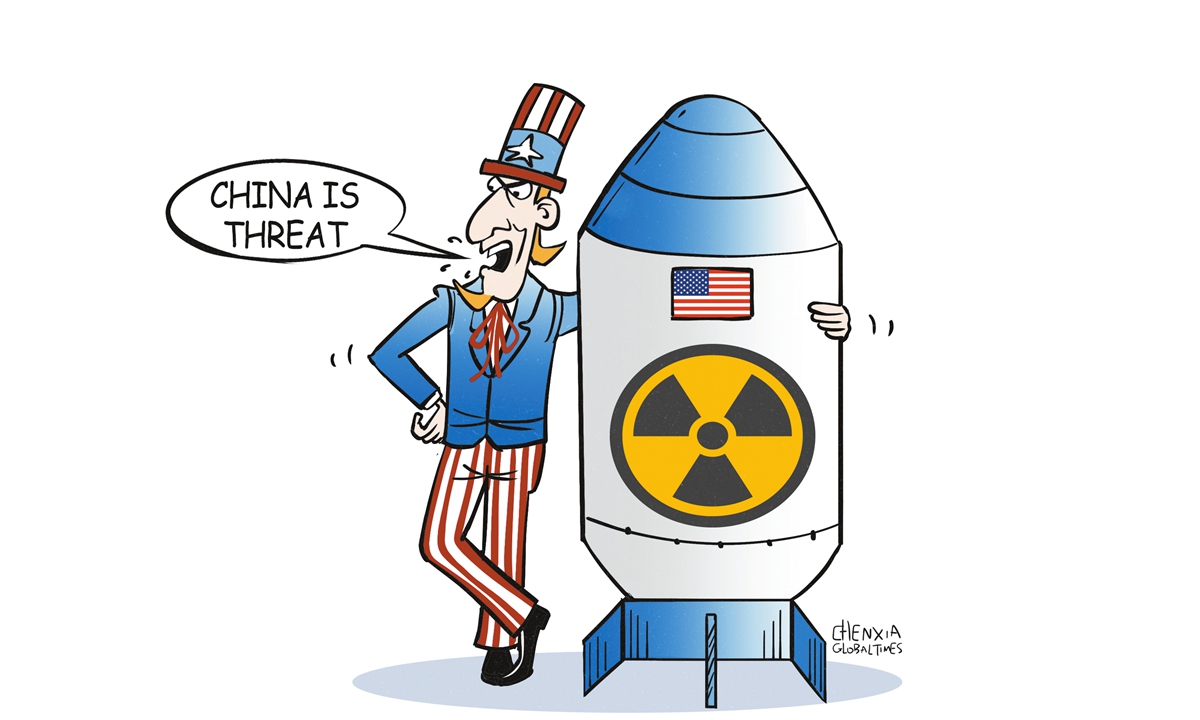
US crying wolf over China’s ‘nuclear threat’ while expanding nuclear arsenal
Aug 22, 2024 https://www.globaltimes.cn/page/202408/1318466.shtml
On Tuesday, a New York Times report caused quite a stir: US President Joe Biden has ordered US forces to prepare for “possible coordinated nuclear confrontations with Russia, China and North Korea.” It sounds like the US president was instructing the military to prepare for doomsday, observers pointed out.
The report revealed that in March, Biden approved a highly classified nuclear strategy plan called “Nuclear Employment Guidance,” which for the first time reorients the US’ deterrent strategy to focus on the so-called threat posed by China’s rapid expansion in its nuclear arsenal. The article states that this shift comes as the Pentagon believes China’s stockpiles will rival the size and diversity of the US’ and Russia’s over the next decade.
With over 5,000 nuclear warheads, the US possesses the world’s largest and most advanced nuclear arsenal. So why does it repeatedly target China in its nuclear threat rhetoric? This can be traced back to a dilemma faced by the US Department of Defense – how to justify maintaining such a massive nuclear arsenal in the post-Cold War world. To secure more defense budgets for the domestic military-industrial complex, the US chooses to constantly manufacture or exaggerate baseless “nuclear threats.” And China has become the best excuse.
What the US truly seeks is to ensure that its power far exceeds that of any other country in the world, allowing it to threaten and coerce other nations at will, without fear of retaliation. As a hegemonic state, US’ security is built on the insecurity of other countries. To maintain its hegemonic status, the US struggles to ensure its absolute superiority in power, with nuclear weapons being a crucial tool in maintaining its global dominance. Therefore, this new nuclear strategy plan is an excuse for expanding its nuclear arsenal and sustaining its military hegemony.
China and the US have fundamentally different perceptions of the strategic role of nuclear weapons. China has repeatedly emphasized that it pursues a nuclear strategy of self-defense, and is committed to the policy of no first use of nuclear weapons. China does not engage in any nuclear arms race with any other country, and keeps its nuclear capabilities at the minimum level required for national security. The notion of establishing an offensive nuclear hegemony or pursuing the so-called goal of rivaling the nuclear arsenal size of the US does not align with China’s strategic logic. As experts pointed out, China’s development of nuclear weapons is aimed at avoiding threats from other nuclear-armed states.
No matter how the US fabricates or exaggerates the so-called China threat narrative, China’s nuclear development follows its own set pace, including a measured increase in the quantity and quality of its nuclear arsenal, which will not be swayed by the US’ interference. This is a necessary measure for China in a complex international environment to safeguard its national security and territorial integrity – a legitimate act of self-defense, Shen Yi, a professor at Fudan University, told the Global Times.
The US repeatedly harps on the “China nuclear threat” narrative, yet it is, in fact, the one that poses the biggest nuclear threat to the world. In possession of the largest nuclear arsenal in the world, the US follows a nuclear policy that allows first-use of nuclear weapons. In recent years, the US has invested heavily to miniaturize nuclear weapons, lowering the threshold of their use in real-combat, and used nuclear weapons as a bait to hijack its allies and partners. Its irresponsible decisions and actions have resulted in the proliferation of nuclear risks, and its attempts to maintain hegemony and intimidate the world with nuclear power have been fully exposed.
There will be no winners in a nuclear war. We urge the US to abandon Cold War mentality, recognize that a nuclear war cannot be won and must never be fought, reduce the role of nuclear weapons in national and collective security policies, and take concrete actions to promote global strategic stability, instead of doing the opposite. Instead of smearing and hyping up China, the US should reflect on itself and consider how to rebuild mutual trust with China through dialogue and sincerity.
Biden approved nuclear strategy focusing on China: Report
President directed US forces to prepare for ‘possible coordinated nuclear confrontations with Russia, China and North Korea,’ New York Times reports
Rabia Iclal Turan |21.08.2024 https://www.aa.com.tr/en/americas/biden-approved-nuclear-strategy-focusing-on-china-report/3308990
WASHINGTON
President Joe Biden approved a classified document in March directing US forces to get ready for potential “coordinated nuclear confrontations involving Russia, China and North Korea,” the New York Times reported Tuesday.
The document, which is revised approximately every four years, is classified to such a degree that there are no electronic versions available. Only a limited number of hard copies have been distributed to select national security officials and Pentagon leaders, the newspaper reported.
The newspaper added, however, that in recent speeches, two senior administration officials were allowed to allude to the change prior to a more comprehensive and unclassified update to Congress that is anticipated before Biden’s term concludes.
The Pentagon believes that China’s nuclear arsenal will rival the size and diversity of US and Russian stockpiles over the next decade, the Times reported.
“The president recently released updated guidance for nuclear weapons employment to address the presence of multiple nuclear-armed adversaries,” the newspaper cited Vipin Narang, a nuclear strategist from the Massachusetts Institute of Technology (MIT) who previously worked at the Pentagon, as saying earlier this month before returning to academia.
He further noted that this guidance specifically considers “the significant increase in the size and diversity” of China’s nuclear arsenal, it added.
In June, the National Security Council’s senior director for arms control and nonproliferation, Pranay Vaddi, said Biden “recently issued updated nuclear weapons employment guidance, which takes into account the realities of a new nuclear era.”
“It emphasizes the need to account for the growth and diversity of the PRC’s nuclear arsenal—and the need to deter Russia, the PRC and North Korea simultaneously,” he added, referring to the People’s Republic of China, China’s official name.
White House National Security Council spokesperson Sean Savett told Anadolu that the US nuclear policy is updated regularly as part of their efforts to “reduce nuclear risks and maintain stable deterrence.”
“This administration—like the four administrations before it—issued a Nuclear Posture Review and Nuclear Weapons Employment Planning Guidance. While the specific text of the Guidance is classified, its existence is in no way secret. The Guidance issued earlier this year is not a response to any single entity, country, or threat,” he added.
Democrats Release Insanely Hawkish Middle East Policy Platform
“President Biden and Vice President Harris believe a strong, secure, and democratic Israel is vital to the interests of the United States,” the platform reads. “Their commitment to Israel’s security, its qualitative military edge, its right to defend itself, and the 2016 Memorandum of Understanding is ironclad.”
The 2016 Memorandum of Understanding is the agreement by which the United States agrees to continue sending Israel $3.8 billion a year to spend on weapons.
Caitlin Johnstone, Aug 21, 2024
Celebrity progressive Alexandria Ocasio-Cortez falsely claimed that Vice President Kamala Harris “is working tirelessly to secure a ceasefire in Gaza” at the Democratic National Convention on Monday night. There is literally no evidentiary basis anywhere for this assertion. She made it up.
Kamala Harris is not “working tirelessly” to do anything at this time besides become the next president. Her own staff are saying she is opposed to an arms embargo on Israel and won’t consider cutting or conditioning military aid, which is the only way the Israeli government can be effectively forced to stop sabotaging a peace deal so that the US-backed genocide can finally end. Saying you’ll continue pouring military explosives into a regime that is using those military explosives to conduct regular massacres of civilians is the exact opposite of working tirelessly to secure a ceasefire.
“This is false, it’s propaganda, and it’s making people misunderstand the issue,” Current Affairs’ Nathan Robinson said of AOC’s statement. “The Biden administration could have imposed a ceasefire anytime it wanted to. The only reason there isn’t one is that Biden has made sure Israel has no incentive to agree to one.”
As we deal with this crap, the DNC has approved a 2024 party platform whose section on the middle east is so surprisingly hawkish that it largely reads like it could have been written by some of Washington’s most war-horny Republicans. It repeatedly calls its support for Israel and the continuation of arms shipments thereto “ironclad”. It criticizes Trump as having been too soft on Iran, for god’s sake.
After boasting about the Biden administration’s bombing campaign against the “Iranian-linked Houthi forces” in Yemen, its “precision airstrikes on key Iranian-linked targets,” and its success in neutralizing Iran’s retaliatory strikes on Israel after Israel assassinated multiple Iranian military officials in Syria, the platform says that this “stands in sharp contrast to Trump’s fecklessness and weakness in the face of Iranian aggression during his presidency.”
Then they literally attack Trump for not going to war with Iran:
“In 2018, when Iranian-backed militias repeatedly attacked the U.S. consulate in Basra, Iraq Trump’s only response was to close our diplomatic facility. In June 2019, when Iran shot down a U.S. surveillance aircraft operating in international airspace above the Straits of Hormuz, Trump responded by tweet and then abruptly called off any actual retaliation, causing confusion and concern among his own national security team. In September 2019, when Iranian-backed groups threatened global energy markets by attacking Saudi oil infrastructure, Trump failed to respond against Iran or its proxies. In January 2020, when Iran, for the first and only time in its history, directly launched ballistic missiles against U.S. troops in western Iraq, Trump mocked the resulting Traumatic Brain Injuries suffered by dozens of American servicemembers as mere ‘headaches’ — and again, took no action.”
The “national security team” who suffered “confusion and concern” when Trump opted not to wade into a middle eastern war of unfathomable horror includes psychopathic war criminal John Bolton, who was reportedly “devastated” when Trump called off a deadly military assault on Iran in retaliation for its shooting down the aforementioned (unmanned) surveillance aircraft.
When you’re siding with John Bolton on whether to bomb Iran, you’re as insanely hawkish as it gets.
“President Biden and Vice President Harris believe a strong, secure, and democratic Israel is vital to the interests of the United States,” the platform reads. “Their commitment to Israel’s security, its qualitative military edge, its right to defend itself, and the 2016 Memorandum of Understanding is ironclad.”
The 2016 Memorandum of Understanding is the agreement by which the United States agrees to continue sending Israel $3.8 billion a year to spend on weapons.
This comes as Kamala Harris’ current and former staff members report that not only will the vice president refuse to cut or condition military support to Israel, she will also refuse to re-enter the Iran deal to ease tensions in the region. The Times of Israel cites congressman Brad Schneider saying he was told by the Harris campaign’s Jewish outreach chief that “the Democratic Party’s presidential nominee would oppose a return to the Iran nuclear deal.”
The Iran nuclear deal, formally known as the Joint Comprehensive Plan of Action, was one of the only decent foreign policy moves made by the Obama administration, and killing it was one of the nastiest things Trump did as president — along with his other recklessly hawkish actions against Iran like implementing starvation sanctions and assassinating Soleimani. But rather than pledging to re-enter the Obama era of de-escalation and detente with Iran, the Democrats are attacking Trump for not fighting a war with Iran while pledging ironclad support for the nation that’s doing everything it can to get that war started.
So yeah, that’s the Democratic Party for you. Vote for them and you get a nicer-looking mask on the blood-spattered face of the US war machine. It’ll kill just as many middle eastern kids as the Republicans will, but it will kill them under the presidency of a woman of color with “she/her” in her Twitter bio.
White House downplays Chinese concerns over possible US nuclear strategy change
VOA, August 21, 2024 By William Gallo, Seoul, South Korea —
White House officials on Wednesday appeared to downplay Beijing’s sentiment that it is “seriously concerned” after a report alleged the United States recently approved a secret plan to shift some of the focus of its nuclear strategy away from Russia to deal with Beijing’s nuclear weapons buildup…………………………….
Late Tuesday, The New York Times reported that U.S. President Joe Biden in March approved a new “nuclear employment guidance,” a highly classified document outlining how the U.S. would use nuclear weapons in a potential conflict.
Asked about the report during a press briefing Wednesday, a Chinese foreign ministry spokesperson accused the United States of “peddling the China nuclear threat narrative” and “finding excuses to seek strategic advantage.”
“China is seriously concerned about the relevant report, and the facts have fully proven that the United States has constantly stirred up the so-called China nuclear threat theory in recent years,” said Chinese foreign ministry spokesperson Mao Ning.
Russia has not responded to the report…………………………………………………………………………. https://www.voanews.com/a/china-concerned-after-report-alleging-us-nuclear-strategy-change-/7750939.html
The U.S. and China Can Lead the Way on Nuclear Threat Reduction
Policies of “no first use” are a model for nuclear states.
Foreign Policy, By Zhou Bo, a senior fellow at the Center for International Security and Strategy at Tsinghua University and a retired senior colonel in the Chinese People’s Liberation Army. August 20, 2024,
Since the end of the Cold War, the role of nuclear weapons has only grown. Nuclear arsenals are being strengthened around the world, with many nuclear states continuing to modernize their arsenals. In June, outgoing NATO Secretary-General Jens Stoltenberg said that the alliance was in talks to deploy more nuclear weapons, taking them out of storage and placing them on standby. Robert C. O’Brien, a former national security advisor to former U.S. President Donald Trump, has urged him to conduct nuclear tests if he wins a new term, arguing that it would help the United States “maintain technical and numerical superiority to the combined Chinese and Russian nuclear stockpiles.”
There are two bleak conclusions about nuclear diplomacy in this age. First, it will be impossible to ban such weapons anytime soon. Since its passage in 2017, no nuclear-armed states have signed the United Nations Treaty on the Prohibition of Nuclear Weapons, some of them instead contending that it will distract attention from other disarmament and nonproliferation initiatives.
It is also very hard, if not impossible, to convince these states to reduce their nuclear stockpiles amid ever-intensifying geopolitical and military competition. On the contrary, in February 2023, Russia announced that it was suspending its participation in the 2010 Treaty on Measures for the Further Reduction and Limitation of Strategic Offensive Arms (New START)—the last remaining nuclear arms control treaty limiting Russian and U.S. strategic nuclear forces.
In response, the United States has also suspended the sharing and publication of treaty data. In November, Russia went a step further and withdrew its ratification of the Comprehensive Nuclear Test Ban Treaty (CTBT), citing “an imbalance” with the United States, which has failed to ratify the treaty since it opened for signature in 1996.
Amid such a situation, it is impossible for Beijing to stand by idly. The Stockholm International Peace Research Institute estimates that the size of China’s nuclear arsenal has increased from 410 warheads in January 2023 to 500 in January 2024, and it is expected to continue to grow. For the first time, China may also now be deploying a small number of warheads on missiles during peacetime. According to the U.S. Defense Department, China is likely to increase its nuclear warheads to 1,500 by 2035.
Given this reality, perhaps the most promising near-term way to guard against nuclear risks is not by limiting the number of nuclear weapons but by controlling the policies that govern their use. In this regard, a pledge by nuclear-armed states of “no first use” of nuclear weapons looks to be the most realistic approach in reducing the escalation of nuclear threats.
In theory, no first use refers to a policy by which a nuclear-armed power formally refrains from the use of nuclear weapons or other weapons of mass destruction in warfare, except in the case of doing so as a second strike in retaliation to an attack by an enemy power using weapon of mass destruction.
Of the five nuclear states that have signed onto the Treaty on the Nonproliferation of Nuclear Weapons (NPT)—China, France, Russia, the United Kingdom, and the United States—only China has ever declared a no-first-use policy. On Oct. 16, 1964, when China successfully detonated its first atomic bomb, the country immediately declared that it would not be the first to use nuclear weapons at any time and under any circumstances, and unconditionally committed itself not to use or threaten to use nuclear weapons against nonnuclear states or in nuclear-weapon-free zones…………………………………………..
All nuclear powers could afford to adopt a formal no-first-use policy—taking the moral high ground without reducing their capabilities for retaliation.
Though it has never adopted a no-first-use policy itself, the United States’ nuclear posture is actually more similar to China’s than it seems. In its 2022 Nuclear Posture Review, the Biden administration declared that it would only consider the use of nuclear weapons “in extreme circumstances to defend the vital interests of the United States or its allies and partners.” But it is hard to imagine which interests are so vital that they might require Washington to use nuclear weapons as a first measure to defend them.
To be sure, it is important for the United States to assure its allies that it will follow through on its deterrent promises. It is equally hard to imagine who would venture to launch a nuclear strike on a U.S. ally, knowing the dire potential consequences.
The United Kingdom’s nuclear deterrent, meanwhile, is operationally independent. But in terms of its nuclear policy, the British government has made it clear that “we would consider using our nuclear weapons only in extreme circumstances of self-defence, including the defence of our NATO allies.” France, meanwhile adheres to a principle of “strict sufficiency.”
The real challenge, then, is getting Russia to commit to a no-first-use policy. The Soviet Union adopted a formal policy of no first use in 1982. But after its dissolution, the Russian Federation reversed this approach in 1993, likely to mitigate the comparative weakness of the Russian Armed Forces in the post-Soviet era………………………………………………….
A dual-track approach may be the best bet for the adoption of a formal no-first-use policy.
In Europe, NATO can start with a unilateral no-first-use pledge against Russia as a gesture of goodwill. Even if such an offer isn’t immediately reciprocated by Russia, it might begin to thaw tensions.
As a second—and crucial—step, NATO could pledge to halt any further expansion of its alliance in exchange for Moscow adopting a no-first-use policy This would be a difficult pill for the alliance to swallow. But after Sweden’s and Finland’s entry earlier this year, there are only three aspiring countries on the waiting list: the barely significant Bosnia and Herzegovina as well as Georgia and Ukraine, which have deeply problematic ongoing conflicts with Russia that NATO is sensitive about.
The path forward would likely be smoother if it went through Asia. Both Russia and China have already agreed to no first use against each other. China and the United States could reach a similar agreement, thus de-escalating potential conflicts involving U.S. allies—such as the Philippines and Japan—as well as the dangers that could be provoked through accidental collisions in the sea or air. A U.S.-led example might then make it easier to bring the Europeans on board.
This may seem far-fetched in the current geopolitical climate, but there is precedent for it. When India and Pakistan tested nuclear devices in May 1998, they incurred swift condemnation from the U.N. Security Council, which called for both countries to sign both the NPT and the Comprehensive Nuclear Test Ban Treaty. In a rare show of solidarity, China and the United States made a joint declaration in June 1998 agreeing to de-target their nuclear weapons against each other.
This was largely a symbolic and unverifiable step. But it was not only a defusing of tensions, but also good to see nuclear states at least partially honoring the vision of nuclear disarmament laid out in Article VI of the NPT. And this China-U.S. joint statement eventually led to another joint statement among the five nuclear-armed permanent Security Council states in May 2000, which affirmed that their nuclear weapons are not targeted at each other or at any other states.
No first use is a big step forward from nontargeting. It’s not out of bounds to imagine that, with enough diplomatic capital, a similar but more important pledge of no first use could be made today. In fact, in January 2022—only a month before Russia’s invasion of Ukraine—these five nuclear powers agreed in a joint statement that “a nuclear war cannot be won and must never be fought.”
What is more significant is that during Chinese President Xi Jinping’s visit to Moscow last year, China and Russia reiterated this commitment, even amid Russia’s ongoing war.
If, indeed, a nuclear war cannot be won, then what is stopping these nuclear powers from taking a no-first-use pledge? Nuclear weapons didn’t help the United States in its wars in Vietnam, Iraq, and Afghanistan—or the Russians in Ukraine. A commitment of no first use by the nuclear-armed states would give people hope that a nuclear-free world, however distant, is still possible one day.
This essay is published in cooperation with the Asian Peace Programme at the National University of Singapore’s Asia Research Institute. https://foreignpolicy.com/2024/08/20/nuclear-weapons-war-no-first-use-policy/—
Biden’s Convention Speech Made Absurd Claims About His Gaza Policy
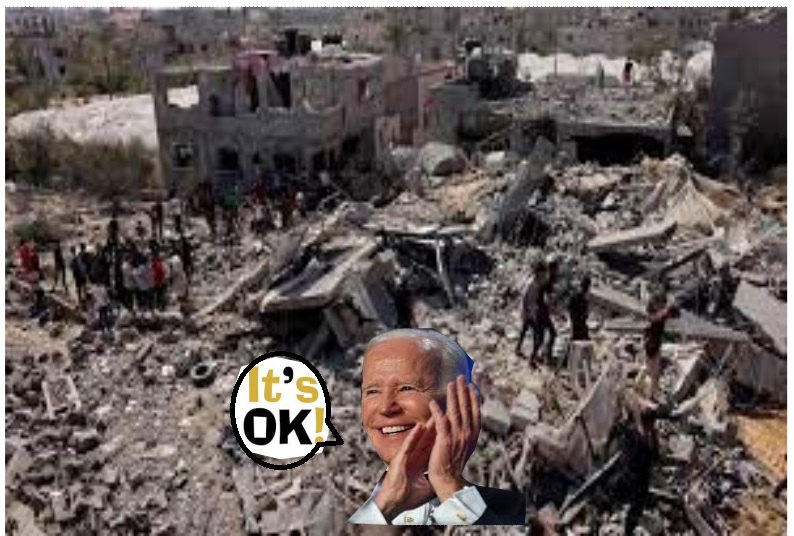
August 21, 2024 By Norman Solomon, https://scheerpost.com/2024/08/21/bidens-convention-speech-made-absurd-claims-about-his-gaza-policy/
An observation from George Orwell — “those who control the present, control the past and those who control the past control the future” — is acutely relevant to how President Biden talked about Gaza during his speech at the Democratic convention Monday night. His words fit into a messaging template now in its eleventh month, depicting the U.S. government as tirelessly seeking peace, while supplying the weapons and bombs that have enabled Israel’s continual slaughter of civilians.
“We’ll keep working, to bring hostages home, and end the war in Gaza, and bring peace and security to the Middle East,” Biden told the cheering delegates. “As you know, I wrote a peace treaty for Gaza. A few days ago I put forward a proposal that brought us closer to doing that than we’ve done since October 7th.”
It was a journey into an alternative universe of political guile from a president who just six days earlier had approved sending $20 billion worth of more weapons to Israel. Yet the Biden delegates in the convention hall responded with a crescendo of roaring admiration.
Applause swelled as Biden continued: “We’re working around-the-clock, my secretary of state, to prevent a wider war and reunite hostages with their families, and surge humanitarian health and food assistance into Gaza now, to end the civilian suffering of the Palestinian people and finally, finally, finally deliver a ceasefire and end this war.”
In Chicago’s United Center, the president basked in adulation while claiming to be a peacemaker despite a record of literally making possible the methodical massacres of tens of thousands of Palestinian civilians.
Orwell would have understood. A political reflex has been in motion from top U.S. leaders, claiming to be peace seekers while aiding and abetting the slaughter. Normalizing deception about the past sets a pattern for perpetrating such deception in the future.
And so, working inside the paradigm that Orwell described, Biden exerts control over the present, strives to control narratives about the past, and seeks to make it all seem normal, prefiguring the future.
The eagerness of delegates to cheer for Biden’s mendaciously absurd narrative about his administration’s policies toward Gaza was in a broader context — the convention’s lovefest for the lame-duck president.
Hours before the convention opened, Peter Beinart released a short video essay anticipating the fervent adulation. “I just don’t think when you’re analyzing a presidency or a person, you sequester what’s happened in Gaza,” he said. “I mean, if you’re a liberal-minded person, you believe that genocide is just about the worst thing that a country can do, and it’s just about the worst thing that your country can do if your country is arming a genocide.”
Beinart continued: “And it’s really not that controversial anymore that this qualifies as a genocide. I read the academic writing on this. I don’t see any genuine scholars of human rights international law who are saying it’s not indeed there. . . . If you’re gonna say something about Joe Biden, the president, Joe Biden, the man, you have to factor in what Joe Biden, the president, Joe Biden, the man, has done, vis-a-vis Gaza. It’s central to his legacy. It’s central to his character. And if you don’t, then you’re saying that Palestinian lives just don’t matter, or at least they don’t matter this particular day, and I think that’s inhumane. I don’t think we can ever say that some group of people’s lives simply don’t matter because it’s inconvenient for us to talk about them at a particular moment.”
Underscoring the grotesque moral obtuseness from the convention stage was the joyful display of generations as the president praised and embraced his offspring. Joe Biden walked off stage holding the hand of his cute little grandson, a precious child no more precious than any one of the many thousands of children the president has helped Israel to kill.
‘Strong record of supporting the U.S.-Israel relationship’: a look at Tim Walz’s votes on Palestine as a member of Congress
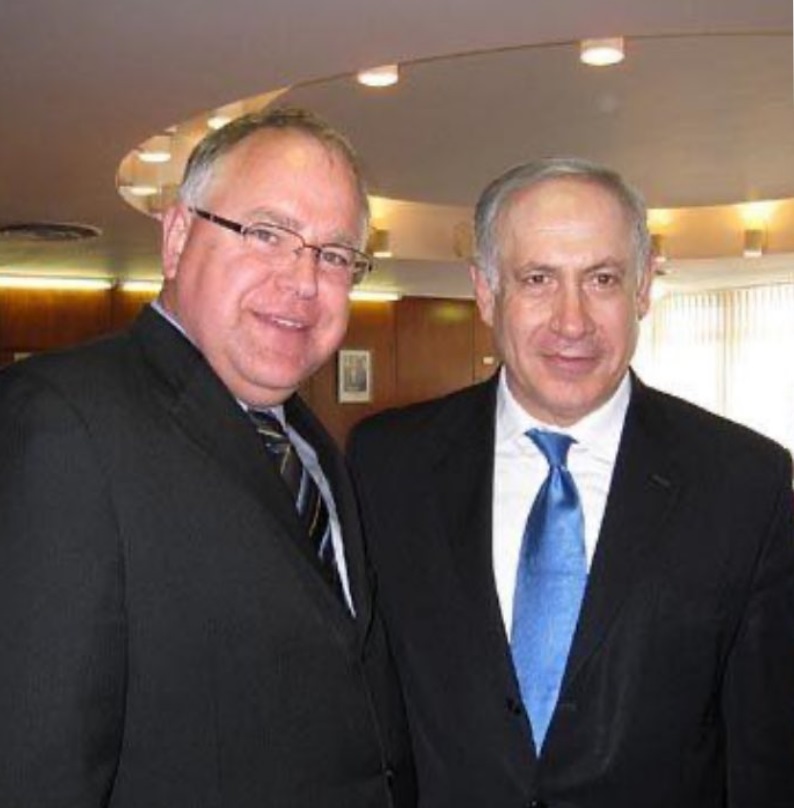
A review of Tim Walz’s time in Congress from 2007 to 2018 shows he supported multiple Israeli wars on Gaza, rejected the international consensus on the illegality of West Bank settlements, and opposed any unilateral declaration of a Palestinian state.
Mondoweiss, By Nicolas Sawaya August 15, 2024
When Kamala Harris selected Minnesota Governor Tim Walz over Pennsylvania Governor Josh Shapiro as her Vice-Presidential running mate, many viewed it as a win for pro-Palestine constituents of the Democratic party. Shapiro’s long history of pro-Israel positions and questionable ties to Israel, as well as his publicly inflammatory statements against Palestinians and their supporters, appeared to be key reasons Harris passed him over. But can Tim Walz be viewed as much better?
A review of Walz’s career shows that he can be fairly characterized as a reliable pro-Israel Democrat who has consistently voted for and taken positions in support of Israel. In fact, it is this very history that has led Israel lobby groups within the Democratic Party to celebrate Harris’s choice, which should give us all pause.
Walz in Congress
While Walz’s time as Minnesota governor has received much attention since it was announced he would become Harris’s running mate, it is actually his time in Congress that might shed the most light on how he will look to influence foreign policy from the executive branch. The record shows that during his career as a member of the House of Representatives between 2007 and 2018, Walz consistently voted in favor of pro-Israeli positions. In these years he supported every Israeli war on Gaza, rejected the international consensus on the illegality of settlements in the West Bank, and opposed any unilateral declaration of a Palestinian state, preferring instead to pay lip service to a “negotiated peace” while Israel continued colonizing the West Bank unimpeded.
Walz on Gaza, 2009 – 2014
In fact, it is Walz’s support for previous assaults on Gaza that are among his most alarming votes………………………………………………………………………….
Walz as Governor
This brings us to the current day, where in his role as Minnesota governor, Walz has paid some lip service to Palestinian concerns, but maintained his staunch support for Israel and opposed legislative action to hold it accountable, even during a genocide………………………………………….
Walz on the Gaza Genocide
Walz made some encouraging remarks after the Minnesota Democratic primaries in March of this year ………………………………………
it is unlikely that these words of sympathy will actually translate to tangible actions that put pressure on the Netanyahu government to end their genocide in Gaza. Indeed, Walz hasn’t called for an arms embargo or sanctions on Israel (and Harris’ national security advisor Phil Gordon recently clarified that Harris “does not support an arms embargo”), or taken any other meaningful policy positions that would potentially result in an end to Israel’s mass slaughter.
……………………………………………………………………………….. Walz on a resolution to the Palestinian-Israeli “conflict”
In early March of this year, in an interview with CNN, Walz said that he supports a “lasting two-state solution”, although he didn’t provide any details as to what that entailed. His voting record suggests the typical support for a “negotiated peace”, where Israel holds all the cards, and opposition to a unilateral declaration of Palestinian statehood. Indeed, on July 7, 2011, Walz voted Yea to H.Res. 268, which “opposes any attempt to establish or seek recognition of a Palestinian state outside of an agreement negotiated between Israel and the Palestinians”.
………………………………….It’s no surprise then, that Marc Mellman, President of Democratic Majority for Israel, praised Walz’s selection and said that he was “a proud pro-Israel Democrat with a strong record of supporting the U.S.-Israel relationship”, while the pro-Israel lobby J-Street (who had previously endorsed him), said that “we know the Harris-Walz team will stand up for our shared values, protect our community, and pursue smart, pro-Israel, pro-peace leadership abroad. We’re all in.” https://mondoweiss.net/2024/08/strong-record-of-supporting-the-u-s-israel-relationship-a-look-at-tim-walzs-votes-on-palestine-as-a-member-of-congress/
1 This Month

of the week – Shut Down Drone Warfare!


Tell the Ukrainian Government to Drop Prosecution of Peace Activist Yurii Sheliazhenko

Petition to revoke the licensing of the Near Surface Nuclear Disposal Facility (NSDF) at Chalk River. https://www.ourcommons.ca/petitions/en/Petition/Details?Petition=e-7247
To see nuclear-related stories in greater depth and intensity – go to https://nuclearinformation.wordpress.com
-
Archives
- March 2026 (251)
- February 2026 (268)
- January 2026 (308)
- December 2025 (358)
- November 2025 (359)
- October 2025 (376)
- September 2025 (257)
- August 2025 (319)
- July 2025 (230)
- June 2025 (348)
- May 2025 (261)
- April 2025 (305)
-
Categories
- 1
- 1 NUCLEAR ISSUES
- business and costs
- climate change
- culture and arts
- ENERGY
- environment
- health
- history
- indigenous issues
- Legal
- marketing of nuclear
- media
- opposition to nuclear
- PERSONAL STORIES
- politics
- politics international
- Religion and ethics
- safety
- secrets,lies and civil liberties
- spinbuster
- technology
- Uranium
- wastes
- weapons and war
- Women
- 2 WORLD
- ACTION
- AFRICA
- Atrocities
- AUSTRALIA
- Christina's notes
- Christina's themes
- culture and arts
- Events
- Fuk 2022
- Fuk 2023
- Fukushima 2017
- Fukushima 2018
- fukushima 2019
- Fukushima 2020
- Fukushima 2021
- general
- global warming
- Humour (God we need it)
- Nuclear
- RARE EARTHS
- Reference
- resources – print
- Resources -audiovicual
- Weekly Newsletter
- World
- World Nuclear
- YouTube
-
RSS
Entries RSS
Comments RSS
 nuclear-news