The Energy Department just made one plutonium pit. Making more is uncertain

Bulletin, By Dylan Spaulding | October 10, 2024
Two conflicting developments arose this month in US efforts to produce new plutonium pits for its nuclear weapons: The National Nuclear Security Administration (NNSA) announced it had produced a warhead-ready pit—the explosive core of a nuclear weapon—for the first time in decades, and a federal court ruled that NNSA will be required to consider the cumulative environmental and health impacts of its pit production program.
Overshadowing these events is a vigorous debate over the necessity for new pits at all. Previous analyses have found that plutonium pits have viable lifespans well beyond the expected service life of the current stockpile, whereas production of pits for new weapons is part of a sweeping US nuclear modernization that raises concern over the future of arms control and any possibility for stockpile reductions at a time of deteriorating international relations.
The two most recent developments illustrate a critical tension in the US nuclear weapons program: New pit production demonstrates a doubling down of US reliance on nuclear weapons for the 21st century. The failure to adhere to environmental policy in doing so highlights the unwitting cost that US citizens may bear for this policy choice—as they have repeatedly in the past………………………………………………………………………………………………………………………………………………………………….
…….Production challenges. Despite any fanfare, demonstrating the ability to certify one plutonium pit doesn’t guarantee smooth sailing toward Los Alamos’s mandated production goals.
The Los Alamos’ Plutonium Facility at Technical Area 55 (PF-4) is conducting the dangerous and difficult work of pit production while also undergoing construction and modernization, with work happening round-the-clock—several other plutonium-related missions are pursued under the same roof. The facility has been criticized for deficiencies in personal safety and safety-related engineering, including recent glovebox fires, floods, worker exposure to plutonium and beryllium, and violations of criticality safety rules. The likelihood of such incidents increases as a result of fast-paced work in close-quarters with a mostly new workforce. In 2013, the PF-4 facility was shut down for three years following a severe criticality safety violation; a repeat could prove fatal, literally and figuratively.
…………………………………………… Regardless of Los Alamos’ success, the congressionally mandated quota of 80 pits per year remains impossible to meet by NNSA’s own admission. This number relies on completion and commissioning of a second production facility at the Savannah River Site in South Carolina, which won’t be operational until the mid-2030s at the earliest.
Just as the future rate of plutonium pit production is uncertain, the missile these pits are intended for—the new Sentinel intercontinental ballistic missile—is also not likely to be completed on schedule. The troubled Sentinel project remains vastly over budget and behind schedule, putting its future at risk and making coordination of the warhead and missile difficult to foresee. Problems or changes in scope for either program will affect the other.
A federal court ruling. Coinciding with NNSA’s announcement of the first diamond-stamped pit, a US District Court ruled that the Energy Department and the NNSA violated the National Environmental Policy Act (NEPA) by failing to properly consider alternatives before proceeding with pit production, requiring the agency to conduct a programmatic environmental impact assessment.
This was a victory for transparency and the community groups—among them, Savannah River Site Watch, Nuclear Watch New Mexico, Tri-Valley Communities Against a Radioactive Environment (CAREs), and the Gullah/Geechee Sea Island Coalition—who, for years, have been asking for such an assessment.
Reestablishing pit production on the scale now contemplated is potentially the biggest investment in the nuclear weapons complex since the Manhattan Project. With it comes hiring and training of thousands of new employees, increased transportation between sites, new construction, safely handing radioactive material, and the generation of new nuclear waste. The cumulative nature of these activities, occurring across many Energy Department’s sites, demands that the impacts of pit production be considered holistically in the form of a programmatic environmental impact assessment.
The environmental impact statements issued by the national laboratories offer perhaps the best public-facing analyses of whether their plans comply with standards for protection of public safety and the environment, including the likelihood of specific scenarios and associated risk of public exposure to hazards such as chemicals or radiation. Still, the NNSA has—until now—resisted issuing such a programmatic statement.
The agency clearly recognizes that pit production involves much of the US nuclear weapons complex. The press release announcing the first diamond-stamped pit thanked workers in Kansas City, Lawrence Livermore National Labs, Los Alamos, and the Pantex plant in Texas. But the NNSA has so far relied on a series of addenda and supplements to a 2008 environmental impact statement for work at Los Alamos and considers Savannah River separately. These assessments largely ignore the cross-complex collaboration required and the subsequent risks, including impacts on the potentially overburdened Waste Isolation Pilot Plant in New Mexico that must absorb the prolific—and complex—waste stream from the pit production process.
The court ruling—which holds that the Energy Department and the NNSA did not follow environmental requirements in pursuing two production sites—will require the NNSA to conduct a new review, bringing renewed public scrutiny and allowing a new opportunity for input from concerned opponents.
An unclear horizon. A programmatic environmental impact statement can take years before it’s finalized. The judge in the case declined to halt construction at NNSA’s second pit production site at Savannah River while the new assessment is being carried out, and the two parties have until October 21st to seek an agreement. It’s likely that the NNSA will argue that stopping pit-production work would be too expensive, too disruptive, and too damaging to national security to consider. It remains unclear what the potential consequences could be if the NNSA decides to challenge the ruling.
While work at Los Alamos is likely to continue amid a programmatic assessment, design choices are still underway at the Savannah River Site, where the NNSA is attempting to retrofit the troubled former mixed oxide (MOX) fuel fabrication plant which never reached productivity despite more than $7 billion of investment. This site is years away from being active and will require extensive transformation that may cost as much as $25 billion. Given this enormous investment, a programmatic environmental impact statement can ensure that this transformation better addresses the actual hazards and better protects communities, workers, and the environment.
Reestablishing pit production in the United States is a massive undertaking. It involves resurrecting a lost capacity that requires complicated engineering, construction, and extremely hazardous work processes that will be carried out by a largely new work force with little to no prior experience. NNSA and its contractors must manage safety risks across multiple sites where new hazardous waste will be generated in communities that don’t want it and where the Energy Department has a poor historic track record of environmental stewardship.
Congress and the Biden administration should eliminate the mandated 80 pit per year requirement while the NNSA conducts a new, thorough environmental assessment that would go a long way toward promoting increased safety and public protection—a challenge that the NNSA and the labs should take seriously. https://thebulletin.org/2024/10/the-energy-department-just-made-one-plutonium-pit-making-more-is-uncertain/
200+ Jewish-Led Protesters Arrested at NY Stock Exchange Say ‘Stop Arming Israel’

“The U.S. war economy is profiting from genocide,” said Jewish Voice for Peace. “The 50+ members of Congress who invest in arms companies get richer every day.”
Jessica Corbett, 14 Oct 24, https://www.commondreams.org/news/israel-wall-street
As the Israeli assault of the Gaza Strip and Lebanon continued on Monday, over 200 Jewish-led protesters, including descendants of Holocaust survivors, were arrested at the New York Stock Exchange while demanding that the United States “stop arming Israel and profiting from genocide.”
Jewish Voice for Peace (JVP)—which has led several anti-genocide protests across the country over the past year of war—said that hundreds of people joined the action in New York City. The advocacy group shared photos and videos on social media of participants in red T-shirts with messages including “Not in Our Name” and “Stop Arming Israel.”
They sat in rows outside the iconic NYC building with banners that said, “Jews Say Stop Arming Israel,” “Arms Embargo Now,” “Jews Say Divest From Israel,” “Gaza Bombed, Wall Street Boomed,” and “Fund FEMA Not Genocide,” a reference to the Federal Emergency Management Agency, which is responding to damage from hurricanes in the Southeast.
As NBC Newsreported on Monday:
Individuals representing Jewish Voices for Peace, a Jewish-led pro-Palestinian group, arrived at the exchange at 85 Broad St. as part of an “unscheduled protest” just before the stock market’s official 9:30 am opening, according to a New York Police Department spokesperson.
A number of arrests were made, the spokesperson said, but an exact figure could not immediately be obtained. An NYSE representative said at least one person had handcuffed himself between an interior and exterior door.
JVP, which said that over 200 people were arrested, posted footage of multiple protesters in red shirts chained to a door and a fence and of officers carrying away demonstrators. The group said that “police are dragging Jewish protesters by their arms and legs as they refuse to leave the global epicenter of capital on Wall Street.”
As the Israeli assault of the Gaza Strip and Lebanon continued on Monday, over 200 Jewish-led protesters, including descendants of Holocaust survivors, were arrested at the New York Stock Exchange while demanding that the United States “stop arming Israel and profiting from genocide.”
Jewish Voice for Peace (JVP)—which has led several anti-genocide protests across the country over the past year of war—said that hundreds of people joined the action in New York City. The advocacy group shared photos and videos on social media of participants in red T-shirts with messages including “Not in Our Name” and “Stop Arming Israel.”
They sat in rows outside the iconic NYC building with banners that said, “Jews Say Stop Arming Israel,” “Arms Embargo Now,” “Jews Say Divest From Israel,” “Gaza Bombed, Wall Street Boomed,” and “Fund FEMA Not Genocide,” a reference to the Federal Emergency Management Agency, which is responding to damage from hurricanes in the Southeast.
As NBC Newsreported on Monday:
Individuals representing Jewish Voices for Peace, a Jewish-led pro-Palestinian group, arrived at the exchange at 85 Broad St. as part of an “unscheduled protest” just before the stock market’s official 9:30 am opening, according to a New York Police Department spokesperson.
A number of arrests were made, the spokesperson said, but an exact figure could not immediately be obtained. An NYSE representative said at least one person had handcuffed himself between an interior and exterior door.
JVP, which said that over 200 people were arrested, posted footage of multiple protesters in red shirts chained to a door and a fence and of officers carrying away demonstrators. The group said that “police are dragging Jewish protesters by their arms and legs as they refuse to leave the global epicenter of capital on Wall Street.”
“As Gaza is bombed, Wall Street booms,” the group said. “The stock prices of weapons manufacturers have skyrocketed this year. The U.S. war economy is profiting from genocide. The 50+ members of Congress who invest in arms companies get richer every day.”
As Common Dreams has reported, stocks of American war profiteers—including Lockheed Martin, Northrop Grumman, and RTX, formerly known as Raytheon—soared in response to Israel launching its assault on Gaza after the Hamas-led October 7, 2023 attack as well as earlier this month, after Israeli forces began a ground invasion of Lebanon and Iran fired off ballistic missiles.
“Remember that members of Congress are permitted to own stock in war manufacturing, so when they vote to send more bombs or send our loved ones to war, they profit personally,” U.S. Rep. Rashida Tlaib (D-Mich.) said in early October.
Tlaib, the only Palestinian American in Congress, has introduced the Stop Politicians Profiting from War Act, which would prohibit federal lawmakers along with their spouses and dependent children from trading defense stocks or having financial interests in companies that do business with the U.S. Department of Defense.
“Politicians should not be allowed to profit from genocide,” said MacArthur fellow Ros Petchesky, an 82-year-old JVP member who was active in the movement to end the war in Vietnam, and the oldest person chained to the Wall Street gates on Monday. “There can be no business as usual while the U.S. arms Israel and profits from genocide. We’re here to demand an arms embargo now.”
U.S. to Deploy Missile Defense System and About 100 Troops to Israel

The Pentagon announced it would send the Terminal High Altitude Area Defense battery and its crew as Israel considered retaliatory attacks against Iran.
NY Times, By Helene Cooper, Reporting from Washington, Oct. 13, 2024
The United States is sending an advanced missile defense system to Israel, along with about 100 American troops to operate it, the Pentagon announced on Sunday. It is the first deployment of U.S. forces to Israel since the Hamas-led attacks there on Oct. 7, 2023.
President Biden directed Defense Secretary Lloyd J. Austin III to deploy the Terminal High Altitude Area Defense system, or THAAD, and its crew, Maj. Gen. Patrick Ryder, the Pentagon press secretary, said in a statement on Sunday.
The move will put American troops operating the ground-based interceptor, which is designed to defend against ballistic missiles, closer to the widening war in the Middle East. It comes after Iran launched about 200 missiles at Israel on Oct. 1 and as Israel plans its retaliatory attack.
The THAAD battery, a mobile defense system, will give the Israel Defense Forces another layer of protection to defend cities, troops and installations from short- and intermediate-range ballistic missiles like those deployed by Iran in its last attack…………………………………………………………………………………
late last month, the Pentagon said that it would send a “few thousand” American troops to the Middle East as Israel intensified its attacks on Hezbollah in Lebanon, with one official putting the figure between 2,000 and 3,000. The United States also sent a THAAD battery along with other air defense systems to the region weeks after the attacks on Oct. 7, 2023. https://www.nytimes.com/2024/10/13/us/politics/us-missile-defense-iran-israel.html?unlocked_article_code=1.R04.e14E.qqRr91Mg9WWs&smid=em-share—
Google Pivots to Nuclear Reactors to Power Its Artificial Intelligence
Science Alert, 15 October 2024, Glenn Chapman,
Google on Monday signed a deal to get electricity from small nuclear reactors to help power artificial intelligence.
The agreement to buy energy from reactors built by Kairos Power came just weeks after word that Three Mile Island, the site of America’s worst nuclear accident, will restart operations to provide energy to Microsoft………………………………………..
Insatiable AI
Tech giants like Microsoft, Amazon, and Google are rapidly expanding their data center capabilities to meet the AI revolution’s computing needs while also scouring the globe for sources of electricity………………………………….
However, the technology is still in its infancy and lacks regulatory approval, leading companies to seek out existing nuclear power options……………………………..
Is it safe?
………………………………… This area faces severe strain from data centers’ massive energy consumption, raising concerns about grid stability as AI demands increase.
Amazon’s AWS agreed in March to invest $650 million in a data center campus powered by another Pennsylvania nuclear plant.
Nuclear energy has staunch opponents due to concerns about radioactive waste disposal, the potential for catastrophic accidents, and the high costs associated with plant construction and decommissioning……….. https://www.sciencealert.com/google-pivots-to-nuclear-reactors-to-power-its-artificial-intelligence
Kamala Harris’ foreign policy agenda music to war party, anathema to swing state voters

Walt Zlotow, West Suburban Peace Coalition, Glen Ellyn IL 13 Oct 24
It’s standard procedure for presidential candidates to promote bellicose US foreign policy in their campaigns. When the weapons makers, career generals, Congressional Hawks and pro war pundits pounce on candidates promoting peace over war, the warning is clear: don’t mess with US unipolar dominance.
But Kamala Harris has taken that to another level with her positions that are furthering the Israeli genocide in Gaza, destruction of Ukraine, looming war with Iran, and endless war provocations in the Far East with China.
She calls the $17.9 billion in US weapons obliterating Palestinian moms and kids “defense” and vows to continue it in a Harris administration. That alone disqualifies her to serve as president. That is not an endorsement of Trump, who’s even more ravenous for Israel to “to finish the job (genocide) in Gaza”
Harris remains in complete denial that US provocations made the Russian invasion of Ukraine inevitable. She’s committed to providing Ukraine with war weapons, already exceeding $150 billion, that have largely destroyed Ukraine as a functioning state. She calls negotiations to end the war “surrender”, something she will never do.
Harris’ claim that Iran is “America’s greatest adversary” is preposterous. She’s cool with Israel bombing folks in Tehran, but when Iran bombed back in protest, Harris got on the phone with Israeli Prime Minister Benjamin Netanyahu, to discuss US help in Israel’s planned reprisals. That is not stateswomanship . That is criminal warmongering.
Harris is also on board endless US provocations against China in the Far East that could provoke war with the third largest nuclear power. Why? Harris says “The US must “win the competition for the 21st century with China.” A competition that ends in war is not winning. It is self destruction.
Harris may be pleasing the US war party, but not voters in swing states. They are not supporting endless US wars sucking up US treasure needed for the Homeland. They favor Trump’s approach to ending them (however unrealistic) over Harris’ bellicose stance by a margin of 58% to 42%. That alone could cost Harris the electoral votes she needs for victory November 5. Her foreign policy is not just wrong…it is stupid.
On domestic issues Kamala checks all the right boxes. On foreign policy issues she my be leading America and the world to ruin.
Biden, Netanyahu Closer to Consensus on Attacking Iran

Netanyahu convened his war cabinet on Thursday to approve plans
by Dave DeCamp October 10, 2024 https://news.antiwar.com/2024/10/10/biden-netanyahu-closer-to-consensus-on-attacking-iran/#gsc.tab=0
President Biden and Israeli Prime Minister Benjamin Netanyahu moved closer to an understanding on Israel’s plans to attack Iran during their phone call on Wednesday, Axios reported on Thursday.
The report, which cited US and Israeli officials, said that the US had accepted Israel is going to launch a major attack on Iran soon and is only concerned that striking certain types of targets could dramatically escalate things. However, Iran has vowed it will respond to any type of Israeli attack, and the situation could easily turn into a full-blown war that would involve the US.
An Israeli official told Axios that the Israeli plans are still a bit more aggressive than the US would like. The US has been warning against striking nuclear facilities or oil infrastructure, and recent media reports have said Israel will likely target military infrastructure.
Netanyahu convened his security cabinet on Thursday to brief them on the situation with the US and is expected to get approval for him and Israeli Defense Minister Yoav Gallant to set a timeline for the Israeli attack. The Times of Israel reported that the US and Israel will continue conversations on the plans in the coming days, signaling the attack is not imminent.
NBC News reported on Tuesday that the US was considering supporting Israel’s attack with direct airstrikes of its own, although US officials said intelligence support was more likely.
The Jerusalem Post reported that the US was offering Israel a “compensation package” of military aid and full diplomatic support if it only hits US-approved targets in Iran. The US has also committed to defending Israel from any Iranian response.
Iran fired nearly 200 ballistic missiles at Israel last week in response to a string of Israeli escalations, including the assassination of Hamas’s political chief, Ismail Haniyeh, in Tehran. Immediately after the attack, National Security Advisor Jake Sullivan said the US would work with Israel to ensure Iran suffers “severe consequences.”
Renewables based systems are reducing blackouts in UK and USA!

David Toke, Oct 11, 2024, https://davidtoke.substack.com/p/renewables-based-systems-are-reducing
The truth is gradually emerging that far from threatening electricity systems with blackouts, renewable energy-based systems are preventing them for occurring! This has a lot to do with the fact that the installation of batteries to deal with renewable output variability has the side-effect of improving grid resilience. Solar power is also reducing possibilities for blackouts in hot places.
Batteries stopped widespread blackouts just three days ago, on October 8th in the UK, when, the UK-Norwegian electricity interconnector suddenly crashed leading to a loss of 1.4 GW of power. Without rapid action, frequency levels would have fallen leading to widespread blackouts as the system tried to preserve grid stability. But 1.5 GW of batteries rapidly clicked into service saving the day (see HERE). Of course the build-up of batteries in the UK is only happening because of the growth of renewable energy!
Similar stories of how blackouts are being averted are coming from other places with growing renewables penetration, including Texas and California in the USA. In both cases, earlier blackouts were caused by conventional power system problems, but widely blamed on renewables by anti-renewables lobbies. But now as renewables, and battery systems, proliferate further, blackout rates are actually being reduced.
Speaking about the October 8th UK incident, Roger Hollies from the ARENCO Group, who originally posted about the outage response on linkedin (HERE) commented: ‘It’s exciting to see batteries casually keeping the lights on whilst delivering diversity of activity to maximise revenue. I count 9 markets and services being participated in by these 12 batteries during this 50 min window alone! This complexity is only going to continue with Quick Reserve coming online later this year, local markets expanding, more renewables coming online and we STILL are not using the +/-3Gvar of reactive power the installed BESS fleet can supply!’
In California, the number of blackouts has been dramatically reduced over the last couple of years. ‘Batteries were the biggest reason California didn’t see the power go out’ says Benjamin Storrow (see HERE). There has been a very big increase in battery installation in California. This has been driven partly by a State-led investment programme. In addition, the increase in battery capacity follows on from the new opportunities in spreading production from the increasing quantity of solar panels over longer periods of the day.
Texas has been saved from a summer power blow-out by a combination of solar pv and batteries. Climate-change inspired hotter summers have put a strain on the Texas grid to cope with the rising demands for air conditioning to meet the summer heat spikes. Once again, solar pv and batteries have come to the state’s rescue. See HERE.
Of course a lot of work still needs to be adapt the electricity from its traditional centralised dispatch mode to a decentralised way of operation. These include incentivising longer duration batteries, something encouraged by a ‘cap and floor’ incentive system for batteries announced by the Government today. See HERE. Initiatives to replace the inertial load system provided by traditional centralised power plant with new inertial sources needed to support variable renewable energy are also in play, for instance promoted by Statkraft’s Guy Nicolson HERE.
Acknowledgement to Dave Andrews from the Claverton Group for the alert on the Norway link tripping event.
Are DOE and NNSA Complying with the National Environmental Policy Act?

The Court found the DOE’s plan had fundamentally changed from the one site plan to its two site plan. DOE did not consider alternatives while moving forward and spending tens of billions of taxpayers’ dollars. The Court found that the plaintiffs had standing to challenge DOE’s two-site plan.
October 10th, 2024, https://nuclearactive.org/
On Monday, September 30th, United States District Court Judge Mary Geiger Lewis ruled that the Department of Energy (DOE) and its National Nuclear Security Administration (NNSA) violated the National Environmental Policy Act (NEPA) because the federal agencies failed to take a “hard look” at the alternatives to fabricate plutonium pits, or the triggers, for nuclear weapons at two of its sites. Los Alamos National Laboratory (LANL) was created to design and fabricate the atomic bombs used during World War II. The Savannah River Site in South Carolina has never fabricated pits for nuclear weapons.
In the late 2000s, DOE released for public review and comment its Complex Transformation Supplemental Programmatic Environmental Impact Statement stating that pit production would take place exclusively at LANL. https://www.energy.gov/nepa/doeeis-0236-s4-complex-transformation-supplemental-programmatic-environmental-impact-statement
Yet in 2019 DOE expanded its proposal to improve the resiliency, flexibility and redundance of the nuclear security enterprise to also fabricate plutonium pits at the Savannah River Site in South Carolina. DOE failed to prepare a new NEPA document for public review and comment detailing how the two sites would interact to fabricate up to 80 plutonium pits per year.
A coalition of non-governmental organizations challenged DOE’s action in the United States District Court of South Carolina. The plaintiffs are the Gullah/Geechee Sea Island Coalition https://gullahgeecheenation.com/gullahgeechee-sea-island-coalition/ , Nuclear Watch New Mexico https://nukewatch.org/home/ , Savannah River Site Watch https://srswatch.org/ , and Tri-Valley Communities Against a Radioactive Environment, or Tri-Valley CARES https://trivalleycares.org/ , and individual Tom Clements. They are represented by Ben Cunningham of the South Carolina Environmental Law Project https://www.scelp.org/ .
The Court found the DOE’s plan had fundamentally changed from the one site plan to its two site plan. DOE did not consider alternatives while moving forward and spending tens of billions of taxpayers’ dollars. The Court found that the plaintiffs had standing to challenge DOE’s two-site plan.
Cunningham said, “This is a significant victory that will ensure NEPA’s goal of public participation is satisfied. Public scrutiny is especially important because the activities at issue here, by their very nature, result in the production of dangerous weapons and extensive amounts of toxic and radioactive waste. I hope the public will seize the upcoming opportunity to review and comment on the federal agencies’ assessment.”
The Court ordered the parties to confer and present the Court with a joint proposal about appropriate remedies to resolve the case, including “Plaintiffs’ request for injunctive relief.” The proposal is due to the Court on Friday, October 25th.
To access the Court documents, go to: https://nukewatch.org/wp-content/uploads/2024/10/Court-Rules-U.S.-Nuclear-Weapons-Production-Plan-Violates-Federal-Law.pdf
Report: US Considers Launching Airstrikes Against Iran To Support Israeli Attack
US officials say Israel hasn’t briefed the US on its specific plans to attack Iran,
by Dave DeCamp October 8, 2024, https://news.antiwar.com/2024/10/08/report-us-considers-launching-airstrikes-against-iran-to-support-israeli-attack/#gsc.tab=0
The US has discussed the idea of supporting Israel’s expected attack on Iran with intelligence or with airstrikes of its own, NBC News reported on Tuesday, citing two unnamed US officials.
The report said senior US military officials have discussed launching “very limited” airstrikes against Iranian targets inside Iran or outside of the country, though the US officials said intelligence support for Israel was more likely.
So far, no final decision on US action has been made, according to the report, and the US officials said Israel has not briefed the US on its specific plans to strike Iran in response to the Iranian missile barrage that hit Israel last week.
Iran launched nearly 200 ballistic missiles into Israel in response to multiple Israeli escalations in the region, including the July 31 assassination of Hamas’s political chief, Ismail Haniyeh, in Tehran. In the aftermath, the US said it would work with Israel to ensure Iran faces “severe consequences” for the attack.
The NBC report said US officials were worried that Israel could launch its attack while Israeli Defense Minister Yoav Gallant is meeting with Secretary of Defense Lloyd Austin at the Pentagon on Wednesday. However, after the report was published, Gallant’s trip to the US has been canceled.
Israeli media said the trip was postponed because Israeli Prime Minister Benjamin Netanyahu wants to speak with President Biden and wants the Israeli security cabinet to agree on a plan to attack Iran before Gallant heads to Washington.
The Israelis are considering several types of targets to hit in Iran: military and intelligence infrastructure, air defenses, and energy facilities. Based on media reports, Israel does not plan to strike Iranian nuclear facilities in its first attack, but could if Iran hits back and the situation turns into a full-blown war, which Israeli officials think is likely to happen.
Biden Allowing Israel to March US Into War With Iran
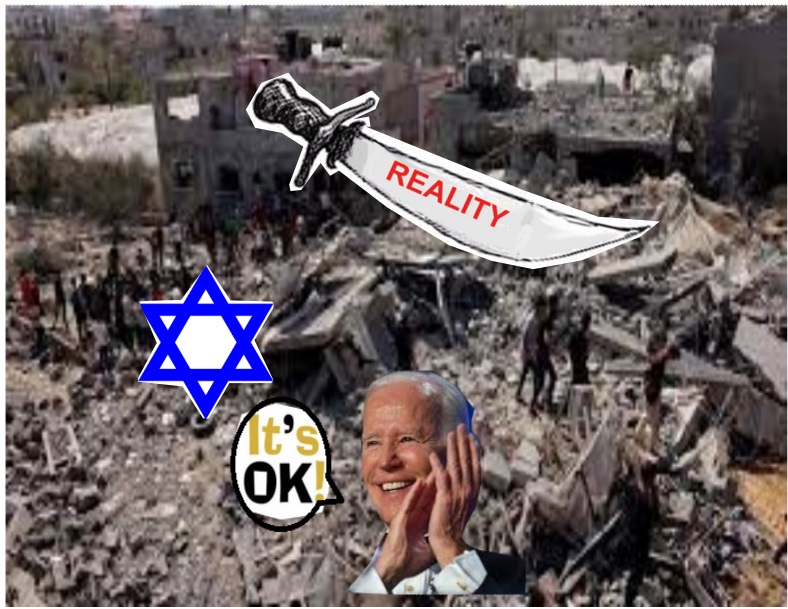
By cooperating with Israel in a new attack, the United States is assisting a state that has been responsible for most of the escalation and the vast majority of death and destruction in the Middle East for at least the past year.
Common Dreams, Paul Pillar. Oct 07, 2024, Responsible Statecraft
The Biden administration is not only endorsing but also on the verge of actively assisting a new Israeli armed attack on Iran. National security adviser Jake Sullivan says that the United States is working directly with Israel regarding such an attack. “The United States is fully, fully, fully supportive of Israel,” declares President Joe Biden.
The projected attack serves no U.S. interests. The attack perpetuates a broader pattern of escalating violence in the Middle East that also serves no U.S. interests. The Iranian missile salvo to which the coming Israeli attack is ostensible retaliation was itself retaliation for previous Israeli attacks. Retaliation for retaliation is a prescription for an unending cycle of violence.
The United States is facilitating an attack on a nation that does not want war and has been remarkably restrained in trying to avoid it, in the face of repeated Israeli provocations. A sustained Israeli bombing campaign against Iranian-related targets within Syria elicited a response only when it escalated to an attack on a diplomatic compound in Damascus, killing senior Iranian officials. Even then, the Iranian response, in the form of an earlier salvo of missiles and drones in April, was designed and telegraphed in a way to make a show of defiance but — with most of the projectiles certain to be shot down — to cause minimal damage and almost no casualties.
When Israel assassinated visiting Hamas political leader Ismail Haniyeh in a government guest house in Tehran in July — the sort of attack that would elicit a quick and forceful response by the U.S. or Israel if it happened in one of their capitals — Iran did nothing until last week. It finally acted only after yet another Israeli attack — this time an assault on residential buildings in a suburb of Beirut that killed a senior Iranian Revolutionary Guard officer along with Hezbollah secretary-general Hassan Nasrallah. Far from being motivated by any grandiose ambitions of regional dominance or desire to destabilize the region, Iranian leaders believed that they were getting killed by a thousand cuts from Israel and that they had to respond to the repeated Israeli attacks lest they lose the confidence not only of their own people but of regional allies. The missile firings that constituted Iran’s retaliation, like the ones in April, again caused minimal damage or casualties.
By cooperating with Israel in a new attack, the United States is assisting a state that has been responsible for most of the escalation and the vast majority of death and destruction in the Middle East for at least the past year. Although Hamas’ attack on southern Israel last October is commonly seen as the starting point of the subsequent mayhem in the Middle East, the question of who is responding to whom could go back farther than that. For example, the 1,200 deaths from that Hamas attack, horrible to be sure, were fewer than the number of Palestinians that Israel had killed in the occupied West Bank and the Gaza Strip just from the day-to-day operations of the occupying Israeli army, supplemented by settler violence in the West Bank, during the previous eight years.
Since the Hamas attack, the devastating Israeli operation in the Gaza Strip has gone far beyond anything that can be construed as defense, or even as a response to Hamas, and has brought suffering to innocent civilians that is orders of magnitude greater than anything Hamas or any other Palestinian group has ever done. The still-rising official death toll exceeds 41,000, with the actual number of Palestinian deaths probably much higher and likely into six figures. Much of the Strip has been reduced to rubble and rendered unlivable.
After Hezbollah fired rounds into Israel last October in a show of support for the Palestinians in Gaza, the story of conflict along the Israeli-Lebanese frontier has mainly been one of repeated Israeli escalations. Israeli attacks in Lebanon have far exceeded Hezbollah attacks on Israel, in number but especially in physical effects, with almost no casualties within Israel apart from a few military personnel at the border. The rapidly rising toll of deaths in Lebanon from Israeli attacks has now passed 2,000, with about 10,000 injured and about 1.2 million people displaced from their homes. As in the Gaza Strip, civilians constitute much and perhaps most of that toll, including as a result of Israeli airstrikes that have demolished residential buildings in densely populated neighborhoods.
As a growing Israeli ground assault in Lebanon accompanies the aerial bombardment, Israel has told people in almost the entire southern third of Lebanon to move north, even though Israel already has been conducting lethal aerial attacks throughout Lebanon, including as far north as Tripoli. This also is reminiscent of the pattern in Gaza, in which residents are told to move, only to be bombed again in their new location……………………………………………………………………………………………………………………………………..
Israel has already entrapped the United States to a large degree in its lethal ways in the Middle East, and the entrapment threatens to become deeper with the anticipated new attack on Iran. The entrapment would not have been possible without mismanagement of the U.S.-Israeli relationship on the Washington end. President Biden’s approach of holding Netanyahu close in the hope of influencing his policies has failed. It also has been counterproductive. In the absence of any willingness to employ the leverage that U.S. material aid to Israel represents, all the bear-hugging and expressions of support have only reassured Netanyahu that he can continue to prosecute his wars and ignore American calls for restraint without losing that aid.
It is refreshing to see reports that at least within the Department of Defense there is some recognition that the policy has been counterproductive by emboldening Israel to escalate. It is perhaps unsurprising that the department whose personnel would be on the front line of any expanded warfare involving the United States is more willing than others to recognize the nature and sources of the violence plaguing the Middle East and the need to deter or restrain Israel rather than embolden it. One can only hope that this willingness will spread more widely in policymaking circles. https://www.commondreams.org/opinion/biden-israel-war-with-iran?fbclid=IwY2xjawFyg3dleHRuA2FlbQIxMAABHRouKaR2ZR-gz5KkJIrj7Lz4yB_yy0cppu3rr4KzPnZL0PIvnbHrmshjLg_aem_SGLFnpWmqgyty62qiA5Trg
Michael Hudson and Richard Wolff: Middle East Exploding, Ukraine Crumbling, US to Take Action?
Mr Zelenskyy in the Ukraine, and Mr. Netanyahu in Israel have no hope of prevailing, given the odds against them – the sheer numbers.
Israel can’t fight five wars at the same time…………….Their only hope is to bring the United States in……………………………….fighting to the last Ukrainian is now being superseded by fighting to the last Israeli.
that visceral hatred of Islam that the Zionists had, or also the visceral hatred of Russia, specifically for anti-Semitism of past centuries,
there’s no solution to the black hole that Israel’s painted itself into………And yet, there’s no willingness to have a single state
marriage of convenience here between the Zionists …and…it’s in the evangelical community…..The biggest festivals every year of Israeli films are held in mega-churches of the Protestant faith in this country, not in synagogues.
the opponents of all this are the U.S. military……who say that if you really want to extend the war, it’s not going to work
I think that the State Department and the National Security Agency and the Democratic Party leadership, with its basis in the military-industrial complex, is absolutely committed to “if we can’t have our way, then who wants to live in such a world.” …………. what Putin said was, “well, who wants to live in a world without Russia after all?”……………………………..That’s the mentality we’re dealing with
By Dialogue Works, October 8, 2024, https://scheerpost.com/2024/10/08/michael-hudson-and-richard-wolff-middle-east-exploding-ukraine-crumbling-us-take-action/
Transcript
NIMA: So nice to have you back, Richard and Michael. And let me just manage this. And let’s get started with the main question here that would be: Why is the United States not interested in putting an end to the conflict in the Middle East and in Ukraine? Which we know in both of these cases, they’re capable of doing this.
And before going to the answer of this question, I’m going to play a clip that the foreign minister of Lebanon is talking with Christiane Amanpour about his point of view and why they couldn’t reach a ceasefire.
CHRISTIANE AMANPOUR: … I spoke with Lebanon’s Foreign Minister, Abdallah Bou Habib, who’s in Washington to meet with American officials and he joined us for his first interview since the latest escalations. Foreign minister, welcome back to the program.
ABDALLAH BOU HABIB: Thank you. Thank you.
CHRISTIANE: Things have reached a major crisis in your country since we last spoke. And I want to ask you, you are in the United States right now. You know that several of the administration officials agree with Israel’s ground incursion into your country. What do you make of that as you’re in Washington trying to get support for a ceasefire?
ABDALLAH: Well, they also agreed on the Biden-Macron statement that calls for a ceasefire and that calls also for the implementation of a 21 days ceasefire. And then Mr. Hochstein would go to Lebanon and negotiate a ceasefire. And they told us that Mr. Netanyahu agreed on this. And so we also got the agreement of Hezbollah on that. And you know what happened since then. That was the day we saw you in New York.
CHRISTIANE: I know. And you were talking about going into the Security Council for this ceasefire. And barely 24 hours later, the head of Hezbollah was assassinated. Are you saying Hassan Nasrallah had agreed to a ceasefire just moments before he was assassinated?
ADBALLAH: He agreed, he agreed. Yes, yes. We agreed completely; Lebanon agreed to a ceasefire by consulting with Hezbollah. The Speaker, Mr. Berri, consulted with Hezbollah and we informed the Americans and the French that [that is] what happened. And they told us that Mr. Netanyahu also agreed on the statement that was issued by both presidents.
NIMA: Yeah. Here is the question here, because if you remember, with the assassination of Ismail Haniyeh while they were talking with Ismail Haniyeh, negotiating with Ismail Haniyeh in Qatar, they assassinated him.
And right after they reached some sort of agreement with the government in Lebanon and just Hezbollah said, okay, we’re going to go with that plan, they assassinated him.
And the question right now is here, why is this with the United States, Michael? Go ahead.
MICHAEL HUDSON: Well, the United States doesn’t want a ceasefire because it wants to take over the entire Near East. It wants to use Israel as the cat’s paw. Everything that’s happened today was planned out just 50 years ago back in 1973 and 1974. I sat in on meetings with Uzi Arad, who became Netanyahu’s chief military advisor after heading Mossad.
And the whole strategy was worked out essentially by the Defense Department, by neoliberals, and almost in a series of stages that I’ll explain.
[Henry Martin] “Scoop” Jackson is the main name to remember. Scoop Jackson was the ultra right wing neo-con was sponsored them all. And he was the head of the Democratic National Committee in 1960 and then worked with military advisors.
I was with Herman Kahn, the model for Dr. Strange Love, at the Hudson Institute during these years, and I sat in on meetings and I’ll describe them, but I want to describe how the whole strategy that led to the United States today, not wanting peace, wanting to take over the whole Near East, took shape gradually.
And this was all spelled out. I wrote a book about the meetings that I had at War College and the White House and various Air Force and Army think tanks back in the 1970s.
The starting point for all the U.S. strategy here was that democracies no longer can field a domestic army with a military draft. America is not in a position to really field enough of an army to invade a country, and without invading a country you can’t really take it over. You can bomb it but that just is going to incite resistance. But you can’t take it over.
The Vietnam War showed that any attempted draft would be met by so much anti-draft resistance taking the form of an anti-war [sentiment] that no country whose leaders have to be elected can ever take that role again.
Now it’s true that America sent a small army into Iraq, and there are 800 U.S. military bases around the world, but this wasn’t a fighting army – it was an army of occupation without really much resistance of the kind that Ukraine is experiencing with Russia for instance, as we’re seeing there. That situation in the Near East is very different.
The anti-war students showed that Lyndon Johnson in 1968 had to withdraw from running for election because everywhere he’d go there would be demonstrations against him to stop the war. No such demonstrations are occurring today, needless to say.
So I won’t call the U.S. or the European Union democracies, but there is no government that has to be elected that is able to send their own soldiers into a big war.
And what that means is that today’s tactics are limited to bombing, not occupying, countries. They are limited to what the Israeli forces can drop the bombs on Gaza and Hezbollah and try to knock out things, but neither the Israeli army, nor any other army, would really be able to invade and try to take over a country in the way that armies did in World War II.
Everything has changed now and there can’t be another occupation by the United States of foreign countries, given today’s alliances with Russia and Iran and China.
So, this was recognized 50 years ago and it seemed at that time that the U.S.-backed wars were going to have to be scaled down . But that hasn’t happened. And the reason is the United States had a fallback position: it was going to rely on foreign troops to do the fighting as proxies instead of itself. That was a solution to get a force.
“The first example was the creation of Wahhabi jihadists in Afghanistan, who later became al-Qaeda. Jimmy Carter mobilized them against secular Afghan interests and justified it by saying, ‘Well, yes, they’re Muslims, but after all, we all believe in God.’”
So the answer to the secular state of Afghanistan was Wahhabi fanaticism and jihads, and the United States realized that in order to have an army that’s willing to fight to the last member of its country — the last Afghan, the last Israeli, the last Ukrainian — you really need a country whose spirit is one of hatred towards the other, a spirit very different from the American and European spirit.
Well, Brzezinski was the grand planner who did all that. The Sunni Jihad fighters became America’s foreign legion in the Middle East and that includes Iraq, Syria and Iran and also Muslim states going up to Russia’s border.
And the aim of the United States was, oil was the center of this policy. That meant the United States had to secure the Near East and there were two proxy armies for it. And these two armies fought together as allies down to today. On the one hand, the al-Qaeda jihadis, on the other hand, their managers, the Israelis, hand in hand.
And they’ve done the fighting so that the United States doesn’t have to do it.
The foreign policy has backed Israel and Ukraine, providing them with arms, bribing their leaders with enormous sums of money, and electronic satellite guidance for everything they’re doing.
President Biden keeps telling Netanyahu, “Well, we’ve just given you a brand new bunker, cluster bombs and huge bombs – please drop them on your enemies, but do it gently. We don’t want you to hurt anybody when you drop these bombs.”
Well, that’s the hypocrisy – it’s a good cop bad cop. Biden and the United States for the last 50 years has posed as a good cop criticizing the bad cops that it’s been backing. Bad cop ISIS and al-Qaeda, bad cop Netanyahu.
But when all of this strategy was being put together, Herman Kahn’s great achievement was to convince the U.S. Empire builders that the key to achieving their control in the Middle East was to rely on Israel as its foreign legion.
And that arms-length arrangement enabled the United States to play the role, as I said, of the good cop, designating Israel to play its role, and Israel has organized and supplied al-Nusra, al-Qaeda while the United States pretends to denounce them. And it’s all part of a plan that’s been backed by the military, the State Department, and the National Security Operation.
And that’s why the State Department has turned over management of U.S. diplomacy to Zionists, seemingly distinguishing Israeli behavior from U.S. empire building. But in a nutshell, the Israelis have joined al-Qaeda and ISIS as troops, as America’s foreign legion.
NIMA: Yeah. As you were talking about, the question was: why is the United States not interested in putting an end to the conflicts in the Middle East and in Ukraine? And Michael was pointing out the endgame of the United States in this type of behavior. And what’s your take right now?
RICHARD WOLFF: Well, I think in the case of Ukraine, at this point, it is merely a kind of vague, left-over desire to weaken Russia. It isn’t working very well, so my guess is it’ll be over pretty soon. And in the case of Israel, I think, Michael is right, that this is a deal: the Israelis, hopefully, will give the Americans some kind of leverage over what happens in the Middle East, that they wouldn’t have if they didn’t have Israel. Otherwise I do not understand why the United States allows its policies to be made by Mr. Netanyahu. We have the strange situation that the people holding back Mr. Netanyahu are Israelis, not Americans, which given that it’s two different countries is rather strange, Americans feel more difficulty in opposing Netanyahu than Israelis do. But I don’t want to take away from the fact that there is a mutuality of interest in shaping the Middle East and hoping to be able to do it.
But I don’t think this is working very well. And I think my suspicion is that they are going, particularly after the election, to do a lot of rethinking about all of this, because this is not going well.
NIMA: Yeah. And Michael?
MICHAEL: Yeah, I think we can use more of the context. Because after I mentioned that the U.S. realized it needs foreign troops, it also realized that the only kind of full-scale war that democracy could afford is atomic war. And the problem is that that only works against adversaries that can’t retaliate.
But in recent years, U.S. military policy has been so aggressive that it’s driven other countries to band together and back their allies with nuclear powers. So all of the countries of the world now are associated with nuclear backups. And we’ve discussed that before.
The result is that today’s military alliances mean that any attempt to use nuclear weapons is going to risk a full-scale nuclear war that’s going to destroy all the participants and the rest of the world as well. So what is left for the United States? Well, I think there’s only one form of non-atomic war that democracies can afford, and that’s terrorism. And I think you should look at Ukraine and Israel as the terrorist alternative to atomic war. I think Andrei Martyanov recently has explained that that’s the alternative to atomic war. And this, unless NATO-West is willing to risk atomic war, which it doesn’t seem to be willing to, then terrorism is the only alternative left to it. And that is the basis of the regime change plans that the United States has in countries bordering Russia, China, and other countries that it views as adversaries. That’s what we’re seeing in Ukraine and above all in Israel, as it fights against the Palestinian population in Gaza.
The whole idea of the Ukrainians and Israelis is to bomb civilians, not military targets, but civilians. It’s a fight literally to destroy the population under an ideology of genocide. And that is absolutely central. It’s not an accident – it’s built in, built into the program. And Lebanon, even though it’s largely Christian, is part of that.
So the other weapon that the United States has is economic. And that’s oil and grain – it was decided way back in 1973-74. That was right the time of the oil war, when oil prices were quadrupled in response to the United States quadrupling its grain prices. So the United States said, well, “the way to avoid a war, terrorism, regime change, is just to starve countries into submission – either by cutting off their food supply or cutting off their oil supply. Because without oil, how can they run their industry, heat their homes and produce electricity?”
And oil is the largest private sector monopoly in the country. The seven sisters controlled the oil trade ever since World War I, and England have been their coordinator.
And after the oil war, Saudi Arabia promised – sort of was told, “you can raise your oil prices as much as you want, but you have to keep all of your export earnings in the United States. You can buy treasury bills, you can buy corporate bonds, you can buy stocks, but you cannot use more than a portion of it for your own development; you have to turn it over to the U.S. financial sector. So Saudi Arabia became the key and the result was the petrodollar that was put into U.S. banks and just increased the liquidity, the whole growth of third world debt that exploded in the 1970s, leading to the debt crisis of the ‘80s was all of that. And basically the United States realized, “okay, we want to extend control to conquer the Near East, conquer countries that have vital raw materials; we want to use the World Bank to make sure that global South countries don’t feed themselves – we’ll give money for plantation export crops, not for food.”
The condition of foreign Latin America and Africa being an ally of the United States was not to grow their own grain and food, but to depend on U.S. grain export. You know, that’s the sort of economic plan that goes together with the military plan to be the organizing force of the American empire.
RICHARD WOLFF: Let me introduce a couple of other considerations, just to add to the stew here. It is my understanding that many forces in the American political establishment interpret the collapse of the Soviet Union in 1989, ‘90 and ’91 as the fruit of a long-term U.S. policy that included the arms race and other mechanisms where the Soviet Union could not afford the level of military activity that the United States could afford, but for political and military reasons could not afford not to do it.
And so the Soviet Union tried to ride that either-or and collapsed between the demands of the nuclear arms race, the cost of their occupation of Afghanistan. They couldn’t do it. And they scrimped here and there and they didn’t quite fulfill the consumer growth plan that they had promised their people and they couldn’t do it.
If you believe that that’s what went on, then you might try to understand that what they’re doing with Russia now is the same policy. In other words, it’s again the arms race, but this time not to fight in Afghanistan, but to fight in Ukraine. Fight them there, draw them out, cost them a fortune and assume that they cannot manage all that they’re doing and that it’s much easier for you, being a richer – much, much richer – country to do this than it is for them.
And the big mistake here was not to understand that the Russians were acutely aware of what their shortcomings were and have worked very hard in the last 25 years not to be in that position again. There’s an aphorism in military thinking: “Everybody fights the last war.” That you got to fight this one, not the last one. The winner of the last one thinks they found the magic bullet. The loser of the last one realizes they have to do something different. Russia is surprising everybody by the extent of its military capability and its military preparation. They’re winning the war in Ukraine because of it. That’s a miscalculation here.
Okay, that’s the first thing. And I suspect that not only is Ukraine re-running the old strategy, but that they hope that by imposing a kind of arms race on the Middle East, partly an arms race between Israel and the Arabs and the Islamists, but also arms races where they could between Shiite and Sunni.
Remember, the war in Iraq and Iran, by splitting them up, by buying off Abu Dhabi or Dubai, or all of the machinations that are going on – they hope that they can fund their ally -Israel- and exhaust all the enemies of Israel, forcing them eventually into some sort of deal with Israel. And Israel has to be very, very careful: it needs to appease the United States to make these deals, but it also has to try to make sure these deals don’t work out, because it wants to be the American agent in that part of the world.
And so my last point. Here’s another similarity between Israel and Ukraine: Mr Zelenskyy in the Ukraine, and Mr. Netanyahu in Israel have no hope of prevailing, given the odds against them – the sheer numbers. And let’s remember, Americans are not understanding: it’s not just now that Israel is at war with Hamas – whom they have not yet defeated in the Gaza – and they are at war with Hezbollah on the West Bank and in Lebanon, bu they are at war with the Houthis in Yemen and they are at war with the Iranians behind all of that, and they are at war, more or less, with the Lebanese.
And then there are the Shiite militias, which are very close to Iran, and are very powerful in both Iraq and Syria. Well, I got news for you: that’s too many enemies. The Houthis recently showed they can send missiles into Israel. My guess is all of the others I’ve just named either can also do that already or will soon be able to do that.
Israel can’t fight five wars at the same time. It’s a small country. God knows what has happened to its economy, which has effectively shut down in order to fight a war. Their only hope is to bring the United States in; it’s the only hope for Ukraine. Otherwise, Ukraine will lose quickly and Israel will lose slowly.
That’s how it looks to me and that’s for me what governs the hysteria around trying to figure out what to do. But it leaves me also with a question: Why is Israel unable or unwilling to cut deals? My sense is, the Egyptians would cut them. And my sense is, many of its neighbors would at least in principle be willing to sit down and at least try to reach some. And then Israel, instead of expanding geographically would go up, build high rises. What are you doing? Stealing land from Palestinian peasants. What are you doing? Is your future agricultural? Don’t be silly – it isn’t; it doesn’t need to be.
It’s as if we were suddenly confronted with Luxembourg demanding pieces of Belgium or Netherlands or France or something because they had to expand. They’ve been perfectly happy building vertical rather than horizontal. For many, many, many decades longer than Israel has been concerned. So what is this?
Anyway, I thought these would be, you know, I’m trying to learn how to think about this in ways that are not constricted by the way the mainstream media analysts do, which is useless.
MICHAEL: Well Richard, you’ve described exactly what’s going on and you’ve shown how fighting to the last Ukrainian is now being superseded by fighting to the last Israeli. Why are they doing this? Well, the answer is: If they were peace – if Egypt and the other countries that you mentioned were to make a peaceful arrangement with Israel – then there’d be no war. And with no war, how could the United States take over the other countries in the region? The U.S. policy, as I said, 50 years ago, and I’ll go into that more now, was based on the U.S. actually taking over all of these countries, again using Israel as the battering ram, as what the army called “America’s landed aircraft carrier” there. Well, all this began to take place in the 1960s with Henry “Scoop” Jackson.
It initially, Israel didn’t really play a role in the U.S. plan. Jackson simply hated communism, he hated the Russians, and he had got a lot of support within the Democratic Party. He was a senator from Washington State, and that was the center of military-industrial complex.
He was called, nicknamed, “The Senator from Boeing,” for his support for the military-industrial complex. And the military-industrial complex backed him for becoming chair of the Democratic National Committee. Well, he was backed by Herman Kahn – as I said, the model for Dr. Strangelove – who became the key strategist for U.S. military hegemony and the Hudson Institute – no relation to me, an ancestor discovered the river we were both named after. They used the Hudson Institute and its predecessor, the Rand Corporation, where Herman came from, as its major long-term planner.
And I was brought in to discuss the dollar exchange rate and the balance of payments. My field was international finance. Well, Herman set up the institute to be a training ground for Mossad and other Israeli agencies. There were numerous Mossad people there, and I made two trips to Asia, as I mentioned, with Uzi Arad, who became, as I said, the head of Mossad.
So we had discussions about just what was going to happen for the long term, and they were about just what’s happening today. Herman told me over dinner one night that the most important thing in his life was Israel. And that’s why he couldn’t get military information even from U.S. allies, like Canada, because he said he wouldn’t pledge allegiance to their country or even the United States, were he to swear loyalty to any other country. And he described the virtue of Jackson for Zionists was precisely that he was not Jewish, but a defender of the dominant U.S. military complex and an opponent of the arms control system that was underway. Jackson was fighting all the arms control – “we’ve got to have war.” And he proceeded to stuff the State Department and other U.S. agencies, with neo-cons, who were planned from the beginning for a permanent worldwide war, and this takeover of government policy was led by Jackson’s former senate aids.
These senate aides were Paul Wolfowitz, Richard Pearl, Douglas Fife, and others who were catapulted into the commanding heights of the State Department and more recently the National Security Council. The Jackson-Vanik amendment to the U.S. Trade Act of 1974 became the model for subsequent sanctions against the Soviet Union.
The claim was it limited Jewish immigration and other human rights. So right then, the State Department realized: here is a group of people who we can use as the theoreticians and the executors of the U.S. policy that we want – they both want to take over all of the Arab countries.
On one occasion, I’d brought my mentor, Terrence McCarthy, to the Hudson Institute, to talk about the Islamic worldview, and every two sentences, Uzi would interrupt: “No, no, we’ve got to kill them all.” And other people, members of the Institute, were also just talking continually about killing Arabs.
I don’t think there were any non-Jewish Americans that had that visceral hatred of Islam that the Zionists had, or also the visceral hatred of Russia, specifically for anti-Semitism of past centuries, most of which was in Ukraine and Kiev, by the way.
Well, that was 50 years ago, and these sanctions that Jackson introduced, the U.S. Trade, became the prototypes for today’s sanctions against all the countries that the neo-cons viewed as adversaries. Joe Lieberman was in the tradition of the Jackson Democrats – the word for them – the pro-Zionist Cold War hawks with this hatred of Russia, and that made Israel the cat’s paw for these Cold Warriors.
They were completely different from most of my Jewish friends, who I grew up with in the 1950s. The Jewish population that I know were all assimilated – they were successful middle-class people. That was not true of the people Jackson brought in. They did not want to be assimilated, and they said just what Netanyahu said earlier this year, that “the enemy of Zionism are the secular Jews who want to assimilate – you can’t have both.” This policy of the 1970s has split Judaism into these two camps: assimilationists, who are for peace and the Cold Warriors, who were for war. And the Cold Warriors were nurtured and financed by the United States – the Defense Department gave a big grant of over $100 million to the Jackson Institute to help work out essentially race-hatred military policies to use to spur this anti-Islamic hatred throughout the Near East. It’s not a pretty sight.
There are not many people around today that were there then, and to remember how all of this was occurring, but what we’re seeing is, as I said, a charade that somehow what Israel is doing is “all Netanyahu’s fault, all the fault of the neo-cons there,” and yet from the very beginning they were promoted, supported with huge amounts of money, all of the bombs they needed, all the armaments they needed, all the funding they needed, and Israel is a country whose economy needs foreign exchange in order to keep its currency solvent. All of that was given to them precisely to do exactly what they’re doing today. So when Biden pretended to say, “can’t there be two-state solution?” No, there can’t be a two-state solution because Netanyahu said, “we hate the Gazans, we hate the Palestinians, we hate the Arabs – there cannot be a two-state solution and here’s my map,” before the United Nations, “here’s Israel: there’s no one who’s not Jewish in Israel – we’re a Jewish state” – he comes right out and says it.

This could not have been said explicitly 50 years ago. That would have been shocking, but it was being said by the neo-cons who were brought in from the beginning to do exactly what they’re doing today. To act as America’s proxy, to conquer the oil-producing countries and make it part of greater Israel as much of a satellite of the United States that England or Germany or Japan have become. The idea that they will continue the U.S. policy to receive all the support they need has become a precondition for their own solvency that, as Richard has just said, looks like it’s not working anymore. It isn’t solvent – there’s no solution to the black hole that Israel’s painted itself into.
And yet, there’s no willingness to have a single state because Biden and the entire national security council – Congress, and the military, and especially the military industrial complex, says there cannot be any common living between Palestinians and Israelis anymore than there can be in Ukraine, Ukrainians speakers and Russian speakers in the same country. It’s exactly the same, it’s following exactly the same policy and all of this is planned and sponsored by the United States and funded with enormous amounts of money.
RICHARD WOLFF: Yeah, let’s take a look at this from the Israeli Zionist perspective because it takes two to tango: whatever the American goals were, they also have to somehow mesh with what the Israelis -at least those in power- are trying to do or else it doesn’t work.
Put yourself in the position of a Zionist: you’ve left the European Asian origins. You’ve left and you’ve resettled thanks to the Balfour Declaration and the British Imperialists. They gave you other people’s land there in the Middle East in Palestine. Fundamental recognition: the independent existence of a state of Israel is fragile.
It is logical to understand, if you’re a Zionist, that given the disagreement of large numbers of Jews around the world with the whole idea of a country and the fact that the majority of Jews of the world didn’t go to Israel even when they could have. They know that their support from the rest of the Jewish community is mixed.
They also know that the only country that could sustain them, that they could rely on after the war in Europe – the Second World War – was the United States. It was certainly the one they would want to rely on, because it came out of the war basically richer than it went in with no competitor. Why would you choose England or France, even if it were possible, if you could have the United States? Okay, now they have to worry – and I believe they do, deeply – that sooner or later, the United States, for its own reasons, will realize that the better bet for the future is on the Arabs, not the Israelis, because the Arabs are many and the Israelis are few, and the wealth gap between them is not working in Israel’s favor. It’s going the other way.
A few weeks ago I learned about a meeting that was held not so long ago. In Beijing, the Chinese government invited all of the factions involved in the Palestinian movement to send representatives for a meeting to unite them all – that included Hamas, Hezbollah, and a whole bunch of others. And they had those meetings in the sponsorship of China. That’s got to worry Mr. Netanyahu, that’s got to worry him a lot.
Why? Not because of some fanciful motion that the Chinese would enter. They’re not going to do that. But that the Chinese, in their complicated negotiation with the United States, will eventually come to agreements by sacrificing somebody else and getting along with each other that way.
How do I know it? Because it’s the subtext of half of Europe’s anxiety – that Europe will be the fall guy, that Europe will be carved up in the interests of the United States and China, much as Europe carved up Africa in the interests of its conflicts. So now the Israelis desperately need… what?
They need an ongoing economic, political, and military support from the United States. And they will be willing to do anything and everything to secure it. If you remember, not that many years ago, there were heavy rumors that the Iran-Contra scandal was brokered by Israelis; that secret support for the apartheid regime in South Africa was coming from Israel. Recently there was a claim – I don’t know if it’s true – that the Russians discovered a Israeli mercenary operation within the Ukrainian army. Okay, I’m not surprised at any of that. That’s what a country like Israel offers: it will be the bad guy; it will say the unsayable; it will advocate for the United States; it will take the heat, including the rage of the Arab world and the rage of the Islamic world. Because if it weren’t focused on Israel, where the hell do you think it would be focused? Here. 9/11 happened here. It was celebrated around the Islamic world for that reason. So there’s what the French would call “un mariage de convenance.”
There’s a marriage of convenience here between the Zionists who feel that they are dependent on the United States – and they are. That’s why their major push diplomatically in the United States of their personnel is not in the Jewish community – they don’t get the support they want – it’s in the evangelical community. They found that scriptural arrangement in which when Jesus returns, he has to find the Jews in charge of the Holy Land. Oh good, the Jews discovered that in that New Testament story they could build an alliance. The biggest festivals every year of Israeli films are held in mega-churches of the Protestant faith in this country, not in synagogues. What the hell is going on? The Israelis are desperate to have support here. And they’re constantly frightened – the very evangelicals who they counted on are going more towards Trump , and they’re worried about that. Right?
It’s the irony: the Jews go more the other way, the Jews seem more interested in helping Ukraine, the secular, the non-Zionists. So this is a constantly shifting scenario. But my guess is, and Michael, maybe you know about this, my guess is that there are voices – no matter how strong Henry Jackson was or his progeny had become – that there are also voices pretty high up that keep wondering out loud whether the United States isn’t betting on the wrong horse in the Middle East. And whether maybe there’s someone you can find to do the job better than the Israelis Zionists.
The minute that happens, Mr. Netanyahu disappears. And the person who worries a lot about that is Mr. and Mrs. Netanyahu.
MICHAEL: Well, you’ve described exactly the dynamics that are as work.
And for the last few weeks, Nima has had numerous guests on who have been explaining that the opponents of all this are the U.S. military, because every war game, according to his guests, that has been done, the U.S. loses in the Near East. Every war game that it does in Ukraine against Russia, the U.S. loses.
So obviously there is an opposition right now between the army – we’ll call them the realists – who say that if you really want to extend the war, it’s not going to work. But against them are, as you point out, not only a logic of the American Empire, but a virtual religion, a religion of hatred. Zionism has been Christianized – it’s accepted all of the hatred of the other that has taken place. And U.S. military strategists don’t want to put an end to the war in Asia and Ukraine, because if there was an end, as I said, then the status quo remains. And the United States couldn’t take over these countries as satellites. Peace would mean dependent country – Iraq would regain independence; Syria would; Iran would be left alone to be independent – that would not give the United States personal direct ownership of the oil.
And if you look at the neo-cons, they had a virtual religion. I met many at the Hudson Institute; some of them, or their fathers, were Trotskyists. And they picked up Trotsky’s idea of permanent revolution. That is, an unfolding revolution – what Trotsky said began in Soviet Russia was going to spread to other countries, Germany and the others. But the neo-cons adopted this and said, “No, the permanent revolution is the American Empire – it’s going to expand and expand and nothing can stop us for the entire world.”
So what you have is a more or less realistic military -if not at the top, which is sort of a political appointee, at least the generals who have actually done the war games – is realism against a religious fanaticism that has been back because fanatics are more willing to die to the last Israeli or the last Ukrainian than realists who look at the situation and try to do what, let’s say, President Xi and China talks about: the win-win situation. Well already, when this split began to occur in the 1970s, I actually heard discussions of the idea that: let’s rethink World War II, that it was really fought over was “what kind of socialism is going to be after the war? Is it going to be national socialism -Nazism- or democratic socialism emerging out of the dynamics and self-interest of industrial capitalism?” Well, much of the government was backing from 1945, the minute of peace, the American government began supporting Nazism. We talked before about this.
The government recruited Nazi leaders and put them, if not in America, throughout Latin America, to fight the communists. As soon as the United States decided, “we’ve got to destroy the Soviet Union,” they found the Nazis to be the fighters who were willing to die for their belief. Not sit and think, “is what I’m doing rational? Is it going to work?” So one of the problems with Israel is, just as Richard has discussed, that it’s not taking a path that is going to lead to the survival of Israel as an economic state. It’s already been put on rations by the United States economically, financially and militarily, just as England was put on rations after World War II and all of Europe was put on rations after World War I. Trotsky wrote an article -America and Europe- and said, “America has put Europe on rations.” Right around 1921, he wrote that.
So again, you could say that the Nazi spirit has won -the spirit of trying to extend an empire by “it’s us or them” – it’s a spirit of hatred and a spirit of terrorism, personally by assassination and anti-war crimes, is the alternative to well-to-atomic war. The Americans realize “well, we really don’t want atomic war, but we can come as close as we can to it by terrorism.” And that’s why the United States today is backing an openly Nazi regime in Ukraine and similar terrorists in Israel to make essentially West Asia part of greater Israel over time. That is a mentality and almost a religious war that we’re in.
RICHARD WOLFF: Again, let me extend it a little bit, and let me pick up on something you said, Michael, earlier at the beginning, which I agree with: that the anxiety in the United States is a long drawn-out land war for fear that the American population will not tolerate it beyond a few months or something like that.
Well, the Israelis can’t survive where they are without these military explosions. We’ve had the Yom Kippur war, the ’67 war, the ’73 war – I mean, we keep having wars, every one of which is justified -at least on the Israelis side- by the need for peace and security, which clearly these wars do not secure.
And so they have another one. And now they have the biggest and the worst one ever. And why is there any reason to believe it’s not going to continue? And what are they doing about it? Well, they’re widening the war, they’re doing much more terrible destruction in Gaza, and now they’re widening it to Hezbollah and to Yemen, they’re bombing and all of that. Okay.
The only way they can not be producing their own demise – literally organizing the cooperation, first among all the Shiite communities, and then eventually beyond that with the Sunni and the broader Islamic communities – their only hope in that eventuality to bring the United States in. As I’ve said, just like Mr. Zelensky has no hope unless he brings… Even this latest business with getting the authority to send missiles deep into Russia, that’s not going to work either – the Russians have hidden those, their missiles, or moved them further away so they can’t be reached. So there’s nothing left.
There is nothing left, but to bring the United States in. And yet your argument is: the United States looks at that situation and says, “We can’t do that. It’s not that we don’t have missiles – we do. It’s not that we can’t do much damage – we can.” Well, we can’t make a quick winning of this war.
Lord knows we couldn’t do it in the poorest countries on Earth, like Afghanistan and Vietnam. Be sure as hell are not going to do it in Europe or for that matter in the Middle East, which means that the only success of the Israelis is to bring the U.S. in and the U.S. can’t go in because of the constraints it feels.
And that means that at some point something’s got to give here, and wouldn’t the logical thing be to expect that the United States will have an epiphany moment in which it decides that Arabs are better allies for us than Israelis. And that if that requires purging the highest levels of government of neo-cons, well, we know after World War II, they know how to purge if they want to purge – they can do that and go after them as Jews, if that’s there, or as Zionists, or as mistaken advisors. There’s lots of ways of doing it. It’s just that a decision has to be made.
And maybe, I think if that’s what I heard you say, the obvious hesitancy of Lloyd Austin to authorize anything – to almost openly now be a voice saying, “don’t go there, don’t do that” to his fellow advisors of Mr. Biden, suggested maybe we have a point in what we’re saying here.
MICHAEL: Well, you’ve said it wonderfully, Richard – that’s exactly the point.
What does it mean to bring the United States in? It’s not going to send troops, because you can just imagine how the American troops, either in Ukraine or in Israel, where many of them would die. You can imagine what that would do to the Democratic administration that would be sending it there. So they can’t do that.
They’ve tried terrorism and the result of terrorism is to align the whole rest of the world against us. But still, we’re in a pre-revolutionary situation. The rest of the world is appalled by the terrorism that it sees, by the breaking of all of the rules of war and rules of civilization that the United Nations wrote into its original articles of agreement and is not following. So what you’re seeing is a whole breakdown of the ability of the rest of the world to enforce civilization. And of course, the hope of you and me is that somehow there would be right-thinking people in the U.S. government.
I don’t see many people in Congress supporting the candidacy of Jill Stein, who’s against the war. I don’t see Congress being reasonable. I think that the State Department and the National Security Agency and the Democratic Party leadership, with its basis in the military-industrial complex, is absolutely committed to “if we can’t have our way, then who wants to live in such a world.” Well, you remember how President Putin, when threatened with American atomic war and people were saying, well, would Russia really retaliate atomically? And what Putin said was, “well, who wants to live in a world without Russia after all?”
Well, the neo-cons and the Senate and the House of Representatives and the President and the Press and the campaign donors to both parties say, “well, who wants to live in a world where we can’t control? Who wants to live in a world where other countries are independent, where they have their own policy? Who wants to live in a world where we can’t siphon off their economic surplus for us? If we can’t take everything and dominate the world, well, who wants to live in that kind of a world?”
That’s the mentality we’re dealing with. And I’m watching what China is doing and Iran is doing: they kept hoping, for instance two days ago, when Iran sent missiles to the United States missiles against one of the airfields in Israel that had the F-16s and other airplanes, it let the United States know -and warned Israel- that Iran’s going to blow up your airfield. You better get all the airplanes in the air.
Well, Iran said, “oh, we don’t want to upset anybody. Can we just show them that a war doesn’t make sense?” Well, and then now there’s an argument in Israel saying, “wait a minute, these airplanes that you didn’t blow up are now going to be flying over Iran and dropping bombs on us.”
The country that does the first strike is going to get an advantage – we had a chance to wipe out the air force so they could stop bombing Lebanon, stop bombing Gaza Strip and other countries and stop bombing us and we didn’t do it because we wanted to keep showing the world that we’re the good guys.
Well, it’s like you’re a good guy naked walking right up against the Nazi tanks that are coming right at you in World War II, or today in the Ukraine – that’s really the problem.
RICHARD WOLFF: If we’re right, then why isn’t… or are we missing it? Where’s the evidence that the United States understands it’s being pulled in a direction it really doesn’t want to go. Just to pick up on your last point, Michael, hear me out for a minute.
The United States understands… let’s suppose they understand it the way you do, that they got the notification -and I picked up on that too- that the Iranians told the United States beforehand that they were going to do it, giving them the time to let the Israelis know.
Okay, where are the Americans who are saying “they did us a service,” because had they not, had they not, had they wrecked the Israeli Air Force or whatever, then the Israelis would have come to us requiring us to give them even more immediate massive support – and this isn’t good; this is dangerous.
The next step will be for the Iranians to target us. Look, the Houthis who are, if I understand correctly, supported by Iran, have been rocket-missiling American warships. Okay, it’s getting close, it’s getting close that you’re drawn in and then your own internal politics will make you respond and then you’re in, and then the Israelis have won, they’ve got you in there. And now it has its own logic, its own escalatory mechanisms and you’ve got what everybody thought you were committed never to do: a land war in Asia that cost you your own troops. Every president after Vietnam said they would never do that again.
There were some who even said it after Korea, because they understood. So I would be more comfortable that we’re onto something, if I could see some sign that there are American voices that sense one or another version of this that we could point to.
MICHAEL: Well, I think there has been a change of consciousness, but it’s been mainly on the Arab and Persian side. I think now that they didn’t shoot down the airplanes. Now, I think the Iranians are saying “no more Mr. Nice Guy.” They made it clear exactly what they can do to retaliate; they’ve said that if Israel tries to attack them or if the United States tries to attack them, they’re going to wipe out the American military bases in Iraq and Syria, which they’ve already shown they can pinpoint and do very well. I think in Iran’s mind, what they’ve achieved is showing the rest of the world, saying “the United States has been trying to goad to the war for the last half year, just as the United States has been trying to goad to Russia in the war in Ukraine,” and Putin has been able to resist that because he’s the longer he takes – he’s winning the war; Europe is being pulled apart.
Well, similarly, the Iranians can say: “the United States would have attacked us and said we’re only defending the poor little Israel because of the Iranian attack. But now that the Iranians did the attack -without killing civilians, first of all only bombing the military sites- whereas the Israeli wants to kill people; they want to kill Arabs, because they hate them. The Iranians only hit military sites, not the population. So now there’s no question, I think, that the whole rest of the world -China, Russia, the global South, the global majority- is not going to fall. It has deprived the United States military and state department from the ability to claim that they are responding to Iran’s unprovoked attack on Israel and to the Gaza, unprovoked attack on Israel that after 100,000 Gazans were killed, a few Israelis were killed. And Russia’s unprovoked attack on the Ukrainians, who were killing the civilians in Luhansk and Donetsk.
They’ve deprived the United States of any pretense of having any ideology or foreign policy besides terrorism and destruction and violating every civilized rule of war that is under land international law for the last few few centuries.
So the United States is in a war against civilization, and the rest of the world is realizing that. And so you’re right, where is the voice in the United States saying what you and I are saying, why somebody like us in a position of authority? Well, we’re on a Nima’s show, not in the New York Times or the Wall Street Journal; we don’t have any money coming to us from the military-industrial complex, from the non-government organizations that the State Department and the National Endowment for Democracy fund; we’re by ourselves and people who think like that find themselves obliged to resign from the State Department, resign from the CIA like McGovern, resign from the army like the guests that Nima’s had – Colonel MacGregor and Scott Ritter – they’ve been excluded from the discussion. That’s the tension that the world’s in today and that’s what makes it so violent.
Are these people really… will the Americans really force atomic war by saying, “oh, we’re only using tactical weapons?” That’s really the question – the Americans are taking a position against the most basic principles of civilization. What are other countries going to do about it? Are they going to realize the threat? Or are they going to say, “let’s explain to you what your self-interest is America: your self-interest is doing what Richard suggests – work with the Arab countries, work with us, it’s a win-win situation.”
Who are the Americans, who, with their donors backing them, who are going to say, “yes, we prefer saving civilization to making money this week and next week for living in the short term.” The American point of view is short term; the rest of the world is taking a longer term position – who’s going to win?
RICHARD WOLFF: Well, the irony is if the history is any guide, they will make a war and then it will drag on and then all of these arguments that we’re making now will find their voices and will have it, you know, will have the argument and then the hard decisions will be made.
The problem is that there are many dimensions of the United States, waltzing itself into a dead end and that has its own dangers and dynamics when there is no way out. If it is correct that after Netanyahu bombed Beirut, his polling numbers in Israel improved dramatically, which I read they did.
That is a very serious fact because it means that one cannot see this as just a right-wing government doing X, Y, and Z. One has to see a right-wing government that has been able to bring its people along with it at least so far, which is what we have to say about the Democrats and Republicans in this country who have done that too.
And that’s frightening because that suggests there are some more steps that they’re going to be able to take, and they probably will, and we will be left as I have been in the last two weeks, I don’t mind telling you, genuinely frightened about where this is going and how close we are coming to something to unspeakably stupid and unspeakably destructive.
The only thing that I can say is that the glib disinterest in all these questions, evidenced by what comes out of Trump’s mouth or Harris’ mouth or Vance’s or Wolz’s… these people are all pretending that the Pax Americana is alive and well and that we can talk endlessly about border incursions and the ingestion of cats and dogs and other minor matters because the big ones aren’t a problem and you and I and all three of us have just spent a long time dealing with all the other problems that they don’t feel the need to talk about ever… it’s remarkable.
MICHAEL: We’re sitting right here in New York, underneath the bomb, you know, whoever wants to live in the world once it’s fallen.
You used the word right wing, and it’s very humorous that the anti-war candidates in Europe are all called right wing – it used to be left wing. Austria has just had an election where the right winger won opposing the war in Ukraine. We’ve had three German elections, the right wing is one basically all three for opposing the war in Ukraine – the German government has found, you know, their true Naziism and said “we’re going to ban the AFG for opposing the war,” they’re calling it a right wing government. So you’re having the Nazis in Europe banning the anti-war parties and yet the anti-war is called “right wing” and the Nazis are called “Democrats and the social Democrats”. That’s what’s so amazing – the whole language is part of this – the world being turned inside out.
RICHARD WOLFF: Not only that, everybody is saving democracy from everybody else. You know, it’s the deterioration… anyway, yes, yes.
MICHAEL: Well, I know you and I like the word “oligarchy.”
RICHARD WOLFF: Yes. But unlike you, I reserve it for only in Russia – they have oligarchs; we have captains of industry.
MICHAEL: Yes.
NIMA: So nice to come to this and then thank you so much for being with us today, Richard and Michael. That was so great to talk with you.
RICHARD WOLFF: Okay. Thank you also. And it’s a pleasure to be part of this ongoing three-way conversation.
MICHAEL: You’ve got to have 200,000 views of this Nima.
NIMA: By the way, I don’t interfere because I do find that you two talk to each other, it’s just perfect, it doesn’t need me to be there. Yeah, it’s just going well. Thank you so much.
RICHARD: Okay. Bye bye.
As Milton bears down on Floridians, Joe and Bibi bear down on Iranians.
Walt Zlotow, West Suburban Peace Coalition, Glen Ellyn IL, 9 Oct 24
We know President Biden didn’t spend his whole schedule Wednesday fretting about hurricane relief for the soon to be inundated Florida. That’s because he spent a half hour discussing with Israeli Prime Minister Benjamin Netanyahu the upcoming Israeli-US attack on Iran.
That’s right, the imminent attack will be with full knowledge and support of the US, putting us at war with Iran if they choose to include US targets in the Middle East along with their retaliatory attack on Israel. And retaliate they have vowed to do.
President Biden has supported all 3 Israeli bombing campaigns, first on Gaza, then Lebanon and now Iran in the year since the Hamas attack on Israel. He’s completely complicit with Netanyahu’s ghoulish carnage by giving Israel an astonishing $17.9 billion in military aid. Biden has squandered another $4.8 billion on a failed bombing campaign against Yemen Houthis and building up its military presence in the region in anticipation of regional war.
Prime Minister Netanyahu is close to realizing his short term dream of ethnically cleansing Gaza of Palestinians. While still underway, he’s pivoted to drawing the US into war with Iran which is the only way he can achieve his long term dream of destroying his only competitor for Middle East dominance.
We don’t know how many billions in damage will be inflicted by Milton on Florida. Wouldn’t it have been nice if that $22.7 billion Biden has squandered on genocide in Gaza, massive destruction in Lebanon and likely soon regional war with Iran, had been squirreled away to alleviate the devastation being visited upon Florida this week.
Biden Officials Say Ceasefire Talks Are Suspended as Harris Names Iran Top Enemy
The U.S. has reportedly all but given up on a ceasefire proposal it put forth just two weeks ago.
By Sharon Zhang , Truthout, October 8, 2024, https://truthout.org/articles/biden-officials-say-ceasefire-talks-are-suspended-as-harris-names-iran-top-enemy/
iden officials have reportedly admitted that ceasefire negotiations amid Israel’s war on Lebanon and genocide in Gaza have been suspended, despite public insistence by high-powered figures within the administration that they are working around the clock for a ceasefire.
The Biden administration has given up on ceasefire talks after first proposing a deal for a 21-day ceasefire between Hezbollah and Israel just two weeks ago, CNN reports, citing U.S. officials. The U.S. is “not actively trying to revive the deal,” the outlet wrote.
Two weeks ago, CNN reported that senior U.S. officials have also suspended efforts for ceasefire negotiations between Israel and Hamas amid Israel’s genocide in Gaza. Officials said the effort isn’t totally canceled but admitted there is no political will for a ceasefire to happen; though officials blamed Hamas and Israel, Israeli officials have been openly sabotaging ceasefire negotiations, while Hamas officials have voiced support for numerous ceasefire proposals.
Though officials are admitting to the suspension of ceasefire talks in private, however, in public, officials are still claiming that the administration is pushing for a ceasefire. Just on Monday, in a statement recognizing the anniversary of the October 7, 2023, attack, President Joe Biden insinuated that talks are ongoing.
“We will not stop working to achieve a ceasefire deal in Gaza that brings the hostages home,” the president said. “We also continue to believe that a diplomatic solution across the Israel-Lebanon border region is the only path to restore lasting calm and allow residents on both sides to return safely to their homes.”
Vice President Kamala Harris also gestured toward the ceasefire talks in a statement Monday, saying, “It is far past time for a hostage and ceasefire deal to end the suffering of innocent people.”
However, as many experts have said, it has long been clear that the priority for the administration is not to secure a ceasefire, but rather to give Israel all of the tools it needs to carry out its genocide and, potentially, escalate tensions into a wider war in the Middle East. Indeed, in the same statement, Harris said: “I will always ensure Israel has what it needs to defend itself against Iran and Iran-backed terrorists like Hamas.”
Just last week, State Department Spokesperson Matthew Miller seemed to openly admit that the goal of ceasefire negotiations has never been to actually achieve a ceasefire.
“We’ve never wanted to see a diplomatic resolution with Hamas,” Miller said in a press briefing, despite the administration having blamed Hamas officials for negotiation failures even as Israel has assassinated multiple top officials in Hamas and Hezbollah responsible for ceasefire negotiations.
Meanwhile, as Israel escalated tensions across the Middle East, including threatening to bomb key sites in Iran, Harris has named Iran as the U.S.’s current top enemy — rather than a country like Russia, a country that the U.S. is actively helping to fight amid its invasion of Ukraine.
When asked in her interview with “60 Minutes” that aired Sunday about the U.S.’s “greatest adversary” on the world stage, Harris said: “I think there’s an obvious one in mind which is Iran. Iran has American blood on their hands.” She raised Iran’s recent missile attack on Israel, and said one of her “highest priorities” is to prevent Iran from gaining nuclear capabilities.
This statement appears aimed at stoking tensions with Iran, gesturing toward a war with the country — a seeming goal of Israeli leaders, some analysts have said. It also ignores that, while it’s unclear what Harris is referring to when she suggests that Iran has killed Americans, Israel has killed many Americans just amid the genocide. Just last week, in fact, Israeli forces killed an American citizen, Hajj Kamel Ahmad Jawad, in a bombing on Lebanon.
Blinken approved Israeli attacks on Gaza aid convoys: Report

Since the start of Israel’s ethnic cleansing campaign in Gaza, the US-backed army has become the leading cause of death for humanitarian workers worldwide
News Desk, OCT 8, 2024, https://thecradle.co/articles/blinken-approved-israeli-attacks-on-gaza-aid-convoys-report
US State Secretary Anthony Blinken gave the green light for Israel to launch attacks against humanitarian aid convoys inside the Gaza Strip in the early days of Israel’s genocide of Palestinians, according to a report by Drop Site News (DSN) citing Israeli journalists and media outlets.
Tel Aviv’s decision was made during a marathon session of the Security Cabinet between 16 and 17 October that Blinken took part in.
“From within the Kirya, the Israeli military’s main headquarters in Tel Aviv, Blinken participated in the frantic discussions of the Israeli War Cabinet … that were occurring in parallel to conversations in the broader Security Cabinet,” DSN reports.
Citing Channel 12 reporter Yaron Avraham, the report states that these sessions saw Israeli officials “[deliberate] for hours over the precise wording of the decision, with each draft being passed between the Cabinet room and Blinken’s room, a distance of a few meters away, inside the Kirya … Eventually, around 3 am, they arrive at an agreed upon text that is read in the Cabinet room in English.”
Channel 13 independently corroborated Avraham’s reporting, detailing: “The discussion with Blinken is conducted as follows: he is sitting in a room in the Kirya with his advisors and security team, while Security Cabinet holds the discussion; [Minister of Strategic Affairs Ron] Dermer goes back and forth and interfaces with him.”
A day later, following additional Cabinet sessions “helmed by both Blinken and [US President Joe] Biden,” Israeli Prime Minister Benjamin Netanyahu’s office publicly announced its final decision.
“In light of President Biden’s demand, Israel will not thwart humanitarian supplies from Egypt as long as it is only food, water, and medicine for the civilian population located in the southern Gaza Strip or moving there, and as long as these supplies do not reach Hamas. Any supplies that reach Hamas will be thwarted,” the statement, issued in Hebrew, reads.
However, DSN highlights that “the Hebrew word לסכל, ‘to thwart,’ is frequently used by Israel to describe targeted killings and assassinations. The previous policy of ‘thwarting’ all humanitarian supplies from entering Gaza was conveyed to Egypt as an explicit threat to ‘bomb’ aid trucks.”
“We in the cabinet were promised at the outset that there would be monitoring, and that aid trucks hijacked by Hamas and its organizations [sic] would be bombed from the air, and the aid would be halted,” Israeli Finance Minister Bezalel Smotrich said a few days after the Security Cabinet’s decision was announced.
When pressed for comment by DSN, State Department spokesperson Vedant Patel called the report “absurd.”
Nevertheless, the State Department did not clarify whether Blinken approved attacks on alleged Hamas fighters “who secure aid convoys or seize their contents.”
Over the past year, intentional Israeli attacks have become the leading cause of death for humanitarian workers across the world, as the Israeli army is now responsible for more than 75 percent of aid workers’ deaths recorded since October 2023.
In the last three months of 2023, following the Security Cabinet session that Blinken took part in, Israeli attacks targeting humanitarian workers across the occupied Palestinian territories were responsible for more deaths “than the deadliest full year ever recorded.”
Last month, ProPublica revealed that two US government offices on humanitarian assistance recommended earlier this year that Washington suspend some or all weapons shipments to Israel because its forces were restricting the delivery of aid inside Gaza. However, their recommendations were sidelined by Blinken, who went on to lie to Congress about the findings.
1 This Month

of the week – Shut Down Drone Warfare!


Tell the Ukrainian Government to Drop Prosecution of Peace Activist Yurii Sheliazhenko

Petition to revoke the licensing of the Near Surface Nuclear Disposal Facility (NSDF) at Chalk River. https://www.ourcommons.ca/petitions/en/Petition/Details?Petition=e-7247
To see nuclear-related stories in greater depth and intensity – go to https://nuclearinformation.wordpress.com
-
Archives
- March 2026 (244)
- February 2026 (268)
- January 2026 (308)
- December 2025 (358)
- November 2025 (359)
- October 2025 (376)
- September 2025 (257)
- August 2025 (319)
- July 2025 (230)
- June 2025 (348)
- May 2025 (261)
- April 2025 (305)
-
Categories
- 1
- 1 NUCLEAR ISSUES
- business and costs
- climate change
- culture and arts
- ENERGY
- environment
- health
- history
- indigenous issues
- Legal
- marketing of nuclear
- media
- opposition to nuclear
- PERSONAL STORIES
- politics
- politics international
- Religion and ethics
- safety
- secrets,lies and civil liberties
- spinbuster
- technology
- Uranium
- wastes
- weapons and war
- Women
- 2 WORLD
- ACTION
- AFRICA
- Atrocities
- AUSTRALIA
- Christina's notes
- Christina's themes
- culture and arts
- Events
- Fuk 2022
- Fuk 2023
- Fukushima 2017
- Fukushima 2018
- fukushima 2019
- Fukushima 2020
- Fukushima 2021
- general
- global warming
- Humour (God we need it)
- Nuclear
- RARE EARTHS
- Reference
- resources – print
- Resources -audiovicual
- Weekly Newsletter
- World
- World Nuclear
- YouTube
-
RSS
Entries RSS
Comments RSS
 nuclear-news