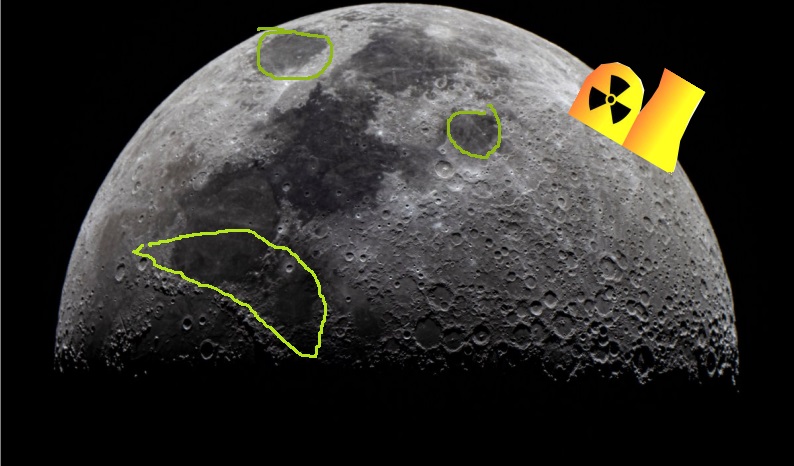
US space agency Nasa will fast-track plans to build a nuclear reactor on the Moon by 2030, according to US media. It is part of US ambitions to build a permanent base for humans to live on the lunar surface. According to Politico, the acting head of Nasa referred to similar plans by China and Russia and said those two countries “could potentially declare a keep-out zone” on the Moon. But questions remain about how realistic the goal and timeframe are, given recent and steep Nasa budget cuts, and some scientists are concerned that the plans are driven by geopolitical goals.
Boeing lands $2.8 billion deal to build next-gen nuclear communications satellites
The ESS satellites are central to U.S. nuclear command, control and communications.
Space News, 3 Aug 25,
WASHINGTON — Boeing won a $2.8 billion contract to develop a new generation of secure military satellites (Evolved Strategic Satellite Communications spacecraft) that will serve as the backbone of the United States’ nuclear command, control and communications network, the U.S. Space Force announced July 3.
The award marks a major milestone in the Pentagon’s effort to modernize its most hardened space-based communication infrastructure. The contract is part of the Evolved Strategic Satellite Communications program, or ESS, which will ultimately replace the current constellation built by Lockheed Martin under the Advanced Extremely High Frequency (AEHF) program.
Boeing edged out Northrop Grumman after a nearly five-year competition that began in 2020, when both aerospace giants were selected to develop prototype systems. The Space Force selected Boeing as the prime contractor for the next phase of the ESS program, which includes development and production of two satellites, with options for two more. If all options are exercised, the contract could reach $3.75 billion.
The first satellite delivery is slated for 2031.
Critical infrastructure for nuclear command
The ESS satellites are designed to provide jam-resistant, always-on communications for the U.S. military’s nuclear command, control, and communications (NC3) architecture. These satellites must function under the most extreme conditions — including in the wake of a nuclear strike — ensuring the President and senior military leaders can communicate securely with deployed forces anywhere in the world.
“The strategic communication mission requires protection, power and always-available capability, even through adversary attempts to interrupt our connectivity,” said Cordell DeLaPeña, the Space Force’s program executive officer overseeing the ESS effort.
Broader $12 billion program
While Boeing’s $2.8 billion development contract is the most visible component, it is only part of a broader $12 billion ESS program that also includes ground systems, cryptographic infrastructure, and user terminals. The terminals, which allow individual military branches to access the ESS network, are acquired separately.
Boeing said its satellite design draws on technology developed for its Wideband Global SATCOM (WGS) satellites and commercial spacecraft it built for SES’s O3b mPOWER broadband constellation.
“This win validates all the investments and innovations we’ve made in our satellite technology,” said Michelle Parker, vice president of Boeing Space Mission Systems.
The ESS satellites will operate in geostationary orbit — 22,000 miles above Earth — where they can provide persistent coverage to specific regions. The full constellation is expected to support global coverage, including the Arctic, an area of growing strategic interest.
The ESS constellation is being built to replace the AEHF network, which was designed and launched over the last two decades to provide similar survivable communications capabilities. Military leaders say growing threats from advanced anti-satellite weapons and electronic warfare systems demand more modern, flexible platforms.
The Space Force is using a cost-reimbursement contracting model for the initial satellite development, a structure more suited to high-risk, high-complexity projects. Under this arrangement, the government pays for allowable costs plus a negotiated profit margin — an approach often used when requirements are not yet fully known and involve extensive non-recurring engineering.
However, future satellites under the ESS program may be procured using fixed-price contracts, which shift more cost risk to the contractor and are generally used once designs mature and production stabilizes.
The US nuclear sector is understandably focused on leveraging Washington’s ever-expanding portfolio of policy support for new nuclear deployments, but what may ultimately turn out to be just as important is state-level support.
Lawmakers in dozens of states are introducing record amounts of legislation meant to advance nuclear projects, as governors create offices or advisory groups meant to help stand up statewide deployments. Multiple states are now incorporating nuclear energy into decarbonization initiatives, working to attract deep-pocketed hyperscalers looking to build power-hungry data centers, or both.
US President Donald Trump ordered the repositioning of two nuclear submarines on 2 August in response to “highly provocative” comments made by Dmitry Medvedev, the deputy chairman of Russia’s Security Council.
“I have ordered two Nuclear Submarines to be positioned in the appropriate regions, just in case these foolish and inflammatory statements are more than just that,” Trump wrote on his Truth Social Platform on Friday.
On Thursday, Medvedev had warned that Trump should be mindful of “how dangerous” Russia’s nuclear weapons could be.
“Words are very important, and can often lead to unintended consequences, I hope this will not be one of those instances,” Trump stated.
In recent weeks, Trump has been exchanging public insults and nuclear threats with Medvedev, who is viewed as close to Russian President Vladimir Putin.
Earlier this week, Trump insulted Medvedev directly, stating, “Russia and the USA do almost no business together. Let’s keep it that way, and tell Medvedev, the failed former President of Russia, who thinks he’s still President, to watch his words. He’s entering very dangerous territory!”
Medvedev, who served as president of Russia from 2008 to 2012 and prime minister from 2012 to 2020, shot back in a post on Telegram.
“If some words from the former president of Russia trigger such a nervous reaction from the high-and-mighty president of the United States, then Russia is doing everything right and will continue to proceed along its own path,” he stated.
On 17 July, Medvedev warned that Moscow must be prepared to deliver preemptive strikes against the west if necessary.
Speaking to TASS on the 80th anniversary of the Potsdam Conference, Medvedev said, “The west’s treacherous nature and its warped sense of superiority are still evident. And we should therefore act accordingly, responding in full or even delivering preemptive strikes if need be.”
Medvedev’s comments followed a string of threatening statements made by the US president toward Moscow after announcing plans to deliver new weapons to Kiev.
A Financial Timesreport revealed that Trump encouraged Ukrainian President Volodymyr Zelensky during a 4 July phone call to strike deep into Russian territory. According to sources, Trump asked, “Can you hit Moscow? Can you hit St. Petersburg too?”
Zelensky allegedly responded, “Absolutely. We can if you give us the weapons.”
In the wake of the US bombing of Iran’s nuclear sites in June, Trump also responded to Medvedev allegedly suggesting that Moscow provide nuclear weapons to Tehran, a claim he later denied.
“Did I hear Former President Medvedev, from Russia, casually throwing around the ‘N word’ (Nuclear!), and saying that he and other Countries would supply Nuclear Warheads to Iran?” Trump wrote on 23 June.
Trump then delivered a veiled threat to Russia by boasting about US nuclear submarine capabilities.
“They are the most powerful and lethal weapons ever built,” he stated.
Three years into the war with Russia, the Ukrainian president has experienced his fortunes turn amid heavy human losses on the battlefield and intense Russian assaults.
Russia’s Foreign Intelligence Service (SVR) has revealed that US and British officials recently held a meeting in the Alps with top Ukrainian officials to discuss “replacing” Ukrainian President Volodymyr Zelensky.
According to a statement made available to TASS, the meeting involved Andrey Yermak, head of the Ukrainian president’s office, Kirill Budanov, chief of the Ukrainian Defense Ministry’s Main Directorate of Intelligence, and Valery Zaluzhny, the country’s ex-commander-in-chief who is now Ukraine’s ambassador to London..
“The Americans and the British announced their decision to propose Zaluzhny to the Ukrainian presidency. Yermak and Budanov ‘snapped a salute,’ while securing promises from the Anglo-Saxons to let them keep their present positions, as well as to take their interests into account in the course of making decisions over other personnel issues,” TASS reports.
The Ukrainian participants were reportedly promised they would retain their positions and influence over future personnel appointments following Zelensky’s ouster.
The SVR said Yermak helped prepare the ground for Zaluzhny by persuading Zelensky to weaken Ukraine’s anti-corruption bodies. Zelensky signed the new law, but Ukrainian MPs said the measure has not appeared on the parliament’s official website. According to the SVR, the secret talks with UK and US officials aim to restructure Ukraine’s ties with the west, especially the US, and have established removing Zelensky as a prerequisite for continued western support in the war with Russia, after ceasefire talks between Moscow and Kiev in Istanbul last week ended without a breakthrough.
The SVR report comes a day after US President Donald Trump shortened his 50-day deadline for a ceasefire between Russia and Ukraine to “10 or 12 days,” warning of stalled progress and approving expanded weapons shipments to Kiev, including US-made Patriot systems financed by European partners and coordinated through NATO.
Former Ukrainian prosecutor general’s adviser Andriy Telizhenko said the plan to replace Zelensky predated Donald Trump’s return to office, adding, “Once the strings are cut, the puppet must be replaced.”
Journalist Seymour Hersh wrote in The End of Zelensky? that Zaluzhny “is now being viewed as Zelensky’s most reliable successor,” citing “well-informed Washington sources” confirming the role could be offered to him.
The CIA didn’t just infiltrate governments; it infiltrated the internet itself. For over a decade, Langley operated a sprawling network of covert websites that served as global spy terminals disguised as harmless blogs, news hubs, and fan pages.
Beginning in 2004, the CIA established a vast network of at least 885 websites, ranging from Johnny Carson and Star Wars fan pages to online message boards about Rastafari. Spanning 29 languages and targeting at least 36 countries directly, these websites were aimed not only at adversaries such as China, Venezuela, and Russia, but also at allied nations, including France, Italy, and Spain, showing that the United States treats its friends much like its foes.
Covert Soccer Blogs and Cracked Passwords
Gholamreza Hosseini is a former CIA informant. In 2007, the Tehran-based industrial engineer contacted the agency and offered to pass them information about Iran’s nuclear energy program. His CIA handlers showed him how to use IranianGoals.com to communicate with them. Iranian Goals was a Farsi-language website that appeared to be dedicated to local soccer news. However, what appeared to be a search bar at the bottom of the home page was actually a password field. Typing the correct word into it would trigger a login process, revealing a secret messaging interface. Each informant had their own webpage, designed specifically for them, to insulate them from others in the network.
It seemed like an ingenious idea. However, Hosseini and the other spies were soon detected, thanks to some sloppy mistakes in Washington, D.C. An Iranian double agent revealed to the authorities their unique website, and some basic detective work led to the uncovering of the entire network.
The CIA purchased the hosting space for dozens, perhaps hundreds, of these websites in bulk, often from the same internet providers, or the same server space. That meant that the IP addresses of these websites were consecutive, akin to housing each informant in adjacent properties on the same street.
Thus, if you looked at neighboring IP addresses, you would see similarly designed websites and could easily put two and two together. Even with some relatively basic online searches, Iranian authorities were able to identify dozens of CIA-run websites. From there, they simply waited to see who would access them.
Spying on Allies and Adversaries Alike
The network of websites spanned a wide range of topics. Few would guess that Rasta Direct, a website dedicated to the relatively niche religion of Rastafari, had anything to do with U.S. intelligence. The CIA also created Star Wars Web, a fan page for the sci-fi franchise, and All Johnny, a page dedicated to late-night legend Johnny Carson. Sports, gaming and news blogs, however, were the most common topics for fake websites.
These websites served as cover for informants, offering some level of plausible deniability if casually examined. Upon close inspection, however, few of these pages provided any unique content and simply rehosted news and blogs from elsewhere, linking to already available resources.
However, a vast network of informants in allied countries, such as France, Spain and Italy, was also uncovered, using financial news, mountaineering, and running websites to pass on vital information to the CIA.
Germany was another country Washington actively targeted. In 2013, it was revealed that the U.S. had been bugging the cellphone of Chancellor Angela Merkel for over a decade, sparking a major diplomatic rift. One year later, in 2014, Germany detained one of its own intelligence officials after catching him spying for the United States.
The Collapse of the CIA’s China Network
China, however, remains a top target for the CIA. The organization maintains an extensive network of informants across the country, who, when the network was active, used platforms such as eChessNews.com and SportsNewsFinder.com to transmit information back to the United States.
But, as in Iran, Chinese authorities began to dismantle the network. Starting in late 2010, the spying network was systematically dismantled by officials, likely using similar tactics to those of the Iranians. Unlike Iran, however, China simply executed those operatives. It is believed that the CIA lost around 30 informants in the purge. The affair is considered one of the worst intelligence failures in the agency’s nearly 80-year history.
Since then, the U.S. spying network in China has been severely diminished. Earlier this year, the CIA changed tack, publicly releasing twovideos encouraging disaffected Communist Party officials to spy for them in exchange for money and the prospect of a new life in America.
“As I rise within the party, I watch those above me being discarded like worn-out shoes, but now I realize that my fate was just as precarious as theirs,” the narrator says in one. “Our leaders’ failure to fulfil repeated promises of prosperity has become a well-known secret… It’s time to build my own dream,” he says in another.
The CIA instructs would-be traitors to download the Tor Browser and contact the CIA via its website. While Tor is marketed in the West as a privacy tool, a previous MintPress News investigation revealed that it was created with funding from the U.S. government by a company with ties to the CIA. Last year, Washington passed a $1.6 billion bill to finance anti-China propaganda worldwide.
Weaponizing Apps and Platforms
This is not the only time that the U.S. national security state has created fake web platforms in order to stoke regime change around the world. In 2010, USAID—a CIA front organization—secretly created the Cuban social media app, Zunzuneo.
Often described as “Cuba’s Twitter,” Zunzuneo rocketed to prominence. The app had been designed to offer a reliable and affordable service, undercutting the competition, before gaining dominance and slowly disseminating anti-government messages to the island.
Then, at a given time, Zunzuneo would urge users to join protests coordinated by the U.S. in an attempt to foment a color revolution on the island.
In an effort to hide its ownership of the project, the U.S. government held a secret meeting with Twitter founder Jack Dorsey to encourage him to take it over. It is unclear to what extent, if at all, Dorsey contributed to the project, as he has declined to comment on the matter. In 2012, Zunzuneo was abruptly shut down.
Infiltrating Journalism and Big Tech
While the 885 fake websites were not established to influence public opinion, today, the U.S. government sponsors thousands of journalists worldwide for precisely this purpose. Earlier this year, the Trump administration’s decision to pause funding to USAID inadvertently exposed a network of more than 6,200 reporters working at nearly 1,000 news outlets or journalism organizations who were all quietly paid to promote pro-U.S. messaging in their countries.
Oksana Romanyuk, director of the Ukrainian Institute for Mass Information, warned that nearly 90% of her country’s media outlets rely on funding from USAID to survive. A survey of 20 leading media organizations in Belarus revealed that 60% of their budget came from Washington. In Iran, more than 30 anti-government groups came together for a crisis response meeting, while in Cuba and Nicaragua, anti-government press resorted to soliciting donations from readers.
The CIA has also successfully infiltrated the largest and most popular social media networks, giving the agency substantial control over what the world sees (and does not see) in their news feeds.
Facebook has hired dozens of former CIA officials to run its most sensitive operations. Perhaps the most notable of these individuals is Aaron Berman.
As the platform’s senior misinformation manager, Berman ultimately has the final say over what content is promoted and what is demoted or deleted from Facebook. Yet, until 2019, Berman was a high-ranking CIA officer, responsible for writing the president’s daily security brief. It was at that time that he jumped ship from Langley to Facebook, despite appearing to have little relevant professional experience.
Google, if anything, is even more saturated with former spies.
A MintPress News investigation revealed that dozens of former CIA agents hold top jobs at the Silicon Valley giant. Among these is Jacqueline Lopour, who spent more than ten years at the agency working on Middle East affairs before being recruited to become Google’s senior Intelligence, Trust, and Safety manager. The role gives her considerable influence on the direction of the company. This form of state censorship is how the agency prefers to shape the internet today.
The CIA continues to maintain a vast worldwide network of informants. Today, they use custom-built apps such as Tor or Signal to communicate. If they are caught by their own countries, they will likely be left to their fate, like Hosseini was. Being a spy or a stool pigeon for the CIA is as perilous as ever.
Violence is diplomacy—that is the essence of the Trumpian encounter with the world: do as I say, or else. Versions of this approach are easily noted in most of President Trump’s public pronouncements. The most recent iteration, in response to Trump’s bombing of Iran, was given by Vice President JD Vance at the Ohio Republican Party dinner in Lima, Ohio, on Tuesday, June 24, 2025. He later summarized it on X also.
Here is what he said: “What I call the Trump Doctrine is quite simple: Number one, you articulate a clear American interest and that’s, in this case, that Iran can’t have a nuclear weapon. Number two, you try to aggressively, diplomatically solve that problem. And number three, when you can’t solve it diplomatically, you use overwhelming military power to solve it and then you get the hell out of there before it ever becomes a protracted conflict.”
The contradictions from one through to three are obvious: how can there be a clarity of “American interest” when the policy is “Israel First?” America has long given up being clear about what it wants, since it wants so many different things which negate one another. It wants to be the hegemon, but also the beacon of “liberty.” Number two: suddenly “American interest” is now a “problem” that needs to “solved” by diplomacy, because other countries do not agree with the “American interest.” Was it not Zelinsky, sitting in the White House, who asked Vance, “What do you mean by diplomacy?” In other words, that “American interest” mentioned in Number one is actually an American demand.
And then we quickly move on to Number three—when America fails at diplomacy, it loves to drop bombs. Bombing, it would appear is the last resort of the scoundrel, to update a famous phrase. What is the point of doing any diplomacy when the people you are trying to diplomatize already know that you are going to bomb them in the end? Iran found that out pretty darned quick—for they thought they were actually involved in diplomacy with Washington when Trump suddenly decided to drop some bombs all over Iran, thinking that this would be persuasive. So, how quickly does Washington move from the diplomatic table to the cockpit of a B2 bomber? In other words, how do bombs become diplomacy?
Vance then throws in the caveat that “you get the hell out of there before it ever becomes a protracted conflict.” So, we are supposed to believe that bombing a country flat and flying back home magically avoids a “protracted conflict?” A recent example—how long has America been bombing Yemen—and what has it accomplished? America just bombed Iran—and what has that accomplished? And, is there any need to mention the fact that Trump, in his first five months of his second term, has carried out 529 airstrikes against Yemen, Syria, Iraq, and Somalia, and bombed 240 locations in these places—it is not known yet how many total civilians he has killed in the process. And whatever happened to Number two in all these cases? How did Trump move past diplomacy and get right to Number three with Iraq, Somalia and Yemen?
In other words, the world is viewed through simplistic Trumpian narratives and bombed accordingly.
It would seem that Vance is trying to lend coherence to a “foreign policy” that is no more than Trump’s feelings. How such feelings, which are erratic at best, become a doctrine is beyond comprehension.
Despite claims of aggressively pursuing diplomacy, what everyone has witnessed is an utter lack of diplomacy—there are only threats; or worse, bomb first and then pretend to talk.
The “overwhelming military force” part has translated into significant civilian casualties, nearly matching the total from many years prior in specific conflicts such as Yemen. Amnesty International and Human Rights Watch have labeled some strikes as potential war crimes. This “bomb first, ask questions later” approach contrasts starkly with the so-called doctrine’s promise to avoid prolonged entanglements, raising ethical and legal questions.
Trump promised rapid resolutions to major conflicts like Ukraine and Gaza and a definitive end to Iran’s nuclear program but has largely failed to achieve any of these objectives. Instead, what the world sees again and again is an overestimation of his own personal influence upon world leaders, and an utter lack of comprehension of the complexity of diplomacy and the ensuing buildup of a deep resentment among nations. In other, there is hardly a doctrine, let alone clarity.
What is clear to see is that all of foreign policy is reduced to a some sort of a transaction, “a deal,” which is spun as prioritizing narrowly defined American interests and sovereignty. However, what ends up happening is confrontation, backed up by a lot of threats of sanctions, tariffs, or bombs.
Despite talk of restraint and rapid exits, Trump’s administration embraces a willingness to wage sustained aerial campaigns and intense military operations, sometimes lacking clarity on long-term goals. What is deployed therefore is intimidation tactics.
This so-called “doctrine” causes unease within political factions and the public who fear prolonged conflicts despite the promise of quick disengagement. It is a strategy that will fail to prevent entanglements, because the world is seen as “ripping American off” and therefore needs to be put in its place. This completely undermines real-world expectations of other nation-states.
In essence, while Vance’s presentation of the “Trump Doctrine” attempts to offer a clear and structured foreign policy, there is a wide gap between rhetoric and reality, made worse by diplomatic incompetence, problematic military consequences, and fundamental inconsistencies that collectively render this “doctrine” not only deeply flawed, but utterly reprehensible as any sort of a guiding principle.
Thus, in June 2025, in the so-called “12 Day War,” the Trump administration conducted airstrikes on three Iranian nuclear sites, aiming to prevent Tehran from obtaining a nuclear weapon, consistent with the Trump Doctrine’s three-step approach (clear interests, aggressive diplomacy, military force, if necessary). However, the strikes were launched just two days after a supposed diplomatic ultimatum, raising suspicions that diplomacy was not genuinely exhausted beforehand.
Plus, the strikes risked escalating into a broader regional war and limited future diplomatic options because of Trump’s prior withdrawal from the Joint Comprehensive Plan of Action (JCPOA) nuclear agreement, which Iran rightly saw as a betrayal. This undercut trust and prospects for peaceful resolution.
Although Vance and administration proponents called the strikes “wildly successful” with no American casualties, initial intelligence suggested damage to Iran’s program was limited. Moreover, Iran’s leadership remained cautious, avoiding direct war with the U.S. despite harsh rhetoric, complicating claims of decisive military resolution.
Humanitarian consequences and the risk of civilian casualties added ethical and legal criticisms, undermining the promise to exit before prolonged conflict.
Proponents of the Trump Doctrine also contrast it with the 2015 Obama nuclear deal, which they argue was lenient and compromised American moral clarity by allowing Iran’s nuclear enrichment program to continue.
The Trump Doctrine calls for denying Iran all paths to nuclear weapons through strength and clarity, but this maximalist stance (zero enrichment demanded) is unrealistic and purely ideological, offering no practical diplomatic off-ramp and increasing risk of sustained conflict.
The doctrine’s combination of maximum pressure without clear enforcement capability resulted in constrained U.S. options and increased involvement in the conflict, contradicting the promise of quick exits.
Then, there are the broader regional implications. The doctrine’s application in Yemen, with intense bombing campaigns against the Houthis, parallels its Iran approach, marked by high civilian casualties and unclear long-term strategic gains, raising concerns about ethical implications and strategic coherence.
Fear of prolonged entanglement in the Middle East and tensions within political factions about the feasibility of rapid withdrawal reveal internal contradictions within the doctrine.
Thus, what happened in Iran and Yemen entirely contradicts what Vance says. In other words, there is a chasm between what is done and what is said.
The rapid shift from diplomacy to military action fully undermines claims of aggressive diplomacy first.
Then, military strikes have yet to yield definitive success and have caused legal, ethical controversies and humanitarian catastrophes.
Overly maximalist demands and the lack of feasible diplomatic pathways constrain U.S. options and risk protracted conflicts.
Contradictions between partisan expectations of quick exits and the reality of prolonged military engagement create strategic incoherence.
Thus, the doctrine abandons traditional moral leadership and multilateral cooperation in favor of a deal that tries to find ways to “protect” America rather than build or lead alliances. This results in a posture of strategic disengagement and economic self-interest rather than any sort of global leadership.
In conflicts like Ukraine, the U.S. under Trump criticizes Russia but also avoids deep involvement, leaving resolution largely to the affected parties (e.g., Kyiv and Moscow). This causes concern among long-term defense partners about the reliability and clarity of American commitments, weakening traditional alliance cohesion.
Trump treats NATO more as a “protection racket,” demanding more financial contributions from allies and showing willingness to reduce U.S. support if unmet. European leaders, uncertain about the U.S. guarantee, are exploring independent defense measures, including shared nuclear capabilities. This unsettles longstanding alliance structures and undermines trust, and points to a West that engage in a new arms race.
The Trump administration has withdrawn from major international agreements (e.g., Paris Climate Accord, WHO), signaling skepticism toward multilateral institutions. This has led to diplomatic isolation and further strains relationships with traditional global partners.
The doctrine involves recalibrated signaling to allies based on geopolitical alignment and interests rather than comprehensive coalition-building, emphasizing sovereignty and economic independence sometimes at the expense of traditional alliance solidarity.
In effect, the Trump Doctrine as articulated essentially reshapes U.S. alliances by emphasizing American sovereignty and international relations as “dealmaking,” coupled with reluctance for enduring involvement, which collectively causes alliance uncertainty, strain on NATO and Western partnerships, and challenges to traditional multilateralism and global leadership that the U.S. once upheld.
So, when Trump repeats the slogan of making America “great,” what does he mean? Great economically, or great in leading the world? He does not know how to do both. On the one hand, he piles on tariffs on the world and threatens it, and on the other he wants the world to look up to America.
Vance’s “Trump Doctrine” is clear in one thing—the Trump administration has no clue how to reconcile what they say with what they do, because their actions and words are always contradictory.
Walt Zlotow, West Suburban Peace Coalition, Glen Ellyn IL, 1 August 25
No US senator loves America’s senseless wars more than Sen. Lindsey Graham (R-SC).
And Graham loves no US war more than the current US enabled Israeli genocide in Gaza. Graham observes the ongoing Israeli genocide in Gaza, near wholly financed, by the US, and declares,
“When we were faced with destruction of our nation after Pearl Harbor, fighting the Germans and the Japanese, we decided to end the war by bombing Hiroshima Nagasaki with nuclear weapons. That was the right decision. Give Israel the bombs they need to end the war. They can’t afford to lose.”
This is not new genocide support territory for Graham. During the Biden presidency he used the same Japanese atomic bombing analogy in blasting Biden for threatening to withhold weapons from Israel if it launched a military operation in Rafah where a million Palestinian civilians were sheltering.
In a just world Graham would be referred to the International Criminal Court for a war crimes investigation. As an influential government official having the ear of President Trump, he is fervently promoting the ongoing genocide of 2,300,000 Palestinians in Gaza to its grisly completion.
The Senior Senator from South Carolina has truly earned his damning moniker ‘Ghoulish Graham’.
All of these companies also claim their plutonium extraction would utilize new technologies that are “proliferation resistant”—but that, too, is bunk.
The White House has now fully embraced bomb-prone nuclear fuel technology. This should stop before an arms race, atomic terrorism or even nuclear war results
Recent events in Iran demonstrate that dropping “bunker buster” bombs on nuclear plants is not an ideal, or even necessarily effective, way to prevent proliferation. It is far preferable to prevent the spread of nuclear-weapon-usable technologies in the first place.
A simplistic way to achieve that might be to halt the worldwide growth of nuclear power. Public approval of nuclear energy, however, is actually growing in the U.S., and the White House recently announced policies to quadruple American nuclear power by 2050 while also promoting nuclear exports. This surge of support is somewhat surprising, considering that new reactors not only pose radiation risks from nuclear waste and potential accidents but also produce electricity that costs considerably more than solar or wind power (which can be similarly reliable when complemented by batteries). But nuclear power plants are touted for other attributes, including their small footprint, constant output, infrequent refueling, low carbon emissions and ability to produce heat for manufacturing. If customers decide this justifies the higher cost—and are willing to wait about a decade for new reactors—then nuclear energy has a future.
That leaves only one other way to stop the spread of dangerous atomic technology – by prudently limiting nuclear energy to the “bomb-resistant” type, which entirely avoids weapons-usable material by disposing of it as waste, rather than the “bomb-prone” variety that creates proliferation risks by purifying and recycling nuclear explosives.
Regrettably, however, the White House recently directed government officials to facilitate the bomb-prone version in a set of executive orders in May. That decision needs to be reversed before it inadvertently triggers an arms race, atomic terrorism or even nuclear war. As Iran has highlighted, ostensibly peaceful nuclear technology can be misused for a weapons program. That is why, from now on, the U.S. should support only bomb-resistant reactors and nuclear fuel.
Most Americans probably don’t realize that nuclear reactors originally were invented not for electricity or research but to produce a new substance, plutonium, for nuclear weapons such as the one dropped on Nagasaki. Every nuclear reactor produces plutonium (or its equivalent), which can be extracted from the irradiated fuel to make bombs.
This raises three crucial questions about the resulting plutonium: How much of it is produced? What is its quality? And will it be extracted from the irradiated fuel, making it potentially available for weapons?
Bomb-resistant nuclear energy—the only type now deployed in the U.S.—produces less plutonium, which is of lower quality and does not need to be extracted from the irradiated fuel. By contrast, bomb-prone nuclear energy produces more plutonium, which is of higher quality and must be extracted to maintain the fuel cycle.
Of course, a declared facility to extract plutonium in a country lacking nuclear weapons could be monitored, but history shows that international inspectors would stand little chance of detecting—let alone blocking—diversion for bombs. That is why the U.S. made bipartisandecisions in the 1970s to abandon bomb-prone nuclear energy, aiming to establish a responsible precedent for other countries.
In light of today’s growing concerns about nuclear weapons proliferation in East Asia, the Middle East and lately even Europe, one might assume that U.S. industry and government would promote only bomb-resistant nuclear energy—but that is not so. A growing number of venture capitalists and politicians are aggressively supporting technologies to commercialize plutonium fuel. They are doing so despite the security, safety and economic downsides that have doomed previous such efforts. These past failures are evidenced by the fact that of the more than 30 countries with nuclear energy today, including many which previously attempted or considered recycling plutonium, only one (France) still does so on a substantial scale—at considerable financial loss. However, if the U.S. government continues subsidizing nuclear technologies without regard to proliferation risk, then the plutonium entrepreneurs will keep hopping on that gravy train. Eventually, they even may find willing customers for their pricey, bomb-prone technology—but mainly among countries willing to pay a premium for a nuclear-weapon option.
The most egregious proposal has come from start-up Oklo, a company originally spearheaded by venture capitalist Sam Altman (who stepped down as chairman in April). It is pursuing “fast” reactors that can produce larger amounts of higher-quality plutonium, and it has declared the intention to extract plutonium for recycling into fresh fuel. Oklo even says it plans to export this proliferation-prone technology “on a global scale.” The Biden administration and Congress, despite the obvious dangers of dispersing nuclear weapons-usable plutonium around the world, chose to subsidize the company as part of a wholesale push for new nuclear energy. Then the Trump administration picked as secretary of energy an industrialist named Chris Wright, who actually was on Oklo’s board of directors until his confirmation. In 2024, Wright and his wife also madecontributions to a fundraising committee for Trump’s presidential campaign totaling about $458,000, along with contributions to the Republication National Committee of about $289,000. In the first quarter of 2025, Oklo increased its lobbying expenditures by 500 percent compared to the same period last year.
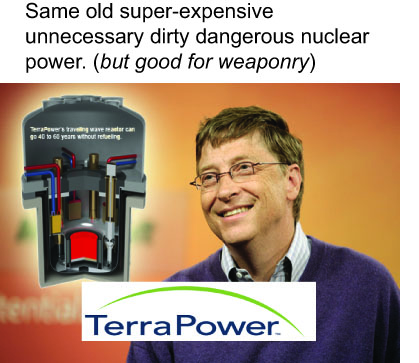
Biden also gave nearly $2 billion to TerraPower, a nuclear energy venture founded by billionaire Bill Gates, for a similar but larger “fast” reactor that also is touted for export. Experts say this inevitably would entail far greater plutonium extraction, even though the company denies any intention to do so. The U.S. Department of Energy also has funded the American branch of Terrestrial Energy, which seeks to build exotic “molten salt” reactors that use liquid rather than solid nuclear fuel. Such fuel must be processed regularly, thereby complicating inspections and creating more opportunities to divert plutonium for bombs.
Most baffling are proposals for large “reprocessing” plants to extract huge amounts of plutonium from irradiated fuel without plausible justification. The company SHINE Technologies, with technical assistance from a firm named Orano, is planning a U.S. pilot plant to process 100 metric tons of spent fuel each year. This would result in the annual extraction of about a metric ton of plutonium—enough for 100 nuclear weapons. SHINE claims the plutonium is valuable to recycle as reactor fuel, but the U.K. recently decided to dispose as waste its entire 140-metric-ton stockpile of civilian plutonium because no one wanted it as fuel. The U.S. similarly has been working to dispose of at least 34 metric tons of undesired plutonium as waste.
Officials from five previous U.S. presidential administrations, and other experts including me, protested in an April 2024 letter to then president Biden that SHINE’s plan would increase “risks of proliferation and nuclear terrorism.” Despite this, President Trump recently issued an executive order in May that directed U.S. officials to approve “privately-funded nuclear fuel recycling, reprocessing, and reactor fuel fabrication technologies … [for] commercial power reactors.” Even more troubling, a separate order directed the government to provide weapons-grade plutonium—retired from our arsenal—directly to private industry as “fuel for advanced nuclear technologies,” which would jump-start bomb-prone nuclear energy before assessing the risks.
SHINE and a similar company, Curio, claim their facilities would slash the country’s radioactive waste stockpile. But realistically, they could barely dent its growth of 2,000 metric tons annually. They also propose to extract valuable radioactive isotopes for medical and space application, but these materials already are available elsewhere at less expense or are needed in such tiny amounts that they require processing only hundreds of kilograms of irradiated fuel annually, not the proposed hundreds of metric tons, which is a thousand times more.
Order comes after president’s anger at tweet from Dmitry Medvedev which called Trump’s threat to sanction Russia over Ukraine a ‘step towards war’.
Donald Trump has said that he has deployed nuclear-capable submarines to the “appropriate regions” in response to a threatening tweet by Russia’s former president Dmitry Medvedev, suggesting that he would be ready to launch a nuclear strike as tensions rise over the war in Ukraine.
In a post on Truth Social on Friday, Trump wrote that he had decided to reposition the nuclear submarines because of “highly provocative statements” by Medvedev, noting he was now the deputy chairman of Russia’s security council.
Medvedev had earlier said that Trump’s threats to sanction Russia and a recent ultimatum were “a threat and a step towards war”.
“I have ordered two Nuclear Submarines to be positioned in the appropriate regions, just in case these foolish and inflammatory statements are more than just that,” Trump responded. “Words are very important, and can often lead to unintended consequences, I hope this will not be one of those instances.”
He did not specify whether he was referring to nuclear-powered or nuclear-armed submarines.
In what may go down as one of the most surreal moments of Donald Trump’s second presidency, White House Press Secretary Karoline Leavitt stood before the press corps and delivered a speech so dripping with delusion that it would have made even the most seasoned propagandist blush.
“The President has now ended conflicts between Thailand and Cambodia, Israel and Iran, Rwanda and the Democratic Republic of the Congo, India and Pakistan, Serbia and Kosovo, and Egypt and Ethiopia. This means President Trump has brokered, on average, about one peace deal or ceasefire per month during his six months in office. It is well past time that President Trump was awarded the Nobel Peace Prize.”
The language bore all his hallmarks: self-congratulation, historical revisionism, and the casual rewriting of reality. If you closed your eyes, you could practically hear Trump dictating it himself, likely from a golf cart: “No president has ever done more for peace… The world is calmer because of President Trump.”
Meanwhile, America burns.
Cities across the country remain divided and anxious. Violent crime is rising in some areas. Racial tensions have intensified under his inflammatory rhetoric. Migrants are being plucked off the streets and separated from their families under legally murky executive actions. The economy, battered by trade wars and broken promises, limps along. The climate crisis – arguably the greatest threat to long-term peace – continues to be denied by the administration altogether.
And yet, here we are, talking about a Nobel Peace Prize.
It’s not that Americans don’t value peace. It’s that they can see through a bad sales pitch. The spectacle was not only cringeworthy, it was offensive. Offensive to genuine peacemakers. Offensive to Americans living pay to pay. Offensive to veterans of actual wars.
To be clear, this isn’t the first time Trump has floated his Nobel ambitions. He’s been obsessed with the prize since taking office the first time. He has tweeted about it. Endlessly. He rages that Obama – a lesser president than himself – has one in his trophy cabinet while his own cupboard is bare. But now, with his second term spiraling and his political capital shrinking, the pursuit of a symbolic trophy has become a sad distraction – a transparent bid for legacy over substance.
This press conference wasn’t about peace. It was about ego. It was about shifting the narrative from legal troubles and legislative failures to a grandiose alternate reality where Donald Trump is not just a divisive figure but a global peacemaker.
The Nobel Peace Prize stands for something: diplomacy, de-escalation, justice. Not manufactured press releases. Not fantasies of greatness. And certainly not a list of imaginary accomplishments recited by a spokesperson who knows better, but has clearly chosen not to care.
Israeli Prime Minister Benjamin Netanyahu is reportedly prepared to propose a plan to annex the entire Gaza Strip that has the backing of the Trump administration, signalling the next horrific phase in Israel’s genocide as it also moves forward with annexing the occupied West Bank.
On Tuesday, Israeli outlet Haaretz reported that Netanyahu is expected to propose the plan to his cabinet soon. The plan would entail giving Hamas a few days to accept a ceasefire deal — likely one designed for Hamas to reject, given Netanyahu’s history — and beginning annexation if Hamas rejects the deal.
The Israeli military would first annex parts of the “buffer zone,” an area spanning all of Gaza’s border created by the military amid its genocide. The zone encompasses over half of Gaza’s land area, and Israeli forces have bulldozed everything inside it, including homes, schools, farming sites, and more.
The military would then move to annex parts of northern Gaza, which Israel has worked diligently to isolate from the rest of Gaza, and move gradually until Israel has annexed the entirety of the Gaza Strip, Haaretz reports.
Netanyahu is reportedly presenting the plan in order to keep Finance Minister Bezalel Smotrich in his government, following the prime minister’s longtime pattern of taking drastic military actions in order to maintain his coalition and stay in power. Citing sources familiar, Haaretz says that Smotrich has said that he will stay in his position if the annexation plan goes forward.
Israeli sources say the plan has already been presented to U.S. Secretary of State Marco Rubio and has the approval of the White House.
Numerous military officials in Netanyahu’s government have said in recent months that annexation has long been the goal of Israel’s genocide, forcible removal of Palestinians, and near-complete destruction of Gaza. Israel has previously distanced itself from an Israeli general’s comments about Israel’s intentions for total occupation in the Strip, but has recently become even more emboldened.
The genocide has accelerated in the past weeks, with Israel’s near-total blockade on all basic resources reaching a breaking point last week, causing at least dozens of starvation deaths.
If Netanyahu’s plan goes forward, Israel will formally begin the process of annexing the entirety of Palestine. In many ways, however, Israel has already been carrying out an annexation plan in all but name.
Israeli officials have vastly accelerated settlement-building and violence in the occupied West Bank throughout their genocide, and last week, the Israeli Knesset passed a nonbinding measure calling for the annexation of the West Bank. Smotrich is a key architect of this plan, and has been pushing for annexation alongside many of the most extremist Israeli politicians for years.
In light of Israel accelerating its genocide and moving to annex Palestine, human rights advocates and experts have issued urgent calls for the world to act.
“The absolute incapacity of Western leaders to enforce international law when it comes to Israel is EPIC,” said UN special rapporteur for the occupied Palestinian territory Francesca Albanese on Tuesday. “Ministers, PrimeMinisters, Presidents of Republic: Doing NOTHING, diverting attention, sanctioning individual ministers IS NOT enforcing the [international] law that was developed after the Holocaust and WWII to prevent another Holocaust and WWII.”
President Trump channeled Animal House’s Dean Vernon Wormer in trying to reign in the out of control John ‘Bluto’ Blutarsky, a.k.a. Vladimir Putin.
Trump is livid over Putin’s refusal to cave into his demand he end the Ukraine war. And what will Trump do if Putin doesn’t enact ceasefire in “10 to 12” days?
Send in American troops to replace the rapidly disappearing Ukraine soldiers filling up numerous freshly dug Ukraine cemeteries? Nope.
Pour another $170 billion in US weapons that have done nothing but cause loss of one fifth of Ukraine territory to Russia? Nope.
Threaten Russia with nuclear annihilation? Nope. Trump is planning something so horrific Putin will cave the moment Trump drops it on him… the Mother of all Sanctions. Only Trump knows what horrifying sanctions he has in store for Putin. Hence, Double Secret Probation (DSP).
Putin’s Bluto simply thumbed his nose at Trump’s Dean Wormer, hurling hundreds of drone bombs into Ukraine every day since Trump imposed DSP.
Trump’s Ukraine war policy is as chaotic as the administration of Faber College in Animal House. Big difference? Trump’s presiding over a catastrophe, destroying Ukraine in the lost cause to weaken Russia. All things considered, I prefer John Landis’ ‘Animal House’ to the Donald Trump version.
AIKEN, SC (WTOC) – A radioactive wasp nest was discovered earlier this month in South Carolina by workers at a nuclear facility, according to a report from the US Department of Energy.
The report states that on July 3, 2025, workers found a wasp nest on a stanchion near a tank at the F-Area tank farm at the Savannah River Site.
When the nest was probed it was discovered to be highly radioactive, according to the DOE’s report. While it does sound like something out of a comic book or horror movie, the report says this is not related to a loss of contamination control at the nuclear facility.
Instead, the wasp nest is considered a victim of “legacy radioactive contamination.”
The nest was sprayed (in order to kill the wasps) and was then bagged as radiological waste.
The report states the ground and surrounding area did not have any contamination.
The Savannah River Site was built in the 1950s near Aiken, South Carolina and covers more than 300 square miles.
During the Cold War, the Savannah River Site produced nuclear material and nuclear weapons components.
It became an EPA Superfund site in 1989, with cleanup and environmental remediation going on ever since.
In recent years, the National Nuclear Security Administration has begun work on a facility there to produce new plutonium cores for American nuclear weapons.
The NNSA plans to build at least 50 new plutonium cores per year in the new facility.
President Trump has shown strong support for Israel in recent days, while much of the world has been outraged over the images of Palestinians who are starving to death due to the US-backed Israeli siege on Gaza.
After the US and Israel quit ceasefire talks, Trump blamed the lack of progress on Hamas and suggested it was time for Israel to “finish the job” in Gaza. “I think they want to die, and it’s very, very bad,” Trump said on Friday, referring to Hamas.
For its part, Hamas has said that it was surprised by the US and Israel quitting the truce talks and that it was committed to continuing the process until a deal was reached.
In recent weeks, Trump has been claiming that a ceasefire deal was close, but now he is appearing to suggest that Israel should escalate its genocidal war. “They’re gonna have to fight, and they’re gonna have to clean it up. You’re gonna have to get rid of [Hamas],” he said.
Israeli officials told Axios that they weren’t sure if Trump’s comments were a negotiating tactic or a “green light” for Israeli Prime Minister Benjamin Netanyahu to use even more extreme military measures. The report said the Trump administration was rethinking its Gaza strategy, but there’s no sign it’s considering putting pressure on Israel to reach a ceasefire.
Israeli officials also told Axios that Trump has applied virtually no pressure on Netanyahu to end the slaughter in Gaza in recent months. “In most calls and meetings, Trump told Bibi, ‘Do what you have to do in Gaza.’ In some cases, he even encouraged Netanyahu to go harder on Hamas,” one official said.
While meeting with European Commission President Ursula von der Leyen in Scotland on Sunday, Trump was asked about the images of starving children in Gaza. The president said people were “stealing the food,” a reference to Israel’s unfounded claims that Hamas has been stealing massive amounts of aid, then quickly pivoted to different topics.
In other comments, Trump said the issue of food shortages in Gaza was an “international problem,” not a “US problem.” But Israel is reliant on US military aid to sustain its military operations in Gaza, and Trump has the power to end the genocidal war by leveraging that support.