Walmart recalls possibly radioactive shrimp after public warned not to eat.
BBC 20th Aug 2025
Walmart has recalled some of its shrimp products in the US after radioactive material was detected in a shipment of seafood.
The US Food and Drug Administration (FDA) warned the public not to eat frozen shrimp sold under Walmart’s Great Value label, as it could have been exposed to a dangerous isotope in shipping containers.
One sample of breaded shrimp tested positive for the substance, the FDA said, but this positive sample “did not enter US commerce”.
Consumers in 13 US states where the shrimp products are sold have been advised to throw any recently bought products among three batches……………………………………
The recalled shrimp was sold at Walmart locations in Alabama, Arkansas, Florida, Georgia, Kentucky, Louisiana, Missouri, Mississippi, Ohio, Oklahoma, Pennsylvania, Texas and West Virginia, and shoppers in those states were advised to be cautious.
It came from an Indonesian supplier that has since had a number of shipping containers denied entry to the US, the FDA said.
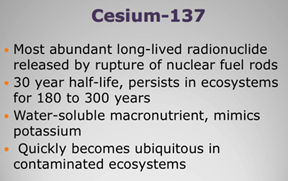
One shipment tested positive for Caesium-137, the radioactive form of the periodic element Caesium.
The amount contained in the tested shipment held by the FDA was not enough to pose acute harm to consumers, exposure over time could pose an elevated risk of cancer by damaging living cells in the body, said officials from the agency.
Caesium-137 is made through nuclear reactions and is present in trace amounts in soil, food and air worldwide. It is one of the principal sources of radiation around Chernobyl in Ukraine and Fukushima in Japan.
The FDA said no Caesium-137 had been detected in the other products it tested, but cautioned this did not rule out contamination. https://www.bbc.co.uk/news/articles/c5ypg4rgnrno
Trump Breaks Europe Over His Knee: Unprecedented Optics of White House ‘Losers’ Gathering’
The end of Europe as a serious political power.
Simplicius, Aug 20, 2025
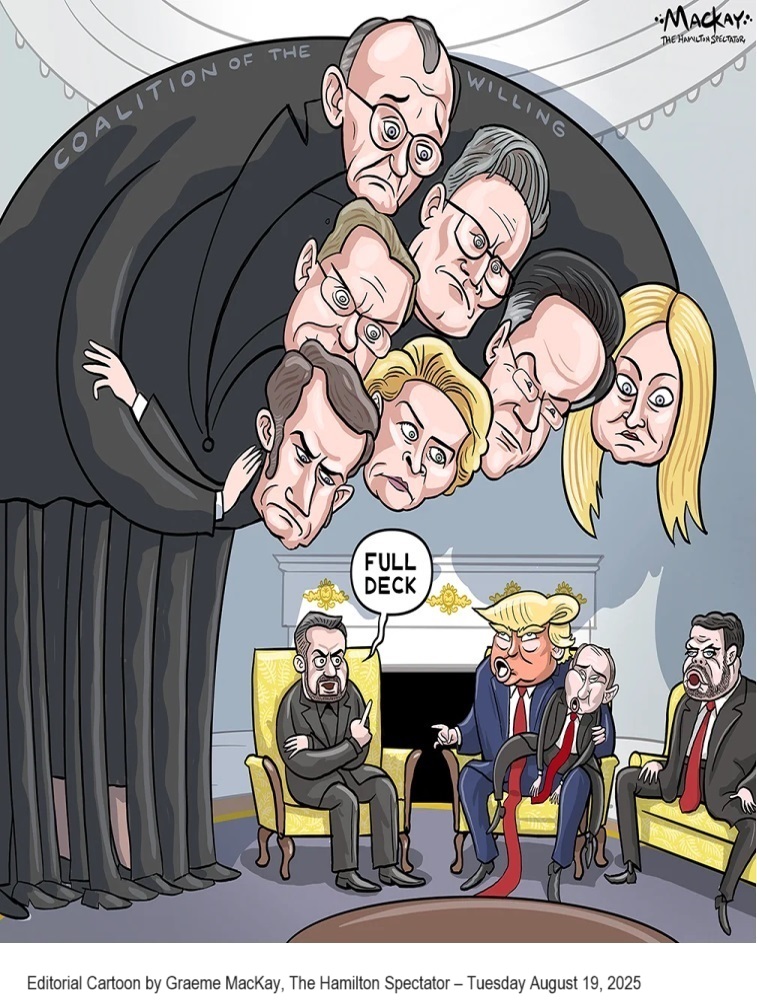
The troupe arrived to “daddy’s” DC office for their official dressing down. If nothing else, we must marvel at the fact that the meeting produced some of the most remarkable political optics, perhaps, in history:
Has there ever been anything like this? The entire pantheon of the European ruling class reduced to sniveling children in their school principal’s office. No one can deny that Trump has succeeded in veritably ‘breaking Europe over his knee’. There is no coming back from this turning point moment, the optics simply cannot be redeemed.
But even snide ridicule aside, objectively speaking, we must point to how absolutely defeated and low-energy the delegation looked……………
Hands in pockets, looks of mild confusion or disinterest, vacant eyes, and that bizarre ‘dead-space’ atmosphere like a “TV tuned to a dead station” (hat tip Mr. Gibson). It’s clear that no one wants to be there, and everyone knows the artificial charade looks and feels forced. The real punchline comes at the 1:00 mark where it becomes eminently obvious the entire hollow exercise is nothing more than an ego-stroke for the cunning Ringmaster himself, as he bids his abject pupils to veer their gaze at the carefully-situated artwork presiding over the gilded humiliation ritual.
Volumes could be written on the implications of such a low point in European influence. But we’ll suffice with concluding that it’s clear the matter of the Ukrainian conflict’s resolution is of such existential importance to the behind-the-scenes cabal which writes the Euro-puppets’ orders, that this cabal is willing to risk everything, including politically sacrificing its “compradors” posing as elected leaders.
It’s pointless to even granularize it, but there were many small moments of humiliation in the meeting: from Trump’s seeming non-recognition of Finland’s president—unable to find him despite his sitting directly across from him—to Trump humbling Ursula, who came armed with a prescripted spiel about Russians kidnapping Ukrainian children; Trump slapped her silent by pointing out they had convened to talk about something else entirely, i.e. your propaganda is irrelevant and unwanted here.
It should also be noted that Trump did not greet a single one of the European messengers personally as they arrived, having a chaperone escort them like children from the White House playground instead. It was in sharp contrast to the pomp and ceremony of the Putin visit. This, of course, is by design, with Trump effectively showing the craven European compradors their subordinate place as part of his slow restructuring of the world order; Trump respects only power—mealy and servile leaders repulse him and earn his boot-print on their foreheads.
So what did the meeting actually accomplish, other than raising Trump’s prestige and smothering inconvenient media narratives from the news cycle?
What we saw was another rehash of the same routine as in Alaska: talks are held, major “progress” announced, yet no concrete details or evidence is provided. In this case, the big achievement is said to be the agreement on a meeting between Putin and Zelensky, followed by a “trilat” as Trump calls it. The problem is, there is zero evidence the Russian side has agreed to any such thing.
Firstly, press outlets blared that Trump “phoned Putin” in the midst of his meeting with the Europeans—Trump himself promptly shot this down:
I post this example to again illustrate just how much disinfo noise is clogging the airwaves around this issue. And this contextualizes the remainder of the analysis, surrounding what Russia may or may not have agreed to. You see, just as easily as mainstream outlets lied about Trump’s call, they may be doing so about the now-circulating claims that Putin has “agreed to” meet with Zelensky.
The Russians have been playing things extremely close to their chests, even more than usual. It appears they have adopted a strategy of deliberate strategic ambiguity in order to give Trump the license he needs to play his game against the Europeans—and Ukraine—while the Russians sit back and watch.
In this case, in confirming Trump’s attempt to get Putin and Zelensky to sit down together, Putin aide Ushakov very subtly modified the language to state that Putin and Trump discussed raising the level of “negotiators” and mentioned the possibility of Russia studying this proposal—as I wrote on X:
An interestingly evasive word-salad as non-answer in customary “Politburo-speak”. He doesn’t really confirm anything other than Trump and Putin discussed “raising the level of negotiators” between Russia and Ukraine (specifically omitting what level that would be). And in fact, he didn’t even say raising the level itself was discussed but rather the possibility of “studying” this proposal. It seems Russia for now continues to play strategic ambiguity to give Trump the arm space he needs to “work” on the Europeans and Zelensky.
In this case, in confirming Trump’s attempt to get Putin and Zelensky to sit down together, Putin aide Ushakov very subtly modified the language to state that Putin and Trump discussed raising the level of “negotiators” and mentioned the possibility of Russia studying this proposal—as I wrote on X:
An interestingly evasive word-salad as non-answer in customary “Politburo-speak”. He doesn’t really confirm anything other than Trump and Putin discussed “raising the level of negotiators” between Russia and Ukraine (specifically omitting what level that would be). And in fact, he didn’t even say raising the level itself was discussed but rather the possibility of “studying” this proposal. It seems Russia for now continues to play strategic ambiguity to give Trump the arm space he needs to “work” on the Europeans and Zelensky.
……………………………………………………………………………………………………………………………. https://simplicius76.substack.com/p/trump-breaks-europe-over-his-knee?utm_source=post-email-title&publication_id=1351274&post_id=171393118&utm_campaign=email-post-title&isFreemail=false&r=191n6&triedRedirect=true&utm_medium=email
Trump Says He’s Working To Arrange a Meeting Between Putin and Zelensky
The president called Putin after meeting with Zelensky and several European leaders in Washington.
by Dave DeCamp | August 18, 2025 , https://news.antiwar.com/2025/08/18/trump-says-hes-working-to-arrange-a-meeting-between-putin-and-zelensky/
President Trump said on Monday that he was working on arranging a meeting between Russian President Vladimir Putin and Ukrainian President Volodymyr Zelensky, comments that came after a day of hosting the Ukrainian leader and several European officials at the White House.
“At the conclusion of the meetings, I called President Putin, and began the arrangements for a meeting, at a location to be determined, between President Putin and President Zelensky,” the president wrote on Truth Social.
Trump said that once Putin and Zelensky meet, he would join them for a three-way talk. “After that meeting takes place, we will have a Trilat, which would be the two Presidents, plus myself,” he wrote.
Yury Ushakov, an aide to Putin, said that during the call with Trump, the Russian leader “expressed support for direct negotiations between the delegations of Russia and Ukraine.”
Trump said that one topic of discussion with Zelensky and European leaders on Monday was the potential security guarantees Ukraine would receive from Western nations as part of a peace deal, which will likely be a major sticking point in negotiations with Russia.
“During the meeting we discussed Security Guarantees for Ukraine, which Guarantees would be provided by the various European Countries, with a coordination with the United States of America,” he said.
European leaders, led by British Prime Minister Keir Starmer and French President Emmanuel Macron, are calling for a troop deployment to Ukraine to uphold any potential peace deal. When asked if the US would send troops to Ukraine, Trump didn’t rule out the idea.
But Russia has made clear that it’s strongly opposed to the idea of the deployment of troops from NATO countries to Ukraine, a position it reiterated on Monday. “We reiterate our repeatedly expressed position that we deny any scenarios that envisage the deployment of a military contingent to Ukraine with the participation of Nato states, which could lead to an uncontrollable escalation of the conflict with unpredictable consequences,” said Russian Foreign Ministry spokeswoman Maria Zakharova.
The other major sticking point is the issue of territory. Russia has reportedly offered to end the war if Ukraine withdraws from the Donbas region and the lines are frozen in the southern Kherson and Zaporizhzhia oblasts, but Zelensky continues to publicly reject the idea of ceding territory.
Zelensky has received strong backing from the European leaders who joined him in Washington and held talks with them to coordinate their position ahead of the meetings with Trump. According to a press release from Zelensky’s office, he and the Europeans “stressed their firm support for Ukraine’s sovereignty and territorial integrity and the unacceptability of changing internationally recognized state borders by force.”
The statement said they also “welcomed the readiness of the United States to participate in guaranteeing security for Ukraine” and that “one of the key issues in the negotiations with President Trump will be the joint participation of the United States and Europe in creating the future security architecture for Ukraine and, consequently, for the entire European continent.”
Zelensky was joined in Washington by Starmer, Macron, German Chancellor Friedrich Merz, Italian Prime Minister Giorgia Meloni, Finnish President Alexander Stubb, European Commission President Ursula von der Leyen, and NATO Secretary-General Mark Rutte.
What really happened in Alaska
It’s clear that both Trump and Putin are playing a long game. Trump wants to get rid of the pesky two-bit actor in Kiev – but without applying old school US coup/regime-change tactics. In his mind, the only thing that really registers is future, possible, mega trade deals on Russian mineral wealth and the development of the Arctic.
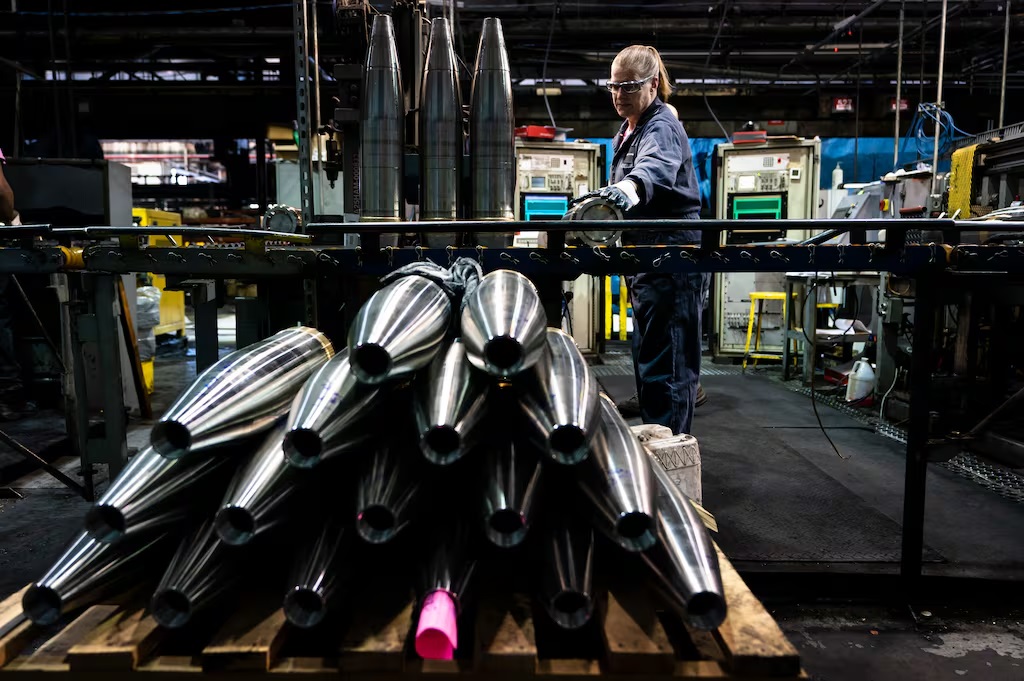
the US seeks a meek Europe subjugated to the strategy of tension, otherwise there’s no EU military surge, buying billions worth of over-priced American weapons with money it doesn’t have.
Pepe Escobar, AUG 18, 2025, https://thecradle.co/articles/what-really-happened-in-alaska
Alaska was not only about Ukraine. Alaska was mostly about the world’s top two nuclear powers attempting to rebuild trust and apply the brakes on an out-of-control train in a mad high-speed rail dash towards nuclear confrontation.
There were no assurances, given the volatile character of US President Donald Trump, who conceived the high-visibility meeting with his Russian counterpart Vladimir Putin. But a new paradigm may be in the works nonetheless. Russia has essentially been de facto recognized by the US as a peer power. That implies, at the very least, the return of high-level diplomacy where it is most needed.
Meanwhile, Europe is dispatching a line-up of impotent leaders to Washington to kowtow in front of the Emperor. The EU’s destiny is sealed: into the dustbin of geopolitical irrelevance.
What has been jointly decided by Trump, personally, and Putin, even before Moscow proposed charged-with-meaning Alaska as the summit venue, remains secret. There will be no leaks about the full content.
Yet it’s quite significant that Trump himself rated Alaska as a 10 out of 10.
The key takeaways, relayed by sources in Moscow with direct access to the Russian delegation, all the way to the 3-3 format (it was initially designed to be a 5-5, but other key members, such as Finance Minister Anton Siluanov, did provide their input), emphasize that:
“It was firmly put [by Putin] to stop all direct US weapon deliveries to Ukraine as a vital step towards the solution. Americans accepted the fact that it is necessary to dramatically decrease lethal shipments.”
After that happens, the ball swings to Europe’s court. The sources specify, in detail:
“Out of the $80 billion Ukrainian budget, Ukraine itself provides less than around $20 billion. The National Bank of Ukraine says that they collect $62 billion in taxes alone, which is a hoax; with a population around 20 million, much more than one million of irreversible battlefield losses, a decimated industry and less than 70 percent of pre-Maidan territory under control that is simply impossible.”
So Europe – as in the NATO/EU combo – has a serious dilemma: ‘Either support Ukraine financially, or militarily. But not both at the same time. Otherwise, the EU itself will collapse even faster.’
Now compare all of the above with arguably the key passage in one of Trump’s Truth Social posts: “It was determined by allthat the best way to end the horrific war between Russia and Ukraine is to go directly to a Peace Agreement, which would end the war, and not a mere Ceasefire Agreement, which often times do not hold up.”
Add to it the essential sauce provided by former Russian president Dmitri Medvedev:
“The President of Russia personally and in detail presented to the US President our conditions for ending the conflict in Ukraine (…) Most importantly: both sides directly placed responsibility for achieving future results in negotiations on ending hostilities on Kiev and Europe.”
Talk about superpower convergence. The devil, of course, will be in the details.
BRICS on the table in Alaska
In Alaska, Vladimir Putin was representing not only the Russian Federation, but BRICS as a whole. Even before the meeting with his US counterpart was announced to the world, Putin spoke on the phone with Chinese President Xi Jinping. After all, it’s the Russia–China partnership that is writing the geostrategic script of this chapter of the New Great Game.
Moreover, top BRICS leaders have been on a flurry of interconnected phone calls, leading to forge, in Brazil’s President Luiz Inacio “Lula” da Silva’s assessment, a concerted BRICS front to counteract the Trump Tariff Wars. The Empire of Chaos, the Trump 2.0 version, is in a Hybrid War against BRICS, especially the Top Five: Russia, China, India, Brazil, and Iran.
So Putin did achieve a minor victory in Alaska. Trump: “Tariffs on Russian oil buyers not needed for now (…) I may have to think about it in two to three weeks.”
Even considering the predictable volatility, the pursuit of high-level dialogue with the US opens to the Russians a window to directly advance the interests of BRICS peers – including, for instance, Egypt and the UAE, blocked from further economic integration across Eurasia by the sanctions/tariff onslaught and the accompanying rampant Russophobia.
None of the above, unfortunately, applies to Iran: The Zionist axis has an iron grip on every nook and cranny of Washington’s policies vis-à-vis the Islamic Republic.
It’s clear that both Trump and Putin are playing a long game. Trump wants to get rid of the pesky two-bit actor in Kiev – but without applying old school US coup/regime-change tactics. In his mind, the only thing that really registers is future, possible, mega trade deals on Russian mineral wealth and the development of the Arctic.
Putin also needs to manage domestic critics who won’t forgive any concessions. The desperate western media spin that he would offer freezing the front in Zaporozhye and Kherson in exchange for getting all of the Donetsk Republic is nonsense. That would go against the constitution of the Russian Federation.
In addition, Putin needs to manage how US business would be allowed to enter two areas that are at the heart of federal priorities, and a matter of national security: the development of the Arctic and the Russian Far East. All that will be discussed in detail two weeks from now, at the Eastern Economic Forum in Vladivostok.
Once again, follow the money: Both oligarchies – in the US and Russia – want to go back to profitable business, pronto.
Lipstick on a defeated pig
Putin, bolstered by Foreign Minister Sergey Lavrov – the undisputed Man of the Match, with his CCCP fashion statement – finally had ample time, 150 minutes, to spell out, in detail, the underlying causes of Russia’s Special Military Operation (SMO) and lay out the rationale for long-term peace: Ukraine neutrality; neo-nazi militias and parties banned and dismantled; no more NATO expansion.
Geopolitically, whatever may evolve from Alaska does not invalidate the fact that Moscow and Washington at least did manage to buy some strategic breathing space. That might yield even a new shot toward respect for both powers’ spheres of influence.
So it’s no wonder the Atlanticist front, from Europe’s old money to the bling bling novices, is freaking out because Ukraine is a giant money laundering mechanism for Eurotrash politicos. The Kafkaesque EU machine has already bankrupted EU member-states and EU taxpayers – but anyway, that’s not Trump’s problem.
Across Global Majority latitudes, Alaska displayed the fraying of Atlanticism in no uncertain terms – revealing that the US seeks a meek Europe subjugated to the strategy of tension, otherwise there’s no EU military surge, buying billions worth of over-priced American weapons with money it doesn’t have.
The Putin–Trump meeting dropped some important veils. It revealed that Washington views Russia as a peer power, and that Europe is little more than a useful American tool.
At the same time, despite covetous US oligarchic private designs on Russian business, what Washington’s puppet masters truly want is to break up Eurasia integration, and by implication every multilateral organization – BRICS, SCO – driven to design a new, multinodal world order.
Of course, a NATO surrender – even as it is being strategically defeated, all across the spectrum – remains anathema. Trump, at best, is applying lipstick on a pig, trying to craft, with trademark fanfare, what could be sold as a Deep State exit strategy, toward the next Forever War.
Putin, the Russian Security Council, BRICS, and the Global Majority, for that matter, harbor no illusions.
Declassified: CIA’s Covert Ukraine Invasion Plan
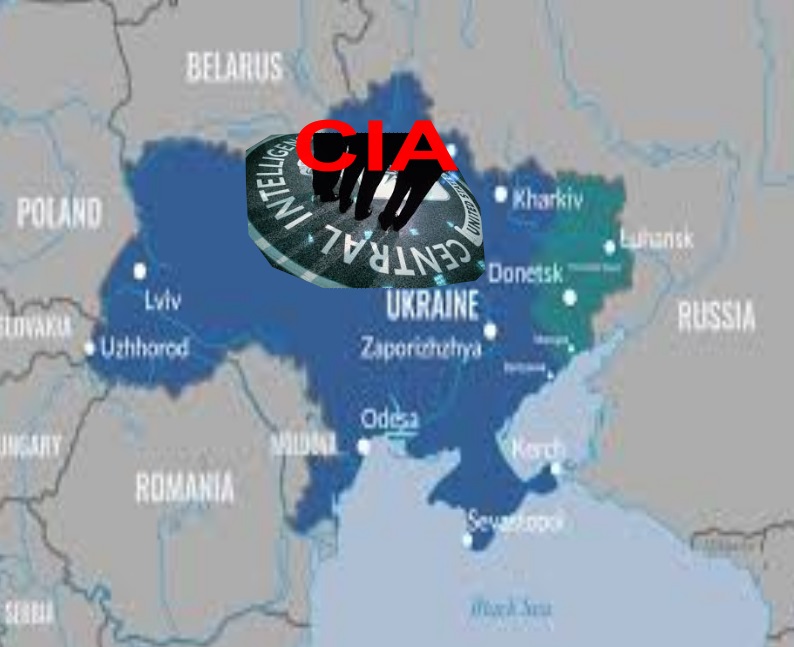
While we are now witnessing in real-time the brutal unravelling of Donnelly’s monstrous plot, Anglo-American designs of using Ukraine as a beachhead for all-out war with Moscow date back far further.
Washington’s quest to ignite local insurrection, and in turn the USSR’s ultimate collapse.
“Inhabitants of Donbass strongly resisted Ukrainian nationalists and at one point created a separate republic, independent of the rest of Ukraine. In the following years, they defended Soviet rule and Russian interests, often attacking the Ukrainian nationalists with more zeal than the Russian leaders themselves. During the German occupation in the Second World War, there was not a single recorded case of support for the Ukrainian nationalists or Germans.”
Global Delinquents, Kit Klarenberg, Aug 17, 2025, https://www.kitklarenberg.com/p/declassified-cias-covert-ukraine
On August 7th, US polling giant Gallup published the remarkable results of a survey of Ukrainians. Public support for Kiev “fighting until victory” has plummeted to a record low “across all segments” of the population, “regardless of region or demographic group.” In a “nearly complete reversal from public opinion in 2022,” 69% of citizens “favor a negotiated end to the war as soon as possible.” Just 24% wish to keep fighting. However, vanishingly few believe the proxy war will end anytime soon.
The reasons for Ukrainian pessimism on this point are unstated, but an obvious explanation is the intransigence of President Volodymyr Zelensky, encouraged by his overseas backers – Britain in particular. London’s reverie of breaking up Russia into readily-exploitable chunks dates back centuries, and became turbocharged in the wake of the February 2014 Maidan coup. In July that year, a precise blueprint for the current proxy conflict was published by the Institute for Statecraft, a NATO/MI6 cutout founded by veteran British military intelligence apparatchik Chris Donnelly.
In response to the Donbass civil war, Statecraft advocated targeting Moscow with a variety of “anti-subversive measures”. This included “economic boycott, breach of diplomatic relations,” as well as “propaganda and counter-propaganda, pressure on neutrals.” The objective was to produce “armed conflict of the old-fashioned sort” with Russia, which “Britain and the West could win.” While we are now witnessing in real-time the brutal unravelling of Donnelly’s monstrous plot, Anglo-American designs of using Ukraine as a beachhead for all-out war with Moscow date back far further.
In August 1957, the CIA secretly drew up elaborate plans for an invasion of Ukraine by US special forces. It was hoped neighbourhood anti-Communist agitators would be mobilized as footsoldiers to assist in the effort. A detailed 200-page report, Resistance Factors and Special Forces Areas, set out demographic, economic, geographical, historical and political factors throughout the then-Soviet Socialist Republic that could facilitate, or impede, Washington’s quest to ignite local insurrection, and in turn the USSR’s ultimate collapse.
The mission was forecast to be a delicate and difficult balancing act, as much of Ukraine’s population held “few grievances” against Russians or Communist rule, which could be exploited to foment an armed uprising. Just as problematically, “the long history of union between Russia and Ukraine, which stretches in an almost unbroken line from 1654 to the present day,” resulted in “many Ukrainians” having “adopted the Russian way of life”. Problematically, there was thus a pronounced lack of “resistance to Soviet rule” among the population.
The “great influence” of Russian culture over Ukrainians, “many influential positions” in local government being held “by Russians or Ukrainians sympathetic to [Communist] rule, and “relative similarity” of their “languages, customs, and backgrounds”, meant there were “fewer points of conflict between the Ukrainians and Russians” than in Warsaw Pact nations. Throughout those satellite states, the CIA had to varying success already recruited clandestine networks of “freedom fighters” as anti-Communist Fifth Columnists. Yet, the Agency remained keen to identify potential “resistance” actors in Ukraine:
“Some Ukrainians are apparently only slightly aware of the differences which set them apart from Russians and feel little national antagonism. Nevertheless, important grievances exist, and among other Ukrainians there is opposition to Soviet authority which often has assumed a nationalist form. Under favorable conditions, these people might be expected to assist American Special Forces in fighting against the regime.”
‘Nationalist Activity’
A CIA map split Ukraine into 12 separate zones, ranked on “resistance” potential, and how “favorable population attitudes [are] toward the Soviet regime.” South and eastern regions, particularly Crimea and Donbass, rated poorly. Their populations were judged “strongly loyal” to Moscow, having never “displayed nationalist feelings or indicated any hostility to the regime,” while viewing themselves as “a Russian island in the Ukrainian sea.” In fact, as the study recorded, during and after World War I, when Germany created a fascist puppet state in Ukraine:
“Inhabitants of Donbass strongly resisted Ukrainian nationalists and at one point created a separate republic, independent of the rest of Ukraine. In the following years, they defended Soviet rule and Russian interests, often attacking the Ukrainian nationalists with more zeal than the Russian leaders themselves. During the German occupation in the Second World War, there was not a single recorded case of support for the Ukrainian nationalists or Germans.”
Still, invading and occupying Crimea was considered of paramount importance. On top of its strategic significance, the peninsula’s landscape was forecast as ideal for guerrilla warfare. The terrain offered “excellent opportunities for concealment and evasion,” the CIA report noted. While “troops operating in these sectors must be specially trained and equipped,” it was forecast the local Tatar population, “which fought so fiercely” against the Soviets in World War II, “would probably be willing to help” invading US forces.
Areas of western Ukraine, including former regions of Poland such as Lviv, Rivne, Transcarpathia and Volyn, which were heavily under control of “Ukrainian insurgents” – adherents of MI6-supported Stepan Bandera – during World War II, were judged most fruitful “resistance” launchpads. There, “nationalist activity was extensive” during World War II, with armed militias opposing “pro-Soviet partisans with some success.” Conveniently too, mass extermination of Jews, Poles and Russians by Banderites in these regions meant there was virtually no non-ethnic Ukrainian population left.

Furthermore, in the post-war period, “resistance to Soviet rule” had been “expressed on a great scale” in western Ukraine. Despite “extensive deportations”, “many nationalists” resided in Lviv et al, and “nationalist cells” created by Bandera’s “task forces” were dotted around the Republic. For example, anti-Communist “partisan bands” had taken up residence in the Carpathian Mountains. The review concluded, “it is in this region [US] Special Forces could expect considerable support from the local Ukrainian population, including active participation in measures directed against the Soviet regime.”
It was also determined that “Ukrainian nationalist, anti-Soviet sentiment” in Kiev was “apparently moderately strong,” and elements of the population “might be expected to provide active assistance to Special Forces.” The capital’s “large Ukrainian population” was reportedly “little affected by Russian influence,” and during the Russian Revolution “provided greater support than any other region for Ukrainian, nationalist, anti-Soviet forces.” Resultantly, “uncertainty about the attitudes of the local population” prompted Moscow to designate Kharkov the Ukrainian SSR’s capital, which it remained until 1934.
The CIA document further offered highly detailed assessments of Ukrainian territory, based on their utility for warfare. For example, “generally forbidding” Polesia – near Belarus – was noted to be “almost impossible” to traverse during spring. Conversely, winter provided “most favorable to movement, depending on the depth to which the ground freezes.” Overall, the area had “proved its worth as an excellent refuge and evasion area by supporting large-scale guerilla activities in the past.” Meanwhile, “swampy valleys of the Dnieper and Desna rivers” were of particular interest:
“The area is densely forested in its north-western part, where there are excellent opportunities for concealment and manoeuvre…There are extensive swamps, interspersed with patches of forest, which also provide good hiding places for the Special Forces. Conditions in the Volyno-Podolskaya Highlands are less suitable, although small groups may find temporary shelter in the sparse forests.”
‘Strongly Anti-Nationalist’
The CIA’s invasion plan never formally came to pass. Yet, areas of Ukraine forecast by the Agency to be most welcoming of US special forces were precisely where support for the Maidan coup was highest. Moreover, in a largely unknown chapter of the Maidan saga, fascist Right Sector militants were bussed en masse to Crimea prior to Moscow’s seizure of the peninsula. Had they succeeded in overrunning the territory, Right Sector would’ve fulfilled the CIA’s objective, as outlined in Resistance Factors and Special Forces Areas.
Given what transpired elsewhere in Ukraine following February 2014, other sections of the CIA report take on a distinctly eerie character. For instance, despite its strategic position facing the Black Sea, the Agency warned against attempting to foment anti-Soviet rebellion in Odessa. The agency noted the city is “the most cosmopolitan area in Ukraine, with a heterogeneous population including significant numbers of Greeks, Moldovans and Bulgarians, as well as Russians and Jews.” As such:
“Odessa…has developed a less nationalistic character. Historically, it has been considered more Russian than Ukrainian territory. There was little evidence of nationalist or anti-Russian sentiment here during the Second World War, and the city…was in fact controlled by a strongly anti-nationalist local administration [during the conflict].”
Odessa became a key battleground between pro- and anti-Maidan elements, from the moment the protests erupted in November 2013. By March the next year, Russophone Ukrainians had occupied the city’s historic Kulykove Pole Square, and were calling for a referendum on the establishment of an “Odessa Autonomous Republic”. Tensions came to a head on May 2nd, when fascist football ultras – who subsequently formed Azov Battalion – stormed Odessa and forced dozens of anti-Maidan activists into Trade Unions House, before setting it ablaze.
In all, 42 people were killed and hundreds injured, while Odessa’s anti-Maidan movement was comprehensively neutralised. In March this year, the European Court of Human Rights issued a damning ruling against Kiev over the massacre. It concluded local police and fire services “deliberately” failed to respond appropriately to the inferno, and authorities insulated culpable officials and perpetrators from prosecution despite possessing incontrovertible evidence. Lethal “negligence” by officials on the day, and ever after, was found to go far “beyond an error of judgment or carelessness.”
The ECHR was apparently unwilling to consider the incineration of anti-Maidan activists was an intentional and premeditated act of mass murder, conceived and directed by Kiev’s US-installed fascist government. However, the findings of a Ukrainian parliamentary commission point ineluctably towards this conclusion. Whether, in turn, the Odessa massacre was intended to trigger Russian intervention in Ukraine, thus precipitating “armed conflict of the old-fashioned sort” with Moscow that “Britain and the West could win” is a matter of speculation – although the Institute for Statecraft was present in the country at the time.
Democrats bashing Trump, Putin summit ensuring continued destruction of Ukraine.
Walt Zlotow, West Suburban Peace Coalition, Glen Ellyn IL, 18 Aug 25
Democrats are horrified that Trump and Putin are actively seeking an end to the 3 year, 6 month US proxy war against Russia in Ukraine. They avoid entirely the imminent collapse of Ukraine’s military in Ukraine’s lost cause to enter NATO and conquer the Donbas Ukrainian separatists. Neither will ever happen as the war is lost with 4 eastern Ukrainian oblasts gone forever. NATO will never include the rump state that is left of Ukraine once they capitulate.
While Democrats have good reason to lambast Trump’s deranged domestic policies, they should be wishing him success, indeed cheering him on as he tries to extricate America for possibly the worst foreign policy blunder in its 250 years.
All 6 US administrations preceding Trump 2.0, including 3 Republicans (H.W. Bush, W. Bush and Trump 1.0), and 3 Democrats (Clinton, Obama, Biden) endlessly provoked the Russian invasion of February 22, 2022. But it was the third Democrat, virulent Russophobe Joe Biden, who made that invasion inevitable. He greenlighted Ukraine’s massing troops on the Donbas border to finish off the Ukrainian separatists in late 2021. Then he dismissed Russia’s entreaties in December to grant the separatists independence and rule out Ukraine NATO membership.
But the August 15 summit has changed the US, Russia trajectory from endless war to seeking an off ramp to peace. Alas, Democratic congresspersons and their sycophant Democratic media had their hair on fire over the summit. ‘Trump was cozying up to a war criminal dictator.’ Trump got rolled.’ ‘Trump betrayed the brave Ukrainian people.’ ‘Trump disgraced America and himself by not including Ukraine President Zelensky ‘
Democrats adhere to the party platform that forbids any support of Trump even it could alleviate Ukrainian suffering and lead to peace. Their endless rant against the Trump summit avoided any mention Ukraine is on US/NATO life support and will likely be finished on the battlefield by summer’s end.
Democrats offer nary an idea to reverse Ukraine’s imminent defeat. Nuke Russia? Nope. Offer up American cannon fodder? Nope. All they offer is ‘Tell Putin to get the hell out of Ukraine.’
Democratic leadership remains oblivious several million of the 6 million 2020 Biden voters who abandoned Harris in 2024 did so over their failed proxy war against Russia and support of Israel’s genocide in Gaza, both getting hundreds of thousands killed for nothing.
Democrats checked all the boxes demonizing Trump for attempting to end the lost US proxy war against Russia in Ukraine. They left unchecked all the boxes that offer any hope for the 70% of Ukrainians who look to America to end forthwith this nightmare war America provoked.
Whether in the White House or out, Democrats’ support of endless war is destroying their party along with the millions in Ukraine and Gaza. Their reaction to the Trump, Putin summit is Exhibit A.
Review of the Alaska meeting – The goal is always domination.
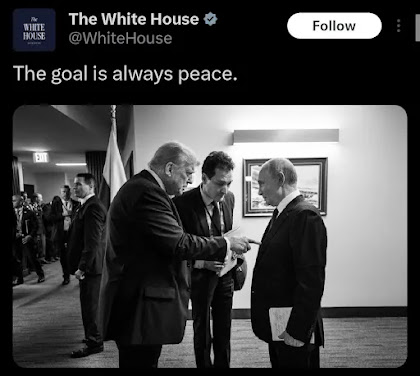
Organizing Notes, Bruce Gagnon, coordinator of the Global Network Against Weapons & Nuclear Power in Space, 16 Aug 25, https://space4peace.blogspot.com/2025/08/the-goal-is-always-domination.html?utm_source=substack&utm_medium=email
The Washington post reports in their top headline this morning the following: Trump reverses on Ukraine war ceasefire demand, aligning with Putin, splitting with allies: An immediate ceasefire to the war in Ukraine had long been a bedrock demand by the U.S., Ukraine and their European allies.
One can easily imagine that most neocons in Washington, London and the EU are pulling their hair out. Zelensky as well. His cash cow is wandering off the farm.
No immediate ceasefire was agreed upon. That was the chief demand of Zelensky, Starmer, Macon and Merz. They wanted to use that time to re-stock Ukraine with more weapons (especially drones) that could keep attacking civilians in the Donbass and inside of Russia.
Give Trump a nod (what ever his real motivations might be) he has now angered the ‘allies’ and they know that if they want the proxy war on Russia to continue (and they surely do) they are going to have to pay for it.
In one interview on Fox, Trump said the US funded Ukraine at the tune of $350 billion while the EU gave $100 billion.
Actually the US can’t afford to keep pissing money down the rat hole – especially when they want to spend that money getting ready for war with China. (And maybe still with Russia and Iran too.)
The Ukraine gamble is lost.
The oligarchic owned media in the US ensured that the Obama-Biden-Hillary Clinton orchestrated coup in Kiev in 2014 was swallowed by the people across the ‘democratic’ west. The public was firmly brainwashed to believe that Ukraine was the white hat team and Russia was the black hat bad guys.
Few know that the US-NATO started the war in 2014 and killed/wounded tens of thousands of Russian-ethnics in the Donbass region of eastern Ukraine – the place where the war is centered today.
In early 2022 Russian went into the Donbass after years of fruitless negotiations with the west to end their attacks on the Donbass. The US-NATO always wanted the war. They dreamed of breaking Russia up into pieces.
But don’t think the US has given up on its ill-fated quest to break up Russia. Alaska was just a ‘strategic retreat’. Just look at how Washington is fiddling with Armenia and Azerbaijan to destabilize another border land of both Russia and Iran.
The US is also working with Canada, Sweden, Denmark, Norway and Finland to militarize the Arctic in order to challenge Russia’s large border with that vast resource rich region.
The US-NATO only know war. Their economies are driven by military spending. Their so-called leaders are virtually all corporate apparatchiks.
And don’t forget that many of these EU-NATO leaders are related to former high level Nazi operatives during WW2.
Europe appears stuck in the quicksand of their disappearing ‘unipolar’ control. They just can’t accept that they must get along with the Global South that is rising after 500 years of colonial domination.
The US and EU got rich off the treasure they stole from the Global South. Museums across the west are loaded with treasures taken from these nations.
Trump is still about America First. That has not changed. The public in the US must campaign against the Pentagon’s trillion dollar a year offensive war machine.
That is the only way we will get true peace.
US flies nuclear bombs to Britain.

“The new nuclear bombs which are now based at Lakenheath are entirely under the control of Donald Trump and could be used without the UK having any say at all in the matter.
Nukewatch UK reveals how US nuclear gravity bombs were deployed on US soil for the first time in 17 years
By Peter Burt
US nuclear bombs were delivered to Lakenheath air base on Thursday 17 July as part of NATO plans to deploy new battlefield nuclear nuclear weapons intended for war-fighting in Europe. The following is an examination of how we know this, with an update also below.
The flight
The arrival of a special flight transporting the bombs was observed by Nukewatch UK, who judge that the evidence publicly available from our observations and flight-tracking data now supports the conclusion that nuclear weapons are based at the Lakenheath US air base in Suffolk. This article explains how the weapons were brought to Lakenheath by the US Air Force and sets out the evidence which indicates they are now stationed at the British base.
Shortly after 7 am local time on Tuesday 15 July a giant C-17 Globemaster transport aircraft, flight number RCH4574 (‘Reach 4574’), assigned to the US Air Force’s 62nd Airlift Wing left Joint Base Lewis–McChord, its home base in Washington state. The 62nd Airlift Wing is an elite, highly trained transport unit which serves as the US Air Force’s Prime Nuclear Airlift Force: the only Air Force section tasked with the role of supporting the US Department of Defence and Department of Energy with their nuclear airlift operations. The aircraft undertaking the flight was a C-17 with the serial number 08-8200, flying on high priority mission with the air force mission number PAM112271196.
The aircraft flew across the continental United States to Kirtland Air Force Base in Albuquerque, New Mexico – the hub of the US Air Force’s nuclear operations, where the largest nuclear weapons storage facility in the world is located: the Kirtland Underground Munitions Maintenance and Storage Complex(KUMMSC). KUMMSC stores a significant portion of the US nuclear arsenal, including gravity bombs and warheads.
At Kirtland the aircraft almost certainly loaded up with a cargo of anything up to 20 newly manufactured B61-12 nuclear weapons – a new, modernised version of the US Air Force’s principal nuclear gravity bomb with greater accuracy than older variants of the weapon. Manufacturing of the B61-12 variant was completed in December 2024 and the weapon is currently being rolled out on deployment. Whilst at Kirtland the aircraft was parked on Pad 5 – the section of the airbase designated for handling hazardous cargoes. Other aircraft at the airport were given a warning not to overfly the aircraft on Pad 5 for a period of over five hours, which ended only once the C-17 had departed.
Mid evening local time on Wednesday 16 July Reach 4574 took off, with the pilot reminding the ground controller that the aircraft has “haz cargo” on board. The aircraft flew through the night across the Atlantic Ocean, rendezvousing with two KC-46 tanker aircraft from Pease Air National Guard Base and McGuire Air Force Base to refuel over the ocean east of New York.
In a co-ordinated operation, a second C-17 aircraft (aircraft number 09-9211, flight number RCH4205, mission number PAM112472196) also left Lewis-McChord on 15 July and flew to Ramstein Air Force Base in Germany (stopping briefly at Lakenheath) to be on standby in the event of a failure or emergency involving the primary aircraft. This standby aircraft may have been loaded with nuclear emergency response equipment for dealing with an accident involving the primary aircraft.
Reach 4574 approached the UK flying south of Ireland, then flew up the Bristol Channel, cut across north Devon, and flew north west along a corridor taking it close to Oxford and Milton Keynes, but avoiding overflying major centres of population. The plane landed at Lakenheath air base at 12.50 local time.
Unloading the bombs
Nukewatch UK was able to observe the aircraft landing and unloading from outside the Lakenheath base. During the unloading operation base security was at an unusually high level, with USAF security patrols and police cars undertaking patrols inside the base’s security fence and plain-clothed (but badged) personnel from the Air Force Office of Special Investigations patrolling outside the base……………………………………………………………………………………………..
Nukewatch UK believes that this C-17 aircraft was transporting a batch of B61-12 nuclear weapons to Lakenheath. Our reasons for arriving at this conclusion are given below.
US nuclear weapons in Europe
The 62nd Airlift Wing regularly conducts Prime Nuclear Airlift Force missions across the Atlantic to transport materials and equipment to air bases in Europe which support NATO’s nuclear mission in Europe, under which B61 bombs are stored at US bases in Europe and bases of European nations which take part in NATO nuclear-sharing arrangements with the US. Nukewatch has been actively tracking these flights for three years, and has used archived tracking data to analyse flights since the beginning of 2020. Over this period missions have included occasional operations which have been unusually complex, involving up to seven aircraft as stand-bys and for in-flight refuelling. In addition to operations involving nuclear weapons, the unit also conducts missions transporting special nuclear materials which visit several NATO nuclear bases in Europe in sequence, and also conducts missions involving training with ground personnel at several nuclear bases.
It is possible that the earliest of these missions were training and rehearsal flights for the delivery of new B61-12 nuclear bombs to Europe, with more recent flights actually transporting the nuclear bombs across the Atlantic for deployment at bases in Europe. Nukewatch has observed that Lakenheath has been involved in many of these missions, initially as a location for basing a stand-by aircraft in Europe – possibly for use by a nuclear emergency response team. More recently Lakenheath appears to have been involved in a series of ‘work up’ exercises and security drills involving aircraft from 62 Airlift Wing to prepare the base for the arrival of nuclear weapons, culminating in a large-scale exercise over two days on 10 – 11 June 2025 which may have been a dress rehearsal for the nuclear delivery operation. ………………………………………………………………………………………………………………………………………
What we think
Speaking on the delivery of US B61-12 nuclear weapons to Lakenheath, Juliet McBride of Nukewatch UK said:
“The new nuclear bombs which are now based at Lakenheath are entirely under the control of Donald Trump and could be used without the UK having any say at all in the matter. In fact, we wonder whether the UK government has even been notified by the US Air Force that the weapons are now stationed at Lakenheath.
“The nuclear weapons now stored at Lakenheath have an explosive power of up to 50 kilotons. For comparison, the atom bomb that devastated Hiroshima in 1945 had an explosive yield of 15 kilotons. Far from protecting Europeans during wartime, these nuclear weapons would contribute to turning Europe into a radioactive wasteland.
“Despite the significant issues and risks involved in basing these weapons of mass destruction in Europe, neither the US nor the UK government have bothered to inform citizens or Parliament that they have been deployed here. Nukewatch UK believes that UK citizens have a right to know that these preparations for fighting a nuclear war are under way, and we will continue to report on nuclear movements to Lakenheath and other European nuclear bases”.
Update: Second nuclear flight arrives at Lakenheath
Following a delivery of nuclear weapons to Lakenheath US air base in Suffolk on 17-18 July 2025, a second Prime Nuclear Airlift force flew to Lakenheath on 24-25 July to delivery a high priority hazardous cargo……………………………………………………………………….
Nukewatch concludes the following:
- A high security unloading operation for hazardous materials took place at Lakenheath.
- The operation seemed to follow slightly different procedures to the one observed the previous week.
- Nevertheless, the degree of security and general circumstances of the flight seem to indicate that a nuclear-related load was probably delivered in the aircraft. This may have been components and equipment related to nuclear weapons, or possibly weapons themselves.
- Between four to six loads seemed to be transported away from the aircraft in small convoys to a location on the airbase nearby.
- Assuming two or three transporting vehicles in each convoy, and each convoy carried one nuclear bomb, this suggests that between around 8 and 18 ‘units’ of cargo were delivered by this flight. https://beyondnuclearinternational.org/2025/08/17/us-flies-nuclear-bombs-to-britain/
Trump Declares Victory After Putin Summit: The Spin Begins.
17 August 2025, Roswell, https://theaimn.net/trump-declares-victory-after-putin-summit-the-spin-begins/
The Trump-Putin summit concluded with no ceasefire or formal deal on Ukraine after nearly three hours of talks. Yet, President Trump and his supporters are framing it as a resounding success, turning a diplomatically thin outcome into a narrative of triumph.
If you listened to Trump and his loyalists, you’d think history had just been made. Trump hailed the meeting as “very productive,” rating it a “10” in a Fox News interview with Sean Hannity. He emphasised “great progress” and “many points agreed to,” though specifics remain elusive. The White House, through Press Secretary Karoline Leavitt, praised it was a restoration of dialogue benefiting U.S. interests – a claim critics argue overlooks the lack of enforceable commitments. Trump leveraged Putin’s remark that the Ukraine invasion “might not have happened” under his watch, spinning it as proof of his foreign policy prowess and a fix for “Democrat mess-ups.” The summit’s optics – red carpets, a joint press conference, and Putin’s ride in “The Beast” limo – were highlighted as symbols of American dominance, though skeptics dismissed them as stagecraft masking substantive failures.
MAGA’s Victory Lap
MAGA supporters amplified the victory lap, flooding social media with memes of Trump as a peacemaker, insisting that the world had witnessed leadership in action. Posts celebrated Putin’s praise as a global endorsement, with one user calling it a “clear winner for America” due to the “USA dominance narrative.” Others blamed Democrats for the war, framing the no-deal outcome as a deliberate dump of the “forever war” on Europe, setting the stage for future deals. The grandeur of flyovers and applause was touted as evidence of Trump’s negotiation mastery, dismissing critics as panicked. Yet, foreign policy analysts noted that without tangible concessions from Russia – such as troop withdrawals or guarantees on Ukrainian sovereignty – the summit risked being remembered as a photo op rather than a turning point.
The Spin vs. Reality
With no concrete outcomes, the summit’s legacy hinges on whose narrative sticks. Trump’s camp bets on spectacle overshadowing substance, while opponents warn that legitimising Putin without concessions undermines international law. As details emerge – and if Russian attacks continue – the “success” narrative may face harder scrutiny. For now, the world is left parsing theatrics from geopolitics, with Ukraine’s fate hanging in the balance.
Trump on Summit with Putin: We Made Great Progress Today.

Russian President Vladimir Putin concluded the summit by inviting Trump to Moscow
by Kyle Anzalone | August 15, 2025 https://news.antiwar.com/2025/08/15/trump-on-summit-with-putin-we-made-great-progress-today/
Following a three-hour meeting between Russian President Vladimir Putin and President Donald Trump, the leaders delivered brief statements at a press conference, stating that the talks were productive and constructive.
Putin spoke first, telling the press that the talks were in a “constructive atmosphere of mutual respect. We had very thorough negotiations.” He added that he hoped European governments and Ukraine would receive the agreements made with Trump “constructively” and that they would not interfere with the progress.
The Russian leader also blamed former US President Joe Biden for starting the war in Ukraine and argued that the invasion would not have happened if Trump had been the president. Trump has often claimed the conflict in Ukraine was Biden’s war, and he could have prevented the war from breaking out.
Putin noted that before the start of the war in 2022, Moscow sent Washington a proposal that would have stopped the Russian invasion of Ukraine. A core issue for the Kremlin was the growing ties between NATO and Ukraine. However, the Biden administration refused to negotiate on this point, and Putin ordered the invasion.
The Russian President said that during the Biden administration, US and Russian relations hit a post-Cold War low point. Putin expressed hope that the summit would be the start of the process to repair the ties and resolve the Ukrainian crisis.
“I believe we had a very productive meeting. There were many, many points we agreed on, I would say most of them,” Trump said. “A couple of big ones we haven’t quite gotten there, but we made some headway.”
Trump explained that no final agreement was made. “So there’s no deal until there’s a deal,” he added. He went on to say he would call European leaders and Ukrainian President Zelensky. He added that it was ultimately up to the Ukrainians to accept any agreement.
The President did not specify what issues were left unresolved, but later in his statement, he mentioned that the “most significant” issue remains unsettled.
At the end of the press conference, Putin extended an invitation to Trump to attend a summit in Moscow. “That is an interesting one. I will get a little heat on that one. But I can see it possibly happening,” Trump replied.
Friday’s meeting in Alaska also included Secretary of State Marco Rubio, envoy Steve Witkoff, Foreign Minister Sergei Lavrov, and aide Yury Ushakov.
Kyle Anzalone is the opinion editor of Antiwar.com and news editor of the Libertarian Institute. He hosts The Kyle Anzalone Show and is co-host of Conflicts of Interest with Connor Freeman.
Trump meets with Putin: the non-event that was sold as history.
16 August 2025 Michael Taylor, https://theaimn.net/trump-meets-with-putin-the-non-event-that-was-sold-as-history/
The buildup was epic. For weeks, the Trump administration talked up the meeting with Vladimir Putin as if the world was about to witness a defining moment in history. Media speculation was feverish – would there be a grand bargain on Ukraine, arms control, or even global security itself? Some even hinted it might mark the beginning of a “new era” in U.S.–Russia relations.
And then it happened.
The meeting was less “historic breakthrough” and more “awkward photo-op.” No landmark agreements were reached, no peace deals signed, no strategies unveiled. Just vague talk about “respect,” “better relations,” and “future discussions.” In other words: business as usual, wrapped in hype.
Trump will, of course, try to frame it as a personal victory – that’s his style. He even claimed afterward that Putin praised him for what he’d done for America. Maybe he did, maybe he didn’t – but given Trump’s track record of exaggerating praise, it’s hard to take the claim at face value. What we do know is that there was little of substance for anyone to point to. America’s allies were left wondering why so much diplomatic capital was spent for so little return, while adversaries quietly enjoyed the spectacle.
Putin, for his part, looked calm and unruffled. He gave away nothing, promised little, and let Trump carry the theatrics. In the end, he walked away looking like the steady hand, while Trump appeared desperate for validation.
This wasn’t the dawn of a new era. It was a reminder that in international politics, theatrics without substance are just that – theatrics. And the more often the world sees this pattern repeat, the less seriously America’s leadership is taken on the global stage.
It’s not ‘Who lost Ukraine?’ It’s ‘Who destroyed Ukraine?

Walt Zlotow, West Suburban Peace Coalition, Glen Ellyn IL , 15 Aug 25
When Mao won the Chinese civil war in 1949, adding China to the USSR in the roster of commie countries, the US war hawks of that era excoriated the Truman administration for ‘losing’ China’. Their unhinged claim was that the commie filled State Department made Mao’s inevitable takeover possible. That helped fuel Sen. Joe McCarthy’s equally unhinged campaign to smoke out all those imagined commies in the Truman administration a year later.
A whiff of that 1949 anti commie hysteria is playing out on mainstream media ahead of Friday’s sit down between President Trump and Russian President Putin seeking a ceasefire and end to this disastrous war destroying Ukraine.
Morning Joe Scarborough this morning pondered whether Trump will cave to evil Putin’s Ukraine dismembership demands to achieve the peace that might garner him a Nobel Peace Prize. Yep, Moring Joe laid out the ‘Who lost Ukraine’ meme on Trump to prepare us for the onslaught of anti-Trump, anti-Russian hysteria sure to follow if a settlement reflecting the reality of Ukraine’s dismembership is inked in Alaska tomorrow.
A settlement is only possible if a US/Russia settlement verifies the battlefield reality. Ukraine’s military is teetering on collapse with over a million dead cannon fodder and 4 oblasts gone to Russia forever. If Trump accomplishes peace…which is far from likely, the blame game will focus on Trump who ‘lost’ Ukraine which will end up as a greatly diminished rump state dependent on US/European life support for years to come.
Historians instead should begin with the 6 administrations preceding Trump’s second term 2.0: George H.W. Bush, Bill Clinton, W. Bush, Barack Obama, Donald Trump 1.0 and most grievously Joe Biden. H.W. Bush, Clinton, W. Bush, Obama, Trump 1.0 and Biden all promoted NATO expansion into Ukraine and dismissed all Russian security pleas that such expansion was a Red Line Russia would view as an existential threat.
While his predecessors put Ukraine on the road to destruction, Joe Biden essentially pulled the trigger on a war Ukraine had no chance of winning. Putin tried to avoid invading. He saw Ukraine massing 60,000 elite troops on the Donbas border to polish off the Ukrainian separatists there seeking independence and safety from Kyiv neo fascists. His plea of December 21 2021 was dismissed out of hand. Biden told Putin that Russia’s security interests, which included autonomy for Ukrainian separatists as well as a neutral Ukraine not in NATO, were ‘not subject to discussion whatsoever.’
Biden knew that response would provoke a Russian invasion. But Biden miscalculated that US weapons combined with draconian Russian sanctions would result in a Vietnam style defeat for Russia, possibly even the overthrow of President Putin.
So here we are three years, eight months later with Putin, not Trump holding all the cards in tomorrow’s negotiation. Trump knows the correct outcome is settling on Russia’s terms: no return of Ukraine territory, no NATO for Ukraine and a demilitarized Ukraine that can never attack inside Russia territory again. He also knows he’ll be branded by America’s ravenous war hawks as ‘The man who lost Ukraine’ should he end the war.
Nobody lost Ukraine. But we now know who destroyed Ukraine. The only question to be answered is…How severely Ukraine will be destroyed before the guns go silent.
‘A million calls an hour’: Israel using Microsoft cloud for mass surveillance of Palestine.

Aug 09, 2025 , Mikael Thalen (Tech Reporter), https://san.com/cc/a-million-calls-an-hour-israel-using-microsoft-cloud-for-mass-surveillance-of-palestine/
Summary
1 million an hour
Israel is reportedly collecting and storing as much as 1 million phone calls an hour from Palestine on Microsoft’s Azure cloud servers.
200 million hours
Since the partnership began between Microsoft and Israel in 2022, over 200 million hours of phone call audio has been captured as of July.
Used in war
The captured cell phone data from Gaza and the West Bank is reportedly being used for blackmail, detainments, arrests and airstrikes.
Full story
Israel’s military intelligence unit has been relying on Microsoft to conduct mass surveillance of phone calls from Palestine, according to a joint investigation by The Guardian, +972 Magazine and the Local Call. The operation, enabled by a customized and segregated environment on Microsoft’s Azure cloud platform, is reportedly capable of processing up to 1 million phone calls an hour.
The system launched in 2022 following a meeting the year prior between Yossi Sariel, then the commander of the intelligence agency known as Unit 8200, and Microsoft CEO Satya Nadella. Leaked internal Microsoft documents as well as interviews with 11 sources, including Microsoft staff and Israeli intelligence officials, revealed that approximately 11,500 terabytes of data, equivalent to 200 million hours of audio, was stored on Microsoft servers in the Netherlands and Ireland as of July.
The captured data has reportedly been used to target Palestinians in Gaza and the West Bank for blackmail, detention and arrest.
Arrests, detainments and airstrikes
“When they need to arrest someone and there isn’t a good enough reason to do so, that’s where they find the excuse,” a Unit 8200 source was quoted as saying.
Israel also dug through the data, according to the investigation, after carrying out airstrikes to find intelligence that could be cited as justification.
Captured phone calls are retained in the cloud for around one month. That time may be expanded to give Unit 8200 the ability to retrieve older telephone conversations involving people who become of interest, The Guardian said.
Microsoft denies knowledge
Microsoft said its CEO was not aware of the types of data that would be stored when he agreed to aid Unit 8200. An external review commissioned by Microsoft on the partnership, carried out earlier this year after the ties between the company and Israel were revealed, found no evidence that Azure was used to target or harm people in Palestine, the company said.
After the surveillance operation was uncovered, Microsoft again said that at no time was it “aware of the surveillance of civilians or collection of their cellphone conversations using Microsoft’s services, including through the external review it commissioned.”
Internal records on the 2021 meeting between Nadella and Sariel do not show that cell phone surveillance was mentioned. Instead, Sariel is said to have referred to “sensitive workloads” of secret data.
Other documents, however, suggest Microsoft engineers in both the U.S. and Israel were aware that raw intelligence, such as audio files, would be stored in the cloud environment. Israel initially reached out to Microsoft after realizing its own internal servers were incapable of storing such vast amounts of data.
“You don’t have to be a genius to figure it out,” one source said. “You tell [Microsoft] we don’t have any more space on the servers, that it’s audio files. It’s pretty clear what it is.”
Numerous Israeli sources insisted that the mass-surveillance program had saved lives by detecting and thwarting attacks on civilians. The system, however, did not prevent the Oct. 7, 2023, Hamas attack, which has been used to justify increased surveillance.
Alan Judd (Content Editor) contributed to this report.
Pentagon to Create ‘Domestic Civil Disturbance Quick Reaction Force’

“You will see them flowing into the streets of Washington“
“They will be strong, they will be tough and they will stand with their law enforcement partners.”
by Kyle Anzalone | Aug 12, 2025, https://libertarianinstitute.org/news/pentagon-to-create-domestic-civil-disturbance-quick-reaction-force/
The Department of Defense is planning to create a rapid response force of National Guard troops to quickly deploy to American cities where protests or unrest are occurring.
On Tuesday, The Washington Post reported that it obtained documents showing the Pentagon is creating a “Domestic Civil Disturbance Quick Reaction Force.”
“The plan calls for 600 troops to be on standby at all times so they can deploy in as little as one hour,” the outlet explained. “They would be split into two groups of 300 and stationed at military bases in Alabama and Arizona, with purview of regions east and west of the Mississippi River, respectively.”
One hundred troops at each base would be on standby to deploy within an hour, while the entire quick force would begin operations within 12 hours. The National Guard will be equipped with weapons and riot gear, and the deployments will be limited to 90 days to prevent burnout among the troops.
On Monday, Trump announced a major crackdown on crime in Washington, DC, by federalizing the Metropolitan DC police and deploying 800 National Guard troops to the capital city. “This is Liberation Day in DC, and we’re going to take our capital back,” Trump said during a press conference at the White House. “I’m officially invoking the District of Columbia Home Rule Act. And placing the DC Metropolitan Police under direct federal control.”
“In addition, I’m deploying the National Guard to help restore law, order and public safety,” he added.
Defense Secretary Pete Hegseth said residents of DC will soon see the National Guard in the capital. “You will see them flowing into the streets of Washington in the coming week,” he explained. “At your direction as well, sir, there are other units we are prepared to bring in — other National Guard units, other specialized units. They will be strong, they will be tough and they will stand with their law enforcement partners.”
The new quick reaction force may be deployed to other American cities if Trump perceives that there is too much crime. Trump threatened to take similar steps in other major cities, noting he hopes some of them “self-clean up.” “If we need to, we’re going to do the same thing in Chicago, which is a disaster,” the president said.
The planned force could face legal barriers as it attempts to deploy to American cities. Many Democratic led-cities may object to a Republican President deploying troops. Additionally, federal law limits the National Guard’s ability to conduct law enforcement within the U.S.
Vonnegut on Nagasaki: “The most racist, nastiest act by this country, after human slavery”
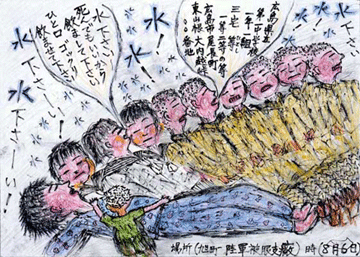
““The rights and wrongs of Hiroshima are debatable,” Telford Taylor, the chief prosecutor at Nuremberg, once said, “but I have never heard a plausible justification of Nagasaki” — which he labeled a war crime.”
Author: John LaForge, August 7, 2014, https://www.peacevoice.info/2014/08/06/vonnegut-on-nagasaki-the-most-racist-nastiest-act-by-this-country-after-human-slavery/
For the full article:
Vonnegut on Nagasaki: “The most racist, nastiest act by this country, after human slavery”
877 Words
“The rights and wrongs of Hiroshima are debatable,” Telford Taylor, the chief prosecutor at Nuremberg, once said, “but I have never heard a plausible justification of Nagasaki” — which he labeled a war crime.
In his 2011 book Atomic Cover-Up, Greg Mitchell says, “If Hiroshima suggests how cheap life had become in the atomic age, Nagasaki shows that it could be judged to have no value whatsoever.” Mitchell notes that the US writer Dwight MacDonald cited in 1945 America’s “decline to barbarism” for dropping “half-understood poisons” on a civilian population. The New York Herald Tribune editorialized there was “no satisfaction in the thought that an American air crew had produced what must without doubt be the greatest simultaneous slaughter in the whole history of mankind.”
Mitchell reports that the novelist Kurt Vonnegut, Jr. — who experienced the firebombing of Dresden first hand and described it in Slaughterhouse Five — said, “The most racist, nastiest act by this country, after human slavery, was the bombing of Nagasaki.”
On Aug. 17, 1945, David Lawrence, the conservative columnist and editor of US News, put it this way: “Last week we destroyed hundreds of thousands of civilians in Japanese cities with the new atomic bomb. …we shall not soon purge ourselves of the feeling of guilt. …we…did not hesitate to employ the most destructive weapon of all times indiscriminately against men, women and children. … Surely we cannot be proud of what we have done. If we state our inner thoughts honestly, we are ashamed of it.”
If shame is the natural response to Hiroshima, how is one to respond to Nagasaki, especially in view of all the declassified government papers on the subject? According to Dr. Joseph Gerson’s With Hiroshima Eye, some 74,000 were killed instantly at Nagasaki, another 75,000 were injured and 120,000 were poisoned.
If Hiroshima was unnecessary, how to justify Nagasaki?
The saving of thousands of US lives is held up as the official justification for the two atomic bombings. Leaving aside the ethical and legal question of slaughtering civilians to protect soldiers, what can be made of the Nagasaki bomb if Hiroshima’s incineration was not necessary?
The most amazingly under-reported statement in this context is that of Truman’s Secretary of State James Byrnes, quoted on the front page of the August 29, 1945 New York Times with the headline, “Japan Beaten Before Atom Bomb, Byrnes Says, Citing Peace Bids.” Byrnes cited what he called “proof that the Japanese knew that they were beaten before the first atomic bomb was dropped on Hiroshima.”
On Sept. 20, 1945, Gen. Curtis LeMay, the famous bombing commander, told a press conference, “The war would have been over in two weeks without the Russians entering and without the atomic bomb. The atomic bomb had nothing to do with the end of the war at all.”
According to Robert Lifton’s and Greg Mitchel’s Hiroshima in America: 50 Years of Denial (1995), only weeks after August 6 and 9, President Truman himself publicly declared that the bomb “did not win the war.”
The US Strategic Bombing Survey, conducted by Paul Nitze less than a year after the atom bombings, concluded that “certainly prior to 31 December 1945, and in all probability prior to 1 November 1945, Japan would have surrendered even if the atomic bombs had not been dropped, even if Russia had not entered the war, and ever if no invasion had been planned or contemplated.”
Likewise, the Intelligence Group of the US War Department’s Military Intelligence Division conducted a study from January to April 1946 and declared that the bombs had not been needed to end the war, according to reports Gar Alperovitz in his massive The Decision to Drop the Atomic Bomb. The IG said it is “almost a certainty that the Japanese would have capitulated upon the entry of Russia into the war.”
Russia did so, Aug. 8, 1945, and as Ward Wilson reports in his Five Myths about Nuclear Weapons, six hours after news of Russia’s invasion of Sakhalin Island reached Tokyo — and before Nagasaki was bombed — the Supreme Council met to discuss unconditional surrender.
Experiments with hell fire?
Nagasaki was attacked with a bomb made of plutonium, named after Pluto, god of the underworld earlier known as Hades, in what some believe to have been a ghastly trial. The most toxic substance known to science, developed for mass destruction, plutonium is so lethal it contaminates everything nearby forever, every isotope a little bit of hell fire.
According to Atomic Cover-Up, Hitoshi Motoshima, mayor of Nagasaki from 1979 to 1995, said, “The reason for Nagasaki was to experiment with the plutonium bomb.” Mitchell notes that “hard evidence to support this ‘experiment’ as the major reason for the bombing remains sketchy.” But according to a wire service report in Newsweek, Aug. 20, 1945, by a journalist traveling with the president aboard the USS Augusta, Truman reportedly announced to his shipmates, “The experiment has been an overwhelming success.”
US investigators visiting Hiroshima Sept. 8, 1945 met with Japan’s leading radiation expert, Professor Masao Tsuzuki. One was given a 1926 paper on Tsuzuki’s famous radiation experiments on rabbits. “Ah, but the Americans, they are wonderful,” Tsuzuki told the group. “It has remained for them to conduct the human experiment!”
~~~~~~~~~~~~~~~
John LaForge is a Co-director of Nukewatch, a nuclear watchdog and environmental justice group in Wisconsin, edits its quarterly newsletter, and writes for PeaceVoice.
1 This Month





PLEASE OPPOSE HR 8255 AND S.3639 – bills would accelerate satellite deployment, with no environmental review or safeguards – https://ncstd5li.quorum.us/campaign/169331/
To see nuclear-related stories in greater depth and intensity – go to https://nuclearinformation.wordpress.com
-
Archives
- October 2026 (39)
- September 2026 (339)
- August 2026 (330)
- July 2026 (355)
- June 2026 (287)
- May 2026 (306)
- April 2026 (356)
- March 2026 (251)
- February 2026 (267)
- January 2026 (308)
- December 2025 (358)
- November 2025 (359)
-
Categories
- 1
- 1 NUCLEAR ISSUES
- business and costs
- climate change
- culture and arts
- ENERGY
- environment
- health
- history
- indigenous issues
- Legal
- marketing of nuclear
- media
- opposition to nuclear
- PERSONAL STORIES
- politics
- politics international
- Religion and ethics
- safety
- secrets,lies and civil liberties
- spinbuster
- technology
- Uranium
- wastes
- weapons and war
- Women
- 2 WORLD
- ACTION
- AFRICA
- Atrocities
- AUSTRALIA
- Christina's notes
- Christina's themes
- culture and arts
- Events
- Fuk 2022
- Fuk 2023
- Fukushima 2017
- Fukushima 2018
- fukushima 2019
- Fukushima 2020
- Fukushima 2021
- general
- global warming
- Humour (God we need it)
- Nuclear
- RARE EARTHS
- Reference
- resources – print
- Resources -audiovicual
- Weekly Newsletter
- World
- World Nuclear
- YouTube
-
RSS
Entries RSS
Comments RSS

