Biden’s Last Minute US-Saudi Deal Could Open Door Nuclear Arms Race
Robert Inlakesh, November 15, 2024, https://www.mintpressnews.com/bidens-last-stand-us-saudi-deal-conflict-nuclear-arms-race/288567/
recent report suggests that quiet negotiations are underway between Riyadh and Washington as the two nations work toward securing a U.S.-Saudi security agreement before President Biden’s term concludes. The initiative appears aimed at establishing what Israeli Prime Minister Benjamin Netanyahu has dubbed “the new Middle East.”
Before the conflict in Gaza erupted on Oct. 7, 2023, U.S. and Saudi officials were deep in discussions over a controversial security pact. The proposed agreement is part of a sweeping initiative designed to pave the way for normalization between Saudi Arabia and Israel.
The initial framework of the U.S.-Saudi deal was anticipated to include a provision akin to NATO’s Article 5, asserting that an attack on one would constitute an attack on all. By September 2023, it became clear that the security pact would hinge on Riyadh’s decision to normalize ties with Israel. Another key demand from Saudi Crown Prince Mohammed bin Salman was the development of a nuclear program, a point expected to be a defining feature of the agreement.
The U.S.-Saudi agreement, however, was far more ambitious than simply providing incentives for normalization; it was part of a sweeping strategy encompassing the entire West Asia region.
In June 2022, Jordan’s King Abdullah II publicly voiced his support for a “Middle East-type NATO.” Speculation quickly followed that such an alliance could include Jordan, Egypt, Saudi Arabia, the United Arab Emirates, and other U.S.-aligned Arab nations—all working in tandem with Israel and the United States. The objective would be to establish a regional bloc capable of counterbalancing Iran’s Axis of Resistance and reinforcing U.S. influence across the region.
Such an alliance would align closely with the push to establish the India-Middle East-Europe Economic Corridor—a trade route designed to connect Asia and Europe through a land passage spanning the UAE, Saudi Arabia, Jordan, and Israel.
On Sept. 9, 2023, the White House issued a memorandum touting the “landmark” trade corridor, with President Biden calling it “a really big deal” during his visit to the G20 summit in New Delhi. Later that month, Israeli Prime Minister Benjamin Netanyahu addressed the United Nations General Assembly, unveiling a map that underscored the emerging Israeli-Arab partnership and featured the trade route, which he hailed as “the new Middle East.”
The only obstacle to the U.S.-backed Arab-Israeli alliance against Iran—and the ambitious trade corridor—was the lack of a formal normalization agreement between Saudi Arabia and Israel. By late September, Saudi Crown Prince Mohammed bin Salman publicly suggested that an agreement with Israel was “getting closer,” effectively sidelining the Palestinian cause.
However, the entire project—predicated on the assumption that the Palestinian issue was no longer a significant factor—was upended by the Hamas-led surprise attack on Israel on Oct. 7.
Saudi Arabia has recently emphasized that establishing a Palestinian state is a prerequisite for any normalization agreement with Israel. Throughout 2024, discussions between Riyadh and Washington regarding a controversial security pact have intermittently surfaced in the news. According to a report by Axios, there is a concerted effort to finalize this security agreement before President Joe Biden’s term concludes in January.
While the full details of the agreement remain undisclosed, two primary aspects have raised concerns: the establishment of a Saudi civilian nuclear program and a defense clause that could obligate the U.S. to engage militarily against Riyadh’s adversaries in the event of an attack.
In his 2024 address to the United Nations General Assembly, Israeli Prime Minister Benjamin Netanyahu once again turned to props, illustrating a vision of an Arab-Israeli alliance he described as the “dream” set against Iran’s “nightmare.” The presentation made clear that Netanyahu remains hopeful of reviving the region’s pre-Gaza war blueprint.
A U.S.-Saudi defense agreement binding Washington to Saudi Arabia’s defense could have significant implications. Any breakdown in the truce between Riyadh and Sana’a could entangle U.S. forces in Yemen’s conflict. Additionally, the establishment of a Saudi nuclear program risks being perceived by Iran as a security threat, heightening regional tensions and adding a new layer of volatility to the Middle East.
Ultra-Conservative War Hawks Dominate Trump Cabinet
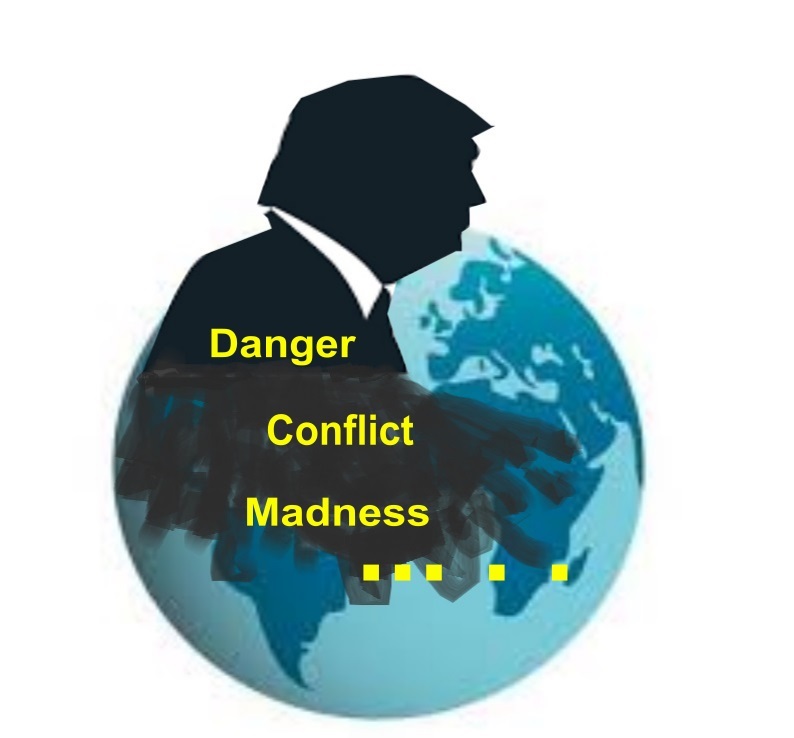
Trump quickly fills cabinet positions with Zionists, warhawks, and personal friends all unified under an ultra-conservative agenda and total loyalty to Trump
November 14, 2024 by Peoples Dispatch, https://peoplesdispatch.org/2024/11/14/ultra-conservative-war-hawks-dominate-trump-cabinet/
Peoples Dispatch has compiled a list of notable appointments below:
Thomas Homan: “Border Czar”
Homan was the head of ICE during Trump’s first term, and has been selected to lead up Trump’s campaign promise to conduct mass deportations of 15 to 20 million people. Homan pledged at the Republican National Convention that he would “run the biggest deportation operation this country’s ever seen” and promised to “flood sanctuary cities” with agents to conduct mass arrests, and carry out massive raids targeting workplaces. He was given the “Presidential Rank Award” by Barack Obama in 2015 for his work in “enforcement and removal operations.” Obama himself was dubbed the “Deporter in Chief” by immigration activists for deporting more people than any president who came before him.
Stephen Miller: Deputy chief of staff for policy
Miller is another pick that signals that Trump is serious regarding his campaign promise to carry out the largest mass deportations in US history. Miller is the architect of the cruelest anti-immigrant policies of the first Trump administration, such as family separation, and a key bridge between the Trump administration and the “alt-right” fascist movement. Miller supports deploying military units of the National Guard to hunt down undocumented people, and advocates for the construction of massive camps to detain immigrants rounded up in raids.
Marco Rubio: Secretary of State
Trump’s choice of Florida Senator Marco Rubio for Secretary of State has surprised some who wanted to believe Trump’s campaign promise of “preventing World War III”. Rubio is a notorious warhawk, known for promoting an aggressive foreign policy approach towards countries that do not tip-toe around the US, including Iran, China, Russia, and Venezuela. Rubio’s appointment could be a test of whether the Trump administration will lean more neoconservative than promised or whether Rubio will be forced to toe a more isolationist foreign policy line.
Rubio, who is of Cuban descent, has a particular hostility towards the socialist state and is a key promoter of harsh sanctions against the island. Rubio has also attacked left-wing social movements within the United States, attempting to use the power of the state to harshly sanction the BDS movement and pro-Palestine and leftist organizations.
Michael Waltz: National Security Adviser
US Army colonel and Florida Representative Michael Waltz is also a notorious warhawk, particularly on China and Iran. During Trump’s first administration, after he almost provoked war with Iran with his assassination of General Qassim Suleimani in 2020, Waltz was one of a small group invited to the White House to receive a briefing on the strike.
Matt Gaetz: Attorney General
Trump loyalist and Florida Representative Matt Gaetz is a prominent figure in the ultra-conservative wing of the Republican Party, leading the charge to overthrow the more established Republican Kevin McCarthy as Speaker of the House—who was replaced with Mike Johnson in 2023. Gaetz, like Trump, is no stranger to scandal, being embroiled in a three-year long federal sex trafficking investigation that ended in 2023.
Pete Hegseth: Secretary of Defense
Hegseth is a controversial Fox News host and military veteran, who is known for his advocacy on behalf of former members of the military who have been convicted of war crimes. This includes lobbying in defense of Navy SEAL Chief Petty Officer Edward Gallagher, who was accused of stabbing a teenaged prisoner of war to death and shooting a teenage girl and elderly man while deployed in Iraq. Since Trump picked Hegseth, his collection of right-wing tattoos has gotten some media attention, which includes a tattoo across his arm of the medieval crusader slogan “Deus Vult,” which translates to “I have not come to bring peace, but a sword,” and signals his political leanings towards the Christian far right.
Kristi Noem: Secretary of Homeland Security
Noem is the current Governor of South Dakota who’s known for her total loyalty to Trump. Noem’s deeply anti-migrant agenda has led her to claim that the “United States of America is in a time of invasion” as a consequence of immigrants “waging war against our nation.” Noem supported the Muslim ban during Trump’s first term because it would restrict refugees from “terrorist hotbed areas.”
John Ratcliffe: CIA Director
Ratcliffe was Trump’s director of national intelligence during his first term. This pick was praised by Republican Representative Mike Turner, who has accused fellow Republican colleagues of repeating Russian propaganda, for helping “counter the serious threats posed by China, Russia, Iran and North Korea.”
Tulsi Gabbard: Director of national intelligence
Trump’s pick of veteran and former Democrat Tulsi Gabbard as the pick to oversee 18 spy agencies has been welcome news to those more critical of the foreign policy establishment. Gabbard endorsed Trump last month, claiming that Trump would transform the Republican Party “back to the party of the people, and the party of peace.”
Steven Witkoff: Special envoy to the Middle East
Witkoff is a Zionist multi-millionaire real estate investor and close personal friend of Trump’s, with zero prior experience in politics in the Middle East/West Asia region.
Mike Huckabee: Ambassador to Israel
Former Arkansas Governor Mike Huckabee and ardent Evangelical Christian is likely to continue his long career of defending Israel in his new post. Huckabee once argued that there was “no such thing as a Palestinian” and recently claimed that the US would back an Israeli attempt to annex the West Bank.
Elise Stefanik: United Nations ambassador
The conservative New York representative went viral for her role in orchestrating the downfall of several prominent university presidents, including former Harvard President Claudine Gay, over the accusation that these presidents were not repressing pro-Palestine students enough. Stefanik is viewed as one of the most prominent enemies of the student movement in the US.
Lee Zeldin: Environmental Protection Agency Administrator
Trump’s pick of Zeldin as EPA Administrator signals that Trump is ready to make good on his campaign promise to attack key environmental protections that are one of the few ways the US government attempts to mitigate the effects of climate change.
Elon Musk and Vivek Ramaswamy: Department of Government Efficiency (DOGE)
The world’s richest person, who in many ways directly bought votes for Trump in key swing states such as Pennsylvania, has been promised a formal role in Trump’s administration alongside entrepreneur Vivek Ramaswamy, through the new commission dubbed the Department of Government Efficiency (the acronym referencing an internet meme). DOGE is in many ways designed to help the ultra-rich including Musk slash through government regulations that may place a limit on power and profit.
Blinken Atrocious in a Dangerous World

Through his various sojourns, the point was always clear. Israel was to be mildly rebuked, if at all, while Hamas was to be given the full chastising treatment as killers without a cause.
November 15, 2024, by: Dr Binoy Kampmark, https://theaimn.com/blinken-atrocious-in-a-dangerous-world/#google_vignette
It is hard to credit one of the least impressive Secretary of States, the United States has ever produced with any merit other than being a plasterwork that, from time to time, moved with caution on the world stage for fear of cracking. On the stage, Antony Blinken’s brittle performances have been nothing short of unimpressive, notably in pursuing such projects comically titled “Peace in the Middle East.” Each time he has ventured to various regions of the world, the combatants seem keener than ever to continue taking up arms or indulging in slaughter.
A sense of Blinken’s detachment from the world can be gathered from his Foreign Affairs piece published on October 1, intended as something of a report on the diplomatic achievements of the Biden administration. It starts with the sermonising treacle that is all a bit much – the naughty states on the world stage, albeit small in number (Russia, Iran, North Korea and Chin
The Biden administration had, in response, “pursued a strategy of renewal, pairing historic investments in competitiveness at home with an intensive diplomatic campaign to revitalize partnerships abroad.” This served to counter those challengers wishing to “undermine the free, open, secure, and prosperous world that the United States and most countries seek.” Then comes the remark that should prompt readers to pinch themselves. “The Biden administration’s strategy has put the United States in a much stronger geopolitical position today than it was four years ago.”
An odd assessment for various reasons. There is the continued war in Ukraine and Washington’s refusal to encourage any meaningful talks between Kiev and Moscow, preferring, instead, the continued supply of weapons to an attritive conflict of slaughter and such acts of industrial terrorism as the attack on the Nord Stream pipeline.
There has been the relentless watering down of the “One China” understanding over the status of Taiwan, along with continued provocations against Beijing through the offensive pact of AUKUS with Australia and the UK. That particularly odious pact has served to turn Australia into a US military garrison without the consent of its citizens, an outcome sold to the dunces in Canberra as utterly necessary to arrest the rise of China. Along the way, an arms buildup in the Indo- and Asia-Pacific has been encouraged.
With such a view of the world, it’s little wonder how blind Blinken, and other members of the Biden administration, have been to Israel’s own rogue efforts at breaking and altering the international system, committing, along the way, a goodly number of atrocities that have seen it taken to the International Court of Justice by South Africa for committing alleged acts of genocide.
Through his various sojourns, the point was always clear. Israel was to be mildly rebuked, if at all, while Hamas was to be given the full chastising treatment as killers without a cause. When the barbarians revolt against their imperial governors, they are to be both feared and reviled. In June this year, for instance, Blinken stated on one of his countless missions for a non-existent peace that Hamas was “the only obstacle” to a ceasefire, a markedly jaundiced explanation given the broader programs and objects being pursued by the Israeli Defence Forces. Hamas has been accused of being absolutist in its goals, but one can hardly exempt Israeli Prime Minister Benjamin Netanyahu from the charge. Not for Blinken: “I think it is clear to everyone around the world, that it’s on them [Hamas] and that they will have made a choice to continue a war that they started.”
On the issue of aid to Gaza’s strangled, dying population, Blinken has been, along with his equally ineffectual colleague in the Pentagon, Defense Secretary Lloyd Austin, cringingly ineffective. Their October 13 letter sent to their Israeli counterparts made mention of several demands, including the entry of some 350 aid trucks into Gaza on a daily basis, and refraining from adopting laws, now in place, banning the UN Agency for Palestinian Refugees (UNRWA). Each demand has been swatted back with a school child’s snotty petulance, and aid continues being blocked to various parts of Gaza.
On October 24, Americans for Justice in Palestine Action (AJP Action) “urgently” called on the Secretary of State “to stop wasting his time with failed diplomatic visits and to demand an immediate ceasefire in Gaza and Lebanon.” Those at AJP Action must surely have realised by now that Blinken would be utterly rudderless without those failed visits. Indeed, Osama Abu Irshaid, Executive Director of the organisation, went so far as to say that “Blinken’s diplomatic theatre is enabling Netanyahu’s war crimes.” To arm and fund Israel “while requesting a ceasefire” was a policy both “hypocritical and ineffective.” Such is the nature of that sort of theatre.
In the meantime, the tectonic plates of international relations are moving in other directions, a point that has been aided, not hindered, by the policy of this administration. Through BRICS and other satellite fora, the United States is finding itself gradually outpaced and isolated, even as it continues to hide behind the slogan of an international rules-based order it did so much to create. This is not to say that the US imperium has quite reached its terminus. If anything, the Biden administration, through the good offices of Blinken, continues to insist on its vitality. But US hegemony long left unchallenged is, most certainly, at an end.
What to know about Elon Musk’s contracts with the federal government
FATONEWS. by Samuel Azevedo, 15/11/2024
Elon Musk is easily the world’s wealthiest man, with a net worth topping $300 billion.
But even he stands to make more money from his association with the federal government after placing a winning bet on Donald Trump’s election to the presidency.
“It’s going to be a golden era for Musk with Trump in the White House,” Wedbush Securities analyst Dan Ives said.
Musk’s aerospace company SpaceX has received billions of dollars in federal contracts, and could be line for more, while his five other businesses could gain from a lighter regulatory touch.
SpaceX
If there’s one Musk business that could profit the most from the incoming Trump administration, it’s SpaceX.
The company, which announced this year it was moving its headquarters from Hawthorne to Texas, already has received at least $21 billion in federal funds since its 2002 founding, according to government contracting research firm The Pulse. That includes contracts for launching military satellites, servicing the International Space Station and building a lunar lander.
However, that figure could be dwarfed by a federal initiative to fund a Mars mission, which is the stated goal of SpaceX.
“Elon Musk is wealthy, but he’s not wealthy enough to completely fund humans to Mars. It needs to be a public, private partnership, because of the tens of billions of dollars that this would cost, or even hundreds of billions dollars,” said Laura Forczyk, executive director of space industry consulting firm Astralytical.
SpaceX has already made big strides testing his Starship rocket, the most powerful ever built. NASA envisions employing the rocket in its Artemis program to return humans to the moon, but it has been designed to have enough thrust to propel a spacecraft to Mars. What’s more, Trump, during his first presidency, speculated on Twitter about why the United States was focusing on the moon instead of Mars…………………………………………………………………………………………..
SpaceX also has Starlink contracts with the military, including a $70-million award from the U.S. Space Force last year, according to Space News.
Tesla
Trump’s policies could reduce the sales of electric vehicles, but with Musk’s influence, his administration’s policies could boost Tesla — though not with federal funding………………………………………………….
xAI
Musk’s startup xAI doesn’t appear to have federal government contracts, but artificial intelligence companies could benefit in other ways under Trump.
Republicans and Musk have expressed support for cutting regulation to fuel AI innovation, a crucial part of the future of tech companies.
xAI
Musk’s startup xAI doesn’t appear to have federal government contracts, but artificial intelligence companies could benefit in other ways under Trump.
Republicans and Musk have expressed support for cutting regulation to fuel AI innovation, a crucial part of the future of tech companies…………………………………………………………..
“It’s going to be a golden era for Musk with Trump in the White House,” Wedbush Securities analyst Dan Ives said.
Musk’s aerospace company SpaceX has received billions of dollars in federal contracts, and could be line for more, while his five other businesses could gain from a lighter regulatory touch.
Trump has named Musk to co-head a new Department of Government Efficiency,” or DOGE — a nod to the cryptocurrency Musk adores. However, federal law bars executive branch employees, which can include unpaid consultants from participating in government matters that will affect their financial interests, unless they divest of their interests or recuse themselves…………………………………………………………………………….more https://fatonews.com.br/2024/11/15/what-to-know-about-elon-musks-contracts-with-the-federal-government/
Trump’s Appointments Reflect a More Openly Hawkish Face of US Empire

In appointing Marco Rubio, Mike Waltz and Pete Hegseth to his administration, Trump emboldens volatile warmongers.
By Sam Rosenthal , Truthout, November 14, 2024
After mounting his comeback win against Kamala Harris, Donald Trump has already announced a slew of administration appointments. Compared to other presidents-elect, and to his own first term, Trump is ahead of the typical timeline in announcing these appointments, giving observers an earlier-than-usual view into how the second Trump administration could function, both in the domestic and foreign policy arenas.
On the foreign policy front, Trump will inherit several major international crises and tensions that Joe Biden has been unable to resolve during his time in office, chief among them Israel’s ongoing genocide in Gaza, Russia’s war in Ukraine and escalating U.S. rivalry with China over Taiwan. Trump has already named several high-profile cabinet members who will shape much of his foreign policy and could oversee the consequential conclusions of those conflicts.
Marco Rubio, the senator from Florida, has been tapped for the coveted secretary of state position. Rubio is a well-known China hawk who has recently led the charge against TikTok and other Chinese-based tech companies, a stance that dovetails well with Trump’s promise to impose a 60 percent tariff on all goods exported from China. Beyond economic warfare, Rubio has called China the “threat that will define this century” and pushed repeatedly on known pressure points in U.S.-China relations, including the status of Taiwan.
Rubio — the grandson of Cuban immigrants who moved to the U.S. before the Cuban revolution but hated Fidel Castro from afar — is an ardent anti-communist who has argued vociferously against the legitimacy of the sitting governments in Cuba and Venezuela and supported devastating sanctions on both……………………
Rubio’s aggressive stance toward China will no doubt be compounded by Trump’s newly announced pick for national security adviser, Mike Waltz, currently a House representative from Florida. Waltz has pushed his anti-China rhetoric even farther than Rubio, …………………………………….
Arguably Trump’s most surprising pick so far has been his choice for secretary of defense. …………………………….. For his second term, in an apparent attempt to institute more accommodating leadership at the Pentagon, Trump has nominated Pete Hegseth, a Fox News host who served in Afghanistan and at Guantánamo Bay in Cuba, to lead the Department of Defense.
During his time at Fox News, Hegseth has become known for advocating for leniency for military personnel found to have committed war crimes abroad while serving. Hegseth has no governmental experience whatsoever, nor has he served in any command role within the U.S. military…………………………..
During Trump’s last term, he encouraged the then-president to bomb cultural sites in Iran. As head of the Department of Defense, he might focus on internal house cleaning, seeking to remake the military into a more homogenous, more overtly male-dominated entity, with even less care for international law and a firmer belief in U.S. supremacy.
…………………………………………….Tulsi Gabbard, chosen as director of national intelligence……….. has also frequently trafficked in anti-Muslim rhetoric, repeating right-wing talking points about “radical Islamic ideology” that are often used to justify the criminalization and surveillance of Muslim communities…
………………………….Trump has also begun to announce high-profile ambassadorships. Among these early picks, the most consequential is likely to be his selection of former Arkansas Gov. Mike Huckabee to serve as U.S. ambassador to Israel. Huckabee, whose daughter, Sarah Huckabee Sanders, served as Trump’s press secretary in his last term, is well-known for his Christian evangelicism. …..
Huckabee’s pick as ambassador to Israel likely portends an even more openly hostile stance toward Palestinian human rights and comes with possibly apocalyptic consequences for the West Bank. Huckabee, an avowed Zionist (like President Biden), has long supported Benjamin Netanyahu. …………………………………….. He has said that Israeli settlements in the West Bank are not illegal, contradicting the overwhelming consensus of international law experts…………………………..
Beyond that, though, Huckabee ascribes to a particular brand of Christian evangelical thought, rooted in the belief that the existence of modern Israel is ordained by God. Huckabee has close ties to Christian Zionist organizations, including Christians United for Israel (CUFI), one of the largest of its type in the U.S., which is already celebrating his nomination.
But Huckabee’s connection with Hagee and CUFI isn’t just alarming because of its founder’s overt antisemitism; Hagee is part of an extreme segment of the Christian Zionist tradition that believes that a cataclysmic war in Israel and Palestine will be the precipitating event for the second coming of the Christian messiah. Hagee and others in this line of thinking, therefore, encourage the hastening of violent conflict between Israel and its neighbors as much as possible. Whether Huckabee himself is aligned with this particular strain of Christian Zionism is not clear, but his close connection with the broader movement, and with Hagee in particular, should be enough to raise the highest level of alarm about what policies Huckabee intends to support toward an Israeli state that is already deeply enmeshed in the bloodiest campaign of its entire existence.
It is not a foregone conclusion that all of these nominees will make it through the Senate confirmation process. Although Republicans now control the chamber, more moderate caucus members, or those with more traditional views of how the federal government should be run, might be hesitant to confirm some of Trump’s most unorthodox picks. Hegseth and Gabbard, in particular, could face strong headwinds. However, that is dependent on whether Republicans are willing to risk antagonizing Trump, who is infamous for his ability to hold and prosecute personal vendettas, at the outset of his second term. If these nominees are confirmed, they will comprise among the most unusual, and unpredictable, stewards of U.S. foreign policy that the country has ever had.
How Trump Will Seek Revenge on the Press

Ari Paul, 14 Nov 24,https://fair.org/home/how-trump-will-seek-revenge-on-the-pres
“Revenge—it’s a big part of Trump’s life,” Mother Jones‘ David Corn (10/19/16) wrote just before Trump was elected to the presidency the first time:
In speeches and public talks, Trump has repeatedly expressed his fondness for retribution. In 2011, he addressed the National Achievers Congress in Sydney, Australia, to explain how he had achieved his success. He noted there were a couple of lessons not taught in business school that successful people must know. At the top of the list was this piece of advice: “Get even with people. If they screw you, screw them back 10 times as hard. I really believe it.”
Knowing this about Trump, Democrats and liberals worry that he will use the Department of Justice, especially if Matt Gaetz is confirmed as attorney general, as an unrestrained vehicle to pursue the prosecution of political enemies.
But given Trump’s constant attacks on media—“the opposition party,” as his ally Steve Bannon called the fourth estate (New York Times, 1/26/17)—journalists fear that he will use the power of the state to intimidate if not destroy the press.
Defunding public broadcasting
Trump called for defunding NPR (Newsweek, 4/10/24) after a long-time editor accused the radio outlet of liberal bias in the conservative journal Free Press (4/9/24). Rep. Claudia Tenney (R–NY) introduced legislation to defund NPR because “taxpayers should not be forced to fund NPR, which has become a partisan propaganda machine” (Office of Claudia Tenney, 4/19/24). With Republicans also holding both houses of congress, bills like Tenney’s become more viable.
Trump has previously supported budget proposals that eliminate funding for the Corporation for Public Broadcasting (Politico, 3/27/19).
The infamous Project 2025, a conservative policy agenda many see as a blueprint for the second Trump term, calls for the end to public broadcasting, because it is viewed as liberal propaganda:
Every Republican president since Richard Nixon has tried to strip the Corporation for Public Broadcasting (CPB) of taxpayer funding. That is significant not just because it means that for half a century, Republican presidents have failed to accomplish what they set out to do, but also because Nixon was the first president in office when National Public Radio (NPR) and the Public Broadcasting Service (PBS), which the CPB funds, went on air.
In other words, all Republican presidents have recognized that public funding of domestic broadcasts is a mistake. As a 35-year-old lawyer in the Nixon White House, one Antonin Scalia warned that conservatives were being “confronted with a long-range problem of significant social consequences—that is, the development of a government-funded broadcast system similar to the BBC.”
All of which means that the next conservative president must finally get this done, and do it despite opposition from congressional members of his own party if necessary. To stop public funding is good policy and good politics. The reason is simple: President Lyndon Johnson may have pledged in 1967 that public broadcasting would become “a vital public resource to enrich our homes, educate our families and to provide assistance to our classrooms,” but public broadcasting immediately became a liberal forum for public affairs and journalism.
PBS and NPR, as FAIR (10/24/24) has noted, has for decades caved in to right-wing pressures—PBS by adding conservative programming, NPR by trying to rid itself of political commentary altogether. But the right will never let go of its ideological opposition to media outlets not directly owned by the corporate class.
‘Whether criminally or civilly’
Trump also has a well known track record of revoking the credentials of journalists who produce reporting he doesn’t like (Washington Post, 2/24/17, 5/8/19; New Republic, 11/5/24). It is realistic to assume that a lot more reporters will be barred from White House events in the years ahead.
While a bill that would grant the secretary of the treasury broad authority to revoke nonprofit status to any organization the office deems as a “terrorist” organization has so far failed (Al Jazeera, 11/12/24), it is quite possible that it could come up for a vote again. If this bill were to become law, the Treasury Department could use this ax against a great many progressive nonprofit outlets, like Democracy Now! and the American Prospect, as well as investigative outlets like ProPublica and the Center for Investigative Reporting.
The department could even target the Committee to Protect Journalists, which has already said in response to Trump’s victory, “The fundamental right to a free press, guaranteed by the First Amendment of the US Constitution, must not be impaired” (11/6/24).
Margaret Sullivan (Guardian, 10/27/24), an avid media observer, said there is no reason to think Trump will soften his campaign against the free press. She said:
In 2022, he sued the Pulitzer Prize board after they defended their awards to the New York Times and the Washington Post. Both newspapers had won Pulitzer Prizes for investigating Trump’s ties to Russia.
More recently, Trump sued ABC News and George Stephanopoulos for defamation over the way the anchor characterized the verdict in E. Jean Carroll’s sexual misconduct case against him. Each of those cases is wending its way through the courts.
She added:
There is nothing to suggest that Trump would soften his approach in a second term. If anything, we can expect even more aggression.
Consider what one of Trump’s most loyal lieutenants, Kash Patel, has said.
“We’re going to come after the people in the media who lied about American citizens, who helped Joe Biden rig presidential elections,” Patel threatened during a podcast with Steve Bannon. “Whether it’s criminally or civilly, we’ll figure that out.”
Trump has already gone after the New York Times and Penguin Random House since Sullivan wrote this. CJR (11/14/24) said:
The letter, addressed to lawyers at the New York Times and Penguin Random House, arrived a week before the election. Attached was a discursive ten-page legal threat from an attorney for Donald Trump that demanded $10 billion in damages over “false and defamatory statements” contained in articles by Peter Baker, Michael S. Schmidt, Susanne Craig and Russ Buettner.
It singles out two stories coauthored by Buettner and Craig that related to their book on Trump and his financial dealings, Lucky Loser: How Donald Trump Squandered His Father’s Fortune and Created the Illusion of Success, released on September 17. It also highlighted an October 20 story headlined “For Trump, a Lifetime of Scandals Heads Toward a Moment of Judgment” by Baker and an October 22 piece by Schmidt, “As Election Nears, Kelly Warns Trump Would Rule Like a Dictator.”
And just before his victory, Trump sued CBS News, alleging the network’s “deceitful” editing of a recent 60 Minutes interview with Vice President Kamala Harris “misled the public and unfairly disadvantaged him” (CBS News, 10/31/24).
Expect more of this, except this time, Trump will have all the levers of the state on his side. And whatever moves the next Trump administration makes to attack the press will surely have a chilling effect, which will only empower his anti-democratic political agenda.
A comprehensive review of the revolving door between Fox and the second Trump administration

Trump has picked 5 former Foxers — so far
by Matt Gert, 11/13/24
Incoming president Donald Trump’s unprecedented relationship with Fox News is once again creating a revolving door between the right-wing propaganda network and his administration. Trump has named three current or former Fox employees to high-ranking positions in the week since he was elected president — and more seem sure to follow.
Trump, an obsessive Fox viewer whose worldview is shaped by the network’s programming, stocked his first-term White House and federal agencies with familiar faces from the network. At least 20 people with Fox on their resumes joined his administration over the course of his tenure, including Cabinet secretaries, top White House aides, and ambassadors.
Trump also consulted privately with an array of Fox stars, creating a shadow Cabinet of advisers with immense influence over government affairs whose key credential was their ability to attract attention via right-wing bombthrowing. And he frequently made important decisions based on what people were telling him on his favorite network — at times with disastrous results.
As Trump ramps up his second term, he is once again plucking top administration officials from the network’s stable.
The list below will be updated as additional former Fox employees join or leave the Trump administration.
……………………………………………………………………………………………………………………… more https://www.mediamatters.org/donald-trump/comprehensive-review-revolving-door-between-fox-and-second-trump-administration
Trump 2.0 promises US enabled Israeli genocide on steroids.
Walt Zlotow, West Suburban Peace Coalition, Glen Ellyn IL, 15 Nov 24
President Biden set a high bar for enabling Israeli genocide in Gaza. Like Israeli Prime Minister Benjamin Netanyahu, Biden didn’t’ lift a finger to bring the remaining 97 Israeli hostages back safely from Gaza. But he’s used over 50,000 tons of weapons, costing over $18 billion for Israel to complete the genocidal ethnic cleansing of Gaza.
He did nothing to force Israel to provide food, water and medicine to the 2,300,000 sick and starving Palestinians (less the 100,000 or so already dead) as a condition for supplying genocide weapons. On October 12th he issued a demand giving Israel 30 days to start allowing in life saving supplies. When Israel did nothing to comply, Biden essentially said ‘Just kidding about the consequences….keep up the genocide.’
But at least Biden said a ceasefire along with food and medicine were needed to stop the Palestinians’ suffering.
Unlike Biden, Trump will continue US genocide enabling without the veneer of sympathy for its victims. He repeatedly demands that Israel “Finish the job” in Gaza.
His picks on foreign policy promise even more genocide in Gaza compared to Biden’s tough act to follow.
Trump tabbed uberhawk Mike Waltz to be his National Security Advisor. Waltz is totally against ceasefire, charging it will only lead to larger Middle East war, when it’s only the ongoing genocide in Gaza fueling it. He’s a huge fan of Netanyahu’s conduct of the genocide, claiming Biden has been too reactive compared to Netanyahu’s proactive aggression.
Pete Hegseth, Trump’s pick to run Defense, is all in for Israeli expanding the genocide in Gaza and bombing of Lebanon, to take out Iranian nuclear sites. He’s enamored of Israeli bombing and assassinations in Iran because he charges Biden is too weak to do it. He carries visible symbols of his beliefs—a large Crusader’s Jerusalem Cross tattoo on his chest and the biblical verse Matthew 10:34, which reads, “Do not suppose that I have come to bring peace to the earth. I did not come to bring peace but a sword.” When in charge of Defense, Hegseth should change its name to Department of Endless War and Genocide.
Trump’s selection of Marco Rubio to head the State Department is equally dreadful. Rubio defends the ongoing Israeli genocide in Gaza saying “Israel’s enemies are also our enemies. The Iranian regime and its proxies – Hamas in Gaza, Hezbollah in Lebanon, the Houthis in Yemen and a multitude of groups in Syria and Iraq seek Israel’s destruction as part of a multi-stage plan to dominate the Middle East and destabilize the West. The Jewish state is on the front lines of this conflict, fighting with many shared American-Israeli lives.” Rubio would be more accurate in saying ‘Israel is on the front lines of genocide.’
But Trump’s pick of Mike Huckabee to be Ambassador to Israel trumps even Waltz, Hegseph and Rubio for genocidal support. Huckabee, a Christian Evangelist claims “There is no such thing as a West Bank. It’s Judea and Samaria. There’s no such thing as a settlement. They’re communities, they’re neighborhoods, they’re cities. There’s no such thing as occupation….there’s no such thing as a Palestinian.”
As grotesque as Biden’s enabling of Israeli genocide in Gaza is…Trump 2.0 figures to be much worse.
Imprisoned ex-Ohio House Speaker Larry Householder to ask Donald Trump for clemency, campaign attorney says
By Jeremy Pelzer, cleveland.com, COLUMBUS, Nov. 11, 2024,
Ex-Ohio House Speaker Larry Householder, who’s serving a 20-year prison sentence for overseeing the largest bribery scandal in Ohio history, is preparing to ask President-elect Donald Trump for clemency, according to his campaign’s attorney.
Householder, a Perry County Republican, is planning to submit an official pardon application to the U.S. Justice Department at some point closer to Trump’s inauguration on Jan. 20, 2025, according to the attorney, Scott Pullins.
“We will also be working to build support and communicate with the President and his team,” Pullins stated in a message. Pullins is not a member of Householder’s criminal defense team; rather, he’s advised Householder about legal and political matters over the years and represented him in some state elections cases.
Mark Marein, one of Trump’s criminal defense attorneys, declined comment.
U.S. presidents have the power to offer two kinds of executive clemency for federal crimes: a presidential pardon, and commuting a prison sentence. Either would result in Householder being immediately released from prison……………………………………………………………………….
Last year, Householder was convicted by a federal jury of leading a scheme to use $60 million in bribes from FirstEnergy to help pass and maintain House Bill 6, a 2019 energy law that offered the Akron-based utility a windfall of financial perks – headlined by a $1 billion-plus bailout of two Ohio nuclear power plants owned at the time by a company subsidiary.
……………………………………….. Even if Trump grants a presidential pardon for his federal conviction, Householder could still remain behind bars if he’s convicted of pending state-level charges filed against him last March claiming he lied on state ethics disclosure forms and illegally used campaign funds to pay criminal defense fees from his federal trial.
While Householder was prosecuted at trial by the office of U.S. Attorney Kenneth Parker, an appointee of Democratic President Joe Biden, the House Bill 6 corruption investigation was launched under Parker’s predecessor, Trump appointee David DeVillers………………………………………….. more https://www.cleveland.com/news/2024/11/larry-householder-imprisoned-ex-ohio-house-speaker-to-ask-donald-trump-for-clemency-campaign-attorney-says.html?outputType=amp&fbclid=IwY2xjawGjYXRleHRuA2FlbQIxMQABHVnzOLnrs4RtAZadAmLBy1ftyo-ntH8VLFbM5eb32xO1e2i2iaCHrnYdmQ_aem_C0GQArV6rnh_v9JKVSeyGQ
The Future of Nuclear Power is Wrought with Challenges
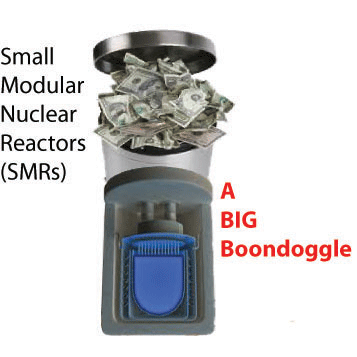
My analysis indicates that while advanced modular nuclear reactors might theoretically be helpful for the very long term, they cannot fix the problems of the US, and other countries in the West, nearly quickly enough. I expect that the Trump administration, which will start in January 2025, will see this program as a boondoggle.
Strangely enough, the US has no working model of a small-scale nuclear reactor, even one operating on conventional fuel.
Oil Price, By Gail Tverberg – Nov 12, 2024
The world is facing a growing shortage of uranium, the essential fuel for nuclear power plants.
The US is heavily reliant on Russia and its allies for enriched uranium, creating geopolitical risks.
Recycling spent nuclear fuel is expensive, complex, and faces significant environmental and security challenges.
It is easy to get the impression that proposed new modular nuclear generating units will solve the problems of nuclear generation. Perhaps they will allow more nuclear electricity to be generated at a low cost and with much less of a problem with spent fuel.
As I analyze the situation, however, the problems associated with nuclear electricity generation are more complex and immediate than most people perceive. My analysis shows that the world is already dealing with “not enough uranium from mines to go around.” In particular, US production of uranium “peaked”about 1980 (Figure 1 on original).
For many years, the US was able to down-blend nuclear warheads (both purchased from Russia and from its own supply) to get around its uranium supply deficit.
Today, the inventory of nuclear warheads has dropped quite low. There are few warheads available for down-blending. This is creating a limit on uranium supply that is only now starting to hit.
Nuclear warheads, besides providing uranium in general, are important for the fact that they provide a concentrated source of uranium-235, which is the isotope of uranium that can sustain a nuclear reaction. With the warhead supply depleting, the US has a second huge problem: developing a way to produce nuclear fuel, probably mostly from spent fuel, with the desired high concentration of uranium-235. Today, Russia is the primary supplier of enriched uranium.
The plan of the US is to use government research grants to kickstart work on new small modular nuclear reactors that will be more efficient than current nuclear plants. These reactors will use a new fuel with a higher concentration of uranium-235 than is available today, except through purchase from Russia. Grants are also being given to start work on US production of the more highly enriched uranium fuel within the US. It is hoped that most of this highly enriched uranium can come from recycling spent nuclear fuel, thus helping to solve the problem of what to do with the supply of spent fuel.
My analysis indicates that while advanced modular nuclear reactors might theoretically be helpful for the very long term, they cannot fix the problems of the US, and other countries in the West, nearly quickly enough. I expect that the Trump administration, which will start in January 2025, will see this program as a boondoggle.
Current problems with nuclear electricity generation are surprisingly hidden. World electricity generation from nuclear has been close to flat since 2004.
Although there was a dip in world generation of nuclear electricity after the tsunami that affected nuclear reactors in Fukushima, Japan, in 2011, otherwise world production of nuclear electricity has been nearly flat since 2004 (Figure 3 on original)……………………………………………………………………………………………………
Recycling of spent fuel to recover usable uranium and plutonium has been accomplished only to a limited extent. Experience to date suggests that recycling has many issues……………………………………………..
There seem to be several issues with building units to recover uranium from spent fuel:
- Higher cost than simply mining more uranium
- Pollution problems from the recycling plants
- Potential for use of the output to make nuclear warheads
- Potential for nuclear accidents within the plants
- Remaining radioactivity at the site at the end of the reprocessing plant’s life, and thus the need to decommission such plants
- Potential for many protestors disrupting construction and operation because of issues (2), (3), (4), and (5)
The US outlawed recycling of spent fuel in 1977, after a few not-very-successful attempts. Once the purchase of Russian warheads was arranged, down-blending of warheads was a much less expensive approach than reprocessing spent fuel. Physics Today recently reported the following regarding US reprocessing:
“A plant in West Valley, New York, reprocessed spent fuel for six years before closing in 1972. Looking to expand the plant, the owners balked at the costs required for upgrades needed to meet new regulatory standards. Construction of a reprocessing plant in Barnwell, South Carolina, was halted in 1977 following the Carter administration’s ban.”
Japan has been trying to build a commercial spent fuel reprocessing plant at Rokkasho since 1993, but it has had huge problems with cost overruns and protests by many groups. The latest estimate of when the plant will actually be completed is fiscal year 2026 or 2027.
The largest commercial spent fuel reprocessing plant in operation is in La Hague, France. It has been in place long enough (since 1966) that it has run into the issue of decommissioning an old unit, which was started as a French military project. The first processing unit was shut down in 2003. The International Atomic Energy Administration says, “The UP2-400 decommissioning project began some 20 years ago and may be expected to continue for several more years.” It talks about the huge cost and number of people involved. It says, “Decommissioning activities represent roughly 20 per cent of the overall activity and socio-economic impact of the La Hague site, which also hosts two operating spent fuel recycling plants.”
The cost of the La Hague reprocessing units is probably not fully known. They were built by government agencies. They have gone through various owners including AREVA. AREVA has had huge financial problems. The successor company is Orano. The currently operating units have the capacity to process about 1,700 metric tons of fuel per year. The 1700 metric tons of reprocessing of spent fuel from La Hague is reported to be nearly half of the world’s operating capacity for recycling spent fuel.The plant would process 800 metric tons of fuel per year.
I understand that Russia is working on approaches that quite possibly are not included in my figures. If so, this may add to world uranium supply, but Russia is not likely to want to share the benefits with the West if there is not enough to go around……………………………………………………………………………………….
The US is trying to implement many new ideas at one time with virtually no successful working models to smooth the transition.
Strangely enough, the US has no working model of a small-scale nuclear reactor, even one operating on conventional fuel. A CNBC article from September 2024 says, Small nuclear reactors could power the world, the challenge is building the first one in the US…………………………………………………………………………………….
Starting at this level, it is difficult to see how reactors with the new technology and the HALEU fuel to feed them can possibly be available in quantity before 2050.
It is difficult to see how the cost of electricity generated using the new advanced modular nuclear reactors and the new HALEU fuel, created by reprocessing spent fuel, could be low.
As far as I can see, the main argument that these new modular electricity generation plants will be affordable is that they will only generate a relatively small amount of electricity at once —about 300 megawatts or less, or about one third of the average of conventional nuclear reactors in the US. Because of the smaller electricity output, the hope is that they will be affordable by more buyers, such as utility companies.
The issue that is often overlooked by economists is that electricity generated using these new techniques needs to be low cost, per kilowatt-hour, to be helpful. High-cost electricity is not affordable. Keeping costs down when many new approaches are being tried for the first time is likely to be a huge hurdle. I look through the long list of problems encountered in recycling spent fuel mentioned in Section [6] and wonder whether these issues can be inexpensively worked around. There are also issues with adopting and installing the proposed new advanced modular reactors, such as security, that I have not even tried to address.https://oilprice.com/Alternative-Energy/Nuclear-Power/The-Future-of-Nuclear-Power-is-Wrought-with-Challenges.html
Caitlin Johnstone: The Incoming Trump Administration Is Already Filling Up With War Sluts,
Caitlin Johnstone, Nov 12, 2024 https://www.caitlinjohnst.one/p/the-incoming-trump-administration?utm_source=post-email-title&publication_id=82124&post_id=151534941&utm_campaign=email-post-title&isFreemail=true&r=1ise1&triedRedirect=true&utm_medium=email
Donald Trump has named Republican congressman Mike Waltz as his next national security advisor, a position that was held by ultrahawk John Bolton in the last Trump administration.
Like Bolton, Waltz is a warmongering freak. Journalist Michael Tracey has been filling up his Twitter page since the announcement with examples of Waltz’s insane hawkishness, including his support for letting Ukraine use US weapons to strike deep into Russian territory, criticizing Biden for not escalating aggressively enough in Ukraine, advocating bombing Iran, opposing the US military withdrawal from Afghanistan, and naming Iran, North Korea, China, Russia and Venezuela as “on the march” against the United States toward global conflict. The mainstream press are calling Waltz a “China hawk”, but from the look of things he’s a war-horny hawk toward all the official enemies of the United States.
Trump has also confirmed that Republican congresswoman Elise Stefanik will be taking on the role of US ambassador to the UN, a role previously held by warmonger Nikki Haley in the last Trump administration. Again, there doesn’t seem to be much difference between the old hawk and the new one.
Stefanik is best known for her congressional efforts to stomp out free speech on college campuses, making a lie of Trump’s lip service to the importance of First Amendment rights. As explained by Antiwar’s Dave DeCamp, she’s a hawkish swamp monster whose political career was primed in some of the most odious neoconservative think tanks in Washington, and opposes placing any limits on US military support for Israel. Earlier this year Stefanik actually flew to Israel to give a speech before the Israeli Knesset vowing to help stop the “antisemitism” of protesters against Israel’s genocidal atrocities at American universities.
And now we’re getting reports throughout the mass media that deranged war slut Marco Rubio has been tapped as Trump’s new secretary of state. It’s really hard to imagine anyone worse for the role of Washington’s top diplomat than a warmonger who has spent his entire political career pushing for more wars, sanctions and slaughter at every opportunity.
This should dash the hopes of Trump supporters everywhere that this time their guy really will end the wars and drain the swamp. Trump’s appointment of Iran hawk Brian Hook to help staff the State Department for the next administration and his rumored consideration of Mike Rogers for secretary of defense are likewise bad signs, as is Tucker Carlson’s claim that virulent China hawk Elbridge Colby is likely to play a role in the administration.
Trump’s anti-interventionist supporters loudly applauded the other day when he unexpectedly announced that Mike Pompeo and Nikki Haley would not be playing a role in the next administration. In response to the announcement, libertarian comedian and podcaster Dave Smith said on Twitter that stopping Pompeo was not enough and that “we need maximum pressure to keep all neocons and war hawks out of the Trump administration.” In response to Smith’s post, Donald Trump Jr tweeted, “Agreed!!! I’m on it.”
When I saw this, I tweeted the following:
“Ignore their words and watch their actions. Been saying it for years, and I’m going to keep on saying it. Ignore their words, watch their actions. Talk, as they say, is cheap.”
Their actions are telling us a lot more than their words right now.
Inside the secret plan to re-open America’s most infamous nuclear power plant code named Tetris
Daily Mail, By RACHEL BOWMAN FOR DAILYMAIL.COM, 11 November 2024
The mastermind behind the plan to reopen the nuclear plant that caused America’s worst reactor accident hatched the idea after learning tech CEOs were desperately searching for energy to power artificial-intelligence.
Constellation Energy and Microsoft announced a power purchase agreement in September to reopen the Three Mile Island (TMI) nuclear plant in Pennsylvania.
The plant is home the worst commercial nuclear power accident after the Unit 2 reactor suffered a partial meltdown due to mechanical failure and human error in 1979.
Joe Dominguez, the chief executive of Constellation Energy, said he came up with the idea after OpenAI co-founder Sam Altman revealed data centers for some AI models would require as much power as a large city during a gathering for CEOs in May 2023. ……………………………………………………………………………..
The Unit 1 reactor located on TMI Unit 2 was shut down in 1979 after its partial meltdown. Its twin – the Unit 2 rector – was operating until 2019.
To restart Unit 2, Constellation will invest $1.6 billion in the turbine, generator, main power transformer and cooling and control systems.
Then Dominguez had to get Pennsylvania Gov. Josh Shapiro’s support for the move. The two met for the first time last December and the CEO said Shapiro questioned him on the plant conditions and if a restart could be done safely without cost to the state……………………………………………
The companies have not released the financial details of the deal, but analysts at Jefferies estimate Microsoft will pay between $110 to $115 per megawatt hour of electricity.
The plant is expected to start delivering energy in 2028 under the agreement, and Constellation said they will pursue license renewal that will extend plant operations to at least 2054. https://www.dailymail.co.uk/news/article-14067243/Inside-secret-plan-open-Americas-infamous-nuclear-power-plant-code-named-Tetris.html
Nuclear sector’s views on second Trump administration mixed as Rogan interview raises questions
Donald Trump enacted pro-nuclear policies during his first term and supported an “all-of-the-above” energy policy during the campaign, but some advocates fear a “divide between words and actions.”
Utility Dive, By Brian Martucci. 8 Nov 24
Dive Brief:
- President-elect Donald Trump in August vowed to “approve new drilling, new pipelines, new refineries, new power plants [and] new reactors” on “day one” of his administration.
- But Trump has more recently sounded skeptical about federal backing for large-scale nuclear builds like Vogtle, which he said in an Oct. 25 interview with podcaster Joe Rogan “get too big, and too complex and too expensive,” raising questions about his second administration’s willingness to support the industry.
- The nuclear sector has mixed views on the incoming administration’s potential support, with some expressing optimism that Trump would build on pro-nuclear policies enacted during the Biden and first Trump administrations and others concerned about a pullback in federal funding for advanced nuclear development.
Dive Insight:
The second Trump administration is likely to “pursue an overall domestic energy agenda focused on energy production and dominance in the United States” but may not continue the Biden-Harris administration’s “massive appropriations” to the nuclear sector, American Nuclear Society Director of Public Policy John Starkey said.
At least one prominent Trump ally, environmental lawyer and former presidential candidate Robert F. Kennedy Jr., has an anti-nuclear track record. Kennedy, a Trump ally who is expected to have an official role in the incoming administration, fought for years to close New York’s Indian Point nuclear plant. More recently, he has voiced opposition to federal nuclear energy subsidies.
“We should have no subsidies … all the companies should internalize their costs in the way that they internalize their profits,” Kennedy told Tesla CEO and fellow Trump backer Elon Musk in an online discussion last year.
But the first Trump administration was broadly supportive of the U.S. nuclear industry……………………………………………………….
…………………………………..the incoming administration’s likely focus on reducing federal discretionary spending — Musk called for at least $2 trillion in spending cuts last month after Trump in September floated his appointment to a new “government efficiency commission” — “is a concern for a lot of potential customers” for advanced nuclear, said Jessica Lovering, co-founder and executive director of the Good Energy Collective, a pro-nuclear advocacy group. ………………………………………………………………………………………………………………..
https://www.utilitydive.com/news/nuclear-energy-sector-mixed-views-second-trump-administration-joe-rogan/732
America Can’t Afford a New Nuclear Buildup

William Hartung, 11 Nov 24, https://www.forbes.com/sites/williamhartung/2024/11/11/america-cant-afford-a-new-nuclear-buildup/
The return to power of Donald Trump raises serious questions about the future of the U.S. nuclear arsenal. His statements on nuclear weapons have been all over the map, but a 2017 review by Anthony Zurcher of The Guardian of Trump’s statements since the 980s concluded that “his thoughts on atomic weaponry reflect a certain strain of Cold War arms-race enthusiasm and diplomatic brinkmanship.” And in 2016, after he was challenged when he said ‘possibly, possibly” nuclear weapons could be used, Trump went on to say that if they weren’t to be used, “Then why are we making them?” On the flip side, he has also called nuclear war “the ultimate catastrophe.”
As for his actions in office, Trump pulled the U.S. out of the Iran nuclear deal, formally known as the Joint Comprehensive Plan of Action (JCPOA), which by all objective accounts had been working to stop Tehran’s pursuit of a nuclear weapon. And in 2019, the Trump administration withdrew from the Intermediate Nuclear Forces in Europe treaty (INF), which had banned ground-based ballistic missiles and cruise missiles in the range of between 500 and 5,500 kilometers.
On the other hand, Trump was roundly (and unfairly) criticized for his short-lived effort at nuclear negotiations with North Korea. The talks ultimately failed, but critics who slammed Trump for “rewarding” North Korean dictator Kim Jong Un seemed to be ignoring the fact that in the final analysis talking with adversaries is a precondition for any sort of agreement. Criticism of Trump for being ill-prepared or inconsistent was fair game, but slamming him for talking to the North Korean leader at all didn’t make a lot of sense.
The real test of Trump’s stance on all-things nuclear will be his approach to the Pentagon’s multi-year effort to build a new generation of nuclear-armed missiles, bombers, and submarines, plus new warheads to go with them, a plan that some experts suggest could cost up to $2 trillion in the next three decades.
The nuclear plan has already been plagued by major cost overruns, including an 81% increase in the projected cost of the new intercontinental ballistic missile, dubbed the Sentinel, and developed and produced by Northrop Grumman. The cost overrun prompted a government review of the program, but the assessment ended up pronouncing that the program was too important to cancel.
The review of the Sentinel was a missed opportunity. Former secretary of defense William Perry has called ICBMs “some of the most dangerous weapons we have,” because the president would have only a matter of minutes to decide whether to launch them on warning of attack, increasing the risk of a nuclear confrontation sparked by a false alarm.
The Pentagon has a big shopping list – a larger Navy, more combat aircraft, new armored vehicles, drones and other unpiloted vehicles. Even with a Pentagon budget soaring towards $1 trillion per year, something may have to be cut. There’s also a chance that at least a few fiscal conservatives in Congress may seek across-the-board cuts, including the Pentagon, upon news that for the first time interest on the federal debt is larger than the Pentagon budget.
On the other hand, despite the occasional criticism, Trump has come to see weapons contractors as important allies in executing his domestic strategy because of the jobs created by contracts with the Pentagon and foreign buyers. This alliance was on display in Trump’s effort to make a huge weapons deal with Saudi Arabia, which he claimed could create 500,000 jobs in the United States, when a more realistic estimate would be one-tenth to one-twentieth of that figure. The ultimate test came after the Saudi regime’s murder of the U.S.-resident Saudi dissident Jamal Khashoggi, when Trump issued a statement saying that U.S. arms to the Saudi regime would continue, in part because he didn’t want to reduce business for “our wonderful defense companies.”
Donald Trump is nothing if not unpredictable. Will Trump the deal maker pleasantly surprise us by attempting to enter into negotiations to reduce nuclear arsenals, or will he resort to bluster and threats that make negotiations more difficult, even as he helps line the pockets of major weapons makers with billions of dollars of our tax money? To some degree it’s up to what kind of pressure he gets for and against the current buildup, which is a question that can only be answered once he is in office.
Prepping Readers to Accept Mass Slaughter in Lebanese ‘Strongholds’

Belén Fernández, November 9, 2024, https://fair.org/home/prepping-readers-to-accept-mass-slaughter-in-lebanese-strongholds/
Back in May 2015, the New York Times’ Isabel Kershner decided to moonlight as an Israeli military propagandist by penning an alleged exposé (5/12/15)—headlined “Israel Says Hezbollah Positions Put Lebanese at Risk”—in which she diligently conveyed all that Israel had to say about Hezbollah’s infrastructure in south Lebanon.
The minuscule hamlet of Muhaybib, for example, was said to contain no fewer than “nine arms depots, five rocket-launching sites, four infantry positions, signs of three underground tunnels, three anti-tank positions and, in the very center of the village, a Hezbollah command post.” In the village of Shaqra, home to approximately 4,000 people, the Israeli army had meanwhile identified some “400 military sites and facilities belonging to Hezbollah.”
Only after 11 full paragraphs of transmitting the Israeli line did Kershner manage to insert the disclaimer that “the Israeli claims could not be independently verified.” But by that time, of course, the damage had been done, the reader having already been persuaded that south Lebanon was one big Hezbollah military installation, where Israel could not afford to concern itself with civilian lives in any future conflict. Driving the point home was former Israeli national security adviser Yaakov Amidror, who informed Kershner that “many, many Lebanese will be killed” in the next showdown with Hezbollah.
I happened to be in south Lebanon at the time of the article’s publication, and drove over to Muhaybib and Shaqra to check out the fearsome landscape. Though I did not encounter any Hezbollah command posts, I did see some schoolchildren, elderly folks, bakeries, farms, clothing shops and, in Shaqra, a colorful establishment offering “Botox filling.”
Legitimizing destruction
Nine years have now passed since Kershner’s bout of weaponized journalism, and Amidror’s words have certainly rung true: Many, many Lebanese have been killed in Israel’s latest war on Lebanon.
From October 2023 through November 5, more than 3,000 people have been slaughtered in the country—among them 589 women and at least 185 children. The vast majority were killed in September through November of 2024, when Israel ramped up its assault on Lebanese territory as a sideshow to the ongoing genocide in the Gaza Strip.
More than 800,000 people have been displaced. Muhaybib has literally been blown up in its entirety, and much of Shaqra has been pulverized as well. Israel has damaged or destroyed nearly a quarter of all buildings along the entire southern border.
And while the United States newspaper of record and other Western corporate media outlets have not exactly been preemptively calling in the strikes, à la Kershner, they have nonetheless done a fine job of legitimizing mass killing, displacement and destruction in other ways.
For starters, as FAIR has written about recently (10/10/24), there’s the insistence on following the US/Israeli lead in branding Hezbollah a “terrorist” organization and a “proxy” for Iran. Never mind that the Shia political party and armed group emerged as a direct consequence of the 1982 US-backed Israeli invasion of Lebanon that killed tens of thousands of people and constituted a textbook case of terrorism, including the cold-blooded murder of thousands of Palestinian refugees and Lebanese civilians in the Sabra and Shatila massacre.
When Israel in September staged an unprecedented terrorist attack in Lebanon by detonating personal electronic devices across the country — killing 12 people, including two children—CNN (9/17/24) spun the episode thusly: “Exploding Pagers Injure Members of Iran-Backed Terror Group.”
Converting communities into targets
Then there is the matter of the term “Hezbollah stronghold,” to which pretty much every corporate media outlet has proved itself hopelessly addicted when describing the densely populated neighborhood of Dahiyeh in the Lebanese capital of Beirut.
The Guardian (10/4/24) was one of numerous outlets that referred to Dahiyeh, a densely packed Beirut suburb, as a “Hezbollah stronghold”—painting the entire community was a legitimate military target.
Devastated in Israel’s 2006 war on Lebanon, Dahiyeh is now once again under maniacal bombardment by the Israeli military, which on September 27 leveled a whole residential block in order to assassinate Hezbollah secretary general Hassan Nasrallah. Sure enough, the New York Times (9/27/24) was standing by with the headline: “Israel Strikes Hezbollah Stronghold in Attempt to Kill Leader.”
Just google “Hezbollah stronghold” and you’ll see what I mean — that the press is apparently incapable of talking about Dahiyeh any other way. Or, if you’re not in the mood for googling, here are some illustrative links to the Washington Post, Guardian, Wall Street Journal, ABC News, NBC News, Reuters and Associated Press. And that’s just the tip of the iceberg.
To be sure, there is substantial public support in Dahiyeh for Hezbollah—not that support for an anti-Zionist resistance organization should make anyone fair game for extrajudicial slaughter. There is also support for numerous other Lebanese parties and groups in this neighborhood of nearly 1 million people, although the “stronghold” designation tends to erase the diversity that exists.
But the real problem with the terminology is that, when deployed in the context of war, a “stronghold” is more likely to be interpreted as “a fortified place”—the first definition of the word appearing in the Merriam-Webster dictionary. In that sense, then, Dahiyeh is effectively converted into a legitimate military target, its inhabitants dehumanized by the linguistic arsenal of a media establishment that is ultimately committed to validating Israeli massacres of civilians.
And it’s not only Dahiyeh. The press has now expanded its obsessive use of the “stronghold” descriptor in accordance with Israel’s current killing spree in south Lebanon and the Bekaa Valley in the east of the country, both of which regions we are now continuously reminded are also “Hezbollah strongholds.” When the Lebanese health ministry reported 60 killed in airstrikes in Lebanon’s Bekaa Valley on October 29, the BBC noted that “rescue efforts were still under way in the valley, which is a Hezbollah stronghold.”
Back in July, the same outlet had warned that the south Lebanese city of Tyre would “be in the firing line in the event of all-out war, along with the rest of southern Lebanon, a Hezbollah stronghold.” Four months later, Tyre and the rest of southern Lebanon are an unmitigated horrorscape, blunted for a Western audience by media euphemism.
1 This Month

of the week – Shut Down Drone Warfare!


Tell the Ukrainian Government to Drop Prosecution of Peace Activist Yurii Sheliazhenko

Petition to revoke the licensing of the Near Surface Nuclear Disposal Facility (NSDF) at Chalk River. https://www.ourcommons.ca/petitions/en/Petition/Details?Petition=e-7247
To see nuclear-related stories in greater depth and intensity – go to https://nuclearinformation.wordpress.com
-
Archives
- March 2026 (244)
- February 2026 (268)
- January 2026 (308)
- December 2025 (358)
- November 2025 (359)
- October 2025 (376)
- September 2025 (257)
- August 2025 (319)
- July 2025 (230)
- June 2025 (348)
- May 2025 (261)
- April 2025 (305)
-
Categories
- 1
- 1 NUCLEAR ISSUES
- business and costs
- climate change
- culture and arts
- ENERGY
- environment
- health
- history
- indigenous issues
- Legal
- marketing of nuclear
- media
- opposition to nuclear
- PERSONAL STORIES
- politics
- politics international
- Religion and ethics
- safety
- secrets,lies and civil liberties
- spinbuster
- technology
- Uranium
- wastes
- weapons and war
- Women
- 2 WORLD
- ACTION
- AFRICA
- Atrocities
- AUSTRALIA
- Christina's notes
- Christina's themes
- culture and arts
- Events
- Fuk 2022
- Fuk 2023
- Fukushima 2017
- Fukushima 2018
- fukushima 2019
- Fukushima 2020
- Fukushima 2021
- general
- global warming
- Humour (God we need it)
- Nuclear
- RARE EARTHS
- Reference
- resources – print
- Resources -audiovicual
- Weekly Newsletter
- World
- World Nuclear
- YouTube
-
RSS
Entries RSS
Comments RSS
 nuclear-news