Ohio Community Faces Cancer Crisis from Radioactive Contamination
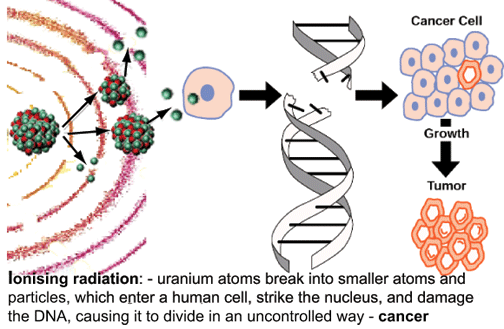
PIKETON, OH – A growing health crisis in Pike County, Ohio, has brought national attention to a region plagued by some of the highest cancer rates and premature death rates in the country. Decades of uranium enrichment and ongoing demolition at the Portsmouth Gaseous Diffusion Plant are now being linked to the troubling health trends impacting this community and six surrounding counties.
A recent study by Joseph J. Mangano, epidemiologist and executive director of the Radiation and Public Health Project, paints a stark picture of the consequences of radioactive contamination in Pike County. Released last summer, the study highlights significant increases in cancer, infant mortality, and premature death rates in communities located downwind of the former uranium enrichment plant.
Cancer Rates and Premature Deaths
The numbers are alarming. Between 2021 and 2023, Pike County’s premature death rate for individuals under 74 years old was 107% higher than the national average, a sharp rise from 85% above the national average between 2017 and 2020. Over 750 premature deaths occurred during this period in a county with a population of just over 27,000.
Cancer rates in Pike County and six neighboring counties—Adams, Gallia, Jackson, Lawrence, Scioto, and Vinton—were 17.5% above the national average between 2015 and 2019. Infant mortality rates in the region were also 31.9% higher than the U.S. average between 1999 and 2020, and middle-aged adults saw mortality rates more than double the national average.
A School at the Center of Controversy
In 2019, concerns about radioactive contamination reached a tipping point when Zahn’s Corner Middle School in Piketon was permanently closed after radioactive isotopes, including enriched uranium and neptunium-237, were discovered inside the building. The school, located just a few miles from the Portsmouth plant, became a symbol of the community’s struggle with the health impacts of the site. Over the years, several students and staff members at Zahn’s succumbed to rare cancers, further heightening concerns.
Recently, the school district sold the building to a Christian ministry, which plans to reopen it as a STEM academy. While the sale marks a new chapter for the facility, it has reignited fears about whether the site is truly safe, given the radioactive materials previously found within its walls.
Radioactive Contamination and Ongoing Demolition
The Portsmouth Gaseous Diffusion Plant, operational from 1954 to 2001, enriched uranium for nuclear weapons and reactors, releasing radioactive particles such as Americium-241, Plutonium-238, and Uranium-235 into the environment. These isotopes, which remain hazardous for thousands of years, have contaminated the air, water, and soil in the surrounding area.
Although uranium enrichment operations ceased in 2001, the plant remains active with demolition and decommissioning projects. Experts have raised concerns that open-air demolition of contaminated buildings is releasing additional radioactive particles into the environment. Critics argue that the U.S. Department of Energy’s (DOE) air monitoring, which detects only “background” levels of radiation, fails to capture the full extent of the contamination.
Community Devastation
The impact on the community has been profound. Families across Pike County and neighboring areas have experienced unusually high rates of rare cancers and aggressive diseases, particularly among children and young adults. Many residents believe these illnesses are tied to decades of exposure to radioactive materials released by the plant.
The closure of Zahn’s Corner Middle School and the deaths of students and staff members have become a grim reminder of the broader crisis affecting the region. Parents and advocates continue to demand answers about the plant’s role in the contamination and the steps being taken to ensure the safety of current and future generations.
A Call for Accountability
Despite mounting evidence of health risks, the DOE has proposed new projects at the Portsmouth site, including uranium purification and experimental reactors. These plans have fueled further concerns among residents, who argue that additional activities could exacerbate the environmental and health challenges they already face.
Advocates and researchers are calling for independent investigations into the health impacts of the Portsmouth plant and comprehensive public health monitoring for affected communities. Many argue that stricter oversight is urgently needed to prevent further harm.
A Community Demanding Justice
The study by Mangano highlights the devastating and long-lasting effects of radioactive contamination in Pike County. The ongoing health crisis, coupled with incidents like the closure of Zahn’s Corner Middle School, underscores the urgent need for accountability and meaningful action to address the region’s toxic legacy. For residents of Pike County and surrounding areas, the fight for answers—and justice—continues.
Japanese crime boss admits to conspiring to sell nuclear material to Iran
Takeshi Ebisawa faces a maximum punishment of life in prison after pleading guilty to six counts in a Manhattan court.
A Japanese crime boss has pleaded guilty to conspiring to sell nuclear material from Myanmar to Iran along with drug trafficking and weapons offences, authorities in the United States have said.
Takeshi Ebisawa, 60, a member of the yakuza, entered a guilty plea to six counts in federal court in Manhattan on Wednesday, the US Department of Justice said in a statement.
He is set to be sentenced on April 9.
According to prosecutors, Ebisawa in 2020 told an undercover agent for the Drug Enforcement Administration (DEA) and a DEA source that he had acquitted a large quantity of thorium and uranium that he wished to sell.
In response to Ebisawa’s repeated inquiries, the undercover agent agreed to help Ebisawa broker the sale of the nuclear materials to an associate who was posing as an Iranian general, prosecutors said.
Ebisawa then offered to supply the undercover associate with plutonium that would be even “better” and more “powerful” than uranium for making nuclear weapons, according to prosecutors.
A powdery yellow substance that Ebisawa’s co-conspirators showed to undercover agents was later determined in a laboratory analysis to contain detectable quantities of uranium, thorium and plutonium, the Justice Department said.
Ebisawa also conspired to broker the purchase of US-made surface-to-air missiles and heavy-duty weaponry to arm multiple ethnic armed groups in Myanmar, and to accept large quantities of heroin and methamphetamine as partial payment for the arms, according to prosecutors.
US officials said they conducted Ebisawa’s arrest and prosecution in cooperation with law enforcement partners in Indonesia, Japan and Thailand.
“Today’s plea should serve as a stark reminder to those who imperil our national security by trafficking weapons-grade plutonium and other dangerous materials on behalf of organized criminal syndicates that the Department of Justice will hold you accountable to the fullest extent of the law,” said Assistant Attorney General Matthew G Olsen of the Justice Department’s National Security Division.
Ebisawa, who was previously charged in 2022 with international drug trafficking and firearms offences, faces possible life imprisonment for the most serious of the charges.
An overlooked Supreme Court case could decide the future of nuclear power

Miles Mogulescu, 6 Dec 24, https://beyondnuclearinternational.org/2025/01/05/a-double-edged-sword-of-damocles/
Although barely mentioned in the mainstream media, in granting cert to Interim Storage Partners, LLC v. Texas, a case about the storage of spent radioactive fuel from nuclear power plants, the U.S. Supreme Court may have taken on potentially the most consequential case of its new term.
SCOTUS will decide whether or not to uphold a Fifth Circuit decision that the Nuclear Regulatory Commission (NRC) does not have the legal power to license a private corporation to construct an off-site storage facility to hold deadly radioactive waste from nuclear power plants.
Depending on the legal rationale for SCOTUS’ decision, it could further enhance the power of courts to overturn decisions of regulatory agencies.
The case could determine whether artificial intelligence companies like Microsoft and Google can build a new generation of nuclear power plants to service the voracious hunger of artificial intelligence for electricity. Depending on its rationale, it could also impact the ability of regulatory agencies to function efficiently without being second guessed by courts.
The issues in the case have brought together an unlikely coalition of environmentalists, Texas Republicans, New Mexico Democrats, and the oil and gas industry against an equally unlikely grouping of the Biden administration, the nuclear power industry, and AI tech companies like Microsoft and Google.
The Legal Substance Issues
The environmental and legal issues in the case have a long history. The nuclear power industry has accumulated nearly 100,000 metric tons of radioactive waste that need to be deposited in a place that could be safe for millions of years. Most of the waste is now stored in temporary facilities adjacent to the power plants that create them, but such sites are running out of space and may not be safe long-term. During the 1980s Congress passed and amended the Nuclear Waste Policy Act providing for a permanent waste site and then designating Yucca Mountain, Nevada as the sole site. But plans for the site were abandoned due to environmental and political opposition, leaving no permanent site for disposable nuclear waste.
In response, for the first time the Nuclear Regulatory Commission began to grant licenses for “interim” storage facilities which were off-site (and often hundreds of miles away) from the power plants which generated the waste, claiming authority under the Atomic Energy Act. One such license was for an off-site storage facility in the Permian Basin, Texas. Texas Republican Attorney General Ken Paxton and a private oil and gas company sued, claiming that the federal government lacked the statutory authority to issue a license for interim off-site storage.
The conservative Fifth Circuit agreed with the plaintiffs, opining “Texas is correct. The Atomic Energy Act does not confer on the commission the broad authority it claims to issue licenses for private parties to store spent nuclear fuel away-from-the-reactor. And the Nuclear Waste Policy Act establishes a comprehensive statutory scheme for dealing with nuclear waste generated from commercial nuclear power generation, thereby foreclosing the commission’s claim of authority.”
The Fifth Circuit vacated the license. The U.S. Supreme Court just granted cert and will hear the case this term. Its decision will likely be highly consequential, both for environmental and AI development reasons, and for legal reasons.
Environmentally, the building of new nuclear power plants has been stalled for decades, both because of cost and because of environmental catastrophes like Three Mile Island, Chernobyl, and Fukushima and anti-nuclear films like Mike Nichols’ Silkwood starring Meryl Streep.
The Role of High-Tech Companies in Expanding Nuclear for AI
But largely under the radar, the voracious demand for electricity to power AI is leading top high-tech companies like Microsoft and Google to reinvigorate nuclear energy. Goldman Sachs analysts say it takes nearly 10 times the energy to power a ChatGPT than a Google search—data center power center demand will grow by 160% in the next five years. Morgan Stanley projects global data center emissions to accumulate 2.5 billion metric tons carbon-dioxide equivalent by then.
Microsoft has contracted for the currently mothballed Three Mile Island plant to reopen and access its entire output for Microsoft’s data centers. The operator is seeking hundreds of millions in tax breaks from the federal government under President Joe Bidens’s Inflation Reduction Act, which it says are necessary to make the reopening economically feasible. Energy Secretary Jennifer Granholm has said in the past that federal subsidies could cut the cost of bringing a new plant online by as much as half.
In March an Amazon affiliate purchased a nuclear-powered data center in Pennsylvania for $650 million.
It will be highly consequential if SCOTUS simply upholds the Fifth Circuit’s result, which would greatly slow high tech’s attempts to kick start nuclear power without time to reexamine the environmental dangers.
Google has already announced that it will support building seven small nuclear-power reactors in the U.S., to help power its growing appetite for electricity for AI and jump-start a U.S. nuclear revival.
The tech companies claim that reviving nuclear power will decrease CO2 emissions and help with global climate change. But they ignore the long-standing warnings of environmentalists of the potentially catastrophic dangers of nuclear power.
If SCOTUS upholds the Fifth Circuit decision outlawing the licensing of off-site nuclear waste dumps, it could considerably slow the renewed push for nuclear power, particularly by high-tech companies. That might give more time to evaluate the potential dangers of widespread renewal of nuclear power.
But depending on the legal rationale for SCOTUS’ decision, it could further enhance the power of courts to overturn decisions of regulatory agencies.
The Fifth Circuit used several rationales to block the license of temporary off-site nuclear waste facilities. The first, and least concerning, is its statutory holding that the Atomic Energy Act is “unambiguous” and “nowhere authorizes issuance of a materials license to possess spent nuclear fuel for any reason, let alone for the sole purpose of storing such material in a standalone facility.” If SCOTUS upholds the Fifth Circuit purely on statutory interpretation grounds, it would create few problematic precedents for regulatory agencies in general.
The Major Questions Doctrine
But the Fifth Circuit unnecessarily went further, holding that “even if the statutes were ambiguous, the [government’s] interpretation would not be entitled to deference by the courts” pursuant to the Chevron Doctrine, under which for previous decades, until recently rejected by the Roberts Court, judges deferred to the expertise of regulatory agencies when reasonably interpreting ambiguous statutes.
The Fifth Circuit cited SCOTUS’ precedent-setting 2022 decision in West Virginia v. EPA, in which, for the first time, a conservative majority of SCOTUS justices relied on the “major questions” doctrine to overturn a major Environmental Protection Agency rule. Under the newly invented “major questions” doctrine, SCOTUS ruled that courts should not defer to agencies on matters of “vast economic or political significance” unless the U.S. Congress has explicitly given the agencies the authority to act in those situations.
Citing West Virginia v. EPA, the Fifth Circuit held that “[D]isposal of nuclear energy is an issue of vast ‘economic and political significance.’ What to do with the nation’s ever-growing accumulation of nuclear waste is a major questions that—as the history of the Yucca Mountain repository shows—has been hotly contested for over half a century.”
It’s questionable whether the Fifth Circuit needed to reach the issues concerning the major questions doctrine in order to block the waste depository. It had already decided that the statutes were “unambiguous” and therefore it was not necessary to decide what would happen if they were “ambiguous,” which is the only situation in which the major questions doctrine might arguably apply. If SCOTUS wants to affirm the Fifth Circuit’s result, it can simply agree that the statutes were unambiguous and treat the parts of the decision involving the major questions doctrine as mere dicta. That would set no additional precedent for when courts can question the expertise of regulatory agencies.
What Party Has the Right to Sue?
There’s also a procedural issue in the case, that depending on SCOTUS’ rationale, could set precedent allowing a wider range of entities to legally challenge regulatory agency decisions. Under the Hobbs Act, a “party aggrieved” by an agency’s final order may seek judicial review in a federal appeals court.
The NRC argued, however, that the plaintiffs were not parties aggrieved by the NRC’s licensing order because they were not parties to the underlying administrative proceeding. The Fifth Circuit cited its own precedent asserting that the Hobbs Act contains an “ultra vires” exception to the party aggrieved requirement when the petitioner attacks the agency action as exceeding its authority and therefore the plaintiffs had a right to sue.
In granting cert SCOTUS agreed to rule on two questions. First is the substance issue on whether the government exceeded its authority in granting the off-site nuclear storage license. The second is the procedural issue of whether an allegation of ultra vires can override statutory limitations on jurisdiction, as the Fifth Circuit held. If SCOTUS rules that the Fifth Circuit was wrong to grant jurisdiction to the plaintiffs, the likely result would be that the licenses for off-site nuclear waste facilities would go forward and expand.
It will be highly consequential if SCOTUS simply upholds the Fifth Circuit’s result, which would greatly slow high tech’s attempts to kick start nuclear power without time to reexamine the environmental dangers. At the same time, if SCOTUS also rules that the plaintiffs had an ultra vires right to sue, it could further cripple the ability of regulatory agencies to act to protect the public interest under broad grants of power.
Miles Mogulescu is an entertainment attorney/business affairs executive, producer, political activist and writer.
Can Trump Trump China (or Vice Versa)?
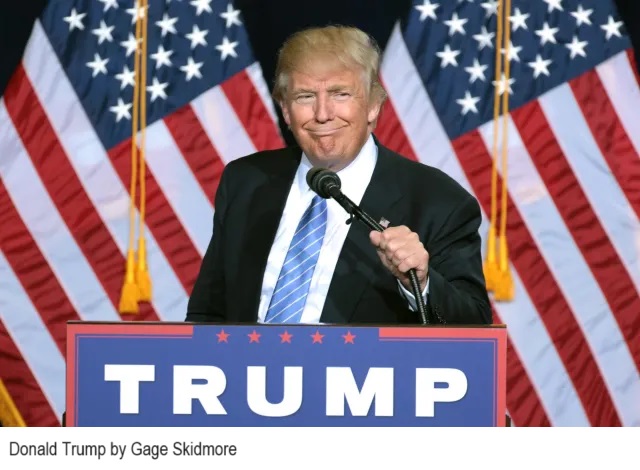
When Washington granted diplomatic recognition to China in 1979, it “acknowledged” that Taiwan and the mainland were both part of “one China” and that the two parts could eventually choose to reunite. The U.S. also agreed to cease diplomatic relations with Taiwan and terminate its military presence there.
For decades, one president after another reaffirmed the “one China” policy while also providing Taiwan with increasingly powerful weaponry.
the bind Trump will inevitably find himself in when it comes to Taiwan this time around.
Trump Confronts a Rising China
Can He Manage U.S.-China Relations Without Precipitating World War III?
By Michael Klare, December 17, 2024, https://scheerpost.com/2024/12/19/trump-confronts-a-rising-china/
Gaza, Haiti, Iran, Israel, Lebanon, Russia, Syria, Ukraine, and Venezuela: President-elect Donald Trump will face no shortage of foreign-policy challenges when he assumes office in January. None, however, comes close to China in scope, scale, or complexity. No other country has the capacity to resist his predictable antagonism with the same degree of strength and tenacity, and none arouses more hostility and outrage among MAGA Republicans. In short, China is guaranteed to put President Trump in a difficult bind the second time around: he can either choose to cut deals with Beijing and risk being branded an appeaser by the China hawks in his party, or he can punish and further encircle Beijing, risking a potentially violent clash and possibly even nuclear escalation. How he chooses to resolve this quandary will surely prove the most important foreign test of his second term in office.
As Waltz and others around Trump see it, China poses a multi-dimensional threat to this country’s global supremacy. In the military domain, by building up its air force and navy, installing military bases on reclaimed islands in the South China Sea, and challenging Taiwan through increasingly aggressive air and naval maneuvers, it is challenging continued American dominance of the Western Pacific. Diplomatically, it’s now bolstering or repairing ties with key U.S. allies, including India, Indonesia, Japan, and the members of NATO. Meanwhile, it’s already close to replicating this country’s most advanced technologies, especially its ability to produce advanced microchips. And despite Washington’s efforts to diminish a U.S. reliance on vital Chinese goods, including critical minerals and pharmaceuticals, it remains a primary supplier of just such products to this country.
Fight or Strike Bargains?
For many in the Trumpian inner circle, the only correct, patriotic response to the China challenge is to fight back hard. Both Representative Waltz, Trump’s pick as national security adviser, and Senator Marco Rubio, his choice as secretary of state, have sponsored or supported legislation to curb what they view as “malign” Chinese endeavors in the United States and abroad.
What such a deal might look like is anyone’s guess, but it’s hard to see how Trump could win significant concessions from Beijing without abandoning some of the punitive measures advocated by the China hawks in his entourage. Count on one thing: this complicated and confusing dynamic will play out in each of the major problem areas in U.S.-China relations, forcing Trump to make critical choices between his transactional instincts and the harsh ideological bent of his advisers.
Trump, China, and Taiwan
Of all the China-related issues in his second term in office, none is likely to prove more challenging or consequential than the future status of the island of Taiwan. At issue are Taiwan’s gradual moves toward full independence and the risk that China will invade the island to prevent such an outcome, possibly triggering U.S. military intervention as well. Of all the potential crises facing Trump, this is the one that could most easily lead to a great-power conflict with nuclear undertones.
When Washington granted diplomatic recognition to China in 1979, it “acknowledged” that Taiwan and the mainland were both part of “one China” and that the two parts could eventually choose to reunite. The U.S. also agreed to cease diplomatic relations with Taiwan and terminate its military presence there. However, under the Taiwan Relations Act of 1979, Washington was also empowered to cooperate with a quasi-governmental Taiwanese diplomatic agency, the Taipei Economic and Cultural Representative Office in the United States, and provide Taiwan with the weapons needed for its defense. Moreover, in what came to be known as “strategic ambiguity,” U.S. officials insisted that any effort by China to alter Taiwan’s status by force would constitute “a threat to the peace and security of the Western Pacific area” and would be viewed as a matter “of grave concern to the United States,” although not necessarily one requiring a military response.
For decades, one president after another reaffirmed the “one China” policy while also providing Taiwan with increasingly powerful weaponry. For their part, Chinese officials repeatedly declared that Taiwan was a renegade province that should be reunited with the mainland, preferably by peaceful means. The Taiwanese, however, have never expressed a desire for reunification and instead have moved steadily towards a declaration of independence, which Beijing has insisted would justify armed intervention.
As such threats became more frequent and menacing, leaders in Washington continued to debate the validity of “strategic ambiguity,” with some insisting it should be replaced by a policy of “strategic clarity” involving an ironclad commitment to assist Taiwan should it be invaded by China. President Biden seemed to embrace this view, repeatedly affirming that the U.S. was obligated to defend Taiwan under such circumstances. However, each time he said so, his aides walked back his words, insisting the U.S. was under no legal obligation to do so.
The Biden administration also boosted its military support for the island while increasing American air and naval patrols in the area, which only heightened the possibility of a future U.S. intervention should China invade. Some of these moves, including expedited arms transfers to Taiwan, were adopted in response to prodding from China hawks in Congress. All, however, fit with an overarching administration strategy of encircling China with a constellation of American military installations and U.S.-armed allies and partners.
From Beijing’s perspective, then, Washington is already putting extreme military and geopolitical pressure on China. The question is: Will the Trump administration increase or decrease those pressures, especially when it comes to Taiwan?
That Trump will approve increased arms sales to and military cooperation with Taiwan essentially goes without saying (as much, at least, as anything involving him does). The Chinese have experienced upticks in U.S. aid to Taiwan before and can probably live through another round of the same. But that leaves far more volatile issues up for grabs: Will he embrace “strategic clarity,” guaranteeing Washington’s automatic intervention should China invade Taiwan, and will he approve a substantial expansion of the American military presence in the region? Both moves have been advocated by some of the China hawks in Trump’s entourage, and both are certain to provoke fierce, hard-to-predict responses from Beijing.
Many of Trump’s closest advisers have, in fact, insisted on “strategic clarity” and increased military cooperation with Taiwan. Michael Waltz, for example, has asserted that the U.S. must “be clear we’ll defend Taiwan as a deterrent measure.” He has also called for an increased military presence in the Western Pacific. Similarly, last June, Robert C. O’Brien, Trump’s national security adviser from 2019 to 2021, wrote that the U.S. “should make clear” its “commitment” to “help defend” Taiwan, while expanding military cooperation with the island.
Trump himself has made no such commitments, suggesting instead a more ambivalent stance. In his typical fashion, in fact, he’s called on Taiwan to spend more on its own defense and expressed anger at the concentration of advanced chip-making on the island, claiming that the Taiwanese “did take about 100% of our chip business.” But he’s also warned of harsh economic measures were China to impose a blockade of the island, telling the editorial board of the Wall Street Journal, “I would say [to President Xi]: if you go into Taiwan, I’m sorry to do this, I’m going to tax you at 150% to 200%.” He wouldn’t need to threaten the use of force to prevent a blockade, he added, because President Xi “respects me and he knows I’m [expletive] crazy.”
Such comments reveal the bind Trump will inevitably find himself in when it comes to Taiwan this time around. He could, of course, try to persuade Beijing to throttle back its military pressure on the island in return for a reduction in U.S. tariffs — a move that would reduce the risk of war in the Pacific but leave China in a stronger economic position and disappoint many of his top advisers. If, however, he chooses to act “crazy” by embracing “strategic clarity” and stepping up military pressure on China, he would likely receive accolades from many of his supporters, while provoking a (potentially nuclear) war with China.
In January 2018, the first Trump administration imposed tariffs of 30% on imported solar panels and 20%-50% on imported washing machines, many sourced from China. Two months later, the administration added tariffs on imported steel (25%) and aluminum (10%), again aimed above all at China. And despite his many criticisms of Trump’s foreign and economic policies, President Biden chose to retain those tariffs, even adding new ones, notably on electric cars and other high-tech products. The Biden administration has also banned the export of advanced computer chips and chip-making technology to China in a bid to slow that country’s technological progress.
Accordingly, when Trump reassumes office on January 20th, China will already be under stringent economic pressures from Washington. But he and his associates insist that those won’t be faintly enough to constrain China’s rise. The president-elect has said that, on day one of his new term, he will impose a 10% tariff on all Chinese imports and follow that with other harsh measures. Among such moves, the Trump team has announced plans to raise tariffs on Chinese imports to 60%, revoke China’s Permanent Normal Trade Relations (also known as “most favored nation”) status, and ban the transshipment of Chinese imports through third countries.
Most of Trump’s advisers have espoused such measures strongly. “Trump Is Right: We Should Raise Tariffs on China,” Marco Rubio wrote last May. “China’s anticompetitive tactics,” he argued, “give Chinese companies an unfair cost advantage over American companies… Tariffs that respond to these tactics prevent or reverse offshoring, preserving America’s economic might and promoting domestic investment.”
But Trump will also face possible pushback from other advisers who are warning of severe economic perturbations if such measures were to be enacted. China, they suggest, has tools of its own to use in any trade war with the U.S., including tariffs on American imports and restrictions on American firms doing business in China, including Elon Musk’s Tesla, which produces half of its cars there. For these and other reasons, the U.S.-China Business Council has warned that additional tariffs and other trade restrictions could prove disastrous, inviting “retaliatory measures from China, causing additional U.S. jobs and output losses.”
As in the case of Taiwan, Trump will face some genuinely daunting decisions when it comes to economic relations with China. If, in fact, he follows the advice of the ideologues in his circle and pursues a strategy of maximum pressure on Beijing, specifically designed to hobble China’s growth and curb its geopolitical ambitions, he could precipitate nothing short of a global economic meltdown that would negatively affect the lives of so many of his supporters, while significantly diminishing America’s own geopolitical clout. He might therefore follow the inclinations of certain of his key economic advisers like transition leader Howard Lutnick, who favor a more pragmatic, businesslike relationship with China. How Trump chooses to address this issue will likely determine whether the future involves increasing economic tumult and uncertainty or relative stability. And it’s always important to remember that a decision to play hardball with China on the economic front could also increase the risk of a military confrontation leading to full-scale war, even to World War III.
And while Taiwan and trade are undoubtedly the most obvious and challenging issues Trump will face in managing (mismanaging?) U.S.-China relations in the years ahead, they are by no means the only ones. He will also have to decide how to deal with increasing Chinese assertiveness in the South China Sea, continued Chinese economic and military-technological support for Russia in its war against Ukraine, and growing Chinese investments in Africa, Latin America, and elsewhere.
In these, and other aspects of the U.S.-China rivalry, Trump will be pulled toward both increased militancy and combativeness and a more pragmatic, transactional approach. During the campaign, he backed each approach, sometimes in the very same verbal outburst. Once in power, however, he will have to choose between them — and his decisions will have a profound impact on this country, China, and everyone living on this planet.
Radiation is normal at Cesar Chavez Park, but it’s a different story underground, tests show

New precautions are being urged for workers in contact with underground liquids at the popular landfill-turned-park, but Berkeley residents need not fear a stroll on the surface.
Berkelyside, by Iris KwokJan. 2, 2025
Radiation testing of Cesar Chavez Park ordered by regional water regulators has found that bird watchers, morning walkers and dogs digging in the dirt have no cause for worry.
“All radiological activity detected at the ground surface and shallow subsurface is equal to or lower than typical background radiation levels expected in the ambient environment,” according to a report released Monday outlining the results of gamma-ray drone tests conducted this fall by UC Berkeley nuclear engineering experts.
But underneath the landfill-turned-park, it’s a somewhat different story.
Tests of groundwater and leachate — liquids between 6 to 34 feet underground formed when rainwater filters through landfill — revealed higher-than-usual levels of radium-226, a radioactive metal, according to the report, which found four types of radionuclides in the city’s monitoring wells.
Groundwater and leachate wells are secured with locks, lids and caps. While the wells are not publicly accessible, there could be a danger for workers.
“Contractors and maintenance personnel who come into contact with subsurface liquids at the site should now take additional precautions to prevent unnecessary exposure to radiation,” reads the report. Chronic exposure to high levels of radium can increase the risk of bone, liver or breast cancer, according to the Environmental Protection Agency website.
The liquid samples were collected by SCS Engineers, which authored the city-commissioned report, and sent to labs in Pittsburg, California and St. Louis, Missouri for analysis.
The highest levels of radium-226 were discovered in a leachate monitoring well on the northwestern quadrant of the park, according to the report. The sample taken from that well measured 226 picocuries per liter (a unit of measurement for radioactivity in air) — far exceeding the EPA’s limit of 5 picocuries per liter for drinking water. The highest level of radium-226 found in a groundwater monitoring well was 88.8 picocuries per liter.
…………………………………………………………………………………………………………………………….. In January 2024, the water board ordered the city to test for the presence of radioactive material in the park after archival documents emerged showing that the now-defunct Stauffer Chemical Company may have dumped 11,100 pounds of potentially toxic industrial waste there in the 1960s and ’70s when it was still a municipal dump. The city closed the landfill in the 1980s, covered it with soil and thick clay, and in the early 1990s reopened it as Cesar Chavez Park. In a July letter to the water board, the city reiterated that it was not previously aware of the potential presence of radioactive material at the site.
…………………………..Berkeley is planning follow-up tests of the radionuclides detected in liquids deep underground at Cesar Chavez Park, but is awaiting further guidance from the water board, city spokesperson Seung Lee wrote in an email. In the coming days, the city plans to share public updates about the test results on its capital projects webpage.
The water board did not immediately respond to Berkeleyside’s questions about a timeline for the follow-up testing. ………. https://www.berkeleyside.org/2025/01/02/radiation-cesar-chavez-park-underground-landfill
2025, Iran is back in the U.S. crosshairs for regime change

Finian Cunningham, Strategic Culture Foundation, Sat, 04 Jan 2025 https://strategic-culture.su/news/2025/01/04/2025-iran-back-in-us-crosshairs-for-regime-change/
A new American president and a new Middle East configuration have brought Iran back into the crosshairs for regime change with an intoxicating vengeance
The signs are that Iran is going to face intensified hostility from the U.S. over the next year for regime change.
The sudden fall of Syria and the isolation of Hezbollah in Lebanon – Iran’s regional allies – have made Tehran look vulnerable.
Anti-Iran hawks in the U.S. are cock-a-hoop about the prospect of regime change in Tehran.
The recent death of Jimmy Carter at the age of 100 puts in perspective how great a prize the Islamic Republic represents for Washington’s imperial desires. Carter was disparaged as the American president who lost Iran in 1979 as a crucial client state for U.S. power in the Middle East.
For over four decades, American imperialist power has sought to topple the Islamic Republic and return the Persian nation to the U.S. global fold.

Though, as U.S. Secretary of State Antony Blinken lamented last month, American “regime change experiments” in Iran have been a failure.
Now, however, there is renewed enthusiasm in Washington for the Persian prize.
The lust for regime change in Tehran has peaked with the dramatic fall of President al-Assad in Syria.
American lawmakers and Iranian exiles are publicly calling for the new Trump administration to get back to its maximum pressure campaign on Tehran because they believe there is “a perfect moment” for regime change.
During Donald Trump’s first White House (2017-2021), he revoked the Iranian nuclear deal of the Obama administration and ramped up economic sanctions in what was referred to as a policy of “maximum pressure.”
A growing chorus of Republicans and Democrats are urging the United States to seize the opportunity of a perceived weakened Iran to overthrow the clerical rule of Ayatollah Ali Khamenei.
At a recent forum in Washington, it was reported that speaker after speaker brayed for regime change in Tehran. For years, such a desire had been dulled with U.S. failure and the formidableness of the Islamic Republic.
“We have an obligation to stand together with allies in making sure this regime’s suppression will come to an end,” said Democratic Senator Cory Booker.
“Iran is projecting only weakness,” declared Jeanne Shaheen, another Democratic Senator.
Republican Senator Ted Cruz sounded vindicated over his long-time anti-Iran stance: “I have, for a long time, been willing to call quite unequivocally for regime change in Iran… The ayatollah will fall, the mullahs will fall, and we will see free and democratic elections in Iran. Change is coming, and it’s coming very soon.”
James Jones, a former White House national security adviser, said: “The tectonic shift in the Syrian government… should mean to the people of Iran that change is in fact possible in the Middle East.”
The Islamic Revolution in 1979 deposed Shah Pahlavi, an ardent American client. The revolution and the hostage crisis at the U.S. embassy in Tehran was a horrible blow to Washington’s global image. The Shah had been brought to power by the U.S.-British coup in 1953 and for 26 years, the dictatorial monarch ruled with an iron fist as a loyal and massive buyer of American weaponry and supplier of oil profits.
The overthrow of the Shah put Iran in the crosshairs for regime change. The Americans prompted the Iraq-Iran War between 1980 and 1988. The new Islamic rulers were subjected to crippling economic sanctions, which were eased in 2015 with the signing of the Iran nuclear deal brokered by the Obama administration. By then, the U.S. was trying a softer policy of regime change and limited engagement.
Trump abandoned that policy, reverting to a more hostile one. Trump ordered the assassination of Iran’s top military commander Major General Qassem Soleimani on January 3, 2020.
Trump can be expected to make Iran his foreign policy goal during the first year of his second administration beginning on January 20.
There is a giddy sense that the U.S.-backed Israeli war on Gaza, Lebanon and Yemen has fatally weakened the Islamic Republic.
During his election campaign, Trump endorsed Israeli plans to attack Iran’s nuclear sites militarily.
Trump will be tempted that Iran could be an early success for his political legacy. To overthrow the Iranian government and replace it with a pro-U.S. regime would be the prize of the century for the American imperial ego.
There is also the imperative of geo-strategy. Russia, China and Iran have emerged as an important alternative geopolitical axis that is perceived as a threat to U.S. global power and the American dollar hegemony. Iran appears to be the weakest link among the opposing bloc, known as the BRICS.
Trump seems to be prioritizing making a peace settlement in Ukraine with Russia. Part of that calculation is incentivized by freeing up U.S. resources to target Iran.
Last year, the imperialist Atlantic Council published an article headlined: “The United States needs a new Iran policy – and it involves regime change, but not the traditional kind”.
The Atlantic Council article advocated intensified economic and political pressure on Iran and internal destabilization by the covert backing of Iranian opposition groups. We can expect a turbo-charged color revolution in Iran, with Western media amplifying public protests against the authorities. Also recommended by the Atlantic Council: “Propaganda efforts to drive a wedge between Russia and Iran, as well as undermine its support by the rank-and-file within the Islamic Revolutionary Guard Corps (IRGC) and military, would also help weaken the regime.”
The year ahead is shaping up for a mammoth effort by the U.S. to target Iran.
Suddenly, the U.S. imperial regime-change machine has found the driving seat again after years of sputtering failure in Iran and Syria. The victory of CIA proxies in Syria to finally overthrow Assad is producing a rush to do the same in Iran. That prize seemed out of reach for too long. A new American president and a new Middle East configuration have brought Iran back into the crosshairs for regime change with an intoxicating vengeance.
Biden discussed plans to strike Iran nuclear sites if Tehran speeds toward bomb
Barak Ravid. AXIOS, 2 Jan 25
White House national security adviser Jake Sullivan presented President Biden with options for a potential U.S. attack on Iran’s nuclear facilities if the Iranians move towards a nuclear weapon before Jan. 20, in a meeting several weeks ago that remained secret until now, three sources with knowledge of the issue tell Axios.
Why it matters: A U.S. strike on Iran’s nuclear program during the lame duck period would be an enormous gamble from a president who promised he would not allow Iran to develop a nuclear weapon, but who would also risk handing a fresh conflict over to his successor. Biden did not green light a strike during the meeting and has not done so since, the sources said.
Biden and his national security team discussed various options and scenarios during the meeting, which took place roughly one month ago, but the president did not make any final decision, according to the sources.A U.S. official with knowledge of the issue said the White House meeting was not prompted by new intelligence or intended to end in a yes or no decision from Biden. Instead, it was part of a discussion on “prudent scenario planning” of how the U.S. should respond if Iran were to take steps like enriching Uranium to 90% purity before Jan. 20, the official said.Another source said there are currently no active discussions inside the White House about possible military action against Iran’s nuclear facilities.
Behind the scenes: Some of Biden’s top aides have argued internally that two trends —the acceleration of Iran’s nuclear program, and the weakening of Iran and its proxies in their war with Israel — together give Biden an imperative and an opportunity to strike.
- The sources said some of Biden’s aides, including Sullivan, think that the degrading of Iran’s air defenses and missile capabilities, along with the significant weakening of Iran’s regional proxies, would improve the odds of a successful strike and decrease the risk of Iranian retaliation and regional escalation.
- The U.S. official said Sullivan did not make any recommendation to Biden on the issue, but only discussed scenario planning. The White House declined to comment.
The intrigue: One source said Biden honed in on the question of urgency, and whether Iran had taken steps that justify a dramatic military strike a few weeks before a new president takes office.
The other side: Iran has long denied it is seeking a nuclear weapon and stressed that its nuclear program is only for civilian purposes.
- But in recent months, several former and current Iranian officials spoke publicly about the possibility of changing Iran’s nuclear doctrine………………………………………………………. more https://www.axios.com/2025/01/02/iran-nuclear-weapon-biden-white-house
US Has Given Israel $22 Billion in Military Aid Since October 2023

According to data from SIPRI, US weapons now account for 78% of Israel’s arms imports
by Dave DeCamp January 1, 2025, https://news.antiwar.com/2025/01/01/us-has-given-israel-22-billion-in-military-aid-since-october-2023/
Since October 7, 2023, the US has provided Israel with more than $22 billion in military aid, Israel Hayom reported Wednesday, citing data from the Stockholm International Peace Research Institute (SIPRI).
The stepped-up US military aid to Israel has supported the genocidal war in Gaza, Israel’s war in Lebanon, military operations in the occupied West Bank, and attacks on Syria, Iran, and Yemen.
According to SIPRI, from 2019 to 2023, US weapons accounted for 69% of Israel’s arms imports. Since October 7, that number has risen to 78%, demonstrating Israel’s significant reliance on US military aid.
In October 2024, Brown University’s Costs of War Project said the US had provided Israel with $17.9 billion in military aid in the first year of the onslaught in Gaza. Since then, Israel has signed a $5.2 billion contract with Boeing to purchase F-15 fighter jets, a deal funded by the US, bringing total US military aid since October 7, 2023, to over $22 billion.
The Costs of War report also said US military operations in the Middle East to support Israel cost American taxpayers at least $4.8 billion, a number that must have also risen since the US has continued to bomb Yemen and deployed a THAAD air defense system to Israel.
Israeli officials have been candid about how reliant they are on US support. An Israeli Air Force official told Haaretz that without US military aid, Israel would not be able to sustain operations in Gaza for more than a few months
Pickering A nuclear power plant bites the dust!
Twitter: https://x.com/NoNukeBailouts/status/1874916809050357787
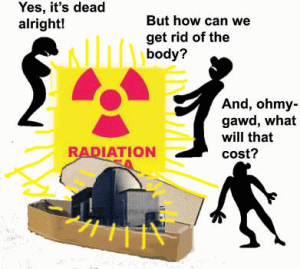
Good riddance! This dawg of a nuke station – 4 reactors at Pickering A – has been finally put to rest. The 2.2 million people that live within 30 km of the station can breathe a sigh of relief (though Pickering B is still open), though taxpayers will now be saddled with billions of dollars of decommissioning and waste expenses into eternity.
The Pickering Nuclear Station is one of the oldest and largest nuclear plants in the world. Designed to last 30 years, it’s now over 50. In 1998, Pickering A was completely shuttered due to safety concerns. Units 1 and 4 were rebuilt at such high public expense that they mothballed units 2 and 3.
The Pickering nuke station has a long history of accidents and safety concerns – learn more here:
https://www.cleanairalliance.org/pickering-safety/
Good by nukes – hello renewables!
https://www.world-nuclear-news.org/articles/opg-says-goodbye-to-pickering-4
US relaxes green hydrogen rules in race to boost nuclear sector

Joe Biden’s administration relaxed the criteria for green hydrogen
producers to claim tax credits on Friday as it raced to help the struggling
sector and secure its [?] clean energy legacy ahead of Donald Trump’s
inauguration. The Treasury department has delayed stricter requirements for
the sector by two years to 2030: from that year, green hydrogen developers
will need to prove that their production is powered by renewables hour by
hour instead of annually, in order to qualify for credits.
The Treasury is also allowing hydrogen produced using power from existing nuclear plants to
qualify in its final rules, as long as the project averts a nuclear
plant’s retirement. This expands from its draft rules that require
developers to produce hydrogen from new clean energy projects, like solar
or wind, that are connected to their regional grid.
FT 3rd Jan 2025
https://www.ft.com/content/38c519c3-1fe9-4d2c-9d8c-6dd158ab35aa
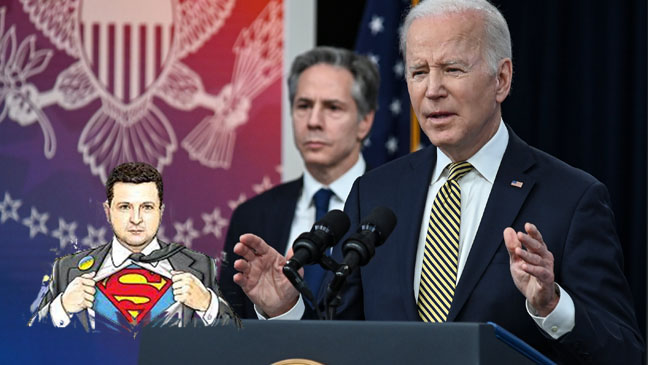
Biden spending last month shoveling billions to get more Ukrainians killed for nothing
Walt Zlotow, West Suburban Peace Coalition, Glen Ellyn IL 2 Jan 25
On Monday, President Biden released another $6 billion in precious US treasure to keep his proxy war against Russia killing Ukrainians till Trump arrives January 20.
Here’s what $6 billion will provide the decimated Ukrainian army being systematically destroyed in a war provoked and prolonged by President Biden
· Munitions for National Advanced Surface-to-Air Missile Systems (NASAMS)
· HAWK air defense munitions
· Stinger missiles
· Counter-Unmanned Aerial Systems (c-UAS) munitions
· Ammunition for High Mobility Artillery Rocket Systems
(HIMARS)
· 155mm and 105mm artillery ammunition
· Air-to-ground munitions
· High-speed Anti-radiation missiles (HARMs)
· Unmanned Aerials Systems (UAS)
· Javelin and AT-4 anti-armor systems
· Tube-launched, Optically guided, Wire-tracked (TOW) missiles
· Small arms and ammunition and grenades
· Demolitions equipment and munitions
· Secure communications equipment
· Commercial satellite imagery services
· Medical equipment
· Clothing and individual equipment
· Spare parts, maintenance and sustainment support, ancillary, services, training, and transportation
That’s the final treasure Biden can squander because House Speaker Mike Johnson nixed his last request for another $25 billion before his thankful departure January 20.
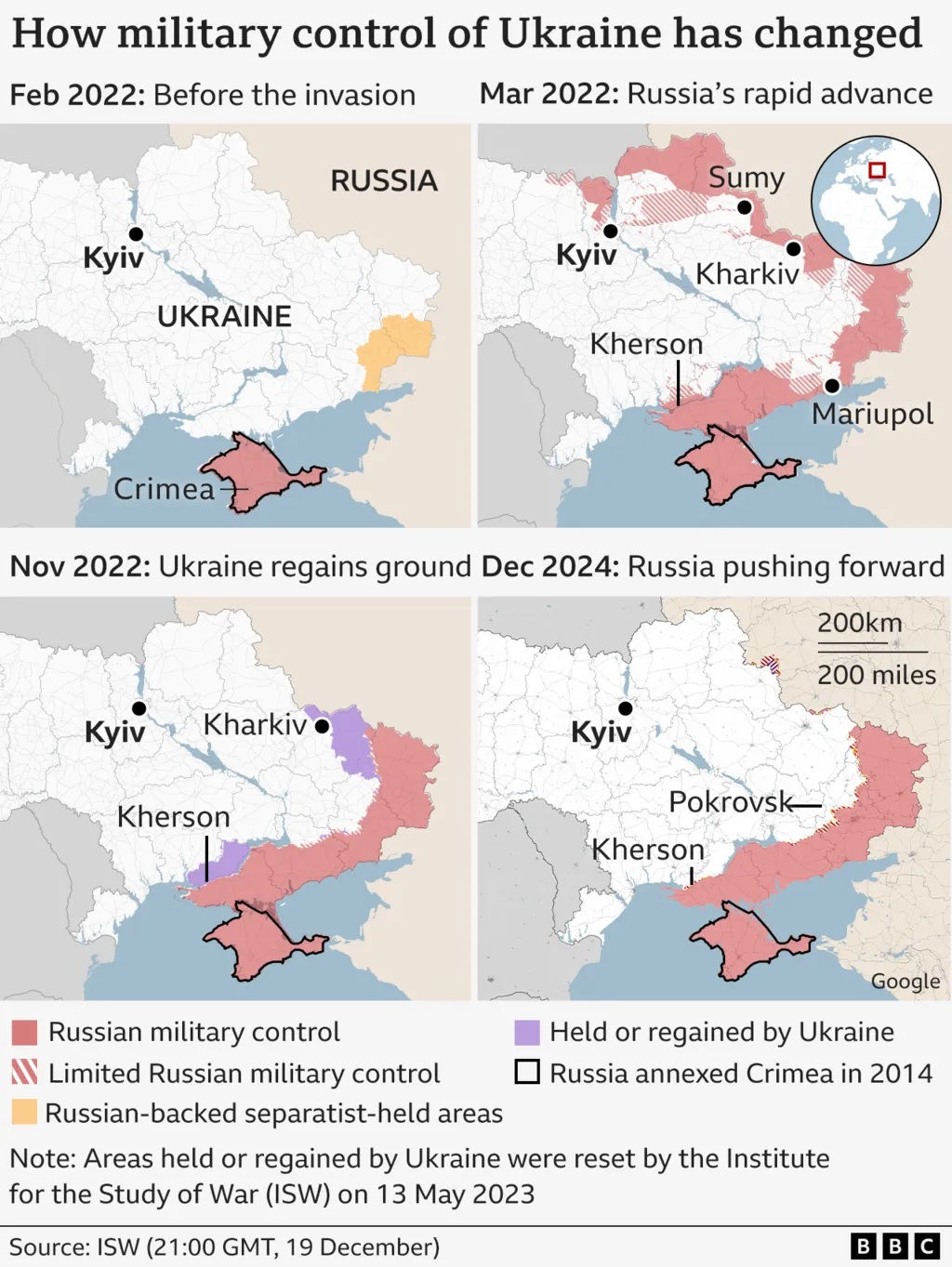
Biden’s $175 billion in 3 years of war is all for naught as Russia is pushing remaining Ukraine forces out of the Russian province of Kursk and extending their defensive perimeter around the 4 eastern Ukraine provinces captured. None of these provinces would be in Russian control had Biden not sabotaged the peace agreement Zelensky and Putin were about to complete back in March, 2022.
Biden will leave office mired in the echo chamber of US exceptionalism and world dominance. He will no doubt praise his bloody, wasteful and failed course he plunged Ukraine to follow in his Farwell Address. While he could be worse, successor Trump has ample opportunity to end Biden’s Ukraine madness. Regarding Ukraine, Joe Biden cannot leave the presidency soon enough.
Biden Administration Announces Nearly $6 Billion in New Ukraine Aid

ANTIWAR.com, Dave DeCamp, 31 Dec 24
Ukraine is receiving about $2.5 billion in military aid and $3.4 billion in ‘budget support,’ which funds government salaries and servicesby Dave DeCamp December 30, 2024.
The Biden administration on Monday announced nearly $6 billion in new aid for Ukraine as it’s determined to escalate the proxy war as much as possible before President-elect Donald Trump is inaugurated on January 20, 2025.
The aid includes $3.4 billion in “direct budget support,” a form of assistance meant to pay for Ukrainian government services, salaries, pensions, and other types of spending. It has also been used to subsidize Ukrainian small businesses and farmers.……………………….
Ukraine is also receiving nearly $2.5 billion in military aid from the US, which includes $1.22 billion from the Ukraine Security Assistance Initiative, a program that allows the US to purchase weapons for Ukraine. The remaining military aid is in the form of the Presidential Drawdown Authority, which enables President Biden to ship weapons directly from US military stockpiles.
The Biden administration is dumping more weapons into Ukraine even though there’s no path to a Ukrainian victory on the battlefield as Russian forces continue to make gains in the Donbas and Ukraine’s invading force in Kursk is being pushed out. Biden officials are determined to keep the war going and are even pressuring Ukraine to begin conscripting 18-year-olds.
According to the Pentagon, the new military aid includes:
Spare parts, maintenance and sustainment support, ancillary equipment, services, training, and transportation
Munitions for National Advanced Surface-to-Air Missile Systems (NASAMS)
HAWK air defense munitions
Stinger missiles
Counter-Unmanned Aerial Systems (c-UAS) munitions
Ammunition for High Mobility Artillery Rocket Systems (HIMARS)
155mm and 105mm artillery ammunition
Air-to-ground munitions
High-speed Anti-radiation missiles (HARMs)
Unmanned Aerials Systems (UAS)
Javelin and AT-4 anti-armor systems
Tube-launched, Optically guided, Wire-tracked (TOW) missiles
Small arms and ammunition and grenades
Demolitions equipment and munitions
Secure communications equipment
Commercial satellite imagery services
Medical equipment
Clothing and individual equipment
In recent months, President Biden signed off on several significant escalations in the proxy war, including supporting long-range strikes on Russian territory and the provision of widely banned anti-personnel mines to Ukraine.
Biden asked Congress for an additional $24 billion to spend on Ukraine, but the request was rejected by House Speaker Mike Johnson (R-LA), who said any decisions on Ukraine aid would be up to Trump. https://news.antiwar.com/2024/12/30/biden-administration-announces-nearly-6-billion-in-new-ukraine-aid/
Is it realistic for Donald Trump to boast of a quick peace deal for Ukraine ?
AIMN Editorial, https://theaimn.net/is-it-realistic-for-donald-trump-to-boast-of-a-quick-peace-deal-for-ukraine/ 2 Jan 25
Donald Trump has made so many promises on what he will quickly achieve once he takes office as President. The one about ending the Ukraine war in 24 hours probably gained him support from quite a few normally left-leaning people, who understand that the history of this conflict is far more complicated than is portrayed by the Western media.
However, Trump made that statement in July 2023. By 2025, he has somewhat moderated that particular promise. He has had several conversations with Ukraine’s President Zelensky, . Zelensky praised their Paris meeting on 7 December as “productive and meaningful”, but there were no details discussed. Later, Trump opposed the sending of long-range missiles for Ukraine , but said he would not “abandon” Ukraine. He predicted “less aid” to Ukraine https://www.youtube.com/watch?v=E-R7Gi-uLiY. BY 21st December, it was reported that Trump would continue to supply military aid to Ukraine, provided that NATO members dramatically increase their defence spending.
So, peace in Ukraine is not going to happen in such a hurry, even with President Trump and his supposed great negotiating skills. Britain considers sending troops to Ukraine to train Ukrainian regiments. NATO is not prepared for any compromises, especially about giving up the plan for Ukraine’s NATO membership. With any peace deal, the Western allies agree with Zelensky – “Security guarantees without the US are not sufficient for Ukraine.”
As well as European reluctance to a peace deal, there is the Russian point of view. Despite many set-backs, and a catastrophic loss of soldiers’ lives, Russia is now headed towards winning this war. Why make a deal now, before being in a more powerful position for demanding concessions?
Then we come to the USA. However much Donald Trump might want to end the carnage, and be seen as the peace hero, he is up against significant forces at home – making up what he calls the Deep State. This is a conspiracy theory that helped Trump to gain popularity – and I hate to agree with it, in its rather paranoid theme. BUT, war enthusiasts do exist – among the, military, intelligence, government officials, and wealthy industrialists, and they do exercise influence, and pressure politicians of both parties, to manipulate America’s defense policies. The war in Ukraine continues to be profitable to America’s weapons industries, and at no cost to American lives.
In the whole saga of the war in Ukraine, history has been forgotten. Of course Ukrainian-Russian relations have been tortuous and often terrible. In modern history it goes back to the 1930s, with Stalin’s starvation and genocide of Ukrainians. Then, following oppression from Russia, came in 1941, the short-lived moment of “liberation” by the German Nazis. That brought mass killings of Jews, slave labour, wholesale destruction, and the loss of up to 7 million lives. Russian control over Ukraine returned in 1944, and while the economy was restored, Stalin’s totalitarian rule was back again. In 1991 Ukraine gained independence from Russia.
Is it any wonder that Ukraine, with both Russian and Ukrainian languages still in common use, has been divided in attitudes and loyalties? Going even further back in history, Catherine the Great of Russia, in the 18th Century, made Kiev become Europe’s centre of art and culture, as well as making improvements in health, education, legal rights for Jews, improved conditions for serfs. Sure, she was an absolute monarch, – miles away from being democratic. Now her name and her statues are trashed in Kiev, which is a pity.
From 2014 to 2022, the Ukrainian government waged a war against the separatists in the Eastern, Donbass region. The war was about the 2014-2015 Minsk agreements which meant that the Donbass should have its autonomous government within Ukraine. Volodymyr Zelensky was elected on a platform that he would implement those agreements, but later he reneged on this promise. Russia’s President Putin in 2022 started what he called “a special military exercise” to support the separatists and uphold the Minsk agreement. That turned into the full-scale war against Ukraine.
European and USA support for Ukraine developed into a campaign, at enormous cost, to weaken Russia. The phrase “too big to fail” is used to describe financial crises. But it could apply to the Russia-Ukraine war. From the Western perspective the war is seen as a battle between good and evil – the evil giant Putin against the heroic little Zelensky. With NATO, with most European countries lined up against Russia, it is world democracy to be desperately defended, For Russia, it now is to prevent that last big nation on its border joining that threatening USA-armed line-up.
It was a mistake that Russia started a ‘special military enterprise’ -to evolve into a full-scale war. Some argue that by encouraging Zelensky to reneg on the Minsk agreement, the Western nations provoked the war.
Whatever started the war, the majority of Ukrainians, and especially those in the East, now just want it to end. The prevailing cry of Western leaders – “Putin must fail, Ukraine must prevail” expresses that simplistic view of good versus evil, and just ignores the complicated historic and local concerns of Eastern Ukraine. Diplomacy is jettisoned. As one writer puts it – voices calling for pragmatism and peace remain drowned out by the cacophony of war rhetoric.
Ultimately , every war ends in some sort of a diplomatic outcome. It is doubtful that Trump can make this one end quickly. It might be just one of the promises that he has to give up.
Japan, US to communicate on possible use of nuclear weapons
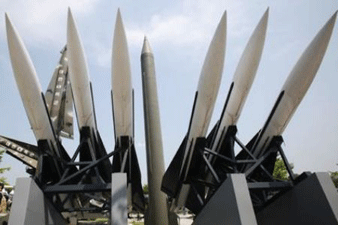
Establishing such an operational framework is aimed at strengthening the U.S. nuclear umbrella that protects Japan and enhancing its deterrence capabilities against North Korea and China.
Asia News Network, December 30, 2024
TOKYO – Japan and the United States will communicate regarding Washington’s possible use of nuclear weapons in the event of a contingency, the two governments have stipulated in their first-ever guidelines for so-called extended deterrence, The Yomiuri Shimbun has learned.
According to Japanese government sources, Japan will convey its requests to the United States via the Alliance Coordination Mechanism (ACM), through which the Self-Defense Forces and U.S. forces maintain contact with each other.
Establishing such an operational framework is aimed at strengthening the U.S. nuclear umbrella that protects Japan and enhancing its deterrence capabilities against North Korea and China.
Against North Korea, China
The Foreign Ministry announced the formulation of the guidelines Friday but had not disclosed the details, as they contain classified military intelligence.
The U.S. president, who is also the commander in chief of U.S. forces, has the sole authority to authorize a nuclear attack. Before the completion of the guidelines, no written statement existed that said Japan was allowed to pass on its views to the United States regarding Washington’s possible use of nuclear weapons.
Extended deterrence is a security policy aimed at preventing a third country from attacking an ally by demonstrating a commitment to retaliate not only in the event of an armed attack on one’s own country, but also in the event of an attack on an ally.
Responding to North Korea’s nuclear development program and China’s military buildup, the Japanese and U.S. governments in 2010 began holding working-level consultations in which their foreign and defense officials meet regularly to discuss nuclear deterrence and other issues. Japan has expressed its stance on the use of nuclear weapons in the meetings.
The two countries will exchange views on Washington’s use of nuclear weapons also in the framework of the ACM, which was set up in normal times under the revised Guidelines for Japan-U.S. Defense Cooperation in 2015.
Under the ACM, discussions are designed to take place both by the Alliance Coordination Group, comprising director general-level officials of the diplomatic and defense authorities, and by the Bilateral Operations Coordination Center, involving senior officials of the SDF and U.S. forces. If necessary, high-level discussions involving Cabinet members are also expected to be held.
This system will enable Japan to convey its views to the United States on Washington’s potential use of nuclear weapons at all stages, from normal times to contingencies………………. https://asianews.network/japan-us-to-communicate-on-possible-use-of-nuclear-weapons/
1 This Month

of the week – Shut Down Drone Warfare!


Tell the Ukrainian Government to Drop Prosecution of Peace Activist Yurii Sheliazhenko

Petition to revoke the licensing of the Near Surface Nuclear Disposal Facility (NSDF) at Chalk River. https://www.ourcommons.ca/petitions/en/Petition/Details?Petition=e-7247
To see nuclear-related stories in greater depth and intensity – go to https://nuclearinformation.wordpress.com
-
Archives
- March 2026 (244)
- February 2026 (268)
- January 2026 (308)
- December 2025 (358)
- November 2025 (359)
- October 2025 (376)
- September 2025 (257)
- August 2025 (319)
- July 2025 (230)
- June 2025 (348)
- May 2025 (261)
- April 2025 (305)
-
Categories
- 1
- 1 NUCLEAR ISSUES
- business and costs
- climate change
- culture and arts
- ENERGY
- environment
- health
- history
- indigenous issues
- Legal
- marketing of nuclear
- media
- opposition to nuclear
- PERSONAL STORIES
- politics
- politics international
- Religion and ethics
- safety
- secrets,lies and civil liberties
- spinbuster
- technology
- Uranium
- wastes
- weapons and war
- Women
- 2 WORLD
- ACTION
- AFRICA
- Atrocities
- AUSTRALIA
- Christina's notes
- Christina's themes
- culture and arts
- Events
- Fuk 2022
- Fuk 2023
- Fukushima 2017
- Fukushima 2018
- fukushima 2019
- Fukushima 2020
- Fukushima 2021
- general
- global warming
- Humour (God we need it)
- Nuclear
- RARE EARTHS
- Reference
- resources – print
- Resources -audiovicual
- Weekly Newsletter
- World
- World Nuclear
- YouTube
-
RSS
Entries RSS
Comments RSS
 nuclear-news