Nuclear Shutdown News – February 2017, San Diego Free PressMARCH 2, 2017 BY AT LARGE“…….Most likely US nukes to shut down in 2017?
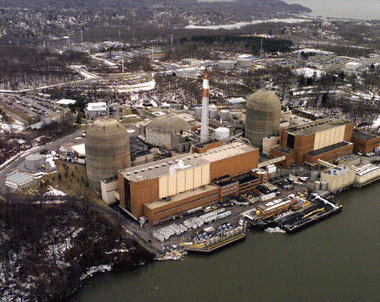
Last October Bloomberg News reported that the following US nuclear plants are likely to shut down this year, some as early as May:
-First Energy’s Davis Besse nuke in Ohio. It started up in 1978.
– First Energy’s almost 40 year old Beaver Valley nuke in Pennsylvania.
-Exelon’s Three Mile Island reactor (the one that didn’t melt down in 1979), which started up in 1974.
– Exelon’s two Byron reactors in Illinois, whose startups were in 85 and 87.
Bloomberg explained that these 4 nuke plants are no longer money makers, but are submitting bids to an electrical distribution company for an auction this spring. If their bids are no accepted, “they could face closure.”
Sources: Bloomberg News, bloomberg.com;chemical info.com http://sandiegofreepress.org/2017/03/nuclear-shutdown-news-february-2017/
March 4, 2017
Posted by Christina Macpherson |
business and costs, USA |
Leave a comment
 How US nuclear force modernization is undermining strategic stability: The burst-height compensating super-fuze, Bulletin of the Atomic Scientists Hans M. Kristensen , Matthew McKinzie , Theodore A. Postol , 1 Mar 17 The US nuclear forces modernization program has been portrayed to the public as an effort to ensure the reliability and safety of warheads in the US nuclear arsenal, rather than to enhance their military capabilities. In reality, however, that program has implemented revolutionary new technologies that will vastly increase the targeting capability of the US ballistic missile arsenal. This increase in capability is astonishing—boosting the overall killing power of existing US ballistic missile forces by a factor of roughly three—and it creates exactly what one would expect to see, if a nuclear-armed state were planning to have the capacity to fight and win a nuclear war by disarming enemies with a surprise first strike.
Because of improvements in the killing power of US submarine-launched ballistic missiles, those submarines now patrol with more than three times the number of warheads needed to destroy the entire fleet of Russian land-based missiles in their silos. US submarine-based missiles can carry multiple warheads, so hundreds of others, now in storage, could be added to the submarine-based missile force, making it all the more lethal.
The revolutionary increase in the lethality of submarine-borne US nuclear forces comes from a “super-fuze” device that since 2009 has been incorporated into the Navy’s W76-1/Mk4A warhead as part of a decade-long life-extension program.
We estimate that all warheads deployed on US ballistic missile submarines now have this fuzing capability. Because the innovations in the super-fuze appear, to the non-technical eye, to be minor, policymakers outside of the US government (and probably inside the government as well) have completely missed its revolutionary impact on military capabilities and its important implications for global security.
Before the invention of this new fuzing mechanism, even the most accurate ballistic missile warheads might not detonate close enough to targets hardened against nuclear attack to destroy them. But the new super-fuze is designed to destroy fixed targets by detonating above and around a target in a much more effective way. Warheads that would otherwise overfly a target and land too far away will now, because of the new fuzing system, detonate above the target.
The result of this fuzing scheme is a significant increase in the probability that a warhead will explode close enough to destroy the target even though the accuracy of the missile-warhead system has itself not improved.
As a consequence, the US submarine force today is much more capable than it was previously against hardened targets such as Russian ICBM silos. A decade ago, only about 20 percent of US submarine warheads had hard-target kill capability; today they all do. (See Figure 1.)
This vast increase in US nuclear targeting capability, which has largely been concealed from the general public, has serious implications for strategic stability and perceptions of US nuclear strategy and intentions.
Russian planners will almost surely see the advance in fuzing capability as empowering an increasingly feasible US preemptive nuclear strike capability—a capability that would require Russia to undertake countermeasures that would further increase the already dangerously high readiness of Russian nuclear forces. Tense nuclear postures based on worst-case planning assumptions already pose the possibility of a nuclear response to false warning of attack. The new kill capability created by super-fuzing increases the tension and the risk that US or Russian nuclear forces will be used in response to early warning of an attack—even when an attack has not occurred.
The increased capability of the US submarine force will likely be seen as even more threatening because Russia does not have a functioning space-based infrared early warning system but relies primarily on ground-based early warning radars to detect a US missile attack. Since these radars cannot see over the horizon, Russia has less than half as much early-warning time as the United States. (The United States has about 30 minutes, Russia 15 minutes or less.)
The inability of Russia to globally monitor missile launches from space means that Russian military and political leaders would have no “situational awareness” to help them assess whether an early-warning radar indication of a surprise attack is real or the result of a technical error.
The combination of this lack of Russian situational awareness, dangerously short warning times, high-readiness alert postures, and the increasing US strike capacity has created a deeply destabilizing and dangerous strategic nuclear situation.
When viewed in the alarming context of deteriorating political relations between Russia and the West, and the threats and counter-threats that are now becoming the norm for both sides in this evolving standoff, it may well be that the danger of an accident leading to nuclear war is as high now as it was in periods of peak crisis during the Cold War.
How the new accuracy-enhancing fuze works. The significant increase in the ability of the W76-1/Mk4A warhead to destroy hardened targets—including Russian silo-based ICBMs—derives from a simple physical fact: Explosions that occur near and above the ground over a target can be lethal to it. This above-target area is known as a “lethal volume”; the detonation of a warhead of appropriate yield in this volume will result in the destruction of the target……..
The history of the US super-fuze program. The super-fuze is officially known as the arming, fuzing and firing (AF&F) system. It consists of a fuze, an arming subsystem (which includes the radar), a firing subsystem, and a thermal battery that powers the system. The AF&F is located in the tip of the cone-shaped reentry body above the nuclear explosive package itself. The AF&F developed for the new W76-1/Mk4A is known as MC4700 and forms part of the W76 life-extension program intended to extend the service life of the W76—the most numerous warhead in the US stockpile—out to the time period 2040-2050………
The implications. The newly created capability to destroy Russian silo-based nuclear forces with 100-kt W76-1/Mk4A warheads—the most numerous in the US stockpile—vastly expands the nuclear warfighting capabilities of US nuclear forces. Since only part of the W76 force would be needed to eliminate Russia’s silo-based ICBMs, the United States will be left with an enormous number of higher-yield warheads that would then be available to be reprogrammed for other missions……….
Even after Russia’s silo-based missiles were attacked, the US nuclear firepower remaining would be staggering—and certainly of concern to Russia or any other country worried about a US first strike.
Because of the new kill capabilities of US submarine-launched ballistic missiles (SLBMs), the United States would be able to target huge portions of its nuclear force against non-hardened targets, the destruction of which would be crucial to a “successful” first strike………
The appearance created by the vast expansion of this missile defense program can and will contribute to perceptions among Russians that the United States is seeking nuclear dominance.
The Russians have most recently reacted to this ongoing program by publicly displaying and implementing a new and novel sea-based nuclear weapons delivery device as a hedge against US missile defenses.
In particular, Russia is now in the process of testing a 40-ton nuclear-powered underwater unmanned vehicle (UUV) that could robotically deliver, across thousands of kilometers, a 100-megaton nuclear warhead against the coastal cities and ports of the United States. The technical details of this bizarre system were released by Putin himself in September 2015—apparently intentionally—and testing began in December 2016. Such actions by the Russian government clearly indicate a grave concern about the unpredictable character of ongoing US missile defense programs……….
Our conclusions. Under the veil of an otherwise-legitimate warhead life-extension program, the US military has quietly engaged in a vast expansion of the killing power of the most numerous warhead in the US nuclear arsenal: the W76, deployed on the Navy’s ballistic missile submarines. This improvement in kill power means that all US sea-based warheads now have the capability to destroy hardened targets such as Russian missile silos, a capability previously reserved for only the highest-yield warheads in the US arsenal.
The capability upgrade has happened outside the attention of most government officials, who have been preoccupied with reducing nuclear warhead numbers. The result is a nuclear arsenal that is being transformed into a force that has the unambiguous characteristics of being optimized for surprise attacks against Russia and for fighting and winning nuclear wars. While the lethality and firepower of the US force has been greatly increased, the numbers of weapons in both US and Russian forces have decreased, resulting in a dramatic increase in the vulnerability of Russian nuclear forces to a US first strike. We estimate that the results of arms reductions with the increase in US nuclear capacity means that the US military can now destroy all of Russia’s ICBM silos using only about 20 percent of the warheads deployed on US land- and sea-based ballistic missiles………..
The decision by the Obama administration in 2009 to deploy the Aegis ship-based European Phased Adaptive Approach (EPAA) missile defense system has created a program under which the United States could eventually have between 500 to 700 anti-missile interceptors that could in theory be used to defend the continental United States from ships off the country’s coasts. In spite of its severe limitations, this growing defense system could appear to both Russia and China as a US attempt to reduce the consequences of a ragged Russian or Chinese retaliation to a US first strike against them.
We cannot foresee a situation in which a competent and properly informed US president would order a surprise first strike against Russia or China. But our conclusion makes the increased sea-based offensive and defensive capabilities we have described seem all the more bizarre as a strategy for reducing the chances of nuclear war with either Russia or China.
That Russian silos are more vulnerable to W76-1/Mk4A warheads will not come as an earth-shattering revelation to Russian military officials; they would have to expect that the silos would be destroyed anyway, by US land-based ICBMs. But the growing capability of the US forward-deployed sea-based nuclear missiles could raise serious questions in the minds of Russian military planners and political leadership about US intentions—especially when seen in context of growing US cyber, advanced conventional, and missile defense capabilities—almost certainly deepening mistrust and encouraging worst-case planning assumptions in Moscow.
We end this article with quotes from Vladimir Putin, talking impromptu to a group of journalists during the St. Petersburg International Economic Forum in June 2016. His unrehearsed remarks are clear and candid predictors of how he will assess the implications of the super-fuze:
No matter what we said to our American partners [to curb the production of weaponry], they refused to cooperate with us, they rejected our offers, and continue to do their own thing.
… They rejected everything we had to offer.
… the Iranian threat does not exist, but missile defense systems are continuing to be positioned…
That means we were right when we said that they are lying to us.
Their reasons were not genuine, in reference to the “Iranian nuclear threat.”
Your people [the populations of the Western alliance] … do not feel a sense of the impending danger—this is what worries me.
A missile defense system is one element of the whole system of offensive military potential.
It works as part of a whole that includes offensive missile launchers.
One complex blocks, the other launches high precision weapons, the third blocks a potential nuclear strike, and the fourth sends out its own nuclear weapon in response.
This is all designed to be part of one system.
I don’t know how this is all going to end.
What I do know is that we will need to defend ourselves. http://thebulletin.org/how-us-nuclear-force-modernization-undermining-strategic-stability-burst-height-compensating-super10578
March 3, 2017
Posted by Christina Macpherson |
USA, weapons and war |
Leave a comment
White House ‘considers direct military action’ to counter North Korean nuclear threat
North Korea threatens to ‘mercilessly foil the nuclear war racket of the aggressors with its treasured nuclear sword’, Independent, 2 Mar 17 Samuel Osborne @SamuelOsborne93 , An internal White House review of strategy on North Korea reportedly includes the possibility of direct military action or regime change to counter the hermit kingdom’s nuclear threat.
Deputy national security adviser K T McFarland held a meeting with other officials ot discuss the US response to a fresh series of provocations from the North, the Wall Street Journal reports.
March 3, 2017
Posted by Christina Macpherson |
politics international, USA, weapons and war |
Leave a comment
 Trump Again Attacks Media as White House Bars NYT, CNN & BBC from Gaggle
  https://www.democracynow.org/2017/2/27/headlines/trump_again_attacks_media_as_white_house_bars_nyt_cnn_bbc_from_gaggle
President Trump again escalated his self-declared war on the media, while speaking at CPAC, the Conservative Political Action Conference, on Friday.
President Donald Trump: “A few days ago, I called the fake news the enemy of the people. And they are. They are the enemy of the people, because they have no sources. They just make them up when there are none.”
That’s Trump, speaking the same day the White House took the unprecedented act of barring The New York Times, CNN, Politico, the Los Angeles Times, the BBC and several other news organizations from an off-camera briefing known as a gaggle. Several right-wing news outlets were allowed to attend, including Breitbart, The Washington Times and One America News Network.
March 1, 2017
Posted by Christina Macpherson |
media, politics, USA |
2 Comments
NY Times rips into Trump: ‘An inept White House led by a celebrity apprentice’http://thehill.com/blogs/blog-briefing-room/news/320231-ny-times-rips-into-trump-an-inept-white-house-led-by-a BY NIKITA VLADIMIROV – 02/18/17 The New York Times on Saturday published a blistering assessment of President Trump’s performance, blasting him for a lack of meaningful accomplishments.
“It’s with a whiff of desperation that President Trump insists these days that he’s the chief executive Washington needs, the decisive dealmaker who, as he said during the campaign, ‘alone can fix it,’ ” The Times wrote in its editorial.
“What America has seen so far is an inept White House led by a celebrity apprentice.”
The newspaper’s editorial board argued that Trump’s executive orders are not achievements and that the president has not yet been able to spearhead any meaningful reform effort.
The editorial board claimed that Trump’s adviser Steve Bannon writes his script while Reince Priebus, the White House chief of staff, “crashes meetings to which he has not been invited.”
“The White House is a toxic mix of ideology, inexperience and rivalries; insiders say tantrums are nearly as common as the spelling errors in the press office’s news releases,” the Times said.
“If there is any upside here, it is that the administration’s ineptitude has so far spared the nation from a wholesale dismantling of major laws, including the Affordable Care Act, though he may yet kill the law through malign neglect.”
The Times also criticized the president for planning to partially dismantle top government agencies, including the Environmental Protection Agency, which employs a vast team of specialists and experts.
“Indeed, unless Mr. Trump can bring some semblance of order to his official household and governing style, the only element of his famous campaign pledge that may prove accurate is the ‘alone’ part,” the newspaper concluded.
March 1, 2017
Posted by Christina Macpherson |
media, politics, USA |
Leave a comment
 Energy Department issues scathing evaluation of nuclear project WP, By Steven Mufson February 28
 The Energy Department has delivered a blunt assessment of the work done by one of the world’s biggest companies in the nuclear business: “Unsatisfactory.”
For a decade, CB&I Areva MOX Services has been under contract with the Energy Department’s National Nuclear Security Administration to design, build and operate a facility near the Savannah River in Aiken, S.C.
Yet the project — designed to convert weapons-grade plutonium and uranium into a mixed oxide fuel for commercial nuclear power plants — has been running far beyond budget and way behind schedule. Estimates now put the price tag at $17 billion.
On Dec. 5, the NNSA completed a scathing evaluation that branded several of the company’s claims about the state of the project “misleading” and “inaccurate.” The agency said CB&I Areva’s claims that the project is 70 percent complete “are patently false.” A separate September 2016 Energy Department report said construction was only 28 percent complete……
CB&I Areva is a venture created as a combination of Chicago Iron & Steel and the French nuclear giant Areva. The company did not return calls for comment……
One of the project’s sharpest critics Tom Clements, director of the public interest group Savannah River Site Watch, obtained the December NNSA assessment through a Freedom of Information Act request. He called the evaluation “devastating.”
“I have never seen an asessment like that. It all but calls them liars,” he said……
the Obama administration continued to say the MOX plant at Savannah River wasn’t practical. What started as a $620 million project in 1999 with a 2006 starting date has become a $17 billion project still decades away from a start state. By some estimates, it would require a $1 billion a year appropriation, which the Obama administration said was unlikely at best…..
The assessment said that while the contractor boasted of “zero order non-compliance,” in fact the NNSA found evidence of non-compliance.
Overall, the NNSA awarded nothing from the $2.7 million available for a bonus payment to the contractors. It said, “there continued to be a lack of transparency and openness in external communications with key project stakeholders by the contractor including continued release of misleading and inaccurate project information.” https://www.washingtonpost.com/business/economy/energy-department-issues-scathing-evaluation-of-nuclear-project/2017/02/28/8af4d11a-fd2c-11e6-99b4-9e613afeb09f_story.html?utm_term=.4b6e8e136ee6
March 1, 2017
Posted by Christina Macpherson |
politics, technology, USA |
Leave a comment
 Advocates stress need for greater progress on advanced nuclear development https://dailyenergyinsider.com/featured/3519-advocates-stress-need-greater-progress-advanced-nuclear-development/ February 28, 2017 by Daily Energy Insider Reports Investors, philanthropists and
 innovators in the nuclear industry recently discussed the need to use the power of storytelling to better communicate the importance of advanced nuclear technology at think tank Third Way’s Advanced Nuclear Summit.
Ross Koningstein, engineering director emeritus of Google Inc.’s advanced energy research and development (R&D) group, stressed the need to communicate the fact that renewables alone will not solve climate change and that nuclear must be part of the solution, especially to people who have already made up their minds to the contrary.
“We’re in the middle of an evolution in thinking, away from anti-nuclear orthodoxy,” Spencer Reeder, senior program officer for climate and energy at Seattle-based Vulcan Inc.’s, philanthropy unit, said. “Our objective is to work through the inherent tension between these narratives. Facts will get you part of the way to influence the narrative — you need storytelling.”
Jay Faison, founder and chief executive officer of ClearPath Foundation, also stressed the need to return to large-scale, industrial innovation with investments in infrastructure projects.
“The nuclear ecosystem is in crisis,” Faison said. “To fix the crisis you need innovation. To get innovation, you need better policy, and to get to better policy, you need a clear, compelling story.”
Faison warned that countries like China and Russia are overtaking the United States in nuclear technology innovation.
A group of U.S. senators also expressed their support for advanced nuclear energy and the Nuclear Energy Innovation Capabilities Act, which the House advanced last month. The bill would direct the U.S. Department of Energy to develop testing centers to commercialize advanced reactor technology.
“The U.S. has long been a global leader in innovation, and the best of the world’s scientists have come to this country to discover, develop, innovate and deploy some of the most compelling technologies of the last century,” U.S. Sen. Chris Coons (D-DE) said. “Whether we’ll continue to lead is up to this Congress and the new administration.”
U.S. Sen. Tim Scott (R-SC), said he would continue supporting legislation “that increases domestic energy production to provide affordable, reliable energy and reduce our dependence on foreign oil. The United States must remain a leader in the global energy sector and nuclear energy is certainly a critical component of our future.”
March 1, 2017
Posted by Christina Macpherson |
spinbuster, USA |
Leave a comment
 Green groups: Indian Point nuke can be replaced with carbon-free resources, Utility Dive, Robert Walton, 28 Feb 17
Dive Brief:
- Increased energy efficiency and transmission upgrades to bring in more renewable power can help replace a nuclear plant north of New York City, according to a new report released by two environmental groups.
- New analysis performed by Synapse Energy Economics shows that lower demand and more solar and wind energy can help the state replace the power from the Indian Point nuclear facility with clean energy options that will not raise consumer bills.
- Under an agreement between the state and plant operator Entergy, the Indian Point nuclear facility will shut down by 2021.
Dive Insight:Last month’s announcement that Entergy would shut down its Indian Point plant was a win for nuclear opponents, who for years have been wary of a plant within 30 miles of the nation’s largest metropolitan area.
The news, however, left open the question of how to continue to power the the city without turning to fossil fuels.
Now, green groups say they believe the city that never sleeps can keep the lights on — all night and every day — using only carbon.
New research from Synapse Energy, released by the Natural Resources Defense Council and Riverkeeper, finds additional solar and wind power, along with energy efficiency gains, can power the city. But that goal also depends on the construction of the Champlain Hudson Express transmission line, which would move 1,000 MW of hydropower from Quebec to the city.
“Recent transmission improvements — coupled with energy efficiency gains, cheaper renewables and lower demand estimates — show that New York is already on its way to a reliable, affordable, clean energy future,” Riverkeeper President Paul Gallay said in a statement.
He said the report shows that when Indian Point closes in 2021, “that power can be replaced entirely with clean sources as long as we take advantage of the additional renewable energy and efficiency options available to us.”
Key findings in the report show the Indian Point retirement will add less than 1% to overall wholesale electric system costs, and retail impacts will be even smaller. The state’s 50% renewables goal is expected to drive the addition of both utility-scale and distributed solar, as well as both offshore and traditional wind generation……. http://www.utilitydive.com/news/green-groups-indian-point-nuke-can-be-replaced-with-other-carbon-free-reso/436938/
March 1, 2017
Posted by Christina Macpherson |
renewable, USA |
Leave a comment
 Thousands of Scott Pruitt’s Emails Just Hit the Internet. Here Are the Wildest, Scariest Bits. http://www.motherjones.com/environment/2017/02/new-epa-head-scott-pruitts-emails-reveal-close-ties-fossil-fuel-interests
The new EPA chief had a “very cozy” relationship with fossil fuel.
OLIVER MILMAN AND DOMINIC RUSHEFEB. 22, 2017 This story was originally published by the Guardian and is reproduced here as part of theClimate Desk collaboration.
The close relationship between Scott Pruitt, the new administrator of the Environmental Protection Agency, and fossil fuel interests including the billionaire Koch brothers has been highlighted in more than 7,500 emails and other records released by the Oklahoma attorney general’s office on Wednesday.
The documents show that Pruitt, while Oklahoma attorney general, acted in close concert with oil and gas companies to challenge environmental regulations, even putting his letterhead to a complaint filed by one firm, Devon Energy. This practice was first revealed in 2014, but it now appears that it occurred more than once.
The emails also show that American Fuel and Petrochemical Manufacturers, an oil and gas lobby group, provided Pruitt’s office with template language to oppose ozone limits and the renewable fuel standard program in 2013. AFPM encouraged Oklahoma to challenge the rules, noting: “This argument is more credible coming from a state.” Later that year, Pruitt did file opposition to both of these regulations.
The letters also show the cozy relationship between Pruitt and the American Legislative Exchange Council (Alec), the influential US lobbying network of Republican politicians and big businesses, and other lobby groups sponsored by the Koch brothers, the billionaire energy investors who have spent decades fighting against environmental regulation.
Alec has consistently challenged the science on climate change and fought against tougher environmental regulation. Companies including Google, Ford and Enterprise Rent-a-Car have quit Alec in protest of its climate change activities.
The emails contain correspondence between Pruitt’s executive assistant and Amy Anderson, Alec director and Oklahoma membership contact, about Pruitt’s appearance at a May 2013 Alec board meeting in Oklahoma City.
That meeting attracted more protesters than attendees, with 600 firefighters, teachers, environmentalists and church leaders carrying signs reading “ALEC is Not OK” and chanting: “Backroom deals are Alec’s game / Sweetheart deals for corporate gain.”
Pruitt addressed a workshop entitled “Embracing American Energy Opportunities: From Wellheads to Pipelines”.
The emails state that Pruitt spoke “on state primacy in oil and gas regulation and the EPA’s sue & settle modus operandi”. The lunch meeting was sponsored by Koch Industries, a major Alec sponsor.
Pruitt was congratulated for his work on pushing back against the EPA by another Koch-backed pressure group.
“Thank you to your respective bosses and all they are doing to push back against President Obama’s EPA and its axis with liberal environmental groups to increase energy costs for Oklahomans and American families across the states,” said one email sent to Pruitt and an Oklahoma congressman in August 2013 by Matt Ball, an executive at Americans for Prosperity, a nonprofit group also funded in part by the Kochs. “You both work for true champions of freedom and liberty!” the note said.
Last week, an Oklahoma judge ordered that emails from a January 2015 open records request be released by Tuesday. A further batch of emails is due to be turned over next week. The Center for Media and Democracy, which has made nine separate open records requests for Pruitt’s emails, said it will attempt to obtain all of the sought-after communications without exceptions.
Pruitt was confirmed as EPA administrator on Friday. Democrats had sought to delay the Senate vote until the emails were released but were unsuccessful.
“The emails show a very cozy relationship between Pruitt’s office and particularly Devon Energy, as well as other coal, oil and gas companies,” said Nick Surgey, research director at the Center for Media and Democracy.
“Pruitt is the world’s top environmental regulator now and these emails raise serious conflict of interest concerns. He has very close ties to fossil fuel firms and has shown himself to be generally opposed to the rules the EPA has to protect the environment.”
Pruitt’s appointment as EPA chief has been vigorously opposed by environmental groups, Democrats and even some EPA staff as antithetical to the agency’s mission. More than 700 former EPA employees wrote to senators to urge them to vote against Pruitt, while some current staff in Chicago took part in protests against him. This effort did little to budge the mathematics of the Senate, with only one Republican, Susan Collins of Maine, voting against Pruitt.
Following the confirmation, the EPA put out a press release listing those that “cheer” Pruitt’s appointment. They include Republican representatives and lobbyists for mining, farming and grazing, who were quoted in the EPA’s own release calling the agency “rogue” and “one of the most vilified agencies in the ‘swamp’ of overreaching government”.
The former Oklahoma attorney general, a Republican, has described himself as a “leading advocate against the EPA’s activist agenda” and sued the regulator 14 times over pollution regulations relating to mercury, smog, methane and sulfur dioxide. Fossil fuel companies or lobbyists, a frequent source of Pruitt’s past donations, joined with him in 13 of these cases against the EPA.
A staunch opponent of what he sees as federal overreach, Pruitt said following his appointment that “citizens don’t trust the EPA is honest” with its scientific work, particularly around climate change. Pruitt has said he accepts the planet is warming but has questioned the degree of human influence over this, despite the volumes of scientific literature on the impact of greenhouse gases.
In his first speech at EPA headquarters in Washington on Tuesday, Pruitt praised career employees and promised to “listen, learn and lead”. He said regulators such as the EPA “ought to make things regular. Regulators exist to give certainty to those that they regulate.”
He added: “I believe that we as a nation can be both pro-energy and -jobs, and pro-environment. We don’t have to choose between the two.”
John O’Grady, an EPA environmental scientist and head of a union that represents 9,000 agency staff, said that Pruitt came across “very professionally and conciliatory, he didn’t come out heavy handed”.
But O’Grady said that many staff are nervously waiting for the administration’s agenda to unfold, with Donald Trump expected to sign executive orders that aim to do away with the EPA’s effort to reduce greenhouse gases and regulate America’s expanse of waterways.
“Mr Pruitt isn’t a proponent of addressing climate change or of a strong EPA, so it won’t surprise me when they start to whittle away at what we do as an agency,” O’Grady told the Guardian. “I’m wondering when the hammer is going to fall.”
March 1, 2017
Posted by Christina Macpherson |
environment, politics, USA |
Leave a comment
 California introduces its own 100% renewable energy bill, Inhabitat, 22 Feb 17, VIEW SLIDESHOW Massachusetts recently introduced a bill to derive 100 percent of the state’s energy from renewables, and now California is following suit. A new bill introduced by state Senate leader Kevin de León would require the state to obtain 100 percent of its electricity from renewable sources by 2045.
Under de León’s bill, SB 584, California would need to reach 50 percent renewable energy use by 2025, five years earlier than the state’s current target of 2030, and cease using fossil fuels completely by 2045.
Related: Massachusetts lawmakers sponsor 100% renewable energy bill
In 2016, the state obtained 27 percent of electricity via wind, solar, and other clean sources, and California’s deserts offer potential spaces for more renewable energy plants. The solar industry has created 100,000 jobs in California. Experts say the state could reach the 100 percent goal since costs for solar and wind power are falling – in many areas of the state solar is already the cheapest option, according to The Desert Sun………
Massachusetts recently introduced a similar bill, but it’s slightly more ambitious than California’s. Under the 100 Percent Renewable Energy Act, Massachusetts would transition to obtaining all their electricity from renewable energy by 2035, and would grant sectors like heating and transportation a 2050 deadline. The California bill gives its state’s electricity sector an extra ten years to reach that 100 percent target. http://inhabitat.com/california-introduces-its-own-100-renewable-energy-bill/
March 1, 2017
Posted by Christina Macpherson |
renewable, USA |
Leave a comment
 New York’s nuclear subsidies contradict economic principles Credits to keep nuclear generation online will not lower emissions, argues the R Street Institute’s Devin Hartman, Utility Dive, 28 Feb 17 In New York State’s massive zero-emission credits (ZECs) program kicks off in April, it will begin a 12-year process of unloading $7 billion in subsidies on unprofitable nuclear plants. Astoundingly, this staggering price tag will yield minimal, if any, immediate climate benefit. Indeed, after factoring in the damage ZECs will do to competitive electricity markets, the plan may actually undermine the long-term goal of reducing greenhouse gas emissions.
The main reason ZECs are unlikely to yield incremental emissions reductions is New York’s participation in the Regional Greenhouse Gas Initiative (RGGI), a regional carbon dioxide emissions trading program. Imposing new policies under a binding emissions-trading program will affect the market price of allowances without changing emissions levels. Should RGGI remain binding, subsidizing nuclear will merely avoid emissions reductions elsewhere…….
The underlying market failure is that pollution is underpriced, not that clean energy is overpriced. Unsurprisingly, economists overwhelmingly prefer emissions pricing (e.g., tax) as the means to address pollution.
As a mirror image of taxes, subsidies can, in theory, provide incentives to reduce emissions, but in practice, they often encourage economically inefficient and environmentally unsound decisions. The ability of nuclear generators to displace emissions from fossil plants varies dramatically by time and location. ……
For example, nuclear generation in wind-heavy areas with transmission constraints generally reduce emissions less than in locales with high coal generation. Emissions pricing accounts for this by building pollution costs into dynamic, sub-regional supply curves. Subsidies do not, resulting in inaccurate compensation for nuclear or other low-emissions resources.
Subsidies are grossly inferior in application, as well as in design. Markets pick different, lower-cost winners than governments……….
Unlike emissions pricing, subsidies create a public financial burden and encourage poor economic behavior from recipients. Production subsidies like ZECs lower the effective costs of operating a power plant. This encourages owners to offer into electricity markets below their true cost, which can artificially suppress market-clearing prices and distort market signals for resource investment……..
Subsidies also encourage poor political behavior. They establish entrenched interests that contribute to an ongoing cycle of subsidization. An examination of bailout policy history reveals that “early bailouts set a stage that makes subsequent requests for assistance more difficult to resist.” This underscores the challenge of using nuclear subsidies as a transitional policy to efficient emissions pricing. Ignoring the political economy of subsidies obscures the complete economic picture.
The economist Frédéric Bastiat once remarked that “the bad economist confines himself to the visible effect; the good economist takes into account both the effect that can be seen and those effects that must be foreseen.”
Beyond the visible price tag, the foreseen effects of ZECs will severely undermine the health of competitive wholesale electricity markets administered by the New York Independent System Operator (NYISO). Investors in competitive markets make decisions based on forward price expectations. Healthy price formation requires quality market design and minimal political interference. New York’s nuclear subsidies unexpectedly retain massive blocks of electric capacity that has already disrupted forward prices. This renders once-profitable investments uneconomic overnight, upends investor confidence and deters or requires a risk premium for new investment……
If New Yorkers truly care about reducing emissions and providing a model for the world, they should remain committed to emissions pricing and embrace competitive electricity markets. http://www.utilitydive.com/news/new-yorks-nuclear-subsidies-contradict-economic-principles/436978/
March 1, 2017
Posted by Christina Macpherson |
business and costs, politics, USA |
Leave a comment
The NRC and Nuclear Safety Culture: Do As I Say, Not As I Do, Union of Concerned Scientists
 DAVE LOCHBAUM, DIRECTOR, NUCLEAR SAFETY PROJECT | FEBRUARY 27, 2017
 Many times over the past 20 years the Nuclear Regulatory Commission (NRC) has intervened when evidence strongly suggested a nuclear power plant had nuclear safety culture problems. The evidence used by the NRC to trigger its interventions was readily available to the plant owners, but the owners had downplayed or rationalized away the evidence until the NRC forced them to face reality.
The evidence used by the NRC to detect these nuclear safety culture problems included work force surveys indicating a sizeable portion of workers reluctant to raise safety concerns and allegations received by NRC from workers about reprisals and harassment they experienced after raising safety concerns.
Ample evidence strongly suggests that the NRC itself has nuclear safety culture problems. The NRC’s Office of the Inspector General (OIG) has surveyed the safety culture and climate within the NRC every three years for the past two decades. The latest survey was conducted during 2015 and released in March 2016. Figure 1 from the OIG’s 2015 survey along with data from the annual Federal Employee Viewpoint Surveys and other sources show safety culture problems as bad as—it not considerably worse—than the worst safety culture problems identified at Millstone, Davis-Besse, and yes, even the TVA reactors.
After the OIG’s 2009 survey of the NRC’s safety culture and climate, UCS submitted a request under the Freedom of Information Act for all records related to the actions taken by the agency in response to the survey. We obtained many records which described very few actions. And regardless of the number of actions, the OIG’s 2015 survey showed that the NRC’s safety culture was worse than in 2009 (see the last column on the right in Figure 1 [graph on original] ).
Why would the NRC take steps to remedy safety culture problems at nuclear plants yet have taken no steps to remedy its own safety culture problems? The answer is the same as to the question of why the plant owners failed to take steps to correct safety culture problems before the NRC intervened—they did not perceive the problems to exist. Likewise, Figure 2 [on original]shows that the NRC’s senior management does not perceive safety culture within the agency to need remediation……..
Just as plant owners failed to correct the problem they could not see, NRC senior management cannot fix the agency’s “invisible” safety culture problems. The NRC intervened to enable owners to see, and then fix, their safety culture problems. Someone needs to intervene to help NRC senior management see the agency’s safety culture problems so they can take the corrective measures they have often compelled plant owners to take…….http://allthingsnuclear.org/dlochbaum/the-nrc-and-nuclear-safety-culture-do-as-i-say-not-as-i-do
March 1, 2017
Posted by Christina Macpherson |
safety, USA |
Leave a comment
Trump to Seek $54 Billion Increase in Military Spending | 27 Feb 2017 | President Trump put both political parties on notice Monday that he intends to slash spending on many of the federal government’s most politically sensitive programs – relating to education, the environment, science and poverty – to protect the economic security of retirees and to shift billions more to the armed forces.
The proposal to increase military spending by 54 billion and cut nonmilitary programs by the same amount was unveiled by White House officials as they prepared the president’s plans for next year’s federal budget. Aides to the president said final decisions about Medicare and Social Security would not be made until later in the year, when he announces his full budget. But Sean Spicer, his spokesman, cited Mr. Trump’s campaign commitments about protecting those programs and vowed that “he’s going to keep his word to the American people.”
March 1, 2017
Posted by Christina Macpherson |
politics, USA |
Leave a comment
Did Putin help elect Trump to restore $500 billion Exxon oil deal killed by sanctions
Follow the money: Will Trump repay Putin by ending Russian sanctions and killing the Paris climate deal? Think Progess, Joe Romm , 28 Feb 17, “……. our democracy and our children have a new axis to worry about: Putin, Trump, and ExxonMobil, whose CEO Rex Tillerson — an extreme Russophile and long-time director of a US-Russian oil company — is Trump’s puzzling choice for Secretary of State.
I say “puzzling” because the long-serving Exxon employee (from age 23!) has no qualifications to be secretary of state — other than a history negotiating major oil deals with countries like Putin’s Russia, which in any sane world would actually disqualify him or at least force a recusal from all State Department dealings with Russia.
But that puzzle disappears if we follow the famous dictum from the Watergate era for uncovering a tangled web of covert campaign acts: “Follow the money.” And perhaps another puzzle is also solved: Why did Putin take such a “fearful risk,” as Frum put it, to “mount a clandestine espionage and disinformation campaign on behalf” of Trump and against Clinton, “when Putin had every reason to expect that he probably would end up facing a President Clinton,” and a tremendous backlash.
You can certainly make a plausible case, as U.S. intelligence agencies do in their bombshell new report, that Putin had plenty of motivation to interfere. He wanted to undermine the legitimacy of U.S. elections and a Clinton Presidency, he blamed Secretary Clinton for “inciting mass protests against his regime,” and he was angry with the U.S. for the Panama Papers leaks.
Those leaks showed a $2 billion trail of offshore accounts and deals that traced back to Putin and his cabal of kleptocrats, who, among other things, were getting rich “trading shares in Rosneft,” Russia’s state-owned (i.e. Putin run) oil monopoly.
But a half trillion dollars to line their pockets and prop up the Russian economy offers a much more tangible motivation for team Putin to get Trump elected. And it was Tillerson who had made the $500 billion oil dealwith Putin that got blocked by sanctions.
Blocking the deal did not just “put Exxon at risk,” as the Wall Street Journal reported in 2014. MSNBC’s Rachel Maddow explained last month the biggest oil deal in history was “expected to change the historical trajectory of Russia.”
The top priority for Putin and the kleptocrats who benefit from his rule is enriching the Kremlin’s coffers and their own, which have been hurt by the sanctions. And Trump’s election already appears to have delivered $11 billion to the Kremlin through sale of a 19.5 percent stake in Rosneft, “confounding expectations that the Kremlin’s standoff with the West would scare off major investors,” as Fortune has reported in a must-read piece.
Kleptocracy — and interfering with our election — pays…….
Indeed, if Trump and Tillerson instead end the sanctions that are blocking the Exxon-Rossneft deal, it is going to look suspiciously like a half trillion dollar quid pro quo for Putin’s help getting elected.
And if Trump and Tillerson work together to kill the Paris climate deal, the last best chance to save Americans from catastrophic climate change—and aridiculously good deal for the U.S.— that will look like they are putting Putin’s interests and Exxon’s profits above America’s national interest and the health and well-being of our children. It bears repeating that ExxonMobil’s future is inextricably tied to their stalled oil deal with Putin — and their future drilling plans would benefit from continued global warming and melting of polar ice…….. https://thinkprogress.org/putin-helped-trump-exxon-oil-deal-sanctions-6f169c4a4cd0#.hxgqiytyu
March 1, 2017
Posted by Christina Macpherson |
politics, politics international, Russia, USA |
Leave a comment

 Trump’s US nuclear stance alarms Russia http://www.skynews.com.au/news/politics/nthamerica/2017/02/25/trump-s-us-nuclear-stance-alarms-russia.html
Published: 10:16 am, Saturday, 25 February 2017 Russian politicians close to the Kremlin say US President Donald Trump’s declared aim of putting the US nuclear arsenal ‘at the top of the pack’ risked triggering a new Cold War-style arms race between Washington and Moscow.
In an interview with Reuters, Trump said the US had fallen behind in its nuclear weapons capacity, a situation he said he would reverse, and he said a treaty limiting Russian and US nuclear arsenals was a bad deal for Washington.
Russian officials issued no reaction, with Friday a public holiday, but pro- Kremlin politicians expressed consternation about the comments from Trump, who Moscow had hoped would usher in new, friendlier relations between the two countries.
‘Trump’s campaign slogan ‘Make America great again’, if that means nuclear supremacy, will return the world to the worst times of the arms race in the ’50s and ’60s,’ said Konstantin Kosachev, chairman of the international affairs committee in the upper house of the Russian parliament.
The president’s remarks in the interview with Reuters were, Kosachev said in a post on his Facebook page, ‘arguably Trump’s most alarming statement on the subject of relations with Russia’.
Over the course of the Cold War, the Soviet Union and the US realised that achieving supremacy was dangerous, and accepted the doctrine of parity as the best way to ensure peace, Kosachev wrote on his Facebook page.
‘Are we entering a new era? In my view we need an answer to that question as soon as possible.’
During the US presidential race, Trump said he would try to end the enmity that broke out between the Kremlin and Washington during Barack Obama’s presidency.
But just over a month into the Trump presidency, that prospect has receded, especially with the sacking of Michael Flynn, a leading proponent of warmer ties with Moscow, from his job as national security adviser.
Another pro-Kremlin lawmaker, Alexei Pushkov, wrote on Twitter that Trump’s comments on increasing US nuclear capacity ‘put in doubt the agreement on limiting strategic arms, returning the world to the 20th century’.
He said a Cold War arms treaty laid the foundation for nuclear stability between Moscow and Washington. ‘That needs to be preserved. And the United States cannot achieve decisive superiority.’
‘Instead of trying to achieve an illusory nuclear supremacy over Russia, the US administration should find a solution to the exceptionally complicated nuclear problem of North Korea,’ wrote Pushkov, a member of the defence and security committee in Russia’s upper house of parliament. – See more at: http://www.skynews.com.au/news/politics/nthamerica/2017/02/25/trump-s-us-nuclear-stance-alarms-russia.html#sthash.fwqZWCfw.dpuf
– See more at: http://www.skynews.com.au/news/politics/nthamerica/2017/02/25/trump-s-us-nuclear-stance-alarms-russia.html#sthash.fwqZWCfw.dpuf
– See more at: http://www.skynews.com.au/news/politics/nthamerica/2017/02/25/trump-s-us-nuclear-stance-alarms-russia.html#sthash.fwqZWCfw.dpuf– See more at: http://www.skynews.com.au/news/politics/nthamerica/2017/02/25/trump-s-us-nuclear-stance-alarms-russia.html#sthash.fwqZWCfw.dpuf
February 27, 2017
Posted by Christina Macpherson |
politics international, Russia, USA, weapons and war |
1 Comment