US moves Thaad missile defence system into South Korea : Trump says it’s a”new phase”
Donald Trump says nuclear threat from North Korea has entered ‘new phase’
US president told Japanese PM he is ‘100%’ with Tokyo as US moves Thaad missile defence system into South Korea following Pyongyang missile launches, Guardian, Justin McCurry The threat posed by North Korea to the US and its allies has entered a “new phase”, Donald Trump said on Tuesday, a day after the regime test-launched four ballistic missiles towards Japan.
In phone talks on Tuesday, Trump told Japan’s prime minister, Shinzo Abe, that the US stood “100%” with Tokyo after three of the intermediate-range missiles landed in the sea off Japan’s north-west coast.
“President Trump told me that the United States was with Japan 100%, and that he wanted his comments to be communicated to the Japanese people,” Abe told reporters at his residence. “He said he wanted us to trust him as well as the United States 100%.
“Japan and the United States confirmed that the latest missile firing by North Korea … is a clear challenge to the region and the international community, and that its threat has entered a new phase.”
The comments came as the US said the “first elements” of its controversial missile defence system had arrived in South Korea on Tuesday. The Terminal High Altitude Area Defense (Thaad) anti-missile system is meant to intercept and destroy short- and medium-range ballistic missiles during the last part of their flights, the US Pacific Command said in a statement.

“Continued provocative actions by North Korea, to include yesterday’s launch of multiple missiles, only confirm the prudence of our alliance decision last year to deploy Thaad to South Korea,” US Pacific Commander Admiral Harry Harris said.
China has denounced Thaad’s deployment, saying its powerful radar would compromise its security.
South Korea’s Yonhap news agency, citing military sources, said the system could be operational as early as April, well ahead of schedule.
Trump and Abe spoke as the North Korean leader, Kim Jong-un, declared the launches a success and warned that they were part of a training exercise for an attack on US military bases in Japan, home to almost 50,000 American troops.
“The four ballistic rockets launched simultaneously are so accurate that they look like acrobatic flying corps in formation,” the state-run Korean Central News Agency quoted Kim as saying. The regime also released images of the missile launches, with a smiling Kim in attendance.
The launches were seen as a protest against the start of joint military exercises involving South Korea and the US that Pyongyang regards as a rehearsal for an invasion of North Korea.
A day after operation Foal Eagle began last Wednesday, North Korea’s army, deploying the same vitriolic language it reserves for the annual drills, warned that it was ready to “immediately launch its merciless military counteractions” if South Korean or US forces fired “even a single shell” into waters near the divided Korean peninsula…….
Trump has yet to state how he intends to address the growing North Korean threat from ballistic missiles, amid evidence that the regime is edging closer to acquiring the ability to marry a miniaturised nuclear warhead with a long-range missile capable of striking the US mainland.
The UN has imposed six rounds of sanctions since the North conducted its first nuclear test in 2006, but they have failed to dent the regime’s quest to build what it claims is a “defensive” nuclear arsenal.
Trump has not publicly commented on Monday’s missile launch, but his ambassador to the UN, Nikki Haley, said on Twitter that the world “won’t allow” North Korea to continue on its “destructive path”.
Choi Kang, an analyst at the Seoul-based Asan Institute for Policy Studies, said the launch was a warning to Tokyo. “North Korea is demonstrating that its target is not just limited to the Korean peninsula any more but can extend to Japan at any time and even the US,” he said. https://www.theguardian.com/world/2017/mar/07/donald-trump-threat-north-korea-new-phase
Lockheed Martin – USA’s top salesman for war?
Lockheed Martin Used Pentagon Dollars to Lobby Congress for Nuclear Weapons Funding One of the uses of the billions of dollars from these contracts is to recycle them back into lobbying the government to push for additional conventional and nuclear weapons spending, as reported by William Hartung and Stephen Miles. Of course, in addition, these funds are used to support a general environment of fear and insecurity, through contributions supporting hawkish think tanks.

 Trump Is Bankrupting Our Nation to Enrich the War Profiteers, March 06, 2017 By Jonathan King and Richard Krushnic, Truthout | News Analysis
“……..Corporations that contract with the Department of Defense (DOD) for nuclear weapons complex work do not report revenues and profits from this work separately from their other military work, although they do break up government work from civilian work, and sometimes break up military work from other government work. Hence, it is not possible to determine profits made from nuclear weapons complex work from the annual reports and Securities and Exchange Commission (SEC) filings of large military corporations. However, it is possible to estimate, and to demonstrate how a significant amount of military R&D and production not recorded as nuclear weapons work is in fact partially nuclear weapons work. The nuclear weapons work financed by the US Department of Energy (DOE) is (not surprisingly) carried out in a semi-secret insiders club that insulates it from public knowledge and oversight. The first contracts for the upgrading of the nuclear weapons triads have already been awarded — one to Northrop Grumman — for a new generation of long-range bomber. But the public remains in the dark as to how many tens of billions of their tax dollars will be spent on the project.
From 2012-2014, according to Lockheed Martin’s 2014 annual report, the company realized an average of $46 billion a year in revenue, with an average of $3.2 billion in profits — 7 percent of revenue, and a 76 percent return on $4.2 billion of investor equity. The annual report informs us that 59 percent of 2014 revenue came from the Pentagon. We know from other sources that $1.4 billion a year is coming from the DOE for operation of the Sandia nuclear weapons lab, and we are estimating that an additional $600 million a year is coming for DOE nuclear weapons complex work. Information in the annual report indicates that around $6.1 billion came from foreign military sales. This adds up to around $35 billion of military revenue, or 75.3 percent of total 2014 revenue. The single biggest revenue earner in recent years is the F-35 jet fighter, bringing in $8.2 billion, 17 percent of total corporation revenue, in 2014. (William Hartung’s recent report describes additional aspects of Lockheed Martin’s military business, and his book Prophets of War: Lockheed Martin and the Making of the Military Industrial Complex provides extensive background).
The only references to Lockheed Martin’s nuclear weapons complex work in its 2014 annual report is a sentence noting provision of infrastructure and site support to the DOE’s Hanford complex, and a phrase noting continuing work on the Trident missile. The words “nuclear weapons” never appear in the report.
Lockheed Martin’s Nuclear Weapons Operations
In spite of the lack of mention in the annual report, Lockheed Martin is a partner with Bechtel ATK, SOC LLC and subcontractor Booz Allen Hamilton in Consolidated Nuclear Security LLC (CNS), in running the DOE Pantex Plant and the Y-12 Complex. Pantex does nuclear weapons life extension, dismantlement, development, testing and fabrication of high explosive nuclear warhead components. Y-12 stores and processes uranium, and fabricates uranium weapons components.
Lockheed Martin produced the Trident strategic nuclear missile for the 14 US Ohio-class nuclear submarines and for the four British Vanguard-class submarines. The 24 Tridents on each Ohio-class submarine each carry either eight or 12 warheads, all of them 20 to 50 times more powerful than the bombs dropped on Hiroshima and Nagasaki. Each warhead is capable of killing most of the people in any one of the world’s largest cities — either immediately or later, from radiation, burns, other injuries, starvation and disease. Lockheed MArtin is not producing new Trident missiles now, but it maintains and modifies them. Previously, Lockheed Martin and its subcontractors received $65 million for each of the 651 Trident missiles, in addition to the $35 billion in earlier development costs.
The other primary strategic nuclear weapon delivery vehicle is Boeing’s land-based Minuteman III strategic missile, also with many warheads per missile. About 450 of them are in silos in Colorado and northern plains states. Lockheed Martin produced and continues to produce key systems for the Minuteman III, and plays a large role in maintaining them. It was awarded a $452 million contract for this work in 2014.
Lockheed’s Sandia Subsidiary
Regarding the Pentagon’s nuclear weapons upgrades planned for the next decade; particularly important is the role of Sandia National Laboratories (SNL). Outside of Albuquerque, New Mexico, this DOE lab’s 10,600 employees make 95 percent of the roughly 6,500 non-nuclear components of all seven US nuclear warhead types. Components arm, fuse, fire, generate neutrons to start nuclear reactions, prevent unauthorized firing, preserve the aging nuclear weapons stockpile and mate the weapons to the missiles, planes and ships that deliver them to targets. Sandia Corporation LLC, wholly owned by Lockheed Martin, operates Sandia. The DOE is spending at least $1.4 billion a year on Sandia nuclear weapons work. The secret Lockheed Martin nuclear warhead assembly plant uncovered in Sunnyvale in 2010 is an extension of Lockheed Martin’s Sandia operations. Again, none of this received any mention or revenue numbers in Lockheed Martin’s 2014 annual report.
Lockheed Martin Used Pentagon Dollars to Lobby Congress for Nuclear Weapons Funding
One of the uses of the billions of dollars from these contracts is to recycle them back into lobbying the government to push for additional conventional and nuclear weapons spending, as reported by William Hartung and Stephen Miles. Of course, in addition, these funds are used to support a general environment of fear and insecurity, through contributions supporting hawkish think tanks. Technically, the federal government does not allow military contracting firms to use awarded funds to lobby Congress. Lobbying funds must come from other parts of the companies’ businesses. In reality, this is a non-functional restriction, since profits from various business segments are fungible; that is, once they are profits, they are intermingled, so in reality, the firms can use the profits from military contracts to lobby Congress. But Lockheed Martin went ahead and spent military contract funds from 2008-2012 as part of the contract expenditures. It didn’t even bother to book the lobbying expenditures as expenditures of profits. In 2015, the US Department of Justice required Lockheed Martin’s Sandia subsidiary to repay $4.9 million of a Sandia contract award to the Pentagon that the firm had spent under the contract for lobbying of Congressman the DOE secretary and the secretary’s family and friends………http://www.truth-out.org/news/item/39712-trump-is-bankrupting-our-nation-to-enrich-the-war-profiteers
New York decision makers absent from nuclear bailout hearing
 Decision-makers skip N.Y. nuclear bailout hearing, Democrat and Chronicle, 7 Mar 17 Jon Campbell , @JonCampbellGAN ALBANY – A state-approved bailout of three upstate nuclear power plants was the focus of a legislative hearing Monday, but New York’s top energy officials declined to attend.
The hearing, however, was absent the key decision-makers in Gov. Andrew Cuomo’s administration who were behind the initiative. The state Public Service Commission, which approved the measure last August, declined to testify in person, citing scheduling conflicts and a late invitation to attend. The state Energy Research Development Authority also declined……
Differing views
Without Cuomo’s administration participating Monday, lawmakers instead heard from private critics and supporters of the plan, including Exelon’s representatives. It began around 10 a.m. Monday and continued into the afternoon.
Blair Horner, legislative director of the New York Public Interest Research Group, urged lawmakers to pass legislation pausing the nuclear subsidy before it takes effect April 1.
NYPIRG and other critics of the plan estimate it will cost ratepayers $7.6 billion over 12 years, though the actual cost will depend largely on the cost of wholesale power.
“I think you hit that pause button, because once these things go on sale, it’s tough to un-ring that bell,” Horner said.
James Vaughn, senior manager at Exelon’s Nine Mile Point plant in Oswego County, spoke in support of the plan, urging lawmakers to be driven by “facts not fear.”
He said the plan is not about “lining our pockets with money,” but keeping the plants profitable so they can stay open and producing clean power.
“At the end of the day, we’re a business,” Vaughn said. “And without these (zero-emissions credits), these plants will shut down.”http://www.democratandchronicle.com/story/news/politics/albany/2017/03/06/hearing-ny-nuclear-bailout/98806392/
The Trump and Congressional Republican Assault on Our Environment
 The Real Lowdown: The Trump and Congressional Republican Assault on Our Environment, Vol. 3 https://www.nrdc.org/experts/nrdc/real-lowdown-trump-and-congressional-republican-assault-our-environment-vol-3 March 03, 2017 NRDC Nearly halfway through his first 100 days, President Donald Trump is on track to set a record for putting Americans’ health and our environment at risk.
In recent days, we’ve seen Trump issue an order to keep streams and rivers flowing with toxic chemicals, add a trio of polluters’ allies to his cabinet, hint of eviscerating the U.S. Environmental Protection Agency, and telegraph he’ll soon start to try to unravel our country’s best chance to curb dangerous climate change: the popular Clean Power Plan.
Cabinet nominees
The GOP-led Senate staffed up Trump’s cabinet of polluters by confirming Ryan Zinke at the U.S. Department of the Interior, threatening public lands; Rick Perry at Energy, jeopardizing clean energy; and Scott Pruitt, the polluters’ lawyer, at the EPA.
After Pruitt was sworn in, his old office in Oklahoma released—on court orders—thousands of e-mails confirming his critics’ worst fears. They showed he worked hand in glove as attorney general with fossil fuel lobbyists and dirty energy companies to try to block the EPA’s clean air and clean water rules as well as other health protections. Pruitt also used private e-mail to communicate with his AG staff, even though he told the Senate he did not.
The newly minted administrator, speaking before the Conservative Political Action Committee on February 25, promised to roll back environmental protections in an “aggressive way” and told his appreciative audience that calls to completely eliminate the EPA are “justified.”
NRDC is fighting back
A few days before, NRDC filed a Freedom of Information Act request for materials and communications related to a press release the EPA issued announcing Pruitt as the new agency administrator. In the press release, the EPA endorsed statements calling itself “tone deaf,” “rogue,” and “one of the most vilified agencies in the ‘swamp’ of overreaching government.” Such statements are “unheard of and extremely alarming,” says Aaron Colangelo, codirector of litigation at NRDC. “We want to know who and what is motivating the agency’s new leader to undermine the EPA’s mission before he even gets started.”
On February 28, Trump addressed a joint session of Congress for the first time as president, where he outline an agenda that purportedly would create jobs and lift the economy. In response, NRDC President Rhea Suh penned a blog on the website The Hill, noting that the speech left unsaid “his unmitigated assault on the nation’s environment and public health.”
Slashing the EPA budget
Words and deeds don’t always match up. In his address to Congress, Trump promised to “promote clean air and clean water.” But he declined to mention this: Behind the scenes, he’s cooking up a budget plan that, according to news reports, includes a 24 percent cut to the EPA, the guardian of our air and water and environment. If approved, his plan would cripple the agency founded by Richard Nixon in 1970. NRDC President Rhea Suh warned: “Slashing the EPA’s budget will be dangerous to our health and the well-being of our children.”
Love that dirty water
Trump loves that dirty water. He has signed away safeguards that protected streams and downstream communities from coal-mining pollution. And he recently signed an executive order dubbed the “Dirty Water Rule” because it begins the rollback of the Obama-approved Clean Water Rule to protect wetlands and drinking water sources for more than 117 million Americans. Suh declared: “We will stand up to this reckless assault. We’ll stand up for clean water and a healthy future for all Americans.”
Moving ahead with pipelines
In that same address to Congress, Trump boasted about clearing the way for construction of the Keystone XL tar sands pipeline, which would threaten drinking water and our climate, and the Dakota Access Pipeline, disregarding concerns from indigenous people about its impact on their communities. Trump also touted a directive he issued that new American pipelines be made with American steel—except a few days later he exempted KXL from his “buy American” requirements.
Pruitt steps away from limiting methane emissions
Just days into his job, Pruitt yanked an Obama administration directive from last November requiring thousands of oil and gas companies to report a broad range of information about their operations’ emissions of methane, a potent greenhouse gas. Pruitt acted just one day after 11 state attorneys general asked the EPA to suspend the requirement, which had been part of a long-term plan to limit wasteful and climate-harming methane emissions.
Drilling on public lands
Even before Zinke took office, the Department of the Interior abruptly stopped enforcing a rule that closed a loophole the fossil fuel industry has used to lower the royalties for extracting oil on public lands (by artificially depressing the market value of that oil). Taxpayers, according to estimates, have lost as much as $30 billion with this scheme.
Orders coming to derail climate action
Trump could, as early as next week, issue an executive order undermining or eliminating the Clean Power Plan, the centerpiece of President Obama’s climate action agenda. The plan sets the first national emissions limits on the nation’s power plants, the largest source of the dangerous carbon pollution that is driving climate change.
Reopening public lands to coal mining
Trump also is expected to sign an order lifting an Obama administration moratorium on new coal leasing on public lands. This ignores poll findings of strong support for conservation rather than development among residents of the Rocky Mountain states, home to large tracts of public lands.
NRDC has prepared a list of other far-ranging threats posed by the new administration. And we will be vigilantly monitoring and reporting on its assault on the environment through Trump Watch.
Americans are confused on climate, but support cutting carbon pollution
 Skeptical Science 6 March 2017 by dana1981 The Yale Program on Climate Change Communication published the findings of its 2016 survey on American public opinion about climate change. The results are interesting – in some ways confusing – and yet they reveal surprisingly broad support for action to address climate change. The Yale team created a tool with which the results can be broken down by state, congressional district, or county to drill down into the geographic differences in Americans’ climate beliefs.
Acceptance of science despite confusion about expert consensus
The first survey questions asked about participants’ beliefs about whether climate changeis happening, what’s causing it, what scientists think, and whether they trust climatescientists. Overall, 70% of Americans realize that global warming is happening, while just 12% said it’s not. A majority of Americans in every state answered the question correctly, ranging from 60% in West Virginia to 77% in New York and 84% in Washington DC. Drilling down to a more local level, majorities in every congressional district and nearly every county in America were aware of the reality of global warming.
But when asked whether most scientists think global warming is happening, Americans got a failing grade. Just 49% correctly answered ‘yes,’ while 28% believed there’s a lot of disagreement among scientists. In reality, even 95% of weathercasters – who are among the most doubtful groups of scientists about human-caused global warming – realize that climate change is happening. This shows that the campaign to cast doubt on the expert consensus on global warming has been remarkably successful in the US.
However, Americans trust climate scientists on the subject of global warming. Overall, 71% trust the scientific experts, while 26% distrust them. Majorities of Americans in every state, county, and congressional district trust climate scientists.
Regarding the cause of that global warming, only 53% of Americans correctly answered that it’s caused mostly by human activities, while 32% incorrectly said it’s mostly natural. By state, correct responses varied from 42% in Wyoming to 59% in California and 67% in Washington DC……..https://www.skepticalscience.com/americans-confused-support-cutting-carbon-pollution.html
Pilgrim Nuclear Plant Remains One of the Worst in the Nation – NRC says
 NRC Says Pilgrim Plant Remains One of the Worst in the Nation, By BRIAN MERCHANT, CapeCod.com NewsCenter March 7, 2017 PLYMOUTH – The Pilgrim Nuclear Power Station in Plymouth remains one of the three worst performing reactors in the country, according to the Nuclear Regulatory Commission’s Annual Assessment Letter.
The NRC letter indicates the plant’s performance remains under Column 4 and no further regulatory action is required……..The plant was downgraded from Column 3 in 2015 and was placed under increased oversight for safety violations and unplanned shutdowns.
If further regulatory action is needed, the plant could be placed under Column 5, the unacceptable performance level, and a shutdown order could be issued…….
Diane Turco with the Cape Downwinders, an organization calling for the immediate closure of the plant, said the Annual Assessment Letter shows that the NRC is just a cheerleader for the nuclear power industry.
“When they sent out this annual report that the performance at Pilgrim is acceptable and additional regulatory action is not required after the initial inspections, this just shows that the NRC is in support of this industry and they don’t provide for public safety,” Turco said.
“When we see systemic mismanagement, when we see equipment failing over and over and not being repaired the public is at risk.”…..
A second public meeting will be March 21 at Plymouth Memorial Hall to discuss the recent inspection findings.
The NRC said the plant would most likely face 10 to 15 more safety violations during the first public meeting in January…..
In the leaked December e-mail, Don Jackson, the lead inspector of the special inspection, raised concerns about the station’s safety culture, writing “we are observing current indications of a safety culture problem that a bunch of talking probably won’t fix.”
Pilgrim is only one of three stations in the country to be under Column 4 oversight by the NRC. The other two reactors are in Arkansas and are both operated by Pilgrim’s owner, Entergy.
Complete findings from the December and January inspection are expected in April or May.http://www.capecod.com/newscenter/nrc-says-pilgrim-plant-remains-one-of-the-worst-in-the-nation/
New York lawmakers struggle with Gov. Cuomo’s costly nuclear bailout
Lawmakers tread murky details of nuclear bailout debate, Anna Gronewold, Associated Press
March 7, 2017 ALBANY, N.Y. (AP) — New York lawmakers are searching for guidance as they wade through hazy details of Gov. Andrew Cuomo’s multibillion-dollar decision to rescue three waning upstate nuclear power plants.
Senators and assembly members at a public hearing Monday denounced the absence of representatives from the Public Service Commission — which approved the landmark bailout in August — to walk them through how and why ratepayer money should be used to preserve the failing plants……
Opponents accused the governor-appointed commission of shrouding the entire decision process in secrecy and questioned whether it considered middle-ground proposals to meet Cuomo’s clean energy goals.
Nuclear watchdog group Alliance for a Green Economy says the program will cost ratepayers an estimated $7.6 billion.
Blair Horner, executive director of the New York Public Interest Research Group, said the organization is most concerned with the speed with which the project slid through the approval process in August.
“The most outrageous part of this from our point of view is that the public was shut out, but they’re going to pay for the tab,” Horner said. “And they’re not even going to know.”
Experts estimate electricity consumers will pay on average about $2 more per month to raise the money. Horner said already-struggling public agencies with enormous electricity costs, such as hospitals and schools and public transportation, could see increases up to $112 million in the first two years of the program……http://finance.yahoo.com/news/lawmakers-tread-murky-details-nuclear-003304425.html
Famed anti-nuclear activist group The Cape Downwinders start ballot campaign about Pilgrim Nuclear Power Station’s wastes
Plymouth: Cape Downwinders Devise Ballot Campaign http://959watd.com/blog/2017/03/plymouth-cape-downwinders-devise-ballot-campaign/ BY MIMI WALKER MARCH 6, 2017 Famed anti-nuclear activist group The Cape Downwinders have devised a ballot campaign to move spent fuel at Pilgrim Nuclear Power Station into dry cask storage.
Activist Becky Chin, who also co-chairs the Duxbury Nuclear Advisory Committee, explains the nuclear storage situation at Pilgrim:
 “There is a swimming pool in the attic of the reactor that was designed for 880 assemblies and it now has over 3,000 in it so that they are racked much closer together, it is like a giant wine rack. On the site next to the reactor is a football field of concrete that has huge casks that they could put 60 or so assemblies in. We have no long term option that the federal government has provided for us, it is a better option than the swimming pool,” said Chin.
Every two years, spent fuel rods from the core of Pilgrim’s reactor are moved into the storage pool; however, it can take up to five years for the rods to cool down to a safe temperature for dry cask storage.
The Cape Downwinders ballot campaign is a plea to government officials; there is no official federal repository to store the spent fuel rods, so nuclear waste could remain on the site for several decades, even after the plant closes in 2019.
The Nuclear Regulatory Commission will be back in Plymouth for another public meeting regarding Pilgrim on March 21.
$110 million deal to keep FitzPatrick nuclear facility operating, NRC approves transfer from Entergy to Exelon
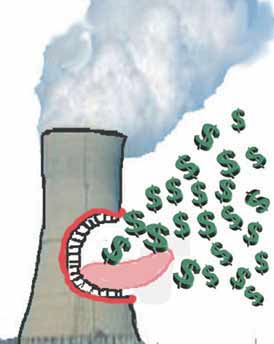 NRC approves transfer of Entergy’s Fitzpatrick nuclear plant to Exelon Robert Walton Utility Dive 8 Mar 17Dive Brief:
- The U.S. Nuclear Regulatory Commission last week approved the transfer of the operating license belonging to Entergy’s FitzPatrick nuclear facility to Exelon as part of a $110 million deal to keep the plant operating.
- The NRC’s approval is the last regulatory hurdle of the deal, Syracuse.com reports, with Exelon officials anticipating to close out the deal later this month.
- Entergy had planned to shutter the struggling FitzPatrick plant, but Exelon agreed to purchase it with the caveat that New York developing a Clean Energy Standard subsidy program to keep it profitable. But the Zero Emissions Credit plan is now being challenged by the Electric Power Supply Association, which argues the credits intrude on federal jurisdiction of wholesale markets.
- Dive Insight:
- New York’s plan to save the state’s nuclear fleet is tied up at the Federal Energy Regulatory Commission. The agency has only two members, preventing any decisions on major cases until a third commissioner is seated for a quorum.
While the deal moves ahead, federal regulators will still need to make broader decisions about how to credit the carbon-zero output from nuclear plants, which struggle against natural gas plants and renewables with lower fixed costs. While generators opposing the plan say the ZECs intrude into wholesale power markets, Exelon has argued they are within the state’s purview…..http://www.utilitydive.com/news/nrc-approves-transfer-of-entergys-fitzpatrick-nuclear-plant-to-exelon/437539/
Energy efficiency programs able to replace the Indian Point Nuclear Power Plant
“Under aggressive but cost-effective and potentially attainable increases in energy efficiency beyond the levels assumed in the Clean Energy Standard, all of the consumption otherwise met with IPEC (Indian Point Energy Center) station output could be met by more efficient energy use alone by 2023…”
The report estimates that aggressive energy efficiency programs could produce savings equal to twice the power generated by the Indian Point plant. A New York Times piece by Patrick McGeehan discusses the report’s analysis of energy efficiency programs in Connecticut and Rhode Island; these two states provide incentives for the adoption of energy efficiency measures and are able to produce energy savings of about 3% a year.
Ultimately, we will need renewable energy to power our entire energy system, but in the short run, we waste so much energy that efficiency can be used to meet our energy needs without using nuclear power. …..
Using energy efficiency to replace nuclear power, as proposed by NRDC and Riverkeeper, is an elegant solution to a difficult problem. New York’s Public Service Commission should work harder to incentivize energy efficiency. Utilities should make more profit when they deliver on efficiency goals. Con Ed should make more money when they sell less electricity. Homeowners should receive tax credits for demonstrating reductions in energy use. Energy audits and the capital costs of retrofits should be provided at a discount. Businesses should receive free consulting services from utilities and the state on how to incorporate energy efficiency practices into routine organizational management. The goal is to grow the economy without building new power plants—to maintain, and even improve, our standard of living while reducing our use of energy.
The idea to replace nuclear power with energy efficiency was not invented in New York. Typical of many new energy and environmental programs, it began in California. In June 2016, Pacific Gas and Electric announced an agreement it had reached with labor unions and environmental groups to close the Diablo Canyon nuclear power plant by 2025 and replace it with energy efficiency and renewable energy. Writing in Scientific American, Debra Kahn reported that: “Environmentalists said other states could use the agreement as a template to replace other nuclear and fossil-fueled plants with renewables, especially distributed solar, in order to fight climate change.”
Renewables still require new technology to displace other sources of energy, but energy efficiency is here right now. Energy efficiency is an important source of energy because of the casual way we have treated the use of energy in the past. Energy is a central resource needed in nearly every aspect of modern life. Appliances such as refrigerators, air conditioners, heaters, vehicles, computers, smartphones, radios, cable boxes, televisions, stoves and coffee makers all require energy. In many cases these appliances have been built to ensure reliable performance, but until the past decade or two, efforts to deliver that performance did not focus on delivery with the least possible energy use. Once engineers turned their attention to energy efficiency they found they could produce new appliances that worked just as well as the old but required much less energy. Similarly, architects and real estate developers started to design structures and HVAC (heating, ventilation and air conditioning) systems that used less energy. Old structures could be retrofitted with better insulated windows, timers, and motion-sensitive lighting, along with LED light bulbs.
Industrial energy use in data farms and other locations provide large, new targets for energy efficiency. One of the chief advantages of energy efficiency is that it is difficult to argue against it. What is the counter-argument? Let’s waste as much energy as we can and spend lots of money on energy instead of saving it for better uses?
There are, however, obstacles to energy efficiency: capital costs, habit, inconvenience, risk due to reduced redundancy (eg. in information technology facilities), outmoded regulations, and so on. But there is undeniable momentum behind efficiency as a “source” of energy. It enables reductions in pollution and in the costs of energy without trading off any benefits…..
The contrast between these two states and the Trump Administration could not be sharper. California and New York are trying to make the transition to a renewable energy future. The Trump folks are trying to piece together the pipelines, oil rigs, and coal mines of our energy present and past. I, for one, am betting on the future.http://www.huffingtonpost.com/entry/replacing-the-indian-point-nuclear-power-plant-with_us_58b9e13de4b02eac8876ce6f

Only the taxpayer can save this Ohio nuclear power station
 BEAVER VALLEY NUCLEAR PLANT FUTURE HINGES ON SUBSIDIES, Beloit Daily News March 07, 2017 By ANYA LITVAK, Pittsburgh Post-Gazette PITTSBURGH (AP) — One way or another, come next year, FirstEnergy Corp. is getting rid of the Beaver Valley nuclear power station.
Useless media is now normalising Trump
 The Media’s Rapid Retreat http://billmoyers.com/story/medias-rapid-retreat/, Tuesday provided a vivid demonstration that we are in this all by ourselves. The media won’t come to America’s rescue. BY NEAL GABLER | MARCH 3, 2017 Oh, how optimistic, naïve and ultimately foolish we were! When Donald Trump bulldozed his way through his first five weeks of his presidency, leaving wreckage in his wake, we knew the mainstream media couldn’t pretend this was business as usual. And they didn’t. And when Trump performed at his first presser as if he were, to put it charitably, deranged, we knew the media couldn’t pretend otherwise. And they didn’t. And when Trump decided to lash out at the mainstream media and declared them an “enemy of the people,” a characterization that even the reliably conservative John McCain thought contained a hint of dictatorship, we knew that the media, if only in self-defense, wouldn’t take that lying down. And they didn’t.
Well, the comfort didn’t last long — just until Trump’s appearance Tuesday before a joint session of Congress. We all know that it doesn’t take much to snooker the press. Alas, Donald Trump knew it too. Before last year’s debates, many of us predicted that if Trump could simply string two sentences together, the media would declare him the winner. His problem was that he couldn’t even manage that. But, to borrow a phrase that George W. Bush once applied to education — “the soft bigotry of low expectations” — when it comes to Republicans, the media always apply their own bigotry of “low expectations” and then somehow turn it into a win for the inept. If a candidate or, in this case, a president, exceeds those expectations by just a smidgen — “surprisingly presidential,” the ordinarily astute Washington Post pronounced afterward — the press gush and grovel. So all Trump had to do was take it down a notch, stay on the TelePrompTer, throw a few tiny bones to his antagonists and — voila! — the roaring lions of the press suddenly became cuddly kittens. It’s too easy.
If you ever needed an object lesson in media abdication, Tuesday’s speech analysis was it. When Trump began by condemning anti-Semitism after weeks of silence and after seemingly helping to incite a wave of national hatred, the media fawned. (Let me repeat that: A president condemns anti-Semitism and gets cheered for it. That is how far we have fallen.) When he said that the time had passed to fasten on “trivial fights” — this from the man who had only focused on the trivial — the media saw statesmanship. When he used the widow of dead Navy Seal William “Ryan” Owens as a prop, milking his death for applause, the media saw a great moment — “an emotional moment,” ABC called it, and CNN’s Van Jones said it was “one of the most extraordinary moments you have ever seen in American politics.” All sins were apparently washed away, no matter that on the same day he had accused former President Obama of leaking the Russian information to the press and picked up the “alt-right,” white nationalist theory that the attacks on Jewish cemeteries and centers were inflicted by his enemies. Some statesman.
The media response would be laughable if it weren’t also terrifying. Of course, Fox News thought Trump’s speech was the Gettysburg Address. Even Chris Wallace, who is supposed to be one of the few sane voices at that insane network, actually said this: “It was one of the best speeches in this setting I’ve ever heard anybody give.” On Trump’s alleged nemesis, CNN, Van Jones, a liberal, declared the speech the moment he became president. “Presidential” was the word that was tossed around the most, along with “optimistic.” Both The New York Times and the Los Angeles Times headed their coverage with that word.
On ABC, White House correspondent Jonathan Karl celebrated an “upbeat President Trump,” “right off the bat reaching out.” The other words we heard endlessly were “new tone” (“a softer and more measured tone,” said anchor Lester Holt Wednesday on the NBC Nightly News, while Kristen Welker said he was “striking a more positive tone”) and “pivot,” as in, he pivoted from being a reckless amateur to a president, though, in fairness, NBC also noted that Trump’s windy pronouncements needed to be subjected to a “reality check,” and had the temerity to challenge his assertion that the raid in which Owens died provided “large amounts of vital intelligence.” Citing 10 officials, Cynthia McFadden said it did no such thing.
Of course, we should have seen this capitulation coming. Trump can’t help himself from being who he is, and the media can’t help themselves from being who they are. The mainstream media have been so timid for so long, so unwilling to take on the right for fear of being accused of liberal bias, that they really don’t know how to behave otherwise. It was a wonderful interlude of media responsibility we had for a few weeks there, but it was an interlude and an anomaly, and even then, Trump’s dalliance with the Russians got 1/10,000 of the coverage that Hillary Clinton’s emails received, and, let me remind you, we are talking about a foreign enemy government hijacking our election.
The problem is not that the media are now normalizing Trump, serious as that is, but that their tendencies to do so are so deep, there is little hope they can ever perform as a real instrument of democracy. First, there is their fascination with style over substance, which was in full display on Tuesday. In the media, it is not what you say or even do, it is how you say it. I assume that this is so because substance is hard and style is easy, and the media almost always take the path of least resistance. Trump talked nice, and they fell for it.
Second, there is their tendency to create narratives — in this case: Trump, who was out of control, has now learned how to become a statesman. This is a much better story than the real one: that of a president who is temperamentally and ideologically unfit for office. The media love this stuff.
Third, there is their obsession with reverting to the mean — which we see not only in the false equivalencies the media seem intent on creating, but also in their timid retreat when they realize they may have acted too boldly. Trump hadn’t given them much of an opportunity to temper criticism with praise, and they were clearly looking for one. (How eager? Seth Meyers showed how often they had leapt to the same conclusion during the campaign.) Once they found it on Tuesday, they seized it with alacrity. Expect more.
Finally, there is the terror of engaging in warfare, even if warfare is the only way to preserve our democracy, as it is now. I suspect that a lot of journalists fear blurring the line between telling the truth and taking sides, and the Republicans have taken full advantage of that fear for years. No doubt Trump will too. If you call him out, you are picking on him, which is to lose your objectivity. And even if individual journalists were to screw their courage to the sticking post, it is highly unlikely that their employers, especially broadcast networks, would let them. You have to play it safe.
So Donald Trump has actually been right about one thing: the mainstream media are a farce. You can game them, as he has and will continue to do. It is best we realize that now. Trump may be his own worst enemy because some things are beyond the pale and must be reported as such. But Tuesday provided a vivid demonstration that we are in this all by ourselves. The media won’t come to America’s rescue. They don’t know how.
Trump is wrecking the State Department: military solutions will prevail over diplomacy?
 Former Reagan Aide: “Trump is decimating State Dept…to force military solutions” http://shareblue.com/former-reagan-aide-trump-is-decimating-state-dept-to-force-military-solutions/
White House Chief Strategist Steve Bannon recently asserted that “deconstruction of the administrative state” was a primary goal of the Trump administration. And he meant it literally, which, when it comes to foreign policy, has potentially dangerous repercussions for the United States and the world.
Immediately after taking office, Donald Trump forced resignations by a number of top level State Department management officials. When Secretary of State Rex Tillerson came on board, he engaged in an abrupt reorganization of remaining management without explanation. And as of yet, the Trump team has put forth nominees for only 7 of the 118 positions within the State Department that require Senate confirmation. The majority of leadership positions remain unfilled, including almost every Ambassadorship.
One mid-level officer at State offered a troubling observation:
They really want to blow this place up. I don’t think this administration thinks the State Department needs to exist. They think Jared [Kushner, Trump’s son-in-law] can do everything. It’s reminiscent of the developing countries where I’ve served. The family rules everything, and the Ministry of Foreign Affairs knows nothing.
During the campaign, Trump was asked who he consults with on foreign policy:
I’m speaking with myself, number one, because I have a very good brain and I’ve said a lot of things. I know what I’m doing and I listen to a lot of people, I talk to a lot of people and at the appropriate time I’ll tell you who the people are. But my primary consultant is myself and I have a good instinct for this stuff.
Trump has also engaged his son-in-law in foreign policy, to the extent that Kushner has been characterized as “a shadow secretary of state, operating outside the boundaries of the State Department or the National Security Council.”
Simultaneous with his gutting of the State Department, Trump has also expressed his intention to seek an additional $54 billion in funding for the Defense Department.
Bruce Bartlett, a historian and economist, and a former aide to Presidents Ronald Reagan and George H.W. Bush, commented on the situation:
Statements about what U.S. foreign policy will look like under the Trump administration have been vague but deeply disconcerting. He has expressed deep-seated nationalism and an intention to change dramatically the role of the U.S. as a world leader. He has expressed doubt about U.S. commitment to long-standing allies, including NATO, and repeatedly asserted a desire to move closer to adversaries like Russia. He has casually discussed the use of nuclear weapons, including saying in one interview, “Somebody hits us within ISIS, you wouldn’t fight back with a nuke?” and reportedly asking three times in a single security briefing “why can’t” the U.S. use nuclear weapons.
Former foreign partners of the U.S. are already “weighing contingency plans and bracing for the worst” with regard to the Trump administration. Regardless of political party, Trump’s affection for military options, including nuclear weapons, and his intentional destruction of the mechanisms of diplomacy are a combination that should send a chill up the spines of all of us.
America’s nuclear bomb tests and their health toll on Americans
U.S. nuclear testing ceased in 1992. In 2002, the Centers for Disease Control estimated that virtually every American that has lived since 1951 has been exposed to nuclear fallout, and that the cumulative effects of all nuclear testing by all nations could ultimately be responsible for up to eleven thousand deaths in the United States alone.
 America’s Forgotten Nuclear War (On Itself), National Interest, http://nationalinterest.org/blog/americas-forgotten-nuclear-war-itself-19662 Kyle Mizokami, 4 Mar `17 , Nuclear weapons have a mysterious quality. Their power is measured in plainly visible blast pressure and thermal energy common to many weapons, but also invisible yet equally destructive radiation and electromagnetic pulse. Between 1945 and 1992, the United States conducted 1,032 nuclear tests seeking to get the measure of these enigmatic weapons. Many of these tests would be today be considered unnecessary, overly dangerous and just plain bizarre. These tests, undertaken on the atomic frontier, gathered much information about these weapons—enough to cease actual use testing—yet scarred the land and left many Americans with long-term health problems.
The majority of U.S. nuclear tests occurred in the middle of the Western desert, at the Nevada Test Site. The NTS hosted 699 nuclear tests, utilizing both above-ground and later underground nuclear devices. The average yield for these tests was 8.6 kilotons. Atmospheric tests could be seen from nearby Las Vegas, sixty-five miles southeast of the Nevada Test site, and even became a tourist draw until the Limited Test Ban Treaty banned them in 1963. Today the craters and pockmarks from underground tests are still visible in satellite map imagery.
The bulk of the remaining nuclear tests took place in Pacific, at the islands of Bikini, Enewetak, Johnson Island and Christmas Island. The second nuclear test, after 1945’s Trinity Test, took place at Bikini Atoll. The Pacific tests were notable not only for their stunning visuals, the most compelling imagery of nuclear weapons since Hiroshima, but also the forced relocation of native islanders. Others that were near tests were exposed to dangerous levels of radioactive fallout and forced to fleet. In 1954, the crew of the Japanese fishing boat Daigo Fukuryu Maru accidentally sailed through fallout from the nearby fifteen-megaton Castle Bravo test. Contaminated with nuclear fallout, one crew member died, and the rest were sickened by radiation.
The first test of a thermonuclear, or fusion, bomb took place on November 1952 at Enewetak Island. Nicknamed Ivy Mike, the huge eighty-two-ton device was more of a building than a usable nuclear device. The device registered a yield of 10.4 megatons, or the equivalent of 10,400,000 tons of TNT. (Hiroshima, by contrast, was roughly eighteen thousand tons of TNT.) Ivy Mike was the biggest test by far, creating a fireball 1.8 miles wide and a mushroom cloud that rose to an altitude of 135,000 feet.
One of the strangest atmospheric tests occurred in 1962 at the NTS, with the testing of the Davy Crockett battlefield nuclear weapon. Davy Crockett was a cartoonish-looking recoilless rifle that lobbed a nuclear warhead with an explosive yield of just ten to twenty tons of TNT. The test, code-named Little Feller I, took place on July 17, 1962, with attorney general and presidential adviser Robert. F. Kennedy in attendance. Although hard to believe, Davy Crockett was issued at the battalion level in both Germany and North Korea.
Also in 1962, as part of a series of high-altitude nuclear experiments, a Thor rocket carried a W49 thermonuclear warhead approximately 250 miles into the exoatmosphere. The test, known as Starfish Prime, had an explosive yield of 1.4 megatons, or 1,400,000 tons of TNT, and resulted in a large amount of electromagnetic pulse being released over the Eastern Pacific Ocean. The test, conducted off Johnston Island, sent a man-made electrical surge as far Hawaii, more than eight hundred miles away. The surge knocked out three hundred streetlights and a telephone exchange, and caused burglar alarms to go off and garage doors to open by themselves.
Nuclear tests weren’t just restricted to the Pacific Ocean and Nevada. In October 1964, as part of Operation Whetstone, the U.S. government detonated a 5.3-kiloton device just twenty-eight miles southwest of Hattiesburg, Mississippi. The test, nicknamed Salmon, was an experiment designed to determine if nuclear tests could be detected by seismometer. This was followed up in 1966 with the Sterling test, which had a yield of 380 tons.
In 1967, as part of a misguided attempt to use nuclear weapons for peaceful purposes, the United States detonated a nuclear device near Farmington, New Mexico. Project Gasbuggy was an early attempt at nuclear “fracking,” detonating a twenty-nine-kiloton nuke 4,227 feet underground just to see if the explosion would fracture surrounding rock and expose natural-gas reserves. The experiment was unsuccessful. Two similar tests, Rulison and Rio Blanco, took place in nearby Colorado. Although Rulison was a success in that it uncovered usable gas reserves, the gas was contaminated with radiation, leaving it unsuitable for practical commercial use.
A handful of nuclear tests were conducted in Alaska, or more specifically the Aleutian island of Amchitka. The first test, in October 1965, was designed to test nuclear detection techniques and had a yield of eighty kilotons. A second test occurred four years later, and had a yield of one megaton, or one thousand kilotons. The third and largest test, Cannikin, was a test of the Spartan antiballistic-missile warhead and had a yield of less than five megatons.
During the early years of nuclear testing it was anticipated that nuclear weapons would be used on the battlefield, and that the Army and Marine Corps had better get used to operating on a “nuclear battlefield.” During the 1952 Big Shot test, 1,700 ground troops took shelter in trenches just seven thousand yards from the thirty-three-kiloton explosion. After the test, the troops conducted a simulated assault that took them to within 160 meters of ground zero. This test and others like them led to increases in leukemia, prostate and nasal cancers among those that participated.
U.S. nuclear testing ceased in 1992. In 2002, the Centers for Disease Control estimated that virtually every American that has lived since 1951 has been exposed to nuclear fallout, and that the cumulative effects of all nuclear testing by all nations could ultimately be responsible for up to eleven thousand deaths in the United States alone. The United States did indeed learn much about how to construct safe and reliable nuclear weapons, and their effects on human life and the environment. In doing so, however, it paid a terrible and tragic price.
Kyle Mizokami is a defense and national-security writer based in San Francisco who has appeared in the Diplomat, Foreign Policy, War is Boring and the Daily Beast. In 2009, he cofounded the defense and security blog Japan Security Watch. You can follow him on Twitter: @KyleMizokami.
Trump administration attacks climate and lead cleanup programmes
 Trump’s EPA budget proposal targets climate, lead cleanup programs Reuters, | WASHINGTON, 5 Mar 17
The White House is proposing to slash a quarter of the U.S. Environmental Protection Agency’s budget, targeting climate-change programs and those designed to prevent air and water pollution like lead contamination, a source with direct knowledge of the proposal said on Thursday.
President Donald Trump has long signaled his intention to reverse former Democratic President Barack Obama’s climate-change initiatives. But the Republican president has vowed his planned overhaul of green regulation would not jeopardize America’s water and air quality.
The 23-page 2018 budget proposal, which aims to slice the environmental regulator’s overall budget by 25 percent to $6.1 billion and staffing by 20 percent to 12,400 as part of a broader effort to fund increased military spending, would cut deeply into programs like climate protection, environmental justice and enforcement.
Politico and other news outlets reported the staff and overall budget cuts earlier, but the source disclosed new details on the impact the cuts would have on programs and grants to states.
Environmentalists slammed the proposed cuts, which must be approved by the Republican-led Congress.
The agency did not immediately respond to a request for comment on the budget proposal or its counter proposal. The White House said it had no comment.
Under the proposal, which was sent to the EPA this week, grants to states for lead cleanup would be cut 30 percent to $9.8 million, according to the source, who read the document to Reuters.
Grants to help Native American tribes combat pollution would be cut 30 percent to $45.8 million. An EPA climate protection program on cutting emissions of greenhouse gases like methane that contribute to global warming would be cut 70 percent to $29 million.
The proposal would cut funding for the brownfields industrial site cleanup program by 42 percent to $14.7 million. It would also reduce funding for enforcing pollution laws by 11 percent to $153 million………http://www.reuters.com/article/us-usa-trump-epa-budget-idUSKBN1692XA?feedType=RSS&feedName=topNews
1 This Month





PLEASE OPPOSE HR 8255 AND S.3639 – bills would accelerate satellite deployment, with no environmental review or safeguards – https://ncstd5li.quorum.us/campaign/169331/
To see nuclear-related stories in greater depth and intensity – go to https://nuclearinformation.wordpress.com
-
Archives
- October 2026 (91)
- September 2026 (339)
- August 2026 (330)
- July 2026 (355)
- June 2026 (287)
- May 2026 (306)
- April 2026 (356)
- March 2026 (251)
- February 2026 (267)
- January 2026 (308)
- December 2025 (358)
- November 2025 (359)
-
Categories
- 1
- 1 NUCLEAR ISSUES
- business and costs
- climate change
- culture and arts
- ENERGY
- environment
- health
- history
- indigenous issues
- Legal
- marketing of nuclear
- media
- opposition to nuclear
- PERSONAL STORIES
- politics
- politics international
- Religion and ethics
- safety
- secrets,lies and civil liberties
- spinbuster
- technology
- Uranium
- wastes
- weapons and war
- Women
- 2 WORLD
- ACTION
- AFRICA
- Atrocities
- AUSTRALIA
- Christina's notes
- Christina's themes
- culture and arts
- Events
- Fuk 2022
- Fuk 2023
- Fukushima 2017
- Fukushima 2018
- fukushima 2019
- Fukushima 2020
- Fukushima 2021
- general
- global warming
- Humour (God we need it)
- Nuclear
- RARE EARTHS
- Reference
- resources – print
- Resources -audiovicual
- Weekly Newsletter
- World
- World Nuclear
- YouTube
-
RSS
Entries RSS
Comments RSS

