U.S. lawmakers push Yucca nuclear dump facing transport crunch, Reuters, By Timothy Gardner| WASHINGTON, 29 Apr 17, Lawmakers in the U.S. House of Representatives on Wednesday debated resurrecting the stalled Yucca Mountain spent nuclear fuel dump in Nevada, a project critics say is hindered by the lack of an easy transport route.
Representative John Shimkus, an Illinois Republican, has proposed draft legislation to restart the licensing of Yucca Mountain. The government has already spent billions of dollars for initial construction of the project, which has been pending since Ronald Reagan was president.
Former President Barack Obama opposed Yucca and stopped its licensing process in 2010. But President Donald Trump’s proposed 2018 budget provides $120 million to restart licensing and for development of interim nuclear waste sites until Yucca can be completed.
More details about the Trump administration’s support of Yucca could come when a broader budget is released in May. Currently, spent nuclear fuel, which can be deadly if left unshielded, is stored at reactors across the country, first in cooling ponds and then in thick casks.
The Yucca site itself, about 100 miles (160 km) northwest of Las Vegas, faces a cumbersome and costly licensing process that could take years to complete and questions from critics about how long spent fuel can remain without radiation leaking into an aquifer.
Yucca supporters say there is little groundwater at the desert site and what is there is contained by barriers and does not flow to any river or drinking water supply.
An even trickier problem will be getting the spent fuel to Yucca Mountain safely by train and truck from nuclear reactors sites all across the country.
“Transportation is the Achilles heel of the Yucca Mountain repository site,” said Bob Halstead, the head of Nevada’s agency for nuclear projects.
One train route studied by the Department of Energy, known as Caliente, has been at least partially blocked by Obama’s 2015 designation of a national monument called Basin and Range.
Another route, known as Mina, is opposed by the Walker River tribe, which withdrew permission in 2007 for the government to ship waste through its reservation.
Many casino owners and gaming associations also oppose the transport of spent nuclear fuel near the city of Las Vegas, saying publicity about the shipments could harm property values and tourism…..
There are no nuclear power reactors in Nevada, and the state’s entire Congressional delegation, which includes members of both parties, opposes Yucca.
Representative Jacky Rosen, a Nevada Democrat, said a major accident would harm human health, cost hundreds of millions of dollars in cleanup costs, and damage the Las Vegas economy. “Do you honestly believe that shipping over 5,000 truck casks of high-level nuclear waste over a span of 50 years won’t result in at least one radiological accident?” Rosen said at the hearing…….http://www.reuters.com/article/us-usa-nuclearpower-yucca-idUSKBN17S08J
Just as chilling is the 1949 follow up to Plan Totality – known as Operation Dropshot – which reveals how the US was really ready to obliterate the USSR with terrifying force.
And we also recently revealed details of the chilling plans drawn up by Soviet generals to survive an all-out war with NATO and conquer the remains of the European continent.
Plan Totality was the name given to a last-ditch nuclear strategy cooked up by American generals in the wake of the Second World War REVEALED By GEORGE HARRISON 15th January 2017,
A DECLASSIFIED military plan reveals that America was prepared to plunge the world into a nuclear conflict just as World War 2 had been brought to an end.
Plan Totality was the name given to a last-ditch nuclear strategy cooked up by American generals in the wake of the Second World War.
Despite the successes of Soviet and American cooperation in toppling Nazi Germany, the conclusion of the war put relations between the two superpowers on ice.
The former Allies fell out when America began to suspect that the then-Soviet Union was plotting to sweep into the charred remains of the European continent to conquer it themselves.
Fearing global domination by the USSR, America prepared for the worst and hatched a number of military plans and simulations designed to beat back a Russian invasion of Western Europe. Plan Totality was established by US General Dwight D. Eisenhower in the summer of 1945, following the Potsdam Conference – where the Allies decided how to carve up defeated Germany.
The chilling strategy involved plans to obliterate 20 Soviet cities with America’s newly-tested atomic arsenal.
Moscow, Leningrad and Stalinsk were all in the American firing line, with military planners claiming that all of the biggest Soviet cities could be wiped out in one surprise strike.
Between 20 and 30 atomic bombs were set to be dropped if it came to it – a move which could have resulted in Russia and America wiping each other off the map.
However, all was not as it seemed, and the supposedly secret plan ended up leaked to the world soon after it was drawn up. In fact, America didn’t have anywhere near 20 atomic bombs at the time, and only had 27 bombers capable of delivering the few devices available.
The real genius of Plan Totality was that it was a complete bluff, which was deliberately leaked with the intention of tricking the USSR into thinking that America’s military was more powerful than it really was. Plan Totality was just one component of then-President Truman’s “Giant Atomic Bluff”, a military strategy aimed at scaring America’s enemies into submission.
Unfortunately, the USSR saw through it, prompting the arms race which could have resulted in the death of billions.
Just as chilling is the 1949 follow up to Plan Totality – known as Operation Dropshot – which reveals how the US was really ready to obliterate the USSR with terrifying force.
And we also recently revealed details of the chilling plans drawn up by Soviet generals to survive an all-out war with NATO and conquer the remains of the European continent.
North Korea already is a nuclear power. Its first nuclear test was over a decade ago, and analysts say it probably has enough material for a dozen bombs today…… there are absolutely no good reasons to start another Korean War.
North Korea’s Nuclear Weapons Are Not Reason Enough to Start a War, TIME, Charlie Campbell / Beijing Apr 28, 2017 More than 2 million people were killed in the 1950-3 Korean War, including almost 40,000 Americans. Some 7,000 U.S. soldiers are still listed as missing. Countless families were torn apart by the conflict, which is still officially ongoing, as it was only ended by armistice rather than a peace treaty. It remains one of modern history’s longest wars.
These facts are important to remember when a U.S. President says, “There is a chance that we could end up having a major, major conflict with North Korea,” as Donald Trump did in an exclusive Reuters interview published Thursday.
The regime of North Korean Supreme Leader Kim Jong Un is a perennial headache for the international community. In recent years, North Korea has shelled South Korean islands and sunk a Naval corvette, claiming dozens of lives, including civilians. To fund its weapons program, the regime produces narcotics, fake currency and uses cybercrime across the globe.
On Feb.13, it even unleashed VX nerve agent — a U.N.-certified Weapon of Mass Destruction — at Kuala Lumpur International Airport to assassinate of Kim Jong Nam, Kim Jong Un’s estranged half-brother. It has abducted possibly hundreds of foreign nationals. At home, its own citizens are subject to “crimes against humanity,” according to a 2014 U.N. report.
However, what’s spurred Trump’s saber-rattling is North Korea’s nuclear program. Pyongyang has tested five nuclear bombs to date, and appears poised for a sixth. It also frequently tests missiles that may one day be able to reach the continental U.S. “[We can] can tip new-type intercontinental ballistic rockets with more powerful nuclear warheads and keep any cesspool of evils in the earth, including the U.S. mainland, within our striking range,” Kim Jong Un said after watching a rocket test last year.
Trump says that if North Korea cannot be persuaded from dismantling its nuclear weapons then military action maybe unavoidable. On April 8, he ordered a U.S. navy strike group — an “armada,” he called it — to the Korean peninsula. The obvious problem is that Seoul — home to half of South Korea’s 50 million people, including 200,000 Americans — lies within range of North Korea’s artillery, and possibly even nuclear weapons.
Trump’s gamble is that Kim Jong Un would shy away from retaliating against a U.S. strike on his nuclear facilities, cognizant that American military superiority means any full-scale war would undoubtedly result in his regime’s complete destruction…….
Trump told Reuters that he operates under the assumption that Kim Jong Un is “rational.” But backed into a corner, is Trump willing to bet nuclear apocalypse on that?
But even if North Korea were not to retaliate, there’s no guarantee strikes would achieve their goal of permanently retarding the regime’s nuclear program. Plus there would be dire strategic consequences. Beijing would be livid. The U.S. would have started yet another 21st Century war, utterly alienating international public opinion, tearing up its hard-fought Asian security alliance and inviting Chinese hardliners to push it out of the region. According to an August 2016 study by Brown University, the wars in Iraq, Afghanistan and Pakistan — in which the U.S. military has been involved — have directly cost 370,000 lives since 2001. (Not that we’ve stopped counting.)
However, the broader point is that North Korea, for all its many and egregious faults, is a state hell-bent on survival. It might have nuclear weapons, but the regime cannot use them without guaranteeing its own destruction……..
Unfortunately, there is little chance the regime will voluntarily give up its nuclear weapons. Kim Jong Un is very aware of the fates of Libyan dictator Muammar Gaddafi and Iraqi dictator Saddam Hussein, who were both toppled after abandoning their nuclear aspirations. He believes a nuclear bomb guarantees the security of his regime. And he might be right.
For lack of any better option, the U.S. and its allies should utilize the countless strategic advantages that won the Cold War, because the tussle with North Korea is still part of that ideological reckoning. ……
In an interview with Reuters today, Mr Trump admitted a major conflict with North Korea was possible but said it wasn’t his preferred outcome.
“There is a chance that we could end up having a major, major conflict with North Korea. Absolutely,” Mr Trump told Reuters in an Oval Office interview ahead of his 100th day in office on Saturday.
He maintained he wanted to resolve the dispute peacefully.
Meanwhile, the commander of US Pacific Command, Admiral Harry B Harris Jr, warned it was only a matter of time before Kim Jong-un is capable of launching a nuclear warhead towards the US.
“The crisis on the Korean peninsula is real — the worst I’ve seen,” he said in an interview with Fox News. “There is some doubt within the intelligence community whether Kim Jong-un has that capability today or whether he will soon, but I have to assume he has it, the capability is real, and that he’s moving towards it.”
US puts onus on China to avert ‘catastrophe’ with North Korea, 9 news.com.au 27 Apr 17, The United States sounded a global call to confront the North Korean nuclear threat Friday, exhorting Beijing to use its “unique” leverage to rein in Pyongyang and avert “catastrophic consequences.”Addressing the UN Security Council after Donald Trump warned of the risk of a “major conflict,” Secretary of State Rex Tillerson called for a campaign of pressure to force Pyongyang to change course and put a halt to its nuclear and ballistic missile programs.
“Failing to act now on the most pressing security issue in the world may bring catastrophic consequences,” Mr Tillerson told the Council.
“The threat of a North Korean nuclear attack on Seoul or Tokyo is real, and it is likely only a matter of time before North Korea develops the capability to strike the US mainland,” he said.
Mr Tillerson told the Council there was “no reason” to think North Korea would change course under the current multilateral sanctions regime, warning: “The time has come for all of us to put new pressure on North Korea to abandon its dangerous path”.
“I urge this council to act before North Korea does,” he said.
Washington has repeatedly called for tougher UN sanctions, but wants China to take the diplomatic lead by using its leverage over Pyongyang — which Beijing has been reluctant to do for fear of destabilising North Korea.
At the council meeting, China pushed back, saying it was not realistic to expect one country to be responsible for solving the conflict
China is not a focal point of the problem on the peninsula and the key to solving the nuclear issue on the peninsula does not lie in the hands of the Chinese side,” Foreign Minister Wang Yi said.
……..The Security Council meeting follows weeks of warnings from the US administration that it is running out of patience.
“All options for responding to future provocation must remain on the table,” Mr Tillerson said.
“Diplomatic and financial levers of power will be backed up by willingness to counteract North Korean aggression with military action, if necessary.”
Russia and China made clear that a military response to the threat from Pyongyang would be disastrous and appealed for a return to talks and de-escalation.
China’s Wang warned “the use of force does not solve differences and will only lead to bigger disasters”.
North Korea “is conducting itself in an inappropriate way”, Russian Deputy Foreign Minister Gennady Gatilov told the council.
“At the same time, options of using force are completely unacceptable and could lead to catastrophic consequences.”……….
At the end of the meeting, Mr Tillerson again took the floor and bluntly re-asserted Washington’s stance.
FirstEnergy looks to the feds for help with coal and nuclear April 28, 2017 By Anya Litvak / Pittsburgh Post-GazetteThe future of FirstEnergy’s coal and nuclear power plants in Pennsylvania and Ohio now is being assessed through the lens of a speedy federal study which, it is widely understood, is looking for ways to prop up coal and nuclear plants.
Chuck Jones, the CEO of Akron-based FirstEnergy Corp., said the company’s subsidiary that operates those plants has delayed a decision on filing for bankruptcy until the Department of Energy releases a study it commissioned two weeks ago.
The study which, among other things, is meant to explore “the extent to which continued regulatory burdens, as well as mandates and tax and subsidy policies, are responsible for forcing the premature retirement of baseload power plants,” is supposed to be done by June 19.
“I think the administration is serious about this,” Mr. Jones said during a call with analysts on Friday. “Our Washington team tells me that this is a very serious initiative. If their intention is to keep these fuel-secure base load assets from closing then they’re going to have to do something to make sure that there’s a financial incentive for these plants to not close,” he said.
Mr. Jones said he’s traveled to Washington D.C. to discuss this matter with representatives of the Trump administration and officials at the Department of Energy.
“And I’m sure this also clearly ties in to one of the President’s key initiatives, which is to protect our coal natural resource and the mining and jobs that go along with that,” he said.
Another government solution that could impact the company’s bankruptcy considerations is a set of bills moving through the Ohio legislature that would to subsidize nuclear plants through zero emission nuclear credits. If enacted, the measures would give FirstEnergy’s two nuclear power stations in Ohio $300 million in annual income.
But that alone won’t be enough to ward off bankruptcy, Mr. Jones cautioned. What it will do, he said, is give those plants a better chance of being scooped up by a buyer during a bankruptcy proceeding.
While he did not address efforts brewing in Pennsylvania to explore nuclear subsidies, he said the way the Ohio legislation is currently written, the Beaver Valley nuclear plant might qualify for credits across the state line.
It’s unusual for financial analysts to throw as much cold water on a company’s narrative as was spilling every which way during FirstEnergy’s earnings call on Friday.
Some questioned whether the Department of Energy has the power to enact measures that would help coal and nuclear plants directly. Others said that even if the DOE study does produce a policy framework, it will likely trigger involvement from other federal agencies, stretching the timeline for implementing any helpful measures……..
What’s clear is that the current system isn’t working, he said, because FirstEnergy’s power plants aren’t making enough money to stay alive. In its quarterly report, FirstEnergy said “prolonged decrease in demand and excess generation supply” compelled it to close more than half of its generation capacity in recent years……..
Stu Bresler, senior vice president of operations and markets at PJM, recently told Pennsylvania’s nuclear caucus that if all of the state’s nuclear plants were to shut down — a scenario he believes is unlikely — the grid would remain reliable.
Two to Tango With Nuclear Weapons The president shouldn’t have sole authority to trigger nuclear war., US News, By Peter D. ZimmermanApril 26, 2017Somewhere in the American southwest, not so very far from civilization, there is a fenced and guarded compound within another fenced and guarded compound in the distant reaches of a large military base……Beneath the fence is a vault where nuclear weapons wait ……
Under the prairies of Montana or the Dakotas underground bunkers are buried adjacent to a bomb-proof silo containing a Minuteman intercontinental missile…….
Somewhere under the ocean a missile submarine receives a message. The captain and his executive officer separately decode and authenticate it.
It always requires two people, two separate actions, to launch, steal, sabotage or tinker with an atomic warhead. This is the inviolable two person rule intended to prevent misuse of a nuclear weapon. ……
But the system deliberately breaks down at the single point where failure would be catastrophic. Only one person need act in order to launch all American nuclear weapons. The president. There is no two-person rule for ordering a strike. Nobody except the president needs to agree; nobody in the chain from president to launch officer has authority to question the order. If the president orders a launch, the system executes it. The service members involved may have their doubts, but years of military training have conditioned them that even this order must be obeyed………
The United States vowed that never again would a potential enemy be able to launch a surprise attack to which this country could not respond instantly and in kind.
This made sense during the height of the Cold War when the United States, terrified by the prospect of a nuclear Pearl Harbor, sought to ensure that a counter strike could not be thwarted by a clumsy decision-making process that would require more time than the country expected to have………
At least twice the Soviet Union and the United States have come very close to launching nuclear weapons based on the warnings provided by radar and satellite systems. A Soviet officer did not pass a notification of a rocket launch to the Kremlin at a time he knew that tensions between the powers were minimal. A good thing; it was not a nuclear missile but a small scientific rocket launched from a Norwegian island and carrying an innocent payload. The Soviets had been notified in advance of the launch, but somehow the message was lost.
Bad weather has sometimes fooled American defenses into thinking that a flight of geese was actually a nuclear missile, and only good judgment stopped the alert in its tracks. But human intervention is only legal going up the chain to the president. It’s ruled out if the president sends down a message ordering a launch, even if he or she is mistaken.
Nor is there any way at all to stop a drunk president, an angered and offended president, an insane one, or merely a bored and curious one from simply ordering the opening of the football and the launch of one or more nuclear weapons………
the president and the Congress must work together now, ignoring partisanship, to prevent an accidental, or even an intentional nuclear holocaust. It is time to extend the two person rule to the top of the pyramid, so that not even the president can start a nuclear war alone.
Peter D. Zimmerman, a nuclear physicist, was chief scientific adviser of the Arms Control and Disarmament Agency and the Bureau of Arms Control at the State Department. He also served as chief scientist of the Senate Foreign Relations Committee. He is professor emeritus of science and security in the Department of War Studies at Kings College London and lives in Northern Virginia. https://www.usnews.com/opinion/articles/2017-04-26/the-president-shouldnt-have-sole-authority-ove
Fracking kills newborn babies – polluted water likely cause http://www.theecologist.org/News/news_round_up/2988876/fracking_kills_newborn_babies_polluted_water_likely_cause.html, Oliver Tickell, 25th April 2017 A new study in Pennsylvania, USA shows that fracking is strongly related to increased mortality in young babies. The effect is most pronounced in counties with many drinking water wells indicating that contamination by ‘produced water’ from fracking is a likely cause. Radioactive pollution with uranium, thorium and radium is a ‘plausible explanation’ for the excess deaths.
A new study of Pennsylvania counties published today in the Journal of Environmental Protection shows for the first time that contamination from fracking kills babies.
The Marcellus shale area of Pennsylvania was one of the first regions where novel gas drilling involving hydraulic fracturing of sub-surface rock, now termed ‘fracking’, was carried out.
The epidemiological study by Christopher Busby and Joseph Mangano examines early infant deaths 0-28 days before and after the drilling of fracking wells, using official data from the US Centre for Disease Control to compare the immediate post-fracking four year period 2007-2010 with the pre-fracking four-year period 2003-2006.
Results showed a statistically significant 29% excess risk of dying age 0-28 days in the ten heavily fracked counties of Pennsylvania during the four-year period following the development of fracking gas wells. Over the same period, the State rate declined by 2%. They conclude:
“There were about 50 more babies died in these 10 counties than would have been predicted if the rate had been the same over the period as all of Pennsylvania, where the incidence rate fell over the same period.”
Radioactive water pollution to blame?
The Marcellus shale beneath Pennsylvania was one of the first areas where fracking began. Only 44 fracking wells were drilled before 2007, while 2,864 were drilled in 2007-2010.
The cause of the excess mortality is not proven in the study, however the authors point out that the fracking production process releases naturally occurring radioactive materials from shale strata which then contaminate groundwater.
These include radium, uranium, thorium and radon, an intensely radioactive gas which decays into radioactive ‘daughters’ with a half life of under four days. And as the authors write, fracking “involves the explosive destruction of large volumes of underground gas and oil retaining rocks and the pumping down of large amounts of what is termed ‘produced water’ which initially contains various chemical and sand additives.
“This produced water and backflow returns to the surface with a high load of dissolved and suspended solids including naturally occurring radioactive elements … The contaminated water has to be safely disposed of but this is often associated with violations of legal disposal constraints.”
Baby mortality related to exposure through water wells
In the five heavily-fracked counties in the northeast part of the state (Susquehanna, Bradford, Wyoming, Lycoming and Tioga), the number of deaths from 2003-2006 vs. 2007-2010 climbed from 36 to 60, a statistically significant rate increase of 66%.
The rate in the five counties in southwest Pennsylvania (Washington, Westmoreland, Greene, Butler and Fayette) rose 18%, from 157 to 178 deaths, though this increase was not statistically significant.
This divergence in relative risk between the heavily fracked NE and SW counties was initially perplexing, however the authors noticed the higher dependence on private water wells (potentially contaminated with frackiing fluids) for drinking water and other needs in the first region compared to the second.
In the NE group of counties , the number of water wells per birth ranged from 4.9 to 13.5, compared to 1.1 to 3 in the SW group of countries. Their chart of Relative Risk for early infant mortality after fracking (see image above right) plotted against ‘exposure’ defined as ‘water wells per birth’ on a county by county basis produced a straight-line graph – indicated a strong relation to increased mortality and exposure to groundwater.
Table [on original]: Water wells per birth and violations per annual birth in highly fracked Pennsylvania Counties.
They conclude: “The results therefore seem to support the suggestion that the vector for the effect is exposure to drinking water from private wells. This is a mechanistically plausible explanation. However the findings do not prove such a suggestion. We may examine other possible explanations for possible health effects which have been advanced.”
While radioactive pollution is carefully examined, the authors acknowledge alternatives including “the existence of chemical contaminants in the produced water” which they consider a “possible but unknown factor.”
Serious questions raised over health hazards of fracking
“A major component of early infant mortality is congenital malformation, e.g., heart, neurological, and kidney defects. These are known to be caused by exposures to Radium and Uranium in drinking water”, said Christopher Busby.
“Infant death rates were significantly high in highly-fracked counties in northeast Pennsylvania, those with the greatest density of private water wells, suggesting it is drinking water contamination driving the effect.”
Joseph Mangano added: “These results raise serious questions about potential health hazards of fracking, especially since the fetus and infant are most susceptible to environmental pollutants. This is a public health issue which should be investigated wherever fracking is being carried out or proposed.”
The result is expected to have significant insurance, investment, economic and downstream political implications in the US and other countries.
Dr Busby is the Scientific Secretary of the European Committee on Radiation Risk www.ecrr.eu and is Scientific Director of Environmental Research SIA, based in the Latvian National Academy of Sciences, Riga, Latvia. Busby’s CV can be found here.
Meanwhile, work at the site continues to go more slowly than expected, adding to the chronic delays that have driven up the project’s price tag. And SCANA (NYSE:SCG) says it is watching efforts in Congress to extend production tax credits for nuclear plants. SCANA concedes that if they are not extended, it would make it difficult to continue with the project.
Questions about the troubled expansion at Summer — plagued by cost overruns, delays and now Westinghouse’s filing for Chapter 11 protection from creditors— dominated SCANA’s earnings call Thursday. And with only a few answers available now, the questions are likely to continue for much of the coming 60 days.
As Westinghouse filed for Chapter 11 protection March 29, SCANA and Southern Co. (NYSE:SO) reached 30-day agreements with Westinghouse to keep construction work going at Summer and the Plant Vogtle nuclear project.
‘No impediments’
SCANA is using the time to determine whether it makes sense to take over construction management and try to complete the two nuclear reactors under construction, or abandon the project. During the review, SCANA is essentially paying all the contractors on the site — either directly or through disbursements to Westinghouse.
But SCANA officials did not expect to be able to complete the review by now. From the start, the company said it would need another 30 to 60 days.
Chief Operating Officer Steve Byrne expressed confidence that extension, for 60 days, is forthcoming.
“As of right now — and there are always a lot of last minute details to be taken care of — we don’t see any impediments … to having an agreement in place sometime by either later today or tomorrow,” he told analysts Thursday.
But no deal was announced yesterday, and the current agreement expires at midnight.
With gimmicky pro nuclear billionaires leading, will this research create more problems than it solves?
Why The Scariest Response To Climate Change Is Finally Being Taken Seriously, Gizmodo ,Maddie Stone, Apr 28, 2017 “……..Earlier this month, Harvard University officially launched a Solar Geoengineering Research Program, which brings together academics from the hard and social sciences to explore the feasibility of stalling global warming by altering the composition of the stratosphere to block incoming sunlight….
…The establishment of the new Harvard program, which has raised over $US7 million ($9 million) in seed funding so far and is backed by tech luminaries like Bill Gates, is a clear sign that geoengineering has broken into the mainstream. Notably, the program’s launch coincided with the announcement of a Harvard-led field experiment that will begin to test one of the most widely-discussed planet-hacking ideas of all: Solar engineering, or injecting shiny particles into Earth’s stratosphere to block incoming sunlight. https://www.gizmodo.com.au/2017/04/why-the-scariest-response-to-climate-change-is-finally-being-taken-seriously/#eivJm2bkPXa0fi5Z.99
The High Costs of US Warmongering Against North Korea TruthOut, Wednesday, April 26, 2017 By Christine Ahn, Truthout | News Analysis
“………..Contrary to Trump’s campaign rhetoric that he “would be very, very cautious” and not be a “happy trigger” compared to Hillary Clinton, the Trump administration has mercilessly and without coherence dropped massive US bombs throughout the Middle East. With regards to Korea, the Trump administration has said that all options are on the table, including military action. Trump announced that the US launched 59 Tomahawk cruise missiles on Syria over dinner with President Xi Jinping at Mar-a-Lago in a clear message to China that it must either rein in North Korea, or the United States will take unilateral action. It was soon after that Donald Trump told the world that the US was “sending an armada, very powerful” toward North Korea, even though it wasn’t.
A Long History of US Military Brutality Against Korea
But North Koreans don’t need to look at Syria or Afghanistan, or at Libya or Iraq, to understand the sheer brutality of US military power. They have their own history of surviving indiscriminate US bombing during the Korean War that destroyed 80 percent of North Korean cities and claimed one in four relatives.
More bombs were dropped on Korea than on all of Asia and the Pacific islands during World War II. According to the memoir Soldier by Anthony Herbert, the most decorated veteran of the Korean War, in May 1951, one year into the war, General MacArthur offered this testimony before Congress:
The war in Korea has already almost destroyed that nation of 20,000,000 people. I have never seen such devastation. I have seen, I guess, as much blood and disaster as any living man, and it just curdled my stomach…. After I looked at that wreckage and those thousands of women and children and everything, I vomited…. If you go on indefinitely, you are perpetuating a slaughter such as I have never heard of in the history of mankind.
Curtis LeMay, who took over for MacArthur, later wrote, “We burned down just about every city in North Korea and South Korea both … we killed off over a million civilian Koreans and drove several million more from their homes.”
While all parties to the Korean War, including the North Korean People’s Army, committed heinous acts, Americans must remember this tragic history because it very much underlies the North Korean mindset and their enormous will to survive, underscoring how counterproductive “strategic patience” is.
Thinking that it’s a matter of making North Korea hurt enough, shows a fundamental misunderstanding of a key attribute of the [Democratic People’s Republic of Korea] state and society which has an extraordinary capacity to absorb pain. They have maybe suffered more than anyone since 1945. They’re like a boxer, they’ll never beat you but you can never knock them down. No matter how hard you hit them, they get back up.
And the sober lesson that the Obama, Bush and Clinton administrations ultimately arrived at was that there was no military option.
In 1994, President Bill Clinton considered a preemptive strike on North Korea’s Yongbyon nuclear reactor, but the Pentagon concluded that even limited action would claim a million lives in the first 24 hours — and this was well before Pyongyang possessed nuclear weapons. President Obama, too, considered surgical strikes, but as David Sanger reported in the New York Times, obtaining such timely intelligence was nearly impossible and “the risks of missing were tremendous, including renewed war on the Korean peninsula.” Any military action by Washington will undoubtedly trigger a counter-reaction from Pyongyang that could instantly kill a third of the South Korean population.
To most Americans, Korea is a problem “over there.” It’s not. The situation on the Korean Peninsula has for 70 years been dictated by US foreign policy. In 1945, at the end of WWII, the United States, along with the Soviets — as victors over Japan in the Pacific Theater — divided the Korean peninsula. Two young officers in the State Department literally tore a page out of the National Geographic and drew a line across the 38th parallel, taking Seoul and giving Pyongyang to the Soviets.
The Korean people, who were preparing for their liberation from 35 years of Japanese colonial rule, had organized one of the most vibrant grassroots democratic people’s committees in history. Instead of liberation, they got two military occupations and became the front line of the Cold War. The division of Korea led in 1948 to the creation to two separate states: the Republic of Korea in the south, and the Democratic People’s Republic in the north, which ultimately led to the 1950-53 Korean War.
The atrocious war was temporarily halted on July 27, 1953, when US Army Lieutenant General William Harrison, representing the UN Command, and North Korean General Nam Il, representing the Korean People’s Army and the Chinese People’s Volunteers, signed the Armistice Agreement. Article IV, paragraph 60, called for the official end of the Korean War by replacing the Armistice with a peace treaty.
Hopes for Diplomacy and Peacebuilding
Today, the US still has wartime operational control over South Korea and jurisdiction over half the DMZ. There are 28,500 US troops across South Korea, and it’s the US missile defense system, THAAD, which has prompted massive protests across South Korea and is straining Seoul’s relations with Beijing. The rapid deployment of THAAD — ahead of schedule and pushed during the political vacuum in South Korea — is just the latest example of US intrusion into Korean affairs to further its own geopolitical interests.
But just as the security of Korean peoples is tied to US policy, Korea has very much influenced human security in the United States. Fifty years ago, Dr. Martin Luther King Jr. presciently noted, “A nation that continues year after year to spend more money on military defense than on programs of social uplift is approaching spiritual death.” In fact, Korea has been the justification for US military expansion in the Asia Pacific, and inaugurated the military-industrial complex and massive spending that has built the greatest war-making force in world history. According to University of Chicago historian Bruce Cumings, “It was the Korean War, not Greece or Turkey, or the Marshall Plan or Vietnam that inaugurated big defense budgets and the national security state that transformed a limited containment doctrine into a global crusade that ignited McCarthyism just as it seemed to fizzle, and thereby gave the Cold War its long run.”
Sadly, the conflict with North Korea is being used as further justification to increase the US military budget. In February, President Trump requested an additional $54 billion for the military — a 10 percent increase — while making drastic cuts to social welfare programs. This is on top of the already bloated $598 billion US military budget, which is the world’s largest and more than the next seven highest-spending countries combined. “The Pentagon spends an estimated $10 billion a year on overseas bases,” according to the Los Angeles Times. “More than 70% of the total is spent in Japan, Germany and South Korea, where most US troops abroad are permanently stationed.”
The good news is that on May 9, South Korea will be holding a snap presidential election after the impeachment and imprisonment of its corrupt politician Park Geun-hye, whose hardline policy against North Korea strained inter-Korean relations. The leading candidate, Moon Jae-in, has pledged to improve relations with Pyongyang, noting that diplomatic relations are the best bet to ensure South Koreans’ security. As South Koreans work to improve peace on the Korean Peninsula, our job here in the United States is to strengthen the connection between the struggles for democracy, justice and liberation throughout the Asia Pacific, including South Korea, Okinawa and the Philippines, which are very much tied to our struggle for a just world built on food, land, water, health care and education. http://www.truth-out.org/news/item/40367-the-high-costs-of-us-warmongering-against-north-korea
White House meeting with full Senate on North Korea sends alarming signal from an unprepared president, ShareBlue, By Leah McElrath |APRIL 26, 2017 The Trump administration’s unusual step of inviting the entire Senate to the White House for a security briefing on North Korea, in addition to Donald Trump’s recent heated rhetoric, suggests he might be preparing for military action — a dangerous and terrifying scenario this ill-tempered and ignorant president is most certainly not capable of handling.
Donald Trump has engaged in a great deal of “saber-rattling” about North Korea, including his claim of “sending an armada” to the region, but his administration’s recent actions suggest they could be preparing for much more than tough talk.
The Trump administration took the highly unusual step of inviting the entire U.S. Senate to the White House on Wednesday for a national security briefing by Secretary of State Rex Tillerson, with Mattis, Dunford, and Director of National Intelligence Dan Coats also in attendance. The State Department also announced that Tillerson will chair a special ministerial meeting of the United Nations Security Council about North Korea on Friday.
Trump’s young presidency is already in trouble, with record low approval ratings, multiple investigations into his campaign’s possible collusion with Russia, and an inability to enact any significant legislation, despite GOP control of both the House and Senate.
For a president desperate to prove his first 100 days are not a total failure, engaging in military action against North Korea, which poses an actual, though not imminent, threat to U.S. national security, could be the opportunity he is seeking to show his strength as a leader……….
The White House’s actions have not gone unnoticed by national intelligence and security expert Malcolm Nance, who questioned whether the White House might not only be briefing the Senate on Wednesday, but also asking for “war powers”:……..
Earlier this month, in response to Trump’s unilateral decision to use military force in Syria and Afghanistan and reports that he was considering a pre-emptive strike against North Korea, Democratic House Minority Leader Nancy Pelosi issued a statement demanding that Speaker Paul Ryan initiate classified discussions about Trump’s use of force. Her effort was an attempt to leverage Congress’ constitutional war-related powers to hold Trump’s executive branch accountable. Unsurprisingly, however, Ryan scheduled no such meetings.
What is perhaps most concerning about the possibility that the Trump administration could be preparing for military action against North Korea is Trump’s failure to demonstrate any understanding whatsoever of the consequences of military action, and specifically, the use of nuclear weapons.
During the presidential campaign, Trump presented conflicting views of nuclear weapon use, and his administration’s policy on nuclear weapon use is also uncertain. In December, Trump indicated a willingness to engage in a new nuclear arms race with Russia, saying during an appearance on MSNBC, “Let it be an arms race. We will outmatch them at every pass and outlast them all.”
Retired General Michael Hayden: Possible I Won’t Vote In This Election | Morning Joe | MSNBC
During his campaign, Trump refused to say he would not use nuclear weapons. He also showed a lack of understanding about the difference between nuclear weapons and conventional munitions, and he indicated that he was not familiar with the concepts of deterrence and disarmament. In fact, during an hour-long national security briefing in 2016, Trump repeatedly asked, “If we have nuclear weapons, why can’t we use them?”
SCARBOROUGH: What concerns you most about Donald Trump?
HAYDEN: How erratic he is, Joe. I can argue about this position or that position. I do that with the current president, but he [Trump] is inconsistent. And when you’re the head of a global superpower — inconsistency, unpredictability, those are dangerous things. They frighten your friends, and they tempt your enemies. So I would be very, very concerned.
FORD: General Hayden, Harold Ford, very very quickly: Who amongst your peers that you respect greatly — whether they think like you or don’t think like you — do you know that’s advising Mr. Trump.
HAYDEN: No one.
[Stunned utterances and looks from other panel members.]
SCARBOROUGH: I have to follow up with that, but, then, I’ll be very careful here. Several months ago, a foreign policy expert — on an international level — went to advise Donald Trump, and three times he [Trump] asked about the use of nuclear weapons. Three times he asked. At one point, “If we have them, why can’t we use them?” That’s one of the reasons why he just doesn’t have foreign policy experts around him.
[Stunned utterances and looks from other panel members.]
Three times in an hour briefing: “Why can’t we use nuclear weapons?”
BRZEZINSKI: Be careful, America, and be careful, Republican leaders. Your (unintelligible) is blowing up.
SCARBOROUGH: So, General Hayden, I want to ask, one more time, and it may be classified, but, the steps. Donald Trump decides to use a nuclear weapon. What is the time frame between his decision and when the nuclear weapons are launched?
HAYDEN: Joe, it’s scenario dependent, but the system is designed for speed and decisiveness. It’s not designed to debate the decision.
With a cabinet full of generals, a decimated State Department, GOP control of both the House and the Senate, and a Republican Party unwilling to hold the Republican president accountable to any laws or norms, the reality is Trump has unchecked power when it comes to military action, including use of nuclear weapons.
Trump’s unpopularity, the ongoing questions about his election, and his demonstrated ignorance about a range of critical and complicated issues — from geopolitics to nuclear weapons — all add up to a dangerous situation with North Korea in which Trump is clearly in over his head and lacks the knowledge, experience, and sober advice to handle it.
The final mission for Cassini, Enformable, 26 Apr 17, Karl GrossmanDespite protests around the world, the Cassini space probe—containing more deadly plutonium than had ever been used on a space device—was launched 20 years ago. And this past weekend—on Earth Day—the probe and its plutonium were sent crashing into Saturn.
The $3.27 billion mission constituted a huge risk. Cassini with its 72.3 pounds of Plutonium-238 fuel was launched on a Titan IV rocket on October 17, 1997 despite several Titan IV rockets having earlier blown up on launch.
At a demonstration two weeks before in front of the fence surrounding the pad at Cape Canaveral from which Cassini was to be launched, Dr. Michio Kaku, professor of theoretical physics at the City University of New York, warned of widespread regional damage if this Titan IV lofting Cassini exploded on launch. Winds could carry the plutonium “into Disney World, University City, into the citrus industry and destroy the economy of central Florida,” he declared………
on an Earth “flyby” by Cassini , done on August 18, 1999, it wouldn’t have been a regional disaster but a global catastrophe if an accident happened.
Cassini didn’t have the propulsion power to get directly from Earth to its final destination of Saturn, so NASA figured on having it hurtle back to Earth in a “sling shot maneuver” or “flyby”—to use Earth’s gravity to increase its velocity so it could reach Saturn. The plutonium was only used to generate electricity—745 watts—to run the probe’s instruments. It had nothing to do with propulsion.
So NASA had Cassini come hurtling back at Earth at 42,300 miles per hour and skim over the Earth’s atmosphere at 727 miles high. If there were a rocket misfire or miscalculation and the probe made what NASA in its “Final Environmental Impact Statement for the Cassini Mission” called an “inadvertent reentry,” it could have fallen into Earth’s atmosphere, disintegrating, and releasing plutonium. Then, said NASA in its statement, “Approximately 7 to 8 billion world population at a time … could receive 99 percent or more of the radiation exposure.”
The worst accident involving space nuclear power occurred in 1964 when a satellite powered by a SNAP-9A plutonium system failed to achieve orbit and fell to Earth, breaking apart and releasing its 2.1 pounds of Plutonium-238 fuel, which dispersed all over the planet. According to the late Dr. John Gofman, professor of medical physics at the University of California at Berkeley, that accident contributed substantially to global lung cancer rates……….
the U.S. Department of Energy working with NASA has started up a new production facility at its Oak Ridge National Laboratory in Tennessee to produce Plutonium-238 for space use. Other DOE labs are also to participate.
Says Gagnon of the Maine-based Global Network: “Various DOE labs are rushing back into the plutonium processing business likely to make it possible for the nuclear industry to move their deadly product off-planet in order to ensure that the mining operations envisioned on asteroids, Mars, and the Moon will be fully nuclear-powered. Not only do the DOE labs have a long history of contaminating us on Earth but imagine a series of rocket launches with toxic plutonium on board that blow up from time to time at the Kennedy Space Center. They are playing with fire and the lives of us Earthlings. The space and the nuke guys are in bed together and that is a bad combination—surely terrible news for all of us.”
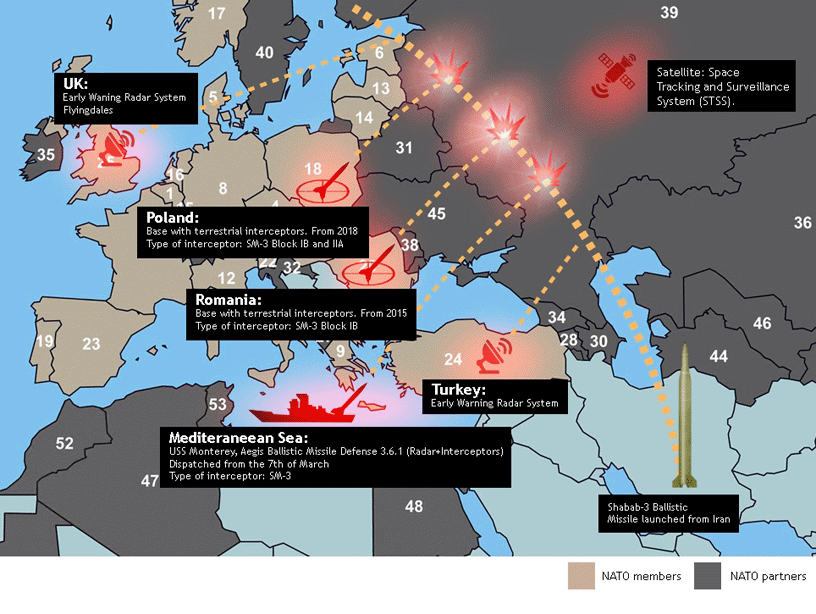
US missile shield aims to cover sudden nuclear strike against Russia – General Staff Rt.com 27 Apr, 2017 The United States is pursuing global strategic domination through developing anti-ballistic missile systems capable of a sudden disarming strike against Russia and China, according to the deputy head of operations of the Russian General Staff.
There is an obvious link between Washington’s prompt global strike initiative, which seeks capability to engage “any targets anywhere in the world within one hour of the decision,” and the deployment of missile launch systems in Europe and aboard naval vessels across the globe, Lt. Gen. Viktor Poznikhir said at a news briefing on Wednesday.
“The presence of US missile defense bases in Europe, missile defense vessels in seas and oceans close to Russia creates a powerful covert strike component for conducting a sudden nuclear missile strike against the Russian Federation,” Poznikhir explained.
While the US keeps claiming that its missile defenses are seeking to mitigate threats from rogue states, the results of computer simulations confirm that the Pentagon’s installations are directed against Russia and China, according to Poznikhir.
American missile attack warning systems, he said, cover all possible trajectories of Russian ballistic missiles flying toward the United States, and are only expected to get more advanced as new low-orbit satellites complement the existing radar systems.
“Applying sudden disarming strikes targeting Russian or Chinese strategic nuclear forces significantly increases the efficiency of the US missile defense system,” Poznikhir added.
American ABM systems are not only creating an “illusion” of safety from a retaliatory strike but can themselves be used to launch a sneak nuclear attack on Russia.
In a blatant breach of the Intermediate-Range Nuclear Forces Treaty, the standard land-based launching systems can be covertly rearmed with Tomahawk cruise missiles instead of interceptors – and the Pentagon’s denial of this fact, according to Poznikhir, is “at the very least unconvincing.”
Moreover, Washington’s unilateral withdrawal from the Anti-Ballistic Missile Treaty, signed in 1972 with the Soviet Union, allowed it to develop more advanced weapons that can now not only pose a threat to targets on the ground but in space as well………https://www.rt.com/news/386276-us-missile-shield-russia-strike/
Gov’t Taking Away Handguns From Guards At Nuclear Power Plants, Daily Caller, ANDREW FOLLETT, Energy and Science Reporter , 27 Apr 17, Security guards at nuclear power plants will soon be prohibited from carrying handguns, according to a Wednesday statement by the Tennessee Valley Authority (TVA).
TVA claims that a recent regulatory review concluded handguns were obsolete compared to other security measures protecting the power plants, but would not clarify what these new measures were citing security concerns. TVA seemingly intends to remove handguns from their security system by the end of the year.
TVA’s own security officers have gone on record strongly objecting to the change.
“Radiological release, that’s what they’re after. Terrorists are after to kill as many as they can in the quickest way.” Paul Tackett, a veteran nuclear security officer at TVA’s Watts Bar reactor, told a local news station. “They’re [TVA] talking about taking away our handguns. I mean, if we’re utilities at night, we have no way of protecting ourselves.”
A successful theft of uranium from a nuclear power plant could have catastrophic consequences. The sort of low-quality uranium and plutonium used in nuclear reactors could be used to make low-tech nuclear explosives often called “dirty bomb.”
“The safety and security of our facilities and host communities is and will always be our top priority,” a spokesperson for the Nuclear Energy Institute (NEI) told The Daily Caller News Foundation. “Our security officers employ powerful weapons such as automatic rifles and shotguns, meaning that phasing out sidearms does not reduce our solid commitment to safety and security.”
“Anything is possible to happen at anytime,” Tackett said. “It was just a few years ago when we had an officer shot at out here.”