Atomic Bellyflop: America’s 1st ’21st Century Nuclear Reactor’ Fails, Shuts Down After 5 Months bureauEnviroNews DC News Bureau ,byJulia Travers July 3, 2017
1,800 tons of radioactive waste has an ocean view and nowhere to go, LA Times, By RALPH VARTABEDIAN | PHOTOGRAPHY BY ALLEN J. SCHABEN 2 July 17 [good photographs and graphs] The massive, 150-ton turbines have stopped spinning. The mile-long cooling pipes that extend into the Pacific will likely become undersea relics. High voltage that once energized the homes of more than a million Californians is down to zero.
But the San Onofre nuclear power plant will loom for a long time as a landmark, its 1,800 tons of lethal radioactive waste stored on the edge of the Pacific and within sight of the busy 5 Freeway.
Across the site, deep pools of water and massive concrete casks confine high-power gamma radiation and other forms of radioactivity emitted by 890,000 spent fuel rods that nobody wants there.
And like the other 79,000 tons of spent fuel spread across the nation, San Onofre’s nuclear waste has nowhere to go.
The nation’s inability to find a permanent home for the dangerous byproduct of its 50-year-adventure in nuclear energy represents one of the biggest and longest running policy failures in federal government history.
Now, the Trump administration and Congress are proposing a fast track fix. The new plan aims, after decades of delays, to move the waste to one or more temporary central storage sites that would hold it until a geologic repository can be built in Nevada or somewhere else.
But the new strategy faces many of the same challenges that have dogged past efforts, leaving some experts doubtful that it can succeed.
America’s nuclear waste failure The shuttered San Onofre facility — not withstanding its overlook of prime surf breaks — is similar to about a dozen other former nuclear power plants nationwide that now have to babysit waste to prevent natural disasters, human errors or terrorist plots from causing an environmental or health catastrophe.
Though utilities and government regulators say such risks are remote, they have inflamed public fear at least since 1979’s Three Mile Island reactor accident in Pennsylvania.
The sites are located on the scenic shores of northern Lake Michigan, along a bucolic river in Maine, on the high plateau of Colorado and along the densely populated Eastern Seaboard — each environmentally sensitive for different reasons.
No one wants that waste near them — including officials in the sleepy beach town of San Clemente, just north of San Onofre. Even Southern California Edison Co. officials, while insisting the waste is safe, agree it should be moved as soon as possible.
“It doesn’t make any sense to store the fuel at all these sites,” said Thomas Palmisano, chief nuclear officer at the Southern California Edison plant.“The public doesn’t want the spent fuel here. Well, the fuel is here.”
But every attempt to solve the problem almost instantly gets tangled in complex federal litigation and imposes enormous expense on taxpayers.
The Energy Department was legally bound to haul away the waste by 1998 under the Nuclear Waste Policy Act, making the agency about 20 years late in fulfilling its promise. That has saddled utilities with multibillion-dollar costs to store the waste onsite.
As a result, every nuclear utility, including Southern California Edison, has sued to recover its waste storage costs. So far, they have won judgments and settlements of $6.1 billion, and the Energy Department has projected that it may be liable for up to $25 billion more.
But the new plan is fraught with complex legal, political and financial questions, and has yet to be fully defined or vetted among powerful interest groups or receive approval by Congress or survive inevitable court challenges.
The House Energy and Commerce Committee last week overwhelmingly approved legislation that could clear up many legal questions. Similar bills have been introduced in recent years and failed to move ahead, but this legislation has strong bipartisan support and is backed by the White House.
Still, a lot could go wrong with the plan, as it has for every plan for decades.
Two little-known privately held companies, New Jersey-based Holtec International and Texas-based WCS, have unveiled plans and begun licensing applications with the Nuclear Regulatory Commission for interim storage sites on each side of the New Mexico-Texas border. Officials in the area, a booming center of oil production, are enthusiastic about the potential economic benefits. And nuclear utilities have offered encouragement.
Company officials and other proponents say such temporary dumps could be opened in as little as three or four years, assuming the licensing goes smoothly. But other nuclear waste experts expect a timetable of 10 to 15 years for a temporary dump and much longer for a permanent repository.
Two dozen antinuclear activist groups and leading environmental nonprofits already have signaled in letters to the NRC that they will dispute the idea of creating temporary consolidated storage sites.
The groups, along with many longtime nuclear waste technical experts, worry that temporary storage will weaken the government’s resolve to build a permanent repository. And they assert the plan would require transporting the fuel twice, first to the temporary site and then to a permanent dump, magnifying transportation costs and the fuel’s exposure to accidents or attacks by terrorists.
“These trains hauling nuclear waste would go right by Trump’s hotel in Las Vegas,” said Marta Adams, a now-retired deputy attorney general in Nevada who is consulting with the state on its renewed legal battle.
Serious business problems cloud the plan. Among the most important is who would own and be legally responsible for the waste once it leaves the utility plant sites.
The federal government promised in the Nuclear Waste Policy Act of 1982 to take ownership at a government-owned dump, but it never authorized such ownership at a temporary private facility — one of the legal questions that the Energy and Commerce Committee’s legislation would clear up.
A temporary facility by Holtec or another organization is intended as a segue to a permanent dump at Yucca Mountain, about 100 miles north of Las Vegas. Along with an interim storage site, the Trump administration wants to restart licensing of Yucca Mountain, which President Obama suspended.
2nd Hanford tunnel storing radioactive waste at risk of failing, federal study says Seattle Times, July 1, 2017 “This makes it clear that the second tunnel may also pose a risk to human health and the environment,” said Alex Smith, nuclear-waste program manager for the state Department of Ecology. Hal BerntonSeattle Times staff reporter. A second tunnel storing radioactive waste at the Hanford nuclear reservation has structural problems and is at risk of failing, according to a U.S. Energy Department investigation released Friday.
This tunnel is more than four times longer than the smaller Hanford tunnel that suffered a partial roof collapse May 9, triggering an order for more than 4,800 employees to stay indoors.
Officials say the May 9 event did not trigger any radioactive releases. But it did escalate safety concerns about the storage of high-hazard materials left from the legacy of Hanford’s plutonium production.
State Department of Ecology officials ordered an engineering evaluation as part of a series of corrective actions. The findings were jointly released Friday in Richland by state and federal officials……..
It is not clear what caused the collapse of the wood-and-concrete tunnel that contains eight flatbed railcars holding radioactive waste. Possible factors included heavy rainfall in early May and deteriorating wood, according to the Energy Department.
The stabilization plan for the smaller tunnel involves filling it with grout, with work scheduled to be done by year’s end.
The Energy Department has until Aug. 1 to submit a plan to state officials for shoring up the second tunnel, which stretches for some 1,700 feet.
Made of metal and concrete, it was built in the 1960s and, like the other tunnel, holds railcars containing radioactive waste.
Investigators found it does not meet codes for structural integrity, and may not be able to bear the weight of soil above it……..
the Energy Department is examining options to shore up the larger tunnel. The task is complicated by the fact that, because of radiation, no one can enter the tunnel to assess its conditions…… About 8,000 people are working on a complex cleanup expected to cost more than $100 billion and last for decades.
1,800 tons of radioactive waste has an ocean view and nowhere to go, LA Times, By RALPH VARTABEDIAN | PHOTOGRAPHY BY ALLEN J. SCHABEN 2 July 17 [good photographs and graphs] “…..A decade ago, the Energy Department estimated Yucca Mountain would cost nearly $100 billion, a figure that has undoubtedly increased. The cost could be a problem for deficit-minded Republicans.
The Energy Department collected a tiny monthly fee from utility customers to build the dump, and currently a so-called trust fund has $39 billion reserved for the purpose.
But a little known clause in federal budget law 20 years ago decreed that contributions to the trust fund would count against the federal deficit. There are no securities or bonds that back up the fund, unlike the Social Security Trust Fund. As a result, every dollar spent on Yucca Mountain will have to be appropriated, and the money will add to the national debt.
“The money was collected for one purpose and used for another,” said Dale Klein, a former NRC chairman who is now associate vice chancellor for research at the University of Texas. “There is a moral obligation to address the issue. It will be a challenge to get Congress to pay for it.”
The Trump plan has also rekindled the strident bipartisan political opposition of Nevada officials, including the governor, senators, representatives and attorney general, among others. They vow to erect every legal and political obstacle to delay or kill the Yucca Mountain dump.
The state filed nearly 300 formal objections to the plan before the Obama administration suspended licensing. They must be individually examined by the NRC, a process that could take five years.
Then, the design and construction of the underground dump will require construction of about two dozen big industrial buildings and 300 miles of new railroad track. It could cost $1 billion or more every year, ranking among the largest federal operations.
A permanent repository could take 10 years to 20 years by most estimates.
On the beach
Nowhere is the nuclear waste problem more urgent than at shuttered power plants like San Onofre.
After utilities dismantle the reactors, haul away the concrete debris and restore the sites to nearly pristine condition, the nuclear waste remains. Security officers with high-powered automatic weapons guard the sites round the clock.
About five years after the spent fuel rods cool off in a 40- to 50-foot-deep pool, they are transferred to massive steel and concrete dry casks about 20 feet tall. Almost every government and outside nuclear expert considers the dry casks much safer than the pools.
The 3 Yankee Cos., which are safeguarding dry casks at three former New England reactors, spend about $10 million annually per site for maintenance and security, company officials say. The costs could be higher at San Onofre if the waste is left in place, Palmisano said.
Edison is building a massive concrete monolith for more storage, using a Holtec design called Hi-Storm UMAX. It will hold about two-thirds of the plant’s spent fuel in 73 stainless-steel canisters about 125 feet from the ocean. The 25-foot structure is about half-buried with the underground foundation just above the mean high-tide line. Tall cranes and swarms of hard hats are moving construction ahead.
The crucial question is whether it will be safe, especially if congressional inaction or litigation by opposition groups keeps it on-site for years.
“The top has four feet of steel-reinforced concrete,” said Ed Mayer, program director at Holtec. “It is remarkably strong. The … steel lids are designed to take an aircraft impact.”
NRC officials say the design is safe and meets all federal requirements. Although nuclear issues are within the NRC’s jurisdiction, the Coastal Commission also examined the potential for a tsunami, sea level rise or an earthquake to undermine the facility.
“Under our authority, which is limited, the commission approved the permit, and behind that is the evaluation that it is safe for a period of 20 years,” said Alison Dettmer, deputy director of the commission.
But suspicion lingers. San Clemente city officials have demanded that the fuel be removed as soon as possible. An activist group, Citizens’ Oversight, has sued Edison for starting construction and the California Coastal Commission for approving it.
The waste “is right down by the water, just inches from the high-tide line,” said Ray Lutz, the group’s founder. “It is the most ridiculous place they could find.”
In an effort to assuage local concerns, Edison participates in a “community engagement panel” that meets at least quarterly, led by UC San Diego professor David Victor.
“Early on, I was surprised by how many people did not understand there was no place for the fuel to go,” he said. Over the last year, the possibility of a temporary storage site has raised people’s hopes for a quicker solution, he said.
The history of nuclear waste, however, is replete with solutions that seem plausible but succumb to obscure and unanticipated legal, technical or financial issues.
Decades of delay
Two decades ago, the Skull Valley Band of Goshute Indians sought to create an interim storage facility for nuclear waste on its reservation about an hour out of Salt Lake City.
The NRC spent nine years examining the license application and approved it. But Utah officials and a broad swath of major environmental groups opposed the plan. Eventually, the state blocked shipping routes to the reservation.
Michael C. Layton, director of the NRC’s division of spent fuel management, said a temporary facility would use the same technology as existing dry cask storage sites, like San Onofre.
But Layton said it is unclear how long it will take to license a consolidated storage site. The formal review is scheduled for three years, but the Skull Valley license that took nine years is the only actual licensing effort to compare it to, he added. Palmisano, the Edison executive, estimates that an off-site temporary storage facility could be operating in 10 to 15 years.
Problems have already delayed WSC, which wants to build a storage site in Andrews, Texas. It asked the NRC in April to suspend its license application.
The $7.5-million cost of just the license application review “is significantly higher than we originally anticipated,” the company said, noting that it is under additional financial stress because the Justice Department has sued it to block a merger.
Holtec officials say that WCS’ problems haven’t deterred their plans for an underground storage site, saying interim storage could save the federal government billions of dollars, particularly if the Yucca Mountain plan is again postponed.
The company has strong support in New Mexico, which already has a dump for nuclear weapons waste, a uranium enrichment plant, a nuclear weapons armory and two nuclear weapons laboratories.
“We are very well-informed,” said Sam Cobb, mayor of nearby Hobbs, rejecting arguments by antinuclear groups that the industry preys on communities that need money and don’t understand the risk.
“It is not a death grab to get money,” he said. “We believe if we have an interim storage site, we will be the center for future nuclear fuel reprocessing.”
Transportation to an interim site would cost the federal government billions of dollars under the pending legislation. Aides at the House Energy and Commerce Committee said those costs would be recovered when the federal government no longer has to pay for legal settlements for failing to take the waste in the first place.
Even if an interim site is built, it is uncertain who would get to ship waste there first. The timing of waste shipments to a permanent site is determined by the so-called standard contract queue, a legal document so complex that federal bureaucrats have dedicated their entire careers to managing it.
The queue was structured so that the oldest waste would go into a future dump first. In the unlikely event that Yucca Mountain were opened in 2024, Edison’s fuel would be in line to start shipping in 2028 with the last bit of waste arriving in 2049, Palmisano said.
Whether that queue would apply to an interim site is unclear, even under the pending legislation.
The dry casks are designed to keep spent fuel confined only for decades, while the health standard for a permanent repository covers hundreds of thousands of years — longer than humans have roamed Earth. If the radioactive waste sits around in temporary storage for hundreds of years, it could be neglected and eventually forgotten.
So one outcome that nobody seems to want is for a temporary site to eventually become permanent by default.
NBC 30th June 2017, As NASA makes plans to one day send humans to Mars, one of the key
technical gaps the agency is working to fill is how to provide enough power
on the Red Planet’s surface for fuel production, habitats, and other
equipment. One option: small nuclear fission reactors, which work by
splitting uranium atoms to generate heat, which is then converted into
electric power. https://www.nbcnews.com/mach/science/nasa-revives-plan-put-nuclear-reactors-mars-ncna778536
Air Force to “Cyber-Secure” Nuclear Arsenal, SCOUT WARRIOR, 2 Jul 17, Modernizing computer networks for the nuclear arsenal is part of the current Air Force plan to build as many as 400 new Inter-Continental Ballistic Missiles, or ICBMs, to serve through the 2070s.
The Air Force is seeking more interactions with private sector firms to build better networks for securing nuclear weapons computer systems, service officials said.
Air Force engineers say protection of computer networks is well established in many ways, but that the service needs to widen its scope with greater focus on IT dimensions to its nuclear arsenal’s command and control apparatus.
“Information technology that touches weapons systems needs to be cyber secure, updated and patched. Worldwide nuclear systems are one example of where we need to get an overhaul,” Peter Kim, Air Force Chief Information Security Officer, told Scout Warrior in an interview.
Science division of White House office left empty as last staffers depart, ByJACQUELINE ALEMANYCBS NEWSJune 30, 2017, WASHINGTON –– The science division of the White House’s Office of Science and Technology Policy (OSTP) was unstaffed as of Friday as the three remaining employees departed this week, sources tell CBS News.
All three employees were holdovers from the Obama administration. The departures from the division — one of four subdivisions within the OSTP — highlight the different commitment to scientific research under Presidents Obama and Trump.
Under Mr. Obama, the science division was staffed with nine employees who led the charge on policy issues such as STEM education, biotechnology and crisis response. It’s possible that the White House will handle these issues through staff in other divisions within the OSTP.
A separate Defense Nuclear Facilities Safety Board report in February detailed the magnitude of the shortfall:
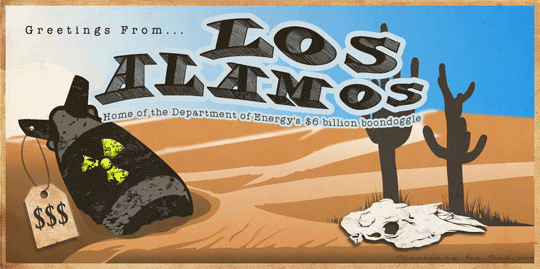
Los Alamos’ dangerous work, it said, demands 27 fully qualified criticality safety engineers.
The lab has 10
Safety problems at a Los Alamos laboratory delay U.S. nuclear warhead testing and production A facility that handles the cores of U.S. nuclear weapons has been mostly closed since 2013 over its inability to control worker safety risks, Science, By The Center for Public Integrity, R. Jeffrey Smith, Patrick MalonJun. 30, 2017
In mid-2013, four federal nuclear safety experts brought an alarming message to the top official in charge of America’s warhead production: Los Alamos National Laboratory, the nation’s sole site for making and testing a key nuclear bomb part, wasn’t taking needed safety precautions. The lab, they said, was ill-prepared to prevent an accident that could kill lab workers, and potentially others nearby.
Some safety infractions had already occurred at the lab that year. But Neile Miller, who was then the acting head of the National Nuclear Security Administration in Washington, says those experts specifically told her that Los Alamos didn’t have enough personnel who knew how to handle plutonium so it didn’t accidentally go “critical” and start an uncontrolled chain reaction.
Such chain reactions generate intense bursts of deadly radiation, and over the last half-century have claimed nearly two dozen lives. The precise consequences, Miller said in a recent interview, “did not need an explanation. You don’t want an accident involving criticality and plutonium.” Indeed, Miller said, criticality “is one of those trigger words” that immediately gets the attention of those responsible for preventing a nuclear weapons disaster.
With two of the four experts remaining in her Washington office overlooking the national mall, Miller picked up the phone and called the lab’s director, Charles McMillan, at his own office on the idyllic Los Alamos campus in the New Mexico mountains, where nuclear weapons work is financed by a federal payment exceeding $2 billion a year. She recommended that a sensitive facility conducting plutonium operations — inside a building known as PF-4 — be shut down, immediately, while the safety deficiencies were fixed.
McMillan, a nuclear physicist and weapons designer with government-funded compensation exceeding a million dollars a year, responded that he had believed the problems could be solved while that lab kept operating. He was “reluctant” to shut it down, Miller recalled. But as the call proceeded, he became open to her view that the risks were too high, she added. So on McMillan’s order, the facility was shut within a day, with little public notice.
In the secrecy-shrouded world of America’s nuclear weapons work, that decision had far-reaching consequences. Continue reading →
US Talk of Exit From Nuclear Treaty With Russia Could Blow Up in New Arms Race, Sputnik News, 30 June 17, Last week, US media reported that the Trump administration was considering withdrawing from the 1987 Treaty on Intermediate-Range Nuclear Forces, citing alleged non-compliance by Moscow. White House officials have denied that the US is considering withdrawing. Russian experts explain why doing so would be a major lose-lose scenario for both powers.
Last week, Politico reported that leading Republican congressmen were urging the Trump administration to withdraw from the INF Treaty, a document signed by Moscow and Washington in 1987 which prohibits the development, deployment and testing of ground-launched nuclear ballistic and cruise missiles which have a range of between 500-5,500 km.
The Senators claimed that Russia was in “material breach of the treaty,” something Moscow has vehemently denied. Foreign Minister Sergei Lavrov has repeatedly said that Russia is in full compliance with the treaty, adding that Moscow has its own concerns about US compliance. Moscow has also called on Washington to engage in discussions on the points of contention regarding the arms control agreement’s implementation.
Although Trump administration special assistant on counterproliferation Christopher Ford has since clarified to Sputnik that the White House does not want to withdraw from the INF Treaty, continued murmurings about Washington’s possible unilateral disengagement have sparked fears of a new nuclear arms race. The Russian Foreign Ministry has said that it could not rule out a unilateral US withdrawal, while experts have warned that such a step would lead to heightened military tensions in Europe……. https://sputniknews.com/politics/201706301055115593-inf-treaty-russia-us-analysis/
NASA Seeks Nuclear Power for Mars After a half-century hiatus, the agency is reviving its reactor development with a test later this summer, Scientific American By Irene Klotz, SPACE.com on June 30, 2017, As NASA makes plans to one day send humans to Mars, one of the key technical gaps the agency is working to fill is how to provide enough power on the Red Planet’s surface for fuel production, habitats and other equipment. One option: small nuclear fission reactors, which work by splitting uranium atoms to generate heat, which is then converted into electric power.
NASA’s technology development branch has been funding a project called Kilopower for three years, with the aim of demonstrating the system at the Nevada National Security Site near Las Vegas. Testing is due to start in September and end in January 2018.
The last time NASA tested a fission reactor was during the 1960s’ Systems for Nuclear Auxiliary Power, or SNAP, program, which developed two types of nuclear power systems. The first system — radioisotope thermoelectric generators, or RTGs — taps heat released from the natural decay of a radioactive element, such as plutonium. RTGs have powered dozens of space probes over the years, including the Curiosity rover currently exploring Mars. [Nuclear Generators Power NASA Deep Space Probes (Infographic)]
The second technology developed under SNAP was an atom-splitting fission reactor. SNAP-10A was the first — and so far, only — U.S. nuclear power plant to operate in space. Launched on April 3, 1965, SNAP-10A operated for 43 days, producing 500 watts of electrical power, before an unrelated equipment failure ended the demonstration. The spacecraft remains in Earth orbit.
Russia has been far more active developing and flying spacecraft powered by small fission reactors, including 30 Radar Ocean Reconnaissance Satellites, or RORSAT, which flew between 1967 and 1988, and higher-powered TOPAZ systems. TOPAZ is an acronym for Thermionic Experiment with Conversion in Active Zone.
NUCLEAR POWER REVIVAL
NASA has funded several nuclear power technology efforts in the 50 years since SNAP, but financial, political and technical issues stymied development. Three years ago, the agency’s Game Changing Developmentprogram backed Kilopower, with the goal of building and testing a small fission reactor by Sept. 30, 2017, the end of the current fiscal year. The project is costing about $15 million…….
NASA engineers figure human expeditions to Mars will require a system capable of generating about 40 kilowatts of power, which is about what is needed for “about eight houses on Earth,” according to the agency. Curiosity’s RTG was designed to supply about 125 watts — less energy than what is needed to power a microwave oven — though power levels fall as the radioactive plutonium decays. [How Will a Human Mars Base Work? NASA’s Vision in Images]
Solar power is another option, but that would restrict power generation to regions that are exposed to enough sunlight to charge batteries. Inside the moon’s Shackleton Crater, for example — a prime candidate for lunar sorties due to its water resources — it is completely dark. The sunniest spots on Mars receive only about one-third the amount of sunlight as Earth does.
“If you want to land anywhere, surface fission power is a key strategy for that,” Michelle Rucker, an engineer at NASA’s Johnson Space Center in Houston, said during a presentation in December to NASA’s Future In-Space Operations working group.
Fission reactors also can continue working in adverse weather conditions, such as Mars’ ubiquitous dust storms. ……
Partners in the Kilopower project include NASA’s Glenn Research Center, the Department of Energy, Los Alamos National Lab and the Y12 National Security Complex, which supplies the reactor’s uranium.
United States 226 Financial Institutions made an estimated USD$ 344 billion available to 27 nuclear weapon producing companies since January 2013.
Introduction This document contains country specific information from the 2016 Don’t Bank on the Bomb update. Hall of Fame and Runners-up include financial institutions with headquarters in the country that have published policies banning or limiting investment in nuclear weapons producers. Hall of Shame are the financial institutions that have significant financing relationships with one or more of the nuclear weapons producers identified in the report. There is also a brief summary of the nuclear weapons related work of each of the identified producers. For more detail, see the full report or go to the www.DontBankOnTheBomb.com website.
This briefing paper includes:
Introduction..………………………………………………………………….
1 Hall of Shame, lists 266 organisations ………………………………………………….
Nuclear weapon producing Companies
The financial institutions identified include banks, pension funds, sovereign wealth funds, insurance companies and asset managers. They have provided various types of financial services to nuclear weapon companies including loans, investment banking and asset management.
All sources of financing provided since 1 January 2013 to the companies listed were analysed from annual reports, financial databases and other sources. The financial institutions which are most significantly involved in the financing of one or more nuclear weapon companies are shown here. See the full report for both a summary and full description of all financial institutions which are found to have the most significant financing relationships with one or more of the selected nuclear weapon companies, by means of participating in bank loans, by underwriting share or bond issues and/or by share- or bondholdings (above a threshold of 0.5% of all outstanding shares or bonds).
Figures presented are rounded up/down to the nearest dollar at the filing date. Commas (,) indicate thousands separators while periods (.) used as decimal points. For more information on loans, investment banking, and asset management, please refer to the website.
Hall of Shame
This section contains the results of our research into which financial institutions are financially involved with the nuclear weapon producing companies identified in the report. For the full methodology, see the website.
Each section provides the following information for each financial institution:
The types of financial relations which the financial institution has with one or more nuclear weapon companies (loans, investment banking and asset management).
Financial institution. Amount in USD millions ……… [ list covers 5 pages] …….
1.Academy Securities (United States) Academy Securities (United States) has made an estimated US$ 30 million available to the nuclear weapons companies selected for this research project since January 2013. Academy Securities (United States) underwrote bond issuances for an estimated amount of US$ 30 million to the nuclear weapon companies since January 2013 (see table below [on original] ). ..
Adage Capital Management (United States) Adage Capital Management (United States) has made an estimated US$ 482 million available to the nuclear weapons companies selected for this research project since January 2013. Adage Capital Management (United States) owns or manages shares of the nuclear weapon companies for an amount of US$ 482 million (see table below). Only holdings of 0.50% or more of the outstanding shares at the most recent available filing date are included. [table on original]
Affiliated Managers Group (United States) Affiliated Managers Group (United States) has made an estimated US$ 1,426 million available to the nuclear weapons companies selected for this research project since January 2013.
Affiliated Managers Group (United States) owns or manages shares of the nuclear weapon companies for an amount of US$ 1,426 million (see table below). Only holdings of 0.50% or more of the outstanding shares at the most recent available filing date are included. [table on original]
AJO (United States) AJO (United States) has made an estimated US$ 351 million available to the nuclear weapons companies selected for this research project since January 2013.
AJO (United States) owns or manages shares of the nuclear weapon companies for an amount of US$ 351 million (see table below). Only holdings of 0.50% or more of the outstanding shares at the most recent available filing date are included. [table]
6 Alyeska Investment Group (United States) Alyeska Investment Group (United States) has made an estimated US$ 143 million available to the nuclear weapons companies selected for this research project since January 2013.
Alyeska Investment Group (United States) owns or manages shares of the nuclear weapon companies for an amount of US$ 143 million (see table below, on original). Only holdings of 0.50% or more of the outstanding shares at the most recent available filing date are included.
Amalgamated Bank of Chicago (United States) Amalgamated Bank of Chicago (United States) has made an estimated US$ 29 million available to the nuclear weapons companies selected for this research project since January 2013. Amalgamated Bank of Chicago (United States) provided loans for an estimated amount of US$ 29 million to the nuclear weapon companies (see table below on original ). The table shows all loans closed since January 2013 or maturing after August 2016
American Automobile Association (United States) American Automobile Association (United States) has made an estimated US$ 4 million available to the nuclear weapons companies selected for this research project since January 2013. American Automobile Association (United States) owns or manages bonds of the nuclear weapon companies for an amount of US$ 4 million (see table below, on original). Only holdings of 0.50% or more of the outstanding bonds at the most recent available filing date are included.
American Century Investments (United States) ……
American Equity Investment Life Holding (United States) …….
American Family (United States) ……
American Financial Group (United States)……
American Financial Group (United States)………
American National Insurance (United States)
American United Mutual Insurance (United States)
Ameriprise Financial (United States)
Analytic Investors (United States)
Anchor Bolt Capital (United States)
Anthem (United States)
Apto Partners (United States)
AQR Capital Management (United States)
Aristotle Capital Management (United States)
Arrowstreet Capital (United States)
Artisan Partners (United States)
Associated Banc-Corp (United States)
Assurant (United States)
Auto-Owners Insurance (United States)
Baird (United States)
BancPlus (United States)
Bank of America (United States) – funds a staggering number of weapons makers……
Bank of New York Mellon (United States)
Banner Bank (United States)
BB&T (United States)
Beck, Mack & Oliver (United States)
Becker Capital Management (United States)
Bessemer Group (United States)
BlackRock (United States)
Blaylock Beal Van (United States)
Blue Cross Blue Shield Association (United States)
Blue Harbour Group (United States)
Boston Private (United States)
Cacti Asset Management (United States)
California First National Bancorp (United States)
Cantor Fitzgerald (United States)
Capital Group (United States)
Capital One Financial (United States)
Carlson Capital (United States)
Carlyle Group (United States)
Cascade Bancorp (United States)
CastleOak Securities (United States)
CAVU Securities (United States)
Central Mutual Insurance (United States)
Central Pacific Financial Corporation (United States)
Charles Schwab (United States)
Chesapeake Partners Management (United States)
Cigna (United States)
Citadel (United States)
Citigroup (United States) – huge no of weapons makers funded
Citizens Bank & Trust (United States)
Citizens Financial Group (United States)
City National Corporation (United States)
CL King & Associates (United States)
CNO Financial Group (United States
Comerica (United States)
Cooper Creek Partners Management (United States)
Corsair Capital Management (United States)
Cuna Mutual Group (United States)
D.E. Shaw & Co. (United States)
Dimensional Fund Advisors (United States)
and so on………… to No. 226. Zeo Capital Advisors (United States)
Nuclear weapon producing Companies This report identifies 27 companies operating in France, India, Italy, the Netherlands, the United Kingdom and the United States that are significantly involved in maintaining and modernising the nuclear arsenals of France, India, the United Kingdom and the United States. This is not an exhaustive list. These companies are providing necessary components and infrastructure to develop, test, maintain and modernise nuclear weapons. The contracts these companies have with nuclear armed countries are for materials and services to keep nuclear weapons in their arsenals. In other nuclear-armed countries –Russia, China, Pakistan and North Korea – the maintenance and modernization of nuclear forces is carried out primarily or exclusively by government agencies. – report goes on to list companies and their activities. …….
The Crazy Story of the 1946 Bikini Atoll Nuclear Tests http://www.smithsonianmag.com/smart-news/crazy-story-1946-bikini-atoll-nuclear-tests-180963833/ They were the first time that a nuclear weapon had been deployed since the 1945 attacks on Japan By Kat Eschner, smithsonian.com June 30, 2017 Operation Crossroads, which had its first big event–the dropping of a nuclear bomb–on July 1, 1946, was just the beginning of the nuclear testing that Bikini Atoll would be subjected to. When the first bomb of the tests dropped, it was the first time since the 1945 attacks on Japan that a nuclear weapon had been deployed. Here are three things you might not know about the infamous test.
The test subjects were ghost ships full of animals
The goal of the tests was to see what happened to naval warships when a nuclear weapon went off, writes the Atomic Heritage Foundation. More than 42,000 people–including a crew of Smithsonian Institution scientists, as well as reporters and United Nations representatives, according to Alex Wellerstein for The New Yorker–were involved in observing the nuclear tests, but the humans were, of course, not the test subjects.
Instead, “some of the ships were loaded with live animals, such as pigs and rats, to study the effects of the nuclear blast and radioactive fallout on animals,” writes the foundation. In total, more than 90 vessels, not all carrying live cargo, were placed in the target area of the bomb, which was named Gilda–after Rita Hayworth’s character in the eponymous film.
The gathered scientists included fish scientist Leonard P. Schultz, who was then the curator of ichthyology for the National Museum of Natural History. Although he was given safety goggles, writes the museum, “he was doubtful whether the goggles would protect him.” So, in true scientific fashion, “he covered one eye and observed the explosion with the other.” His eyes were fine, and the effects that he felt included “a slight warmth” on his face and hearing a boom about two minutes after the flash.
Schultz and his colleagues were there to collect species and document the Atoll before and after the tests. They collected numerous specimens including sea and land creatures, writes the museum, which remain in the museum’s collections today. “The Smithsonian’s collections document the extent to which the diversity of marine life was affected by the atomic blasts,” writes the museum, “providing researchers who continue to study the health of the ecosystem with a means to compare species extant today with those collected before the tests.”
The first bomb missed its target
That reduced the damage done to the ghost ships. “The weapon exploded almost directly above the Navy’s data-gathering equipment, sinking one of its instrument ships, and a signal that was meant to trigger dozens of cameras was sent ten seconds too late,” Wellerstein writes.
It started a tradition of nuclear testing in this vulnerable place
“The nuclear arms race between the US and Soviet Union displaced 167 Marshallese as refugees in their own country,” writes Sarah Emerson for Motherboard. After the first 1946 tests, the U.S. government continued to use the area around Bikini Atoll and the Marshall Islands for nuclear testing, writes Erin Blakemore for Smithsonian.com, conducting 67 nuclear tests in total. 23 of those tests were conducted at Bikini Atoll specifically, including one 1954 test of the largest nuclear device the U.S. ever exploded.
The Marshallese displaced by the testing have not been able to go back to their poisoned homes. Today, it’s hard to know when the Atoll will ever be safe to return to, writes Blakemore, although the Marshall Islands overall are becoming less radioactive.
Safety problems at a Los Alamos laboratory delay U.S. nuclear warhead testing and production A facility that handles the cores of U.S. nuclear weapons has been mostly closed since 2013 over its inability to control worker safety risks, Science,
Los Alamos’s progress in improving its criticality safety since the shutdown began has been fitful, and the dissonance between safety experts and its top managers has stubbornly persisted.
McMillan initially promised to train fissile material handlers to be more heedful of plutonium-handling perils, for example, and to bring the inventory and safety documents guiding their work up to date. In an email to lab employees, he promised that a “pause” lasting less than a year wouldn’t cause “any significant impact to mission deliverables.”
But at the end of 2013, a new group of safety experts, commissioned by the lab to guide its reforms, delivered bad news just as the lab was attempting to restart operations at PF-4. “Management has not yet fully embraced its commitment to criticality safety,” the group said, according to a copy of its report obtained by CPI.
It also listed nine weaknesses in the lab’s safety culture that were rooted in a “production focus” to meet work deadlines. Workers say these deadlines are typically linked to financial bonuses. Los Alamos’s leaders, the report said, had made the right promises, but failed to alter the underlying safety culture. “The focus appears to remain short-term and compliance oriented rather than based on a strategic plan,” the report said.
In May 2014, Peter Winokur, who at the time chaired the Defense Nuclear Facilities Safety Board, weighed in with a separate, written warning to the head of the National Nuclear Security Administration. He said McMillan was improperly trying to restart “high-risk” PF-4 operations without first carefully setting new, written, safety benchmarks for the lab’s plutonium work.
The NNSA head, Klotz, alerted the Secretary of Energy, Moniz, and the two of them flew to Los Alamos to meet with McMillan, a man known for both charm and hubris. “Los Alamos is a legend,” McMillan has boasted in a promotional video. “It’s an icon. And of course, because of that, everybody notices what we do here; and we’re held to a very high standard.”
Moniz said he told McMillan personally that “I was not entirely satisfied with the reactions of some of his senior managers.” As a result, he said, “actions were taken,” without offering details.
But progress was not swift.
The NNSA, in its annual evaluation of Los Alamos’ overall performance for fiscal year 2014, judged the criticality safety program to be “below expectations” with deficiencies “similar to issues identified in past” evaluations; it particularly faulted the labels the lab had placed on nuclear materials and the guides the lab had prepared for workers performing plutonium handling chores.
Some of these shortfalls persisted in 2015, and new ones were discovered. On May 6, 2015, for example, the NNSA sent Los Alamos’ managing contractors a letter again criticizing the lab for being slow to fix criticality risks. The Defense Nuclear Facilities Safety Board, which summarized the letter in one of its weekly reports, said “there are currently more than 60 unresolved infractions,” many present for months “or even years.”
In January and again in April 2015, workers discovered tubes of liquids containing plutonium in seldom-used rooms at PF-4, with labels that made it hard to know how much plutonium they held or where they’d come from, the safety board said. In May, workers packed a drum of nuclear waste with too much plutonium, posing a criticality risk, and in the ensuing probe, it became clear that they were relying on inaccurate and confusing documentation. Safety experts had miscalculated how much plutonium the drum could safely hold.
“These issues are very similar to the issues that contributed to the LANL Director’s decision to pause operations in June of 2013,” safety board inspectors wrote.
Asked about the persistence of the Los Alamos lab’s problems, former NNSA director Miller smiled and said her colleagues at the nuclear oversight agency sometimes told the following joke: If Washington sent all three of America’s nuclear weapons labs an order to study how to “jump,” they would all respond differently. Lawrence Livermore, she said, would convene a conference and produce a three-inch stack of reports about “jumping.” Officials at Sandia would simply jump.
But at Los Alamos, she said, officials would instinctively respond with a “**ck you, we’re not jumping.”
Helmand is one of the most turbulent provinces in Afghanistan, and is a center of the country’s mining industry and the shadowy drug-smuggling industry. There are four deposits of uranium, magnetite, apatite and carbonite in the south of this region, in the southern village of Khanashin, just 160 km from the border with Pakistan.
According to earlier geological exploration works, the province has lucrative uranium and thorium deposits. It also contains vast resources of tantalum and other rare elements.
According to NASA estimates, there are also deposits of copper, iron and other metals worth of $81.2 billion. Until now, there was no industrial uranium mining in Afghanistan. During Taliban rule, the captives did all the mining.
Deputies of the lower chamber of the country’s parliament from the province of Helmand have repeatedly said that much evidence exists that uranium from Khanashin is being smuggled out in US cargo planes, Sputnik Afghanistan quotes local media reports as saying.
The deputies said that the US military have set up their military base near the uranium mines and smuggle uranium through it.
The deputies said that since the US military intervention back in 2001, the Americans and their British allies have concentrated their bases in this particular province as the largest uranium resources are concentrated there. The uranium deposit in Khanashin was previously controlled by the Taliban. However since the foreign troops set up their air bases and air fields, which are working around the clock, in the neighboring settlement of Garmsi, the deposit has been since controlled by them.
Local residents confirmed to Sputnik Afghanistan that at nights, the US military are smuggling out uranium in trucks and then in cargo planes.
Ex-SF Navy shipyard workers allege fraud in radiation cleanup, http://www.sfgate.com/bayarea/article/Ex-SF-Navy-shipyard-workers-allege-fraud-in-11257774.phpBy J.K. Dineen, June 29, 2017
The cleanup of radioactive contamination at the Hunters Point Shipyard was marred by widespread fraud, faked soil samples, and a high-pressure culture where speed was valued over accuracy and safety, according to four former site workers.
On Thursday, the four whistle-blowers, including a radiation safety officer who reported directly to the Nuclear Regulatory Commission, gathered with environmentalists to describe the problems with the cleanup, which has cost the federal government $600 million. In the background, construction crews were at work redeveloping the property, where 1,200 units of housing, millions of square feet of commercial space and hundreds of acres of parks are planned.
David Anton, an attorney for the workers, said the Navy and the Environmental Protection Agency — as well as the district attorney and state attorney general — should immediately launch investigations into the cleanup, a process that should include interviews with former workers and the retesting of the soil at the site. Also, the nonprofit Greenaction for Healthand Environmental Justice filed a petition with the NRC to revoke the license of contractor Tetra Tech, which oversaw the cleanup at the Superfund site.
“Talk to the workers who were involved in the fraud. Find out what fraud was taking place, and then test and sample based on reality,” Anton said. “The Navy has fought at virtually every step a real look at contamination at Hunters Point.”
Questions over the accuracy of the soil tests emerged in October 2012, when the Navy discovered that some results were inconsistent with results from previous samples collected in the same areas. While the dirt in question was identified as having been collected from beneath a lab used to conduct radiation tests on animals, an internal investigation found that in at least 386 cases it had been pulled from areas already given a clean bill for radiological contamination.
On Thursday, the former workers said soil samples from areas known to be highly contaminated were switched with dirt gathered from the foundation of an old movie theater, where there were minimal toxic chemicals. Anton alleges that at least 2,500 samples were faked.
Robert McClain, a radiation technician who worked at the site in 2005, said Tetra Tech management ordered him to increase the speed of a conveyor-belt system he operated — even though the soil carried by the belt could not be properly tested for contaminants at the faster speed.
“Management was production-driven,” he said. “They wanted to run it faster so they could get the soil moved. I was told by Tetra Tech officials that I didn’t know what I was doing. I have 25 years experience in the nuclear power business.”
In a statement, Tetra Tech spokesman Charlie MacPherson said the company “emphatically denies the allegations made by individuals at today’s news conference that Tetra Tech engaged in a cover-up of fraud on the Hunters Point Naval Shipyard.”
FivePoint Holdings, the company developing the property, said its “utmost concern is the safety of our residents and employees. We are confident in the oversight process of the Environmental Protection Agency and other local and state agencies to insure when we take title of a parcel it is up to the standard consistent with the designated uses.”